


ISO/FDIS 8100-1
(Main)Lifts for the transport of persons and goods - Part 1: Safety rules for the construction and installation of passenger and goods passenger lifts
Lifts for the transport of persons and goods - Part 1: Safety rules for the construction and installation of passenger and goods passenger lifts
Ascenseurs pour le transport de personnes et d'objets — Partie 1: Règles de sécurité pour la construction et l'installation d'ascenseurs et d'ascenseurs de charge
General Information
- Status
- Not Published
- Technical Committee
- ISO/TC 178 - Lifts, escalators and moving walks
- Drafting Committee
- ISO/TC 178/WG 4 - Safety requirements and risk assessment
- Current Stage
- 5020 - FDIS ballot initiated: 2 months. Proof sent to secretariat
- Start Date
- 03-Dec-2025
- Completion Date
- 03-Dec-2025
Relations
- Effective Date
- 23-Apr-2020
Overview
ISO/FDIS 8100-1:2025 - "Lifts for the transport of persons and goods - Part 1: Safety rules for the construction and installation of passenger and goods passenger lifts" - defines safety requirements for the design, construction and installation of passenger and goods‑passenger lifts. It is a Type C standard (ISO 12100), intended to be used by manufacturers, installers and safety authorities. The standard replaces ISO 8100-1:2019 and applies to traction, positive‑drive and hydraulic lifts that:
- serve specific levels;
- have rated speed > 0.15 m/s;
- have an enclosed car;
- move along guide rails inclined ≤ 15° to the vertical;
- are indoor or weather‑protected.
The document covers mechanical, electrical and operational safety, including lighting, sockets in the well, and associated information for use.
Key topics and technical requirements
ISO/FDIS 8100-1 organizes requirements into clear technical topics:
- Safety requirements and protective measures (Clause 4): comprehensive rules for guarding users, maintenance staff and people outside the well.
- Verification (Clause 5): testing and verification procedures for safety devices and measures.
- Information for use (Clause 6): required documentation, marking and user instructions.
- Building‑related boundary conditions (Clause 7): interface requirements between lift and building.
Notable technical updates and additions in this edition:
- Requirements for vertically sliding landing and car doors.
- Provisions for suspension means other than steel wire ropes.
- Rules for automatic rescue operation and revised emergency operation.
- Requirements for traction lifts with increased car area and machine brake performance/monitoring.
- Added cybersecurity requirements and revised SIL levels for electric safety devices (see Annex A).
- Specifics for pit access ladders, working platforms in the pit, and fire classification for lift cables.
- Electrical fault considerations including travelling‑cable short circuits.
The standard explicitly excludes lifts installed before publication and certain specialized cases (seismic design, some accessibility/firefighting/evacuation functions).
Applications and users
Who uses ISO/FDIS 8100-1:
- Lift manufacturers (design and component selection)
- Installers and contractors (construction and commissioning)
- Maintenance and service providers (inspection, verification and repair)
- Regulators and health & safety bodies (conformity assessment, market surveillance)
- Building owners/specifiers (procurement and integration with building infrastructure)
Practical applications include specifying compliance criteria in tender documents, designing safe lift installations, performing acceptance testing, and updating maintenance regimes to meet the latest safety and cybersecurity expectations.
Related standards
Relevant associated documents referenced by ISO/FDIS 8100-1 include:
- ISO 8100-2 (design rules and verification of components)
- ISO 8102‑20 (electrical requirements - cybersecurity)
- IEC and ISO electrical, mechanical and fire‑test standards listed in Clause 2
- Annex D: relationship with ISO 8100-20:2018
Keywords: ISO/FDIS 8100-1, lifts safety, passenger lifts, goods passenger lifts, lift construction, lift installation, traction lifts, hydraulic lifts, lift cybersecurity, SIL electric safety devices.
ISO/FDIS 8100-1 - Lifts for the transport of persons and goods — Part 1: Safety rules for the construction and installation of passenger and goods passenger lifts Released:19. 11. 2025
REDLINE ISO/FDIS 8100-1 - Lifts for the transport of persons and goods — Part 1: Safety rules for the construction and installation of passenger and goods passenger lifts Released:19. 11. 2025
Frequently Asked Questions
ISO/FDIS 8100-1 is a draft published by the International Organization for Standardization (ISO). Its full title is "Lifts for the transport of persons and goods - Part 1: Safety rules for the construction and installation of passenger and goods passenger lifts". This standard covers: Lifts for the transport of persons and goods - Part 1: Safety rules for the construction and installation of passenger and goods passenger lifts
Lifts for the transport of persons and goods - Part 1: Safety rules for the construction and installation of passenger and goods passenger lifts
ISO/FDIS 8100-1 is classified under the following ICS (International Classification for Standards) categories: 91.140.90 - Lifts. Escalators. The ICS classification helps identify the subject area and facilitates finding related standards.
ISO/FDIS 8100-1 has the following relationships with other standards: It is inter standard links to ISO 8100-1:2019. Understanding these relationships helps ensure you are using the most current and applicable version of the standard.
ISO/FDIS 8100-1 is available in PDF format for immediate download after purchase. The document can be added to your cart and obtained through the secure checkout process. Digital delivery ensures instant access to the complete standard document.
Standards Content (Sample)
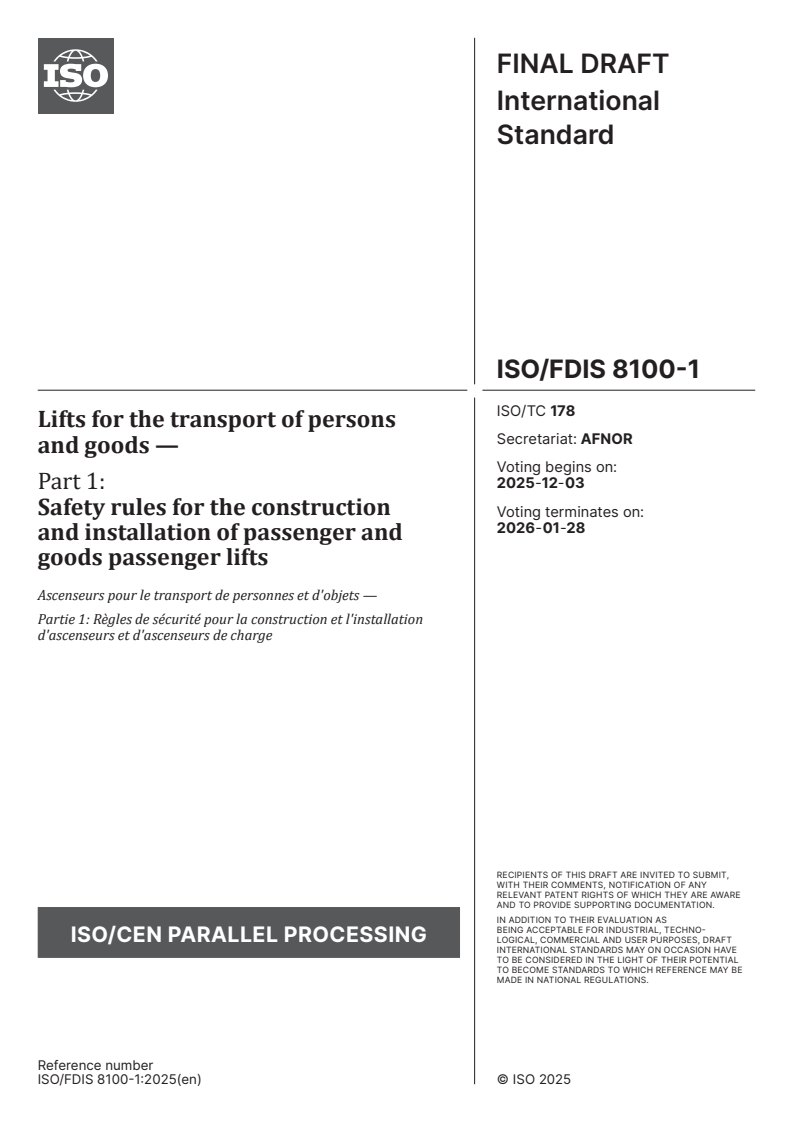
FINAL DRAFT
International
Standard
ISO/TC 178
Lifts for the transport of persons
Secretariat: AFNOR
and goods —
Voting begins on:
2025-12-03
Part 1:
Safety rules for the construction
Voting terminates on:
2026-01-28
and installation of passenger and
goods passenger lifts
Ascenseurs pour le transport de personnes et d'objets —
Partie 1: Règles de sécurité pour la construction et l'installation
d'ascenseurs et d'ascenseurs de charge
RECIPIENTS OF THIS DRAFT ARE INVITED TO SUBMIT,
WITH THEIR COMMENTS, NOTIFICATION OF ANY
RELEVANT PATENT RIGHTS OF WHICH THEY ARE AWARE
AND TO PROVIDE SUPPOR TING DOCUMENTATION.
IN ADDITION TO THEIR EVALUATION AS
BEING ACCEPTABLE FOR INDUSTRIAL, TECHNO-
ISO/CEN PARALLEL PROCESSING LOGICAL, COMMERCIAL AND USER PURPOSES, DRAFT
INTERNATIONAL STANDARDS MAY ON OCCASION HAVE
TO BE CONSIDERED IN THE LIGHT OF THEIR POTENTIAL
TO BECOME STAN DARDS TO WHICH REFERENCE MAY BE
MADE IN NATIONAL REGULATIONS.
Reference number
FINAL DRAFT
International
Standard
ISO/TC 178
Lifts for the transport of persons
Secretariat: AFNOR
and goods —
Voting begins on:
Part 1:
Safety rules for the construction
Voting terminates on:
and installation of passenger and
goods passenger lifts
Ascenseurs pour le transport de personnes et d'objets —
Partie 1: Règles de sécurité pour la construction et l'installation
d'ascenseurs et d'ascenseurs de charge
RECIPIENTS OF THIS DRAFT ARE INVITED TO SUBMIT,
WITH THEIR COMMENTS, NOTIFICATION OF ANY
RELEVANT PATENT RIGHTS OF WHICH THEY ARE AWARE
AND TO PROVIDE SUPPOR TING DOCUMENTATION.
© ISO 2025
IN ADDITION TO THEIR EVALUATION AS
All rights reserved. Unless otherwise specified, or required in the context of its implementation, no part of this publication may
BEING ACCEPTABLE FOR INDUSTRIAL, TECHNO-
ISO/CEN PARALLEL PROCESSING
LOGICAL, COMMERCIAL AND USER PURPOSES, DRAFT
be reproduced or utilized otherwise in any form or by any means, electronic or mechanical, including photocopying, or posting on
INTERNATIONAL STANDARDS MAY ON OCCASION HAVE
the internet or an intranet, without prior written permission. Permission can be requested from either ISO at the address below
TO BE CONSIDERED IN THE LIGHT OF THEIR POTENTIAL
or ISO’s member body in the country of the requester.
TO BECOME STAN DARDS TO WHICH REFERENCE MAY BE
MADE IN NATIONAL REGULATIONS.
ISO copyright office
CP 401 • Ch. de Blandonnet 8
CH-1214 Vernier, Geneva
Phone: +41 22 749 01 11
Email: copyright@iso.org
Website: www.iso.org
Published in Switzerland Reference number
ii
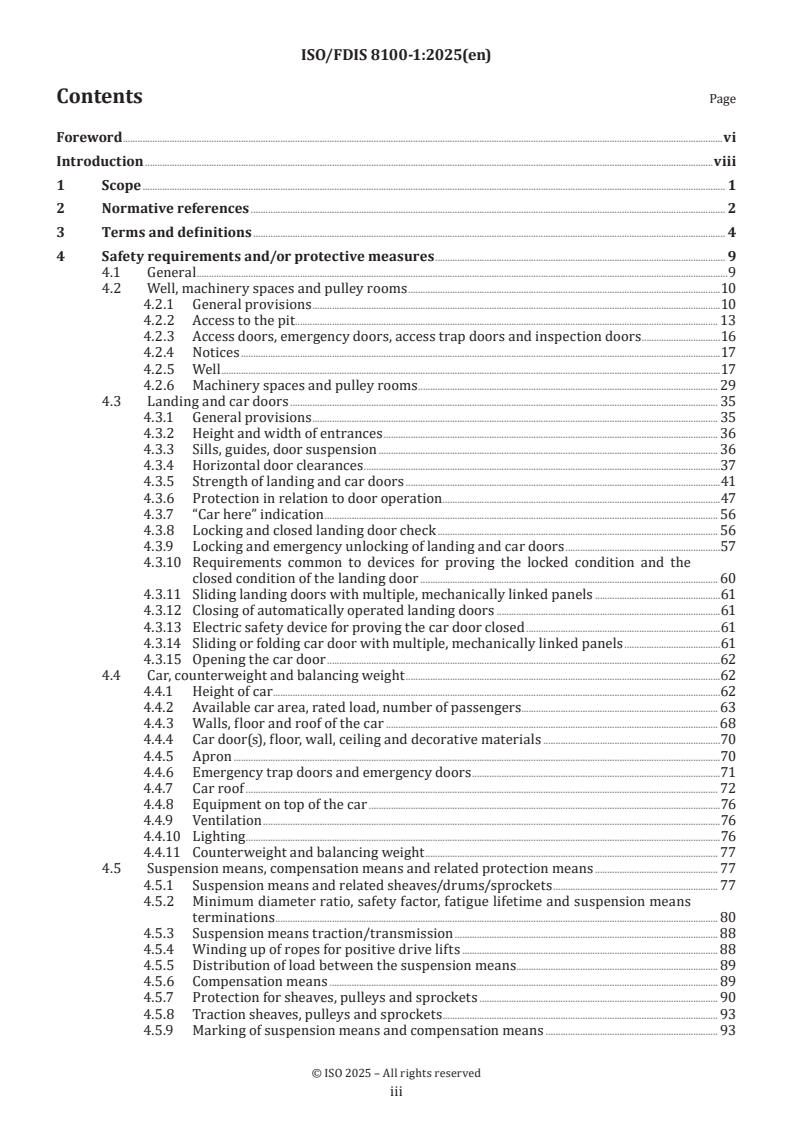
Contents Page
Foreword .vi
Introduction .viii
1 Scope . 1
2 Normative references . 2
3 Terms and definitions . 4
4 Safety requirements and/or protective measures . 9
4.1 General .9
4.2 Well, machinery spaces and pulley rooms .10
4.2.1 General provisions .10
4.2.2 Access to the pit . 13
4.2.3 Access doors, emergency doors, access trap doors and inspection doors .16
4.2.4 Notices .17
4.2.5 Well .17
4.2.6 Machinery spaces and pulley rooms . 29
4.3 Landing and car doors . 35
4.3.1 General provisions . 35
4.3.2 Height and width of entrances . 36
4.3.3 Sills, guides, door suspension . 36
4.3.4 Horizontal door clearances .37
4.3.5 Strength of landing and car doors .41
4.3.6 Protection in relation to door operation .47
4.3.7 “Car here” indication . 56
4.3.8 Locking and closed landing door check . 56
4.3.9 Locking and emergency unlocking of landing and car doors .57
4.3.10 Requirements common to devices for proving the locked condition and the
closed condition of the landing door . 60
4.3.11 Sliding landing doors with multiple, mechanically linked panels .61
4.3.12 Closing of automatically operated landing doors .61
4.3.13 Electric safety device for proving the car door closed .61
4.3.14 Sliding or folding car door with multiple, mechanically linked panels .61
4.3.15 Opening the car door .62
4.4 Car, counterweight and balancing weight .62
4.4.1 Height of car . . .62
4.4.2 Available car area, rated load, number of passengers. 63
4.4.3 Walls, floor and roof of the car . 68
4.4.4 Car door(s), floor, wall, ceiling and decorative materials .70
4.4.5 Apron .70
4.4.6 Emergency trap doors and emergency doors .71
4.4.7 Car roof . 72
4.4.8 Equipment on top of the car .76
4.4.9 Ventilation .76
4.4.10 Lighting .76
4.4.11 Counterweight and balancing weight . 77
4.5 Suspension means, compensation means and related protection means . 77
4.5.1 Suspension means and related sheaves/drums/sprockets . 77
4.5.2 Minimum diameter ratio, safety factor, fatigue lifetime and suspension means
terminations . 80
4.5.3 Suspension means traction/transmission . 88
4.5.4 Winding up of ropes for positive drive lifts . 88
4.5.5 Distribution of load between the suspension means. 89
4.5.6 Compensation means . 89
4.5.7 Protection for sheaves, pulleys and sprockets . 90
4.5.8 Traction sheaves, pulleys and sprockets . 93
4.5.9 Marking of suspension means and compensation means . 93
iii
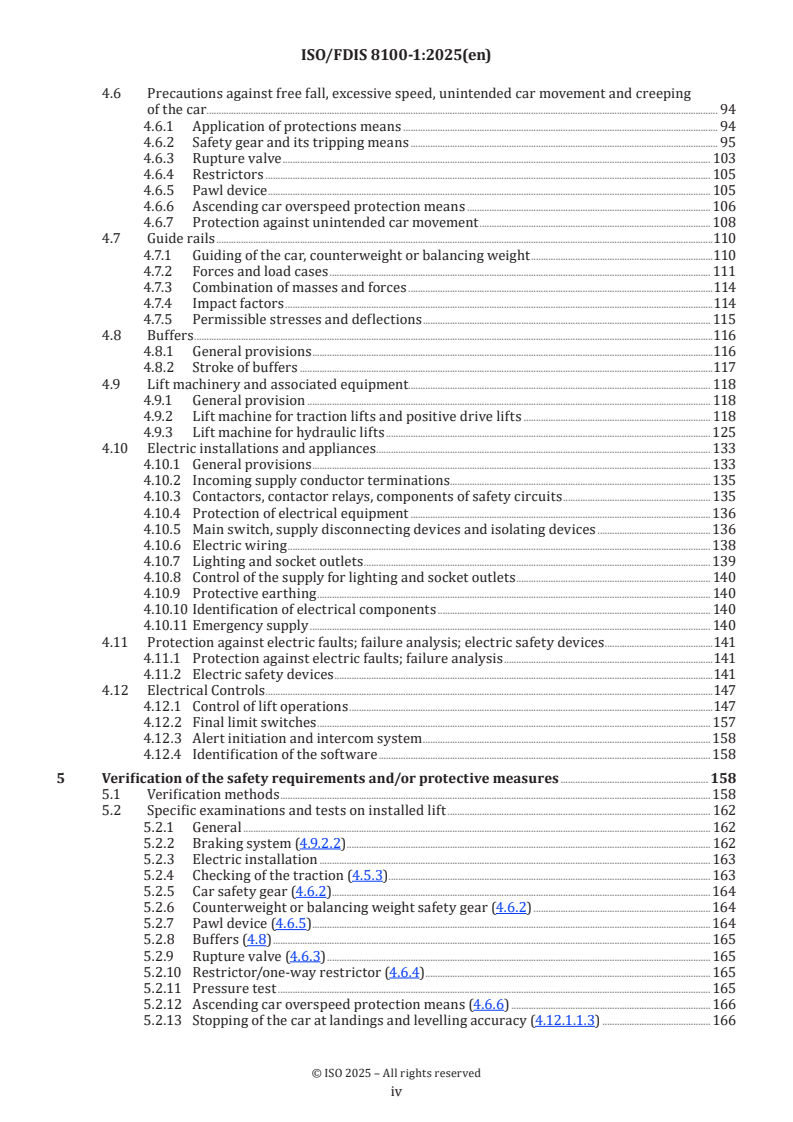
4.6 Precautions against free fall, excessive speed, unintended car movement and creeping
of the car . . 94
4.6.1 Application of protections means . 94
4.6.2 Safety gear and its tripping means . 95
4.6.3 Rupture valve . 103
4.6.4 Restrictors . 105
4.6.5 Pawl device . 105
4.6.6 Ascending car overspeed protection means . 106
4.6.7 Protection against unintended car movement . 108
4.7 Guide rails .110
4.7.1 Guiding of the car, counterweight or balancing weight .110
4.7.2 Forces and load cases . 111
4.7.3 Combination of masses and forces .114
4.7.4 Impact factors .114
4.7.5 Permissible stresses and deflections . 115
4.8 Buffers .116
4.8.1 General provisions .116
4.8.2 Stroke of buffers .117
4.9 Lift machinery and associated equipment. 118
4.9.1 General provision . 118
4.9.2 Lift machine for traction lifts and positive drive lifts . 118
4.9.3 Lift machine for hydraulic lifts . 125
4.10 Electric installations and appliances . 133
4.10.1 General provisions . 133
4.10.2 Incoming supply conductor terminations . . 135
4.10.3 Contactors, contactor relays, components of safety circuits . 135
4.10.4 Protection of electrical equipment . 136
4.10.5 Main switch, supply disconnecting devices and isolating devices . 136
4.10.6 Electric wiring . 138
4.10.7 Lighting and socket outlets . 139
4.10.8 Control of the supply for lighting and socket outlets . 140
4.10.9 Protective earthing . 140
4.10.10 Identification of electrical components . 140
4.10.11 Emergency supply . 140
4.11 Protection against electric faults; failure analysis; electric safety devices .141
4.11.1 Protection against electric faults; failure analysis .141
4.11.2 Electric safety devices .141
4.12 Electrical Controls .147
4.12.1 Control of lift operations .147
4.12.2 Final limit switches . 157
4.12.3 Alert initiation and intercom system . 158
4.12.4 Identification of the software . 158
5 Verification of the safety requirements and/or protective measures . 158
5.1 Verification methods . 158
5.2 Specific examinations and tests on installed lift . 162
5.2.1 General . 162
5.2.2 Braking system (4.9.2.2) . 162
5.2.3 Electric installation . 163
5.2.4 Checking of the traction (4.5.3) . 163
5.2.5 Car safety gear (4.6.2). 164
5.2.6 Counterweight or balancing weight safety gear (4.6.2) . 164
5.2.7 Pawl device (4.6.5) . . 164
5.2.8 Buffers (4.8) . 165
5.2.9 Rupture valve (4.6.3) . 165
5.2.10 Restrictor/one-way restrictor (4.6.4) . 165
5.2.11 Pressure test . 165
5.2.12 Ascending car overspeed protection means (4.6.6) . 166
5.2.13 Stopping of the car at landings and levelling accuracy (4.12.1.1.3) . 166
iv
5.2.14 Protection against unintended car movement (4.6.7) . 166
5.2.15 Protection against falling/shearing (4.3.9.3.4) . 166
5.2.16 Balancing of vertically sliding door (4.3.3.3.5) . 166
5.2.17 Counterweight balance (4.5.3) . 166
5.2.18 Balancing weight balance (4.5.3) .167
6 Information for use .167
6.1 General .167
6.2 Instructions .167
6.2.1 General .167
6.2.2 Basic data and characteristics .167
6.2.3 Operating information for use . 168
6.2.4 Information for maintenance, inspection, repair and periodic checks . 169
6.2.5 Information for emergency operation .171
6.3 Logbook.171
7 Building-related boundary conditions.171
7.1 General provisions .171
7.2 Plans for the installation in the building . 172
Annex A (normative) List of the electric safety devices .173
Annex B (normative) Information on the building-related conditions in which the lift is
installed .175
Annex C (normative) Pit access ladder .180
Annex D (informative) Relationship between this document and ISO 8100-20:2018 .186
Annex E (informative) Operations overview . 189
Annex ZA (informative) Relationship between this European Standard and the essential
requirements of Directive 2014/33/EU aimed to be covered .190
Bibliography .198
v
Foreword
ISO (the International Organization for Standardization) is a worldwide federation of national standards
bodies (ISO member bodies). The work of preparing International Standards is normally carried out through
ISO technical committees. Each member body interested in a subject for which a technical committee
has been established has the right to be represented on that committee. International organizations,
governmental and non-governmental, in liaison with ISO, also take part in the work. ISO collaborates closely
with the International Electrotechnical Commission (IEC) on all matters of electrotechnical standardization.
The procedures used to develop this document and those intended for its further maintenance are described
in the ISO/IEC Directives, Part 1. In particular, the different approval criteria needed for the different types
of ISO document should be noted. This document was drafted in accordance with the editorial rules of the
ISO/IEC Directives, Part 2 (see www.iso.org/directives).
ISO draws attention to the possibility that the implementation of this document may involve the use of (a)
patent(s). ISO takes no position concerning the evidence, validity or applicability of any claimed patent
rights in respect thereof. As of the date of publication of this document, ISO had not received notice of (a)
patent(s) which may be required to implement this document. However, implementers are cautioned that
this may not represent the latest information, which may be obtained from the patent database available at
www.iso.org/patents. ISO shall not be held responsible for identifying any or all such patent rights.
Any trade name used in this document is information given for the convenience of users and does not
constitute an endorsement.
For an explanation of the voluntary nature of standards, the meaning of ISO specific terms and expressions
related to conformity assessment, as well as information about ISO's adherence to the World Trade
Organization (WTO) principles in the Technical Barriers to Trade (TBT), see www.iso.org/iso/foreword.html.
This document was prepared by Technical Committee ISO/TC 178, Lifts, escalators, passenger conveyors,
in collaboration with the European Committee for Standardization (CEN) Technical Committee CEN/TC
CEN/TC 10, Lifts, escalators and moving walks, in accordance with the Agreement on technical cooperation
between ISO and CEN (Vienna Agreement).
This second edition cancels and replaces the first edition (ISO 8100-1:2019), which has been technically
revised.
The main changes are as follows:
— requirements for vertically sliding landing and car doors have been added;
— requirements for suspension means other than steel wire ropes have been added;
— requirements for automatic rescue operation have been added;
— requirements for traction lifts with increased available car area have been added;
— requirements for SIL-rated circuits (previously called PESSRAL) have been revised;
— requirements for a working platform in the pit have been added;
— requirements to avoid the dragging of hands in doors have been extended;
— requirements for compensation means entering the refuge space in the pit have been added;
— requirements for the brake have been aligned with overload limits;
— performance and monitoring of the machine brake have been revised;
— requirements for pit access ladders have been revised;
— fire classification of electric cables has been specified;
— requirements for cybersecurity have been added;
vi
— requirements for emergency operation have been revised;
— bypassing normal travel limits in inspection operation has been added;
— SIL levels of the electric safety devices (Annex A) have been revised;
— short circuit between adjacent conductors of travelling cable has been added to electric fault list;
— mechanical strength of luminaires for the well lighting system has been specified;
— requirements for information for use have been revised;
— requirements for tripping the safety gear by electrical means have been added,
— the position of the inspection operation switch has been revised;
— the document structure has been revised as per the ISO/IEC Directives, Part 2.
For relationship with this document and ISO 8100-20:2018, see Annex D, which is an integral part of this
document.
ISO/TS 8100-3:2019 provides information on the differences between this document local standards
(ASME A17.1/CSA B44 and JIS A 4307 1/JIS A 4307-2) not included in this document.
A list of all parts in the ISO 8100 series can be found on the ISO website.
Any feedback or questions on this document should be directed to the user’s national standards body. A
complete listing of these bodies can be found at www.iso.org/members.html.
vii
Introduction
This document is a type C standard as stated in ISO 12100:2010.
This document is of relevance, in particular, for the following stakeholder groups representing the market
players with regard to machinery safety:
— machine manufacturers (small, medium and large enterprises);
— health and safety bodies (regulators, accident prevention organizations, market surveillance, etc.).
Others can be affected by the level of machinery safety achieved with the means of the document by the
above-mentioned stakeholder groups:
— machine users/employers (small, medium and large enterprises);
— machine users/employees (e.g. trade unions, organizations for people with special needs);
— service providers, e.g. for maintenance (small, medium and large enterprises);
— consumers (in case of machinery intended for use by consumers).
The above-mentioned stakeholder groups have been given the possibility to participate in the drafting
process of this document
The machinery concerned and the extent to which hazards, hazardous situations and hazardous events are
covered are indicated in the scope of this document.
When requirements of this type-C standard are different from those which are stated in type-A or type-B
standards, the requirements of this type-C standard take precedence over the requirements of the other
standards for machines that have been designed and built according to the requirements of this type-C
standard.
viii
FINAL DRAFT International Standard ISO/FDIS 8100-1:2025(en)
Lifts for the transport of persons and goods —
Part 1:
Safety rules for the construction and installation of passenger
and goods passenger lifts
1 Scope
This document specifies the safety rules for lifts permanently serving buildings and constructions and
intended for the transport of persons or persons and goods. It applies to traction lifts, positive drive lifts and
hydraulic lifts that:
— serve specific levels; and
— have a rated speed exceeding 0,15 m/s; and
— have an enclosed car; and
— move along guide rails inclined not more than 15° to the vertical; and
— are indoor or weather-protected.
This document also applies to the electrical equipment of these lifts including the lighting and socket outlets
in the well.
This document specifies safety rules related to:
— persons to be safeguarded:
— users, including passengers, maintenance and inspection personnel;
— persons at the landings and outside of the well, or any machinery space and pulley room, who can be
affected by the lift.
— property to be safeguarded:
— loads in the car;
— components of the lift installation;
— building in which the lift is installed
This document does not specify additional requirements for:
— lifts serving buildings with requirements for seismic conditions;
— lifts serving buildings with requirements for accessibility;
— lifts exposed to vandalism;
— lifts which can be used for firefighting and evacuation purposes under firefighters control;
— lifts which can be used to support faster evacuation of persons with disabilities;
— the behaviour of the lift when the control system of the lift receives a recall signal(s) in the event of fire
in a building.
This document is not applicable to passenger and goods passenger lifts, which are installed before the date
of its publication.
2 Normative references
The following documents are referred to in the text in such a way that some or all of their content constitutes
requirements of this document. For dated references, only the edition cited applies. For undated references,
the latest edition of the referenced document (including any amendments) applies.
ISO 1219-1:2012, Fluid power systems and components — Graphical symbols and circuit diagrams — Part 1:
Graphical symbols for conventional use and data-processing applications
ISO 3008-2:2017, Fire-resistance tests — Part 2: Lift landing door assemblies
ISO 4344:2022, Steel wire ropes for lifts — Minimum requirements
ISO 4190-5:2006, Lift (Elevator) installation — Part 5: Control devices, signals and additional fittings
ISO 4413:2010, Hydraulic fluid power — General rules and safety requirements for systems and their components
ISO 6743-4:2015, Lubricants, industrial oils and related products (class L) — Classification — Part 4: Family H
(Hydraulic systems)
1)
ISO 7000:2019 , Graphical symbols for use on equipment — Registered symbols
1)
ISO 7010:2019 , Graphical symbols — Safety colours and safety signs — Registered safety signs
ISO 8100-2:2025, Lifts for the transport of persons and goods —Part 2: Design rules, calculations, verifications
and tests of lift components
ISO 8100-33:2022, Lifts for the transport of persons and goods — Part 33: T-type guide rails for lift cars and
counterweights
ISO 8102-1:2020, Electrical requirements for lifts, escalators and moving walks — Part 1: Electromagnetic
compatibility with regard to emission
ISO 8102-2:2021, Electrical requirements for lifts, escalators and moving walks — Part 2: Electromagnetic
compatibility with regard to immunity
ISO 8102-20:2022, Electrical requirements for lifts, escalators and moving walks — Part 20: Cybersecurity
ISO 12100:2010, Safety of machinery — General principles for design — Risk assessment and risk reduction
ISO 12543-2:2021, Glass in building — Laminated glass and laminated safety glass — Part 2: Laminated safety glass
ISO 12543-3:2021, Glass in building — Laminated glass and laminated safety glass — Part 3: Laminated glass
ISO 13857:2019, Safety of machinery — Safety distances to prevent hazard zones being reached by upper and
lower limbs
ISO 14122-2:2016, Safety of machinery — Permanent means of access to machinery — Part 2: Working platforms
and walkways
ISO 14122-3:2016, Safety of machinery — Permanent means of access to machinery — Part 3: Stairs, stepladders
and guard-rails
ISO 14122-4:2016, Safety of machinery — Permanent means of access to machinery — Part 4: Fixed ladders
ISO 29584:2015, Glass in building — Pendulum impact testing and classification of safety glass
1) The graphical symbol collections of ISO 7000 and ISO 7101 can be previewed and purchased on the Online Browsing
Platform (OBP), www .iso .org/ obp
IEC 60204-1:2016+A1:2021, Safety of machinery — Electrical equipment of machines — Part 1: General
requirements
IEC 60227-6:2001, Polyvinyl chloride insulated cables of rated voltages up to and including 450/750 V — Part 6:
Lift cables and cables for flexible connections
IEC 60332-1-2:2004+AMD1:2015, Tests on electric and optical fibre cables under fire conditions — Part 1‑2: Test
for vertical flame propagation for a single insulated wire or cable — Procedure for 1 kW pre‑mixed flame
IEC 60364-4-41:2005+AMD1:2017, Low voltage electrical installations — Part 4‑41: Protection for safety —
Protection against electric shock
IEC 60364-6:2016, Low voltage electrical installations — Part 6: Verification
2)
IEC 60417:2002 , Database — Graphical symbols for use on equipment
IEC 60529:1989+AMD1:1999+AMD2:2013, Degrees of protection provided by enclosures (IP Code)
IEC 60598-1:2024, Luminaires — Part 1: General requirements and tests
IEC 60617:2025, Database — Graphical symbols for diagrams
IEC 60664-1:2020, Insulation coordination for equipment within low-voltage systems — Part 1: Principles,
requirements and tests
IEC 60947-4-1:2023, Low‑voltage switchgear and controlgear — Part 4‑1: Contactors and motor‑starters —
Electromechanical contactors and motor-starters
IEC 60947-5-1:2024, Low-voltage switchgear and controlgear — Part 5-1: Control circuit devices and switching
elements — Electromechanical control circuit devices
IEC 61310-3:2007, Safety of machinery - Indication, marking and actuation — Requirements for the location
and operation of actuators
IEC 61508-1:2010, Functional safety of electrical/electronic/programmable electronic safety‑related systems —
Part 1: General requirements
IEC 61800-5-2:2016, Adjustable speed electrical power drive systems — Part 5-2: Safety requirements.
Functional
IEC 61810-1:2015+AMD1:2019, Electromechanical elementary relays — Part 1: General requirements
IEC 61810-3:2015, Electromechanical elementary relays - Part 3: Relays with forcibly guided (mechanically
linked) contacts
EN 81-28:2025, Safety rules for the construction and installation of lifts — Lifts for the transport of persons and
goods — Part 28: Two-way communication system to contact a rescue service
EN 81-58:2022, Safety rules for the construction and installation of lifts — Examinations and tests —
Part 58: Landing door fire resistance test
EN 13411-3:2022, Terminations for steel wire ropes — Part 3: Safety. Ferrules and ferrule-securing
EN 13411-6:2004+A1:2008, Terminations for steel wire ropes — Part 6: Safety. Asymmetric wedge socket
EN 13411-7:2021, Terminations for steel wire ropes — Part 7: Safety. Symmetric wedge socket
EN 13411-8:2011, Termination for steel wire ropes — Part 8: Safety. Swage terminals and swaging
EN 13501-1:2018, Fire classification of construction products and building elements — Part 1: Classification
using data from reaction to fire tests
2) The graphical symbol collections of IEC 60417 can be previewed and purchased on the Online Browsing Platform
(OBP), www .iso .org/ obp
EN 13501-6:2018+A1:2022, Fire classification of construction products and building elements —
Part 6: Classification using data from reaction to fire tests on electric cables
EN 50214:2024, Flat polyvinyl chloride sheathed flexible cables
3 Terms and definitions
For the purposes of this document, the terms and definitions given in ISO 12100:2010 and the following apply.
ISO and IEC maintain terminological databases for use in standardization at the following addresses:
— ISO Online browsing platform: available at https:// www .iso .org/ obp
— IEC Electropedia: available at https:// www .electropedia .org/
3.1
apron
smooth vertical part extending downwards from the sill of the landing or car entrance
3.2
automatic operation
operation in which start of the movement of the car happens in response to the momentary actuation of
operating devices or in response to any other automatic starting function
Note 1 to entry: See Annex E for additional information.
3.3
automatic rescue operation
device or function that operates automatically in case of failure or loss of power supply to move the lift car
to a landing
3.4
average probability of dangerous failure on demand
PFD
avg
mean unavailability of a E/E/PE safety-related system to perform the specified safety function when a
demand occurs from the lift or lift control system
[SOURCE: IEC 61508-4:2010, 3.6.18, modified — replaced "EUC or EUC control system" with "lift or lift
control system"; deleted Notes 1, 2 and 3]
3.5
average frequency of a dangerous failure per hour
PFH
average frequency of a dangerous failure of a E/E/PE safety-related system to perform the specified safety
function over a given period of time
[SOURCE: IEC 61508-4:2010, 3.6.19, modified — deleted Notes 1, 2, 3 and 4.]
3.6
balancing weight
mass which compensates all or part of the mass of the car
3.7
buffer
device with characteristics to dissipate or store kinetic energy
3.8
car
part of the lift which carries passengers and goods
3.9
carbon fibre reinforced polymer
CFRP
material consisting of carbon filaments and resin
3.10
counterweight
mass which compensates the mass of the car and a part of the rated load
3.11
direct acting lift
hydraulic lift where the ram or cylinder is directly attached to the car or the car sling
3.12
down direction valve
electrically controlled valve in a hydraulic circuit for controlling the descent of the car
3.13
drive control system
system controlling and monitoring the running of the lift machine
3.14
electrical anti-creep system
measure for hydraulic lifts against the danger of the car moving slowly away from the floor level
3.15
electric safety device
safety contact, safety circuit or SIL-rated circuit, having the required reliability of opera
...
ISO/TC 178
Secretariat: AFNOR
Date: 2025-11-14
Lifts for the transport of persons and goods —
Part 1:
Safety rules for the construction and installation of passenger and
goods passenger lifts
Ascenseurs pour le transport de personnes et d'objets —
Partie 1: Règles de sécurité pour la construction et l'installation d'ascenseurs et d'ascenseurs de charge
FDIS stage
All rights reserved. Unless otherwise specified, or required in the context of its implementation, no part of this publication
may be reproduced or utilized otherwise in any form or by any means, electronic or mechanical, including photocopying,
or posting on the internet or an intranet, without prior written permission. Permission can be requested from either ISO
at the address below or ISO’s member body in the country of the requester.
ISO copyright office
CP 401 • Ch. de Blandonnet 8
CH-1214 Vernier, Geneva
Phone: + 41 22 749 01 11
E-mail: copyright@iso.org
Website: www.iso.org
Published in Switzerland
ii
Contents
Foreword . iv
Introduction . vi
1 Scope . 1
2 Normative references . 2
3 Terms and definitions . 4
4 Safety requirements and/or protective measures . 10
5 Verification of the safety requirements and/or protective measures . 180
6 Information for use . 189
7 Building-related boundary conditions . 195
Annex A (normative) List of the electric safety devices . 196
Annex B (normative) Information on the building-related conditions in which the lift is
installed . 199
Annex C (normative) Pit access ladder. 205
Annex D (informative) Relationship between this document and ISO 8100-20:2018 . 211
Annex E (informative) Operations overview . 215
Annex ZA (informative) Relationship between this European Standard and the essential
requirements of Directive 2014/33/EU aimed to be covered . 218
Bibliography . 228
Foreword . iv
Introduction . vi
1 Scope . 1
2 Normative references . 2
3 Terms and definitions . 4
4 Safety requirements and/or protective measures . 10
5 Verification of the safety requirements and/or protective measures . 180
6 Information for use . 189
7 Building-related boundary conditions . 195
Annex A (normative) List of the electric safety devices . 196
Annex B (normative) Information on the building-related conditions in which the lift is
installed . 199
Annex C (normative) Pit access ladder. 205
Annex D (informative) Relationship between this document and ISO 8100-20:2018 . 211
Annex E (informative) Operations overview . 215
Annex ZA (informative) Relationship between this European Standard and the essential
requirements of Directive 2014/33/EU aimed to be covered . 218
Bibliography . 228
iii
Foreword
ISO (the International Organization for Standardization) is a worldwide federation of national standards
bodies (ISO member bodies). The work of preparing International Standards is normally carried out through
ISO technical committees. Each member body interested in a subject for which a technical committee has been
established has the right to be represented on that committee. International organizations, governmental and
non-governmental, in liaison with ISO, also take part in the work. ISO collaborates closely with the
International Electrotechnical Commission (IEC) on all matters of electrotechnical standardization.
The procedures used to develop this document and those intended for its further maintenance are described
in the ISO/IEC Directives, Part 1. In particular, the different approval criteria needed for the different types of
ISO document should be noted. This document was drafted in accordance with the editorial rules of the
ISO/IEC Directives, Part 2 (see www.iso.org/directives).
ISO draws attention to the possibility that the implementation of this document may involve the use of (a)
patent(s). ISO takes no position concerning the evidence, validity or applicability of any claimed patent rights
in respect thereof. As of the date of publication of this document, ISO had not received notice of (a) patent(s)
which may be required to implement this document. However, implementers are cautioned that this may not
represent the latest information, which may be obtained from the patent database available at
www.iso.org/patents. ISO shall not be held responsible for identifying any or all such patent rights.
Any trade name used in this document is information given for the convenience of users and does not
constitute an endorsement.
For an explanation of the voluntary nature of standards, the meaning of ISO specific terms and expressions
related to conformity assessment, as well as information about ISO's adherence to the World Trade
Organization (WTO) principles in the Technical Barriers to Trade (TBT), see www.iso.org/iso/foreword.html.
This document was prepared by Technical Committee ISO/TC 178, Lifts, escalators, passenger conveyors, in
collaboration with the European Committee for Standardization (CEN) Technical Committee CEN/TC
CEN/TC 10, Lifts, escalators and moving walks, in accordance with the Agreement on technical cooperation
between ISO and CEN (Vienna Agreement).
This second edition cancels and replaces the first edition (ISO 8100-1:2019), which has been technically
revised.
The main changes are as follows:
— requirements for vertically sliding landing and car doors have been added;
— requirements for suspension means other than steel wire ropes have been added;
— requirements for automatic rescue operation have been added;
— requirements for traction lifts with increased available car area have been added;
— requirements for SIL-rated circuits (previously called PESSRAL) have been revised;
— requirements for a working platform in the pit have been added;
— requirements to avoid the dragging of hands in doors have been extended;
— requirements for compensation means entering the refuge space in the pit have been added;
— requirements for the brake have been aligned with overload limits;
iv
— performance and monitoring of the machine brake have been revised;
— requirements for pit access ladders have been revised;
— fire classification of electric cables has been specified;
— requirements for cybersecurity have been added;
— requirements for emergency operation have been revised;
— bypassing normal travel limits in inspection operation has been added;
— SIL levels of the electric safety devices (Annex AAnnex A) have been revised;
— short circuit between adjacent conductors of travelling cable has been added to electric fault list;
— mechanical strength of luminaires for the well lighting system has been specified;
— requirements for information for use have been revised;
— requirements for tripping the safety gear by electrical means have been added,
— the position of the inspection operation switch has been revised;
— the document structure has been revised as per the ISO/IEC Directives, Part 2.
For relationship with this document and ISO 8100-20:2018, see Annex DAnnex D, which is an integral part of
this document.
ISO/TS 8100-3:2019, provides information on the differences between this document and local standards
(ASME A17.1/CSA B44 and JIS A 4307 1/JIS A 4307-2) not included in this document.
A list of all parts in the ISO 8100 series can be found on the ISO website.
Any feedback or questions on this document should be directed to the user’s national standards body. A
complete listing of these bodies can be found at www.iso.org/members.html.
v
Introduction
This document is a type C standard as stated in ISO 12100:2010.
This document is of relevance, in particular, for the following stakeholder groups representing the market
players with regard to machinery safety:
— machine manufacturers (small, medium and large enterprises);
— health and safety bodies (regulators, accident prevention organizations, market surveillance, etc.).
Others can be affected by the level of machinery safety achieved with the means of the document by the above-
mentioned stakeholder groups:
— machine users/employers (small, medium and large enterprises);
— machine users/employees (e.g. trade unions, organizations for people with special needs);
— service providers, e.g. for maintenance (small, medium and large enterprises);
— consumers (in case of machinery intended for use by consumers).
The above-mentioned stakeholder groups have been given the possibility to participate in the drafting process
of this document
The machinery concerned and the extent to which hazards, hazardous situations and hazardous events are
covered are indicated in the scope of this document.
When requirements of this type-C standard are different from those which are stated in type-A or type-B
standards, the requirements of this type-C standard take precedence over the requirements of the other
standards for machines that have been designed and built according to the requirements of this type-C
standard.
vi
Lifts for the transport of persons and goods —
Part 1:
Safety rules for the construction and installation of passenger and
goods passenger lifts
1 Scope
This document specifies the safety rules for lifts permanently serving buildings and constructions and
intended for the transport of persons or persons and goods. It applies to traction lifts, positive drive lifts and
hydraulic lifts that:
— serve specific levels; and
— have a rated speed exceeding 0,15 m/s; and
— have an enclosed car; and
— move along guide rails inclined not more than 15° to the vertical; and
— are indoor or weather-protected.
This document also applies to the electrical equipment of these lifts including the lighting and socket outlets
in the well.
This document specifies safety rules related to:
— persons to be safeguarded:
— users, including passengers, maintenance and inspection personnel;
— persons at the landings and outside of the well, or any machinery space and pulley room, who can be
affected by the lift.
— property to be safeguarded:
— loads in the car;
— components of the lift installation;
— building in which the lift is installed
This document does not specify additional requirements for:
— lifts serving buildings with requirements for seismic conditions;
— lifts serving buildings with requirements for accessibility;
— lifts exposed to vandalism;
— lifts which can be used for firefighting and evacuation purposes under firefighters control;
— lifts which can be used to support faster evacuation of persons with disabilities;
— the behaviour of the lift when the control system of the lift receives a recall signal(s) in the event of fire in
a building.
This document is not applicable to passenger and goods passenger lifts, which are installed before the date of
its publication.
2 Normative references
The following documents are referred to in the text in such a way that some or all of their content constitutes
requirements of this document. For dated references, only the edition cited applies. For undated references,
the latest edition of the referenced document (including any amendments) applies.
ISO 1219-1:2012, Fluid power systems and components — Graphical symbols and circuit diagrams — Part 1:
Graphical symbols for conventional use and data-processing applications
ISO 3008-2:2017, Fire-resistance tests — Part 2: Lift landing door assemblies
ISO 4344:2022, Steel wire ropes for lifts — Minimum requirements
ISO 4190-5:2006, Lift (Elevator) installation — Part 5: Control devices, signals and additional fittings
ISO 4413:2010, Hydraulic fluid power — General rules and safety requirements for systems and their
components
ISO 6743-4:2015, Lubricants, industrial oils and related products (class L) — Classification — Part 4: Family H
(Hydraulic systems)
1 1)
ISO 7000:20190F ,2019 , Graphical symbols for use on equipment — Registered symbols
1 1)
ISO 7010:20191F 2019 , Graphical symbols — Safety colours and safety signs — Registered safety signs
ISO 8100-2:2025, Lifts for the transport of persons and goods —Part 2: Design rules, calculations, verifications
and tests of lift components
ISO 8100-33:2022, Lifts for the transport of persons and goods — Part 33: T-type guide rails for lift cars and
counterweights
ISO 8102-1:2020, Electrical requirements for lifts, escalators and moving walks — Part 1: Electromagnetic
compatibility with regard to emission
ISO 8102-2:2021, Electrical requirements for lifts, escalators and moving walks — Part 2: Electromagnetic
compatibility with regard to immunity
ISO 8102-20:2022, Electrical requirements for lifts, escalators and moving walks — Part 20: Cybersecurity
ISO 12100:2010, Safety of machinery — General principles for design — Risk assessment and risk reduction
The graphical symbol collections of ISO 7000 can be previewed and purchased on the Online Browsing Platform (OBP),
www.iso.org/obp
1)
The graphical symbol collections of ISO 7000 and ISO 7101 can be previewed and purchased on the Online Browsing
Platform (OBP), www.iso.org/obp
1)
The graphical symbol collections of ISO 7010 can be previewed and purchased on the Online Browsing Platform (OBP),
www.iso.org/obp
ISO 12543-2:2021, Glass in building — Laminated glass and laminated safety glass — Part 2: Laminated safety
glass
ISO 12543-3:2021, Glass in building — Laminated glass and laminated safety glass — Part 3: Laminated glass
ISO 13857:2019, Safety of machinery — Safety distances to prevent hazard zones being reached by upper and
lower limbs
ISO 14122-2:2016, Safety of machinery — Permanent means of access to machinery — Part 2: Working
platforms and walkways
ISO 14122-3:2016, Safety of machinery — Permanent means of access to machinery — Part 3: Stairs, stepladders
and guard-rails
ISO 14122-4:2016, Safety of machinery — Permanent means of access to machinery — Part 4: Fixed ladders
ISO 29584:2015, Glass in building — Pendulum impact testing and classification of safety glass
IEC 60204-1:2016+A1:2021, Safety of machinery — Electrical equipment of machines — Part 1: General
requirements
IEC 60227-6:2001, Polyvinyl chloride insulated cables of rated voltages up to and including 450/750 V — Part 6:
Lift cables and cables for flexible connections
IEC 60332-1-2:2004+AMD1:2015, Tests on electric and optical fibre cables under fire conditions —
Part 1‑2: Test for vertical flame propagation for a single insulated wire or cable — Procedure for 1 kW pre-mixed
flame
IEC 60364-4-41:2005+AMD1:2017, Low voltage electrical installations — Part 4-41: Protection for safety —
Protection against electric shock
IEC 60364-6:2016, Low voltage electrical installations — Part 6: Verification
2)
IEC 60417:20022F2002 , Database — Graphical symbols for use on equipment
IEC 60529:1989+AMD1:1999+AMD2:2013, Degrees of protection provided by enclosures (IP Code)
IEC 60598-1:2024, Luminaires — Part 1: General requirements and tests
IEC 60617:2025, Database — Graphical symbols for diagrams
IEC 60664-1:2020, Insulation coordination for equipment within low-voltage systems — Part 1: Principles,
requirements and tests
IEC 60947-4-1:2023, Low-voltage switchgear and controlgear — Part 4-1: Contactors and motor‑starters —
Electromechanical contactors and motor-starters
IEC 60947-5-1:2024, Low-voltage switchgear and controlgear — Part 5-1: Control circuit devices and switching
elements — Electromechanical control circuit devices
IEC 61310-3:2007, Safety of machinery - Indication, marking and actuation — Requirements for the location
and operation of actuators
2)
The graphical symbol collections of IEC 60417 can be previewed and purchased on the Online Browsing Platform
(OBP), www.iso.org/obp
IEC 61508-1:2010, Functional safety of electrical/electronic/programmable electronic safety-related
systems — Part 1: General requirements
IEC 61800-5-2:2016, Adjustable speed electrical power drive systems — Part 5‑2: Safety requirements.
Functional
IEC 61810-1:2015+AMD1:2019, Electromechanical elementary relays — Part 1: General requirements
IEC 61810-3:2015, Electromechanical elementary relays - Part 3: Relays with forcibly guided (mechanically
linked) contacts
EN 81-28:2025, Safety rules for the construction and installation of lifts — Lifts for the transport of persons and
goods — Part 28: Two-way communication system to contact a rescue service
EN 81-58:2022, Safety rules for the construction and installation of lifts — Examinations and tests —
Part 58: Landing door fire resistance test
EN 13411-3:2022, Terminations for steel wire ropes — Part 3: Safety. Ferrules and ferrule-securing
EN 13411-6:2004+A1:2008, Terminations for steel wire ropes — Part 6: Safety. Asymmetric wedge socket
EN 13411-7:2021, Terminations for steel wire ropes — Part 7: Safety. Symmetric wedge socket
EN 13411-8:2011, Termination for steel wire ropes — Part 8: Safety. Swage terminals and swaging
EN 13501-1:2018, Fire classification of construction products and building elements — Part 1: Classification
using data from reaction to fire tests
EN 13501-6:2018+A1:2022, Fire classification of construction products and building elements —
Part 6: Classification using data from reaction to fire tests on electric cables
EN 50214:2024, Flat polyvinyl chloride sheathed flexible cables
3 Terms and definitions
For the purposes of this document, the terms and definitions given in ISO 12100:2010 and the following apply.
ISO and IEC maintain terminological databases for use in standardization at the following addresses:
— ISO Online browsing platform: available at https://www.iso.org/obp
— IEC Electropedia: available at https://www.electropedia.org/
3.1
apron
smooth vertical part extending downwards from the sill of the landing or car entrance
3.2
automatic operation
operation in which start of the movement of the car happens in response to the momentary actuation of
operating devices or in response to any other automatic starting function
Note 1 to entry: See Annex EAnnex E for additional information.
3.3
automatic rescue operation
device or function that operates automatically in case of failure or loss of power supply to move the lift car to
a landing
3.4
average probability of dangerous failure on demand
PFD
avg
mean unavailability of a E/E/PE safety-related system to perform the specified safety function when a demand
occurs from the lift or lift control system
[SOURCE: IEC 61508-4:2010, 3.6.18, modified — replaced "EUC or EUC control system" with "lift or lift control
system"; deleted Notes 1, 2 and 3]
3.5
average frequency of a dangerous failure per hour
PFH
average frequency of a dangerous failure of a E/E/PE safety-related system to perform the specified safety
function over a given period of time
[SOURCE: IEC 61508-4:2010, 3.6.19, modified — deleted Notes 1, 2, 3 and 4.]
3.6
balancing weight
mass which compensates all or part of the mass of the car
3.7
buffer
device with characteristics to dissipate or store kinetic energy
3.8
car
part of the lift which carries passengers and goods
3.9
carbon fibre reinforced polymer
CFRP
material consisting of carbon filaments and resin
3.10
counterweight
mass which compensates the mass of the car and a part of the rated load
3.11
direct acting lift
hydraulic lift where the ram or cylinder is directly attached to the car or the car sling
3.12
down direction valve
electrically controlled valve in a hydraulic circuit for controlling the descent of the car
3.13
drive control system
system controlling and monitoring the running of the lift machine
3.14
electrical anti-creep system
measure for hydraulic lifts against the danger of the car moving slowly away from the floor level
3.15
electric safety device
safety contact, safety circuit or SIL-rated circuit, having the required reliability of operation
3.16
electric safety chain
total of the electric safety devices
3.17
full load pressure
static pressure exerted on the piping, jack, valve block, etc., with the car and rated load being at rest at the
highest landing level
3.18
goods passenger lift
passenger lift with additional measures for the transport of goods
3.19
headroom
part of the well between the highest landing served by the car and the ceiling of the well
3.20
hold-to-run control device
control device which initiates and maintains machine functions only as long as the manual control (actuator)
is actuated
[SOURCE: ISO 12100:2010, 3.28.3]
3.21
hydraulic lift
lift in which movement of the car is operated by hydraulic fluid
3.22
indirect acting lift
hydraulic lift where the ram or cylinder is connected to the car or the car sling by suspension means
3.23
instantaneous safety gear
safety gear without limitation of retardation
3.24
jack
combination of a cylinder and a ram forming a hydraulic actuating unit
3.25
levelling
operation which achieves the stopping accuracy at a landing
3.26
levelling accuracy
vertical distance between car sill and landing sill
3.27
lift machine
unit which drives and stops the lift, including any motor, gear, machine brake, sheave/sprockets and drum
(traction or positive drive lift) or comprising the pump, pump motor and control valves (hydraulic drive lift)
3.28
machine room
fully enclosed machinery space outside of the well with ceiling, walls, floor and access door(s) in which
machinery as a whole or in parts is placed
3.29
machinery
control cabinet(s) and drive system, lift machine, main switch(es), and devices for emergency and test
operation
3.30
machinery space
volume(s) inside or outside of the well where the machinery as a whole or in parts is placed, including the
working areas associated with the machinery
3.31
machinery cabinet
fully enclosed volume outside of the well and machine room where the machinery as a whole or parts of it are
placed
Note 1 to entry: Related working area is located outside of the machinery cabinet.
3.32
maintenance
process of examination, lubrication, cleaning and adjustments of lift parts to ensure the safe and intended
functioning of the lift and its components after the completion of the installation and throughout its life cycle
[SOURCE: ISO 8100-20:2018, 3.19]
3.33
minimum breaking force
MBF
specified value in kilonewtons below which the measured breaking force is not allowed to fail in a breaking
force test
3.34
mission time
maximum time interval between manufacturing date and replacement date
3.35
non-return valve
valve preventing the discharge of the hydraulic fluid when the pressure is removed from the inlet side
3.36
normal operation
automatic operation wherein the lift is used for transport of passenger or goods, and wherein the car is
stopped automatically at the landings
Note 1 to entry: See Annex EAnnex E for additional information.
3.37
one-way restrictor
valve which allows free flow in one direction and restricted flow in the other direction
3.38
overspeed governor
device to detect excessive speed of the lift and to trigger the operation of devices to stop the lift
3.39
passenger
any person transported in the car
3.40
pawl device
mechanical device for stopping involuntary descent of the car, and maintaining it stationary on fixed supports
3.41
pit
part of the well situated below the lowest landing served by the car
3.42
positive drive lift
lift which is directly driven (not reliant on friction) by drum and ropes or by sprockets and chains or by
sprockets and timing belts
3.43
power cycle
restoration of the power supply after it has been unavailable
3.44
preliminary operation
energizing of the lift machine as preparation to a normal run when the car is in the door zone and doors are
not closed and not locked
3.45
pressure relief valve
valve to automatically discharge the hydraulic fluid when the pre-set pressure is exceeded
3.46
progressive safety gear
safety gear with limited retardation
3.47
pulley room
room not containing the lift machine, in which pulleys are located, and in which the overspeed governor can
also be housed
3.48
rated load
load which is intended to be carried in the car, e.g. passengers or goods, in normal operation
3.49
rated speed
speed, v, in metres per second of the car for which the equipment has been built
Note 1 to entry: For hydraulic drive lifts:
— vm is the rated speed upward in metres per second;
— vd is the rated speed downward in metres per second;
3.50
re-levelling
operation to correct the car position, after the lift has stopped at a landing
3.51
residual breaking force
RBF
Force that the suspension means can withstand at the end of the lifetime
3.52
restrictor
component in which the inlet and outlet are connected through a restricted passageway
3.53
rupture valve
valve that closed automatically when the hydraulic flow exceeds a pre-set amount
3.54
safety circuit
circuit based on electrical and/or electronic components
Note 1 to entry: Electrical components include electromechanical devices like contacts and relays. Electronic
components include solid-state non-programmable electronic devices.
3.55
safety gear
mechanical device gripping on the guide rails
3.56
safety integrity level
SIL
discrete level corresponding to a range of safety integrity values, where safety integrity level 4 has the highest
level of safety integrity and safety integrity level 1 has the lowest
[SOURCE: IEC 61508-4:2010, 3.5.8, modified.]
3.57
safety rope
auxiliary rope attached to the car, the counterweight or balancing weight for the purpose of tripping a safety
gear in case of a suspension failure
3.58
shut-off valve
manually operated two-way valve permitting or preventing flow in either direction
3.59
SIL-rated circuit
circuit based on electrical (E), and/or electronic (E), and/or programmable electronic (PE) components with
a defined safety integrity level (SIL)
Note 1 to entry: The term is intended to cover any and all devices or systems operating on electrical principles.
EXAMPLE Electrical/electronic/programmable electronic technology includes:
a) electromechanical devices (electrical);
b) solid-state non-programmable electronic devices (electronic);
c) electronic devices based on computer technology (programmable electronic).
3.60
special tool
tool unique to the equipment required for maintenance or for emergency operation
3.61
stopping accuracy
vertical distance between car sill and landing sill at the moment when a car is stopped by the control system
at its destination floor and the doors reach their fully open position
3.62
tension member
load-bearing structural element
3.63
traction lift
lift which is driven by friction between the driving sheave and the suspension means
3.64
travelling cable
flexible electric cable for connection between the car, the counterweight, the balancing weight or a fixed point
3.65
unlocking zone
zone, extending above and below the landing level, where the car enables the corresponding landing door to
be unlocked
3.66
user
person making use of a lift installation which includes passengers and persons waiting at the landings
3.67
well
space in which the car, the counterweight or the balancing weight travels
4 Safety requirements and/or protective measures
4.1 General
4.1.1 Passenger and goods passenger lifts shall be in accordance with the safety requirements and/or
protective measures of the following clauses. In addition, the passenger and goods passenger lifts shall be
designed in accordance with the principles of ISO 12100:2010 for hazards relevant but not significant that are
not dealt with by this document.
NOTE ISO 14798:2009 methodology can be used for specific risks.
4.1.2 The fixing system of guards shall remain attached to the guard or to the equipment when the guard is
removed as per 6.2.4.
4.1.3 Textual information shall be in the accepted language(s) of the country where the lift is installed.
4.1.4 Labels, notices, markings and signs:
— shall be permanently affixed;
— shall not become unreadable by use of cleaning agents, oil and grease as instructed in 6.2.4;
— shall not be hidden behind parts of the product, excluding enclosures.
4.2 Well, machinery spaces and pulley rooms
4.2.1 General provisions
4.2.1.1 Arrangement of lift equipment
4.2.1.1.1 All lift components covered by this document, shall be accessible only by use of a key, except those
provided for use by passengers.
All lift components covered by this document, except those provided for use by passengers, shall be located:
— in a machine room; or
— in a pulley room; or
— in a machinery cabinet; or
— in the well.
4.2.1.1.2 Where parts (lift machine, controller, overspeed governor, switches, etc.) of a lift are installed in a
machine room and/or a pulley room which contains parts from other lifts, parts belonging to that lift shall be
identified by consistently used number, letter or colour unique to that lift.
4.2.1.2 Lighting
The well shall be provided with permanently installed electric lighting, giving the following intensity of
illumination, even when all doors are closed, at any position of the car throughout its travel in the well:
a) at least 50 lx, 1,00 m above the car roof within its vertical projection;
b) at least 50 lx, 1,00 m above the pit floor, and above the pit platform, if provided, and everywhere a person
can stand, work and/or move between the working areas;
c) at least 20 lx outside of the locations defined in 4.2.1.2 a) and 4.2.1.2 b), excluding shadows created by the
car or other components.
To achieve this, luminaires shall be fixed throughout the well enclosure and, where necessary, additional
luminaires on the car roof as a part of the well’s lighting system.
The mechanical strength of permanently installed luminaires shall be in accordance with:
— IEC 60598-1:2024, 7.13 level 1 or IEC 62262:2002+AMD1:2021, IK03 for fixed luminaires; and
— IEC 60598-1:2024, 7.13 level 3 or IEC 62262:2002+AMD1:2021, IK05 for movable luminaires.
For the electrical supply for this lighting, see 4.10.7.1.
The light meter sensor shall be facing directly towards the light source when taking lux level readings.
4.2.1.3 Electric equipment in the pit area, in machinery spaces and in pulley rooms
4.2.1.3.1 There shall be in the pit area:
a) at the access door to the pit, and at the landing door(s) provided with a ladder to enter the pit (see 4.2.2.1),
an inspection operation switch as per 4.12.1.5.1.2 a) and a means to control the well lighting (see 4.2.1.2)
both,
— within a vertical distance of minimum 0,90 m and maximum 1,20 m above the access floor;
— within a horizontal distance of maximum 0,75 m from the door frame inner edge.
b) permanently installed inspection operation control devices as per 4.12.1.5 without inspection operation
switch, at a horizontal clear distance not exceeding 0,30 m of a refuge space;
c) socket outlet(s) as per 4.10.7.2
d) in case of a pit platform and where there are moving parts below the pit platform; a stopping device
located below the pit platform within a vertical distance of maximum 1,20 m above the floor below the pit
platform.
4.2.1.3.2 There shall be in machinery spaces and pulley rooms:
a) means to switch the lighting of the spaces and rooms as per 4.10.8.2;
b) a socket outlet (4.10.7.2) for each space and room.
4.2.1.3.3 There shall be in pulley rooms a stopping device, as per 4.12.1.11, close to each access point.
4.2.1.4 Alert initiation
Alert initiation device(s) shall be installed:
— on the car roof, where it is not possible to alert via inside the car as per 4.2.6.4.3.1 c); and
— in the pit or underneath the car, where an access door to the pit is not provided.
The alert initiation device(s) shall:
a) be connected to a two-way communication system in accordance with EN 81-28:2025; or
b) activate an acoustic device with a sound level of 80 dB(A) at 1,00 m distance, located on the car roof or at
a landing. The acoustic device shall be powered by the emergency supply as per 4.10.11.
NOTE National or local regulation can require a).
4.2.1.5 Forces
4.2.1.5.1 The vertical force beneath each guide rail shall be calculated considering the relevant forces
amoungamong the following ones: the force due to the mass of the guide rails, loads due to components fixed
or linked to the guide(s) and/or any additional reaction, occurring during emergency stopping (e.g. load on
traction sheave due to rebound when machine on rails), the reaction at the moment of operation of the safety
gear and any push through force exerted by the guide rails clips (see 4.7.2.3.5).
NOTE freelyFreely hanging rails do not contact the pit floor during normal operation, but there are spot cases where
forces can be transmitted to the pit floor (i.e. during guide rail installation and during a safety device actuation on the
guide rails).
4.2.1.5.2 The vertical force beneath the car buffer supports shall be calculated as four times the static load
imposed by the mass of the fully loaded car, evenly distributed between the total number of car buffers [see
Formula (1)0]:
𝐹=4⋅𝑔 ⋅(𝑃+𝑄) (1)
n
where
F is the total vertical force in newtons;
gn is the standard acceleration of free fall, [9,81 (m/s )];
P is the mass of the empty car and components supported by the car, i.e. part of the travelling cable, compensation
means (if any), etc. in kilograms;
Q is the rated load, in kilograms.
4.2.1.5.3 The vertical force beneath the counterweight buffer supports shall be calculated as four times the
static load imposed by the mass of the counterweight, evenly distributed between the total number of
counterweight buffers [see 0]:
𝐹=4⋅𝑔 ⋅(𝑃+𝑞⋅𝑄) (2)
n
where
F is the total vertical force in newtons;
g is the standard acceleration of free fall, [9,81 (m/s )];
n
P is the mass of the empty car and components supported by the car, i.e. part of the travelling cable, compensation
means (if any), etc. in kilograms;
Q is the rated load, in kilograms;
q is the balance factor indicating the amount of counterbalance of the rated load by the counterweight.
4.2.1.5.4 For hydraulic lifts, the vertical force beneath each jack shall be calculated as the loads and forces
(in newtons) imposed to it.
4.2.1.5.5 For lifts equipped with a device as per 4.6.50 or 4.4.2.2.10 d) 1), the fixed stops shall be able to
withstand the vertical force imposed on the stops by the device as calculated by:
a) Formula (3)0 for devices provided with energy accumulation type buffers;
3⋅𝑔 ⋅(𝑃+𝑄)
𝑛
𝐹= (3)
𝑛
b) Formula (4)0 for devices provided with energy dissipation type buffers.
2⋅𝑔 ⋅(𝑃+𝑄)2⋅𝑔 ⋅(𝑃+𝑄)
n 𝑛
𝐹= (4)
𝑛 𝑛
where
F is the total vertical force in newtons on fixed stops imposed during operation of pawl device;
gn is the standard acceleration of free fall, [9,81 (m/s )];
n is the number of pawl devices;
P is the mass of the empty car and components supported by the car, i.e. part of the travelling cables, compensation
means (if any), etc. in kilograms;
Q is the rated load, in kilograms.
4.2.2 Access to the pit
4.2.2.1 A means to enter the pit (see Figure 10) shall be provided consisting of:
a) In case a pit platform is not provided:
1) where the pit depth does not exceed 2,50 m, either:
— an access door to the pit; or
— a pit access ladder as per Annex CAnnex C;
2) where the pit depth exceeds 2,50 m:
— an access door to the pit.
b) In case a pit platform is provided, either:
1) an access door to the pit, a ladder to access the platform and an access trap door; or
2) an access door to the pit platform, a ladder to access the pit and an access trap door; or
3) a pit access ladder as per Annex CAnnex C where the distance from the floor of the door giving access
to the pit platform does not exceed 2,50 m, a ladder to access the pit and an access trap door. Where
the falling height below the pit platform is 3,00 m or more, the ladder shall be fitted with a safety cage
in accordance with ISO 14122-4:2016, 5.5.1.
The access door(s) to the pit shall be in accordance with the requirements of 4.2.3.
Where the vertical distance between a door giving access to the pit and the pit floor exceeds 0,5 m a pit access
ladder shall be provided.
Dimensions in metres
a) Example 4.2.2.1 a) 1) b) Example 4.2.2.1 a) 2)
c) Example 4.2.2.1 b) 1) d) Example 4.2.2.1 b) 2) e) Example 4.2.2.1 b) 3)
Key
1 landing door
2 pit access ladder
3 access door to the pit
4 access trap door
5 ladder
Figure 1 — Examples for access to the pit
4.2.2.2 A pit platform shall be provided when the vertical distance exceeds 2,20 m from the standing area(s)
on the pit floor to:
— equipment mounted on the underside of the car which needs to be maintained with the car at its lowest
possible position during pit inspection operation (see 4.12.1.5.2.1 f) 4); or
— equipment placed in the pit which needs to be maintained.
Where a pit platform is provided, the following shall apply:
a) the vertical distance from the floor of the standing area(s) on the pit platform to equipment which needs
to be maintained from the pit platform shall not exceed 2,20 m;
b) the clear vertical height between the bottom of the pit and the lowest parts of the pit platform shall be at
least 1,50 m where access is required as per 6.2.4;
c) refuge space(s) according 4.2.5.8.1 shall be available on the pit platform;
d) clearances between the pit platform and the car shall be in accordance with 4.2.5.8.2;
e) the horizontal perpendicular distance between the outer edges of the pit platform and the walls of the
well or components of the lift shall not exceed 0,30 m, unless the pit platform is provided with a balustrade
as per 4.4.7.4. The horizontal distance between the door giving access to the pit platform and the leading
edge of the pit platform shall not exceed 20 mm;
f) the pit platform shall be provided with a toe board of a minimum height of 100 mm on the outer edges
excluding the leading edge between the pit platform and the door giving access to the pit platform;
g) openings in the pit platform for e.g. guide rails, buffers and electric cables shall be provided with ferrules
projecting at least 50 mm above the pit platform;
h) no load bearing component of the lift, e.g. guide rails, or hydraulic jack, shall be supported by the pit
platform;
i) the pit platform shall have a strength to support the maximum number of persons, as per 4.2.5.8.1. In
addition, the pit platform shall resist a minimum force of 2 000 N at any position on the pit platform over
an area of 0,30 m × 0,30 m without causing permanent deformation greater than 1 mm;
j) the maximum permissib
...
Questions, Comments and Discussion
Ask us and Technical Secretary will try to provide an answer. You can facilitate discussion about the standard in here.
Loading comments...