

ISO 7105:1985
(Main)Liquefied anhydrous ammonia for industrial use — Determination of water content — Karl Fischer method
General Information
- Abstract
A test portion is evaporated in the presence of ethanediol and the water content of the residue is determined by the Karl Fischer method with direct electrometric measurement. The method is applicable to products having water contents equal to or greater than 50 mg/kg. For water contents greater than 1000 mg/kg it is preferable to dilute the evaporation residue with anhydrous methanol in accordance with ISO 4276 and titrate an aliquot portion of the diluted solution.
- Status
- Published
- Publication Date
- 05-Jun-1985
- Technical Committee
- ISO/TC 47 - Chemistry
- Drafting Committee
- ISO/TC 47 - Chemistry
- Current Stage
- 9093 - International Standard confirmed
- Start Date
- 14-Feb-2025
- Completion Date
- 29-Aug-2026
Buy Documents
ISO 7105:1985 - Liquefied anhydrous ammonia for industrial use — Determination of water content — Karl Fischer method Released:6/6/1985
ISO 7105:1985 - Ammoniac anhydre liquéfié a usage industriel — Dosage de l'eau — Méthode de Karl Fischer Released:6/6/1985
ISO 7105:1985 - Ammoniac anhydre liquéfié a usage industriel — Dosage de l'eau — Méthode de Karl Fischer Released:6/6/1985
Overview
ISO 7105:1985 - Liquefied anhydrous ammonia for industrial use - Determination of water content - Karl Fischer method specifies a laboratory procedure for measuring the water content of liquefied anhydrous ammonia using the Karl Fischer direct electrometric titration. The method applies to samples with water contents ≥ 50 mg/kg. For high water levels (> 1 000 mg/kg), the standard recommends diluting the evaporation residue with anhydrous methanol (per ISO 4276) and titrating an aliquot.
Key topics and requirements
- Scope and applicability: Designed for industrial-grade liquefied anhydrous ammonia; applicable from 50 mg/kg upward.
- Principle: Evaporate a weighed test portion in the presence of 1,2-ethanediol (ethyleneglycol) to leave a water/ethanediol residue, then determine water by the Karl Fischer direct electrometric method.
- Reagents and materials: Includes freezing mixture (CO2/methanol), sulfuric acid solution, 1,2-ethanediol (very hygroscopic), methanol/acetic acid mixture, and Karl Fischer reagent of analytical grade.
- Apparatus & sampling: Uses a specified glass collection/test tube assembly, Dewar vessel, and conical flasks to collect liquefied ammonia (follow sampling procedure in ISO 7103). Stopcocks must be PTFE or silicone-greased.
- Procedure highlights:
- Collect and weigh a laboratory sample in a cooled test tube.
- Evaporate ammonia slowly to obtain residue; rinse residue into the Karl Fischer titration vessel using methanol/acetic acid mixture.
- Run a simultaneous blank and perform direct electrometric titration per ISO 760.
- Results & reporting: Water content expressed as percentage by mass of H2O. Test report must include sample ID, method reference, titration volumes (including blank), test portion mass, calculated result and any unusual observations.
- Safety: Emphasizes strong hazards of liquefied anhydrous ammonia (toxic, corrosive, -33.3 °C boiling point). Operations must be performed in a well‑ventilated fume cupboard with appropriate PPE (rubber gloves, apron, full-face/head protection, protective gas‑mask).
Practical applications and users
- Quality control and acceptance testing for industrial ammonia suppliers and users.
- Analytical and calibration laboratories performing routine water determination in bulk ammonia.
- Process engineers and storage/transport specialists monitoring product quality and safety.
- Regulatory and procurement teams requiring standardized, traceable water-content data for compliance, safety, and product specifications.
Related standards
- ISO 760 - Determination of water - Karl Fischer method (general method)
- ISO 4276 - Anhydrous ammonia for industrial use - Evaluation of residue on evaporation (gravimetric method)
- ISO 7103 - Liquefied anhydrous ammonia - Sampling
- ISO 3165 - Safety in sampling
Keywords: ISO 7105:1985, liquefied anhydrous ammonia, water content determination, Karl Fischer method, ethanolediol, methanol dilution, ISO 760, ISO 4276, industrial ammonia testing, water in ammonia.
Relations
- Effective Date
- 25-Aug-2026
- Effective Date
- 25-Aug-2026
Buy Documents
ISO 7105:1985 - Liquefied anhydrous ammonia for industrial use — Determination of water content — Karl Fischer method Released:6/6/1985
ISO 7105:1985 - Ammoniac anhydre liquéfié a usage industriel — Dosage de l'eau — Méthode de Karl Fischer Released:6/6/1985
ISO 7105:1985 - Ammoniac anhydre liquéfié a usage industriel — Dosage de l'eau — Méthode de Karl Fischer Released:6/6/1985
Get Certified
Connect with accredited certification bodies for this standard

ECOCERT
Organic and sustainability certification.

Eurofins Food Testing Global
Global leader in food, environment, and pharmaceutical product testing.

Intertek Bangladesh
Intertek certification and testing services in Bangladesh.
Sponsored listings
Frequently Asked Questions
ISO 7105:1985 is a standard published by the International Organization for Standardization (ISO). Its full title is "Liquefied anhydrous ammonia for industrial use — Determination of water content — Karl Fischer method". This standard covers: A test portion is evaporated in the presence of ethanediol and the water content of the residue is determined by the Karl Fischer method with direct electrometric measurement. The method is applicable to products having water contents equal to or greater than 50 mg/kg. For water contents greater than 1000 mg/kg it is preferable to dilute the evaporation residue with anhydrous methanol in accordance with ISO 4276 and titrate an aliquot portion of the diluted solution.
A test portion is evaporated in the presence of ethanediol and the water content of the residue is determined by the Karl Fischer method with direct electrometric measurement. The method is applicable to products having water contents equal to or greater than 50 mg/kg. For water contents greater than 1000 mg/kg it is preferable to dilute the evaporation residue with anhydrous methanol in accordance with ISO 4276 and titrate an aliquot portion of the diluted solution.
ISO 7105:1985 is classified under the following ICS (International Classification for Standards) categories: 71.060.99 - Other inorganic chemicals. The ICS classification helps identify the subject area and facilitates finding related standards.
ISO 7105:1985 has the following relationships with other standards: It is inter standard links to EN 12126:2022, EN 12126:2012. Understanding these relationships helps ensure you are using the most current and applicable version of the standard.
ISO 7105:1985 is available in PDF format for immediate download after purchase. The document can be added to your cart and obtained through the secure checkout process. Digital delivery ensures instant access to the complete standard document.
Standards Content (Sample)
International Standard
INTERNATIONAL ORGANIZATION FOR STANDARDIZATION.ME>K~YHAPO~HAR OPTAHl43ALWlfl fl0 CTAH,lJAPTt43A~MM~ORGANISATlON INTERNATIONALE DE NORMALISATION
Liquefied anhydrous ammonia for industrial use -
Determination of water content - Karl Fischer method
Ammoniac anh ydre liqutSfi6 6 wage industriel - Dosage de l’eau - IWthode de Karl Fischer
First edition - 1985-06-01
Ref. No. ISO 71054985 (E)
UDC 661.51 : 543.712
Descriptors : industrial products, Chemical compounds, liquid ammonia, Chemical analysis, determination of content, water, test equipment,
Karl Fischer method.
Price based on 4 pages
Foreword
ISO (the International Organization for Standardization) is a worldwide federation of
national Standards bodies (ISO member bodies). The work of preparing International
Standards is normally carried out through ISO technical committees. Esch member
body interested in a subject for which a technical committee has been established has
the right to be represented on that committee. International organizations, govern-
mental and non-governmental, in liaison with ISO, also take part in the work.
Draft International Standards adopted by the technical committees are circulated to
the member bodies for approval before their acceptance as International Standards by
the ISO Council. They are approved in accordance with ISO procedures requiring at
least 75 % approval by the member bodies voting.
International Standard ISO 7105 was prepared by Technical Committee ISO/TC 47,
Chemistry.
0 International Organization for Standardization, 1985
Printed in Switzerland
ISO 7105-1985 (E)
INTERNATIONAL STANDARD
Liquefied anhydrous ammonia for industrial use -
Determination of water content - Karl Fischer method
WARNING - Liquefied anhydrous ammonia is a highly corrosive, toxic substance, which boils at - 33,3 OC at Standard
atmospheric pressure. Its action on the skin is strongly corrosive, producing severe and painful burns. Contact with the
eyes tan Cause permanent blindness.
Its vapour is strongly irritant to the mucous membrane and eyes, and produces a suffocating effect on the respiratory
tract.
In concentrations of 16 to 25 % (V/ v), gaseous anhydrous ammonia forms explosive mixtures with air.
Personne1 responsible for handling the product shall be fully informed as to its dangerous Character and the precautions
to be taken.
Operators shall wear thick rubber gloves, a rubber apron and full face and head protection, and shall be provided with a
protective gas-mask fitted with a filter for ammonia.
The operations described shall be carried out only in a weil-ventilated fume cupboard.
For further information, see the appropriate sections of ISO 3165.
3 Principle
1 Scope and field of application
Evaporation of a test Portion in the presence of ethanediol and
This International Standard specifies the Karl Fischer direct
electrometric method for the determination of the water con- determination of the water content of the residue by the Karl
Fischer direct electrometric method.
tent of liquefied anhydrous ammonia for industrial use.
The method is applicable to products having water contents
equal to or greater than 50 mg/kg. 4 Reagents and materials
During the analysis, unless otherwise stated, use only reagents
NOTE - For water contents greater than 1 000 mg/kg, it is preferable
of recognized analytical grade and only distilled water or water
to dilute the evaporation residue with anhydrous methanol in ac-
of equivalent purity.
cordante with ISO 4276 and titrate an aliquot portion of the diluted
Solution.
Reagents and materials given in clause 4 of ISO 760, and in ad-
dition :
2 References
4.1 Freezing mixture, consisting of a mixture of solid car-
bon dioxide and methanol (technical grade is suitable), capable
ISO 760, Determination of water - Karl Fischer method of reaching a temperature of between - 35 and - 40 OC.
(General methodl.
NOTE - Technical grade acetone may be used instead of methanol.
ISO 3165, Sampling of Chemical products for industrial use -
4.2 Sulfuric acid, (Q approximately 1,84 g/ml), approxi-
Safe ty in sampling.
mately 10 % (mlm) Solution.
ISO 4276, Anhydrous ammonia for industrial use - Evaluation
4.3 1,2-Ethanediol (ethyleneglycol) (CH,OH-CH,OH),
of residue on evaporation - Gravimetric method.
having a water content not greater than 0,l % (mlm).
ISO 7103, Liquefied anhydrous ammonia for industrial use - NOTE - 1,2-Ethanediol is very hygroscopic; prevent absorption of at-
Sampling - Taking a laboratory Sample. mospheric moisture.
ISO 71054985 (El
Connect arm 1 to the cylinder containing the laboratory
4.4 MethanoVacetic acid mixture
Sample, using rubber tubing. Carefully open the valve of the
Mix 100 ml of glacial acetic acid, e approximately 1,05 g/ml, cylinder and allow the ammonia to escape slowly into the at-
mosphere, until arms 1 and 2 are well cooled and the ammonia
with 900 ml of methanol having a water content not greater
than 0,03 % (mlm). emerges in the form of droplets.
Immediately adjust stopcock 3 so as to isolate arm 2, at the
4.5 Methyl red, 1 g/l Solution in 95 % (V/v) ethanol.
same time connecting arm 1 with the test tube and leaving arm
6 open by means of stopcock 4.
5 Apparatus
Quickly adjust stopcock 4 so as to connect the two conical
flasks to the rest of th
...
Norme internationale
INTERNATIONAL ORGANIZATION FOR STANDARDIZATION.MEX~YHAPO~HAR OPrAHM3AlJMR Il0 CTAH,QAPTM3A~MM*ORGANlSATlON INTERNATIONALE DE NORMALISATION
Ammoniac anhydre liquéfié à usage industriel - Dosage
de l’eau - Méthode de Karl Fischer
Liquefied anhydrous ammonia for industriaf use - Determination of water content - Karl Fischer method
Première édition - 1985-06-01
CDU 661.51 : 543.712
Réf. no : SO 71054985 (FI
Descripteurs : produit industriel, composé chimique, ammoniac liquéfié, analyse chimique, dosage, eau,
matériel d’essai, méthode de Karl
Fischer.
Prix basé sur 4 pages
Avant-propos
L’ISO (Organisation internationale de normalisation) est une fédération mondiale
d’organismes nationaux de normalisation (comités membres de I’ISO). L’élaboration
des Normes internationales est confiée aux comités techniques de I’ISO. Chaque
comité membre intéressé par une étude a le droit de faire partie du comité technique
créé à cet effet. Les organisations internationales, gouvernementales et non gouverne-
mentales, en liaison avec I’ISO, participent également aux travaux.
Les projets de Normes internationales adoptés par les comités techniques sont soumis
aux comités membres pour approbation, avant leur acceptation comme Normes inter-
nationales par le Conseil de I’ISO. Les Normes internationales sont approuvées confor-
mément aux procédures de I’ISO qui requièrent l’approbation de 75 % au moins des
comités membres votants.
La Norme internationale ISO 7105 a été élaborée par le comité technique ISO/TC 47,
Chimie.
0 Organisation internationale de normalisation, 1985
Imprimé en Suisse
ISO 7105-1985 (F)
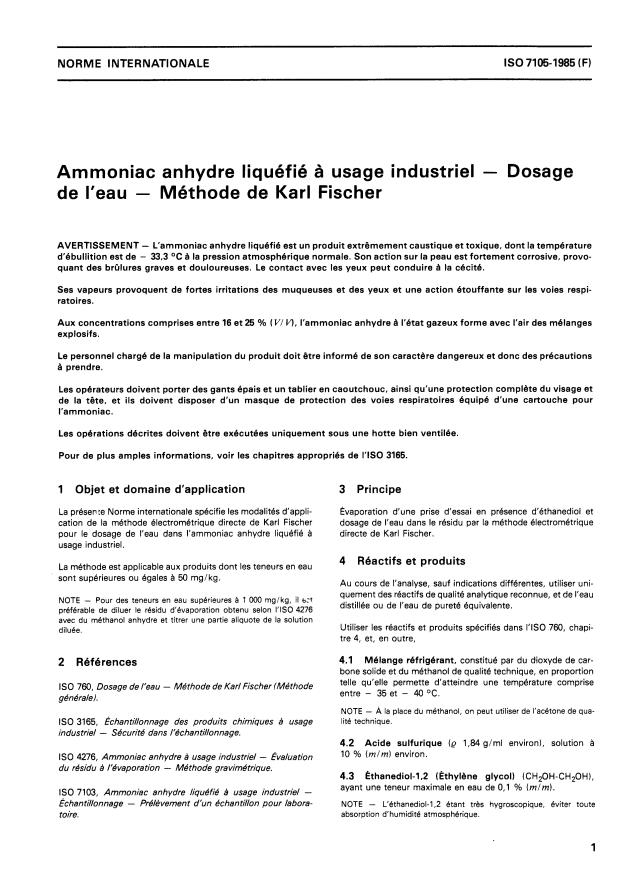
NORME INTERNATIONALE
Ammoniac anhydre liquéfié à usage industriel - Dosage
de l’eau - Méthode de Karl Fischer
AVERTISSEMENT - L’ammoniac anhydre liquefié est un produit extrêmement caustique et toxique, dont la température
d’ébullition est de - 33,3 OC à la pression atmospherique normale. Son action sur la peau est fortement corrosive, provo-
quant des brûlures graves et douloureuses. Le contact avec les yeux peut conduire à la cecité.
Ses vapeurs provoquent de fortes irritations des muqueuses et des yeux et une action étouffante sur les voies respi-
ratoires.
Aux concentrations comprises entre 16 et 25 % (c// W, l’ammoniac anhydre à l’état gazeux forme avec l’air des melanges
explosifs.
Le personnel chargé de la manipulation du produit doit être informé de son caractère dangereux et donc des précautions
à prendre.
Les opbrateurs doivent porter des gants épais et un tablier en caoutchouc, ainsi qu’une protection complète du visage et
de la tête, et ils doivent disposer d’un masque de protection des voies respiratoires équipé d’une cartouche pour
l’ammoniac.
Les opérations décrites doivent être exécutées uniquement sous une hotte bien ventilée.
Pour de plus amples informations, voir les chapitres appropriés de I’ISO 3165.
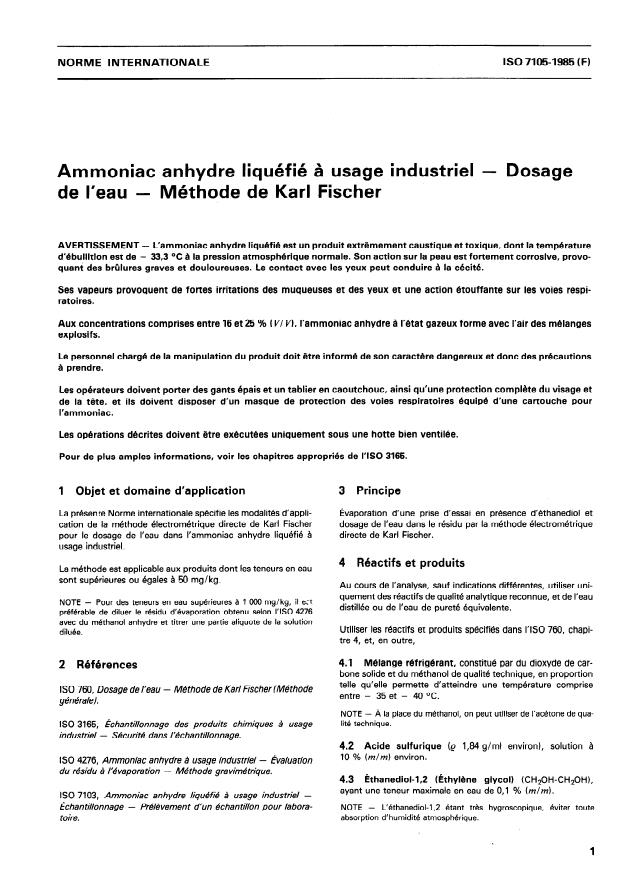
3 Principe
1 Objet et domaine d’application
La présen te Norme internationale spécifie les modalités d’appli- Évaporation d’une prise d’essai en présence d’éthanediol et
cation de la méthode électrométrique directe de Karl Fischer dosage de l’eau dans le résidu par la méthode électrométrique
directe de Karl Fischer.
pour le dosage de l’eau dans l’ammoniac anhydre liquéfié à
usage industriel.
4 Réactifs et produits
La méthode est applicable aux produits dont les teneurs en eau
sont supérieures ou égales à 50 mg/kg.
Au cours de l’analyse, sauf indications différentes, utiliser uni-
quement des réactifs de qualité analytique reconnue, et de l’eau
NOTE - Pour des teneurs en eau supérieures à 1 000 mg/kg, il e:t
distillée ou de l’eau de pureté équivalente.
préférable de diluer le résidu d’évaporation obtenu selon I’ISO 4276
avec du méthanol anhydre et titrer une partie aliquote de la solution
Utiliser les réactifs et produits spécifiés dans I’ISO 766, chapi-
diluée.
tre 4, et, en outre,
4.1 Melange réfrigérant, constitué par du dioxyde de car-
2 Références
bone solide et du méthanol de qualité technique, en proportion
telle qu’elle permette d’atteindre une température comprise
Méthode de Karl Fischer (Méthode
ISO 766, Dosage de l’eau -
entre - 35 et - 40 OC.
généralel.
NOTE - À la place du méthanol, on peut utiliser de l’acétone de qua-
lité technique.
ISO 3165, Échantillonnage des produits chimiques à usage
indus trie/ - S&urit& dans l’échantillonnage.
4.2 Acide sulfurique (Q 1,84 g/ml environ), solution à
10 % (mlm) environ.
ISO 4276, Ammoniac anhydre a usage industriel - Évaluation
du résidu a lëvapora tion - Me thode gravimetrique.
4.3 Éthanediol-1,2 (Éthylène glycol) (CH*OH-CH20H),
ayant une teneur maximale en eau de 0,l % (mlm).
ISO 7103, Ammoniac anhydre liquéfie a usage industriel -
Echantillonnage - Prélèvement d’un echan tillon pour labora- NOTE - L’éthanediol-l,2 étant trés hygroscopique, éviter toute
toire. absorption d’humidité atmosphérique.
.
ISO 71054985 (FI
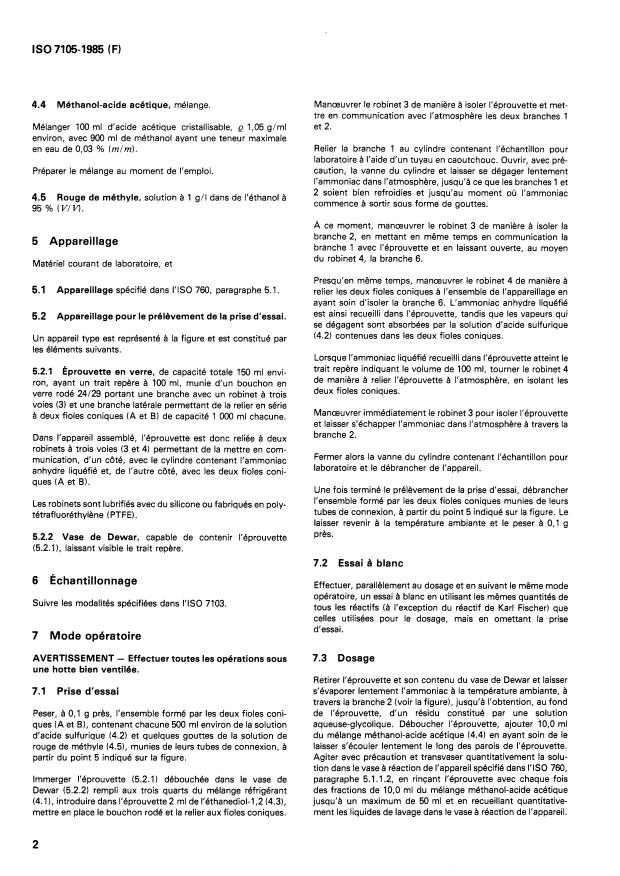
Manoeuvrer le robinet 3 de manière à isoler l’éprouvette et met-
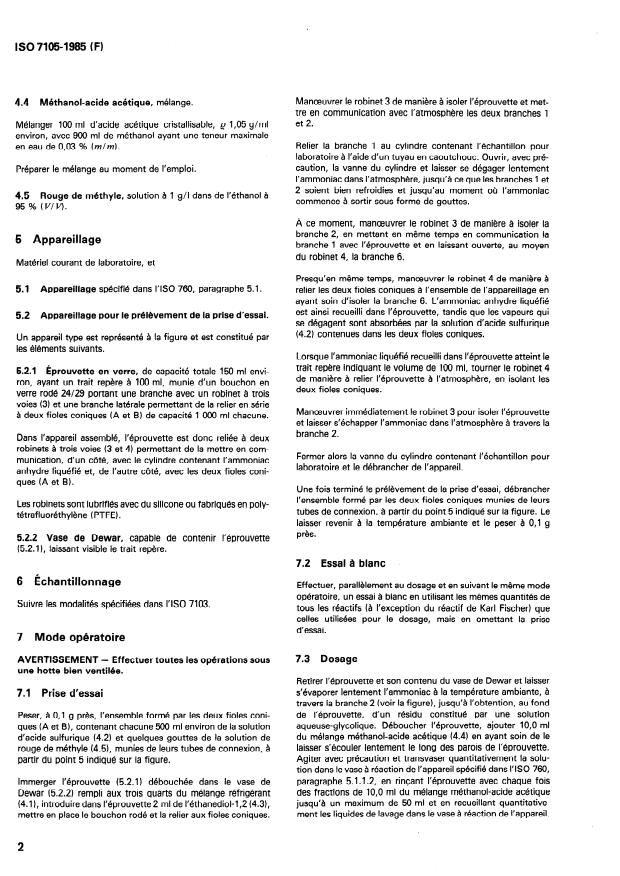
4.4 Méthanol-acide acétique, mélange.
tre en communication avec l’atmosphère les deux branches 1
et 2.
Mélanger 100 ml d’acide acétique cristallisable, Q 1,05 g/ml
environ, avec 900 ml de méthanol ayant une teneur maximale
Relier la branche 1 au cylindre contenant l’échantillon pour
en eau de 0,03 % (mlm).
laboratoire à l’aide d’un tuyau en caoutchouc. Ouvrir, avec pré-
caution, la vanne du cylindre et laisser se dégager lentement
Préparer le mélange au moment de l’emploi.
l’ammoniac dans l’atmosphère, jusqu’à ce que les branches 1 et
2 soient bien refroidies et jusqu’au moment où l’ammoniac
4.5 Rouge de méthyle, solution à 1 g/l dans de I’éthanol à
commence à sortir sous forme de gouttes.
95 % wm.
À ce moment, manoeuvrer le robinet 3 de manière a isoler la
branche 2, en mettant en même temps en communication la
5 Appareillage
branche 1 avec l’éprouvette et en laissant ouverte, au moyen
du robinet 4, la b
...
Norme internationale @ 7105
INTERNATIONAL ORGANIZATION FOR STANDARDIZATION*MEX/l,YHAPD/l,HAR OPrAHM3AUMR no CTAH/l,APTk43AUMM*ORGANlSATlON INTERNATIONALE DE NORMALISATION
Ammoniac anhydre liquéfié à usage industriel - Dosage
de l’eau - Méthode de Karl Fischer
liquefied anhydrous ammonia for industrial use - Determination of water content - Karl Fischer method
Première ddition - 1985-06-01
-
CDU 661.51 : 543.712 Rdf. no : IS0 7105-1985 (F)
v
Q) UY
? Descripteurs : produit industriel, compos6 chimique, ammoniac liqu6fi6, analyse chimique, dosage, eau, materiel d’essai, méthode de Karl
LA Fischer.
r-
i?
Prix basé sur 4 pages
Avant-propos
L’ISO (Organisation internationale de normalisation) est une fédération mondiale
d’organismes nationaux de normalisation (comités membres de I’ISO). L’elaboration
des Normes internationales est confiée aux comites techniques de I‘ISO. Chaque
comité membre interesse par une etude a le droit de faire partie du cornite technique
cr66 3 cet effet. Les organisations internationales, gouvernementales et non gouverne-
mentales, en liaison avec I’ISO, participent egalement aux travaux.
Les projets de Normes internationales adoptés par les comités techniques sont soumis
aux comites membres pour approbation, avant leur acceptation comme Normes inter-
nationales par le Conseil de I’ISO. Les Normes internationales sont approuvées confor-
mement aux procedures de I’ISO qui requierent l’approbation de 75 % au moins des
comités membres votants.
La Norme internationale IS0 7105 a été élaborée par le comité technique ISO/TC 47,
Chimie.
@ Organisation internationale de normalisation, 1985 O
Imprime en Suisse
IS0 7105-1985 (FI
NORM E I NTE R NAT1 ON ALE
Ammoniac anhydre liquéfié à usage industriel - Dosage
de l'eau - Méthode de Karl Fischer
AVERTISSEMENT - L'ammoniac anhydre liquefié est un produit extrêmement caustique et toxique, dont la température
- 33.3 OC B la pression atmospherique normale. Son action sur la peau est fortement corrosive, provo-
d'ébullition est de
quant des brûlures graves et douloureuses. Le contact avec les yeux peut conduire B la cécité.
Ses vapeurs provoquent de fortes irritations des muqueuses et des yeux et une action etouffante sur les voies respi-
ratoires.
Aux concentrations comprises entre 16 et 25 ?40 (V/ V), l'ammoniac anhydre B I'état gazeux forme avec l'air des melanges
explosifs.
Le personnel chargé de la manipulation du produit doit être informé de son caractère dangereux et donc des précautions
B prendre.
Les operateurs doivent porter des gants épais et un tablier en caoutchouc, ainsi qu'une protection complète du visage et
de la tête, et ils doivent disposer d'un masque de protection des voies respiratoires equipé d'une cartouche pour
l'ammoniac.
Les operations décrites doivent être executees uniquement sous une hotte bien ventilee.
Pour de plus amples informations, voir les chapitres appropries de I'ISO 3165.
1 Objet et domaine d'application 3 Principe
La présen re Norme internationale spécifie les modalités d'appli- Évaporation d'une prise d'essai en présence d'éthanedioi et
dosage de l'eau dans le résidu par la méthode électrométrique
cation de la méthode électrométrique directe de Karl Fischer
pour le dosage de l'eau dans l'ammoniac anhydre liquéfié à directe de Karl Fischer.
usage industriel.
4 R6actifs et produits
La méthode est applicable aux produits dont les teneurs en eau
sont supérieures ou égales à 50 mg/kg.
Au cours de l'analyse, sauf indications différentes, utiliser uni-
quement des réactifs de qualité analytique reconnue, et de l'eau
NOTE - Pour des teneurs en eau superieures B 1 O00 mg/kg, il 63
distillée ou de l'eau de pureté équivalente.
preferable de diluer le residu d'evaporation obtenu selon I'ISO 4276
avec du methanol anhydre et titrer une partie aliquote de la solution
Utiliser les réactifs et produits spécifiés dans I'ISO 760, chapi-
dilu6e.
4, et, en outre,
tre
4.1 Melange refrigerant, constitué par du dioxyde de car-
2 Références
bone solide et du méthanol de qualité technique, en proportion
telle qu'elle permette d'atteindre une température comprise
IS0 760, Dosage de l'eau - Méthode de Karl Fischer (Méthode
entre - 35 et - 40 OC.
g6n6ralel.
NOTE - A la place du methanol, on peut utiliser de I'ac6tone de qua-
IS0 3165, Echantillonnage des produits chimiques B usage lit6 technique.
industriel - Sdcurit6 dans réchantillonnage.
4.2 Acide sulfurique (e 1,84 g/ml environ), solution à
10 % (rn/rn) environ.
IS0 4276, Ammoniac anhydre E) usage industriel - Evaluation
du résidu B I'6vaporation - Méthode gravim6trique.
4.3 Ethanediol-1.2 (Éthybe glycol) (CHzOH-CHzOH),
ayant une teneur maximale en eau de 0,l % (m/m).
IS0 7103, Ammoniac anhydre liquéfié B usage industriel -
Echantillonnage - Prél&vement d'un Bchantillon pour labora- NOTE - L'BthanedioC1,2 etant trhs hygroscopique, Bviter toute
toire. absorption d'humidit6 atmospherique.
IS0 7105-1985 (FI
Manœuvrer le robinet 3 de manière B isoler I’éprouvette et met-
4.4 Méthanol-acide acetique, mélange.
tre en communication avec l’atmosphère les deux branches 1
et 2.
Mélanger 100 ml d‘acide acétique cristallisable, 1,05 g/ml
environ, avec 900 ml de méthanol ayant une teneur maximale
Relier la branche 1 au cylindre contenant I‘échantillon pour
en eau de 0.03 % (m/m).
laboratoire à l’aide d’un tuyau en caoutchouc. Ouvrir, avec pré-
caution, la vanne du cylindre et laisser se dégager lentement
Préparer le mélange au moment de l’emploi
l’ammoniac dans l’atmosphère, jusqu’h ce que les branches 1 et
2 soient bien refroidies et jusqu‘au moment où l’ammoniac
4.5 Rouge de methyle, solution à 1 g/l dans de I‘éthanol à
commence à sortir sous forme de gouttes.
95 % (V
...