

ISO 1496-4:2023
(Main)Series 1 freight containers — Specification and testing — Part 4: Non-pressurized containers for dry bulk
General Information
- Abstract
This document specifies the basic specifications and testing requirements for series 1 freight containers of the dry bulk container non-pressurized type which are suitable for international exchange and for conveyance by road, rail and sea, including interchange between these forms of transport. As the density and flow characteristics of dry bulk cargoes vary widely, containers conforming to this document are not expected to be suitable for the carriage of all such cargoes. Therefore, except where otherwise stated, the requirements of this document are minimum requirements. The container types covered by this document are given in Table 1. This document does not apply to BK3 flexible bulk containers.
- Status
- Published
- Publication Date
- 25-Oct-2023
- Technical Committee
- ISO/TC 104/SC 2 - Specific purpose containers
- Drafting Committee
- ISO/TC 104/SC 2 - Specific purpose containers
- Current Stage
- 6060 - International Standard published
- Start Date
- 26-Oct-2023
- Due Date
- 07-Oct-2023
- Completion Date
- 26-Oct-2023
Overview
ISO 1496-4:2023 - Series 1 freight containers - Specification and testing - Part 4: Non-pressurized containers for dry bulk - defines the minimum specifications and testing requirements for Series 1 dry-bulk, non‑pressurized containers intended for international exchange and intermodal transport (road, rail, sea). The standard updates and replaces the 1991 edition, aligns structural tests with ISO 1496-1, and clarifies performance expectations for box‑type and hopper‑type bulk containers. Note: BK3 flexible bulk containers are excluded and containers conforming to this standard are not automatically suitable for every dry bulk cargo because of widely varying densities and flow characteristics.
Key topics and technical requirements
- Scope and intended use: Requirements for Series 1 dry bulk containers suitable for interchange and multimodal conveyance; minimum requirements unless otherwise stated.
- Design elements: External/internal dimensions and ratings; corner fittings; base structure; floor strength; end, side and shell constructions for box and hopper types.
- Openings and access: Prescribed provisions for loading and discharging openings, inspection/maintenance access (hopper), and door openings for box types.
- Optional features: Forklift pockets, gooseneck tunnels, walkways, ladders, sanitation provisions and interface for fumigation equipment.
- Testing program: Structural and operational tests including:
- End wall strength with discharge hatches
- Bottom hatch operation
- Floor strength tests for specific box-types
- Internal longitudinal and lateral restraint tests (hopper)
- Walkway and ladder load tests
- Airtightness tests for specified types according to ISO 6346
- Conformity with hazardous goods rules: A container built and tested per ISO 1496-4 is deemed to meet BK1/BK2 classifications in the UN Recommendations on the Transport of Dangerous Goods, provided additional requirements (e.g., siftproofing, securing for service equipment) are met.
Practical applications and users
Who uses ISO 1496-4:2023:
- Container designers and manufacturers - to design and certify dry bulk containers for intermodal use.
- Shipping lines and intermodal operators - to procure containers that meet interchange and handling expectations.
- Shippers of dry bulk and hazardous bulk goods - to select correct container types (box or hopper) and ensure compliance with dangerous goods rules.
- Testing laboratories and certification bodies - to perform the standardized structural and operational tests.
- Regulators and port/rail authorities - for evaluating container safety and interchangeability.
Practical benefits include safer handling of dry bulk cargoes, clearer manufacturer test requirements, and smoother intermodal interchange.
Related standards and references
- ISO 1496-1 (general structural tests for freight containers)
- ISO 6346 (container identification and airtightness testing reference)
- UN Recommendations on the Transport of Dangerous Goods (BK1/BK2 classifications)
- IMO/ILO/UNECE CTU Code (packing guidance for cargo transport units)
Keywords: ISO 1496-4:2023, series 1 freight containers, dry bulk, non-pressurized containers, container testing, intermodal, bulk cargo, BK1 BK2.
Relations
- Effective Date
- 09-Feb-2026
- Effective Date
- 06-Jun-2022
- Effective Date
- 06-Jun-2022
Get Certified
Connect with accredited certification bodies for this standard

BRCGS (Brand Reputation Compliance Global Standards)
Global food safety and quality standards owner.
Sponsored listings
Frequently Asked Questions
ISO 1496-4:2023 is a standard published by the International Organization for Standardization (ISO). Its full title is "Series 1 freight containers — Specification and testing — Part 4: Non-pressurized containers for dry bulk". This standard covers: This document specifies the basic specifications and testing requirements for series 1 freight containers of the dry bulk container non-pressurized type which are suitable for international exchange and for conveyance by road, rail and sea, including interchange between these forms of transport. As the density and flow characteristics of dry bulk cargoes vary widely, containers conforming to this document are not expected to be suitable for the carriage of all such cargoes. Therefore, except where otherwise stated, the requirements of this document are minimum requirements. The container types covered by this document are given in Table 1. This document does not apply to BK3 flexible bulk containers.
This document specifies the basic specifications and testing requirements for series 1 freight containers of the dry bulk container non-pressurized type which are suitable for international exchange and for conveyance by road, rail and sea, including interchange between these forms of transport. As the density and flow characteristics of dry bulk cargoes vary widely, containers conforming to this document are not expected to be suitable for the carriage of all such cargoes. Therefore, except where otherwise stated, the requirements of this document are minimum requirements. The container types covered by this document are given in Table 1. This document does not apply to BK3 flexible bulk containers.
ISO 1496-4:2023 is classified under the following ICS (International Classification for Standards) categories: 55.180.10 - General purpose containers. The ICS classification helps identify the subject area and facilitates finding related standards.
ISO 1496-4:2023 has the following relationships with other standards: It is inter standard links to EN ISO 10855-1:2024, ISO 1496-4:1991, ISO 1496-4:1991/Amd 1:1994. Understanding these relationships helps ensure you are using the most current and applicable version of the standard.
ISO 1496-4:2023 is associated with the following European legislation: EU Directives/Regulations: 2018-01-1387. When a standard is cited in the Official Journal of the European Union, products manufactured in conformity with it benefit from a presumption of conformity with the essential requirements of the corresponding EU directive or regulation.
ISO 1496-4:2023 is available in PDF format for immediate download after purchase. The document can be added to your cart and obtained through the secure checkout process. Digital delivery ensures instant access to the complete standard document.
Standards Content (Sample)
INTERNATIONAL ISO
STANDARD 1496-4
Second edition
2023-10
Series 1 freight containers —
Specification and testing —
Part 4:
Non-pressurized containers for dry
bulk
Reference number
© ISO 2023
All rights reserved. Unless otherwise specified, or required in the context of its implementation, no part of this publication may
be reproduced or utilized otherwise in any form or by any means, electronic or mechanical, including photocopying, or posting on
the internet or an intranet, without prior written permission. Permission can be requested from either ISO at the address below
or ISO’s member body in the country of the requester.
ISO copyright office
CP 401 • Ch. de Blandonnet 8
CH-1214 Vernier, Geneva
Phone: +41 22 749 01 11
Email: copyright@iso.org
Website: www.iso.org
Published in Switzerland
ii
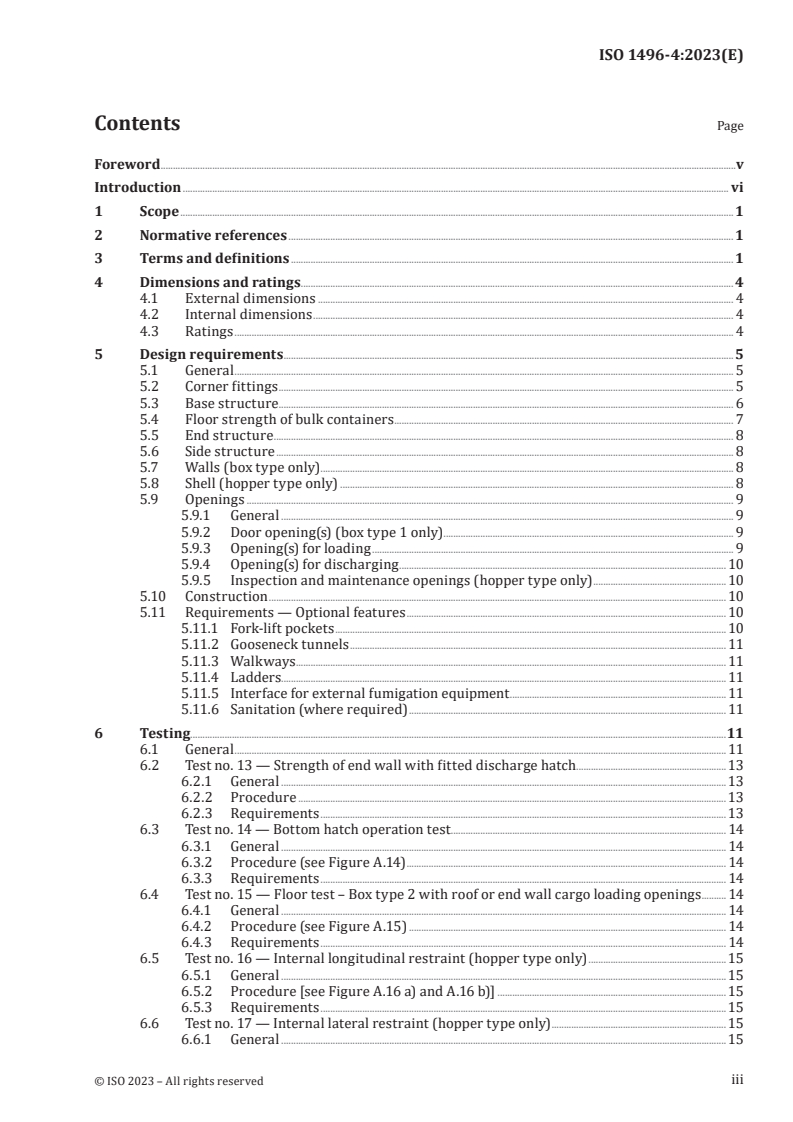
Contents Page
Foreword .v
Introduction . vi
1 Scope . 1
2 Normative references . 1
3 Terms and definitions . 1
4 Dimensions and ratings . 4
4.1 External dimensions . 4
4.2 Internal dimensions . 4
4.3 Ratings . 4
5 Design requirements .5
5.1 General . 5
5.2 Corner fittings . 5
5.3 Base structure . . . 6
5.4 Floor strength of bulk containers . 7
5.5 End structure . 8
5.6 Side structure . 8
5.7 Walls (box type only) . . 8
5.8 Shell (hopper type only) . 8
5.9 Openings . 9
5.9.1 General . 9
5.9.2 Door opening(s) (box type 1 only) . 9
5.9.3 Opening(s) for loading . 9
5.9.4 Opening(s) for discharging . 10
5.9.5 Inspection and maintenance openings (hopper type only) . 10
5.10 Construction . 10
5.11 Requirements — Optional features . 10
5.11.1 Fork-lift pockets . 10
5.11.2 Gooseneck tunnels . 11
5.11.3 Walkways . 11
5.11.4 Ladders. 11
5.11.5 Interface for external fumigation equipment . 11
5.11.6 Sanitation (where required) . 11
6 Testing.11
6.1 General . 11
6.2 Test no. 13 — Strength of end wall with fitted discharge hatch .13
6.2.1 General .13
6.2.2 Procedure . 13
6.2.3 Requirements . 13
6.3 Test no. 14 — Bottom hatch operation test. 14
6.3.1 General . 14
6.3.2 Procedure (see Figure A.14) . 14
6.3.3 Requirements . 14
6.4 Test no. 15 — Floor test – Box type 2 with roof or end wall cargo loading openings . 14
6.4.1 General . 14
6.4.2 Procedure (see Figure A.15) . 14
6.4.3 Requirements . 14
6.5 Test no. 16 — Internal longitudinal restraint (hopper type only) . 15
6.5.1 General .15
6.5.2 Procedure [see Figure A.16 a) and A.16 b)] . 15
6.5.3 Requirements .15
6.6 Test no. 17 — Internal lateral restraint (hopper type only) . 15
6.6.1 General .15
iii
6.6.2 Procedure [see Figure A.17 a) and A.17 b)] . 15
6.6.3 Requirements . 16
6.7 Test no. 18 — Walkways (where provided) . 16
6.7.1 General . 16
6.7.2 Procedure (see Figure A.18) . 16
6.7.3 Requirements . 16
6.8 Test no. 19 — Ladders (where provided) . 16
6.8.1 General . 16
6.8.2 Procedure (see Figure A.19) . 16
6.8.3 Requirements . 16
6.9 Test no. 20 — Airtightness test types B1/BB according to ISO 6346. 17
6.9.1 General . 17
6.9.2 Procedure . 17
6.9.3 Requirements . 17
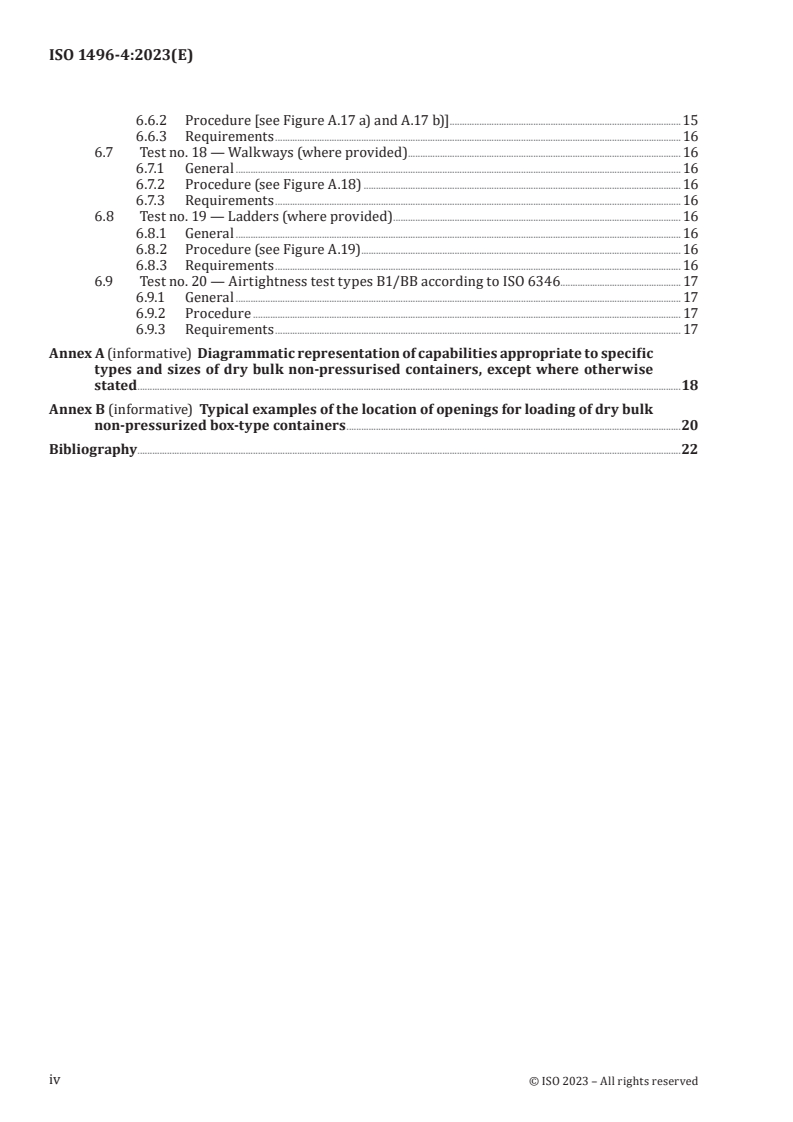
Annex A (informative) Diagrammatic representation of capabilities appropriate to specific
types and sizes of dry bulk non-pressurised containers, except where otherwise
stated .18
Annex B (informative) Typical examples of the location of openings for loading of dry bulk
non-pressurized box-type containers .20
Bibliography .22
iv
Foreword
ISO (the International Organization for Standardization) is a worldwide federation of national standards
bodies (ISO member bodies). The work of preparing International Standards is normally carried out
through ISO technical committees. Each member body interested in a subject for which a technical
committee has been established has the right to be represented on that committee. International
organizations, governmental and non-governmental, in liaison with ISO, also take part in the work.
ISO collaborates closely with the International Electrotechnical Commission (IEC) on all matters of
electrotechnical standardization.
The procedures used to develop this document and those intended for its further maintenance are
described in the ISO/IEC Directives, Part 1. In particular, the different approval criteria needed for the
different types of ISO document should be noted. This document was drafted in accordance with the
editorial rules of the ISO/IEC Directives, Part 2 (see www.iso.org/directives).
ISO draws attention to the possibility that the implementation of this document may involve the use
of (a) patent(s). ISO takes no position concerning the evidence, validity or applicability of any claimed
patent rights in respect thereof. As of the date of publication of this document, ISO had not received
notice of (a) patent(s) which may be required to implement this document. However, implementers are
cautioned that this may not represent the latest information, which may be obtained from the patent
database available at www.iso.org/patents. ISO shall not be held responsible for identifying any or all
such patent rights.
Any trade name used in this document is information given for the convenience of users and does not
constitute an endorsement.
For an explanation of the voluntary nature of standards, the meaning of ISO specific terms and
expressions related to conformity assessment, as well as information about ISO's adherence to
the World Trade Organization (WTO) principles in the Technical Barriers to Trade (TBT), see
www.iso.org/iso/foreword.html.
This document was prepared by Technical Committee ISO/TC 104, Freight containers, Subcommittee
SC 2, Specific purpose containers.
This second edition cancels and replaces the first edition (ISO 1496-4:1991), which has been technically
revised. It also incorporates the Amendment(s) ISO 1496-4:1991/Amd 1:1994.
The main changes are as follows:
— ensure that the main structural tests are consistent with those described in ISO 1496-1;
— introduce testing for box-type bulk containers with bottom discharge;
— reflect the forces on end and side walls when the freight container is being discharged by tipping or
rotating;
— ensure that the freight container can operate correctly and safely when fully packed with a bulk
cargo.
A list of all parts in the ISO 1496 series can be found on the ISO website.
Any feedback or questions on this document should be directed to the user’s national standards body. A
complete listing of these bodies can be found at www.iso.org/members.html.
v
Introduction
This document replaces the first edition published in 1991 and brings it into line with other parts of
this document including Part 1 which provides information on those tests that are consistent for all
freight containers.
Freight containers built to transport non-pressurised bulk cargos are considered to be special and
therefore not produced in large numbers, and often, freight containers built to meet the requirements
of ISO 1496-1 are used in their place. However, when the bulk cargo is classified as a dangerous cargo
as identified in the United Nations' Recommendations on the Transport of Dangerous Goods - Model
[2]
Regulations, such cargoes must be transported in a bulk container as described in 6.8 of those
regulations.
A freight container built and tested according to this document are deemed to meet with the
requirements for a BK1 or a BK2 bulk container as described in the Recommendations on the transport
[2]
of Dangerous Goods – Model Regulations. To fully meet these requirements the container will need to
be:
— rendered siftproof, either by design or by the addition of a siftproof liner,
— fitted with suitable securing means for service equipment required for packing and unpacking.
Containers to be used for the carriage of dangerous goods can be subject to additional international and
national requirements as applied by competent authorities.
Freight containers constructed in accordance with ISO 1496-1 may be used for the transport certain
non-packed dry bulk solids only if the end walls are strengthened to meet the test requirements of this
document and care be taken to ensure that the design loadings are shall not exceeded under operating
conditions.
Bulk cargoes that comprise of large particles that have a density greater than 1 200 kg/m and/or are
angular can damage the floor structure if dropped from the height of the roof or higher. Such cargoes
require additional strengthening to the floor and/or base structure.
The forces involved with packing dry bulk containers are associated with the container being fully
horizontal or inclined to a certain degree as stated in the IMO / ILO / UN ECE Code of Practice for
[3]
packing cargo transport units (CTU Code). Containers tested to this document are not designed for
packing with the rear end significantly inclined or at 90° to the horizontal.
The marking requirements for these containers need to be in accordance with the principles embodied
in ISO 6346.
vi
INTERNATIONAL STANDARD ISO 1496-4:2023(E)
Series 1 freight containers — Specification and testing —
Part 4:
Non-pressurized containers for dry bulk
1 Scope
This document specifies the basic specifications and testing requirements for series 1 freight containers
of the dry bulk container non-pressurized type which are suitable for international exchange and for
conveyance by road, rail and sea, including interchange between these forms of transport.
As the density and flow characteristics of dry bulk cargoes vary widely, containers conforming to this
document are not expected to be suitable for the carriage of all such cargoes. Therefore, except where
otherwise stated, the requirements of this document are minimum requirements.
The container types covered by this document are given in Table 1.
This document does not apply to BK3 flexible bulk containers.
2 Normative references
The following documents are referred to in the text in such a way that some or all of their content
constitutes requirements of this document. For dated references, only the edition cited applies. For
undated references, the latest edition of the referenced document (including any amendments) applies.
ISO 668:2020, Series 1 freight containers — Classification, dimensions and ratings
1)
ISO 830 , Freight containers — Vocabulary
ISO 1161, Series 1 freight containers — Corner and intermediate fittings — Specifications
ISO 1496-1:2013/Amd 1:2016, Series 1 freight containers — Specification and testing — Part 1: General
cargo containers for general purposes
ISO 6346, Freight containers — Coding, identification and marking
ISO 17712, Freight containers — Mechanical seals
EN 13374, Temporary edge protection
3 Terms and definitions
For the purposes of this document, the terms and definitions given in ISO 830 and the following apply.
ISO and IEC maintain terminology databases for use in standardization at the following addresses:
— ISO Online browsing platform: available at https:// www .iso .org/ obp
— IEC Electropedia: available at https:// www .electropedia .org/
1) Under preparation. Stage at the time of publication: ISO/DIS 830:2023.
3.1
dry bulk cargo - non-pressurised, box type
container for the transport of dry bulk solids, capable of withstanding the loads resulting from filling,
transport motions and discharging of non-packaged dry bulk solids, having filling and discharge
apertures and fittings and complying with the requirements of this document
Note 1 to entry: Dry bulk cargo is also known as dry bulk container.
Note 2 to entry: Dry bulk containers are referred to as containers in this document.
3.1.1
box type 1
dry bulk non-pressurized container for tipping discharge having a parallelepiped cargo space and a
door opening at least at one end
Note 1 to entry: It may also be used as a general-purpose freight container.
3.1.2
box type 2
dry bulk non-pressurized container for tipping discharge having a parallelepiped cargo space with a
door opening in either ends or fitted with one or more access hatches
Note 1 to entry: It cannot be used as a general-purpose freight container.
3.1.3
hopper type
dry bulk non-pressurized container for horizontal or vertical discharge without tipping and having no
door opening
Note 1 to entry: It may not be used as a general-purpose freight container.
3.1.4
bottom discharge type
dry bulk non-pressurised container for vertical discharge having no door opening
Note 1 to entry: It may not be used as a general-purpose freight container.
3.2
dry bulk solids
assemblies of separate solid particles normally substantially in contact with one another which are, or
which may be rendered, capable of fluid flow
3.3
openings for cargo loading
openings provided in a container for the filling of dry bulk solids
3.4
openings for cargo discharging
openings provided in a container for the discharge of dry bulk solids
3.5
interface for external fumigation equipment
point(s) at which the connection between the container and any external fumigation equipment is made
3.6
dangerous goods
substances classified as dangerous by the United Nations committee of experts on the transport of
dangerous goods or by the competent authority (3.7)
3.7
competent authority
authority or authorities designated as such in each country or in each specified case by the governments
concerned, for the approval of dry bulk containers
3.8
bulk density
mass per unit volume of a dry bulk solid measured when the dry bulk solid is in a loose or non-
compacted condition
3.9
cargo space
space bounded by the container walls or shell when all apertures are closed
3.10
access hatch
personnel access hatch set into a wall or the roof
3.11
BK1
sheeted and open top bulk container with rigid bottom (including hopper-type bottom), side and end
walls and a non-rigid covering
[SOURCE: Recommendations on the Transport of Dangerous Goods - Model Regulations, United
[2]
Nations ]
3.12
BK2
totally closed bulk container with a rigid roof, sidewalls, end and floor walls (including hopper-type
bottom)
Note 1 to entry: BK2 includes bulk containers with an opening roof, side or end wall that can be closed during
transport. Closed bulk containers may be equipped with openings to allow for the exchange of vapour and gases
with air and which prevent under normal conditions of transport the release of solid contents as well as the
penetration of rain and splash water.
[SOURCE: Recommendations on the Transport of Dangerous Goods - Model Regulations, United
[2]
Nations ]
3.13
BK3
flexible bulk container with a capacity not exceeding 15 m
Note 1 to entry: BK3 includes liners, attached handling devices and service equipment.
[SOURCE: Recommendations on the Transport of Dangerous Goods - Model Regulations, United
[2]
Nations ]
3.14
siftproof
impermeable to dry contents including fine solid materials produced during transport
Note 1 to entry: Where a liner is used to make the container sift proof, it shall be made of a suitable material.
The strength of the material used for, and the construction of, the liner shall be appropriate to the capacity of
the container and its intended use. Joins made in the liner shall withstand pressures and impacts liable to occur
under normal conditions of handling and transport.
Note 2 to entry: For ventilated bulk containers, any liner shall not impair the operation of ventilating devices.
[SOURCE: Recommendations on the Transport of Dangerous Goods - Model Regulations, United
[2]
Nations ]
3.15
arching
tendency of some solids when transported in bulk to form an arch of material clinging to the roof of a
bulk container in the shape of an arch especially during discharge
Note 1 to entry: The process is likely to cause instability in the cargo.
3.16
bridging
tendency of some solids when transported in bulk to form a bridge of material clinging to a bulk
container as if a bridge especially during discharge
Note 1 to entry: The process is likely to cause instability in the cargo.
3.17
rat-holing
tendency of flows of air or other gases to form enclosed channels through the substance especially
during discharge
Note 1 to entry: The process can cause instability in the cargo.
3.18
surge
tendency of substances to start moving suddenly especially during discharge
Note 1 to entry: The process can cause instability in the load.
4 Dimensions and ratings
4.1 External dimensions
The overall external dimensions and tolerances of the freight containers covered by this document shall
be in accordance with ISO 668. No part of the container shall project beyond these specified overall
external dimensions.
4.2 Internal dimensions
Internal dimensions of containers shall be as large as possible but, in any case, box type 1 containers
with full access rear doors shall have a minimum internal width of 2 330 mm. This dimension applies
when measured at a temperature of 20 °C.
Measurements taken at other temperatures shall be adjusted accordingly.
4.3 Ratings
The values of the rating R, being the maximum gross mass of the container, shall be those specified in
ISO 668.
5 Design requirements
5.1 General
Table 1 — Container types (in accordance with ISO 6346:2022, Table E.1)
Code Type designation Type group code
B Dry bulk cargo - non-pressurised, box type BU
N Pressurised and non-pressurised tank container (dry)
Hopper type NH
Non-pressurised tank NN
This document includes all container types shown in Table 1 and shall be capable of fulfilling the
following requirements.
5.1.1 The strength requirements for containers are given in ISO 1496-1 (these requirements are
applicable to all bulk containers except where otherwise stated). They apply to containers as complete
units, except as described in 6.1.
5.1.2 The strength requirements for corner fittings (see also 5.2) shall be in accordance with ISO 1161.
5.1.3 As the effects of loads encountered under any dynamic operating condition should only
approach, but not exceed, the effects of the corresponding test loads, it is implicit that the capabilities
of containers indicated in ISO 1496-1 and demonstrated by those additional tests described in Clause 6
shall not be exceeded in any mode of operation.
5.1.4 Any closure in a container which, if unsecured, can lead to an unsafe situation, shall be provided
with an adequate securing system. Each securing system shall have, in so far as is practicable, an
external indication of the positive securement of that closure in the appropriate operating position.
In particular, doors and closures for openings for cargo loading or openings for cargo discharging shall
be capable of being securely fastened in the open or closed position.
The closures of bulk containers shall be such that they remain effective during testing and operations
and dynamic movement of the bulk solid due to its bulk density, drop height, the friability of the
substance or to arching, bridging, rat-holing, surge or any other similar effect.
5.1.5 Any removable roof or roof section (not including hinged hatches) shall be fitted with locking
devices such that an observer at ground level can check (when the container is on a rail or highway
carrying vehicle) that the roof is secured.
5.1.6 All closed containers and all open containers fitted with covers which were designed for them
shall be weatherproof as required by test no. 12 (see 6.1.5.12).
5.1.7 Bulk containers shall be capable of being secured to the satisfaction of customs authorities, for
[5]
example, in order to conform to the TIR convention.
5.2 Corner fittings
All containers shall be equipped with top and bottom corner fittings according to ISO 1161. 1EEE and
1EE units shall also have intermediate fittings in the 1AAA/1AA/1A position according to ISO 668.
The upper faces of the top corner fittings shall protrude above the top of the container by a minimum of
6 mm. The “top of the container” means the highest level of the top part of the container, e.g. the level of
the top of the closure of a cargo-loading opening.
However, if reinforced zones or doubler plates are provided to afford protection to the roof in the
vicinity of the top corner fittings, such plates and their securements shall not protrude above the upper
faces of the top corner fittings. These plates shall not extend more than 750 mm from either end of the
container but may extend the full width.
5.3 Base structure
5.3.1 All containers shall be capable of being supported by their bottom corner fittings only.
5.3.2 All containers, other than 1D and 1DX as defined in ISO 668, shall be capable of being supported
only by load-transfer areas in their base structure.
5.3.2.1 Consequently, these containers shall have end transverse members and sufficient intermediate
load-transfer areas (or a flat underside) of sufficient strength to permit vertical load-transfer to or from
the longitudinal member of a carrying vehicle. Such longitudinal members are assumed to lie within the
two 375 mm wide zones defined by the broken lines in ISO 668:2020, Figure B.1.
5.3.2.2 The lower faces of the load-transfer areas, including those of the end transverse members,
+ 5
shall be in one plane located 12,5 mm mm above the plane of the lower faces of the bottom corner
−15,
fitting
...