


ISO 10845-1:2010
(Main)Construction procurement — Part 1: Processes, methods and procedures
Construction procurement — Part 1: Processes, methods and procedures
ISO 10845-1:2010 describes processes, methods and procedures for the establishment within an organization of a procurement system that is fair, equitable, transparent, competitive and cost-effective. ISO 10845-1:2010 describes generic procurement processes around which an employer can develop its procurement system, establishes basic requirements for the conduct of an employer's employees, agents, board members and office bearers when engaging in procurement, establishes the framework for the development of an employer's procurement policy, including any secondary procurement policy, and establishes generic methods and procedures for procurements, including those pertaining to disposals.
Marchés de construction — Partie 1: Processus, méthodes et procédures
General Information
- Status
- Withdrawn
- Publication Date
- 27-Jun-2010
- Withdrawal Date
- 27-Jun-2010
- Technical Committee
- ISO/TC 59/SC 18 - Construction procurement
- Drafting Committee
- ISO/TC 59/SC 18 - Construction procurement
- Current Stage
- 9599 - Withdrawal of International Standard
- Start Date
- 21-Dec-2020
- Completion Date
- 14-Feb-2026
Relations
- Effective Date
- 10-Dec-2016



Related Packages

Get Certified
Connect with accredited certification bodies for this standard

ICC Evaluation Service
Building products evaluation and certification.

QAI Laboratories
Building and construction product testing and certification.

Aboma Certification B.V.
Specialized in construction, metal, and transport sectors.
Sponsored listings
Frequently Asked Questions
ISO 10845-1:2010 is a standard published by the International Organization for Standardization (ISO). Its full title is "Construction procurement — Part 1: Processes, methods and procedures". This standard covers: ISO 10845-1:2010 describes processes, methods and procedures for the establishment within an organization of a procurement system that is fair, equitable, transparent, competitive and cost-effective. ISO 10845-1:2010 describes generic procurement processes around which an employer can develop its procurement system, establishes basic requirements for the conduct of an employer's employees, agents, board members and office bearers when engaging in procurement, establishes the framework for the development of an employer's procurement policy, including any secondary procurement policy, and establishes generic methods and procedures for procurements, including those pertaining to disposals.
ISO 10845-1:2010 describes processes, methods and procedures for the establishment within an organization of a procurement system that is fair, equitable, transparent, competitive and cost-effective. ISO 10845-1:2010 describes generic procurement processes around which an employer can develop its procurement system, establishes basic requirements for the conduct of an employer's employees, agents, board members and office bearers when engaging in procurement, establishes the framework for the development of an employer's procurement policy, including any secondary procurement policy, and establishes generic methods and procedures for procurements, including those pertaining to disposals.
ISO 10845-1:2010 is classified under the following ICS (International Classification for Standards) categories: 91.010.20 - Contractual aspects. The ICS classification helps identify the subject area and facilitates finding related standards.
ISO 10845-1:2010 has the following relationships with other standards: It is inter standard links to ISO 10845-1:2020. Understanding these relationships helps ensure you are using the most current and applicable version of the standard.
ISO 10845-1:2010 is available in PDF format for immediate download after purchase. The document can be added to your cart and obtained through the secure checkout process. Digital delivery ensures instant access to the complete standard document.
Standards Content (Sample)
INTERNATIONAL ISO
STANDARD 10845-1
First edition
2010-07-01
Construction procurement —
Part 1:
Processes, methods and procedures
Marchés de construction —
Partie 1: Processus, méthodes et procédures
Reference number
©
ISO 2010
PDF disclaimer
This PDF file may contain embedded typefaces. In accordance with Adobe's licensing policy, this file may be printed or viewed but
shall not be edited unless the typefaces which are embedded are licensed to and installed on the computer performing the editing. In
downloading this file, parties accept therein the responsibility of not infringing Adobe's licensing policy. The ISO Central Secretariat
accepts no liability in this area.
Adobe is a trademark of Adobe Systems Incorporated.
Details of the software products used to create this PDF file can be found in the General Info relative to the file; the PDF-creation
parameters were optimized for printing. Every care has been taken to ensure that the file is suitable for use by ISO member bodies. In
the unlikely event that a problem relating to it is found, please inform the Central Secretariat at the address given below.
© ISO 2010
All rights reserved. Unless otherwise specified, no part of this publication may be reproduced or utilized in any form or by any means,
electronic or mechanical, including photocopying and microfilm, without permission in writing from either ISO at the address below or
ISO's member body in the country of the requester.
ISO copyright office
Case postale 56 • CH-1211 Geneva 20
Tel. + 41 22 749 01 11
Fax + 41 22 749 09 47
E-mail copyright@iso.org
Web www.iso.org
Published in Switzerland
ii © ISO 2010 – All rights reserved
Contents Page
Foreword .iv
Introduction.v
1 Scope.1
2 Normative references.1
3 Terms and definitions .2
4 Establishing a procurement system.6
4.1 General .6
4.2 Conduct of employees, agents and contractors.7
4.3 Procurement policy.8
4.4 Secondary procurement policy.11
4.5 Rotating electronic databases .13
4.6 Means of communication .16
4.7 Devices relating to the electronic receipt of submissions.16
5 Preparing for procurement.16
5.1 Preparation for a procurement other than a disposal .16
5.2 Preparation for a disposal .17
6 Procurement methods and procedures .18
6.1 General .18
6.2 Procurement documentation .19
6.3 Solicitation of tender offers.25
6.4 Advertisements.32
6.5 Tender process and procedures.32
6.6 Award of contracts.39
6.7 Contract administration.40
6.8 Resolution of disputes arising from a contract .40
6.9 Unsolicited proposals.41
6.10 Departures from established methods and procedures .41
Annex A (informative) Commentary.42
Annex B (informative) Best-value procurement.55
Annex C (informative) Generic procurement process .60
Annex D (informative) Adjudication procedures to challenge decisions made during the tender
process.64
Annex E (informative) Establishing a procurement system and managing procurement processes .67
Annex F (informative) Standard procurement procedures.74
Annex G (informative) Targeted procurement procedures.85
Annex H (informative) Auction Data.109
Bibliography.112
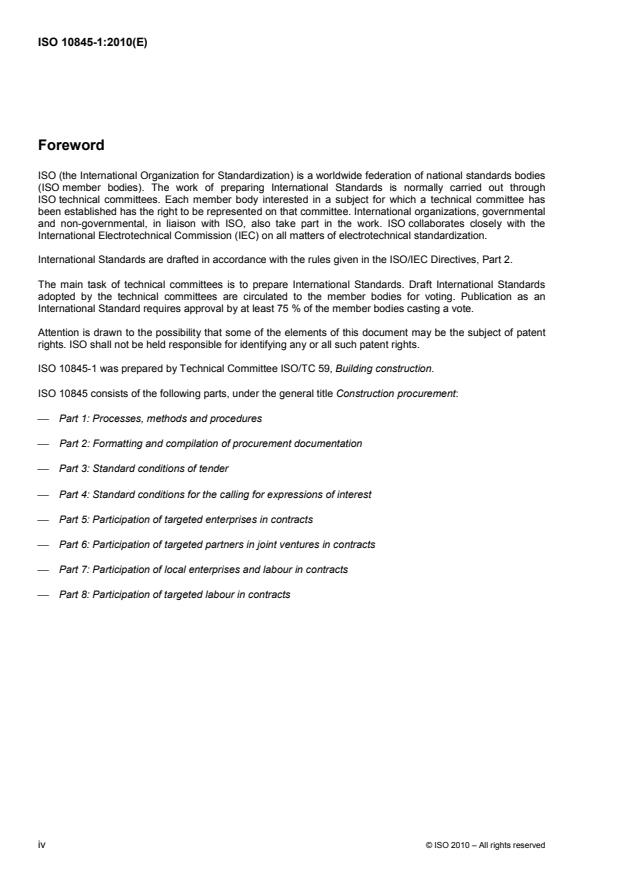
Foreword
ISO (the International Organization for Standardization) is a worldwide federation of national standards bodies
(ISO member bodies). The work of preparing International Standards is normally carried out through
ISO technical committees. Each member body interested in a subject for which a technical committee has
been established has the right to be represented on that committee. International organizations, governmental
and non-governmental, in liaison with ISO, also take part in the work. ISO collaborates closely with the
International Electrotechnical Commission (IEC) on all matters of electrotechnical standardization.
International Standards are drafted in accordance with the rules given in the ISO/IEC Directives, Part 2.
The main task of technical committees is to prepare International Standards. Draft International Standards
adopted by the technical committees are circulated to the member bodies for voting. Publication as an
International Standard requires approval by at least 75 % of the member bodies casting a vote.
Attention is drawn to the possibility that some of the elements of this document may be the subject of patent
rights. ISO shall not be held responsible for identifying any or all such patent rights.
ISO 10845-1 was prepared by Technical Committee ISO/TC 59, Building construction.
ISO 10845 consists of the following parts, under the general title Construction procurement:
⎯ Part 1: Processes, methods and procedures
⎯ Part 2: Formatting and compilation of procurement documentation
⎯ Part 3: Standard conditions of tender
⎯ Part 4: Standard conditions for the calling for expressions of interest
⎯ Part 5: Participation of targeted enterprises in contracts
⎯ Part 6: Participation of targeted partners in joint ventures in contracts
⎯ Part 7: Participation of local enterprises and labour in contracts
⎯ Part 8: Participation of targeted labour in contracts
iv © ISO 2010 – All rights reserved
Introduction
Procurement is the process which creates, manages and fulfils contracts. Procurement can, as such, be
described as a succession of logically related actions occurring or performed in a definite manner and which
culminate in the completion of a major deliverable or the attainment of a milestone. Processes, in turn, are
underpinned by methods (i.e. a documented, systematically-ordered collection of rules or approaches) and
procedures (i.e. the formal steps to be taken in the performance of a specific task), which are informed and
shaped by the policy of an employer. Methods and procedures can likewise be documented and linked to
processes.
Procurement activities commence once the need for procurement is identified and end when the transaction is
completed. There are six principal activities associated with the procurement process, namely:
1) establish what is to be procured;
2) decide on procurement strategies in terms of packaging, contracting, pricing and targeting strategy and
procurement procedure;
3) solicit tender offers;
4) evaluate tender offers;
5) award contract;
6) administer contracts and confirm compliance with requirements.
Methods, procedures and operational policies are required to implement these principal activities. There is a
finite range of methods and procedures associated with the various procurement sub-processes which can be
standardized around a set of system objectives. Public, private, international organizations and main
contractors can then establish their procurement systems around these standard procedures and methods.
Contractors who contract with such organizations can in turn be required, as an obligation of the contract, to
apply relevant standard procedures and methods when procuring goods and services or subcontracting
construction works associated with their contracts.
This part of ISO 10845 is one of a series of International Standards entitled “Construction procurement” which
cover various aspects of procurement within the construction industry. Each part of the series relates to a
different aspect of procurement. The objective of this series of standards is to provide a generic and standard
set of processes, procedures and methods for a procurement system that is fair, equitable, transparent,
competitive and cost-effective and which can be used to promote objectives additional to those associated
with the immediate objective of the procurement itself.
This series of standards is especially relevant for developing countries that lack experience and instruments in
this field and can be used to improve international trade. This part of ISO 10845 provides a framework around
which public, private and international organizations can develop their procurement systems to achieve fair
competition, to reduce the possibilities for abuse and to improve predictability in procurement outcomes.
NOTE Standardization, apart from removing technical barriers to trade, enables
a) those engaged in procurement activities to perform their duties, within the confines of their organization's
procurement policy, in a uniform and generic manner;
b) procurement documents to be readily compiled in a uniform and generic manner; and
c) curricula to be developed to capacitate those engaged in a range of procurement activities.
Furthermore, it allows governments to readily develop an internal procurement-skills base, which is not lost
when members of staff move between different departments or levels of government or organizations.
INTERNATIONAL STANDARD ISO 10845-1:2010(E)
Construction procurement —
Part 1:
Processes, methods and procedures
1 Scope
This part of ISO 10845 describes processes, methods and procedures for the establishment within an
organization of a procurement system that is fair, equitable, transparent, competitive and cost-effective. This
part of ISO 10845
a) describes generic procurement processes around which an employer can develop its procurement
system,
b) establishes basic requirements for the conduct of an employer's employees, agents, board members and
office bearers when engaging in procurement,
c) establishes the framework for the development of an employer's procurement policy, including any
secondary procurement policy, and
d) establishes generic methods and procedures for procurements, including those pertaining to disposals.
Guidance on the application of certain clauses is provided in Annex A and on the establishment and
management of procurement processes in Annex E. An approach for obtaining best-value procurement
outcomes is outlined in Annex B. Various types of procurement procedures are discussed in Annexes C, F
and G. A tender-adjudication procedure to challenge decisions made during the tender process is given in
Annex D and suggested Auction Data is given in Annex H.
2 Normative references
The following referenced documents are indispensable for the application of this document. For dated
references, only the edition cited applies. For undated references, the latest edition of the referenced
document (including any amendments) applies.
ISO 10845-5, Construction procurement — Part 5: Participation of targeted enterprises in contracts
ISO 10845-6, Construction procurement — Part 6: Participation of targeted partners in joint ventures in
contracts
ISO 10845-7, Construction procurement — Part 7: Participation of local enterprises and labour in contracts
ISO 10845-8, Construction procurement — Part 8: Participation of targeted labour in contracts
ISO 15392:2008, Sustainability in building construction — General principles
ISO 15686 (all parts), Buildings and constructed assets — Service life planning
3 Terms and definitions
For the purposes of this document, the following terms and definitions apply.
3.1
acceptance
agreeing to a contractor's offer or tender, thereby creating a binding contract
[ISO 6707-2:1993, definition 3.4.2]
3.2
agent
person or organization that is not an employee of the employer and that acts on the employer's behalf
3.3
bill of quantities
document that lists the items of work and the quantities and rates associated with each item to allow
contractors to be paid, at regular intervals, an amount equal to the agreed rate for the work multiplied by the
quantity of work completed
3.4
bond
sum of money or securities submitted to the employer or placed in the hands of a third party to guarantee
completion of the work and recovery of the sums which the contractor would be recognized as owing under
the terms of contract
[ISO 6707-2:1993, definition 3.5.4]
3.5
competitive negotiation procedure
procurement procedure which, through a series of negotiations, reduces the number of tenderers competing
for the contract until the remaining tenderers are invited to submit final offers
3.6
competitive selection procedure
any procurement procedure in which the contract is normally awarded to the contractor who submits the
lowest financial offer or obtains the highest number of tender-evaluation points
3.7
conditions of contract
terms that collectively describe the rights and obligations of contracting parties and the agreed procedures for
the administration of their contract or document containing conditions of contract
NOTE Adapted from ISO 6707-2:1993, definitions 3.2.1 and 3.2.2.
3.8
conflict of interest
any situation in which someone in a position of trust has competing professional or personal interests which
make it difficult for him to fulfil his duties impartially, an individual or organization is in a position to exploit a
professional or official capacity in some way for his personal or for corporate benefit, or incompatibility or
contradictory interests exist between an employee and the organization which employs that employee
3.9
contract
legally enforceable agreement to supply goods, execute work or provide services
[ISO 6707-2:1993, definition 3.4.8]
2 © ISO 2010 – All rights reserved
3.10
contract data
document that identifies the applicable conditions of a contract and states the associated contract-specific
data
3.11
contracting strategy
strategy that governs the nature of the relationship which the employer wishes to foster with the contractor,
which in turn determines the risks and responsibilities between the parties to the contract and the
methodology by which the contractor is to be paid
3.12
contractor
person or organization that contracts to provide the goods, services or engineering and construction works
covered by the contract
3.13
corrupt practice
offering, giving, receiving or soliciting of anything of value to influence the action of the employer or his staff or
agents in the procurement process or the administration of the contract
3.14
cost plus contract
cost reimbursement contract in which the contractor is paid for his actual expenditure plus a percentage or fee
[ISO 6707-2:1993, definition 3.4.11]
3.15
cost reimbursement contract
contract based on costs expended
[ISO 6707-2:1993, definition 3.4.12]
3.16
electronic auction
repetitive process involving an electronic device for the presentation of new prices, revised downwards or new
values concerning certain elements of tenders (or both), and which occurs after an initial full evaluation of the
tenders, enabling them to be ranked using an automatic evaluation method
3.17
employer
person or organization intending to or entering into a contract with the contractor for the provision of goods,
services, or engineering and construction works
3.18
expression of interest
request for respondents to register their interest in undertaking a specific contract or to participate in a project
or programme and to submit their credentials so they may, in terms of the employer's procurement
procedures, be invited to submit a tender offer should they qualify or be selected to do so
3.19
framework agreement
agreement between an employer and one or more contractors, the purpose of which is to establish the terms
governing contracts to be awarded during a given period, in particular with regard to price and, where
appropriate, the quantity envisaged
3.20
fraudulent practice
misrepresentation of the facts in order to influence the tender process, the award of a contract arising from a
tender offer to the detriment of the employer, including collusive practices intended to establish prices at
artificial levels, or the administration of the contract including compensation procedures
3.21
joint venture
grouping of two or more contractors acting as one legal entity, where each is liable for the actions of the other
[ISO 6707-2:1993, definition 3.4.22]
3.22
method
documented, systematically ordered collection of rules or approaches
3.23
organization
company, firm, enterprise, association or other legal entity, whether incorporated or not, or a public body
3.24
packaging strategy
organization of work packages into contracts
3.25
price adjustment
amount to be added or to be deducted from the contract price in accordance with the terms of the contract by
way of allowances for increases or decreases in the costs of labour, plant, materials and equipment occurring
during the performance of the contract
3.26
pricing strategy
strategy which is adopted to secure financial offers and to remunerate contractors in terms of the contract
3.27
principal, noun
owner, partner, director or office bearer
3.28
procedure
formal steps to be taken in the performance of a specific task, which may be called upon in the course of a
process
3.29
process
succession of logically related actions occurring or performed in a definite manner which culminates in the
completion of a major deliverable or the attainment of a milestone
3.30
procurement
process which creates, manages and fulfils contracts relating to the provision of goods, services and
engineering and construction works or disposals, or any combination thereof
3.31
procurement document
documentation used to initiate or conclude (or both) a contract
4 © ISO 2010 – All rights reserved
3.32
procurement procedure
selected procedure for a specific procurement
NOTE Specific procedures provided in terms of this part of ISO 10845 may be described as auction, competitive
negotiations, electronic auction, negotiated, nominated, open, qualified, quotation, proposal or shopping.
3.33
procurement strategy
selected packaging, contracting, pricing and targeting strategy, and procurement procedure for a particular
procurement
3.34
project
contract or a series of related contracts
3.35
quality
totality of features and characteristics of a product or service that bears on the ability of the product or service
to satisfy stated or implied needs
3.36
respondent
person or organization that submits an expression of interest in response to an invitation to do so
3.37
scope of work
document that specifies and describes the goods, services, or engineering and construction works which are
to be provided, and any other requirements and constraints relating to the manner in which the contract work
is to be performed
3.38
secondary procurement policy
procurement policy that promotes objectives additional to those associated with the immediate objective of the
procurement itself
3.39
submission data
document that establishes the respondent's obligations in responding to a call for an expression of interest
and the employer's undertakings in administering the process of calling for and receiving expressions of
interest
3.40
suitable
capable of fulfilling or having fulfilled the intended function, or fit for its intended purpose
3.41
sustainability
state in which components of the ecosystem and their functions are maintained for the present and future
generations
[ISO 15392:2008, definition 3.20]
3.42
system
organized scheme or plan of action or an orderly or regular procedure or method
3.43
target cost contract
cost reimbursement contract in which a preliminary target cost is estimated and on completion of the work the
difference between the target cost and the actual cost is apportioned between the employer and contractor on
an agreed basis
NOTE Adapted from ISO 6707-2.
3.44
targeted procurement procedure
process used to create a demand for the services or goods (or both) of, or to secure the participation of,
targeted enterprises and targeted labour in contracts in response to the objectives of a secondary
procurement policy
3.45
tender data
document that establishes the tenderer's obligations in submitting a tender and the employer's undertakings in
administering the tender process and evaluating tender offers
3.46
tender offer
written offer for the provision of goods, or to carry out a service or engineering and construction works under
given conditions, usually at a stated price, and which is capable of acceptance and conversion into a binding
contract
3.47
tenderer
person or organization that submits a tender offer
4 Establishing a procurement system
4.1 General
4.1.1 Developing and documenting the system
An employer shall develop and document its procurement system
a) in a manner which is fair, equitable, transparent, competitive and cost-effective and which may, subject to
the policies of an employer and any prevailing legislation, include the promotion of other objectives, in
accordance with the requirements of Table 1, and
b) around a process which commences once the need for procurement is identified, ends when the
transaction is completed and includes the attainment of procedural milestones which enable the system
to be controlled and managed.
The employer's executive shall designate persons to undertake the actions associated with the attainment of
procedural milestones.
NOTE Annex C provides a generic procurement process which incorporates activities linked to procedural milestones. A
procurement system can be developed around this generic process. Separate processes might (but not necessarily) be
required for different categories of procurement, e.g. disposals, services, goods, and engineering and construction works.
6 © ISO 2010 – All rights reserved
Table 1 — Basic procurement system requirements
Attribute Basic system requirement
Fair The process of offer and acceptance is conducted impartially without bias and provides participating
parties simultaneous and timely access to the same information.
Terms and conditions for performing the work do not unfairly prejudice the interests of the parties.
Equitable The only grounds for not awarding a contract to a tenderer who complies with all requirements are
restrictions from doing business with the employer, lack of capability or capacity, legal impediments
and conflicts of interest.
Transparent The procurement process and criteria upon which decisions are to be made shall be publicized.
Decisions (award and intermediate) are made publicly available, together with reasons for those
decisions. It is possible to verify that criteria were applied.
The requirements of procurement documents are presented in a clear, unambiguous, comprehensive
and understandable manner.
Competitive The system provides for appropriate levels of competition to ensure cost-effective and best-value
outcomes.
Cost-effective The processes, procedures and methods are standardized with sufficient flexibility to attain best-value
outcomes in respect of quality, timing and price, and the least resources to effectively manage and
control procurement processes.
Promotion of The system may incorporate measures to promote objectives associated with a secondary
other objectives procurement policy (see 4.4) subject to qualified tenderers not being excluded and deliverables or
evaluation criteria being measurable, quantifiable and monitored for compliance.
4.1.2 Responding to decisions taken
The employer shall provide, upon request, written reasons to respondents and tenderers for any decisions
that are taken during a call for an expression of interest and an invitation to tender, but may withhold
information which
a) would not be in the public interest to be divulged,
b) is considered to prejudice the legitimate commercial interests of tenderers and respondents, or
c) might prejudice fair competition between tenderers.
Organizations should consider, when developing their procurement systems, how challenges resulting from
the outcomes of the tender process should be dealt with.
NOTE Annex D suggests an adjudication procedure to enable disputes around the tender processes to be resolved.
4.2 Conduct of employees, agents and contractors
4.2.1 Code of conduct
The employer shall comply with all legal obligations and shall establish a code of conduct for procurement to
regulate the actions of its employees, agents, public office bearers or board members. Such a code shall at
least require that these persons
a) discharge their duties and obligations on time and with integrity,
b) behave equitably, honestly and transparently,
c) avoid conflicts of interest and, where a conflict of interest is known, declare and address that conflict, and
d) not maliciously or recklessly injure, or attempt to injure, the reputation of another party.
NOTE ISO 10845-3 deals with the manner in which conflicts of interest are to be dealt with during the process of offer
and acceptance. The commentary to this part of ISO 10845 contained in Annex A provides guidance on how to deal with
conflicts of interest in a number of situations.
4.2.2 Disciplinary action
Employers should discipline their employees, agents, public office bearers or board members who contravene
the requirements of their code of conduct for procurement.
Employers may place contractors or their principals (or both) who have engaged in corrupt and fraudulent
practices under restrictions from participating in the employer's procurement for periods of time. Contractors
and persons placed under restrictions shall be advised of the restriction and the reason for it.
NOTE 1 The standard conditions of tender contained in ISO 10845-3 require both the employer and each tenderer to
discharge their duties and obligations on time and with integrity, behave equitably, honestly and transparently, comply with
all legal obligations, not engage in anti-competitive practices and avoid conflicts of interest.
NOTE 2 A conflict of interest might exist even if there are no improper acts as a result of it. This might arise due to a
conflict of roles which might provide an incentive for improper acts in some circumstances. A conflict of interest can create
an appearance of impropriety that might undermine confidence in the ability of that person to act properly in his position.
NOTE 3 Conflicts of interest in respect of those engaged in the procurement process include direct, indirect or family
interests in the tender or outcome of the procurement process, and any personal bias, inclination, obligation, allegiance or
loyalty which would in any way affect any decisions taken.
4.3 Procurement policy
The employer's executive shall, taking into account all laws governing procurement processes and laws
governing contracts locally and internationally, develop and document a procurement policy which should, as
a minimum, establish
a) which of the standard procurement procedures listed in Table 2 and described in 6.3 apply to which
categories of procurement and under which circumstances,
b) whether or not framework agreements may be utilized,
c) the manner in which procurements, including disposals, shall be managed and controlled,
d) the employer's secondary procurement policy, if any, in accordance with the requirements of 4.4,
e) requirements for recording and reporting,
f) the functioning and composition of the employer's oversight structures and evaluation panels (see
Annex E),
g) requirements for managing risks associated with the breaching of the basic procurement system
requirements established in Table 1,
h) the legal requirements, if any, which will be sufficient grounds for the employer to decline to enter into a
contract, in terms of 6.7,
i) the employer's procedures for placing contractors and persons under procurement restrictions,
j) advertising arrangements for the calling for tender submissions and expressions of interest,
k) which standard forms of contract and industry standards shall be incorporated by reference in
procurement documents and how procurement documents shall be formatted and compiled,
l) which standard conditions of tender (e.g. ISO 10845-3) and standard conditions for the calling for
expressions of interest (e.g. ISO 10845-4) shall be adopted,
8 © ISO 2010 – All rights reserved
m) levels of retention and bonds in the various categories of procurement, if any,
n) insurance arrangements, if any,
o) quality standards,
p) health and safety policy,
q) the cost of procurement documents (see 6.6.2),
r) the authorized percentage increase in the final contract amount (see 6.7),
s) the procedures for unsolicited proposals (see 6.9),
t) departures from procedures (see 6.10),
u) the language in which procurement documents are prepared and the language for communications,
v) the preferred means of communication (see 4.6),
w) the maximum term of framework agreements that may be permitted (see 6.3.7),
x) the minimum number of framework agreements which need to be entered into should competition be
reopened amongst framework contractors (see 6.3.7),
y) whether or not agents and contractors that are commissioned to prepare a procurement document or part
thereof for a particular procurement shall be excluded from submitting a tender for that procurement even
if it is determined that the outputs of their commission and the procurement document is objective and
unbiased with regard to their role and recommendations, and
z) whether or not use may be made of contracts awarded by other employers for economies of scale and
improved purchasing power.
NOTE 1 Annex E provides guidance on establishing, managing and controlling procurement processes. Annex F
provides guidance on the selection of standard procurement procedures.
NOTE 2 Employers need to be aware that they are responsible for the correct application of the processes, methods
and procedures contained in this part of ISO 10845 and for ensuring consistency with prevailing legislation. Compliance
with this part of ISO 10845 cannot confer immunity from legal obligations. If doubt exists, legal advice should be sought.
Table 2 — Standard procurement procedures
Procedure Description
1 Negotiation procedure A tender offer is solicited from a single tenderer.
Competitive selection Any procurement procedure in which the contract is normally awarded to the contractor
procedure who submits the lowest financial offer or obtains the highest number of tender-evaluation
points.
Nominated Tenderers that satisfy prescribed criteria are entered into an electronic database.
procedure Tenderers are invited to submit tender offers based on search criteria and, if relevant,
A
their position in the database. Tenderers are repositioned in the database upon
appointment or upon submission of a tender offer.
Open procedure Tenderers may submit tender offers in response to an advertisement by the employer to
B
do so.
Qualified procedure A call for expressions of interest is advertised and thereafter only those tenderers who
C have expressed interest, satisfy objective criteria and who are selected to submit tender
offers, are invited to do so.
Quotation Tender offers are solicited from not less than three tenderers in any manner the employer
D procedure chooses, subject to the procedures being fair, equitable, transparent, competitive and
cost-effective.
Proposal procedure Tenderers submit technical and financial proposals in two envelopes. The financial
E
using the two- proposal is only opened if the technical proposal is found to attain the minimum threshold
envelope system score.
Proposal procedure Non-financial proposals are called for. Tender offers are then invited from those tenderers
F using the two-stage that submit acceptable proposals based on revised procurement documents. Alternatively,
system a contract is negotiated with the tenderer scoring the highest number of evaluation points.
Shopping Written or verbal offers are solicited in respect of readily available goods obtained from
G procedure three sources. The goods are purchased from the source providing the lowest financial
offer once it is confirmed in writing.
Competitive negotiation A procurement procedure which reduces the number of tenderers competing for the
procedure contract through a series of negotiations until the remaining tenderers are invited to
submit their final offers.
Restricted A call for expressions of interest is advertised and thereafter only those tenderers who
competitive have expressed interest, satisfy objective criteria and who are selected to submit tender
A
negotiations offers, are invited to do so. The employer evaluates the offers and determines who may
enter into competitive negotiations.
Open competitive Tenderers may submit tender offers in response to an advertisement by the employer to
B negotiations do so. The employer evaluates the offers and determines who may enter into competitive
negotiations.
Electronic auction Tender submissions are initially evaluated using stated methods and criteria. All tenderers
procedure who submit responsive tenders are invited simultaneously, by electronic means, to submit
4 new evaluation parameters and have their evaluation scored, without having their identity
made known to other tenderers. Tenderers may amend their offers up until the time when
the auction is closed.
10 © ISO 2010 – All rights reserved
4.4 Secondary procurement policy
4.4.1 General requirements
4.4.1.1 Minimum requirements
The employer's executive shall develop and document the employer's secondary procurement policy, if any,
which, as a minimum, shall establish
a) the specific objectives that are to be pursued, such as those pertaining to the promotion of small and
medium enterprises (SMEs), poverty alleviation, job creation, local economic development, business
equity, HIV-Aids prevention, skills transfer, skills development, construction industry development, quality
standards, environmental standards, sustainability, etc.,
b) targeted procurement procedures that may be used, as well as any limitations placed on their use or
application, and
c) recording and reporting requirements associated with a) and b) above.
NOTE Annex G provides information on the range of targeted procurement procedures that might be applicable.
4.4.1.2 Contract-specific goals
Contract-specific goals [(deliverables or key performance indicators, (KPls)] relating to a secondary
procurement policy should be capable of being measured, verified and audited and should be achievable
within the contract period, unless
a) specific arrangements are put in place to monitor and enforce compliance after the contract has been
completed,
b) they are measured before the award of a contract and maintained for the duration of the contract, or
c) they are assessed in terms of objective criteria or an evidence-based system of evaluation before the
award of the contract.
Goals may include minimizing the environmental impacts of the goods and engineering and construction
works over their whole life.
NOTE 1 Environmental impacts might be reduced by selecting
⎯ products that are reusable, recyclable or contain recycled content, and
⎯ design, manufacturing, production, distribution and service processes that reduce the use of resources (energy,
water); reduce greenhouse gas emissions; minimize the release of toxic substances; and minimize waste disposal to
landfills.
NOTE 2 The targeted procurement procedures set out in Annex G provide a framework within which
⎯ access to markets can be provided for targeted enterprises and targeted labour,
⎯ incentives can be provided for contractors to satisfy the objectives of an employer's secondary procurement policy in
the performance of the contract, and
⎯ the participation of targeted enterprises and targeted labour can be secured or promoted in contracts.
NOTE 3 When formulating specific goals, consideration can be given to measures to prevent fraudulent practices, the
application of sanctions as an instrument to promote compliance and the implementation of supply-side interventions (see
Annex G).
NOTE 4 SANS 1921-6 enables requirements for the prevention of HIV-Aids to be incorporated in the scope of work of
a contract.
4.4.1.3 Break-out procurement
The breaking down of projects into smaller contracts (unbundling) should only be undertaken when
a) there is administrative capacity to administer the increased number of contracts that result from the
unbundling of the project; and
b) the unbundling does not result in an inappropriate division of responsibilities, increased contractual risk,
duplication of establishment charges and under-utilization of resources.
4.4.2 Requirements relating to the granting of evaluation points
4.4.2.1 General
Tenderers and respondents shall be advised of all evaluation points offered by the employer for contract-
specific goals in relation to a particular procurement, the conditions relating thereto and the manner in which
such goals will be evaluated.
The weighting between contract-specific goals and other evaluation criteria at the shortlisting stage or in the
evaluation of tenders shall be fair and equitable (see Annex G).
4.4.2.2 Evaluating contract-specific goals
Tender-evaluation points for contract-specific goals should be granted using one of the following methods:
a) award a fixed number of points for attaining a specific goal;
b) award a variable number of points in proportion to the degree to which a tenderer responds to a particular
goal (i.e. in proportion to the quantum of the goal offered);
c) award points on a comparative basis in terms of which
1) the best offer received scores the maximum number of allotted points,
2) the worst offer scores no points, and
3) the remaining offers are scored between the limits of 1) and 2).
As a general rule, the number of specific goals for which tender-evaluation points are awarded should be kept
to a minimum, in order to ensure efficiency in administration and monitoring for compliance, promote greater
clarity of requirements in procurement documents, and maintain focus on the primary policy objectives.
NOTE 1 Methods a) and b) are objective and require no subjective judgements to be exercised in the quantification of
the contract-specific goal. The evaluation of these methods merely ascertains whether or not the tenderer is eligible for a
tender-evaluation point. Method c), on the other hand, requires a somewhat subjective judgement to arrive at the quantum
of the points allocated, unless tenderers are required to submit contract-participation goals in accordance with
ISO 10845-5, ISO 10845-6, ISO 10845-7 or ISO 10845-8.
NOTE 2 The granting of too wide a range of contract-specific goals can lead to a situation whereby most tenderers
become eligible for the awarding of evaluation points. This can undermine the thrust and intent of the use of tender-
evaluation points to promote contract-specific goals.
12 © ISO 2010 – All rights reserved
4.4.2.3 Formulating contract-specific goals
The granting of tender-evaluation points for the participation of targeted enterprises and targeted labour
should, as far as possible, be based on the attainment of contract-participation goals as measured in
accordance with the requirements of ISO 10845-5, ISO 10845-6, ISO 10845-7 or ISO 10845-8.
Tender-evaluation points awarded in respect of the structure of the contracting entity should be subject to the
tenderer undertaking to maintain such a structure within nominated requirements for the duration of the
contract and to limit the quantum of work subcontracted to firms not contributing to such go
...
Questions, Comments and Discussion
Ask us and Technical Secretary will try to provide an answer. You can facilitate discussion about the standard in here.
Loading comments...