

ISO 22453:2021
(Main)Exchange of information on rare earth elements in industrial wastes and end-of-life cycled products
General Information
- Abstract
This document specifies methods of information exchange between waste handlers and recyclers for rare earth elements (REEs) contained in industrial waste and end-of-life (EOL) products. This document facilitates the efficient recycling of REEs so that dependency on mining can be reduced by promotion of REE recycling. This document also includes a generic life cycle of the REE recycling process.
- Status
- Published
- Publication Date
- 15-Jun-2021
- Technical Committee
- ISO/TC 298 - Rare earth
- Drafting Committee
- ISO/TC 298/WG 2 - Elements recycling
- Current Stage
- 9060 - Close of review
- Completion Date
- 02-Dec-2031
Buy Documents
ISO 22453:2021 - Exchange of information on rare earth elements in industrial wastes and end-of-life cycled products
ISO 22453:2021 - Exchange of information on rare earth elements in industrial wastes and end-of-life cycled products/16/2021
Overview
ISO 22453:2021 defines standardized methods for the exchange of information on rare earth elements (REEs) contained in industrial waste and end-of-life (EOL) products. The standard aims to improve REE recycling and urban mining - reducing dependency on mining - by specifying how waste handlers and recyclers communicate important product and material data. ISO 22453 includes a generic life cycle for REE recycling and recommends data-carrier technologies such as QR codes and RFID for secure, machine-readable information exchange.
Key topics and requirements
- Scope and purpose
- Methods for information exchange between waste handlers and recyclers for REEs in industrial waste and EOL products.
- Facilitates efficient REE recycling and supports circular economy objectives.
- Generic life cycle
- Describes stages where REE information is relevant (collection, dismantling, pre-treatment, recycling).
- Labelling methods
- 2D barcodes (especially QR codes) and RFID are specified due to high data capacity and read reliability.
- QR codes: low cost, high storage (thousands of ASCII characters), orientation- and damage-tolerant.
- RFID: supports non-line-of-sight reading, real-time tracking, suitable for certain geometries.
- Label contents (minimum recommended fields)
- Supplier/manufacturer name
- Product name
- Gross mass of shipment (and REE mass if available)
- Physical form
- Storage method
- Date of production
- Country and region
- Production method
- WRE code (waste rare earth classification per ISO 22450)
- Batch number
- Data exchange
- REE information (except composition declaration) should be recorded in QR codes in accordance with ISO 22450.
- Composition declaration may be shared but is not mandatory.
- Annex
- Provides a measurement/example QR code for an EOL sintered magnet.
Applications and who uses it
ISO 22453 is practical for:
- Waste handlers and recyclers seeking standardized REE data to assess recovery value
- Manufacturers and suppliers who need to label EOL or scrap shipments
- Logistics providers managing shipments of REE-containing waste
- Policymakers and regulators monitoring circularity and cross-border information flows
- Product designers and sustainability teams integrating material traceability into design-for-recycling
Benefits include faster material identification, reduced sorting costs, improved cross-border information reliability, and enhanced REE recovery rates.
Related standards
- ISO 22450 - Recycling of rare earth elements (requirements for information provision)
- ISO 22444-1 and ISO 22444-2 - REE vocabulary (minerals, oxides, metals)
- ISO 14040 and ISO 14009 - Life cycle and material-circulation guidance
Keywords: ISO 22453, rare earth elements, REE recycling, QR code, RFID, industrial waste, end-of-life products, information exchange, WRE code, life cycle.
Buy Documents
ISO 22453:2021 - Exchange of information on rare earth elements in industrial wastes and end-of-life cycled products
ISO 22453:2021 - Exchange of information on rare earth elements in industrial wastes and end-of-life cycled products/16/2021
Get Certified
Connect with accredited certification bodies for this standard

CIS Institut d.o.o.
Personal Protective Equipment (PPE) certification body. Notified Body NB-2890 for EU Regulation 2016/425 PPE.

Kiwa BDA Testing
Building and construction product certification.
Kmetijski inštitut Slovenije
Agricultural Institute of Slovenia. Soil testing, plant health, agricultural product analysis.
Sponsored listings
Frequently Asked Questions
ISO 22453:2021 is a standard published by the International Organization for Standardization (ISO). Its full title is "Exchange of information on rare earth elements in industrial wastes and end-of-life cycled products". This standard covers: This document specifies methods of information exchange between waste handlers and recyclers for rare earth elements (REEs) contained in industrial waste and end-of-life (EOL) products. This document facilitates the efficient recycling of REEs so that dependency on mining can be reduced by promotion of REE recycling. This document also includes a generic life cycle of the REE recycling process.
This document specifies methods of information exchange between waste handlers and recyclers for rare earth elements (REEs) contained in industrial waste and end-of-life (EOL) products. This document facilitates the efficient recycling of REEs so that dependency on mining can be reduced by promotion of REE recycling. This document also includes a generic life cycle of the REE recycling process.
ISO 22453:2021 is classified under the following ICS (International Classification for Standards) categories: 13.030.30 - Special wastes; 13.030.50 - Recycling. The ICS classification helps identify the subject area and facilitates finding related standards.
ISO 22453:2021 is available in PDF format for immediate download after purchase. The document can be added to your cart and obtained through the secure checkout process. Digital delivery ensures instant access to the complete standard document.
Standards Content (Sample)
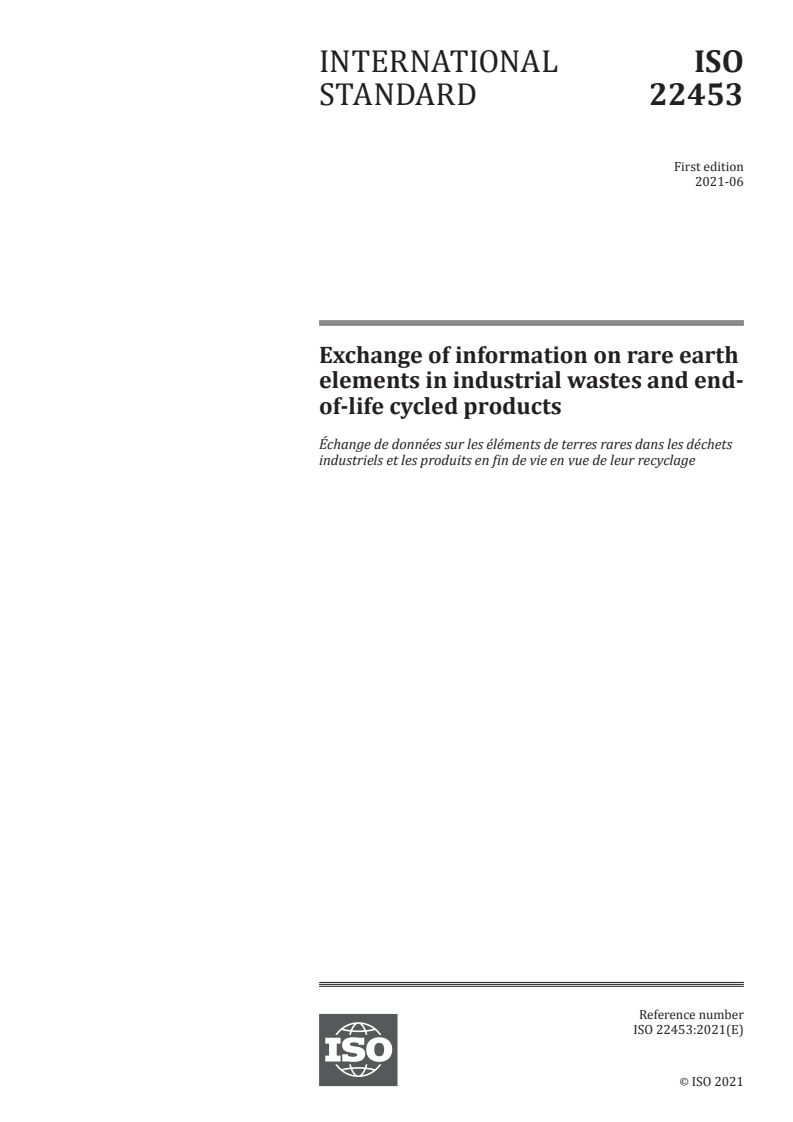
INTERNATIONAL ISO
STANDARD 22453
First edition
2021-06
Exchange of information on rare earth
elements in industrial wastes and end-
of-life cycled products
Échange de données sur les éléments de terres rares dans les déchets
industriels et les produits en fin de vie en vue de leur recyclage
Reference number
©
ISO 2021
© ISO 2021
All rights reserved. Unless otherwise specified, or required in the context of its implementation, no part of this publication may
be reproduced or utilized otherwise in any form or by any means, electronic or mechanical, including photocopying, or posting
on the internet or an intranet, without prior written permission. Permission can be requested from either ISO at the address
below or ISO’s member body in the country of the requester.
ISO copyright office
CP 401 • Ch. de Blandonnet 8
CH-1214 Vernier, Geneva
Phone: +41 22 749 01 11
Email: copyright@iso.org
Website: www.iso.org
Published in Switzerland
ii © ISO 2021 – All rights reserved
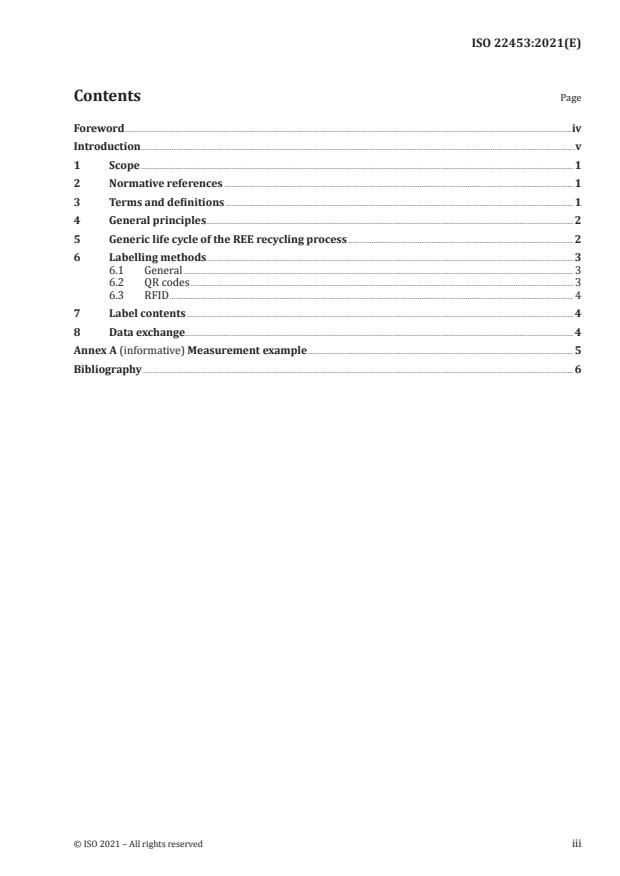
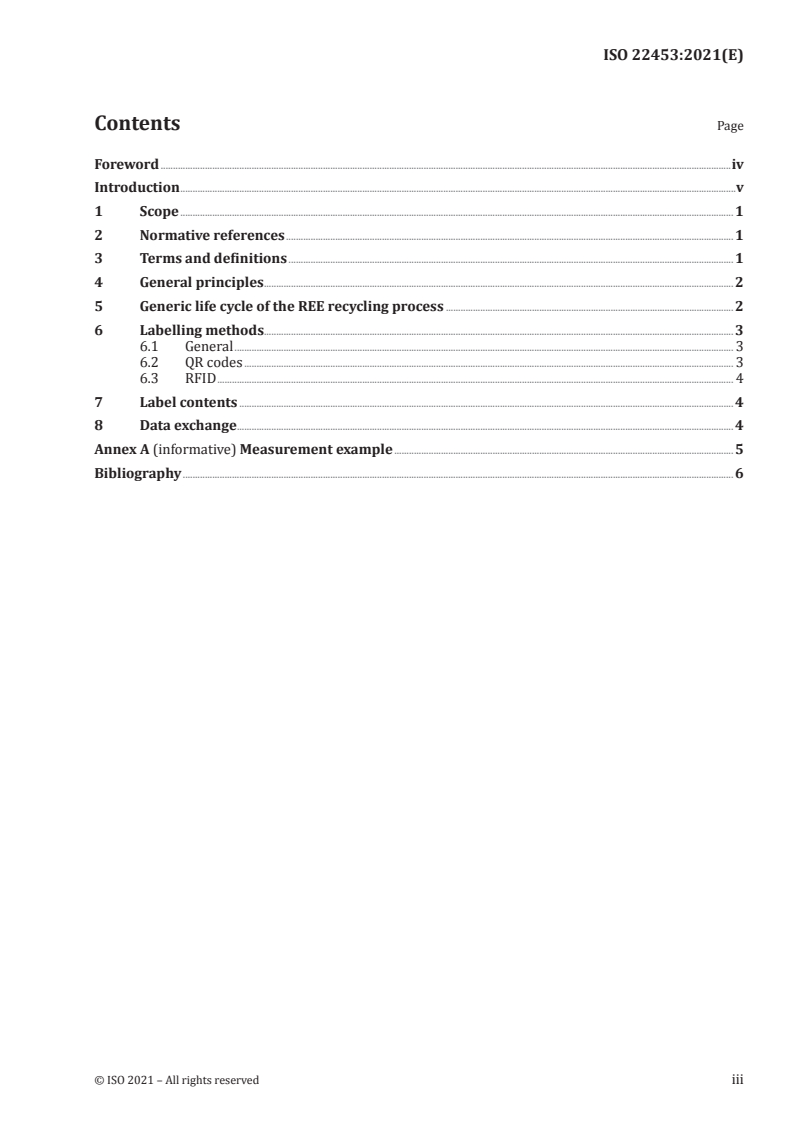
Contents Page
Foreword .iv
Introduction .v
1 Scope . 1
2 Normative references . 1
3 Terms and definitions . 1
4 General principles . 2
5 Generic life cycle of the REE recycling process . 2
6 Labelling methods. 3
6.1 General . 3
6.2 QR codes . 3
6.3 RFID . 4
7 Label contents . 4
8 Data exchange . 4
Annex A (informative) Measurement example . 5
Bibliography . 6
Foreword
ISO (the International Organization for Standardization) is a worldwide federation of national standards
bodies (ISO member bodies). The work of preparing International Standards is normally carried out
through ISO technical committees. Each member body interested in a subject for which a technical
committee has been established has the right to be represented on that committee. International
organizations, governmental and non-governmental, in liaison with ISO, also take part in the work.
ISO collaborates closely with the International Electrotechnical Commission (IEC) on all matters of
electrotechnical standardization.
The procedures used to develop this document and those intended for its further maintenance are
described in the ISO/IEC Directives, Part 1. In particular, the different approval criteria needed for the
different types of ISO documents should be noted. This document was drafted in accordance with the
editorial rules of the ISO/IEC Directives, Part 2 (see www .iso .org/ directives).
Attention is drawn to the possibility that some of the elements of this document may be the subject of
patent rights. ISO shall not be held responsible for identifying any or all such patent rights. Details of
any patent rights identified during the development of the document will be in the Introduction and/or
on the ISO list of patent declarations received (see www .iso .org/ patents).
Any trade name used in this document is information given for the convenience of users and does not
constitute an endorsement.
For an explanation of the voluntary nature of standards, the meaning of ISO specific terms and
expressions related to conformity assessment, as well as information about ISO’s adherence to the
World Trade Organization (WTO) principles in the Technical Barriers to Trade (TBT), see www .iso .org/
iso/ foreword .html.
This document was prepared by Technical Committee ISO/TC 298, Rare earth.
Any feedback or questions on this document should be directed to the user’s national standards body. A
complete listing of these bodies can be found at www .iso .org/ members .html.
iv © ISO 2021 – All rights reserved
Introduction
Rare earth elements (REEs) have become essential for a wide range of industrial applications including
electric vehicles, batteries, smartphones, displays, transparent lenses, optical fibre and so on. Due to
these varied, important applications, REEs are referred to as “vitamins of industry”. In order to ensure
the successful use of these vitamins, supply to the industry should be smooth. However, resource
scarcity creates an imbalance between supply and demand. Therefore, the importance of REEs
is increasingly significant. In order to overcome resource scarcity, the recycling or urban mining of
industrial waste and end-of-life (EOL) cycle products is necessary.
For recyclers, it is of utmost importance to know what kind of REEs are present in the waste or scrap
material, and how much can be extracted. In order to facilitate recycling, it is important to define what
information is required by the recycler, and to establish a standard method of information exchange on
REEs in industrial waste and EOL products.
Due to the lack of a standardized system and communication exchange mechanism between waste
handlers and recyclers, the ability to recycle currently lags behind what it should be. There are
many producers of the same product, but compositions and concentrations are different, which
makes it difficult and complicated for recyclers to obtain exact information about the elements being
recycled. Furthermore, if the producer and the recycler are located in different countries, information
reliability and cross-border transaction of information exchange is problematic. Therefore, a system of
information exchange between the waste handler and the recycler is needed.
This document contains a system of information exchange between waste handlers and recyclers
about REEs in industrial waste and EOL products. The system of information exchange involves a data
exchange mechanism such as quick response (QR) codes and radio frequency identification (RFID).
INTERNATIONAL STANDARD ISO 22453:2021(E)
Exchange of information on rare earth elements in
industrial wastes and end-of-life cycled products
1 Scope
This document specifies methods of information exchange between waste handlers and recyclers for
rare earth elements (REEs) contained in industrial waste and end-of-life (EOL) products. This document
facilitates the efficient recycling of REEs so that dependency on mining can be reduced by promotion of
REE recycling.
This document also includes a generic life cycle of the REE recycling process.
2 Normative references
The following documents are referred to in the text in such a way that some or all of their content
constitutes requirements of this document. For dated references, only
...
INTERNATIONAL ISO
STANDARD 22453
First edition
2021-06
Exchange of information on rare earth
elements in industrial wastes and end-
of-life cycled products
Échange de données sur les éléments de terres rares dans les déchets
industriels et les produits en fin de vie en vue de leur recyclage
Reference number
©
ISO 2021
© ISO 2021
All rights reserved. Unless otherwise specified, or required in the context of its implementation, no part of this publication may
be reproduced or utilized otherwise in any form or by any means, electronic or mechanical, including photocopying, or posting
on the internet or an intranet, without prior written permission. Permission can be requested from either ISO at the address
below or ISO’s member body in the country of the requester.
ISO copyright office
CP 401 • Ch. de Blandonnet 8
CH-1214 Vernier, Geneva
Phone: +41 22 749 01 11
Email: copyright@iso.org
Website: www.iso.org
Published in Switzerland
ii © ISO 2021 – All rights reserved
Contents Page
Foreword .iv
Introduction .v
1 Scope . 1
2 Normative references . 1
3 Terms and definitions . 1
4 General principles . 2
5 Generic life cycle of the REE recycling process . 2
6 Labelling methods. 3
6.1 General . 3
6.2 QR codes . 3
6.3 RFID . 4
7 Label contents . 4
8 Data exchange . 4
Annex A (informative) Measurement example . 5
Bibliography . 6
Foreword
ISO (the International Organization for Standardization) is a worldwide federation of national standards
bodies (ISO member bodies). The work of preparing International Standards is normally carried out
through ISO technical committees. Each member body interested in a subject for which a technical
committee has been established has the right to be represented on that committee. International
organizations, governmental and non-governmental, in liaison with ISO, also take part in the work.
ISO collaborates closely with the International Electrotechnical Commission (IEC) on all matters of
electrotechnical standardization.
The procedures used to develop this document and those intended for its further maintenance are
described in the ISO/IEC Directives, Part 1. In particular, the different approval criteria needed for the
different types of ISO documents should be noted. This document was drafted in accordance with the
editorial rules of the ISO/IEC Directives, Part 2 (see www .iso .org/ directives).
Attention is drawn to the possibility that some of the elements of this document may be the subject of
patent rights. ISO shall not be held responsible for identifying any or all such patent rights. Details of
any patent rights identified during the development of the document will be in the Introduction and/or
on the ISO list of patent declarations received (see www .iso .org/ patents).
Any trade name used in this document is information given for the convenience of users and does not
constitute an endorsement.
For an explanation of the voluntary nature of standards, the meaning of ISO specific terms and
expressions related to conformity assessment, as well as information about ISO’s adherence to the
World Trade Organization (WTO) principles in the Technical Barriers to Trade (TBT), see www .iso .org/
iso/ foreword .html.
This document was prepared by Technical Committee ISO/TC 298, Rare earth.
Any feedback or questions on this document should be directed to the user’s national standards body. A
complete listing of these bodies can be found at www .iso .org/ members .html.
iv © ISO 2021 – All rights reserved
Introduction
Rare earth elements (REEs) have become essential for a wide range of industrial applications including
electric vehicles, batteries, smartphones, displays, transparent lenses, optical fibre and so on. Due to
these varied, important applications, REEs are referred to as “vitamins of industry”. In order to ensure
the successful use of these vitamins, supply to the industry should be smooth. However, resource
scarcity creates an imbalance between supply and demand. Therefore, the importance of REEs
is increasingly significant. In order to overcome resource scarcity, the recycling or urban mining of
industrial waste and end-of-life (EOL) cycle products is necessary.
For recyclers, it is of utmost importance to know what kind of REEs are present in the waste or scrap
material, and how much can be extracted. In order to facilitate recycling, it is important to define what
information is required by the recycler, and to establish a standard method of information exchange on
REEs in industrial waste and EOL products.
Due to the lack of a standardized system and communication exchange mechanism between waste
handlers and recyclers, the ability to recycle currently lags behind what it should be. There are
many producers of the same product, but compositions and concentrations are different, which
makes it difficult and complicated for recyclers to obtain exact information about the elements being
recycled. Furthermore, if the producer and the recycler are located in different countries, information
reliability and cross-border transaction of information exchange is problematic. Therefore, a system of
information exchange between the waste handler and the recycler is needed.
This document contains a system of information exchange between waste handlers and recyclers
about REEs in industrial waste and EOL products. The system of information exchange involves a data
exchange mechanism such as quick response (QR) codes and radio frequency identification (RFID).
INTERNATIONAL STANDARD ISO 22453:2021(E)
Exchange of information on rare earth elements in
industrial wastes and end-of-life cycled products
1 Scope
This document specifies methods of information exchange between waste handlers and recyclers for
rare earth elements (REEs) contained in industrial waste and end-of-life (EOL) products. This document
facilitates the efficient recycling of REEs so that dependency on mining can be reduced by promotion of
REE recycling.
This document also includes a generic life cycle of the REE recycling process.
2 Normative references
The following documents are referred to in the text in such a way that some or all of their content
constitutes requirements of this document. For dated references, only
...