

ISO 12131-2:2023
(Main)Plain bearings — Hydrodynamic plain thrust pad bearings under steady-state conditions — Part 2: Functions for the calculation of thrust pad bearings
General Information
- Abstract
This document specifies functions for thrust pad bearings. It also covers the effect of dynamic viscosity on lubricant film temperature.
- Status
- Published
- Publication Date
- 07-Jun-2023
- Current Stage
- 6060 - International Standard published
- Start Date
- 08-Jun-2023
- Due Date
- 13-Jul-2023
- Completion Date
- 08-Jun-2023
Overview
ISO 12131-2:2023 - "Plain bearings - Hydrodynamic plain thrust pad bearings under steady-state conditions - Part 2: Functions for the calculation of thrust pad bearings" - specifies mathematical functions and supporting data used to calculate the steady-state hydrodynamic performance of oil‑lubricated thrust pad (pad) bearings. The document complements ISO 12131-1 by providing characteristic functions and covers the influence of dynamic viscosity on lubricant film temperature.
Key topics and technical requirements
- Calculation functions for thrust pad bearings, including approximations and auxiliary coefficients for practical use. Functions are provided for:
- Load carrying capacity (characteristic value F*) as a function of relative bearing width (B/L) and relative minimum film thickness (h_min/C). Range of application quoted: h_min/C = 0.1 to 10.
- Friction (characteristic value f*) versus B/L and h_min/C.
- Relative lubricant flow rates (Q1*, Q3*) as functions of B/L and h_min/C.
- Effective dynamic viscosity (η_eff) as a function of effective lubricant film temperature (T_eff). The standard references the Vogel formula for liquids and notes a practical constant (K = 95 °C) for mineral oils; it also links operational viscosity to ISO Viscosity Grade (VG) and provides relations using fluid density.
- Supporting data: tables and figures (e.g., Figures 1–5, Tables 2–5) give numerical values and charts to validate or interpolate results; formulae are approximations of numerically determined curves.
- Normative cross‑reference: ISO 12131-1:2020 (calculation methods and symbol definitions). Bibliography cites Part 3 (guide values) and foundational literature on viscosity-temperature relations.
Applications and who uses it
- Bearing designers and mechanical engineers: to size and validate hydrodynamic thrust pad bearings for machines (pumps, turbines, gearboxes, marine propulsors).
- Tribologists and lubricant specialists: to assess film thickness, friction, and temperature-dependent viscosity effects on bearing performance.
- OEMs and rotating-equipment manufacturers: for product development, specification of bearing geometry and lubricant selection.
- Condition‑monitoring and maintenance engineers: to predict steady-state operating behavior and inform lubrication and cooling strategies.
- CAE and calculation software developers: to implement standardized functions for bearing performance modules.
Related standards
- ISO 12131-1:2020 - Calculation of thrust pad bearings (symbols, boundary conditions, worked examples)
- ISO 12131-3 - Guide values for calculation of thrust pad bearings
- Relevant lubricant standards: ISO VG viscosity grades
Keywords: ISO 12131-2, plain bearings, thrust pad bearings, hydrodynamic, lubricant viscosity, load carrying capacity, friction, lubricant flow rates, ISO VG, bearing calculation.
Relations
- Effective Date
- 06-Jun-2022
Frequently Asked Questions
ISO 12131-2:2023 is a standard published by the International Organization for Standardization (ISO). Its full title is "Plain bearings — Hydrodynamic plain thrust pad bearings under steady-state conditions — Part 2: Functions for the calculation of thrust pad bearings". This standard covers: This document specifies functions for thrust pad bearings. It also covers the effect of dynamic viscosity on lubricant film temperature.
This document specifies functions for thrust pad bearings. It also covers the effect of dynamic viscosity on lubricant film temperature.
ISO 12131-2:2023 is classified under the following ICS (International Classification for Standards) categories: 21.100.10 - Plain bearings. The ICS classification helps identify the subject area and facilitates finding related standards.
ISO 12131-2:2023 has the following relationships with other standards: It is inter standard links to ISO 12131-2:2016. Understanding these relationships helps ensure you are using the most current and applicable version of the standard.
ISO 12131-2:2023 is available in PDF format for immediate download after purchase. The document can be added to your cart and obtained through the secure checkout process. Digital delivery ensures instant access to the complete standard document.
Standards Content (Sample)
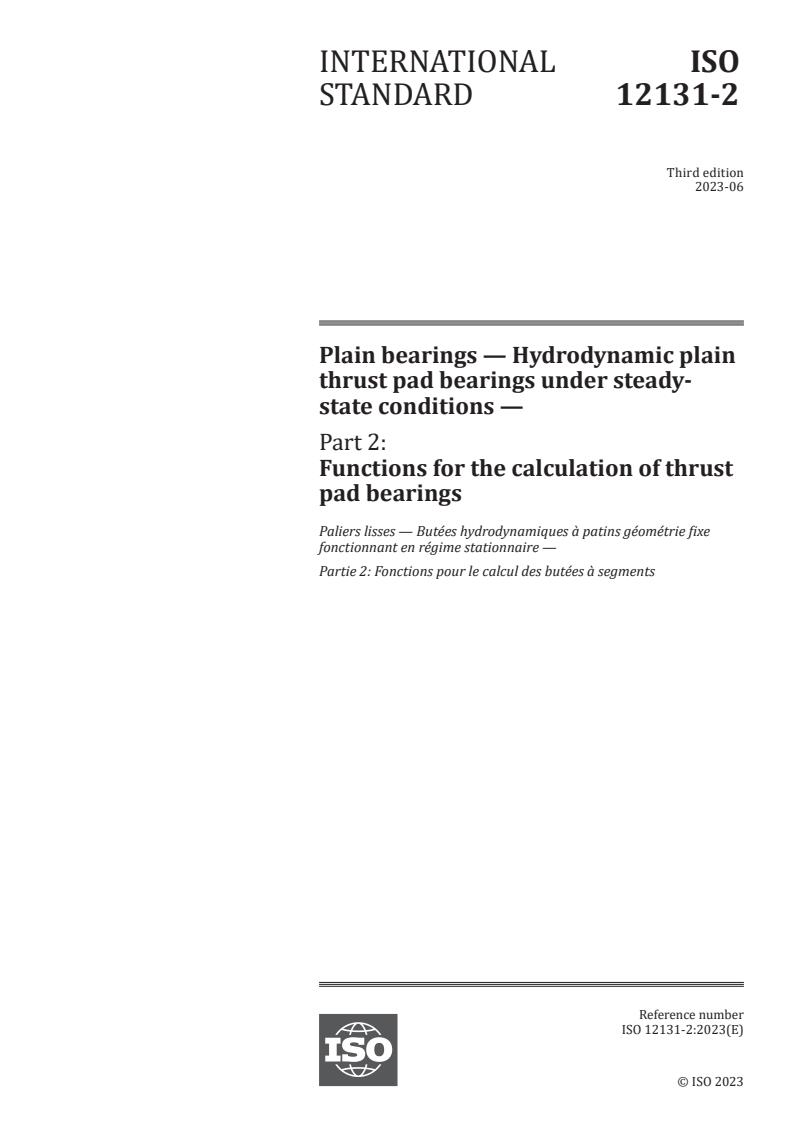
INTERNATIONAL ISO
STANDARD 12131-2
Third edition
2023-06
Plain bearings — Hydrodynamic plain
thrust pad bearings under steady-
state conditions —
Part 2:
Functions for the calculation of thrust
pad bearings
Paliers lisses — Butées hydrodynamiques à patins géométrie fixe
fonctionnant en régime stationnaire —
Partie 2: Fonctions pour le calcul des butées à segments
Reference number
© ISO 2023
All rights reserved. Unless otherwise specified, or required in the context of its implementation, no part of this publication may
be reproduced or utilized otherwise in any form or by any means, electronic or mechanical, including photocopying, or posting on
the internet or an intranet, without prior written permission. Permission can be requested from either ISO at the address below
or ISO’s member body in the country of the requester.
ISO copyright office
CP 401 • Ch. de Blandonnet 8
CH-1214 Vernier, Geneva
Phone: +41 22 749 01 11
Email: copyright@iso.org
Website: www.iso.org
Published in Switzerland
ii
Contents Page
Foreword .iv
Introduction .v
1 Scope . 1
2 Normative references . 1
3 Terms and definitions . 1
4 Symbols, terms and units .1
5 Functions for the thrust pad bearing . 2
5.1 Load carrying capacity . 2
5.2 Friction for thrust pad bearings . 4
5.3 Relative lubricant flow rates . 6
6 Effective dynamic viscosity of the lubricant, η , as a function of the effective
eff
lubricant film temperature, T . 9
eff
Bibliography .11
iii
Foreword
ISO (the International Organization for Standardization) is a worldwide federation of national standards
bodies (ISO member bodies). The work of preparing International Standards is normally carried out
through ISO technical committees. Each member body interested in a subject for which a technical
committee has been established has the right to be represented on that committee. International
organizations, governmental and non-governmental, in liaison with ISO, also take part in the work.
ISO collaborates closely with the International Electrotechnical Commission (IEC) on all matters of
electrotechnical standardization.
The procedures used to develop this document and those intended for its further maintenance are
described in the ISO/IEC Directives, Part 1. In particular, the different approval criteria needed for the
different types of ISO documents should be noted. This document was drafted in accordance with the
editorial rules of the ISO/IEC Directives, Part 2 (see www.iso.org/directives).
Attention is drawn to the possibility that some of the elements of this document may be the subject of
patent rights. ISO shall not be held responsible for identifying any or all such patent rights. Details of
any patent rights identified during the development of the document will be in the Introduction and/or
on the ISO list of patent declarations received (see www.iso.org/patents).
Any trade name used in this document is information given for the convenience of users and does not
constitute an endorsement.
For an explanation of the voluntary nature of standards, the meaning of ISO specific terms and
expressions related to conformity assessment, as well as information about ISO's adherence to
the World Trade Organization (WTO) principles in the Technical Barriers to Trade (TBT), see
www.iso.org/iso/foreword.html.
This document was prepared by Technical Committee ISO/TC 123, Plain bearings, Subcommittee SC 8,
Calculation methods for plain bearings and their applications.
This third edition cancels and replaces the second edition (ISO 12131-2:2016), which has been
technically revised.
The main changes are as follows:
— Formula (1) has been corrected;
— Table 1 has been added;
— some editorial corrections have been made.
A list of all parts in the ISO 12131 series can be found on the ISO website.
Any feedback or questions on this document should be directed to the user’s national standards body. A
complete listing of these bodies can be found at www.iso.org/members.html.
iv
Introduction
Assuming hydrodynamic conditions with full lubrication, the functions of the type covered by this
document are necessary for the calculation of oil-lubricated pad thrust bearings in accordance with
ISO 12131-1. They are based on the premises and boundary conditions specified. The values necessary
for the calculation can be determined by means of the given formulae, as well as from diagrams and
tables. The formulae in this document are approximations of the numerically determined values traced
as curves according to Reference [2]. The explanation of the symbols, as well as examples for the
calculation, are included in ISO 12131-1.
v
INTERNATIONAL STANDARD ISO 12131-2:2023(E)
Plain bearings — Hydrodynamic plain thrust pad bearings
under steady-state conditions —
Part 2:
Functions for the calculation of thrust pad bearings
1 Scope
This document specifies functions for thrust pad bearings. It also covers the effect of dynamic viscosity
on lubricant film temperature.
2 Normative references
The following documents are referred to in the text in such a way that some or all of their content
constitutes requirements of this document. For dated references, only the edition cited applies. For
undated references, the latest edition of the referenced document (including any amendments) applies.
ISO 12131-1:2020, Plain bearings — Hydrodynamic plain thrust pad bearings under steady-state conditions
— Part 1: Calculation of thrust pad bearings
3 Terms and definitions
No terms and definitions are listed in this document.
ISO and IEC maintain terminology databases for use in standardization at the following addresses:
— ISO Online browsing platform: available at https:// www .iso .org/ obp
— IEC Electropedia: available at https:// www .electropedia .org/
4 Symbols, terms and units
Symbols and units are defined in Table 1. Any symbols not listed in Table 1 shall be defined in accordance
with ISO 12131-1:2020, Table 1.
Table 1 — Symbols, terms, and units
Symbol Term Unit
i (index) Consecutive number 1
*
A , A , A , A Auxiliary quantity 1
1 3 i
*
B , B , B , B Auxiliary quantity 1
1 3 i
*
C Auxiliary quantity 1
K “Thickness” of oil Pa·s
K Inherent viscosity-temperature dependence of oil °C
K Oil temperature for infinite viscosity °C
VG ISO Viscosity Grade 1
α Auxiliary quantity 1
η Constant coefficient Pa·s
x
5 Functions for the thrust pad bearing
5.1 Load carrying capacity
*
Characteristic value of load carrying capacity, F , as a function of the relative bearing length, B/L, and
B
the relative minimum lubricant film thickness, h /C is defined by Formula (1) using the auxiliary
min wed
* * *
quantities α, A , B and C .
Approximation of the curves of Figure 1 (range of application: 0,1 ≤ h /C ≤ 10).
min wed
l h 1 + hC/
wed min min wed
× × ln
L C h /C
wed miin wed
*
2 2
F =×5
B
l 1 l l h l
wed wedwed min wed
×
...