

ISO/TR 24419-2:2023
(Main)Mine closure and reclamation – Managing mining legacies — Part 2: Case studies and bibliography
General Information
- Abstract
This document is a supplementary document to the International standard for managing mining legacies (ISO 24419-1) that provides illustrative case studies and resources providing further reading. The content provided in this document covers various regions of the world as a supplement to ISO 24419-1. The purpose is to provide insight into specific case studies that show how practitioners have addressed mining legacy challenges in practice. This document does not provide instructions for managing mining legacies, but instead a resource with insights from other practitioners, thereby widening knowledge of what can be required to effectively manage mining legacies.
- Status
- Published
- Publication Date
- 16-Oct-2023
- Technical Committee
- ISO/TC 82/SC 7 - Mine closure and reclamation management
- Drafting Committee
- ISO/TC 82/SC 7 - Mine closure and reclamation management
- Current Stage
- 6060 - International Standard published
- Start Date
- 17-Oct-2023
- Due Date
- 27-May-2024
- Completion Date
- 17-Oct-2023

Overview
ISO/TR 24419-2:2023, Mine closure and reclamation - Managing mining legacies - Part 2: Case studies and bibliography, is a Technical Report published by ISO that supplements ISO 24419-1. Rather than prescribing procedures, this document compiles illustrative case studies, lessons learned and a curated bibliography from around the world to broaden practitioner understanding of practical approaches for managing mining legacies. It is a reference resource that documents real-world experiences - from legal reforms and funding models to community engagement and technical remediation - across diverse geographies and mine types.
Key topics covered
The report organizes practical insight into recurring themes and examples, including:
- Case studies from multiple jurisdictions (Canada, Australia, South Africa, Germany, France, USA, China, New Caledonia, Chile, Finland, Mali and others).
- Design and stakeholder engagement in complex remediation projects (e.g., Giant Mine).
- Program performance evaluation and reporting for legacy mine programs.
- Remediation techniques for abandoned and contaminated sites, including uranium and asbestos mine fields.
- Integration of traditional knowledge into rehabilitation planning.
- Legal and regulatory improvements informed by closure difficulties.
- Funding and long‑term financing models, such as national funds, foundations, public–private partnerships and biodiversity offsets.
- Operational topics: monitoring and early warning systems for tailings storage facilities (TSFs), maintenance of rehabilitated sites, and program resourcing.
- Bibliography and further reading to support deeper technical or policy research.
Note: As a Technical Report, ISO/TR 24419-2 does not establish normative requirements or mandatory procedures; it provides documented examples and references to inform decision-making.
Practical applications and who uses it
This report is valuable to:
- Mine operators and closure planners seeking examples of remediation and stewardship approaches.
- Regulators and policymakers designing frameworks for abandoned mine management, financial assurance and long‑term obligations.
- Environmental and geotechnical consultants looking for precedent cases and lessons learned for technical design, monitoring and stakeholder engagement.
- Community stakeholders and Indigenous groups interested in how traditional knowledge and social engagement have been incorporated in other projects.
- Financiers and fund managers assessing models for perpetual care, legacy funds and biodiversity offset financing.
- Researchers and educators using the bibliography and case studies for applied studies in mine closure and reclamation.
Related standards and resources
- ISO 24419-1 - the primary standard on managing mining legacies (normative guidance).
- National mining codes, environmental regulations, and technical guidance cited within the report (see bibliography in ISO/TR 24419-2 for full references).
Keywords: mine closure, reclamation, managing mining legacies, ISO 24419-2, case studies, tailings monitoring, legacy rehabilitation, funding mechanisms, biodiversity offsets.
Get Certified
Connect with accredited certification bodies for this standard

Bureau Veritas Chile
Bureau Veritas certification services in Chile.
Bureau Veritas Peru
Bureau Veritas certification services in Peru.
BVQI Peru
Bureau Veritas certification in Peru.
Sponsored listings
Frequently Asked Questions
ISO/TR 24419-2:2023 is a technical report published by the International Organization for Standardization (ISO). Its full title is "Mine closure and reclamation – Managing mining legacies — Part 2: Case studies and bibliography". This standard covers: This document is a supplementary document to the International standard for managing mining legacies (ISO 24419-1) that provides illustrative case studies and resources providing further reading. The content provided in this document covers various regions of the world as a supplement to ISO 24419-1. The purpose is to provide insight into specific case studies that show how practitioners have addressed mining legacy challenges in practice. This document does not provide instructions for managing mining legacies, but instead a resource with insights from other practitioners, thereby widening knowledge of what can be required to effectively manage mining legacies.
This document is a supplementary document to the International standard for managing mining legacies (ISO 24419-1) that provides illustrative case studies and resources providing further reading. The content provided in this document covers various regions of the world as a supplement to ISO 24419-1. The purpose is to provide insight into specific case studies that show how practitioners have addressed mining legacy challenges in practice. This document does not provide instructions for managing mining legacies, but instead a resource with insights from other practitioners, thereby widening knowledge of what can be required to effectively manage mining legacies.
ISO/TR 24419-2:2023 is classified under the following ICS (International Classification for Standards) categories: 73.020 - Mining and quarrying. The ICS classification helps identify the subject area and facilitates finding related standards.
ISO/TR 24419-2:2023 is available in PDF format for immediate download after purchase. The document can be added to your cart and obtained through the secure checkout process. Digital delivery ensures instant access to the complete standard document.
Standards Content (Sample)
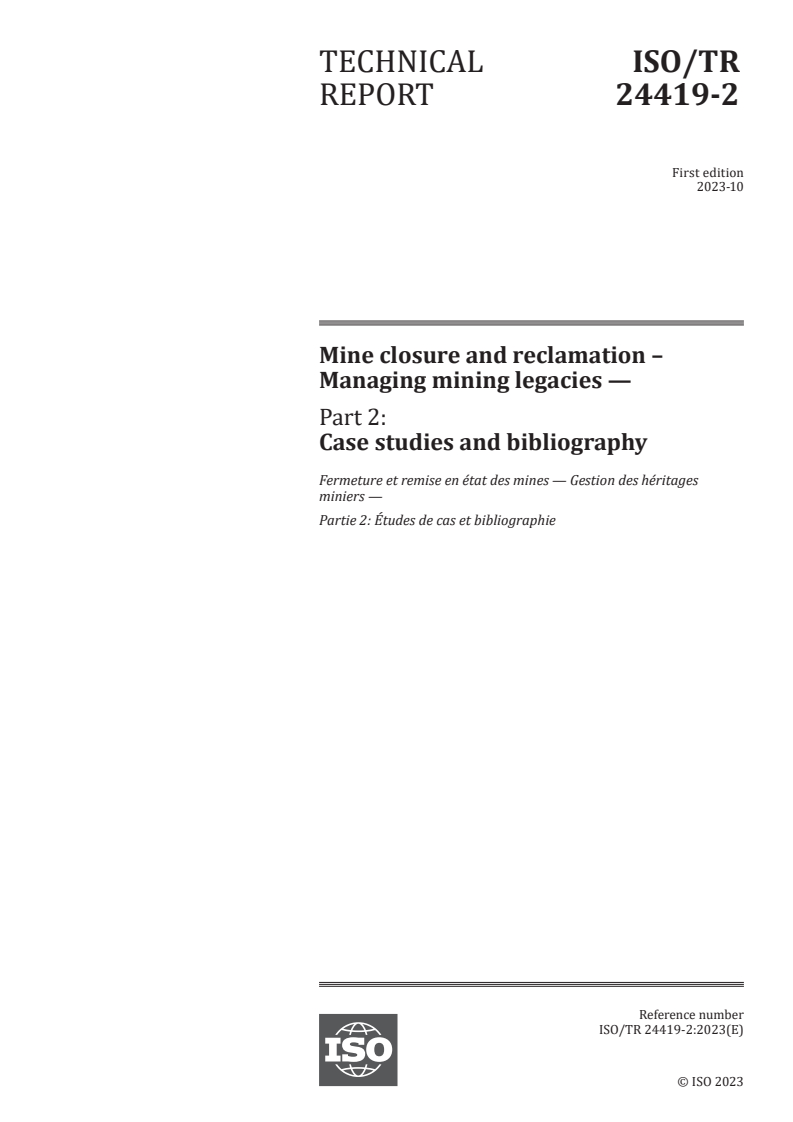
TECHNICAL ISO/TR
REPORT 24419-2
First edition
2023-10
Mine closure and reclamation –
Managing mining legacies —
Part 2:
Case studies and bibliography
Fermeture et remise en état des mines — Gestion des héritages
miniers —
Partie 2: Études de cas et bibliographie
Reference number
© ISO 2023
All rights reserved. Unless otherwise specified, or required in the context of its implementation, no part of this publication may
be reproduced or utilized otherwise in any form or by any means, electronic or mechanical, including photocopying, or posting on
the internet or an intranet, without prior written permission. Permission can be requested from either ISO at the address below
or ISO’s member body in the country of the requester.
ISO copyright office
CP 401 • Ch. de Blandonnet 8
CH-1214 Vernier, Geneva
Phone: +41 22 749 01 11
Email: copyright@iso.org
Website: www.iso.org
Published in Switzerland
ii
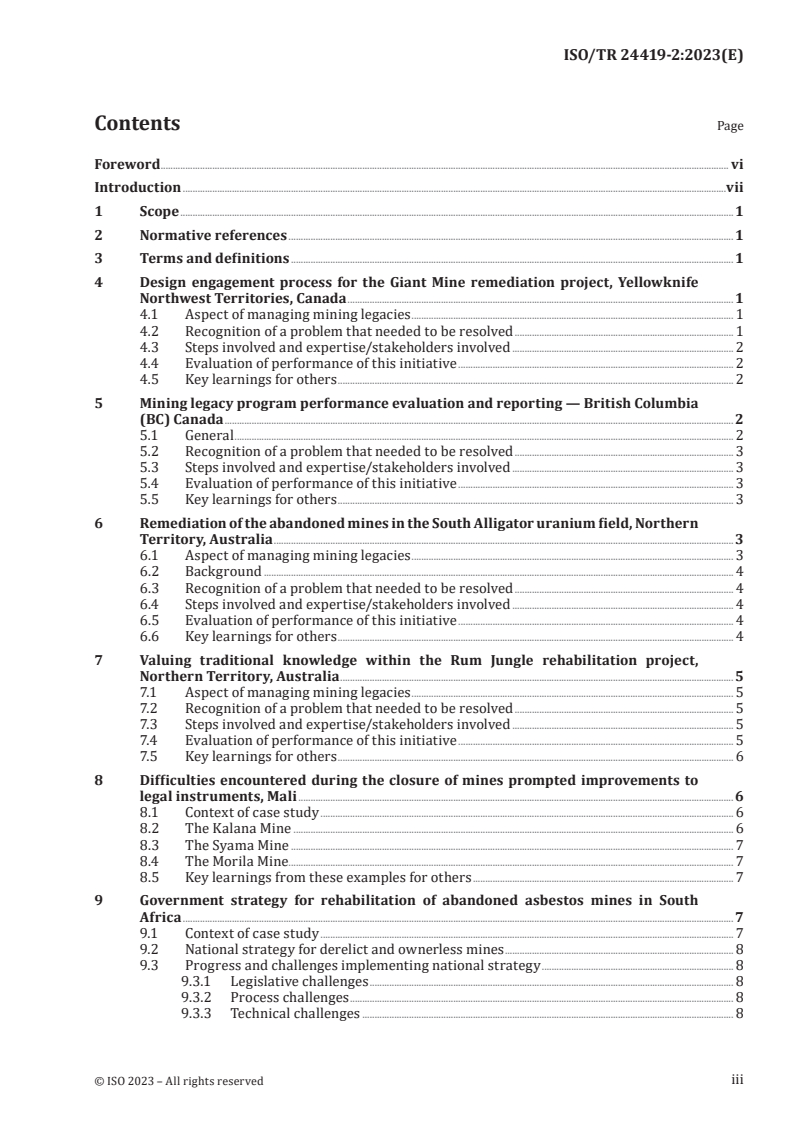
Contents Page
Foreword . vi
Introduction .vii
1 Scope . 1
2 Normative references . 1
3 Terms and definitions . 1
4 Design engagement process for the Giant Mine remediation project, Yellowknife
Northwest Territories, Canada . 1
4.1 Aspect of managing mining legacies . 1
4.2 Recognition of a problem that needed to be resolved . 1
4.3 Steps involved and expertise/stakeholders involved . 2
4.4 Evaluation of performance of this initiative . 2
4.5 Key learnings for others . 2
5 Mining legacy program performance evaluation and reporting — British Columbia
(BC) Canada . 2
5.1 General . 2
5.2 Recognition of a problem that needed to be resolved . 3
5.3 Steps involved and expertise/stakeholders involved . 3
5.4 Evaluation of performance of this initiative . 3
5.5 Key learnings for others . 3
6 Remediation of the abandoned mines in the South Alligator uranium field, Northern
Territory, Australia .3
6.1 Aspect of managing mining legacies . 3
6.2 Background . 4
6.3 Recognition of a problem that needed to be resolved . 4
6.4 Steps involved and expertise/stakeholders involved . 4
6.5 Evaluation of performance of this initiative . 4
6.6 Key learnings for others . 4
7 Valuing traditional knowledge within the Rum Jungle rehabilitation project,
Northern Territory, Australia . 5
7.1 Aspect of managing mining legacies . 5
7.2 Recognition of a problem that needed to be resolved . 5
7.3 Steps involved and expertise/stakeholders involved . 5
7.4 Evaluation of performance of this initiative . 5
7.5 Key learnings for others . 6
8 Difficulties encountered during the closure of mines prompted improvements to
legal instruments, Mali . 6
8.1 Context of case study . 6
8.2 The Kalana Mine . 6
8.3 The Syama Mine . 7
8.4 The Morila Mine . . 7
8.5 Key learnings from these examples for others . 7
9 Government strategy for rehabilitation of abandoned asbestos mines in South
Africa . 7
9.1 Context of case study . 7
9.2 National strategy for derelict and ownerless mines . 8
9.3 Progress and challenges implementing national strategy . 8
9.3.1 Legislative challenges . 8
9.3.2 Process challenges . 8
9.3.3 Technical challenges . 8
iii
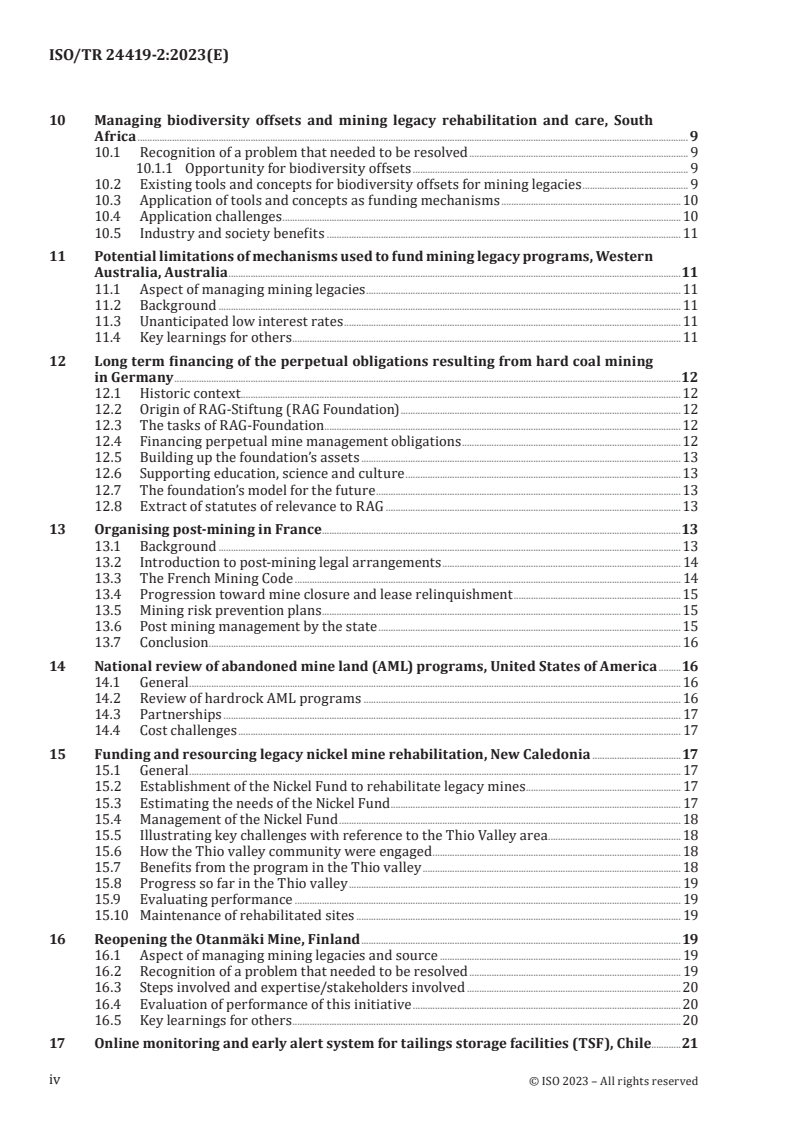
10 Managing biodiversity offsets and mining legacy rehabilitation and care, South
Africa . 9
10.1 Recognition of a problem that needed to be resolved . 9
10.1.1 Opportunity for biodiversity offsets . 9
10.2 Existing tools and concepts for biodiversity offsets for mining legacies . 9
10.3 Application of tools and concepts as funding mechanisms . 10
10.4 Application challenges . 10
10.5 Industry and society benefits . 11
11 Potential limitations of mechanisms used to fund mining legacy programs, Western
Australia, Australia .11
11.1 Aspect of managing mining legacies . 11
11.2 Background . 11
11.3 Unanticipated low interest rates . 11
11.4 Key learnings for others . 11
12 Long term financing of the perpetual obligations resulting from hard coal mining
in Germany .12
12.1 Historic context. 12
12.2 Origin of RAG-Stiftung (RAG Foundation) .12
12.3 The tasks of RAG-Foundation .12
12.4 Financing perpetual mine management obligations .12
12.5 Building up the foundation’s assets . 13
12.6 Supporting education, science and culture . 13
12.7 The foundation’s model for the future . 13
12.8 Extract of statutes of relevance to RAG . 13
13 Organising post-mining in France .13
13.1 Background . 13
13.2 Introduction to post-mining legal arrangements . 14
13.3 The French Mining Code . 14
13.4 Progression toward mine closure and lease relinquishment . 15
13.5 Mining risk prevention plans . 15
13.6 Post mining management by the state . 15
13.7 Conclusion . 16
14 National review of abandoned mine land (AML) programs, United States of America .16
14.1 General . 16
14.2 Review of hardrock AML programs . 16
14.3 Partnerships . 17
14.4 Cost challenges . 17
15 Funding and resourcing legacy nickel mine rehabilitation, New Caledonia .17
15.1 General . 17
15.2 Establishment of the Nickel Fund to rehabilitate legacy mines . 17
15.3 Estimating the needs of the Nickel Fund . 17
15.4 Management of the Nickel Fund . 18
15.5 Illustrating key challenges with reference to the Thio Valley area . 18
15.6 How the Thio valley community were engaged . 18
15.7 Benefits from the program in the Thio valley . 18
15.8 Progress so far in the Thio valley . 19
15.9 Evaluating performance . 19
15.10 Maintenance of rehabilitated sites . 19
16 Reopening the Otanmäki Mine, Finland .19
16.1 Aspect of managing mining legacies and source . 19
16.2 Recognition of a problem that needed to be resolved . 19
16.3 Steps involved and expertise/stakeholders involved . 20
16.4 Evaluation of performance of this initiative . 20
16.5 Key learnings for others .20
17 Online monitoring and early alert system for tailings storage facilities (TSF), Chile.21
iv
17.1 Background . 21
17.2 Transparent tailings initiative . 21
17.3 Purpose of initiative . 21
17.4 System design . 22
18 Public private partnership funding mode of legacy Green Golden Lake coal mining
rehabilitation program, China .23
18.1 Introduction of China managing mine legacy . 23
18.2 Green Golden Lake coal mining rehabilitation program . 23
18.2.1 Background . 23
18.2.2 Recognition of a financial problem that needed to be resolved .23
18.2.3 Evaluation of performance of this initiative . 24
18.2.4 Key learning for others . 24
19 Structured case studies .24
Bibliography .37
v
Foreword
ISO (the International Organization for Standardization) is a worldwide federation of national standards
bodies (ISO member bodies). The work of preparing International Standards is normally carried out
through ISO technical committees. Each member body interested in a subject for which a technical
committee has been established has the right to be represented on that committee. International
organizations, governmental and non-governmental, in liaison with ISO, also take part in the work.
ISO collaborates closely with the International Electrotechnical Commission (IEC) on all matters of
electrotechnical standardization.
The procedures used to develop this document and those intended for its further maintenance are
described in the ISO/IEC Directives, Part 1. In particular, the different approval criteria needed for the
different types of ISO document should be noted. This document was drafted in accordance with the
editorial rules of the ISO/IEC Directives, Part 2 (see www.iso.org/directives).
ISO draws attention to the possibility that the implementation of this document may involve the use
of (a) patent(s). ISO takes no position concerning the evidence, validity or applicability of any claimed
patent rights in respect thereof. As of the date of publication of this document, ISO had not received
notice of (a) patent(s) which may be required to implement this document. However, implementers are
cautioned that this may not represent the latest information, which may be obtained from the patent
database available at www.iso.org/patents. ISO shall not be held responsible for identifying any or all
such patent rights.
Any trade name used in this document is information given for the convenience of users and does not
constitute an endorsement.
For an explanation of the voluntary nature of standards, the meaning of ISO specific terms and
expressions related to conformity assessment, as well as information about ISO's adherence to
the World Trade Organization (WTO) principles in the Technical Barriers to Trade (TBT), see
www.iso.org/iso/foreword.html.
This document was prepared by Technical Committee ISO/TC 82, Mining, Subcommittee SC 7, Mine
closure and reclamation management.
Any feedback or questions on this document should be directed to the user’s national standards body. A
complete listing of these bodies can be found at https://www.iso.org/members.html
vi
Introduction
This document includes case studies and a bibliography provided by working group members and has
been separated from the standard so that development of the two documents proceeded in parallel.
These resources provide supporting information and illustration of various aspects of the managing
mining legacy standard. While expanding upon some of the content of the guidance of the standard, it
cannot be assumed that a particular strategy that was applied in one context is directly applicable to
another. Not every clause in the standard has a corresponding case study. Instead, clause activities are
revealed in an integrated way as they occur in practice within these cases. In addition to descriptive
case studies, there are some table-format case studies toward the end, that illustrate how inventories
can be structured and developed. The bibliography expands the resources available to those applying
ISO 24419-1. This bibliography is not fully comprehensive of all global regions but instead are important
and relevant at the time of preparation of the standard. As management of mining legacies evolves,
further resources are likely to emerge. It is up to the user to adapt and apply their understandings of
the ISO 24419-1 standard and this Technical Report to local circumstances.
vii
TECHNICAL REPORT ISO/TR 24419-2:2023(E)
Mine closure and reclamation – Managing mining
legacies —
Part 2:
Case studies and bibliography
1 Scope
This document is a supplementary document to the International standard for managing mining legacies
(ISO 24419-1) that provides illustrative case studies and resources providing further reading. The
content provided in this document covers various regions of the world as a supplement to ISO 24419-1.
The purpose is to provide insight into specific case studies that show how practitioners have addressed
mining legacy challenges in practice. This document does not provide instructions for managing mining
legacies, but instead a resource with insights from other practitioners, thereby widening knowledge of
what can be required to effectively manage mining legacies.
2 Normative references
The following documents are referred to in the text in such a way that some or all of their content
constitutes requirements of this document. For dated references, only the edition cited applies. For
undated references, the latest edition of the referenced document (including any amendments) applies.
ISO 24419-1, Mine closure and reclamation — Managing mining legacies — Part 1: Requirements and
recommendations
3 Terms and definitions
For the purposes of this document, the terms and definitions given in ISO 24419-1 apply.
ISO and IEC maintain terminology databases for use in standardization at the following addresses:
— ISO Online browsing platform: available at https:// www .iso .org/ obp
— IEC Electropedia: available at https:// www .electropedia .org/
4 Design engagement process for the Giant Mine remediation project,
Yellowknife Northwest Territories, Canada
4.1 Aspect of managing mining legacies
This case study describes stakeholder engagement and consultation for management of a large
mining legacy by the Canadian Government to addressing the historic legacy whilst also developing a
collaborative engagement process. See Reference [32].
4.2 Recognition of a problem that needed to be resolved
In 1999, the Giant Mine went into receivership and subsequently became an abandoned mine under
the responsibility of the Government of Canada. The roughly 50 years period of gold mining resulted in
significant disturbance to the land and water, and severe impacts on the health and lifestyles of local
people, especially Indigenous groups. The project developed an initial remediation plan for the site in
2007 that failed to receive wide spread public support and a subsequent Environmental Assessment
raised significant public concerns. In 2014, the project team concluded that the remediation plan
required a more meaningful engagement process with stakeholders in order to build public trust and
obtain support for the management and remediation of the abandoned mine.
4.3 Steps involved and expertise/stakeholders involved
In late 2014, the project proposed a 2 year engagement process to stakeholders that involved a series
of multi-day workshops. Stakeholders had a large role in developing the engagement process and
ensuring the process would be meaningful to them. The series of meetings, reports and workshops
addressed public education and preparation, stakeholder objectives, development of closure options,
risk assessment and review, and finally the evaluation of options for the abandoned mine.
During the engagement process, the project recognized that the Indigenous and other local groups
were not meaningfully engaged on what happened at Giant Mine for almost all of its operating life. More
effective engagement could not address all the wrongs in a 50 year history, but it could contribute to
reconciliation and a different future. Participants in the engagement process were asked to remember
the past and its lessons, but to focus on how the Giant Mine could be managed in the future.
4.4 Evaluation of performance of this initiative
Since the completion of the engagement process in 2016, the stakeholder evaluation results have been
used by the Government of Canada in selecting closure options for Giant Mine. Key decisions informed
by the engagement included the selection of closure options for open pits, tailings areas, water
management and future land use. Many of these options differed significantly from the initial closure
plan and the decisions made based on engagement were communicated back to stakeholders.
A favourable outcome of the engagement process is that while the final plan could not reflect every
stakeholder group’s first choice for closure, there was an understanding of the many other perspectives
that need to be considered in selecting closure options and the management of abandoned mines. The
engagement process significantly increased stakeholder understanding of the mine and improved the
project’s relationship with stakeholders.
The revised Giant Mine Closure Plan was resubmitted for regulatory review and resulted in public
support being voiced for the plan by stakeholders. Regulatory approval for the remediation of the Giant
Mine is expected in August 2020, over 20 years since the site was abandoned by its last owner.
4.5 Key learnings for others
The Giant Mine demonstrated the importance of incorporating meaningful stakeholder input into all
aspects of an abandoned mine, from planning, option selection, through to long-term care, in order to
ensure stakeholder concerns are addressed. This is particularly important where there is a difficult
historical legacy, that if left unaddressed, can make moving the project forward and securing regulatory
and other approvals difficult.
5 Mining legacy program performance evaluation and reporting — British
Columbia (BC) Canada
5.1 General
Performance reporting on a mining legacy program is part of the Crown Contaminated Sites Program
(CCSP) in BC, Canada. This program was restructured following on Auditor General report that
recommended improvements to accountability and transparency and overall performance of the
program. This case study is largely drawn from Reference [12]. Later performance reports on the BC
program indicate that about 80 % of the sites in this program are mining legacies – see References [10]
and [11].
5.2 Recognition of a problem that needed to be resolved
The purpose of the Auditor General’s audit was to assess whether the Province had an adequate program
for managing its contaminated sites and whether it was adequately accounting for its performance.
Specifically, they examined whether the provincial government had:
— established an adequate governance framework;
— gathered appropriate information to develop management plans and to support resource allocations;
and
— accounted adequately for its overall performance.
5.3 Steps involved and expertise/stakeholders involved
The BC auditor general conducted an audit of the CCSP and found the program was inadequate.
Following up on the audit, recommendations were made (Clause 5) and the program was restructured.
A link is provided to performance reports of the CCSP to show how the recommended actions were
implemented. See References [10] and [11]. Every two years a performance report like this is published.
Historic reports provide further insights.
5.4 Evaluation of performance of this initiative
Key findings of the audit copied:
The Province does not have an adequate program in place for managing its contaminated sites and is
not adequately accounting for its performance. Significant improvements are required in three main
areas.
First, the foundation needed for a sound program is lacking. Ministries and agencies are not being
guided by clear direction from government, and roles and responsibilities are not clearly defined. While
some progress is being made, it varies from organization to organization. Some are well underway in
incorporating a contaminated sites policy into their portfolio; others are only at the early stages of
doing this.
Second, there are significant gaps in the information ministries and agencies need to develop
management plans and to make resource allocation decisions. As a result, few management plans are in
place and no government-wide plan exists.
Third, without a clear, coordinated program for guiding contaminated site management activities,
ministries and agencies are unable to account in a meaningful way on their progress in dealing with the
risks and liabilities posed by contaminated sites.
5.5 Key learnings for others
The important role of independent auditing of programs is demonstrated. The improvements
made ensure that managing mining legacies is more effective at reducing liability as well as being
transparent. Performance is reviewed and made public in an accessible easy to read form that improves
the reputation of governments managing these sites. A research report includes more detail on this and
other programs reviewed as part of a Churchill Fellowship. See Reference [6].
6 Remediation of the abandoned mines in the South Alligator uranium field,
Northern Territory, Australia
6.1 Aspect of managing mining legacies
Knowledge sharing between all stakeholders.
6.2 Background
Work was carried out between 1999 and 2007 in various phases. The Commonwealth Government was
responsible for getting work done with federal parks agency as lead but other agencies from Federal
and Northern Territory Governments involved. Original survey work was undertaken in 1986 but
consultation with Indigenous people was not organised until 1990s.
6.3 Recognition of a problem that needed to be resolved
In 1952/3, exploration for uranium commenced in the upper valley of the South Alligator River,
Northern Territory, Australia. Prior to 1962 more than 50 exploration sites and 17 small mining sites
and three processing sites were operated. Then, all work stopped, and sites were abandoned. In 1986
a survey took place to inventory sites. This was to gain knowledge of rehabilitation requirements
prior to the area being designated stage 3 of the World Heritage Listed Kakadu National Park. Stage 3
was incorporated in 1988 and the lease from the Traditional Owners required that all mining sites be
remediated by 2015 at the expense of the Commonwealth Government and to the satisfaction of the
Traditional Owners.
6.4 Steps involved and expertise/stakeholders involved
In 1992 a programme of hazard reduction work was carried out to mitigate radiation and physical safety
risks for tourists and other visitors to the valley. There was little consultation with the Traditional
Owners. In 2000 work began to consult with Traditional Owners on what they wanted to see in terms
of rehabilitation and for experts to prepare options for discussion. Consultations were extensive and
had frequency that did not over stress Traditional Owners but enabled regular progress to be made
on the planning for rehabilitation. Meetings were held on that incorporated site visits during the
dry season; wet season meetings were less frequent and were held in a variety of locations including
nearby motels and communities. The style of meeting was arranged to be less formal than usual but
with a structure determined by the Traditional Owners that was in sympathy with their traditional
governance mechanisms.
6.5 Evaluation of performance of this initiative
Work progress was slow in terms of obtaining data but this often related to the timing of meetings
to obtain approval for studies and the delay in obtaining funds from government. Once designs had
been completed there were further delays until funds to undertake civil engineering works (such
as construction of the containment for all radioactive residues) could be made available. Traditional
Owners were offered work and training opportunities during the construction phases as well as being
employed to provide cultural advice on access to sites and issues of possible presence of sacred sites.
6.6 Key learnings for others
The involvement of Traditional Owners was essential to the long-term success of this programme. The
development of a process for meetings that was sympathetic to the traditional governance mechanisms
of the Traditional Owners was a vital part of the process and has been repeated elsewhere successfully.
The lack of clarity in funding was a major cause of delays in implementation. Designs were completed,
however these waited for four years before government finance could be found to support their
implementation. Patience was essential at all stages in dealing with both the Traditional Owners and
governments.
7 Valuing traditional knowledge within the Rum Jungle rehabilitation project,
Northern Territory, Australia
7.1 Aspect of managing mining legacies
The former Rum Jungle Uranium Mine (Rum Jungle) is a mining legacy site located on Indigenous
owned land. This case study describes the value of stakeholder input into decision making. The content
is derived from two key sources. See References [1] and [2].
7.2 Recognition of a problem that needed to be resolved
The Rum Jungle ore body was discovered in 1949. Mining was undertaken between 1952 and 1963
and processing operations ceased in 1971. The sulphide rich waste mined at Rum Jungle generates
substantial volumes of acid and metalliferous drainage. An aesthetic clean-up of the site was completed
in 1973.
The Finniss River Land Claim No.39 was lodged on 20 July 1979. Rum Jungle formed part of the area
subject to the claim. An inquiry into the land claim identified that the Kungarakan and Warai people
were the traditional Traditional Owners of Rum Jungle and other areas subject to claim.
In the years that followed Rum Jungle became iconic due to the significant impacts from ongoing
oxidation of sulphide minerals releasing large concentrations of copper and other heavy metals into
the downstream receiving environment. This resulted in rehabilitation works being undertaken at the
site during the 1980’s. The Kungarakan and Warai people were not consulted about these works and
remained very unhappy with the state of the site.
To address this, in 2009, the Northern Territory and Commonwealth governments commenced
rehabilitation planning at the site.
7.3 Steps involved and expertise/stakeholders involved
Work began to identify which Kungarakan and Warai people spoke for this land. This involved engaging
anthropological expertise to understand all the family structures and sacred sites.
Structured meetings were organised where the outcomes and learnings of technical investigations and
potential rehabilitation options discussed, and rehabilitation objectives developed. Initially this was
a very confrontational environment, as there had been a long history of unfulfilled promises and not
being included in decision making.
As the project developed meetings were moved from being held in town to on Indigenous country and
as it became apparent that site access restrictions that had been in place over the previous 50 plus
years had created a loss of connection to land. Site visits were organised to start to re-establish these
connections.
Kungarakan and Warai people were also included in providing site inductions. They shared valuable
cultural knowledge of the site. They were also key participants in options analysis workshops which
identified a preferred rehabilitation strategy for the site.
7.4 Evaluation of performance of this initiative
At the end of stage 1 of the project in 2013, the Kungarakan and Warai people had been involved in all of
the key decisions which informed the selection of a rehabilitation strategy. Their desire to see the site
return, where practical to its pre-mining topography and allow for sustainable traditional land uses
fitting in seamlessly with other rehabilitation objectives developed for the site.
Throughout stage 2 (2013 – 2016) the increased knowledge of the site both culturally and technically
supported the development of detailed designs. More importantly as we shared information, we became
more equal as stakeholders in this process.
A two-way process of honestly and transparently sharing information is the most powerful way to
build respect and trust.
7.5 Key learnings for others
Stakeholder engagement is at its most effective when all parties feel like they are equals in the process.
Understanding that cultural knowledge of a site is just a valuable as technical investigations allows for
this to occur.
Working collaboratively creates better outcomes, with a result that is greater than the sum of all of the
individual inputs.
If no one is really sharing anything of significance it is most likely not because there is nothing
important to say, but rather it will be a lack of trust in either the people or the process. The development
of trusting relationships takes patience, time, commitment and accountability.
8 Difficulties encountered during the closure of mines prompted improvements
to legal instruments, Mali
8.1 Context of case study
From the colonial period to the present day, Mali has acquired several legal instruments to manage
mining, among which, there are five (5) generations of Mining Code (1970, 1991, 1999, 2012 and
2019) and environmental protection texts. This case study illustrates the recognition of inadequate
regulatory requirements in Mali and how they were addressed.
Officially, there have been no permanent closures of industrial mines to date in Mali. However, some
mines have observed more or less long shutdowns. They include the Kalana, Syama and Morila Mines
described here from which learnings have been gained regarding how to strengthen regulations.
Further information on this case study can be accessed from Chief of the Environmental Information
Department at the Environment and Sustainable Development Agency (AEDD and Malian Agency for
Standardization and Quality Promotion (AMANORM).
8.2 The Kalana Mine
Entering production in 1985, this mine observed two shutdowns, from 1991 to 2004 and from 2018 to
2019. The causes were the low gold content, associated with the high cost of production. As difficulties
arose, it was found that:
— the content of the memorandum of understanding between the Kalana Mine and the country had
never been disseminated to other stakeholders;
— environmental safeguarding measures (rehabilitation of quarries, mud park management) and
social measures (income-generating activities) which were provided for by the protocol, were not
discussed with the other stakeholders; and
— neighbouring communities were not prepared for the two operating shutdowns.
Communities were therefore severely affected by the negative consequences, in particular by: (i)
loss of jobs and financial resources; (ii) deterioration in the purchasing power and standard of living
of workers and
...