

ISO 21512:2024
(Main)Project, programme and portfolio management — Earned value management implementation guidance
General Information
- Abstract
This document specifies guidance and examples for establishing, implementing and maintaining an earned value management system based on ISO 21508:2018. This document also provides practises for earned value management, as set forth in ISO 21508:2018. This document can be used by any organization. This document is aligned with and complements the information contained in ISO 21508:2018 which is the higher tier international standard and companion document for this document. Further guidance on project, programme and governance and other related guidance are set out in relevant standards.
- Status
- Published
- Publication Date
- 21-Aug-2024
- Technical Committee
- ISO/TC 258 - Project, programme and portfolio management
- Drafting Committee
- ISO/TC 258/WG 12 - EVM implementation guide
- Current Stage
- 6060 - International Standard published
- Start Date
- 22-Aug-2024
- Due Date
- 19-Aug-2023
- Completion Date
- 22-Aug-2024
Buy Documents

ISO 21512:2024 - Project, programme and portfolio management — Earned value management implementation guidance Released:22. 08. 2024

ISO 21512:2024 - Project, programme and portfolio management — Earned value management implementation guidance/9/2025

ISO 21512:2024 - Management de projets, programmes et portefeuilles — Recommandations de mise en oeuvre du management de la valeur acquise Released:22. 08. 2024

ISO 21512:2024 - Management de projets, programmes et portefeuilles — Recommandations de mise en oeuvre du management de la valeur acquise/9/2025
Overview - ISO 21512:2024 (Earned Value Management implementation guidance)
ISO 21512:2024 provides practical guidance and examples for establishing, implementing and maintaining an earned value management (EVM) system. It is explicitly based on and complements ISO 21508:2018, the higher‑tier international standard for EVM practices. ISO 21512:2024 is applicable to any organization and focuses on how to apply EVM methods in project, programme and portfolio management to measure performance, forecast outcomes and support decision‑making.
Key topics and technical requirements
The standard organizes EVM implementation into clear process steps and supporting topics. Key technical areas covered include:
- Work breakdown structure (WBS) creation and decomposition (100% rule, hierarchical decomposition, progressive elaboration).
- Assignment of responsibility and definition of work packages for accountability.
- Scheduling activities, durations, milestones and interdependencies to validate a time‑based plan.
- Time‑phased budgets and development of the performance measurement baseline (PMB).
- Objective measures of performance, including earned value techniques and their advantages/disadvantages.
- Control periods, accumulation and reporting of scope, schedule and cost data.
- Performance indices and metrics: cost performance, schedule performance, scope indices, and predictors such as Estimate at Completion (EAC) and To‑Complete Cost Performance Index (TCPI).
- Earned schedule implementation and time‑based schedule analysis.
- Performance analysis and trend evaluation, variance analysis, forecasting and data validity checks.
- Management actions, baseline maintenance and change control (change order processes).
- System reviews: demonstration reviews and surveillance reviews to assess EVM system effectiveness.
Practical applications and who uses ISO 21512:2024
ISO 21512:2024 is designed for organizations that need robust performance measurement and forecasting in projects and programmes. Typical users:
- Project, programme and portfolio managers seeking consistent, objective performance metrics.
- Project management offices (PMOs) implementing standardized EVM processes.
- Cost controllers, schedulers and contract managers responsible for time‑phased budgeting and forecasting.
- Procurement, governance and audit teams requiring transparent performance evidence.
- Systems integrators and contractors delivering complex, schedule‑driven work.
Benefits include improved visibility into schedule and cost performance, earlier detection of risks, and better informed management decisions and forecasts.
Related standards
- ISO 21508:2018 - higher‑tier EVM standard and companion document providing core principles and requirements.
- Relevant project, programme and governance standards referenced for broader context and alignment.
Keywords: ISO 21512:2024, earned value management, EVM implementation guidance, ISO 21508:2018, performance measurement baseline, work breakdown structure, earned schedule, estimate at completion.
Relations
- Effective Date
- 06-Sep-2025
Buy Documents
ISO 21512:2024 - Project, programme and portfolio management — Earned value management implementation guidance Released:22. 08. 2024
ISO 21512:2024 - Project, programme and portfolio management — Earned value management implementation guidance/9/2025
ISO 21512:2024 - Management de projets, programmes et portefeuilles — Recommandations de mise en oeuvre du management de la valeur acquise Released:22. 08. 2024
ISO 21512:2024 - Management de projets, programmes et portefeuilles — Recommandations de mise en oeuvre du management de la valeur acquise/9/2025
Get Certified
Connect with accredited certification bodies for this standard

BSI Group
BSI (British Standards Institution) is the business standards company that helps organizations make excellence a habit.

Bureau Veritas
Bureau Veritas is a world leader in laboratory testing, inspection and certification services.

DNV
DNV is an independent assurance and risk management provider.
Sponsored listings
Frequently Asked Questions
ISO 21512:2024 is a standard published by the International Organization for Standardization (ISO). Its full title is "Project, programme and portfolio management — Earned value management implementation guidance". This standard covers: This document specifies guidance and examples for establishing, implementing and maintaining an earned value management system based on ISO 21508:2018. This document also provides practises for earned value management, as set forth in ISO 21508:2018. This document can be used by any organization. This document is aligned with and complements the information contained in ISO 21508:2018 which is the higher tier international standard and companion document for this document. Further guidance on project, programme and governance and other related guidance are set out in relevant standards.
This document specifies guidance and examples for establishing, implementing and maintaining an earned value management system based on ISO 21508:2018. This document also provides practises for earned value management, as set forth in ISO 21508:2018. This document can be used by any organization. This document is aligned with and complements the information contained in ISO 21508:2018 which is the higher tier international standard and companion document for this document. Further guidance on project, programme and governance and other related guidance are set out in relevant standards.
ISO 21512:2024 is classified under the following ICS (International Classification for Standards) categories: 03.100.40 - Research and development. The ICS classification helps identify the subject area and facilitates finding related standards.
ISO 21512:2024 has the following relationships with other standards: It is inter standard links to ISO 21512:2024/Amd 1:2026. Understanding these relationships helps ensure you are using the most current and applicable version of the standard.
ISO 21512:2024 is available in PDF format for immediate download after purchase. The document can be added to your cart and obtained through the secure checkout process. Digital delivery ensures instant access to the complete standard document.
Standards Content (Sample)
International
Standard
ISO 21512
First edition
Project, programme and portfolio
2024-08
management — Earned value
management implementation
guidance
Management de projets, programmes et portefeuilles —
Recommandations de mise en oeuvre du management de la
valeur acquise
Reference number
© ISO 2024
All rights reserved. Unless otherwise specified, or required in the context of its implementation, no part of this publication may
be reproduced or utilized otherwise in any form or by any means, electronic or mechanical, including photocopying, or posting on
the internet or an intranet, without prior written permission. Permission can be requested from either ISO at the address below
or ISO’s member body in the country of the requester.
ISO copyright office
CP 401 • Ch. de Blandonnet 8
CH-1214 Vernier, Geneva
Phone: +41 22 749 01 11
Email: copyright@iso.org
Website: www.iso.org
Published in Switzerland
ii
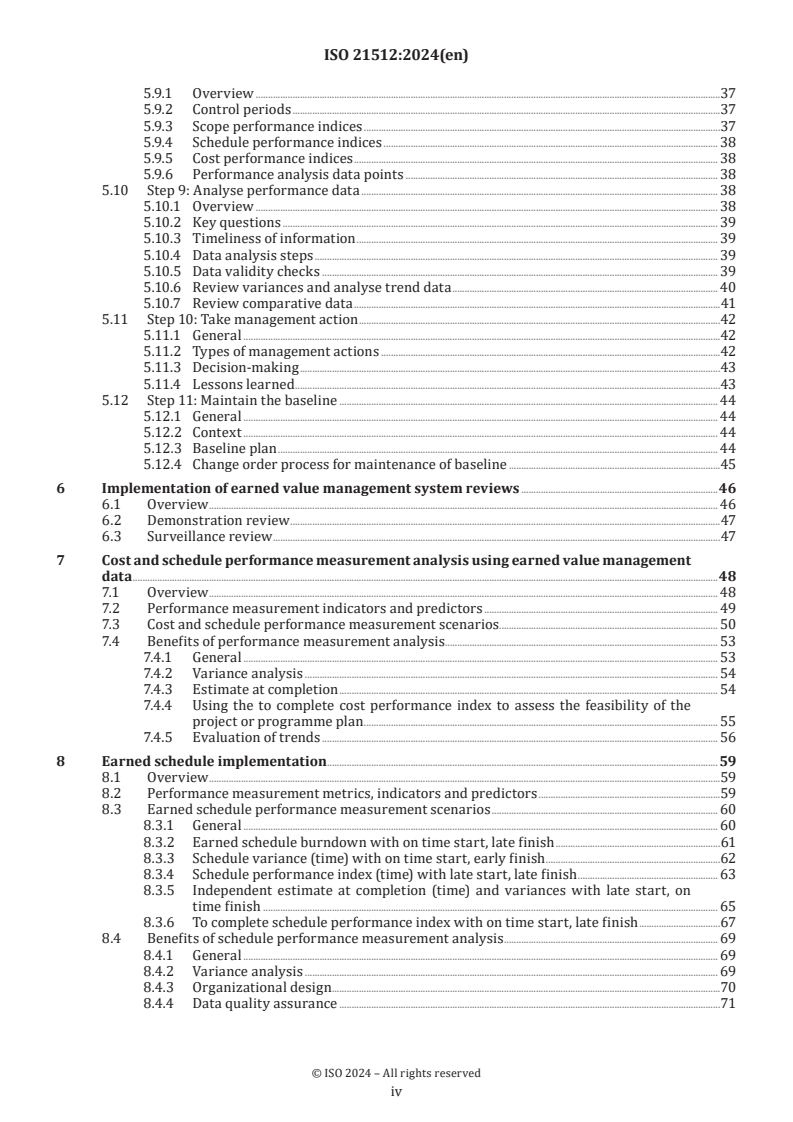
Contents Page
Foreword .vi
Introduction .vii
1 Scope . 1
2 Normative references . 1
3 Terms, definitions and abbreviated terms . 1
3.1 Terms and definitions .1
3.2 Abbreviated terms .10
4 Overview of earned value management .12
4.1 Overview . 12
4.2 Earned value management . 12
4.3 Purpose and benefits of earned value management . 12
4.4 Initiation considerations for an earned value management system . 13
4.5 Earned value management planning .14
4.6 Using earned value measurements and performance metrics . 15
5 Implementation of the earned value management process steps .16
5.1 Overview .16
5.2 Step 1: Decompose the project or programme scope .17
5.2.1 Introduction .17
5.2.2 Context .17
5.2.3 Work breakdown structure creation .17
5.2.4 Decomposition . .18
5.2.5 100 % rule .18
5.2.6 Description of the project or programme work breakdown structure elements .18
5.2.7 Hierarchical decomposition .19
5.2.8 Project and programme relationship.19
5.2.9 Progressive elaboration . 20
5.2.10 Characteristics of a work breakdown structure . 20
5.3 Step 2: Assign responsibility . 20
5.3.1 General . 20
5.3.2 Work assignment .21
5.3.3 Assigning responsibility during work breakdown structure decomposition . 22
5.3.4 Description of the project or programme assignment of responsibility . 22
5.3.5 Work packages . 22
5.4 Step 3: Schedule the work . 22
5.4.1 General . 22
5.4.2 Planning the work . 23
5.4.3 Identification activities . 23
5.4.4 Durations. 23
5.4.5 Milestones .24
5.4.6 Interdependencies.24
5.4.7 Schedule validity .24
5.5 Step 4: Develop a time-phased budget . 25
5.5.1 Overview . 25
5.5.2 Concepts and considerations . 25
5.6 Step 5: Assign objective measures of performance . 29
5.6.1 General . 29
5.6.2 Earned value techniques — Description, advantages and disadvantages . 30
5.7 Step 6: Set the performance measurement baseline . 35
5.7.1 Overview . 35
5.7.2 Management responsibility . 35
5.7.3 Control period . 36
5.8 Step 7: Authorize and perform the work . 36
5.9 Step 8: Accumulate and report performance data.37
iii
5.9.1 Overview .37
5.9.2 Control periods .37
5.9.3 Scope performance indices .37
5.9.4 Schedule performance indices . 38
5.9.5 Cost performance indices . 38
5.9.6 Performance analysis data points . 38
5.10 Step 9: Analyse performance data . 38
5.10.1 Overview . 38
5.10.2 Key questions . 39
5.10.3 Timeliness of information . 39
5.10.4 Data analysis steps . 39
5.10.5 Data validity checks . 39
5.10.6 Review variances and analyse trend data . 40
5.10.7 Review comparative data .41
5.11 Step 10: Take management action .42
5.11.1 General .42
5.11.2 Types of management actions .42
5.11.3 Decision-making .43
5.11.4 Lessons learned .43
5.12 Step 11: Maintain the baseline . 44
5.12.1 General . 44
5.12.2 Context . 44
5.12.3 Baseline plan . 44
5.12.4 Change order process for maintenance of baseline .45
6 Implementation of earned value management system reviews .46
6.1 Overview . 46
6.2 Demonstration review .47
6.3 Surveillance review .47
7 Cost and schedule performance measurement analysis using earned value management
data .48
7.1 Overview . 48
7.2 Performance measurement indicators and predictors . 49
7.3 Cost and schedule performance measurement scenarios. 50
7.4 Benefits of performance measurement analysis . 53
7.4.1 General . 53
7.4.2 Variance analysis . 54
7.4.3 Estimate at completion . 54
7.4.4 Using the to complete cost performance index to assess the feasibility of the
project or programme plan . 55
7.4.5 Evaluation of trends . 56
8 Earned schedule implementation .59
8.1 Overview .59
8.2 Performance measurement metrics, indicators and predictors .59
8.3 Earned schedule performance measurement scenarios . 60
8.3.1 General . 60
8.3.2 Earned schedule burndown with on time start, late finish .61
8.3.3 Schedule variance (time) with on time start, early finish .62
8.3.4 Schedule performance index (time) with late start, late finish . 63
8.3.5 Independent estimate at completion (time) and variances with late start, on
time finish . 65
8.3.6 To complete schedule performance index with on time start, late finish .67
8.4 Benefits of schedule performance measurement analysis . 69
8.4.1 General . 69
8.4.2 Variance analysis . 69
8.4.3 Organizational design .70
8.4.4 Data quality assurance .71
iv
8.4.5 Variance analysis, and project or programme manager's estimate at completion
(time) . .71
8.4.6 Assessment of the indicators and predictors against thresholds. 72
8.5 Trend analysis . 73
8.5.1 General . 73
8.5.2 Magnitude of trend and threshold .74
8.5.3 Direction of the trend and threshold with the to complete schedule performance
index . 75
9 Integrating other project or programme management practices .77
9.1 Integration of risk management . 77
9.1.1 Overview . 77
9.1.2 Project or programme risk context . 77
9.1.3 Intersections between risk management and earned value management
processes . 78
9.1.4 Risk management during project or programme planning . 78
9.2 Integrating earned schedule with the critical path . 83
9.2.1 General . 83
9.2.2 Process steps . 84
9.2.3 Cyclical process . 85
9.2.4 Collect periodic performance data . 86
9.2.5 Proposed recovery action for the critical path . 90
9.3 Integrating critical chain scheduling .91
9.3.1 General .91
9.3.2 Benefits of adopting and integrated critical chain project management and
earned value management approach .91
9.3.3 Critical chain scheduling process . 92
9.3.4 Critical chain and earned value management control . 94
9.4 Integrating earned schedule . 96
9.5 Integrating agile development. 97
9.6 Integrating project or programme management office . 101
9.6.1 General . 101
9.6.2 Activities of a project or programme management office . 101
9.6.3 Benefits of a project or programme management office . 101
9.7 Integrating continuous improvement . 101
9.7.1 General . 101
9.7.2 Continuous improvement . 102
9.7.3 Types of continuous improvement processes and methodologies . 102
9.7.4 Core continuous improvement functions aligned with earned value . 103
9.8 Integrating governance . 103
Annex A (informative) Worked example .105
Annex B (informative) Integrated baseline review .125
Bibliography .139
v
Foreword
ISO (the International Organization for Standardization) is a worldwide federation of national standards
bodies (ISO member bodies). The work of preparing International Standards is normally carried out through
ISO technical committees. Each member body interested in a subject for which a technical committee
has been established has the right to be represented on that committee. International organizations,
governmental and non-governmental, in liaison with ISO, also take part in the work. ISO collaborates closely
with the International Electrotechnical Commission (IEC) on all matters of electrotechnical standardization.
The procedures used to develop this document and those intended for its further maintenance are described
in the ISO/IEC Directives, Part 1. In particular, the different approval criteria needed for the different types
of ISO document should be noted. This document was drafted in accordance with the editorial rules of the
ISO/IEC Directives, Part 2 (see www.iso.org/directives).
ISO draws attention to the possibility that the implementation of this document may involve the use of (a)
patent(s). ISO takes no position concerning the evidence, validity or applicability of any claimed patent
rights in respect thereof. As of the date of publication of this document, ISO had not received notice of (a)
patent(s) which may be required to implement this document. However, implementers are cautioned that
this may not represent the latest information, which may be obtained from the patent database available at
www.iso.org/patents. ISO shall not be held responsible for identifying any or all such patent rights.
Any trade name used in this document is information given for the convenience of users and does not
constitute an endorsement.
For an explanation of the voluntary nature of standards, the meaning of ISO specific terms and
expressions related to conformity assessment, as well as information about ISO's adherence to
the World Trade Organization (WTO) principles in the Technical Barriers to Trade (TBT), see
https://www.iso.org/foreword-supplementary-information.html.
This document was prepared by Technical Committee ISO/TC 258, Project, programme and portfolio
management.
Any feedback or questions on this document should be directed to the user’s national standards body. A
complete listing of these bodies can be found at www.iso.org/members.html.
vi
Introduction
This document provides guidance when implementing an earned value management system based on
ISO 21508. This document shows how an organization can take a systematic approach to implement and
maintain an earned value management system that enables improved project and programme management.
This document is not intended to be prescriptive; each organization should determine its approach for earned
value management and to what extent the organization should adopt ISO 21508. Users are encouraged to
use this document along with ISO 21508.
This document provides guidance to users either establishing or maintaining an earned value
management system.
The text in each clause is topically arranged to assist the organization in establishing or improving its earned
value management system. The topics are arranged in the following order:
a) general introduction to the material contained in the clause;
b) guidance on how an organization can approach the subject;
c) practical tools, methods, strategies and examples.
The examples and approaches presented in this document are for illustrative purposes only, and are not
necessarily suitable for every organization, project or programme. In implementing, maintaining or
improving an earned value management system, it is important that organizations select approaches, tools
and methods appropriate to their needs and governance framework.
Earned value management tools and methods are sustainable and useful, when they are integrated within
an organization’s overall governance for projects and programmes.
This document is applicable to:
a) practitioners and professionals of earned value management, project management, programme
management and portfolio management;
b) management, sponsors and other governing bodies overseeing projects, programmes, and portfolios;
c) project, programme and portfolio management office professionals;
d) project, programme and portfolio stakeholders;
e) academia including faculty, students and researchers;
f) developers of national standards, organizational standards and public policy.
vii
International Standard ISO 21512:2024(en)
Project, programme and portfolio management — Earned
value management implementation guidance
1 Scope
This document specifies guidance and examples for establishing, implementing and maintaining an earned
value management system based on ISO 21508:2018. This document also provides practises for earned
value management, as set forth in ISO 21508:2018. This document can be used by any organization.
This document is aligned with and complements the information contained in ISO 21508:2018 which is the
higher tier international standard and companion document for this document.
Further guidance on project, programme and governance and other related guidance are set out in relevant
standards.
2 Normative references
The following documents are referred to in the text in such a way that some or all of their content constitutes
requirements of this document. For dated references, only the edition cited applies. For undated references,
the latest edition of the referenced document (including any amendments) applies.
ISO/TR 21506, Project, programme and portfolio management — Vocabulary
ISO 21508:2018, Earned value management in project and programme management
3 Terms, definitions and abbreviated terms
For the purposes of this document, the terms and definitions given in ISO/TR 21506 and ISO 21508 apply.
ISO and IEC maintain terminology databases for use in standardization at the following addresses:
— ISO Online browsing platform: available at https:// www .iso .org/ obp
— IEC Electropedia: available at https:// www .electropedia .org/
3.1 Terms and definitions
3.1.1
100 % rule
concept concerning the entire work required to be accomplished to achieve the project (3.1.57) or programme
(3.1.53) scope captured in the work breakdown structure (3.1.89)
Note 1 to entry: The 100 % rule applies to the parent and child elements. The child-level of decomposition (3.1.23) of a
work breakdown structure element (3.1.90) represents 100 % of the work applicable to the parent-level.
[SOURCE: ISO 21511:2018, 3.1]
3.1.2
activity
identified piece of work that is required to be undertaken to complete a project (3.1.57) or programme
(3.1.53)
Note 1 to entry: It can also be considered a work element. It is a defined, discrete piece of work.
[SOURCE: ISO 21508:2018, 3.1.1, modified — a second sentence has been added to the Note 1 to entry.]
3.1.3
actual cost
cost incurred for work performed
Note 1 to entry: Actual cost is also known as “actual cost of work performed”.
[SOURCE: ISO 21508:2018, 3.1.2]
3.1.4
actual time
number of time periods between the actual start date and the date on which the project (3.1.57) data is
reported
3.1.5
agile development
agile approach
agile management
agile project management
agile programme management
iterative approach to project (3.1.57) and programme (3.1.53) planning and implementation to allow
continuous adaptation for the delivery of scope and the final deliverable or outcome
3.1.6
baseline
reference basis for comparison against which performance is monitored and controlled
[SOURCE: ISO 21502:2020, 3.1]
3.1.7
baseline plan
tool to facilitate the comparison against which performance is monitored and controlled
3.1.8
basis of estimate
documentation that supports the calculation of resources required to perform activities
3.1.9
budget at completion
total forecasted cost for accomplishing the work related to a work package (3.1.91), activity (3.1.2) or control
account (3.1.11)
[SOURCE: ISO 21508:2018, 3.1.3]
3.1.10
change order
documentation to alter the baseline (3.1.6) of a project (3.1.57) or programme (3.1.53)
Note 1 to entry: Documentation prior to the formal change order is often referred to as a baseline change proposal or
a change request.
3.1.11
control account
management control point (3.1.15) where scope, budget, actual cost (3.1.3) and schedule of a project (3.1.57)
or programme (3.1.53), work package (3.1.91) or activity (3.1.2) are integrated
[SOURCE: ISO 21508:2018, 3.1.4]
3.1.12
control account manager
cost account manager
person with the authority and responsibility to manage a management control point (3.1.15) where cost and
scope are integrated and compared to the designated performance metrics for earned value (3.1.26)
3.1.13
control account plan
cost account plan
management tool for organizing work within one or more work or planning packages (3.1.91)
3.1.14
control period
established time frame in which the actual project (3.1.57) or programme (3.1.53) results are compared with
the performance measurement baseline (3.1.51) to assess performance and take management action, if needed
3.1.15
control point
point in the processes of project (3.1.57) or programme management (3.1.54) that can serve as a decision
time or gate and can be further defined by one or more individual activities (3.1.2)
3.1.16
corrective action
direction and activity (3.1.2) for modifying the performance of work to bring performance in line with a plan
[SOURCE: ISO/TR 21506:2018, 3.15]
3.1.17
cost management system
set of tools for estimating, allocating and controlling costs in a project (3.1.57) or programme (3.1.53)
3.1.18
cost performance index
measure of the actual cost (3.1.3) efficiency of a project (3.1.57) or programme (3.1.53)
3.1.19
cost variance
measure of cost performance on a project (3.1.57) or programme (3.1.53)
Note 1 to entry: Actual cost compared to planned cost.
3.1.20
critical chain project management
scheduling method for planning and managing a project (3.1.57) or programme (3.1.53) that focusses on
resource availability to complete project or programme activities (3.1.2)
3.1.21
critical path
sequence of activities (3.1.2) that determines the earliest possible completion date for a project (3.1.57),
programme (3.1.53) or phase
[SOURCE: ISO 21502:2020, 3.8, modified — "programme" has been added to the definition.]
3.1.22
data tracing
activity (3.1.2) of end-to-end to performance data quality checks
3.1.23
decomposition
iterative process to incorporate an increased level of detail as identified during the lifecycle (3.1.43) of a
project (3.1.57) or programme (3.1.53)
Note 1 to entry: Decomposition can be accomplished through a hierarchal, functional or other method to achieve a
manageable set of elements.
3.1.24
demonstration review
check for compliance with the governance (3.1.35) of earned value (3.1.26) criteria on a new or modified
earned value management system (3.1.30)
3.1.25
earned schedule
time-based technique used to provide status and predictions regarding the schedule, using earned value data
Note 1 to entry: Earned schedule is analogous to the use of cost to determine earned value.
Note 2 to entry: Earned schedule is also a measure of the number of time periods in the performance measurement
baseline (3.1.51) in which the earned value is greater than the planned value (3.1.52).
3.1.26
earned value
value of completed work expressed in terms of the budget assigned to that work
Note 1 to entry: Earned value is also known as budgeted cost of work performed.
[SOURCE: ISO 21508:2018, 3.1.5]
3.1.27
earned value management
method that integrates the project (3.1.57) or programme (3.1.53) scope, actual cost (3.1.3), budget, and
schedule for the assessment of progress and performance
[SOURCE: ISO 21508:2018, 3.1.6]
3.1.28
earned value management methodology
approach that permits progress achieved to be objectively measured
3.1.29
earned value management planning
delineation of steps, methods and reporting necessary for the creation and tracking of the performance
measurement baseline (3.1.51)
3.1.30
earned value management system
earned value management tool
selected toolset that integrates the project (3.1.57) or programme (3.1.53) scope, actual cost (3.1.3), budget,
and schedule for assessment of progress and performance
3.1.31
earned value measurement
earned value metrics
metrics used to determine the earned value (3.1.26) of projects (3.1.57) or integrated programmes (3.1.53)
3.1.32
estimate at completion
forecasted total cost to accomplish the work on a project (3.1.57), programme (3.1.53), work package (3.1.91)
or activity (3.1.2)
[SOURCE: ISO 21508:2018, 3.1.7]
3.1.33
estimate to completion
forecasted cost of the work remaining in a project (3.1.57), programme (3.1.53), work package (3.1.91) or
activity (3.1.2)
[SOURCE: ISO 21508:2018, 3.1.8]
3.1.34
feeding buffer
time cushion placed at the end of a sequence of tasks that lead into the critical chain
3.1.35
governance
principles, policies and framework by which an organization is directed and controlled
[SOURCE: ISO 21502:2020, 3.10]
3.1.36
integrated baseline review
assessment to establish a common understanding of the performance measurement baseline (3.1.51) for
verification of the technical content of the project (3.1.57) or programme (3.1.53)
[SOURCE: ISO 21508:2018, 3.1.9]
3.1.37
integrated baseline review handbook
document that compiles guidance for the preparation, conduct and closeout of an integrated baseline
(3.1.6) review
3.1.38
issue
event that arises during a project (3.1.57) or programme (3.1.53) needing resolution for the project or
programme to proceed
[SOURCE: ISO 21502:2020, 3.11, modified — "or programme" has been added to the definition.]
3.1.39
issue register
document to record issues (3.1.38), responses and other relevant issue information
3.1.40
lag
attribute applied to a logical relationship to delay the start or end of an activity (3.1.2)
[SOURCE: ISO/TR 21506:2018, 3.28]
3.1.41
lead
attribute applied to a logical relationship to advance the start or end of an activity (3.1.2)
[SOURCE: ISO/TR 21506:2018, 3.29]
3.1.42
lessons learned
knowledge gained throughout a project (3.1.57), programme (3.1.53) or portfolio that shows how events
were addressed or should be addressed for the purpose of improving future performance
[SOURCE: ISO/TR 21506:2018, 3.30]
3.1.43
lifecycle
systematic and organized grouping or staging of necessary activities (3.1.2) to be completed to provide the
expected deliverable or outcome of a project (3.1.57) or programme (3.1.53)
3.1.44
management reserve
amount of budget or schedule external to the performance measurement baseline (3.1.51), withheld for
management control in response to unforeseen events or activities (3.1.2) that are a part of the scope
[SOURCE: ISO 21508:2018, 3.1.10, modified — "or schedule" has been added to the definition.]
3.1.45
milestone
significant planned, or to be planned, point in a project (3.1.57), programme (3.1.53) or portfolio
[SOURCE: ISO/TR 21506:2018, 3.34]
3.1.46
organizational breakdown structure
decomposition (3.1.23) of the management team of an organization or decomposition of the management
team that performs the work of a project (3.1.57) or programme (3.1.53)
Note 1 to entry: The organizational breakdown structure can include partnering or subcontracting. It is used to
illustrate the relationship between project and programme activities and the organizational units that will manage or
perform the work activities.
[SOURCE: ISO 21511:2018, 3.5]
3.1.47
parent element
work that is decomposed into two or more lower level elements
...
International
Standard
ISO 21512
First edition
Project, programme and portfolio
2024-08
management — Earned value
management implementation
Corrected version
guidance
2025-04
Management de projets, programmes et portefeuilles —
Recommandations de mise en oeuvre du management de la
valeur acquise
Reference number
© ISO 2024
All rights reserved. Unless otherwise specified, or required in the context of its implementation, no part of this publication may
be reproduced or utilized otherwise in any form or by any means, electronic or mechanical, including photocopying, or posting on
the internet or an intranet, without prior written permission. Permission can be requested from either ISO at the address below
or ISO’s member body in the country of the requester.
ISO copyright office
CP 401 • Ch. de Blandonnet 8
CH-1214 Vernier, Geneva
Phone: +41 22 749 01 11
Email: copyright@iso.org
Website: www.iso.org
Published in Switzerland
ii
Contents Page
Foreword .vi
Introduction .vii
1 Scope . 1
2 Normative references . 1
3 Terms, definitions and abbreviated terms . 1
3.1 Terms and definitions .1
3.2 Abbreviated terms .10
4 Overview of earned value management .12
4.1 Overview . 12
4.2 Earned value management . 12
4.3 Purpose and benefits of earned value management . 12
4.4 Initiation considerations for an earned value management system . 13
4.5 Earned value management planning .14
4.6 Using earned value measurements and performance metrics . 15
5 Implementation of the earned value management process steps .16
5.1 Overview .16
5.2 Step 1: Decompose the project or programme scope .17
5.2.1 Introduction .17
5.2.2 Context .17
5.2.3 Work breakdown structure creation .17
5.2.4 Decomposition . .18
5.2.5 100 % rule .18
5.2.6 Description of the project or programme work breakdown structure elements .18
5.2.7 Hierarchical decomposition .19
5.2.8 Project and programme relationship.19
5.2.9 Progressive elaboration . 20
5.2.10 Characteristics of a work breakdown structure . 20
5.3 Step 2: Assign responsibility . 20
5.3.1 General . 20
5.3.2 Work assignment .21
5.3.3 Assigning responsibility during work breakdown structure decomposition . 22
5.3.4 Description of the project or programme assignment of responsibility . 22
5.3.5 Work packages . 22
5.4 Step 3: Schedule the work . 22
5.4.1 General . 22
5.4.2 Planning the work . 23
5.4.3 Identification activities . 23
5.4.4 Durations. 23
5.4.5 Milestones .24
5.4.6 Interdependencies.24
5.4.7 Schedule validity .24
5.5 Step 4: Develop a time-phased budget . 25
5.5.1 Overview . 25
5.5.2 Concepts and considerations . 25
5.6 Step 5: Assign objective measures of performance . 29
5.6.1 General . 29
5.6.2 Earned value techniques — Description, advantages and disadvantages . 30
5.7 Step 6: Set the performance measurement baseline . 35
5.7.1 Overview . 35
5.7.2 Management responsibility . 35
5.7.3 Control period . 36
5.8 Step 7: Authorize and perform the work . 36
5.9 Step 8: Accumulate and report performance data.37
iii
5.9.1 Overview .37
5.9.2 Control periods .37
5.9.3 Scope performance indices .37
5.9.4 Schedule performance indices . 38
5.9.5 Cost performance indices . 38
5.9.6 Performance analysis data points . 38
5.10 Step 9: Analyse performance data . 38
5.10.1 Overview . 38
5.10.2 Key questions . 39
5.10.3 Timeliness of information . 39
5.10.4 Data analysis steps . 39
5.10.5 Data validity checks . 39
5.10.6 Review variances and analyse trend data . 40
5.10.7 Review comparative data .41
5.11 Step 10: Take management action .42
5.11.1 General .42
5.11.2 Types of management actions .42
5.11.3 Decision-making .43
5.11.4 Lessons learned .43
5.12 Step 11: Maintain the baseline . 44
5.12.1 General . 44
5.12.2 Context . 44
5.12.3 Baseline plan . 44
5.12.4 Change order process for maintenance of baseline .45
6 Implementation of earned value management system reviews .46
6.1 Overview . 46
6.2 Demonstration review .47
6.3 Surveillance review .47
7 Cost and schedule performance measurement analysis using earned value management
data .48
7.1 Overview . 48
7.2 Performance measurement indicators and predictors . 49
7.3 Cost and schedule performance measurement scenarios. 50
7.4 Benefits of performance measurement analysis . 53
7.4.1 General . 53
7.4.2 Variance analysis . 54
7.4.3 Estimate at completion . 54
7.4.4 Using the to complete cost performance index to assess the feasibility of the
project or programme plan . 55
7.4.5 Evaluation of trends . 56
8 Earned schedule implementation .59
8.1 Overview .59
8.2 Performance measurement metrics, indicators and predictors .59
8.3 Earned schedule performance measurement scenarios . 60
8.3.1 General . 60
8.3.2 Earned schedule burndown with on time start, late finish .61
8.3.3 Schedule variance (time) with on time start, early finish .62
8.3.4 Schedule performance index (time) with late start, late finish . 63
8.3.5 Independent estimate at completion (time) and variances with late start, on
time finish . 65
8.3.6 To complete schedule performance index with on time start, late finish .67
8.4 Benefits of schedule performance measurement analysis . 69
8.4.1 General . 69
8.4.2 Variance analysis . 69
8.4.3 Organizational design .70
8.4.4 Data quality assurance .71
iv
8.4.5 Variance analysis, and project or programme manager's estimate at completion
(time) . .71
8.4.6 Assessment of the indicators and predictors against thresholds. 72
8.5 Trend analysis . 73
8.5.1 General . 73
8.5.2 Magnitude of trend and threshold .74
8.5.3 Direction of the trend and threshold with the to complete schedule performance
index . 75
9 Integrating other project or programme management practices .77
9.1 Integration of risk management . 77
9.1.1 Overview . 77
9.1.2 Project or programme risk context . 77
9.1.3 Intersections between risk management and earned value management
processes . 78
9.1.4 Risk management during project or programme planning . 78
9.2 Integrating earned schedule with the critical path . 83
9.2.1 General . 83
9.2.2 Process steps . 84
9.2.3 Cyclical process . 85
9.2.4 Collect periodic performance data . 86
9.2.5 Proposed recovery action for the critical path . 90
9.3 Integrating critical chain scheduling .91
9.3.1 General .91
9.3.2 Benefits of adopting and integrated critical chain project management and
earned value management approach .91
9.3.3 Critical chain scheduling process . 92
9.3.4 Critical chain and earned value management control . 94
9.4 Integrating earned schedule . 96
9.5 Integrating agile development. 97
9.6 Integrating project or programme management office . 101
9.6.1 General . 101
9.6.2 Activities of a project or programme management office . 101
9.6.3 Benefits of a project or programme management office . 101
9.7 Integrating continuous improvement . 101
9.7.1 General . 101
9.7.2 Continuous improvement . 102
9.7.3 Types of continuous improvement processes and methodologies . 102
9.7.4 Core continuous improvement functions aligned with earned value . 103
9.8 Integrating governance . 103
Annex A (informative) Worked example .105
Annex B (informative) Integrated baseline review .125
Bibliography .139
v
Foreword
ISO (the International Organization for Standardization) is a worldwide federation of national standards
bodies (ISO member bodies). The work of preparing International Standards is normally carried out through
ISO technical committees. Each member body interested in a subject for which a technical committee
has been established has the right to be represented on that committee. International organizations,
governmental and non-governmental, in liaison with ISO, also take part in the work. ISO collaborates closely
with the International Electrotechnical Commission (IEC) on all matters of electrotechnical standardization.
The procedures used to develop this document and those intended for its further maintenance are described
in the ISO/IEC Directives, Part 1. In particular, the different approval criteria needed for the different types
of ISO document should be noted. This document was drafted in accordance with the editorial rules of the
ISO/IEC Directives, Part 2 (see www.iso.org/directives).
ISO draws attention to the possibility that the implementation of this document may involve the use of (a)
patent(s). ISO takes no position concerning the evidence, validity or applicability of any claimed patent
rights in respect thereof. As of the date of publication of this document, ISO had not received notice of (a)
patent(s) which may be required to implement this document. However, implementers are cautioned that
this may not represent the latest information, which may be obtained from the patent database available at
www.iso.org/patents. ISO shall not be held responsible for identifying any or all such patent rights.
Any trade name used in this document is information given for the convenience of users and does not
constitute an endorsement.
For an explanation of the voluntary nature of standards, the meaning of ISO specific terms and
expressions related to conformity assessment, as well as information about ISO's adherence to
the World Trade Organization (WTO) principles in the Technical Barriers to Trade (TBT), see
https://www.iso.org/foreword-supplementary-information.html.
This document was prepared by Technical Committee ISO/TC 258, Project, programme and portfolio
management.
Any feedback or questions on this document should be directed to the user’s national standards body. A
complete listing of these bodies can be found at www.iso.org/members.html.
This corrected version of ISO 21513:2024 incorporates the following corrections: "planned finish date" has
been replaced with "performance factor" in 3.2, 7.4.3 and 8.3.5.
vi
Introduction
This document provides guidance when implementing an earned value management system based on
ISO 21508. This document shows how an organization can take a systematic approach to implement and
maintain an earned value management system that enables improved project and programme management.
This document is not intended to be prescriptive; each organization should determine its approach for earned
value management and to what extent the organization should adopt ISO 21508. Users are encouraged to
use this document along with ISO 21508.
This document provides guidance to users either establishing or maintaining an earned value
management system.
The text in each clause is topically arranged to assist the organization in establishing or improving its earned
value management system. The topics are arranged in the following order:
a) general introduction to the material contained in the clause;
b) guidance on how an organization can approach the subject;
c) practical tools, methods, strategies and examples.
The examples and approaches presented in this document are for illustrative purposes only, and are not
necessarily suitable for every organization, project or programme. In implementing, maintaining or
improving an earned value management system, it is important that organizations select approaches, tools
and methods appropriate to their needs and governance framework.
Earned value management tools and methods are sustainable and useful, when they are integrated within
an organization’s overall governance for projects and programmes.
This document is applicable to:
a) practitioners and professionals of earned value management, project management, programme
management and portfolio management;
b) management, sponsors and other governing bodies overseeing projects, programmes, and portfolios;
c) project, programme and portfolio management office professionals;
d) project, programme and portfolio stakeholders;
e) academia including faculty, students and researchers;
f) developers of national standards, organizational standards and public policy.
vii
International Standard ISO 21512:2024(en)
Project, programme and portfolio management — Earned
value management implementation guidance
1 Scope
This document specifies guidance and examples for establishing, implementing and maintaining an earned
value management system based on ISO 21508:2018. This document also provides practises for earned
value management, as set forth in ISO 21508:2018. This document can be used by any organization.
This document is aligned with and complements the information contained in ISO 21508:2018 which is the
higher tier international standard and companion document for this document.
Further guidance on project, programme and governance and other related guidance are set out in relevant
standards.
2 Normative references
The following documents are referred to in the text in such a way that some or all of their content constitutes
requirements of this document. For dated references, only the edition cited applies. For undated references,
the latest edition of the referenced document (including any amendments) applies.
ISO/TR 21506, Project, programme and portfolio management — Vocabulary
ISO 21508:2018, Earned value management in project and programme management
3 Terms, definitions and abbreviated terms
For the purposes of this document, the terms and definitions given in ISO/TR 21506 and ISO 21508 apply.
ISO and IEC maintain terminology databases for use in standardization at the following addresses:
— ISO Online browsing platform: available at https:// www .iso .org/ obp
— IEC Electropedia: available at https:// www .electropedia .org/
3.1 Terms and definitions
3.1.1
100 % rule
concept concerning the entire work required to be accomplished to achieve the project (3.1.57) or programme
(3.1.53) scope captured in the work breakdown structure (3.1.89)
Note 1 to entry: The 100 % rule applies to the parent and child elements. The child-level of decomposition (3.1.23) of a
work breakdown structure element (3.1.90) represents 100 % of the work applicable to the parent-level.
[SOURCE: ISO 21511:2018, 3.1]
3.1.2
activity
identified piece of work that is required to be undertaken to complete a project (3.1.57) or programme
(3.1.53)
Note 1 to entry: It can also be considered a work element. It is a defined, discrete piece of work.
[SOURCE: ISO 21508:2018, 3.1.1, modified — a second sentence has been added to the Note 1 to entry.]
3.1.3
actual cost
cost incurred for work performed
Note 1 to entry: Actual cost is also known as “actual cost of work performed”.
[SOURCE: ISO 21508:2018, 3.1.2]
3.1.4
actual time
number of time periods between the actual start date and the date on which the project (3.1.57) data is
reported
3.1.5
agile development
agile approach
agile management
agile project management
agile programme management
iterative approach to project (3.1.57) and programme (3.1.53) planning and implementation to allow
continuous adaptation for the delivery of scope and the final deliverable or outcome
3.1.6
baseline
reference basis for comparison against which performance is monitored and controlled
[SOURCE: ISO 21502:2020, 3.1]
3.1.7
baseline plan
tool to facilitate the comparison against which performance is monitored and controlled
3.1.8
basis of estimate
documentation that supports the calculation of resources required to perform activities
3.1.9
budget at completion
total forecasted cost for accomplishing the work related to a work package (3.1.91), activity (3.1.2) or control
account (3.1.11)
[SOURCE: ISO 21508:2018, 3.1.3]
3.1.10
change order
documentation to alter the baseline (3.1.6) of a project (3.1.57) or programme (3.1.53)
Note 1 to entry: Documentation prior to the formal change order is often referred to as a baseline change proposal or
a change request.
3.1.11
control account
management control point (3.1.15) where scope, budget, actual cost (3.1.3) and schedule of a project (3.1.57)
or programme (3.1.53), work package (3.1.91) or activity (3.1.2) are integrated
[SOURCE: ISO 21508:2018, 3.1.4]
3.1.12
control account manager
cost account manager
person with the authority and responsibility to manage a management control point (3.1.15) where cost and
scope are integrated and compared to the designated performance metrics for earned value (3.1.26)
3.1.13
control account plan
cost account plan
management tool for organizing work within one or more work or planning packages (3.1.91)
3.1.14
control period
established time frame in which the actual project (3.1.57) or programme (3.1.53) results are compared with
the performance measurement baseline (3.1.51) to assess performance and take management action, if needed
3.1.15
control point
point in the processes of project (3.1.57) or programme management (3.1.54) that can serve as a decision
time or gate and can be further defined by one or more individual activities (3.1.2)
3.1.16
corrective action
direction and activity (3.1.2) for modifying the performance of work to bring performance in line with a plan
[SOURCE: ISO/TR 21506:2018, 3.15]
3.1.17
cost management system
set of tools for estimating, allocating and controlling costs in a project (3.1.57) or programme (3.1.53)
3.1.18
cost performance index
measure of the actual cost (3.1.3) efficiency of a project (3.1.57) or programme (3.1.53)
3.1.19
cost variance
measure of cost performance on a project (3.1.57) or programme (3.1.53)
Note 1 to entry: Actual cost compared to planned cost.
3.1.20
critical chain project management
scheduling method for planning and managing a project (3.1.57) or programme (3.1.53) that focusses on
resource availability to complete project or programme activities (3.1.2)
3.1.21
critical path
sequence of activities (3.1.2) that determines the earliest possible completion date for a project (3.1.57),
programme (3.1.53) or phase
[SOURCE: ISO 21502:2020, 3.8, modified — "programme" has been added to the definition.]
3.1.22
data tracing
activity (3.1.2) of end-to-end to performance data quality checks
3.1.23
decomposition
iterative process to incorporate an increased level of detail as identified during the lifecycle (3.1.43) of a
project (3.1.57) or programme (3.1.53)
Note 1 to entry: Decomposition can be accomplished through a hierarchal, functional or other method to achieve a
manageable set of elements.
3.1.24
demonstration review
check for compliance with the governance (3.1.35) of earned value (3.1.26) criteria on a new or modified
earned value management system (3.1.30)
3.1.25
earned schedule
time-based technique used to provide status and predictions regarding the schedule, using earned value data
Note 1 to entry: Earned schedule is analogous to the use of cost to determine earned value.
Note 2 to entry: Earned schedule is also a measure of the number of time periods in the performance measurement
baseline (3.1.51) in which the earned value is greater than the planned value (3.1.52).
3.1.26
earned value
value of completed work expressed in terms of the budget assigned to that work
Note 1 to entry: Earned value is also known as budgeted cost of work performed.
[SOURCE: ISO 21508:2018, 3.1.5]
3.1.27
earned value management
method that integrates the project (3.1.57) or programme (3.1.53) scope, actual cost (3.1.3), budget, and
schedule for the assessment of progress and performance
[SOURCE: ISO 21508:2018, 3.1.6]
3.1.28
earned value management methodology
approach that permits progress achieved to be objectively measured
3.1.29
earned value management planning
delineation of steps, methods and reporting necessary for the creation and tracking of the performance
measurement baseline (3.1.51)
3.1.30
earned value management system
earned value management tool
selected toolset that integrates the project (3.1.57) or programme (3.1.53) scope, actual cost (3.1.3), budget,
and schedule for assessment of progress and performance
3.1.31
earned value measurement
earned value metrics
metrics used to determine the earned value (3.1.26) of projects (3.1.57) or integrated programmes (3.1.53)
3.1.32
estimate at completion
forecasted total cost to accomplish the work on a project (3.1.57), programme (3.1.53), work package (3.1.91)
or activity (3.1.2)
[SOURCE: ISO 21508:2018, 3.1.7]
3.1.33
estimate to completion
forecasted cost of the work remaining in a project (3.1.57), programme (3.1.53), work package (3.1.91) or
activity (3.1.2)
[SOURCE: ISO 21508:2018, 3.1.8]
3.1.34
feeding buffer
time cushion placed at the end of a sequence of tasks that lead into the critical chain
3.1.35
governance
principles, policies and framework by which an organization is directed and controlled
[SOURCE: ISO 21502:2020, 3.10]
3.1.36
integrated baseline review
assessment to establish a common understanding of the performance measurement baseline (3.1.51) for
verification of the technical content of the project (3.1.57) or programme (3.1.53)
[SOURCE: ISO 21508:2018, 3.1.9]
3.1.37
integrated baseline review handbook
document that compiles guidance for the preparation, conduct and closeout of an integrated baseline
(3.1.6) review
3.1.38
issue
event that arises during a project (3.1.57) or programme (3.1.53) needing resolution for the project or
programme to proceed
[SOURCE: ISO 21502:2020, 3.11, modified — "or programme" has been added to the definition.]
3.1.39
issue register
document to record issues (3.1.38), responses and other relevant issue information
3.1.40
lag
attribute applied to a logical relationship to delay the start or end of an activity (3.1.2)
[SOURCE: ISO/TR 21506:2018, 3.28]
3.1.41
lead
attribute applied to a logical relationship to advance the start or end of an activity (3.1.2)
[SOURCE: ISO/TR 21506:2018, 3.29]
3.1.42
lessons learned
knowledge gained throughout a project (3.1.57), programme (3.1.53) or portfolio that shows how events
were addressed or should be addressed for the purpose of improving future performance
[SOURCE: ISO/TR 21506:2018, 3.30]
3.1.43
lifecycle
systematic and organized grouping or staging of necessary activities (3.1.2) to be completed to provide the
expected deliverable or outcome of a project (3.1.57) or programme (3.1.53)
3.1.44
management reserve
amount of budget or schedule external to the performance measurement baseline (3.1.51), withheld for
management control in response to unforeseen events or activities (3.1.2) that are a part of the scope
[SOURCE: ISO 21508:2018, 3.1.10, modified — "or schedule" has been added to the definition.]
3.1.45
milestone
significant planned, or to be planned, point in a project (3.1.57), programme (3.1.53) or portfolio
[SOURCE: ISO/TR 21506:2018, 3.34]
3.1.46
organizational breakdown structure
decomposition (3.1.23) of the management team of an organization or decomposition of the management
team that performs the work of a project (3.1.57) or programme (3.1.53)
Note 1 to entry: The organizational breakdown structure can include partnering or subcontracting. It is used to
illustrate the relationship between project and programme act
...
Norme
internationale
ISO 21512
Première édition
Management de projets,
2024-08
programmes et portefeuilles —
Recommandations de mise en oeuvre
du management de la valeur acquise
Project, programme and portfolio management — Earned value
management implementation guidance
Numéro de référence
DOCUMENT PROTÉGÉ PAR COPYRIGHT
© ISO 2024
Tous droits réservés. Sauf prescription différente ou nécessité dans le contexte de sa mise en œuvre, aucune partie de cette
publication ne peut être reproduite ni utilisée sous quelque forme que ce soit et par aucun procédé, électronique ou mécanique,
y compris la photocopie, ou la diffusion sur l’internet ou sur un intranet, sans autorisation écrite préalable. Une autorisation peut
être demandée à l’ISO à l’adresse ci-après ou au comité membre de l’ISO dans le pays du demandeur.
ISO copyright office
Case postale 401 • Ch. de Blandonnet 8
CH-1214 Vernier, Genève
Tél.: +41 22 749 01 11
E-mail: copyright@iso.org
Web: www.iso.org
Publié en Suisse
ii
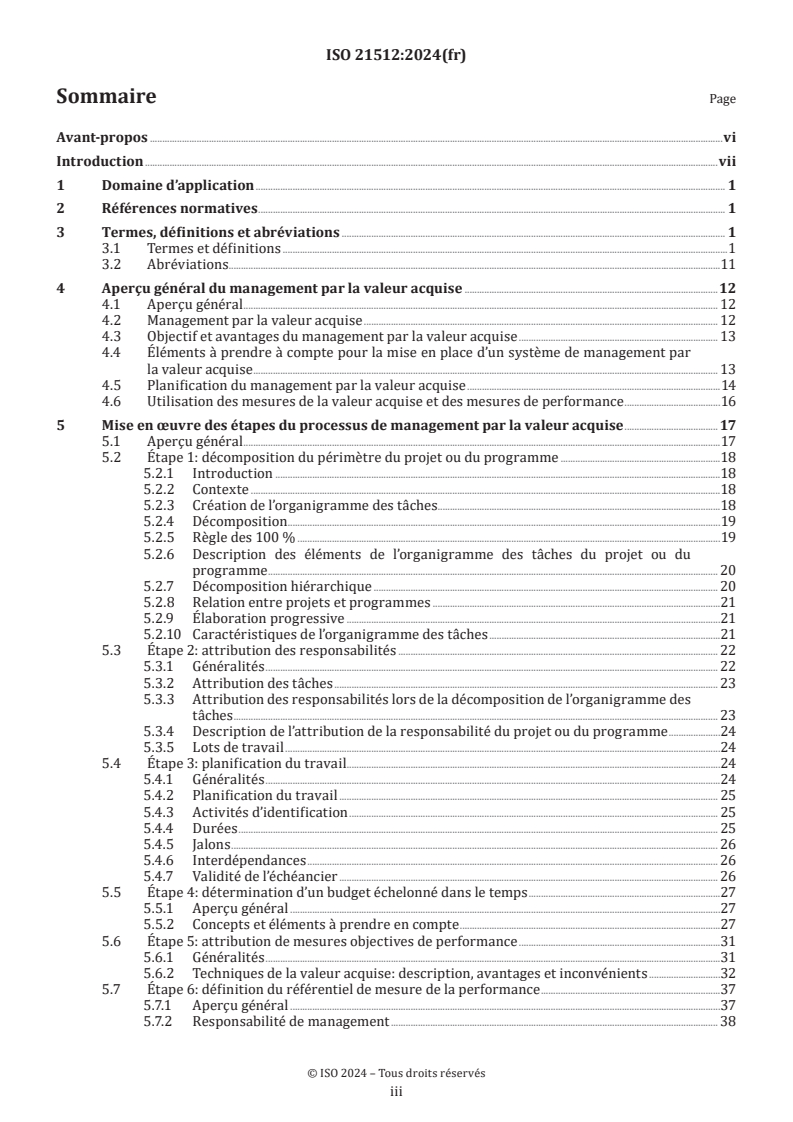
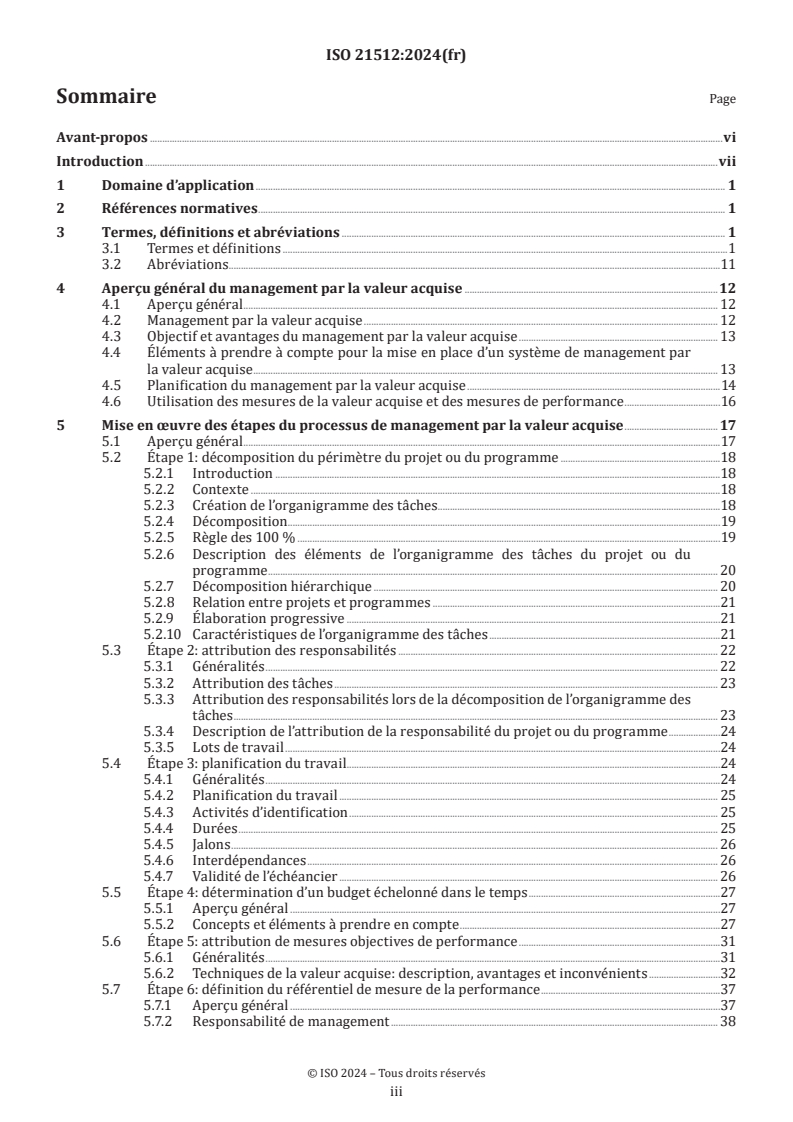
Sommaire Page
Avant-propos .vi
Introduction .vii
1 Domaine d’application . 1
2 Références normatives . 1
3 Termes, définitions et abréviations . 1
3.1 Termes et définitions .1
3.2 Abréviations.11
4 Aperçu général du management par la valeur acquise .12
4.1 Aperçu général . 12
4.2 Management par la valeur acquise . 12
4.3 Objectif et avantages du management par la valeur acquise . 13
4.4 Éléments à prendre à compte pour la mise en place d’un système de management par
la valeur acquise . 13
4.5 Planification du management par la valeur acquise .14
4.6 Utilisation des mesures de la valeur acquise et des mesures de performance .16
5 Mise en œuvre des étapes du processus de management par la valeur acquise . 17
5.1 Aperçu général .17
5.2 Étape 1: décomposition du périmètre du projet ou du programme .18
5.2.1 Introduction .18
5.2.2 Contexte .18
5.2.3 Création de l’organigramme des tâches.18
5.2.4 Décomposition . .19
5.2.5 Règle des 100 % .19
5.2.6 Description des éléments de l’organigramme des tâches du projet ou du
programme . 20
5.2.7 Décomposition hiérarchique . 20
5.2.8 Relation entre projets et programmes .21
5.2.9 Élaboration progressive .21
5.2.10 Caractéristiques de l’organigramme des tâches .21
5.3 Étape 2: attribution des responsabilités . 22
5.3.1 Généralités . 22
5.3.2 Attribution des tâches . 23
5.3.3 Attribution des responsabilités lors de la décomposition de l’organigramme des
tâches . 23
5.3.4 Description de l’attribution de la responsabilité du projet ou du programme .24
5.3.5 Lots de travail .24
5.4 Étape 3: planification du travail . .24
5.4.1 Généralités .24
5.4.2 Planification du travail . 25
5.4.3 Activités d’identification . 25
5.4.4 Durées . 25
5.4.5 Jalons . 26
5.4.6 Interdépendances . 26
5.4.7 Validité de l’échéancier . 26
5.5 Étape 4: détermination d’un budget échelonné dans le temps .27
5.5.1 Aperçu général .27
5.5.2 Concepts et éléments à prendre en compte .27
5.6 Étape 5: attribution de mesures objectives de performance .31
5.6.1 Généralités .31
5.6.2 Techniques de la valeur acquise: description, avantages et inconvénients .32
5.7 Étape 6: définition du référentiel de mesure de la performance .37
5.7.1 Aperçu général .37
5.7.2 Responsabilité de management . 38
iii
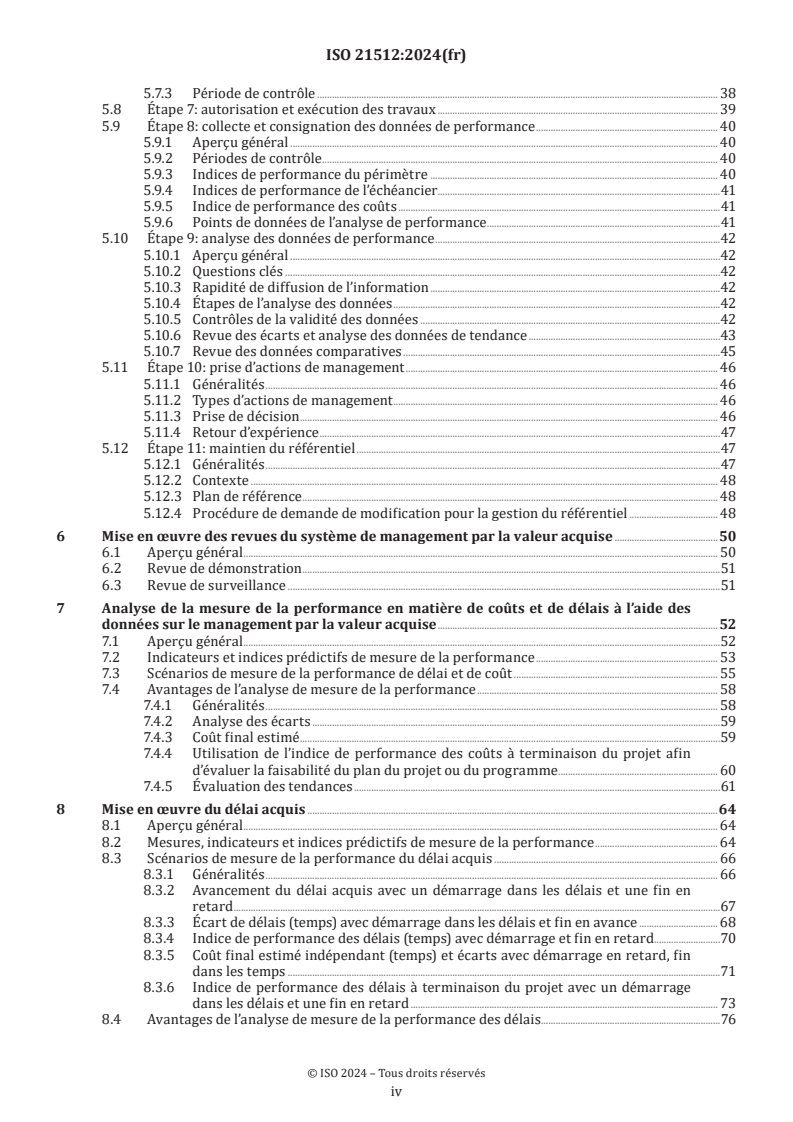
5.7.3 Période de contrôle . 38
5.8 Étape 7: autorisation et exécution des travaux . 39
5.9 Étape 8: collecte et consignation des données de performance . 40
5.9.1 Aperçu général . 40
5.9.2 Périodes de contrôle . 40
5.9.3 Indices de performance du périmètre . 40
5.9.4 Indices de performance de l’échéancier .41
5.9.5 Indice de performance des coûts .41
5.9.6 Points de données de l’analyse de performance .41
5.10 Étape 9: analyse des données de performance .42
5.10.1 Aperçu général .42
5.10.2 Questions clés .42
5.10.3 Rapidité de diffusion de l’information .42
5.10.4 Étapes de l’analyse des données .42
5.10.5 Contrôles de la validité des données .42
5.10.6 Revue des écarts et analyse des données de tendance .43
5.10.7 Revue des données comparatives .45
5.11 Étape 10: prise d’actions de management . 46
5.11.1 Généralités . 46
5.11.2 Types d’actions de management . 46
5.11.3 Prise de décision . 46
5.11.4 Retour d’expérience .47
5.12 Étape 11: maintien du référentiel .47
5.12.1 Généralités .47
5.12.2 Contexte . 48
5.12.3 Plan de référence . 48
5.12.4 Procédure de demande de modification pour la gestion du référentiel . 48
6 Mise en œuvre des revues du système de management par la valeur acquise .50
6.1 Aperçu général . 50
6.2 Revue de démonstration .51
6.3 Revue de surveillance .51
7 Analyse de la mesure de la performance en matière de coûts et de délais à l’aide des
données sur le management par la valeur acquise .52
7.1 Aperçu général .52
7.2 Indicateurs et indices prédictifs de mesure de la performance . 53
7.3 Scénarios de mesure de la performance de délai et de coût . 55
7.4 Avantages de l’analyse de mesure de la performance . 58
7.4.1 Généralités . 58
7.4.2 Analyse des écarts .59
7.4.3 Coût final estimé .59
7.4.4 Utilisation de l’indice de performance des coûts à terminaison du projet afin
d’évaluer la faisabilité du plan du projet ou du programme . 60
7.4.5 Évaluation des tendances .61
8 Mise en œuvre du délai acquis .64
8.1 Aperçu général . 64
8.2 Mesures, indicateurs et indices prédictifs de mesure de la performance . 64
8.3 Scénarios de mesure de la performance du délai acquis . 66
8.3.1 Généralités . 66
8.3.2 Avancement du délai acquis avec un démarrage dans les délais et une fin en
retard .67
8.3.3 Écart de délais (temps) avec démarrage dans les délais et fin en avance . 68
8.3.4 Indice de performance des délais (temps) avec démarrage et fin en retard.70
8.3.5 Coût final estimé indépendant (temps) et écarts avec démarrage en retard, fin
dans les temps .71
8.3.6 Indice de performance des délais à terminaison du projet avec un démarrage
dans les délais et une fin en retard . 73
8.4 Avantages de l’analyse de mesure de la performance des délais.76
iv
8.4.1 Généralités .76
8.4.2 Analyse des écarts .76
8.4.3 Conception organisationnelle . 77
8.4.4 Assurance qualité des données . 77
8.4.5 Analyse des écarts et coût final estimé (temps) des chefs de projet ou
responsables du programme . 78
8.4.6 Évaluation des indicateurs et indices prédictifs par rapport aux seuils . 79
8.5 Analyse de tendances . 81
8.5.1 Généralités . 81
8.5.2 Amplitude d’une tendance et seuil . 81
8.5.3 Direction de la tendance et seuil de l’indice de performance des délais à
terminaison du projet . 82
9 Intégration d’autres pratiques de management de projet ou de programme .84
9.1 Intégration du management des risques . 84
9.1.1 Aperçu général . 84
9.1.2 Contexte de risque du projet ou programme . 84
9.1.3 Intersections entre les processus de management par la valeur acquise et de
management des risques . 85
9.1.4 Management des risques lors de la planification du projet ou du programme . 86
9.2 Intégration du délai acquis au chemin critique .91
9.2.1 Généralités .91
9.2.2 Étapes du processus .91
9.2.3 Processus cyclique . 92
9.2.4 Collecte périodique de données de performance . 93
9.2.5 Action de récupération suggérée pour le chemin critique. 97
9.3 Intégration de la planification de la chaîne critique . 98
9.3.1 Généralités . 98
9.3.2 Avantages liés à l’adoption et à l’intégration d’une approche de management par
la valeur acquise et de méthode de la chaîne critique . 99
9.3.3 Processus de planification de la chaîne critique . 99
9.3.4 Contrôle de la chaîne critique et management par la valeur acquise . 101
9.4 Intégration du délai acquis . 104
9.5 Intégration du développement agile . 104
9.6 Intégration d’un bureau de management de projet ou de programme . 108
9.6.1 Généralités . 108
9.6.2 Activités d’un bureau de management de projet ou de programme . 108
9.6.3 Avantages d’un bureau de management de projet ou de programme . 109
9.7 Intégration de l’amélioration continue. 109
9.7.1 Généralités . 109
9.7.2 Amélioration continue . 109
9.7.3 Types de processus et de méthodologies d’amélioration continue .110
9.7.4 Fonctions principales d’amélioration continue alignées sur la valeur acquise .110
9.8 Intégration de la gouvernance . 111
Annexe A (informative) Exemple pratique .112
Annexe B (informative) Revue du référentiel intégré . 134
Bibliographie .149
v
Avant-propos
L’ISO (Organisation internationale de normalisation) est une fédération mondiale d’organismes nationaux
de normalisation (comités membres de l’ISO). L’élaboration des Normes internationales est en général
confiée aux comités techniques de l’ISO. Chaque comité membre intéressé par une étude a le droit de faire
partie du comité technique créé à cet effet. Les organisations internationales, gouvernementales et non
gouvernementales, en liaison avec l’ISO participent également aux travaux. L’ISO collabore étroitement avec
la Commission électrotechnique internationale (IEC) en ce qui concerne la normalisation électrotechnique.
Les procédures utilisées pour élaborer le présent document et celles destinées à sa mise à jour sont
décrites dans les Directives ISO/IEC, Partie 1. Il convient, en particulier, de prendre note des différents
critères d’approbation requis pour les différents types de documents ISO. Le présent document
a été rédigé conformément aux règles de rédaction données dans les Directives ISO/IEC, Partie 2
(voir www.iso.org/directives).
L’ISO attire l’attention sur le fait que la mise en application du présent document peut entraîner l’utilisation
d’un ou de plusieurs brevets. L’ISO ne prend pas position quant à la preuve, à la validité et à l’applicabilité de tout
droit de propriété revendiqué à cet égard. À la date de publication du présent document, l’ISO n’avait pas reçu
notification qu’un ou plusieurs brevets pouvaient être nécessaires à sa mise en application. Toutefois, il y a lieu
d’avertir les responsables de la mise en application du présent document que des informations plus récentes
sont susceptibles de figurer dans la base de données de brevets, disponible à l’adresse www.iso.org/brevets.
L’ISO ne saurait être tenue pour responsable de ne pas avoir identifié de tels droits de brevet.
Les appellations commerciales éventuellement mentionnées dans le présent document sont données pour
information, par souci de commodité, à l’intention des utilisateurs et ne sauraient constituer un engagement.
Pour une explication de la nature volontaire des normes, la signification des termes et expressions
spécifiques de l’ISO liés à l’évaluation de la conformité, ou pour toute information au sujet de l’adhésion de
l’ISO aux principes de l’Organisation mondiale du commerce (OMC) concernant les obstacles techniques au
commerce (OTC), voir https://www.iso.org/foreword-supplementary-information.html.
Le présent document a été élaboré par le comité technique ISO/TC 258, Management de projets, programmes
et portefeuilles.
Il convient que l’utilisateur adresse tout retour d’information ou toute question concernant le présent
document à l’organisme national de normalisation de son pays. Une liste exhaustive desdits organismes se
trouve à l’adresse www.iso.org/fr/members.html.
vi
Introduction
Le présent document fournit des recommandations pour la mise en œuvre d’un système de management
par la valeur acquise basé sur l’ISO 21508. Il montre comment un organisme peut adopter une approche
systématique pour mettre en œuvre et maintenir un système de management par la valeur acquise qui
permet d’améliorer le management des projets et des programmes. Le présent document n’a pas vocation
à être prescriptif; il convient que chaque organisme détermine son approche du management par la valeur
acquise et dans quelle mesure il convient qu’il adopte l’ISO 21508. Les utilisateurs sont encouragés à utiliser
le présent document conjointement avec l’ISO 21508.
Le présent document fournit des recommandations aux utilisateurs qui mettent en place ou maintiennent
un système de management par la valeur acquise.
Le texte de chaque article est organisé de manière thématique afin d’aider l’organisme à mettre en place ou à
améliorer son système de management par la valeur acquise. Les thèmes sont organisés dans l’ordre suivant:
a) introduction générale au contenu de l’article;
b) recommandations sur la manière dont un organisme peut traiter le sujet;
c) outils, méthodes, stratégies et exemples pratiques.
Les exemples et les approches présentés dans le présent document sont donnés à titre indicatif uniquement
et ne conviennent pas nécessairement à tous les organismes, projets ou programmes. Lors de la mise en
œuvre, du maintien ou de l’amélioration d’un système de management par la valeur acquise, il est important
que les organismes choisissent des approches, des outils et des méthodes adaptés à leurs besoins et à leur
cadre de gouvernance.
Les outils et méthodes de management de la valeur acquise sont durables et utiles lorsqu’ils sont intégrés
dans la gouvernance globale d’un organisme pour les projets et les programmes.
Le présent document s’applique:
a) aux praticiens et professionnels du management par la valeur acquise, du management de projets, du
management de programmes et du management de portefeuilles;
b) à la direction générale, aux commanditaires et aux autres instances dirigeantes qui supervisent les
projets, programmes et portefeuilles;
c) aux professionnels des bureaux de management de projets, de programmes et de portefeuilles;
d) aux parties prenantes des projets, programmes et portefeuilles;
e) au monde universitaire, y compris aux enseignants, étudiants et chercheurs;
f) aux rédacteurs de normes nationales, de normes organisationnelles et de politiques publiques.
vii
Norme internationale ISO 21512:2024(fr)
Management de projets, programmes et portefeuilles —
Recommandations de mise en oeuvre du management de la
valeur acquise
1 Domaine d’application
Le présent document spécifie des recommandations et des exemples pour la mise en place, la mise en œuvre
et le maintien d’un système de management par la valeur acquise basé sur l’ISO 21508:2018. Il fournit
également des pratiques pour le management par la valeur acquise, comme indiqué dans l’ISO 21508:2018.
Le présent document peut être utilisé par n’importe quel organisme.
Le présent document est aligné sur les informations contenues dans l’ISO 21508:2018, qui est la norme
internationale de niveau supérieur et le document d’accompagnement du présent document, et les complète.
D’autres recommandations sur les projets, les programmes et la gouvernance, ainsi que d’autres
recommandations connexes, sont énoncées dans les normes pertinentes.
2 Références normatives
Les documents suivants sont cités dans le texte de sorte qu’ils constituent, pour tout ou partie de leur
contenu, des exigences du présent document. Pour les références datées, seule l’édition citée s’applique. Pour
les références non datées, la dernière édition du document de référence s’applique (y compris les éventuels
amendements).
ISO/TR 21506, Gestion de projet, programme et portefeuille — Vocabulaire
ISO 21508:2018, Management de la valeur acquise en management de projet et de programme
3 Termes, définitions et abréviations
Pour les besoins du présent document, les termes et les définitions de l’ISO/TR 21506 et de l’ISO 21508, ainsi
que les suivants s’appliquent.
L’ISO et l’IEC tiennent à jour des bases de données terminologiques destinées à être utilisées en normalisation,
consultables aux adresses suivantes:
— ISO Online browsing platform: disponible à l’adresse https:// www .iso .org/ obp
— IEC Electropedia: disponible à l’adresse https:// www .electropedia .org/
3.1 Termes et définitions
3.1.1
règle des 100 %
concept concernant l’ensemble des travaux devant être accomplis pour couvrir le périmètre du projet
(3.1.57) ou du programme (3.1.53) est intégré dans l’organigramme des tâches (3.1.89)
Note 1 à l'article: La règle des 100 % s’applique aux éléments parents et enfants. Le niveau enfant de décomposition
(3.1.23) d’un élément de l’organigramme des tâches (3.1.90) représente 100 % du travail applicable au niveau parent.
[SOURCE: ISO 21511:2018, 3.1]
3.1.2
activité
partie identifiée du travail qu’il est nécessaire d’entreprendre pour mener à bien un projet (3.1.57) ou un
programme (3.1.53)
Note 1 à l'article: Elle peut également être considérée comme un élément de travail. Il s’agit d’un élément défini et
discret.
[SOURCE: ISO 21508:2018, 3.1.1, modifié — une seconde phrase a été ajoutée à la Note 1 à l’article.]
3.1.3
coût réel
coût engagé pour le travail effectué
Note 1 à l'article: Le coût réel peut également s’appeler «coût réel du travail effectué».
[SOURCE: ISO 21508:2018, 3.1.2]
3.1.4
temps réel
nombre de périodes entre la date de début effective et la date à laquelle les données du projet (3.1.57)
sont communiquées
3.1.5
développement agile
approche agile
management agile
management de projet agile
management de programme agile
approche itérative de la planification et de la mise en œuvre des projets (3.1.57) et des programmes (3.1.53)
pour permettre une adaptation continue en vue de la réalisation du champ d’application et du livrable ou du
résultat final
3.1.6
référentiel
référence utilisée comme élément de comparaison pour le suivi et la maîtrise des performances
[SOURCE: ISO 21502:2020, 3.1]
3.1.7
plan de référence
outil facilitant la comparaison par rapport à laquelle les performances sont suivies et contrôlées
3.1.8
base d’estimation
documentation qui étaye le calcul des ressources nécessaires à l’exécution des activités
3.1.9
budget à l’achèvement
coût total prévisionnel pour la réalisation du travail associé à un lot de travail (3.1.91), une activité (3.1.2) ou
un compte de contrôle (3.1.11)
[SOURCE: ISO 21508:2018, 3.1.3]
3.1.10
demande de modification
document qui définit une proposition de modification à apporter au référentiel (3.1.6) d’un projet (3.1.57) ou
d’un programme (3.1.53)
Note 1 à l'article: La documentation précédant la demande de modification officielle est souvent appelée proposition
de modification du référentiel ou demande de changement.
3.1.11
compte de contrôle
point de contrôle (3.1.15) de management où sont intégrés le périmètre, le budget, le coût réel (3.1.3) et
l’échéancier d’un projet (3.1.57) ou programme (3.1.53), d’un lot de travail (3.1.91) ou d’une activité (3.1.2)
[SOURCE: ISO 21508:2018, 3.1.4]
3.1.12
gestionnaire de compte de contrôle
gestionnaire de compte de coûts
personne disposant de l’autorité et de la responsabilité nécessaire pour le management d’un point de contrôle
(3.1.15) de management pour lequel le périmètre et le budget sont intégrés et comparés aux mesures de
performance désignées pour la valeur acquise (3.1.26)
3.1.13
plan de compte de contrôle
plan de compte de coûts
outil de management pour l’organisation des tâches dans un ou plusieurs lots de travail ou lots de planification
(3.1.91)
3.1.14
période de contrôle
intervalle de temps déterminé au cours duquel les résultats réels du projet (3.1.57) ou du programme (3.1.53)
sont comparés au référentiel de mesure de la performance (3.1.51) afin d’évaluer la performance et de prendre
des mesures de management, le cas échéant
3.1.15
point de contrôle
point du processus de management de projet (3.1.57) ou de management de programme (3.1.54) qui peut faire
office de temps ou de porte de décision et peut être défini par une ou plusieurs activités (3.1.2) individuelles
3.1.16
action corrective
instruction et activité (3.1.2) de modification des performances d’un travail donné afin de les mettre en
conformité avec un plan
[SOURCE: ISO/TR 21506:2018, 3.15]
3.1.17
système de management des coûts
ensemble d’outils permettant d’estimer, de répartir et de contrôler les coûts d’un projet (3.1.57) ou d’un
programme (3.1.53)
3.1.18
indice de performance des coûts
mesure de l’efficience du coût réel (3.1.3) d’un projet (3.1.57) ou d’un programme (3.1.53)
3.1.19
écart de coûts
mesure de la performance de coûts d’un projet (3.1.57) ou d’un programme (3.1.53)
Note 1 à l'article: Coût réel comparativement au coût prévu.
3.1.20
méthode de la chaîne critique
méthode de planification et de management d’un projet (3.1.57) ou d’un programme (3.1.53) axée sur la
disponibilité des ressources pour mener à bien les activités (3.1.2) d’un projet ou d’un programme
3.1.21
chemin critique
séquence d’activités (3.1.2) qui détermine la date d’achèvement au plus tôt d’un projet (3.1.57),
d’un programme (3.1.53) ou d’une phase
[SOURCE: ISO 21502:2020, 3.8, modifié — «d’un programme» a été ajouté à la définition.]
3.1.22
suivi des données
activité (3.1.2) de contrôle de la qualité des données de la performance de bout en bout
3.1.23
décomposition
processus itératif visant à intégrer un niveau de détail accru tel qu’identifié au cours du cycle de vie (3.1.43)
d’un projet (3.1.57) ou d’un programme (3.1.53)
Note 1 à l'article: La décomposition peut être mise en œuvre au moyen d’une méthode hiérarchique, fonctionnelle ou
autre, afin d’obtenir un ensemble d’éléments gérable.
3.1.24
revue de démonstration
contrôle de la conformité avec les critères de gouvernance (3.1.35) de la valeur acquise (3.1.26) sur un système
de management par la valeur acquise (3.1.30) nouveau ou modifié
3.1.25
délai acquis
technique temporelle utilisée pour fournir un état d’avancement et des prévisions du délai, à l’aide de
données sur la valeur acquise
Note 1 à l'article: Le délai acquis est analogue à l’utilisation du coût pour déterminer la valeur acquise.
Note 2 à l'article: Le délai acquis est également une mesure du nombre de périodes dans le référentiel de mesure de la
performance (3.1.51) au cours desquelles la valeur acquise est supérieure à la valeur planifiée (3.1.52).
3.1.26
valeur acquise
valeur du travail effectué exprimée en termes de budget affecté à ce travail
Note 1 à l'article: La valeur acquise peut également s’appeler coût budgétisé du travail effectué.
[SOURCE: ISO 21508:2018, 3.1.5]
3.1.27
management par la valeur acquise
méthode qui intègre le périmètre, le coût réel (3.1.3), le budget et l’échéancier d’un projet (3.1.57)
ou programme (3.1.53) pour évaluer l’avancement et la performance
[SOURCE: ISO 21508:2018, 3.1.6]
3.1.28
méthodologie de management par la valeur acquise
approche qui permet de mesurer objectivement l’avancement des travaux
3.1.29
planification du management par la valeur acquise
définition des étapes, des méthodes et des rapports nécessaires à la création et au suivi du référentiel de
mesure de la performance (3.1.51)
3.1.30
système de management par la valeur acquise
outil de management de la valeur acquise
ensemble d’outils sélectionnés qui intègre le périmètre, le coût réel (3.1.3), le budget et l’échéancier d’un
projet (3.1.57) ou programme (3.1.53) pour évaluer l’avancement et la performance
3.1.31
mesurage de la valeur acquise
mesure de la valeur acquise
mesure utilisée pour déterminer la valeur acquise (3.1.26) des projets (3.1.57) ou des programmes (3.1.53)
intégrés
3.1.32
coût final estimé
coût total prévisionnel de l’ensemble du travail associé à un projet (3.1.57), un programme (3.1.53), un lot de
travail (3.1.91) ou une activité (3.1.2)
[SOURCE: ISO 21508:2018, 3.1.7]
3.1.33
coût estimé pour l’achèvement
coût prévu pour terminer tous les travaux restants associés à un projet (3.1.57), un programme (3.1.53),
un lot de travail (3.1.91) ou une activité (3.1.2)
[SOURCE: ISO 21508:2018, 3.1.8]
3.1.34
marge de sécurité
période de temps placée à la fin d’une séquence de tâches qui aboutissent à la chaîne critique
3.1.35
gouvernance
principes, politiques et cadre permettant à un organisme d’être dirigé et contrôlé
[SOURCE: ISO 21502:2020, 3.10]
3.1.36
revue du référentiel intégré
évaluation visant à établir une compréhension commune du référentiel de mesure de la performance (3.1.51),
en vue de la vérification du contenu technique du projet (3.1.57) ou du programme (3.1.53)
[SOURCE: ISO 21508:2018, 3.1.9, modifée — «revue de la référence de base intégrée» a été remplacé par
«revue du référentiel intégré»]
3.1.37
manuel de revue du référentiel intégré
document compilant des recommandations pour la préparation, la conduite et la clôture d’une revue du
référentiel (3.1.6) intégré
3.1.38
point à traiter
événement survenant au cours d’un projet (3.1.57) ou d’un programme (3.1.53) exigeant une résolution pour
la poursuite du projet ou du programme
[SOURCE: ISO 21502:2020, 3.11, modifié — «ou d’un programme» et «ou du programme» ont été ajoutés à la
définition.]
3.1.39
registre des points à traiter
document perme
...
Norme
internationale
ISO 21512
Première édition
Management de projets,
2024-08
programmes et portefeuilles —
Recommandations de mise en oeuvre
Version corrigée
du management de la valeur acquise
2025-04
Project, programme and portfolio management — Earned value
management implementation guidance
Numéro de référence
DOCUMENT PROTÉGÉ PAR COPYRIGHT
© ISO 2024
Tous droits réservés. Sauf prescription différente ou nécessité dans le contexte de sa mise en œuvre, aucune partie de cette
publication ne peut être reproduite ni utilisée sous quelque forme que ce soit et par aucun procédé, électronique ou mécanique,
y compris la photocopie, ou la diffusion sur l’internet ou sur un intranet, sans autorisation écrite préalable. Une autorisation peut
être demandée à l’ISO à l’adresse ci-après ou au comité membre de l’ISO dans le pays du demandeur.
ISO copyright office
Case postale 401 • Ch. de Blandonnet 8
CH-1214 Vernier, Genève
Tél.: +41 22 749 01 11
E-mail: copyright@iso.org
Web: www.iso.org
Publié en Suisse
ii
Sommaire Page
Avant-propos .vi
Introduction .vii
1 Domaine d’application . 1
2 Références normatives . 1
3 Termes, définitions et abréviations . 1
3.1 Termes et définitions .1
3.2 Abréviations.11
4 Aperçu général du management par la valeur acquise .12
4.1 Aperçu général . 12
4.2 Management par la valeur acquise . 12
4.3 Objectif et avantages du management par la valeur acquise . 13
4.4 Éléments à prendre à compte pour la mise en place d’un système de management par
la valeur acquise . 13
4.5 Planification du management par la valeur acquise .14
4.6 Utilisation des mesures de la valeur acquise et des mesures de performance .16
5 Mise en œuvre des étapes du processus de management par la valeur acquise . 17
5.1 Aperçu général .17
5.2 Étape 1: décomposition du périmètre du projet ou du programme .18
5.2.1 Introduction .18
5.2.2 Contexte .18
5.2.3 Création de l’organigramme des tâches.18
5.2.4 Décomposition . .19
5.2.5 Règle des 100 % .19
5.2.6 Description des éléments de l’organigramme des tâches du projet ou du
programme . 20
5.2.7 Décomposition hiérarchique . 20
5.2.8 Relation entre projets et programmes .21
5.2.9 Élaboration progressive .21
5.2.10 Caractéristiques de l’organigramme des tâches .21
5.3 Étape 2: attribution des responsabilités . 22
5.3.1 Généralités . 22
5.3.2 Attribution des tâches . 23
5.3.3 Attribution des responsabilités lors de la décomposition de l’organigramme des
tâches . 23
5.3.4 Description de l’attribution de la responsabilité du projet ou du programme .24
5.3.5 Lots de travail .24
5.4 Étape 3: planification du travail . .24
5.4.1 Généralités .24
5.4.2 Planification du travail . 25
5.4.3 Activités d’identification . 25
5.4.4 Durées . 25
5.4.5 Jalons . 26
5.4.6 Interdépendances . 26
5.4.7 Validité de l’échéancier . 26
5.5 Étape 4: détermination d’un budget échelonné dans le temps .27
5.5.1 Aperçu général .27
5.5.2 Concepts et éléments à prendre en compte .27
5.6 Étape 5: attribution de mesures objectives de performance .31
5.6.1 Généralités .31
5.6.2 Techniques de la valeur acquise: description, avantages et inconvénients .32
5.7 Étape 6: définition du référentiel de mesure de la performance .37
5.7.1 Aperçu général .37
5.7.2 Responsabilité de management . 38
iii
5.7.3 Période de contrôle . 38
5.8 Étape 7: autorisation et exécution des travaux . 39
5.9 Étape 8: collecte et consignation des données de performance . 40
5.9.1 Aperçu général . 40
5.9.2 Périodes de contrôle . 40
5.9.3 Indices de performance du périmètre . 40
5.9.4 Indices de performance de l’échéancier .41
5.9.5 Indice de performance des coûts .41
5.9.6 Points de données de l’analyse de performance .41
5.10 Étape 9: analyse des données de performance .42
5.10.1 Aperçu général .42
5.10.2 Questions clés .42
5.10.3 Rapidité de diffusion de l’information .42
5.10.4 Étapes de l’analyse des données .42
5.10.5 Contrôles de la validité des données .42
5.10.6 Revue des écarts et analyse des données de tendance .43
5.10.7 Revue des données comparatives .45
5.11 Étape 10: prise d’actions de management . 46
5.11.1 Généralités . 46
5.11.2 Types d’actions de management . 46
5.11.3 Prise de décision . 46
5.11.4 Retour d’expérience .47
5.12 Étape 11: maintien du référentiel .47
5.12.1 Généralités .47
5.12.2 Contexte . 48
5.12.3 Plan de référence . 48
5.12.4 Procédure de demande de modification pour la gestion du référentiel . 48
6 Mise en œuvre des revues du système de management par la valeur acquise .50
6.1 Aperçu général . 50
6.2 Revue de démonstration .51
6.3 Revue de surveillance .51
7 Analyse de la mesure de la performance en matière de coûts et de délais à l’aide des
données sur le management par la valeur acquise .52
7.1 Aperçu général .52
7.2 Indicateurs et indices prédictifs de mesure de la performance . 53
7.3 Scénarios de mesure de la performance de délai et de coût . 55
7.4 Avantages de l’analyse de mesure de la performance . 58
7.4.1 Généralités . 58
7.4.2 Analyse des écarts .59
7.4.3 Coût final estimé .59
7.4.4 Utilisation de l’indice de performance des coûts à terminaison du projet afin
d’évaluer la faisabilité du plan du projet ou du programme . 60
7.4.5 Évaluation des tendances .61
8 Mise en œuvre du délai acquis .64
8.1 Aperçu général . 64
8.2 Mesures, indicateurs et indices prédictifs de mesure de la performance . 64
8.3 Scénarios de mesure de la performance du délai acquis . 66
8.3.1 Généralités . 66
8.3.2 Avancement du délai acquis avec un démarrage dans les délais et une fin en
retard .67
8.3.3 Écart de délais (temps) avec démarrage dans les délais et fin en avance . 68
8.3.4 Indice de performance des délais (temps) avec démarrage et fin en retard.70
8.3.5 Coût final estimé indépendant (temps) et écarts avec démarrage en retard, fin
dans les temps .71
8.3.6 Indice de performance des délais à terminaison du projet avec un démarrage
dans les délais et une fin en retard . 73
8.4 Avantages de l’analyse de mesure de la performance des délais.76
iv
8.4.1 Généralités .76
8.4.2 Analyse des écarts .76
8.4.3 Conception organisationnelle . 77
8.4.4 Assurance qualité des données . 77
8.4.5 Analyse des écarts et coût final estimé (temps) des chefs de projet ou
responsables du programme . 78
8.4.6 Évaluation des indicateurs et indices prédictifs par rapport aux seuils . 79
8.5 Analyse de tendances . 81
8.5.1 Généralités . 81
8.5.2 Amplitude d’une tendance et seuil . 81
8.5.3 Direction de la tendance et seuil de l’indice de performance des délais à
terminaison du projet . 82
9 Intégration d’autres pratiques de management de projet ou de programme .84
9.1 Intégration du management des risques . 84
9.1.1 Aperçu général . 84
9.1.2 Contexte de risque du projet ou programme . 84
9.1.3 Intersections entre les processus de management par la valeur acquise et de
management des risques . 85
9.1.4 Management des risques lors de la planification du projet ou du programme . 86
9.2 Intégration du délai acquis au chemin critique .91
9.2.1 Généralités .91
9.2.2 Étapes du processus .91
9.2.3 Processus cyclique . 92
9.2.4 Collecte périodique de données de performance . 93
9.2.5 Action de récupération suggérée pour le chemin critique. 97
9.3 Intégration de la planification de la chaîne critique . 98
9.3.1 Généralités . 98
9.3.2 Avantages liés à l’adoption et à l’intégration d’une approche de management par
la valeur acquise et de méthode de la chaîne critique . 99
9.3.3 Processus de planification de la chaîne critique . 99
9.3.4 Contrôle de la chaîne critique et management par la valeur acquise . 101
9.4 Intégration du délai acquis . 104
9.5 Intégration du développement agile . 104
9.6 Intégration d’un bureau de management de projet ou de programme . 108
9.6.1 Généralités . 108
9.6.2 Activités d’un bureau de management de projet ou de programme . 108
9.6.3 Avantages d’un bureau de management de projet ou de programme . 109
9.7 Intégration de l’amélioration continue. 109
9.7.1 Généralités . 109
9.7.2 Amélioration continue . 109
9.7.3 Types de processus et de méthodologies d’amélioration continue .110
9.7.4 Fonctions principales d’amélioration continue alignées sur la valeur acquise .110
9.8 Intégration de la gouvernance . 111
Annexe A (informative) Exemple pratique .112
Annexe B (informative) Revue du référentiel intégré . 134
Bibliographie .149
v
Avant-propos
L’ISO (Organisation internationale de normalisation) est une fédération mondiale d’organismes nationaux
de normalisation (comités membres de l’ISO). L’élaboration des Normes internationales est en général
confiée aux comités techniques de l’ISO. Chaque comité membre intéressé par une étude a le droit de faire
partie du comité technique créé à cet effet. Les organisations internationales, gouvernementales et non
gouvernementales, en liaison avec l’ISO participent également aux travaux. L’ISO collabore étroitement avec
la Commission électrotechnique internationale (IEC) en ce qui concerne la normalisation électrotechnique.
Les procédures utilisées pour élaborer le présent document et celles destinées à sa mise à jour sont
décrites dans les Directives ISO/IEC, Partie 1. Il convient, en particulier, de prendre note des différents
critères d’approbation requis pour les différents types de documents ISO. Le présent document
a été rédigé conformément aux règles de rédaction données dans les Directives ISO/IEC, Partie 2
(voir www.iso.org/directives).
L’ISO attire l’attention sur le fait que la mise en application du présent document peut entraîner l’utilisation
d’un ou de plusieurs brevets. L’ISO ne prend pas position quant à la preuve, à la validité et à l’applicabilité de tout
droit de propriété revendiqué à cet égard. À la date de publication du présent document, l’ISO n’avait pas reçu
notification qu’un ou plusieurs brevets pouvaient être nécessaires à sa mise en application. Toutefois, il y a lieu
d’avertir les responsables de la mise en application du présent document que des informations plus récentes
sont susceptibles de figurer dans la base de données de brevets, disponible à l’adresse www.iso.org/brevets.
L’ISO ne saurait être tenue pour responsable de ne pas avoir identifié de tels droits de brevet.
Les appellations commerciales éventuellement mentionnées dans le présent document sont données pour
information, par souci de commodité, à l’intention des utilisateurs et ne sauraient constituer un engagement.
Pour une explication de la nature volontaire des normes, la signification des termes et expressions
spécifiques de l’ISO liés à l’évaluation de la conformité, ou pour toute information au sujet de l’adhésion de
l’ISO aux principes de l’Organisation mondiale du commerce (OMC) concernant les obstacles techniques au
commerce (OTC), voir https://www.iso.org/foreword-supplementary-information.html.
Le présent document a été élaboré par le comité technique ISO/TC 258, Management de projets, programmes
et portefeuilles.
Il convient que l’utilisateur adresse tout retour d’information ou toute question concernant le présent
document à l’organisme national de normalisation de son pays. Une liste exhaustive desdits organismes se
trouve à l’adresse www.iso.org/fr/members.html.
La présente version corrigée de l'ISO 21512:2024 inclut les corrections suivantes:
— «date de fin planifiée» a été remplacé par «facteur de performance» en 3.2, 7.4.3 et 8.3.5;
— «DFP» a été remplacé par «FP» en 3.2, 7.4.3 et 8.3.5.
vi
Introduction
Le présent document fournit des recommandations pour la mise en œuvre d’un système de management
par la valeur acquise basé sur l’ISO 21508. Il montre comment un organisme peut adopter une approche
systématique pour mettre en œuvre et maintenir un système de management par la valeur acquise qui
permet d’améliorer le management des projets et des programmes. Le présent document n’a pas vocation
à être prescriptif; il convient que chaque organisme détermine son approche du management par la valeur
acquise et dans quelle mesure il convient qu’il adopte l’ISO 21508. Les utilisateurs sont encouragés à utiliser
le présent document conjointement avec l’ISO 21508.
Le présent document fournit des recommandations aux utilisateurs qui mettent en place ou maintiennent
un système de management par la valeur acquise.
Le texte de chaque article est organisé de manière thématique afin d’aider l’organisme à mettre en place ou à
améliorer son système de management par la valeur acquise. Les thèmes sont organisés dans l’ordre suivant:
a) introduction générale au contenu de l’article;
b) recommandations sur la manière dont un organisme peut traiter le sujet;
c) outils, méthodes, stratégies et exemples pratiques.
Les exemples et les approches présentés dans le présent document sont donnés à titre indicatif uniquement
et ne conviennent pas nécessairement à tous les organismes, projets ou programmes. Lors de la mise en
œuvre, du maintien ou de l’amélioration d’un système de management par la valeur acquise, il est important
que les organismes choisissent des approches, des outils et des méthodes adaptés à leurs besoins et à leur
cadre de gouvernance.
Les outils et méthodes de management de la valeur acquise sont durables et utiles lorsqu’ils sont intégrés
dans la gouvernance globale d’un organisme pour les projets et les programmes.
Le présent document s’applique:
a) aux praticiens et professionnels du management par la valeur acquise, du management de projets, du
management de programmes et du management de portefeuilles;
b) à la direction générale, aux commanditaires et aux autres instances dirigeantes qui supervisent les
projets, programmes et portefeuilles;
c) aux professionnels des bureaux de management de projets, de programmes et de portefeuilles;
d) aux parties prenantes des projets, programmes et portefeuilles;
e) au monde universitaire, y compris aux enseignants, étudiants et chercheurs;
f) aux rédacteurs de normes nationales, de normes organisationnelles et de politiques publiques.
vii
Norme internationale ISO 21512:2024(fr)
Management de projets, programmes et portefeuilles —
Recommandations de mise en oeuvre du management de la
valeur acquise
1 Domaine d’application
Le présent document spécifie des recommandations et des exemples pour la mise en place, la mise en œuvre
et le maintien d’un système de management par la valeur acquise basé sur l’ISO 21508:2018. Il fournit
également des pratiques pour le management par la valeur acquise, comme indiqué dans l’ISO 21508:2018.
Le présent document peut être utilisé par n’importe quel organisme.
Le présent document est aligné sur les informations contenues dans l’ISO 21508:2018, qui est la norme
internationale de niveau supérieur et le document d’accompagnement du présent document, et les complète.
D’autres recommandations sur les projets, les programmes et la gouvernance, ainsi que d’autres
recommandations connexes, sont énoncées dans les normes pertinentes.
2 Références normatives
Les documents suivants sont cités dans le texte de sorte qu’ils constituent, pour tout ou partie de leur
contenu, des exigences du présent document. Pour les références datées, seule l’édition citée s’applique. Pour
les références non datées, la dernière édition du document de référence s’applique (y compris les éventuels
amendements).
ISO/TR 21506, Gestion de projet, programme et portefeuille — Vocabulaire
ISO 21508:2018, Management de la valeur acquise en management de projet et de programme
3 Termes, définitions et abréviations
Pour les besoins du présent document, les termes et les définitions de l’ISO/TR 21506 et de l’ISO 21508, ainsi
que les suivants s’appliquent.
L’ISO et l’IEC tiennent à jour des bases de données terminologiques destinées à être utilisées en normalisation,
consultables aux adresses suivantes:
— ISO Online browsing platform: disponible à l’adresse https:// www .iso .org/ obp
— IEC Electropedia: disponible à l’adresse https:// www .electropedia .org/
3.1 Termes et définitions
3.1.1
règle des 100 %
concept concernant l’ensemble des travaux devant être accomplis pour couvrir le périmètre du projet
(3.1.57) ou du programme (3.1.53) est intégré dans l’organigramme des tâches (3.1.89)
Note 1 à l'article: La règle des 100 % s’applique aux éléments parents et enfants. Le niveau enfant de décomposition
(3.1.23) d’un élément de l’organigramme des tâches (3.1.90) représente 100 % du travail applicable au niveau parent.
[SOURCE: ISO 21511:2018, 3.1]
3.1.2
activité
partie identifiée du travail qu’il est nécessaire d’entreprendre pour mener à bien un projet (3.1.57) ou un
programme (3.1.53)
Note 1 à l'article: Elle peut également être considérée comme un élément de travail. Il s’agit d’un élément défini et
discret.
[SOURCE: ISO 21508:2018, 3.1.1, modifié — une seconde phrase a été ajoutée à la Note 1 à l’article.]
3.1.3
coût réel
coût engagé pour le travail effectué
Note 1 à l'article: Le coût réel peut également s’appeler «coût réel du travail effectué».
[SOURCE: ISO 21508:2018, 3.1.2]
3.1.4
temps réel
nombre de périodes entre la date de début effective et la date à laquelle les données du projet (3.1.57)
sont communiquées
3.1.5
développement agile
approche agile
management agile
management de projet agile
management de programme agile
approche itérative de la planification et de la mise en œuvre des projets (3.1.57) et des programmes (3.1.53)
pour permettre une adaptation continue en vue de la réalisation du champ d’application et du livrable ou du
résultat final
3.1.6
référentiel
référence utilisée comme élément de comparaison pour le suivi et la maîtrise des performances
[SOURCE: ISO 21502:2020, 3.1]
3.1.7
plan de référence
outil facilitant la comparaison par rapport à laquelle les performances sont suivies et contrôlées
3.1.8
base d’estimation
documentation qui étaye le calcul des ressources nécessaires à l’exécution des activités
3.1.9
budget à l’achèvement
coût total prévisionnel pour la réalisation du travail associé à un lot de travail (3.1.91), une activité (3.1.2) ou
un compte de contrôle (3.1.11)
[SOURCE: ISO 21508:2018, 3.1.3]
3.1.10
demande de modification
document qui définit une proposition de modification à apporter au référentiel (3.1.6) d’un projet (3.1.57) ou
d’un programme (3.1.53)
Note 1 à l'article: La documentation précédant la demande de modification officielle est souvent appelée proposition
de modification du référentiel ou demande de changement.
3.1.11
compte de contrôle
point de contrôle (3.1.15) de management où sont intégrés le périmètre, le budget, le coût réel (3.1.3) et
l’échéancier d’un projet (3.1.57) ou programme (3.1.53), d’un lot de travail (3.1.91) ou d’une activité (3.1.2)
[SOURCE: ISO 21508:2018, 3.1.4]
3.1.12
gestionnaire de compte de contrôle
gestionnaire de compte de coûts
personne disposant de l’autorité et de la responsabilité nécessaire pour le management d’un point de contrôle
(3.1.15) de management pour lequel le périmètre et le budget sont intégrés et comparés aux mesures de
performance désignées pour la valeur acquise (3.1.26)
3.1.13
plan de compte de contrôle
plan de compte de coûts
outil de management pour l’organisation des tâches dans un ou plusieurs lots de travail ou lots de planification
(3.1.91)
3.1.14
période de contrôle
intervalle de temps déterminé au cours duquel les résultats réels du projet (3.1.57) ou du programme (3.1.53)
sont comparés au référentiel de mesure de la performance (3.1.51) afin d’évaluer la performance et de prendre
des mesures de management, le cas échéant
3.1.15
point de contrôle
point du processus de management de projet (3.1.57) ou de management de programme (3.1.54) qui peut faire
office de temps ou de porte de décision et peut être défini par une ou plusieurs activités (3.1.2) individuelles
3.1.16
action corrective
instruction et activité (3.1.2) de modification des performances d’un travail donné afin de les mettre en
conformité avec un plan
[SOURCE: ISO/TR 21506:2018, 3.15]
3.1.17
système de management des coûts
ensemble d’outils permettant d’estimer, de répartir et de contrôler les coûts d’un projet (3.1.57) ou d’un
programme (3.1.53)
3.1.18
indice de performance des coûts
mesure de l’efficience du coût réel (3.1.3) d’un projet (3.1.57) ou d’un programme (3.1.53)
3.1.19
écart de coûts
mesure de la performance de coûts d’un projet (3.1.57) ou d’un programme (3.1.53)
Note 1 à l'article: Coût réel comparativement au coût prévu.
3.1.20
méthode de la chaîne critique
méthode de planification et de management d’un projet (3.1.57) ou d’un programme (3.1.53) axée sur la
disponibilité des ressources pour mener à bien les activités (3.1.2) d’un projet ou d’un programme
3.1.21
chemin critique
séquence d’activités (3.1.2) qui détermine la date d’achèvement au plus tôt d’un projet (3.1.57),
d’un programme (3.1.53) ou d’une phase
[SOURCE: ISO 21502:2020, 3.8, modifié — «d’un programme» a été ajouté à la définition.]
3.1.22
suivi des données
activité (3.1.2) de contrôle de la qualité des données de la performance de bout en bout
3.1.23
décomposition
processus itératif visant à intégrer un niveau de détail accru tel qu’identifié au cours du cycle de vie (3.1.43)
d’un projet (3.1.57) ou d’un programme (3.1.53)
Note 1 à l'article: La décomposition peut être mise en œuvre au moyen d’une méthode hiérarchique, fonctionnelle ou
autre, afin d’obtenir un ensemble d’éléments gérable.
3.1.24
revue de démonstration
contrôle de la conformité avec les critères de gouvernance (3.1.35) de la valeur acquise (3.1.26) sur un système
de management par la valeur acquise (3.1.30) nouveau ou modifié
3.1.25
délai acquis
technique temporelle utilisée pour fournir un état d’avancement et des prévisions du délai, à l’aide de
données sur la valeur acquise
Note 1 à l'article: Le délai acquis est analogue à l’utilisation du coût pour déterminer la valeur acquise.
Note 2 à l'article: Le délai acquis est également une mesure du nombre de périodes dans le référentiel de mesure de la
performance (3.1.51) au cours desquelles la valeur acquise est supérieure à la valeur planifiée (3.1.52).
3.1.26
valeur acquise
valeur du travail effectué exprimée en termes de budget affecté à ce travail
Note 1 à l'article: La valeur acquise peut également s’appeler coût budgétisé du travail effectué.
[SOURCE: ISO 21508:2018, 3.1.5]
3.1.27
management par la valeur acquise
méthode qui intègre le périmètre, le coût réel (3.1.3), le budget et l’échéancier d’un projet (3.1.57)
ou programme (3.1.53) pour évaluer l’avancement et la performance
[SOURCE: ISO 21508:2018, 3.1.6]
3.1.28
méthodologie de management par la valeur acquise
approche qui permet de mesurer objectivement l’avancement des travaux
3.1.29
planification du management par la valeur acquise
définition des étapes, des méthodes et des rapports nécessaires à la création et au suivi du référentiel de
mesure de la performance (3.1.51)
3.1.30
système de management par la valeur acquise
outil de management de la valeur acquise
ensemble d’outils sélectionnés qui intègre le périmètre, le coût réel (3.1.3), le budget et l’échéancier d’un
projet (3.1.57) ou programme (3.1.53) pour évaluer l’avancement et la performance
3.1.31
mesurage de la valeur acquise
mesure de la valeur acquise
mesure utilisée pour déterminer la valeur acquise (3.1.26) des projets (3.1.57) ou des programmes (3.1.53)
intégrés
3.1.32
coût final estimé
coût total prévisionnel de l’ensemble du travail associé à un projet (3.1.57), un programme (3.1.53), un lot de
travail (3.1.91) ou une activité (3.1.2)
[SOURCE: ISO 21508:2018, 3.1.7]
3.1.33
coût estimé pour l’achèvement
coût prévu pour terminer tous les travaux restants associés à un projet (3.1.57), un programme (3.1.53),
un lot de travail (3.1.91) ou une activité (3.1.2)
[SOURCE: ISO 21508:2018, 3.1.8]
3.1.34
marge de sécurité
période de temps placée à la fin d’une séquence de tâches qui aboutissent à la chaîne critique
3.1.35
gouvernance
principes, politiques et cadre permettant à un organisme d’être dirigé et contrôlé
[SOURCE: ISO 21502:2020, 3.10]
3.1.36
revue du référentiel intégré
évaluation visant à établir une compréhension commune du référentiel de mesure de la performance (3.1.51),
en vue de la vérification du contenu technique du projet (3.1.57) ou du programme (3.1.53)
[SOURCE: ISO 21508:2018, 3.1.9, modifée — «revue de la référence de base intégrée» a été remplacé par
«revue du référentiel intégré»]
3.1.37
manuel de revue du référentiel intégré
document compilant des recommandations pour la préparation, la conduite et la clôture d’une revue du
référentiel (3.1.6) intégré
3.1.38
point à traiter
événement survenant au cours d’un projet (3.1.57) ou d
...