


ISO/TS 17539
(Main)Railway applications — Track foundation — Observation and evaluation method of railway subgrade settlement and deformation
Railway applications — Track foundation — Observation and evaluation method of railway subgrade settlement and deformation
This document specifies the general requirements relating to the observation and evaluation method of railway subgrade (substructure and foundation ground) settlement and deformation for new-built railway and existing railway. (1) In Chapter “General Requirements”; the observation duration and interval of settlement/deformation, the instrument calibration, etc. are defined. The measurement conditions, the deformation monitoring network establishment, repeated survey, observation level, observation accuracy, observation path and other measurement- related technological requirements, as well as requirements on observation equipment, observation data processing, feedback of and countermeasures for settlement/deformation abnormalities and data abnormalities, are stipulated. (2) In Chapter “Observation schemes for subgrade”, the key points of the observation of the settlement/deformation of the earthworks are clarified, and the observation period, the observation cross-section interval, the observation point layout, the observation frequency, the starting time of the settlement observation as well as the cases where the observation frequency is increased or decreased are defined. (3) In Chapter “Observation prediction and evaluation”, the requirements on definition of evaluation section, method of evaluation, time and conditions for evaluation are specified; the influence factors that shall be considered in the evaluation are defined; the evaluation criteria, prediction and analysis of the settlement of the observation points, as well as settlement evaluation, are specified
Infrastructure ferroviaire — Fondation des voies — Méthode d'observation et d'évaluation du tassement et de la déformation des plateformes ferroviaires
General Information
- Status
- Not Published
- Technical Committee
- ISO/TC 269/SC 1 - Infrastructure
- Drafting Committee
- ISO/TC 269/SC 1 - Infrastructure
- Current Stage
- 6000 - International Standard under publication
- Start Date
- 26-Nov-2025
- Completion Date
- 14-Feb-2026
Overview
ISO/TS 17539 - Railway applications - Track foundation - Observation and evaluation method of railway subgrade settlement and deformation - specifies general requirements and practical methods for monitoring, recording and evaluating settlement and deformation of railway subgrade (substructure and foundation ground) for both new-built and existing lines. Issued as a draft technical specification (DTS) stage, it defines measurement conditions, monitoring network design, instrumentation, data processing, and evaluation/prediction procedures to support safe track laying and long‑term performance of railway infrastructure.
Key words: ISO/TS 17539, railway subgrade settlement, deformation monitoring, track foundation, geotechnical monitoring, instrumentation, settlement evaluation.
Key Topics and Technical Requirements
- Scope and structure
- Covers general requirements, observation schemes for earthworks, and prediction & evaluation approaches.
- Applies to embankments, cuttings, soft ground, transition sections and areas affected by frost or swelling soils.
- Measurement techniques
- Recommended methods include levelling, electro‑optical/trigonometric levelling, inclinometers, piezometers, single‑point settlement meters, hydraulic level gauges, differential settlement gauges and frost‑heave meters.
- Monitoring design
- Rules for establishing a deformation monitoring network: observation point numbering, layout of cross‑sections, interval selection, and instrument protection.
- Observation frequency, start time and duration defined according to ground conditions, climate and construction phase; criteria for increasing or decreasing frequency are included.
- Data quality and processing
- Instrument calibration, inspection records and electronic observation logs are required.
- Observation result tables must record date/time, point ID, elevation, current and cumulative settlement, settlement rate, groundwater level and construction status.
- Procedures for quality assessment, compensating computations and handling data anomalies are specified.
- Evaluation and prediction
- Defines evaluation sections, methods and timing; identifies influencing factors (e.g., consolidation, creep, frost heave, swelling).
- Provides guidance for settlement prediction, analysis and criteria for track‑laying decisions and corrective measures.
Applications
- Design and execution of monitoring programs during construction (preloading, embankment compaction, ground improvement).
- Routine and special monitoring of existing lines to detect abnormal settlement or deformation.
- Input for geotechnical analysis, settlement prediction, and decisions about track laying, maintenance or remediation.
- Frost heave and swelling soil evaluation during seasonal or environmental changes.
Who would use this standard
- Railway infrastructure owners and asset managers
- Geotechnical and track engineers
- Design consultants and contractors
- Maintenance planners and monitoring specialists
Related standards
- Other ISO railway infrastructure publications developed by ISO/TC 269 (see ISO national bodies for related track, geotechnical and monitoring standards). Note: ISO/TS 17539 is distributed as a draft and may change before final approval.
Buy Documents


ISO/DTS 17539 - Railway applications — Track foundation — Observation and evaluation method of railway subgrade settlement and deformation Released:16. 09. 2025

REDLINE ISO/DTS 17539 - Railway applications — Track foundation — Observation and evaluation method of railway subgrade settlement and deformation Released:16. 09. 2025

ISO/DTS 17539 - Infrastructure ferroviaire — Fondation des voies — Méthode d'observation et d'évaluation du tassement et de la déformation des plates-formes ferroviaires Released:23. 10. 2025
Get Certified
Connect with accredited certification bodies for this standard

Bureau Veritas Railway Certification
Railway and transportation certification.

Deutsch Quality Systems (India) Pvt. Ltd. (DQS India)
Subsidiary of DQS Holding GmbH, founding member of IQNet. CDSCO Notified Body.

Excellence Ireland Quality Association (EIQA)
Irish quality certification organization.
Sponsored listings
Frequently Asked Questions
ISO/TS 17539 is a draft published by the International Organization for Standardization (ISO). Its full title is "Railway applications — Track foundation — Observation and evaluation method of railway subgrade settlement and deformation". This standard covers: This document specifies the general requirements relating to the observation and evaluation method of railway subgrade (substructure and foundation ground) settlement and deformation for new-built railway and existing railway. (1) In Chapter “General Requirements”; the observation duration and interval of settlement/deformation, the instrument calibration, etc. are defined. The measurement conditions, the deformation monitoring network establishment, repeated survey, observation level, observation accuracy, observation path and other measurement- related technological requirements, as well as requirements on observation equipment, observation data processing, feedback of and countermeasures for settlement/deformation abnormalities and data abnormalities, are stipulated. (2) In Chapter “Observation schemes for subgrade”, the key points of the observation of the settlement/deformation of the earthworks are clarified, and the observation period, the observation cross-section interval, the observation point layout, the observation frequency, the starting time of the settlement observation as well as the cases where the observation frequency is increased or decreased are defined. (3) In Chapter “Observation prediction and evaluation”, the requirements on definition of evaluation section, method of evaluation, time and conditions for evaluation are specified; the influence factors that shall be considered in the evaluation are defined; the evaluation criteria, prediction and analysis of the settlement of the observation points, as well as settlement evaluation, are specified
This document specifies the general requirements relating to the observation and evaluation method of railway subgrade (substructure and foundation ground) settlement and deformation for new-built railway and existing railway. (1) In Chapter “General Requirements”; the observation duration and interval of settlement/deformation, the instrument calibration, etc. are defined. The measurement conditions, the deformation monitoring network establishment, repeated survey, observation level, observation accuracy, observation path and other measurement- related technological requirements, as well as requirements on observation equipment, observation data processing, feedback of and countermeasures for settlement/deformation abnormalities and data abnormalities, are stipulated. (2) In Chapter “Observation schemes for subgrade”, the key points of the observation of the settlement/deformation of the earthworks are clarified, and the observation period, the observation cross-section interval, the observation point layout, the observation frequency, the starting time of the settlement observation as well as the cases where the observation frequency is increased or decreased are defined. (3) In Chapter “Observation prediction and evaluation”, the requirements on definition of evaluation section, method of evaluation, time and conditions for evaluation are specified; the influence factors that shall be considered in the evaluation are defined; the evaluation criteria, prediction and analysis of the settlement of the observation points, as well as settlement evaluation, are specified
ISO/TS 17539 is classified under the following ICS (International Classification for Standards) categories: 45.080 - Rails and railway components; 93.100 - Construction of railways. The ICS classification helps identify the subject area and facilitates finding related standards.
ISO/TS 17539 is available in PDF format for immediate download after purchase. The document can be added to your cart and obtained through the secure checkout process. Digital delivery ensures instant access to the complete standard document.
Standards Content (Sample)
FINAL DRAFT
Technical
Specification
ISO/DTS 17539
ISO/TC 269/SC 1
Railway applications — Track
Secretariat: AFNOR
foundation — Observation and
Voting begins on:
evaluation method of railway
2025-09-30
subgrade settlement and
Voting terminates on:
deformation
2025-11-25
Infrastructure ferroviaire — Fondation des voies — Méthode
d'observation et d'évaluation du tassement et de la déformation
des plates-formes ferroviaires
RECIPIENTS OF THIS DRAFT ARE INVITED TO SUBMIT,
WITH THEIR COMMENTS, NOTIFICATION OF ANY
RELEVANT PATENT RIGHTS OF WHICH THEY ARE AWARE
AND TO PROVIDE SUPPOR TING DOCUMENTATION.
IN ADDITION TO THEIR EVALUATION AS
BEING ACCEPTABLE FOR INDUSTRIAL, TECHNO
LOGICAL, COMMERCIAL AND USER PURPOSES, DRAFT
INTERNATIONAL STANDARDS MAY ON OCCASION HAVE
TO BE CONSIDERED IN THE LIGHT OF THEIR POTENTIAL
TO BECOME STAN DARDS TO WHICH REFERENCE MAY BE
MADE IN NATIONAL REGULATIONS.
Reference number
ISO/DTS 17539:2025(en) © ISO 2025
FINAL DRAFT
ISO/DTS 17539:2025(en)
Technical
Specification
ISO/DTS 17539
ISO/TC 269/SC 1
Railway applications — Track
Secretariat: AFNOR
foundation — Observation and
Voting begins on:
evaluation method of railway
subgrade settlement and
Voting terminates on:
deformation
Infrastructure ferroviaire – Fondation des voies - Méthode
d'observation et d'évaluation du tassement et de la déformation
des plates-formes ferroviaires
RECIPIENTS OF THIS DRAFT ARE INVITED TO SUBMIT,
WITH THEIR COMMENTS, NOTIFICATION OF ANY
RELEVANT PATENT RIGHTS OF WHICH THEY ARE AWARE
AND TO PROVIDE SUPPOR TING DOCUMENTATION.
© ISO 2025
IN ADDITION TO THEIR EVALUATION AS
All rights reserved. Unless otherwise specified, or required in the context of its implementation, no part of this publication may
BEING ACCEPTABLE FOR INDUSTRIAL, TECHNO
LOGICAL, COMMERCIAL AND USER PURPOSES, DRAFT
be reproduced or utilized otherwise in any form or by any means, electronic or mechanical, including photocopying, or posting on
INTERNATIONAL STANDARDS MAY ON OCCASION HAVE
the internet or an intranet, without prior written permission. Permission can be requested from either ISO at the address below
TO BE CONSIDERED IN THE LIGHT OF THEIR POTENTIAL
or ISO’s member body in the country of the requester.
TO BECOME STAN DARDS TO WHICH REFERENCE MAY BE
MADE IN NATIONAL REGULATIONS.
ISO copyright office
CP 401 • Ch. de Blandonnet 8
CH-1214 Vernier, Geneva
Phone: +41 22 749 01 11
Email: copyright@iso.org
Website: www.iso.org
Published in Switzerland Reference number
ISO/DTS 17539:2025(en) © ISO 2025
ii
ISO/DTS 17539:2025(en)
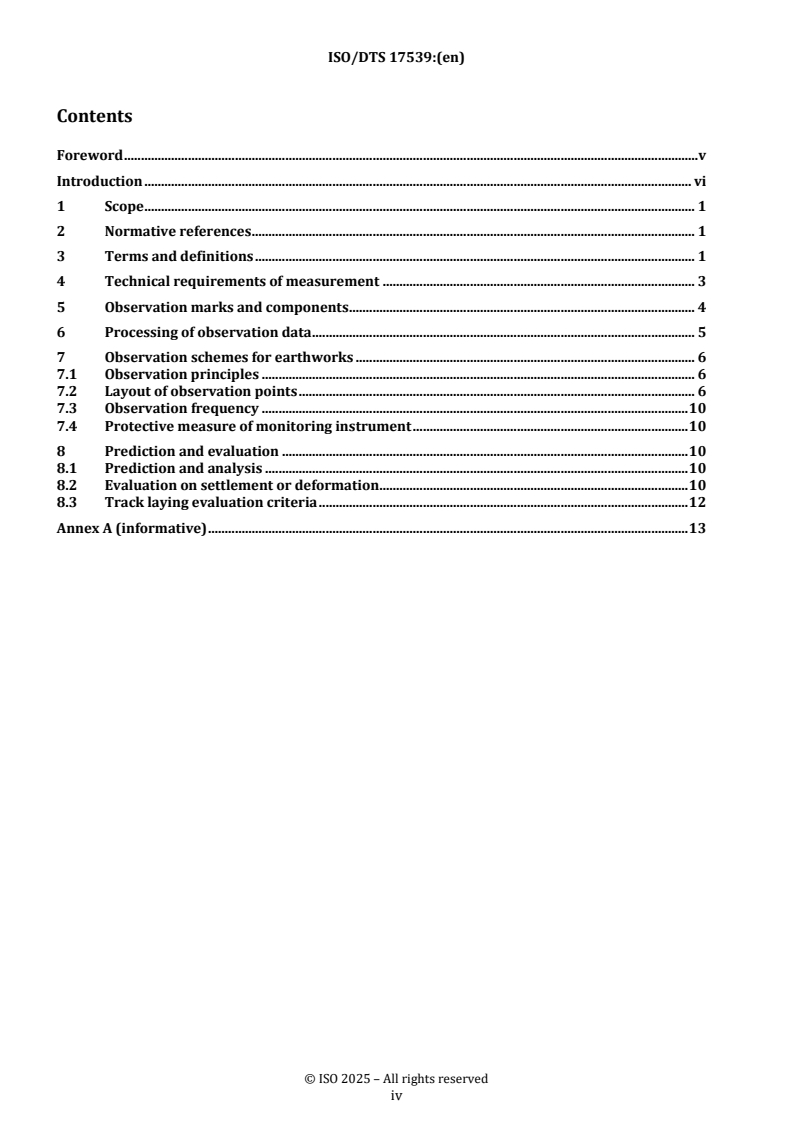
Contents Page
Foreword .iv
Introduction .v
1 Scope . 1
2 Normative references . 1
3 Terms and definitions . 1
4 Technical requirements of measurement . 3
5 Observation marks and components . 3
6 Processing of observation data . 4
7 Observation schemes for earthworks . 5
7.1 Observation principles .5
7.2 Layout of observation points .5
7.3 Observation frequency .8
7.4 Protective measure of monitoring instrument .8
8 Prediction and evaluation . 8
8.1 Prediction and analysis .8
8.2 Evaluation on settlement or deformation .8
8.3 Track laying evaluation criteria .10
Annex A (informative) .11
iii
ISO/DTS 17539:2025(en)
Foreword
ISO (the International Organization for Standardization) is a worldwide federation of national standards
bodies (ISO member bodies). The work of preparing International Standards is normally carried out through
ISO technical committees. Each member body interested in a subject for which a technical committee
has been established has the right to be represented on that committee. International organizations,
governmental and non-governmental, in liaison with ISO, also take part in the work. ISO collaborates closely
with the International Electrotechnical Commission (IEC) on all matters of electrotechnical standardization.
The procedures used to develop this document and those intended for its further maintenance are described
in the ISO/IEC Directives, Part 1. In particular, the different approval criteria needed for the different types
of ISO documents should be noted. This document was drafted in accordance with the editorial rules of the
ISO/IEC Directives, Part 2 (see www.iso.org/directives).
ISO draws attention to the possibility that the implementation of this document may involve the use of (a)
patent(s). ISO takes no position concerning the evidence, validity or applicability of any claimed patent
rights in respect thereof. As of the date of publication of this document, ISO had not received notice of (a)
patent(s) which may be required to implement this document. However, implementers are cautioned that
this may not represent the latest information, which may be obtained from the patent database available at
www.iso.org/patents. ISO shall not be held responsible for identifying any or all such patent rights.
Any trade name used in this document is information given for the convenience of users and does not
constitute an endorsement.
For an explanation of the voluntary nature of standards, the meaning of ISO specific terms and expressions
related to conformity assessment, as well as information about ISO's adherence to the World Trade
Organization (WTO) principles in the Technical Barriers to Trade (TBT), see www.iso.org/iso/foreword.html.
This document was prepared by Technical Committee ISO/TC 269, Railway applications, Subcommittee SC 1,
Infrastructure.
Any feedback or questions on this document should be directed to the user’s national standards body. A
complete listing of these bodies can be found at www.iso.org/members.html.
iv
ISO/DTS 17539:2025(en)
Introduction
This document is intended to be used by customers, designers, specifiers of observation and evaluation of
settlement and deformation of railway subgrade and contractor.
v
FINAL DRAFT Technical Specification ISO/DTS 17539:2025(en)
Railway applications — Track foundation — Observation
and evaluation method of railway subgrade settlement and
deformation
1 Scope
This document defines the general requirements relating to the observation and evaluation method of
railway earthworks (substructure and foundation ground) settlement and deformation for new-built and
existing railway.
2 Normative references
There are no normative references in this document.
3 Terms and definitions
For the purposes of this document, the following terms and definitions apply.
ISO and IEC maintain terminology databases for use in standardization at the following addresses:
— ISO Online browsing platform: available at https:// www .iso .org/ obp
— IEC Electropedia: available at https:// www .electropedia .org/
3.1
ballast
crushed stone or coarse gravel used to construct the top layer of the track bed
3.2
ballastless track
track bed built without a ballast (3.1) layer, usually on concrete slabs
3.3
break angle
angle formed by the differential settlement (3.8) of the trackbed in the transition section (3.20)
3.4
settlement
vertical displacement (compression), usually positive in the downward direction, due to an imposed load or
lowering of the groundwater table
Note 1 to entry: Settlement (3.4) can be due to serval causes primary compression results from the process of
consolidation, and secondary compression (creep) caused by the flow of soil grains.
3.5
culvert
covered channel used to convey a watercourse, passage and others below ground, mainly under railways
3.6
cutting
cut
permanent excavation formed by removing soil or rock to create a level or graded path to allow the formation
of a railway
ISO/DTS 17539:2025(en)
3.7
deformation
dimensionless expression of changes in shape
3.8
differential settlement
difference in settlement (3.4) between two different defined points
3.9
earth structure
structure resulting from earthwork (3.10) construction (e.g. cut, fill, infill)
3.10
earthwork
engineering work associated with the movement and processing of quantities of soils
3.11
embankment
compacted earth structure (3.9), which is typically trapezium, in cross section used to carry an elevated railway
3.12
foundation ground
underlaying natural or improved ground supporting earthworks (3.10)
3.13
frost heave of subgrade
vertical displacement due to the formation of ice lenses in the subgrade (3.17)
3.14
lateral displacement
horizontal movement, often perpendicular to the track
3.15
observation frequency
rate at which the act of observing, watching, or noticing is made
3.16
observation point
geospatial location at which an observation is made
3.17
subgrade
natural ground below the formation level of a pavement
Note 1 to entry: Some countries distinguish subgrade from subsoil. In that case, subgrade then refers to the granular
foundation layer between the subsoil and the ballast (3.1) or slab.
3.18
substructure
parts of a structure that are constructed below the track bed, including the foundation layers and elements
3.19
soft ground
natural soil layers with high water content, large void ratio, high compressibility, and low strength (e.g. silt,
silty soil), prone to significant settlement (3.4) under load, often requiring improvement for subgrade (3.17)
or substructure projects
3.20
transition section
transition zone between earthwork (3.10) sections and rigid structures (i.e. tunnels, bridges)
ISO/DTS 17539:2025(en)
4 Technical requirements of measurement
4.1 Prior to construction, detailed rules for settlement or deformation observation and assessment, as
well as implementation plans for settlement or deformation observation should be prepared based on the
type of track, line speed and traffic, expected track geometry quality objectives, structure, scale of earth
structure and geotechnical conditions, etc.
4.2 The observation points shall be numbered taking into account of suitable rules and ensure unique
identification of the points.
4.3 The measurement components shall have sufficient stability and durability, meeting requirements for
normal functioning.
4.4 When circumstances change between the planning stage and the actual construction stage, the
implementation plan of settlement or deformation observation shall be adjusted accordingly in time.
4.5 Appropriate monitoring method shall be used that is suitable for the measurement purpose.
4.6 The observation point for settlement or deformation shall be set at the location which is able to
reflect the deformation features of structure, and shall be firmly attached to the structure, such that the
observation is convenient and not subject to interference of construction or other activities.
4.7 Levelling, electro-optical distance measurement and trigonometric levelling can be adopted for
settlement or deformation and frost heave deformation, the technical requirements, the accuracy shall
conform with the track category of each country and relevant requirements.
4.8 Where shear deformation is a concern, lateral displacements should be measured. This can be in
earthworks on soft ground or in cuttings on slopes.
4.9 Settlement measurement of each layer should be adopted to grasp the progress of consolidation in each
layer such as in earthworks on soft clayey ground. Pore-water pressure measurement may be supplementary
adopted to grasp the dissipation of pore water pressure.
4.10 Temperature data within or above the ground is necessary for seasonal frost design.
4.11 Settlement or deformation observation for each phase should conform with the following rules:
a) use the same observation method;
b) use the same function of instruments and equipment;
c) use the same reference point and working reference point.
5 Observation marks and components
5.1 Settlement observation posts, settlement plates, observation marks, etc. may be used as observation
marks for settlement or deformation; the single-point settlement meter, hydraulic level gauge, cross-section
settlement instrument, etc. may be used as the measurement component for settlement or deformation; the
frost heave meter and settlement plate may be used as measurement component for frost heave deformation.
5.2 Inclinometers may be used as measurement instruments for lateral displacement of earth structures
and foundation ground.
5.3 Differential settlement gauges may be used as measurement instruments for settlement of each layer.
ISO/DTS 17539:2025(en)
5.4 Piezometers may be used as measurement instruments for change in pore water pressure of
foundation ground.
5.5 The reference point for automatic monitoring equipment such as single-point settlement meter and
hydraulic level gauge shall be set on a stable stratum or structure.
5.6 Single-point settlement meter, hydraulic level gauge, cross-section settlement instrument and frost
heave meter shall have sufficient accuracy and resolution to grasp the change of ground displacement or
water level or both.
5.7 Single-point settlement meter, hydraulic level gauge, profile settlement instrument and frost heave
meter shall have sufficient scale to grasp the change of ground displacement or water level, or both.
6 Processing of observation data
6.1 Settlement or deformation observation data shall include instrument inspection and calibration data,
electronic version of observation records (handbook), electronic version of compensating computation,
observation quality assessment data, observation result table for settlement or deformation and work
report for settlement or deformation observation.
6.2 Frost heave deformation data shall include frost heave deformation observation data and fr
...
ISO/TSDTS 17539 (E)
ISO/TC 269/SC 1/WG 8
Secretariat: AFNOR
Date: 2025-07-1009-15
Railway applications — Track foundation — Observation and
evaluation method of railway subgrade settlement and
deformation
DTS stage
Warning for WDs and CDs
This document is not an ISO International Standard. It is distributed for review and comment. It is subject to
change without notice and may not be referred to as an International Standard.
Recipients of this draft are invited to submit, with their comments, notification of any relevant patent rights of
which they are aware and to provide supporting documentation.
ISO #####-#:####(X)
Infrastructure ferroviaire – Fondation des voies - Méthode d'observation et d'évaluation du tassement et de la
déformation des plates-formes ferroviaires
2 © ISO #### – All rights reserved
ISO/DTS 17539:(en)
All rights reserved. Unless otherwise specified, or required in the context of its implementation, no part of this publication
may be reproduced or utilized otherwise in any form or by any means, electronic or mechanical, including photocopying,
or posting on the internet or an intranet, without prior written permission. Permission can be requested from either ISO
at the address below or ISO’s member body in the country of the requester.
ISO copyright office
CP 401 • Ch. de Blandonnet 8
CH-1214 Vernier, Geneva
Phone: + 41 22 749 01 11
EmailE-mail: copyright@iso.org
Website: www.iso.orgwww.iso.org
Published in Switzerland
iii
ISO/DTS 17539:(en)
Contents
Foreword . v
Introduction . vi
1 Scope . 1
2 Normative references . 1
3 Terms and definitions . 1
4 Technical requirements of measurement . 3
5 Observation marks and components . 4
6 Processing of observation data . 5
7 Observation schemes for earthworks . 6
7.1 Observation principles . 6
7.2 Layout of observation points . 6
7.3 Observation frequency . 10
7.4 Protective measure of monitoring instrument . 10
8 Prediction and evaluation . 10
8.1 Prediction and analysis . 10
8.2 Evaluation on settlement or deformation. 10
8.3 Track laying evaluation criteria . 12
Annex A (informative) . 13
iv
ISO/DTS 17539:(en)
Foreword
ISO (the International Organization for Standardization) is a worldwide federation of national standards
bodies (ISO member bodies). The work of preparing International Standards is normally carried out through
ISO technical committees. Each member body interested in a subject for which a technical committee has been
established has the right to be represented on that committee. International organizations, governmental and
non-governmental, in liaison with ISO, also take part in the work. ISO collaborates closely with the
International Electrotechnical Commission (IEC) on all matters of electrotechnical standardization.
The procedures used to develop this document and those intended for its further maintenance are described
in the ISO/IEC Directives, Part 1. In particular, the different approval criteria needed for the different types of
ISO documents should be noted. This document was drafted in accordance with the editorial rules of the
ISO/IEC Directives, Part 2 (see www.iso.org/directives).
ISO draws attention to the possibility that the implementation of this document may involve the use of (a)
patent(s). ISO takes no position concerning the evidence, validity or applicability of any claimed patent rights
in respect thereof. As of the date of publication of this document, ISO had not received notice of (a) patent(s)
which may be required to implement this document. However, implementers are cautioned that this may not
represent the latest information, which may be obtained from the patent database available at
www.iso.org/patents. ISO shall not be held responsible for identifying any or all such patent rights.
Any trade name used in this document is information given for the convenience of users and does not
constitute an endorsement.
For an explanation of the voluntary nature of standards, the meaning of ISO specific terms and expressions
related to conformity assessment, as well as information about ISO's adherence to the World Trade
Organization (WTO) principles in the Technical Barriers to Trade (TBT), see www.iso.org/iso/foreword.html.
This document was prepared by Technical Committee ISO/TC 269, Railway applications, Subcommittee SC 1,
Infrastructure.
Any feedback or questions on this document should be directed to the user’s national standards body. A
complete listing of these bodies can be found at www.iso.org/members.html.
v
ISO/DTS 17539:(en)
Introduction
This document is intended to be used by customers, designers, specifiers of observation and evaluation of
settlement and deformation of railway subgrade and contractor.
vi
ISO/DTS 17539:(en)
Railway applications — Track foundation — Observation and
evaluation method of railway subgrade settlement and deformation
1 Scope
This document defines the general requirements relating to the observation and evaluation method of railway
earthworks (substructure and foundation ground) settlement and deformation for new-built and existing
railway.
2 Normative references
There are no normative references in this document.
3 Terms and definitions
For the purposes of this document, the following terms and definitions apply.
ISO and IEC maintain terminology databases for use in standardization at the following addresses:
— ISO Online browsing platform: available at https://www.iso.org/obp
— IEC Electropedia: available at https://www.electropedia.org/
3.1
Ballast
3.1
ballast
crushed stone or coarse gravel used to construct the top layer of the track bed
3.2
3.2 Ballastless
ballastless track
track bed built without a ballast (0) layer, usually on concrete slabs
3.3
3.3 Break
break angle
angle formed by the differential settlement (0) of the trackbed in the transition section (0)
3.13.4
3.4
Consolidation settlement
Primary compression
settlement caused by the consolidation process
3.5
Settlement
vertical displacement (compression), usually positive in the downward direction, due to an imposed load or
lowering of the groundwater table
Note 1 to entry: Settlement (3.4) can be due to serval causes primary compression results from the process of
consolidation, and secondary compression (creep) caused by the flow of soil grains.
ISO/DTS 17539:(en)
3.6
Creep
Secondary compression
on-going deformation under constant total stress conditions
3.7
Culvert
3.5
culvert
covered channel used to convey a watercourse, passage and others below ground, mainly under railways
3.8
Cutting
Cut
3.6
cutting
cut
permanent excavation with given sideformed by removing soil or rock to create a slopelevel or graded path
to allow the formation of a railway
3.9
Deformation
3.7
deformation
dimensionless expression of changes in shape
3.10
3.8 Differential
differential settlement
difference in settlement (3.4) between two different defined points
3.11
3.9 Earth
earth structure
structure resulting from earthwork (0) construction (e.g. cut, fill, infill)
3.12
Earthworks
3.10
earthwork
engineering work associated with the movement and processing of quantities of soils
3.13
Embankment
3.11
embankment
compacted earth structure (0,), which is typically trapezium, in cross section used to carry an elevated railway
3.14
3.12 Foundation
foundation ground
underlaying natural or improved ground supporting earthworks (0)
ISO/DTS 17539:(en)
3.15
3.13 Frost
frost heave of subgrade
vertical displacement due to the formation of ice lenses in the subgrade (0)
3.16
3.14 Lateral
lateral displacement
horizontal movement, often perpendicular to the track
3.17
3.15 Observation
observation frequency
rate at which the act of observing, watching, or noticing is made
3.18
3.16 Observation
observation point
geospatial location at which an observation is made
3.19
Subgrade
3.17
subgrade
natural ground below the formation level of a pavement
Note 1 to entry: Some countries distinguish subgrade from subsoil. SubgradeIn that case, subgrade then refers to the
granular foundation layer between the subsoil and the ballast (0) or slab.
3.20
Substructure
3.18
substructure
parts of a structure that are constructed below the track bed, including the foundation layers and elements
3.21
3.19 Soft
soft ground
natural soil layers with high water content, large void ratio, high compressibility, and low strength (e.g.,. silt,
silty soil), prone to significant settlement (3.4) under load, often requiring improvement for subgrade (0) or
substructure projects
3.22
3.20 Transition
transition section
transition zone between earthwork (0) sections and rigid structures, (i.e. tunnels, bridges)
4 Technical requirements of measurement
4.1 4.1 Prior to construction, detailed rules for settlement or deformation observation and assessment, as
well as implementation plans for settlement or deformation observation should be prepared based on the type
of track, line speed and traffic, expected track geometry quality objectives, structure, scale of earth structure
and geotechnical conditions, etc.
ISO/DTS 17539:(en)
4.2 4.2 The observation points shall be numbered taking into account of suitable rules and ensure unique
identification of the points.
4.3 4.3 The measurement components shall have sufficient stability and durability, meeting requirements
for normal functioning.
4.4 4.4 When circumstances change between the planning stage and the actual construction stage, the
implementation plan of settlement or deformation observation shall be adjusted accordingly in time.
4.5 4.5 Appropriate monitoring method shall be used that is suitable for the measurement purpose.
4.6 4.6 The observation point for settlement or deformation shall be set at the location which is able to
reflect the deformation features of structure, and shall be firmly attached to the structure, such that the
observation is convenient and not subject to interference of construction or other activities.
4.7 4.7 Levelling, electro-optical distance measurement and trigonometric levelinglevelling can be adopted
for settlement or deformation and frost heave deformation, the technical requirements, the accuracy shall
complyconform with the track category of each country and relevant requirements.
4.8 4.8 Where shear deformation is a concern, lateral displacements should be measured. This couldcan
be in earthworks on soft ground or in cuttings on slopes.
4.9 4.9 Settlement measurement of each layer should be adopted to grasp the progress of consolidation in
each layer such as in earthworks on soft clayey ground. Pore-water pressure measurement may be
supplementary adopted to grasp the dissipation of pore water pressure.
4.10 4.10 Temperature data within or above the ground is necessary for seasonal frost design.
4.11 4.11 Settlement or deformation observation for each phase should complyconform with the following
rules:
a) a) use the same observation method;
b) b) use the same function of instruments and equipment;
c) c) use the same reference point and working reference point.
5 Observation marks and components
5.1 5.1 Settlement observation posts, settlement plates, observation marks, etc. may be used as observation
marks for settlement or deformation; the single-point settlement meter, hydraulic level gauge, cross-section
settlement instrument, etc. may be used as the measurement component for settlement or deformation; the
frost heave meter and settlement plate may be used as measurement component for frost heave deformation.
5.2 5.2 Inclinometers may be used as measurement instruments for lateral displacement of earth structures
and foundation ground.
5.3 5.3 Differential settlement gauges may be used as measurement instruments for settlement of each
layer.
5.4 5.4 Piezometers may be used as measurement instruments for change in pore water pressure of
foundation ground.
5.5 5.5 The reference point for automatic monitoring equipment such as single-point settlement meter and
hydraulic level gauge shall be set on a stable stratum or structure.
ISO/DTS 17539:(en)
5.6 5.6 Single-point settlement meter, hydraulic level gauge, cross-section settlement instrument and frost
heave meter shall have sufficient accuracy and resolution to grasp the change of ground displacement or water
level or both.
5.7 5.7 Single-point settlement meter, hydraulic level gauge, profile settlement instrument and frost heave
meter shall have sufficient scale to grasp the change of ground displacement or water level, or both.
6 Processing of observation data
6.1 6.1 Settlement or deformation observation data shall include instrument inspection and calibration
data, electronic version of observation records (handbook), electronic version of compensating computation,
observation quality assessment data, observation result table for settlement or deformation and work report
for settlement or deformation observation.
6.2 6.2 Frost heave deformation data shall include frost heave deformation observation data and frost
heave deformation analysis report. Frost heave deformation observation data shall include instrument
inspection and calibration data, electronic version of observation records, electronic version of compensating
computation, the result quality assessment data, observation result table for frost heave deformation and
work report for frost heave deformation observation.
6.3 6.3 Observation The observation result table for settlement or deformation shall contain the
following:
a) a) observation date and time;
b) b) measuring point number;
c) c) subgrade filling height;
d) d) construction status, including construction stage, etc. .;
e) e) current elevation;
f) f) settlement volume of current period;
g) g) cumulative settlement volume;
h) h) settlement rate;
i) i) ground water level.
6.4 6.4 Observation result table for frost heave deformation shall include the following:
a) a) observation date and time;
b) b) measuring point number;
c) c) measuring point location;
d) d) meteorological condition;
e) e) current elevation;
f) f) current frost heave;
g) g) cumulative frost heave;
ISO/DTS 17539:(en)
h) h) frost heave rate;
i) i) air temperature;
j) j) temperature in the ground;
k) k) ground water level.
7 Observation schemes for earthworks
7.1 Observation pri
...
PROJET FINAL
Spécification
technique
ISO/DTS 17539
ISO/TC 269/SC 1
Infrastructure ferroviaire —
Secrétariat: AFNOR
Fondation des voies — Méthode
Début de vote:
d'observation et d'évaluation du
2025-09-30
tassement et de la déformation des
Vote clos le:
plates-formes ferroviaires
2025-11-25
Railway applications — Track foundation — Observation
and evaluation method of railway subgrade settlement and
deformation
LES DESTINATAIRES DU PRÉSENT PROJET SONT
INVITÉS À PRÉSENTER, AVEC LEURS OBSERVATIONS,
NOTIFICATION DES DROITS DE PROPRIÉTÉ DONT ILS
AURAIENT ÉVENTUELLEMENT CONNAISSANCE ET À
FOURNIR UNE DOCUMENTATION EXPLICATIVE.
OUTRE LE FAIT D’ÊTRE EXAMINÉS POUR
ÉTABLIR S’ILS SONT ACCEPTABLES À DES FINS
INDUSTRIELLES, TECHNOLOGIQUES ET COM-MERCIALES,
AINSI QUE DU POINT DE VUE DES UTILISATEURS, LES
PROJETS DE NORMES
INTERNATIONALES DOIVENT PARFOIS ÊTRE CONSIDÉRÉS
DU POINT DE VUE DE LEUR POSSI BILITÉ DE DEVENIR DES
NORMES POUVANT
SERVIR DE RÉFÉRENCE DANS LA RÉGLEMENTATION
NATIONALE.
Numéro de référence
ISO/DTS 17539:2025(fr) © ISO 2025
PROJET FINAL
ISO/DTS 17539:2025(fr)
Spécification
technique
ISO/DTS 17539
ISO/TC 269/SC 1
Infrastructure ferroviaire —
Secrétariat: AFNOR
Fondation des voies — Méthode
Début de vote:
d'observation et d'évaluation du
2025-09-30
tassement et de la déformation des
Vote clos le:
plates-formes ferroviaires
2025-11-25
Railway applications — Track foundation — Observation
and evaluation method of railway subgrade settlement and
deformation
LES DESTINATAIRES DU PRÉSENT PROJET SONT
INVITÉS À PRÉSENTER, AVEC LEURS OBSERVATIONS,
NOTIFICATION DES DROITS DE PROPRIÉTÉ DONT ILS
AURAIENT ÉVENTUELLEMENT CONNAISSANCE ET À
FOURNIR UNE DOCUMENTATION EXPLICATIVE.
DOCUMENT PROTÉGÉ PAR COPYRIGHT
OUTRE LE FAIT D’ÊTRE EXAMINÉS POUR
ÉTABLIR S’ILS SONT ACCEPTABLES À DES FINS
© ISO 2025 INDUSTRIELLES, TECHNOLOGIQUES ET COM-MERCIALES,
AINSI QUE DU POINT DE VUE DES UTILISATEURS, LES
Tous droits réservés. Sauf prescription différente ou nécessité dans le contexte de sa mise en œuvre, aucune partie de cette
PROJETS DE NORMES
INTERNATIONALES DOIVENT PARFOIS ÊTRE CONSIDÉRÉS
publication ne peut être reproduite ni utilisée sous quelque forme que ce soit et par aucun procédé, électronique ou mécanique,
DU POINT DE VUE DE LEUR POSSI BILITÉ DE DEVENIR DES
y compris la photocopie, ou la diffusion sur l’internet ou sur un intranet, sans autorisation écrite préalable. Une autorisation peut
NORMES POUVANT
être demandée à l’ISO à l’adresse ci-après ou au comité membre de l’ISO dans le pays du demandeur.
SERVIR DE RÉFÉRENCE DANS LA RÉGLEMENTATION
NATIONALE.
ISO copyright office
Case postale 401 • Ch. de Blandonnet 8
CH-1214 Vernier, Genève
Tél.: +41 22 749 01 11
E-mail: copyright@iso.org
Web: www.iso.org
Publié en Suisse Numéro de référence
ISO/DTS 17539:2025(fr) © ISO 2025
ii
ISO/DTS 17539:2025(fr)
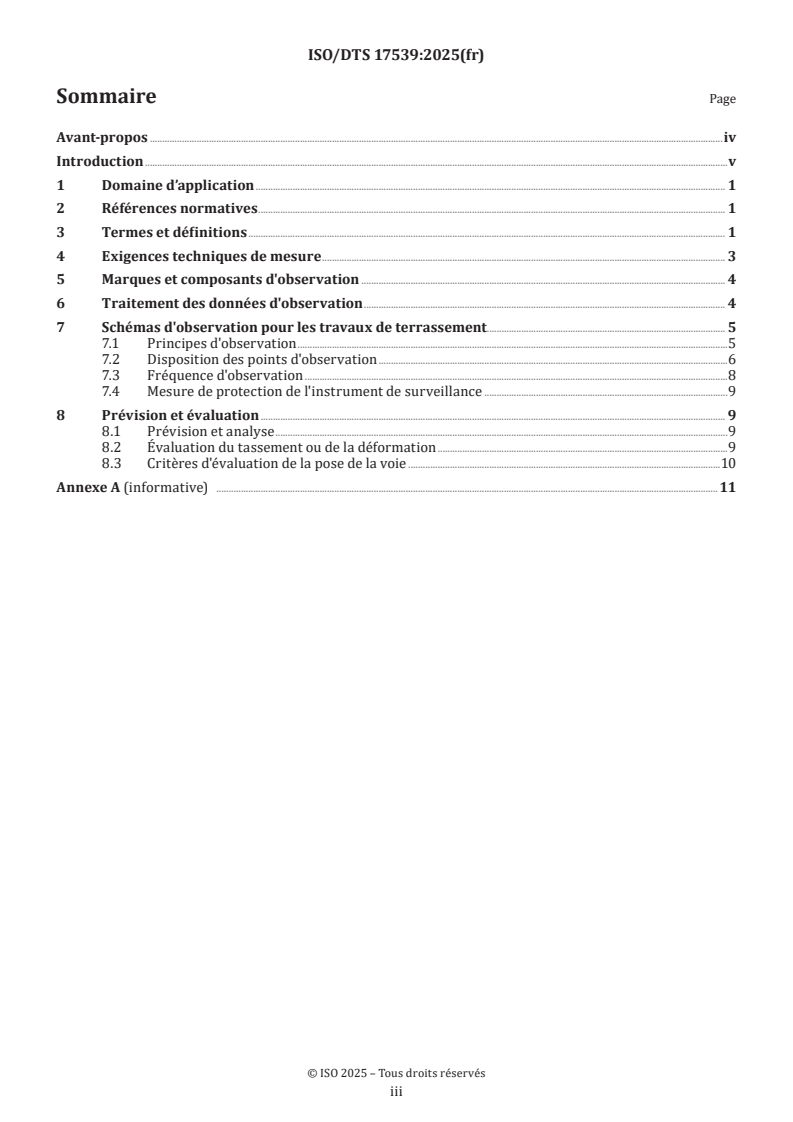
Sommaire Page
Avant-propos .iv
Introduction .v
1 Domaine d’application . 1
2 Références normatives . 1
3 Termes et définitions . 1
4 Exigences techniques de mesure . 3
5 Marques et composants d'observation . 4
6 Traitement des données d'observation . 4
7 Schémas d'observation pour les travaux de terrassement. 5
7.1 Principes d'observation .5
7.2 Disposition des points d'observation .6
7.3 Fréquence d'observation .8
7.4 Mesure de protection de l'instrument de surveillance .9
8 Prévision et évaluation . 9
8.1 Prévision et analyse .9
8.2 Évaluation du tassement ou de la déformation .9
8.3 Critères d'évaluation de la pose de la voie .10
Annexe A (informative) .11
iii
ISO/DTS 17539:2025(fr)
Avant-propos
L'ISO (Organisation internationale de normalisation) est une fédération mondiale d'organismes nationaux
de normalisation (comités membres de l'ISO). L'élaboration des Normes internationales est en général
confiée aux comités techniques de l'ISO. Chaque comité membre intéressé par une étude a le droit de faire
partie du comité technique créé à cet effet. Les organisations internationales, gouvernementales et non
gouvernementales, en liaison avec l'ISO participent également aux travaux. L'ISO collabore étroitement avec
la Commission électrotechnique internationale (IEC) en ce qui concerne la normalisation électrotechnique.
Les procédures utilisées pour élaborer le présent document et celles destinées à sa mise à jour sont
décrites dans les Directives ISO/IEC, Partie 1. Il convient en particulier de prendre note des différents
critères d'approbation requis pour les différents types de documents ISO. Le présent document
a été rédigé conformément aux règles de rédaction données dans les Directives ISO/IEC, Partie 2
(voir www.iso.org/directives).
L’ISO attire l’attention sur le fait que la mise en application du présent document peut entraîner l’utilisation
d’un ou de plusieurs brevets. L’ISO ne prend pas position quant à la preuve, à la validité et à l’applicabilité de
tout droit de brevet revendiqué à cet égard. À la date de publication du présent document, l’ISO n'avait pas
reçu notification qu’un ou plusieurs brevets pouvaient être nécessaires à sa mise en application. Toutefois,
il y a lieu d’avertir les responsables de la mise en application du présent document que des informations
plus récentes sont susceptibles de figurer dans la base de données de brevets, disponible à l'adresse
www.iso.org/patents. L'ISO ne saurait être tenue pour responsable de ne pas avoir identifié de tels droits de
brevets et de ne pas avoir signalé leur existence.
Les appellations commerciales éventuellement mentionnées dans le présent document sont données pour
information, par souci de commodité, à l'intention des utilisateurs et ne sauraient constituer un engagement.
Pour une explication de la nature volontaire des normes, de la signification des termes et expressions
spécifiques de l'ISO liés à l'évaluation de la conformité, ou pour toute information au sujet de l'adhésion de
l'ISO aux principes de l'Organisation mondiale du commerce (OMC) concernant les obstacles techniques au
commerce (OTC), voir le lien suivant: www.iso.org/iso/foreword.html.
Le présent document a été élaboré par le Comité Technique ISO/TC 269, «Applications ferroviaires»; sous-
comité SC 1, «Infrastructure».
Il convient que l'utilisateur adresse tout retour d'information ou toute question concernant le présent
document à l'organisme national de normalisation de son pays. Une liste exhaustive desdits organismes se
trouve à l'adresse www.iso.org/members.html.
iv
ISO/DTS 17539:2025(fr)
Introduction
Le présent document est destiné à être utilisé par les clients, les concepteurs, les prescripteurs d'observation
et d'évaluation du tassement et de la déformation des plate-formes ferroviaires, ainsi que par les prestataires.
v
PROJET FINAL Spécification technique ISO/DTS 17539:2025(fr)
Infrastructure ferroviaire — Fondation des voies —
Méthode d'observation et d'évaluation du tassement et de la
déformation des plates-formes ferroviaires
1 Domaine d’application
Le présent document définit les exigences générales relatives à la méthode d'observation et d'évaluation de
l'affaissement et de la déformation des ouvrages en terre ferroviaires (infrastructure et sol de fondation)
pour les chemins de fer nouvellement construits et existants.
2 Références normatives
Le présent document ne contient aucune référence normative.
3 Termes et définitions
Pour les besoins du présent document, les termes et définitions suivants s'appliquent.
L'ISO et l'IEC tiennent à jour des bases de données terminologiques destinées à être utilisées en normalisation,
consultables aux adresses suivantes:
— ISO Online browsing platform: disponible à l'adresse https:// www .iso .org/ obp
— IEC Electropedia: disponible à l'adresse https:// www .electropedia .org/
3.1
ballast
pierre concassée ou gros gravier utilisé pour construire la couche supérieure de la structure d’assises
3.2
voie sans ballast
structure d’assises construite sans couche de ballast (3.1), généralement sur des dalles en béton
3.3
angle de rupture
angle formé par le tassement différentiel (3.8) de la structure d’assises dans la section de transition (3.20)
3.4
tassement
déplacement vertical (compression), généralement positif dans la direction descendante, en raison d'une
charge imposée ou de l'abaissement de la nappe phréatique
Note 1 à l'article: Le tassement (3.4) peut être dû à plusieurs causes: la compression primaire résulte du processus de
consolidation, et la compression secondaire (fluage) est causée par l'écoulement des grains de sol
3.5
ponceau
canal couvert utilisé pour acheminer un cours d'eau, un flot d’eau, etc. sous terre, principalement sous les
chemins de fer
ISO/DTS 17539:2025(fr)
3.6
déblai
tranchée
excavation permanente formée par l'enlèvement de terre ou de roche pour créer un chemin nivelé ou en
pente permettant la construction d'une voie ferrée
3.7
déformation
expression sans dimension des changements de forme
3.8
tassement différentiel
différence de tassement (3.4) entre deux points donnés différents
3.9
ouvrage en terre
structure résultant de travaux de terrassement (3.10) (par exemple, déblai, remblai)
3.10
travaux de terrassement
travaux d'ingénierie concernant le déplacement et le traitement de sol
3.11
remblai
ouvrage en terre (3.9) compactée, qui est généralement un trapèze en coupe transversale, utilisé pour
soutenir un chemin de fer surélevé
3.12
sol de fondation
sol sous-jacent naturel ou amélioré supportant des travaux de terrassement (3.10)
3.13
soulèvement de la plate-forme de la voie par le gel
déplacement vertical dû à la formation de lentilles de glace dans la plate-forme de la voie (3.17)
3.14
déplacement latéral
mouvement horizontal, souvent perpendiculaire à la voie
3.15
fréquence d'observation
taux auquel des observations, des surveillances ou des constatations sont effectuées
3.16
point d'observation
emplacement géospatial auquel une observation est faite
3.17
plate-forme de la voie
sol naturel en dessous du niveau de formation d'une chaussée
Note 1 à l'article: Certains pays font la distinction entre plate-forme et sous-sol. Dans ce cas, la plate-forme de voie fait
référence à la couche de fondation granulaire entre le sous-sol et le ballast (3.1) ou la dalle.
3.18
sous-structure
parties d'une structure construites sous la structure d’assises, y compris les couches et les éléments de
fondation
ISO/DTS 17539:2025(fr)
3.19
sol meuble
couches de sol naturel avec une forte teneur en eau, un grand rapport de vide, une compressibilité élevée et
une faible résistance (par exemple, limon, sol limoneux), sujettes à un tassement (3.4) important sous charge,
nécessitant souvent une amélioration pour des projets de plate-forme de voie (3.17) ou de sous-structure
3.20
section de transition
zone de transition entre des sections de travaux de terrassement (3.10) et des structures rigides (c.-à-d.
tunnels, ponts)
4 Exigences techniques de mesure
4.1 Avant la construction, il convient d’établir des règles détaillées pour l'observation et l'évaluation des
tassements ou des déformations, ainsi que des plans de mise en œuvre de ces observations en fonction du
type de voie, de la vitesse et du trafic de la ligne, des objectifs de qualité géométrique de voie attendus, de la
structure, de l'échelle de l’ouvrage en terre, des conditions géotechniques, etc.
4.2 Les points d'observation doivent être numérotés en tenant compte des règles appropriées et être
identifiables de manière unique.
4.3 Les composants de mesure doivent avoir une stabilité et une durabilité suffisantes, répondant aux
exigences pour un fonctionnement normal.
4.4 Lorsque les circonstances changent entre la phase de planification et la phase de construction réelle, le
plan de mise en œuvre de l'observation des tassements ou des déformations doit être ajusté en conséquence
et en temps opportun.
4.5 Une méthode de surveillance appropriée doit être utilisée, adaptée à l'objectif de mesure.
4.6 Le point d'observation pour le tassement ou la déformation doit être situé à l'endroit capable de
refléter les caractéristiques de déformation de la structure, et doit être fermement attaché à la structure,
de sorte que l'observation soit pratique et ne soit pas sujette à l'interférence de la construction ou d'autres
activités.
4.7 Le nivellement, la mesure de distance électro-optique et le nivellement trigonométrique peuvent
être adoptés pour le tassement ou la déformation, ainsi que pour le soulèvement dû au gel. Les exigences
techniques et la précision doivent être conformes à la catégorie de voie de chaque pays et aux exigences
pertinentes.
4.8 Lorsqu’une déformation en cisaillement est un sujet de préoccupations, il convient de mesurer les
déplacements latéraux. Ces derniers peuvent avoir lieu lors des travaux de terrassement sur sol meuble ou
dans des déblais sur des pentes.
4.9 Il convient d’adopter la mesure de tassement de chaque couche afin de comprendre l'avancement de
la consolidation dans chaque couche, comme dans les travaux de terrassement sur sol meuble argileux.
La mesure de la pression interstitielle peut être adoptée de manière complémentaire pour comprendre la
dissipation de la pression interstitielle.
4.10 Les données de température à l'intérieur ou au-dessus du sol sont nécessaires pour la conception des
plate-formes ferroviaires vis-à-vis du gel.
ISO/DTS 17539:2025(fr)
4.11 Il convient que l'observation du tassement ou de la déformation pour chaque phase soit conforme aux
règles suivantes:
a) utiliser la même méthode d'observation;
b) utiliser la même fonction des instruments et équipements;
c) utiliser le même point de référence et le même point de référence de travail.
5 Marques et composants d'observation
5.1 Les postes d'observation de tassement, les plaques de tassement, les marques d'observation, etc. peuvent
être utilisés comme marques d'observation pour le tassement ou la déformation; le tassomètre à point unique,
le niveau hydraulique, l'instrument de tassement en section, etc. peuvent être utilisés comme composant de
mesure pour le tassement ou la déformation; le mètre de soulèvement par le gel et la plaque de tassement
peuvent être utilisés comme composant de mesure pour la déformation due au soulèvement par le gel.
5.2 Les inclinomètres peuvent être utilisés comme instruments de mesure pour le déplacement latéral des
ouvrages en terre et du sol de fondation.
5.3 Des jauges de tassement différentiel peuvent être utilisées comme instruments de mesure pour le
tassement de chaque couche.
5.4 Des piézomètres peuvent être utilisés comme instruments de mesure pour le changement de pression
interstitielle du sol de fondation.
5.5 Le point de référence pour les équipements de surveillance automatique tels que le tassomètre à point
unique et une jauge de niveau hydraulique doit être fixé sur une couche géologique ou une structure stables.
5.6 Le tassomètre à point unique, la jauge de niveau hydraulique, l'instrument de tassement de section
transversale et le compteur de soulèvement par le gel doivent avoir une précision et une résolution
suffisantes pour enregistrer les changements dans le déplacement du sol ou le niveau d'eau, ou les deux.
5.7 Le tassomètre à point unique, la jauge de niveau hydraulique, l'instrument de tassement de profil et le
compteur de soulèvement par le gel doivent avoir une échelle suffisante pour enregistrer les changements
dans le déplacement du sol ou le niveau d'eau, ou les deux.
6 Traitement des données d'observation
6.1 Les données d'observation de tassement ou de déformation doivent inclure les données d'inspection
et d'étalonnage des instruments, la version électronique des enregistrements d'observation (manuel), la
version électronique du calcul de compensation, les données d'évaluation de la qualité d'observation, le
tableau des résultats d'observation et le rapport de travail relatifs à l'observation du tassement ou de la
déformation.
6.2 Les données de déformation par le gel doivent inclure les données d'observation de la déformation par
le gel et le rapport d'analyse de la déformation par le gel. Les données d'observation de la déformation par
le gel doivent inclure les données d'inspection et d'étalonnage des instruments, la version électronique des
enregistrements d'observation, la version électronique du calcul de compensation, les données d'évaluation
de la qualité des résultats, le tableau des résultats d'observation et le rapport de travail relatifs à l'observation
de la déformatio
...
Questions, Comments and Discussion
Ask us and Technical Secretary will try to provide an answer. You can facilitate discussion about the standard in here.
Loading comments...