

ISO 23016-1:2025
(Main)Fine bubble technology — Agricultural applications — Part 1: Test method for evaluating the growth promotion of hydroponically grown lettuce
General Information
- Abstract
This document specifies a test method for evaluating the effect of fine bubble water on the growth promotion of hydroponically grown lettuce by estimating the incremental gain in mass of the stems and leaves over a specified growth period.
- Status
- Published
- Publication Date
- 22-Jul-2025
- Technical Committee
- ISO/TC 281 - Fine bubble technology
- Drafting Committee
- ISO/TC 281/WG 3 - Applications of fine bubble technology
- Current Stage
- 6060 - International Standard published
- Start Date
- 23-Jul-2025
- Due Date
- 27-Feb-2026
- Completion Date
- 23-Jul-2025

Overview
ISO 23016-1:2025 - Fine bubble technology - Agricultural applications - Part 1: Test method for evaluating the growth promotion of hydroponically grown lettuce - specifies a standardized laboratory test method to quantify how fine bubble water affects the growth of hydroponically grown lettuce. The standard measures the incremental gain in mass of stems and leaves over a defined growth period, enabling objective performance comparisons of fine bubble generating systems used in plant factories and hydroponic production.
Key topics and technical requirements
- Scope and objective: Evaluate growth promotion of lettuce by estimating mass increase of stems and leaves when exposed to fine bubble water versus control (raw water).
- Two-line test configuration: Parallel lines - a fine bubble water line (treated) and a control water line (raw water) - supplied to separate hydroponic sections to provide direct comparative data.
- Fine bubble generating system: Defines fine bubbles as bubbles < 100 µm and requires continuous, monitored operation of the system throughout the test period.
- Water and nutrient handling: Fine bubble water is mixed with liquid fertilizer in a mixing tank; control line uses raw water mixed with the same fertilizer dosage.
- Environmental monitoring: Mandatory measurement and recording of atmospheric temperature, CO2 concentration, relative humidity, water temperature, dissolved oxygen, pH, electrical conductivity (EC), and PPFD (photosynthetic photon flux density).
- Measurement and reproducibility: Plant mass measured with a calibrated scale (readability 0.1 g). The standard requires preliminary tests to confirm reproducibility and specifies statistical actions if significant differences arise.
- Apparatus and setup details: Recommendations for tank design (gas-barrier inner surfaces to limit air exposure, laminar flow), water flow and volume recording, and operator documentation (operation manual, sampling, records).
- Reporting and annexes: Test report requirements plus informative annexes with example results, recording formats, and confirmation test examples.
Practical applications and users
ISO 23016-1:2025 is designed for:
- Agri‑tech and hydroponic equipment manufacturers evaluating fine bubble generating systems
- Plant factories and controlled-environment agriculture (CEA) operators testing growth-enhancement technologies
- Research institutions studying bubble-mediated plant responses
- Certification bodies and purchasers seeking objective performance data for fine bubble systems
Adopting this ISO test method helps stakeholders compare systems, support technology transfer, document product claims, and accelerate market acceptance of fine bubble technology in agricultural and food-industry applications.
Related standards
- ISO 20480-1: Terminology for fine bubble technology
- ISO 20480-2: Categorization of fine bubble attributes
Keywords: ISO 23016-1:2025, fine bubble technology, hydroponic lettuce, growth promotion test method, plant factory, fine bubble water, fine bubble generating system, PPFD, dissolved oxygen.
Relations
- Effective Date
- 02-Mar-2024
Get Certified
Connect with accredited certification bodies for this standard

Control Union Certifications
Global certification for agriculture and sustainability.

ECOCERT
Organic and sustainability certification.

FSC International
Forest Stewardship Council certification.
Sponsored listings
Frequently Asked Questions
ISO 23016-1:2025 is a standard published by the International Organization for Standardization (ISO). Its full title is "Fine bubble technology — Agricultural applications — Part 1: Test method for evaluating the growth promotion of hydroponically grown lettuce". This standard covers: This document specifies a test method for evaluating the effect of fine bubble water on the growth promotion of hydroponically grown lettuce by estimating the incremental gain in mass of the stems and leaves over a specified growth period.
This document specifies a test method for evaluating the effect of fine bubble water on the growth promotion of hydroponically grown lettuce by estimating the incremental gain in mass of the stems and leaves over a specified growth period.
ISO 23016-1:2025 is classified under the following ICS (International Classification for Standards) categories: 07.030 - Physics. Chemistry; 65.020.20 - Plant growing. The ICS classification helps identify the subject area and facilitates finding related standards.
ISO 23016-1:2025 has the following relationships with other standards: It is inter standard links to ISO/TS 23016-1:2019. Understanding these relationships helps ensure you are using the most current and applicable version of the standard.
ISO 23016-1:2025 is available in PDF format for immediate download after purchase. The document can be added to your cart and obtained through the secure checkout process. Digital delivery ensures instant access to the complete standard document.
Standards Content (Sample)
International
Standard
ISO 23016-1
First edition
Fine bubble technology —
2025-07
Agricultural applications —
Part 1:
Test method for evaluating the
growth promotion of hydroponically
grown lettuce
Reference number
© ISO 2025
All rights reserved. Unless otherwise specified, or required in the context of its implementation, no part of this publication may
be reproduced or utilized otherwise in any form or by any means, electronic or mechanical, including photocopying, or posting on
the internet or an intranet, without prior written permission. Permission can be requested from either ISO at the address below
or ISO’s member body in the country of the requester.
ISO copyright office
CP 401 • Ch. de Blandonnet 8
CH-1214 Vernier, Geneva
Phone: +41 22 749 01 11
Email: copyright@iso.org
Website: www.iso.org
Published in Switzerland
ii
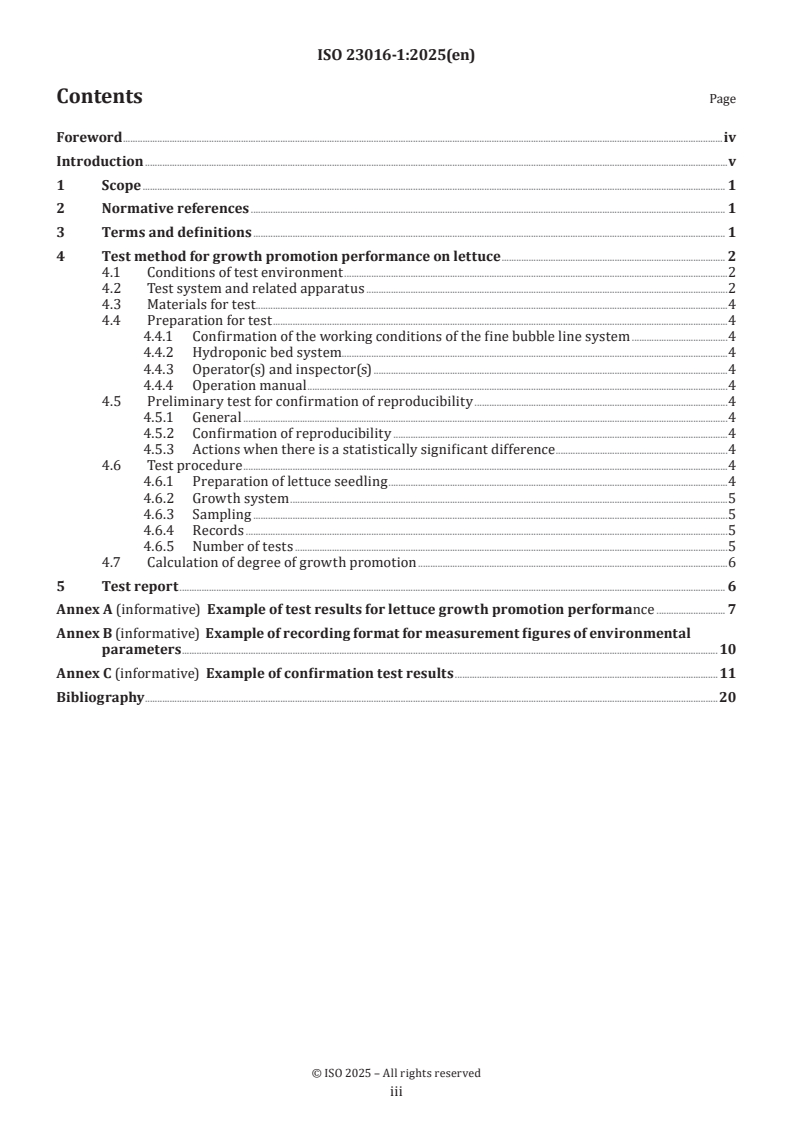
Contents Page
Foreword .iv
Introduction .v
1 Scope . 1
2 Normative references . 1
3 Terms and definitions . 1
4 Test method for growth promotion performance on lettuce . 2
4.1 Conditions of test environment .2
4.2 Test system and related apparatus .2
4.3 Materials for test.4
4.4 Preparation for test .4
4.4.1 Confirmation of the working conditions of the fine bubble line system .4
4.4.2 Hydroponic bed system.4
4.4.3 Operator(s) and inspector(s) .4
4.4.4 Operation manual .4
4.5 Preliminary test for confirmation of reproducibility .4
4.5.1 General .4
4.5.2 Confirmation of reproducibility .4
4.5.3 Actions when there is a statistically significant difference .4
4.6 Test procedure .4
4.6.1 Preparation of lettuce seedling .4
4.6.2 Growth system .5
4.6.3 Sampling .5
4.6.4 Records .5
4.6.5 Number of tests .5
4.7 Calculation of degree of growth promotion .6
5 Test report . 6
Annex A (informative) Example of test results for lettuce growth promotion performance . 7
Annex B (informative) Example of recording format for measurement figures of environmental
parameters . 10
Annex C (informative) Example of confirmation test results .11
Bibliography .20
iii
Foreword
ISO (the International Organization for Standardization) is a worldwide federation of national standards
bodies (ISO member bodies). The work of preparing International Standards is normally carried out through
ISO technical committees. Each member body interested in a subject for which a technical committee
has been established has the right to be represented on that committee. International organizations,
governmental and non-governmental, in liaison with ISO, also take part in the work. ISO collaborates closely
with the International Electrotechnical Commission (IEC) on all matters of electrotechnical standardization.
The procedures used to develop this document and those intended for its further maintenance are described
in the ISO/IEC Directives, Part 1. In particular, the different approval criteria needed for the different types
of ISO document should be noted. This document was drafted in accordance with the editorial rules of the
ISO/IEC Directives, Part 2 (see www.iso.org/directives).
ISO draws attention to the possibility that the implementation of this document may involve the use of (a)
patent(s). ISO takes no position concerning the evidence, validity or applicability of any claimed patent
rights in respect thereof. As of the date of publication of this document, ISO had not received notice of (a)
patent(s) which may be required to implement this document. However, implementers are cautioned that
this may not represent the latest information, which may be obtained from the patent database available at
www.iso.org/patents. ISO shall not be held responsible for identifying any or all such patent rights.
Any trade name used in this document is information given for the convenience of users and does not
constitute an endorsement.
For an explanation of the voluntary nature of standards, the meaning of ISO specific terms and expressions
related to conformity assessment, as well as information about ISO's adherence to the World Trade
Organization (WTO) principles in the Technical Barriers to Trade (TBT), see www.iso.org/iso/foreword.html.
This document was prepared by Technical Committee ISO/TC 281, Fine bubble technology.
This first edition of ISO 23016-1 cancels and replaces ISO/TS 23016-1:2019, which has been technically
revised.
The main changes are as follows:
— a new Annex C has been added to give an example of confirmation test results.
Any feedback or questions on this document should be directed to the user’s national standards body. A
complete listing of these bodies can be found at www.iso.org/members.html.
iv
Introduction
The recent progress in the application of fine bubble technology exhibits successes in the various technical
fields such as environmental technology in water and washing and cleaning technology for mechanical
engineering. The applications for agro- and aqua- farming and food industrial field also draw high interests
of markets in view of fine bubble enabled performance in enhancing growth of agro- and aqua- products,
improving their quality, saving resources for farming and ensuring safety of the food products. Various
industries engaged in such products are introducing the fine bubbles to their farming field by applying fine
bubble generating systems, eventually creating new market for the generating systems.
However, since technology transfer from fine bubble technology to technology fields of agro- and aqua-
farming and food industries is not well supported by common understanding of the fine bubbles or their
generating technology, results of evaluation on fine bubble enhanced performance cannot be accepted
commonly by both generating system suppliers and its users at the transaction scene. Furthermore, a
variety of agro- and aqua- farming products makes it difficult to adopt a systematic approach for selection
and application of generating systems.
The performance evaluation based on objective evidence resulting from standardized procedures is
intended to bridge the two technologies and facilitate diverse fields of applications for fine bubble technology
in the global market. In order to accelerate sound global market formation, development of test procedures
is urgently demanded by both technology stakeholders.
This document is intended to meet these needs by specifying the test procedure to be applied to the
generating system for agro- and aqua- farming and food industries uses. The evaluation is made by applying
fine bubble water generated by the object system to lettuce and by measuring its growth. The product,
lettuce, is globally accepted and the yielded test data represents the performance of the tested system over
other products in such major product family as, for example, leaf vegetable. The growth process of lettuce is
much simpler than other vegetables making the measuring process much easier in the test procedure. The
specified test conditions, namely the environment for growth, are also easy to be controlled allowing many
testing plants globally available. The parameter measured is the change in the harvested mass of lettuces
with application of fine bubbles compared to that without application in a specified period of growth.
Since the performance in terms of parameters is improving rapidly as the technology evolves, the
quantitative criteria for the testing are not specified in this document.
v
International Standard ISO 23016-1:2025(en)
Fine bubble technology — Agricultural applications —
Part 1:
Test method for evaluating the growth promotion of
hydroponically grown lettuce
1 Scope
This document specifies a test method for evaluating the effect of fine bubble water on the growth promotion
of hydroponically grown lettuce by estimating the incremental gain in mass of the stems and leaves over a
specified growth period.
2 Normative references
The following documents are referred to in the text in such a way that some or all of their content constitutes
requirements of this document. For dated references, only the edition cited applies. For undated references,
the latest edition of the referenced document (including any amendments) applies.
ISO 20480-1, Fine bubble technology — General principles for usage and measurement of fine bubbles — Part 1:
Terminology
ISO 20480-2, Fine bubble technology — General principles for usage and measurement of fine bubbles — Part 2:
Categorization of the attributes of fine bubbles
3 Terms and definitions
For the purposes of this document, the terms and definitions given in ISO 20480-1, ISO 20480-2 and the
following apply.
ISO and IEC maintain terminological databases for use in standardization at the following addresses:
— ISO Online browsing platform: available at https:// www .iso .org/ obp
— IEC Electropedia: available at https:// www .electropedia .org/
3.1
plant factory
facilities which allow systematic growth and production of plants where the internal environment
conditions, e.g. temperature, carbon dioxide, and liquid fertilizer are controlled
3.2
fine bubble generating system
system which mechanically generates fine bubbles (bubbles less than 100 μm in diameter) using water and air
3.3
fine bubble water
water including fine bubbles and used in plant factories (3.1)
3.4
raw water
tap water or water with equivalent quality level provided to produce fine bubble water (3.3) and used as the
control water for the reference
3.5
fine bubble section
area to grow plants using fine bubble water (3.3)
Note 1 to entry: For the purpose of this document, plants grown are lettuces.
3.6
control section
area to grow plants using raw water (3.4) as a reference for fine bubble section (3.6)
Note 1 to entry: For the purpose of this document, plants grown are lettuces.
3.7
liquid fertilizer
liquid used as nutrient to grow plants
3.8
culture solution
solution containing liquid fertilizer (3.7) supplied to hydroponic cultivation system
3.9
photosynthetic photon flux density
PPFD
number of photons per unit of time and area, which are contained in 400 nm – 700 nm of wave length needed
for photosynthesis
4 Test method for growth promotion performance on lettuce
4.1 Conditions of test environment
4.1.1 Water supply. Sufficient water supply shall be provided to circulate the water in the piping of the
hydroponic bed and the tank.
4.1.2 Air quality. There shall be no significantly abnormal values that would have impact on lettuce
growth, compared with normal air composition.
4.1.3 Operation of growth promotion system. Continuous operation shall be available for the whole
period of the test. The test method shall be applied to the growth promotion system and continuous
operation shall be maintained for the whole period of the test. Each operation parameter related to stable
fine bubble generation shall allow monitoring.
4.1.4 Performance of fine bubbles Each operation parameter related to stable fine bubble generation
shall allow monitoring. Sizes and number concentrations of fine bubble water can be measured by the user
own test or system supplier’s data may be provided. However, when measurement is carried by the user, it is
not necessary after mixing the liquid fertilizer.
4.1.5 Measuring systems. Measuring devices are required to monitor environmental parameters such
as atmospheric temperature, carbon dioxide concentration, relative humidity, water temperature, dissolved
oxygen, pH, electric conductivity and PPFD, as well as sample performance through measurement of the
mass of stems and leaves.
4.2 Test system and related apparatus
The test system shall consist of the following (see Figure 1).
4.2.1 Configuration of test system. Two-line systems are used. One is for fine bubble water that is
generated when the raw water is supplied to the fine bubble generating system, and is supplied to the fine
bubble section of the plant factory for promoting the growth of lettuce. In the fine bubble section, two or
more sections can be used for the test. Meanwhile, another one is for the raw water without fine bubbles
as a reference for the fine bubble section and is directly supplied to the control section of the plant factory.
Figure 1 shows the basic layout of test line. Test apparatus is composed of fine bubble generating system,
water tank, water supply system including pump, planting system and lettuce under growing stage, and has
two planting lines. The planting system shall be installed in artificial light only, sunlight only or sunlight-
artificial light type plant factory.
4.2.2 Fine bubble water line system. The fine bubble water mixed with liquid fertilizer in the liquid
fertilizer mixing tank after the generation of fine bubbles in the bubble generation tank is supplied to the
one (line for supplying fine bubble water) of two lines. Regarding liquid fertilizer, fine bubble water and
liquid fertilizer are supplied by a fixed amount in the liquid fertilizer mixing tank. Alternatively, water and
liquid fertilizer can be simultaneously supplied into a mixed tank, circulated through fine bubble generating
system and returned to the mixed tank. The water tanks in Figure 1 can be combined. For fine bubble water,
two or more sections can be used for tests.
4.2.3 Control water line system. Raw water and liquid fertilizer are supplied to the other line, by a fixed
amount, to mix them after the raw water is supplied to the tank.
4.2.4 Tank. It is desirable that the inner walls of the tank are covered with materials with gas-barrier
properties including glass to prevent the surface of the water in the tank from exposure to the air, and to
ensure that the flow in the tank is in laminar flow conditions.
4.2.5 Water flow. The dimensions of the hydroponic bed, the volume of water including the hydroponic
bed, tank and the piping as well as the water flow in the hydroponic bed, etc. shall be recorded in a test report.
4.2.6 Weighing scale. A calibrated weighing scale which can read to
...