


ISO/FDIS 14644-13
(Main)Cleanrooms and associated controlled environments - Part 13: Cleaning of surfaces to achieve defined levels of cleanliness in terms of particle and chemical concentration
Cleanrooms and associated controlled environments - Part 13: Cleaning of surfaces to achieve defined levels of cleanliness in terms of particle and chemical concentration
ISO 14644-13:2017 gives guidelines for cleaning to a specified degree on cleanroom surfaces, surfaces of equipment in a cleanroom and surfaces of materials in a cleanroom. Under consideration are all surfaces (external or internal) that are of interest. It provides guidance on the assessment of cleaning methods for achieving the required surface cleanliness by particle concentration (SCP) and surface cleanliness by chemical concentration (SCC) classes and which techniques should be considered to achieve these specified levels. The appropriateness of cleaning techniques will make reference to the cleanliness classes and associated test methods found in ISO 14644‑9 and ISO 14644‑10. The following matters of general guidance will be provided: - expected surface cleanliness levels; - suitability of cleaning methods; - compatibility of surfaces with the cleaning technique; - assessment of cleaning appropriateness. The following will be excluded from this document: - classification of cleaning methods; - product produced within a cleanroom; - specific surface-related cleaning methods; - detailed description of cleaning mechanisms, methods and procedures of various cleaning methods; - detailed material characteristics; - description of damage mechanisms by cleaning processes and time-dependent effects; - references to interactive bonding forces between contaminants and surfaces or generation processes that are usually time-dependent and process-dependent; - other characteristics of particles such as electrostatic charge, ionic charges, etc.; - chemical reactions between molecular contaminants and surfaces; - microbiological aspects of surface cleanliness; - radioactive aspects of contamination; - health and safety considerations; - environmental aspects such as waste disposal, emissions, etc.; - selection and use of statistical methods.
Salles propres et environnements maîtrisés apparentés — Partie 13: Nettoyage des surfaces afin d’obtenir des niveaux de gradation de la propreté par rapport à la concentration particulaire et chimique
ISO 14644-13:2017 donne des lignes directrices concernant le nettoyage, jusqu'à atteindre un degré de nettoyage spécifié, des surfaces d'une salle propre ainsi que des surfaces des équipements et des matériaux contenus dans une salle propre. Toutes les surfaces d'intérêt (internes ou externes) sont concernées par le présent document. Il fournit des préconisations concernant l'évaluation des méthodes de nettoyage en vue d'obtenir les classes exigées de propreté particulaire des surfaces (SCP) et de propreté chimique des surfaces (SCC) ainsi que les techniques qu'il convient d'utiliser pour atteindre ces niveaux spécifiés. L'adéquation des techniques de nettoyage fera référence aux classes de propreté et aux méthodes d'essai associées disponibles dans l'ISO 14644‑9 et l'ISO 14644‑10. Les préconisations générales porteront sur les questions suivantes: - niveaux de propreté des surfaces souhaités; - pertinence des méthodes de nettoyage; - compatibilité des surfaces avec la technique de nettoyage; - évaluation de l'adéquation du nettoyage. Les points suivants ne seront pas traités dans le présent document: - classification des méthodes de nettoyage; - produits fabriqués dans une salle propre; - méthodes de nettoyage spécifiques en lien avec une surface; - description détaillée des mécanismes de nettoyage, méthodes et modes opératoires de diverses méthodes de nettoyage; - caractéristiques détaillées des matériaux; - description des mécanismes de détérioration dus aux procédés de nettoyage et effets dans le temps; - références aux forces de liaison entre les contaminants et les surfaces, ou aux processus de génération qui dépendent généralement du temps et du procédé; - autres caractéristiques des particules, telles que la charge électrostatique, les charges ioniques, etc.; - réactions chimiques entre les contaminants moléculaires et les surfaces; - aspects microbiologiques de la propreté des surfaces; - aspects radioactifs de la contamination; - considérations relatives à la santé et la sécurité; - aspects environnementaux tels que l'élimination des déchets, les émissions, etc.; - sélection et utilisation de méthodes statistiques.
General Information
- Status
- Not Published
- Technical Committee
- ISO/TC 209 - Cleanrooms and associated controlled environments
- Drafting Committee
- ISO/TC 209 - Cleanrooms and associated controlled environments
- Current Stage
- 5020 - FDIS ballot initiated: 2 months. Proof sent to secretariat
- Start Date
- 23-Oct-2025
- Completion Date
- 23-Oct-2025
Relations
- Effective Date
- 12-Apr-2025
- Effective Date
- 15-Mar-2025
Overview
ISO/FDIS 14644-13 (Cleanrooms and associated controlled environments - Part 13) provides guidance for cleaning surfaces in cleanrooms and associated controlled environments to reach defined levels of surface cleanliness expressed as surface cleanliness by particle concentration (SCP) and surface cleanliness by chemical concentration (SCC). The standard focuses on all relevant surfaces (external and internal) of equipment, materials and room surfaces, and describes a methodology to assess and select cleaning techniques and validate that required cleanliness classes are met.
Key topics and requirements
- General methodology for defining objects, specifying target cleanliness, and determining initial contamination.
- Cleanliness specifications: defining SCP and SCC targets aligned with the ISO 14644 series.
- Selection of cleaning methodologies: overview of mechanical, fluidic, blasting and chemical techniques and criteria to choose appropriate methods based on target cleanliness and surface compatibility.
- Material compatibility checks: guidance to assess whether cleaning agents and techniques are compatible with surfaces and components.
- Cleaning validation: requirements and approaches for demonstrating cleaning efficiency and cleaning appropriateness to meet SCP and SCC classes.
- Measurement methods: direct and indirect measurement approaches for verifying particle and chemical surface contamination.
- Documentation: recommended records for methods, validation results and ongoing monitoring.
- Informative annexes: practical aspects of cleaning, descriptions of cleaning methods, material compatibility guidance and measurement guidance.
What the standard provides guidance on:
- Expected surface cleanliness levels
- Suitability of cleaning methods
- Compatibility of surfaces with cleaning techniques
- Assessment of cleaning appropriateness
What is intentionally excluded (high-level):
- Classification of cleaning methods, detailed cleaning procedures, microbiological or radioactive contamination, health & safety, environmental waste/disposal, and selection/use of statistical methods.
Applications and practical value
ISO 14644-13 is used to:
- Develop and validate cleaning procedures for cleanrooms and critical equipment
- Select cleaning agents and techniques that meet particle and chemical surface limits
- Establish acceptance criteria and test methods for cleaning qualification
- Support contamination-control strategies in regulated industries
Typical practical uses include cleaning-procedure development, vendor and consumable selection, audit evidence for quality systems, and supporting regulatory compliance for product and process cleanliness.
Who should use this standard
- Cleanroom managers and contamination-control engineers
- Validation and quality assurance specialists (pharmaceuticals, medical devices)
- Semiconductor, optics and aerospace manufacturing professionals
- Facilities engineers, equipment manufacturers and suppliers of cleaning agents/tools
Related standards
- ISO 14644 series (general cleanroom standards)
- Specifically references ISO 14644‑9 and ISO 14644‑10 for cleanliness classes and associated test methods
Keywords: ISO 14644-13, cleanrooms, surface cleanliness, SCP, SCC, cleaning validation, material compatibility, contamination control.


ISO/FDIS 14644-13 - Cleanrooms and associated controlled environments — Part 13: Cleaning of surfaces to achieve defined levels of cleanliness in terms of particle and chemical concentration Released:10/9/2025

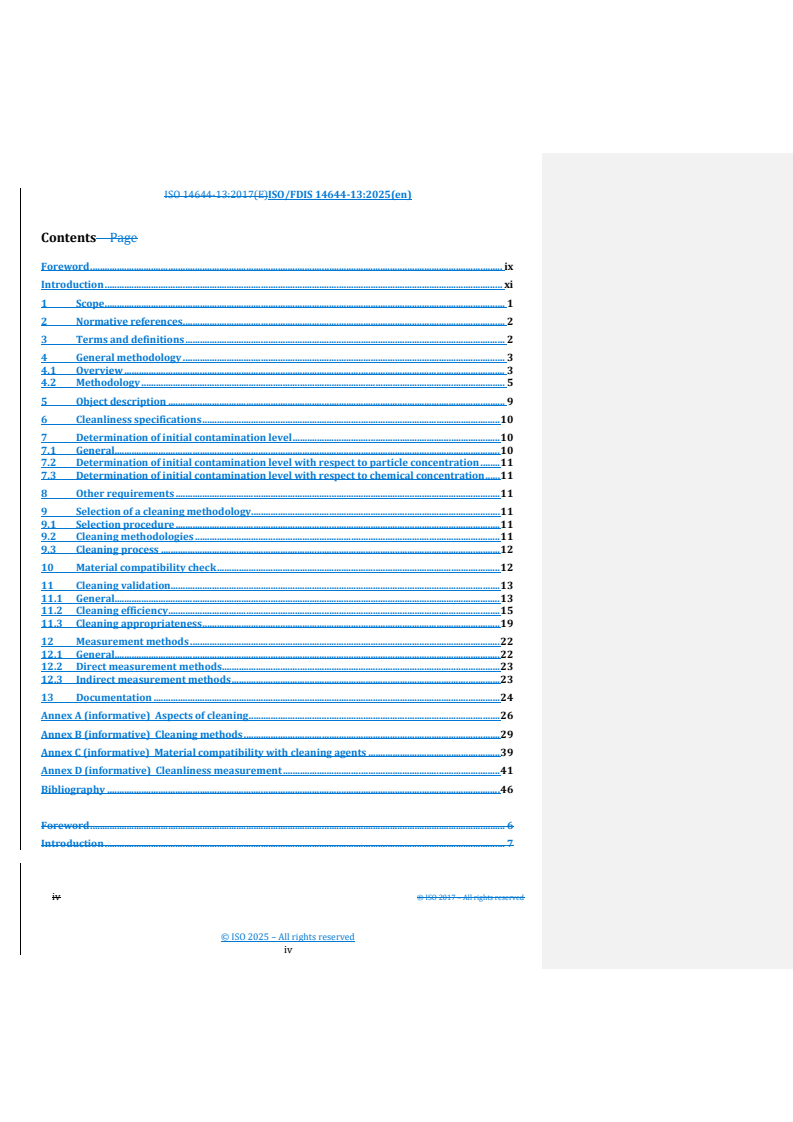
REDLINE ISO/FDIS 14644-13 - Cleanrooms and associated controlled environments — Part 13: Cleaning of surfaces to achieve defined levels of cleanliness in terms of particle and chemical concentration Released:10/9/2025

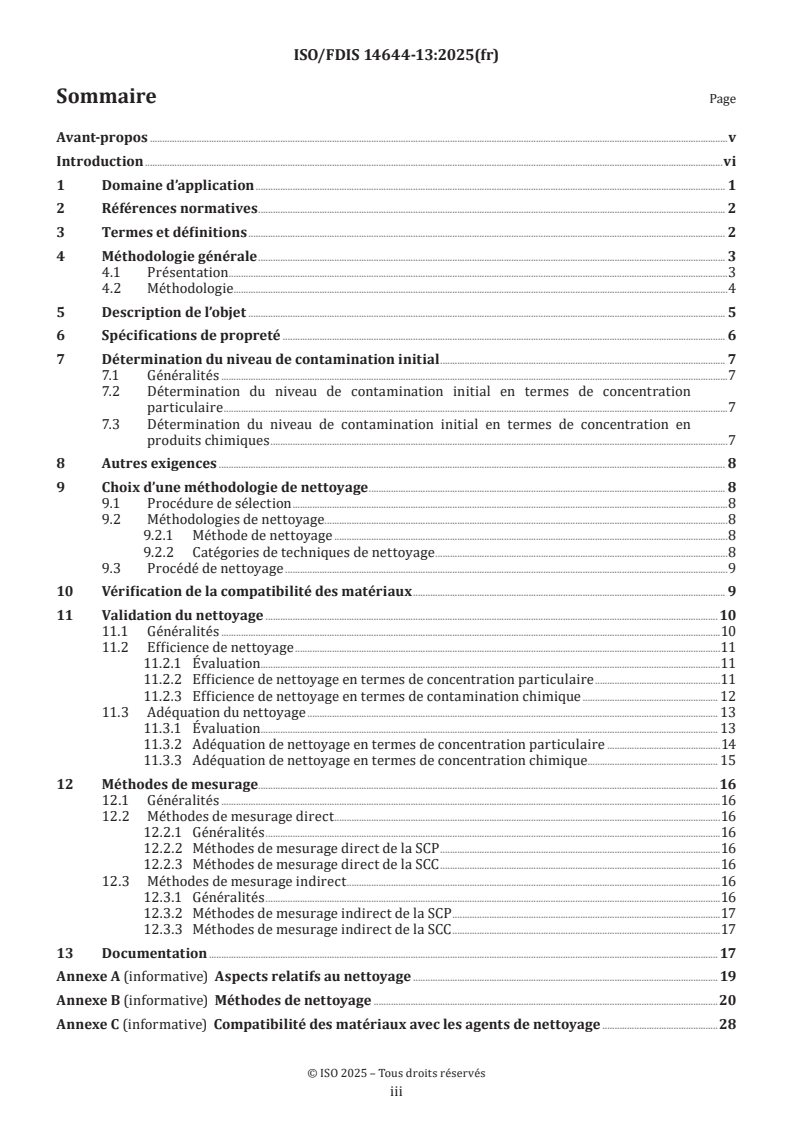

ISO/FDIS 14644-13 - Salles propres et environnements maîtrisés apparentés — Partie 13: Nettoyage des surfaces afin d’obtenir des niveaux de gradation de la propreté par rapport à la concentration particulaire et chimique Released:11/26/2025
Frequently Asked Questions
ISO/FDIS 14644-13 is a draft published by the International Organization for Standardization (ISO). Its full title is "Cleanrooms and associated controlled environments - Part 13: Cleaning of surfaces to achieve defined levels of cleanliness in terms of particle and chemical concentration". This standard covers: ISO 14644-13:2017 gives guidelines for cleaning to a specified degree on cleanroom surfaces, surfaces of equipment in a cleanroom and surfaces of materials in a cleanroom. Under consideration are all surfaces (external or internal) that are of interest. It provides guidance on the assessment of cleaning methods for achieving the required surface cleanliness by particle concentration (SCP) and surface cleanliness by chemical concentration (SCC) classes and which techniques should be considered to achieve these specified levels. The appropriateness of cleaning techniques will make reference to the cleanliness classes and associated test methods found in ISO 14644‑9 and ISO 14644‑10. The following matters of general guidance will be provided: - expected surface cleanliness levels; - suitability of cleaning methods; - compatibility of surfaces with the cleaning technique; - assessment of cleaning appropriateness. The following will be excluded from this document: - classification of cleaning methods; - product produced within a cleanroom; - specific surface-related cleaning methods; - detailed description of cleaning mechanisms, methods and procedures of various cleaning methods; - detailed material characteristics; - description of damage mechanisms by cleaning processes and time-dependent effects; - references to interactive bonding forces between contaminants and surfaces or generation processes that are usually time-dependent and process-dependent; - other characteristics of particles such as electrostatic charge, ionic charges, etc.; - chemical reactions between molecular contaminants and surfaces; - microbiological aspects of surface cleanliness; - radioactive aspects of contamination; - health and safety considerations; - environmental aspects such as waste disposal, emissions, etc.; - selection and use of statistical methods.
ISO 14644-13:2017 gives guidelines for cleaning to a specified degree on cleanroom surfaces, surfaces of equipment in a cleanroom and surfaces of materials in a cleanroom. Under consideration are all surfaces (external or internal) that are of interest. It provides guidance on the assessment of cleaning methods for achieving the required surface cleanliness by particle concentration (SCP) and surface cleanliness by chemical concentration (SCC) classes and which techniques should be considered to achieve these specified levels. The appropriateness of cleaning techniques will make reference to the cleanliness classes and associated test methods found in ISO 14644‑9 and ISO 14644‑10. The following matters of general guidance will be provided: - expected surface cleanliness levels; - suitability of cleaning methods; - compatibility of surfaces with the cleaning technique; - assessment of cleaning appropriateness. The following will be excluded from this document: - classification of cleaning methods; - product produced within a cleanroom; - specific surface-related cleaning methods; - detailed description of cleaning mechanisms, methods and procedures of various cleaning methods; - detailed material characteristics; - description of damage mechanisms by cleaning processes and time-dependent effects; - references to interactive bonding forces between contaminants and surfaces or generation processes that are usually time-dependent and process-dependent; - other characteristics of particles such as electrostatic charge, ionic charges, etc.; - chemical reactions between molecular contaminants and surfaces; - microbiological aspects of surface cleanliness; - radioactive aspects of contamination; - health and safety considerations; - environmental aspects such as waste disposal, emissions, etc.; - selection and use of statistical methods.
ISO/FDIS 14644-13 is classified under the following ICS (International Classification for Standards) categories: 13.040.35 - Cleanrooms and associated controlled environments. The ICS classification helps identify the subject area and facilitates finding related standards.
ISO/FDIS 14644-13 has the following relationships with other standards: It is inter standard links to ISO 28399:2021, ISO 14644-13:2017. Understanding these relationships helps ensure you are using the most current and applicable version of the standard.
ISO/FDIS 14644-13 is available in PDF format for immediate download after purchase. The document can be added to your cart and obtained through the secure checkout process. Digital delivery ensures instant access to the complete standard document.
Standards Content (Sample)
FINAL DRAFT
International
Standard
ISO/TC 209
Cleanrooms and associated
Secretariat: ANSI
controlled environments —
Voting begins on:
Part 13:
Cleaning of surfaces to achieve
Voting terminates on:
defined levels of cleanliness in
terms of particle and chemical
concentration
RECIPIENTS OF THIS DRAFT ARE INVITED TO SUBMIT,
WITH THEIR COMMENTS, NOTIFICATION OF ANY
RELEVANT PATENT RIGHTS OF WHICH THEY ARE AWARE
AND TO PROVIDE SUPPOR TING DOCUMENTATION.
IN ADDITION TO THEIR EVALUATION AS
BEING ACCEPTABLE FOR INDUSTRIAL, TECHNO-
ISO/CEN PARALLEL PROCESSING LOGICAL, COMMERCIAL AND USER PURPOSES, DRAFT
INTERNATIONAL STANDARDS MAY ON OCCASION HAVE
TO BE CONSIDERED IN THE LIGHT OF THEIR POTENTIAL
TO BECOME STAN DARDS TO WHICH REFERENCE MAY BE
MADE IN NATIONAL REGULATIONS.
Reference number
FINAL DRAFT
International
Standard
ISO/TC 209
Cleanrooms and associated
Secretariat: ANSI
controlled environments —
Voting begins on:
Part 13:
Cleaning of surfaces to achieve
Voting terminates on:
defined levels of cleanliness in
terms of particle and chemical
concentration
RECIPIENTS OF THIS DRAFT ARE INVITED TO SUBMIT,
WITH THEIR COMMENTS, NOTIFICATION OF ANY
RELEVANT PATENT RIGHTS OF WHICH THEY ARE AWARE
AND TO PROVIDE SUPPOR TING DOCUMENTATION.
© ISO 2025
IN ADDITION TO THEIR EVALUATION AS
All rights reserved. Unless otherwise specified, or required in the context of its implementation, no part of this publication may
BEING ACCEPTABLE FOR INDUSTRIAL, TECHNO-
ISO/CEN PARALLEL PROCESSING
LOGICAL, COMMERCIAL AND USER PURPOSES, DRAFT
be reproduced or utilized otherwise in any form or by any means, electronic or mechanical, including photocopying, or posting on
INTERNATIONAL STANDARDS MAY ON OCCASION HAVE
the internet or an intranet, without prior written permission. Permission can be requested from either ISO at the address below
TO BE CONSIDERED IN THE LIGHT OF THEIR POTENTIAL
or ISO’s member body in the country of the requester.
TO BECOME STAN DARDS TO WHICH REFERENCE MAY BE
MADE IN NATIONAL REGULATIONS.
ISO copyright office
CP 401 • Ch. de Blandonnet 8
CH-1214 Vernier, Geneva
Phone: +41 22 749 01 11
Email: copyright@iso.org
Website: www.iso.org
Published in Switzerland Reference number
ii
Contents Page
Foreword .v
Introduction .vi
1 Scope . 1
2 Normative references . 2
3 Terms and definitions . 2
4 General methodology . 3
4.1 Overview .3
4.2 Methodology .4
5 Object description . 5
6 Cleanliness specifications . 6
7 Determination of initial contamination level . 6
7.1 General .6
7.2 Determination of initial contamination level with respect to particle concentration .6
7.3 Determination of initial contamination level with respect to chemical concentration .6
8 Other requirements . . 7
9 Selection of a cleaning methodology . 7
9.1 Selection procedure .7
9.2 Cleaning methodologies .7
9.2.1 Cleaning method .7
9.2.2 Categories of cleaning techniques .7
9.3 Cleaning process .8
10 Material compatibility check . 8
11 Cleaning validation . 8
11.1 General .8
11.2 Cleaning efficiency .9
11.2.1 Evaluation .9
11.2.2 Cleaning efficiency with respect to particle concentration .10
11.2.3 Cleaning efficiency with respect to chemical contamination .11
11.3 Cleaning appropriateness .11
11.3.1 Assessment .11
11.3.2 Cleaning appropriateness with respect to particle concentration . 12
11.3.3 Cleaning appropriateness with respect to chemical concentration . 13
12 Measurement methods . 14
12.1 General .14
12.2 Direct measurement methods .14
12.2.1 General .14
12.2.2 Direct measurement methods with respect to SCP .14
12.2.3 Direct measurement methods with respect to SCC .14
12.3 Indirect measurement methods .14
12.3.1 General .14
12.3.2 Indirect measurement methods with respect to SCP . . 15
12.3.3 Indirect measurement methods with respect to SCC . 15
13 Documentation .15
Annex A (informative) Aspects of cleaning . 17
Annex B (informative) Cleaning methods .18
Annex C (informative) Material compatibility with cleaning agents .25
Annex D (informative) Cleanliness measurement .27
iii
Bibliography .32
iv
Foreword
ISO (the International Organization for Standardization) is a worldwide federation of national standards
bodies (ISO member bodies). The work of preparing International Standards is normally carried out through
ISO technical committees. Each member body interested in a subject for which a technical committee
has been established has the right to be represented on that committee. International organizations,
governmental and non-governmental, in liaison with ISO, also take part in the work. ISO collaborates closely
with the International Electrotechnical Commission (IEC) on all matters of electrotechnical standardization.
The procedures used to develop this document and those intended for its further maintenance are described
in the ISO/IEC Directives, Part 1. In particular, the different approval criteria needed for the different types
of ISO document should be noted. This document was drafted in accordance with the editorial rules of the
ISO/IEC Directives, Part 2 (see www.iso.org/directives).
ISO draws attention to the possibility that the implementation of this document may involve the use of (a)
patent(s). ISO takes no position concerning the evidence, validity or applicability of any claimed patent
rights in respect thereof. As of the date of publication of this document, ISO had not received notice of (a)
patent(s) which may be required to implement this document. However, implementers are cautioned that
this may not represent the latest information, which may be obtained from the patent database available at
www.iso.org/patents. ISO shall not be held responsible for identifying any or all such patent rights.
Any trade name used in this document is information given for the convenience of users and does not
constitute an endorsement.
For an explanation of the voluntary nature of standards, the meaning of ISO specific terms and expressions
related to conformity assessment, as well as information about ISO's adherence to the World Trade
Organization (WTO) principles in the Technical Barriers to Trade (TBT), see www.iso.org/iso/foreword.html.
This document was prepared by Technical Committee ISO/TC 209, Cleanrooms and associated controlled
environments, in collaboration with the European Committee for Standardization (CEN) Technical Committee
CEN/TC 243, Cleanroom technology, in accordance with the Agreement on technical cooperation between
ISO and CEN (Vienna Agreement).
This second edition cancels and replaces the first edition (ISO 14644-13:2017), of which it constitutes a
minor revision. The changes are as follows:
— term class (classification, classified) changed to levels or assessment where appropriate;
— updated document titles and issue dates where appropriate;
— minor editorial changes;
— removed references not cited in the document.
A list of all parts in the ISO 14644 series can be found on the ISO website.
Any feedback or questions on this document should be directed to the user’s national standards body. A
complete listing of these bodies can be found at www.iso.org/members.html.
v
Introduction
The term surface refers to the interface between two phases. For the purpose of this document, the surface
is a solid. A “clean surface” is where one or more of the contamination categories (particles, chemical) are
under control due to cleaning/decontamination. The degree of cleanliness is specified in the corresponding
surface cleanliness levels (see ISO 14644-9 and ISO 14644-10). Different cleaning methods are necessary
depending on the degree of cleanliness (cleanliness level) required. This document gives guidance on the
selection of cleaning methods to achieve specified cleanliness levels. For the selection procedure, the aspects
of surface description, cleanliness specifications, types of contamination, cleaning techniques, material
compatibility, and assessment methodology are taken into consideration. Most of the methods are suitable
for removal of more than one contamination category at the same time; therefore, a common standard for
the selection of a cleaning method for both particles, as well as chemical contamination, is needed.
vi
FINAL DRAFT International Standard ISO/FDIS 14644-13:2025(en)
Cleanrooms and associated controlled environments —
Part 13:
Cleaning of surfaces to achieve defined levels of cleanliness in
terms of particle and chemical concentration
1 Scope
This document gives guidelines for cleaning to a specified degree on cleanroom surfaces, surfaces of
equipment in a cleanroom and surfaces of materials in a cleanroom. Under consideration are all surfaces
(external or internal) that are of interest. It provides guidance on the assessment of cleaning methods for
achieving the required surface cleanliness by particle concentration (SCP) and surface cleanliness by chemical
concentration (SCC) levels and which techniques should be considered to achieve these specified levels.
The appropriateness of cleaning techniques will make reference to the cleanliness levels and associated test
methods found in ISO 14644-9 and ISO 14644-10.
The document gives general guidance on the following:
— expected surface cleanliness levels;
— suitability of cleaning methods;
— compatibility of surfaces with the cleaning technique;
— assessment of cleaning appropriateness.
The following are excluded from this document:
— classification of cleaning methods;
— product produced within a cleanroom;
— specific surface-related cleaning methods;
— detailed description of cleaning mechanisms, methods and procedures of various cleaning methods;
— detailed material characteristics;
— description of damage mechanisms by cleaning processes and time-dependent effects;
— references to interactive bonding forces between contaminants and surfaces or generation processes
that are usually time-dependent and process-dependent;
— other characteristics of particles such as electrostatic charge, ionic charges, etc.;
— chemical reactions between molecular contaminants and surfaces;
— microbiological aspects of surface cleanliness;
— radioactive aspects of contamination;
— health and safety considerations;
— environmental aspects such as waste disposal, emissions, etc.;
— selection and use of statistical methods.
2 Normative references
The following documents are referred to in the text in such a way that some or all of their content constitutes
requirements of this document. For dated references, only the edition cited applies. For undated references,
the latest edition of the referenced document (including any amendments) applies.
ISO 14644-8, Cleanrooms and associated controlled environments — Part 8: Assessment of air cleanliness by
chemical concentration (ACC)
ISO 14644-9, Cleanrooms and associated controlled environments — Part 9: Assessment of surface cleanliness
for particle concentration
ISO 14644-10, Cleanrooms and associated controlled environments — Part 10: Assessment of surface cleanliness
for chemical contamination
3 Terms and definitions
For the purposes of this document, the terms and definitions given in ISO 14644-9, ISO 14644-10 and the
following apply.
ISO and IEC maintain terminology databases for use in standardization at the following addresses:
— ISO Online browsing platform: available at https:// www .iso .org/ obp
— IEC Electropedia: available at https:// www .electropedia .org/
3.1
cleanliness
condition of a solid surface where the amount of contamination (3.4) (particle, chemical)
is controlled to a specific level
3.2
cleaning appropriateness
relation between the required cleanliness (3.1) and the accomplished cleanliness under controlled conditions
Note 1 to entry: In some languages, the term cleaning efficacy is used to indicate cleaning appropriateness.
Note 2 to entry: In case of real operational conditions or monitoring, the term cleaning effectiveness is used.
3.3
cleaning efficiency
fraction of specific contaminants removed from a surface by a cleaning process
Note 1 to entry: The fraction is determined by the accomplished surface cleanliness in respect to the initial surface
cleanliness.
3.4
contamination
unwanted matter in an undesirable location
3.5
particle
minute piece of matter with defined physical boundaries
[SOURCE: ISO 14644-1:2015, 3.2.1]
3.6
particle contamination
particles (3.5) having the potential to affect the process, the product, the personnel or the facilities
3.7
particle size
diameter of a sphere that produces a response, by a given particle-sizing instrument, that is equivalent to
the response produced by the particle (3.5) being measured
4 General methodology
4.1 Overview
Multiple aspects need to be considered for cleaning. Figure 1 provides an overview of the factors that
contribute to the suitability of cleaning methods to achieve a defined level of surface cleanliness. For more
details, see Annex A.
Key
more details in Figure A.1
Figure 1 — Overview of cleaning aspects (non-exhaustive)
4.2 Methodology
Appropriateness of a cleaning technique for an application depends on many factors. For complex objects, it
is advised to follow the sequence described in this clause and in the decision tree (see Figure 2). By using this
procedure, it can be assured that all important issues are covered. For simple objects or surfaces, deviations
from the sequence are allowable, as long as the critical information is documented.
The approach starts with describing the object that has to be cleaned. The description should cover, among
others, composition of materials, chemical characteristics, surface finish and shape factors like geometrical
complexity and size (step 1). In the second step, the objective of the cleaning procedure is to be specified in
terms of the desired cleanliness of the object. To have a starting point, the initial contamination level should
be assessed (step 3) and other requirements shall be listed (step 4). Based on type of contaminants and
the required removal efficiency, a cleaning technique or a combination of techniques can be selected (step
5). The cleaning methodology shall be checked against the materials from the first step in order to avoid
material compatibility issues (step 6). At the last step, a validation method shall be carried out (step 7).
The validation shall at least comprise methods for determination of the cleaning performance and material
compatibility. The performance of the cleaning shall be checked against the specification.
Figure 2 — Decision tree
5 Object description
In the object description, the following aspects shall be considered.
a) Physical properties of the object:
— physical dimensions;
— form/shape/complexity of the object;
— critical surfaces.
A general description of the object shall be given. Size, shape, complexity and identification of the critical
surfaces set many boundary conditions for a cleaning method.
b) Surface(s):
— material composition of the object surface(s);
— complexity;
— materials/critical materials (sensitive to cleaning agents);
— thin/atomic surface layers (e.g. protective layers);
— other physical properties (e.g. electrostatic).
The composition of the object can be simple (one or more similar material(s)) or a system consisting of
a range of different materials (e.g. metal/plastic/glass composition). Each individual material should
be taken into account when choosing a cleaning method. Some combinations of materials can be very
difficult to clean as one cleaning method may be suitable for one material but not the other. The selection
of the cleaning method shall be the best compromise between minimal damage of the materials at
maximum cleaning efficiency.
c) Chemical properties of the surface(s):
— chemical composition;
— state of the surface (hydrophobic, hydrophilic, lipophobic, lipophilic, etc.);
— energetic state of the surface (zeta potential).
Physical and chemical properties of a surface have a large influence on the choice of a cleaning method.
Choice of a method shall take into account all involved materials/chemical composition of the surface(s)
and the combination of materials undergoing cleaning.
The activity of the surface is determined by the chemical configuration of the final atomic layer. This is
an important parameter in determining the choice of method. These layers may be hydrophilic (water
wettable-lipophobic) or hydrophobic (water repellent but oil-wettable-lipophilic). The cleaning method
used can influence the surface activity. The surface activity also influences the electrostatic properties
of a material — a hydrophilic surface will have fewer tendencies to electrically charge.
d) Morphology:
Cleaning is influenced by the morphological aspects of a surface such as shape, size, structure, surface
roughness or porosity. Morphological aspects may further complicate cleaning due to the accessibility
of the surfaces to be cleaned and to the retention of cleaning agents and materials used for cleaning.
e) Object specific requirements:
— intended use of the object;
— environmental conditions, both pre- and post-cleaning;
— critical surfaces, surfaces with either high importance in the application or sensitive to cleaning.
6 Cleanliness specifications
The rationale of determining appropriateness of the cleaning method should include the contaminants of
concern, as well as acceptable levels of contamination for the application.
The required cleanliness shall be specified in terms of particle concentration according to ISO 14644-9 and/
or in terms of the concentration of a specific group of chemicals according to ISO 14644-10.
The specification of the targeted cleanliness level can be determined in various ways:
— cleanliness level required by customer;
— common cleanliness level required for similar objects;
— by performing an analysis on the impact of contamination of the surface in the (future) function of a
product or process where the cleaned surface will be used;
— by performing tests or simulations with various cleanliness levels of the considered surface and/or;
— by performing an analysis of the contamination that caused failure or quality loss.
7 Determination of initial contamination level
7.1 General
To select the cleaning procedure for achieving a required surface cleanliness level, the initial surface
cleanliness shall be established. The initial surface cleanliness by chemical and/or particle concentration
shall be determined for the surfaces of interest. This can be determined qualitatively or quantitatively.
Qualitative evaluation is a non-numerical assessment (e.g. a visual inspection).
Where the quantitative surface cleanliness is determined, it can be related to the efficiency of the cleaning
procedure in respect to the required surface cleanliness by particle concentration and/or chemical
concentration. The quantified contamination (particle and/or chemical) shall be related to the area of the
representative surface. This evaluation allows determination of the initial cleanliness level.
7.2 Determination of initial contamination level with respect to particle concentration
The initial surface cleanliness by particle concentration shall be determined for the different surfaces.
Depending on the required cleanliness level, a qualitative assessment of the initial cleanliness level may
be sufficient. For quantitative assessment, the number and size of particles shall be characterized by
a measurement method as described in Clause 12. The surface cleanliness grading level as outlined in
ISO 14644-9 shall be applied.
The quantified particle concentration shall be related to the area of the representative surface. This
evaluation allows determination of the initial cleanliness level.
7.3 Determination of initial contamination level with respect to chemical concentration
The initial surface cleanliness by chemical concentration shall be determined for the different surfaces.
Depending on the specific application, a qualitative assessment (e.g. water break test) of the initial cleanliness
level might be sufficient. For quantitative assessment of the mass and nature of the chemical contaminants,
a measurement technique according to Clause 12 and ISO 14644-10 shall be applicable.
The quantified chemical contamination shall be related to the area of the representative surface. This
evaluation allows determination of the initial cleanliness level.
8 Other requirements
In addition to requirements for cleaning appropriateness and product integrity, many other elements
influence the applicability of the cleaning method. In step 5 of the decision tree (see Figure 2), these other
aspects shall be listed and requirements shall be defined. The contents of these requirements are strongly
related to the object or surface and its application.
Typical examples for other requirements are time available for cleaning, number of items that will be
cleaned, available footprint, waste, investment and labour costs, level of operator skill and environmental
aspects.
9 Selection of a cleaning methodology
9.1 Selection procedure
Requirements for cleaning are defined in Clause 5 to Clause 8. These requirements shall be considered
during the selection process for the cleaning methodology to ensure the greatest uniformity between the
requirements and the method.
The final decision of the choice of cleaning methodology shall be based on a combination of all aspects to find
the technically and financially optimal, most efficient solution. The customer, the clean technology supplier
and the process owner of the surface/object/component to be cleaned should be involved in this selection
process. The decision optimizes the various parameters and shall assure specified surface quality. Table B.1
and Table B.2 can aid the selection process.
9.2 Cleaning methodologies
9.2.1 Cleaning method
A cleaning methodology consists of a cleaning technique (e.g. wiping, plasma cleaning and ultrasonic
cleaning) and a cleaning process. The cleaning process is linked to the cleaning techniques and involves
the amount of mechanical energy, chemical energy, temperature and process time. By using a balanced
combination of these four process parameters, the optimum cleaning result can be achieved. Final cleanliness
can be limited by substrate damage and/or selection criteria defined in Clause 8.
The required cleanliness level and the initial cleanliness level in particle and/or chemical concentration led
to a selection of cleaning methods. In case the initial cleanliness level is high and the required cleanliness
level is low, a combination of methods may be required.
9.2.2 Categories of cleaning techniques
The cleaning techniques can be divided depending on the major cleaning mechanism into physical and
chemical cleaning which additionally can be divided into wet and dry-cleaning techniques. Whether a
process is categorized as physical/chemical or as wet/dry depends on the dominant mechanism used for the
cleaning. A non-exhaustive list of physical cleaning techniques can be found in B.2 (mechanical cleaning),
B.3 (fluidic cleaning), and B.4 (blasting cleaning techniques). A list of chemical cleaning techniques can be
found in B.5 (chemical cleaning). References to the categories of cleaning techniques are given in Table 1.
Table 1 — Categorization of cleaning techniques as described in Annex B
Cleaning technique Physical Chemical
Dry B.2, B.4 dry B.5 dry
Wet B.3, B.4 wet B.5 wet
The numbers refer to subclauses within Annex B that provide a brief description of the major cleaning
techniques.
Table B.1 and Table B.2 support the choice of an appropriate cleaning technique (physical/chemical)
that fulfils the cleanliness specifications. With the help of feasibility tests on material compatibility (see
Clause 10) and empirical values/evaluation, the best suitable technique shall be chosen for validation (see
Clause 11).
9.3 Cleaning process
In Table B.1 and Table B.2, an overview is given on the working ranges for different cleaning techniques. In
these ranges, optimum process conditions are assumed. Since material properties and other requirements
can require the use of suboptimum conditions, the actual cleaning efficiency and appropriateness can be
lower. The process settings shall be defined either by an experimental investigation or from experience.
10 Material compatibility check
The compatibility of materials with cleaning agents shall be considered. These cleaning agents (e.g.
chemicals, solvents, high pressure gas or liquid) shall be selected with respect to their compatibility with the
materials or items to be cleaned and their efficiency in removing different kinds of contaminants: particle or
chemical contaminants.
Detrimental effects on surfaces can be caused by the cleaning agents and/or the cleaning technique.
The chemical nature of the materials of the surface — individually or in combination depending on the
composition of the surface — should be evaluated technically.
The following describes such direct, indirect and long duration effects.
— Direct effects are changes of intrinsic material properties (physical and/or chemical) as a consequence
of the interaction with a process parameter from the cleaning technique: chemical nature of a solvent,
time of exposure and temperature.
EXAMPLE 1 The change of the chemical surface structure may strongly change the physical behaviour. Change
of the hydrophilic character of the last atomic layer to hydrophobic through the cleaning process may change the
physical behaviour of the cleaned surface, i.e. wettability and electrostatic charge. Hydrophobic surface is not
wettable and is easily charged which may attract particles.
EXAMPLE 2 Change in surface roughness.
— Indirect effects can be caused by different physical-chemical mechanisms as a consequence of secondary
interactions (e.g. chemical reactions with specific compounds of the substrate) or as an interaction
with a non-process parameter (post-degradation or oxidation by O of air, deposits of residues as a new
contamination).
NOTE An indirect effect might not be observed immediately.
— Long duration effects result from a slow process (e.g. induced corrosion from chemical conversion after
chemical cleaning, ageing and weakening).
Annex C gives an overview of compatibility with chemical solvents; it is a non-exhaustive list. In the case of
a lack of information for a specific cleaning solvent, the chemical resistance of the material shall be assessed
through an appropriate test.
11 Cleaning validation
11.1 General
To assess the suitability of a selected cleaning procedure, the cleaning efficiency and the cleaning
appropriateness should be considered.
For the validation of a cleaning process to reach the required surface cleanliness with respect to particle
concentration and/or chemical concentration, the achieved surface cleanliness SCP and/or SCC levels should
be determined.
Other performance-related aspects, such as repeatability, reproducibility and operator influences, shall also
be considered. In Clause 8, a set of requirements are defined that are not related to cleaning performance.
Although these requirements are taken into account during the selection of the cleaning method, the
validation process shall verify that these requirements are fulfilled.
Figure 3 and Figure 4 are depictions of the terms cleaning efficiency and cleaning appropriateness.
Cleaning efficiency = 1 − final cleanliness level/initial cleanliness level (expressed as a percentage)
Cleaning appropriateness = required cleanliness level/final cleanliness level
Figure 3 — Example for a method with low cleaning efficiency leading to unsuitable cleaning
appropriateness
Figure 4 — Example for a method with high cleaning efficiency leading to suitable cleaning
appropriateness
11.2 Cleaning efficiency
11.2.1 Evaluation
For evaluation of the cleaning efficiency, the initial surface cleanliness level and final cleanliness level shall
be determined.
11.2.2 Cleaning efficiency with respect to particle concentration
The cleaning efficiency is calculated by Formula (1):
fin
C
SCP;D
C =−1 (1)
eff
ini
C
SCP;D
where
D is the particle size, in micrometres (µm);
ini
C is the initial surface concentration, in particles per square metre of surface, of particles that are
SCP;D
equal to or larger than the considered particle size D in µm;
fin
C is the final surface concentration, in particles per square metre of surface, of particles that are
SCP;D
equal to or larger than the considered particle size D in µm.
In accordance with ISO 14644-9, the relation with the surface cleanliness level is given by Formula (2):
SCP;N
Ck= (2)
SCP;D
D
where
C is the maximum permitted total surface concentration, in particles per square metre of surface,
SCP;D
of particles that are equal to or larger than the considered particle size;
SCP;N is the SCP level number;
D is the considered particle size, in micrometres;
k is the constant 1, in micrometres.
Combining Formula (1) and Formula (2) gives the cleaning efficiency in terms of SCP, in Formula (3):
SCP;N
fin
k
SCP;N
fin
SCP;NN− SCP;
()
D finini
C =−1 = 1− = 11− 0 (3)
eff
SCP;N SCP;N
ini ini
10 10
k
D
where
D is the particle size, in micrometres;
SCP;N is the SCP level number;
SCP;N is the SCP level number of the final surface cleanliness of particles;
fin
SCP;N is the SCP level number of the initial surface cleanliness of particles.
ini
NOTE The cleaning efficiency can also be expressed as a percentage (%).
EXAMPLE In this example, the smallest particle size that can be measured with the applied measurement method
is 5 µm. Therefore, the concentration of the number of particles ≥5 µm is used.
ini
The initial concentration of particles ≥5 µm per m C is 600 000. Therefore, the SCP;N = lg (600 000 × 5) = 6,5.
ini
SCP;5
The initial surface cleanliness level SCP;N = 6,5 for particles equal to or larger than 5 µm.
ini
fin
After cleaning, the final concentration of particles ≥5 µm per m C is 1 000. Therefore, the
SCP;5
SCP;N = lg (1 000 × 5) = 3,7.
fin
The final surface cleanliness level SCP;N = 3,7 for particles equal to or larger than 5 µm.
fin
The cleaning efficiency in terms of particle concentration = 1 − (1 000)/(600 000) = 1 − 1/600 = 0,998 or 99,8 % for
particles ≥5 µm.
(3,7 − 6,5) -2,8
Similarly, the cleaning efficiency in respect to the SCP levels = 1 − 10 = 1 – 10 = 0,998 4 or 99,8 % for
particles ≥5 µm.
11.2.3 Cleaning efficiency with respect to chemical contamination
The cleaning efficiency is calculated by Formula (4):
fin
C
SCC
C =−1 (4)
eff
ini
C
SCC
where
ini
C is the initial concentration of the considered chemical (g/m );
SCC
fin
C is the final concentration of the considered chemical (g/m ).
SCC
According to ISO 14644-10, the relation with the surface cleanliness level by chemical concentration (SCC) is
given by Formula (5):
SCC;N
C = 10 (5)
SCC
where SCC;N is the surface cleanliness of chemical concentration by level.
Combining Formula (4) and Formula (5) gives the cleaning efficiency in terms of SCC, in Formula (6):
SCC;N
fin
10 ()SCC;NN−SCC;
finini
C =−1 = 11− 0 (6)
eff
SCC;N
ini
NOTE The cleaning efficiency can also be expressed as a percentage (%).
EXAMPLE The initial concentration of the hydrocarbons is 50 mg per m for hydrocarbons.
Therefore, the
−3
SCC;N =×lg 50 10 =−13,
( )
ini
for hydrocarbons.
The final concentration of the hydrocarbons is 10 µg per m .
Therefore, the
−6
SCC;N =×��lg 10 10 =−� 50, .
)
fin (
The cleaning efficiency in terms of chemical concentration =
−6 −6
1 − 10 × 10 /50 × 1 000 × 10 = 1 − 10/50 000 = 0,999 8 or 99,98 % for hydrocarbons.
(−5,0 + 1,3) −3,7
Similarly, the cleaning efficiency in respect to the SCC levels = 1 − 10 = 1 − 10 = 0,999 8 or 99,98 % for
hydrocarbons.
11.3 Cleaning appropriateness
11.3.1 Assessment
For evaluation of the cleaning appropriateness, the final cleanliness level obtained shall be determined and
compared to the required surface cleanliness.
11.3.2 Cleaning appropriateness with respect to particle concentration
The cleaning appropriateness is calculated by Formula (7):
requ
C
SCP;D
C = (7)
app
fin
C
SCP;D
where
requ
C is the required concentration of particles equal to or larger than D µm;
SCP;D
fin
C is the final particle concentration obtained of particles equal to or larger than D µm.
SCP;D
D is the particle size, in micrometres.
According to ISO 14644-9, the relation with the surface cleanliness level is given by Formula (8):
SCP;N
Ck= (8)
SCP;D
D
where
C is the concentration of particles equal to or larger than D µm;
SCP;D
D is the particle size, in micrometres;
SCP;N is the SCP level number.
Combining Formula (7) and Formula (8) gives the cleaning appropriateness in terms of SCP level, in
Formula (9):
SCP;N
requ
SCP;NN− SCP;
()
requ fin
C = = 10 (9)
app
SCP;N
fin
If the cleaning appropriateness is less than 1, the chosen cleaning procedure was not suitable.
If the cleaning appropriateness is equal or greater than 1, the chosen cleaning procedure was suitable and
results in a surface at the required cleanliness level.
NOTE The cleaning appropriateness can also be expressed as a percentage (%).
EXAMPLE In this example, the smallest particle size that can be measured with the applied measurement method
is 10 µm. Therefore, the concentration of the number of particles ≥ 10 µm is used.
The required SCP;N = 4,0 for particles equal to or larger than 10 µm.
requ
requ
This means that C (10 µm) = 10 000/10 µm = 1 000 particles/m .
SCP;10
fin
The final concentration of particles obtained ≥ 10 µm C is 1 250 particles/m .
SCP;10
requ fin
Cleaning appropriateness = C / C = 1 000/1 250 = 0,8 → 80 % for particles ≥10 µm.
SCP;10 SCP;10
In terms of SCP:
SCP;N =×lg 1 250 10 = 41, .
()
fin
(4,0 − 4,1) −0,1
The cleaning appropriateness = 10 = 10 = 0,8 or 80 %.
The cleaning appropriateness does not meet the requirements.
11.3.3 Cleaning appropriateness with respect to chemical concentration
The cleaning appropriateness is the ratio of the required surface cleanliness by chemical concentration
under controlled conditions to the (final) chemical concentration after cleaning, given by Formula (10):
requ
C
SCC
C =� (10)
app
fin
C
SCC
where
requ
C is the required maximum concentration of the considered chemical (g/m );
SCC
fin
C is the final concentration of the considered chemical (g/m ).
SCC
According to ISO 14644-10, the relation with the surface cleanliness level by chemical concentration (SCC) is
given by Formula (11):
SCC;N
C = 10 (11)
SCC
where
C is the maximum allowable concentration of the specified chemical substance or group of
SCC
substances, expressed in g/m ;
SCC;N is the common logarithm index of concentration C .
SCC
Combining both Formula (10) and Formula (11) gives the cleaning appropriateness in terms of SCC, in
Formula (12):
requ requ fin
CC−
C
SCC
SCC
SCC
C ==� 10 (12)
app
fin
C
SCC
where
requ
C is the required maximum concentration
...
© ISO
ISO/TC 209/WG 12
ISO/TC 209
Secretariat: ANSI
Date: 2025-10-09
ISO 14644-13:2017(E)
ISO/TC 209/SC /WG 12
Secretariat: IEST/ANSI
Cleanrooms and associated controlled environments — Part 13: Cleaning of
surfaces to achieve defined levels of cleanliness in terms of particle and chemical
classificationconcentration
Document type:
Document subtype:
Document stage:
Document language:
© ISO
Cleanrooms and associated controlled environments —
Part 13:
Cleaning of surfaces to achieve defined levels of cleanliness in terms
of particle and chemical concentration
FDIS stage
Document type:
Document subtype:
Document stage:
Document language:
ISO 14644-13:2017(E)ISO/FDIS 14644-13:2025(en)
All rights reserved. Unless otherwise specified, or required in the context of its implementation, no part of this publication
may be reproduced or utilized otherwise in any form or by any means, electronic or mechanical, including photocopying,
or posting on the internet or an intranet, without prior written permission. Permission can be requested from either ISO
at the address below or ISO’s member body in the country of the requester.
ISO copyright office
CP 401 • Ch. de Blandonnet 8
CH-1214 Vernier, Geneva
Phone: + 41 22 749 01 11
E-mail: copyright@iso.org
Website: www.iso.org
Published in Switzerland
iii
ISO 14644-13:2017(E)ISO/FDIS 14644-13:2025(en)
Contents Page
Foreword . ix
Introduction . xi
1 Scope . 1
2 Normative references . 2
3 Terms and definitions . 2
4 General methodology . 3
4.1 Overview . 3
4.2 Methodology . 5
5 Object description . 9
6 Cleanliness specifications . 10
7 Determination of initial contamination level . 10
7.1 General. 10
7.2 Determination of initial contamination level with respect to particle concentration . 11
7.3 Determination of initial contamination level with respect to chemical concentration . 11
8 Other requirements . 11
9 Selection of a cleaning methodology . 11
9.1 Selection procedure . 11
9.2 Cleaning methodologies . 11
9.3 Cleaning process . 12
10 Material compatibility check . 12
11 Cleaning validation . 13
11.1 General. 13
11.2 Cleaning efficiency . 15
11.3 Cleaning appropriateness . 19
12 Measurement methods . 22
12.1 General. 22
12.2 Direct measurement methods . 23
12.3 Indirect measurement methods . 23
13 Documentation . 24
Annex A (informative) Aspects of cleaning . 26
Annex B (informative) Cleaning methods . 29
Annex C (informative) Material compatibility with cleaning agents . 39
Annex D (informative) Cleanliness measurement . 41
Bibliography . 46
Foreword . 6
Introduction . 7
iv © ISO 2017 – All rights reserved
iv
ISO 14644-13:2017(E)ISO/FDIS 14644-13:2025(en)
1 Scope . 1
2 Normative references . 2
3 Terms and definitions . 2
4 General methodology . 3
4.1 Overview . 3
4.2 Methodology . 4
5 Object description . 7
6 Cleanliness specifications . 8
7 Determination of initial contamination level . 8
7.1 General. 8
7.2 Determination of initial contamination level with respect to particle concentration . 8
7.3 Determination of initial contamination level with respect to chemical concentration . 8
8 Other requirements . 9
9 Selection of a cleaning methodology . 9
9.1 Selection procedure . 9
9.2 Cleaning methodologies . 9
9.2.1 Cleaning method . 9
9.2.2 Categories of cleaning techniques . 9
9.3 Cleaning process . 10
10 Material compatibility check . 10
11 Cleaning validation . 11
11.1 General. 11
11.2 Cleaning efficiency . 12
11.2.1 Evaluation . 12
11.2.2 Cleaning efficiency with respect to particle concentration . 12
11.2.3 Cleaning efficiency with respect to chemical contamination . 13
11.3 Cleaning appropriateness . 14
11.3.1 Assessment . 14
11.3.2 Cleaning appropriateness with respect to particle concentration . 14
11.3.3 Cleaning appropriateness with respect to chemical concentration . 15
12 Measurement methods . 16
12.1 General. 16
12.2 Direct measurement methods . 17
12.2.1 General. 17
12.2.2 Direct measurement methods with respect to SCP . 17
12.2.3 Direct measurement methods with respect to SCC . 17
12.3 Indirect measurement methods . 17
12.3.1 General. 17
12.3.2 Indirect measurement methods with respect to SCP . 17
12.3.3 Indirect measurement methods with respect to SCC . 18
13 Documentation . 18
Annex A (informative) Aspects of cleaning . 19
Annex B (informative) Cleaning methods . 20
v
ISO 14644-13:2017(E)ISO/FDIS 14644-13:2025(en)
B.1 General. 20
B.2 Mechanical cleaning . 20
B.2.1 Wiping . 20
B.2.2 Brushing/sweeping . 20
B.2.3 Scraping/abrading . 21
B.2.4 Grinding . 21
B.3 Fluidic cleaning . 21
B.3.1 Washing/rinsing/drying . 21
B.3.2 Compressed gas cleaning . 21
B.3.3 Vacuum cleaning . 21
B.3.4 Sonic cleaning . 22
B.3.4.1 Ultrasonic cleaning . 22
B.3.4.2 Megasonic cleaning . 22
B.3.5 Spray cleaning . 22
B.4 Blasting cleaning techniques . 22
B.4.1 General. 22
B.4.2 Gas blasting . 22
B.4.2.1 Compressed air blasting . 22
B.4.2.2 Wet compressed air blasting . 23
B.4.2.3 CO2 pellet cleaning . 23
B.4.2.4 Accelerated CO snow cleaning . 23
B.4.3 Liquid blasting . 23
B.4.3.1 Pressurized liquid blasting . 23
B.4.3.2 Low-pressure water jet blasting . 23
B.4.3.3 Elutriation blasting . 23
B.4.3.4 Steam blasting . 24
B.5 Chemical cleaning . 24
B.5.1 General. 24
B.5.2 Etching . 24
B.5.3 Chemical reaction . 24
B.5.4 Vapour cleaning . 24
B.5.5 Plasma cleaning . 24
B.5.6 Ozone cleaning . 24
B.6 Working ranges of described cleaning techniques . 25
vi © ISO 2017 – All rights reserved
vi
ISO 14644-13:2017(E)ISO/FDIS 14644-13:2025(en)
Annex C (informative) Material compatibility with cleaning agents . 28
Annex D (informative) Cleanliness measurement . 30
D.1 General. 30
D.2 Visual inspection . 30
D.3 Direct surface cleanliness measurement . 30
D.4 Indirect surface cleanliness measurement by extraction . 30
D.4.1 General. 30
D.4.2 Extraction techniques . 30
D.4.3 Extraction from the object . 31
D.4.4 Extraction from the wipe . 31
D.5 Measurement methods . 31
D.5.1 General. 31
D.5.2 Measurement methods for particles . 31
D.5.2.1 Visual inspection . 31
D.5.2.2 Light microscopy . 31
D.5.2.3 Oblique-, glancing- and side-light measurement systems . 31
D.5.2.4 Scanning electron microscopy (SEM) . 32
D.5.2.5 Optical particle counting . 32
D.5.2.6 Light-extinction particle counting . 32
D.5.2.7 Scattered-light surface scanning device . 32
D.5.2.8 Analysis by atomic force microscopy (AFM) . 32
D.5.2.9 Gravimetry . 33
D.5.3 Measurement methods for chemical contamination . 33
D.5.3.1 General. 33
D.5.3.2 Direct measurements . 33
D.5.3.2.1 . Secondary ion mass spectrometry (SIMS) 33
D.5.3.2.2 . Total reflection X-ray Fluorescence spectroscopy (TXRF) 33
D.5.3.2.3 . Fourier Transform infrared spectroscopy (FTIR) 33
D.5.3.3 Microgravimetry . 33
D.5.3.4 Indirect measurements . 33
D.5.3.4.1 . General 33
D.5.3.4.2 . Solvent dissolution–gas chromatography/mass spectrometry (SD-GC/MS) 34
D.5.3.4.3 . Thermal desorption–gas chromatography/mass spectrometry TD-GC/MS 34
D.5.3.4.4 . Solvent dissolution–high performance liquid chromatography (SD-HPLC) 34
vii
ISO 14644-13:2017(E)ISO/FDIS 14644-13:2025(en)
Bibliography . 35
viii © ISO 2017 – All rights reserved
viii
ISO 14644-13:2017(E)ISO/FDIS 14644-13:2025(en)
Foreword
ISO (the International Organization for Standardization) is a worldwide federation of national standards
bodies (ISO member bodies). The work of preparing International Standards is normally carried out through
ISO technical committees. Each member body interested in a subject for which a technical committee has been
established has the right to be represented on that committee. International organizations, governmental and
non-governmental, in liaison with ISO, also take part in the work. ISO collaborates closely with the
International Electrotechnical Commission (IEC) on all matters of electrotechnical standardization.
The procedures used to develop this document and those intended for its further maintenance are described
in the ISO/IEC Directives, Part 1. In particular, the different approval criteria needed for the different types of
ISO documentsdocument should be noted. This document was drafted in accordance with the editorial rules
of the ISO/IEC Directives, Part 2 (see www.iso.org/directiveswww.iso.org/directives).
Attention is drawnISO draws attention to the possibility that some of the elementsimplementation of this
document may beinvolve the subjectuse of (a) patent(s). ISO takes no position concerning the evidence,
validity or applicability of any claimed patent rights. in respect thereof. As of the date of publication of this
document, ISO had not received notice of (a) patent(s) which may be required to implement this document.
However, implementers are cautioned that this may not represent the latest information, which may be
obtained from the patent database available at www.iso.org/patents. ISO shall not be held responsible for
identifying any or all such patent rights. Details of any patent rights identified during the development of the
document will be in the Introduction and/or on the ISO list of patent declarations received (see
www.iso.org/patents).
Any trade name used in this document is information given for the convenience of users and does not
constitute an endorsement.
For an explanation onof the voluntary nature of standards, the meaning of ISO specific terms and expressions
related to conformity assessment, as well as information about ISO's adherence to the World Trade
Organization (WTO) principles in the Technical Barriers to Trade (TBT) see the following URL:
www.iso.org/iso/foreword.html), see www.iso.org/iso/foreword.html.
This document was prepared by Technical Committee ISO/TC 209, Cleanrooms and associated controlled
environments., in collaboration with the European Committee for Standardization (CEN) Technical Committee
CEN/TC 243, Cleanroom technology, in accordance with the Agreement on technical cooperation between ISO
and CEN (Vienna Agreement).
This second edition cancels and replaces the first edition (ISO 14644-13:2017), of which it constitutes a minor
revision. The changes are as follows:
— — the term class (classification, classified) changed to levels or assessment where appropriate.;
— updated document titles and issue dates where appropriate;
— — minor editorial changes throughout the document.;
— removed references that were note sitednot cited in the standard document.
A list of all parts in the ISO 14644 series can be found on the ISO website.
ix
ISO 14644-13:2017(E)ISO/FDIS 14644-13:2025(en)
Any feedback or questions on this document should be directed to the user’s national standards body. A
complete listing of these bodies can be found at www.iso.org/members.html.
x © ISO 2017 – All rights reserved
x
ISO 14644-13:2017(E)ISO/FDIS 14644-13:2025(en)
Introduction
The term surface refers to the interface between two phases. For the purpose of this document, the surface is
a solid. A “clean surface” is where one or more of the contamination categories (particles, chemical) are under
control due to cleaning/decontamination. The degree of cleanliness is specified in the corresponding surface
cleanliness levels (see ISO 14644--9 and ISO 14644--10). Different cleaning methods are necessary depending
on the degree of cleanliness (cleanliness level) required. This document gives guidance on the selection of
cleaning methods to achieve specified cleanliness levels. For the selection procedure, the aspects of surface
description, cleanliness specifications, types of contamination, cleaning techniques, material compatibility,
and assessment methodology are taken into consideration. Most of the methods are suitable for removal of
more than one contamination category at the same time; therefore, a common standard for the selection of a
cleaning method for both particles, as well as chemical contamination, is needed.
xi
FINAL DRAFT INTERNATIONAL STANDARD ISO 14644-13:2017(E)
© ISO
Cleanrooms and associated controlled environments — Part 13:
Cleaning of surfaces to achieve defined levels of cleanliness in terms
of particle and chemical classification concentration
Cleanrooms and associated controlled environments —
Part 13:
Cleaning of surfaces to achieve defined levels of cleanliness in terms
of particle and chemical concentration
1 Scope
This document gives guidelines for cleaning to a specified degree on cleanroom surfaces, surfaces of
equipment in a cleanroom and surfaces of materials in a cleanroom. Under consideration are all surfaces
(external or internal) that are of interest. It provides guidance on the assessment of cleaning methods for
achieving the required surface cleanliness by particle concentration (SCP) and surface cleanliness by chemical
concentration (SCC) levels and which techniques should be considered to achieve these specified levels.
The appropriateness of cleaning techniques will make reference to the cleanliness levels and associated test
methods found in ISO 14644--9 and ISO 14644--10.
The following matters ofdocument gives general guidance will be providedon the following:
— — expected surface cleanliness levels;
— — suitability of cleaning methods;
— — compatibility of surfaces with the cleaning technique;
— — assessment of cleaning appropriateness.
The following will beare excluded from this document:
— — classification of cleaning methods;
— — product produced within a cleanroom;
Deleted Cells
Document subtype:
Document stage:
Document language:
ISO 14644-13:2017(E)ISO/FDIS 14644-13:2025(en)
— — specific surface-related cleaning methods;
— — detailed description of cleaning mechanisms, methods and procedures of various cleaning methods;
— — detailed material characteristics;
— — description of damage mechanisms by cleaning processes and time-dependent effects;
— — references to interactive bonding forces between contaminants and surfaces or generation processes
that are usually time-dependent and process-dependent;
— — other characteristics of particles such as electrostatic charge, ionic charges, etc.;
— — chemical reactions between molecular contaminants and surfaces;
— — microbiological aspects of surface cleanliness;
— — radioactive aspects of contamination;
— — health and safety considerations;
— — environmental aspects such as waste disposal, emissions, etc.;
— — selection and use of statistical methods.
2 Normative references
The following documents are referred to in the text in such a way that some or all of their content constitutes
requirements of this document. For dated references, only the edition cited applies. For undated references,
the latest edition of the referenced document (including any amendments) applies.
ISO 14644--8, Cleanrooms and associated controlled environments — Part 8: Assessment of air cleanliness by
chemical concentration (ACC)
ISO 14644--9, Cleanrooms and associated controlled environments — Part 9: 2Assessment of surface cleanliness
for particle concentration
ISO 14644--10, Cleanrooms and associated controlled environments — Part 10: Assessment of surface
cleanliness for chemical contamination
3 Terms and definitions
For the purposes of this document, the terms and definitions given in ISO 14644--9, ISO 14644--10 and the
following apply.
ISO and IEC maintain terminologicalterminology databases for use in standardization at the following
addresses:
— IEC Electropedia: available at http://www.electropedia.org/
— — ISO Online browsing platform: available at http://www.iso.org/obphttps://www.iso.org/obp
2 © ISO 2017 – All rights reserved
ISO 14644-13:2017(E)ISO/FDIS 14644-13:2025(en)
3.1
— IEC Electropedia: available at https://www.electropedia.org/
3.1
cleanliness
condition of a solid surface where the amount of contamination (3.4)(Error! Reference
source not found.) (particle, chemical) is controlled to a specific level
3.13.2 3.2
cleaning appropriateness
relation between the required cleanliness (3.1)(Error! Reference source not found.) and the accomplished
cleanliness under controlled conditions
Note 1 to entry: In some languages, the term cleaning efficacy is used to indicate cleaning appropriateness.
Note 2 to entry: In case of real operational conditions or monitoring, the term cleaning effectiveness is used.
3.23.3 3.3
cleaning efficiency
fraction of specific contaminants removed from a surface by a cleaning process
Note 1 to entry: The fraction is determined by the accomplished surface cleanliness in respect to the initial surface
cleanliness.
3.33.4 3.4
contamination
unwanted matter in an undesirable location
3.43.5 3.5
particle
minute piece of matter with defined physical boundaries
[SOURCE: ISO 14644-‑1:2015, 3.2.1]
3.53.6 3.6
particle contamination
particles (3.5)(Error! Reference source not found.) having the potential to affect the process, the product,
the personnel or the facilities
3.63.7 3.7
particle size
diameter of a sphere that produces a response, by a given particle-sizing instrument, that is equivalent to the
response produced by the particle (3.5)(Error! Reference source not found.) being measured
4 General methodology
4.1 Overview
Multiple aspects need to be considered for cleaning. Figure 10 provides an overview of the factors that
contribute to the suitability of cleaning methods to achieve a defined level of surface cleanliness. For more
details, see Annex A.Annex A.
ISO 14644-13:2017(E)ISO/FDIS 14644-13:2025(en)
4 © ISO 2017 – All rights reserved
ISO 14644-13:2017(E)ISO/FDIS 14644-13:2025(en)
Key
+ more details in Figure A.1
more details in 0
Figure 1 — Overview of cleaning aspects (non-exhaustive)
4.2 Methodology
Appropriateness of a cleaning technique for an application depends on many factors. For complex objects, it
is advised to follow the sequence described in this clause and in the decision tree (see Figure 2).0). By using
this procedure, it can be assured that all important issues are covered. For simple objects or surfaces,
deviations from the sequence are allowable, as long as the critical information is documented.
The approach starts with describing the object that has to be cleaned. The description should cover, among
others, composition of materials, chemical characteristics, surface finish and shape factors like geometrical
complexity and size (step 1). In the second step, the objective of the cleaning procedure is to be specified in
ISO 14644-13:2017(E)ISO/FDIS 14644-13:2025(en)
terms of the desired cleanliness of the object. To have a starting point, the initial contamination level should
be assessed (step 3) and other requirements shall be listed (step 4). Based on type of contaminants and the
required removal efficiency, a cleaning technique or a combination of techniques can be selected (step 5). The
cleaning methodology shall be checked against the materials from the first step in order to avoid material
compatibility issues (step 6). At the last step, a validation method shall be carried out (step 7). The validation
shall at least comprise methods for determination of the cleaning performance and material compatibility.
The performance of the cleaning shall be checked against the specification.
6 © ISO 2017 – All rights reserved
ISO 14644-13:2017(E)ISO/FDIS 14644-13:2025(en)
ISO 14644-13:2017(E)ISO/FDIS 14644-13:2025(en)
Figure 2 — Decision tree
8 © ISO 2017 – All rights reserved
ISO 14644-13:2017(E)ISO/FDIS 14644-13:2025(en)
5 Object description
In the object description, the following aspects shall be considered.
a) Physical properties of the object:
— — physical dimensions;
— — form/shape/complexity of the object;
— — critical surfaces.
A general description of the object shall be given. Size, shape, complexity and identification of the critical
surfaces set many boundary conditions for a cleaning method.
b) Surface(s):
— — material composition of the object surface(s);
— — complexity;
— — materials/critical materials (sensitive to cleaning agents);
— — thin/atomic surface layers (e.g. protective layers);
— — other physical properties (e.g. electrostatic).
The composition of the object couldcan be simple (one or more similar material(s)) or a system consisting
of a range of different materials (e.g. metal/plastic/glass composition). Each individual material should
be taken into account when choosing a cleaning method. Some combinations of materials can be very
difficult to clean as one cleaning method may be suitable for one material but not the other. The selection
of the cleaning method shall be the best compromise between minimal damage of the materials at
maximum cleaning efficiency.
c) Chemical properties of the surface(s):
— — chemical composition;
— — state of the surface (hydrophobic, hydrophilic, lipophobic, lipophilic, etc.);
— — energetic state of the surface (zeta potential).
Physical and chemical properties of a surface have a large influence on the choice of a cleaning method.
Choice of a method shall take into account all involved materials/chemical composition of the surface(s)
and the combination of materials undergoing cleaning.
The activity of the surface is determined by the chemical configuration of the final atomic layer. This is an
important parameter in determining the choice of method. These layers may be hydrophilic (water
wettable-lipophobic) or hydrophobic (water repellent but oil-wettable-lipophilic). The cleaning method
used can influence the surface activity. The surface activity also influences the electrostatic properties of
a material — a hydrophilic surface will have fewer tendencies to electrically charge.
ISO 14644-13:2017(E)ISO/FDIS 14644-13:2025(en)
d) Morphology:
Cleaning is influenced by the morphological aspects of a surface such as shape, size, structure, surface
roughness or porosity. Morphological aspects may further complicate cleaning due to the accessibility of
the surfaces to be cleaned and to the retention of cleaning agents and materials used for cleaning.
e) Object specific requirements:
— — intended use of the object;
— — environmental conditions, both pre- and post-cleaning;
— — critical surfaces —, surfaces with either high importance in the application or sensitive to
cleaning.
6 Cleanliness specifications
The rationale of determining appropriateness of the cleaning method should include the contaminants of
concern, as well as acceptable levels of contamination for the application.
The required cleanliness shall be specified in terms of particle concentration according to ISO 14644--9
and/or in terms of the concentration of a specific group of chemicals according to ISO 14644--10.
The specification of the targeted cleanliness level can be determined in various ways:
— — cleanliness level required by customer;
— — common cleanliness level required for similar objects;
— — by performing an analysis on the impact of contamination of the surface in the (future) function of a
product or process where the cleaned surface will be used;
— — by performing tests or simulations with various cleanliness levels of the considered surface and/or;
— — by performing an analysis of the contamination that caused failure or quality loss.
7 Determination of initial contamination level
7.1 General
To select the cleaning procedure for achieving a required surface cleanliness level, the initial surface
cleanliness shall be established. The initial surface cleanliness by chemical and/or particle concentration shall
be determined for the surfaces of interest. This can be determined qualitatively or quantitatively.
Qualitative evaluation is a non-numerical assessment (e.g. a visual inspection).
Where the quantitative surface cleanliness is determined, it can be related to the efficiency of the cleaning
procedure in respect to the required surface cleanliness by particle concentration and/or chemical
concentration. The quantified contamination (particle and/or chemical) shall be related to the area of the
representative surface. This evaluation allows determination of the initial cleanliness level.
10 © ISO 2017 – All rights reserved
ISO 14644-13:2017(E)ISO/FDIS 14644-13:2025(en)
7.2 Determination of initial contamination level with respect to particle concentration
The initial surface cleanliness by particle concentration shall be determined for the different surfaces.
Depending on the required cleanliness level, a qualitative assessment of the initial cleanliness level may be
sufficient. For quantitative assessment, the number and size of particles shall be characterized by a
measurement method as described in Clause 12.12. The surface cleanliness grading level as outlined in
ISO 14644--9 shall be applied.
The quantified particl
...
PROJET FINAL
Norme
internationale
ISO/TC 209
Salles propres et environnements
Secrétariat: ANSI
maîtrisés apparentés —
Début de vote:
Partie 13:
Nettoyage des surfaces afin
Vote clos le:
d’obtenir des niveaux de gradation
de la propreté par rapport à la
concentration particulaire et
chimique
Cleanrooms and associated controlled environments —
Part 13: Cleaning of surfaces to achieve defined levels of
cleanliness in terms of particle and chemical concentration
LES DESTINATAIRES DU PRÉSENT PROJET SONT
INVITÉS À PRÉSENTER, AVEC LEURS OBSERVATIONS,
NOTIFICATION DES DROITS DE PROPRIÉTÉ DONT ILS
AURAIENT ÉVENTUELLEMENT CONNAISSANCE ET À
FOURNIR UNE DOCUMENTATION EXPLICATIVE.
OUTRE LE FAIT D’ÊTRE EXAMINÉS POUR
ÉTABLIR S’ILS SONT ACCEPTABLES À DES FINS
INDUSTRIELLES, TECHNOLOGIQUES ET COM-MERCIALES,
AINSI QUE DU POINT DE VUE DES UTILISATEURS, LES
PROJETS DE NORMES
TRAITEMENT PARALLÈLE ISO/CEN
INTERNATIONALES DOIVENT PARFOIS ÊTRE CONSIDÉRÉS
DU POINT DE VUE DE LEUR POSSI BILITÉ DE DEVENIR DES
NORMES POUVANT
SERVIR DE RÉFÉRENCE DANS LA RÉGLEMENTATION
NATIONALE.
Numéro de référence
PROJET FINAL
Norme
internationale
ISO/TC 209
Salles propres et environnements
Secrétariat: ANSI
maîtrisés apparentés —
Début de vote:
Partie 13:
Nettoyage des surfaces afin
Vote clos le:
d’obtenir des niveaux de gradation
de la propreté par rapport à la
concentration particulaire et
chimique
Cleanrooms and associated controlled environments —
Part 13: Cleaning of surfaces to achieve defined levels of
cleanliness in terms of particle and chemical concentration
LES DESTINATAIRES DU PRÉSENT PROJET SONT
INVITÉS À PRÉSENTER, AVEC LEURS OBSERVATIONS,
NOTIFICATION DES DROITS DE PROPRIÉTÉ DONT ILS
AURAIENT ÉVENTUELLEMENT CONNAISSANCE ET À
FOURNIR UNE DOCUMENTATION EXPLICATIVE.
DOCUMENT PROTÉGÉ PAR COPYRIGHT
OUTRE LE FAIT D’ÊTRE EXAMINÉS POUR
ÉTABLIR S’ILS SONT ACCEPTABLES À DES FINS
© ISO 2025 INDUSTRIELLES, TECHNOLOGIQUES ET COM-MERCIALES,
AINSI QUE DU POINT DE VUE DES UTILISATEURS, LES
Tous droits réservés. Sauf prescription différente ou nécessité dans le contexte de sa mise en œuvre, aucune partie de cette
PROJETS DE NORMES
TRAITEMENT PARALLÈLE ISO/CEN
INTERNATIONALES DOIVENT PARFOIS ÊTRE CONSIDÉRÉS
publication ne peut être reproduite ni utilisée sous quelque forme que ce soit et par aucun procédé, électronique ou mécanique,
DU POINT DE VUE DE LEUR POSSI BILITÉ DE DEVENIR DES
y compris la photocopie, ou la diffusion sur l’internet ou sur un intranet, sans autorisation écrite préalable. Une autorisation peut
NORMES POUVANT
être demandée à l’ISO à l’adresse ci-après ou au comité membre de l’ISO dans le pays du demandeur.
SERVIR DE RÉFÉRENCE DANS LA RÉGLEMENTATION
NATIONALE.
ISO copyright office
Case postale 401 • Ch. de Blandonnet 8
CH-1214 Vernier, Genève
Tél.: +41 22 749 01 11
E-mail: copyright@iso.org
Web: www.iso.org
Publié en Suisse Numéro de référence
ii
Sommaire Page
Avant-propos .v
Introduction .vi
1 Domaine d’application . 1
2 Références normatives . 2
3 Termes et définitions . 2
4 Méthodologie générale . 3
4.1 Présentation .3
4.2 Méthodologie . .4
5 Description de l’objet . 5
6 Spécifications de propreté . 6
7 Détermination du niveau de contamination initial . 7
7.1 Généralités .7
7.2 Détermination du niveau de contamination initial en termes de concentration
particulaire .7
7.3 Détermination du niveau de contamination initial en termes de concentration en
produits chimiques .7
8 Autres exigences . 8
9 Choix d’une méthodologie de nettoyage . 8
9.1 Procédure de sélection .8
9.2 Méthodologies de nettoyage.8
9.2.1 Méthode de nettoyage .8
9.2.2 Catégories de techniques de nettoyage .8
9.3 Procédé de nettoyage .9
10 Vérification de la compatibilité des matériaux . 9
11 Validation du nettoyage . 10
11.1 Généralités .10
11.2 Efficience de nettoyage .11
11.2.1 Évaluation .11
11.2.2 Efficience de nettoyage en termes de concentration particulaire .11
11.2.3 Efficience de nettoyage en termes de contamination chimique . 12
11.3 Adéquation du nettoyage . 13
11.3.1 Évaluation . . 13
11.3.2 Adéquation de nettoyage en termes de concentration particulaire .14
11.3.3 Adéquation de nettoyage en termes de concentration chimique . . 15
12 Méthodes de mesurage . 16
12.1 Généralités .16
12.2 Méthodes de mesurage direct .16
12.2.1 Généralités .16
12.2.2 Méthodes de mesurage direct de la SCP .16
12.2.3 Méthodes de mesurage direct de la SCC .16
12.3 Méthodes de mesurage indirect .16
12.3.1 Généralités .16
12.3.2 Méthodes de mesurage indirect de la SCP .17
12.3.3 Méthodes de mesurage indirect de la SCC .17
13 Documentation . 17
Annexe A (informative) Aspects relatifs au nettoyage . 19
Annexe B (informative) Méthodes de nettoyage .20
Annexe C (informative) Compatibilité des matériaux avec les agents de nettoyage .28
iii
Annexe D (informative) Mesurage de la propreté .30
Bibliographie .35
iv
Avant-propos
L’ISO (Organisation internationale de normalisation) est une fédération mondiale d’organismes nationaux
de normalisation (comités membres de l’ISO). L’élaboration des Normes internationales est en général
confiée aux comités techniques de l’ISO. Chaque comité membre intéressé par une étude a le droit de faire
partie du comité technique créé à cet effet. Les organisations internationales, gouvernementales et non
gouvernementales, en liaison avec l’ISO participent également aux travaux. L’ISO collabore étroitement avec
la Commission électrotechnique internationale (IEC) en ce qui concerne la normalisation électrotechnique.
Les procédures utilisées pour élaborer le présent document et celles destinées à sa mise à jour sont
décrites dans les Directives ISO/IEC, Partie 1. Il convient, en particulier, de prendre note des différents
critères d’approbation requis pour les différents types de documents ISO. Le présent document
a été rédigé conformément aux règles de rédaction données dans les Directives ISO/IEC, Partie 2
(voir www.iso.org/directives).
L’ISO attire l’attention sur le fait que la mise en application du présent document peut entraîner l’utilisation
d’un ou de plusieurs brevets. L’ISO ne prend pas position quant à la preuve, à la validité et à l’applicabilité de
tout droit de brevet revendiqué à cet égard. À la date de publication du présent document, l’ISO n’avait pas
reçu notification qu’un ou plusieurs brevets pouvaient être nécessaires à sa mise en application. Toutefois,
il y a lieu d’avertir les responsables de la mise en application du présent document que des informations
plus récentes sont susceptibles de figurer dans la base de données de brevets, disponible à l’adresse
www.iso.org/brevets. L’ISO ne saurait être tenue pour responsable de ne pas avoir identifié de tels droits de
propriété et averti de leur existence.
Les appellations commerciales éventuellement mentionnées dans le présent document sont données pour
information, par souci de commodité, à l’intention des utilisateurs et ne sauraient constituer un engagement.
Pour une explication de la nature volontaire des normes, la signification des termes et expressions
spécifiques de l’ISO liés à l’évaluation de la conformité, ou pour toute information au sujet de l’adhésion de
l’ISO aux principes de l’Organisation mondiale du commerce (OMC) concernant les obstacles techniques au
commerce (OTC), voir www.iso.org/avant-propos.
Le présent document a été élaboré par le comité ISO/TC 209, Salles propres et environnements maîtrisés
apparentés, en collaboration avec le comité technique CEN/TC 243, Technologie des salles propres, du Comité
européen de normalisation (CEN), conformément à l’Accord de coopération technique entre l’ISO et le
CEN (Accord de Vienne).
Cette deuxième édition annule et remplace la première édition (ISO 14644-13:2017), dont elle constitue une
révision mineure. Les modifications sont les suivantes:
— modification du terme classe (classification, classifié) en niveaux ou évaluation, le cas échéant;
— mise à jour des titres et des dates de publication des documents, le cas échéant;
— modifications rédactionnelles mineures;
— suppression des références non citées dans le document.
Une liste de toutes les parties de la série ISO 14644 se trouve sur le site web de l’ISO.
Il convient que l’utilisateur adresse tout retour d’information ou toute question concernant le présent
document à l’organisme national de normalisation de son pays. Une liste exhaustive desdits organismes se
trouve à l’adresse www.iso.org/fr/members.html.
v
Introduction
Le terme surface fait référence à l’interface située entre deux phases. Pour les besoins du présent
document, les surfaces sont des éléments solides. «Surface propre» s’applique lorsqu’une ou plusieurs
catégories de contamination (particulaire, chimique) sont maîtrisées à la suite d’un nettoyage ou d’une
décontamination. Le degré de propreté est spécifié dans les niveaux de gradation de la propreté des surfaces
correspondantes (voir l’ISO 14644-9 et l’ISO 14644-10). Différentes méthodes de nettoyage sont nécessaires
en fonction du degré de propreté (niveau de gradation de la propreté) requis. La présente norme fournit des
recommandations concernant le choix des méthodes de nettoyage en vue d’obtenir des niveaux de gradation
de la propreté spécifiés. La procédure permettant d’effectuer ce choix prend en considération la description
des surfaces, les spécifications de propreté, les types de contamination, les techniques de nettoyage,
la compatibilité des matériaux et la méthodologie de l’évaluation. La plupart des méthodes sont adaptées
à l’élimination simultanée de plusieurs catégories de contamination, il est donc nécessaire d’utiliser une
norme commune permettant de choisir une méthode de nettoyage applicable à la fois à la contamination
particulaire et à la contamination chimique.
vi
PROJET FINAL Norme internationale ISO/FDIS 14644-13:2025(fr)
Salles propres et environnements maîtrisés apparentés —
Partie 13:
Nettoyage des surfaces afin d’obtenir des niveaux de
gradation de la propreté par rapport à la concentration
particulaire et chimique
1 Domaine d’application
Le présent document donne des lignes directrices concernant le nettoyage, jusqu’à atteindre un degré de
nettoyage spécifié, des surfaces d’une salle propre ainsi que des surfaces des équipements et des matériaux
contenus dans une salle propre. Toutes les surfaces d’intérêt (internes ou externes) sont concernées par le
présent document. Il fournit des recommandations concernant l’évaluation des méthodes de nettoyage en
vue d’obtenir les niveaux de gradation exigés de propreté particulaire des surfaces (SCP) et de propreté
chimique des surfaces (SCC) ainsi que les techniques qu’il convient d’utiliser pour atteindre ces niveaux
spécifiés.
L’adéquation des techniques de nettoyage fera référence aux niveaux de gradation de la propreté et aux
méthodes d’essai associées disponibles dans l’ISO 14644-9 et l’ISO 14644-10.
Le document donne des recommandations générales sur les points suivants:
— niveaux de gradation de la propreté des surfaces souhaités;
— pertinence des méthodes de nettoyage;
— compatibilité des surfaces avec la technique de nettoyage;
— évaluation de l’adéquation du nettoyage.
Les points suivants ne seront pas traités dans le présent document:
— classification des méthodes de nettoyage;
— produits fabriqués dans une salle propre;
— méthodes de nettoyage spécifiques en lien avec une surface;
— description détaillée des mécanismes de nettoyage, méthodes et modes opératoires de diverses méthodes
de nettoyage;
— caractéristiques détaillées des matériaux;
— description des mécanismes de détérioration dus aux procédés de nettoyage et effets dans le temps;
— références aux forces de liaison entre les contaminants et les surfaces, ou aux processus de génération
qui dépendent généralement du temps et du procédé;
— autres caractéristiques des particules, telles que la charge électrostatique, les charges ioniques, etc.;
— réactions chimiques entre les contaminants moléculaires et les surfaces;
— aspects microbiologiques de la propreté des surfaces;
— aspects radioactifs de la contamination;
— considérations relatives à la santé et la sécurité;
— aspects environnementaux tels que l’élimination des déchets, les émissions, etc.;
— sélection et utilisation de méthodes statistiques.
2 Références normatives
Les documents suivants sont cités dans le texte de sorte qu’ils constituent, pour tout ou partie de leur
contenu, des exigences du présent document. Pour les références datées, seule l’édition citée s’applique. Pour
les références non datées, la dernière édition du document de référence s’applique (y compris les éventuels
amendements).
ISO 14644-8, Salles propres et environnements maîtrisés apparentés — Partie 8: Évaluation de la propreté
chimique de l'air
ISO 14644-9, Salles propres et environnements maîtrisés apparentés — Partie 9: Évaluation de la propreté des
surfaces en fonction de la concentration de particules
ISO 14644-10, Salles propres et environnements maîtrisés apparentés — Partie 10: Évaluation de la propreté
chimique des surfaces
3 Termes et définitions
Pour les besoins du présent document, les termes et définitions de l’ISO 14644:9 et de l’ISO 14644:10,
ainsi que les suivants, s’appliquent.
L’ISO et l’IEC tiennent à jour des bases de données terminologiques destinées à être utilisées en normalisation,
consultables aux adresses suivantes:
— ISO Online browsing platform: disponible à l’adresse https:// www .iso .org/ obp
— IEC Electropedia: disponible à l’adresse https:// www .electropedia .org/
3.1
propreté
condition d’une surface solide où la quantité de contamination (3.4) (particulaire,
chimique) est maîtrisée selon un niveau spécifique
3.2
adéquation du nettoyage
relation entre la propreté (3.1) exigée et la propreté obtenue en pratique dans des conditions maîtrisées
Note 1 à l'article: Dans certaines langues, le terme «efficacité de nettoyage» est utilisé pour indiquer l’adéquation du
nettoyage.
Note 2 à l'article: En cas de conditions d’utilisation réelles ou de surveillance, le terme efficacité de nettoyage est
utilisé.
3.3
efficience de nettoyage
fraction de contaminants spécifiques éliminée de la surface par un procédé de nettoyage
Note 1 à l'article: La fraction est déterminée en comparant la propreté de la surface obtenue par rapport à la propreté
initiale de la surface.
3.4
contamination
matières indésirables situées à un endroit indésirable
3.5
particule
élément de matière isolé possédant des limites physiques définies
[SOURCE: ISO 14644-1:2015, 3.2.1]
3.6
contamination particulaire
particules (3.5) ayant la capacité d’influer sur le procédé, le produit, le personnel ou les installations
3.7
taille de particule
diamètre d’une sphère qui, dans un instrument donné de mesure des tailles de particules, donne une réponse
qui est équivalente à la réponse de la particule (3.5) à mesurer
4 Méthodologie générale
4.1 Présentation
De nombreux aspects doivent être pris en compte dans le nettoyage. La Figure 1 présente un aperçu des
facteurs qui contribuent à la pertinence des méthodes de nettoyage en vue d’atteindre un niveau défini de
propreté des surfaces. Pour plus d’informations, voir l’Annexe A.
Légende
plus d’informations à la Figure A.1
Figure 1 — Aperçu (non exhaustif) des aspects relatifs au nettoyage
4.2 Méthodologie
L’adéquation d’une technique de nettoyage pour une application donnée dépend de nombreux facteurs.
Pour les objets complexes, il est conseillé de suivre la séquence décrite dans le présent article ainsi que
dans l’arbre de décision (voir la Figure 2). L’utilisation de ce mode opératoire garantit que tous les points
importants sont couverts. Pour des objets ou des surfaces simples, les écarts par rapport à cette séquence
sont autorisés tant que les informations critiques sont documentées.
L’approche commence par la description de l’objet qui doit être nettoyé. Il convient que la description couvre,
entre autres, la composition des matériaux, leurs caractéristiques chimiques, la finition de surface et les
facteurs relatifs à la forme comme la complexité géométrique et la taille (étape 1). Dans la deuxième étape,
l’objectif du mode opératoire de nettoyage doit spécifier la propreté de l’objet souhaitée. Afin d’établir une
référence de départ, il convient de déterminer le niveau de contamination initial (étape 3) et les autres
exigences qui doivent être répertoriées (étape 4). En fonction du type de contaminants et de l’efficience
d’élimination exigée, une technique de nettoyage ou une association de techniques peuvent être choisies
(étape 5). La méthodologie de nettoyage doit être adaptée aux matériaux identifiés à la première étape afin
d’éviter tout problème de compatibilité entre les matériaux (étape 6). Une méthode de validation doit être
effectuée à la dernière étape (7). La validation doit comprendre, au minimum, une méthode de détermination
de la performance du nettoyage et une méthode de détermination de la compatibilité des matériaux. Les
performances du nettoyage doivent être comparées aux spécifications.
Figure 2 — Arbre de décision
5 Description de l’objet
Les aspects suivants doivent être pris en compte dans la description de l’objet.
a) Propriétés physiques de l’objet:
— dimensions physiques;
— forme/complexité de l’objet;
— surfaces critiques.
Une description générale de l’objet doit être donnée. La taille, la forme, la complexité et l’identification
des surfaces critiques définissent de nombreuses conditions aux limites pour une méthode de nettoyage.
b) Surface(s):
— composition du matériau constituant la ou les surfaces de l’objet;
— complexité;
— matériaux/matériaux critiques (présentant une sensibilité aux agents de nettoyage);
— couches de surface fines/de dimension atomique (par exemple couches protectrices);
— autres propriétés physiques (par exemple propriétés électrostatiques).
La composition de l’objet peut être de nature simple (un ou plusieurs matériaux similaires) ou peut
former un système constitué d’un ensemble de différents matériaux (par exemple combinaison de métal/
plastique/verre). Il convient de prendre en compte chaque matériau pris de façon individuelle dans le
choix d’une méthode de nettoyage. Certaines associations de matériaux peuvent être très difficiles à
nettoyer, car une méthode de nettoyage peut être adaptée à l’un des matériaux mais pas aux autres.
Le choix de la méthode de nettoyage doit représenter le meilleur compromis entre une détérioration
minimale des matériaux et une efficience maximale du nettoyage.
c) Propriétés chimiques de la ou des surfaces:
— composition chimique;
— état de la surface (hydrophobe, hydrophile, lipophobe, lipophile, etc.);
— état énergétique de la surface (potentiel zêta).
Les propriétés physiques et chimiques d’une surface ont une grande influence sur le choix de la
méthode de nettoyage. Le choix d’une méthode doit prendre en compte tous les matériaux impliqués/la
composition chimique de la ou des surfaces et l’association des matériaux à nettoyer.
L’activité de la surface est déterminée par la configuration chimique de la couche atomique finale. Il s’agit
d’un paramètre important dans la détermination du choix de la méthode. Ces couches peuvent être
hydrophiles (mouillables à l’eau - lipophobes) ou hydrophobes (hydrofuges, mais mouillables à l’huile -
lipophiles). La méthode de nettoyage utilisée peut avoir un impact sur l’activité de surface. L’activité de
surface influence également les propriétés électrostatiques d’un matériau: une surface hydrophile aura
moins tendance à se charger électriquement.
d) Morphologie:
Le nettoyage est influencé par les aspects morphologiques de la surface, tels que la forme, la taille,
la structure, la rugosité de la surface ou sa porosité. Les aspects morphologiques peuvent également
rendre le nettoyage plus difficile en raison de l’accessibilité des surfaces à nettoyer et de la rétention des
agents et des matériaux de nettoyage utilisés.
e) Exigences spécifiques à l’objet:
— usage prévu de l’objet;
— conditions environnementales, à la fois précédant et suivant le nettoyage;
— surfaces critiques: surfaces qui soit revêtent une grande importance dans l’application, soit sont
sensibles au nettoyage.
6 Spécifications de propreté
Il convient que la démarche permettant de déterminer l’adéquation de la méthode de nettoyage inclue les
contaminants d’intérêt ainsi que les niveaux acceptables de contamination pour l’application.
La propreté exigée doit être spécifiée en termes de concentration particulaire conformément à l’ISO 14644-9
et/ou en termes de concentration d’un groupe spécifique de produits chimiques conformément à
l’ISO 14644-10.
La spécification du niveau de gradation de la propreté visé peut être déterminée de plusieurs manières:
— niveau de gradation de la propreté exigé par le client;
— niveau de gradation de la propreté commun exigé pour des objets similaires;
— en effectuant une analyse visant à déterminer l’effet de la contamination de la surface sur la fonction
(future) d’un produit ou d’un procédé dans lequel la surface nettoyée sera utilisée;
— en réalisant des essais ou des simulations avec différents niveaux de gradation de la propreté de la
surface considérée et/ou;
— en effectuant une analyse de la contamination ayant provoqué une défaillance ou une baisse de qualité.
7 Détermination du niveau de contamination initial
7.1 Généralités
La propreté initiale de la surface doit être établie afin de choisir le mode opératoire de nettoyage qui
permettra d’atteindre le niveau de gradation de la propreté de la surface exigé. La propreté initiale de
la surface, qu’elle soit particulaire et/ou chimique, doit être déterminée pour les surfaces considérées.
Cette détermination peut être qualitative ou quantitative.
L’évaluation qualitative correspond à une évaluation non numérique (par exemple un contrôle visuel).
Dans le cas de la détermination quantitative de la propreté d’une surface, celle-ci peut être liée à l’efficience
du mode opératoire de nettoyage par rapport à la propreté particulaire et/ou chimique exigée des surfaces.
La contamination quantifiée (particules et/ou produits chimiques) doit être établie à partir d’une surface
représentative. Cette évaluation permet de déterminer le niveau de gradation de la propreté initial.
7.2 Détermination du niveau de contamination initial en termes de concentration
particulaire
La propreté particulaire initiale des surfaces doit être déterminée pour les différentes surfaces. Selon le
niveau de gradation de la propreté exigé, une évaluation qualitative du niveau de gradation de la propreté
initial peut suffire. Pour l’évaluation quantitative, le nombre et la taille des particules doivent être
caractérisés par une méthode de mesurage, tel que décrit à l’article 12. Le niveau de gradation de la propreté
d’une surface, tel que présenté dans l’ISO 14644-9, doit être appliqué.
La quantification de la concentration particulaire doit être établie à partir d’une surface représentative.
Cette évaluation permet de déterminer le niveau de gradation de la propreté initial.
7.3 Détermination du niveau de contamination initial en termes de concentration en
produits chimiques
La propreté chimique initiale d’une surface doit être déterminée pour les différentes surfaces.
Selon l’application spécifique considérée, il se peut qu’une évaluation qualitative (par exemple un essai de
mouillage) du niveau de gradation de la propreté initial s’avère suffisante. Pour une évaluation quantitative
de la masse et de la nature des contaminants chimiques, une technique de mesurage conforme à l’Article 12
et à l’ISO 14644-10 doit être appliquée.
La quantification de la contamination chimique doit établie à partir d’une surface représentative.
Cette évaluation permet de déterminer le niveau de gradation de la propreté initial.
8 Autres exigences
Outre les exigences relatives à l’adéquation du nettoyage et l’intégrité du produit, de nombreux autres
éléments influencent l’applicabilité de la méthode de nettoyage. Dans l’étape 5 de l’arbre de décision (voir
la Figure 2), ces autres aspects doivent être répertoriés et les exigences doivent être définies. Le contenu de
ces exigences est fortement lié à l’objet ou la surface et son application.
Exemples typiques d’autres exigences: temps disponible pour effectuer le nettoyage, nombre d’éléments à
nettoyer, espace disponible, déchets, investissement et coûts de la main-d’œuvre, niveau de compétence de
l’opérateur et aspects environnementaux.
9 Choix d’une méthodologie de nettoyage
9.1 Procédure de sélection
Les exigences relatives au nettoyage sont définies de l’Article 5 à l’Article 8. Ces exigences doivent être
prises en compte dans le processus de sélection de la méthode de nettoyage, afin de garantir une uniformité
optimale entre ces exigences et la méthode.
La décision finale du choix de la méthode de nettoyage doit être basée sur la prise en considération de tous
les aspects afin de trouver la solution optimale du point de vue technique et financier et la plus efficace
possible. Il convient d’impliquer le client, le fournisseur de la technologie de nettoyage et le responsable du
procédé de nettoyage de la surface/objet/composant à nettoyer dans ce processus de sélection. La décision
doit optimiser les différents paramètres et garantir la qualité de surface spécifiée. Le Tableau B.1 et le
Tableau B.2 peuvent faciliter le processus de sélection.
9.2 Méthodologies de nettoyage
9.2.1 Méthode de nettoyage
Une méthodologie de nettoyage intègre une technique de nettoyage (par exemple essuyage, nettoyage par
plasma et nettoyage à ultrasons) et un procédé de nettoyage. Le procédé de nettoyage est lié aux techniques
de nettoyage et implique une certaine quantité d’énergie mécanique, d’énergie chimique, de chauffage et
de temps. En utilisant une association équilibrée de ces quatre paramètres dans le cadre du procédé, il est
possible d’atteindre un résultat de nettoyage optimal. La propreté finale peut être limitée par la détérioration
du substrat et/ou les critères de sélection définis à l’Article 8.
Le niveau de gradation de la propreté exigé et le niveau de gradation de la propreté particulaire et/ou
chimique initial ont permis de choisir des méthodes de nettoyage. En cas de niveau de gradation de la
propreté initial élevé et de niveau de gradation de la propreté exigé faible, une combinaison de méthodes
peut être exigée.
9.2.2 Catégories de techniques de nettoyage
Les techniques de nettoyage peuvent comprendre plusieurs nettoyages successifs, en fonction du mécanisme
de nettoyage principal utilisé, à savoir un nettoyage physique et un nettoyage chimique, qui peut lui-même
être divisé en nettoyage humide et nettoyage à sec. Le mécanisme dominant utilisé lors du nettoyage
définit la catégorie du procédé, à savoir physique/chimique ou humide/sec. Une liste non exhaustive des
techniques de nettoyage physiques est disponible en B.2 (nettoyage mécanique), B.3 (nettoyage par fluide)
et B.4 (techniques de nettoyage par sablage). Une liste des techniques de nettoyage chimiques est disponible
en B.5 (nettoyage chimique). Les références aux catégories de techniques de nettoyage sont données dans le
Tableau 1.
Tableau 1 — Catégories de techniques de nettoyage telles que décrites à l’Annexe B
Technique de nettoyage Physique Chimique
À sec B.2, B.4 à sec B.5 à sec
Humide B.3, B.4 humide B.5 humide
Les numéros font référence à l’Annexe B qui donne une brève description des principales techniques de
nettoyage.
Le Tableau B.1 et le Tableau B.2 facilitent le choix d’une technique de nettoyage appropriée (physique/
chimique) répondant aux spécifications de propreté. Grâce à des essais de faisabilité sur la compatibilité des
matériaux (voir l’Article 10) et des valeurs issues d’une évaluation empirique, la technique la plus adaptée
doit être choisie puis validée (voir l’Article 11).
9.3 Procédé de nettoyage
Le Tableau B.1 et le Tableau B.2 donnent un aperçu des plages de fonctionnement des diverses techniques
de nettoyage. Ces plages correspondent aux conditions optimales de chaque procédé. Comme les propriétés
des matériaux et d’autres exigences peuvent exiger l’utilisation de conditions sous-optimales, l’efficience et
l’adéquation réelles du nettoyage peuvent en être réduites. Les paramètres du procédé doivent être définis
par une étude expérimentale ou en se fondant sur l’expérience.
10 Vérification de la compatibilité des matériaux
La compatibilité entre les matériaux et les agents de nettoyage doit être évaluée. Ces agents de nettoyage
(par exemple produits chimiques, solvants, gaz ou liquide à haute pression) doivent être choisis en fonction
de leur compatibilité avec les matériaux ou les éléments à nettoyer et de leur efficience dans l’élimination
des différents types de contaminants: contaminants particulaires ou chimiques.
Les agents de nettoyage et/ou la technique de nettoyage peuvent endommager les surfaces. Il
convient d’évaluer du point de vue technique la nature chimique des matériaux constituant la surface,
pris individuellement ou associés, en fonction de la composition de la surface.
Ces effets directs, indirects et à long terme sont décrits ci-après.
— Les effets directs modifient les propriétés intrinsèques des matériaux (physiques et/ou chimiques) à la
suite de l’interaction avec un paramètre du procédé de la technique de nettoyage: nature chimique d’un
solvant, temps d’exposition, température.
EXEMPLE 1 La modification de la structure chimique de surface peut fortement modifier le comportement
physique. La transformation du caractère hydrophile de la dernière couche atomique en caractère hydrophobe,
à cause du procédé de nettoyage, peut modifier le comportement physique de la surface nettoyée, c’est-à-dire
sa mouillabilité et sa charge électrostatique. Une surface hydrophobe n’est pas mouillable et peut se charger
facilement, ce qui peut attirer des particules.
EXEMPLE 2 Modification de la rugosité d’une surface.
— Les effets indirects peuvent être causés par différents mécanismes physico-chimiques, du fait des
interactions secondaires (par exemple réactions chimiques avec des composés spécifiques du substrat),
ou à la suite d’une interaction avec un paramètre non lié au procédé (post-dégradation ou oxydation par
l’O contenu dans l’air, dépôts de résidus formant une nouvelle contamination).
NOTE Un effet indirect peut ne pas apparaître immédiatement.
— Les effets à long terme résultent d’un processus lent (par exemple corrosion induite par une conversion
chimique après nettoyage chimique, vieillissement et fragilisation).
L’Annexe C donne un aperçu de la compatibilité avec des solvants chimiques. Il s’agit d’une liste non
exhaustive. En cas d’absence d’informations sur un solvant de nettoyage spécifique, la résistance chimique
du matériau doit être évaluée par un essai approprié.
11 Validation du nettoyage
11.1 Généralités
Afin d’évaluer la pertinence du choix d’un mode opératoire de nettoyage, il convient d’évaluer l’efficience et
l’adéquation du nettoyage.
Pour la validation d’un procédé de nettoyage, il convient de déterminer les niveaux de gradation de propreté
de surface SCP et/ou SCC dans le but d’atteindre la propreté de surface exigée en termes de concentration
particulaire et/ou chimique.
D’autres aspects liés aux performances, comme la répétabilité, la reproductibilité et l’influence de l’opérateur,
doivent également être pris en compte. L’Article 8 définit un ensemble d’exigences qui ne sont pas liées aux
performances du nettoyage. Bien que ces exigences soient prises en compte lors du choix de la méthode de
nettoyage, le processus de validation doit vérifier que ces exigences sont remplies.
La Figure 3 et la Figure 4 expliquent les termes efficience de nettoyage et adéquation de nettoyage.
Efficience de nettoyage = 1− niveau de gradation de la propreté final/niveau de gradation de la propreté
initial (exprimée en pourcentage)
Adéquation de nettoyage = niveau de gradation de la propreté exigé/niveau de gradation de la propreté final
Figure 3 — Exemple d’une méthode de faible efficience de nettoyage conduisant à une adéquation
inappropriée du nettoyage
Figure 4 — Exemple d’une méthode de haute efficience de nettoyage conduisant à une adéquation
appropriée du nettoyage
11.2 Efficience de nettoyage
11.2.1 Évaluation
Pour évaluer l’efficience de nettoyage, le niveau de gradation de la propreté initial de la surface et le niveau
de gradation de la propreté final doivent être déterminés.
11.2.2 Efficience de nettoyage en termes de concentration particulaire
L’efficience du nettoyage est calculée à l’aide de la Formule 1:
fin
C
SCP;D
C =−1 (1)
eff
ini
C
SCP;D
où
D est la taille de particule, en micromètres (µm);
ini
C est la concentration de surface initiale (en particules par mètre carré de surface) des particules
SCP;D
de taille supérieure ou égale à la taille de particule considérée D exprimée en µm;
fin
C est la concentration de surface finale (en particules par mètre carré de surface) des particules
SCP;D
de taille supérieure ou égale à la taille de particule considérée D exprimée en µm.
Conformément à l’ISO 14644-9, la relation avec le niveau de gradation de propreté de la surface est donnée
par la Formule 2:
SCP;N
Ck= (2)
SCP;D
D
où
C est la concentration de surface totale maximale admissible (en particules par mètre carré de
SCP;D
surface) des particules de taille supérieure ou égale à la taille de particule considérée;
SCP;N est le numéro de niveau de gradation SCP;
D est la taille de particule considérée, en micromètres;
k est une constante égale à 1, en micromètres.
La combinaison de la Formule 1 et de la Formule 2 donne l’efficience de nettoyage en termes de SCP, selon la
Formule 3:
SCP;N
fin
k
SCP;N
fin
D ()SCP;NN−SCP;
finini
C =−1 = 1− = 11− 0 (3)
eff
SCP;N SCP;N
ini ini
10 10
k
D
où
D est la taille de particule, en micromètres;
SCP;N est le numéro de niveau de gradation SCP;
SCP;N est le numéro de niveau de gradation SCP de la propreté de surface finale des particules;
fin
SCP;N est le numéro de niveau de gradation SCP de la propreté de surface initiale des particules.
ini
NOTE L’efficience de nettoyage peut également être exprimée en pourcentage (%).
EXEMPLE Dans cet exemple, la plus faible taille de particule qu’il est possible de mesurer par cette méthode de
mesurage est de 5 μm. Par conséquent, une concentration du nombre de particules ≥ 5 μm est utilisée.
ini
La concentration initiale en particules ≥ 5 µm par m C est de 600 000. Par conséquent, SCP;
SCP;5
N = lg (600 000 × 5) = 6,5.
ini
Le numéro du niveau de gradation de la propreté de surface initiale SCP; N est = 6,5 pour les particules supérieures
ini
ou égales à 5 µm.
fin
Après nettoyage, la concentration finale en particules ≥ 5 µm par m C est de 1 000. Par conséquent,
SCP;5
SCP;N = lg (1 000 × 5) = 3,7.
fin
Le niveau de gradation de la propreté de surface finale SCP; N est = 3,7 pour les particules supérieures ou égales
...
Questions, Comments and Discussion
Ask us and Technical Secretary will try to provide an answer. You can facilitate discussion about the standard in here.
Loading comments...