

ISO/TS 17117-3:2024
(Main)Health informatics — Terminological resources — Part 3: Terminology implementation maturity model (TIMM)
General Information
- Abstract
The document defines the progression of implementation of terminology capability in information systems. This document does not specify requirements for any specific terminological resource. It is intended to provide a basis for conformance criteria for terminological resources capabilities in specific use cases. This document does not cover in detail the software being used, though the capabilities of that software are included and impact the level of maturity reached. This document is applicable to terminological resources of all types, terminologies, classifications, value sets, code systems, and value domains.
- Status
- Published
- Publication Date
- 04-Dec-2024
- Technical Committee
- ISO/TC 215 - Health informatics
- Drafting Committee
- ISO/TC 215 - Health informatics
- Current Stage
- 6060 - International Standard published
- Start Date
- 05-Dec-2024
- Due Date
- 21-Oct-2024
- Completion Date
- 05-Dec-2024

Overview - ISO/TS 17117-3:2024 (TIMM)
ISO/TS 17117-3:2024, “Health informatics - Terminological resources - Part 3: Terminology implementation maturity model (TIMM),” defines a model for assessing the progression of terminology implementation capability in health information systems. TIMM focuses on how terminological resources (terminologies, classifications, value sets, code systems, value domains) are implemented across the information lifecycle. It does not prescribe requirements for any specific terminology and does not detail the internal design of software, although software capability influences maturity outcomes.
Key topics and technical focus
- Five maturity pillars that structure capability assessment:
- Pillar 1: Data design (data specifications)
- Pillar 2: Data capture (user interface, validation, binding)
- Pillar 3: Data storage (meaning management over time)
- Pillar 4: Data retrieval (queries, subsumption, equivalence)
- Pillar 5: Data exchange and re‑use (maps, interoperability)
- Terminological resource capability - services and functions a terminology can deliver when implemented (e.g., multilingual support, hierarchies).
- Software terminology capability - how software delivers terminological functions (e.g., subsumption, equivalence, post‑coordination support).
- Data governance and data dictionary expectations as part of design maturity.
- Standards conformance considerations for data capture, storage, exchange and reuse.
- Measurement framework to calculate maturity across pillars and to support conformance criteria.
- Scope clarifications: tooling effects (e.g., computer‑assisted coding) are acknowledged but not detailed.
Practical applications and users
Who benefits from implementing TIMM:
- Health IT vendors - benchmark and enhance product terminology capabilities; plan feature roadmaps for terminology services.
- Healthcare organizations and EHR implementers - assess vendor products, plan purchases, and prioritize improvements to improve safety and data quality.
- Government and procurement bodies - define conformance criteria and purchasing requirements for semantic interoperability.
- Terminology developers and educators - align resource design and workforce training with implementation needs. Practical outcomes:
- Improved semantic interoperability between systems.
- Safer, more reliable clinical data capture for clinical decision support, reporting and analytics.
- Clearer conformance criteria for vendor selection and integration projects.
Related standards
TIMM references and complements other standards and guidance, including:
- ISO/IEC 11179 (Parts 1, 3, 4) - metadata registries
- ISO/TS 21526 - Metadata repository requirements (MetaRep)
- ISO/TS 21564 - Terminology resource map quality measures (MapQual)
- ISO 22287 - Workforce roles and capabilities for terminology services
- HL7 Value Set Specification
ISO/TS 17117-3:2024 is a practical maturity model for organizations and vendors aiming to advance terminology implementation, strengthen semantic interoperability, and improve patient-safety outcomes in health informatics.
Get Certified
Connect with accredited certification bodies for this standard

BSI Group
BSI (British Standards Institution) is the business standards company that helps organizations make excellence a habit.

NYCE
Mexican standards and certification body.
Sponsored listings
Frequently Asked Questions
ISO/TS 17117-3:2024 is a technical specification published by the International Organization for Standardization (ISO). Its full title is "Health informatics — Terminological resources — Part 3: Terminology implementation maturity model (TIMM)". This standard covers: The document defines the progression of implementation of terminology capability in information systems. This document does not specify requirements for any specific terminological resource. It is intended to provide a basis for conformance criteria for terminological resources capabilities in specific use cases. This document does not cover in detail the software being used, though the capabilities of that software are included and impact the level of maturity reached. This document is applicable to terminological resources of all types, terminologies, classifications, value sets, code systems, and value domains.
The document defines the progression of implementation of terminology capability in information systems. This document does not specify requirements for any specific terminological resource. It is intended to provide a basis for conformance criteria for terminological resources capabilities in specific use cases. This document does not cover in detail the software being used, though the capabilities of that software are included and impact the level of maturity reached. This document is applicable to terminological resources of all types, terminologies, classifications, value sets, code systems, and value domains.
ISO/TS 17117-3:2024 is classified under the following ICS (International Classification for Standards) categories: 01.020 - Terminology (principles and coordination); 35.240.80 - IT applications in health care technology. The ICS classification helps identify the subject area and facilitates finding related standards.
ISO/TS 17117-3:2024 is available in PDF format for immediate download after purchase. The document can be added to your cart and obtained through the secure checkout process. Digital delivery ensures instant access to the complete standard document.
Standards Content (Sample)
Technical
Specification
ISO/TS 17117-3
First edition
Health informatics —
2024-12
Terminological resources —
Part 3:
Terminology implementation
maturity model (TIMM)
Informatique de santé — Ressources terminologiques —
Partie 3: Modèle de maturité pour la mise en œuvre de la
terminologie
Reference number
© ISO 2024
All rights reserved. Unless otherwise specified, or required in the context of its implementation, no part of this publication may
be reproduced or utilized otherwise in any form or by any means, electronic or mechanical, including photocopying, or posting on
the internet or an intranet, without prior written permission. Permission can be requested from either ISO at the address below
or ISO’s member body in the country of the requester.
ISO copyright office
CP 401 • Ch. de Blandonnet 8
CH-1214 Vernier, Geneva
Phone: +41 22 749 01 11
Email: copyright@iso.org
Website: www.iso.org
Published in Switzerland
ii
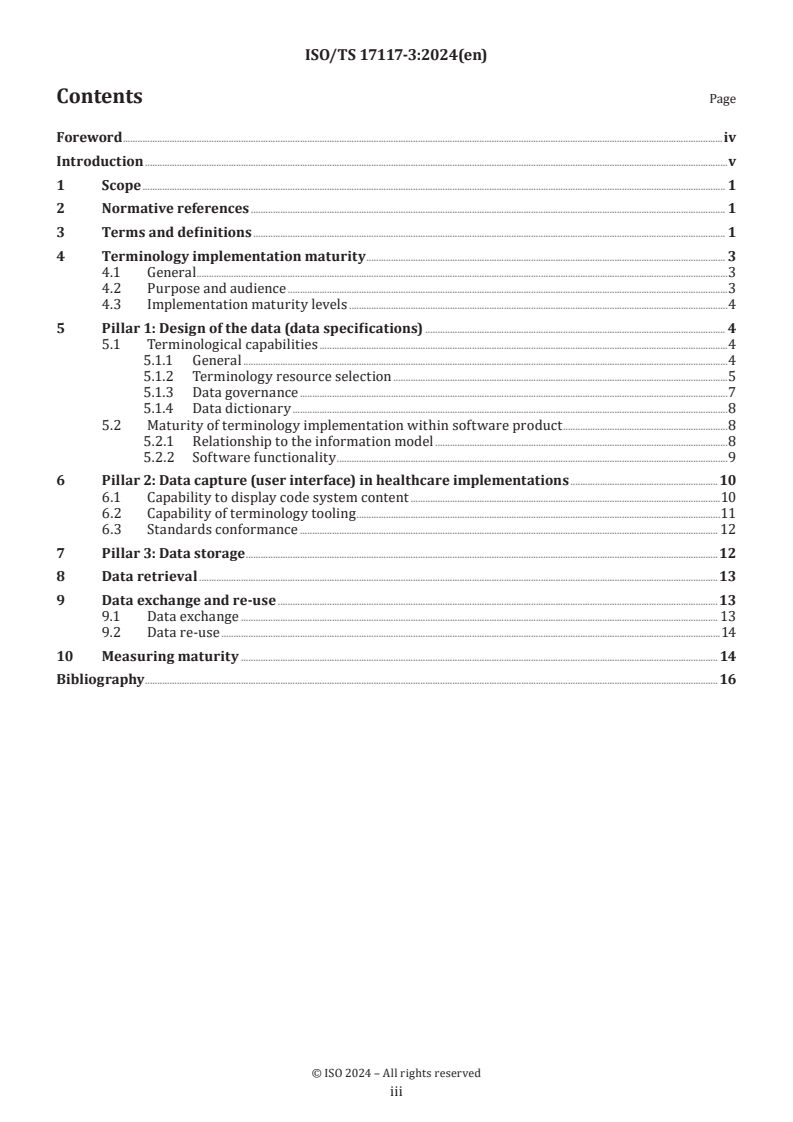
Contents Page
Foreword .iv
Introduction .v
1 Scope . 1
2 Normative references . 1
3 Terms and definitions . 1
4 Terminology implementation maturity . 3
4.1 General .3
4.2 Purpose and audience .3
4.3 Implementation maturity levels .4
5 Pillar 1: Design of the data (data specifications) . 4
5.1 Terminological capabilities .4
5.1.1 General .4
5.1.2 Terminology resource selection .5
5.1.3 Data governance .7
5.1.4 Data dictionary .8
5.2 Maturity of terminology implementation within software product .8
5.2.1 Relationship to the information model .8
5.2.2 Software functionality .9
6 Pillar 2: Data capture (user interface) in healthcare implementations .10
6.1 Capability to display code system content .10
6.2 Capability of terminology tooling .11
6.3 Standards conformance . 12
7 Pillar 3: Data storage .12
8 Data retrieval .13
9 Data exchange and re-use .13
9.1 Data exchange . 13
9.2 Data re-use .14
10 Measuring maturity . 14
Bibliography .16
iii
Foreword
ISO (the International Organization for Standardization) is a worldwide federation of national standards
bodies (ISO member bodies). The work of preparing International Standards is normally carried out through
ISO technical committees. Each member body interested in a subject for which a technical committee
has been established has the right to be represented on that committee. International organizations,
governmental and non-governmental, in liaison with ISO, also take part in the work. ISO collaborates closely
with the International Electrotechnical Commission (IEC) on all matters of electrotechnical standardization.
The procedures used to develop this document and those intended for its further maintenance are described
in the ISO/IEC Directives, Part 1. In particular, the different approval criteria needed for the different types
of ISO documents should be noted. This document was drafted in accordance with the editorial rules of the
ISO/IEC Directives, Part 2 (see www.iso.org/directives).
ISO draws attention to the possibility that the implementation of this document may involve the use of (a)
patent(s). ISO takes no position concerning the evidence, validity or applicability of any claimed patent
rights in respect thereof. As of the date of publication of this document, ISO had not received notice of (a)
patent(s) which may be required to implement this document. However, implementers are cautioned that
this may not represent the latest information, which may be obtained from the patent database available at
www.iso.org/patents. ISO shall not be held responsible for identifying any or all such patent rights.
Any trade name used in this document is information given for the convenience of users and does not
constitute an endorsement.
For an explanation of the voluntary nature of standards, the meaning of ISO specific terms and expressions
related to conformity assessment, as well as information about ISO's adherence to the World Trade
Organization (WTO) principles in the Technical Barriers to Trade (TBT), see www.iso.org/iso/foreword.html.
This document was prepared by Technical Committee ISO/TC 215, Health informatics.
A list of all parts in the ISO 17117 series can be found on the ISO website.
Any feedback or questions on this document should be directed to the user’s national standards body. A
complete listing of these bodies can be found at www.iso.org/members.html.
iv
Introduction
This document identifies a model for evaluation of the maturity of terminology implementation in healthcare
systems and identifies a maturity module for terminology implementation for use in electronic health
records (EHRs) and healthcare systems in general.
This document supports common activities of healthcare including:
— identification of the relationship between each terminology resource capability to the safety and
effectiveness of system use in healthcare;
— support healthcare software vendors and organizations to;
— compare software terminological resource capabilities and organizational requirements for those
resources;
— plan improvements, i.e. align requirements and capabilities, as needed;
— improve the safety and utility of healthcare information systems and the data in them, and the use of
terminological resources in applications such as clinical decision support systems;
— improve information sharing (semantic interoperability) between organizations and systems;
— support short and long-term analytics within the organization and more broadly to enable knowledge
acquisition.
The impact of tooling (including computer-assisted coding, speech recognition, template development) on
the capability of the terminological resources is not covered in detail in this document.
This document provides a model against which conformity can be measured and improvements made to
products and implementations with a positive impact both on efficiency and patient safety. This assists
implementation, reduces inappropriate spending, manages expectations more effectively and encourages
software vendors and decision makers at all levels to progress their products into higher functional capacity.
This document is also produced to encourage the development of the skills required to safely and efficiently
implement and use terminologies in healthcare systems.
The users of this document include:
— health care organisation, to assess product capabilities and plan future directions and purchases;
— vendors (including cloud services and conventional software products), to:
— support implementation of terminological resources in their products;
— enable semantic interoperability across different systems;
— assess product conformance requirements influencing future directions for software development;
— government and other decision makers;
— educators and educational organizations;
— terminological resource developers.
v
Technical Specification ISO/TS 17117-3:2024(en)
Health informatics — Terminological resources —
Part 3:
Terminology implementation maturity model (TIMM)
1 Scope
The document defines the progression of implementation of terminology capability in information systems.
This document does not specify requirements for any specific terminological resource. It is intended to
provide a basis for conformance criteria for terminological resources capabilities in specific use cases. This
document does not cover in detail the software being used, though the capabilities of that software are
included and impact the level of maturity reached. This document is applicable to terminological resources
of all types, terminologies, classifications, value sets, code systems, and value domains.
2 Normative references
The following documents are referred to in the text in such a way that some or all of their content constitutes
requirements of this document. For dated references, only the edition cited applies. For undated references,
the latest edition of the referenced document (including any amendments) applies.
ISO/IEC 11179-1, Information technology — Metadata registries (MDR) — Part 1: Framework
ISO/IEC 11179-3, Information technology — Metadata registries (MDR) — Part 3: Metamodel for registry
common facilities
ISO/IEC 11179-4, Information technology — Metadata registries (MDR) — Part 4: Formulation of data
definitions
ISO/TS 21526, Health informatics — Metadata repository requirements (MetaRep)
ISO/TS 21564, Health informatics — Terminology resource map quality measures (MapQual)
ISO 22287, Health informatics — Workforce roles and capabilities for terminology and terminology services in
healthcare (term workforce)
1)
HL7, Value Set Specification
3 Terms and definitions
For the purposes of this document, the following terms and definitions apply.
ISO and IEC maintain terminology databases for use in standardization at the following addresses:
— ISO Online browsing platform: available at https:// www .iso .org/ obp
— IEC Electropedia: available at https:// www .electropedia .org/
1) Available at https:// www .hl7 .org/ fhir/ valueset .html.
3.1
concept
unit of knowledge created by a unique combination of characteristics
Note 1 to entry: Informally, the term ‘concept’ is often used when what is meant is ‘concept representation’. However,
this leads to confusion when precise meanings are required. Concepts arise out of human individual and social
conceptualizations of the world around them. Concept representations are artefacts constructed of symbols.
Note 2 to entry: Concept representations are not necessarily bound to particular languages. However, they are
influenced by the social or cultural context of use often leading to different categorizations.
[SOURCE: ISO 17117-1:2018, 3.1.1]
3.2
implementation
life cycle phase at the end of which the hardware, software and procedures of the
system considered become operational
[SOURCE: ISO 81001-1:2021, 3.2.6]
3.3
term
linguistic representation of a concept (3.1) in a specific subject field
[SOURCE: ISO 17117-1:2018, 3.1.2]
3.4
terminology implementation
process of taking a terminological system and applying it for concept (3.1) representation to achieve efficient
and accurate concept representation
Note 1 to entry: Terminology implementation relates to implementing a terminological resource in a system rather
than the system itself. So, during a design and development of a system that uses a terminology, its implementation
occurs at that stage of the SDLC and not after Software Development Life Cycle.
[SOURCE: ISO/TS 17117-2:2022, 3.4, modified — Note 1 to entry was added.]
3.5
terminological resource
controlled set of terms (3.3) in healthcare
Note 1 to entry: Usually designed and controlled for use with computers for specific healthcare purposes, such as data
entry, aggregation, retrieval and analysis.
Note 2 to entry: Value domains, ontologies, computable terminologies, code sets and classifications.
[SOURCE: ISO/TR 12300:2014, 2.2.11, modified — The example was added.]
3.6
terminological resource capability
services and functionality that a terminology is able to deliver when implemented
Note 1 to entry: These services and functionality are dependent upon the design structure, maintenance and scope of
the terminological.
Note 2 to entry: For example, terminologies which do not have multilingual features are not able to support multiple
languages or translations.
Note 3 to entry: For example, a single hierarchy terminological resource is not able to support multi-hierarchical
reporting or retrieval.
3.7
software terminology capability
specification of a software’s ability to deliver the terminological resource capabilities (3.6) in an
implementation (3.2)
Note 1 to entry: This includes functionality such as the ability to calculate subsumption, equivalence, post-coordination
requirements.
Note 2 to entry: Software includes terminology servers but also the health software product within which the
terminology is used. The software terminology capability is dependent upon the suite of software, available to support
the implementation.
Note 3 to entry: Software tool includes the use of servers but also the software system within which the terminology
is used, including:
— functions used to access and manage maintenance of the terminology within the organisation (server capabilities)
processing operations using the knowledge in the terminology resource;
— maintenance functions used to maintain a terminological resources implementation within the organisation;
— user software - user interface and retrieval and display name requirements.
4 Terminology implementation maturity
4.1 General
This document provides a method to assess the capability of an implemented terminological resource based
on the information lifecycle (5 maturity pillars) and levels of maturity within these pillars. Capability is
defined across each of these 5 pillars and a method of calculation is included.
The 5 pillars are described in detail in ISO/TS 17117-2. These pillars are:
a) Pillar 1: Data design (data specifications);
b) Pillar 2: Data capture (user interface), including data validation, binding;
c) Pillar 3: Data storage (meaning management over time, binding);
d) Pillar 4: Data retrieval in health systems (includes use of retrieval and comparison tools such as queries,
subsumption, equivalence checking);
e) Pillar 5: Data exchange and data re-use (includes use of maps).
The pillars cover representation of instances of patient information captured in health systems including
conformity to standards, terminology governance capability, terminology implementation workforce
capability, software terminology capability and terminology resource (the code system) capability.
ISO/TS 17117-2 defines the determinants of maturity for each pillar and sub pillar activities, maturity levels.
4.2 Purpose and audience
The maturity model helps vendors, implementers, project leaders and decision makers to:
— identify implementation best practice for clinical safety;
— ensure that the environment for using terminologies is efficient, safe and fit for use (both existing and
newly introduced terminological resources);
— benchmark where an organization, data collection or product stands in relation to others with respect to
terminology implementation;
— assess the areas of strength and performance gaps in implementations;
— identify the steps that can be taken to close gaps and move to the next stage of maturity;
— communicate progress to the broader community and within the organization;
— identify resource requirements for quality terminology use (technical and workforce).
4.3 Implementation maturity levels
The following levels are used throughout this document and are based upon ISO 30401, modified to reflect
clearer common usage.
a) Level 1: Initial (Ad Hoc) − implementation where terminologies, code systems and classifications may
be used but are not governed across the implementation. This includes code sets created for initial use
to meet a single need, often without consideration of other potential uses or the need to communicate
or share data. The terminology may represent some of the concepts but is not governed to ensure
completeness of representation.
b) Level 2: Repeatable (Rudimentary) − includes implementations where terminologies are maintained
and deployed within software implementation but are largely reactive. The terminological resource is
maintained locally, i.e. not governed outside the organisation.
c) Level 3: Defined (Organized and Repeatable) – terminologies that are clearly defined. The definition
may be textual or computable and that definition informs the collection and use of the data. The
terminological resource is well maintained and governed at least at national level with clear context
associated with the information mode.
d) Level 4: Capable (Managed and Standardised)– where the implementation supports safe care and the
data supply chain, and where terminology implementation is capable of clear and safe information
exchange through semantic interoperability. A capable terminology represents all concepts, with
longevity of meaning, is nationally governed and implemented with a standard information model
supporting semantic interoperability.
e) Level 5: Efficient (harmonised terminology and information model). Safe use of data requires that the
data is defined and capable and governed at all levels and where terminology and the information model
are optimised. The terminological resource can represent all concepts, with longevity of meaning, is
internationally governed and implemented with a standard information model supporting international
semantic interoperability.
Clauses 5 to 10 of this document identify the capabilities of terminology implementation and where each
of these fit in the maturity evaluation of an implementation. A checklist is also provided to assist in such
evaluations.
Determination of the importance of each capability was influenced by the Desiderata for controlled medical
[12] [13]
vocabularies in the twenty-first century and SNOMED International Implementation Maturity .
5 Pillar 1: Design of the data (data specifications)
5.1 Terminological capabilities
5.1.1 General
When collecting data, the ability of the code system or terminological resource selected to represent the
data impacts the capacity to represent the concepts required. This pillar assesses the ability of the selected
concept representations to accurately meet the needs of clinical care in a health record.
5.1.2 Terminology resource selection
5.1.2.1 General
The choice of a terminological resource (code system) for a specific use case shall take into account that
use case and the characteristics of the terminology itself and shall be able to support safe and efficient
information capture and exchange for that use case. The specific levels of maturity are indicated in 5.1.2.3 for
each capability of a terminological resource for the two most common use cases, clinical use and statistical
use. These levels do not reflect the implementation of the code system, this is measured later.
The measures provided indicate the level of conformance that shall be present to claim the specified level of
maturity for the terminology implementation in a health record system.
5.1.2.2 Determinant 1:1 Ability to represent concepts at different levels
The terminological resource selected to represent each data element shall be assessed and confirmed to
represent the data at the level of specificity or specificities required by the users of the data for a specific
use case. Where the data element is re-used the representation should be reassessed for that purpose of use.
This assessment shall be clearly documented including the rationale for the decision made.
a) Level 1: all concepts are represented at one level of specificity only.
b) Level 2: all concepts are able to be represented at different levels of granularity suited to clinical need.
c) Level 3: in addition to level 3 requirements, all decisions made about the data element rules and
instructions are clearly documented.
d) Level 5: in addition to level 3, any changes are documented, and that documentation is maintained
historically to ensure the ability to support data permanence.
As there are only 3 criteria to be met here, level 4 is not used.
5.1.2.3 Determinant 1:2 Ability to represent precise meaning of the concept
Where the use case requires clear and accurate meaning, the terminology chosen shall provide the ability to
consistently represent that meaning, including clear representation of what is known and what is not known.
This supports clinical care. Use cases which are rule-based, such as fiscal reporting or morbidity data,
represent meanings which are dependent not just on the terminology or code but also on acknowledging
where the rules are not suitable for clinical use or clinical interoperability.
Table 1 is an example of the maturity of an implementation which is suitable for clinical use showing the
pillar level needed.
Table 1 — Terminological resource selection — Maturity for clinical use
Level of maturity needed 1 2 3 4 5 Comment
Ability to represent:
— concept at different levels of X It is essential that clinicians are able to indicate the
granularity; level of information relevant to their use case and
are not forced into grouping of concepts which do
not meet clinical needs.
— the meaning of that concept. X The meaning of the concept shall be consistently
applied and retained across all clinical use cases
with a minimum of mapping to ensure that meaning
is not changed.
Ability to persist meaning over time X Ask health records persist longer through the
advent of electronic health records, the meaning
of information collected in those systems using
terminological resources shall persist over time.
This is especially vital when considering clinical
decision support systems which use data recorded
in the past to trigger actions today.
Design supports retrieval of concepts by X Terminological resources used in health records
multiple attributes (multi-hierarchical) shall be able to be easily queried. Terminology
or using ontological relationships servers are designed to undertake this analysis,
but not all healthcare environments can afford or
implement such sophisticated tools. The use of a
standardised information model with standardised
terminology supports simpler retrieval of data
from the record.
Scope of the terminological resource able X In clinical practice a concept, no matter how unusual
to represent all concepts for the use case or rare still needs to be able to be represented. The
rarer the condition, the more important it can be to
represent the concept correctly in clinical practice.
Scope of the terminology reducible to X The ability of a terminology resource to be present-
concepts required for the use case ed in a subset to represent the specific concepts is
needed to assist data capture and the user interface.
Clear definition and differentiation between X Note: many code systems do not meet this require-
concepts to ensure clarity of meaning ment as the code/s selected are often dependent
upon standards, rule or guidelines, and the qual-
ity of these rules or guidelines impacts
...