

IEC 62321-11:2023
(Main)Determination of certain substances in electrotechnical products — Part 11: Tris (2-chloroethyl) phosphate (TCEP) in plastics by gas chromatography-mass spectrometry (GC-MS) and liquid chromatography-mass spectrometry (LC-MS)
General Information
- Abstract
This part of IEC 62321 specifies two different techniques for the determination of tris(2‑chloroethyl) phosphate (TCEP) in plastics, the GC-MS or LC-MS method, both of which are applicable to quantitative analysis. These two techniques are applicable to use with polyurethane, polyvinylchloride, and polyethylene materials containing TCEP between 200 mg/kg to 2 000 mg/kg. These test methods do not apply to plastic materials having a processing temperature higher than 230 °C. GC-MS using a pyrolyser/thermal desorption accessory (Py/TD-GC-MS) technique is described in REF _Ref141858781 \w \h Annex A 08D0C9EA79F9BACE118C8200AA004BA90B02000000080000000E0000005F005200650066003100340031003800350038003700380031000000 and can be used for the screening of TCEP in plastics. NOTE TCEP starts thermal decomposition at approximately 230 °C. Polymer types that have a processing temperature into shapes of plastics (e.g. pellets, moulded parts or sheets) not exceeding the decomposition temperature can contain TCEP.
- Status
- Published
- Publication Date
- 19-Dec-2023
- Technical Committee
- ISO/TC 61/SC 5 - Physical-chemical properties
- Drafting Committee
- ISO/TC 61/SC 5 - Physical-chemical properties
- Current Stage
- 6060 - International Standard published
- Start Date
- 20-Dec-2023
- Due Date
- 15-Sep-2023
- Completion Date
- 20-Dec-2023
Buy Documents
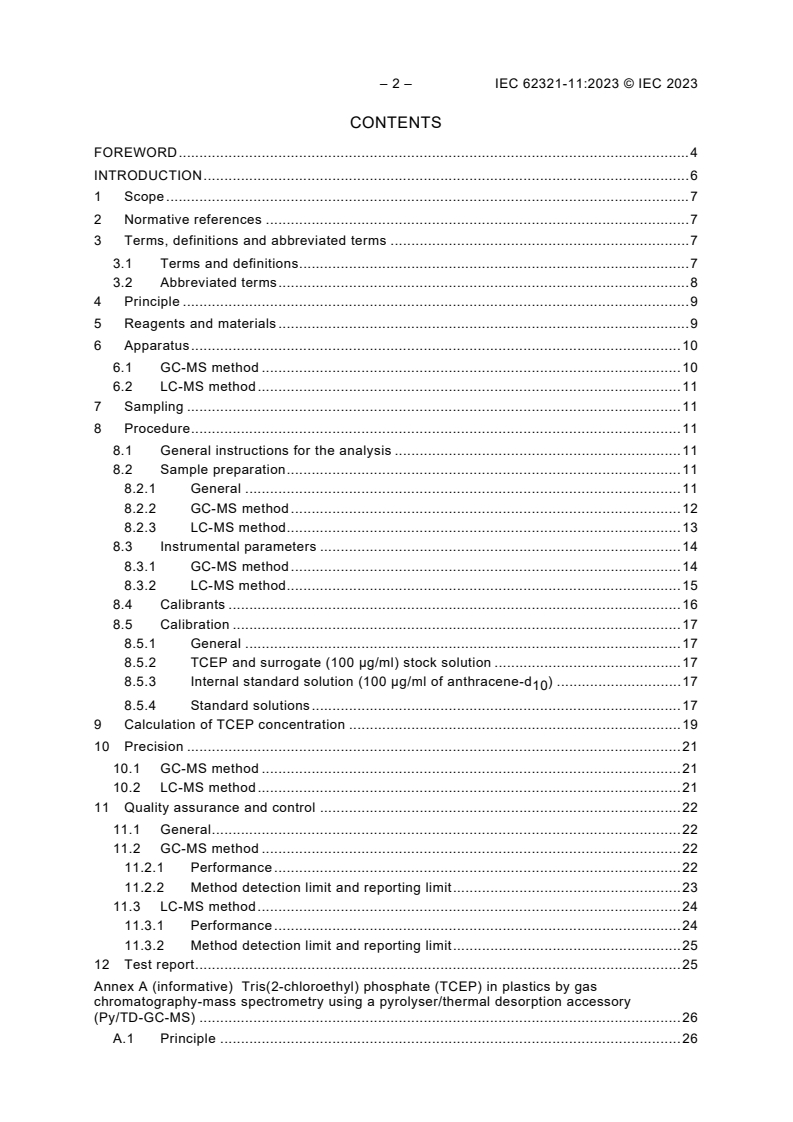
IEC 62321-11:2023 - Determination of certain substances in electrotechnical products — Part 11: Tris (2-chloroethyl) phosphate (TCEP) in plastics by gas chromatography-mass spectrometry (GC-MS) and liquid chromatography-mass spectrometry (LC-MS) Released:20. 12. 2023
IEC/FDIS 62321-11 - Determination of certain substances in electrotechnical products — Part 11: Tris (2-chloroethyl) phosphate (TCEP) in plastics by gas chromatography-mass spectrometry (GC-MS) and liquid chromatography-mass spectrometry (LC-MS) Released:5. 10. 2023
IEC/FDIS 62321-11 - Détermination de certaines substances dans les produits électrotechniques — Partie 11: Phosphate de tris (2-chloroéthyle) (TCEP) dans les plastiques par chromatographie en phase gazeuse-spectrométrie de masse (GC-MS) et chromatographie liquide-spectrométrie de masse (LC-MS) Released:6. 10. 2023
Overview
IEC 62321-11:2023 specifies standardized analytical techniques for determining tris(2-chloroethyl) phosphate (TCEP) content in plastics used in electrotechnical products. Developed jointly by IEC and ISO, this standard outlines two quantitative methods – gas chromatography-mass spectrometry (GC-MS) and liquid chromatography-mass spectrometry (LC-MS) – applicable to a range of common polymers, including polyurethane (PUR), polyvinylchloride (PVC), and polyethylene (PE). It supports regulatory compliance and environmental safety by enabling accurate detection and quantification of TCEP, a substance listed as a Substance of Very High Concern (SVHC) due to its toxicological properties.
Key Topics
Scope and Applicability
- The standard details procedures for measuring TCEP concentrations between 200 mg/kg and 2,000 mg/kg in PUR, PVC, and PE plastics.
- Not applicable to plastic materials with processing temperatures above 230 °C, as TCEP begins to decompose at this threshold.
- Includes guidance for both qualitative screening and quantitative assessment.
Analytical Methods
- GC-MS: Utilizes gas chromatography with mass spectrometry for quantification, including an optional pyrolyser/thermal desorption accessory (Py/TD-GC-MS) for screening applications.
- LC-MS: Employs liquid chromatography-mass spectrometry as an alternative for polymers less amenable to GC-MS or requiring different sample preparation.
Sample Preparation
- Emphasizes clean and precise sample handling to avoid cross-contamination, employing techniques such as cryogenic grinding and ultrasonication.
- Outlines blank testing and calibration standards to ensure result accuracy.
Quality Assurance
- Stresses routine instrument validation, use of surrogate and internal standards for performance checks, and procedural blanks to monitor potential contamination.
- Provides repeatability and reproducibility assessment methods.
Applications
IEC 62321-11:2023 serves various stakeholders in the electrotechnical and plastics manufacturing industries:
- Regulatory Compliance: Helps manufacturers, importers, and suppliers demonstrate conformity with environmental directives and chemical substance restrictions, such as those enforced under REACH and RoHS.
- Product Safety and Quality: Supports risk assessment and assurance programs related to hazardous substances in consumer and industrial electronics, cables, housings, and polymeric parts.
- Laboratory Testing: Provides laboratories with reliable methods to deliver consistent, accurate test results for TCEP in relevant plastic matrices.
- Supply Chain Management: Enables upstream and downstream suppliers to verify material purity, contributing to responsible sourcing and transparent material declarations throughout the value chain.
Related Standards
For comprehensive substance determination in electrotechnical products, consult these related standards:
- IEC 62321-1:2013: Introduction and overview to the IEC 62321 series, covering determination of various substances in electronic equipment.
- IEC 62321-2:2021: Guidelines for sample disassembly, disjointment, and mechanical sample preparation.
- Other Parts of IEC 62321: Detailed methods for specific substances of concern (lead, cadmium, PBDEs, PBBs, etc.).
- ISO 472:2013: Plastics – Vocabulary, relevant for terminology alignment.
- ISO/IEC terminology platforms: Electropedia and ISO Online Browsing Platform provide standardized definitions used throughout the documents.
By adopting IEC 62321-11:2023, organizations enhance their environmental stewardship, align with international best practices, and ensure the safe use of plastics in electrotechnical products. This standard is a vital resource for anyone involved in laboratory analysis, compliance testing, or material selection regarding TCEP in electrical and electronic applications.
Buy Documents
IEC 62321-11:2023 - Determination of certain substances in electrotechnical products — Part 11: Tris (2-chloroethyl) phosphate (TCEP) in plastics by gas chromatography-mass spectrometry (GC-MS) and liquid chromatography-mass spectrometry (LC-MS) Released:20. 12. 2023
IEC/FDIS 62321-11 - Determination of certain substances in electrotechnical products — Part 11: Tris (2-chloroethyl) phosphate (TCEP) in plastics by gas chromatography-mass spectrometry (GC-MS) and liquid chromatography-mass spectrometry (LC-MS) Released:5. 10. 2023
IEC/FDIS 62321-11 - Détermination de certaines substances dans les produits électrotechniques — Partie 11: Phosphate de tris (2-chloroéthyle) (TCEP) dans les plastiques par chromatographie en phase gazeuse-spectrométrie de masse (GC-MS) et chromatographie liquide-spectrométrie de masse (LC-MS) Released:6. 10. 2023
Get Certified
Connect with accredited certification bodies for this standard

TÜV Rheinland
TÜV Rheinland is a leading international provider of technical services.

TÜV SÜD
TÜV SÜD is a trusted partner of choice for safety, security and sustainability solutions.

BSI Group
BSI (British Standards Institution) is the business standards company that helps organizations make excellence a habit.
Sponsored listings
Frequently Asked Questions
IEC 62321-11:2023 is a standard published by the International Organization for Standardization (ISO). Its full title is "Determination of certain substances in electrotechnical products — Part 11: Tris (2-chloroethyl) phosphate (TCEP) in plastics by gas chromatography-mass spectrometry (GC-MS) and liquid chromatography-mass spectrometry (LC-MS)". This standard covers: This part of IEC 62321 specifies two different techniques for the determination of tris(2‑chloroethyl) phosphate (TCEP) in plastics, the GC-MS or LC-MS method, both of which are applicable to quantitative analysis. These two techniques are applicable to use with polyurethane, polyvinylchloride, and polyethylene materials containing TCEP between 200 mg/kg to 2 000 mg/kg. These test methods do not apply to plastic materials having a processing temperature higher than 230 °C. GC-MS using a pyrolyser/thermal desorption accessory (Py/TD-GC-MS) technique is described in REF _Ref141858781 \w \h Annex A 08D0C9EA79F9BACE118C8200AA004BA90B02000000080000000E0000005F005200650066003100340031003800350038003700380031000000 and can be used for the screening of TCEP in plastics. NOTE TCEP starts thermal decomposition at approximately 230 °C. Polymer types that have a processing temperature into shapes of plastics (e.g. pellets, moulded parts or sheets) not exceeding the decomposition temperature can contain TCEP.
This part of IEC 62321 specifies two different techniques for the determination of tris(2‑chloroethyl) phosphate (TCEP) in plastics, the GC-MS or LC-MS method, both of which are applicable to quantitative analysis. These two techniques are applicable to use with polyurethane, polyvinylchloride, and polyethylene materials containing TCEP between 200 mg/kg to 2 000 mg/kg. These test methods do not apply to plastic materials having a processing temperature higher than 230 °C. GC-MS using a pyrolyser/thermal desorption accessory (Py/TD-GC-MS) technique is described in REF _Ref141858781 \w \h Annex A 08D0C9EA79F9BACE118C8200AA004BA90B02000000080000000E0000005F005200650066003100340031003800350038003700380031000000 and can be used for the screening of TCEP in plastics. NOTE TCEP starts thermal decomposition at approximately 230 °C. Polymer types that have a processing temperature into shapes of plastics (e.g. pellets, moulded parts or sheets) not exceeding the decomposition temperature can contain TCEP.
IEC 62321-11:2023 is classified under the following ICS (International Classification for Standards) categories: 13.020.01 - Environment and environmental protection in general; 43.040.10 - Electrical and electronic equipment; 83.080.01 - Plastics in general. The ICS classification helps identify the subject area and facilitates finding related standards.
IEC 62321-11:2023 is available in PDF format for immediate download after purchase. The document can be added to your cart and obtained through the secure checkout process. Digital delivery ensures instant access to the complete standard document.
Standards Content (Sample)
IEC 62321-11
Edition 1.0 2023-12
INTERNATIONAL
STANDARD
NORME
INTERNATIONALE
Determination of certain substances in electrotechnical products –
Part 11: Tris(2-chloroethyl) phosphate (TCEP) in plastics by gas
chromatography-mass spectrometry (GC-MS) and liquid chromatography-mass
spectrometry (LC-MS)
Détermination de certaines substances dans les produits électrotechniques –
Partie 11: Phosphate de tris(2-chloroéthyle) (TCEP) dans les plastiques par
chromatographie en phase gazeuse-spectrométrie de masse (GC-MS) et
chromatographie en phase liquide-spectrométrie de masse (LC-MS)
All rights reserved. Unless otherwise specified, no part of this publication may be reproduced or utilized in any form
or by any means, electronic or mechanical, including photocopying and microfilm, without permission in writing from
either IEC or IEC's member National Committee in the country of the requester. If you have any questions about IEC
copyright or have an enquiry about obtaining additional rights to this publication, please contact the address below or
your local IEC member National Committee for further information.
Droits de reproduction réservés. Sauf indication contraire, aucune partie de cette publication ne peut être reproduite ni
utilisée sous quelque forme que ce soit et par aucun procédé, électronique ou mécanique, y compris la photocopie et
les microfilms, sans l'accord écrit de l'IEC ou du Comité national de l'IEC du pays du demandeur. Si vous avez des
questions sur le copyright de l'IEC ou si vous désirez obtenir des droits supplémentaires sur cette publication, utilisez
les coordonnées ci-après ou contactez le Comité national de l'IEC de votre pays de résidence.
IEC Secretariat Tel.: +41 22 919 02 11
3, rue de Varembé info@iec.ch
CH-1211 Geneva 20 www.iec.ch
Switzerland
About the IEC
The International Electrotechnical Commission (IEC) is the leading global organization that prepares and publishes
International Standards for all electrical, electronic and related technologies.
About IEC publications
The technical content of IEC publications is kept under constant review by the IEC. Please make sure that you have the
latest edition, a corrigendum or an amendment might have been published.
IEC publications search - webstore.iec.ch/advsearchform IEC Products & Services Portal - products.iec.ch
The advanced search enables to find IEC publications by a Discover our powerful search engine and read freely all the
variety of criteria (reference number, text, technical publications previews. With a subscription you will always have
committee, …). It also gives information on projects, replaced access to up to date content tailored to your needs.
and withdrawn publications.
Electropedia - www.electropedia.org
IEC Just Published - webstore.iec.ch/justpublished
The world's leading online dictionary on electrotechnology,
Stay up to date on all new IEC publications. Just Published
containing more than 22 300 terminological entries in English
details all new publications released. Available online and once
and French, with equivalent terms in 19 additional languages.
a month by email.
Also known as the International Electrotechnical Vocabulary
(IEV) online.
IEC Customer Service Centre - webstore.iec.ch/csc
If you wish to give us your feedback on this publication or need
further assistance, please contact the Customer Service
Centre: sales@iec.ch.
A propos de l'IEC
La Commission Electrotechnique Internationale (IEC) est la première organisation mondiale qui élabore et publie des
Normes internationales pour tout ce qui a trait à l'électricité, à l'électronique et aux technologies apparentées.
A propos des publications IEC
Le contenu technique des publications IEC est constamment revu. Veuillez vous assurer que vous possédez l’édition la
plus récente, un corrigendum ou amendement peut avoir été publié.
Recherche de publications IEC - Découvrez notre puissant moteur de recherche et consultez
webstore.iec.ch/advsearchform gratuitement tous les aperçus des publications. Avec un
La recherche avancée permet de trouver des publications IEC abonnement, vous aurez toujours accès à un contenu à jour
en utilisant différents critères (numéro de référence, texte, adapté à vos besoins.
comité d’études, …). Elle donne aussi des informations sur les
projets et les publications remplacées ou retirées. Electropedia - www.electropedia.org
Le premier dictionnaire d'électrotechnologie en ligne au monde,
IEC Just Published - webstore.iec.ch/justpublished
avec plus de 22 300 articles terminologiques en anglais et en
Restez informé sur les nouvelles publications IEC. Just
français, ainsi que les termes équivalents dans 19 langues
Published détaille les nouvelles publications parues.
additionnelles. Egalement appelé Vocabulaire
Disponible en ligne et une fois par mois par email.
Electrotechnique International (IEV) en ligne.
Service Clients - webstore.iec.ch/csc
Si vous désirez nous donner des commentaires sur cette
publication ou si vous avez des questions contactez-nous:
sales@iec.ch.
IEC Products & Services Portal - products.iec.ch
IEC 62321-11
Edition 1.0 2023-12
INTERNATIONAL
STANDARD
NORME
INTERNATIONALE
Determination of certain substances in electrotechnical products –
Part 11: Tris(2-chloroethyl) phosphate (TCEP) in plastics by gas
chromatography-mass spectrometry (GC-MS) and liquid chromatography-mass
spectrometry (LC-MS)
Détermination de certaines substances dans les produits électrotechniques –
Partie 11: Phosphate de tris(2-chloroéthyle) (TCEP) dans les plastiques par
chromatographie en phase gazeuse-spectrométrie de masse (GC-MS) et
chromatographie en phase liquide-spectrométrie de masse (LC-MS)
INTERNATIONAL
ELECTROTECHNICAL
COMMISSION
COMMISSION
ELECTROTECHNIQUE
INTERNATIONALE
ICS 13.020.01, 43.040.10 ISBN 978-2-8322-7777-50
– 2 – IEC 62321-11:2023 © IEC 2023
CONTENTS
FOREWORD . 4
INTRODUCTION . 6
1 Scope . 7
2 Normative references . 7
3 Terms, definitions and abbreviated terms . 7
3.1 Terms and definitions . 7
3.2 Abbreviated terms . 8
4 Principle . 9
5 Reagents and materials . 9
6 Apparatus . 10
6.1 GC-MS method . 10
6.2 LC-MS method . 11
7 Sampling . 11
8 Procedure . 11
8.1 General instructions for the analysis . 11
8.2 Sample preparation . 11
8.2.1 General . 11
8.2.2 GC-MS method . 12
8.2.3 LC-MS method . 13
8.3 Instrumental parameters . 14
8.3.1 GC-MS method . 14
8.3.2 LC-MS method . 15
8.4 Calibrants . 16
8.5 Calibration . 17
8.5.1 General . 17
8.5.2 TCEP and surrogate (100 μg/ml) stock solution . 17
8.5.3 Internal standard solution (100 μg/ml of anthracene-d ) . 17
8.5.4 Standard solutions . 17
9 Calculation of TCEP concentration . 19
10 Precision . 21
10.1 GC-MS method . 21
10.2 LC-MS method . 21
11 Quality assurance and control . 22
11.1 General . 22
11.2 GC-MS method . 22
11.2.1 Performance . 22
11.2.2 Method detection limit and reporting limit . 23
11.3 LC-MS method . 24
11.3.1 Performance . 24
11.3.2 Method detection limit and reporting limit . 25
12 Test report . 25
Annex A (informative) Tris(2-chloroethyl) phosphate (TCEP) in plastics by gas
chromatography-mass spectrometry using a pyrolyser/thermal desorption accessory
(Py/TD-GC-MS) . 26
A.1 Principle . 26
A.2 Reagents and materials . 27
A.3 Apparatus . 27
A.4 Sampling. 28
A.5 Procedure . 28
A.5.1 General instructions for the analysis . 28
A.5.2 Sample preparation . 28
A.5.3 Instrumental parameters . 29
A.5.4 Calibration . 30
A.6 Calculation of TCEP concentration . 31
A.6.1 General . 31
A.6.2 Determination of RF of DEHP . 31
A.6.3 Calculation . 32
Annex B (informative) Examples of chromatograms and mass spectrum by GC-MS . 33
Annex C (informative) Examples of chromatograms and mass spectrum by LC-MS . 34
Annex D (informative) Examples of chromatograms and mass spectrum by
Py-TD-GC-MS . 35
Bibliography . 36
Figure B.1 – Gas chromatogram of TCEP, TCEP-d , and anthracene-d . 33
12 10
Figure B.2 – Mass spectrum of TCEP by GC-MS . 33
Figure B.3 – Mass spectrum of TCEP-d by GC-MS . 33
Figure C.1 – Liquid chromatogram of TCEP and TCEP-d . 34
Figure C.2 – Mass spectrum of TCEP by LC-MS . 34
Figure C.3 – Mass spectrum of TCEP-d by LC-MS . 34
Figure D.1 – Total ion current chromatogram of TCEP by Py-TD-GC-MS . 35
Figure D.2 – Mass spectrum of TCEP by Py-TD-GC-MS . 35
Table 1 – Measurement condition of GC-MS . 14
Table 2 – Reference masses for the quantification of TCEP . 15
Table 3 – Measurement condition of LC-MS . 16
Table 4 – Calibration standard solution of TCEP with internal standard – Estimated
TCEP sample solution concentration 0,1 µg/ml and higher . 18
Table 5 – Calibration standard solution of TCEP with internal standard – Estimated
TCEP sample solution concentration lower than 0,1 µg/ml . 18
Table 6 – IIS 11 repeatability and reproducibility (GC-MS) . 21
Table 7 – IIS 11 repeatability and reproducibility (LC-MS) . 22
Table A.1 – Measurement conditions of Py/TD-GC-MS . 29
– 4 – IEC 62321-11:2023 © IEC 2023
INTERNATIONAL ELECTROTECHNICAL COMMISSION
____________
DETERMINATION OF CERTAIN SUBSTANCES
IN ELECTROTECHNICAL PRODUCTS –
Part 11: Tris(2-chloroethyl) phosphate (TCEP) in plastics by gas
chromatography-mass spectrometry (GC-MS) and liquid
chromatography-mass spectrometry (LC-MS)
FOREWORD
1) The International Electrotechnical Commission (IEC) is a worldwide organization for standardization comprising
all national electrotechnical committees (IEC National Committees). The object of IEC is to promote international
co-operation on all questions concerning standardization in the electrical and electronic fields. To this end and
in addition to other activities, IEC publishes International Standards, Technical Specifications, Technical Reports,
Publicly Available Specifications (PAS) and Guides (hereafter referred to as “IEC Publication(s)”). Their
preparation is entrusted to technical committees; any IEC National Committee interested in the subject dealt with
may participate in this preparatory work. International, governmental and non-governmental organizations liaising
with the IEC also participate in this preparation. IEC collaborates closely with the International Organization for
Standardization (ISO) in accordance with conditions determined by agreement between the two organizations.
2) The formal decisions or agreements of IEC on technical matters express, as nearly as possible, an international
consensus of opinion on the relevant subjects since each technical committee has representation from all
interested IEC National Committees.
3) IEC Publications have the form of recommendations for international use and are accepted by IEC National
Committees in that sense. While all reasonable efforts are made to ensure that the technical content of IEC
Publications is accurate, IEC cannot be held responsible for the way in which they are used or for any
misinterpretation by any end user.
4) In order to promote international uniformity, IEC National Committees undertake to apply IEC Publications
transparently to the maximum extent possible in their national and regional publications. Any divergence between
any IEC Publication and the corresponding national or regional publication shall be clearly indicated in the latter.
5) IEC itself does not provide any attestation of conformity. Independent certification bodies provide conformity
assessment services and, in some areas, access to IEC marks of conformity. IEC is not responsible for any
services carried out by independent certification bodies.
6) All users should ensure that they have the latest edition of this publication.
7) No liability shall attach to IEC or its directors, employees, servants or agents including individual experts and
members of its technical committees and IEC National Committees for any personal injury, property damage or
other damage of any nature whatsoever, whether direct or indirect, or for costs (including legal fees) and
expenses arising out of the publication, use of, or reliance upon, this IEC Publication or any other IEC
Publications.
8) Attention is drawn to the Normative references cited in this publication. Use of the referenced publications is
indispensable for the correct application of this publication.
9) IEC draws attention to the possibility that the implementation of this document may involve the use of (a)
patent(s). IEC takes no position concerning the evidence, validity or applicability of any claimed patent rights in
respect thereof. As of the date of publication of this document, IEC had not received notice of (a) patent(s), which
may be required to implement this document. However, implementers are cautioned that this may not represent
the latest information, which may be obtained from the patent database available at https://patents.iec.ch. IEC
shall not be held responsible for identifying any or all such patent rights.
IEC 62321-11 has been prepared by IEC technical committee 111: Environmental
standardization for electrical and electronic products and systems, in collaboration with
ISO subcommittee SC 5: Physical-chemical properties of ISO technical committee 61: Plastics.
It is an International Standard.
It is published as a double logo standard.
The text of this International Standard is based on the following documents:
Draft Report on voting
111/723/FDIS 111/735A/RVD
Full information on the voting for its approval can be found in the report on voting indicated in
the above table.
The language used for the development of this International Standard is English.
This document was drafted in accordance with ISO/IEC Directives, Part 2, and developed in
accordance with ISO/IEC Directives, Part 1 and ISO/IEC Directives, IEC Supplement, available
at www.iec.ch/members_experts/refdocs. The main document types developed by IEC are
described in greater detail at www.iec.ch/publications.
A list of all parts in the IEC 62321 series, published under the general title Determination of
certain substances in electrotechnical products, can be found on the IEC website.
The committee has decided that the contents of this document will remain unchanged until the
stability date indicated on the IEC website under webstore.iec.ch in the data related to the
specific document. At this date, the document will be
• reconfirmed,
• withdrawn, or
• revised.
– 6 – IEC 62321-11:2023 © IEC 2023
INTRODUCTION
The widespread use of electrotechnical products has drawn increased attention to their impact
on the environment. In many countries, this has resulted in the adoption of regulations affecting
wastes, substances, and energy use of electrotechnical products.
The use of certain substances (e.g. lead (Pb), cadmium (Cd), and polybrominated diphenyl
ethers (PBDEs)) in electrotechnical products is a source of concern in current and proposed
regional legislation.
The purpose of the IEC 62321 series is therefore to provide test methods that will allow the
electrotechnical industry to determine the levels of certain substances of concern in
electrotechnical products on a consistent global basis.
This first edition of IEC 62321-11 introduces a new subject covering tris(2-chloroethyl)
phosphate (TCEP) in the IEC 62321 series.
TCEP is a halogenated phosphorus-based flame retardant that is disclosable as a substance
of very high concern (SVHC) as it is classified as toxic to reproduction category 2 (R60) and
was included in the candidate list for authorization on 13 January 2010, following ECHA’s
decision ED/68/2009 [1] and in regulation (EC) No 1907/2006 ANNEX XVI [2].
TCEP is used as a flame retardant in plastics such as polyester and polyurethane foam and as
a plasticizer in polyvinyl chloride. Additionally, TCEP is used as an alternative for brominated
flame retardants that have been restricted. No applicable testing standard exists for TCEP
analysis in plastics.
As a result, analysis criteria have been established by an IEC TC 111 and ISO/TC 61/SC 5 joint
working group for the joint development of an IEC and ISO double logo International Standard,
to provide a test method that will allow the industry to determine the concentrations of TCEP in
plastics.
WARNING – Persons using this document should be familiar with normal laboratory practice.
This document does not purport to address all of the safety problems, if any, associated with
its use. It is the responsibility of the user to establish appropriate safety and health practices
and to ensure compliance with any national regulatory conditions.
___________
Numbers in square brackets refer to the Bibliography.
DETERMINATION OF CERTAIN SUBSTANCES
IN ELECTROTECHNICAL PRODUCTS –
Part 11: Tris(2-chloroethyl) phosphate (TCEP) in plastics by gas
chromatography-mass spectrometry (GC-MS) and liquid
chromatography-mass spectrometry (LC-MS)
1 Scope
This part of IEC 62321 specifies two different techniques for the determination of
tris(2-chloroethyl) phosphate (TCEP) in plastics, the GC-MS or LC-MS method, both of which
are applicable to quantitative analysis.
These two techniques are applicable to use with polyurethane, polyvinylchloride, and
polyethylene materials containing TCEP between 200 mg/kg to 2 000 mg/kg.
These test methods do not apply to plastic materials having a processing temperature higher
than 230 °C.
GC-MS using a pyrolyser/thermal desorption accessory (Py/TD-GC-MS) technique is described
in Annex A and can be used for the screening of TCEP in plastics.
NOTE TCEP starts thermal decomposition at approximately 230 °C. Polymer types that have a processing
temperature into shapes of plastics (e.g. pellets, moulded parts or sheets) not exceeding the decomposition
temperature can contain TCEP.
2 Normative references
The following documents are referred to in the text in such a way that some or all of their content
constitutes requirements of this document. For dated references, only the edition cited applies.
For undated references, the latest edition of the referenced document (including any
amendments) applies.
IEC 62321-1:2013, Determination of certain substances in electrotechnical products – Part 1:
Introduction and overview
IEC 62321-2:2021, Determination of certain substances in electrotechnical products – Part 2:
Disassembly, disjointment and mechanical sample preparation
3 Terms, definitions and abbreviated terms
3.1 Terms and definitions
For the purposes of this document, the following terms and definitions apply.
ISO and IEC maintain terminology databases for use in standardization at the following
addresses:
• IEC Electropedia: available at https://www.electropedia.org
• ISO Online browsing platform: available at https://www.iso.org/obp
– 8 – IEC 62321-11:2023 © IEC 2023
3.1.1
screening
analytical procedure to determine the presence or absence of substances in the representative
part or section of a product, relative to the value or values chosen as the criterion for presence,
absence, or further testing
Note 1 to entry: If the screening method produces values that are not conclusive, then additional analysis or other
follow-up actions can be necessary to make a final presence or absence decision.
3.1.2
plastic
material that contains as an essential ingredient a high polymer and which, at some stage in its
processing into finished products, can be shaped by flow
Note 1 to entry: Elastomeric materials, which are also shaped by flow, are not considered to be plastics.
Note 2 to entry: In some countries, particularly the United Kingdom, the term "plastics" is used as the singular form
as well as the plural form.
[SOURCE: ISO 472:2013 [3], 2.702]
3.1.3
polymer
substance composed of molecules characterized by the multiple repetition of one or more
species of atoms or groups of atoms (constitutional units) linked to each other in amounts
sufficient to provide a set of properties that do not vary markedly with the addition or removal
of one or a few of the constitutional units
[SOURCE: ISO 1382:2020 [4], 3.369]
3.1.4
blank
test that follows the same procedures and conditions as the sample test without a sample, which
enables quantification of the contamination in the test
3.2 Abbreviated terms
ACN acetonitrile
API-ES atmospheric pressure ionization-electrostatic
BSA N,O-bis(trimethylsilyl)acetamide
BSTFA N,O-bis(trimethylsilyl)trifluoroacetamide
CCC continuing calibration check standard
D dilution factor
DEHP di-(2-ethylhexyl) phthalate
DMDCS dimethyldichlorosilane
EI electron ionization
GC-MS gas chromatography-mass spectrometry
HPLC high-performance liquid chromatography
ID internal diameter
IIS international interlaboratory study
IS internal standard
LC-MS liquid chromatography-mass spectrometry
LOD limit of detection
MDL method detection limit
MS mass spectrometry
PBB polybrominated biphenyl
PBDE polybrominated diphenyl ether
PE polyethylene
PS polystyrene
PTFE polytetrafluoroethylene
PUR polyurethane
PVC polyvinyl chloride
Py/TD-GC-MS gas chromatography-mass spectrometry using a pyrolyser/thermal desorption
accessory
QC quality control
RF response factor
RRF relative response factor
RSD relative standard deviation
SIM single (or "selected") ion monitoring
TCEP tris(2-chloroethyl) phosphate
TD thermal desorption
THF tetrahydrofuran
TICS tentatively identified compounds
4 Principle
The samples are dissolved in THF and the matrix polymer is separated by precipitation with
methanol, TCEP is determined qualitatively and quantitatively using GC-MS or LC-MS.
5 Reagents and materials
Use chemicals of analytical grade, unless otherwise indicated.
a) TCEP (tris(2-chloroethyl) phosphate): CAS No. 115-96-8 (purity of greater than a mass
fraction of 98 %);
b) THF (GC grade or higher, higher than 99,9 %);
c) n-Hexane (GC grade or higher, higher than 98,5 %);
d) methanol (GC grade or higher, higher than 99,9 %);
e) mixed solvent (THF mixed with methanol, the volume ratio of THF/methanol is 1/4);
f) helium (purity of greater than a volume fraction of 99,999 %);
g) calibrants; reference materials of TCEP (purity of greater than a mass fraction of 98 %);
h) surrogate and internal standards:
– surrogate standard is used to monitor analytes recovery according to 8.2.2.1 and 8.2.3.1,
for example TCEP-d ;
– internal standard is used to correct injection errors, according to 8.2.2.1 and 8.2.3.1, for
example anthracene-d .
The standards are acceptable when using a quadruple-type mass spectrometer.
A high-resolution mass spectrometer will require the use of other suitable standard substances
having a mass and elution time similar to that of the analyte.
– 10 – IEC 62321-11:2023 © IEC 2023
6 Apparatus
6.1 GC-MS method
The following items shall be used for the analysis:
a) analytical balance capable of measuring accurately to 0,000 1 g;
b) cryogenic grinding mill with liquid N cooling;
c) ultrasonic bath;
d) 1 ml, 5 ml, 10 ml, 50 ml, and 100 ml volumetric flasks;
e) Soxhlet extractors:
– 30 ml Soxhlet extractors;
– 250 ml round-bottomed flask;
– ground-in stopper NS 29/32;
– Dimroth condenser NS 29/32;
– boiling stones (e.g. glass pearls or Raschig rings);
f) 30 ml cellulose extraction thimble with ID 22 mm, height 80 mm;
g) glass wool for extraction thimble;
h) heating jackets for 250 ml round-bottomed flask;
i) glass funnels;
j) aluminium foil;
k) cork rings;
l) 0,45 µm PTFE syringe filter;
m) microlitre syringe or automatic pipettes;
n) Pasteur pipettes;
o) 2 ml sample vials and a screw cap with a PTFE gasket or, depending on the analytical
system, a comparable sample receptacle;
p) mini-shaker known as vortexer or vortex mixer;
q) deactivated injector liner for GC-MS;
r) gas chromatograph-mass spectrometer, split/splitless inlet, and a programmable
temperature-controlled oven. The mass spectrometer shall be able to perform selected ion
monitoring (SIM) and total ion current ("full scan"). The ionization box shall be treated for
chemical stability and controlled at 230 °C. The kinetic energy of 70 eV shall be applied in
electron ionization (EI) mode;
s) capillary column;
A liquid phase of 100 % dimethyl polysiloxane or 5 % diphenyl, 95 % dimethyl polysiloxane
has been found suitable. The preferred column dimension length is 30 m, internal diameter
is 0,25 mm, and the film thickness is 0,25 µm;
t) 50 ml amber vial;
u) vacuum rotary evaporator;
v) auto-sampler.
.
The use of an auto-sampler is recommended to ensure repeatability
6.2 LC-MS method
Items a) to p) in 6.1 and the following items shall be used for the analysis:
a) high-performance liquid chromatography (HPLC) system equipped with a mass
spectrometer detector;
The use of an auto-sampler is recommended to ensure repeatability.
b) pump;
c) column oven;
d) stationary phase: C , 150 mm × 2,1 mm, 5 µm or equivalent film thickness.
7 Sampling
Manual cutting or cryogenic grinding or milling with liquid nitrogen cooling is recommended to
be performed in accordance with IEC 62321-2:2021.
The sample shall be ground as small as 500 µm in diameter. Cryogenic grinding with liquid N
cooling is strongly recommended. Reference polymer materials shall also be ground in the same
way.
If the grinder cannot be used, the sample shall be cut to around 2 mm × 2 mm.
NOTE For a composite plastic that is made from more than one material, but cannot be separated mechanically,
the concentration of TCEP can be determined for the composite material, as it cannot be confirmed which of the
constituent plastics is the source of the TCEP.
8 Procedure
8.1 General instructions for the analysis
The validation of the instrumentation should include testing of potential cross-contaminations
between sequential samples. Additional blanks or an inverted sequence of testing will help to
identify cross-contamination.
In order to reduce blank values, ensure the cleanliness of all glass equipment and deactivate
glass wool (see 6.1 g)) by subjecting it to 450 °C for at least 30 min. To avoid the decomposition
of TCEP by UV light during extraction and analysis, glass equipment made from brown or amber
glass shall be used.
If the amount of TCEP in the sample is considerably above the 0,1 % range, it will be necessary
to carry out the analysis using an adjusted sample size or by repeating the analysis using an
extract that has been appropriately diluted prior to internal standard addition.
After analysis of test samples with high analyte concentration, blank samples shall be analysed,
until the background level is decreased to lower than 30 mg/kg. In order to reduce blank values,
ensure the cleanliness of all tools used in sample preparation.
A blank polymer material or blank sample cup is used for blank-sample analysis.
8.2 Sample preparation
8.2.1 General
The sample preparation requires clean glassware (e.g. single-use items) to avoid cross-
contamination. The extraction method is chosen by the solubility of the sample polymer in THF.
– 12 – IEC 62321-11:2023 © IEC 2023
8.2.2 GC-MS method
8.2.2.1 Stock solution
The following stock solution shall be prepared:
a) surrogate standard to monitor analyte recovery (e.g. TCEP-d ): 1 000 μg/ml in a solvent;
NOTE 1 The solvent is THF or n-hexane, which is decided by the extraction method.
b) internal standard to correct for injection error (e.g. anthracene-d ): 10 μg/ml or 100 μg/ml
in a solvent.
NOTE 2 The solvent is methanol or n-hexane, which is decided by the extraction method.
8.2.2.2 Extraction by sonication for soluble polymer
For a soluble polymer sample like PUR or PVC, the following procedure shall be applied:
a) Weigh 200 mg ± 10 mg of the sample and transfer it into a 50 ml vial (6.1 t)). Record the
weight to the nearest 0,1 mg. Other sample amounts may be used for samples with
potentially very low or very high TCEP concentrations but the maximum sample amount is
500 mg. Transfer 10 ml of THF and 10 μl of surrogate standard (8.2.2.1 a)) to the 50 ml vial
(6.1 t)).
b) Tightly cap the sample 50 ml vial (6.1 t)). A small piece of adhesive tape may be used to
prevent the cap from loosening due to vibration.
c) Place the 50 ml vial (6.1 t)) in an ultrasonic bath (6.1 c)) at 60 °C and sonicate for 60 min.
d) Allow the 50 ml vial (6.1 t)) to cool to ambient temperature, (20 ± 5) °C.
e) Add 40 ml of methanol (Clause 5 d)) dropwise into the 50 ml vial (6.1 t)) and mix well to
precipitate the sample matrix. The resulting extracted solution should stand at room
temperature for 30 min.
f) Filter the solution through a 0,45 µm PTFE membrane filter.
g) Transfer 1 ml of the filtrate into a 2 ml vial (6.1 o)) and add 10 μl of internal standard (8.2.2.1
b)) into the 2 ml vial (6.1 o)).
h) Cap the 2 ml vial (6.1 o)) with a PTFE-coated seal and stir well.
8.2.2.3 Soxhlet extraction for insoluble polymer
The following steps shall be applied for samples other than PUR and PVC:
a) To clean the Soxhlet extractors (6.1 e)), a 2 h pre-extraction is carried out with 100 ml of
n-hexane (Clause 5 c)). The washing solvent is discarded after cleaning.
b) Transfer 200 mg ± 10 mg of the sample into cellulose extraction thimbles (6.1 f)) for Soxhlet
extraction. Record the mass to the nearest 0,1 mg. Other sample amounts may be used for
samples with potentially very low or very high TCEP concentrations but the maximum
sample amount is 500 mg.
c) Allow the sample to be transferred through a funnel (6.1 i)) into the extraction thimble
(6.1 f)). In order to ensure a quantitative transfer, the funnel (6.1 i)) should be rinsed with
approximately 10 ml of n-hexane (Clause 5 c)).
d) 10 μl of surrogate standard (8.2.2.1 a) is added.
e) Cover the thimble (6.1 f)) with glass wool (6.1 g)) to prevent the sample from floating.
f) 100 ml of n-hexane (Clause 5 c)) is used for extraction under reflux. Allow the sample to be
extracted for at least 6 h with 6 cycles/h to 8 cycles/h. Cover the flask with aluminium foil
during extraction. The evaporation temperature is recommended to be controlled under
68 °C.
g) After 6 h of reflux, concentrate the extract to less than 40 ml using a vacuum rotary
evaporator (6.1 u)), or a similar process.
h) Transfer the concentrated solution into a 50 ml volumetric flask (6.1 d)). Rinse the
evaporator flask with a small amount of n-hexane (Clause 5 c)) and add to the 50 ml
volumetric flask (6.1 d)). Dilute with n-hexane (Clause 5 c)) to 50 ml.
i) Filter the solution through a 0,45 µm PTFE syringe filter (6.1 l)).
j) Transfer 1 ml of the filtrate into a 2 ml vial (6.1 o)) and add 10 μl of internal standard
(8.2.2.1 b)) into the vial (6.1 o)).
k) Cap the vial (6.1 o)) with a PTFE-coated seal and stir well.
8.2.3 LC-MS method
8.2.3.1 Stock solution
The following stock solution shall be prepared:
a) surrogate standard to monitor analyte recovery (e.g. TCEP-d ): 1 000 μg/ml in a solvent.
NOTE The solvent is THF or n-hexane, which is decided by the extraction method.
8.2.3.2 Extraction by sonication for soluble polymer
For a soluble polymer sample like PUR or PVC, the following procedure shall be applied:
a) Weigh 200 mg ± 10 mg of the sample and transfer it into a 50 ml vial (6.1 t)). Record the
weight to the nearest 0,1 mg. Other sample amounts may be used for samples with
potentially very low or very high TCEP concentrations but the maximum sample amount is
500 mg.
b) Transfer 10 ml of THF and 10 μl of surrogate standard (8.2.2.1 a)) to the 50 ml vial (6.1 t)).
c) Tightly cap the sample 50 ml vial (6.1 t)). A small piece of adhesive tape may be used to
prevent the cap from loosening due to vibration.
d) Place the 50 ml vial (6.1 t)) in a 60 °C ultrasonic bath and sonicate it for 60 min.
e) Allow the 50 ml vial (6.1 t)) to cool to ambient temperature, (20 ± 5) °C.
f) Add 40 ml of methanol (Clause 5 d)) dropwise into the 50 ml vial (6.1 t)) and mix well to
precipitate the sample matrix. The resulting extracted solution stands at room temperature
for 30 min.
g) Filter the solution through a 0,45 µm PTFE membrane filter.
h) Transfer 1 ml of the filtrate into a 2 ml vial (6.1 o)).
i) Cap the 2 ml vial (6.1 o)) with a PTFE-coated seal and stir well.
8.2.3.3 Soxhlet extraction for insoluble polymer
The following steps shall be applied for samples other than PUR and PVC:
a) To clean the Soxhlet extractors (6.1 e), a 2 h pre-extraction is carried out with 100 ml of
n-hexane (Clause 5 c)). The washing solvent is discarded after cleaning.
b) Transfer 200 mg ± 10 mg of the sample into cellulose extraction thimbles (6.1 f)) for Soxhlet
extraction. Record the mass to the nearest 0,1 mg. Other sample amounts may be used for
samples with potentially very low or very high TCEP concentrations but the maximum
sample amount is 500 mg.
c) Allow the sample to be transferred through a funnel (6.1 i)) into the extraction thimble
(6.1 f)). In order to ensure a quantitative transfer, the funnel (6.1 i)) should be rinsed with
approximately 10 ml of n-hexane (Clause 5 c)).
d) 10 μl of surrogate standard (8.2.3.1 a) is added.
e) Cover the thimble (6.1 f)) with glass wool (6.1 g)) to prevent the sample from floating.
f) 100 ml of n-hexane (Clause 5 c)) is used for extraction under reflux. Allow the sample to be
extracted for at least 6 h with 6 cycles/h to 8 cycles/h. Cover the flask with aluminium foil
during extraction.
– 14 – IEC 62321-11:2023 © IEC 2023
g) After 6 h of reflux, concentrate the extract to less than 5 ml using a vacuum rotary evaporator
(6.1 u)), or a similar process.
h) Transfer the concentrated solution into a 50 ml volumetric flask (6.1 d)). Rinse the
evaporator flask with a small amount of methanol (Clause 5 d)) and add to the 50 ml
volumetric flask (6.1 d)). Dilute with methanol (Clause 5 d)) to 50 ml. The solvent shall be
changed to methanol by dilution so that the solvent is the same as for the mobile phase of
LC-MS.
i) Filter the solution through a 0,45 µm PTFE membrane filter.
j) Transfer 1 ml of the filtrate into a 2 ml vial (6.1 o)).
k) Cap the vial (6.1 o)) with a PTFE-coated seal and stir well.
8.3 Instrumental parameters
8.3.1 GC-MS method
Different conditions can be necessary to optimize a specific GC-MS system to achieve effective
separation of TCEP and meet the QC and LOD requirements.
The parameters given in Table 1 and Table 2 have been found suitable and are provided as an
example.
Table 1 – Measurement condition of GC-MS
GC
Injection volume 1,0 μl
Non-polar (Phenyl-arylene polymer equivalent to 5 % diphenyl-dimethylpolysiloxane)
Column
Length 30 m; internal diameter 0,25 mm; film thickness 0,25 µm
Injector liner 4 mm single bottom taper glass liner with glass wool at bottom (deactivated)
Injection port
270 °C
temperature
110 °C for 2 min, then increase at a rate of 15 K/min up to 150 °C, then increase at
Column temperature
a rate of 30 K/min up to 320 °C and maintain for 5 min
Injection mode Split (10:1)
Carrier gas Helium (5 f)), 1 ml/min, constant flow
Transfer line 320 °C
MS
Ion source temperature 230 °C
Electron ionization (EI) 70 eV
Quad 150 °C
Dwell time 50 ms
Scan range (m/z) 50 to 500
Additional deactivation of a purchased deactivated injector liner can be performed. An example
of a chemical deactivation procedure is as follows: take a commercially available, factory-
deactivated liner which is split/splitless single-taper with glass wool at the bottom and immerse
it in 5 % dimethyldichlorosilane (DMDCS) in dichloromethane or toluene for 15 min. Pick it up
with forceps and drain and immerse it three times in the DMDCS to make sure the glass wool
has been thoroughly covered and flushed. Drain once more and blot the residue solution onto
a clean wiper. Immerse the liner in methanol for 10 min to 15 min, and again drain and immerse
three times. Rinse it inside and out with methanol from a squeeze bottle, followed by
dichloromethane from a squeeze bottle. Transfer the liner to a vacuum oven purged with
nitrogen and dry it at 110 °C for at least 15 min. Once dry it is ready for use.
Table 2 – Reference masses for the quantification of TCEP
Ions (m/z) monitored in the extract
Compound
Quantification ions Confirmation ions-1
Anthracene-d
188 94
TCEP 249 205
TCEP-d
261 148
A full scan run using a total ion current MS method for each sample is also recommended for
checking for the existence of TICS peaks or congeners not present in the calibration or not seen
in the SIM window. If present, identify the peak and determine the class of compound by
evaluation of the total ion spectra.
To achieve the required
...
FINAL
INTERNATIONAL IEC/FDIS
DRAFT
STANDARD 62321-11
ISO/TC 61/SC 5
Determination of certain substances
Secretariat: DIN
in electrotechnical products —
Voting begins on:
2023-10-06
Part 11:
Voting terminates on:
Tris (2-chloroethyl) phosphate (TCEP)
2023-12-01
in plastics by gas chromatography-
mass spectrometry (GC-MS) and liquid
chromatography-mass spectrometry
(LC-MS)
Détermination de certaines substances dans les produits
électrotechniques —
Partie 11: Phosphate de tris (2-chloroéthyle) (TCEP) dans les
plastiques par chromatographie en phase gazeuse-spectrométrie de
masse (GC-MS) et chromatographie liquide-spectrométrie de masse
(LC-MS)
This draft is submitted to a parallel vote in ISO and in IEC.
RECIPIENTS OF THIS DRAFT ARE INVITED TO
SUBMIT, WITH THEIR COMMENTS, NOTIFICATION
OF ANY RELEVANT PATENT RIGHTS OF WHICH
THEY ARE AWARE AND TO PROVIDE SUPPOR TING
DOCUMENTATION.
IN ADDITION TO THEIR EVALUATION AS
Reference number
BEING ACCEPTABLE FOR INDUSTRIAL, TECHNO-
IEC/FDIS 62321-11:2023(E)
LOGICAL, COMMERCIAL AND USER PURPOSES,
DRAFT INTERNATIONAL STANDARDS MAY ON
OCCASION HAVE TO BE CONSIDERED IN THE
LIGHT OF THEIR POTENTIAL TO BECOME STAN-
DARDS TO WHICH REFERENCE MAY BE MADE IN
NATIONAL REGULATIONS. © IEC 2023
– 2 – IEC FDIS 62321-11 © IEC 2023
CONTENTS
FOREWORD . 4
INTRODUCTION . 6
1 Scope . 7
2 Normative references . 7
3 Terms, definitions and abbreviated terms . 7
3.1 Terms and definitions . 7
3.2 Abbreviated terms . 8
4 Principle . 9
5 Reagents and materials . 9
6 Apparatus . 10
6.1 GC-MS method . 10
6.2 LC-MS method . 11
7 Sampling . 11
8 Procedure . 11
8.1 General instructions for the analysis . 11
8.2 Sample preparation . 11
8.2.1 General . 11
8.2.2 GC-MS method . 12
8.2.3 LC-MS method . 13
8.3 Instrumental parameters . 14
8.3.1 GC-MS method . 14
8.3.2 LC-MS method . 15
8.4 Calibrants . 16
8.5 Calibration . 17
8.5.1 General . 17
8.5.2 TCEP and surrogate (100 μg/ml) stock solution . 17
8.5.3 Internal standard solution (100 μg/ml of anthracene-d ) . 17
8.5.4 Standard solutions . 17
9 Calculation of TCEP concentration . 19
10 Precision . 21
10.1 GC-MS method . 21
10.2 LC-MS method . 21
11 Quality assurance and control . 22
11.1 General . 22
11.2 GC-MS method . 22
11.2.1 Performance . 22
11.2.2 Method detection limit and reporting limit . 23
11.3 LC-MS method . 24
11.3.1 Performance . 24
11.3.2 Method detection limit and reporting limit . 25
12 Test report . 25
Annex A (informative) Tris(2-chloroethyl) phosphate (TCEP) in plastics by gas
chromatography-mass spectrometry using a pyrolyser/thermal desorption accessory
(Py/TD-GC-MS) . 26
IEC FDIS 62321-11 © IEC 2023 – 3 –
A.1 Principle . 26
A.2 Reagents and materials . 27
A.3 Apparatus . 27
A.4 Sampling. 28
A.5 Procedure . 28
A.5.1 General instructions for the analysis . 28
A.5.2 Sample preparation . 28
A.5.3 Instrumental parameters . 29
A.5.4 Calibration . 30
A.6 Calculation of TCEP concentration . 31
A.6.1 General . 31
A.6.2 Determination of RF of DEHP . 31
A.6.3 Calculation . 32
Annex B (informative) Examples of chromatograms and mass spectrum by GC-MS . 33
Annex C (informative) Examples of chromatograms and mass spectrum by LC-MS . 34
Annex D (informative) Examples of chromatograms and mass spectrum by Py-TD-GC-MS . 35
Bibliography . 36
Figure B.1 – Gas chromatogram of TCEP, TCEP-d , and anthracene-d . 33
12 10
Figure B.2 – Mass spectrum of TCEP by GC-MS . 33
Figure B.3 – Mass spectrum of TCEP-d by GC-MS . 33
Figure C.1 – Liquid chromatogram of TCEP and TCEP-d . 34
Figure C.2 – Mass spectrum of TCEP by LC-MS . 34
Figure C.3 – Mass spectrum of TCEP-d by LC-MS . 34
Figure D.1 – Total ion current chromatogram of TCEP by Py-TD-GC-MS . 35
Figure D.2 – Mass spectrum of TCEP by Py-TD-GC-MS . 35
Table 1 – Measurement condition of GC-MS . 14
Table 2 – Reference masses for the quantification of TCEP . 15
Table 3 – Measurement condition of LC-MS . 16
Table 4 – Calibration standard solution of TCEP with internal standard – Estimated
TCEP sample solution concentration 0,1 µg/ml and higher . 18
Table 5 – Calibration standard solution of TCEP with internal standard – Estimated
TCEP sample solution concentration lower than 0,1 µg/ml . 18
Table 6 – IIS 11 repeatability and reproducibility (GC-MS) . 21
Table 7 – IIS 11 repeatability and reproducibility (LC-MS) . 22
Table A.1 – Measurement conditions of Py/TD-GC-MS . 29
– 4 – IEC FDIS 62321-11 © IEC 2023
INTERNATIONAL ELECTROTECHNICAL COMMISSION
____________
DETERMINATION OF CERTAIN SUBSTANCES
IN ELECTROTECHNICAL PRODUCTS –
Part 11: Tris(2-chloroethyl) phosphate (TCEP) in plastics by gas
chromatography-mass spectrometry (GC-MS) and liquid
chromatography-mass spectrometry (LC-MS)
FOREWORD
1) The International Electrotechnical Commission (IEC) is a worldwide organization for standardization comprising
all national electrotechnical committees (IEC National Committees). The object of IEC is to promote international
co-operation on all questions concerning standardization in the electrical and electronic fields. To this end and
in addition to other activities, IEC publishes International Standards, Technical Specifications, Technical Reports,
Publicly Available Specifications (PAS) and Guides (hereafter referred to as “IEC Publication(s)”). Their
preparation is entrusted to technical committees; any IEC National Committee interested in the subject dealt with
may participate in this preparatory work. International, governmental and non-governmental organizations liaising
with the IEC also participate in this preparation. IEC collaborates closely with the International Organization for
Standardization (ISO) in accordance with conditions determined by agreement between the two organizations.
2) The formal decisions or agreements of IEC on technical matters express, as nearly as possible, an international
consensus of opinion on the relevant subjects since each technical committee has representation from all
interested IEC National Committees.
3) IEC Publications have the form of recommendations for international use and are accepted by IEC National
Committees in that sense. While all reasonable efforts are made to ensure that the technical content of IEC
Publications is accurate, IEC cannot be held responsible for the way in which they are used or for any
misinterpretation by any end user.
4) In order to promote international uniformity, IEC National Committees undertake to apply IEC Publications
transparently to the maximum extent possible in their national and regional publications. Any divergence between
any IEC Publication and the corresponding national or regional publication shall be clearly indicated in the latter.
5) IEC itself does not provide any attestation of conformity. Independent certification bodies provide conformity
assessment services and, in some areas, access to IEC marks of conformity. IEC is not responsible for any
services carried out by independent certification bodies.
6) All users should ensure that they have the latest edition of this publication.
7) No liability shall attach to IEC or its directors, employees, servants or agents including individual experts and
members of its technical committees and IEC National Committees for any personal injury, property damage or
other damage of any nature whatsoever, whether direct or indirect, or for costs (including legal fees) and
expenses arising out of the publication, use of, or reliance upon, this IEC Publication or any other IEC
Publications.
8) Attention is drawn to the Normative references cited in this publication. Use of the referenced publications is
indispensable for the correct application of this publication.
9) IEC draws attention to the possibility that the implementation of this document may involve the use of (a)
patent(s). IEC takes no position concerning the evidence, validity or applicability of any claimed patent rights in
respect thereof. As of the date of publication of this document, IEC had not received notice of (a) patent(s), which
may be required to implement this document. However, implementers are cautioned that this may not represent
the latest information, which may be obtained from the patent database available at https://patents.iec.ch. IEC
shall not be held responsible for identifying any or all such patent rights.
IEC 62321-11 has been prepared by IEC technical committee 111: Environmental
standardization for electrical and electronic products and systems, in collaboration with
ISO subcommittee SC 5: Physical-chemical properties of ISO technical committee 61: Plastics.
It is an International Standard.
It is published as a double logo standard.
IEC FDIS 62321-11 © IEC 2023 – 5 –
The text of this International Standard is based on the following documents:
Draft Report on voting
111/XX/FDIS 111/XX/RVD
Full information on the voting for its approval can be found in the report on voting indicated in
the above table.
The language used for the development of this International Standard is English.
This document was drafted in accordance with ISO/IEC Directives, Part 2, and developed in
accordance with ISO/IEC Directives, Part 1 and ISO/IEC Directives, IEC Supplement, available
at www.iec.ch/members_experts/refdocs. The main document types developed by IEC are
described in greater detail at www.iec.ch/publications.
A list of all parts in the IEC 62321 series, published under the general title Determination of
certain substances in electrotechnical products, can be found on the IEC website.
The committee has decided that the contents of this document will remain unchanged until the
stability date indicated on the IEC website under webstore.iec.ch in the data related to the
specific document. At this date, the document will be
• reconfirmed,
• withdrawn, or
• revised.
– 6 – IEC FDIS 62321-11 © IEC 2023
INTRODUCTION
The widespread use of electrotechnical products has drawn increased attention to their impact
on the environment. In many countries, this has resulted in the adoption of regulations affecting
wastes, substances, and energy use of electrotechnical products.
The use of certain substances (e.g. lead (Pb), cadmium (Cd), and polybrominated diphenyl
ethers (PBDEs)) in electrotechnical products is a source of concern in current and proposed
regional legislation.
The purpose of the IEC 62321 series is therefore to provide test methods that will allow the
electrotechnical industry to determine the levels of certain substances of concern in
electrotechnical products on a consistent global basis.
This first edition of IEC 62321-11 introduces a new subject covering tris(2-chloroethyl)
phosphate (TCEP) in the IEC 62321 series.
TCEP is a halogenated phosphorus-based flame retardant that is disclosable as a substance
of very high concern (SVHC) as it is classified as toxic to reproduction category 2 (R60) and
was included in the candidate list for authorization on 13 January 2010, following ECHA’s
decision ED/68/2009 [1] and in regulation (EC) No 1907/2006 ANNEX XVI [2].
TCEP is used as a flame retardant in plastics such as polyester and polyurethane foam and as
a plasticizer in polyvinyl chloride. Additionally, TCEP is used as an alternative for brominated
flame retardants that have been restricted. No applicable testing standard exists for TCEP
analysis in plastics.
As a result, analysis criteria have been established by an IEC TC 111 and ISO/TC 61/SC 5 joint
working group for the joint development of an IEC and ISO double logo International Standard,
to provide a test method that will allow the industry to determine the concentrations of TCEP in
plastics.
WARNING – Persons using this document should be familiar with normal laboratory practice.
This document does not purport to address all of the safety problems, if any, associated with
its use. It is the responsibility of the user to establish appropriate safety and health practices
and to ensure compliance with any national regulatory conditions.
___________
Numbers in square brackets refer to the Bibliography.
IEC FDIS 62321-11 © IEC 2023 – 7 –
DETERMINATION OF CERTAIN SUBSTANCES
IN ELECTROTECHNICAL PRODUCTS –
Part 11: Tris(2-chloroethyl) phosphate (TCEP) in plastics by gas
chromatography-mass spectrometry (GC-MS) and liquid
chromatography-mass spectrometry (LC-MS)
1 Scope
This part of IEC 62321 specifies two different techniques for the determination of
tris(2-chloroethyl) phosphate (TCEP) in plastics, the GC-MS or LC-MS method, both of which
are applicable to quantitative analysis.
These two techniques are applicable to use with polyurethane, polyvinylchloride, and
polyethylene materials containing TCEP between 200 mg/kg to 2 000 mg/kg.
These test methods do not apply to plastic materials having a processing temperature higher
than 230 °C.
GC-MS using a pyrolyser/thermal desorption accessory (Py/TD-GC-MS) technique is described
in Annex A and can be used for the screening of TCEP in plastics.
NOTE TCEP starts thermal decomposition at approximately 230 °C. Polymer types that have a processing
temperature into shapes of plastics (e.g. pellets, moulded parts or sheets) not exceeding the decomposition
temperature can contain TCEP.
This document has the status of a horizontal publication in accordance with IEC Guide 108 [3].
2 Normative references
The following documents are referred to in the text in such a way that some or all of their content
constitutes requirements of this document. For dated references, only the edition cited applies.
For undated references, the latest edition of the referenced document (including any
amendments) applies.
IEC 62321-1:2013, Determination of certain substances in electrotechnical products – Part 1:
Introduction and overview
IEC 62321-2:2021, Determination of certain substances in electrotechnical products – Part 2:
Disassembly, disjointment and mechanical sample preparation
3 Terms, definitions and abbreviated terms
3.1 Terms and definitions
For the purposes of this document, the following terms and definitions apply.
ISO and IEC maintain terminology databases for use in standardization at the following
addresses:
• IEC Electropedia: available at https://www.electropedia.org
• ISO Online browsing platform: available at https://www.iso.org/obp
– 8 – IEC FDIS 62321-11 © IEC 2023
3.1.1
screening
analytical procedure to determine the presence or absence of substances in the representative
part or section of a product, relative to the value or values chosen as the criterion for presence,
absence, or further testing
Note 1 to entry: If the screening method produces values that are not conclusive, then additional analysis or other
follow-up actions can be necessary to make a final presence or absence decision.
3.1.2
plastic
material that contains as an essential ingredient a high polymer and which, at some stage in its
processing into finished products, can be shaped by flow
Note 1 to entry: Elastomeric materials, which are also shaped by flow, are not considered to be plastics.
Note 2 to entry: In some countries, particularly the United Kingdom, the term "plastics" is used as the singular form
as well as the plural form.
[SOURCE: ISO 472:2013 [4], 2.702]
3.1.3
polymer
substance composed of molecules characterized by the multiple repetition of one or more
species of atoms or groups of atoms (constitutional units) linked to each other in amounts
sufficient to provide a set of properties that do not vary markedly with the addition or removal
of one or a few of the constitutional units
[SOURCE: ISO 1382:2020 [5], 3.369]
3.1.4
blank
test that follows the same procedures and conditions as the sample test without a sample, which
enables quantification of the contamination in the test
3.2 Abbreviated terms
ACN acetonitrile
API-ES atmospheric pressure ionization-electrostatic
BSA N,O-bis(trimethylsilyl)acetamide
BSTFA N,O-bis(trimethylsilyl)trifluoroacetamide
CCC continuing calibration check standard
D dilution factor
DEHP di-(2-ethylhexyl) phthalate
DMDCS dimethyldichlorosilane
EI electron ionization
GC-MS gas chromatography-mass spectrometry
HPLC high-performance liquid chromatography
ID internal diameter
IIS international interlaboratory study
IS internal standard
LC-MS liquid chromatography-mass spectrometry
LOD limit of detection
MDL method detection limit
IEC FDIS 62321-11 © IEC 2023 – 9 –
MS mass spectrometry
PBB polybrominated biphenyl
PBDE polybrominated diphenyl ether
PE polyethylene
PS polystyrene
PTFE polytetrafluoroethylene
PUR polyurethane
PVC polyvinyl chloride
Py/TD-GC-MS gas chromatography-mass spectrometry using a pyrolyser/thermal desorption
accessory
QC quality control
RF response factor
RRF relative response factor
RSD relative standard deviation
SIM single (or "selected") ion monitoring
TCEP tris(2-chloroethyl) phosphate
TD thermal desorption
THF tetrahydrofuran
TICS tentatively identified compounds
4 Principle
The samples are dissolved in THF and the matrix polymer is separated by precipitation with
methanol, TCEP is determined qualitatively and quantitatively using GC-MS or LC-MS.
5 Reagents and materials
Use chemicals of analytical grade, unless otherwise indicated.
a) TCEP (tris(2-chloroethyl) phosphate): CAS No. 115-96-8 (purity of greater than a mass
fraction of 98 %);
b) THF (GC grade or higher, higher than 99,9 %);
c) n-Hexane (GC grade or higher, higher than 98,5 %);
d) methanol (GC grade or higher, higher than 99,9 %);
e) mixed solvent (THF mixed with methanol, the volume ratio of THF/methanol is 1/4);
f) helium (purity of greater than a volume fraction of 99,999 %);
g) calibrants; reference materials of TCEP (purity of greater than a mass fraction of 98 %);
h) surrogate and internal standards:
– surrogate standard is used to monitor analytes recovery according to 8.2.2.1 and 8.2.3.1,
for example TCEP-d ;
– internal standard is used to correct injection errors, according to 8.2.2.1 and 8.2.3.1, for
example anthracene-d .
The standards are acceptable when using a quadruple-type mass spectrometer.
A high-resolution mass spectrometer will require the use of other suitable standard substances
having a mass and elution time similar to that of the analyte.
– 10 – IEC FDIS 62321-11 © IEC 2023
6 Apparatus
6.1 GC-MS method
The following items shall be used for the analysis:
a) analytical balance capable of measuring accurately to 0,000 1 g;
b) cryogenic grinding mill with liquid N cooling;
c) ultrasonic bath;
d) 1 ml, 5 ml, 10 ml, 50 ml, and 100 ml volumetric flasks;
e) Soxhlet extractors:
– 30 ml Soxhlet extractors;
– 250 ml round-bottomed flask;
– ground-in stopper NS 29/32;
– Dimroth condenser NS 29/32;
– boiling stones (e.g. glass pearls or Raschig rings);
f) 30 ml cellulose extraction thimble with ID 22 mm, height 80 mm;
g) glass wool for extraction thimble;
h) heating jackets for 250 ml round-bottomed flask;
i) glass funnels;
j) aluminium foil;
k) cork rings;
l) 0,45 µm PTFE syringe filter;
m) microlitre syringe or automatic pipettes;
n) Pasteur pipettes;
o) 2 ml sample vials and a screw cap with a PTFE gasket or, depending on the analytical
system, a comparable sample receptacle;
p) mini-shaker known as vortexer or vortex mixer;
q) deactivated injector liner for GC-MS;
r) gas chromatograph-mass spectrometer, split/splitless inlet, and a programmable
temperature-controlled oven. The mass spectrometer shall be able to perform selected ion
monitoring (SIM) and total ion current ("full scan"). The ionization box shall be treated for
chemical stability and controlled at 230 °C. The kinetic energy of 70 eV shall be applied in
electron ionization (EI) mode;
s) capillary column;
A liquid phase of 100 % dimethyl polysiloxane or 5 % diphenyl, 95 % dimethyl polysiloxane
has been found suitable. The preferred column dimension length is 30 m, internal diameter
is 0,25 mm, and the film thickness is 0,25 µm;
t) 50 ml amber vial;
u) vacuum rotary evaporator;
v) auto-sampler.
.
The use of an auto-sampler is recommended to ensure repeatability
IEC FDIS 62321-11 © IEC 2023 – 11 –
6.2 LC-MS method
Items a) to p) in 6.1 and the following items shall be used for the analysis:
a) high-performance liquid chromatography (HPLC) system equipped with a mass
spectrometer detector;
The use of an auto-sampler is recommended to ensure repeatability.
b) pump;
c) column oven;
d) stationary phase: C , 150 mm × 2,1 mm, 5 µm or equivalent film thickness.
7 Sampling
Manual cutting or cryogenic grinding or milling with liquid nitrogen cooling is recommended to
be performed in accordance with IEC 62321-2:2021.
The sample shall be ground as small as 500 µm in diameter. Cryogenic grinding with liquid N
cooling is strongly recommended. Reference polymer materials shall also be ground in the same
way.
If the grinder cannot be used, the sample shall be cut to around 2 mm × 2 mm.
NOTE For a composite plastic that is made from more than one material, but cannot be separated mechanically,
the concentration of TCEP can be determined for the composite material, as it cannot be confirmed which of the
constituent plastics is the source of the TCEP.
8 Procedure
8.1 General instructions for the analysis
The validation of the instrumentation should include testing of potential cross-contaminations
between sequential samples. Additional blanks or an inverted sequence of testing will help to
identify cross-contamination.
In order to reduce blank values, ensure the cleanliness of all glass equipment and deactivate
glass wool (see 6.1 g)) by subjecting it to 450 °C for at least 30 min. To avoid the decomposition
of TCEP by UV light during extraction and analysis, glass equipment made from brown or amber
glass shall be used.
If the amount of TCEP in the sample is considerably above the 0,1 % range, it will be necessary
to carry out the analysis using an adjusted sample size or by repeating the analysis using an
extract that has been appropriately diluted prior to internal standard addition.
After analysis of test samples with high analyte concentration, blank samples shall be analysed,
until the background level is decreased to lower than 30 mg/kg. In order to reduce blank values,
ensure the cleanliness of all tools used in sample preparation.
A blank polymer material or blank sample cup is used for blank-sample analysis.
8.2 Sample preparation
8.2.1 General
The sample preparation requires clean glassware (e.g. single-use items) to avoid cross-
contamination. The extraction method is chosen by the solubility of the sample polymer in THF.
– 12 – IEC FDIS 62321-11 © IEC 2023
8.2.2 GC-MS method
8.2.2.1 Stock solution
The following stock solution shall be prepared:
a) surrogate standard to monitor analyte recovery (e.g. TCEP-d ): 1 000 μg/ml in a solvent;
NOTE 1 The solvent is THF or n-hexane, which is decided by the extraction method.
b) internal standard to correct for injection error (e.g. anthracene-d ): 10 μg/ml or 100 μg/ml
in a solvent.
NOTE 2 The solvent is methanol or n-hexane, which is decided by the extraction method.
8.2.2.2 Extraction by sonication for soluble polymer
For a soluble polymer sample like PUR or PVC, the following procedure shall be applied:
a) Weigh 200 mg ± 10 mg of the sample and transfer it into a 50 ml vial (6.1 t)). Record the
weight to the nearest 0,1 mg. Other sample amounts may be used for samples with
potentially very low or very high TCEP concentrations but the maximum sample amount is
500 mg. Transfer 10 ml of THF and 10 μl of surrogate standard (8.2.2.1 a)) to the 50 ml vial
(6.1 t)).
b) Tightly cap the sample 50 ml vial (6.1 t)). A small piece of adhesive tape may be used to
prevent the cap from loosening due to vibration.
c) Place the 50 ml vial (6.1 t)) in an ultrasonic bath (6.1 c)) at 60 °C and sonicate for 60 min.
d) Allow the 50 ml vial (6.1 t)) to cool to ambient temperature, (20 ± 5) °C.
e) Add 40 ml of methanol (Clause 5 d)) dropwise into the 50 ml vial (6.1 t)) and mix well to
precipitate the sample matrix. The resulting extracted solution should stand at room
temperature for 30 min.
f) Filter the solution through a 0,45 µm PTFE membrane filter.
g) Transfer 1 ml of the filtrate into a 2 ml vial (6.1 o)) and add 10 μl of internal standard (8.2.2.1
b)) into the 2 ml vial (6.1 o)).
h) Cap the 2 ml vial (6.1 o)) with a PTFE-coated seal and stir well.
8.2.2.3 Soxhlet extraction for insoluble polymer
The following steps shall be applied for samples other than PUR and PVC:
a) To clean the Soxhlet extractors (6.1 e)), a 2 h pre-extraction is carried out with 100 ml of
n-hexane (Clause 5 c)). The washing solvent is discarded after cleaning.
b) Transfer 200 mg ± 10 mg of the sample into cellulose extraction thimbles (6.1 f)) for Soxhlet
extraction. Record the mass to the nearest 0,1 mg. Other sample amounts may be used for
samples with potentially very low or very high TCEP concentrations but the maximum
sample amount is 500 mg.
c) Allow the sample to be transferred through a funnel (6.1 i)) into the extraction thimble
(6.1 f)). In order to ensure a quantitative transfer, the funnel (6.1 i)) should be rinsed with
approximately 10 ml of n-hexane (Clause 5 c)).
d) 10 μl of surrogate standard (8.2.2.1 a) is added.
e) Cover the thimble (6.1 f)) with glass wool (6.1 g)) to prevent the sample from floating.
f) 100 ml of n-hexane (Clause 5 c)) is used for extraction under reflux. Allow the sample to be
extracted for at least 6 h with 6 cycles/h to 8 cycles/h. Cover the flask with aluminium foil
during extraction. The evaporation temperature is recommended to be controlled under
68 °C.
g) After 6 h of reflux, concentrate the extract to less than 40 ml using a vacuum rotary
evaporator (6.1 u)), or a similar process.
IEC FDIS 62321-11 © IEC 2023 – 13 –
h) Transfer the concentrated solution into a 50 ml volumetric flask (6.1 d)). Rinse the
evaporator flask with a small amount of n-hexane (Clause 5 c)) and add to the 50 ml
volumetric flask (6.1 d)). Dilute with n-hexane (Clause 5 c)) to 50 ml.
i) Filter the solution through a 0,45 µm PTFE syringe filter (6.1 l)).
j) Transfer 1 ml of the filtrate into a 2 ml vial (6.1 o)) and add 10 μl of internal standard
(8.2.2.1 b)) into the vial (6.1 o)).
k) Cap the vial (6.1 o)) with a PTFE-coated seal and stir well.
8.2.3 LC-MS method
8.2.3.1 Stock solution
The following stock solution shall be prepared:
a) surrogate standard to monitor analyte recovery (e.g. TCEP-d ): 1 000 μg/ml in a solvent.
NOTE The solvent is THF or n-hexane, which is decided by the extraction method.
8.2.3.2 Extraction by sonication for soluble polymer
For a soluble polymer sample like PUR or PVC, the following procedure shall be applied:
a) Weigh 200 mg ± 10 mg of the sample and transfer it into a 50 ml vial (6.1 t)). Record the
weight to the nearest 0,1 mg. Other sample amounts may be used for samples with
potentially very low or very high TCEP concentrations but the maximum sample amount is
500 mg.
b) Transfer 10 ml of THF and 10 μl of surrogate standard (8.2.2.1 a)) to the 50 ml vial (6.1 t)).
c) Tightly cap the sample 50 ml vial (6.1 t)). A small piece of adhesive tape may be used to
prevent the cap from loosening due to vibration.
d) Place the 50 ml vial (6.1 t)) in a 60 °C ultrasonic bath and sonicate it for 60 min.
e) Allow the 50 ml vial (6.1 t)) to cool to ambient temperature, (20 ± 5) °C.
f) Add 40 ml of methanol (Clause 5 d)) dropwise into the 50 ml vial (6.1 t)) and mix well to
precipitate the sample matrix. The resulting extracted solution stands at room temperature
for 30 min.
g) Filter the solution through a 0,45 µm PTFE membrane filter.
h) Transfer 1 ml of the filtrate into a 2 ml vial (6.1 o)).
i) Cap the 2 ml vial (6.1 o)) with a PTFE-coated seal and stir well.
8.2.3.3 Soxhlet extraction for insoluble polymer
The following steps shall be applied for samples other than PUR and PVC:
a) To clean the Soxhlet extractors (6.1 e), a 2 h pre-extraction is carried out with 100 ml of
n-hexane (Clause 5 c)). The washing solvent is discarded after cleaning.
b) Transfer 200 mg ± 10 mg of the sample into cellulose extraction thimbles (6.1 f)) for Soxhlet
extraction. Record the mass to the nearest 0,1 mg. Other sample amounts may be used for
samples with potentially very low or very high TCEP concentrations but the maximum
sample amount is 500 mg.
c) Allow the sample to be transferred through a funnel (6.1 i)) into the extraction thimble
(6.1 f)). In order to ensure a quantitative transfer, the funnel (6.1 i)) should be rinsed with
approximately 10 ml of n-hexane (Clause 5 c)).
d) 10 μl of surrogate standard (8.2.3.1 a) is added.
e) Cover the thimble (6.1 f)) with glass wool (6.1 g)) to prevent the sample from floating.
f) 100 ml of n-hexane (Clause 5 c)) is used for extraction under reflux. Allow the sample to be
extracted for at least 6 h with 6 cycles/h to 8 cycles/h. Cover the flask with aluminium foil
during extraction.
– 14 – IEC FDIS 62321-11 © IEC 2023
g) After 6 h of reflux, concentrate the extract to less than 5 ml using a vacuum rotary evaporator
(6.1 u)), or a similar process.
h) Transfer the concentrated solution into a 50 ml volumetric flask (6.1 d)). Rinse the
evaporator flask with a small amount of methanol (Clause 5 d)) and add to the 50 ml
volumetric flask (6.1 d)). Dilute with methanol (Clause 5 d)) to 50 ml. The solvent shall be
changed to methanol by dilution so that the solvent is the same as for the mobile phase of
LC-MS.
i) Filter the solution through a 0,45 µm PTFE membrane filter.
j) Transfer 1 ml of the filtrate into a 2 ml vial (6.1 o)).
k) Cap the vial (6.1 o)) with a PTFE-coated seal and stir well.
8.3 Instrumental parameters
8.3.1 GC-MS method
Different conditions can be necessary to optimize a specific GC-MS system to achieve effective
separation of TCEP and meet the QC and LOD requirements.
The parameters given in Table 1 and Table 2 have been found suitable and are provided as an
example.
Table 1 – Measurement condition of GC-MS
GC
Injection volume 1,0 μl
Non-polar (Phenyl-arylene polymer equivalent to 5 % diphenyl-dimethylpolysiloxane)
Column
Length 30 m; internal diameter 0,25 mm; film thickness 0,25 µm
Injector liner 4 mm single bottom taper glass liner with glass wool at bottom (deactivated)
Injection port
270 °C
temperature
110 °C for 2 min, then increase at a rate of 15 K/min up to 150 °C, then increase at
Column temperature
a rate of 30 K/min up to 320 °C and maintain for 5 min
Injection mode Split (10:1)
Carrier gas Helium (5 f)), 1 ml/min, constant flow
Transfer line 320 °C
MS
Ion source temperature 230 °C
Electron ionization (EI) 70 eV
Quad 150 °C
Dwell time 50 ms
Scan range (m/z) 50 to 500
IEC FDIS 62321-11 © IEC 2023 – 15 –
Additional deactivation of a purchased deactivated injector liner can be performed. An example
of a chemical deactivation procedure is as follows: take a commercially available, factory-
deactivated liner which is split/splitless single-taper with glass wool at the bottom and immerse
it in 5 % dimethyldichlorosilane (DMDCS) in dichloromethane or toluene for 15 min. Pick it up
with forceps and drain and immerse it three times in the DMDCS to make sure the glass wool
has been thoroughly covered and flushed. Drain once more and blot the residue solution onto
a clean wiper. Immerse the liner in methanol for 10 min to 15 min, and again drain and immerse
three times. Rinse it inside and out with methanol from a squeeze bottle, followed by
dichloromethane from a squeeze bottle. Transfer the liner to a vacuum oven purged with
nitrogen and dry it at 110 °C for at least 15 min. Once dry it is ready for use.
Table 2 – Reference masses for the quantification of TCEP
Ions (m/z) monitored in the extract
Compound
Quantification ions Confirmation ions-1
Anthracene-d
188 94
TCEP 249 205
TCEP-d
261 148
A full scan run using a total ion current MS method for each sample is also recommended for
checking for the existence of TICS peaks or congeners not present in the calibration or not seen
in the SIM window. If present, identify the peak and determine the class of compound by
evaluation of the total ion spectra.
To achieve the required data quality for TCEP, it is recommended that three to four scans of
the quantification ions selected be acquired per second. This will give the appropriate dwell
time for each ion (m/z) to be monitored. The scan rate will result in a dwell time in the range of
50 ms per ion. It is recommended to be noted that by default some software sets the dwell time
as a function of the scan rate. The analysis of TCEP is carried out in SIM mode with the mass
traces given in Table 2. These have been found suitable and are provided as examples.
NOTE Refer to the examples of chromatograms and mass spectrum in Annex B (see Figure B.1, Figure B.2 and
Figure B.3).
8.3.2 LC-MS method
Different conditions can be necessary to optimize a specific LC-MS system to achieve effective
separation of TCEP and meet the QC and LOD requirements. The parameters given in Table 3
have been found suitable and are provided as an example.
The run time is 45 min at a flow rate of 0,4 ml/min. Data in Table 3 are collected in scan mode
between m/z 100 and m/z 500.
– 16 – IEC FDIS 62321-11 © IEC 2023
Table 3 – Measurement condition of LC-MS
LC
Stop time 30 min
Post run time 3 min
Injection volume 5 μl
Solvent programme Solvent gradient
a
10 mmol/l ammonium acetate
Liquid phase A
Liquid phase B Methanol
Column flow
Time (min) Liquid phase A (%) Liquid phase B (%)
(ml/min)
0 60 40 0,4
7 40 60 0,4
Timetable
17 2 98 0,4
35 2 98 0,4
45 60 40 0,4
MS
Polarity Positive API-ES (Atmospheric pressure ionization-electrostatic)
Fragmentor 160
Voltage of capillary 4 000 V
Dry gas temperature 340 °C
Nebulizer pressure 200 kPa
Dry gas flow 10 l/min
Substances Target ions (m/z)
Monitoring mass ions
TCEP 285 or 287
(m/z)
TCEP-d
297 or 299
a
Dissolve 0,771 g ammonium acetate into 900 ml of deionized water in a 1 000 ml beaker, add 10 ml of ACN
and fill up to the mark in a 1 000 ml volumetric flask. Filter the buffer solution with a suction filtration set-up
and transfer it to a 1 000 ml screw bottle.
A full scan run using a total ion current MS method for each sample is also recommended for
checking for the existence of peaks or congeners not present in the calibration (tentatively
identified compounds or "TICS") or not seen in the SIM window. If present, identify the peak
and determine the class of compound by evaluation of the total ion spectra.
NOTE Refer to the examples of chromatograms and mass spectrum in Annex C (see Figure C.1, Figure C.2 and
Figure C.3).
8.4 Calibrants
Reference materials are used as calibrants.
IEC FDIS 62321-11 © IEC 2023 – 17 –
8.5 Calibration
8.5.1 General
Calibration is the same for both methods, GC-MS and LC-MS. Whenever possible, the solvent
used for the sample and standard solutions are recommended to be the same to avoid any
potential solvent effects. A calibration curve shall be developed for quantitative analysis. At
least five calibration solutions shall be prepared in equidistant concentration steps.
Quantification is made on the basis of the measurement of the peak areas. The linear regression
fit of each calibration curve is required to have a relative standard deviation (RSD) of less than
or equal to 15 % of the linear calibration function.
NOTE If the limiting value of the RSD of 15 % is exceeded, from the point of view of quality assurance, second-
order curve fitting does not guarantee any significantly better adjustment. Only statistical tests such as the F-test
fulfil these requirements by comparing linear or second order. That means that although the RSD value is exceeded,
the calibration is linear.
8.5.2 TCEP and surrogate (100 μg/ml) stock solution
a) Place 10 mg of TCEP (Clause 5 a)) and surrogate (Clause 5 h)) in a 100 ml volumetric flask
(6.1 d)). Dissolve in 25 ml of solvent with sonication and dilute with the solvent to 100 ml.
The solvent is a mixture of THF and methanol (1:4) in the case of sonication. In the case of
Soxhlet extraction, the solvent is n-hexane for GC-MS or methanol for LC-MS.
b) If the concentration of TCEP to be determined is lower than 100 μg/l, prepare 10 μg/ml
TCEP stock solution by transferring 1 ml of 100 µg/ml stock solution into a 10 ml volumetric
flask (6.1 d)) and fill up with solvent. The solvent is a mixture of THF and methanol (1:4) in
the case of sonication. In the case of Soxhlet extraction, the solvent is n-hexane for GC-MS
or methanol for LC-MS.
8.5.3 Internal standard solution (100 μg/ml of anthracene-d )
a) Transfer 1 000 μl of IS stock solution (1 000 μg/ml, see 8.2.2.1 b) and 8.2.3.1 b)) into a
10 ml volumetric flask (6.1 d)) and fill up with solvent. The solvent is the same as for the
TCEP stock solution.
b) If the concentration of TCEP to be determined is lower than 100 μg/l, prepare 1 000 μg/l of
the internal standard by transferring 10 μl of IS stock solution (8.2.2.1 b) and 8.2.3.1 b)) into
a 10 ml volumetric flask (6.1 d)) and filling up with solvent. The solvent is the same as for
the TCEP stock solution.
8.5.4 Standard solutions
The calibration standard solutions given in Table 4 and Table 5 are prepared from t
...
PROJET
NORME ISO/FDIS
FINAL
INTERNATIONALE 62321-11
ISO/TC 61/SC 5
Détermination de certaines
Secrétariat: DIN
substances dans les produits
Début de vote:
2023-10-06 électrotechniques —
Vote clos le:
Partie 11:
2023-12-01
Phosphate de tris (2-chloroéthyle)
(TCEP) dans les plastiques par
chromatographie en phase gazeuse-
spectrométrie de masse (GC-MS)
et chromatographie liquide-
spectrométrie de masse (LC-MS)
Determination of certain substances in electrotechnical products —
Part 11: Tris (2-chloroethyl) phosphate (TCEP) in plastics by
gas chromatography-mass spectrometry (GC-MS) and liquid
chromatography-mass spectrometry (LC-MS)
Ce projet est soumis à un vote parallèle à ISO et à IEC.
LES DESTINATAIRES DU PRÉSENT PROJET SONT
INVITÉS À PRÉSENTER, AVEC LEURS OBSER-
VATIONS, NOTIFICATION DES DROITS DE PRO-
PRIÉTÉ DONT ILS AURAIENT ÉVENTUELLEMENT
CONNAISSANCE ET À FOURNIR UNE DOCUMEN-
TATION EXPLICATIVE.
OUTRE LE FAIT D’ÊTRE EXAMINÉS POUR
ÉTABLIR S’ILS SONT ACCEPTABLES À DES FINS
INDUSTRIELLES, TECHNOLOGIQUES ET COM-
Numéro de référence
MERCIALES, AINSI QUE DU POINT DE VUE
ISO/FDIS 62321-11:2023(F)
DES UTILISATEURS, LES PROJETS DE NORMES
INTERNATIONALES DOIVENT PARFOIS ÊTRE
CONSIDÉRÉS DU POINT DE VUE DE LEUR POSSI-
BILITÉ DE DEVENIR DES NORMES POUVANT
SERVIR DE RÉFÉRENCE DANS LA RÉGLEMENTA-
TION NATIONALE. © ISO 2023
ISO/FDIS 62321-11:2023(F)
PROJET
NORME IEC/FDIS
FINAL
INTERNATIONALE 62321-11
ISO/TC 61/SC 5
Détermination de certaines
Secrétariat: DIN
substances dans les produits
Début de vote:
2023-10-06 électrotechniques —
Vote clos le:
Partie 11:
2023-12-01
Phosphate de tris (2-chloroéthyle)
(TCEP) dans les plastiques par
chromatographie en phase gazeuse-
spectrométrie de masse (GC-MS)
et chromatographie liquide-
spectrométrie de masse (LC-MS)
Determination of certain substances in electrotechnical products —
Part 11: Tris (2-chloroethyl) phosphate (TCEP) in plastics by
gas chromatography-mass spectrometry (GC-MS) and liquid
chromatography-mass spectrometry (LC-MS)
DOCUMENT PROTÉGÉ PAR COPYRIGHT
© ISO 2023
Ce projet est soumis à un vote parallèle à ISO et à IEC.
Tous droits réservés. Sauf prescription différente ou nécessité dans le contexte de sa mise en œuvre, aucune partie de cette
publication ne peut être reproduite ni utilisée sous quelque forme que ce soit et par aucun procédé, électronique ou mécanique,
LES DESTINATAIRES DU PRÉSENT PROJET SONT
y compris la photocopie, ou la diffusion sur l’internet ou sur un intranet, sans autorisation écrite préalable. Une autorisation peut
INVITÉS À PRÉSENTER, AVEC LEURS OBSER-
VATIONS, NOTIFICATION DES DROITS DE PRO-
être demandée à l’ISO à l’adresse ci-après ou au comité membre de l’ISO dans le pays du demandeur.
PRIÉTÉ DONT ILS AURAIENT ÉVENTUELLEMENT
ISO copyright office
CONNAISSANCE ET À FOURNIR UNE DOCUMEN-
TATION EXPLICATIVE.
Case postale 401 • Ch. de Blandonnet 8
CH-1214 Vernier, Genève OUTRE LE FAIT D’ÊTRE EXAMINÉS POUR
ÉTABLIR S’ILS SONT ACCEPTABLES À DES FINS
Tél.: +41 22 749 01 11
INDUSTRIELLES, TECHNOLOGIQUES ET COM-
Numéro de référence
E-mail: copyright@iso.org
MERCIALES, AINSI QUE DU POINT DE VUE
IEC/FDIS 62321-11:2023(F)
Web: www.iso.org
DES UTILISATEURS, LES PROJETS DE NORMES
INTERNATIONALES DOIVENT PARFOIS ÊTRE
Publié en Suisse
CONSIDÉRÉS DU POINT DE VUE DE LEUR POSSI-
BILITÉ DE DEVENIR DES NORMES POUVANT
SERVIR DE RÉFÉRENCE DANS LA RÉGLEMENTA-
ii
TION NATIONALE. © IEC 2023
IEC FDIS 62321-11 © IEC 2023 – 3 –
A.1 Principe . 28
A.2 Réactifs et matériaux . 29
A.3 Appareils . 30
A.4 Échantillonnage . 30
A.5 Procédure . 31
A.5.1 Instructions générales pour l'analyse . 31
A.5.2 Préparation de l'échantillon . 31
A.5.3 Paramètres de l'instrument . 31
A.5.4 Étalonnage . 32
A.6 Calcul de la concentration en TCEP . 34
A.6.1 Généralités . 34
A.6.2 Détermination du RF du DEHP . 34
A.6.3 Calcul . 35
Annexe B (informative) Exemples de chromatogrammes et de spectres de masse par
GC-MS . 36
Annexe C (informative) Exemples de chromatogrammes et de spectres de masse par
LC-MS . 37
Annexe D (informative) Exemples de chromatogrammes et de spectres de masse par
Py-TD-GC-MS . 38
Bibliographie . 39
Figure B.1 – Chromatogramme en phase gazeuse du TCEP, du TCEP-d et de
l'anthracène-d . 36
Figure B.2 – Spectre de masse du TCEP par GC-MS . 36
Figure B.3 – Spectre de masse du TCEP-d par GC-MS . 36
Figure C.1 – Chromatogramme en phase liquide du TCEP et du TCEP-d . 37
Figure C.2 – Spectre de masse du TCEP par LC-MS . 37
Figure C.3 – Spectre de masse du TCEP-d par LC-MS . 37
Figure D.1 – Chromatogramme du courant ionique total de TCEP par Py-TD-GC-MS . 38
Figure D.2 – Spectre de masse du TCEP par Py-TD-GC-MS. 38
Tableau 1 – Conditions de mesure par GC-MS . 15
Tableau 2 – Masses de référence pour la quantification du TCEP . 16
Tableau 3 – Conditions de mesure par LC-MS . 17
Tableau 4 – Solution d'étalonnage du TCEP avec étalon interne – Concentration
estimée de la solution d'échantillon de TCEP de 0,1 µg/ml et plus . 19
Tableau 5 – Solution d'étalonnage du TCEP avec étalon interne – Concentration
estimée de la solution d'échantillon de TCEP inférieure à 0,1 µg/ml . 19
Tableau 6 – Répétabilité et reproductibilité IIS 11 (GC-MS) . 23
Tableau 7 – Répétabilité et reproductibilité IIS 11 (LC-MS) . 23
Tableau A.1 – Conditions de mesure par Py/TD-GC-MS . 32
– 4 – IEC FDIS 62321-11 © IEC 2023
COMMISSION ÉLECTROTECHNIQUE INTERNATIONALE
____________
DÉTERMINATION DE CERTAINES SUBSTANCES
DANS LES PRODUITS ÉLECTROTECHNIQUES –
Partie 11: Phosphate de tris(2-chloroéthyle) (TCEP) dans les plastiques
par chromatographie en phase gazeuse-spectrométrie de masse (GC-MS)
et chromatographie en phase liquide-spectrométrie de masse (LC-MS)
AVANT-PROPOS
1) La Commission Électrotechnique Internationale (IEC) est une organisation mondiale de normalisation composée
de l'ensemble des comités électrotechniques nationaux (Comités nationaux de l'IEC). L'IEC a pour objet
de favoriser la coopération internationale pour toutes les questions de normalisation dans les domaines
de l'électricité et de l'électronique. À cet effet, l'IEC – entre autres activités – publie des Normes internationales,
des Spécifications techniques, des Rapports techniques, des Spécifications accessibles au public (PAS) et
des Guides (ci-après dénommés "Publication(s) de l'IEC"). Leur élaboration est confiée à des comités d'études,
aux travaux desquels tout Comité national intéressé par le sujet traité peut participer. Les organisations
internationales, gouvernementales et non gouvernementales, en liaison avec l'IEC, participent également
aux travaux. L'IEC collabore étroitement avec l'Organisation Internationale de Normalisation (ISO), selon
des conditions fixées par accord entre les deux organisations.
2) Les décisions ou accords officiels de l'IEC concernant les questions techniques représentent, dans la mesure
du possible, un accord international sur les sujets étudiés, étant donné que les Comités nationaux de l'IEC
intéressés sont représentés dans chaque comité d'études.
3) Les Publications de l'IEC se présentent sous la forme de recommandations internationales et sont agréées
comme telles par les Comités nationaux de l'IEC. Tous les efforts raisonnables sont entrepris afin que l'IEC
s'assure de l'exactitude du contenu technique de ses publications; l'IEC ne peut pas être tenue responsable
de l'éventuelle mauvaise utilisation ou interprétation qui en est faite par un quelconque utilisateur final.
4) Dans le but d'encourager l'uniformité internationale, les Comités nationaux de l'IEC s'engagent, dans toute
la mesure possible, à appliquer de façon transparente les Publications de l'IEC dans leurs publications nationales
et régionales. Toutes divergences entre toutes Publications de l'IEC et toutes publications nationales ou
régionales correspondantes doivent être indiquées en termes clairs dans ces dernières.
5) L'IEC elle-même ne fournit aucune attestation de conformité. Des organismes de certification indépendants
fournissent des services d'évaluation de conformité et, dans certains secteurs, accèdent aux marques
de conformité de l'IEC. L'IEC n'est responsable d'aucun des services effectués par les organismes de certification
indépendants.
6) Tous les utilisateurs doivent s'assurer qu'ils sont en possession de la dernière édition de cette publication.
7) Aucune responsabilité ne doit être imputée à l'IEC, à ses administrateurs, employés, auxiliaires ou mandataires,
y compris ses experts particuliers et les membres de ses comités d'études et des Comités nationaux de l'IEC,
pour tout préjudice causé en cas de dommages corporels et matériels, ou de tout autre dommage de quelque
nature que ce soit, directe ou indirecte, ou pour supporter les coûts (y compris les frais de justice) et les dépenses
découlant de la publication ou de l'utilisation de cette Publication de l'IEC ou de tout e autre Publication de l'IEC,
ou au crédit qui lui est accordé.
8) L'attention est attirée sur les références normatives citées dans cette publication. L'utilisation de publications
référencées est obligatoire pour une application correcte de la présente publication.
9) L'IEC attire l'attention sur le fait que la mise en application du présent document peut entraîner l'utilisation d'un ou
de plusieurs brevets. L'IEC ne prend pas position quant à la preuve, à la validité et à l'applicabilité de tout droit
de brevet revendiqué à cet égard. À la date de publication du présent document, l'IEC n'avait pas reçu notification
qu'un ou plusieurs brevets pouvaient être nécessaires à sa mise en application. Toutefois, il y a lieu d'avertir
les responsables de la mise en application du présent document que des informations plus récentes
sont susceptibles de figurer dans la base de données de brevets, disponible à l'adresse https://patents.iec.ch.
L'IEC ne saurait être tenue pour responsable de ne pas avoir identifié de tels droits de brevets.
L'IEC 62321-11 a été établie par le comité d'études 111 de l'IEC: Normalisation
environnementale pour les produits et les systèmes électriques et électroniques,
en collaboration avec le sous-comité SC 5 de l'ISO: Propriétés physicochimiques, du comité
technique 61 de l'ISO: Plastiques. Il s'agit d'une Norme internationale.
Elle est publiée comme norme double logo.
IEC FDIS 62321-11 © IEC 2023 – 5 –
Le texte de cette Norme internationale est issu des documents suivants:
Projet Rapport de vote
111/XX/FDIS 111/XX/RVD
Le rapport de vote indiqué dans le tableau ci-dessus donne toute information sur le vote ayant
abouti à son approbation.
La langue employée pour l'élaboration de cette Norme internationale est l'anglais.
Le présent document a été rédigé selon les Directives ISO/IEC, Partie 2, il a été développé
selon les Directives ISO/IEC, Partie 1 et les Directives ISO/IEC, Supplément IEC, disponibles
sous www.iec.ch/members_experts/refdocs. Les principaux types de documents développés
par l'IEC sont décrits plus en détail sous www.iec.ch/publications.
Une liste de toutes les parties de la série IEC 62321, publiées sous le titre général
Détermination de certaines substances dans les produits électrotechniques, se trouve sur
le site web de l'IEC.
Le comité a décidé que le contenu de ce document ne sera pas modifié avant la date de stabilité
indiquée sur le site web de l'IEC sous webstore.iec.ch dans les données relatives au document
recherché. À cette date, le document sera
• reconduit,
• supprimé, ou
• révisé.
– 6 – IEC FDIS 62321-11 © IEC 2023
INTRODUCTION
L'utilisation largement répandue des produits électrotechniques suscite une attention accrue
concernant leur impact sur l'environnement. Dans de nombreux pays, ceci a conduit à l'adoption
de réglementations relatives aux déchets, aux substances et à la consommation d'énergie
des produits électrotechniques.
L'utilisation de certaines substances (comme le plomb (Pb), le cadmium (Cd) et
les diphényléthers polybromés (PBDE)) dans les produits électrotechniques est une source
de préoccupation dans la législation régionale en vigueur et en cours d'élaboration.
L'objet de la série IEC 62321 est par conséquent de fournir, à une échelle mondiale et
de manière cohérente, des méthodes d'essai qui permettent à l'industrie électrotechnique
de déterminer les niveaux de certaines substances, sources de préoccupation,
dans les produits électrotechniques.
La première édition de l'IEC 62321-11 introduit un nouveau sujet qui couvre la phosphate
de tris(2-chloroéthyle) (TCEP) dans la série IEC 62321.
Le TCEP est un retardateur de flamme halogéné à base de phosphore qui peut être déclaré
comme substance extrêmement préoccupante (SVHC, Substance of Very High Concern),
puisqu'il a été classé comme toxique pour la reproduction en catégorie 2 (R60) et a été inscrit
sur la liste des substances candidates à l'autorisation le 13 janvier 2010 conformément à la
décision ED/68/2009 de l'ECHA [1] et au règlement (CE) n° 1907/2006, ANNEXE XVI [2].
Le TCEP est utilisé comme retardateur de flamme dans les plastiques tels que le polyester et
la mousse de polyuréthane, et comme plastifiant dans le polychlorure de vinyle. Le TCEP est
en outre utilisé en remplacement des retardateurs de flamme bromés qui ont été soumis
à des restrictions. Aucune norme d'essai applicable n'existe pour l'analyse du TCEP
dans les plastiques.
En conséquence, des critères d'analyse ont été établis par le groupe de travail commun SC 5
du comité d'études 111 de l'IEC et du comité technique 61 de l'ISO pour l'établissement conjoint
d'une Norme internationale à double logo ISO et IEC, afin de fournir aux industriels
une méthode d'essai qui leur permette de déterminer les concentrations de TCEP
dans les plastiques.
AVERTISSEMENT – Il convient que les personnes qui utilisent le présent document aient
une bonne connaissance des pratiques normales de laboratoire. Le présent document
ne prétend pas aborder tous les problèmes de sécurité éventuels associés à son utilisation.
Il incombe à l'utilisateur de mettre en place les pratiques adéquates de sécurité et de santé,
mais aussi d'assurer la conformité avec les conditions réglementaires nationales.
___________
Les chiffres entre crochets renvoient à la Bibliographie.
IEC FDIS 62321-11 © IEC 2023 – 7 –
DÉTERMINATION DE CERTAINES SUBSTANCES
DANS LES PRODUITS ÉLECTROTECHNIQUES –
Partie 11: Phosphate de tris(2-chloroéthyle) (TCEP) dans les plastiques
par chromatographie en phase gazeuse-spectrométrie de masse (GC-MS)
et chromatographie en phase liquide-spectrométrie de masse (LC-MS)
1 Domaine d'application
La présente partie de l'IEC 62321 spécifie deux techniques différentes pour la détermination
du phosphate de tris(2-chloroéthyle) (TCEP) dans les plastiques, à savoir la méthode GC-MS
et la méthode LC-MS, qui s'appliquent toutes les deux pour une analyse quantitative.
Ces deux techniques s'appliquent aux matériaux en polyuréthane, en polychlorure de vinyle et
en polyéthylène qui contiennent entre 200 mg/kg et 2 000 mg/kg de TCEP.
Ces méthodes d'essai ne s'appliquent pas aux matières plastiques dont la température de mise
en œuvre est supérieure à 230 °C.
La technique de GC-MS à l'aide d'un pyrolyseur/accessoire de désorption thermique
(Py/TD-GC-MS) est décrite à l'Annexe A et peut être utilisée pour la détection du TCEP
dans les plastiques.
NOTE La décomposition thermique du TCEP commence à environ 230 ℃. Les types de polymères
dont la température de mise en œuvre sous forme plastique (granulés, pièces moulées ou feuilles, par exemple)
ne dépasse pas la température de décomposition peuvent contenir du TCEP.
Le présent document a le statut d'une publication horizontale conformément au Guide 108
de l'IEC [3].
2 Références normatives
Les documents suivants sont cités dans le texte de sorte qu'ils constituent, pour tout ou partie
de leur contenu, des exigences du présent document. Pour les références datées, seule
l'édition citée s'applique. Pour les références non datées, la dernière édition du document
de référence s'applique (y compris les éventuels amendements).
IEC 62321-1:2013, Détermination de certaines substances dans les produits
électrotechniques – Partie 1: Introduction et présentation
IEC 62321-2:2021, Détermination de certaines substances dans les produits
électrotechniques – Partie 2: Démontage, défabrication et préparation mécanique
de l'échantillon
– 8 – IEC FDIS 62321-11 © IEC 2023
3 Termes, définitions et abréviations
3.1 Termes et définitions
Pour les besoins du présent document, les termes et définitions suivants s'appliquent.
L'ISO et l'IEC tiennent à jour des bases de données terminologiques destinées à être utilisées
en normalisation, consultables aux adresses suivantes:
• IEC Electropedia: disponible à l'adresse https://www.electropedia.org
• ISO Online browsing platform: disponible à l'adresse https://www.iso.org/obp
3.1.1
détection
procédure analytique utilisée pour déterminer la présence ou l'absence de substances
dans la partie ou section représentative d'un produit, eu égard à la (aux) valeur(s) choisie(s)
comme critère(s) de présence, d'absence ou d'essais supplémentaires
Note 1 à l'article: Si les valeurs obtenues par la méthode de détection ne sont pas concluantes, une analyse
supplémentaire ou d'autres mesures de suivi peuvent être nécessaires pour prendre la décision finale quant
à la présence ou l'absence de la substance ou du composé.
3.1.2
plastique
matière qui contient, comme ingrédient essentiel, un haut polymère et qui, à une certaine étape
de sa transformation en produit fini, peut être mise en forme par fluage
Note 1 à l'article: Les élastomères, qui sont également mis en forme par fluage, ne sont pas considérés comme
des plastiques.
Note 2 à l'article: Cette note ne concerne pas le texte français.
[SOURCE: ISO 472:2013 [4], 2.702]
3.1.3
polymère
substance composée de molécules caractérisées par la répétition multiple d'une ou plusieurs
espèces d'atomes ou de groupes d'atomes (unités constitutives) liées les unes aux autres
en quantité suffisante pour conférer une rémanence de propriétés qui ne varient pas
d'une manière notable par addition ou retrait d'une ou quelques unités constitutives
[SOURCE: ISO 1382:2020 [5], 3.369]
3.1.4
témoin
essai qui respecte les même procédures et conditions que l'essai sur prélèvements
sans prélèvement et qui permet de quantifier la contamination lors de l'essai
3.2 Abréviations
ACN acétonitrile
API-ES (Atmospheric Pressure ionisation à pression atmosphérique-par
Ionization-ElectroStatic) électronébulisation
BSA N,O-bis(triméthylsilyl)acétamide
BSTFA N,O-Bis(triméthylsilyl)trifluoroacétamide
CCC (Continuing Calibration étalon de vérification continue de l'étalonnage
Check standard)
D facteur de dilution
IEC FDIS 62321-11 © IEC 2023 – 9 –
DEHP (Di-(2-Ethylhexyl) phtalate de bis(2-éthylhexyle)
Phthalate)
DMDCS diméthyldichlorosilane
EI (Electron Ionization) ionisation par impact électronique
GC-MS (Gas Chromatography- chromatographie en phase gazeuse-spectrométrie de
Mass Spectrometry) masse
HPLC (High-Performance Liquid chromatographie liquide à haute performance
Chromatography)
ID (Internal Diameter) diamètre intérieur
IIS (International Interlaboratory étude internationale interlaboratoire
Study)
IS (Internal Standard) étalon interne
LC-MS (Liquid Chromatography- chromatographie en phase liquide-spectrométrie de
Mass Spectrometry) masse
LOD (Limit Of Detection) limite de détection
MDL (Method Detection Limit) limite de détection de la méthode
MS (Mass Spectrometry) spectrométrie de masse
PBB (PolyBrominated Biphenyl) diphényle polybromé
PBDE (polybrominated diphenyl diphényléther polybromé
ether)
PE polyéthylène
PS polystyrène
PTFE polytétrafluoroéthylène
PUR polyuréthane
PVC (Polyvinyl Chloride) polychlorure de vinyle
Py/TD-GC-MS chromatographie en phase gazeuse-spectrométrie de
masse à l'aide d'un pyrolyseur/accessoire de
désorption thermique
QC (Quality Control) contrôle de la qualité
RF (Response Factor) facteur de réponse
RRF (Relative Response Factor) facteur de réponse relatif
RSD (Relative Standard Deviation) écart-type relatif
SIM (Single/Selected Ion détection d'ions sélectionnés
Monitoring)
TCEP (Tris(2-ChloroEthyl) phosphate de tris(2-chloroéthyle)
Phosphate)
TD (Thermal Desorption) désorption thermique
THF tétrahydrofurane
TICS (Tentatively Identified composés provisoirement identifiés
CompoundS)
4 Principe
Les échantillons sont dissous dans le THF et la matrice polymère est séparée par précipitation
à l'aide de méthanol; le TCEP est déterminé de façon quantitative et qualitative par GC -MS ou
par LC-MS.
– 10 – IEC FDIS 62321-11 © IEC 2023
5 Réactifs et matériaux
Tous les produits chimiques sont de qualité analytique, sauf indication contraire.
a) TCEP (phosphate de tris(2-chloroéthyle)): n° CAS 115-96-8 (d'une pureté supérieure
à une fraction massique de 98 %).
b) THF (de qualité GC ou supérieure, supérieure à 99,9 %).
c) n-Hexane (de qualité GC ou supérieure, supérieure à 98,5 %).
d) méthanol (de qualité GC ou supérieure, supérieure à 99,9 %).
e) solvant mélangé (THF mélangé à du méthanol, le rapport THF/méthanol étant de 1/4) .
f) hélium (d'une pureté supérieure à une fraction volumique de 99,999 %).
g) étalons; matériaux de référence pour le TCEP (d'une pureté supérieure à 98 %).
h) étalons succédané et interne:
– l'étalon succédané est utilisé pour surveiller le recouvrement des analytes
conformément au 8.2.2.1 et au 8.2.3.1, par exemple TCEP-d ;
– l'étalon interne est utilisé pour corriger les erreurs d'injection conformément au 8.2.2.1
et au 8.2.3.1, par exemple anthracène-d .
Les étalons sont acceptables en cas d'utilisation d'un spectromètre de masse de type
quadripolaire. Un spectromètre de masse de haute résolution nécessite l'utilisation d'autres
substances étalons appropriées avec une masse et un temps d'élution similaires à ceux
de l'analyte.
6 Appareils
6.1 Méthode GC-MS
Les éléments suivants doivent être utilisés pour l'analyse:
a) balance d'analyse avec une exactitude de mesure de 0,0001 g;
b) broyeur cryogénique avec refroidissement par de l'azote liquide;
c) bain d'ultrasons;
d) flacons volumétriques de 1 ml, 5 ml, 10 ml, 50ml et 100 ml;
e) extracteurs de Soxhlet:
– extracteurs de Soxhlet de 30 ml;
– ballon à fond arrondi de 250 ml;
– bouchon rodé NS 29/32;
– condenseur de Dimroth NS 29/32;
– pierres d'évaporation (perles de verre ou anneaux de Raschig, par exemple);
f) cartouche d'extraction en cellulose, d'une contenance de 30 ml, d'un ID de 22 mm et
d'une hauteur de 80 mm;
g) laine de verre pour cartouche d'extraction;
h) enveloppes de chauffage pour ballon à fond arrondi de 250 ml;
i) entonnoirs en verre;
j) feuille d'aluminium;
k) anneaux de liège;
l) disque filtrant pour seringue en PTFE de 0,45 µm;
m) seringue à graduation en microlitres ou pipettes automatiques;
IEC FDIS 62321-11 © IEC 2023 – 11 –
n) pipettes Pasteur;
o) fioles à échantillon de 2 ml et bouchon vissé avec un joint en PTFE ou, en fonction
du système analytique, un récipient à échantillon comparable;
p) miniagitateur, appelé mélangeur ou agitateur vortex;
q) doublure à injecteur désactivée pour GC-MS;
r) chromatographe en phase gazeuse-spectromètre de masse, injecteur avec division
d'entrée/sans division d'entrée et four à température programmable. Le spectromètre
de masse doit être en mesure de procéder à une détection d'ions sélectionnés (SIM) et
à un balayage complet à courant ionique total. La chambre d'ionisation doit être traitée pour
assurer sa stabilité chimique et contrôlée à 230 °C. L'énergie de 70 eV doit être appliquée
en mode d'ionisation par impact électronique (EI);
s) colonne capillaire;
Une phase liquide de 100 % diméthylpolysiloxane ou 5 % diphényle, 95 %
diméthylpolysiloxane s'avère appropriée. La longueur préférentielle de la colonne est
de 30 m, le diamètre intérieur de 0,25 mm et l'épaisseur de film de 0,25 µm;
t) fiole ambrée de 50 ml;
u) évaporateur rotatif sous vide;
v) échantillonneur automatique.
L'utilisation d'un échantillonneur automatique est recommandée pour assurer la répétabilité.
6.2 Méthode LC-MS
Les éléments a) à p) du 6.1 ainsi que les éléments suivants doivent être utilisés pour l'analyse:
a) système HPLC (chromatographe en phase liquide à haute performance) équipé
d'un détecteur spectrométrique de masse.
L'utilisation d'un échantillonneur automatique est recommandée pour assurer la répétabilité.
b) pompe;
c) four à colonne;
d) phase stationnaire: C , de dimensions 150 mm × 2,1 mm et d'une épaisseur de film de 5 µm
ou équivalente.
7 Échantillonnage
Il est recommandé de procéder à une découpe manuelle ou à un broyage cryogénique
avec refroidissement par de l'azote liquide, conformément à l'IEC 62321-2:2021.
L'échantillon doit être broyé assez finement pour obtenir un diamètre de 500 µm. Le broyage
cryogénique avec refroidissement par de l'azote liquide est fortement recommandé.
Les matériaux polymères de référence doivent également être broyés de la même manière.
Si le broyeur ne peut pas être utilisé, l'échantillon doit être découpé pour obtenir des dimensions
d'environ 2 mm × 2 mm.
NOTE En ce qui concerne les matières plastiques composites constituées de plus d'un matériau qui ne peuvent
pas être séparées mécaniquement, la concentration en TCEP ne peut être déterminée que pour le matériau
composite, comme l'élément plastique duquel provient le TCEP ne peut pas être identifié avec certitude.
– 12 – IEC FDIS 62321-11 © IEC 2023
8 Procédure
8.1 Instructions générales pour l'analyse
Il convient que la validation des instruments comprenne l'essai des éventuelles contaminations
croisées entre échantillons en séquence. Des témoins supplémentaires ou une séquence
d'essais inversée facilitent l'identification d'une contamination croisée.
Pour diminuer les valeurs témoins, s'assurer de la propreté de tout le matériel en verre et
désactiver la laine de verre (voir 6.1 g)) en l'exposant à une température de 450 ℃ pendant
au moins 30 min. Pour éviter la décomposition du TCEP par exposition à la lumière UV lors
de l'extraction et de l'analyse, du matériel en verre brun ou ambré doit être utilisé.
Si la quantité de TCEP dans l'échantillon est bien au-dessus de la plage de 0,1 %, il est
nécessaire d'effectuer l'analyse en ajustant la taille de l'échantillon ou en répétant l'analyse
à l'aide d'un extrait dilué de manière appropriée avant d'ajouter l'étalon interne.
Après l'analyse d'échantillons d'essai avec une concentration élevée d'analyte, des échantillons
témoins doivent être analysés tant que le niveau de fond n'a pas diminué à moins de 30 mg/kg.
Pour limiter les valeurs témoins, s'assurer de la propreté de tous les outils utilisés
dans la préparation des échantillons.
Un matériau polymère témoin ou une coupelle à échantillon témoin est utilisé(e) pour l'analyse
de l'échantillon témoin.
8.2 Préparation de l'échantillon
8.2.1 Généralités
La préparation de l'échantillon nécessite des accessoires en verre propres (par exemple,
des éléments à usage unique) pour éviter une contamination croisée. La méthode d'extraction
est choisie d'après la solubilité de l'échantillon de polymère dans le THF.
8.2.2 Méthode GC-MS
8.2.2.1 Solution mère
La solution mère suivante doit être préparée:
a) étalon succédané pour surveiller le recouvrement de l'analyte (TCEP-d , par exemple):
1 000 μg/ml dans un solvant;
NOTE 1 Le solvant est du THF ou du n-hexane, selon la méthode d'extraction.
b) étalon interne pour corriger une erreur d'injection (anthracène-d , par exemple): 10 μg/ml
ou 100 μg/ml dans un solvant.
NOTE 2 Le solvant est du méthanol ou du n-hexane, selon la méthode d'extraction.
IEC FDIS 62321-11 © IEC 2023 – 13 –
8.2.2.2 Extraction par sonication pour polymère soluble
Pour un échantillon de polymère soluble tel que du PUR ou du PVC, la procédure suivante doit
être appliquée:
a) peser 200 mg ± 10 mg d'échantillon et le transvaser dans une fiole de 50 ml (6.1 t)).
Enregistrer le poids à 0,1 mg près. D'autres quantités peuvent être utilisées
pour des échantillons dont les concentrations en TCEP sont potentiellement très faibles ou
très élevées, la quantité maximale d'échantillon étant toutefois de 500 mg. Transvaser 10 ml
de THF et 10 μl d'étalon succédané (8.2.2.1 a)) dans la fiole de 50 ml (6.1 t));
b) fermer la fiole de 50 ml qui contient l'échantillon en serrant bien le bouchon (6.1 t)). Un petit
morceau de ruban adhésif peut être utilisé pour empêcher le bouchon de se desserrer sous
l'effet des vibrations;
c) placer la fiole de 50 ml (6.1 t)) dans un bain d'ultrasons (6.1 c)) à 60 °C et la soumettre
à sonication pendant 60 min;
d) laisser la fiole de 50 ml (6.1 t)) refroidir à température ambiante, (20 ± 5) ℃;
e) ajouter 40 ml de méthanol (Article 5 d)), goutte à goutte, dans la fiole de 50 ml (6.1 t)) et
bien mélanger pour précipiter la matrice d'échantillon. Il convient de conserver pendant
30 min à température ambiante la solution extraite obtenue ;
f) filtrer la solution à travers un filtre à membrane en PTFE de 0,45 µm;
g) transvaser 1 ml du filtrat dans une fiole de 2 ml (6.1 o)) et ajouter 10 μl d'étalon interne
(8.2.2.1 b)) dans la fiole de 2 ml (6.1 o));
h) fermer la fiole de 2 ml (6.1 o)) avec un joint recouvert de PTFE et bien agiter.
8.2.2.3 Extraction au Soxhlet pour polymère insoluble
La procédure suivante doit être appliquée pour les échantillons autres que du PUR et du PVC:
a) pour nettoyer les extracteurs de Soxhlet (6.1 e)), une extraction préalable de 2 h est
effectuée avec 100 ml de n-hexane (Article 5 c)). Le solvant de lavage est éliminé après
le nettoyage;
b) transvaser 200 mg ± 10 mg de l'échantillon dans des cartouches d'extraction en cellulose
(6.1 f)) pour l'extraction au Soxhlet. Enregistrer la masse à 0,1 mg près. D'autres quantités
peuvent être utilisées pour des échantillons dont les concentrations en TCEP
sont potentiellement très faibles ou très élevées, la quantité maximale d'échantillon étant
toutefois de 500 mg;
c) transvaser l'échantillon dans la cartouche d'extraction (6.1 f)) au moyen d'un entonnoir
(6.1 i)). Pour assurer un transfert quantitatif, il convient de rincer l'entonnoir ( 6.1 i))
avec environ 10 ml de n-hexane (Article 5 c));
d) 10 μl d'étalon succédané (8.2.2.1 a)) sont ajoutés;
e) couvrir la cartouche (6.1 f)) avec la laine de verre (6.1 g)) pour empêcher l'échantillon
de flotter;
f) 100 ml de n-hexane (Article 5 c)) sont utilisés pour l'extraction sous reflux. Extraire
l'échantillon pendant au moins 6 h à raison de 6 cycles/h à 8 cycles/h. Couvrir le ballon
avec une feuille d'aluminium pendant l'extraction. Il est recommandé de maintenir
la température d'évaporation au-dessous de 68 °C;
g) après 6 h de reflux, concentrer l'extrait à moins de 40 ml à l'aide d'un évaporateur rotatif
sous vide (6.1 u)) ou d'un procédé similaire;
h) transvaser la solution concentrée dans un flacon volumétrique de 50 ml (6.1 d)).
Rincer le ballon d'évaporation avec une petite quantité de n-hexane (Article 5 c)) et remplir
le flacon volumétrique de 50 ml (6.1 d)). Diluer avec du n-hexane (Article 5 c)) à 50 ml;
i) filtrer la solution à travers un disque filtrant pour seringue en PTFE de 0,45 µm (6.1 l));
j) transvaser 1 ml du filtrat dans une fiole de 2 ml (6.1 o)) et ajouter 10 μl d'étalon interne
(8.2.2.1 b)) dans la fiole (6.1 o));
k) fermer la fiole (6.1 o)) avec un joint recouvert de PTFE et bien agiter.
– 14 – IEC FDIS 62321-11 © IEC 2023
8.2.3 Méthode LC-MS
8.2.3.1 Solution mère
La solution mère suivante doit être préparée:
a) étalon succédané pour surveiller le recouvrement de l'analyte (TCEP-d , par exemple):
1 000 μg/ml dans un solvant.
NOTE Le solvant est du THF ou du n-hexane, selon la méthode d'extraction.
8.2.3.2 Extraction par sonication pour polymère soluble
Pour un échantillon de polymère soluble tel que du PUR ou du PVC, la procédure suivante
doit être appliquée:
a) peser 200 mg ± 10 mg d'échantillon et le transvaser dans une fiole de 50 ml (6.1 t)).
Enregistrer le poids à 0,1 mg près. D'autres quantités peuvent être utilisées
pour des échantillons dont les concentrations en TCEP sont potentiellement très faibles ou
très élevées, la quantité maximale d'échantillon étant toutefois de 500 mg;
b) transvaser 10 ml de THF et 10 μl d'étalon succédané (8.2.2.1 a)) dans la fiole de 50 ml
(6.1 t));
c) fermer la fiole de 50 ml qui contient l'échantillon en serrant bien le bouchon (6.1 t)). Un petit
morceau de ruban adhésif peut être utilisé pour empêcher le bouchon de se desserrer
sous l'effet des vibrations;
d) placer la fiole de 50 ml (6.1 t)) dans un bain d'ultrasons à 60 ℃ et la soumettre à sonication
pendant 60 min;
e) laisser la fiole de 50 ml (6.1 t)) refroidir à température ambiante, (20 ± 5) ℃;
f) ajouter 40 ml de méthanol (Article 5 d)), goutte à goutte, dans la fiole de 50 ml (6.1 t)) et
bien mélanger pour précipiter la matrice d'échantillon. Conserver pendant 30 min
à température ambiante la solution extraite obtenue;
g) filtrer la solution à travers un filtre à membrane en PTFE de 0,45 µm;
h) transvaser 1 ml du filtrat dans une fiole de 2 ml (6.1 o));
i) fermer la fiole de 2 ml (6.1 o)) avec un joint recouvert de PTFE et bien agiter.
8.2.3.3 Extraction au Soxhlet pour polymère insoluble
La procédure suivante doit être appliquée pour les échantillons autres que du PUR et du PVC:
a) pour nettoyer les extracteurs de Soxhlet (6.1 e)), une extraction préalable de 2 h est
effectuée avec 100 ml de n-hexane (Article 5 c)). Le solvant de lavage est éliminé après
le nettoyage;
b) transvaser 200 mg ± 10 mg de l'échantillon dans des cartouches d'extraction en cellulose
(6.1 f)) pour l'extraction au Soxhlet. Enregistrer la masse à 0,1 mg près. D'autres quantit és
peuvent être utilisées pour des échantillons dont les concentrations en TCEP
sont potentiellement très faibles ou très élevées, la quantité maximale d'échantillon étant
toutefois de 500 mg;
c) transvaser l'échantillon dans la cartouche d'extraction (6.1 f)) au moyen d'un entonnoir
(6.1 i)). Pour assurer un transfert quantitatif, il convient de rincer l'entonnoir ( 6.1 i))
avec environ 10 ml de n-hexane (Article 5 c));
d) 10 μl d'étalon succédané (8.2.3.1 a)) sont ajoutés;
e) couvrir la cartouche (6.1 f)) avec la laine de verre (6.1 g)) pour empêcher l'échantillon
de flotter;
f) 100 ml de n-hexane (Article 5 c)) sont utilisés pour l'extraction sous reflux. Extraire
l'échantillon pendant au moins 6 h à raison de 6 cycles/h à 8 cycles/h. Couvrir le ballon
avec une feuille d'aluminium pendant l'extraction;
IEC FDIS 62321-11 © IEC 2023 – 15 –
g) après 6 h de reflux, concentrer l'extrait à moins de 5 ml à l'aide d'un évaporateur rotatif
sous vide (6.1 u)) ou d'un procédé similaire;
h) transvaser la solution concentrée dans un flacon volumétrique de 50 ml (6.1 d)).
Rincer le ballon d'évaporation avec une petite quantité de méthanol (Article 5 d)) et remplir
le flacon volumétrique de 50 ml (6.1 d)). Diluer avec du méthanol (Article 5 d)) à 50 ml.
Le solvant doit être transformé en méthanol par dilution de sorte que le solvant soit le même
que pour la phase mobile de la LC-MS;
i) filtrer la solution à travers un filtre à membrane en PTFE de 0,45 µm;
j) transvaser 1 ml du filtrat dans une fiole de 2 ml (6.1 o));
k) fermer la fiole (6.1 o)) avec un joint recouvert de PTFE et bien agiter.
8.3 Paramètres de l'instrument
8.3.1 Méthode GC-MS
Différentes conditions peuvent être nécessaires pour optimiser un système GC-MS spécifique
de manière à obtenir une séparation effective du TCEP et satisfaire aux exigences en matière
de contrôle de la qualité et de limite de détection.
Les paramètres indiqués dans le Tableau 1 et le Tableau 2 ont été jugés appropriés et
sont fournis à titre d'exemple.
Tableau 1 – Conditions de mesure par GC-MS
GC
Volume d'injection 1,0 μl
Non polaire (polymère phénylarylène équivalent à 5 % de diphényle
diméthylepolysiloxane)
Colonne
Longueur 30 mètres; diamètre intérieur 0,25 mm; épaisseur de film 0,25 µm
4 mm, en verre, à cône unique, avec de la laine de verre (désactivée) disposée au
Doublure de l'injecteur
fond
Température de l'accès
270 °C
d'injection
110°C pendant 2 min, puis augmenter à une vitesse de 15 K/min jusqu'à atteindre
Température de la
150°C, puis augmenter à une vitesse de 30K/min jusqu'à atteindre 320°C et
colonne
maintenir la température pendant 5 min
Mode d'injection Avec division (10:1)
Gaz vecteur Hélium (5 f)), 1 ml/min, débit constant
Ligne de transfert 320 °C
MS
Température de la
230 °C
source d'ions
ionisation par impact
70 eV
électronique (EI)
Quad 150 °C
Temps de séjour 50 ms
Plage de balayage (m/z) 50 à 500
– 16 – IEC FDIS 62321-11 © IEC 2023
La doublure désactivée d'un injecteur acheté dans le commerce peut faire l'objet
d'une désactivation supplémentaire. Exemple de procédure de désactivation chimique: prendre
une doublure à cône unique de qualité commerciale désactivée en usine, avec/sans division et
avec laine de verre disposée au fond, et l'immerger pendant 15 min dans du dichlorométhane
ou du toluène qui contient 5 % de diméthyldichlorosilane (DMDCS). Récupérer la doublure
avec des pinces, l'égoutter, puis l'immerger trois fois dans le DMDCS pour s'assurer
que la laine de verre a été entièrement imprégnée et rincée. Égoutter encore une fois et
éponger la solution résiduelle sur un chiffon propre. Immerger la doublure dans le méthanol
pendant 10 min à 15 min, puis égoutter et immerger trois fois de plus. Rincer l'intérieur et
l'extérieur de la doublure avec une pissette de méthanol, puis rincer avec une pissette
de dichlorométhane. Transvaser la doublure dans une étuve à vide purgée à l'azote et la sécher
à 110°C pendant au moins 15 min. Lorsqu'elle est sèche, elle est prête à être utilisée.
Tableau 2 – Masses de référence pour la quantification du TCEP
Ions (m/z) détectés dans l'extrait
Composé
Ions de quantification Ions de confirmation 1
Anthracène-d
188 94
TCEP 249 205
TCEP-d
261 148
Il est également recommandé d'effectuer un balayage complet en employant une méthode MS
à courant ionique total pour chaque échantillon afin de déterminer l'existence de pics de TICS
ou de congénères non présents dans l'étalonnage ou non perçus dans la fenêtre SIM. Le cas
échéant, identifier le pic et déterminer la classe de composé en évaluant les spectres ioniques
totaux.
Pour obtenir la qualité de données exigée pour le TCEP, il est recommandé d'acquérir trois
à quatre balayages des ions de quantification sélectionnés par seconde. Ceci fournit le temps
de séjour approprié pour chaque ion (m/z) à détecter. La vitesse de balayage produit un temps
de séjour de l'ordre de 50 ms par ion. Il est recommandé de noter que, par défaut, certains
logiciels règlent le temps de séjour en fonction de la vitesse de balayage. L'analyse du TCEP
est réalisée en mode SIM avec les traces de masse données dans le Tableau 2. Elles se sont
révélées appropriées et sont fournies à titre d'exemple.
NOTE Se référer aux exemples de chromatogrammes et de spectres de masse de l'Annexe B (voir Figure B.1,
Figure B.2 et Figure B.3).
8.3.2 Méthode LC-MS
Différentes conditions peuvent être nécessaires pour optimiser un système LC-MS spécifique
de manière à obtenir une séparation effective du TCEP et satisfaire aux exigences en matière
de contrôle de la qualité et de limite de détection. Les paramètres indiqués dans le Tableau 3
ont été jugés appropriés et sont fournis à titre d'exemple.
Le temps d'exécution est de 45 min avec un débit de 0,4 ml/min. Les données du Tableau 3
sont collectées en mode balayage entre m/z 100 et m/z 500.
IEC FDIS 62321-11 © IEC 2023 – 17 –
Tableau 3 – Conditions de mesure par LC-MS
LC
Temps d'arrêt 30 min
Temps postexécution 3 min
Volume d'injection 5 μl
Programme de solvant Gradient de solvant
a
Phase liquide A 10 mmol/l d'acétate d'ammonium
Phase liquide B Méthanol
Phase liquide A Phase liquide B Débit de la
Temps (min)
(%) (%) colonne (ml/min)
0 60 40 0,4
7 40 60 0,4
Rythme
17 2 98 0,4
35 2 98 0,4
45 60 40 0,4
MS
Polarité API-ES (ionisation à pression atmosphérique-par électronébulisation) positive
Diviseur 160
Tension de capillaire 4 000 V
Température de gaz sec 340 °C
Pression du nébuliseur 200 kPa
Débit de gaz sec 10 l/min
Substances Ions cibles (m/z)
Surveillance de la
charge massique des
TCEP 285 ou 287
ions (m/z)
TCEP-d 297 ou 299
a
Dissoudre 0,771 g d'acétate d'ammonium dans 900 ml d'eau déminéralisée dans un bécher de 1 000 ml,
ajouter 10 ml d'ACN et remplir jusqu'au repère dans un flacon volumétrique de 1 000 ml. Filtrer la solution
tampon avec un appareil de filtration par succion et la transvaser dans une bouteille à vis de 1 000 ml.
Il est également recommandé d'effectuer un balayage complet en employant une méthode MS
à courant ionique total pour chaque échantillon afin de déterminer l'existence de pics ou
de congénères non présents dans l'étalonnage (composés provisoirement identifiés ou "TICS")
ou non perçus dans la fenêtre SIM.
...