

ISO 17607-4:2023
(Main)Steel structures — Execution of structural steelwork — Part 4: Erection
General Information
- Abstract
This document defines the general requirements for erection of steels used in the execution of structural steelwork as structures or as manufactured components in conjunction with ISO 17607-1. Additional requirements to be addressed in the execution of structural steelwork, as structures or as fabricated components, can be found in other parts of the ISO 17607 series.
- Status
- Published
- Publication Date
- 07-Dec-2023
- Technical Committee
- ISO/TC 167 - Steel and aluminium structures
- Drafting Committee
- ISO/TC 167/WG 3 - Execution of steel structures
- Current Stage
- 6060 - International Standard published
- Start Date
- 08-Dec-2023
- Due Date
- 11-Feb-2023
- Completion Date
- 08-Dec-2023

Overview
ISO 17607-4:2023 - "Steel structures - Execution of structural steelwork - Part 4: Erection" defines the general requirements for the erection phase of structural steelwork. Intended to be used in conjunction with ISO 17607‑1 (General requirements and vocabulary), it provides guidance and mandatory provisions for on-site assembly, survey, support, anchoring, grouting and acceptance of steel structures and manufactured steel components.
Key topics and technical requirements
- Execution specification and quality requirements
- Defines what the erection execution specification must contain (identification, traceability, geometrical tolerances, options and execution levels).
- Requires agreed technical requirements before starting erection and procedures for changes.
- Constituent products
- Covers anchorages, foundation bolts, grouting materials (cement-based and special grouts), and fine concrete used during erection.
- Erection planning and methods
- Design basis for erection methods and the constructor’s erection method statement.
- Site conditions, temporary supports, measuring and maintaining suitability of supports.
- Survey and control
- Reference systems, positioning points and survey procedures for accurate setting-out and alignment.
- Handling, trial assembly and on-site work
- Erection drawings, marking, storage/handling, trial assembly and permitted erection methods.
- Geometrical tolerances
- Tolerances for buildings, bridges, crane runways and concrete foundations (informative annexes provide guidance).
- Inspection, testing and correction
- Inspections of trial assemblies and erected structures, surveys of connection node positions, and other acceptance tests.
- Documentation and conformity
- Requirements for records and a declaration of conformity to claim compliance with the standard.
Practical applications and users
ISO 17607‑4 is relevant for:
- Structural engineers and designers specifying erection requirements and tolerances.
- Steel fabricators and erectors preparing method statements, trial assemblies and on‑site erection.
- Contractors and site managers overseeing supports, anchoring, grouting and survey control.
- Quality control inspectors and certifiers performing inspections and acceptance tests.
- Owners and project specifiers seeking a standardized basis where national/regional standards are absent.
Common projects: building steel frames, bridge erection, crane runway installation, steel-to-concrete connections and any manufactured steel components requiring site assembly.
Related standards
- ISO 17607 series: Part 1 (General), Part 2 (Steels), Part 3 (Fabrication), Part 5 (Welding), Part 6 (Bolting)
- Normative references cited include ISO 4463‑1, ISO 7976‑1/2 and ISO 22966 (concrete execution)
Using ISO 17607‑4 helps ensure consistent, auditable erection practices, clear execution specifications and reliable quality control for steel structures in international projects.
Relations
- Effective Date
- 16-Oct-2025
- Effective Date
- 24-Dec-2022
Get Certified
Connect with accredited certification bodies for this standard

DIBt (Deutsches Institut für Bautechnik)
German Institute for Building Technology.
DIN CERTCO
DIN Group product certification.

Aboma Certification B.V.
Specialized in construction, metal, and transport sectors.
Sponsored listings
Frequently Asked Questions
ISO 17607-4:2023 is a standard published by the International Organization for Standardization (ISO). Its full title is "Steel structures — Execution of structural steelwork — Part 4: Erection". This standard covers: This document defines the general requirements for erection of steels used in the execution of structural steelwork as structures or as manufactured components in conjunction with ISO 17607-1. Additional requirements to be addressed in the execution of structural steelwork, as structures or as fabricated components, can be found in other parts of the ISO 17607 series.
This document defines the general requirements for erection of steels used in the execution of structural steelwork as structures or as manufactured components in conjunction with ISO 17607-1. Additional requirements to be addressed in the execution of structural steelwork, as structures or as fabricated components, can be found in other parts of the ISO 17607 series.
ISO 17607-4:2023 is classified under the following ICS (International Classification for Standards) categories: 91.080.13 - Steel structures. The ICS classification helps identify the subject area and facilitates finding related standards.
ISO 17607-4:2023 has the following relationships with other standards: It is inter standard links to ISO 10721-2:1999/Cor 1:1999, ISO 10721-2:1999. Understanding these relationships helps ensure you are using the most current and applicable version of the standard.
ISO 17607-4:2023 is available in PDF format for immediate download after purchase. The document can be added to your cart and obtained through the secure checkout process. Digital delivery ensures instant access to the complete standard document.
Standards Content (Sample)
INTERNATIONAL ISO
STANDARD 17607-4
First edition
2023-12
Steel structures — Execution of
structural steelwork —
Part 4:
Erection
Structures en acier – Exécution des charpentes et ossatures en
acier —
Partie 4: Montage
Reference number
© ISO 2023
All rights reserved. Unless otherwise specified, or required in the context of its implementation, no part of this publication may
be reproduced or utilized otherwise in any form or by any means, electronic or mechanical, including photocopying, or posting on
the internet or an intranet, without prior written permission. Permission can be requested from either ISO at the address below
or ISO’s member body in the country of the requester.
ISO copyright office
CP 401 • Ch. de Blandonnet 8
CH-1214 Vernier, Geneva
Phone: +41 22 749 01 11
Email: copyright@iso.org
Website: www.iso.org
Published in Switzerland
ii
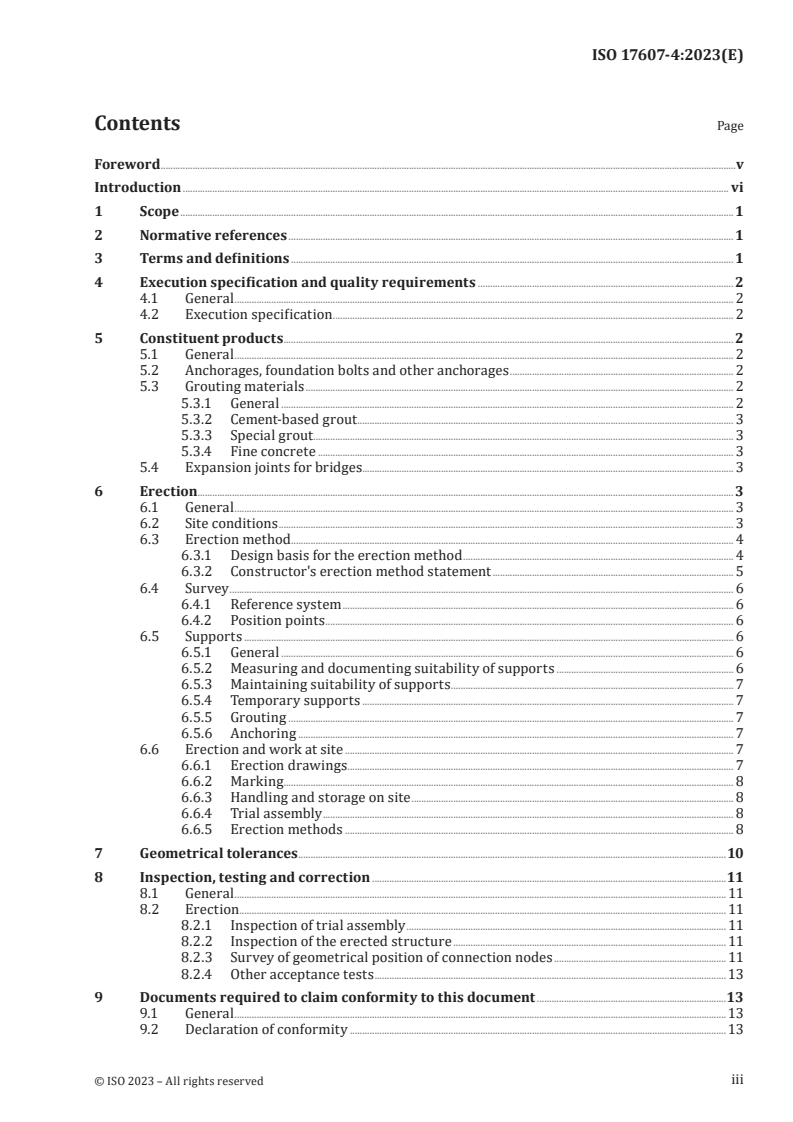
Contents Page
Foreword .v
Introduction . vi
1 Scope . 1
2 Normative references . 1
3 Terms and definitions . 1
4 Execution specification and quality requirements . 2
4.1 General . 2
4.2 Execution specification . 2
5 Constituent products . 2
5.1 General . 2
5.2 Anchorages, foundation bolts and other anchorages . 2
5.3 Grouting materials . 2
5.3.1 General . 2
5.3.2 Cement-based grout . 3
5.3.3 Special grout. 3
5.3.4 Fine concrete . 3
5.4 Expansion joints for bridges . . 3
6 Erection. 3
6.1 General . 3
6.2 Site conditions . 3
6.3 Erection method. 4
6.3.1 Design basis for the erection method . 4
6.3.2 Constructor's erection method statement . 5
6.4 Survey . 6
6.4.1 Reference system . 6
6.4.2 Position points . 6
6.5 Supports . 6
6.5.1 General . 6
6.5.2 Measuring and documenting suitability of supports . 6
6.5.3 Maintaining suitability of supports . 7
6.5.4 Temporary supports . 7
6.5.5 Grouting . 7
6.5.6 Anchoring . 7
6.6 Erection and work at site . 7
6.6.1 Erection drawings . 7
6.6.2 Marking . . 8
6.6.3 Handling and storage on site . 8
6.6.4 Trial assembly . 8
6.6.5 Erection methods . 8
7 Geometrical tolerances .10
8 Inspection, testing and correction .11
8.1 General . 11
8.2 Erection . 11
8.2.1 Inspection of trial assembly . 11
8.2.2 Inspection of the erected structure . 11
8.2.3 Survey of geometrical position of connection nodes . 11
8.2.4 Other acceptance tests . 13
9 Documents required to claim conformity to this document .13
9.1 General .13
9.2 Declaration of conformity . 13
iii
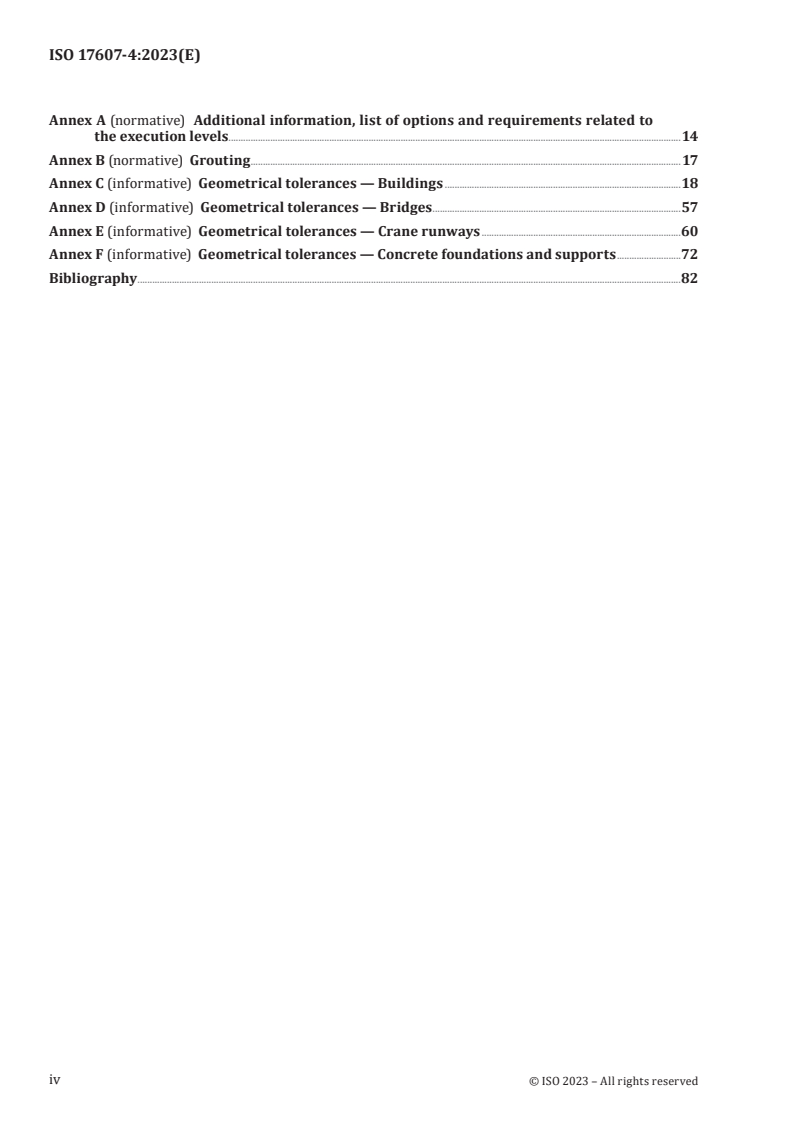
Annex A (normative) Additional information, list of options and requirements related to
the execution levels.14
Annex B (normative) Grouting .17
Annex C (informative) Geometrical tolerances — Buildings .18
Annex D (informative) Geometrical tolerances — Bridges .57
Annex E (informative) Geometrical tolerances — Crane runways .60
Annex F (informative) Geometrical tolerances — Concrete foundations and supports .72
Bibliography .82
iv
Foreword
ISO (the International Organization for Standardization) is a worldwide federation of national standards
bodies (ISO member bodies). The work of preparing International Standards is normally carried out
through ISO technical committees. Each member body interested in a subject for which a technical
committee has been established has the right to be represented on that committee. International
organizations, governmental and non-governmental, in liaison with ISO, also take part in the work.
ISO collaborates closely with the International Electrotechnical Commission (IEC) on all matters of
electrotechnical standardization.
The procedures used to develop this document and those intended for its further maintenance are
described in the ISO/IEC Directives, Part 1. In particular, the different approval criteria needed for the
different types of ISO document should be noted. This document was drafted in accordance with the
editorial rules of the ISO/IEC Directives, Part 2 (see www.iso.org/directives).
ISO draws attention to the possibility that the implementation of this document may involve the use
of (a) patent(s). ISO takes no position concerning the evidence, validity or applicability of any claimed
patent rights in respect thereof. As of the date of publication of this document, ISO had not received
notice of (a) patent(s) which may be required to implement this document. However, implementers are
cautioned that this may not represent the latest information, which may be obtained from the patent
database available at www.iso.org/patents. ISO shall not be held responsible for identifying any or all
such patent rights.
Any trade name used in this document is information given for the convenience of users and does not
constitute an endorsement.
For an explanation of the voluntary nature of standards, the meaning of ISO specific terms and
expressions related to conformity assessment, as well as information about ISO's adherence to
the World Trade Organization (WTO) principles in the Technical Barriers to Trade (TBT), see
www.iso.org/iso/foreword.html.
This document was prepared by Technical Committee ISO/TC 167, Steel and aluminium structures.
This first edition cancels and replaces ISO 10721-2:1999, which has been technically revised.
A list of all parts in the ISO 17607 series can be found on the ISO website.
Any feedback or questions on this document should be directed to the user’s national standards body. A
complete listing of these bodies can be found at www.iso.org/members.html.
v
Introduction
Specific requirements for the achievement of structures that are optimal with respect to safety, the
state of the economy, development and general values of a nation are given in the appropriate regional
or national standards, if they exist.
Many nations do not have their own standards for structural steelwork. Some reference other national
or regional standards. Some permit the project’s standard to be selected by the owner, designer or
constructor of the structure. Some do not require any standards to be followed.
The ISO 17607 series of standards on the execution of structural steelwork was developed to serve
as a means to provide a set of requirements and guidance for projects that are constructed without a
governing regional or national standard. The ISO 17607 series can also serve to reduce trade barriers.
Additional requirements to be addressed in the execution of structural steelwork, as structures or as
fabricated components, can be found in the other parts of the series:
— ISO 17607-1 (General requirements and terms and definitions);
— ISO 17607-2 (Steels);
— ISO 17607-3 (Fabrication);
— ISO 17607-5 (Welding);
— ISO 17607-6 (Bolting).
vi
INTERNATIONAL STANDARD ISO 17607-4:2023(E)
Steel structures — Execution of structural steelwork —
Part 4:
Erection
1 Scope
This document defines the general requirements for erection of steels used in the execution of structural
steelwork as structures or as manufactured components in conjunction with ISO 17607-1.
Additional requirements to be addressed in the execution of structural steelwork, as structures or as
fabricated components, can be found in other parts of the ISO 17607 series.
2 Normative references
The following documents are referred to in the text in such a way that some or all of their content
constitutes requirements of this document. For dated references, only the edition cited applies. For
undated references, the latest edition of the referenced document (including any amendments) applies.
ISO 4463-1, Measurement methods for building — Setting-out and measurement — Part 1: Planning and
organization, measuring procedures, acceptance criteria
ISO 7976-1, Tolerances for building — Methods of measurement of buildings and building products —
Part 1: Methods and instruments
ISO 7976-2, Tolerances for building — Methods of measurement of buildings and building products —
Part 2: Position of measuring points
ISO 17607-1, Steel structures — Execution of structural steelwork — Part 1: General requirements and
vocabulary
ISO 17607-3, Steel structures — Execution of structural steelwork — Part 3: Fabrication
ISO 17607-5, Steel structures — Execution of structural steelwork — Part 5: Welding
ISO 17607-6, Steel structures — Execution of structural steelwork — Part 6: Bolting
ISO 22966, Execution of concrete structures
3 Terms and definitions
For the purposes of this document, the terms and definitions given in ISO 17607-1 apply.
ISO and IEC maintain terminology databases for use in standardization at the following addresses:
— ISO Online browsing platform: available at https:// www .iso .org/ obp
— IEC Electropedia: available at https:// www .electropedia .org/
4 Execution specification and quality requirements
4.1 General
See ISO 17607-1.
This clause specifies the requirements for the erection of structural steelwork.
When work performed on site involves operations similar to fabrication, the work shall be performed
in accordance with ISO 17607-3.
NOTE 1 Examples of similar operations include cutting, holing, and assembling of components prior to
erection.
NOTE 2 Welding and structural bolting are addressed in ISO 17607-5 and ISO 17607-6.
4.2 Execution specification
National standards and documents that provide technically equivalent conditions may be used, in
whole or in part, in place of referenced ISO standards or requirements of this document. In these cases,
the technically equivalent national standards and documents, and deviations from the requirements of
this document, shall be referenced in the execution specification.
The necessary information and technical requirements for execution of each part of the structural
steelwork shall be agreed upon and complete before commencement of execution of that part of the
structural steelwork.
The execution specification shall include the following items as are relevant:
a) additional information, see A.1;
b) options that may be specified, see A.2;
c) requirements related to the execution levels, see A.3;
d) identification and traceability requirements in accordance with ISO 17607-1;
e) geometrical tolerances, see Clause 7.
There shall be procedures for making alterations to a previously agreed upon execution specification.
5 Constituent products
5.1 General
ISO 17607-1 provides information and requirements for constituent products.
5.2 Anchorages, foundation bolts and other anchorages
ISO 17607-6 provides information and requirements for anchorages, foundation bolts and other
anchorages.
5.3 Grouting materials
5.3.1 General
The grouting materials to be used shall be specified in the execution specification. They shall be cement-
based grout, special grout, or fine concrete.
5.3.2 Cement-based grout
Cement-based grout for use between steel bases or bearing plates and concrete foundations shall be as
follows:
a) for nominal thickness not exceeding 25 mm: Neat Portland cement mortar;
b) for nominal thickness between 25 mm and 50 mm: Fluid Portland cement mortar that is not leaner
than 1:1 cement to fine aggregate;
c) for nominal thickness of 50 mm and above: Dry as possible Portland cement mortar that is not
leaner than 1:2 cement to fine aggregate.
5.3.3 Special grout
Special grout includes cement-based grout used with admixtures, expanding grout and resin-based
grout. Those with low shrinkage characteristics are recommended.
Special grout shall be accompanied by detailed instructions for use that are in conformity with the
manufacturer's recommendations.
5.3.4 Fine concrete
Fine concrete shall only be used between steel bases or bearing plates and concrete foundations that
have gaps with nominal thickness of 50 mm and above.
5.4 Expansion joints for bridges
Requirements for type and characteristics of expansion joints shall be specified.
6 Erection
6.1 General
This clause gives requirements for erection and other work undertaken on site including grouting of
bases as well as those relevant to the suitability of the site for safe erection and for accurately prepared
supports.
Work carried out on site that includes fabrication, welding, and structural bolting shall be in accordance
with ISO 17607-3, ISO 17607-5, and ISO 17607-6, respectively.
Inspection and acceptance of the structure shall be performed in accordance with the requirements
specified in Clause 8.
6.2 Site conditions
Erection shall not commence until the site for the construction works conforms with the technical
requirements with respect to the safety of the structural steelwork. This shall include the following
items where relevant:
a) provision and maintenance of hard standing for cranes, and access equipment;
b) access routes to the site, and within the site suitable for delivery, and movement of material,
components, equipment and personnel;
c) soil conditions affecting the safe operations, and construction at the site;
d) possible settlement of erection supports for the structure;
e) details of underground services, overhead cables, or site obstructions, including the necessity to
relocate overhead obstructions such as power lines from the area of erection;
f) limitations on dimensions, or weights of components that can be delivered onto the site;
g) special environmental, and climatic conditions on, and around the site;
h) particulars of adjacent structures affecting, or affected by the works;
i) adequate and suitable storage space for material, and components.
Access routes to the site and within the site shall be given in a site plan. This shall show areas available
for storage, dimensions and level of access routes, and level of the prepared working area for site traffic
and plant.
If the structural steelwork is inter-linked with other trades, the coherence of technical requirements
with respect to the safety of the structural steelwork should be coordinated with those for other parts
of the construction works. This check shall consider the following items as relevant:
j) prearranged procedures for co-operation with other constructors, including availability of hoisting
equipment;
k) availability of site services;
l) analysis and definition of maximum construction and storage loads permitted on the steelwork;
m) control of concrete placement during composite construction (see ISO 22966).
6.3 Erection method
6.3.1 Design basis for the erection method
If the structural stability in the part-erected condition is not evident, a safe method of erection on
which the design was based shall be provided. This design basis method of erection shall consider the
following items:
a) positions and types of site connections;
b) maximum piece size, weight and location;
c) identification of critical lifts, such as lifts above a selected proportion of crane capacity and multi-
crane lifts;
d) sequence of erection;
e) stability concept for the part-erected structure, including any requirements for temporary bracing
or propping (shoring);
f) propping or other measures for the execution of phased concreting of composite structures;
g) conditions for removal of temporary bracing or propping, or any requirement for de-stressing or
stressing the structure including foundation bolts and anchor rods;
h) features that can create a safety hazard during construction;
i) timing and method for adjustment of foundation connections or bearings and for grouting;
j) camber and pre-sets required in relation of those provided at fabrication stage;
k) use of diaphragms (e.g. profiled steel sheeting, precast panel) to ensure stability;
l) use of diaphragms to provide lateral restraint;
m) transportation of units, including attachments for lifting, turning or pulling;
n) positions and conditions for supporting and jacking;
o) stability concept for the bearings;
p) expected settlements of the supports;
q) particular positions and loads from, e.g. cranes, stored components, counterweight, for the various
construction phases;
r) instructions for the delivery, storage, lifting, positioning, and pre-tensioning of stay cables;
s) actions required to account for deformations of the partly erected structure, such as the use of
propping, jacks or loads that must be adjusted as erection progresses to set or maintain camber,
position within the specified tolerances or pre-stress;
t) analysis, design and details of all temporary works and attachments to permanent works with
instructions as to their removal.
6.3.2 Constructor's erection method statement
A method statement describing the constructor's erection method shall be prepared and it shall be
checked in accordance with design rules, notably against resistance of the partly erected structure to
erection loads and other loading.
The erection method statement may deviate from the design basis method of erection, provided that it
is a safe alternative.
Amendments to the erection method statement, including those necessitated by site conditions, shall
be checked and reviewed in accordance with the above requirement.
The erection method statement shall describe procedures to be used to safely erect the steelwork and
shall consider the technical requirements regarding the safety of the structural steelwork.
The procedures should link to specific work instructions, written or verbal as appropriate.
The erection method statement shall address all relevant items in 6.3.1, and shall also consider the
following items as relevant:
a) experience from any trial assembly undertaken in accordance with 6.6.4;
b) restraints necessary to ensure stability prior to welding and to control local movement of the joint;
c) lifting devices necessary;
d) necessity to mark either weights or centres of gravity, or both, on large or irregularly shaped pieces;
e) relationship between the weights to be lifted and the radius of operation where cranes are to be
used;
f) identification of sway or overturning forces, particularly those due to the predicted wind conditions
on site during erection, and the exact methods of maintaining adequate sway and overturning
resistance;
g) methods of minimizing risk from identified safety hazards;
h) provision of safe working positions and safe means of access to them.
In addition, the following apply for composite steel and concrete structures:
i) sequence of fixing of profiled steel sheeting for composite slabs shall be planned to ensure that
sheets are adequately supported by supporting beams before fixing, and are securely fixed before
they are used to gain access to subsequent working positions;
j) profiled steel sheeting should not be used to gain access for welding of shear connectors unless the
sheeting is secured already by fasteners in accordance with i);
k) sequence of placing and method of securing and sealing permanent formwork to ensure that
formwork is secure before being used to gain access for subsequent construction operations and
supporting slab reinforcement and deck concrete.
Factors associated with the execution of the concrete works should be considered as relevant, such
as sequence of placing concrete, pre-stressing, and temperature difference between steel and freshly
placed concrete, jacking and supports.
6.4 Survey
6.4.1 Reference system
Unless otherwise specified, site measurements for the structural steelwork shall be related to the
system established for the setting out and measurement of the construction works in accordance with
ISO 4463-1.
A documented survey of a secondary net (a survey grid established to control the building) shall be
provided and used as the reference system for setting out the steelwork and establishing the deviations
of supports. The coordinates of the secondary net given in this survey shall be accepted as true if they
conform with the acceptance criteria given in ISO 4463-1.
When required by the execution specification, the reference temperature for setting out and measuring
the steelwork shall be specified.
6.4.2 Position points
The position points which mark the intended position for the erection of individual components shall
be in accordance with ISO 4463-1.
6.5 Supports
6.5.1 General
Supports may include foundation bolts, anchor rods, anchors, embedded plates and bearings.
6.5.2 Measuring and documenting suitability of supports
The condition and location of the supports shall be checked using appropriate visual and measurement
means and shall be confirmed as suitable before the commencement of erection. Unsuitable supports
shall be corrected prior to the commencement of erection. Nonconformities shall be documented and
records shall be available to the constructor performing steel erection.
All supports for the steelwork shall be suitably prepared to receive the steel structure. Installation
of structural bearings shall conform with either the relevant standards or documents or product
manufacturer's instructions, or combination thereof.
Erection shall not commence until the location and levels of the supports are in accordance with the
acceptance criteria in Clause 7, or an appropriate amendment to the specified requirements has been
issued.
The survey used to check the positions of the supports shall be documented.
If foundation bolts are to be pre-stressed, methods and procedure requirements shall be specified in
the execution specification.
6.5.3 Maintaining suitability of supports
During erection, the supports for the steelwork shall be maintained in a condition to serve their
intended function.
Areas of supports that require protection against rust staining shall be identified and appropriate
protection provided.
Compensation for settlement of supports is permitted, unless otherwise specified in the execution
specification. This shall be done by grouting or packing between steelwork and support.
6.5.4 Temporary supports
Shims, packings and other supporting devices used as temporary supports under base plates shall
present a flat surface to the steel and be of adequate size, strength and rigidity to avoid local crushing
of the substructure concrete or masonry.
If shims, packings or other supporting devices are subsequently to be grouted, they shall be placed
so that the grout will provide the packings with a minimum lateral cover of 25 mm, unless otherwise
specified in the execution specification.
If shims, packings or other supporting devices are left in position after grouting they shall be made
from materials with the same durability as the structure.
If adjustment to the position of the base is achieved using levelling nuts on the foundation bolts under
the base plate, these may be left in position unless specified in the execution specification. The nuts
shall be selected to ensure that they are suitable to maintain the stability of the part-erected structure
without adversely affecting the performance of the foundation bolt in service.
Shims, blocks, half-nuts or plastic nuts may be used for levelling.
6.5.5 Grouting
Grouting shall be carried out in accordance with Annex B.
6.5.6 Anchoring
Anchoring devices in concrete parts of the structure or adjacent structures are not addressed by this
document and shall be set in accordance with their specification.
6.6 Erection and work at site
6.6.1 Erection drawings
Erection drawings or equivalent instructions shall be provided and form a part of the erection method
statement (see 6.3.1 and 6.3.2).
Drawings shall be prepared showing plans and elevations and at such a scale that the erection marks
for all components can be shown on them.
Drawings shall show grid locations, bearing positions and assembly of components together with
requirements for special tolerances and those that differ from the requirements of this document.
Foundation plans shall show the base location and orientation of the steelwork, any other components
in direct contact with the foundations, their base location and level, the intended bearing level and the
datum level. Foundation plans shall include column base support and other structural supports.
Elevations shall show required levels for floors, structure, or both.
Drawings shall show necessary details for fixing of steel or bolts to the foundations, the method of
adjustment by packing and wedging, and grout requirements as well as fixing of steelwork and bearings
to their supports.
Drawings shall show details and arrangements of any steelwork or other temporary works necessary
for erection purposes to ensure the stability of the construction or the safety of personnel.
Drawings shall state the weight of all components or assemblies over five tonnes and the centre of
gravity of all large irregular pieces.
6.6.2 Marking
Components that are individually assembled or erected at the site shall be allocated an erection mark.
A component shall be marked with its erected orientation if this is not clear from its shape.
Marking methods shall be in accordance with ISO 17607-3.
6.6.3 Handling and storage on site
Handling and storage of fabricated steel, filler metals and bolting products on site shall be in accordance
with ISO 17607-3, ISO 17607-5, and ISO 17607-6 respectively, and those given below.
Components shall be handled and stacked in such a way that the likelihood of damage is minimized.
Particular attention shall be paid to slinging methods to avoid damage to the steelwork and protective
treatment.
Steelwork damaged during off-loading, transportation, storage or erection shall be restored to
conformity.
The procedure for restoration shall be defined before undertaking the repair. For execution levels EXL2,
EXL3 and EXL4, the procedure shall also be documented.
All small plates and other fittings shall be suitably packed and identified.
6.6.4 Trial assembly
Any site trial assembly shall be performed in accordance with ISO 17607-3.
Trial assembly should be considered:
a) to confirm fit between components;
b) to prove methodology to maintain stability during erection if the erection sequence needs
evaluating in advance;
c) to prove duration of operations if site conditions are restricted by limited possession time.
6.6.5 Erection methods
6.6.5.1 General
The erection of the steelwork shall be carried out in conformity with the erection method statement
and in such a way as to ensure stability at all times.
Foundation bolts shall not be used to secure un-guyed columns against overturning unless they have
been checked for this mode of use.
Throughout the erection of the structure, the steelwork shall be made safe against temporary erection
loads, including those due to erection equipment or its operation and against the effects of wind loads
on the unfinished structure.
For buildings, at least one third of the permanent bolts in each connection should be installed before
that connection can be considered to contribute to the stability of the partly completed structure.
Further requirements for the degree of completion of connections shall be considered and defined in
the stability analysis of the structure during erection.
6.6.5.2 Temporary works
All temporary bracing and temporary restraints shall be left in position until erection is sufficiently
advanced to allow their safe removal.
If bracings in tall buildings are required to be de-stressed as erection progresses, to release the forces
induced in them by vertical loads, this shall be carried out progressively one panel at a time. During such
de-stressing, sufficient alternative bracing shall be in place to ensure stability. If necessary, additional
bracing shall be added temporarily for this purpose.
All connections for temporary components provided for erection purposes shall be made in accordance
with this document and in such a way that they do not weaken the permanent structure or impair its
serviceability.
If temporary erection aids are used to support the structure during welding, it shall be ensured
that they are sufficiently strong and that their retaining welds are appropriate for the erection load
conditions.
If the erection procedure involves rolling or otherwise moving the structure, or part of the structure,
into its final position after assembly, provision shall be made for controlled braking of the moving mass.
All temporary anchoring devices shall be made secure against unintentional release.
Jacks shall be capable of being locked in any position under load unless other safety provisions are
made.
6.6.5.3 Fit-up and alignment
Care shall be taken that no part of the structure is permanently distorted or over-stressed by stacking
of steelwork components or by erection loads during the erection process.
Each part of the structure shall be aligned as soon as practicable after it has been erected and final
assembly completed as soon as possible thereafter.
Permanent connections shall not be made between components until a sufficient portion of the
structure has been aligned, levelled, plumbed, and temporarily connected to ensure that components
will not be displaced during subsequent erection or alignment of the remainder of the structure.
Alignment of the structure and lack of fit in connections may be adjusted using shims. Shims shall be
secured where they are in danger of coming loose.
Shims shall be made of flat steel, unless otherwise specified. Shims shall have similar durability to that
of the structure.
If shims are used to align structures composed of coated material, the shims shall be protected in a
similar manner to provide the specified durability unless the shims are required to meet a specified
friction surface slip factor.
If lack-of-fit between erected components cannot be corrected by the use of shims, components of
the structure shall be locally modified in accordance with this document. The modifications shall not
compromise the performance of the structure in the temporary or permanent state. This work may be
executed on site. Care shall be taken with structures built of welded latticed components and space-
frame structures to ensure that they are not subjected to excessive forces in an attempt to force a fit
against their inherent rigidity.
Processes for aligning of holes and bolting shall be in accordance with ISO 17607-3 and ISO 17607-6.
6.6.5.4 Bolted splices with full contact bearing
Where full contact bearing is specified for bolted splices, and where the fit-up between surfaces of
erected components exceeds the specified tolerance, shims may be used where the gap exceeds the
specified limits after initial bolting-up, to reduce the gaps to within the permitted deviation.
Unless otherwise specified, the shims may be made of flat mild steel with a maximum thickness of
3 mm. No more than three shims shall be used at any point. If necessary, and if not prohibited by the
execution specification, the shims may be held in place by means of either fillet welds or a partial
penetration butt weld extending over the shims, as shown in Figure 1.
Key
t component thickness
1 partial penetration butt weld or fillet weld
2 shims
Figure 1 — Option for securing shims used for bolted splice in full contact bearing
7 Geometrical tolerances
Geometrical tolerances shall be specified in the execution specification.
NOTE Information provided in Annexes C, D, E, and F can be used to specify the geometrical tolerances in
the execution specification.
The types and requirements for geometrical deviations and the quantitative values for different types
of permitted deviations are given per country in Annexes C, D, E and F, for:
— buildings;
— bridges;
— crane runways;
— concrete foundations and supports.
The permitted deviations given do not include elastic deformations induced by the self-weight of the
components.
In addition, special tolerances may be specified either for geometrical deviations already defined with
quantitative values or for other types of geometrical deviations. If special tolerances are required, the
following information shall be given as appropriate:
— amended values for tolerances already defined;
— defined parameters and permitted values for the geometrical deviations to be controlled;
— whether these special tolerances apply to all relevant components or only to particular components
that are specified.
In each case, the requirements are for final acceptance testing. If fabricated components are used on
site to form/build a structure, the tolerances for the final check of the erected structure shall be defined
in addition to the tolerances for the fabricated parts.
NOTE The specifier can make direct reference to the Annexes (C, D, E, F).
8 Inspection, testing and correction
8.1 General
ISO 17607-1 provides information and requirements for inspection, testing and correction.
8.2 Erection
8.2.1 Inspection of trial assembly
Requirements for inspection of any trial assembly to 6.6.4 shall be specified.
8.2.2 Inspection of the erected structure
The structure shall be inspected to confirm that all components are erected in the correct location and
orientation, and that the connections are completed in conformance with the execution specification.
The condition of the erected structure shall be inspected for any indication that components have been
distorted, and to ensure that any temporary attachments have either been removed satisfactorily or
are in accordance with the specified requirements.
8.2.3 Survey of geometrical position of connection nodes
8.2.3.1 Survey methods and accuracy
A survey of the structure shall be made. This survey shall be related to the secondary net (survey grid
established to control the building). For EXL3 and EXL4 this survey shall be recorded; if there is a
requirement to record dimensional checks at acceptance of the structure, this shall be specified.
Methods and instruments used shall be selected from those listed in ISO 7976-1 and ISO 7976-2. The
selection shall take into account the capability of the survey process in terms of accuracy relative to
the acceptance criteria. If appropriate, the survey shall be corrected for the effects of temperature and
the accuracy of the measurements relative to that in 6.4.1 shall be estimated in accordance with the
relevant parts of the ISO 17123 series.
8.2.3.2 System of measurement
The
...