

ISO 5644:2024
(Main)Porcelain Tableware — Specification and test method
General Information
- Abstract
This document gives specifications, test methods, sampling, marking and labelling of porcelain tableware that is used for the preparation and serving of foods.
- Status
- Published
- Publication Date
- 21-Mar-2024
- Current Stage
- 6060 - International Standard published
- Start Date
- 22-Mar-2024
- Due Date
- 02-Nov-2023
- Completion Date
- 22-Mar-2024
Overview
ISO 5644:2024 - "Porcelain Tableware - Specification and test method" defines requirements, test methods, sampling, marking and labelling for porcelain tableware used in the preparation and serving of food. The standard covers physical, chemical and functional performance characteristics to ensure safety, durability and fitness for intended use of porcelain items such as cups, plates, bowls, jugs and teapots.
Key topics and technical requirements
- Material definitions: classification of porcelain types (hard paste, soft paste, china, bone china, vitreous china, parian ware) with reference performance characteristics.
- Water absorption: all porcelain categories shall have water absorption < 0.5 % (EN 1217:1998, Test Method A).
- Translucency: conformity with EN 1184:1997 (Test Method A) for translucency requirements.
- Impact resistance:
- Rim impact energy to cause failure ≥ 0.05 J (EN 12980).
- Handle impact energy to cause failure ≥ 0.05 J (ASTM C368, per BS 8654 procedure).
- Thermal shock endurance: articles intended for hot liquids/foods shall have ΔT50 ≥ 90 °C (EN 1183 Test Method B).
- Handle and knob temperature: surface temperature of handles/knobs shall not exceed 56 °C under test conditions (BS 8654 referenced).
- Metal release (food contact): lead and cadmium release tested per ISO 6486‑1 and must meet limits in ISO 6486‑2.
- Dishwasher resistance: detergent durability classifications per EN 12875‑4 - labelled dishwasher-safe items must show classification 0 (no change) or 1 (first discernible change), but not 2 (clearly visible change).
- Pouring, lid security and stability: lids of pouring vessels, single-stream pouring performance and stability at a 15° tilt are specified (BS 8654 procedures).
- Microwave and oven/freezer use: performance tests for microwave heating (EN 15284) and oven/freezer application requirements are included.
- Sampling, marking and labelling: requirements for conformity marking and consumer information are specified.
Applications and who uses it
ISO 5644 is used by:
- Porcelain manufacturers and product designers to specify material and performance targets.
- Quality control and testing laboratories to verify compliance with test methods and limits.
- Importers, retailers and procurement teams (hospitality, food service) assessing product fitness for intended use.
- Regulators and conformity assessors checking food-contact safety (metal release) and performance claims (dishwasher-safe, microwave-safe).
Related standards
Normative references include ISO 6486‑1/2, EN 1217, EN 1183, EN 1184, EN 12875‑4, EN 12980, EN 15284 and ASTM C368. BS 8654 is referenced for practical test procedures.
ISO 5644:2024 provides an authoritative framework to assure the safety, durability and functionality of porcelain tableware in food service and domestic markets.
Get Certified
Connect with accredited certification bodies for this standard

BSI Group
BSI (British Standards Institution) is the business standards company that helps organizations make excellence a habit.

Bureau Veritas
Bureau Veritas is a world leader in laboratory testing, inspection and certification services.

DNV
DNV is an independent assurance and risk management provider.
Sponsored listings
Frequently Asked Questions
ISO 5644:2024 is a standard published by the International Organization for Standardization (ISO). Its full title is "Porcelain Tableware — Specification and test method". This standard covers: This document gives specifications, test methods, sampling, marking and labelling of porcelain tableware that is used for the preparation and serving of foods.
This document gives specifications, test methods, sampling, marking and labelling of porcelain tableware that is used for the preparation and serving of foods.
ISO 5644:2024 is classified under the following ICS (International Classification for Standards) categories: 67.250 - Materials and articles in contact with foodstuffs; 81.060.20 - Ceramic products; 97.040.60 - Cookware, cutlery and flatware. The ICS classification helps identify the subject area and facilitates finding related standards.
ISO 5644:2024 is available in PDF format for immediate download after purchase. The document can be added to your cart and obtained through the secure checkout process. Digital delivery ensures instant access to the complete standard document.
Standards Content (Sample)
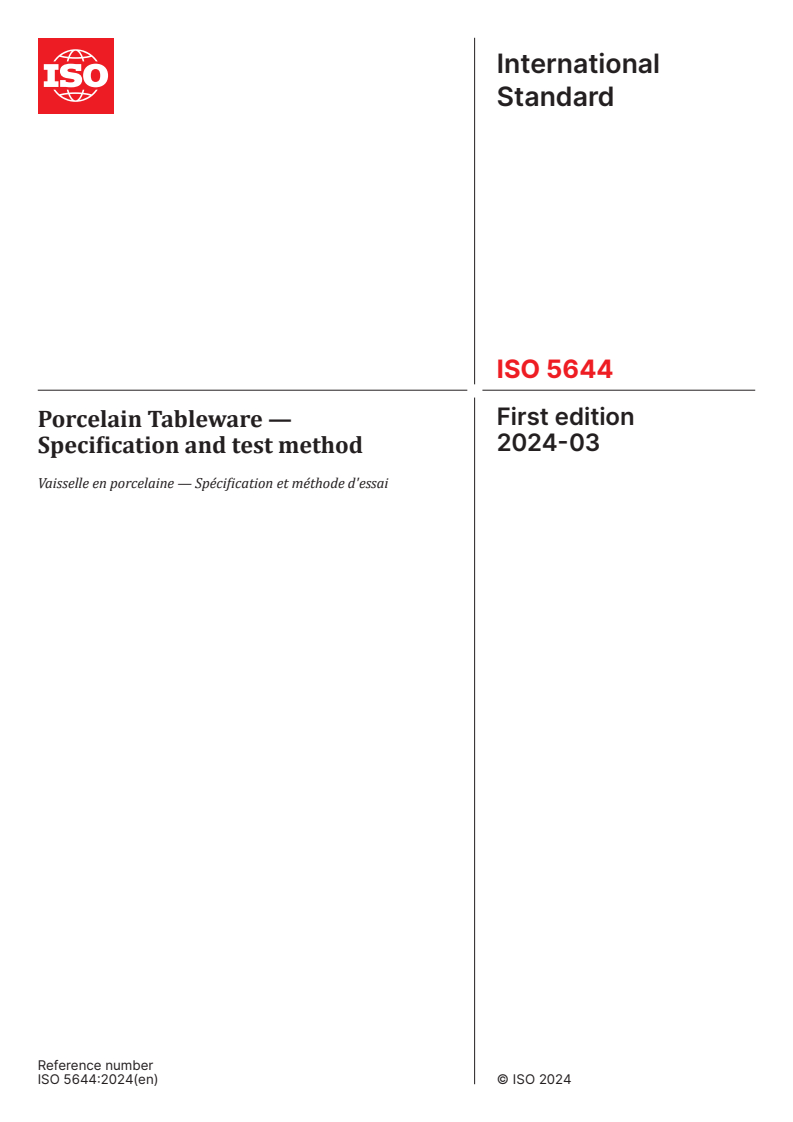
International
Standard
ISO 5644
First edition
Porcelain Tableware —
2024-03
Specification and test method
Vaisselle en porcelaine — Spécification et méthode d'essai
Reference number
© ISO 2024
All rights reserved. Unless otherwise specified, or required in the context of its implementation, no part of this publication may
be reproduced or utilized otherwise in any form or by any means, electronic or mechanical, including photocopying, or posting on
the internet or an intranet, without prior written permission. Permission can be requested from either ISO at the address below
or ISO’s member body in the country of the requester.
ISO copyright office
CP 401 • Ch. de Blandonnet 8
CH-1214 Vernier, Geneva
Phone: +41 22 749 01 11
Email: copyright@iso.org
Website: www.iso.org
Published in Switzerland
ii
Contents Page
Foreword .iv
1 Scope . 1
2 Normative references . 1
3 Terms and definitions . 1
4 Requirements . 3
4.1 General .3
4.2 Chemical composition requirements . .3
4.3 Physical requirements .3
4.3.1 Integrity of handle attachments .3
4.3.2 Resistance to impact breakage in service .3
4.3.3 Water absorption .4
4.3.4 Translucency .4
4.4 Functionality requirements .4
4.4.1 Metal release (Food Contact Compliance) .4
4.4.2 Dishwasher usage (detergent durability) .4
4.4.3 Articles intended to serve hot foods and beverages .4
4.4.4 Articles intended for pouring liquids .5
4.4.5 Stability .5
4.4.6 Microwave usage .5
4.4.7 Oven usage .5
4.4.8 Freezer usage .5
4.4.9 Metal marking .6
5 Sampling . 6
6 Marking and labelling . 6
Bibliography . 7
iii
Foreword
ISO (the International Organization for Standardization) is a worldwide federation of national standards
bodies (ISO member bodies). The work of preparing International Standards is normally carried out through
ISO technical committees. Each member body interested in a subject for which a technical committee
has been established has the right to be represented on that committee. International organizations,
governmental and non-governmental, in liaison with ISO, also take part in the work. ISO collaborates closely
with the International Electrotechnical Commission (IEC) on all matters of electrotechnical standardization.
The procedures used to develop this document and those intended for its further maintenance are described
in the ISO/IEC Directives, Part 1. In particular, the different approval criteria needed for the different types
of ISO document should be noted. This document was drafted in accordance with the editorial rules of the
ISO/IEC Directives, Part 2 (see www.iso.org/directives).
ISO draws attention to the possibility that the implementation of this document may involve the use of (a)
patent(s). ISO takes no position concerning the evidence, validity or applicability of any claimed patent
rights in respect thereof. As of the date of publication of this document, ISO had not received notice of (a)
patent(s) which may be required to implement this document. However, implementers are cautioned that
this may not represent the latest information, which may be obtained from the patent database available at
www.iso.org/patents. ISO shall not be held responsible for identifying any or all such patent rights.
Any trade name used in this document is information given for the convenience of users and does not
constitute an endorsement.
For an explanation of the voluntary nature of standards, the meaning of ISO specific terms and expressions
related to conformity assessment, as well as information about ISO's adherence to the World Trade
Organization (WTO) principles in the Technical Barriers to Trade (TBT), see www.iso.org/iso/foreword.html.
This document was prepared by Technical Committee ISO/TC 166, Ceramic ware, glassware and glass ceramic
ware in contact with food.
Any feedback or questions on this document should be directed to the user’s national standards body. A
complete listing of these bodies can be found at www.iso.org/members.html.
iv
International Standard ISO 5644:2024(en)
Porcelain Tableware — Specification and test method
1 Scope
This document gives specifications, test methods, sampling, marking and labelling of porcelain tableware
that is used for the preparation and serving of foods.
2 Normative references
The following documents are referred to in the text in such a way that some or all of their content constitutes
requirements of this document. For dated references, only the edition cited applies. For undated references,
the latest edition of the referenced document (including any amendments) applies.
ISO 6486-1, Ceramic ware, glass ceramic ware and glass dinnerware in contact with food — Release of lead and
cadmium — Part 1: Test method
ISO 6486-2, Ceramic ware, glass-ceramic ware and glass dinnerware in contact with food — Release of lead and
cadmium — Part 2: Permissible limits
ASTM C368-88, Standard test method for impact resistance of ceramic tableware
EN 1217:1998, Materials and articles in contact with foodstuff. Test methods for water absorption of ceramic
articles
EN 1184:1997, Materials and articles in contact with foodstuffs- Test methods for translucency of ceramic
articles
EN 1183:1997, Materials and articles in contact with foodstuffs. Test methods for thermal shock and thermal
shock endurance
BS 8654, Domestic and hospitality use ceramic tableware articles intended for contact with foodstuffs –
Specification
EN 15284, Materials and articles in contact with food stuffs. Test method for the resistance to microwave heating
of ceramic, glass, glass-ceramic or plastic cookware
EN 13834, Cookware. Ovenware for use in traditional domestic ovens
EN 12875-2, Mechanical dishwashing resistance of domestic utensils. Inspection of nonmetallic articles
EN 12875-4, Mechanical dishwashing resistance of utensils. Rapid test for domestic ceramic articles
EN 12980, Materials and articles in contact with foodstuffs. Non-metallic articles for catering and industrial
use. Method of test for the determination of impact resistance
3 Terms and definitions
For the purposes of this document, the following terms and definitions apply.
ISO and IEC maintain terminology databases for use in standardization at the following addresses:
— ISO Online browsing platform: available at https:// www .iso .org/ obp
— IEC Electropedia: available at https:// www .electropedia .org/
3.1
ceramic
inorganic non-metallic material made by firing a mixture of raw materials at high temperature
Note 1 to entry: The firing temperature is high enough to give the necessary strength to the article, which is already
[8]
shaped, but lower than the temperature which is necessary to achieve complete fusion of the mixture .
3.2
glaze
substance resulting from the melting or sintering of inorganic constituents and designed to form a surface
layer which is fused, in one or more coats, during the firing process
[8]
Note 1 to entry: Glazes can be opaque or transparent .
3.3
porcelain
glazed ceramic material, vitrified, impervious, white (or artificially coloured), translucent and resonant
Note 1 to entry: It is generally made from kaolin (or other china clays), silica, feldspar or feldspathic fluxes and
sometimes calcium carbonate or alumina. When determined in accordance with EN 1217:1998, Test Method A, the
water absorption of the body is less than 0,5 %. Porcelain is generally fired in a kiln at temperatures of between
1,200 °C and 1,400 °C (2,200 °F and 2,600 °F). The fired body presents the simultaneous coexistence of a glassy phase
[8]
and a mullitic crystalline phase according respectively to the proportions 60 %-80 % and 40 %-20 % .
3.3.1
hard (hard paste) porcelain
porcelain made from a body composed of kaolin, quartz, feldspar and sometimes calcium c
...