


ISO/IEC DTS 20071-40
(Main)Information technology — User interface component accessibility — Part 40: Augmentative and alternative communication (AAC)
Information technology — User interface component accessibility — Part 40: Augmentative and alternative communication (AAC)
This document provides an introduction to and basic guidance on augmentative and alternative communication (AAC) in the ICT domain. It also provides common definitions and a framework for the development of further, more detailed guidance relating to aspects of these AACs. NOTE This document includes definitions that will be used in other parts of ISO/IEC 20071m but that are not necessarily used in this document. This document recognizes that AAC can be delivered on various ICT devices and the importance of consistency for users across devices. It applies to AAC software and not the devices on which the software is used. This document recognizes that AAC provides many users with a unique form of communication that is not necessarily based on any specific natural language.
Technologies de l'information — Accessibilité du composant interface utilisateur — Partie 40: Communication alternative et améliorée (CAA)
General Information
- Status
- Not Published
- Technical Committee
- ISO/IEC JTC 1/SC 35 - User interfaces
- Drafting Committee
- ISO/IEC JTC 1/SC 35/WG 6 - User interfaces accessibility
- Current Stage
- 5020 - FDIS ballot initiated: 2 months. Proof sent to secretariat
- Start Date
- 08-Dec-2025
- Completion Date
- 08-Dec-2025
Overview
ISO/IEC DTS 20071-40 - "Information technology - User interface component accessibility - Part 40: Augmentative and alternative communication (AAC)" is a working-draft international guidance document that introduces augmentative and alternative communication (AAC) in the ICT domain. It provides common definitions, a conceptual framework and basic guidance for AAC software (not the physical devices). The document recognizes AAC’s role as a non‑language‑specific means of communication, the importance of consistency across devices, and the need for further, detailed guidance in subsequent parts of the ISO/IEC 20071 series.
Key Topics
- Scope and applicability
- Applies to computer‑based AAC software across varied ICT environments.
- Focuses on consistent user experience for AAC users across devices.
- Terms and definitions
- Standardizes vocabulary such as AAC, assistive technology (AT), pictogram, utterance, dialogue, narrative, graphical modality, and non‑verbal user.
- Basic guidance and functionality
- High‑level guidance on design focus, essential AAC functionality and user accessibility needs.
- Further guidance areas (framework)
- Design and use of pictograms, photos and icons in AAC
- Development of a core pictogram vocabulary
- Use of written, auditory and tactile text forms
- Translating AAC utterances to natural languages
- Face‑to‑face and remote messaging integration
- Creating and delivering accessible narratives
- Accessible authoring workflows for narratives and other AAC applications
- References to accessibility goals
- Aligns user accessibility needs with principles in ISO/IEC Guide 71 and ISO/IEC 29138‑1.
Applications
- Who should use this standard
- UX/UI designers and product teams building AAC software
- Assistive technology vendors and accessibility engineers
- Rehabilitation professionals advising on AAC solutions
- Policy makers and procurement specialists evaluating AAC accessibility
- Practical uses
- Designing pictogram vocabularies and graphical modalities for AAC interfaces
- Ensuring consistent cross‑device behavior and accessibility of AAC software
- Integrating AAC for both face‑to‑face and remote communications
- Providing a terminological basis for further technical specifications and implementation guidance
Related Standards
- ISO/IEC 20071 series (user interface component accessibility)
- ISO/IEC 30071‑1:2019 (ICT accessibility guidance)
- ISO/IEC 29138‑1:2018 (user accessibility needs)
- ISO/IEC 20382‑1:2017 (face‑to‑face definition reference)
- ISO/IEC Guide 71:2014 (accessibility goals and guidance)
This document is an introductory framework intended to guide developers and stakeholders toward more detailed, implementable AAC accessibility standards in future parts of the ISO/IEC 20071 series.

ISO/IEC DTS 20071-40 - Information technology — User interface component accessibility — Part 40: Augmentative and alternative communication (AAC) Released:11/24/2025


REDLINE ISO/IEC DTS 20071-40 - Information technology — User interface component accessibility — Part 40: Augmentative and alternative communication (AAC) Released:11/24/2025
Frequently Asked Questions
ISO/IEC DTS 20071-40 is a draft published by the International Organization for Standardization (ISO). Its full title is "Information technology — User interface component accessibility — Part 40: Augmentative and alternative communication (AAC)". This standard covers: This document provides an introduction to and basic guidance on augmentative and alternative communication (AAC) in the ICT domain. It also provides common definitions and a framework for the development of further, more detailed guidance relating to aspects of these AACs. NOTE This document includes definitions that will be used in other parts of ISO/IEC 20071m but that are not necessarily used in this document. This document recognizes that AAC can be delivered on various ICT devices and the importance of consistency for users across devices. It applies to AAC software and not the devices on which the software is used. This document recognizes that AAC provides many users with a unique form of communication that is not necessarily based on any specific natural language.
This document provides an introduction to and basic guidance on augmentative and alternative communication (AAC) in the ICT domain. It also provides common definitions and a framework for the development of further, more detailed guidance relating to aspects of these AACs. NOTE This document includes definitions that will be used in other parts of ISO/IEC 20071m but that are not necessarily used in this document. This document recognizes that AAC can be delivered on various ICT devices and the importance of consistency for users across devices. It applies to AAC software and not the devices on which the software is used. This document recognizes that AAC provides many users with a unique form of communication that is not necessarily based on any specific natural language.
ISO/IEC DTS 20071-40 is classified under the following ICS (International Classification for Standards) categories: 35.240.20 - IT applications in office work. The ICS classification helps identify the subject area and facilitates finding related standards.
ISO/IEC DTS 20071-40 is available in PDF format for immediate download after purchase. The document can be added to your cart and obtained through the secure checkout process. Digital delivery ensures instant access to the complete standard document.
Standards Content (Sample)
FINAL DRAFT
Technical
Specification
ISO/IEC DTS
20071-40
ISO/IEC JTC 1/SC 35
Information technology — User
Secretariat: AFNOR
interface component accessibility —
Voting begins on:
2025-12-08
Part 40:
Augmentative and alternative
Voting terminates on:
2026-02-02
communication (AAC)
RECIPIENTS OF THIS DRAFT ARE INVITED TO SUBMIT,
WITH THEIR COMMENTS, NOTIFICATION OF ANY
RELEVANT PATENT RIGHTS OF WHICH THEY ARE AWARE
AND TO PROVIDE SUPPOR TING DOCUMENTATION.
IN ADDITION TO THEIR EVALUATION AS
BEING ACCEPTABLE FOR INDUSTRIAL, TECHNO-
LOGICAL, COMMERCIAL AND USER PURPOSES, DRAFT
INTERNATIONAL STANDARDS MAY ON OCCASION HAVE
TO BE CONSIDERED IN THE LIGHT OF THEIR POTENTIAL
TO BECOME STAN DARDS TO WHICH REFERENCE MAY BE
MADE IN NATIONAL REGULATIONS.
Reference number
FINAL DRAFT
Technical
Specification
ISO/IEC DTS
20071-40
ISO/IEC JTC 1/SC 35
Information technology — User
Secretariat: AFNOR
interface component accessibility —
Voting begins on:
Part 40:
Augmentative and alternative
Voting terminates on:
communication (AAC)
RECIPIENTS OF THIS DRAFT ARE INVITED TO SUBMIT,
WITH THEIR COMMENTS, NOTIFICATION OF ANY
RELEVANT PATENT RIGHTS OF WHICH THEY ARE AWARE
AND TO PROVIDE SUPPOR TING DOCUMENTATION.
© ISO/IEC 2025
IN ADDITION TO THEIR EVALUATION AS
All rights reserved. Unless otherwise specified, or required in the context of its implementation, no part of this publication may
BEING ACCEPTABLE FOR INDUSTRIAL, TECHNO-
LOGICAL, COMMERCIAL AND USER PURPOSES, DRAFT
be reproduced or utilized otherwise in any form or by any means, electronic or mechanical, including photocopying, or posting on
INTERNATIONAL STANDARDS MAY ON OCCASION HAVE
the internet or an intranet, without prior written permission. Permission can be requested from either ISO at the address below
TO BE CONSIDERED IN THE LIGHT OF THEIR POTENTIAL
or ISO’s member body in the country of the requester.
TO BECOME STAN DARDS TO WHICH REFERENCE MAY BE
MADE IN NATIONAL REGULATIONS.
ISO copyright office
CP 401 • Ch. de Blandonnet 8
CH-1214 Vernier, Geneva
Phone: +41 22 749 01 11
Email: copyright@iso.org
Website: www.iso.org
Published in Switzerland Reference number
© ISO/IEC 2025 – All rights reserved
ii
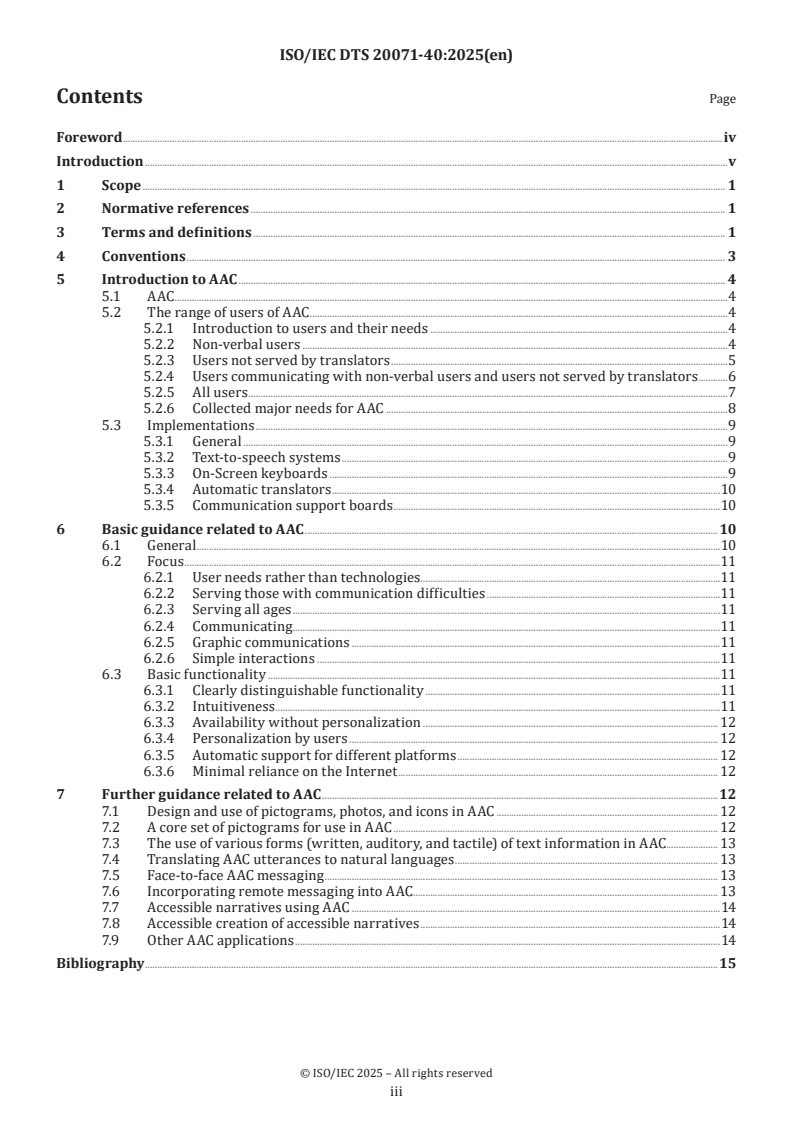
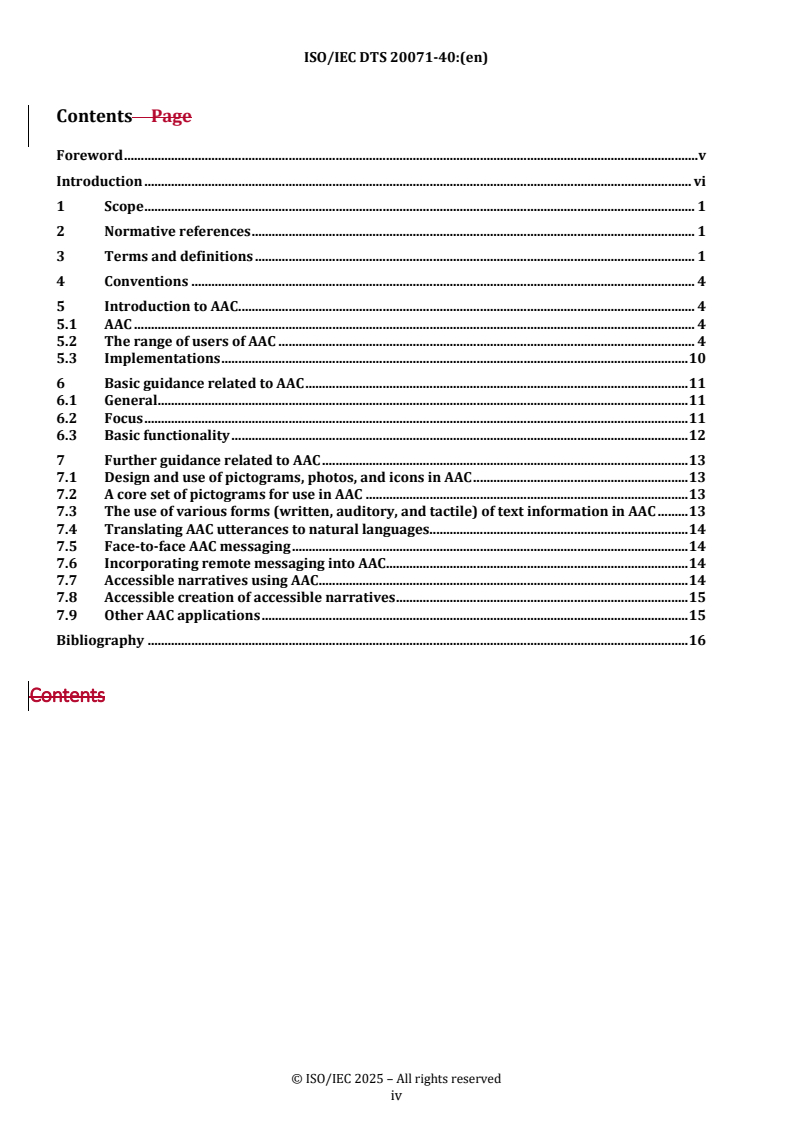
Contents Page
Foreword .iv
Introduction .v
1 Scope . 1
2 Normative references . 1
3 Terms and definitions . 1
4 Conventions . 3
5 Introduction to AAC . 4
5.1 AAC .4
5.2 The range of users of AAC .4
5.2.1 Introduction to users and their needs .4
5.2.2 Non-verbal users .4
5.2.3 Users not served by translators .5
5.2.4 Users communicating with non-verbal users and users not served by translators .6
5.2.5 All users .7
5.2.6 Collected major needs for AAC .8
5.3 Implementations .9
5.3.1 General .9
5.3.2 Text-to-speech systems .9
5.3.3 On-Screen keyboards .9
5.3.4 Automatic translators .10
5.3.5 Communication support boards .10
6 Basic guidance related to AAC .10
6.1 General .10
6.2 Focus .11
6.2.1 User needs rather than technologies.11
6.2.2 Serving those with communication difficulties .11
6.2.3 Serving all ages .11
6.2.4 Communicating . . .11
6.2.5 Graphic communications .11
6.2.6 Simple interactions .11
6.3 Basic functionality .11
6.3.1 Clearly distinguishable functionality .11
6.3.2 Intuitiveness .11
6.3.3 Availability without personalization . 12
6.3.4 Personalization by users . 12
6.3.5 Automatic support for different platforms . 12
6.3.6 Minimal reliance on the Internet . 12
7 Further guidance related to AAC .12
7.1 Design and use of pictograms, photos, and icons in AAC . 12
7.2 A core set of pictograms for use in AAC . 12
7.3 The use of various forms (written, auditory, and tactile) of text information in AAC . 13
7.4 Translating AAC utterances to natural languages . 13
7.5 Face-to-face AAC messaging . 13
7.6 Incorporating remote messaging into AAC . 13
7.7 Accessible narratives using AAC .14
7.8 Accessible creation of accessible narratives .14
7.9 Other AAC applications .14
Bibliography .15
© ISO/IEC 2025 – All rights reserved
iii
Foreword
ISO (the International Organization for Standardization) and IEC (the International Electrotechnical
Commission) form the specialized system for worldwide standardization. National bodies that are
members of ISO or IEC participate in the development of International Standards through technical
committees established by the respective organization to deal with particular fields of technical activity.
ISO and IEC technical committees collaborate in fields of mutual interest. Other international organizations,
governmental and non-governmental, in liaison with ISO and IEC, also take part in the work.
The procedures used to develop this document and those intended for its further maintenance are described
in the ISO/IEC Directives, Part 1. In particular, the different approval criteria needed for the different types
of document should be noted. This document was drafted in accordance with the editorial rules of the ISO/
IEC Directives, Part 2 (see www.iso.org/directives or www.iec.ch/members_experts/refdocs).
ISO and IEC draw attention to the possibility that the implementation of this document may involve the
use of (a) patent(s). ISO and IEC take no position concerning the evidence, validity or applicability of any
claimed patent rights in respect thereof. As of the date of publication of this document, ISO and IEC had not
received notice of (a) patent(s) which may be required to implement this document. However, implementers
are cautioned that this may not represent the latest information, which may be obtained from the patent
database available at www.iso.org/patents and https://patents.iec.ch. ISO and IEC shall not be held
responsible for identifying any or all such patent rights.
Any trade name used in this document is information given for the convenience of users and does not
constitute an endorsement.
For an explanation of the voluntary nature of standards, the meaning of ISO specific terms and expressions
related to conformity assessment, as well as information about ISO's adherence to the World Trade
Organization (WTO) principles in the Technical Barriers to Trade (TBT) see www.iso.org/iso/foreword.html.
In the IEC, see www.iec.ch/understanding-standards.
This document was prepared by Joint Technical Committee ISO/IEC JTC 1, Information technology,
Subcommittee SC 35, User interfaces.
A list of all parts in the ISO/IEC 20071 series can be found on the ISO and IEC websites.
Any feedback or questions on this document should be directed to the user’s national standards
body. A complete listing of these bodies can be found at www.iso.org/members.html and
www.iec.ch/national-committees.
© ISO/IEC 2025 – All rights reserved
iv
Introduction
Face-to-face communication (e.g. vocal speech and sign language) is the most basic and oldest means of
communication between humans. Speech communication only works when the various persons involved
share a common natural language. Today, there are over 7,000 natural languages in the world. Speech
between two persons not sharing a common language only works if they have one or more translators to
assist them.
Pictures are the oldest form of recording communications for other humans to receive at a later point in
time. While some pictures can be challenging to understand, simple pictures that clearly represent what is
being communicated are a good way of communicating between humans who can see the pictures.
Written text arrived later as a means of recording speech communications. However, there are over 3000
natural languages that do not have a written form. Thus, written text only works for human-to-human
communications where both humans share the ability to use the same written language. Text has recently
taken a much more critical role in communications due to the printing of books and the use of text by
computer systems. Some people who communicate face-to-face via text find it easier to communicate face-
to-face with pictograms.
Pictograms, like early forms of writing in some natural languages, use simple pictures to communicate with
persons who cannot speak or use the written form of some natural language.
Augmentative and alternative communication (AAC) makes use of pictograms and other alternate forms of
communication to serve a variety of users not able to fully use the available spoken or written language.
NOTE While the most common use of AAC is to facilitate communication or at least one person with langage
difficulties, some AAC are also used for vocalization from text or pictograms by people with speech difficulties.
© ISO/IEC 2025 – All rights reserved
v
FINAL DRAFT Technical Specification ISO/IEC DTS 20071-40:2025(en)
Information technology — User interface component
accessibility —
Part 40:
Augmentative and alternative communication (AAC)
1 Scope
This document provides an introduction to and basic guidance on augmentative and alternative
communication (AAC) in the ICT domain. It also provides common definitions and a framework for the
development of further, more detailed guidance relating to aspects of these AACs.
This document recognizes that AAC can be delivered on various ICT devices and the importance of consistency
for users across devices. It applies to AAC software and not the devices on which the software is used.
This document recognizes that AAC provides many users with a unique form of communication that is not
necessarily based on any specific natural language.
2 Normative references
There are no normative references in this document.
3 Terms and definitions
For the purposes of this document, the following terms and definitions apply.
ISO and IEC maintain terminology databases for use in standardization at the following addresses:
— ISO Online browsing platform: available at https:// www .iso .org/ obp
— IEC Electropedia: available at https:// www .electropedia .org/
3.1
augmentative and alternative communication
AAC
assistive technology (3.2) that helps a person to communicate
Note 1 to entry: AAC can be used for face-to-face or remote communications between individuals or to provide
communications with IT applications.
Note 2 to entry: AAC can be used to express thoughts, needs, wants, questions, commands, and ideas.
Note 3 to entry: The AAC that this document deals with are computer-based.
3.2
assistive technology
AT
equipment, product system, hardware, software or service that is used to increase, maintain or improve
capabilities of individuals
Note 1 to entry: Assistive technology is an umbrella term that is broader than assistive products.
© ISO/IEC 2025 – All rights reserved
Note 2 to entry: Assistive technology can include assistive services and professional services needed for assessment,
recommendation and provision.
EXAMPLE Braille displays, screen readers, screen magnification software, eye tracking devices.
[SOURCE: ISO/IEC Guide 71: 2014, 2.16, modified — example added.]
3.3
augmentative
in addition to speech
Note 1 to entry: AAC can provide picture only, text only or a combination of picture and text communication to
augment or replace speech.
3.4
alternative
instead of speech
Note 1 to entry: Alternative forms of communication include pictures, speech, and sign language.
3.5
information and communication technology
ICT
technology for gathering, storing, retrieving, processing, analysing and transmitting information
[SOURCE: ISO/IEC 30071-1:2019, 3.2.5]
3.6
diverse users
individuals with differing abilities and characteristics or accessibility needs
[SOURCE: ISO/IEC Guide 71:2014, 2.3]
3.7
non-verbal user
person who cannot or who chooses not to use speech as their primary mode of communication
Note 1 to entry: This can be due to the inability to use speech or to a choice made by the user.
3.8
non-verbal
conveying information without using speech
3.9
speech
voice patterns in a given natural language or acoustic signals simulating such patterns
[SOURCE: ISO/IEC 2382:2015, 2120708, modified — notes deleted.]
3.10
word
a single distinct meaningful element of communication in a given language
Note 1 to entry: Words can be represented in various formats, including writing, graphics, speech, sign language, and
tactile patterns.
3.11
pictogram
graphical user interface element representing meaningful information
Note 1 to entry: Pictograms are designed to facilitate communication through a visually accessible approach.
Note 2 to entry: Meaningful information represented by pictograms includes: objects (persons, places, things), actions
(and activities), attributes (of objects or actions), and concepts (internal to an individual or used in social interactions).
© ISO/IEC 2025 – All rights reserved
3.12
pictogram vocabulary
set of pictograms that serves as part of a graphical modality
3.13
icon
graphical user interface element representing an object or a function of the computer system
Note 1 to entry: Icons differ from pictograms, since icons create actions while pictograms represent concepts without
creating actions.
3.14
utterance
one or more words presenting the user's communication intent
Note 1 to entry: Human users can create or receive utterances.
Note 2 to entry: In an AAC, the primary format of words is pictograms. Some AAC also use spoken words.
Note 3 to entry: Utterances can convey a statement, question, exclamation, or command.
3.15
dialogue
interaction via a series of utterances between a user and one or more other user(s) and/or a system
to achieve a goal
3.16
narrative
a set of utterances intended to be used together
3.17
diverse contexts
differing contexts of use and differing economic, cultural and organizational conditions
[SOURCE: ISO/IEC Guide 71:2014, 2.8]
3.18
face-to-face
arrangement where two users are physically in the same location
[SOURCE: ISO/IEC 20382-1:2017, 3.1]
3.19
natural language
language which is or was in active use in a community of people, and the rules of which are mainly deduced
from usage
[SOURCE: ISO 5127:2017, 3.1.5.02, modified — Note 1 to entry deleted.]
3.20
graphical modality
language modality used in visual communication that uses a system of pictographic symbols
4 Conventions
This clause is reserved for use by ITU-T in creating their version of this document.
© ISO/IEC 2025 – All rights reserved
5 Introduction to AAC
5.1 AAC
Augmentative and alternative communications (AAC) can provide or improve communications by diverse
users in diverse contexts.
AAC supports a wide range of people with communication impairments (such as speaking, listening, reading,
and writing) who communicate their intentions to others through the use of residual abilities (both verbal
and nonverbal).
Alternative and augmentative communication supports people whether or not they understand natural
language.
5.2 The range of users of AAC
5.2.1 Introduction to users and their needs
ISO/IEC 29138-1 identifies a wide range of user accessibility needs. While all user accessibility needs are
important to some users, this document focuses on those most needed by the various users of AAC.
Subclauses 5.2.2 to 5.2.5 describe some of the most important characteristics of major types of AAC users
and identify related user accessibility needs from ISO/IEC 29138-1.
Subclause 5.2.2 organizes these user accessibility needs according to the accessibility goals from
ISO/IEC Guide 71 that are also the basis for organizing user accessibility needs (UAN) in ISO/IEC 29138-1:2018.
5.2.2 Non-verbal users
5.2.2.1 Users born without verbal capabilities
Some people are born without the capabilities of either hearing or speaking, or both.
EXAMPLE Users with autism or users born deaf who have never learned to speak.
This can lead to the inability to use speech as a means of communicating. While the tactile modality is more
typically used for individuals to communicate with IT, speech is the primary means of communication
between humans.
Computerized AAC typically provides non-verbal users with a means of using the tactile modality to input
information to a system (which can then communicate with others) and using the visual modality as the
means of output.
According to ISO/IEC 29138-1:2018, 6.5.2 some users need "to have information presented visually".
Some users need to use the tactile modality, using pictograms as a source of inputs to the system.
[ISO/IEC 29138-1:2018, 6.7.3, with using pictograms added]
Sometimes users born without verbal capabilities have other disabilities.
According to ISO/IEC 29138-1:2018, 6.1.3 some users need "to have the system accessible to an individual
with combinations of needs".
Some users with severe motor limitations can interact with AAC using visual recognition or specialty input
devices.
According to ISO/IEC 29138-1:2018, 6.7.5 some users need "to use visual recognition as a source of inputs".
According to ISO/IEC 29138-1:2018, 6.11.1 dome users need "to use their own assistive products or assistive
technologies to interact with all the functionalities of the system".
© ISO/IEC 2025 – All rights reserved
Because non-verbal users have difficulty in communicating, users of AAC are often dependent on others to
assist them in communicating.
EXAMPLE Most current AACs depend on verbal individuals for their setup and maintenance.
According to ISO/IEC 29138-1:2018, 6.7.2 some users need "to have a suitable level of autonomy".
Because non-verbal people have difficulty communicating, it is often difficult to properly assess their
cognitive capabilities.
According to ISO/IEC 29138-1:2018, 6.6.8 some users need "to have presented information provided as easy
to understand as possible.”
5.2.2.2 Users who have lost verbal capabilities
Some people have lost one or more verbal capabilities, including the ability to:
— understand verbal information presented auditorially;
— understand verbal information presented visually;
— understand verbal information presented tactilely;
— produce verbal information auditorially;
— clearly produce verbal information auditorially;
— produce verbal information tactilely.
EXAMPLE Users with neuro-mucular diseases, users who experienced traumatic injuries, and users who have
had a stroke.
According to ISO/IEC 29138-1:2018, 6.6.12 some users need "to have information provided pictorially as
well as via text".
According to ISO/IEC 29138-1:2018, 6.7.3 some users need "to use the tactile modality" using pictograms "as
a source of inputs to the system". This can be specialized in terms of "using pictograms" to modify the source.
5.2.3 Users not served by translators
5.2.3.1 Users of languages without a writing system
Users not served by computerized translation systems rely on underlying writing systems to base their
translations upon.
EXAMPLE People who use one or more of the thousands of languages that do not have a writing system. The
current estimate is that at least 3000 (of the 7000+ spoken languages) are not served by a writing system.
According to ISO/IEC 29138-1:2018, 6.6.9 some users need "to have individual linguistic requirements
supported by the system".
5.2.3.2 Users of languages without computerized translation services
Various cultural differences can exist within a particular language group that influence how communications
are made and understood.
According to ISO/IEC 29138-1:2018, 6.2.2 some users need "to have individual cultural requirements
supported by the system".
© ISO/IEC 2025 – All rights reserved
ISO/IE
...
/SC N
Date:
TC /SC /WG ISO/IEC DTS 20071-40
ISO/IEC JTC 1/SC 35
Secretariat: AFNOR
Document type:
Document subtype:
Document stage:
Document language:
D:\tmp\prod_iso_macroserver\DOCX2PDFRGB\DOCX2PDFRGB.estrada@W-
GM01BCW9_132\C090280e_trackchanges.docx
Copyright notice
This ISO document is a working draftDate: 2025-11-24
Information technology — User interface component accessibility —
Part 40:
Augmentative and alternative communication (AAC)
FDIS stage
© ISO/IEC 2025
All rights reserved. Unless otherwise specified, or committee draft and is copyright-protected by ISO. While required
in the reproduction of working draftscontext of its implementation, no part of this publication may be reproduced or
committee draftsutilized otherwise in any form for use by participants inor by any means, electronic or mechanical,
including photocopying, or posting on the ISO standards development process is permitted without prior permission
from ISO, neither this document nor any extract from it may be reproduced, stored or transmitted in any form for any
other purposeinternet or an intranet, without prior written permission. Permission can be requested from either ISO.
Requests for permission to reproduce this document for at the purpose of selling it should be addressed as shownaddress
below or to ISO'sISO’s member body in the country of the requester:.
ISO copyright office
CP 401 • Ch. de Blandonnet 8
CH-1214 Vernier, Geneva
Phone: + 41 22 749 01 11
E-mail: copyright@iso.org
Website: www.iso.org[Indicate the full address, telephone number, fax number, telex number, and electronic mail
address, as appropriate, of the Copyright Manager of the ISO member body responsible for the secretariat of the TC or
SC within the framework of which the working document has been prepared.]
Reproduction for sales purposes may be subject to royalty payments or a licensing agreement.
Violators may be prosecuted.
Published in Switzerland
© ISO/IEC 2025 – All rights reserved
iii
Contents Page
Foreword . v
Introduction . vi
1 Scope . 1
2 Normative references . 1
3 Terms and definitions . 1
4 Conventions . 4
5 Introduction to AAC . 4
5.1 AAC . 4
5.2 The range of users of AAC . 4
5.3 Implementations . 10
6 Basic guidance related to AAC . 11
6.1 General . 11
6.2 Focus . 11
6.3 Basic functionality . 12
7 Further guidance related to AAC . 13
7.1 Design and use of pictograms, photos, and icons in AAC . 13
7.2 A core set of pictograms for use in AAC . 13
7.3 The use of various forms (written, auditory, and tactile) of text information in AAC . 13
7.4 Translating AAC utterances to natural languages. 14
7.5 Face-to-face AAC messaging . 14
7.6 Incorporating remote messaging into AAC. 14
7.7 Accessible narratives using AAC . 14
7.8 Accessible creation of accessible narratives . 15
7.9 Other AAC applications . 15
Bibliography . 16
Contents
© ISO/IEC 2025 – All rights reserved
iv
Foreword
ISO (the International Organization for Standardization) and IEC (the International Electrotechnical
Commission) form the specialized system for worldwide standardization. National bodies that are members
of ISO or IEC participate in the development of International Standards through technical committees
established by the respective organization to deal with particular fields of technical activity. ISO and IEC
technical committees collaborate in fields of mutual interest. Other international organizations, governmental
and non-governmental, in liaison with ISO and IEC, also take part in the work. In the field of information
technology, ISO and IEC have established a joint technical committee, ISO/IEC JTC 1.
The procedures used to develop this document and those intended for its further maintenance are described
in the ISO/IEC Directives, Part 1. In particular, the different approval criteria needed for the different types of
document should be noted. This document was drafted in accordance with the editorial rules of the ISO/IEC
Directives, Part 2 (see www.iso.org/directives or www.iec.ch/members_experts/refdocs). ).
Attention is drawnISO and IEC draw attention to the possibility that some of the elementsimplementation of
this document may beinvolve the subjectuse of (a) patent(s). ISO and IEC take no position concerning the
evidence, validity or applicability of any claimed patent rights in respect thereof. As of the date of publication
of this document, ISO and IEC had not received notice of (a) patent(s) which may be required to implement
this document. However, implementers are cautioned that this may not represent the latest information,
which may be obtained from the patent database available at www.iso.org/patents and https://patents.iec.ch
rights. ISO and IEC shall not be held responsible for identifying any or all such patent rights. Details of any
patent rights identified during the development of the document will be in the Introduction and/or on the ISO
list of patent declarations received (see ).
Any trade name used in this document is information given for the convenience of users and does not
constitute an endorsement.
For an explanation onof the voluntary nature of standards, the meaning of ISO specific terms and expressions
related to conformity assessment, as well as information about ISO's adherence to the World Trade
Organization (WTO) principles in the Technical Barriers to Trade (TBT) see www.iso.org/iso/foreword.html.
In the following URLIEC, see www.iec.ch/understanding-standards.
The committee responsible for thisThis document iswas prepared by Joint Technical Committee ISO/IEC
JTC 1, Information technology, Subcommittee SC XXX 35, User interfaces.
A list of all parts in the ISO/IEC 20071 series can be found on the ISO and IEC websites.
Any feedback or questions on this document should be directed to the user’s national standards body. A
complete listing of these bodies can be found at www.iso.org/members.html and www.iec.ch/national-
committeesThis second/third/. edition cancels and replaces the first/second/. edition (), [clause(s) /
subclause(s) / table(s) / figure(s) / annex(es)] of which [has / have] been technically revised.
ISO XXXX consists of the following parts. [Add information as necessary.]
.
© ISO/IEC 2025 – All rights reserved
v
Introduction
Face-to-face communication (e.g. vocal speech and sign language) is the most basic and oldest means of
communication between humans. Speech communication only works when the various persons involved
share a common natural language. Today, there are over 7,000 natural languages in the world. Speech between
two persons not sharing a common language only works if they have one or more translators to assist them.
Pictures are the oldest form of recording communications for other humans to receive at a later point in time.
While some pictures can be challenging to understand, simple pictures that clearly represent what is to
bebeing communicated are a good way of communicating between humans who can see the pictures.
Written text camearrived later as a means of recording speech communications. However, there are over 3000
natural languages that do not have a written form. Thus, written text only works for human-to-human
communications where both humans share the ability to use the same written language. Text has recently
taken a much more critical role in communications due to the printing of books and the use of text by computer
systems. Some people who communicate face-to-face via text find it easier to communicate face-to-face with
pictograms.
Pictograms, like early forms of writing in some natural languages, use simple pictures to communicate with
persons who cannot speak or use the written form of some natural language.
Augmentative and alternative communication (AAC) makes use of pictograms and other alternate forms of
communication to serve a variety of users not able to fully use the available spoken or written language.
NOTE While the most common use of AAC is to facilitate communication or at least one person with langage
difficulties, some AAC are also used for vocalization from text or pictograms by people with speech difficulties.
© ISO/IEC 2025 – All rights reserved
vi
Information technology — User interface component accessibility —
Part 40:
Augmentative and alternative communication (AAC)
1 Scope
This document provides an introduction to and basic guidance on augmentative and alternative
communication (AAC) in the ICT domain. It also provides common definitions and a framework for the
development of further, more detailed guidance relating to aspects of these AACs.
This document recognizes that AAC can be delivered on various ICT devices and the importance of consistency
for users across devices. It applies to AAC software and not the devices on which the software is used.
This document recognizes that AAC provides many users with a unique form of communication that is not
necessarily based on any specific natural language.
2 Normative references
There are no normative references in this document.
3 Terms and definitions
For the purposes of this document, the following terms and definitions apply.
ISO and IEC maintain terminologicalterminology databases for use in standardization at the following
addresses:
— — IEC Electropedia: available at
— — ISO Online browsing platform: available at https://www.iso.org/obp
3.1
— IEC Electropedia: available at https://www.electropedia.org/
3.1
augmentative and alternative communication
AAC
assistive technology (3.2[3.2]) that helps a person to communicate
Note 1 to entry: AAC can be used for face-to-face or remote communications between individuals or to provide
communications with IT applications.
Note 2 to entry: AAC can be used to express thoughts, needs, wants, questions, commands, and ideas.
Note 3 to entry: The AAC that this document deals with are computer-based.
3.2 3.2
assistive technology
AT
equipment, product system, hardware, software or service that is used to increase, maintain or improve
capabilities of individuals
© ISO/IEC 2025 – All rights reserved
Note 1 to entry: Assistive technology is an umbrella term that is broader than assistive products.
Note 2 to entry: Assistive technology can include assistive services and professional services needed for assessment,
recommendation and provision.
EXAMPLE Braille displays, screen readers, screen magnification software, eye tracking devices.
[SOURCE: ISO/IEC Guide 71: 2014, 2.16, modified — example added].]
3.3 3.3
augmentative
in addition to speech
NOTE Note 1 to entry: AAC can provide picture only, text only or a combination of picture and text communication
to augment or replace speech.
3.4 3.4
alternative
instead of speech
NOTE Note 1 to entry: Alternative forms of communication include pictures, speech, and sign language.
3.5 3.5
information and communication technology
ICT
technology for gathering, storing, retrieving, processing, analysing and transmitting information
[SOURCE: ISO/IEC 30071-1:2019, 3.2.5]
3.6 3.6
diverse users
individuals with differing abilities and characteristics or accessibility needs
[SOURCE: ISO/IEC Guide 71:2014, 2.3]
3.7 3.7
non-verbal user
person who cannot or who chooses not to use speech as their primary mode of communication
Note 1 to entry: This can be due to the inability to use speech or to a choice made by the user.
3.8 3.8
non-verbal
conveying information without using speech
3.9 3.9
speech
voice patterns in a given natural language or acoustic signals simulating such patterns
[SOURCE: ISO/IEC 2382:2015, 2120708, modified — notes deleted].]
3.10 3.10
word
a single distinct meaningful element of communication in a given language
Note 1 to entry: Words can be represented in various formats, including writing, graphics, speech, sign language, and
tactile patterns.
© ISO/IEC 2025 – All rights reserved
3.11 3.11
pictogram
graphical user interface element representing meaningful information
Note 1 to entry: Pictograms are designed to facilitate communication through a visually accessible approach.
Note 2 to entry: Meaningful information represented by pictograms includes: objects (persons, places, things), actions
(and activities), attributes (of objects or actions), and concepts (internal to an individual or used in social interactions).
3.12 3.12
pictogram vocabulary
set of pictograms that serves as part of a graphical modality
3.13
category pictogram
version of a pictogram that is used to represent a class of pictograms, in a pictogram vocabulary (rather than
be used in the construction of an utterance)
3.13 3.14
icon
graphical user interface element representing an object or a function of the computer system
NOTE Note 1 to entry: Icons differ from pictograms, since icons create actions while pictograms represent concepts
without creating actions.
3.14 3.15
utterance
one or more words presenting the user's communication intent
Note 1 to entry: Human users can create or receive utterances.
Note 2 to entry: In an AAC, the primary format of words is pictograms. Some AAC also use spoken words.
Note 3 to entry: Utterances can convey a statement, question, exclamation, or command.
3.15 3.16
dialogue
interaction via a series of utterances between a user and one or more other user(s) and/or a system to
achieve a goal
3.16 3.17
narrative
a set of utterances intended to be used together
3.17 3.18
diverse contexts
differing contexts of use and differing economic, cultural and organizational conditions
[SOURCE: ISO/IEC Guide 71:2014, 2.8]
3.18 3.19
face-to-face
arrangement where two users are physically in the same location
[SOURCE: ISO/IEC 20382-1:2017, 3.1]
© ISO/IEC 2025 – All rights reserved
3.19 3.20
natural language
language which is or was in active use in a community of people, and the rules of which are mainly deduced
from usage
[SOURCE: ISO 5127:2017, 3.1.5.02, modified — Note 1 to entry deleted].]
3.20 3.21
graphical modality
language modality used in visual communication that uses a system of pictographic symbols
4 Conventions
This clause is reserved for use by ITU-T in creating their version of this document.
5 Introduction to AAC
5.1 AAC
Augmentative and alternative communications (AAC) can provide or improve communications by diverse
users in diverse contexts.
AAC supports a wide range of people with communication impairments (such as speaking, listening, reading,
and writing) who communicate their intentions to others through the use of residual abilities (both verbal and
nonverbal).
Alternative and augmentative communication supports people whether or not they understand natural
language.
5.2 The range of users of AAC
5.2.1 Introduction to users and their needs
ISO/IEC 29138-1 identifies a wide range of user accessibility needs. While all user accessibility needs are
important to some users, this document focuses on those most needed by the various users of AAC.
Subclauses 5.2.2Subclauses 5.2.2 – 5.2.5 to 5.2.5 describe some of the most important characteristics of major
types of AAC users and identify related user accessibility needs from ISO/IEC 29138-1:2018. .
Subclause 5.2.2Subclause 5.6.2 organizes these user accessibility needs according to the accessibility goals
from ISO/IEC Guide 71 that are also the basis for organizing user accessibility needs (UAN) in ISO/IEC 29138-
1:2018.
5.2.2 Non-verbal users
5.2.2.1 Users born without verbal capabilities
Some people are born without the capabilities of either hearing and/or speaking, or both.
EXAMPLE Users with autism or users born deaf who have never learned to speak.
This can lead to the inability to use speech as a means of communicating. While the tactile modality is more
typically used for individuals to communicate with IT, speech is the primary means of communication between
humans.
© ISO/IEC 2025 – All rights reserved
Computerized AAC typically provides non-verbal users with a means of using the tactile modality to input
information to a system (which can then communicate with others) and using the visual modality as the means
of output.
According to ISO/IEC 29138-1:2018, 6.5.2 some users need "to have information presented visually".
Some users need to use the tactile modality, using pictograms as a source of inputs to the system. [ISO/IEC
29138-1:2018, 6.7.3, with using pictograms added]
Sometimes users born without verbal capabilities have other disabilities.
According to ISO/IEC 29138-1:2018, 6.1.3 some users need "to have the system accessible to an individual
with combinations of needs".
Some users with severe motor limitations can interact with AAC using visual recognition or specialty input
devices.
According to ISO/IEC 29138-1:2018, 6.7.5 some users need "to use visual recognition as a source of inputs".
According to ISO/IEC 29138-1:2018, 6.11.1 dome users need "to use their own assistive products or assistive
technologies to interact with all the functionalities of the system".
Because non-verbal users have difficulty in communicating, users of AAC are often dependent on others to
assist them in communicating.
EXAMPLE Most current AACs depend on verbal individuals for their setup and maintenance.
According to ISO/IEC 29138-1:2018, 6.7.2 some users need "to have a suitable level of autonomy".
Because non-verbal people have difficulty communicating, it is often difficult to properly assess their cognitive
capabilities.
According to ISO/IEC 29138-1:2018, 6.6.8 some users need "to have presented information provided as easy
to understand as possible.”
5.2.2.2 Users who have lost verbal capabilities
Some people have lost one or more verbal capabilities, including the ability to:
— — understand verbal information presented auditorially;
— — understand verbal information presented visually;
— — understand verbal information presented tactilely;
— — produce verbal information auditorially;
— — clearly produce verbal information auditorially;
— — produce verbal information tactilely.
EXAMPLE Users with neuro-mucular diseases, users who experienced traumatic injuries, and users who have had
a stroke.
According to ISO/IEC 29138-1:2018, 6.6.12 some users need "to have information provided pictorially as well
as via text".
© ISO/IEC 2025 – All rights reserved
According to ISO/IEC 29138-1:2018, 6.7.3 some users need "to use the tactile modality" using pictograms "as
a source of inputs to the system". This can be specialized in terms of "using pictograms" to modify the source.
5.2.3 Users not served by translators
5.2.3.1 Users of languages without a writing system
Users not served by computerized translation systems rely on underlying writing systems to base their
translations upon.
EXAMPLE People who use one or more of the thousands of languages that do not have a writing system. The current
estimate is that at least 3000 (of the 7000+ spoken languages) are not served by a writing system.
According to ISO/IEC 29138-1:2018, 6.6.9 some users need "to have individual linguistic requirements
supported by the system".
5.2.3.2 Users of languages without computerized translation services
Various cultural differences can exist within a particular language group that influence how communications
are made and understood.
According to ISO/IEC 29138-1:2018, 6.2.2 some users need "to have individual cultural requirements
supported by the system".
While there have been many recent advances in computerized language translation, and these advances can
benefit many people, many languages are still not served by computerized translation systems.
EXAMPLE Speakers of the thousands of languages that are not served by translators. The current estimate is that
there are over 7,000 different spoken languages in the world.
5.2.3.3 Users without the availability of a human translator
The most effective means of translating is often a human translator, even where computerized translation
systems are available. However, access is typically limited to expert translators or to individuals able to
translate in some part. While computerized translation services can be available 24 hours a day, human
translators need time to sleep, eat, and care for themselves.
According to ISO/IEC 29138-1:2018, 6.8.7 some users need "to complete tasks within the available time".
5.2.4 Users communicating with non-verbal users and users not served by translators
5.2.4.1 Family and Friends
While verbal family and friends typically will not need translation of natural languages, they can have
significant communication problems with non-verbal users.
Due to financial and other considerations, current AACs focus more on the needs of caregivers than on the
needs of family and friends.
According to ISO/IEC 29138-1:2018, 6.1.1 some users need "to recognize that they are included as a system
user within diverse contexts".
What works for non-verbal users can be difficult or even inaccessible for verbal users. Just as those means of
communication that work for verbal family and friends can be difficult or inaccessible for non-verbal users.
Especially in face-to-face communications, this can involve simultaneously meeting different interaction /
/communication needs.
© ISO/IEC 2025 – All rights reserved
According to ISO/IEC 29138-1:2018, 6.3.3 some users need "to have simultaneous use of alternate interaction
modalities".
Communication with a single individual can often take considerable training on using an AAC, which only the
closest family and friends are likely to undertake.
According to ISO/IEC 29138-1:2018, 6.2.3 some users need "to rece
...
Questions, Comments and Discussion
Ask us and Technical Secretary will try to provide an answer. You can facilitate discussion about the standard in here.
Loading comments...