

ISO 13680:2024
(Main)Oil and gas industries including lower carbon energy — Corrosion-resistant alloy seamless products for use as casing, tubing, coupling stock and accessory material — Technical delivery conditions
General Information
- Abstract
This document specifies the technical delivery conditions for corrosion-resistant alloy seamless products for casing, tubing, coupling stock and accessory material (including coupling stock and accessory material from bar) for two product specification levels: PSL-1, which is the basis of this document; PSL-2, which provides additional requirements for a product that is intended to be both corrosion and cracking resistant for the environments and qualification method specified in Annex G and in the ISO 15156 series or NACE MR0175. This document contains no provisions relating to the connection of individual lengths of pipe. Demonstration of conformance to ISO 15156-3:2020 or NACE MR0175-2021 of material affected by end sizing, connection manufacture or welding operations is outside the scope of this document. This document contains provisions relating to marking of tubing and casing after threading. This document is applicable to the following five groups of products: a) group 1, which is composed of stainless alloys with a martensitic or martensitic/ferritic structure; b) group 2, which is composed of stainless alloys with a ferritic-austenitic structure, such as duplex and super-duplex stainless alloy; c) group 3, which is composed of stainless alloys with an austenitic structure (iron base); d) group 4, which is composed of nickel-based alloys with an austenitic structure (nickel base); e) group 5, which is composed of bar only (Annex F) in age-hardened (AH) nickel-based alloys with austenitic structure.
- Status
- Published
- Publication Date
- 16-May-2024
- Technical Committee
- ISO/TC 67/SC 5 - Casing, tubing and drill pipe
- Current Stage
- 9092 - International Standard to be revised
- Start Date
- 24-Mar-2026
- Completion Date
- 29-Aug-2026
Buy Documents

ISO 13680:2024 - Oil and gas industries including lower carbon energy — Corrosion-resistant alloy seamless products for use as casing, tubing, coupling stock and accessory material — Technical delivery conditions Released:17. 05. 2024

ISO 13680:2024 - Industries du pétrole et du gaz y compris les énergies a faible teneur en carbone — Produits sans soudure en acier allié résistant a la corrosion utilisés comme tubes de cuvelage, tubes de production, tubes-ébauches pour manchons et matériau pour accessoires — Conditions techniques de livraison Released:17. 05. 2024
Overview
ISO 13680:2024 - "Oil and gas industries including lower carbon energy - Corrosion‑resistant alloy seamless products for use as casing, tubing, coupling stock and accessory material - Technical delivery conditions" - defines technical delivery conditions for seamless corrosion‑resistant alloy products used as casing, tubing, coupling stock and accessory material in oil, gas and lower‑carbon energy applications. The standard covers two product specification levels (PSL‑1 as the baseline and PSL‑2 with additional requirements for combined corrosion and cracking resistance) and five product groups spanning martensitic, duplex, austenitic (iron‑base), nickel‑base and age‑hardened nickel‑base alloys.
Key technical topics and requirements
ISO 13680:2024 addresses manufacturing, material, testing and delivery controls. Major topics include:
Product groups:
- Group 1: martensitic / martensitic‑ferritic stainless alloys
- Group 2: ferritic‑austenitic (duplex / super‑duplex) stainless alloys
- Group 3: austenitic iron‑base stainless alloys
- Group 4: austenitic nickel‑base alloys
- Group 5: bar only, age‑hardened nickel‑base alloys (Annex F)
Product specification levels: PSL‑1 (baseline) and PSL‑2 (additional corrosion and cracking resistance requirements referencing Annex G and qualification methods in ISO 15156 / NACE MR0175).
Manufacturing process controls: melting practices, forming, pipe end sizing, straightening, validation of critical processes, traceability and manufacturing procedure qualification.
Material requirements: chemical composition, tensile and hardness properties, microstructure, corrosion properties (including pitting considerations for duplex alloys), and surface condition.
Mechanical testing: Charpy V‑notch impact and flattening tests (including low‑temperature requirements for group 2), tensile tests, hardness tests and associated specimen selection and criteria.
Dimensions and tolerances: outside diameter, wall thickness, mass, length, straightness, drift and product end conditions.
Inspection, testing and marking: test equipment, test frequency, chemical analysis, chromium depletion tests, marking of tubing and casing after threading, process control plans and traceability.
Exclusions: connection design and explicit demonstration of conformity to ISO 15156‑3:2020 or NACE MR0175‑2021 for material altered by end sizing, connection manufacture or welding are outside the scope.
Practical applications and who uses this standard
ISO 13680:2024 is intended for manufacturers, material suppliers, procurement engineers, quality and inspection teams, and operators in the oil, gas and lower‑carbon energy sectors who specify or supply corrosion‑resistant seamless casing and tubing. Typical uses include:
- Specifying delivery requirements for corrosion‑resistant casing, tubing and coupling stock.
- Establishing manufacturing and testing programs for stainless and nickel‑base seamless products.
- Ensuring traceability, marking and acceptance criteria for downhole tubulars and accessory material.
Related standards
- ISO 15156 series (materials for sour service) - referenced for PSL‑2 qualification and environment/cracking resistance.
- NACE MR0175 / MR0103 - industry guidance for material selection in H2S environments (duplex/austenitic and nickel alloys).
Keywords: ISO 13680:2024, corrosion‑resistant alloy, casing, tubing, coupling stock, oil and gas, duplex stainless, nickel‑base, PSL‑1, PSL‑2, ISO 15156, NACE MR0175, technical delivery conditions.
Relations
- Effective Date
- 09-Sep-2023
Buy Documents
ISO 13680:2024 - Oil and gas industries including lower carbon energy — Corrosion-resistant alloy seamless products for use as casing, tubing, coupling stock and accessory material — Technical delivery conditions Released:17. 05. 2024
ISO 13680:2024 - Industries du pétrole et du gaz y compris les énergies a faible teneur en carbone — Produits sans soudure en acier allié résistant a la corrosion utilisés comme tubes de cuvelage, tubes de production, tubes-ébauches pour manchons et matériau pour accessoires — Conditions techniques de livraison Released:17. 05. 2024
Get Certified
Connect with accredited certification bodies for this standard

Element Materials Technology
Materials testing and product certification.

ABS Group Brazil
ABS Group certification services in Brazil.

ABS Quality Evaluations Inc.
American Bureau of Shipping quality certification.
Sponsored listings
Frequently Asked Questions
ISO 13680:2024 is a standard published by the International Organization for Standardization (ISO). Its full title is "Oil and gas industries including lower carbon energy — Corrosion-resistant alloy seamless products for use as casing, tubing, coupling stock and accessory material — Technical delivery conditions". This standard covers: This document specifies the technical delivery conditions for corrosion-resistant alloy seamless products for casing, tubing, coupling stock and accessory material (including coupling stock and accessory material from bar) for two product specification levels: PSL-1, which is the basis of this document; PSL-2, which provides additional requirements for a product that is intended to be both corrosion and cracking resistant for the environments and qualification method specified in Annex G and in the ISO 15156 series or NACE MR0175. This document contains no provisions relating to the connection of individual lengths of pipe. Demonstration of conformance to ISO 15156-3:2020 or NACE MR0175-2021 of material affected by end sizing, connection manufacture or welding operations is outside the scope of this document. This document contains provisions relating to marking of tubing and casing after threading. This document is applicable to the following five groups of products: a) group 1, which is composed of stainless alloys with a martensitic or martensitic/ferritic structure; b) group 2, which is composed of stainless alloys with a ferritic-austenitic structure, such as duplex and super-duplex stainless alloy; c) group 3, which is composed of stainless alloys with an austenitic structure (iron base); d) group 4, which is composed of nickel-based alloys with an austenitic structure (nickel base); e) group 5, which is composed of bar only (Annex F) in age-hardened (AH) nickel-based alloys with austenitic structure.
This document specifies the technical delivery conditions for corrosion-resistant alloy seamless products for casing, tubing, coupling stock and accessory material (including coupling stock and accessory material from bar) for two product specification levels: PSL-1, which is the basis of this document; PSL-2, which provides additional requirements for a product that is intended to be both corrosion and cracking resistant for the environments and qualification method specified in Annex G and in the ISO 15156 series or NACE MR0175. This document contains no provisions relating to the connection of individual lengths of pipe. Demonstration of conformance to ISO 15156-3:2020 or NACE MR0175-2021 of material affected by end sizing, connection manufacture or welding operations is outside the scope of this document. This document contains provisions relating to marking of tubing and casing after threading. This document is applicable to the following five groups of products: a) group 1, which is composed of stainless alloys with a martensitic or martensitic/ferritic structure; b) group 2, which is composed of stainless alloys with a ferritic-austenitic structure, such as duplex and super-duplex stainless alloy; c) group 3, which is composed of stainless alloys with an austenitic structure (iron base); d) group 4, which is composed of nickel-based alloys with an austenitic structure (nickel base); e) group 5, which is composed of bar only (Annex F) in age-hardened (AH) nickel-based alloys with austenitic structure.
ISO 13680:2024 is classified under the following ICS (International Classification for Standards) categories: 75.180.10 - Exploratory, drilling and extraction equipment; 77.140.75 - Steel pipes and tubes for specific use. The ICS classification helps identify the subject area and facilitates finding related standards.
ISO 13680:2024 has the following relationships with other standards: It is inter standard links to ISO 13680:2020. Understanding these relationships helps ensure you are using the most current and applicable version of the standard.
ISO 13680:2024 is available in PDF format for immediate download after purchase. The document can be added to your cart and obtained through the secure checkout process. Digital delivery ensures instant access to the complete standard document.
Standards Content (Sample)
International
Standard
ISO 13680
Fifth edition
Oil and gas industries including
2024-05
lower carbon energy — Corrosion-
resistant alloy seamless products
for use as casing, tubing, coupling
stock and accessory material —
Technical delivery conditions
Industries du pétrole et du gaz y compris les énergies à faible
teneur en carbone — Produits sans soudure en acier allié
résistant à la corrosion utilisés comme tubes de cuvelage, tubes
de production, tubes-ébauches pour manchons et matériau pour
accessoires — Conditions techniques de livraison
Reference number
© ISO 2024
All rights reserved. Unless otherwise specified, or required in the context of its implementation, no part of this publication may
be reproduced or utilized otherwise in any form or by any means, electronic or mechanical, including photocopying, or posting on
the internet or an intranet, without prior written permission. Permission can be requested from either ISO at the address below
or ISO’s member body in the country of the requester.
ISO copyright office
CP 401 • Ch. de Blandonnet 8
CH-1214 Vernier, Geneva
Phone: +41 22 749 01 11
Email: copyright@iso.org
Website: www.iso.org
Published in Switzerland
ii
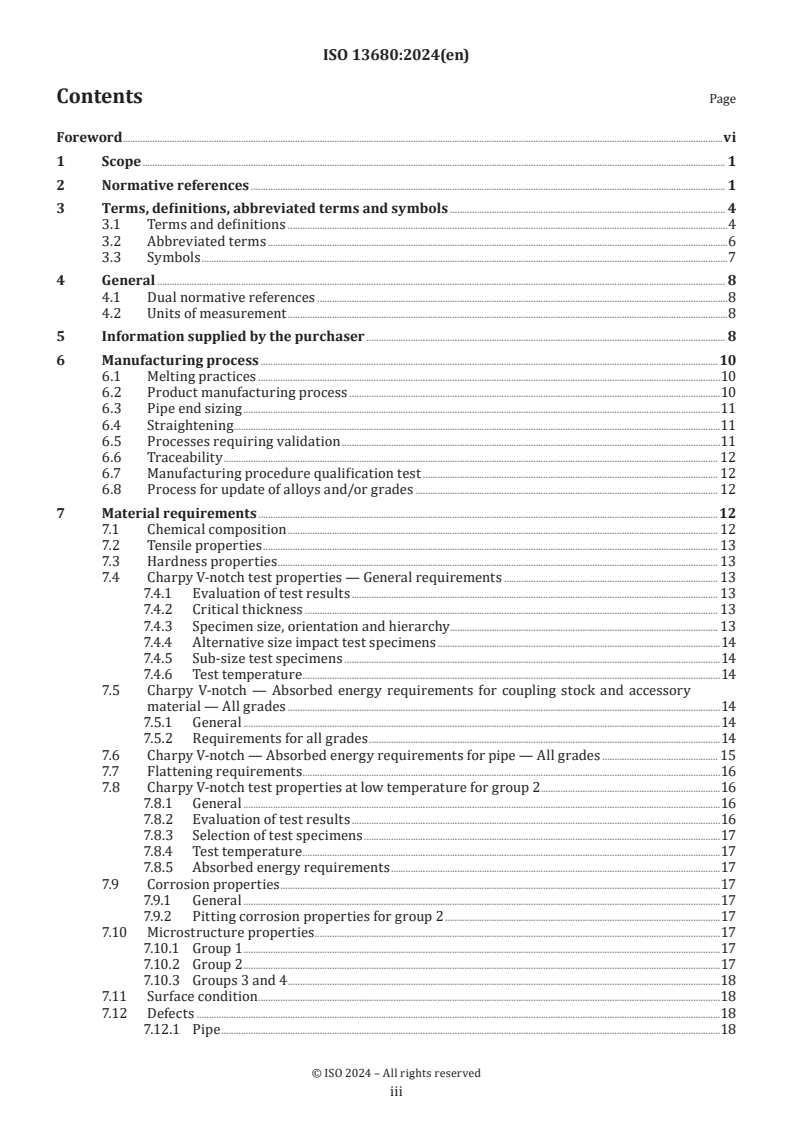
Contents Page
Foreword .vi
1 Scope . 1
2 Normative references . 1
3 Terms, definitions, abbreviated terms and symbols . 4
3.1 Terms and definitions .4
3.2 Abbreviated terms .6
3.3 Symbols .7
4 General . 8
4.1 Dual normative references .8
4.2 Units of measurement .8
5 Information supplied by the purchaser . 8
6 Manufacturing process . 10
6.1 Melting practices .10
6.2 Product manufacturing process .10
6.3 Pipe end sizing .11
6.4 Straightening . .11
6.5 Processes requiring validation .11
6.6 Traceability . 12
6.7 Manufacturing procedure qualification test . 12
6.8 Process for update of alloys and/or grades . 12
7 Material requirements .12
7.1 Chemical composition . 12
7.2 Tensile properties . 13
7.3 Hardness properties . 13
7.4 Charpy V-notch test properties — General requirements . 13
7.4.1 Evaluation of test results . 13
7.4.2 Critical thickness . 13
7.4.3 Specimen size, orientation and hierarchy . . 13
7.4.4 Alternative size impact test specimens .14
7.4.5 Sub-size test specimens .14
7.4.6 Test temperature . .14
7.5 Charpy V-notch — Absorbed energy requirements for coupling stock and accessory
material — All grades .14
7.5.1 General .14
7.5.2 Requirements for all grades .14
7.6 Charpy V-notch — Absorbed energy requirements for pipe — All grades . 15
7.7 Flattening requirements . .16
7.8 Charpy V-notch test properties at low temperature for group 2 .16
7.8.1 General .16
7.8.2 Evaluation of test results .16
7.8.3 Selection of test specimens .17
7.8.4 Test temperature .17
7.8.5 Absorbed energy requirements .17
7.9 Corrosion properties .17
7.9.1 General .17
7.9.2 Pitting corrosion properties for group 2 .17
7.10 Microstructure properties . .17
7.10.1 Group 1 .17
7.10.2 Group 2 .17
7.10.3 Groups 3 and 4 .18
7.11 Surface condition .18
7.12 Defects .18
7.12.1 Pipe .18
iii
7.12.2 Coupling stock and accessory material .19
7.12.3 Process control plan .19
8 Dimensions, masses and tolerances . . 19
8.1 Outside diameter, wall thickness and mass.19
8.2 Length .19
8.3 Tolerances .19
8.3.1 Tolerance on outside diameter, wall thickness and mass .19
8.3.2 Inside diameter, d . 20
8.3.3 Straightness . 20
8.3.4 Drift requirements . 20
8.4 Product ends . 20
9 Inspection and testing .20
9.1 Test equipment . 20
9.2 Type and frequency of tests . 20
9.3 Testing of chemical composition . 20
9.3.1 Chemical analysis . 20
9.3.2 Test method .21
9.3.3 Chromium depletion test — Groups 2, 3 and 4 .21
9.4 Testing of mechanical characteristics .21
9.4.1 Test lot .21
9.4.2 Selection and preparation of samples and test pieces .21
9.5 Tensile test .21
9.5.1 Orientation and size of test pieces .21
9.5.2 Test method .21
9.5.3 Invalidation of test . 22
9.5.4 Retest . 22
9.6 Hardness test . 22
9.6.1 Test pieces . 22
9.6.2 Test method . 22
9.6.3 Invalidation of tests . 23
9.6.4 Periodic checks of hardness-testing machines . 23
9.6.5 Verification of hardness-testing machines and indenters .24
9.6.6 Retests . 25
9.7 Impact or flattening test . 25
9.7.1 Test pieces . 25
9.7.2 Frequency of testing. 25
9.7.3 Impact test method . 26
9.7.4 Flattening test method . 26
9.7.5 Impact test retest . 26
9.7.6 Flattening test retest .27
9.7.7 Invalidation of tests .27
9.8 Impact test at low temperature for group 2 .27
9.9 Pitting corrosion test for group 2 .27
9.10 Microstructural examination . 28
9.10.1 Test pieces . 28
9.10.2 Test method . 28
9.10.3 Retest . 29
9.11 Dimensional testing . 29
9.11.1 General . 29
9.11.2 Outside diameter . 29
9.11.3 Wall thickness at end of products . 29
9.11.4 Wall thickness of product body . 30
9.12 Drift test . 30
9.12.1 Non-upset and external upset pipe . 30
9.12.2 Internal upset pipe . 30
9.12.3 Drift mandrel coating . 30
9.13 Length . 30
9.14 Straightness . 30
iv
9.15 Mass determination . 30
9.16 Visual inspection . 30
9.16.1 General . 30
9.16.2 Pipe body, coupling stock and accessory material .31
9.16.3 Pipe ends .31
9.16.4 Disposition .31
9.17 Non-destructive examination .31
9.17.1 General .31
9.17.2 NDE personnel .32
9.17.3 Products .32
9.17.4 Pup joints .32
9.17.5 Untested ends . .32
9.17.6 Upset ends . 33
9.17.7 Reference standards . 33
9.17.8 NDE system capability records . 33
9.17.9 All product group 1 . 34
9.17.10 Full-body NDE of product — Groups 2, 3 and 4 . 34
9.17.11 Pipe, coupling stock and accessory material requiring further evaluation . 34
9.17.12 Evaluation of indications (prove-up) . 35
9.17.13 Disposition of pipe containing defects . . 35
9.17.14 Disposition of coupling stock and accessory material containing defects . 36
9.18 Positive material identification .37
10 Surface treatment .37
10.1 Group 1 .37
10.2 Groups 2, 3 and 4 .37
11 Marking . .38
11.1 General . 38
11.2 Colour-code identification . 38
11.3 Marking content and sequence . 38
11.4 Marking for couplings, pup joints and accessories after threading . 39
12 Surface protection — Group 1 .39
13 Documents .40
13.1 Electronic media . 40
13.2 Retention of records . 40
13.3 Test certificates . . 40
14 Handling, packaging and storage . 41
14.1 General .41
14.2 Handling .41
14.3 Packaging .41
14.3.1 General .41
14.3.2 Identification .41
14.4 Storage .42
Annex A (normative) Tables in SI units .43
Annex B (normative) Figures in SI (USC) units .66
Annex C (normative) Tables in USC units .71
Annex D (normative) Purchaser inspection .94
Annex E (normative) Cleanliness requirements . .95
Annex F (normative) Coupling blanks and accessory material from bar .97
Annex G (normative) Product specification level 2 (PSL-2) .111
Annex H (normative) Standardized manufacturing procedure qualification test .113
Annex I (informative) Photographic examples of microstructures, groups 2, 3 and 4 .117
Bibliography .121
v
Foreword
ISO (the International Organization for Standardization) is a worldwide federation of national standards
bodies (ISO member bodies). The work of preparing International Standards is normally carried out through
ISO technical committees. Each member body interested in a subject for which a technical committee
has been established has the right to be represented on that committee. International organizations,
governmental and non-governmental, in liaison with ISO, also take part in the work. ISO collaborates closely
with the International Electrotechnical Commission (IEC) on all matters of electrotechnical standardization.
The procedures used to develop this document and those intended for its further maintenance are described
in the ISO/IEC Directives, Part 1. In particular, the different approval criteria needed for the different types
of ISO document should be noted. This document was drafted in accordance with the editorial rules of the
ISO/IEC Directives, Part 2 (see www.iso.org/directives).
ISO draws attention to the possibility that the implementation of this document may involve the use of (a)
patent(s). ISO takes no position concerning the evidence, validity or applicability of any claimed patent
rights in respect thereof. As of the date of publication of this document, ISO had not received notice of (a)
patent(s) which may be required to implement this document. However, implementers are cautioned that
this may not represent the latest information, which may be obtained from the patent database available at
www.iso.org/patents. ISO shall not be held responsible for identifying any or all such patent rights.
Any trade name used in this document is information given for the convenience of users and does not
constitute an endorsement.
For an explanation of the voluntary nature of standards, the meaning of ISO specific terms and expressions
related to conformity assessment, as well as information about ISO's adherence to the World Trade
Organization (WTO) principles in the Technical Barriers to Trade (TBT), see www.iso.org/iso/foreword.html.
This document was prepared by Technical Committee ISO/TC 67, Oil and gas industries including lower carbon
energy, Subcommittee SC 5, Casing, tubing and drill pipe.
This fifth edition cancels and replaces the fourth edition (ISO 13680:2020), which has been technically
revised.
The main changes are as follows:
— adjustment of the scope and title to make it clear that bar material is now included (removal of the word
"tubular");
— update of normative references;
— review of straightening requirements, including addition of Figure B.9;
— clarification on the use of alternative method for visual inspection;
— clarification of PMI requirements;
— clarification of marking content and sequence;
— extension of records retention period to five years;
— review of Annex H.
Any feedback or questions on this document should be directed to the user’s national standards body. A
complete listing of these bodies can be found at www.iso.org/members.html.
vi
International Standard ISO 13680:2024(en)
Oil and gas industries including lower carbon energy —
Corrosion-resistant alloy seamless products for use as casing,
tubing, coupling stock and accessory material — Technical
delivery conditions
WARNING — It is the purchaser's responsibility to specify the product specification level (PSL),
corrosion-resistant alloy (CRA) group, category, grade, delivery conditions and any other
requirement in addition to those specified herewith to ensure that the product is adequate for the
intended service environment. The ISO 15156 series or NACE MR0175 should be considered when
making specific requirements for H S-containing environments; see Annex G. It is the product user's
responsibility to ensure that the product is suitable for the intended application with consideration
of all environmental degradation threats during both normal operation and system upsets. There
are other sources of hydrogen besides H S-containing environments, which are not addressed by the
ISO 15156 series or NACE MR0175. Not all PSL-1 categories and grades can be made cracking resistant
in accordance with the ISO 15156 series or NACE MR0175 and are, therefore, not included in PSL-2.
1 Scope
This document specifies the technical delivery conditions for corrosion-resistant alloy seamless products
for casing, tubing, coupling stock and accessory material (including coupling stock and accessory material
from bar) for two product specification levels:
— PSL-1, which is the basis of this document;
— PSL-2, which provides additional requirements for a product that is intended to be both corrosion
and cracking resistant for the environments and qualification method specified in Annex G and in the
ISO 15156 series or NACE MR0175.
This document contains no provisions relating to the connection of individual lengths of pipe. Demonstration
of conformance to ISO 15156-3:2020 or NACE MR0175-2021 of material affected by end sizing, connection
manufacture or welding operations is outside the scope of this document.
This document contains provisions relating to marking of tubing and casing after threading.
This document is applicable to the following five groups of products:
a) group 1, which is composed of stainless alloys with a martensitic or martensitic/ferritic structure;
b) group 2, which is composed of stainless alloys with a ferritic-austenitic structure, such as duplex and
super-duplex stainless alloy;
c) group 3, which is composed of stainless alloys with an austenitic structure (iron base);
d) group 4, which is composed of nickel-based alloys with an austenitic structure (nickel base);
e) group 5, which is composed of bar only (Annex F) in age-hardened (AH) nickel-based alloys with
austenitic structure.
2 Normative references
The following documents, as applicable for the product, are referred to in the text in such a way that some
or all of their content constitutes requirements of this document. For dated references, only the edition cited
applies. For undated references, the latest edition of the referenced document (including any amendments)
applies.
ISO 377, Steel and steel products — Location and preparation of samples and test pieces for mechanical testing
ISO 404, Steel and steel products — General technical delivery requirements
ISO 525, Bonded abrasive products — General requirements
ISO 643, Steels– Micrographic determination of the apparent grain size
ISO 3452-1, Non-destructive testing — Penetrant testing — Part 1: General principles
ISO 4885, Ferrous materials — Heat treatments — Vocabulary
ISO 4948-1, Steels — Classification — Part 1: Classification of steels into unalloyed and alloy steels based on
chemical composition
ISO 4948-2, Steels — Classification — Part 2: Classification of unalloyed and alloy steels according to main
quality classes and main property or application characteristics
ISO 6508-1, Metallic materials — Rockwell hardness test — Part 1: Test method
ISO 6508-2, Metallic materials — Rockwell hardness test — Part 2: Verification and calibration of testing
machines and indenters
ISO 6892-1, Metallic materials — Tensile testing — Part 1: Method of test at room temperature
ISO 6892-2, Metallic materials — Tensile testing — Part 2: Method of test at elevated temperature
ISO 6929, Steel products — Vocabulary
ISO 8501-1, Preparation of steel substrates before application of paints and related products — Visual
assessment of surface cleanliness — Part 1: Rust grades and preparation grades of uncoated steel substrates and
of steel substrates after overall removal of previous coatings
ISO 9712, Non-destructive testing — Qualification and certification of NDT personnel
ISO 9934-1, Non-destructive testing — Magnetic particle testing — Part 1: General principles
ISO 10423, Petroleum and natural gas industries — Drilling and production equipment — Wellhead and tree
equipment
ISO 10474, Steel and steel products — Inspection documents
ISO 10893-2, Non-destructive testing of steel tubes — Part 2: Automated eddy current testing of seamless and
welded (except submerged arc-welded) steel tubes for the detection of imperfections
ISO 10893-3, Non-destructive testing of steel tubes — Part 3: Automated full peripheral flux leakage testing of
seamless and welded (except submerged arc-welded) ferromagnetic steel tubes for the detection of longitudinal
and/or transverse imperfections
ISO 10893-4, Non-destructive testing of steel tubes — Part 4: Liquid penetrant inspection of seamless and
welded steel tubes for the detection of surface imperfections
ISO 10893-5, Non-destructive testing of steel tubes — Part 5: Magnetic particle inspection of seamless and
welded ferromagnetic steel tubes for the detection of surface imperfections
ISO 10893-8, Non-destructive testing of steel tubes — Part 8: Automated ultrasonic testing of seamless and
welded steel tubes for the detection of laminar imperfections
ISO 10893-10, Non-destructive testing of steel tubes — Part 10: Automated full peripheral ultrasonic testing
of seamless and welded (except submerged arc-welded) steel tubes for the detection of longitudinal and/or
transverse imperfections
ISO 10893-12, Non-destructive testing of steel tubes — Part 12: Automated full peripheral ultrasonic thickness
testing of seamless and welded (except submerged arc-welded) steel tubes
ISO 11484, Steel products — Employer's qualification system for non-destructive testing (NDT) personnel
ISO 14284, Steel and iron — Sampling and preparation of samples for the determination of chemical composition
ISO 15156 (all parts), Petroleum and natural gas industries — Materials for use in H2S-containing environments
in oil and gas production
ISO 15156-3:2020, Petroleum and natural gas industries — Materials for use in H2S-containing environments in
oil and gas production — Part 3: Cracking-resistant CRAs (corrosion-resistant alloys) and other alloys
ISO 21920-2, Geometrical product specifications (GPS) — Surface texture: Profile — Part 2: Terms, definitions
and surface texture parameters
ISO 80000-1, Quantities and units — Part 1: General
API RP 578, Guidelines for a Material Verification Program (MVP) for New and Existing Assets
API Spec 6A, Specification for Wellhead and Christmas Tree Equipment
API Standard 6ACRA, Age-hardened Nickel-based Alloys for Oil and Gas Drilling and Production Equipment
ASNT SNT-TC-1A, Recommended Practice — Non-Destructive Testing
ASTM A370, Standard Test Methods and Definitions for Mechanical Testing of Steel Products
ASTM A604/A604M, Standard Practice for Macroetch Testing of Consumable Electrode Remelted Steel Bars
and Billets
ASTM A941, Standard Terminology Relating to Steel, Stainless Steel, Related Alloys and Ferroalloys
ASTM E18, Standard Test Methods for Rockwell Hardness of Metallic Materials
ASTM E21, Standard Test Methods for Elevated Temperatu
...
Norme
internationale
ISO 13680
Cinquième édition
Industries du pétrole et du gaz
2024-05
y compris les énergies à faible
teneur en carbone — Produits sans
soudure en acier allié résistant à
la corrosion utilisés comme tubes
de cuvelage, tubes de production,
tubes-ébauches pour manchons
et matériau pour accessoires —
Conditions techniques de livraison
Oil and gas industries including lower carbon energy —
Corrosion-resistant alloy seamless products for use as casing,
tubing, coupling stock and accessory material — Technical
delivery conditions
Numéro de référence
DOCUMENT PROTÉGÉ PAR COPYRIGHT
© ISO 2024
Tous droits réservés. Sauf prescription différente ou nécessité dans le contexte de sa mise en œuvre, aucune partie de cette
publication ne peut être reproduite ni utilisée sous quelque forme que ce soit et par aucun procédé, électronique ou mécanique,
y compris la photocopie, ou la diffusion sur l’internet ou sur un intranet, sans autorisation écrite préalable. Une autorisation peut
être demandée à l’ISO à l’adresse ci-après ou au comité membre de l’ISO dans le pays du demandeur.
ISO copyright office
Case postale 401 • Ch. de Blandonnet 8
CH-1214 Vernier, Genève
Tél.: +41 22 749 01 11
E-mail: copyright@iso.org
Web: www.iso.org
Publié en Suisse
ii
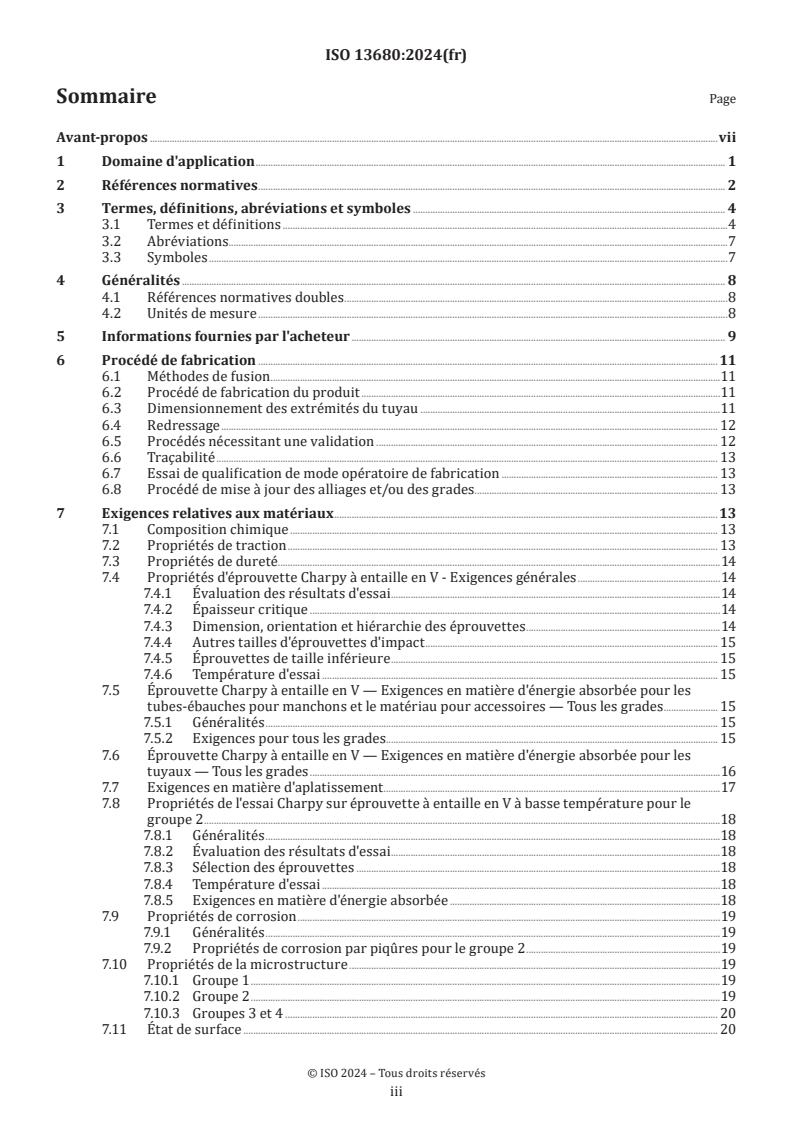
Sommaire Page
Avant-propos .vii
1 Domaine d'application . 1
2 Références normatives . 2
3 Termes, définitions, abréviations et symboles . 4
3.1 Termes et définitions .4
3.2 Abréviations.7
3.3 Symboles .7
4 Généralités . 8
4.1 Références normatives doubles . .8
4.2 Unités de mesure .8
5 Informations fournies par l'acheteur . 9
6 Procédé de fabrication .11
6.1 Méthodes de fusion .11
6.2 Procédé de fabrication du produit .11
6.3 Dimensionnement des extrémités du tuyau .11
6.4 Redressage . 12
6.5 Procédés nécessitant une validation . 12
6.6 Traçabilité . 13
6.7 Essai de qualification de mode opératoire de fabrication . 13
6.8 Procédé de mise à jour des alliages et/ou des grades . 13
7 Exigences relatives aux matériaux .13
7.1 Composition chimique . 13
7.2 Propriétés de traction . 13
7.3 Propriétés de dureté.14
7.4 Propriétés d'éprouvette Charpy à entaille en V - Exigences générales .14
7.4.1 Évaluation des résultats d'essai .14
7.4.2 Épaisseur critique .14
7.4.3 Dimension, orientation et hiérarchie des éprouvettes .14
7.4.4 Autres tailles d'éprouvettes d'impact . 15
7.4.5 Éprouvettes de taille inférieure . 15
7.4.6 Température d'essai . 15
7.5 Éprouvette Charpy à entaille en V — Exigences en matière d'énergie absorbée pour les
tubes-ébauches pour manchons et le matériau pour accessoires — Tous les grades . 15
7.5.1 Généralités . 15
7.5.2 Exigences pour tous les grades . . 15
7.6 Éprouvette Charpy à entaille en V — Exigences en matière d'énergie absorbée pour les
tuyaux — Tous les grades .16
7.7 Exigences en matière d'aplatissement .17
7.8 Propriétés de l'essai Charpy sur éprouvette à entaille en V à basse température pour le
groupe 2 .18
7.8.1 Généralités .18
7.8.2 Évaluation des résultats d'essai .18
7.8.3 Sélection des éprouvettes .18
7.8.4 Température d'essai .18
7.8.5 Exigences en matière d'énergie absorbée .18
7.9 Propriétés de corrosion .19
7.9.1 Généralités .19
7.9.2 Propriétés de corrosion par piqûres pour le groupe 2 .19
7.10 Propriétés de la microstructure .19
7.10.1 Groupe 1 .19
7.10.2 Groupe 2 .19
7.10.3 Groupes 3 et 4 . 20
7.11 État de surface . 20
iii
7.12 Défauts . 20
7.12.1 Tuyau . 20
7.12.2 Tube-ébauche pour manchon et matériau pour accessoires . 20
7.12.3 Plan de contrôle du processus . 20
8 Dimensions, masses et tolérances .21
8.1 Diamètre extérieur, épaisseur de paroi et masse .21
8.2 Longueur .21
8.3 Tolérances .21
8.3.1 Tolérance de diamètre extérieur, d'épaisseur de paroi et de masse.21
8.3.2 Diamètre intérieur, d .21
8.3.3 Linéarité . 22
8.3.4 Exigences en matière de calibrage . 22
8.4 Extrémités de produit . 22
9 Contrôle et essais.22
9.1 Banc d'essai. 22
9.2 Type et fréquence des essais . 22
9.3 Essai de composition chimique . 22
9.3.1 Analyse chimique . 22
9.3.2 Méthode d'essai . 23
9.3.3 Essai de déplétion en chrome — Groupes 2, 3 et 4 . 23
9.4 Essai des caractéristiques mécaniques . 23
9.4.1 Lot d'essai . 23
9.4.2 Sélection et préparation des échantillons et des éprouvettes . 23
9.5 Essai de traction . 23
9.5.1 Orientation et dimension des éprouvettes . 23
9.5.2 Méthode d'essai . 23
9.5.3 Invalidation de l'essai .24
9.5.4 Contre-essais .24
9.6 Essai de dureté .24
9.6.1 Éprouvettes .24
9.6.2 Méthode d'essai .24
9.6.3 Invalidation des essais . 25
9.6.4 Contrôles périodiques des machines d'essai de dureté . 26
9.6.5 Vérification des machines d'essai de dureté et des pénétrateurs. 26
9.6.6 Contre-essais .27
9.7 Essai de résistance aux chocs ou d'aplatissement .27
9.7.1 Éprouvettes .27
9.7.2 Fréquence des essais .27
9.7.3 Méthode d'essai de résistance aux chocs . . 28
9.7.4 Méthode d'essai d'aplatissement . 28
9.7.5 Contre-essai d'essai de résistance aux chocs . 29
9.7.6 Contre-essai d'essai d'aplatissement . 29
9.7.7 Invalidation des essais . 29
9.8 Essai de résistance aux chocs à basse température pour le groupe 2 . 30
9.9 Essai de corrosion par piqûres pour le groupe 2 . 30
9.10 Examen microstructurel .31
9.10.1 Éprouvettes .31
9.10.2 Méthode d'essai .31
9.10.3 Contre-essais .32
9.11 Essais dimensionnels .32
9.11.1 Généralités .32
9.11.2 Diamètre extérieur .32
9.11.3 Épaisseur de la paroi à l'extrémité des produits .32
9.11.4 Épaisseur de la paroi du corps du produit .32
9.12 Essai de calibrage . 33
9.12.1 Tube avec refoulement externe et sans refoulement . 33
9.12.2 Tuyau avec refoulement interne . 33
9.12.3 Revêtement du calibre d'alésage . 33
iv
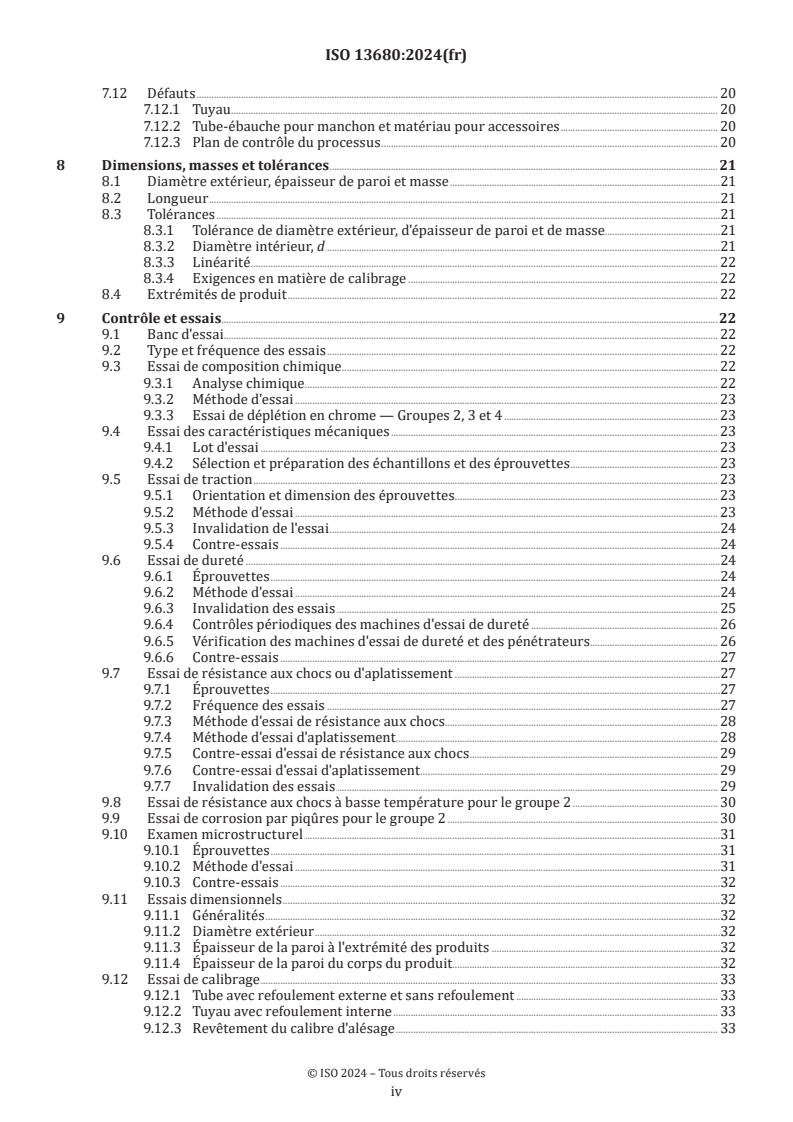
9.13 Longueur . 33
9.14 Linéarité . 33
9.15 Détermination de la masse . 33
9.16 Contrôle visuel . 33
9.16.1 Généralités . 33
9.16.2 Corps de tuyau, tube-ébauche pour manchon et matériau pour accessoires. 34
9.16.3 Extrémités du tuyau . 34
9.16.4 Disposition . 34
9.17 Contrôle non destructif . 34
9.17.1 Généralités . 34
9.17.2 Personnel en charge des contrôles non destructifs . 35
9.17.3 Produits . 35
9.17.4 Joints de tube courts . 35
9.17.5 Extrémités non soumises à essai . 35
9.17.6 Extrémités avec refoulement . 36
9.17.7 Normes de référence . 36
9.17.8 Registres des capacités du système de CND . 36
9.17.9 Tous les produits du groupe 1 .37
9.17.10 Contrôle non destructif du corps entier du produit — Groupes 2, 3 et 4 .37
9.17.11 Tuyau, tube-ébauche pour manchon et matériau pour accessoires nécessitant
une évaluation plus poussée . 38
9.17.12 Évaluation des indications («prove-up») . 38
9.17.13 Élimination des tuyaux contenant des défauts . 38
9.17.14 Élimination du tube-ébauche pour manchon et matériau pour accessoires
présentant des défauts . 39
9.18 Identification positive des matériaux . 40
10 Traitement de surface . 41
10.1 Groupe 1 .41
10.2 Groupes 2, 3 et 4 .41
11 Marquage . 41
11.1 Généralités .41
11.2 Identification par code couleur .41
11.3 Contenu du marquage et séquence .42
11.4 Marquage des tubes-ébauches pour manchon, des joints de tube courts et du matériau
pour accessoires après filetage .42
12 Protection des surfaces — Groupe 1.43
13 Documents .44
13.1 Médias électroniques . 44
13.2 Conservation des enregistrements . 44
13.3 Certificats d'essai . 44
14 Manutention, emballage et stockage .45
14.1 Généralités .45
14.2 Manutention .45
14.3 Emballage .45
14.3.1 Généralités .45
14.3.2 Identification .45
14.4 Stockage . 46
Annexe A (normative) Tableaux en unités SI.47
Annexe B (normative) Figures en unités SI (USC) .72
Annexe C (normative) Tableaux en unités USC .77
Annexe D (normative) Contrôle par l'acheteur .101
Annexe E (normative) Exigences en matière de propreté .102
Annexe F (normative) Pièces brutes pour manchons et matériau pour accessoires de barre .104
v
Annexe G (normative) Niveau de spécification de produit 2 (PSL-2) .120
Annexe H (normative) Essai de qualification de mode opératoire de fabrication normalisé .122
Annexe I (informative) Photographic examples of microstructures, groups 2, 3 and 4 .127
Bibliographie .131
vi
Avant-propos
L'ISO (Organisation internationale de normalisation) est une fédération mondiale d'organismes nationaux
de normalisation (comités membres de l'ISO). L'élaboration des Normes internationales est en général
confiée aux comités techniques de l'ISO. Chaque comité membre intéressé par une étude a le droit de faire
partie du comité technique créé à cet effet. Les organisations internationales, gouvernementales et non
gouvernementales, en liaison avec l'ISO participent également aux travaux. L'ISO collabore étroitement avec
la Commission électrotechnique internationale (IEC) en ce qui concerne la normalisation électrotechnique.
Les procédures utilisées pour élaborer le présent document et celles destinées à sa mise à jour sont
décrites dans les Directives ISO/IEC, Partie 1. Il convient, en particulier, de prendre note des différents
critères d'approbation requis pour les différents types de documents ISO. Le présent document
a été rédigé conformément aux règles de rédaction données dans les Directives ISO/IEC, Partie 2
(voir www.iso.org/directives).
L'ISO attire l'attention sur le fait que la mise en application du présent document peut entraîner l'utilisation
d'un ou de plusieurs brevets. L'ISO ne prend pas position quant à la preuve, à la validité et à l'applicabilité de
tout droit de propriété revendiqué à cet égard. À la date de publication du présent document, l'ISO n'avait pas
reçu notification qu'un ou plusieurs brevets pouvaient être nécessaires à sa mise en application. Toutefois,
il y a lieu d'avertir les responsables de la mise en application du présent document que des informations
plus récentes sont susceptibles de figurer dans la base de données de brevets, disponible à l'adresse
www.iso.org/brevets. L'ISO ne saurait être tenue pour responsable de ne pas avoir identifié de tels droits de
propriété et averti de leur existence.
Les appellations commerciales éventuellement mentionnées dans le présent document sont données pour
information, par souci de commodité, à l'intention des utilisateurs et ne sauraient constituer un engagement.
Pour une explication de la nature volontaire des normes, la signification des termes et expressions
spécifiques de l'ISO liés à l'évaluation de la conformité, ou pour toute information au sujet de l'adhésion de
l'ISO aux principes de l'Organisation mondiale du commerce (OMC) concernant les obstacles techniques au
commerce (OTC), voir www.iso.org/avant-propos.
Le présent document a été élaboré par le comité technique ISO/TC 67, Industries du pétrole et du gaz, y
compris les énergies à faible teneur en carbone, sous-comité SC 5, Tubes de cuvelage, tubes de production et
tiges de forage.
Cette cinquième édition annule et remplace la quatrième édition (ISO 13680:2020), qui a fait l'objet d'une
révision technique.
Les principales modifications sont les suivantes:
— ajustement du domaine d’application et du titre pour indiquer clairement que les matériaux en barres
sont désormais inclus (suppression du mot «tubulaire»);
— mise à jour des références normatives;
— révision des exigences de redressement, y compris l’ajout de la Figure B.9;
— clarification sur l’utilisation d’une méthode alternative pour l’inspection visuelle;
— clarification des exigences PMI;
— clarification du contenu et de la séquence du marquage;
— extension de la durée de conservation des dossiers à cinq ans;
— révision de l’Annexe H.
Il convient que l'utilisateur adresse tout retour d'information ou toute question concernant le présent
document à l'organisme national de normalisation de son pays. Une liste exhaustive desdits organismes se
trouve à l'adresse www.iso.org/fr/members.html.
vii
Norme internationale ISO 13680:2024(fr)
Industries du pétrole et du gaz y compris les énergies à faible
teneur en carbone — Produits sans soudure en acier allié
résistant à la corrosion utilisés comme tubes de cuvelage,
tubes de production, tubes-ébauches pour manchons et
matériau pour accessoires — Conditions techniques de
livraison
AVERTISSEMENT — Il incombe à l'acheteur de spécifier le niveau de spécification de produit (PSL),
le groupe, la catégorie, le grade et les conditions de livraison de l'alliage résistant à la corrosion
(ARC), ainsi que toute autre exigence en plus de celles spécifiées dans le présent document afin de
s'assurer que le produit est adapté à l'environnement de service prévu. Il convient de tenir compte
de la série ISO 15156 ou de la NACE MR0175 lors de l'établissement d'exigences spécifiques pour les
environnements contenant de l'H S; voir l'Annexe G. Il incombe à l'utilisateur du produit de s'assurer
que le produit est adapté à l'application prévue, en tenant compte de toutes les menaces en matière
de dégradation de l'environnement, à la fois en fonctionnement normal et en cas de perturbation du
système. Il existe des sources d'hydrogène autres que les environnements contenant de l'H S qui ne
sont pas traitées dans la série ISO 15156 ou dans la NACE MR0175. Toutes les catégories et grades
PSL-1 ne peuvent pas tous être rendus résistants à la fissuration conformément à la série ISO 15156
ou à la NACE MR0175 et ne sont donc pas inclus dans PSL-2.
1 Domaine d'application
Le présent document spécifie les conditions techniques de livraison des produits sans soudure en acier
allié résistant à la corrosion, utilisés comme tubes de cuvelage, tubes de production, tubes-ébauches pour
manchons et matériau pour accessoires (y compris les tubes-ébauches pour manchons et matériau pour
accessoires en barres), pour deux niveaux de spécification de produit:
— PSL-1, qui constitue la base du présent document;
— PSL-2, qui fournit des exigences supplémentaires pour un produit destiné à être à la fois résistant à la
corrosion et résistant à la fissuration pour les environnements et la méthode de qualification spécifiés à
l'Annexe G et dans la série ISO 15156 ou dans la NACE MR0175.
Le présent document ne contient aucune disposition relative au raccordement de longueurs de tube
individuelles. La démonstration de la conformité à l'ISO 15156-3:2020 ou à la NACE MR0175-2021 des
matériaux affectés par le dimensionnement des extrémités, la fabrication des raccords ou les opérations de
soudage ne relèvent pas du domaine d'application du présent document.
Le présent document contient des dispositions relatives au marquage des tubes de production et de cuvelage
après filetage.
Le présent document s'applique aux cinq groupes de produits suivants:
a) le groupe 1, qui est composé d'alliages inoxydables à structure martensitique ou martensitique/
ferritique;
b) le groupe 2, qui est composé d'alliages inoxydables à structure ferritique austénitique, tels que les
alliages inoxydables duplex et super-duplex;
c) le groupe 3, qui est composé d'alliages inoxydables à structure austénitique (à base de fer);
d) le groupe 4, qui est composé d'alliages à base de nickel à structure austénitique (à base de nickel);
e) le groupe 5, qui est uniquement composé de barres (Annexe F) dans les alliages à base de nickel durcis
par vieillissement à structure austénitique.
2 Références normatives
Les documents suivants, applicables au produit, sont cités dans le texte de sorte qu'ils constituent, pour tout
ou partie de leur contenu, des exigences du présent document. Pour les références datées, seule l'édition
citée s'applique. Pour les références non datées, la dernière édition du document de référence s'applique
(y compris les éventuels amendements).
ISO 377, Acier et produits en acier — Position et préparation des échantillons et éprouvettes pour essais
mécaniques
ISO 404, Aciers et produits sidérurgiques — Conditions générales techniques de livraison
ISO 525, Produits abrasifs agglomérés — Types de forme, désignation et marquage
ISO 643, Aciers — Détermination micrographique de la grosseur de grain apparente
ISO 3452-1, Essais non destructifs — Examen par ressuage — Partie 1: Principes généraux
ISO 4885, Matériaux ferreux — Traitements thermiques — Vocabulaire
ISO 4948-1, Aciers — Classification — Partie 1: Classification en aciers alliés et en aciers non alliés basée sur la
composition chimique
ISO 4948-2, Aciers — Classification — Partie 2: Classification des aciers alliés et aciers non alliés en fonction des
principales classes de qualité et des caractéristiques principales de propriétés ou d'application
ISO 6508-1, Matériaux métalliques — Essai de dureté Rockwell — Partie 1: Méthode d'essai
ISO 6508-2, Matériaux métalliques — Essai de dureté Rockwell — Partie 2: Vérification et étalonnage des
machines d'essai et des pénétrateurs
ISO 6892-1, Matériaux métalliques — Essai de traction — Partie 1: Méthode d'essai à température ambiante
ISO 6892-2, Matériaux métalliques — Essai de traction — Partie 2: Méthode d'essai à température élevée
ISO 6929, Produits en acier — Vocabulaire
ISO 8501-1, Préparation des subjectiles d'acier avant application de peintures et de produits assimilés —
Évaluation visuelle de la propreté d'un subjectile — Partie 1: Degrés de rouille et degrés de préparation des
subjectiles d'acier non recouverts et des subjectiles d'acier après décapage sur toute la surface des revêtements
précédents
ISO 9712, Essais non destructifs — Qualification et certification du personnel END
ISO 9934-1, Essais non destructifs — Magnétoscopie — Partie 1: Principes généraux du contrôle
ISO 10423, Industries du pétrole et du gaz naturel — Équipement de forage et de production — Équipement
pour têtes de puits et arbres de Noël
ISO 10474, Aciers et produits sidérurgiques — Documents de contrôle
ISO 10893-2, Essais non destructifs des tubes en acier — Partie 2: Contrôle automatisé par courants de Foucault pour
la détection des imperfections des tubes en acier sans soudure et soudés (sauf à l'arc immergé sous flux en poudre)
ISO 10893-3, Essais non destructifs des tubes en acier — Partie 3: Contrôle automatisé par flux de fuite sur
toute la circonférence des tubes en acier ferromagnétique sans soudure et soudés (sauf à l'arc immergé sous flux
en poudre) pour la détection des imperfections longitudinales et/ou transversales
ISO 10893-4, Essais non destructifs des tubes en acier — Partie 4: Contrôle par ressuage des tubes en acier sans
soudure et soudés pour la détection des imperfections de surface
ISO 10893-5, Essais non destructifs des tubes en acier — Partie 5: Contrôle par magnétoscopie des tubes en
acier ferromagnétique sans soudure et soudés pour la détection des imperfections de surface
ISO 10893-8, Essais non destructifs des tubes en acier — Partie 8: Contrôle automatisé par ultrasons pour la
détection des dédoublures des tubes en acier sans soudure et soudés
ISO 10893-10, Essais non destructifs des tubes en acier — Partie 10: Contrôle automatisé par ultrasons sur toute
la circonférence des tubes en acier sans soudure et soudés (sauf à l'arc immergé sous flux en poudre) pour la
détection des imperfections longitudinales et/ou transversales
ISO 10893-12, Essais non destructifs des tubes en acier — Partie 12: Contrôle automatisé de l'épaisseur par ultrasons
sur toute la circonférence des tubes en acier sans soudure et soudés (sauf à l'arc immergé sous flux en poudre)
ISO 11484, Produits en acier — Système de qualification, par l'employeur, du personnel pour essais non
destructifs (END)
ISO 14284, Aciers et fontes — Prélèvement et préparation des échantillons pour la détermination de la
composition chimique
ISO 15156 (toutes l
...