

ISO 20076:2019
(Main)Road vehicles — Test methods and performance requirements for voltage class B connectors
General Information
- Abstract
This document defines terms and specifies test methods for general performance requirements of voltage class B connectors with single-pole and multi-pole connections used with electrical wiring harnesses of road vehicles. This document applies to connectors for voltage class B electric circuits of electric propulsion systems and conductively connected auxiliary electric systems of electrically propelled road vehicles. This document applies to voltage class B connectors designed to be disconnected after mounting in the vehicle for repair and maintenance only. It does not apply to vehicle inlets of charging systems. This document applies to cable conductor sizes ranging from 1,5 mm2 to 120mm2. This document is not applicable to internal connections of electronic devices.
- Status
- Published
- Publication Date
- 19-Nov-2019
- Technical Committee
- ISO/TC 22/SC 32 - Electrical and electronic components and general system aspects
- Drafting Committee
- ISO/TC 22/SC 32/WG 6 - On-board electrical connections
- Current Stage
- 9092 - International Standard to be revised
- Start Date
- 14-Aug-2025
- Completion Date
- 29-Aug-2026
Buy Documents

ISO 20076:2019 - Road vehicles -- Test methods and performance requirements for voltage class B connectors
ISO 20076:2019 - Road vehicles — Test methods and performance requirements for voltage class B connectors/20/2019
Overview
ISO 20076:2019 specifies test methods and general performance requirements for voltage class B connectors used in road-vehicle electrical wiring harnesses. It covers single‑pole and multi‑pole connectors intended for electric propulsion systems and conductively connected auxiliary electric systems of electrically propelled road vehicles. The standard applies to connectors designed to be disconnected only after mounting in the vehicle (for repair/maintenance), for cable conductor sizes from 1.5 mm² to 120 mm², and explicitly excludes vehicle charging inlets and internal electronic device connections.
Key topics and technical requirements
ISO 20076:2019 organizes testing and requirements across mechanical, electrical and environmental performance. Major topics include:
- Terms and definitions specific to voltage class B connectors to ensure consistent interpretation.
- Preconditioning and durability: environmental and mechanical preconditioning before performance tests.
- Mechanical tests: visual examination; connection/disconnection cycles; tensile strength of terminal-to-cable and shield connections; locking device strength; forces for unintentional lever release and lock-button actuation; CPA (connector position assurance) and TPA (terminal position assurance) locking and disengagement/extraction tests.
- Insertion/extraction forces: terminal insertion force, insertion with incorrect orientation, and terminal extraction force.
- Functional checks: connector engagement sound and connector coding/polarization effectiveness to prevent misconnection.
- Electrical performance: connection resistance (voltage drop), temperature rise under load, insulation resistance, and withstanding voltage tests.
- EMC and protection: electromagnetic shielding performance and water tightness tests.
- Test sequencing and sample quantities: defined conditions for reproducibility and consistency in type testing.
(The standard defines tests and pass/fail requirements; numerical thresholds and detailed procedures are contained in the full ISO document.)
Practical applications - who uses ISO 20076:2019
ISO 20076:2019 is used by:
- Automotive OEMs and Tier‑1 wiring harness and connector suppliers for product design, validation and supplier specifications.
- Test laboratories and certification bodies conducting compliance testing and type approval.
- Design and safety engineers to verify mechanical reliability, electrical safety and environmental robustness of high‑voltage connectors in electric and hybrid vehicles.
- Procurement and quality teams to set acceptance criteria and supplier conformity checks.
Adoption helps ensure connector safety, interchangeability, maintainability and compliance with industry best practices for high‑voltage vehicle systems.
Related standards
ISO 20076:2019 complements other automotive and electrical connector standards covering high‑voltage system design, charging interfaces and internal electronic connections. For full technical implementation, consult ISO 20076:2019 alongside other relevant ISO and regional vehicle electrification standards.
Buy Documents
ISO 20076:2019 - Road vehicles -- Test methods and performance requirements for voltage class B connectors
ISO 20076:2019 - Road vehicles — Test methods and performance requirements for voltage class B connectors/20/2019
Get Certified
Connect with accredited certification bodies for this standard

TÜV Rheinland
TÜV Rheinland is a leading international provider of technical services.

TÜV SÜD
TÜV SÜD is a trusted partner of choice for safety, security and sustainability solutions.

DEKRA Certification Inc.
DEKRA US certification services.
Sponsored listings
Frequently Asked Questions
ISO 20076:2019 is a standard published by the International Organization for Standardization (ISO). Its full title is "Road vehicles — Test methods and performance requirements for voltage class B connectors". This standard covers: This document defines terms and specifies test methods for general performance requirements of voltage class B connectors with single-pole and multi-pole connections used with electrical wiring harnesses of road vehicles. This document applies to connectors for voltage class B electric circuits of electric propulsion systems and conductively connected auxiliary electric systems of electrically propelled road vehicles. This document applies to voltage class B connectors designed to be disconnected after mounting in the vehicle for repair and maintenance only. It does not apply to vehicle inlets of charging systems. This document applies to cable conductor sizes ranging from 1,5 mm2 to 120mm2. This document is not applicable to internal connections of electronic devices.
This document defines terms and specifies test methods for general performance requirements of voltage class B connectors with single-pole and multi-pole connections used with electrical wiring harnesses of road vehicles. This document applies to connectors for voltage class B electric circuits of electric propulsion systems and conductively connected auxiliary electric systems of electrically propelled road vehicles. This document applies to voltage class B connectors designed to be disconnected after mounting in the vehicle for repair and maintenance only. It does not apply to vehicle inlets of charging systems. This document applies to cable conductor sizes ranging from 1,5 mm2 to 120mm2. This document is not applicable to internal connections of electronic devices.
ISO 20076:2019 is classified under the following ICS (International Classification for Standards) categories: 43.040.10 - Electrical and electronic equipment. The ICS classification helps identify the subject area and facilitates finding related standards.
ISO 20076:2019 is available in PDF format for immediate download after purchase. The document can be added to your cart and obtained through the secure checkout process. Digital delivery ensures instant access to the complete standard document.
Standards Content (Sample)
INTERNATIONAL ISO
STANDARD 20076
First edition
2019-11
Road vehicles — Test methods and
performance requirements for voltage
class B connectors
Véhicules routiers — Méthodes d'essai et exigences de performance
pour connecteurs haute tension
Reference number
©
ISO 2019
© ISO 2019
All rights reserved. Unless otherwise specified, or required in the context of its implementation, no part of this publication may
be reproduced or utilized otherwise in any form or by any means, electronic or mechanical, including photocopying, or posting
on the internet or an intranet, without prior written permission. Permission can be requested from either ISO at the address
below or ISO’s member body in the country of the requester.
ISO copyright office
CP 401 • Ch. de Blandonnet 8
CH-1214 Vernier, Geneva
Phone: +41 22 749 01 11
Fax: +41 22 749 09 47
Email: copyright@iso.org
Website: www.iso.org
Published in Switzerland
ii © ISO 2019 – All rights reserved
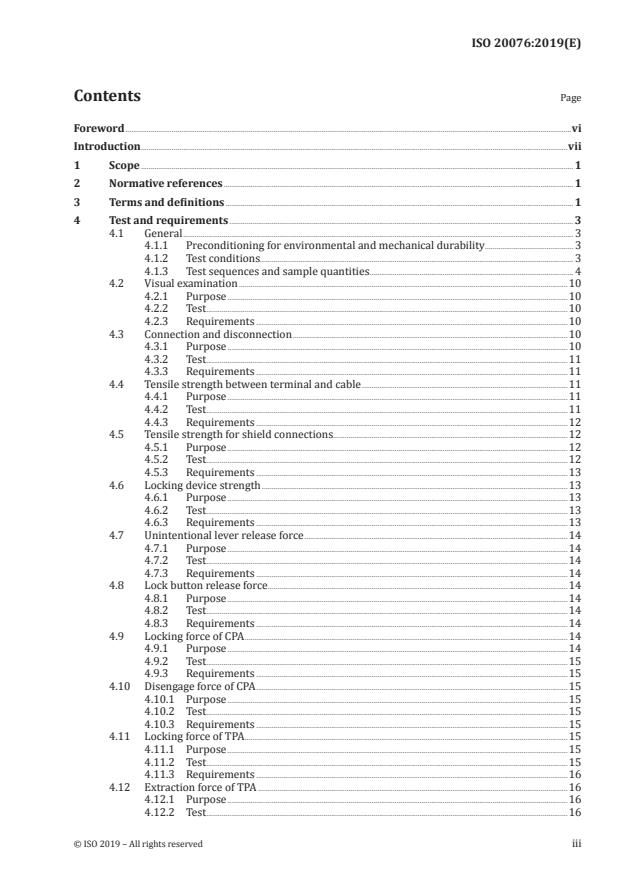
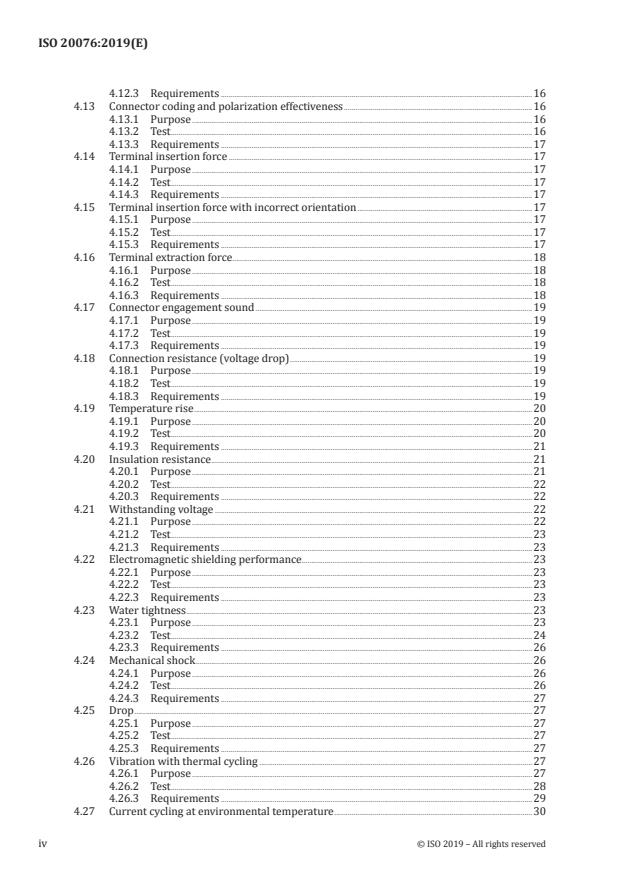
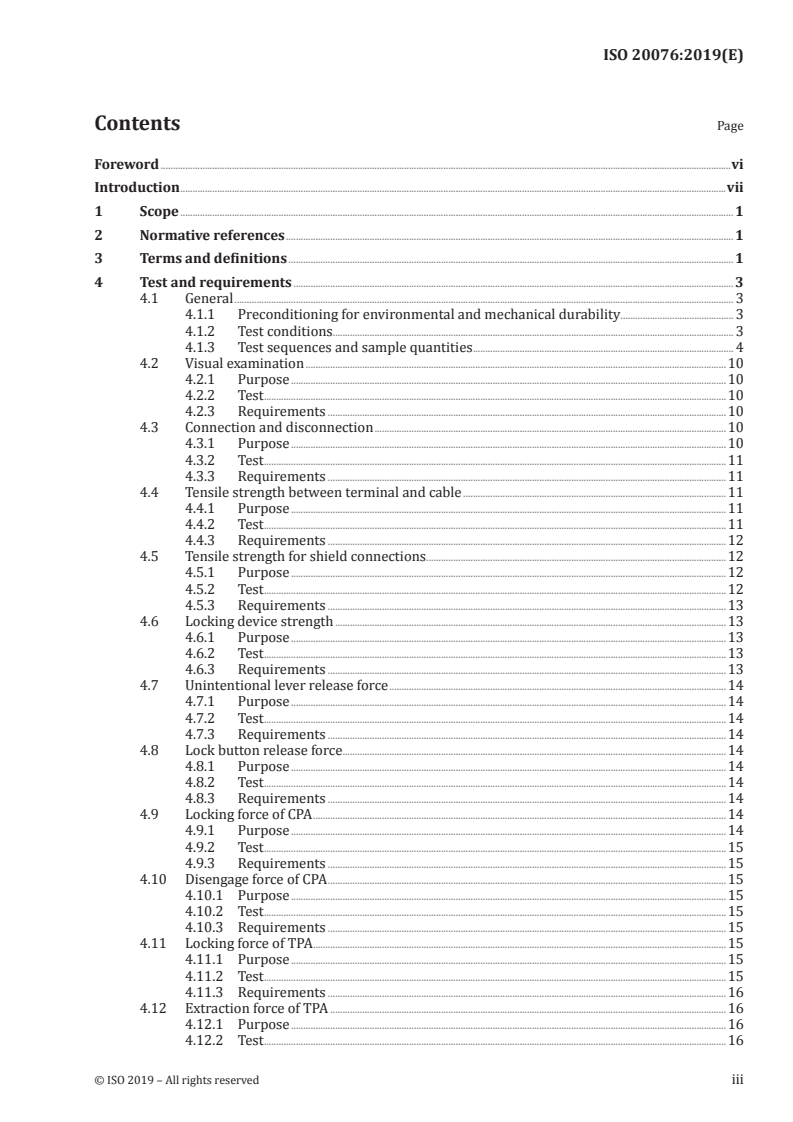
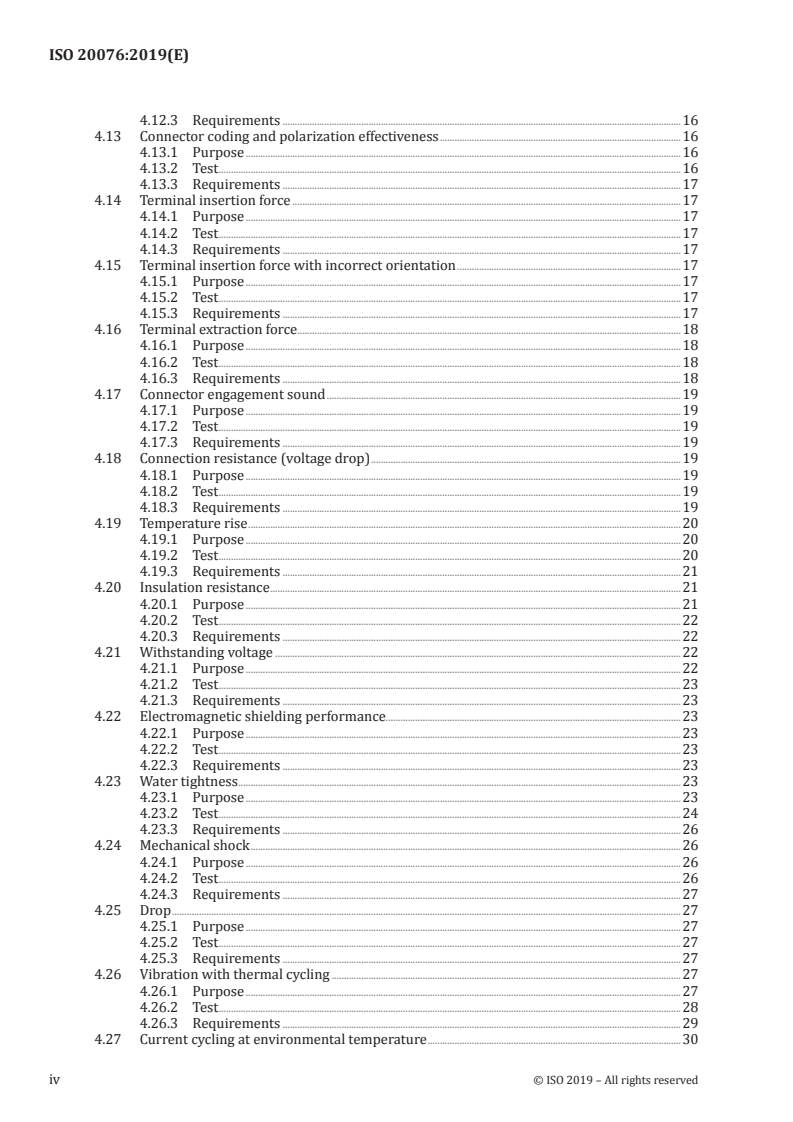
Contents Page
Foreword .vi
Introduction .vii
1 Scope . 1
2 Normative references . 1
3 Terms and definitions . 1
4 Test and requirements . 3
4.1 General . 3
4.1.1 Preconditioning for environmental and mechanical durability . 3
4.1.2 Test conditions. 3
4.1.3 Test sequences and sample quantities . 4
4.2 Visual examination .10
4.2.1 Purpose .10
4.2.2 Test .10
4.2.3 Requirements .10
4.3 Connection and disconnection .10
4.3.1 Purpose .10
4.3.2 Test .11
4.3.3 Requirements .11
4.4 Tensile strength between terminal and cable .11
4.4.1 Purpose .11
4.4.2 Test .11
4.4.3 Requirements .12
4.5 Tensile strength for shield connections .12
4.5.1 Purpose .12
4.5.2 Test .12
4.5.3 Requirements .13
4.6 Locking device strength .13
4.6.1 Purpose .13
4.6.2 Test .13
4.6.3 Requirements .13
4.7 Unintentional lever release force .14
4.7.1 Purpose .14
4.7.2 Test .14
4.7.3 Requirements .14
4.8 Lock button release force .14
4.8.1 Purpose .14
4.8.2 Test .14
4.8.3 Requirements .14
4.9 Locking force of CPA .14
4.9.1 Purpose .14
4.9.2 Test .15
4.9.3 Requirements .15
4.10 Disengage force of CPA .15
4.10.1 Purpose .15
4.10.2 Test .15
4.10.3 Requirements .15
4.11 Locking force of TPA .15
4.11.1 Purpose .15
4.11.2 Test .15
4.11.3 Requirements .16
4.12 Extraction force of TPA .16
4.12.1 Purpose .16
4.12.2 Test .16
4.12.3 Requirements .16
4.13 Connector coding and polarization effectiveness .16
4.13.1 Purpose .16
4.13.2 Test .16
4.13.3 Requirements .17
4.14 Terminal insertion force .17
4.14.1 Purpose .17
4.14.2 Test .17
4.14.3 Requirements .17
4.15 Terminal insertion force with incorrect orientation .17
4.15.1 Purpose .17
4.15.2 Test .17
4.15.3 Requirements .17
4.16 Terminal extraction force .18
4.16.1 Purpose .18
4.16.2 Test .18
4.16.3 Requirements .18
4.17 Connector engagement sound .19
4.17.1 Purpose .19
4.17.2 Test .19
4.17.3 Requirements .19
4.18 Connection resistance (voltage drop) .19
4.18.1 Purpose .19
4.18.2 Test .19
4.18.3 Requirements .19
4.19 Temperature rise .20
4.19.1 Purpose .20
4.19.2 Test .20
4.19.3 Requirements .21
4.20 Insulation resistance .21
4.20.1 Purpose .21
4.20.2 Test .22
4.20.3 Requirements .22
4.21 Withstanding voltage .22
4.21.1 Purpose .22
4.21.2 Test .23
4.21.3 Requirements .23
4.22 Electromagnetic shielding performance.23
4.22.1 Purpose .23
4.22.2 Test .23
4.22.3 Requirements .23
4.23 Water tightness .23
4.23.1 Purpose .23
4.23.2 Test .24
4.23.3 Requirements .26
4.24 Mechanical shock .26
4.24.1 Purpose .26
4.24.2 Test .26
4.24.3 Requirements .27
4.25 Drop .27
4.25.1 Purpose .27
4.25.2 Test .27
4.25.3 Requirements .27
4.26 Vibration with thermal cycling .27
4.26.1 Purpose .27
4.26.2 Test .28
4.26.3 Requirements .29
4.27 Current cycling at environmental temperature .30
iv © ISO 2019 – All rights reserved
4.27.1 Purpose .30
4.27.2 Test .30
4.27.3 Requirements .30
4.28 Thermal aging .30
4.28.1 Purpose .30
4.28.2 Test .30
4.28.3 Requirements .30
4.29 Thermal shock .30
4.29.1 Purpose .30
4.29.2 Test .30
4.29.3 Requirements .31
4.30 Temperature/humidity cycle .31
4.30.1 Purpose .31
4.30.2 Test .31
4.30.3 Requirements .31
4.31 Condensation .32
4.31.1 Purpose .32
4.31.2 Test .32
4.31.3 Requirements .32
4.32 Salt spray .32
4.32.1 Purpose .32
4.32.2 Test .32
4.32.3 Requirements .33
4.33 High-pressure/steam-jet cleaning .33
4.33.1 Purpose .33
4.33.2 Test .33
4.33.3 Requirements .36
4.34 Dust resistance .36
4.34.1 Purpose .36
4.34.2 Test .36
4.34.3 Requirements .36
4.35 Oil and liquid resistance .36
4.35.1 Purpose .36
4.35.2 Test .36
4.35.3 Requirements .36
Annex A (informative) EMC test methods .37
Annex B (informative) Typical sample preparation for environmental tests .55
Bibliography .57
Foreword
ISO (the International Organization for Standardization) is a worldwide federation of national standards
bodies (ISO member bodies). The work of preparing International Standards is normally carried out
through ISO technical committees. Each member body interested in a subject for which a technical
committee has been established has the right to be represented on that committee. International
organizations, governmental and non-governmental, in liaison with ISO, also take part in the work.
ISO collaborates closely with the International Electrotechnical Commission (IEC) on all matters of
electrotechnical standardization.
The procedures used to develop this document and those intended for its further maintenance are
described in the ISO/IEC Directives, Part 1. In particular, the different approval criteria needed for the
different types of ISO documents should be noted. This document was drafted in accordance with the
editorial rules of the ISO/IEC Directives, Part 2 (see www .iso .org/ directives).
Attention is drawn to the possibility that some of the elements of this document may be the subject of
patent rights. ISO shall not be held responsible for identifying any or all such patent rights. Details of
any patent rights identified during the development of the document will be in the Introduction and/or
on the ISO list of patent declarations received (see www .iso .org/ patents).
Any trade name used in this document is information given for the convenience of users and does not
constitute an endorsement.
For an explanation of the voluntary nature of standards, the meaning of ISO specific terms and
expressions related to conformity assessment, as well as information about ISO's adherence to
the World Trade Organization (WTO) principles in the Technical Barriers to Trade (TBT) see
www .iso .org/ iso/ foreword .html.
This document was prepared by Technical Committee ISO/TC 22, Road vehicles, Subcommittee SC 32,
Electrical and electronic components and general system aspects.
Any feedback or questions on this document should be directed to the user’s national standards body. A
complete listing of these bodies can be found at www .iso .org/ members .html.
vi © ISO 2019 – All rights reserved
Introduction
High voltage connectors differ from low voltage connectors in several ways due to their higher operating
voltage and need for shielding. These differences lead to unique failure modes and a need for unique
validation tests. This document is a test specification that is unique to high voltage connectors on road
vehicles. Some of the unique items that are tested in this document are:
— higher limits on dielectric withstanding voltage,
— more exhaustive testing for airtightness,
— evaluation of EMC compatibility, and
— evaluation of unique components such as shielding and metal housings (also for electrical shielding).
Note that safety features in a connector design to prevent electric shock (such as high voltage interlock)
are specific to the connector and the vehicle electrical architecture and therefore must be assessed
separately.
INTERNATIONAL STANDARD ISO 20076:2019(E)
Road vehicles — Test methods and performance
requirements for voltage class B connectors
WARNING — The use of this document can involve hazardous materials, operations and
equipment. It does not purport to address all of the safety or environmental problems associated
with its use.
1 Scope
This document defines terms and specifies test methods for general performance requirements of
voltage class B connectors with single-pole and multi-pole connections used with electrical wiring
harnesses of road vehicles.
This document applies to connectors for voltage class B electric circuits of electric propulsion systems
and conductively connected auxiliary electric systems of electrically propelled road vehicles.
This document applies to voltage class B connectors designed to be disconnected after mounting in the
vehicle for repair and maintenance only. It does not apply to vehicle inlets of charging systems.
2 2
This document applies to cable conductor sizes ranging from 1,5 mm to 120mm .
This document is not applicable to internal connections of electronic devices.
2 Normative references
The following documents are referred to in the text in such a way that some or all of their content
constitutes requirements of this document. For dated references, only the edition cited applies. For
undated references, the latest edition of the referenced document (including any amendments) applies.
ISO 8092-2:2005, Road vehicles — Connections for on-board electrical wiring harnesses — Part 2:
Definitions, test methods and general performance requirements
1)
ISO 8092-5 , Road vehicles — Connections for on-board electrical wiring harnesses — Part 5: Automotive
parts — Test methods and general performance requirements for wiring harness connector operation
ISO 19453-3:2018, Road vehicles — Environmental conditions and testing for electrical and electronic
equipment for drive system of electric propulsion vehicles — Part 3: Mechanical loads
ISO 19453-4:2018, Road vehicles — Environmental conditions and testing for electrical and electronic
equipment for drive system of electric propulsion vehicles — Part 4: Climatic loads
ISO 19453-5, Road vehicles — Environmental conditions and testing for electrical and electronic equipment
for drive system of electric propulsion vehicles — Part 5: Chemical loads
ISO 20653, Road vehicles — Degrees of protection (IP code) — Protection of electrical equipment against
foreign objects, water and access
3 Terms and definitions
For the purposes of this document, the following terms and definitions apply.
1) Under preparation. Stage at the time of publication: ISO/DIS 8092-5:2019.
ISO and IEC maintain terminological databases for use in standardization at the following addresses:
— ISO Online browsing platform: available at https:// www .iso .org/ obp
— IEC Electropedia: available at http:// www .electropedia .org/
3.1
cable attachment
any permanent junction of cable to terminal
Note 1 to entry: Crimp and weld are typical methods.
3.2
connector
assembly of terminal, housing and related parts that terminate cable and shielding for the purpose of
providing connection and disconnection to a suitable mating connector
3.3
connector coding
visual or mechanical feature to provide differentiation, preventing mating of connectors (3.2) not
intended to be mated
3.4
connector position assurance
CPA
device that prevents accidental release of the connector (3.2) lock and serves as an indicator of full
connector mating
3.5
female terminal
terminal, including means for cable attachment (3.1), designed for electrical engagement on its inner
surface, and to accept entry of a male terminal (3.6), thus forming an electrical connection
3.6
male terminal
terminal, including means for cable attachment (3.1), designed for electrical engagement on its outer
surface and to enter a female terminal (3.5), thus forming an electrical connection
3.7
shield
conductive material intended to reduce the penetration and/or radiation of a varying
electromagnetic field
Note 1 to entry: Metallic sheaths, foils, braids, armour, and earthed concentric conductors may also serve as
shields.
3.8
terminal position assurance
TPA
feature installed or seated after the terminals are inserted into their housing to assure that the
terminals are properly positioned, which reinforces the primary terminal locking mechanism or
provides a separate redundant terminal lock
3.9
voltage class A
classification of an electric component or circuit with a maximum working voltage of ≤30 V AC (rms)
or ≤60 V DC, respectively
[SOURCE: ISO 6469-4:2015, 3.17]
2 © ISO 2019 – All rights reserved
3.10
voltage class B
classification of an electric component or circuit with a maximum working voltage between 30 V AC
(rms) and 1 000 V AC (rms) or between 60 V DC and 1 500 V DC
[SOURCE: ISO 6469-4:2015, 3.18]
4 Test and requirements
4.1 General
4.1.1 Preconditioning for environmental and mechanical durability
All test samples shall be preconditioned at standard ambient temperature (23 ± 3) °C and 45 % to 75 %
relative humidity for 24 h before the start of any test sequence.
4.1.2 Test conditions
All tests shall be carried out at a standard ambient temperature (23 ± 3) °C and 45 % to 75 % relative
humidity unless otherwise stated in the test procedure. This is referenced as room temperature (RT).
Cable in compliance with applicable part of ISO 19642 is encouraged. The cable or cables used shall be
noted in the test report.
Cable attachment shall be performed in accordance with the terminal manufacturer's specifications, or
as agreed between customer and supplier.
When length of cable is not specified, it is 500 mm. When tolerance of length of cable is not specified, it
is ±10 mm.
Typical sample preparation for environmental tests is shown in Annex B.
Care shall be taken so that test samples do not influence each other (e.g. in a heat chamber).
Each connector shall have the full complement of terminals fitted unless otherwise specified.
Connectors shall be tested in mated conditions unless stated otherwise. In the case of a connector
connecting directly to a device, a mating dummy may be used to carry out tests. This dummy shall
represent the intended device’s interface and electrical properties.
Measurements shall be taken on all terminals regardless number of poles per connector unless
otherwise specified in the test methods.
Lubrication or other means of attaining better test results shall not be added to the test surface, unless
representative of production intent. Production-related remains of lubricants on the terminals are
permitted.
Unless otherwise specified, all forces shall be applied at a constant speed of (50 ± 10) mm/min.
Unless otherwise specified, when a temperature of T is specified in a test, use the applicable “highest
max
value” temperature per Table 1. When a temperature of T is specified in a test, use the applicable
min
“lowest value” temperature per Table 1.
Table 1 — Environmental and test temperatures
Environmental temperature range
°C
a
Class Lowest value Highest value
Use for T of chamber Use for T of chamber
min max
1 (D) 70
2 (G) 85
3 (J) −40 100
4 (O) 125
5 (S) 155
a
Class designations align with ISO 8092-2:2005, Table 3 equivalents as “Class” 1 through 5.
( ) Value aligns to ISO 19453-4:2018, Table 1.
Cross-sectional area of cable mentioned in this document refers to cables with a copper conductor.
When the conductor of a cable is a material other than copper, the cross–sectional area of cable shall be
specified by agreement between customer and supplier.
The terminals and connectors used in the test shall be fully assembled unless otherwise specified. The
cross-sectional area of cable conductor is defined in Tables 2, 3, 4 and 5.
4.1.3 Test sequences and sample quantities
Tables 2, 3, 4 and 5 list the test sequences. The test groups in the tables apply to sealed and unsealed
connectors as noted. New samples are used for each test group. The test sequence for each test group is
performed in accordance with the sequence number defined in the table’s rows for each sequence. For
each test group, perform the complete test sequence for the group on each sample.
4 © ISO 2019 – All rights reserved
Table 2 — Mechanical test sequences groups A through G
Test group identification A B C D E F G
u=apply test if samples are un-
u u u u u u u
sealed
s=apply test if samples are sealed s s s s s s s
Minimum test quantity of termi-
k k
10 10 10 10 10 10 10
nals/connectors
Sample cable length (mm) - >50 >50 - - - -
Maximum - See “l” See “l” - - - -
Sample cable
size
Minimum - See “l” See “l” - - - -
4.2 Visual examination 1, 3 1, 3 1, 3 1, 3 1, 3 1,3 1,4
g
4.3 Connection and disconnection 2
4.4 Tensile strength between
terminal and cable
4.5 Tensile strength for shield
connections
4.6 Locking device strength 2
4.7 Unintentional lever release
force
4.8 Lock button release force 2
4.9 Locking force of CPA 2
4.10 Disengage force of CPA 3
4.11 Locking force of TPA
4.12 Extraction force of TPA
4.13 Connector coding and polari-
zation effectiveness
4.14 Terminal insertion force
4.15 Terminal insertion force with
incorrect orientation
4.16 Terminal extraction force
4.17 Connector engagement sound
g
Perform force measurement for first mate and first unmate with part held in force tester.
Remaining mate and unmate cycles can be either hand mated or using the mechanized force test machine.
k
Sample is made from terminal and cable only.
l
Test quantity is per terminal/cable combination; each combination shall be validated with a 10-piece sample, minimum.
- Cells containing "-" to be defined between supplier and customer. Selection typically does not matter to test result.
Table 3 — Mechanical test sequences groups H through N
Test group identification H I J K L M N
u=apply test if samples are un-
u u u u u u u
sealed
s=apply test if samples are sealed s s s s s s s
Minimum test quantity of termi-
f f f f
10 10 10 10 20 10 10
nals/connectors
Sample cable length (mm) - - - - - - -
Maximum - - - - 10 10 -
Sample cable
size
Minimum - - - - 10 - -
4.2 Visual examination 1,3 1, 3 1, 4 1, 3 1, 4 1, 3 1,3
4.3 Connection and disconnection
4.4 Tensile strength between
terminal and cable
4.5 Tensile strength for shield
connections
4.6 Locking device strength
4.7 Unintentional lever release
force
4.8 Lock button release force
4.9 Locking force of CPA 2
4.10 Disengage force of CPA
4.11 Locking force of TPA 2 2
4.12 Extraction force of TPA 3
4.13 Connector coding and polari-
zation effectiveness
4.14 Terminal insertion force 2
4.15 Terminal insertion force with
incorrect orientation
4.16 Terminal extraction force 3
4.17 Connector engagement sound 2
f
Use unmated wire harness connector; the mati
...
INTERNATIONAL ISO
STANDARD 20076
First edition
2019-11
Road vehicles — Test methods and
performance requirements for voltage
class B connectors
Véhicules routiers — Méthodes d'essai et exigences de performance
pour connecteurs haute tension
Reference number
©
ISO 2019
© ISO 2019
All rights reserved. Unless otherwise specified, or required in the context of its implementation, no part of this publication may
be reproduced or utilized otherwise in any form or by any means, electronic or mechanical, including photocopying, or posting
on the internet or an intranet, without prior written permission. Permission can be requested from either ISO at the address
below or ISO’s member body in the country of the requester.
ISO copyright office
CP 401 • Ch. de Blandonnet 8
CH-1214 Vernier, Geneva
Phone: +41 22 749 01 11
Fax: +41 22 749 09 47
Email: copyright@iso.org
Website: www.iso.org
Published in Switzerland
ii © ISO 2019 – All rights reserved
Contents Page
Foreword .vi
Introduction .vii
1 Scope . 1
2 Normative references . 1
3 Terms and definitions . 1
4 Test and requirements . 3
4.1 General . 3
4.1.1 Preconditioning for environmental and mechanical durability . 3
4.1.2 Test conditions. 3
4.1.3 Test sequences and sample quantities . 4
4.2 Visual examination .10
4.2.1 Purpose .10
4.2.2 Test .10
4.2.3 Requirements .10
4.3 Connection and disconnection .10
4.3.1 Purpose .10
4.3.2 Test .11
4.3.3 Requirements .11
4.4 Tensile strength between terminal and cable .11
4.4.1 Purpose .11
4.4.2 Test .11
4.4.3 Requirements .12
4.5 Tensile strength for shield connections .12
4.5.1 Purpose .12
4.5.2 Test .12
4.5.3 Requirements .13
4.6 Locking device strength .13
4.6.1 Purpose .13
4.6.2 Test .13
4.6.3 Requirements .13
4.7 Unintentional lever release force .14
4.7.1 Purpose .14
4.7.2 Test .14
4.7.3 Requirements .14
4.8 Lock button release force .14
4.8.1 Purpose .14
4.8.2 Test .14
4.8.3 Requirements .14
4.9 Locking force of CPA .14
4.9.1 Purpose .14
4.9.2 Test .15
4.9.3 Requirements .15
4.10 Disengage force of CPA .15
4.10.1 Purpose .15
4.10.2 Test .15
4.10.3 Requirements .15
4.11 Locking force of TPA .15
4.11.1 Purpose .15
4.11.2 Test .15
4.11.3 Requirements .16
4.12 Extraction force of TPA .16
4.12.1 Purpose .16
4.12.2 Test .16
4.12.3 Requirements .16
4.13 Connector coding and polarization effectiveness .16
4.13.1 Purpose .16
4.13.2 Test .16
4.13.3 Requirements .17
4.14 Terminal insertion force .17
4.14.1 Purpose .17
4.14.2 Test .17
4.14.3 Requirements .17
4.15 Terminal insertion force with incorrect orientation .17
4.15.1 Purpose .17
4.15.2 Test .17
4.15.3 Requirements .17
4.16 Terminal extraction force .18
4.16.1 Purpose .18
4.16.2 Test .18
4.16.3 Requirements .18
4.17 Connector engagement sound .19
4.17.1 Purpose .19
4.17.2 Test .19
4.17.3 Requirements .19
4.18 Connection resistance (voltage drop) .19
4.18.1 Purpose .19
4.18.2 Test .19
4.18.3 Requirements .19
4.19 Temperature rise .20
4.19.1 Purpose .20
4.19.2 Test .20
4.19.3 Requirements .21
4.20 Insulation resistance .21
4.20.1 Purpose .21
4.20.2 Test .22
4.20.3 Requirements .22
4.21 Withstanding voltage .22
4.21.1 Purpose .22
4.21.2 Test .23
4.21.3 Requirements .23
4.22 Electromagnetic shielding performance.23
4.22.1 Purpose .23
4.22.2 Test .23
4.22.3 Requirements .23
4.23 Water tightness .23
4.23.1 Purpose .23
4.23.2 Test .24
4.23.3 Requirements .26
4.24 Mechanical shock .26
4.24.1 Purpose .26
4.24.2 Test .26
4.24.3 Requirements .27
4.25 Drop .27
4.25.1 Purpose .27
4.25.2 Test .27
4.25.3 Requirements .27
4.26 Vibration with thermal cycling .27
4.26.1 Purpose .27
4.26.2 Test .28
4.26.3 Requirements .29
4.27 Current cycling at environmental temperature .30
iv © ISO 2019 – All rights reserved
4.27.1 Purpose .30
4.27.2 Test .30
4.27.3 Requirements .30
4.28 Thermal aging .30
4.28.1 Purpose .30
4.28.2 Test .30
4.28.3 Requirements .30
4.29 Thermal shock .30
4.29.1 Purpose .30
4.29.2 Test .30
4.29.3 Requirements .31
4.30 Temperature/humidity cycle .31
4.30.1 Purpose .31
4.30.2 Test .31
4.30.3 Requirements .31
4.31 Condensation .32
4.31.1 Purpose .32
4.31.2 Test .32
4.31.3 Requirements .32
4.32 Salt spray .32
4.32.1 Purpose .32
4.32.2 Test .32
4.32.3 Requirements .33
4.33 High-pressure/steam-jet cleaning .33
4.33.1 Purpose .33
4.33.2 Test .33
4.33.3 Requirements .36
4.34 Dust resistance .36
4.34.1 Purpose .36
4.34.2 Test .36
4.34.3 Requirements .36
4.35 Oil and liquid resistance .36
4.35.1 Purpose .36
4.35.2 Test .36
4.35.3 Requirements .36
Annex A (informative) EMC test methods .37
Annex B (informative) Typical sample preparation for environmental tests .55
Bibliography .57
Foreword
ISO (the International Organization for Standardization) is a worldwide federation of national standards
bodies (ISO member bodies). The work of preparing International Standards is normally carried out
through ISO technical committees. Each member body interested in a subject for which a technical
committee has been established has the right to be represented on that committee. International
organizations, governmental and non-governmental, in liaison with ISO, also take part in the work.
ISO collaborates closely with the International Electrotechnical Commission (IEC) on all matters of
electrotechnical standardization.
The procedures used to develop this document and those intended for its further maintenance are
described in the ISO/IEC Directives, Part 1. In particular, the different approval criteria needed for the
different types of ISO documents should be noted. This document was drafted in accordance with the
editorial rules of the ISO/IEC Directives, Part 2 (see www .iso .org/ directives).
Attention is drawn to the possibility that some of the elements of this document may be the subject of
patent rights. ISO shall not be held responsible for identifying any or all such patent rights. Details of
any patent rights identified during the development of the document will be in the Introduction and/or
on the ISO list of patent declarations received (see www .iso .org/ patents).
Any trade name used in this document is information given for the convenience of users and does not
constitute an endorsement.
For an explanation of the voluntary nature of standards, the meaning of ISO specific terms and
expressions related to conformity assessment, as well as information about ISO's adherence to
the World Trade Organization (WTO) principles in the Technical Barriers to Trade (TBT) see
www .iso .org/ iso/ foreword .html.
This document was prepared by Technical Committee ISO/TC 22, Road vehicles, Subcommittee SC 32,
Electrical and electronic components and general system aspects.
Any feedback or questions on this document should be directed to the user’s national standards body. A
complete listing of these bodies can be found at www .iso .org/ members .html.
vi © ISO 2019 – All rights reserved
Introduction
High voltage connectors differ from low voltage connectors in several ways due to their higher operating
voltage and need for shielding. These differences lead to unique failure modes and a need for unique
validation tests. This document is a test specification that is unique to high voltage connectors on road
vehicles. Some of the unique items that are tested in this document are:
— higher limits on dielectric withstanding voltage,
— more exhaustive testing for airtightness,
— evaluation of EMC compatibility, and
— evaluation of unique components such as shielding and metal housings (also for electrical shielding).
Note that safety features in a connector design to prevent electric shock (such as high voltage interlock)
are specific to the connector and the vehicle electrical architecture and therefore must be assessed
separately.
INTERNATIONAL STANDARD ISO 20076:2019(E)
Road vehicles — Test methods and performance
requirements for voltage class B connectors
WARNING — The use of this document can involve hazardous materials, operations and
equipment. It does not purport to address all of the safety or environmental problems associated
with its use.
1 Scope
This document defines terms and specifies test methods for general performance requirements of
voltage class B connectors with single-pole and multi-pole connections used with electrical wiring
harnesses of road vehicles.
This document applies to connectors for voltage class B electric circuits of electric propulsion systems
and conductively connected auxiliary electric systems of electrically propelled road vehicles.
This document applies to voltage class B connectors designed to be disconnected after mounting in the
vehicle for repair and maintenance only. It does not apply to vehicle inlets of charging systems.
2 2
This document applies to cable conductor sizes ranging from 1,5 mm to 120mm .
This document is not applicable to internal connections of electronic devices.
2 Normative references
The following documents are referred to in the text in such a way that some or all of their content
constitutes requirements of this document. For dated references, only the edition cited applies. For
undated references, the latest edition of the referenced document (including any amendments) applies.
ISO 8092-2:2005, Road vehicles — Connections for on-board electrical wiring harnesses — Part 2:
Definitions, test methods and general performance requirements
1)
ISO 8092-5 , Road vehicles — Connections for on-board electrical wiring harnesses — Part 5: Automotive
parts — Test methods and general performance requirements for wiring harness connector operation
ISO 19453-3:2018, Road vehicles — Environmental conditions and testing for electrical and electronic
equipment for drive system of electric propulsion vehicles — Part 3: Mechanical loads
ISO 19453-4:2018, Road vehicles — Environmental conditions and testing for electrical and electronic
equipment for drive system of electric propulsion vehicles — Part 4: Climatic loads
ISO 19453-5, Road vehicles — Environmental conditions and testing for electrical and electronic equipment
for drive system of electric propulsion vehicles — Part 5: Chemical loads
ISO 20653, Road vehicles — Degrees of protection (IP code) — Protection of electrical equipment against
foreign objects, water and access
3 Terms and definitions
For the purposes of this document, the following terms and definitions apply.
1) Under preparation. Stage at the time of publication: ISO/DIS 8092-5:2019.
ISO and IEC maintain terminological databases for use in standardization at the following addresses:
— ISO Online browsing platform: available at https:// www .iso .org/ obp
— IEC Electropedia: available at http:// www .electropedia .org/
3.1
cable attachment
any permanent junction of cable to terminal
Note 1 to entry: Crimp and weld are typical methods.
3.2
connector
assembly of terminal, housing and related parts that terminate cable and shielding for the purpose of
providing connection and disconnection to a suitable mating connector
3.3
connector coding
visual or mechanical feature to provide differentiation, preventing mating of connectors (3.2) not
intended to be mated
3.4
connector position assurance
CPA
device that prevents accidental release of the connector (3.2) lock and serves as an indicator of full
connector mating
3.5
female terminal
terminal, including means for cable attachment (3.1), designed for electrical engagement on its inner
surface, and to accept entry of a male terminal (3.6), thus forming an electrical connection
3.6
male terminal
terminal, including means for cable attachment (3.1), designed for electrical engagement on its outer
surface and to enter a female terminal (3.5), thus forming an electrical connection
3.7
shield
conductive material intended to reduce the penetration and/or radiation of a varying
electromagnetic field
Note 1 to entry: Metallic sheaths, foils, braids, armour, and earthed concentric conductors may also serve as
shields.
3.8
terminal position assurance
TPA
feature installed or seated after the terminals are inserted into their housing to assure that the
terminals are properly positioned, which reinforces the primary terminal locking mechanism or
provides a separate redundant terminal lock
3.9
voltage class A
classification of an electric component or circuit with a maximum working voltage of ≤30 V AC (rms)
or ≤60 V DC, respectively
[SOURCE: ISO 6469-4:2015, 3.17]
2 © ISO 2019 – All rights reserved
3.10
voltage class B
classification of an electric component or circuit with a maximum working voltage between 30 V AC
(rms) and 1 000 V AC (rms) or between 60 V DC and 1 500 V DC
[SOURCE: ISO 6469-4:2015, 3.18]
4 Test and requirements
4.1 General
4.1.1 Preconditioning for environmental and mechanical durability
All test samples shall be preconditioned at standard ambient temperature (23 ± 3) °C and 45 % to 75 %
relative humidity for 24 h before the start of any test sequence.
4.1.2 Test conditions
All tests shall be carried out at a standard ambient temperature (23 ± 3) °C and 45 % to 75 % relative
humidity unless otherwise stated in the test procedure. This is referenced as room temperature (RT).
Cable in compliance with applicable part of ISO 19642 is encouraged. The cable or cables used shall be
noted in the test report.
Cable attachment shall be performed in accordance with the terminal manufacturer's specifications, or
as agreed between customer and supplier.
When length of cable is not specified, it is 500 mm. When tolerance of length of cable is not specified, it
is ±10 mm.
Typical sample preparation for environmental tests is shown in Annex B.
Care shall be taken so that test samples do not influence each other (e.g. in a heat chamber).
Each connector shall have the full complement of terminals fitted unless otherwise specified.
Connectors shall be tested in mated conditions unless stated otherwise. In the case of a connector
connecting directly to a device, a mating dummy may be used to carry out tests. This dummy shall
represent the intended device’s interface and electrical properties.
Measurements shall be taken on all terminals regardless number of poles per connector unless
otherwise specified in the test methods.
Lubrication or other means of attaining better test results shall not be added to the test surface, unless
representative of production intent. Production-related remains of lubricants on the terminals are
permitted.
Unless otherwise specified, all forces shall be applied at a constant speed of (50 ± 10) mm/min.
Unless otherwise specified, when a temperature of T is specified in a test, use the applicable “highest
max
value” temperature per Table 1. When a temperature of T is specified in a test, use the applicable
min
“lowest value” temperature per Table 1.
Table 1 — Environmental and test temperatures
Environmental temperature range
°C
a
Class Lowest value Highest value
Use for T of chamber Use for T of chamber
min max
1 (D) 70
2 (G) 85
3 (J) −40 100
4 (O) 125
5 (S) 155
a
Class designations align with ISO 8092-2:2005, Table 3 equivalents as “Class” 1 through 5.
( ) Value aligns to ISO 19453-4:2018, Table 1.
Cross-sectional area of cable mentioned in this document refers to cables with a copper conductor.
When the conductor of a cable is a material other than copper, the cross–sectional area of cable shall be
specified by agreement between customer and supplier.
The terminals and connectors used in the test shall be fully assembled unless otherwise specified. The
cross-sectional area of cable conductor is defined in Tables 2, 3, 4 and 5.
4.1.3 Test sequences and sample quantities
Tables 2, 3, 4 and 5 list the test sequences. The test groups in the tables apply to sealed and unsealed
connectors as noted. New samples are used for each test group. The test sequence for each test group is
performed in accordance with the sequence number defined in the table’s rows for each sequence. For
each test group, perform the complete test sequence for the group on each sample.
4 © ISO 2019 – All rights reserved
Table 2 — Mechanical test sequences groups A through G
Test group identification A B C D E F G
u=apply test if samples are un-
u u u u u u u
sealed
s=apply test if samples are sealed s s s s s s s
Minimum test quantity of termi-
k k
10 10 10 10 10 10 10
nals/connectors
Sample cable length (mm) - >50 >50 - - - -
Maximum - See “l” See “l” - - - -
Sample cable
size
Minimum - See “l” See “l” - - - -
4.2 Visual examination 1, 3 1, 3 1, 3 1, 3 1, 3 1,3 1,4
g
4.3 Connection and disconnection 2
4.4 Tensile strength between
terminal and cable
4.5 Tensile strength for shield
connections
4.6 Locking device strength 2
4.7 Unintentional lever release
force
4.8 Lock button release force 2
4.9 Locking force of CPA 2
4.10 Disengage force of CPA 3
4.11 Locking force of TPA
4.12 Extraction force of TPA
4.13 Connector coding and polari-
zation effectiveness
4.14 Terminal insertion force
4.15 Terminal insertion force with
incorrect orientation
4.16 Terminal extraction force
4.17 Connector engagement sound
g
Perform force measurement for first mate and first unmate with part held in force tester.
Remaining mate and unmate cycles can be either hand mated or using the mechanized force test machine.
k
Sample is made from terminal and cable only.
l
Test quantity is per terminal/cable combination; each combination shall be validated with a 10-piece sample, minimum.
- Cells containing "-" to be defined between supplier and customer. Selection typically does not matter to test result.
Table 3 — Mechanical test sequences groups H through N
Test group identification H I J K L M N
u=apply test if samples are un-
u u u u u u u
sealed
s=apply test if samples are sealed s s s s s s s
Minimum test quantity of termi-
f f f f
10 10 10 10 20 10 10
nals/connectors
Sample cable length (mm) - - - - - - -
Maximum - - - - 10 10 -
Sample cable
size
Minimum - - - - 10 - -
4.2 Visual examination 1,3 1, 3 1, 4 1, 3 1, 4 1, 3 1,3
4.3 Connection and disconnection
4.4 Tensile strength between
terminal and cable
4.5 Tensile strength for shield
connections
4.6 Locking device strength
4.7 Unintentional lever release
force
4.8 Lock button release force
4.9 Locking force of CPA 2
4.10 Disengage force of CPA
4.11 Locking force of TPA 2 2
4.12 Extraction force of TPA 3
4.13 Connector coding and polari-
zation effectiveness
4.14 Terminal insertion force 2
4.15 Terminal insertion force with
incorrect orientation
4.16 Terminal extraction force 3
4.17 Connector engagement sound 2
f
Use unmated wire harness connector; the mati
...