

ISO 17927-1:2020
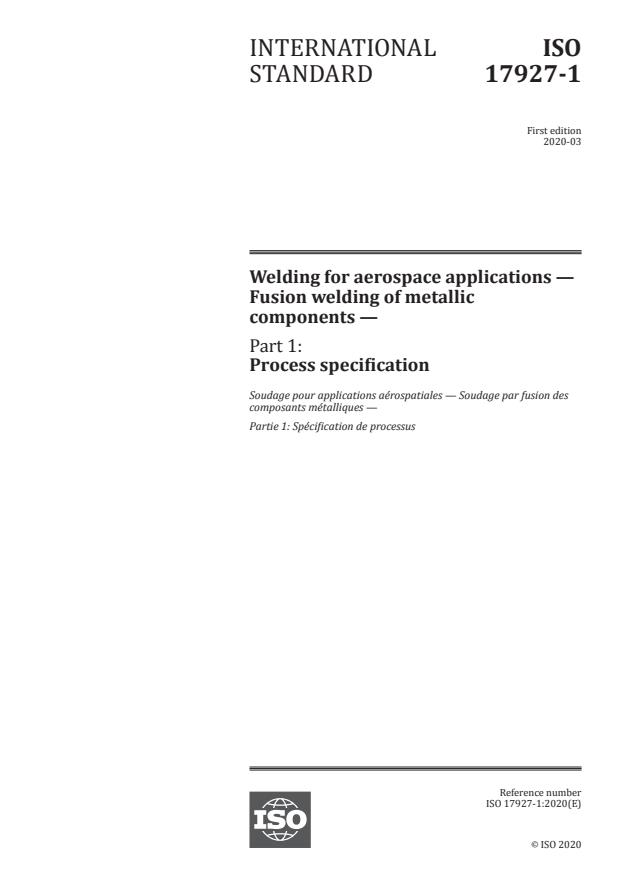
(Main)Welding for aerospace applications — Fusion welding of metallic components — Part 1: Process specification
General Information
- Abstract
This document specifies the requirements for fusion welding of aerospace hardware. It is to be used in conjunction with the design/engineering authority's design documents or their accepted data. This document covers the processes given in Table 1 and material groups given in Table 2.
- Status
- Published
- Publication Date
- 16-Mar-2020
- Technical Committee
- ISO/TC 44/SC 14 - Welding and brazing in aerospace
- Drafting Committee
- ISO/TC 44/SC 14 - Welding and brazing in aerospace
- Current Stage
- 9093 - International Standard confirmed
- Start Date
- 10-Sep-2025
- Completion Date
- 29-Aug-2026
Buy Documents
ISO 17927-1:2020 - Welding for aerospace applications -- Fusion welding of metallic components
ISO 17927-1:2020 - Welding for aerospace applications — Fusion welding of metallic components — Part 1: Process specification/17/2020
Overview
ISO 17927-1:2020 - Welding for aerospace applications - Fusion welding of metallic components - Part 1: Process specification - defines mandatory and recommended process-level requirements for fusion welding used on aerospace hardware. The standard is intended to be used together with the design/engineering authority’s documents or accepted data and covers the fusion welding processes listed in the standard’s Table 1 and the material groups in Table 2.
Keywords: ISO 17927-1, welding for aerospace, fusion welding, aerospace welding standard, WPS, WPQR, TIG, plasma, weld inspection.
Key topics and technical requirements
ISO 17927-1 organizes process requirements across the full welding lifecycle. Major technical topics include:
- Conformance and classification - definitions of conformance criteria and joint classification/inspection levels.
- Quality levels and weldment design - expectations for design compatibility with welding processes.
- Welding Procedure Specification (WPS) and WPQR - preparation, qualification and documentation requirements for WPS and Welding Procedure Qualification Records (WPQR).
- Fabrication and consumables - identification, traceability, storage and handling of filler metals, fluxes and gases.
- Equipment and calibration - requirements for welding equipment condition and calibration to ensure reproducible results.
- Joint preparation and pre-weld treatment - joint geometry, cleaning, protection, preheat and interpass temperature control.
- Welding execution - tack welds, run-on/run-off, shielding, spatter protection, parameter control and in-process correction.
- Inspection, testing and acceptance - visual inspection, non-destructive testing (PT, MT, RT, UT and others), destructive testing, acceptance criteria and recordkeeping.
- Personnel qualifications - requirements for welders, welding operators, welding coordinators and inspection personnel.
- Rework and repair - controlled procedures, allowed attempts and documentation of rework/repair.
- Process-specific requirements - clauses addressing TIG and plasma welding specifics.
- Annexes - example WPQR, WPS templates and preheat/interpass examples (informative).
Practical applications
ISO 17927-1 is used to:
- Develop and qualify welding procedures for aerospace components.
- Produce documented WPS/WPQR records for contract compliance.
- Establish fabrication, inspection and traceability programs that meet aerospace quality and safety expectations.
- Guide NDT planning and acceptance criteria for welded aerospace hardware.
Who should use this standard
- Aerospace OEMs and Tier suppliers
- Welding engineers and process developers
- Quality assurance and production managers
- NDT and visual inspection personnel
- Regulatory and design authorities responsible for aircraft/space hardware integrity
Related standards
- Other parts of the ISO 17927 series (processs/qualification/inspection) and ISO technical committee outputs from ISO/TC 44 (Welding and allied processes) are complementary. Always use ISO 17927-1 in conjunction with the design/engineering authority’s specifications.
Buy Documents
ISO 17927-1:2020 - Welding for aerospace applications -- Fusion welding of metallic components
ISO 17927-1:2020 - Welding for aerospace applications — Fusion welding of metallic components — Part 1: Process specification/17/2020
Get Certified
Connect with accredited certification bodies for this standard

DVS-ZERT GmbH
German welding certification society.
CARES (UK Certification Authority for Reinforcing Steels)
UK certification for reinforcing steels and construction.
EWF/IIW (European/International Welding Federation)
International welding personnel certification.
Sponsored listings
Frequently Asked Questions
ISO 17927-1:2020 is a standard published by the International Organization for Standardization (ISO). Its full title is "Welding for aerospace applications — Fusion welding of metallic components — Part 1: Process specification". This standard covers: This document specifies the requirements for fusion welding of aerospace hardware. It is to be used in conjunction with the design/engineering authority's design documents or their accepted data. This document covers the processes given in Table 1 and material groups given in Table 2.
This document specifies the requirements for fusion welding of aerospace hardware. It is to be used in conjunction with the design/engineering authority's design documents or their accepted data. This document covers the processes given in Table 1 and material groups given in Table 2.
ISO 17927-1:2020 is classified under the following ICS (International Classification for Standards) categories: 25.160.01 - Welding, brazing and soldering in general. The ICS classification helps identify the subject area and facilitates finding related standards.
ISO 17927-1:2020 is available in PDF format for immediate download after purchase. The document can be added to your cart and obtained through the secure checkout process. Digital delivery ensures instant access to the complete standard document.
Standards Content (Sample)
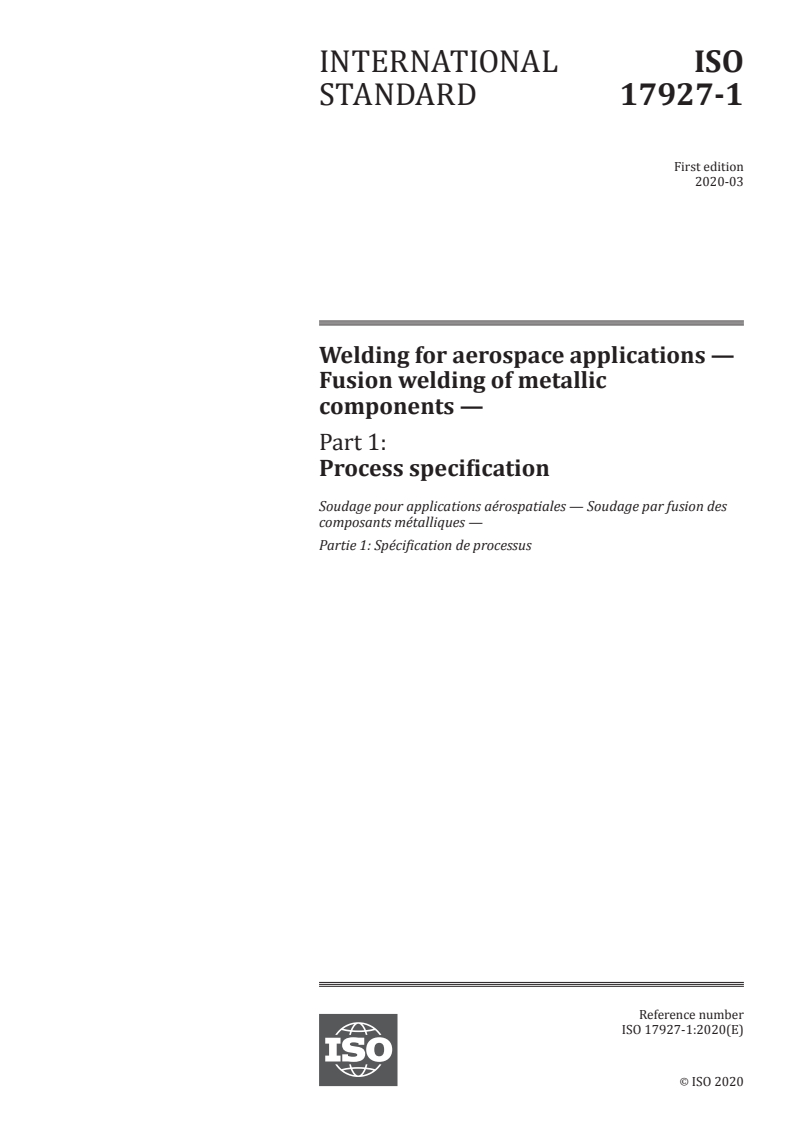
INTERNATIONAL ISO
STANDARD 17927-1
First edition
2020-03
Welding for aerospace applications —
Fusion welding of metallic
components —
Part 1:
Process specification
Soudage pour applications aérospatiales — Soudage par fusion des
composants métalliques —
Partie 1: Spécification de processus
Reference number
©
ISO 2020
© ISO 2020
All rights reserved. Unless otherwise specified, or required in the context of its implementation, no part of this publication may
be reproduced or utilized otherwise in any form or by any means, electronic or mechanical, including photocopying, or posting
on the internet or an intranet, without prior written permission. Permission can be requested from either ISO at the address
below or ISO’s member body in the country of the requester.
ISO copyright office
CP 401 • Ch. de Blandonnet 8
CH-1214 Vernier, Geneva
Phone: +41 22 749 01 11
Fax: +41 22 749 09 47
Email: copyright@iso.org
Website: www.iso.org
Published in Switzerland
ii © ISO 2020 – All rights reserved
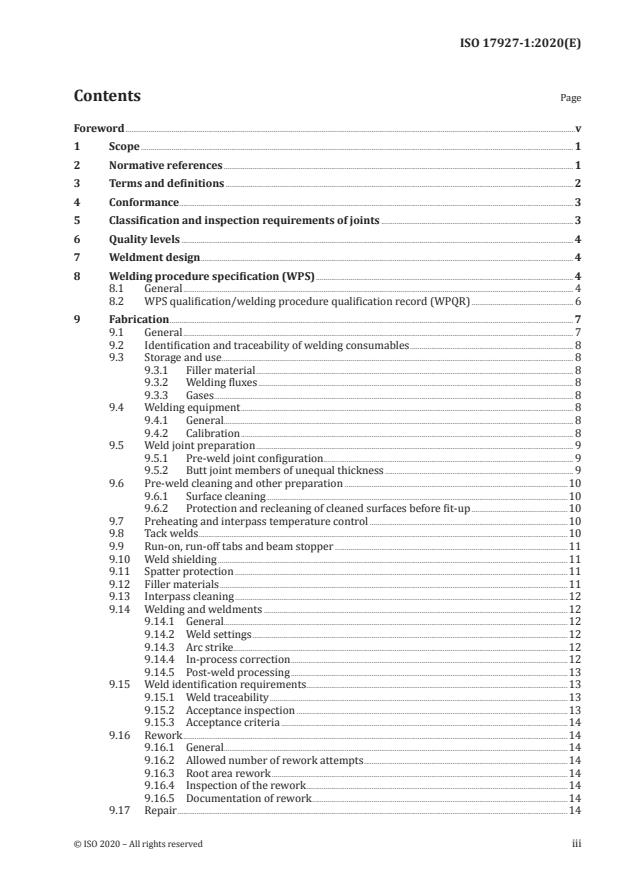
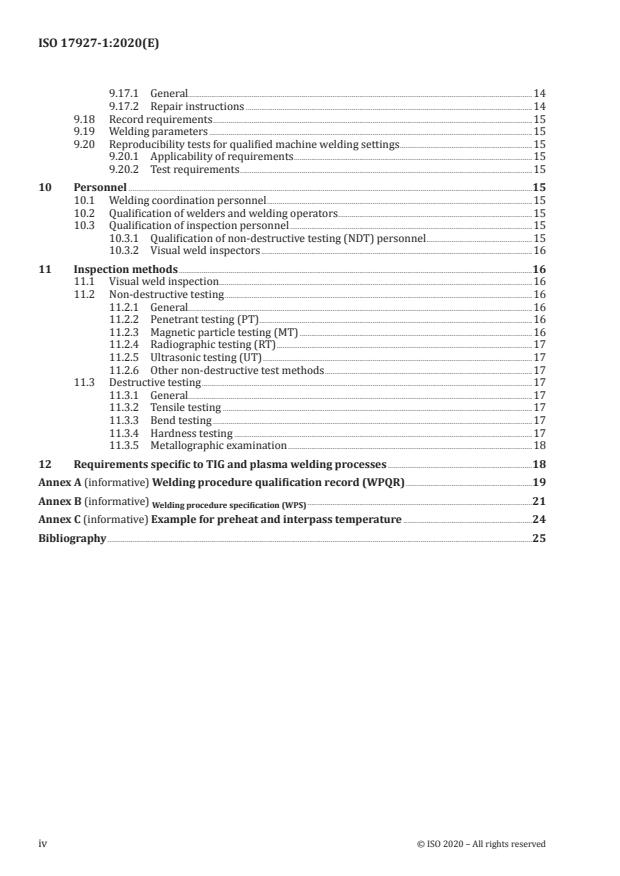
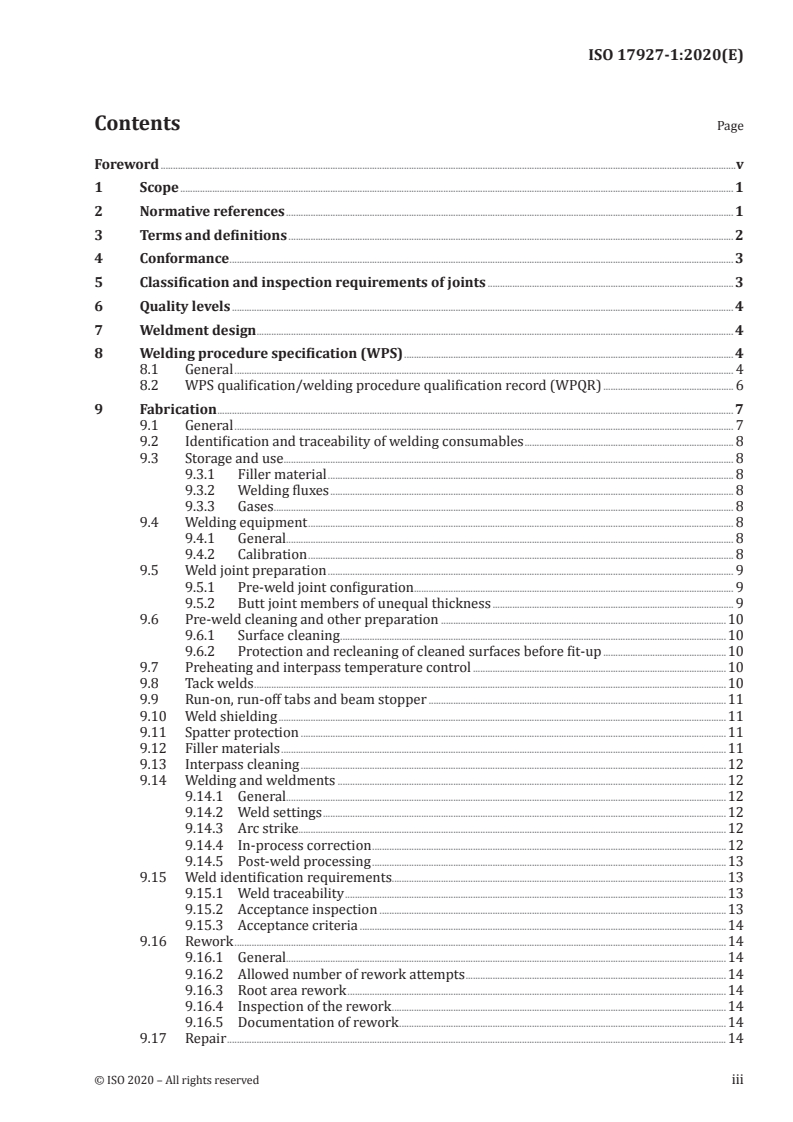
Contents Page
Foreword .v
1 Scope . 1
2 Normative references . 1
3 Terms and definitions . 2
4 Conformance . 3
5 Classification and inspection requirements of joints . 3
6 Quality levels . 4
7 Weldment design . 4
8 Welding procedure specification (WPS) . 4
8.1 General . 4
8.2 WPS qualification/welding procedure qualification record (WPQR) . 6
9 Fabrication . 7
9.1 General . 7
9.2 Identification and traceability of welding consumables . 8
9.3 Storage and use . . 8
9.3.1 Filler material . 8
9.3.2 Welding fluxes . 8
9.3.3 Gases . 8
9.4 Welding equipment . 8
9.4.1 General. 8
9.4.2 Calibration . 8
9.5 Weld joint preparation . 9
9.5.1 Pre-weld joint configuration. 9
9.5.2 Butt joint members of unequal thickness . 9
9.6 Pre-weld cleaning and other preparation .10
9.6.1 Surface cleaning .10
9.6.2 Protection and recleaning of cleaned surfaces before fit-up .10
9.7 Preheating and interpass temperature control .10
9.8 Tack welds .10
9.9 Run-on, run-off tabs and beam stopper .11
9.10 Weld shielding .11
9.11 Spatter protection .11
9.12 Filler materials .11
9.13 Interpass cleaning .12
9.14 Welding and weldments .12
9.14.1 General.12
9.14.2 Weld settings .12
9.14.3 Arc strike.12
9.14.4 In-process correction .12
9.14.5 Post-weld processing .13
9.15 Weld identification requirements.13
9.15.1 Weld traceability .13
9.15.2 Acceptance inspection .13
9.15.3 Acceptance criteria .14
9.16 Rework .14
9.16.1 General.14
9.16.2 Allowed number of rework attempts .14
9.16.3 Root area rework .14
9.16.4 Inspection of the rework .14
9.16.5 Documentation of rework .14
9.17 Repair .14
9.17.1 General.14
9.17.2 Repair instructions .14
9.18 Record requirements .15
9.19 Welding parameters .15
9.20 Reproducibility tests for qualified machine welding settings .15
9.20.1 Applicability of requirements .15
9.20.2 Test requirements .15
10 Personnel .15
10.1 Welding coordination personnel .15
10.2 Qualification of welders and welding operators .15
10.3 Qualification of inspection personnel .15
10.3.1 Qualification of non-destructive testing (NDT) personnel .15
10.3.2 Visual weld inspectors .16
11 Inspection methods .16
11.1 Visual weld inspection.16
11.2 Non-destructive testing .16
11.2.1 General.16
11.2.2 Penetrant testing (PT) .16
11.2.3 Magnetic particle testing (MT) .16
11.2.4 Radiographic testing (RT) .17
11.2.5 Ultrasonic testing (UT) .17
11.2.6 Other non-destructive test methods .17
11.3 Destructive testing .17
11.3.1 General.17
11.3.2 Tensile testing .17
11.3.3 Bend testing .17
11.3.4 Hardness testing .17
11.3.5 Metallographic examination .18
12 Requirements specific to TIG and plasma welding processes .18
Annex A (informative) Welding procedure qualification record (WPQR) .19
Annex B (informative) .21
Welding procedure specification (WPS)
Annex C (informative) Example for preheat and interpass temperature .24
Bibliography .25
iv © ISO 2020 – All rights reserved
Foreword
ISO (the International Organization for Standardization) is a worldwide federation of national standards
bodies (ISO member bodies). The work of preparing International Standards is normally carried out
through ISO technical committees. Each member body interested in a subject for which a technical
committee has been established has the right to be represented on that committee. International
organizations, governmental and non-governmental, in liaison with ISO, also take part in the work.
ISO collaborates closely with the International Electrotechnical Commission (IEC) on all matters of
electrotechnical standardization.
The procedures used to develop this document and those intended for its further maintenance are
described in the ISO/IEC Directives, Part 1. In particular, the different approval criteria needed for the
different types of ISO documents should be noted. This document was drafted in accordance with the
editorial rules of the ISO/IEC Directives, Part 2 (see www .iso .org/ directives).
Attention is drawn to the possibility that some of the elements of this document may be the subject of
patent rights. ISO shall not be held responsible for identifying any or all such patent rights. Details of
any patent rights identified during the development of the document will be in the Introduction and/or
on the ISO list of patent declarations received (see www .iso .org/ patents).
Any trade name used in this document is information given for the convenience of users and does not
constitute an endorsement.
For an explanation of the voluntary nature of standards, the meaning of ISO specific terms and
expressions related to conformity assessment, as well as information about ISO's adherence to the
World Trade Organization (WTO) principles in the Technical Barriers to Trade (TBT) see www .iso .org/
iso/ foreword .html.
This document was prepared by Technical Committee ISO/TC 44, Welding and allied processes,
Subcommittee SC 14, Welding and brazing in aerospace.
Any feedback or questions on this document should be directed to the user’s national standards body. A
complete listing of these bodies can be found at www .iso .org/ members .html. Official interpretations of
ISO/TC 44 documents, where they exist, are available from this page: https:// committee .iso .org/ sites/
tc44/ home/ interpretation .html.
A list of all parts in the ISO 17297 series can be found on the ISO website.
INTERNATIONAL STANDARD ISO 17927-1:2020(E)
Welding for aerospace applications — Fusion welding of
metallic components —
Part 1:
Process specification
1 Scope
This document specifies the requirements for fusion welding of aerospace hardware. It is to be used in
conjunction with the design/engineering authority’s design documents or their accepted data.
This document covers the processes given in Table 1 and material groups given in Table 2.
Table 1 — Fusion welding processes covered by this document
Process Process number (ISO 4063)
Oxyfuel welding 31
Gas-shielded arc welding with non-consumable tungsten electrode,
Gas tungsten arc welding
Plasma arc welding 15
Electron beam welding 51
Laser welding, Laser beam welding 52
Table 2 — Material groups covered by this document (see ISO 24394:2018, 4.5)
Material group Description
A Unalloyed steel, low-alloyed steels, high-alloyed ferritic steels
B Austenitic, martensitic and precipitation hardening steels
C Titanium and titanium alloys, niobium, zirconium and other reactive metals
D Aluminium and magnesium alloys
E Materials that do not conform to other material groups
(e.g. molybdenum, tungsten, copper alloys)
F Nickel alloys, cobalt alloys.
2 Normative references
The following documents are referred to in the text in such a way that some or all of their content
constitutes requirements of this document. For dated references, only the edition cited applies. For
undated references, the latest edition of the referenced document (including any amendments) applies.
ISO 3452 (all parts), Non-destructive testing — Penetrant testing
ISO 4063, Welding and allied processes — Nomenclature of processes and reference numbers
ISO 4136, Destructive tests on welds in metallic materials — Transverse tensile test
ISO 5173, Destructive tests on welds in metallic materials — Bend tests
ISO 6506-1, Metallic materials — Brinell hardness test — Part 1: Test method
ISO 6507-1, Metallic materials — Vickers hardness test — Part 1: Test method
ISO 6508 (all parts), Metallic materials — Rockwell hardness test
ISO 6892 (all parts), Metallic materials — Tensile testing
ISO 9015-1, Destructive tests on welds in metallic materials — Hardness testing — Part 1: Hardness test on
arc welded joints
ISO 10863, Non-destructive testing of welds — Ultrasonic testing — Use of time-of-flight diffraction
technique (TOFD)
ISO 13588, Non-destructive testing of welds — Ultrasonic testing — Use of automated phased array
technology
ISO 17636 (all parts), Non-destructive testing of welds — Radiographic testing
ISO 17638, Non-destructive testing of welds — Magnetic particle testing
ISO 17640, Non-destructive testing of welds — Ultrasonic testing — Techniques, testing levels, and
assessment
1)
ISO 17927-2 , Welding for aerospace applications — Fusion welding of metallic components — Part 2:
Acceptance criteria
ISO 19828, Welding for aerospace applications — Visual inspection of welds
ISO 24394, Welding for aerospace applications — Qualification test for welders and welding operators —
Fusion welding of metallic components
ISO/TR 25901-1, Welding and allied processes — Vocabulary — Part 1: General terms
EN 4179, Aerospace series — Qualification and approval of personnel for non-destructive testing
ASTM E8/E8M, Test Methods for Tension Testing of Metallic Materials
ASTM E18, Test Methods for Rockwell Hardness of Metallic Materials
ASTM E21, Standard Test Methods for Elevated Temperature Tension Tests of Metallic Materials
ASTM E384, Standard Test Method for Microindentation Hardness of Materials
ASTM E1417/E1417M, Standard Practice for Liquid Penetrant Testing
ASTM E1742/E1742M, Standard Practice for Radiographic Examination
ASTM E1444/E1444M, Standard Practice for Magnetic Particle Testing
SAE AMS 2644, Inspection Material, Penetrant
SAE AMS-STD-2154, Inspection, Ultrasonic, Wrought Metals, Process for
3 Terms and definitions
For the purposes of this document, the terms and definitions given in ISO/TR 25901-1 and the
following apply.
ISO and IEC maintain terminological databases for use in standardization at the following addresses:
— ISO Online browsing platform: available at https:// www .iso .org/ obp
— IEC Electropedia: available at http:// www .electropedia .org/
1) Under preparation. (Stage at the time of publication: ISO/FDIS 17927-2:2019.)
2 © ISO 2020 – All rights reserved
3.1
backgouging
removal of weld metal and base metal from the weld root side of a welded joint to facilitate complete
fusion and complete joint penetration upon subsequent welding from that side
3.2
design/engineering authority
organization having the responsibility for the structural integrity or maintenance of airworthiness of
the hardware and compliance with all relevant documents
[SOURCE: ISO 24394:2018, 3.8]
3.3
welding procedure specification
WPS
document providing in detail the required variables of the welding procedure to ensure repeatability
3.4
welding procedure qualification record
WPQR
record comprising all necessary data needed for qualification of a preliminary welding procedure
specification
3.5
autogenous weld
fusion weld without filler material
4 Conformance
When conformance to this document is claimed, all provisions of this document are to be complied
with, except those for provisions that the design/engineering authority specifically exempts.
5 Classification and inspection requirements of joints
For the purposes of this document, three classes of welds are defined. This classification shall be stated
in the design documents. If there are no other testing requirements defined by the design/engineering
authority, the minimum amount of testing shall be as follows.
— Class I: A welded joint whose failure under operating conditions causes the loss of the aircraft/
spacecraft or one of its main components, or constitutes a direct hazard to people.
Visual and dimensional inspection: 100 % of all welds; penetrant or and magnetic particle testing
or any other surface test method: 100 % of all welds; testing of the sub-surface characteristics:
100 % of all welds.
— Class II: A welded joint whose failure causes malfunctions without compromising continued safe
flight until the end of the mission.
Visual and dimensional inspection, 100 % of all welds and penetrant or and magnetic particle
testing or any other adequate test method, 100 % of all welds.
— Class III: A welded joint whose failure does not affect the safety and the transport function of the
aircraft/spacecraft.
Visual and dimensional inspection, 100 % of all welds.
For the purpose of series preparation/pre-production or in the case of critical welding operations, it
can be necessary, also for classes II and III, to increase the scope of testing beyond that specified here.
Likewise, in the course of series production, the scope of testing may be reduced if sufficient evidence
of process reliability can be provided.
Refer to design/engineering authority for design documents not specifying a classification and/or
inspection requirements.
6 Quality levels
Quality level A weld: Weld with high quality acceptance requirements.
Quality level B weld: Weld with moderate quality acceptance requirements.
Quality level C weld: Weld with typical quality acceptance requirements.
The quality levels are as defined by the engineering/drawing and/or specified by the design/
engineering authority.
7 Weldment design
The design/engineering authority is responsible for the design of the weldment and defines the
requirements to ensure compliance with all mission and systems requirements. The engineering
documentation shall clearly define special requirements, such as fracture critical, durability critical,
mission critical, or safety critical, imposed over and above the general requirements. Also, the design/
engineering authority shall define process controls to ensure that all design requirements can be met
by welds produced in accordance with specified procedure, fabrication, and inspection requirements.
For fillet welds, the weld size specified on the drawing is the minimum.
8 Welding procedure specification (WPS)
8.1 General
A welding procedure specification is required for each weld. For an example of a WPS, see Annex B.
The welding procedure specification (WPS) shall include the information as given in Table 3.
Table 3 — Welding procedure specification (WPS) data
Electron TIG Laser Plasma
Essential Oxyfuel
beam welding beam arc
variable welding
a
welding (GTAW ) welding welding
Joint design
* Joint type and dimensions X X X X X
Treatment of backside, method
* O O O O O
of gouging/preparation
* Backing O O O O O
Base metal(s)
* Base metal(s) designation(s) X X X X X
* Heat treatment condition X X X X X
Base metal form
* X X X X X
(sheet, tube etc.)
* Thickness X X X X X
Diameter (tubular only) X X X X X
X Data that shall be included in a WPS.
O Data that only need to be included in a WPS if used for that particular welding procedure.
a
Gas tungsten arc welding.
4 © ISO 2020 – All rights reserved
Table 3 (continued)
Electron TIG Laser Plasma
Essential Oxyfuel
beam welding beam arc
variable welding
a
welding (GTAW ) welding welding
* Coating description or type O O O O O
Material group number accord-
X X X X X
ing to Table 2
Filler material
Specification, alloy designation,
* O O O O O
or the nominal composition
* Filler material size or diameter O O O O O
* Flux O O
* Filler material feed rate O O O O
* Consumable insert and type O O
* Hot wire O O O
Position
* Welding position(s) X X X X X
Preheat and interpass temperature
Preheat method O O O O O
Preheat minimum and/or
* O O O O O
maximum temperature
Interpass temperature minimum
* O O O O O
and/or maximum
Shielding gas
Torch shielding gas and flow
* X X X
rate range
Root shielding gas and flow
* X X X
rate range
Environmental shielding and
* X O O
vacuum pressure
Shielding gas devices and flow
* O O O
rate ranges
* Gas cup design/size or gas lens O O
Energy characteristics
* Current type and polarity X X
* Current range X X X
* Voltage range X O X
Beam power; focus, current;
* pulse frequency range; filament X X
type, shape, size
Specification, classification, and
* X X
diameter of tungsten electrode
* Electrode geometry X X
Control of electrode to work
* piece distance (mechanized X X
welding)
* Pulsed current parameters O O
X Data that shall be included in a WPS.
O Data that only need to be included in a WPS if used for that particular welding procedure.
a
Gas tungsten arc welding.
Table 3 (continued)
Electron TIG Laser Plasma
Essential Oxyfuel
beam welding beam arc
variable welding
a
welding (GTAW ) welding welding
Torch model number O O
Other welding process variables
Welding process (designation
* and process number according to X X X X X
ISO 4063)
Type of mechanization (manual,
semiautomatic, mechanized, or X X
automatic)
Machine type for mechanized or
* X X X X
automatic welding
Multiple electrodes/energy
* O O O O
sources and spacing
* Single or multipass X X X X X
Cleaning method, tools, and/or
* X X X X
agents
Post weld mechanical treatment
O O
(e.g. peening)
Conventional or keyhole tech-
* X X X
nique
* Stringer bead or weave bead X X
Travel-speed range for mecha-
nized or automatic welding and
* X X X X
manual applications requiring
heat input calculations
Fuel gas and flame type (oxidiz-
* X
ing, neutral, carburizing)
X Data that shall be included in a WPS.
O Data that only need to be included in a WPS if used for that particular welding procedure.
a
Gas tungsten arc welding.
8.2 WPS qualification/welding procedure qualification record (WPQR)
WPS shall be qualified to the requirements given by the design/engineering authority.
The documentation shall be made by using a WPQR form (for an example, see Annex A) or as defined by
the design/engineering authority.
If representative test pieces are used to replicate production parts, the correlation shall be based on the
minimum essential variables as given in 8.1.
The standard welding procedure test shall be based on the design/engineering authority requirements.
If no standard weld test pieces are specified, the standard weld test pieces specified in ISO 24394 may
be used.
See Figure 1.
6 © ISO 2020 – All rights reserved
Figure 1 — WPS qualification flowc
...
INTERNATIONAL ISO
STANDARD 17927-1
First edition
2020-03
Welding for aerospace applications —
Fusion welding of metallic
components —
Part 1:
Process specification
Soudage pour applications aérospatiales — Soudage par fusion des
composants métalliques —
Partie 1: Spécification de processus
Reference number
©
ISO 2020
© ISO 2020
All rights reserved. Unless otherwise specified, or required in the context of its implementation, no part of this publication may
be reproduced or utilized otherwise in any form or by any means, electronic or mechanical, including photocopying, or posting
on the internet or an intranet, without prior written permission. Permission can be requested from either ISO at the address
below or ISO’s member body in the country of the requester.
ISO copyright office
CP 401 • Ch. de Blandonnet 8
CH-1214 Vernier, Geneva
Phone: +41 22 749 01 11
Fax: +41 22 749 09 47
Email: copyright@iso.org
Website: www.iso.org
Published in Switzerland
ii © ISO 2020 – All rights reserved
Contents Page
Foreword .v
1 Scope . 1
2 Normative references . 1
3 Terms and definitions . 2
4 Conformance . 3
5 Classification and inspection requirements of joints . 3
6 Quality levels . 4
7 Weldment design . 4
8 Welding procedure specification (WPS) . 4
8.1 General . 4
8.2 WPS qualification/welding procedure qualification record (WPQR) . 6
9 Fabrication . 7
9.1 General . 7
9.2 Identification and traceability of welding consumables . 8
9.3 Storage and use . . 8
9.3.1 Filler material . 8
9.3.2 Welding fluxes . 8
9.3.3 Gases . 8
9.4 Welding equipment . 8
9.4.1 General. 8
9.4.2 Calibration . 8
9.5 Weld joint preparation . 9
9.5.1 Pre-weld joint configuration. 9
9.5.2 Butt joint members of unequal thickness . 9
9.6 Pre-weld cleaning and other preparation .10
9.6.1 Surface cleaning .10
9.6.2 Protection and recleaning of cleaned surfaces before fit-up .10
9.7 Preheating and interpass temperature control .10
9.8 Tack welds .10
9.9 Run-on, run-off tabs and beam stopper .11
9.10 Weld shielding .11
9.11 Spatter protection .11
9.12 Filler materials .11
9.13 Interpass cleaning .12
9.14 Welding and weldments .12
9.14.1 General.12
9.14.2 Weld settings .12
9.14.3 Arc strike.12
9.14.4 In-process correction .12
9.14.5 Post-weld processing .13
9.15 Weld identification requirements.13
9.15.1 Weld traceability .13
9.15.2 Acceptance inspection .13
9.15.3 Acceptance criteria .14
9.16 Rework .14
9.16.1 General.14
9.16.2 Allowed number of rework attempts .14
9.16.3 Root area rework .14
9.16.4 Inspection of the rework .14
9.16.5 Documentation of rework .14
9.17 Repair .14
9.17.1 General.14
9.17.2 Repair instructions .14
9.18 Record requirements .15
9.19 Welding parameters .15
9.20 Reproducibility tests for qualified machine welding settings .15
9.20.1 Applicability of requirements .15
9.20.2 Test requirements .15
10 Personnel .15
10.1 Welding coordination personnel .15
10.2 Qualification of welders and welding operators .15
10.3 Qualification of inspection personnel .15
10.3.1 Qualification of non-destructive testing (NDT) personnel .15
10.3.2 Visual weld inspectors .16
11 Inspection methods .16
11.1 Visual weld inspection.16
11.2 Non-destructive testing .16
11.2.1 General.16
11.2.2 Penetrant testing (PT) .16
11.2.3 Magnetic particle testing (MT) .16
11.2.4 Radiographic testing (RT) .17
11.2.5 Ultrasonic testing (UT) .17
11.2.6 Other non-destructive test methods .17
11.3 Destructive testing .17
11.3.1 General.17
11.3.2 Tensile testing .17
11.3.3 Bend testing .17
11.3.4 Hardness testing .17
11.3.5 Metallographic examination .18
12 Requirements specific to TIG and plasma welding processes .18
Annex A (informative) Welding procedure qualification record (WPQR) .19
Annex B (informative) .21
Welding procedure specification (WPS)
Annex C (informative) Example for preheat and interpass temperature .24
Bibliography .25
iv © ISO 2020 – All rights reserved
Foreword
ISO (the International Organization for Standardization) is a worldwide federation of national standards
bodies (ISO member bodies). The work of preparing International Standards is normally carried out
through ISO technical committees. Each member body interested in a subject for which a technical
committee has been established has the right to be represented on that committee. International
organizations, governmental and non-governmental, in liaison with ISO, also take part in the work.
ISO collaborates closely with the International Electrotechnical Commission (IEC) on all matters of
electrotechnical standardization.
The procedures used to develop this document and those intended for its further maintenance are
described in the ISO/IEC Directives, Part 1. In particular, the different approval criteria needed for the
different types of ISO documents should be noted. This document was drafted in accordance with the
editorial rules of the ISO/IEC Directives, Part 2 (see www .iso .org/ directives).
Attention is drawn to the possibility that some of the elements of this document may be the subject of
patent rights. ISO shall not be held responsible for identifying any or all such patent rights. Details of
any patent rights identified during the development of the document will be in the Introduction and/or
on the ISO list of patent declarations received (see www .iso .org/ patents).
Any trade name used in this document is information given for the convenience of users and does not
constitute an endorsement.
For an explanation of the voluntary nature of standards, the meaning of ISO specific terms and
expressions related to conformity assessment, as well as information about ISO's adherence to the
World Trade Organization (WTO) principles in the Technical Barriers to Trade (TBT) see www .iso .org/
iso/ foreword .html.
This document was prepared by Technical Committee ISO/TC 44, Welding and allied processes,
Subcommittee SC 14, Welding and brazing in aerospace.
Any feedback or questions on this document should be directed to the user’s national standards body. A
complete listing of these bodies can be found at www .iso .org/ members .html. Official interpretations of
ISO/TC 44 documents, where they exist, are available from this page: https:// committee .iso .org/ sites/
tc44/ home/ interpretation .html.
A list of all parts in the ISO 17297 series can be found on the ISO website.
INTERNATIONAL STANDARD ISO 17927-1:2020(E)
Welding for aerospace applications — Fusion welding of
metallic components —
Part 1:
Process specification
1 Scope
This document specifies the requirements for fusion welding of aerospace hardware. It is to be used in
conjunction with the design/engineering authority’s design documents or their accepted data.
This document covers the processes given in Table 1 and material groups given in Table 2.
Table 1 — Fusion welding processes covered by this document
Process Process number (ISO 4063)
Oxyfuel welding 31
Gas-shielded arc welding with non-consumable tungsten electrode,
Gas tungsten arc welding
Plasma arc welding 15
Electron beam welding 51
Laser welding, Laser beam welding 52
Table 2 — Material groups covered by this document (see ISO 24394:2018, 4.5)
Material group Description
A Unalloyed steel, low-alloyed steels, high-alloyed ferritic steels
B Austenitic, martensitic and precipitation hardening steels
C Titanium and titanium alloys, niobium, zirconium and other reactive metals
D Aluminium and magnesium alloys
E Materials that do not conform to other material groups
(e.g. molybdenum, tungsten, copper alloys)
F Nickel alloys, cobalt alloys.
2 Normative references
The following documents are referred to in the text in such a way that some or all of their content
constitutes requirements of this document. For dated references, only the edition cited applies. For
undated references, the latest edition of the referenced document (including any amendments) applies.
ISO 3452 (all parts), Non-destructive testing — Penetrant testing
ISO 4063, Welding and allied processes — Nomenclature of processes and reference numbers
ISO 4136, Destructive tests on welds in metallic materials — Transverse tensile test
ISO 5173, Destructive tests on welds in metallic materials — Bend tests
ISO 6506-1, Metallic materials — Brinell hardness test — Part 1: Test method
ISO 6507-1, Metallic materials — Vickers hardness test — Part 1: Test method
ISO 6508 (all parts), Metallic materials — Rockwell hardness test
ISO 6892 (all parts), Metallic materials — Tensile testing
ISO 9015-1, Destructive tests on welds in metallic materials — Hardness testing — Part 1: Hardness test on
arc welded joints
ISO 10863, Non-destructive testing of welds — Ultrasonic testing — Use of time-of-flight diffraction
technique (TOFD)
ISO 13588, Non-destructive testing of welds — Ultrasonic testing — Use of automated phased array
technology
ISO 17636 (all parts), Non-destructive testing of welds — Radiographic testing
ISO 17638, Non-destructive testing of welds — Magnetic particle testing
ISO 17640, Non-destructive testing of welds — Ultrasonic testing — Techniques, testing levels, and
assessment
1)
ISO 17927-2 , Welding for aerospace applications — Fusion welding of metallic components — Part 2:
Acceptance criteria
ISO 19828, Welding for aerospace applications — Visual inspection of welds
ISO 24394, Welding for aerospace applications — Qualification test for welders and welding operators —
Fusion welding of metallic components
ISO/TR 25901-1, Welding and allied processes — Vocabulary — Part 1: General terms
EN 4179, Aerospace series — Qualification and approval of personnel for non-destructive testing
ASTM E8/E8M, Test Methods for Tension Testing of Metallic Materials
ASTM E18, Test Methods for Rockwell Hardness of Metallic Materials
ASTM E21, Standard Test Methods for Elevated Temperature Tension Tests of Metallic Materials
ASTM E384, Standard Test Method for Microindentation Hardness of Materials
ASTM E1417/E1417M, Standard Practice for Liquid Penetrant Testing
ASTM E1742/E1742M, Standard Practice for Radiographic Examination
ASTM E1444/E1444M, Standard Practice for Magnetic Particle Testing
SAE AMS 2644, Inspection Material, Penetrant
SAE AMS-STD-2154, Inspection, Ultrasonic, Wrought Metals, Process for
3 Terms and definitions
For the purposes of this document, the terms and definitions given in ISO/TR 25901-1 and the
following apply.
ISO and IEC maintain terminological databases for use in standardization at the following addresses:
— ISO Online browsing platform: available at https:// www .iso .org/ obp
— IEC Electropedia: available at http:// www .electropedia .org/
1) Under preparation. (Stage at the time of publication: ISO/FDIS 17927-2:2019.)
2 © ISO 2020 – All rights reserved
3.1
backgouging
removal of weld metal and base metal from the weld root side of a welded joint to facilitate complete
fusion and complete joint penetration upon subsequent welding from that side
3.2
design/engineering authority
organization having the responsibility for the structural integrity or maintenance of airworthiness of
the hardware and compliance with all relevant documents
[SOURCE: ISO 24394:2018, 3.8]
3.3
welding procedure specification
WPS
document providing in detail the required variables of the welding procedure to ensure repeatability
3.4
welding procedure qualification record
WPQR
record comprising all necessary data needed for qualification of a preliminary welding procedure
specification
3.5
autogenous weld
fusion weld without filler material
4 Conformance
When conformance to this document is claimed, all provisions of this document are to be complied
with, except those for provisions that the design/engineering authority specifically exempts.
5 Classification and inspection requirements of joints
For the purposes of this document, three classes of welds are defined. This classification shall be stated
in the design documents. If there are no other testing requirements defined by the design/engineering
authority, the minimum amount of testing shall be as follows.
— Class I: A welded joint whose failure under operating conditions causes the loss of the aircraft/
spacecraft or one of its main components, or constitutes a direct hazard to people.
Visual and dimensional inspection: 100 % of all welds; penetrant or and magnetic particle testing
or any other surface test method: 100 % of all welds; testing of the sub-surface characteristics:
100 % of all welds.
— Class II: A welded joint whose failure causes malfunctions without compromising continued safe
flight until the end of the mission.
Visual and dimensional inspection, 100 % of all welds and penetrant or and magnetic particle
testing or any other adequate test method, 100 % of all welds.
— Class III: A welded joint whose failure does not affect the safety and the transport function of the
aircraft/spacecraft.
Visual and dimensional inspection, 100 % of all welds.
For the purpose of series preparation/pre-production or in the case of critical welding operations, it
can be necessary, also for classes II and III, to increase the scope of testing beyond that specified here.
Likewise, in the course of series production, the scope of testing may be reduced if sufficient evidence
of process reliability can be provided.
Refer to design/engineering authority for design documents not specifying a classification and/or
inspection requirements.
6 Quality levels
Quality level A weld: Weld with high quality acceptance requirements.
Quality level B weld: Weld with moderate quality acceptance requirements.
Quality level C weld: Weld with typical quality acceptance requirements.
The quality levels are as defined by the engineering/drawing and/or specified by the design/
engineering authority.
7 Weldment design
The design/engineering authority is responsible for the design of the weldment and defines the
requirements to ensure compliance with all mission and systems requirements. The engineering
documentation shall clearly define special requirements, such as fracture critical, durability critical,
mission critical, or safety critical, imposed over and above the general requirements. Also, the design/
engineering authority shall define process controls to ensure that all design requirements can be met
by welds produced in accordance with specified procedure, fabrication, and inspection requirements.
For fillet welds, the weld size specified on the drawing is the minimum.
8 Welding procedure specification (WPS)
8.1 General
A welding procedure specification is required for each weld. For an example of a WPS, see Annex B.
The welding procedure specification (WPS) shall include the information as given in Table 3.
Table 3 — Welding procedure specification (WPS) data
Electron TIG Laser Plasma
Essential Oxyfuel
beam welding beam arc
variable welding
a
welding (GTAW ) welding welding
Joint design
* Joint type and dimensions X X X X X
Treatment of backside, method
* O O O O O
of gouging/preparation
* Backing O O O O O
Base metal(s)
* Base metal(s) designation(s) X X X X X
* Heat treatment condition X X X X X
Base metal form
* X X X X X
(sheet, tube etc.)
* Thickness X X X X X
Diameter (tubular only) X X X X X
X Data that shall be included in a WPS.
O Data that only need to be included in a WPS if used for that particular welding procedure.
a
Gas tungsten arc welding.
4 © ISO 2020 – All rights reserved
Table 3 (continued)
Electron TIG Laser Plasma
Essential Oxyfuel
beam welding beam arc
variable welding
a
welding (GTAW ) welding welding
* Coating description or type O O O O O
Material group number accord-
X X X X X
ing to Table 2
Filler material
Specification, alloy designation,
* O O O O O
or the nominal composition
* Filler material size or diameter O O O O O
* Flux O O
* Filler material feed rate O O O O
* Consumable insert and type O O
* Hot wire O O O
Position
* Welding position(s) X X X X X
Preheat and interpass temperature
Preheat method O O O O O
Preheat minimum and/or
* O O O O O
maximum temperature
Interpass temperature minimum
* O O O O O
and/or maximum
Shielding gas
Torch shielding gas and flow
* X X X
rate range
Root shielding gas and flow
* X X X
rate range
Environmental shielding and
* X O O
vacuum pressure
Shielding gas devices and flow
* O O O
rate ranges
* Gas cup design/size or gas lens O O
Energy characteristics
* Current type and polarity X X
* Current range X X X
* Voltage range X O X
Beam power; focus, current;
* pulse frequency range; filament X X
type, shape, size
Specification, classification, and
* X X
diameter of tungsten electrode
* Electrode geometry X X
Control of electrode to work
* piece distance (mechanized X X
welding)
* Pulsed current parameters O O
X Data that shall be included in a WPS.
O Data that only need to be included in a WPS if used for that particular welding procedure.
a
Gas tungsten arc welding.
Table 3 (continued)
Electron TIG Laser Plasma
Essential Oxyfuel
beam welding beam arc
variable welding
a
welding (GTAW ) welding welding
Torch model number O O
Other welding process variables
Welding process (designation
* and process number according to X X X X X
ISO 4063)
Type of mechanization (manual,
semiautomatic, mechanized, or X X
automatic)
Machine type for mechanized or
* X X X X
automatic welding
Multiple electrodes/energy
* O O O O
sources and spacing
* Single or multipass X X X X X
Cleaning method, tools, and/or
* X X X X
agents
Post weld mechanical treatment
O O
(e.g. peening)
Conventional or keyhole tech-
* X X X
nique
* Stringer bead or weave bead X X
Travel-speed range for mecha-
nized or automatic welding and
* X X X X
manual applications requiring
heat input calculations
Fuel gas and flame type (oxidiz-
* X
ing, neutral, carburizing)
X Data that shall be included in a WPS.
O Data that only need to be included in a WPS if used for that particular welding procedure.
a
Gas tungsten arc welding.
8.2 WPS qualification/welding procedure qualification record (WPQR)
WPS shall be qualified to the requirements given by the design/engineering authority.
The documentation shall be made by using a WPQR form (for an example, see Annex A) or as defined by
the design/engineering authority.
If representative test pieces are used to replicate production parts, the correlation shall be based on the
minimum essential variables as given in 8.1.
The standard welding procedure test shall be based on the design/engineering authority requirements.
If no standard weld test pieces are specified, the standard weld test pieces specified in ISO 24394 may
be used.
See Figure 1.
6 © ISO 2020 – All rights reserved
Figure 1 — WPS qualification flowc
...