


ISO 18777-1
(Main)Transportable liquid oxygen systems for medical use — Part 1: Common requirements and particular requirements for base units
Transportable liquid oxygen systems for medical use — Part 1: Common requirements and particular requirements for base units
This document specifies common requirements for transportable liquid oxygen systems and specific requirements for base units. Base units are used as a store for liquid oxygen for recharging portable units. They may also, if fitted with a flow outlet and flow selector, be used as a source for the supply of oxygen direct to the patient.
Systèmes transportables d'oxygène liquide à usage médical — Partie 1: Exigences communes et exigences particulières s'appliquant aux unités de base
General Information
- Status
- Not Published
- Technical Committee
- ISO/TC 121/SC 6 - Medical gas supply systems
- Drafting Committee
- ISO/TC 121/SC 6 - Medical gas supply systems
- Current Stage
- 6000 - International Standard under publication
- Start Date
- 03-Dec-2025
- Completion Date
- 14-Feb-2026
Relations
- Effective Date
- 09-Feb-2026
- Effective Date
- 12-Feb-2026
- Revises
ISO 18777:2005 - Transportable liquid oxygen systems for medical use — Particular requirements - Effective Date
- 06-Jun-2022
Overview
ISO 18777-1 specifies common requirements for transportable liquid oxygen systems used in medical applications and the particular requirements for base units. Base units are vacuum-insulated cryogenic vessels that store liquid oxygen (LOX, approx. –180 °C) for recharging portable units and, if equipped with a flow outlet and selector, can also supply oxygen directly to patients. This standard covers design, construction, safety, performance, marking and user information to ensure safe, interoperable and reliable medical oxygen supply in home-care and portable settings.
Key Topics and Requirements
Important technical topics addressed in ISO 18777-1 include:
- Risk management and usability: Manufacturers shall perform risk assessments in accordance with ISO 14971 and apply a usability engineering process to mitigate use errors.
- Materials and oxygen compatibility: Components contacting LOX or breathing gases must be corrosion resistant and comply with ISO 15001 and ISO 23208; biocompatibility per ISO 18562-1.
- Cryogenic vessel design: Double-walled, vacuum-insulated construction, content level indication and evaporation/heat-exchanger performance for safe gas conversion.
- Transfilling devices and connectors: Requirements for safe liquid transfer between base and portable units, including interoperability and defined opening sequences.
- Flow outlets and flow control: Specifications for outlet pressure, temperature, flow control devices and oxygen-conserving technology.
- Safety and performance tests: Leakage, evaporation rate, pressure control, electrical safety, excessive surface temperature, stability and protection of components.
- Information and labeling: Manufacturer marking, instructions for use and technical documentation requirements.
- Annexes: Test methods, rationale, opening sequences, IEC 60601-1 guidance and hazard identification for risk assessments.
Applications and Who Uses It
ISO 18777-1 is intended for:
- Manufacturers and designers of medical liquid oxygen base units and integrated LOX systems.
- Regulatory bodies and certification/inspection labs assessing conformity, safety and performance.
- Healthcare providers and clinical engineers evaluating devices for home-care oxygen therapy.
- Procurement teams specifying interoperability between base and portable units.
Typical applications include home oxygen refilling stations, ambulatory oxygen support systems and non-pipeline oxygen supply where a transportable LOX store is required.
Related Standards
- ISO 14971 (risk management for medical devices)
- ISO 15001 (oxygen compatibility)
- ISO 18562-1 (biocompatibility of breathing gas pathways)
- ISO 21029 series (cryogenic vessels)
- IEC 60601-1 (electrical safety for medical equipment)
- ISO 18777-2 (requirements specific to portable units)
Keywords: ISO 18777-1, transportable liquid oxygen systems, base units, medical oxygen, LOX, cryogenic vessel, transfilling device, oxygen compatibility, risk management, flow control.
Buy Documents

ISO/FDIS 18777-1 - Transportable liquid oxygen systems for medical use — Part 1: Common requirements and particular requirements for base units Released:9/23/2025
REDLINE ISO/FDIS 18777-1 - Transportable liquid oxygen systems for medical use — Part 1: Common requirements and particular requirements for base units Released:9/23/2025

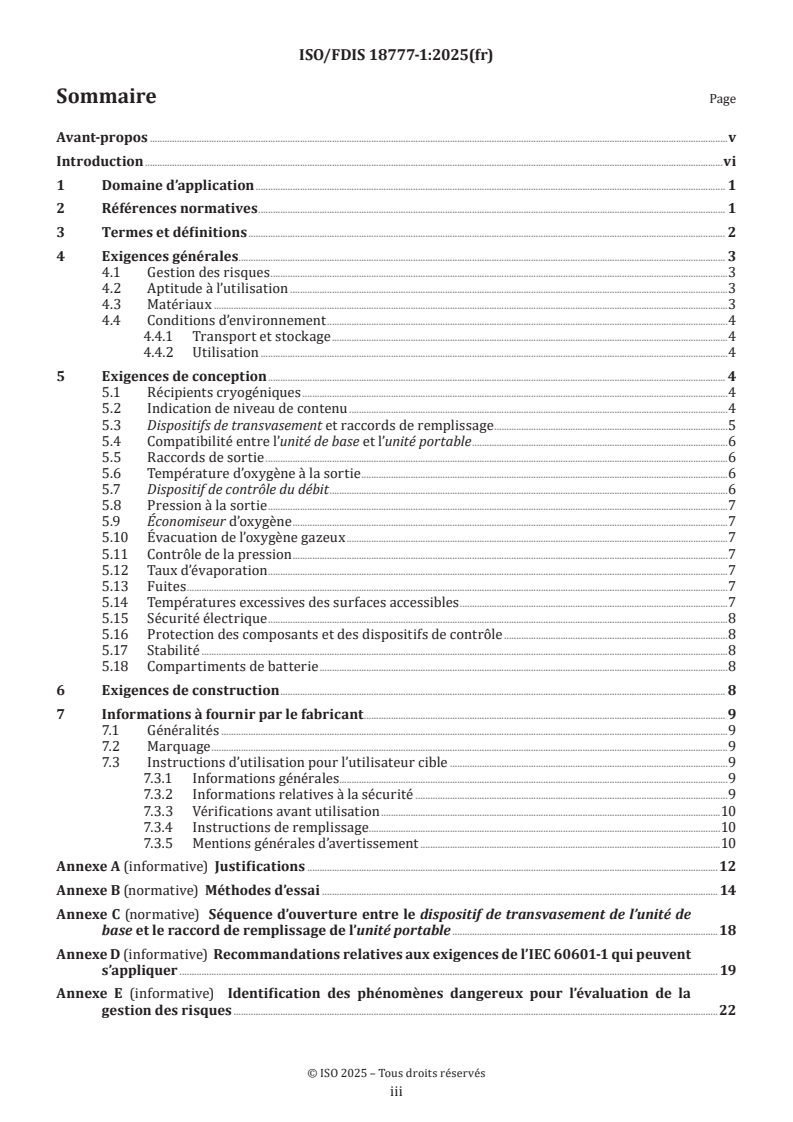

ISO/FDIS 18777-1 - Systèmes transportables d'oxygène liquide à usage médical — Partie 1: Exigences communes et exigences particulières s'appliquant aux unités de base Released:24. 10. 2025
Get Certified
Connect with accredited certification bodies for this standard

BSI Group
BSI (British Standards Institution) is the business standards company that helps organizations make excellence a habit.

TÜV Rheinland
TÜV Rheinland is a leading international provider of technical services.

TÜV SÜD
TÜV SÜD is a trusted partner of choice for safety, security and sustainability solutions.
Sponsored listings
Frequently Asked Questions
ISO 18777-1 is a draft published by the International Organization for Standardization (ISO). Its full title is "Transportable liquid oxygen systems for medical use — Part 1: Common requirements and particular requirements for base units". This standard covers: This document specifies common requirements for transportable liquid oxygen systems and specific requirements for base units. Base units are used as a store for liquid oxygen for recharging portable units. They may also, if fitted with a flow outlet and flow selector, be used as a source for the supply of oxygen direct to the patient.
This document specifies common requirements for transportable liquid oxygen systems and specific requirements for base units. Base units are used as a store for liquid oxygen for recharging portable units. They may also, if fitted with a flow outlet and flow selector, be used as a source for the supply of oxygen direct to the patient.
ISO 18777-1 is classified under the following ICS (International Classification for Standards) categories: 11.040.10 - Anaesthetic, respiratory and reanimation equipment. The ICS classification helps identify the subject area and facilitates finding related standards.
ISO 18777-1 has the following relationships with other standards: It is inter standard links to EN ISO 18777-2:2025, FprEN ISO 18777-1, ISO 18777:2005. Understanding these relationships helps ensure you are using the most current and applicable version of the standard.
ISO 18777-1 is available in PDF format for immediate download after purchase. The document can be added to your cart and obtained through the secure checkout process. Digital delivery ensures instant access to the complete standard document.
Standards Content (Sample)
FINAL DRAFT
International
Standard
ISO/FDIS 18777-1
ISO/TC 121/SC 6
Transportable liquid oxygen
Secretariat: ANSI
systems for medical use —
Voting begins on:
2025-10-07
Part 1:
Common requirements and
Voting terminates on:
2025-12-02
particular requirements for base
units
Systèmes transportables d'oxygène liquide à usage médical —
Partie 1: Exigences communes et exigences particulières
s'appliquant aux unités de base
RECIPIENTS OF THIS DRAFT ARE INVITED TO SUBMIT,
WITH THEIR COMMENTS, NOTIFICATION OF ANY
RELEVANT PATENT RIGHTS OF WHICH THEY ARE AWARE
AND TO PROVIDE SUPPOR TING DOCUMENTATION.
IN ADDITION TO THEIR EVALUATION AS
BEING ACCEPTABLE FOR INDUSTRIAL, TECHNO-
ISO/CEN PARALLEL PROCESSING LOGICAL, COMMERCIAL AND USER PURPOSES, DRAFT
INTERNATIONAL STANDARDS MAY ON OCCASION HAVE
TO BE CONSIDERED IN THE LIGHT OF THEIR POTENTIAL
TO BECOME STAN DARDS TO WHICH REFERENCE MAY BE
MADE IN NATIONAL REGULATIONS.
Reference number
ISO/FDIS 18777-1:2025(en) © ISO 2025
FINAL DRAFT
ISO/FDIS 18777-1:2025(en)
International
Standard
ISO/FDIS 18777-1
ISO/TC 121/SC 6
Transportable liquid oxygen
Secretariat: ANSI
systems for medical use —
Voting begins on:
Part 1:
Common requirements and particular
Voting terminates on:
requirements for base units
Systèmes transportables d'oxygène liquide à usage médical —
Partie 1: Exigences communes et exigences particulières
s'appliquant aux unités de base
RECIPIENTS OF THIS DRAFT ARE INVITED TO SUBMIT,
WITH THEIR COMMENTS, NOTIFICATION OF ANY
RELEVANT PATENT RIGHTS OF WHICH THEY ARE AWARE
AND TO PROVIDE SUPPOR TING DOCUMENTATION.
© ISO 2025
IN ADDITION TO THEIR EVALUATION AS
All rights reserved. Unless otherwise specified, or required in the context of its implementation, no part of this publication may
BEING ACCEPTABLE FOR INDUSTRIAL, TECHNO-
ISO/CEN PARALLEL PROCESSING
LOGICAL, COMMERCIAL AND USER PURPOSES, DRAFT
be reproduced or utilized otherwise in any form or by any means, electronic or mechanical, including photocopying, or posting on
INTERNATIONAL STANDARDS MAY ON OCCASION HAVE
the internet or an intranet, without prior written permission. Permission can be requested from either ISO at the address below
TO BE CONSIDERED IN THE LIGHT OF THEIR POTENTIAL
or ISO’s member body in the country of the requester.
TO BECOME STAN DARDS TO WHICH REFERENCE MAY BE
MADE IN NATIONAL REGULATIONS.
ISO copyright office
CP 401 • Ch. de Blandonnet 8
CH-1214 Vernier, Geneva
Phone: +41 22 749 01 11
Email: copyright@iso.org
Website: www.iso.org
Published in Switzerland Reference number
ISO/FDIS 18777-1:2025(en) © ISO 2025
ii
ISO/FDIS 18777-1:2025(en)
Contents Page
Foreword .iv
Introduction .v
1 Scope . 1
2 Normative references . 1
3 Terms and definitions . 1
4 General requirements . 2
4.1 Risk management .2
4.2 Usability .3
4.3 Materials .3
4.4 Environmental conditions .3
4.4.1 Transport and storage .3
4.4.2 Operational .4
5 Design requirements . 4
5.1 Cryogenic vessels .4
5.2 Contents level indication .4
5.3 Transfilling devices and filling port connectors .4
5.4 Interoperability between the base unit and the portable unit .6
5.5 Flow outlets .6
5.6 Oxygen temperature at the flow outlet .6
5.7 Flow control device .6
5.8 Pressure at the flow outlet.6
5.9 Oxygen conserving device .6
5.10 Venting of gaseous oxygen .6
5.11 Pressure control .7
5.12 Evaporation rate .7
5.13 Leakage .7
5.14 Excessive temperatures of accessible surfaces .7
5.15 Electrical safety .7
5.16 Protection of components and controls .7
5.17 Stability .8
5.18 Battery compartments .8
6 Construction requirements . 8
7 Information to be supplied by the manufacturer . 8
7.1 General .8
7.2 Marking .8
7.3 Instructions for use for the intended user .9
7.3.1 General information .9
7.3.2 Safety information .9
7.3.3 Pre use checks .9
7.3.4 Filling instructions .9
7.3.5 General warning statements .10
Annex A (informative) Rationale .11
Annex B (Normative) Test Methods .13
Annex C (Normative) Opening sequence between the base unit transfilling device and the
portable unit filling port connector . 17
Annex D (informative) Guidance on the requirements in IEC 60601-1 that can be applicable .18
Annex E (informative) Hazard identification for risk management assessment .21
Bibliography .22
iii
ISO/FDIS 18777-1:2025(en)
Foreword
ISO (the International Organization for Standardization) is a worldwide federation of national standards
bodies (ISO member bodies). The work of preparing International Standards is normally carried out through
ISO technical committees. Each member body interested in a subject for which a technical committee
has been established has the right to be represented on that committee. International organizations,
governmental and non-governmental, in liaison with ISO, also take part in the work. ISO collaborates closely
with the International Electrotechnical Commission (IEC) on all matters of electrotechnical standardization.
The procedures used to develop this document and those intended for its further maintenance are described
in the ISO/IEC Directives, Part 1. In particular, the different approval criteria needed for the different types
of ISO document should be noted. This document was drafted in accordance with the editorial rules of the
ISO/IEC Directives, Part 2 (see www.iso.org/directives).
ISO draws attention to the possibility that the implementation of this document may involve the use of (a)
patent(s). ISO takes no position concerning the evidence, validity or applicability of any claimed patent
rights in respect thereof. As of the date of publication of this document, ISO had not received notice of (a)
patent(s) which may be required to implement this document. However, implementers are cautioned that
this may not represent the latest information, which may be obtained from the patent database available at
www.iso.org/patents. ISO shall not be held responsible for identifying any or all such patent rights.
Any trade name used in this document is information given for the convenience of users and does not
constitute an endorsement.
For an explanation of the voluntary nature of standards, the meaning of ISO specific terms and expressions
related to conformity assessment, as well as information about ISO's adherence to the World Trade
Organization (WTO) principles in the Technical Barriers to Trade (TBT), see www.iso.org/iso/foreword.html.
This document was prepared by Technical Committee ISO/TC 121 Anaesthetic and respiratory equipment
Subcommittee SC 6, Medical gas supply systems in collaboration with the European Committee for
Standardization (CEN) Technical Committee CEN/TC 215, Respiratory and anaesthetic equipment, in
accordance with the Agreement on technical cooperation between ISO and CEN (Vienna Agreement).
This first edition together with ISO 18777-2 cancels and replaces ISO 18777:2005 which has been technically
revised.
The main changes are as follows:
— part 1 includes requirements that are common to both base units and portable units.
— requirements for the transfilling device have been included.
A list of all parts in the ISO 18777 series can be found on the ISO website.
Any feedback or questions on this document should be directed to the user’s national standards body. A
complete listing of these bodies can be found at www.iso.org/members.html.
iv
ISO/FDIS 18777-1:2025(en)
Introduction
Transportable liquid oxygen systems comprise a base unit and a portable unit for use primarily in home-care
applications and without professional supervision. This document specifies requirements that are common
to both base units and portable units and requirements that are particular to base units. Base units can be
used solely to store the liquid oxygen for refilling the portable unit or can, if fitted with a flow outlet and flow
control, also be used to provide a controlled flow of oxygen for inhalation by the patient.
Base units comprise:
— a double-walled vacuum-insulated cryogenic container for storing liquid oxygen (LOX) at approximately
–180 °C;
— a content level indicator;
— a heat exchanger to convert liquid oxygen to gaseous oxygen and warming it to ambient temperature;
— a transfilling device; and
— can also include a separate filling connector.
Annex A contains rationale for some of the requirements. It is included to provide additional insight into the
committee’s reasoning that led to a particular requirement to address the identified hazards.
v
FINAL DRAFT International Standard ISO/FDIS 18777-1:2025(en)
Transportable liquid oxygen systems for medical use —
Part 1:
Common requirements and particular requirements for
base units
1 Scope
This document specifies requirements for transportable liquid oxygen systems that are common to both
base units and portable units and requirements that are particular to base units.
Stationary liquid oxygen systems used for oxygen pipeline supply systems are excluded from this document.
NOTE 1 Throughout this document the term “units” is used where the requirement applies to both base units and
portable units.
NOTE 2 ISO 18777 - 2 specifies those requirements particular to portable units.
2 Normative references
The following documents are referred to in the text in such a way that some or all of their content constitutes
requirements of this document. For dated references, only the edition cited applies. For undated references,
the latest edition of the referenced document (including any amendments) applies.
ISO 14971, Medical devices — Application of risk management to medical devices
ISO 15001:2010, Anaesthetic and respiratory equipment — Compatibility with oxygen
ISO 17256:2024, Anaesthetic and respiratory equipment — Respiratory therapy tubing and connectors
ISO 18562-1, Biocompatibility evaluation of breathing gas pathways in healthcare applications — Part 1:
Evaluation and testing within a risk management process
ISO 20417, Medical devices — Information to be supplied by the manufacturer
ISO 21029-1:2018+A1:2019, Cryogenic vessels — Transportable vacuum insulated vessels of not more than
1 000 litres volume — Part 1: Design, fabrication, inspection and tests
ISO 21029-2, Cryogenic vessels — Transportable vacuum insulated vessels of not more than 1 000 litres volume
— Part 2: Operational requirements
ISO 23208, Cryogenic vessels — Cleanliness for cryogenic service
IEC 60601-1:2005+AMD1:2012, Medical electrical equipment — Part 1: General requirements for basic safety
and essential performance
ISO 80601-2-67, Medical electrical equipment — Part 2-67: Particular requirements for basic safety and essential
performance of oxygen conserving equipment
3 Terms and definitions
For the purposes of this document, the following terms and definitions apply.
ISO/FDIS 18777-1:2025(en)
ISO and IEC maintain terminology databases for use in standardization at the following addresses:
— ISO Online browsing platform: available at https:// www .iso .org/ obp
— IEC Electropedia: available at https:// www .electropedia .org/
NOTE the terms defined in clause 3 are delineated throughout this document by italic font.
3.1
base unit
transportable vacuum insulated cryogenic vessel for storing liquid oxygen, used for refilling the portable
unit and can also be used as the supply source for administering oxygen to the patient
3.2
conserving device
device that reduces the amount of oxygen consumed by delivering gas intermittently and synchronized with
the patient's inspiratory cycle
Note 1 to entry: Conserving devices can be electrically or pneumatically powered.
[SOURCE: ISO 80601-2-67:2020 (201.3.201), modified — “equipment/ME equipment” replaced with “device”
and “intended to conserve supplemental oxygen” replaced with “amount of oxygen consumed”.]
3.3
flow control device
FCD
device that indicates the selected flow of a specific gas
[9]
[SOURCE: ISO 15002:2023, 3.1 , modified — Note 1 to entry deleted.]
3.4
maximum allowable working pressure
MAWP
maximum effective gauge pressure permissible at the top of the vessel in its normal operating position
including the highest effective pressure during filling and discharge
[SOURCE: ISO 21029-1:3.17, modified — "Ps" deleted and Note 1 to entry deleted.]
3.5
portable unit
refillable, vacuum insulated cryogenic vessel for administering a controlled flow of gaseous oxygen to the
patient whilst mobile
3.6
transfilling device
device for transferring liquid oxygen from a base unit to a portable unit
Note 1 to entry: transfilling devices can also be used as the means to fill base units from liquid oxygen sources.
4 General requirements
4.1 Risk management
4.1.1 Manufacturers shall assess the risks, in accordance with ISO 14971, when the units are transported,
stored, installed and operated under normal and single fault conditions and maintained according to the
manufacturer’s instructions.
Check conformance by inspection of the risk management file.
4.1.2 Any risks identified shall be reduced to an acceptable level.
ISO/FDIS 18777-1:2025(en)
NOTE 1 A situation in which a fault is not detected is considered a normal condition.
NOTE 2 Annex D lists known hazards for use as guidance during a risk assessment.
Check conformance by inspection of the risk management file.
4.2 Usability
[6] [7]
Manufacturers shall apply a usability engineering process, (e.g. IEC 60601-1-6 and IEC 62366-1 ), to
assess and mitigate any risks caused by usability problems associated with correct use (i.e. normal use) and
use errors.
Check conformance by inspection of the usability engineering file.
4.3 Materials
NOTE There is rationale for this clause in A.1.
4.3.1 Materials, which come in contact with liquid or gaseous oxygen under normal or single fault
conditions, shall:
a) be resistant to corrosion;
b) be compatible with oxygen in accordance with ISO 15001:2010;
c) conform with ISO 23208; and
d) if liable to shed particles, shall not be used for highly strained components and parts liable to wear, (e.g.
springs).
NOTE 1 Corrosion resistance includes resistance against moisture and surrounding materials.
NOTE 2 Oxygen compatibility is usually defined as the ability of a material to coexist with oxygen and a potential
source of ignition at an expected pressure and temperature.
NOTE 3 Many materials which do not burn in air will do so in an oxygen-enriched environment, particularly
under pressure. Similarly, materials which can be ignited in air require lower ignition energies to ignite in an oxygen
atmosphere. Many such materials can be ignited by friction at a valve seat or by adiabatic compression when oxygen at
high pressure is rapidly introduced into a system at low pressure.
NOTE 4 Design considerations and criteria for the selection of metallic and non-metallic materials that are
compatible with oxygen are given in Annexes C and D of ISO 15001:2010.
Check conformance by inspection of the technical file.
4.3.2 Components which come in contact with breathing gas pathways shall be evaluated for
biocompatibility in accordance with ISO 18562-1. Any identified risks shall be reduced to an acceptable level.
4.3.3 Units and parts thereof shall be designed and manufactured to minimize health risks due to
substances leached from the units or their components during normal use.
Check conformance by inspection of the technical file.
4.4 Environmental conditions
4.4.1 Transport and storage
Units shall conform to the performance requirements of this document after being exposed to the
environmental conditions stated by the manufacturer in their instructions for use [see 7.3 a) iii)].
ISO/FDIS 18777-1:2025(en)
Check conformance by exposing test samples to the environmental conditions stated in the instructions for
use prior to performing the tests given in Annex B.
4.4.2 Operational
Units shall conform with the requirements of this document and the performance stated by the manufacturer
when operated under the following environmental conditions unless a different range of environmental
conditions is stated by the manufacturer in their instructions for user, [see 7.3 a) iii)]:
a) an ambient temperature range of (−10 to + 40) °C; and
b) a relative humidity range of (15 to 90) %, non-condensing.
Check conformance by performing the tests given in Annex B.
5 Design requirements
5.1 Cryogenic vessels
The units’ cryogenic vessels shall conform with ISO 21029-1:2018+A1:2019 and ISO 21029-2.
Check conformance by inspection of the technical file.
5.2 Contents level indication
5.2.1 Units shall have a means to indicate the level of the contents in the unit.
NOTE Ideally this should indicate the hours of remaining gaseous oxygen supply based on the flow setting [see
7.3. a) vi)].
Check conformance by visual inspection.
5.2.2 The level at which it is recommended that units should be refilled shall be indicated by marking [see
7.2 c)] or an audible or visual alarm signal.
Check conformance by visual inspection and functional testing.
5.2.3 The means to indicate the level of the contents shall be non-user-detachable (i.e. not detachable
without the use of a tool).
Check conformance by functional testing.
5.3 Transfilling devices and filling port connectors
5.3.1 Base units shall be equipped with a transfilling device conforming with Figure 1.
NOTE Figure 1 specifies the essential dimensions necessary to ensure compatibility between different
manufacturer’s base units and portable units.
5.3.2 Transfilling devices shall be manufactured to:
a) ensure the safe transfer of liquid oxygen from the base unit to the portable unit without causing a spillage
of excess gas or liquid oxygen under normal and single fault conditions; and
b) be non-user detachable from the base unit (i.e. not detachable without the use of a tool).
5.3.3 Base units shall have means to safely drain any excess liquid oxygen during the filling of the portable
unit. These means shall be at a radius of 125 mm and 40 mm from the centre of the transfilling device.
ISO/FDIS 18777-1:2025(en)
NOTE There is rational for this sub clause (see A.2).
NOTE 1 Annex C, Figure C.1 shows the opening sequence between the base unit transfilling device and the portable
unit filling port connector during the filling process.
NOTE 2 Transfilling devices are primarily for transferring liquid oxygen from a base unit to a portable unit but can
also be used as the means for filling the base unit from a liquid oxygen source.
Check conformance by visual inspection and functional testing.
Key Dimensions
Øa 15,85 ± 0,05 mm
c 2,0 to 3,80 mm
e 19,86 mm minimum
Ra Surface 0,8 µm
finish
Spring tension 20 to 40 N
Figure 1 — Base unittransfillingdevice
5.3.4 If a base unit is equipped with a separate filling connector for filling the base unit from a liquid oxygen
source, that connector shall:
a) permit the safe transfer of liquid oxygen from a liquid oxygen source without causing a spillage of excess
gas or liquid oxygen under normal and single fault conditions;
b) be incompatible with the portable unit filling port connector; and
c) be non-user detachable from the base unit (i.e. not detachable without the use of a tool).
Check conformance by visual inspection and the test given in B.2.
5.3.5 Units shall be provided with a means to reduce the risk of contamination of the transfilling device or
filling connector either in transport, storage or in use. (e.g. removable plug or cap).
Check conformance by inspection of the risk management file.
ISO/FDIS 18777-1:2025(en)
5.3.6 Base units shall be fitted with a means, (e.g. protective cover), to reduce the risk of cryogenic burn
injuries during the filling of the portable unit.
Check conformance by visual inspection.
5.4 Interoperability between the base unit and the portable unit
There shall be a radius of space around the transfilling device of at least 150 mm to allow the por
...
ISO/DIS 18777-1.2:2025(en)
ISO/FDIS 18777-1.2:2025(en)
ISO/TC 121/SC 6
Secretariat: ANSI
Date: 2025/05/15-09-22
Transportable liquid oxygen systems for medical use — —
Part 1: common
Common requirements and particular requirements for base units
Draft Systèmes transportables d'oxygène liquide à usage médical —
Partie 1: Exigences communes et exigences particulières s'appliquant aux unités de base
FDIS stage
ISO/DIS FDIS 18777-1.2:2024:2025(en)
All rights reserved. Unless otherwise specified, or required in the context of its implementation, no part of this publication
may be reproduced or utilized otherwise in any form or by any means, electronic or mechanical, including photocopying,
or posting on the internet or an intranet, without prior written permission. Permission can be requested from either ISO
at the address below or ISO’s member body in the country of the requester.
ISO copyright office
CP 401 • Ch. de Blandonnet 8
CH-1214 Vernier, Geneva
Phone: + 41 22 749 01 11
EmailE-mail: copyright@iso.org
Website: www.iso.orgwww.iso.org
Published in Switzerland
ii
ISO/DIS FDIS 18777-1.2:2025(en)
Contents
Foreword . iv
Introduction . v
1 Scope . 1
2 Normative references . 1
3 Terms and definitions . 1
4 General requirements . 2
4.1 Risk management . 2
4.2 Usability . 3
4.3 Materials . 3
4.4 Environmental conditions . 4
5 Design requirements . 4
5.1 Cryogenic vessels . 4
5.2 Contents level indication . 4
5.3 Transfilling devices and filling port connectors . 4
5.4 Interoperability between the base unit and the portable unit . 6
5.5 Flow outlets . 7
5.6 Oxygen temperature at the flow outlet . 7
5.7 Flow control device . 7
5.8 Pressure at the flow outlet . 7
5.9 Oxygen conserving device . 7
5.10 Venting of gaseous oxygen . 7
5.11 Pressure control . 7
5.12 Evaporation rate . 8
5.13 Leakage . 8
5.14 Excessive temperatures of accessible surfaces . 8
5.15 Electrical safety . 8
5.16 Protection of components and controls . 8
5.17 Stability . 9
5.18 Battery compartments . 9
6 Construction requirements . 9
7 Information to be supplied by the manufacturer . 9
7.1 General . 9
7.2 Marking . 9
7.3 Instructions for use for the intended user . 10
Annex A (informative) Rationale . 13
Annex B (Normative) Test Methods . 15
Annex C (Normative) Opening sequence between the base unit transfilling device and the
portable unit filling port connector . 21
Annex D (informative) Guidance on the requirements in IEC 60601-1 that can be applicable . 23
Annex E (informative) Hazard identification for risk management assessment. 26
Bibliography . 27
iii
ISO/DIS FDIS 18777-1.2:2024:2025(en)
Foreword
ISO (the International Organization for Standardization) is a worldwide federation of national standards
bodies (ISO member bodies). The work of preparing International Standards is normally carried out through
ISO technical committees. Each member body interested in a subject for which a technical committee has been
established has the right to be represented on that committee. International organizations, governmental and
non-governmental, in liaison with ISO, also take part in the work. ISO collaborates closely with the
International Electrotechnical Commission (IEC) on all matters of electrotechnical standardization.
The procedures used to develop this document and those intended for its further maintenance are described
in the ISO/IEC Directives, Part 1. In particular, the different approval criteria needed for the different types of
ISO document should be noted. This document was drafted in accordance with the editorial rules of the
ISO/IEC Directives, Part 2 (see www.iso.org/directives).
ISO draws attention to the possibility that the implementation of this document may involve the use of (a)
patent(s). ISO takes no position concerning the evidence, validity or applicability of any claimed patent rights
in respect thereof. As of the date of publication of this document, ISO had not received notice of (a) patent(s)
which may be required to implement this document. However, implementers are cautioned that this may not
represent the latest information, which may be obtained from the patent database available at
www.iso.org/patents. ISO shall not be held responsible for identifying any or all such patent rights.
Any trade name used in this document is information given for the convenience of users and does not
constitute an endorsement.
For an explanation of the voluntary nature of standards, the meaning of ISO specific terms and expressions
related to conformity assessment, as well as information about ISO's adherence to the World Trade
Organization (WTO) principles in the Technical Barriers to Trade (TBT), see www.iso.org/iso/foreword.html.
This document was prepared by Technical Committee ISO/TC 121 Anaesthetic and respiratory equipment
Subcommittee SC 6, Medical gas supply systems in collaboration with the European Committee for
Standardization (CEN) Technical Committee CEN/TC 215, Respiratory and anaesthetic equipment, in
accordance with the Agreement on technical cooperation between ISO and CEN (Vienna Agreement).
This first edition together with ISO 18777-2 cancels and replaces ISO 18777:2005 which has been technically
revised.
The main changes are as follows:
— part 1 includes requirements that are common to both base units and portable units.
— requirements for the transfilling device have been included.
A list of all parts in the ISO 18777 series can be found on the ISO website.
Any feedback or questions on this document should be directed to the user’s national standards body. A
complete listing of these bodies can be found at www.iso.org/members.html.
iv
ISO/DIS FDIS 18777-1.2:2025(en)
Introduction
Transportable liquid oxygen systems comprise a base unit and a portable unit for use primarily in home-care
applications and without professional supervision. This document specifies requirements that are common to
both base units and portable units and requirements that are particular to base units. Base units can be used
solely to store the liquid oxygen for refilling the portable unit or can, if fitted with a flow outlet and flow control,
also be used to provide a controlled flow of oxygen for inhalation by the patient.
Base units comprise:
— a double-walled vacuum-insulated cryogenic container for storing liquid oxygen (LOX) at approximately
–180 °C;
— a content level indicator;
— a heat exchanger to convert liquid oxygen to gaseous oxygen and warming it to ambient temperature;
— a transfilling device; and
— can also include a separate filling connector.
Annex AAnnex A contains rationale for some of the requirements. It is included to provide additional insight
into the committee’s reasoning that led to a particular requirement to address the identified hazards.
In this document, the following verbal forms are used:
— “shall” indicates a requirement;
— “should” indicates a recommendation;
— “may” indicates a permission;
— "can" is used to describe a possibility or capability.
v
ISO/DIS FDIS 18777-1.2:2025(en)
Transportable liquid oxygen systems for medical use —
Part 1: common
Common requirements and particular requirements for base units
1 Scope
This document specifies requirements for transportable liquid oxygen systems that are common to both base
units and portable units and requirements that are particular to base units.
Stationary liquid oxygen systems used for oxygen pipeline supply systems are excluded from this document.
NOTE 1: Throughout this document the term “units” is used where the requirement applies to both base units and
portable units.
NOTE 2: ISO 18777 - 2 specifies those requirements particular to portable units.
2 Normative references
The following documents are referred to in the text in such a way that some or all of their content constitutes
requirements of this document. For dated references, only the edition cited applies. For undated references,
the latest edition of the referenced document (including any amendments) applies.
ISO 14971, Medical devices — Application of risk management to medical devices
ISO 15001:2010, Anaesthetic and respiratory equipment — Compatibility with oxygen
ISO 17256:2024, Anaesthetic and respiratory equipment — Respiratory therapy tubing and connectors
ISO 18562-1, Biocompatibility evaluation of breathing gas pathways in healthcare applications — Part 1:
Evaluation and testing within a risk management process
ISO 20417, Medical devices — Information to be supplied by the manufacturer
ISO 21029-1:2018+A1:2019, Cryogenic vessels — Transportable vacuum insulated vessels of not more than
1 000 litres volume — Part 1: Design, fabrication, inspection and tests
ISO 21029-2, Cryogenic vessels — Transportable vacuum insulated vessels of not more than 1 000 litres volume
— Part 2: Operational requirements
ISO 23208, Cryogenic vessels — Cleanliness for cryogenic service
IEC 60601-1:2005+AMD1:2012+AMD2:2020, Medical electrical equipment — Part 1: General requirements for
basic safety and essential performance
ISO 80601-2-67, Medical electrical equipment — Part 2-67: Particular requirements for basic safety and
essential performance of oxygen conserving equipment
3 Terms and definitions
For the purposes of this document, the following terms and definitions apply.
ISO and IEC maintain terminology databases for use in standardization at the following addresses:
ISO/DIS FDIS 18777-1.2:2024:2025(en)
— ISO Online browsing platform: available at https://www.iso.org/obp
— IEC Electropedia: available at https://www.electropedia.org/
NOTE : the terms defined in 3clause 3 are delineated throughout this document by italic font.
3.1 3.1
base unit
transportable vacuum insulated cryogenic vessel for storing liquid oxygen, used for refilling the portable unit
and can also be used as the supply source for administering oxygen to the patient
3.2 3.2
conserving device
device that reduces the amount of oxygen consumed by delivering gas intermittently and synchronized with
the patient's inspiratory cycle
Note 1 to entry: Conserving devices can be electrically or pneumatically powered.
[SOURCE: ISO 80601-2-67:2020 (201.3.201)), modified replacing— “equipment/ME equipment” replaced
with “device” and “intended to conserve supplemental oxygen” replaced with “amount of oxygen
consumed”.”.]
3.3 3.3
flow control device
FCD
device that indicates the selected flow of a specific gas
[ [9]]
[SOURCE: ISO 15002:2023, 3.1 0 , modified, note — Note 1 to entry deleted.]
3.4 3.4
maximum allowable working pressure
MAWP
maximum effective gauge pressure permissible at the top of the vessel in its normal operating position
including the highest effective pressure during filling and discharge
[SOURCE: ISO 21029-1:3.17, modified, — "Ps" deleted and noteNote 1 to entry deleted.]
3.5 3.5
portable unit
refillable, vacuum insulated cryogenic vessel for administering a controlled flow of gaseous oxygen to the
patient whilst mobile
3.6 3.6
transfilling device
device for transferring liquid oxygen from a base unit to a portable unit
NOTE Note 1 to entry: transfilling devices can also be used as the means to fill base units from liquid oxygen sources.
4 General requirements
4.1 Risk management
4.1.1 4.1.1 Manufacturers shall assess the risks, in accordance with ISO 14971, when the units are
transported, stored, installed and operated under normal and single fault conditions and maintained
according to the manufacturer’s instructions.
ISO/DIS FDIS 18777-1.2:2025(en)
Check conformance by inspection of the risk management file.
4.1.2 4.1.2 Any risks identified shall be reduced to an acceptable level.
NOTE 1: A situation in which a fault is not detected is considered a normal condition.
NOTE 2 Annex D: Annex D lists known hazards for use as guidance during a risk assessment.
Check conformance by inspection of the risk management file.
4.2 Usability
[ [6]] [ [7] ]
Manufacturers shall apply a usability engineering process, (e.g. IEC 60601-1-6 0 and IEC 62366-1 0 ), ), to
assess and mitigate any risks caused by usability problems associated with correct use (i.e. normal use) and
use errors.
Check conformance by inspection of the usability engineering file.
4.3 Materials
NOTE : There is rationale for this clause in A.1A.1.
4.3.1 4.3.1 Materials, which come in contact with liquid or gaseous oxygen under normal or single fault
conditions, shall:
a) be resistant to corrosion;
b) be compatible with oxygen in accordance with ISO 15001:2010;
c) conform with ISO 23208; and
d) if liable to shed particles, shall not be used for highly strained components and parts liable to wear, (e.g.
springs)).
NOTE 1 : Corrosion resistance includes resistance against moisture and surrounding materials.
NOTE 2 : Oxygen compatibility is usually defined as the ability of a material to coexist with oxygen and a potential
source of ignition at an expected pressure and temperature.
NOTE 3 : Many materials which do not burn in air will do so in an oxygen-enriched environment, particularly under
pressure. Similarly, materials which can be ignited in air require lower ignition energies to ignite in an oxygen
atmosphere. Many such materials can be ignited by friction at a valve seat or by adiabatic compression when oxygen at
high pressure is rapidly introduced into a system at low pressure.
NOTE 4 : Design considerations and criteria for the selection of metallic and non-metallic materials that are
compatible with oxygen are given in Annexes C and D of ISO 15001:2010.
Check conformance by inspection of the technical file.
4.3.2 4.3.2 Components which come in contact with breathing gas pathways shall be evaluated for
biocompatibility in accordance with ISO 18562-1. Any identified risks shall be reduced to an acceptable level.
4.3.3 4.3.3 Units and parts thereof shall be designed and manufactured to minimize health risks due to
substances leached from the units or their components during normal use.
Check conformance by inspection of the technical file.
ISO/DIS FDIS 18777-1.2:2024:2025(en)
4.4 Environmental conditions
4.4.1 4.4.1 Transport and storage
Units shall conform to the performance requirements of this document after being exposed to the
environmental conditions stated by the manufacturer in their instructions for use [see 7.37.3 a) iii)].
Check conformance by exposing test samples to the environmental conditions stated in the instructions for
use prior to performing the tests given in Annex BAnnex B.
4.4.2 4.4.2 Operational
Units shall conform with the requirements of this document and the performance stated by the manufacturer
when operated under the following environmental conditions unless a different range of environmental
conditions is stated by the manufacturer in their instructions for user, [see 7.37.3 a) iii)]:
a) a) an ambient temperature range of (−10 to + 40) °C; and
b) b) a relative humidity range of (15 to 90) %, non-condensing.
Check conformance by performing the tests given in Annex BAnnex B.
5 Design requirements
5.1 Cryogenic vessels
The units’ cryogenic vessels shall conform with ISO 21029-1:2018+A1:2019 and ISO 21029-2.
Check conformance by inspection of the technical file.
5.2 Contents level indication
5.2.1 5.2.1 Units shall have a means to indicate the level of the contents in the unit.
NOTE: Ideally this should indicate the hours of remaining gaseous oxygen supply based on the flow setting [see
7.37.3. a) vi)].
Check conformance by visual inspection.
5.2.2 5.2.2 The level at which it is recommended that units should be refilled shall be indicated by marking
[see 7.27.2 c)] or an audible or visual alarm signal.
Check conformance by visual inspection and functional testing.
5.2.3 5.2.3 The means to indicate the level of the contents shall be non-user-detachable (i.e. not detachable
without the use of a tool).
Check conformance by functional testing.
5.3 Transfilling devices and filling port connectors
5.3.1 5.3.1 Base units shall be equipped with a transfilling device conforming with Figure 1Figure 1.
NOTE Figure 1: Figure 1 specifies the essential dimensions necessary to ensure compatibility between
different manufacturer’s base units and portable units.
5.3.2 5.3.2 Transfilling devices shall be manufactured to:
ISO/DIS FDIS 18777-1.2:2025(en)
a) a) ensure the safe transfer of liquid oxygen from the base unit to the portable unit
without causing a spillage of excess gas or liquid oxygen under normal and single fault conditions; and
b) b) be non-user detachable from the base unit (i.e. not detachable without the use
of a tool).
5.3.3 5.3.3 Base units shall have means to safely drain any excess liquid oxygen during the filling of the
portable unit. These means shall be at a radius of 125 mm and 40 mm from the centre of the transfilling device.
NOTE: There is rational for this sub clause (see A.2A.2)).
NOTE 1 Annex C: Annex C, Figure C.1, Figure C.1 shows the opening sequence between the base unit
transfilling device and the portable unit filling port connector during the filling process.
NOTE 2: Transfilling devices are primarily for transferring liquid oxygen from a base unit to a portable unit but can also
be used as the means for filling the base unit from a liquid oxygen source.
Check conformance by visual inspection and functional testing.
Øa
SECTION A-A
Ra
e c
ISO/DIS FDIS 18777-1.2:2024:2025(en)
Dimensions
Key Inserted Cells
Øa 15.,85 ± 0,05 mm
c 2,0 to 3,80 mm
e 19,86 mm minimum
Ra Surface finish 0,8 µm
Spring tension 20 to 40 N
Figure1Figure 1 — Base unit transfilling deviceunittransfillingdevice
5.3.4 5.3.4 If a base unit is equipped with a separate filling connector for filling the base unit from a liquid
oxygen source, that connector shall:
a) a) permit the safe transfer of liquid oxygen from a liquid oxygen source without causing a spillage
of excess gas or liquid oxygen under normal and single fault conditions;
b) b) be incompatible with the portable unit filling port connector; and
c) c) be non-user detachable from the base unit (i.e. not detachable without the use of a tool).
Check conformance by visual inspection and the test given in B.2B.2.
5.3.5 5.3.5 Units shall be provided with a means to reduce the risk of contamination of the transfilling
device or filling connector either in transport, storage or in use. (e.g. removable plug or cap).
Check conformance by inspection of the risk management file.
5.3.6 5.3.6 Base units shall be fitted with a means, (e.g. protective cover), to reduce the risk of cryogenic
burn injuries during the filling of the portable unit.
Check conformance by visual inspection.
5.4 Interoperability between the base unit and the portable unit
There shall be a radius of space around the transfilling device of at least 150 mm to allow the portable unit to
be attached to enable refilling.
ISO/DIS FDIS 18777-1.2:2025(en)
Check conformance by functional testing.
5.5 Flow outlets
Flow outlets shall be non-user detachable (i.e. not detachable without the use of a tool) and either:
a) a) an external 9/16‐18 UNF‐2A‐RH screw-threaded connector as specified in Figure B.2 a) of ISO
17256:2024; or
b) b) a nipple connector conforming with Figure B.1 of ISO 17256:2024.
NOTE : A user-detachable adaptor to convert the screw-threaded connector specified in a) to a nipple as specified
in b) can be used.
Check conformance by inspection of the technical file and functional testing.
5.6 Oxygen temperature at the flow outlet
The temperature of the gaseous oxygen, at a distance of 1,5 m from the flow outlet, shall not fall more than
3 °C below the ambient temperature at the flow and duration stated in the instructions for use (see 7.37.3 a)
vii).
Check conformance by the test given in B.3B.3.
5.7 Flow control device
Flow control devices shall comply with the appropriate requirements of ISO 15002:2023, subclause 5.7.
Check conformance by inspection of the technical file.
5.8 Pressure at the flow outlet
If a means to indicate the pressure upstream of the flow control device is provided it shall have an accuracy of
±4,0 % of full scale.
Check conformance by inspection of the technical file.
5.9 Oxygen conserving device
Oxygen conserving devices, if provided or recommended, shall comply with ISO 80601-2-67.
Check conformance by inspection of the technical file.
5.10 Venting of gaseous oxygen
Units shall be equipped with a means to safely control the venting of gaseous oxygen when filling or emptying
the portable unit. (See also 5.3.35.3.3).).
Check conformance by inspection of the risk management file and functional testing.
5.11 Pressure control
Units shall be equipped with a means to ensure that the pressure within the unit:
a) a) does not exceed the maximum allowable working pressure MAWP; and
ISO/DIS FDIS 18777-1.2:2024:2025(en)
b) b) can be discharged to atmosphere at a flow not less than the maximum flow
determined for the situation of complete loss of thermal isolation (see B.4.1B.4.1)) under the worst-case
operational environmental conditions specified in 4.4.24.4.2,, or as specified by the manufacturer [see
7.37.3 a) iii)].
NOTE : There is a rational for this requirement (see A.3A 3).).
Check conformance by the test given in B.4B.4.
5.12 Evaporation rate
The normal evaporation rate of the liquid oxygen in the cryogenic vessel at a temperature of (15 ± ± 1) °C and
an atmospheric pressure of (1013 ±1 013 ± 10) hPa shall not exceed:
a) a) 0,65 kg/day; for cryogenic vessels with a capacity of 20 l or less; and
b) b) 0,85 kg/day for cryogenic vessels with a capacity exceeding 20 l.
[ [4]]
NOTE: ISO 21014 0 provides information on how to calculate evaporation rate at other temperatures.
Check conformance by the test given in B.5B.5.
5.13 Leakage
Leakage of gaseous oxyge
...
PROJET FINAL
Norme
internationale
ISO/FDIS 18777-1
ISO/TC 121/SC 6
Systèmes transportables d'oxygène
Secrétariat: ANSI
liquide à usage médical —
Début de vote:
2025-10-07
Partie 1:
Exigences communes et exigences
Vote clos le:
2025-12-02
particulières s'appliquant aux
unités de base
Transportable liquid oxygen systems for medical use —
Part 1: Common requirements and particular requirements for
base units
LES DESTINATAIRES DU PRÉSENT PROJET SONT
INVITÉS À PRÉSENTER, AVEC LEURS OBSERVATIONS,
NOTIFICATION DES DROITS DE PROPRIÉTÉ DONT ILS
AURAIENT ÉVENTUELLEMENT CONNAISSANCE ET À
FOURNIR UNE DOCUMENTATION EXPLICATIVE.
OUTRE LE FAIT D’ÊTRE EXAMINÉS POUR
ÉTABLIR S’ILS SONT ACCEPTABLES À DES FINS
INDUSTRIELLES, TECHNOLOGIQUES ET COM-MERCIALES,
AINSI QUE DU POINT DE VUE DES UTILISATEURS, LES
PROJETS DE NORMES
TRAITEMENT PARALLÈLE ISO/CEN
INTERNATIONALES DOIVENT PARFOIS ÊTRE CONSIDÉRÉS
DU POINT DE VUE DE LEUR POSSI BILITÉ DE DEVENIR DES
NORMES POUVANT
SERVIR DE RÉFÉRENCE DANS LA RÉGLEMENTATION
NATIONALE.
Numéro de référence
ISO/FDIS 18777-1:2025(fr) © ISO 2025
PROJET FINAL
ISO/FDIS 18777-1:2025(fr)
Norme
internationale
ISO/FDIS 18777-1
ISO/TC 121/SC 6
Systèmes transportables d'oxygène
Secrétariat: ANSI
liquide à usage médical —
Début de vote:
Partie 1: 2025-10-07
Exigences communes et exigences
Vote clos le:
2025-12-02
particulières s'appliquant aux
unités de base
Transportable liquid oxygen systems for medical use —
Part 1: Common requirements and particular requirements for
base units
LES DESTINATAIRES DU PRÉSENT PROJET SONT
INVITÉS À PRÉSENTER, AVEC LEURS OBSERVATIONS,
NOTIFICATION DES DROITS DE PROPRIÉTÉ DONT ILS
AURAIENT ÉVENTUELLEMENT CONNAISSANCE ET À
FOURNIR UNE DOCUMENTATION EXPLICATIVE.
DOCUMENT PROTÉGÉ PAR COPYRIGHT
OUTRE LE FAIT D’ÊTRE EXAMINÉS POUR
ÉTABLIR S’ILS SONT ACCEPTABLES À DES FINS
© ISO 2025 INDUSTRIELLES, TECHNOLOGIQUES ET COM-MERCIALES,
AINSI QUE DU POINT DE VUE DES UTILISATEURS, LES
Tous droits réservés. Sauf prescription différente ou nécessité dans le contexte de sa mise en œuvre, aucune partie de cette
PROJETS DE NORMES
TRAITEMENT PARALLÈLE ISO/CEN
INTERNATIONALES DOIVENT PARFOIS ÊTRE CONSIDÉRÉS
publication ne peut être reproduite ni utilisée sous quelque forme que ce soit et par aucun procédé, électronique ou mécanique,
DU POINT DE VUE DE LEUR POSSI BILITÉ DE DEVENIR DES
y compris la photocopie, ou la diffusion sur l’internet ou sur un intranet, sans autorisation écrite préalable. Une autorisation peut
NORMES POUVANT
être demandée à l’ISO à l’adresse ci-après ou au comité membre de l’ISO dans le pays du demandeur.
SERVIR DE RÉFÉRENCE DANS LA RÉGLEMENTATION
NATIONALE.
ISO copyright office
Case postale 401 • Ch. de Blandonnet 8
CH-1214 Vernier, Genève
Tél.: +41 22 749 01 11
E-mail: copyright@iso.org
Web: www.iso.org
Publié en Suisse Numéro de référence
ISO/FDIS 18777-1:2025(fr) © ISO 2025
ii
ISO/FDIS 18777-1:2025(fr)
Sommaire Page
Avant-propos .v
Introduction .vi
1 Domaine d’application . 1
2 Références normatives . 1
3 Termes et définitions . 2
4 Exigences générales . . 3
4.1 Gestion des risques .3
4.2 Aptitude à l’utilisation .3
4.3 Matériaux .3
4.4 Conditions d’environnement .4
4.4.1 Transport et stockage .4
4.4.2 Utilisation .4
5 Exigences de conception . 4
5.1 Récipients cryogéniques .4
5.2 Indication de niveau de contenu .4
5.3 Dispositifs de transvasement et raccords de remplissage .5
5.4 Compatibilité entre l’unité de base et l’unité portable .6
5.5 Raccords de sortie .6
5.6 Température d’oxygène à la sortie .6
5.7 Dispositif de contrôle du débit .6
5.8 Pression à la sortie .7
5.9 Économiseur d’oxygène .7
5.10 Évacuation de l’oxygène gazeux .7
5.11 Contrôle de la pression .7
5.12 Taux d’évaporation .7
5.13 Fuites .7
5.14 Températures excessives des surfaces accessibles .7
5.15 Sécurité électrique .8
5.16 Protection des composants et des dispositifs de contrôle .8
5.17 Stabilité .8
5.18 Compartiments de batterie .8
6 Exigences de construction . 8
7 Informations à fournir par le fabricant . 9
7.1 Généralités .9
7.2 Marquage .9
7.3 Instructions d’utilisation pour l’utilisateur cible .9
7.3.1 Informations générales.9
7.3.2 Informations relatives à la sécurité .9
7.3.3 Vérifications avant utilisation .10
7.3.4 Instructions de remplissage.10
7.3.5 Mentions générales d’avertissement .10
Annexe A (informative) Justifications .12
Annexe B (normative) Méthodes d’essai . 14
Annexe C (normative) Séquence d’ouverture entre le dispositif de transvasement de l’unité de
base et le raccord de remplissage de l’unité portable .18
Annexe D (informative) Recommandations relatives aux exigences de l’IEC 60601-1 qui peuvent
s’appliquer . 19
Annexe E (informative) Identification des phénomènes dangereux pour l’évaluation de la
gestion des risques .22
iii
ISO/FDIS 18777-1:2025(fr)
Bibliographie .23
iv
ISO/FDIS 18777-1:2025(fr)
Avant-propos
L’ISO (Organisation internationale de normalisation) est une fédération mondiale d’organismes nationaux
de normalisation (comités membres de l’ISO). L’élaboration des Normes internationales est en général
confiée aux comités techniques de l’ISO. Chaque comité membre intéressé par une étude a le droit de faire
partie du comité technique créé à cet effet. Les organisations internationales, gouvernementales et non
gouvernementales, en liaison avec l’ISO participent également aux travaux. L’ISO collabore étroitement avec
la Commission électrotechnique internationale (IEC) en ce qui concerne la normalisation électrotechnique.
Les procédures utilisées pour élaborer le présent document et celles destinées à sa mise à jour sont
décrites dans les Directives ISO/IEC, Partie 1. Il convient, en particulier, de prendre note des différents
critères d’approbation requis pour les différents types de documents ISO. Le présent document
a été rédigé conformément aux règles de rédaction données dans les Directives ISO/IEC, Partie 2
(voir www.iso.org/directives).
L’ISO attire l’attention sur le fait que la mise en application du présent document peut entraîner l’utilisation
d’un ou de plusieurs brevets. L’ISO ne prend pas position quant à la preuve, à la validité et à l’applicabilité
de tout droit de brevet revendiqué à cet égard. À la date de publication du présent document, l’ISO n’avait
pas reçu notification qu’un ou plusieurs brevets pouvaient être nécessaires à sa mise en application.
Toutefois, il y a lieu d’avertir les responsables de la mise en application du présent document que des
informations plus récentes sont susceptibles de figurer dans la base de données de brevets, disponible à
l’adresse www.iso.org/brevets. L’ISO ne saurait être tenue pour responsable de ne pas avoir identifié tout ou
partie de tels droits de brevet.
Les appellations commerciales éventuellement mentionnées dans le présent document sont données pour
information, par souci de commodité, à l’intention des utilisateurs et ne sauraient constituer un engagement.
Pour une explication de la nature volontaire des normes, la signification des termes et expressions
spécifiques de l’ISO liés à l’évaluation de la conformité, ou pour toute information au sujet de l’adhésion de
l’ISO aux principes de l’Organisation mondiale du commerce (OMC) concernant les obstacles techniques au
commerce (OTC), voir www.iso.org/iso/fr/avant-propos.html.
Le présent document a été élaboré par le comité technique ISO/TC 121, Matériel d’anesthésie et de réanimation
respiratoire, sous-comité SC 6, Systèmes d’alimentation en gaz médicaux, en collaboration avec le comité
technique CEN/TC 215, Équipement respiratoire et anesthésique, du Comité européen de normalisation (CEN),
conformément à l’Accord de coopération technique entre l’ISO et le CEN (Accord de Vienne).
Cette première édition ainsi que l’ISO 18777-2 annulent et remplacent l’ISO 18777:2005, qui a fait l’objet
d’une révision technique.
Les principales modifications sont les suivantes:
— la Partie 1 inclut les exigences communes s’appliquant à la fois aux unités de base et aux unités portables;
— des exigences concernant le dispositif de transvasement ont été introduites.
Une liste de toutes les parties de la série ISO 18777 se trouve sur le site web de l’ISO.
Il convient que l’utilisateur adresse tout retour d’information ou toute question concernant le présent
document à l’organisme national de normalisation de son pays. Une liste exhaustive desdits organismes se
trouve à l’adresse www.iso.org/fr/members.html.
v
ISO/FDIS 18777-1:2025(fr)
Introduction
Les systèmes transportables d’oxygène liquide comprennent une unité de base et une unité portable et sont
principalement utilisés dans les applications de soins à domicile, sans surveillance professionnelle. Le
présent document spécifie les exigences communes aux unités de base et aux unités portables ainsi que les
exigences particulières des unités de base. Les unités de base peuvent n’être utilisées que pour le stockage
de l’oxygène liquide destiné à recharger l’unité portable. Lorsqu’elles sont munies d’un raccord de sortie et
d’un dispositif de contrôle du débit, elles peuvent également servir à fournir un débit régulé d’oxygène pour
inhalation par le patient.
Les unités de base comprennent:
— un conteneur cryogénique à double paroi isolé sous vide pour le stockage de l’oxygène liquide (LOX) à
environ –180 °C;
— un indicateur de niveau de contenu;
— un échangeur de chaleur pour transformer l’oxygène liquide en oxygène gazeux et l’amener à température
ambiante;
— un dispositif de transvasement; et
— elles peuvent également comprendre un raccord de remplissage séparé.
L’Annexe A contient la justification de certaines des exigences. Elle est incluse pour fournir des informations
supplémentaires sur le raisonnement qui a amené le comité à définir une exigence particulière permettant
de couvrir les phénomènes dangereux identifiés.
vi
PROJET FINAL Norme internationale ISO/FDIS 18777-1:2025(fr)
Systèmes transportables d'oxygène liquide à usage médical —
Partie 1:
Exigences communes et exigences particulières s'appliquant
aux unités de base
1 Domaine d’application
Le présent document spécifie les exigences relatives aux systèmes transportables d’oxygène liquide
communes aux unités de base et aux unités portables ainsi que les exigences particulières des unités de base.
Les systèmes fixes d’oxygène liquide utilisés pour les systèmes de distribution d’oxygène sont exclus du
présent document.
NOTE 1 Dans tout le document, le terme «unités» est utilisé lorsque l’exigence s’applique à la fois aux unités de base
et aux unités portables.
NOTE 2 L’ISO 18777-2 spécifie les exigences particulières aux unités portables.
2 Références normatives
Les documents suivants sont cités dans le texte de sorte qu’ils constituent, pour tout ou partie de leur
contenu, des exigences du présent document. Pour les références datées, seule l’édition citée s’applique. Pour
les références non datées, la dernière édition du document de référence s'applique (y compris les éventuels
amendements).
ISO 14971, Dispositifs médicaux — Application de la gestion des risques aux dispositifs médicaux
ISO 15001:2010, Matériel d'anesthésie et de réanimation respiratoire — Compatibilité avec l'oxygène
ISO 17256:2024, Matériel d'anesthésie et de réanimation respiratoire — Tubulures pour thérapie respiratoire et
raccords
ISO 18562-1, Évaluation de la biocompatibilité des chemins de gaz respiratoire utilisés dans le domaine de la
santé — Partie 1: Évaluation et essais au sein d'un processus de gestion du risque
ISO 20417, Dispositifs médicaux — Informations à fournir par le fabricant
ISO 21029-1:2018+A1:2019, Récipients cryogéniques — Récipients transportables, isolés sous vide, d’un volume
n’excédant pas 1 000 litres — Partie 1: Conception, fabrication, inspection et essais
ISO 21029-2, Récipients cryogéniques — Récipients transportables, isolés, sous vide, d'un volume n'excédant pas
1 000 litres — Partie 2: Exigences de fonctionnement
ISO 23208, Récipients cryogéniques — Propreté en service cryogénique
IEC 60601-1:2005+AMD1:2012, Appareils électromédicaux — Partie 1: Exigences générales pour la sécurité de
base et les performances essentielles
ISO 80601-2-67, Appareils électromédicaux — Partie 2-67: Exigences particulières pour la sécurité de base et les
performances essentielles des économiseurs d’oxygène
ISO/FDIS 18777-1:2025(fr)
3 Termes et définitions
Pour les besoins du présent document, les termes et définitions suivants s’appliquent.
L’ISO et l’IEC tiennent à jour des bases de données terminologiques destinées à être utilisées en normalisation,
consultables aux adresses suivantes:
— ISO Online browsing platform: disponible à l’adresse https:// www .iso .org/ obp
— IEC Electropedia: disponible à l’adresse https:// www .electropedia .org/
NOTE Les termes définis dans l’Article 3 sont en italique dans tout le document.
3.1
unité de base
récipient cryogénique transportable isolé sous vide destiné au stockage d’oxygène liquide, utilisé pour
recharger l’unité portable et pouvant également être utilisé comme source d’alimentation pour administrer
de l’oxygène au patient
3.2
économiseur
dispositif qui réduit la quantité d’oxygène consommé en délivrant du gaz de manière intermittente et
synchronisée en suivant le cycle d’inspiration du patient
Note 1 à l'article: Un économiseur peut être doté d’une alimentation électrique ou pneumatique.
[SOURCE: ISO 80601-2-67:2020 (201.3.201), modifiée — «appareil EM» remplacé par «dispositif» et «prévu
pour économiser le supplément d’oxygène» par «qui réduit la quantité d’oxygène consommé»]
3.3
dispositif de contrôle du débit
FCD
dispositif qui indique le débit sélectionné d’un gaz spécifique
[9]
[SOURCE: ISO 15002:2023, 3.1, modifiée — Note 1 à l’article supprimée]
3.4
pression de service maximale autorisée
PSMA
pression manométrique maximale admissible au sommet du récipient lorsqu’il est placé dans sa position
d’utilisation normale, y compris la pression effective maximale pendant le remplissage et pendant la vidange
[SOURCE: ISO 21029-1:3.17, modifiée — «Ps» supprimé et Note 1 à l’article supprimée]
3.5
unité portable
récipient cryogénique rechargeable, isolé sous vide, permettant d’administrer un débit contrôlé d’oxygène
gazeux à un patient mobile
3.6
dispositif de transvasement
dispositif destiné à transférer de l’oxygène liquide d’une unité de base dans une unité portable
Note 1 à l'article: Les dispositifs de transvasement peuvent également être utilisés comme un moyen de remplir des
unités de base à partir de sources d’oxygène liquide.
ISO/FDIS 18777-1:2025(fr)
4 Exigences générales
4.1 Gestion des risques
4.1.1 Les fabricants doivent évaluer les risques conformément à l’ISO 14971 lorsque les unités sont
transportées, stockées, installées et utilisées dans des conditions normales et de premier défaut et
entretenues conformément aux instructions du fabricant.
Vérifier la conformité par examen du dossier de gestion des risques.
4.1.2 Tout risque identifié doit être réduit à un niveau acceptable.
NOTE 1 Une situation dans laquelle un défaut n’est pas détecté est considérée comme une condition normale.
NOTE 2 L’Annexe D énumère les phénomènes dangereux connus à utiliser comme guide pour l’appréciation du risque.
Vérifier la conformité par examen du dossier de gestion des risques.
4.2 Aptitude à l’utilisation
[6]
Les fabricants doivent appliquer un processus d’ingénierie de l’aptitude à l’utilisation (normes IEC 60601-1-6
[7]
et IEC 62366-1, par exemple) pour évaluer et limiter les risques résultant de problèmes d’aptitude à
l’utilisation associés à un usage correct (c’est-à-dire à un usage normal) et à des erreurs d’utilisation.
Vérifier la conformité par examen du dossier d’ingénierie de l’aptitude à l’utilisation.
4.3 Matériaux
NOTE Une justification de cet article figure en A.1.
4.3.1 Les matériaux entrant en contact avec de l’oxygène liquide ou gazeux dans des conditions normales
ou de premier défaut:
a) doivent être résistants à la corrosion;
b) doivent être compatibles avec l’oxygène conformément à l’ISO 15001:2010;
c) doivent être conformes à l’ISO 23208; et
d) s’ils sont susceptibles de libérer des particules, ne doivent pas être utilisés pour des composants et des
pièces soumis à une forte contrainte mécanique et aux effets de l’usure (ressorts, par exemple).
NOTE 1 La résistance à la corrosion englobe la résistance à l’humidité et aux matériaux environnants.
NOTE 2 La compatibilité avec l’oxygène est généralement définie comme la capacité d’un matériau à coexister avec
l’oxygène et une source potentielle d’inflammation à une pression et à une température attendues.
NOTE 3 De nombreux matériaux qui ne brûlent pas dans l’air brûlent dans un environnement enrichi en oxygène,
en particulier sous pression. De même, les matériaux qui peuvent s’enflammer dans l’air requièrent une énergie
d’inflammation moindre pour s’enflammer dans une atmosphère riche en oxygène. Un grand nombre de ces matériaux
peuvent s’enflammer par frottement au niveau d’un siège de vanne ou par compression adiabatique lorsque de
l’oxygène sous haute pression est rapidement introduit dans un système à basse pression.
NOTE 4 Des considérations de conception et des critères de sélection de matériaux métalliques et non métalliques
compatibles avec l’oxygène figurent dans les Annexes C et D de l’ISO 15001:2010.
Vérifier la conformité par examen du dossier technique.
4.3.2 La biocompatibilité des composants qui entrent en contact avec les voies de gaz respiratoires doit
être évaluée conformément à l’ISO 18562-1. Tout risque identifié doit être réduit à un niveau acceptable.
ISO/FDIS 18777-1:2025(fr)
4.3.3 Les unités et leurs pièces doivent être conçues et fabriquées de manière à limiter les risques pour la
santé liés aux substances qui se dégagent des unités ou de leurs composants pendant un usage normal.
Vérifier la conformité par examen du dossier technique.
4.4 Conditions d’environnement
4.4.1 Transport et stockage
Les unités doivent satisfaire aux exigences de performance énoncées dans le présent document après avoir
été exposées aux conditions d’environnement énoncées par le fabricant dans ses instructions d’utilisation
[voir 7.3 a) iii)].
Vérifier la conformité en exposant des échantillons pour essai aux conditions environnementales indiquées
dans la notice d’utilisation avant de réaliser les essais indiqués dans l’Annexe B.
4.4.2 Utilisation
Les unités doivent satisfaire aux exigences énoncées dans le présent document et aux performances
déclarées par le fabricant lorsqu’elles sont utilisées dans les conditions d’environnement suivantes, à moins
que le fabricant n’indique des conditions d’environnement différentes dans ses instructions d’utilisation
[voir 7.3 a) iii)]:
a) une plage de température ambiante de (−10 à + 40) °C; et
b) une plage d’humidité relative de (15 à 90) %, sans condensation.
Vérifier la conformité en effectuant les essais décrits dans l’Annexe B.
5 Exigences de conception
5.1 Récipients cryogéniques
Les récipients cryogéniques des unités doivent être conformes à l’ISO 21029-1:2018+A1:2019 et
à l’ISO 21029-2.
Vérifier la conformité par examen du dossier technique.
5.2 Indication de niveau de contenu
5.2.1 Les unités doivent être équipées d’un moyen d’indiquer le niveau du contenu de l’unité.
NOTE Idéalement, il convient d’indiquer les heures d’alimentation en oxygène gazeux restantes en fonction du
réglage du débit [voir 7.3 a) vi)].
Vérifier la conformité par examen visuel.
5.2.2 Le niveau auquel il est recommandé de recharger les unités doit être indiqué par un marquage
[voir 7.2 c)] ou un signal d’alarme sonore ou visuel.
Vérifier la conformité par examen visuel et par des essais fonctionnels.
5.2.3 Les moyens pour indiquer le niveau du contenu doivent être non détachables par l’utilisateur (c’est-
à-dire non détachables sans l’aide d’un outil).
Vérifier la conformité en réalisant des essais fonctionnels.
ISO/FDIS 18777-1:2025(fr)
5.3 Dispositifs de transvasement et raccords de remplissage
5.3.1 Les unités de base doivent être équipées d’un dispositif de transvasement conforme à la Figure 1.
NOTE La Figure 1 spécifie les dimensions essentielles nécessaires pour assurer la compatibilité entre les unités de
base et les unités portables des différents fabricants.
5.3.2 Les dispositifs de transvasement doivent être fabriqués pour:
a) assurer le transfert en toute sécurité d’oxygène liquide de l’unité de base à l’unité portable sans provoquer
de déversement d’oxygène gazeux ou liquide en excès dans des conditions normales et de premier
défaut; et
b) être non détachables par l’utilisateur de l’unité de base (c’est-à-dire non détachables sans l’aide d’un outil).
5.3.3 Les unités de base doivent disposer de moyens pour évacuer en toute sécurité tout excès d’oxygène
liquide pendant le remplissage de l’unité portable. Ces moyens doivent être situés à un rayon de 125 mm et
à 40 mm du centre du dispositif de transvasement.
NOTE Une justification de ce paragraphe est donnée en A.2.
NOTE 1 L’Annexe C, Figure C.1, montre la séquence d’ouverture entre le dispositif de transvasement de l’unité de base
et le raccord de remplissage de l’unité portable pendant le processus de remplissage.
NOTE 2 Les dispositifs de transvasement sont principalement destinés au transfert d’oxygène liquide d’une unité de
base dans une unité portable, mais peuvent également être utilisés pour le remplissage de l’unité de base à partir d’une
source d’oxygène liquide.
Vérifier la conformité par examen visuel et par des essais fonctionnels.
Légende Dimensions
Øa 15,85 ± 0,05 mm
c 2,0 à 3,80 mm
e 19,86 mm minimum
Finition de surface Ra 0,8 µm
Tension du ressort 20 à 40 N
ISO/FDIS 18777-1:2025(fr)
Figure 1 — Dispositif de transvasement de l’unité de base
5.3.4 Si une unité de base est équipée d’un raccord de remplissage séparé pour le remplissage de l’unité de
base à partir d’une source d’oxygène liquide, ce raccord doit:
a) permettre le transfert en toute sécurité d’oxygène liquide d’une source d’oxygène liquide sans provoquer
de déversement d’oxygène gazeux ou liquide en excès dans des conditions normales et de premier défaut;
b) être incompatible avec le raccord de remplissage de l’unité portable; et
c) être non détachable par l’utilisateur de l’unité de base (c’est-à-dire non détachable sans l’aide d’un outil).
Vérifier la conformité par examen visuel et par l’essai indiqué en B.2.
5.3.5 Les unités doivent être munies d’un moyen de limiter le risque de contamination du dispositif de
transvasement ou du raccord de remplissage lors du transport, du stockage ou de l’utilisation (par exemple,
bouchon ou capuchon amovible).
Vérifier la conformité par examen du dossier de gestion des risques.
5.3.6 Les unités de base doivent être munies d’un moyen (couvercle de protection, par exemple) limitant le
risque de brûlures cryogéniques lors du remplissage de l’unité portable.
Vérifier la conformité par examen visuel.
5.4 Compatibilité entre l’unité de base et l’unité portable
L’espace autour du dispositif de transvasement doit être d’au moins 150 mm de rayon afin de permettre la
fixation de l’unité portable et son remplissage.
Vérifier la conformité en réalisant des essais fonctionnels.
5.5 Raccords de sortie
Les raccords de sortie doivent être non détachables par l’utilisateur (c’est-à-dire non détachables sans l’aide
d’un outil) et être soit:
a) un connecteur externe fileté 9/16-18 UNF-2A-RH comme spécifié à la Figure B.2 a) de l’ISO 17256:2024; ou
b) un embout de raccordement conforme à la Figure B.1 de l’ISO 17256:2024.
NOTE Il est possible d’utiliser un adaptateur détachable par l’utilisateur pour transformer le connecteur fileté
spécifié en a) en embout spécifié en b).
Vérifier la conformité par exame
...
Questions, Comments and Discussion
Ask us and Technical Secretary will try to provide an answer. You can facilitate discussion about the standard in here.
Loading comments...