

ISO 14030-2:2021
(Main)Environmental performance evaluation — Green debt instruments — Part 2: Process for green loans
General Information
- Abstract
This document establishes principles, specifies requirements and gives guidelines: for designating as “green” loans which finance eligible projects, assets and supporting expenditures; for managing and reporting on the use of proceeds; for defining, monitoring and reporting on the environmental impacts; for reporting to interested parties; for validation and verification. This document is applicable to any borrower seeking financing by way of a green loan for eligible green projects, assets and supporting expenditures. It is also applicable to lenders.
- Status
- Published
- Publication Date
- 13-Sep-2021
- Technical Committee
- ISO/TC 207/SC 4 - Environmental performance evaluation
- Drafting Committee
- ISO/TC 207/SC 4 - Environmental performance evaluation
- Current Stage
- 9020 - International Standard under periodical review
- Start Date
- 15-Jul-2026
- Completion Date
- 15-Jul-2026
Buy Documents



ISO 14030-2:2021 - Environmental performance evaluation -- Green debt instruments

ISO 14030-2:2021 - Environmental performance evaluation — Green debt instruments — Part 2: Process for green loans/14/2021



ISO 14030-2:2021 - Évaluation de la performance environnementale -- Titres de créance verts

ISO 14030-2:2021 - Évaluation de la performance environnementale — Titres de créance verts — Partie 2: Processus pour les crédits verts/14/2021
Overview
ISO 14030-2:2021: Environmental performance evaluation - Green debt instruments - Part 2: Process for green loans is an international standard developed by ISO to define clear principles, requirements, and guidelines for the issuance and management of green loans. This standard targets borrowers and lenders involved in financing projects, assets, and supporting expenditures with positive environmental impacts. ISO 14030-2:2021 aims to improve the transparency, reliability, and credibility of green loans by providing a robust framework for designation, evaluation, management, and reporting.
Green loans are financial instruments specifically designed to fund eligible projects that contribute to environmental objectives such as climate change mitigation, resource conservation, and pollution prevention. As such, this standard is essential for financial institutions, borrowers, and market stakeholders seeking to ensure the environmental integrity and market trust in green financing initiatives.
Key Topics
Principles for Green Loan Processes
ISO 14030-2:2021 is built on seven core principles to guide borrowers and lenders:
- Transparency - Open and comprehensive disclosure of information related to environmental aspects and processes.
- Accuracy - Minimizing bias and uncertainties in reporting and assessment.
- Completeness - Inclusion of all relevant information for decision-making and reporting.
- Relevance - Ensuring presented data meets the needs of users.
- Robustness - Application of scientifically sound methods and recognition of uncertainties.
- Accountability - Acknowledgement of responsibility for environmental impacts and willingness to respond to scrutiny.
- Precautionary Principle - Avoidance or mitigation of significant risks to the environment.
Eligibility Criteria
Projects and expenditures financed by green loans must:
- Make a positive contribution to at least one environmental objective (e.g., climate change mitigation, circular economy).
- Be evaluated against suitability taxonomies or established criteria.
- Have processes for identification, quantification, and mitigation of significant negative environmental impacts.
Standardized and Specialized Green Loans
- Standardized green loans have preset terms typically suitable for borrowers with limited resources, focusing on simplified processes while maintaining compliance.
- Specialized green loans are bespoke arrangements allowing detailed eligibility assessment for complex or larger projects.
Management and Reporting
The standard sets requirements for:
- Clear procedures for the use of green loan proceeds.
- Internal tracking and governance to ensure the correct allocation of funds.
- Ongoing monitoring, performance evaluation, and transparent reporting to stakeholders.
- Verification and validation of eligibility and environmental impact claims.
Applications
ISO 14030-2:2021 supports a broad range of practical applications, including:
- Financial Institutions: Banks, lenders, and other financial entities can develop, offer, and manage credible green loan products in line with international best practices.
- Borrowers: Project developers, corporations, and public entities seeking green finance can structure loan applications and reporting to meet recognized standards.
- Sustainable Project Financing: Applicable to sectors such as renewable energy, sustainable construction, water management, pollution prevention, and ecosystem restoration.
- Risk Management: Enhances due diligence, reducing the risk of "greenwashing" and improving confidence among investors and other stakeholders.
Related Standards
- ISO 14030-1:2021: General principles, definitions, and eligibility criteria for green debt instruments.
- ISO 14030-3: Criteria for eligible green projects and assets.
- ISO 14030-4: Further guidance on impact assessment and performance measurement of green debt instruments.
- ISO 14001/ISO 14031: Environmental management and performance evaluation systems.
- Loan Market Association (LMA) Green Loan Principles: Industry guidelines referenced by ISO 14030-2.
For organizations committed to environmental performance and sustainable finance, ISO 14030-2:2021 offers a practical framework for credible, transparent green loans, driving positive environmental outcomes and fostering trust in green finance markets.
Buy Documents
ISO 14030-2:2021 - Environmental performance evaluation -- Green debt instruments
ISO 14030-2:2021 - Environmental performance evaluation — Green debt instruments — Part 2: Process for green loans/14/2021
ISO 14030-2:2021 - Évaluation de la performance environnementale -- Titres de créance verts
ISO 14030-2:2021 - Évaluation de la performance environnementale — Titres de créance verts — Partie 2: Processus pour les crédits verts/14/2021
Get Certified
Connect with accredited certification bodies for this standard

BSI Group
BSI (British Standards Institution) is the business standards company that helps organizations make excellence a habit.

Bureau Veritas
Bureau Veritas is a world leader in laboratory testing, inspection and certification services.

DNV
DNV is an independent assurance and risk management provider.
Sponsored listings
Frequently Asked Questions
ISO 14030-2:2021 is a standard published by the International Organization for Standardization (ISO). Its full title is "Environmental performance evaluation — Green debt instruments — Part 2: Process for green loans". This standard covers: This document establishes principles, specifies requirements and gives guidelines: for designating as “green” loans which finance eligible projects, assets and supporting expenditures; for managing and reporting on the use of proceeds; for defining, monitoring and reporting on the environmental impacts; for reporting to interested parties; for validation and verification. This document is applicable to any borrower seeking financing by way of a green loan for eligible green projects, assets and supporting expenditures. It is also applicable to lenders.
This document establishes principles, specifies requirements and gives guidelines: for designating as “green” loans which finance eligible projects, assets and supporting expenditures; for managing and reporting on the use of proceeds; for defining, monitoring and reporting on the environmental impacts; for reporting to interested parties; for validation and verification. This document is applicable to any borrower seeking financing by way of a green loan for eligible green projects, assets and supporting expenditures. It is also applicable to lenders.
ISO 14030-2:2021 is classified under the following ICS (International Classification for Standards) categories: 03.060 - Finances. Banking. Monetary systems. Insurance; 13.020.20 - Environmental economics. Sustainability. The ICS classification helps identify the subject area and facilitates finding related standards.
ISO 14030-2:2021 is available in PDF format for immediate download after purchase. The document can be added to your cart and obtained through the secure checkout process. Digital delivery ensures instant access to the complete standard document.
Standards Content (Sample)
INTERNATIONAL ISO
STANDARD 14030-2
First edition
2021-09
Environmental performance
evaluation — Green debt
instruments —
Part 2:
Process for green loans
Évaluation de la performance environnementale — Titres de créance
verts —
Partie 2: Processus pour les crédits verts
Reference number
©
ISO 2021
© ISO 2021
All rights reserved. Unless otherwise specified, or required in the context of its implementation, no part of this publication may
be reproduced or utilized otherwise in any form or by any means, electronic or mechanical, including photocopying, or posting
on the internet or an intranet, without prior written permission. Permission can be requested from either ISO at the address
below or ISO’s member body in the country of the requester.
ISO copyright office
CP 401 • Ch. de Blandonnet 8
CH-1214 Vernier, Geneva
Phone: +41 22 749 01 11
Email: copyright@iso.org
Website: www.iso.org
Published in Switzerland
ii © ISO 2021 – All rights reserved
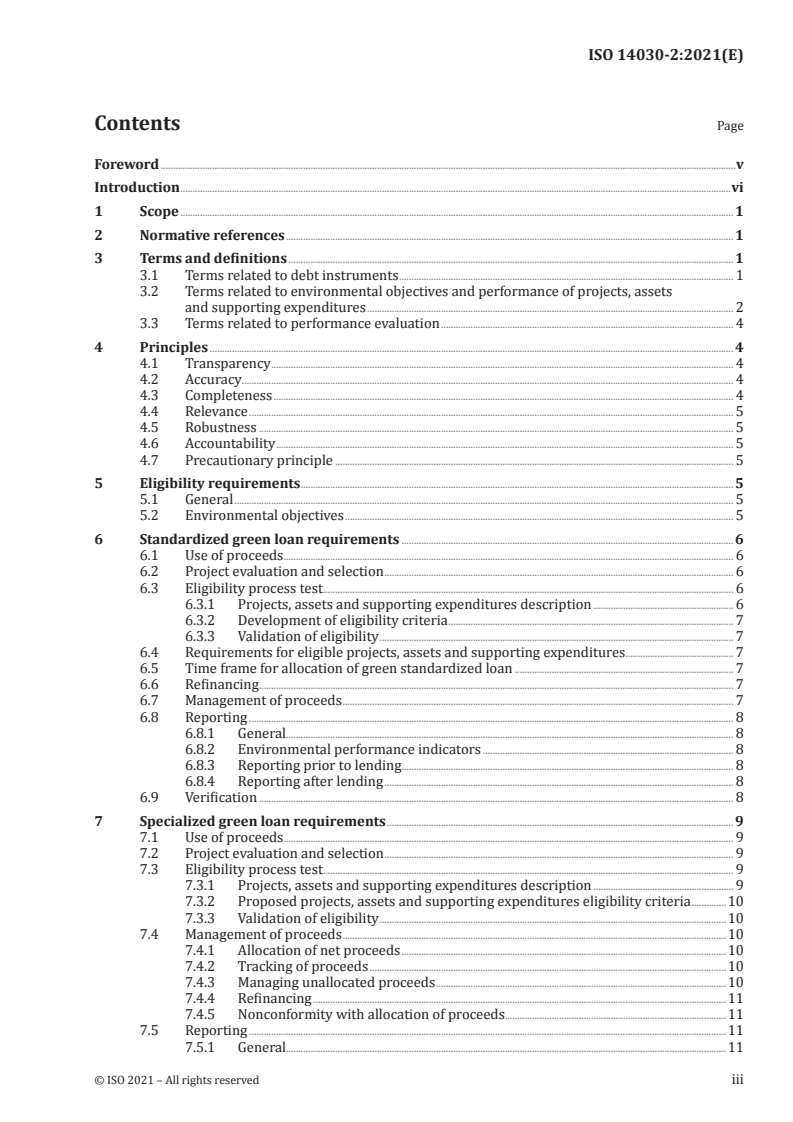
Contents Page
Foreword .v
Introduction .vi
1 Scope . 1
2 Normative references . 1
3 Terms and definitions . 1
3.1 Terms related to debt instruments . 1
3.2 Terms related to environmental objectives and performance of projects, assets
and supporting expenditures . 2
3.3 Terms related to performance evaluation . 4
4 Principles . 4
4.1 Transparency . 4
4.2 Accuracy . 4
4.3 Completeness . 4
4.4 Relevance . 5
4.5 Robustness . 5
4.6 Accountability . 5
4.7 Precautionary principle . 5
5 Eligibility requirements . 5
5.1 General . 5
5.2 Environmental objectives . 5
6 Standardized green loan requirements . 6
6.1 Use of proceeds . 6
6.2 Project evaluation and selection . 6
6.3 Eligibility process test . 6
6.3.1 Projects, assets and supporting expenditures description . 6
6.3.2 Development of eligibility criteria . 7
6.3.3 Validation of eligibility . 7
6.4 Requirements for eligible projects, assets and supporting expenditures. 7
6.5 Time frame for allocation of green standardized loan . 7
6.6 Refinancing . 7
6.7 Management of proceeds . 7
6.8 Reporting . 8
6.8.1 General. 8
6.8.2 Environmental performance indicators . 8
6.8.3 Reporting prior to lending . 8
6.8.4 Reporting after lending . 8
6.9 Verification . 8
7 Specialized green loan requirements . 9
7.1 Use of proceeds . 9
7.2 Project evaluation and selection . 9
7.3 Eligibility process test . 9
7.3.1 Projects, assets and supporting expenditures description . 9
7.3.2 Proposed projects, assets and supporting expenditures eligibility criteria .10
7.3.3 Validation of eligibility .10
7.4 Management of proceeds .10
7.4.1 Allocation of net proceeds .10
7.4.2 Tracking of proceeds .10
7.4.3 Managing unallocated proceeds .10
7.4.4 Refinancing .11
7.4.5 Nonconformity with allocation of proceeds .11
7.5 Reporting .11
7.5.1 General.11
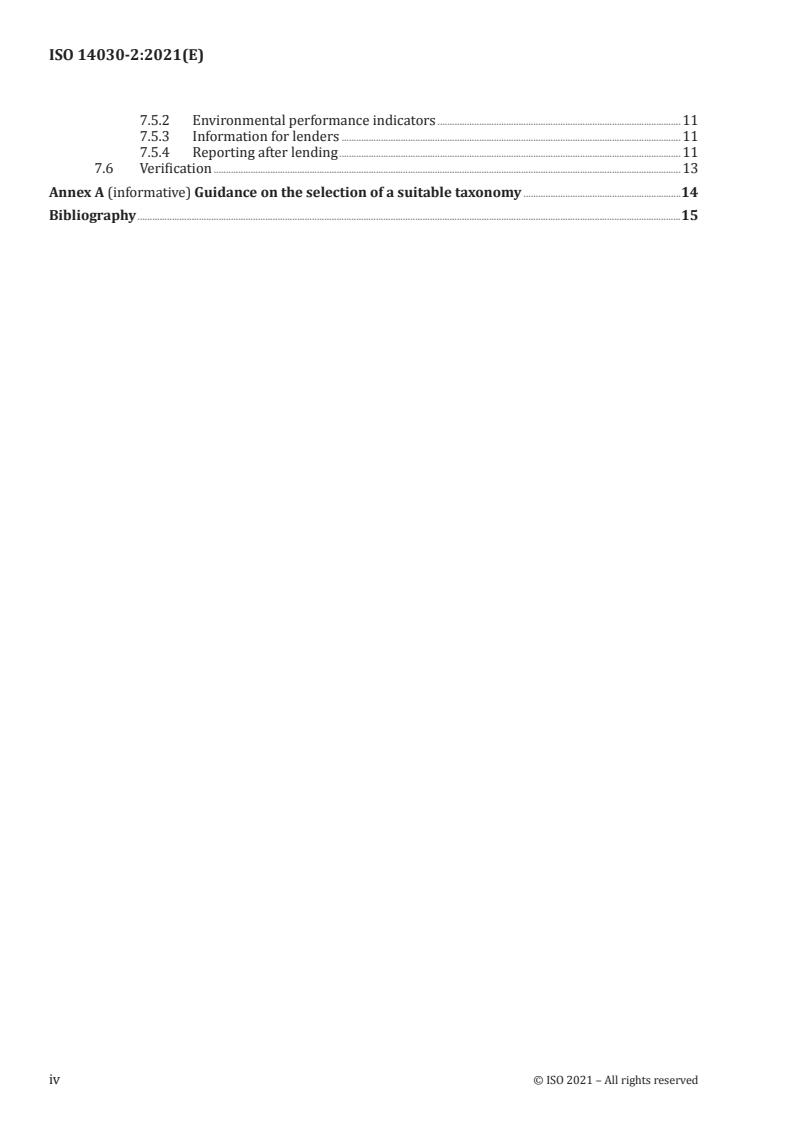
7.5.2 Environmental performance indicators .11
7.5.3 Information for lenders .11
7.5.4 Reporting after lending .11
7.6 Verification .13
Annex A (informative) Guidance on the selection of a suitable taxonomy .14
Bibliography .15
iv © ISO 2021 – All rights reserved
Foreword
ISO (the International Organization for Standardization) is a worldwide federation of national standards
bodies (ISO member bodies). The work of preparing International Standards is normally carried out
through ISO technical committees. Each member body interested in a subject for which a technical
committee has been established has the right to be represented on that committee. International
organizations, governmental and non-governmental, in liaison with ISO, also take part in the work.
ISO collaborates closely with the International Electrotechnical Commission (IEC) on all matters of
electrotechnical standardization.
The procedures used to develop this document and those intended for its further maintenance are
described in the ISO/IEC Directives, Part 1. In particular, the different approval criteria needed for the
different types of ISO documents should be noted. This document was drafted in accordance with the
editorial rules of the ISO/IEC Directives, Part 2 (see www .iso .org/ directives).
Attention is drawn to the possibility that some of the elements of this document may be the subject of
patent rights. ISO shall not be held responsible for identifying any or all such patent rights. Details of
any patent rights identified during the development of the document will be in the Introduction and/or
on the ISO list of patent declarations received (see www .iso .org/ patents).
Any trade name used in this document is information given for the convenience of users and does not
constitute an endorsement.
For an explanation of the voluntary nature of standards, the meaning of ISO specific terms and
expressions related to conformity assessment, as well as information about ISO’s adherence to the
World Trade Organization (WTO) principles in the Technical Barriers to Trade (TBT), see www .iso .org/
iso/ foreword .html.
This document was prepared by Technical Committee ISO/TC 207, Environmental management,
Subcommittee SC 4, Environmental performance evaluation.
A list of all parts in the ISO 14030 series can be found on the ISO website.
Any feedback or questions on this document should be directed to the user’s national standards body. A
complete listing of these bodies can be found at www .iso .org/ members .html.
Introduction
Green debt financing has become an important tool to provide funding to meet growing environmental
challenges. For financial and other institutions which offer loans, the designation as “green” can be
used to finance projects, assets and supporting expenditures that result in potential environmental
benefits such as aligning with global climate goals, protecting the environment and conserving natural
resources. For lenders, borrowers and intermediaries, green loans are an attractive option with
growing market appeal.
The growth in demand for green investments has also led to concerns over “greenwashing”, i.e.
intended or inadvertent misrepresentation of green-related attributes. However, the clear, consistent,
robust and transparent assessment, management and reporting of positive and negative impacts can
offer confidence and reassurance to investors and other interested parties.
[13]
This document expands on the Loan Market Association’s Green Loan Principles by offering specific
requirements and guidance for the eligibility of green loans. The intended result is to provide clarity on,
and improve the credibility of, green loans. Like ISO 14030-1, this is achieved by setting requirements
for the allocation of funds to projects, assets and supporting expenditures and for requiring reporting
on actual or expected impacts.
The following elements of the process for issuing and managing a green loan have been drawn from the
process defined within ISO 14030-1 and the Green Loan Principles with a view to promoting consistency
across debt instruments:
— use of proceeds;
— process for evaluation and selection;
— management of proceeds;
— reporting.
This document also provides specific requirements for lender and borrower responsibilities related to
additional documentation, loan refinancing and reporting.
The process for green loans is similar to ISO 14030-1. Both focus on the elements of green financing:
the use of proceeds, the process for project evaluation and selection, the management of proceeds, and
reporting.
vi © ISO 2021 – All rights reserved
Figure 1 outlines the relationship between the four parts of the ISO 14030 series.
Figure 1 — Relationship between the parts of the ISO 14030 series
In this document:
— “shall” indicates a requirement;
— “should” indicates a recommendation;
— “may” indicates a permission;
— “can” indicates a possibility or a capability.
Information marked “NOTE” is for guidance in understanding or clarifying the associated requirement.
INTERNATIONAL STANDARD ISO 14030-2:2021(E)
Environmental performance evaluation — Green debt
instruments —
Part 2:
Process for green loans
1 Scope
This document establishes principles, specifies requirements and gives guidelines:
— for designating as “green” loans which finance eligible projects, assets and supporting expenditures;
— for managing and reporting on the use of proceeds;
— for defining, monitoring and reporting on the environmental impacts;
— for reporting to interested parties;
— for validation and verification.
This document is applicable to any borrower seeking financing by way of a green loan for eligible green
projects, assets and supporting expenditures. It is also applicable to lenders.
2 Normative references
There are no normative references in this document.
3 Terms and definitions
For the purposes of this document, the following terms and definitions apply.
ISO and IEC maintain terminology databases for use in standardization at the following addresses:
— ISO Online browsing platform: available at https:// www .iso .org/ obp
— IEC Electropedia: available at https:// www .electropedia .org/
3.1 Terms related to debt instruments
3.1.1
debt instrument
obligation that enables a party to raise funds by promising to repay a lender (3.1.6) in accordance with
the terms of a contract
3.1.2
green debt instrument
debt instrument (3.1.1) whose net proceeds or an amount equivalent to the net proceeds will be
exclusively applied to finance or refinance in part or in full new or existing eligible projects, assets and
supporting expenditures
3.1.3
borrower
person or entity who has contracted a loan (3.1.4)
3.1.4
loan
money lent, usually at interest, by one or more lenders (3.1.6) to a borrower (3.1.3) for a limited period
3.1.5
green loan
loan (3.1.4) whose net proceeds will be exclusively applied to finance or refinance, in part or in full, new
or existing eligible projects, assets and supporting expenditures
3.1.6
lender
institution or other entity that makes funds available to a borrower (3.1.3), with the expectation that
those funds will be repaid
Note 1 to entry: For the purposes of this document, the term “lender” is generic and includes all financial
organizations that make loans to individuals, small- and medium-sized enterprises, independently to the
investees.
Note 2 to entry: “Lenders” include, without limitation, chartered banks, insurance companies, cooperative banks,
crowdfunding companies, revolving credit companies, Islamic banks, individuals and solidarity-based finance
providers.
3.1.7
standardized green loan
green loan (3.1.5) provided on standard terms and conditions, typically made available to borrowers
(3.1.3) with limited size and resources
3.1.8
specialized green loan
green loan (3.1.5) provided on bespoke terms and conditions, where the borrower (3.1.3) has the
resources to assess the eligibility of a proposed project, asset and supporting expenditure
3.2 Terms related to environmental objectives and performance of projects, assets and
supporting expenditures
3.2.1
objective
result to be achieved
[SOURCE: ISO 14001:2015, 3.2.5, modified — The notes to entry have been deleted.]
3.2.2
environment
surroundings in which an organization operates, including air, water, land, natural resources, flora,
fauna, humans and their interrelationships
Note 1 to entry: For the purposes of this document, the phrase “in which an organization operates” is understood
as “inherent to or affected directly or indirectly by the eligible projects, assets and supporting expenditures of
the loan or other debt instruments.”
[SOURCE: ISO 14001:2015, 3.2.1, modified — Notes 1 and 2 to entry have been deleted and a new Note 1
to entry has been added.]
3.2.3
environmental objective
objective (3.2.1) set by the borrower (3.1.3) or lender (3.1.6) that relates to the environment (3.2.2)
2 © ISO 2021 – All rights reserved
3.2.4
environmental performance
performance related to the management of environmental aspects (3.2.9)
[SOURCE: ISO 14001:2015, 3.4.11, modified — Note 1 to entry has been deleted.]
3.2.5
impact
change that can be adverse or beneficial
[SOURCE: ISO 15392:2019, 3.17, modified — The words “result of a change or existing condition” have
been replaced with “change” and the words “may be adverse, neutral or beneficial” have been replaced
with “can be adverse or beneficial”.]
3.2.6
environmental impact
impact (3.2.5) to or conservation of the environment (3.2.2), wholly or partially resulting from eligible
projects, assets and supporting expenditures
3.2.7
outcome
change resulting from the use of the output from a project, asset and supporting expenditure
[SOURCE: ISO 21502:2020, 3.13, modified — “asset and supporting expenditure” has been added.]
3.2.8
natural capital
stock of renewable and non-renewable natural resources (e.g. plants, animals, air, water, soils, minerals)
that combine to yield a flow of benefits to people
[15]
[SOURCE: Natural Capital Coalition ]
3.2.9
environmental aspect
element of an organization’s activities or products or services that interacts or can interact with the
environment (3.2.2)
Note 1 to entry: An environmental aspect can cause (an) environmental impact(s) (3.2.6). A significant
environmental aspect is one that has or can have one or more significant environmental impact(s).
Note 2 to entry: Significant environmental aspects are determined by the organization applying one or more
criteria.
[SOURCE: ISO 14001:2015, 3.2.2]
3.2.10
prevention of pollution
use of processes (3.3.3), practices, techniques, materials, products, services or energy to avoid, reduce
or control (separately or in combination) the creation, emission or discharge of any type of pollutant or
waste, in order to reduce adverse environmental impacts (3.2.9)
Note 1 to entry: Prevention of pollution can include source reduction or elimination; process, product or service
changes; efficient use of resources; material and energy substitution; reuse; recovery; recycling, reclamation; or
treatment.
[SOURCE: ISO 14001:2015, 3.2.7]
3.3 Terms related to performance evaluation
3.3.1
indicator
quantitative, qualitative or binary variable that can be measured or described, representing the status
of operations, management, conditions or impacts
[SOURCE: ISO 14031:2021, 3.4.1]
3.3.2
monitoring
determining the status of a system, a process (3.3.3) or an activity
[SOURCE: ISO 14001:2015, 3.4.8, modified — Note 1 to entry has been deleted.]
3.3.3
process
set of interrelated or interacting activities which transforms inputs into outputs
[SOURCE: ISO 14001:2015, 3.3.5, modified — Note 1 to entry has been deleted.]
3.3.4
validation
process (3.3.3) for evaluating the reasonableness of the assumptions, limitations and methods that
support a statement about the outcome of future activities
[SOURCE: ISO 14065:2020, 3.3.16]
3.3.5
verification
process (3.3.3) for evaluating a statement of historical data and information to determine if the
statement is materially correct and conforms to criteria
[SOURCE: ISO 14064-3:2019, 3.6.2]
3.3.6
verifier
competent and impartial person with responsibility for performing and reporting on a verification
(3.3.5)
[SOURCE: ISO 14064-3:2019, 3.2.6]
4 Principles
4.1 Transparency
Reports and communication on the environmental aspects are based on an open, comprehensive and
understandable presentation of information.
4.2 Accuracy
Bias and uncertainties are reduced as far as is practical.
4.3 Completeness
All relevant information is included.
4 © ISO 2021 – All rights reserved
4.4 Relevance
Information and data are selected that are appropriate to the needs of the intended user.
4.5 Robustness
Organizations use appropriate methodological approaches and information sources grounded in
the latest science to support their decision-making and environmental actions. Acknowledgement of
uncertainties is recognized as a particularly valuable contribution to decision-making.
4.6 Accountability
Organizations acknowledge and assume responsibility for their positive and negative environmental
aspects and assessment processes. They accept appropriate scrutiny and also accept a duty to respond
to this scrutiny.
4.7 Precautionary principle
Significant risks to the environment, natural habitats, biodiversity, and human health and welfare are
avoided, reduced and mitigated.
5 Eligibility requirements
5.1 General
Projects, assets and supporting expenditures that meet the eligibility criteria described in ISO 14030-3
or other suitable ta
...
INTERNATIONAL ISO
STANDARD 14030-2
First edition
2021-09
Environmental performance
evaluation — Green debt
instruments —
Part 2:
Process for green loans
Évaluation de la performance environnementale — Titres de créance
verts —
Partie 2: Processus pour les crédits verts
Reference number
©
ISO 2021
© ISO 2021
All rights reserved. Unless otherwise specified, or required in the context of its implementation, no part of this publication may
be reproduced or utilized otherwise in any form or by any means, electronic or mechanical, including photocopying, or posting
on the internet or an intranet, without prior written permission. Permission can be requested from either ISO at the address
below or ISO’s member body in the country of the requester.
ISO copyright office
CP 401 • Ch. de Blandonnet 8
CH-1214 Vernier, Geneva
Phone: +41 22 749 01 11
Email: copyright@iso.org
Website: www.iso.org
Published in Switzerland
ii © ISO 2021 – All rights reserved
Contents Page
Foreword .v
Introduction .vi
1 Scope . 1
2 Normative references . 1
3 Terms and definitions . 1
3.1 Terms related to debt instruments . 1
3.2 Terms related to environmental objectives and performance of projects, assets
and supporting expenditures . 2
3.3 Terms related to performance evaluation . 4
4 Principles . 4
4.1 Transparency . 4
4.2 Accuracy . 4
4.3 Completeness . 4
4.4 Relevance . 5
4.5 Robustness . 5
4.6 Accountability . 5
4.7 Precautionary principle . 5
5 Eligibility requirements . 5
5.1 General . 5
5.2 Environmental objectives . 5
6 Standardized green loan requirements . 6
6.1 Use of proceeds . 6
6.2 Project evaluation and selection . 6
6.3 Eligibility process test . 6
6.3.1 Projects, assets and supporting expenditures description . 6
6.3.2 Development of eligibility criteria . 7
6.3.3 Validation of eligibility . 7
6.4 Requirements for eligible projects, assets and supporting expenditures. 7
6.5 Time frame for allocation of green standardized loan . 7
6.6 Refinancing . 7
6.7 Management of proceeds . 7
6.8 Reporting . 8
6.8.1 General. 8
6.8.2 Environmental performance indicators . 8
6.8.3 Reporting prior to lending . 8
6.8.4 Reporting after lending . 8
6.9 Verification . 8
7 Specialized green loan requirements . 9
7.1 Use of proceeds . 9
7.2 Project evaluation and selection . 9
7.3 Eligibility process test . 9
7.3.1 Projects, assets and supporting expenditures description . 9
7.3.2 Proposed projects, assets and supporting expenditures eligibility criteria .10
7.3.3 Validation of eligibility .10
7.4 Management of proceeds .10
7.4.1 Allocation of net proceeds .10
7.4.2 Tracking of proceeds .10
7.4.3 Managing unallocated proceeds .10
7.4.4 Refinancing .11
7.4.5 Nonconformity with allocation of proceeds .11
7.5 Reporting .11
7.5.1 General.11
7.5.2 Environmental performance indicators .11
7.5.3 Information for lenders .11
7.5.4 Reporting after lending .11
7.6 Verification .13
Annex A (informative) Guidance on the selection of a suitable taxonomy .14
Bibliography .15
iv © ISO 2021 – All rights reserved
Foreword
ISO (the International Organization for Standardization) is a worldwide federation of national standards
bodies (ISO member bodies). The work of preparing International Standards is normally carried out
through ISO technical committees. Each member body interested in a subject for which a technical
committee has been established has the right to be represented on that committee. International
organizations, governmental and non-governmental, in liaison with ISO, also take part in the work.
ISO collaborates closely with the International Electrotechnical Commission (IEC) on all matters of
electrotechnical standardization.
The procedures used to develop this document and those intended for its further maintenance are
described in the ISO/IEC Directives, Part 1. In particular, the different approval criteria needed for the
different types of ISO documents should be noted. This document was drafted in accordance with the
editorial rules of the ISO/IEC Directives, Part 2 (see www .iso .org/ directives).
Attention is drawn to the possibility that some of the elements of this document may be the subject of
patent rights. ISO shall not be held responsible for identifying any or all such patent rights. Details of
any patent rights identified during the development of the document will be in the Introduction and/or
on the ISO list of patent declarations received (see www .iso .org/ patents).
Any trade name used in this document is information given for the convenience of users and does not
constitute an endorsement.
For an explanation of the voluntary nature of standards, the meaning of ISO specific terms and
expressions related to conformity assessment, as well as information about ISO’s adherence to the
World Trade Organization (WTO) principles in the Technical Barriers to Trade (TBT), see www .iso .org/
iso/ foreword .html.
This document was prepared by Technical Committee ISO/TC 207, Environmental management,
Subcommittee SC 4, Environmental performance evaluation.
A list of all parts in the ISO 14030 series can be found on the ISO website.
Any feedback or questions on this document should be directed to the user’s national standards body. A
complete listing of these bodies can be found at www .iso .org/ members .html.
Introduction
Green debt financing has become an important tool to provide funding to meet growing environmental
challenges. For financial and other institutions which offer loans, the designation as “green” can be
used to finance projects, assets and supporting expenditures that result in potential environmental
benefits such as aligning with global climate goals, protecting the environment and conserving natural
resources. For lenders, borrowers and intermediaries, green loans are an attractive option with
growing market appeal.
The growth in demand for green investments has also led to concerns over “greenwashing”, i.e.
intended or inadvertent misrepresentation of green-related attributes. However, the clear, consistent,
robust and transparent assessment, management and reporting of positive and negative impacts can
offer confidence and reassurance to investors and other interested parties.
[13]
This document expands on the Loan Market Association’s Green Loan Principles by offering specific
requirements and guidance for the eligibility of green loans. The intended result is to provide clarity on,
and improve the credibility of, green loans. Like ISO 14030-1, this is achieved by setting requirements
for the allocation of funds to projects, assets and supporting expenditures and for requiring reporting
on actual or expected impacts.
The following elements of the process for issuing and managing a green loan have been drawn from the
process defined within ISO 14030-1 and the Green Loan Principles with a view to promoting consistency
across debt instruments:
— use of proceeds;
— process for evaluation and selection;
— management of proceeds;
— reporting.
This document also provides specific requirements for lender and borrower responsibilities related to
additional documentation, loan refinancing and reporting.
The process for green loans is similar to ISO 14030-1. Both focus on the elements of green financing:
the use of proceeds, the process for project evaluation and selection, the management of proceeds, and
reporting.
vi © ISO 2021 – All rights reserved
Figure 1 outlines the relationship between the four parts of the ISO 14030 series.
Figure 1 — Relationship between the parts of the ISO 14030 series
In this document:
— “shall” indicates a requirement;
— “should” indicates a recommendation;
— “may” indicates a permission;
— “can” indicates a possibility or a capability.
Information marked “NOTE” is for guidance in understanding or clarifying the associated requirement.
INTERNATIONAL STANDARD ISO 14030-2:2021(E)
Environmental performance evaluation — Green debt
instruments —
Part 2:
Process for green loans
1 Scope
This document establishes principles, specifies requirements and gives guidelines:
— for designating as “green” loans which finance eligible projects, assets and supporting expenditures;
— for managing and reporting on the use of proceeds;
— for defining, monitoring and reporting on the environmental impacts;
— for reporting to interested parties;
— for validation and verification.
This document is applicable to any borrower seeking financing by way of a green loan for eligible green
projects, assets and supporting expenditures. It is also applicable to lenders.
2 Normative references
There are no normative references in this document.
3 Terms and definitions
For the purposes of this document, the following terms and definitions apply.
ISO and IEC maintain terminology databases for use in standardization at the following addresses:
— ISO Online browsing platform: available at https:// www .iso .org/ obp
— IEC Electropedia: available at https:// www .electropedia .org/
3.1 Terms related to debt instruments
3.1.1
debt instrument
obligation that enables a party to raise funds by promising to repay a lender (3.1.6) in accordance with
the terms of a contract
3.1.2
green debt instrument
debt instrument (3.1.1) whose net proceeds or an amount equivalent to the net proceeds will be
exclusively applied to finance or refinance in part or in full new or existing eligible projects, assets and
supporting expenditures
3.1.3
borrower
person or entity who has contracted a loan (3.1.4)
3.1.4
loan
money lent, usually at interest, by one or more lenders (3.1.6) to a borrower (3.1.3) for a limited period
3.1.5
green loan
loan (3.1.4) whose net proceeds will be exclusively applied to finance or refinance, in part or in full, new
or existing eligible projects, assets and supporting expenditures
3.1.6
lender
institution or other entity that makes funds available to a borrower (3.1.3), with the expectation that
those funds will be repaid
Note 1 to entry: For the purposes of this document, the term “lender” is generic and includes all financial
organizations that make loans to individuals, small- and medium-sized enterprises, independently to the
investees.
Note 2 to entry: “Lenders” include, without limitation, chartered banks, insurance companies, cooperative banks,
crowdfunding companies, revolving credit companies, Islamic banks, individuals and solidarity-based finance
providers.
3.1.7
standardized green loan
green loan (3.1.5) provided on standard terms and conditions, typically made available to borrowers
(3.1.3) with limited size and resources
3.1.8
specialized green loan
green loan (3.1.5) provided on bespoke terms and conditions, where the borrower (3.1.3) has the
resources to assess the eligibility of a proposed project, asset and supporting expenditure
3.2 Terms related to environmental objectives and performance of projects, assets and
supporting expenditures
3.2.1
objective
result to be achieved
[SOURCE: ISO 14001:2015, 3.2.5, modified — The notes to entry have been deleted.]
3.2.2
environment
surroundings in which an organization operates, including air, water, land, natural resources, flora,
fauna, humans and their interrelationships
Note 1 to entry: For the purposes of this document, the phrase “in which an organization operates” is understood
as “inherent to or affected directly or indirectly by the eligible projects, assets and supporting expenditures of
the loan or other debt instruments.”
[SOURCE: ISO 14001:2015, 3.2.1, modified — Notes 1 and 2 to entry have been deleted and a new Note 1
to entry has been added.]
3.2.3
environmental objective
objective (3.2.1) set by the borrower (3.1.3) or lender (3.1.6) that relates to the environment (3.2.2)
2 © ISO 2021 – All rights reserved
3.2.4
environmental performance
performance related to the management of environmental aspects (3.2.9)
[SOURCE: ISO 14001:2015, 3.4.11, modified — Note 1 to entry has been deleted.]
3.2.5
impact
change that can be adverse or beneficial
[SOURCE: ISO 15392:2019, 3.17, modified — The words “result of a change or existing condition” have
been replaced with “change” and the words “may be adverse, neutral or beneficial” have been replaced
with “can be adverse or beneficial”.]
3.2.6
environmental impact
impact (3.2.5) to or conservation of the environment (3.2.2), wholly or partially resulting from eligible
projects, assets and supporting expenditures
3.2.7
outcome
change resulting from the use of the output from a project, asset and supporting expenditure
[SOURCE: ISO 21502:2020, 3.13, modified — “asset and supporting expenditure” has been added.]
3.2.8
natural capital
stock of renewable and non-renewable natural resources (e.g. plants, animals, air, water, soils, minerals)
that combine to yield a flow of benefits to people
[15]
[SOURCE: Natural Capital Coalition ]
3.2.9
environmental aspect
element of an organization’s activities or products or services that interacts or can interact with the
environment (3.2.2)
Note 1 to entry: An environmental aspect can cause (an) environmental impact(s) (3.2.6). A significant
environmental aspect is one that has or can have one or more significant environmental impact(s).
Note 2 to entry: Significant environmental aspects are determined by the organization applying one or more
criteria.
[SOURCE: ISO 14001:2015, 3.2.2]
3.2.10
prevention of pollution
use of processes (3.3.3), practices, techniques, materials, products, services or energy to avoid, reduce
or control (separately or in combination) the creation, emission or discharge of any type of pollutant or
waste, in order to reduce adverse environmental impacts (3.2.9)
Note 1 to entry: Prevention of pollution can include source reduction or elimination; process, product or service
changes; efficient use of resources; material and energy substitution; reuse; recovery; recycling, reclamation; or
treatment.
[SOURCE: ISO 14001:2015, 3.2.7]
3.3 Terms related to performance evaluation
3.3.1
indicator
quantitative, qualitative or binary variable that can be measured or described, representing the status
of operations, management, conditions or impacts
[SOURCE: ISO 14031:2021, 3.4.1]
3.3.2
monitoring
determining the status of a system, a process (3.3.3) or an activity
[SOURCE: ISO 14001:2015, 3.4.8, modified — Note 1 to entry has been deleted.]
3.3.3
process
set of interrelated or interacting activities which transforms inputs into outputs
[SOURCE: ISO 14001:2015, 3.3.5, modified — Note 1 to entry has been deleted.]
3.3.4
validation
process (3.3.3) for evaluating the reasonableness of the assumptions, limitations and methods that
support a statement about the outcome of future activities
[SOURCE: ISO 14065:2020, 3.3.16]
3.3.5
verification
process (3.3.3) for evaluating a statement of historical data and information to determine if the
statement is materially correct and conforms to criteria
[SOURCE: ISO 14064-3:2019, 3.6.2]
3.3.6
verifier
competent and impartial person with responsibility for performing and reporting on a verification
(3.3.5)
[SOURCE: ISO 14064-3:2019, 3.2.6]
4 Principles
4.1 Transparency
Reports and communication on the environmental aspects are based on an open, comprehensive and
understandable presentation of information.
4.2 Accuracy
Bias and uncertainties are reduced as far as is practical.
4.3 Completeness
All relevant information is included.
4 © ISO 2021 – All rights reserved
4.4 Relevance
Information and data are selected that are appropriate to the needs of the intended user.
4.5 Robustness
Organizations use appropriate methodological approaches and information sources grounded in
the latest science to support their decision-making and environmental actions. Acknowledgement of
uncertainties is recognized as a particularly valuable contribution to decision-making.
4.6 Accountability
Organizations acknowledge and assume responsibility for their positive and negative environmental
aspects and assessment processes. They accept appropriate scrutiny and also accept a duty to respond
to this scrutiny.
4.7 Precautionary principle
Significant risks to the environment, natural habitats, biodiversity, and human health and welfare are
avoided, reduced and mitigated.
5 Eligibility requirements
5.1 General
Projects, assets and supporting expenditures that meet the eligibility criteria described in ISO 14030-3
or other suitable ta
...
NORME ISO
INTERNATIONALE 14030-2
Première édition
2021-09
Évaluation de la performance
environnementale — Titres de
créance verts —
Partie 2:
Processus pour les crédits verts
Environmental performance evaluation — Green debt instruments —
Part 2: Process for green loans
Numéro de référence
©
ISO 2021
DOCUMENT PROTÉGÉ PAR COPYRIGHT
© ISO 2021
Tous droits réservés. Sauf prescription différente ou nécessité dans le contexte de sa mise en œuvre, aucune partie de cette
publication ne peut être reproduite ni utilisée sous quelque forme que ce soit et par aucun procédé, électronique ou mécanique,
y compris la photocopie, ou la diffusion sur l’internet ou sur un intranet, sans autorisation écrite préalable. Une autorisation peut
être demandée à l’ISO à l’adresse ci-après ou au comité membre de l’ISO dans le pays du demandeur.
ISO copyright office
Case postale 401 • Ch. de Blandonnet 8
CH-1214 Vernier, Genève
Tél.: +41 22 749 01 11
E-mail: copyright@iso.org
Web: www.iso.org
Publié en Suisse
ii © ISO 2021 – Tous droits réservés
Sommaire Page
Avant-propos .v
Introduction .vi
1 Domaine d’application . 1
2 Références normatives . 1
3 Termes et définitions . 1
3.1 Termes relatifs aux titres de créance . 1
3.2 Termes relatifs aux objectifs environnementaux et à la performance
environnementale des projets, actifs et dépenses annexes. 2
3.3 Termes relatifs à l’évaluation des performances . 4
4 Principes . 4
4.1 Transparence . 4
4.2 Exactitude . 4
4.3 Complétude . 4
4.4 Pertinence . 5
4.5 Solidité . 5
4.6 Responsabilité . 5
4.7 Principe de précaution . 5
5 Exigences d’éligibilité . 5
5.1 Généralités . 5
5.2 Objectifs environnementaux . 5
6 Exigences relatives aux crédits verts normalisés . 6
6.1 Utilisation des fonds . 6
6.2 Évaluation et sélection des projets . 6
6.3 Processus de contrôle d’éligibilité . 6
6.3.1 Description des projets, actifs et dépenses annexes . 6
6.3.2 Élaboration des critères d’éligibilité . 7
6.3.3 Validation de l’éligibilité . 7
6.4 Exigences relatives aux projets actifs et dépenses annexes éligibles . 7
6.5 Délai d’allocation du crédit vert normalisé . 7
6.6 Refinancement . 7
6.7 Gestion des fonds . 8
6.8 Rapport . 8
6.8.1 Généralités . 8
6.8.2 Indicateurs de performance environnementale . 8
6.8.3 Rapport préalable aux crédits . 8
6.8.4 Rapports postérieurs aux crédits . 8
6.9 Vérification . 9
7 Exigences relatives aux crédits verts spécialisés . 9
7.1 Utilisation des fonds . 9
7.2 Évaluation et sélection des projets . 9
7.3 Processus de contrôle d’éligibilité . 9
7.3.1 Description des projets, actifs et dépenses annexes . 9
7.3.2 Critères d’éligibilité des projets, actifs et dépenses annexes proposés .10
7.3.3 Validation de l’éligibilité .10
7.4 Gestion des fonds .10
7.4.1 Allocation du produit net d’émission .10
7.4.2 Suivi des montants .10
7.4.3 Gestion des fonds non alloués .10
7.4.4 Refinancement .11
7.4.5 Non-conformité avec l’allocation des fonds .11
7.5 Rapport .11
7.5.1 Généralités .11
7.5.2 Indicateurs de performance environnementale .11
7.5.3 Informations pour les prêteurs .11
7.5.4 Rapports postérieurs aux crédits .12
7.6 Vérification .13
Annexe A (informative) Recommandations relatives à la sélection d’une taxinomie adéquate .14
Bibliographie .15
iv © ISO 2021 – Tous droits réservés
Avant-propos
L’ISO (Organisation internationale de normalisation) est une fédération mondiale d’organismes L’ISO
(Organisation internationale de normalisation) est une fédération mondiale d’organismes nationaux
de normalisation (comités membres de l’ISO). L’élaboration des Normes internationales est en général
confiée aux comités techniques de l’ISO. Chaque comité membre intéressé par une étude a le droit de
faire partie du comité technique créé à cet effet. Les organisations internationales, gouvernementales
et non gouvernementales, en liaison avec l’ISO participent également aux travaux. L’ISO collabore
étroitement avec la Commission électrotechnique internationale (IEC) en ce qui concerne la
normalisation électrotechnique.
Les procédures utilisées pour élaborer le présent document et celles destinées à sa mise à jour sont
décrites dans les Directives ISO/IEC, Partie 1. Il convient, en particulier de prendre note des différents
critères d’approbation requis pour les différents types de documents ISO. Le présent document a été
rédigé conformément aux règles de rédaction données dans les Directives ISO/IEC, Partie 2 (voir www
.iso .org/ directives).
L’attention est attirée sur le fait que certains des éléments du présent document peuvent faire l’objet de
droits de propriété intellectuelle ou de droits analogues. L’ISO ne saurait être tenue pour responsable
de ne pas avoir identifié de tels droits de propriété et averti de leur existence. Les détails concernant
les références aux droits de propriété intellectuelle ou autres droits analogues identifiés lors de
l’élaboration du document sont indiqués dans l’Introduction et/ou dans la liste des déclarations de
brevets reçues par l’ISO (voir www .iso .org/ brevets).
Les appellations commerciales éventuellement mentionnées dans le présent document sont données
pour information, par souci de commodité, à l’intention des utilisateurs et ne sauraient constituer un
engagement.
Pour une explication de la nature volontaire des normes, la signification des termes et expressions
spécifiques de l’ISO liés à l’évaluation de la conformité, ou pour toute information au sujet de l’adhésion
de l’ISO aux principes de l’Organisation mondiale du commerce (OMC) concernant les obstacles
techniques au commerce (OTC), voir www .iso .org/ avant -propos.
Le présent document a été élaboré par le comité technique ISO/TC 207, Management environnemental,
sous-comité SC 4, Évaluation de la performance environnementale.
Une liste de toutes les parties de la série ISO 14030 se trouve sur le site web de l’ISO.
Il convient que l’utilisateur adresse tout retour d’information ou toute question concernant le présent
document à l’organisme national de normalisation de son pays. Une liste exhaustive desdits organismes
se trouve à l’adresse www .iso .org/ fr/ members .html.
Introduction
Le financement par les titres de créances verts est aujourd’hui un outil important pour lever des fonds
pour faire face aux enjeux environnementaux croissants. Pour les institutions financières et autres
qui proposent des crédits, la désignation «vert» peut être utilisée au sens de financer des projets,
des actifs et des dépenses annexes qui apportent des bénéfices environnementaux potentiels tels que
l’alignement sur les objectifs climatiques mondiaux, la protection de l’environnement et la conservation
des ressources naturelles. Pour les prêteurs, les emprunteurs et les intermédiaires, les crédits verts
constituent une option attractive qui présente un intérêt croissant sur le marché.
La croissance de la demande en matière d’investissements verts a également suscité des inquiétudes
quant au «greenwashing», c’est-à-dire la représentation erronée, intentionnelle ou non, de qualités
environnementales. Cependant, une évaluation, une gestion et une publication claires, cohérentes,
solides et transparentes des impacts positifs et négatifs peuvent permettre de donner confiance et de
rassurer les investisseurs et les autres parties intéressées.
Le présent document s’appuie sur les principes des crédits verts (GLP, Green Loan Principles) de la
[13]
Loan Market Association en proposant des exigences et des recommandations spécifiques pour
l’éligibilité des crédits verts. Le résultat attendu est d’apporter de la clarté et de renforcer la crédibilité
des crédits verts. Pour ce faire, à l’instar de l’ISO 14030-1, des exigences sont fixées pour l’allocation de
fonds à des projets, actifs et dépenses annexes et pour rendre compte des impacts réels ou escomptés.
Les éléments suivants du processus d’émission et de gestion d’un crédit vert sont tirés du processus
défini dans l’ISO 14030-1 et des Principes des crédits verts (Green Loan Principles) dans le but de
promouvoir l’harmonisation entre les titres de créance:
— l’utilisation des fonds;
— le processus d’évaluation et de sélection;
— la gestion des fonds;
— les rapports.
Le présent document fournit également des exigences spécifiques concernant les responsabilités des
prêteurs et des emprunteurs en matière de documentation supplémentaire, de refinancement des
crédits et de rapports.
Le processus pour les crédits verts est semblable à l’ISO 14030-1. Les deux normes se concentrent sur
les éléments du financement vert: l’utilisation des fonds, le processus d’évaluation et de sélection des
projets, la gestion des fonds, et les rapports.
La Figure 1 décrit les relations entre les quatre parties de la série de normes ISO 14030.
vi © ISO 2021 – Tous droits réservés
Figure 1 — Relations entre les parties de la série de normes ISO 14030
Dans le présent document:
— «doit» indique une exigence;
— «il convient de»/«il est recommandé de» indique une recommandation;
— «peut» indique parfois («may» en anglais) une autorisation;
— ou encore («can» en anglais) une possibilité ou une capacité.
Les informations sous forme de «NOTE» sont fournies pour clarifier l’exigence associée ou en faciliter la
compréhension.
NORME INTERNATIONALE ISO 14030-2:2021(F)
Évaluation de la performance environnementale — Titres
de créance verts —
Partie 2:
Processus pour les crédits verts
1 Domaine d’application
Le présent document établit des principes, spécifie des exigences et donne des lignes directrices:
— pour les obligations désignées en tant que «vertes» finançant des projets, des actifs et des dépenses
annexes éligibles;
— pour la gestion et l’établissement de rapports d’utilisation des fonds;
— pour définir, surveiller et rapporter leurs impacts environnementaux;
— pour rapporter aux parties intéressées;
— pour valider et vérifier.
Le présent document peut être appliqué par tout emprunteur cherchant à obtenir un financement par le
biais d’un crédit vert pour des projets, des actifs et des dépenses annexes vert(e)s éligibles. Il est aussi
applicable aux prêteurs.
2 Références normatives
Le présent document ne contient aucune référence normative.
3 Termes et définitions
Pour les besoins du présent document, les termes et définitions suivants s’appliquent.
L’ISO et l’IEC tiennent à jour des bases de données terminologiques destinées à être utilisées en
normalisation, consultables aux adresses suivantes:
— ISO Online browsing platform: disponible à l’adresse https:// www .iso .org/ obp
— IEC Electropedia: disponible à l’adresse https:// www .electropedia .org/
3.1 Termes relatifs aux titres de créance
3.1.1
titre de créance
créance qui permet à une partie de lever des fonds en promettant de rembourser un prêteur (3.1.6)
conformément aux modalités d’un contrat
3.1.2
titre de créance vert
titre de créance (3.1.1) dont le produit net d’émission ou un montant équivalent au produit net d’émission
sera exclusivement affecté au financement ou au refinancement partiel ou total de projets, d’actifs et de
dépenses annexes éligibles nouveaux ou déjà existants
3.1.3
emprunteur
personne ou entreprise qui a contracté un crédit (3.1.4)
3.1.4
crédit
argent prêté, généralement avec intérêts, par un ou plusieurs prêteurs (3.1.6) à un emprunteur (3.1.3)
pour une période limitée
3.1.5
crédit vert
credit (3.1.4) dont le produit net d’émission sera exclusivement affecté au financement ou au
refinancement partiel ou total de projets, d’actifs et de dépenses annexes éligibles nouveaux ou existants
3.1.6
prêteur
institution ou autre entité qui met des fonds à la disposition d’un emprunteur (3.1.3) en espérant que
ces fonds seront remboursés
Note 1 à l'article: Dans le contexte du présent document, le terme «prêteur» est générique et inclut tous
les organismes financiers qui accordent des prêts aux particuliers, aux petites et moyennes entreprises,
indépendamment des bénéficiaires.
Note 2 à l'article: Les «prêteurs» incluent notamment des banques agréées, des compagnies d’assurance, des
banques coopératives, des sociétés de financement participatif, des sociétés de crédit renouvelable, des banques
islamiques, des particuliers et des fournisseurs de financement solidaire.
3.1.7
crédit vert normalisé
crédit vert (3.1.5) accordé selon des modalités standards, généralement mis à la disposition
d’emprunteurs (3.1.3) dont la taille et les ressources sont limitées
3.1.8
crédit vert spécialisé
crédit vert (3.1.5) accordé selon des modalités sur mesure, lorsque l’emprunteur (3.1.3) dispose
des ressources nécessaires pour évaluer l’éligibilité d’un projet, d’un actif et d’une dépense annexe
proposé(e)
3.2 Termes relatifs aux objectifs environnementaux et à la performance
environnementale des projets, actifs et dépenses annexes
3.2.1
objectif
résultat à atteindre
[SOURCE: ISO 14001:2015, 3.2.5, modifiée — Les notes à l’article ont été supprimées.]
3.2.2
environnement
milieu dans lequel un organisme fonctionne, incluant l’air, l’eau, le sol, les ressources naturelles, la flore,
la faune, les êtres humains et leurs interrelations
Note 1 à l'article: Dans la présente norme, l’expression «dans lequel un organisme fonctionne» signifie «inhérent
aux projets, actifs et dépenses annexes éligibles du crédit ou d’autres titres de créance ou influencé directement
ou indirectement par ceux-ci».
[SOURCE: ISO 14001:2015, 3.2.1, modifiée — Les Notes 1 et 2 à l’article ont été supprimées et une
nouvelle Note 1 à l’article a été ajoutée.]
2 © ISO 2021 – Tous droits réservés
3.2.3
objectif environnemental
objectif (3.2.1), fixé par l’emprunteur (3.1.3) ou le prêteur (3.1.6), qui se rapporte à l’environnement (3.2.2)
3.2.4
performance environnementale
performance liée au management des aspects environnementaux (3.2.9)
[SOURCE: ISO 14001:2015, 3.4.11, modifiée — La Note 1 à l’article a été supprimée.]
3.2.5
impact
changement pouvant avoir des effets négatifs ou positifs
[SOURCE: ISO 15392:2019, 3.17, modifiée — Les termes «résultat d’un changement ou d’état modifié ou
existant» ont été remplacés par «changement» et les termes «qui peut être négatif, neutre ou positif»
ont été remplacés «pouvant avoir des effets négatifs ou positifs».]
3.2.6
impact environnemental
impact (3.2.5) sur l’environnement (3.2.2) ou conservation de l’environnement, résultant totalement ou
partiellement des projets, actifs et dépenses annexes éligibles
3.2.7
résultat
changement résultant de l’utilisation de l’élément de sortie d’un projet, d’un actif et d’une dépense
annexe
[SOURCE: ISO 21502:2020, 3.13, modifiée — «d’un actif et d’une dépense annexe» a été ajouté.]
3.2.8
capital naturel
stock de ressources naturelles renouvelables et non renouvelables (par exemple, plantes, animaux, air,
eau, sols, minéraux) qui se combinent pour produire un ensemble de bénéfices pour les personnes
[15]
[SOURCE: Natural Capital Coalition ]
3.2.9
aspect environnemental
élément des activités, produits ou services d’un organisme interagissant ou susceptible d’interactions
avec l’environnement (3.2.2)
Note 1 à l'article: Un aspect environnemental peut causer un ou plusieurs impacts environnementaux (3.2.6).
Un aspect environnemental significatif est un aspect environnemental qui a ou peut avoir un ou plusieurs impacts
environnementaux significatifs.
Note 2 à l'article: Les aspects environnementaux significatifs sont déterminés par l’organisme en utilisant un ou
plusieurs critères.
[SOURCE: ISO 14001:2015, 3.2.2]
3.2.10
prévention de la pollution
utilisation de processus (3.3.3), pratiques, techniques, matériaux, produits, services ou énergie pour
éviter, réduire ou maîtriser (séparément ou par combinaison) la création, l’émission ou le rejet de tout
type de polluant ou déchet, afin de réduire les impacts environnementaux (3.2.9) négatifs
Note 1 à l'article: La prévention de la pollution peut inclure la réduction ou l’élimination à la source; les
modifications de processus, produits ou services; l’utilisation efficace des ressources; la substitution de
matériaux et d’énergie; la réutilisation; la récupération; le recyclage; la réhabilitation; ou le traitement.
[SOURCE: ISO 14001:2015, 3.2.7]
3.3 Termes relatifs à l’évaluation des performances
3.3.1
indicateur
variable quantitative, qualitative ou binaire qui peut être mesurée ou décrite, représentant le statut des
opérations, du management, des conditions ou des impacts
[SOURCE: ISO 14031:2021, 3.4.1]
3.3.2
surveillance
détermination de l’état d’un système, d’un processus (3.3.3) ou d’une activité
[SOURCE: ISO 14001:2015, 3.4.8, modifiée — La Note 1 à l’article a été supprimée.]
3.3.3
processus
ensemble d’activités corrélées ou en interaction qui transforme des éléments d’entrée en éléments
de sortie
[SOURCE: ISO 14001:2015, 3.3.5, modifiée — La Note 1 à l’article a été supprimée.]
3.3.4
validation
processus (3.3.3) d’évaluation du caractère raisonnable des hypothèses, des limites et des méthodes qui
viennent à l’appui d’une déclaration concernant le résultat d’activités futures
[SOURCE: ISO 14065:2020, 3.3.16]
3.3.5
vérification
processus (3.3.3) d’évaluation d’une déclaration de données historiques et d’informations pour
déterminer si la déclaration est matériellement correcte et conforme aux critères
[SOURCE: ISO 14064-3:2019, 3.6.2]
3.3.6
vérificateur
personne impartiale et compétente qui est responsable des performances et de la communication des
résultats d’un processus de vérification (3.3.5)
[SOURCE: ISO 14064-3:2019, 3.2.6]
4 Principes
4.1 Transparence
Les rapports et la communication relatifs aux aspects environnementaux sont basés sur une
présentation franche, complète et compréhensible des informations.
4.2 Exactitude
Les biais et les incertitudes sont réduits dans la mesure du possible.
4.3 Complétude
Toutes les informations pertinentes sont incluses.
4 © ISO 2021 – Tous droits réservés
4.4 Pertinence
Les informations et les données sont sélectionnées selon leur pertinence en fonction des intentions de
l’utilisateur cible.
4.5 Solidité
Les organismes utilisent des approches méthodologiques appropriées et des sources d’information
fondées sur les dernières connaissances scientifiques pour soutenir leurs prises de décisions et de leurs
actions environnementales. La connaissance des incertitudes est reconnue comme une contribution
particulièrement précieuse à la prise de décision.
4.6 Responsabilité
Les organismes reconnaissent et assument la responsabilité de leurs aspects environnementaux positifs
et négatifs et de leurs processus d’évaluation. Ils acceptent de se soumettre à un contrôle approprié et
acceptent également le devoir de répondre à ce contrôle.
4.7 Principe de précaution
Les risques significatifs pour l’environnement, les habitats naturels, la biodiversité ainsi que la santé et
le bien-être humains sont évités, réduits et atténués.
5 Exigences d’éligibilité
5.1 Généralités
Les projets, actifs et dépenses annexes qui répondent aux critères d’éligibilité décrits dans l’ISO 14030-3
ou dans une autre taxinomie adéquate sont éligibles pour être financés par un crédit vert. Pour les
projets, actifs et dépenses
...
NORME ISO
INTERNATIONALE 14030-2
Première édition
2021-09
Évaluation de la performance
environnementale — Titres de
créance verts —
Partie 2:
Processus pour les crédits verts
Environmental performance evaluation — Green debt instruments —
Part 2: Process for green loans
Numéro de référence
©
ISO 2021
DOCUMENT PROTÉGÉ PAR COPYRIGHT
© ISO 2021
Tous droits réservés. Sauf prescription différente ou nécessité dans le contexte de sa mise en œuvre, aucune partie de cette
publication ne peut être reproduite ni utilisée sous quelque forme que ce soit et par aucun procédé, électronique ou mécanique,
y compris la photocopie, ou la diffusion sur l’internet ou sur un intranet, sans autorisation écrite préalable. Une autorisation peut
être demandée à l’ISO à l’adresse ci-après ou au comité membre de l’ISO dans le pays du demandeur.
ISO copyright office
Case postale 401 • Ch. de Blandonnet 8
CH-1214 Vernier, Genève
Tél.: +41 22 749 01 11
E-mail: copyright@iso.org
Web: www.iso.org
Publié en Suisse
ii © ISO 2021 – Tous droits réservés
Sommaire Page
Avant-propos .v
Introduction .vi
1 Domaine d’application . 1
2 Références normatives . 1
3 Termes et définitions . 1
3.1 Termes relatifs aux titres de créance . 1
3.2 Termes relatifs aux objectifs environnementaux et à la performance
environnementale des projets, actifs et dépenses annexes. 2
3.3 Termes relatifs à l’évaluation des performances . 4
4 Principes . 4
4.1 Transparence . 4
4.2 Exactitude . 4
4.3 Complétude . 4
4.4 Pertinence . 5
4.5 Solidité . 5
4.6 Responsabilité . 5
4.7 Principe de précaution . 5
5 Exigences d’éligibilité . 5
5.1 Généralités . 5
5.2 Objectifs environnementaux . 5
6 Exigences relatives aux crédits verts normalisés . 6
6.1 Utilisation des fonds . 6
6.2 Évaluation et sélection des projets . 6
6.3 Processus de contrôle d’éligibilité . 6
6.3.1 Description des projets, actifs et dépenses annexes . 6
6.3.2 Élaboration des critères d’éligibilité . 7
6.3.3 Validation de l’éligibilité . 7
6.4 Exigences relatives aux projets actifs et dépenses annexes éligibles . 7
6.5 Délai d’allocation du crédit vert normalisé . 7
6.6 Refinancement . 7
6.7 Gestion des fonds . 8
6.8 Rapport . 8
6.8.1 Généralités . 8
6.8.2 Indicateurs de performance environnementale . 8
6.8.3 Rapport préalable aux crédits . 8
6.8.4 Rapports postérieurs aux crédits . 8
6.9 Vérification . 9
7 Exigences relatives aux crédits verts spécialisés . 9
7.1 Utilisation des fonds . 9
7.2 Évaluation et sélection des projets . 9
7.3 Processus de contrôle d’éligibilité . 9
7.3.1 Description des projets, actifs et dépenses annexes . 9
7.3.2 Critères d’éligibilité des projets, actifs et dépenses annexes proposés .10
7.3.3 Validation de l’éligibilité .10
7.4 Gestion des fonds .10
7.4.1 Allocation du produit net d’émission .10
7.4.2 Suivi des montants .10
7.4.3 Gestion des fonds non alloués .10
7.4.4 Refinancement .11
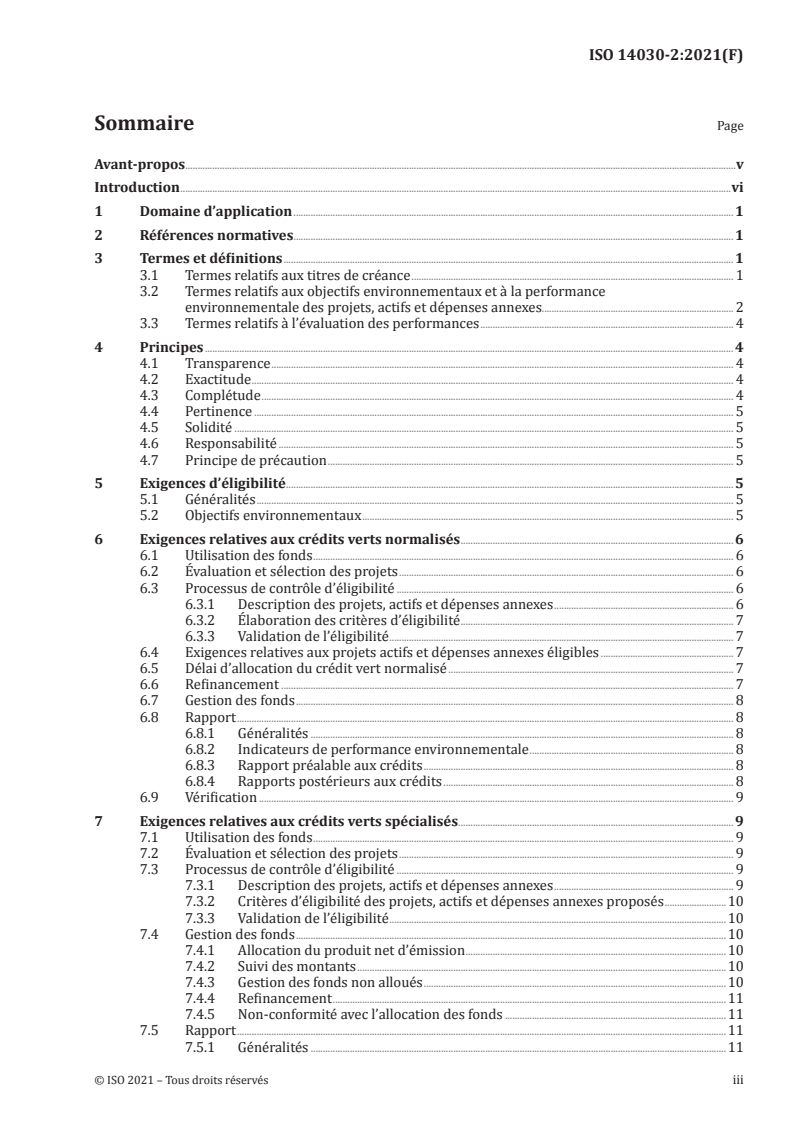
7.4.5 Non-conformité avec l’allocation des fonds .11
7.5 Rapport .11
7.5.1 Généralités .11
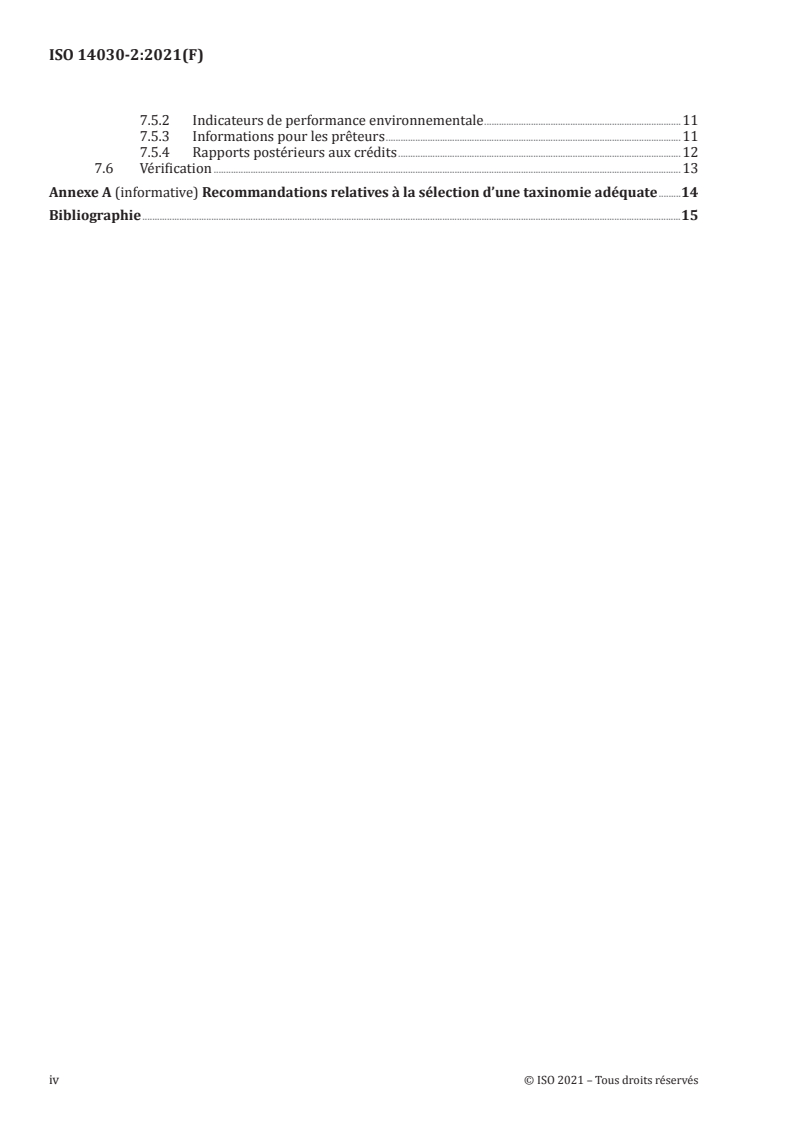
7.5.2 Indicateurs de performance environnementale .11
7.5.3 Informations pour les prêteurs .11
7.5.4 Rapports postérieurs aux crédits .12
7.6 Vérification .13
Annexe A (informative) Recommandations relatives à la sélection d’une taxinomie adéquate .14
Bibliographie .15
iv © ISO 2021 – Tous droits réservés
Avant-propos
L’ISO (Organisation internationale de normalisation) est une fédération mondiale d’organismes L’ISO
(Organisation internationale de normalisation) est une fédération mondiale d’organismes nationaux
de normalisation (comités membres de l’ISO). L’élaboration des Normes internationales est en général
confiée aux comités techniques de l’ISO. Chaque comité membre intéressé par une étude a le droit de
faire partie du comité technique créé à cet effet. Les organisations internationales, gouvernementales
et non gouvernementales, en liaison avec l’ISO participent également aux travaux. L’ISO collabore
étroitement avec la Commission électrotechnique internationale (IEC) en ce qui concerne la
normalisation électrotechnique.
Les procédures utilisées pour élaborer le présent document et celles destinées à sa mise à jour sont
décrites dans les Directives ISO/IEC, Partie 1. Il convient, en particulier de prendre note des différents
critères d’approbation requis pour les différents types de documents ISO. Le présent document a été
rédigé conformément aux règles de rédaction données dans les Directives ISO/IEC, Partie 2 (voir www
.iso .org/ directives).
L’attention est attirée sur le fait que certains des éléments du présent document peuvent faire l’objet de
droits de propriété intellectuelle ou de droits analogues. L’ISO ne saurait être tenue pour responsable
de ne pas avoir identifié de tels droits de propriété et averti de leur existence. Les détails concernant
les références aux droits de propriété intellectuelle ou autres droits analogues identifiés lors de
l’élaboration du document sont indiqués dans l’Introduction et/ou dans la liste des déclarations de
brevets reçues par l’ISO (voir www .iso .org/ brevets).
Les appellations commerciales éventuellement mentionnées dans le présent document sont données
pour information, par souci de commodité, à l’intention des utilisateurs et ne sauraient constituer un
engagement.
Pour une explication de la nature volontaire des normes, la signification des termes et expressions
spécifiques de l’ISO liés à l’évaluation de la conformité, ou pour toute information au sujet de l’adhésion
de l’ISO aux principes de l’Organisation mondiale du commerce (OMC) concernant les obstacles
techniques au commerce (OTC), voir www .iso .org/ avant -propos.
Le présent document a été élaboré par le comité technique ISO/TC 207, Management environnemental,
sous-comité SC 4, Évaluation de la performance environnementale.
Une liste de toutes les parties de la série ISO 14030 se trouve sur le site web de l’ISO.
Il convient que l’utilisateur adresse tout retour d’information ou toute question concernant le présent
document à l’organisme national de normalisation de son pays. Une liste exhaustive desdits organismes
se trouve à l’adresse www .iso .org/ fr/ members .html.
Introduction
Le financement par les titres de créances verts est aujourd’hui un outil important pour lever des fonds
pour faire face aux enjeux environnementaux croissants. Pour les institutions financières et autres
qui proposent des crédits, la désignation «vert» peut être utilisée au sens de financer des projets,
des actifs et des dépenses annexes qui apportent des bénéfices environnementaux potentiels tels que
l’alignement sur les objectifs climatiques mondiaux, la protection de l’environnement et la conservation
des ressources naturelles. Pour les prêteurs, les emprunteurs et les intermédiaires, les crédits verts
constituent une option attractive qui présente un intérêt croissant sur le marché.
La croissance de la demande en matière d’investissements verts a également suscité des inquiétudes
quant au «greenwashing», c’est-à-dire la représentation erronée, intentionnelle ou non, de qualités
environnementales. Cependant, une évaluation, une gestion et une publication claires, cohérentes,
solides et transparentes des impacts positifs et négatifs peuvent permettre de donner confiance et de
rassurer les investisseurs et les autres parties intéressées.
Le présent document s’appuie sur les principes des crédits verts (GLP, Green Loan Principles) de la
[13]
Loan Market Association en proposant des exigences et des recommandations spécifiques pour
l’éligibilité des crédits verts. Le résultat attendu est d’apporter de la clarté et de renforcer la crédibilité
des crédits verts. Pour ce faire, à l’instar de l’ISO 14030-1, des exigences sont fixées pour l’allocation de
fonds à des projets, actifs et dépenses annexes et pour rendre compte des impacts réels ou escomptés.
Les éléments suivants du processus d’émission et de gestion d’un crédit vert sont tirés du processus
défini dans l’ISO 14030-1 et des Principes des crédits verts (Green Loan Principles) dans le but de
promouvoir l’harmonisation entre les titres de créance:
— l’utilisation des fonds;
— le processus d’évaluation et de sélection;
— la gestion des fonds;
— les rapports.
Le présent document fournit également des exigences spécifiques concernant les responsabilités des
prêteurs et des emprunteurs en matière de documentation supplémentaire, de refinancement des
crédits et de rapports.
Le processus pour les crédits verts est semblable à l’ISO 14030-1. Les deux normes se concentrent sur
les éléments du financement vert: l’utilisation des fonds, le processus d’évaluation et de sélection des
projets, la gestion des fonds, et les rapports.
La Figure 1 décrit les relations entre les quatre parties de la série de normes ISO 14030.
vi © ISO 2021 – Tous droits réservés
Figure 1 — Relations entre les parties de la série de normes ISO 14030
Dans le présent document:
— «doit» indique une exigence;
— «il convient de»/«il est recommandé de» indique une recommandation;
— «peut» indique parfois («may» en anglais) une autorisation;
— ou encore («can» en anglais) une possibilité ou une capacité.
Les informations sous forme de «NOTE» sont fournies pour clarifier l’exigence associée ou en faciliter la
compréhension.
NORME INTERNATIONALE ISO 14030-2:2021(F)
Évaluation de la performance environnementale — Titres
de créance verts —
Partie 2:
Processus pour les crédits verts
1 Domaine d’application
Le présent document établit des principes, spécifie des exigences et donne des lignes directrices:
— pour les obligations désignées en tant que «vertes» finançant des projets, des actifs et des dépenses
annexes éligibles;
— pour la gestion et l’établissement de rapports d’utilisation des fonds;
— pour définir, surveiller et rapporter leurs impacts environnementaux;
— pour rapporter aux parties intéressées;
— pour valider et vérifier.
Le présent document peut être appliqué par tout emprunteur cherchant à obtenir un financement par le
biais d’un crédit vert pour des projets, des actifs et des dépenses annexes vert(e)s éligibles. Il est aussi
applicable aux prêteurs.
2 Références normatives
Le présent document ne contient aucune référence normative.
3 Termes et définitions
Pour les besoins du présent document, les termes et définitions suivants s’appliquent.
L’ISO et l’IEC tiennent à jour des bases de données terminologiques destinées à être utilisées en
normalisation, consultables aux adresses suivantes:
— ISO Online browsing platform: disponible à l’adresse https:// www .iso .org/ obp
— IEC Electropedia: disponible à l’adresse https:// www .electropedia .org/
3.1 Termes relatifs aux titres de créance
3.1.1
titre de créance
créance qui permet à une partie de lever des fonds en promettant de rembourser un prêteur (3.1.6)
conformément aux modalités d’un contrat
3.1.2
titre de créance vert
titre de créance (3.1.1) dont le produit net d’émission ou un montant équivalent au produit net d’émission
sera exclusivement affecté au financement ou au refinancement partiel ou total de projets, d’actifs et de
dépenses annexes éligibles nouveaux ou déjà existants
3.1.3
emprunteur
personne ou entreprise qui a contracté un crédit (3.1.4)
3.1.4
crédit
argent prêté, généralement avec intérêts, par un ou plusieurs prêteurs (3.1.6) à un emprunteur (3.1.3)
pour une période limitée
3.1.5
crédit vert
credit (3.1.4) dont le produit net d’émission sera exclusivement affecté au financement ou au
refinancement partiel ou total de projets, d’actifs et de dépenses annexes éligibles nouveaux ou existants
3.1.6
prêteur
institution ou autre entité qui met des fonds à la disposition d’un emprunteur (3.1.3) en espérant que
ces fonds seront remboursés
Note 1 à l'article: Dans le contexte du présent document, le terme «prêteur» est générique et inclut tous
les organismes financiers qui accordent des prêts aux particuliers, aux petites et moyennes entreprises,
indépendamment des bénéficiaires.
Note 2 à l'article: Les «prêteurs» incluent notamment des banques agréées, des compagnies d’assurance, des
banques coopératives, des sociétés de financement participatif, des sociétés de crédit renouvelable, des banques
islamiques, des particuliers et des fournisseurs de financement solidaire.
3.1.7
crédit vert normalisé
crédit vert (3.1.5) accordé selon des modalités standards, généralement mis à la disposition
d’emprunteurs (3.1.3) dont la taille et les ressources sont limitées
3.1.8
crédit vert spécialisé
crédit vert (3.1.5) accordé selon des modalités sur mesure, lorsque l’emprunteur (3.1.3) dispose
des ressources nécessaires pour évaluer l’éligibilité d’un projet, d’un actif et d’une dépense annexe
proposé(e)
3.2 Termes relatifs aux objectifs environnementaux et à la performance
environnementale des projets, actifs et dépenses annexes
3.2.1
objectif
résultat à atteindre
[SOURCE: ISO 14001:2015, 3.2.5, modifiée — Les notes à l’article ont été supprimées.]
3.2.2
environnement
milieu dans lequel un organisme fonctionne, incluant l’air, l’eau, le sol, les ressources naturelles, la flore,
la faune, les êtres humains et leurs interrelations
Note 1 à l'article: Dans la présente norme, l’expression «dans lequel un organisme fonctionne» signifie «inhérent
aux projets, actifs et dépenses annexes éligibles du crédit ou d’autres titres de créance ou influencé directement
ou indirectement par ceux-ci».
[SOURCE: ISO 14001:2015, 3.2.1, modifiée — Les Notes 1 et 2 à l’article ont été supprimées et une
nouvelle Note 1 à l’article a été ajoutée.]
2 © ISO 2021 – Tous droits réservés
3.2.3
objectif environnemental
objectif (3.2.1), fixé par l’emprunteur (3.1.3) ou le prêteur (3.1.6), qui se rapporte à l’environnement (3.2.2)
3.2.4
performance environnementale
performance liée au management des aspects environnementaux (3.2.9)
[SOURCE: ISO 14001:2015, 3.4.11, modifiée — La Note 1 à l’article a été supprimée.]
3.2.5
impact
changement pouvant avoir des effets négatifs ou positifs
[SOURCE: ISO 15392:2019, 3.17, modifiée — Les termes «résultat d’un changement ou d’état modifié ou
existant» ont été remplacés par «changement» et les termes «qui peut être négatif, neutre ou positif»
ont été remplacés «pouvant avoir des effets négatifs ou positifs».]
3.2.6
impact environnemental
impact (3.2.5) sur l’environnement (3.2.2) ou conservation de l’environnement, résultant totalement ou
partiellement des projets, actifs et dépenses annexes éligibles
3.2.7
résultat
changement résultant de l’utilisation de l’élément de sortie d’un projet, d’un actif et d’une dépense
annexe
[SOURCE: ISO 21502:2020, 3.13, modifiée — «d’un actif et d’une dépense annexe» a été ajouté.]
3.2.8
capital naturel
stock de ressources naturelles renouvelables et non renouvelables (par exemple, plantes, animaux, air,
eau, sols, minéraux) qui se combinent pour produire un ensemble de bénéfices pour les personnes
[15]
[SOURCE: Natural Capital Coalition ]
3.2.9
aspect environnemental
élément des activités, produits ou services d’un organisme interagissant ou susceptible d’interactions
avec l’environnement (3.2.2)
Note 1 à l'article: Un aspect environnemental peut causer un ou plusieurs impacts environnementaux (3.2.6).
Un aspect environnemental significatif est un aspect environnemental qui a ou peut avoir un ou plusieurs impacts
environnementaux significatifs.
Note 2 à l'article: Les aspects environnementaux significatifs sont déterminés par l’organisme en utilisant un ou
plusieurs critères.
[SOURCE: ISO 14001:2015, 3.2.2]
3.2.10
prévention de la pollution
utilisation de processus (3.3.3), pratiques, techniques, matériaux, produits, services ou énergie pour
éviter, réduire ou maîtriser (séparément ou par combinaison) la création, l’émission ou le rejet de tout
type de polluant ou déchet, afin de réduire les impacts environnementaux (3.2.9) négatifs
Note 1 à l'article: La prévention de la pollution peut inclure la réduction ou l’élimination à la source; les
modifications de processus, produits ou services; l’utilisation efficace des ressources; la substitution de
matériaux et d’énergie; la réutilisation; la récupération; le recyclage; la réhabilitation; ou le traitement.
[SOURCE: ISO 14001:2015, 3.2.7]
3.3 Termes relatifs à l’évaluation des performances
3.3.1
indicateur
variable quantitative, qualitative ou binaire qui peut être mesurée ou décrite, représentant le statut des
opérations, du management, des conditions ou des impacts
[SOURCE: ISO 14031:2021, 3.4.1]
3.3.2
surveillance
détermination de l’état d’un système, d’un processus (3.3.3) ou d’une activité
[SOURCE: ISO 14001:2015, 3.4.8, modifiée — La Note 1 à l’article a été supprimée.]
3.3.3
processus
ensemble d’activités corrélées ou en interaction qui transforme des éléments d’entrée en éléments
de sortie
[SOURCE: ISO 14001:2015, 3.3.5, modifiée — La Note 1 à l’article a été supprimée.]
3.3.4
validation
processus (3.3.3) d’évaluation du caractère raisonnable des hypothèses, des limites et des méthodes qui
viennent à l’appui d’une déclaration concernant le résultat d’activités futures
[SOURCE: ISO 14065:2020, 3.3.16]
3.3.5
vérification
processus (3.3.3) d’évaluation d’une déclaration de données historiques et d’informations pour
déterminer si la déclaration est matériellement correcte et conforme aux critères
[SOURCE: ISO 14064-3:2019, 3.6.2]
3.3.6
vérificateur
personne impartiale et compétente qui est responsable des performances et de la communication des
résultats d’un processus de vérification (3.3.5)
[SOURCE: ISO 14064-3:2019, 3.2.6]
4 Principes
4.1 Transparence
Les rapports et la communication relatifs aux aspects environnementaux sont basés sur une
présentation franche, complète et compréhensible des informations.
4.2 Exactitude
Les biais et les incertitudes sont réduits dans la mesure du possible.
4.3 Complétude
Toutes les informations pertinentes sont incluses.
4 © ISO 2021 – Tous droits réservés
4.4 Pertinence
Les informations et les données sont sélectionnées selon leur pertinence en fonction des intentions de
l’utilisateur cible.
4.5 Solidité
Les organismes utilisent des approches méthodologiques appropriées et des sources d’information
fondées sur les dernières connaissances scientifiques pour soutenir leurs prises de décisions et de leurs
actions environnementales. La connaissance des incertitudes est reconnue comme une contribution
particulièrement précieuse à la prise de décision.
4.6 Responsabilité
Les organismes reconnaissent et assument la responsabilité de leurs aspects environnementaux positifs
et négatifs et de leurs processus d’évaluation. Ils acceptent de se soumettre à un contrôle approprié et
acceptent également le devoir de répondre à ce contrôle.
4.7 Principe de précaution
Les risques significatifs pour l’environnement, les habitats naturels, la biodiversité ainsi que la santé et
le bien-être humains sont évités, réduits et atténués.
5 Exigences d’éligibilité
5.1 Généralités
Les projets, actifs et dépenses annexes qui répondent aux critères d’éligibilité décrits dans l’ISO 14030-3
ou dans une autre taxinomie adéquate sont éligibles pour être financés par un crédit vert. Pour les
projets, actifs et dépenses
...