


ISO 16100-1:2002
(Main)Industrial automation systems and integration — Manufacturing software capability profiling for interoperability — Part 1: Framework
Industrial automation systems and integration — Manufacturing software capability profiling for interoperability — Part 1: Framework
Part 1 of ISO 16100 specifies a framework for the interoperability of a set of software products used in the manufacturing domain and to facilitate its integration into a manufacturing application (see Annex A for a discussion of a manufacturing application). This framework addresses information exchange models, software object models, interfaces, services, protocols, capability profiles, and conformance test methods.
Systèmes d'automatisation industrielle et intégration — Profil d'aptitude du logiciel de fabrication pour interopérabilité — Partie 1: Cadre
General Information
- Status
- Withdrawn
- Publication Date
- 28-Nov-2002
- Withdrawal Date
- 28-Nov-2002
- Technical Committee
- ISO/TC 184/SC 5 - Interoperability, integration, and architectures for enterprise systems and automation applications
- Drafting Committee
- ISO/TC 184/SC 5/WG 4 - Manufacturing software and its environment
- Current Stage
- 9599 - Withdrawal of International Standard
- Start Date
- 03-Dec-2009
- Completion Date
- 14-Feb-2026
Relations
- Effective Date
- 06-Jun-2022
- Effective Date
- 18-Dec-2008
Get Certified
Connect with accredited certification bodies for this standard

National Aerospace and Defense Contractors Accreditation Program (NADCAP)
Global cooperative program for special process quality in aerospace.
CARES (UK Certification Authority for Reinforcing Steels)
UK certification for reinforcing steels and construction.
DVS-ZERT GmbH
German welding certification society.
Sponsored listings
Frequently Asked Questions
ISO 16100-1:2002 is a standard published by the International Organization for Standardization (ISO). Its full title is "Industrial automation systems and integration — Manufacturing software capability profiling for interoperability — Part 1: Framework". This standard covers: Part 1 of ISO 16100 specifies a framework for the interoperability of a set of software products used in the manufacturing domain and to facilitate its integration into a manufacturing application (see Annex A for a discussion of a manufacturing application). This framework addresses information exchange models, software object models, interfaces, services, protocols, capability profiles, and conformance test methods.
Part 1 of ISO 16100 specifies a framework for the interoperability of a set of software products used in the manufacturing domain and to facilitate its integration into a manufacturing application (see Annex A for a discussion of a manufacturing application). This framework addresses information exchange models, software object models, interfaces, services, protocols, capability profiles, and conformance test methods.
ISO 16100-1:2002 is classified under the following ICS (International Classification for Standards) categories: 25.040.01 - Industrial automation systems in general. The ICS classification helps identify the subject area and facilitates finding related standards.
ISO 16100-1:2002 has the following relationships with other standards: It is inter standard links to ISO 10510:2011, ISO 16100-1:2009. Understanding these relationships helps ensure you are using the most current and applicable version of the standard.
ISO 16100-1:2002 is available in PDF format for immediate download after purchase. The document can be added to your cart and obtained through the secure checkout process. Digital delivery ensures instant access to the complete standard document.
Standards Content (Sample)
INTERNATIONAL ISO
STANDARD 16100-1
First edition
2002-12-15
Industrial automation systems and
integration — Manufacturing software
capability profiling for interoperability —
Part 1:
Framework
Systèmes d'automatisation industrielle et intégration — Profil d'aptitude
du logiciel de fabrication pour interopérabilité —
Partie 1: Cadre
Reference number
©
ISO 2002
PDF disclaimer
This PDF file may contain embedded typefaces. In accordance with Adobe's licensing policy, this file may be printed or viewed but
shall not be edited unless the typefaces which are embedded are licensed to and installed on the computer performing the editing. In
downloading this file, parties accept therein the responsibility of not infringing Adobe's licensing policy. The ISO Central Secretariat
accepts no liability in this area.
Adobe is a trademark of Adobe Systems Incorporated.
Details of the software products used to create this PDF file can be found in the General Info relative to the file; the PDF-creation
parameters were optimized for printing. Every care has been taken to ensure that the file is suitable for use by ISO member bodies. In
the unlikely event that a problem relating to it is found, please inform the Central Secretariat at the address given below.
© ISO 2002
All rights reserved. Unless otherwise specified, no part of this publication may be reproduced or utilized in any form or by any means,
electronic or mechanical, including photocopying and microfilm, without permission in writing from either ISO at the address below or
ISO's member body in the country of the requester.
ISO copyright office
Case postale 56 • CH-1211 Geneva 20
Tel. + 41 22 749 01 11
Fax + 41 22 749 09 47
E-mail copyright@iso.org
Web www.iso.org
Published in Switzerland
ii © ISO 2002 — All rights reserved
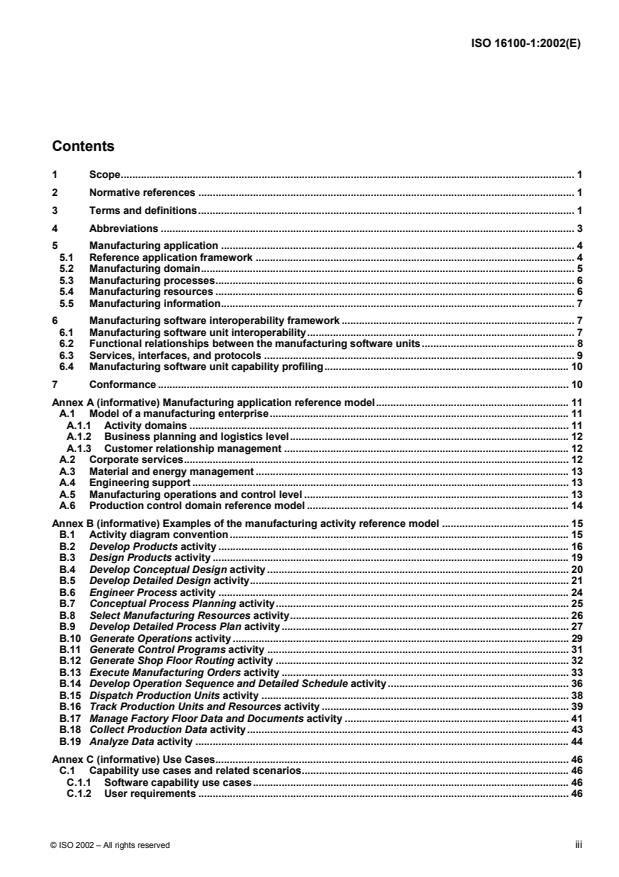
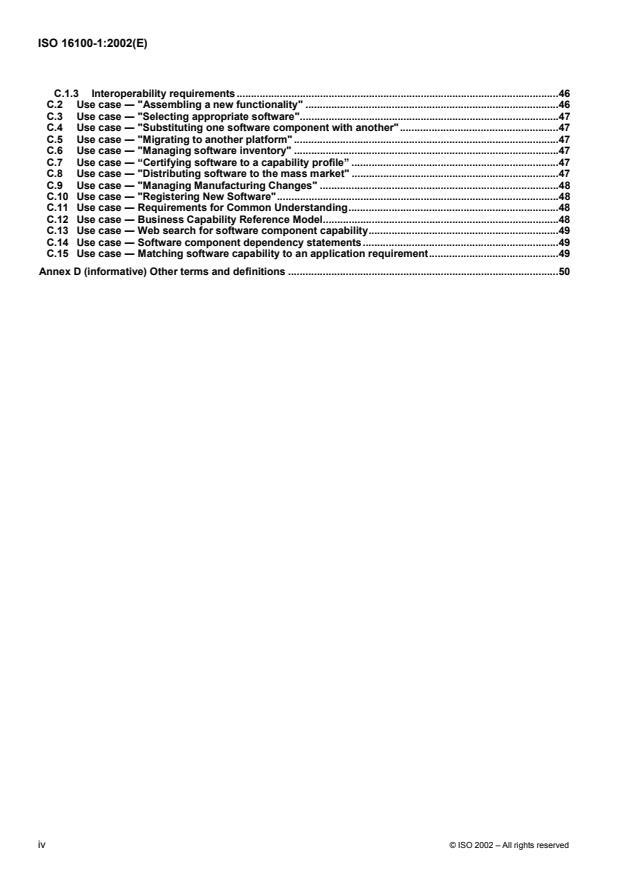
Contents
1 Scope. 1
2 Normative references . 1
3 Terms and definitions. 1
4 Abbreviations . 3
5 Manufacturing application . 4
5.1 Reference application framework . 4
5.2 Manufacturing domain. 5
5.3 Manufacturing processes. 6
5.4 Manufacturing resources . 6
5.5 Manufacturing information. 7
6 Manufacturing software interoperability framework . 7
6.1 Manufacturing software unit interoperability. 7
6.2 Functional relationships between the manufacturing software units. 8
6.3 Services, interfaces, and protocols . 9
6.4 Manufacturing software unit capability profiling. 10
7 Conformance . 10
Annex A (informative) Manufacturing application reference model. 11
A.1 Model of a manufacturing enterprise. 11
A.1.1 Activity domains . 11
A.1.2 Business planning and logistics level. 12
A.1.3 Customer relationship management . 12
A.2 Corporate services. 12
A.3 Material and energy management . 13
A.4 Engineering support . 13
A.5 Manufacturing operations and control level . 13
A.6 Production control domain reference model . 14
Annex B (informative) Examples of the manufacturing activity reference model . 15
B.1 Activity diagram convention. 15
B.2 Develop Products activity . 16
B.3 Design Products activity . 19
B.4 Develop Conceptual Design activity . 20
B.5 Develop Detailed Design activity. 21
B.6 Engineer Process activity . 24
B.7 Conceptual Process Planning activity. 25
B.8 Select Manufacturing Resources activity. 26
B.9 Develop Detailed Process Plan activity. 27
B.10 Generate Operations activity . 29
B.11 Generate Control Programs activity . 31
B.12 Generate Shop Floor Routing activity . 32
B.13 Execute Manufacturing Orders activity . 33
B.14 Develop Operation Sequence and Detailed Schedule activity. 36
B.15 Dispatch Production Units activity . 38
B.16 Track Production Units and Resources activity . 39
B.17 Manage Factory Floor Data and Documents activity . 41
B.18 Collect Production Data activity. 43
B.19 Analyze Data activity . 44
Annex C (informative) Use Cases. 46
C.1 Capability use cases and related scenarios. 46
C.1.1 Software capability use cases. 46
C.1.2 User requirements . 46
C.1.3 Interoperability requirements.46
C.2 Use case ― "Assembling a new functionality" .46
C.3 Use case ― "Selecting appropriate software".47
C.4 Use case ― "Substituting one software component with another".47
C.5 Use case ― "Migrating to another platform" .47
C.6 Use case ― "Managing software inventory" .47
C.7 Use case ― “Certifying software to a capability profile” .47
C.8 Use case ― "Distributing software to the mass market" .47
C.9 Use case ― "Managing Manufacturing Changes" .48
C.10 Use case ― "Registering New Software".48
C.11 Use case ― Requirements for Common Understanding.48
C.12 Use case ― Business Capability Reference Model.48
C.13 Use case ― Web search for software component capability.49
C.14 Use case ― Software component dependency statements.49
C.15 Use case ― Matching software capability to an application requirement.49
Annex D (informative) Other terms and definitions .50
iv © ISO 2002 – All rights reserved
Foreword
ISO (the International Organization for Standardization) is a worldwide federation of national standards bodies (ISO
member bodies). The work of preparing International Standards is normally carried out through ISO technical
committees. Each member body interested in a subject for which a technical committee has been established has
the right to be represented on that committee. International organizations, governmental and non-governmental, in
liaison with ISO, also take part in the work. ISO collaborates closely with the International Electrotechnical
Commission (IEC) on all matters of electro-technical standardization.
International Standards are drafted in accordance with the rules given in the ISO/IEC Directives, Part 2.
The main task of technical committees is to prepare International Standards. Draft International Standards adopted
by the technical committees are circulated to the member bodies for voting. Publication as an International
Standard requires approval by at least 75 % of the member bodies casting a vote.
Attention is drawn to the possibility that some of the elements of this document may be the subject of patent rights.
ISO shall not be held responsible for identifying any or all such patent rights.
ISO 16100 was prepared by Technical Committee ISO/TC 184, Industrial automation systems and integration,
Subcommittee SC 5, Architecture, communications and integration frameworks.
ISO 16100 consists of the following parts, under the general title Industrial automation systems and integration
Manufacturing software capability profiling for interoperability:
Part 1: Framework
Part 2: Profiling methodology
Part 3: Interface protocols and templates
Part 4: Conformance test methods, criteria and reports
Introduction
The motivation for ISO 16100 stems from the industrial and economic environment noted by ISO/TC 184/SC5. In
particular, there is broad recognition by industry that application software and the expertise to apply that software
are assets of the enterprise. Industry feedback has noted the need for improvement and continued development of
current design and manufacturing standards to enable software interoperability.
ISO 16100 specifies a manufacturing information model that characterizes software-interfacing requirements. With
interfacing requirements clearly expressed, standard interfaces can be more easily and quickly developed using the
Interface Definition Language (IDL) or an appropriate programming language, such as Java and C++. These
standard interfaces are expected to enable the interoperability among manufacturing software tools (modules or
systems).
The Unified Modelling Language (UML) is used in this International Standard for modelling these interfaces. Also,
the manufacturing information model can be used to develop commonly sharable database schema using
languages such as the eXtensible Markup Language (XML).
Sectors of the manufacturing industry such as automotive, aerospace, machine tool manufacturing, computer
peripheral manufacturing, and mold and die manufacturing that intensively use computer-aided design (CAD),
computer-aided manufacturing (CAM), numerical control (NC) programming, computer-aided engineering (CAE),
product data management (PDM), and manufacturing execution systems (MES) will directly benefit from ISO 16100.
The software interface requirements in ISO 16100 will facilitate the development of:
a) interoperable design and manufacturing software tools leading to shortened product development time;
b) new software tools that can be easily integrated with current technologies leading to more choices in the
market;
c) new application software leading to reduced capital expenditures to replace legacy systems;
d) programming interfaces and database schema leading to cost savings by not having to develop proprietary
interfaces for point-to-point software integration.
The end result will be a reduction in product and manufacturing information management cost and lower product
costs.
ISO 16100 enables manufacturing software integration by providing the following :
a) standard interface specifications that allow information exchange among software units in industrial automation
systems developed by different vendors;
b) software capability profiling, using a standardized method to enable users to select software units that meet
their functional requirements;
c) conformance tests that ensure the integrity of the software integration.
ISO 16100 consists of four parts. Part 1 specifies a framework for interoperability of a set of manufacturing software
products used in the manufacturing domain and its integration into a manufacturing application. Part 2 specifies a
methodology for constructing profiles of manufacturing software capabilities, and includes a methodology for
creating manufacturing software capability profiles as well as for using these profiles at the developing stage of
manufacturing applications. Part 3 specifies the interface protocol and templates for various manufacturing
application areas. Part 4 specifies the concepts and rules for the conformity assessment of the other parts of ISO
16100.
vi © ISO 2002 – All rights reserved
INTERNATIONAL STANDARD ISO 16100-1:2002(E)
Industrial automation systems and integration — Manufacturing
software capability profiling for interoperability —
Part 1:
Framework
1 Scope
Part 1 of ISO 16100 specifies a framework for the interoperability of a set of software products used in the
manufacturing domain and to facilitate its integration into a manufacturing application (see Annex A for a discussion
of a manufacturing application). This framework addresses information exchange models, software object models,
interfaces, services, protocols, capability profiles, and conformance test methods.
2 Normative references
The following referenced documents are indispensable for the application of this document. For dated references,
only the edition cited applies. For undated references, the latest edition of the referenced document (including any
amendments) applies.
ISO 15704, Industrial automation systems — Requirements for enterprise-reference architectures and
methodologies
ISO 15745-1, Industrial automation systems and integration — Open systems application integration framework —
Part 1: Generic reference description
ISO/IEC 19501-1, Information technology — Unified Modelling Language (UML) — Part 1: Specification
IEC 62264-1, Enterprise-Control System Integration — Part 1: Models and Terminology
IEEE 1320.1-1998, Standard for Functional Modelling Language — Syntax and Semantics for IDEF0
W3C Recommendation Feb 1998, Extensible Markup Language (XML) 1.0
3 Terms and definitions
For the purposes of this document, the following terms and definitions apply. Other relevant terms are defined in
Annex D.
3.1
advanced planning
production planning over time horizons of months or years using constraint models that treat both materials and
capacity
NOTE In some cases, the planning system includes master production scheduling, material requirements planning, or
capacity planning.
3.2
CAD/PDM
computer systems that are used for product design and modelling, engineering, product data management, and
process data management
3.3
capability
set of functions and services with a set of criteria for evaluating the performance of a capability provider
NOTE This definition differs from that given in ISO 15531-1 and ISO/DIS 19439, where capability is defined as the quality
of being able to perform a given activity. See IEC 62264-1 for a general definition of capability.
3.4
capability profiling
selection of a set of offered services defined by a particular interface within a software interoperability framework
3.5
CAPP/CAM
computer systems that are used for process planning and programming of numerically controlled machines
3.6
controller
hybrid hardware/software systems that are used for controlling machines
EXAMPLES Distributed control systems (DCS), programmable logic controllers (PLC), numerical controller (NC), and
supervisory control and data acquisition (SCADA) systems.
3.7
data collection
gathering of information on workpieces, timing, personnel, lots, and other critical entities for production
management in a timely manner
3.8
design knowledge
rules and logic that a human designer brings to bear on design problems, including design and implementation
techniques
NOTE Many different types of design knowledge are used in different design activities, such as decomposition knowledge,
assignment knowledge, consolidation knowledge, and optimization knowledge.
3.9
design pattern
medium-scale patterns, smaller in scale than architectural patterns, but are at a higher level than the programming
1)
language-specific idioms
NOTE The application of a design pattern has no effect on the fundamental structure of a software system, but may have a
strong influence on the architecture of a subsystem.
3.10
manufacturing software
type of software resource within an automation system that provides value to a manufacturing application (e.g.
CAD/PDM) by enabling the flow of control and information among the automation system components involved in
the manufacturing processes, between these components and other enterprise resources, and between enterprises
in a supply chain or demand chain
3.11
manufacturing software component
class of manufacturing software resource intended to support the execution of a particular manufacturing task
1)
Taken from Pattern-oriented Software Architecture, John Wiley & Sons, June 2000.
2 © ISO 2002 – All rights reserved
3.12
manufacturing software unit
class of software resource, consisting of one or more manufacturing software components, performing a definite
function or role within a manufacturing activity while supporting a common information exchange mechanism with
other units
NOTE A software unit can be modeled using UML as a software object.
3.13
manufacturing system
system coordinated by a particular information model to support the execution and control of manufacturing
processes involving the flow of information, material, and energy in a manufacturing plant
3.14
manufacturing software capability
set of manufacturing software functions and services against a set of criteria for evaluating performance under a
given set of manufacturing conditions
NOTE See Annex C for use cases and related scenarios involving manufacturing software capability.
3.15
manufacturing software capability profile
concise representation of a manufacturing software capability to meet a requirement of a manufacturing application
3.16
software architecture
fundamental organization of a software system embodied in its components, their relationships to each other and to
the environment, and the principles guiding its design and evolution
[IEEE 1471-2000]
3.17
software environment
other manufacturing resources within the computing system that affect the operational aspects of the
manufacturing software unit
NOTE The software environment can include other systems that interact with the system of interest, either directly via
interfaces or indirectly in other ways. The environment determines the boundaries that define the scope of the system of interest
relative to other systems.
3.18
supply chain planning
usage of information technology to address planning and logistics problems at different levels and granularities of
detail using models for a product line, a production plant, or a full chain of multiple demand sources, suppliers,
production plants, and distribution means
NOTE Supply chain planning can be used to synchronize production, balancing constraints based on goals including on-
time delivery, minimal inventory, and maximum profit.
4 Abbreviations
AGV Automatic Guided Vehicle
APT Automated Programmed Tool
BOM Bill of Materials
CAD Computer Aided Design
CAM Computer Aided Manufacturing
CAPP Computer Aided Process Planning
ERP Enterprise Resource Planning
MES Manufacturing Execution System
NC Numerical Control
PDM Product Data Management
SCM Supply Chain Management
SCADA Supervisory Control and Data Acquisition
SQC Statistical Quality control
XML eXtensible Markup Language
UML Unified Modelling Language
5 Manufacturing application
5.1 Reference application framework
The interoperability framework for manufacturing software is based upon a more general interoperability framework
for manufacturing applications. Such an application interoperability framework, which is explained in further detail in
ISO 15745-1, provides a basis for integrating an automation and control system architecture within a manufacturing
application architecture.
An integrated manufacturing application shall be modeled as a combination of a set of manufacturing resources
and a set of information units whose data structure, semantics, and behaviour can be shared and exchanged
among the manufacturing resources, as shown in Figure 1. Manufacturing resources are communication networks,
devices, software, equipment, material, and personnel necessary to support the processes and information
exchanges required by the application.
In this application integration model, the various elements of the model have shared interfaces and exchange
material, energy, and information in a cooperative and coordinated manner. The manufacturing processes can
cooperate with each other if the functions performed by the various elements of the model can interoperate with
each other. When software units perform some of these functions, it is necessary for the software units to be
interoperable with the other elements, as well as with each other.
4 © ISO 2002 – All rights reserved
Manufacturing
Application
Manufacturing
1.* Manufacturing
Process
Resource
1.*
Manufacturing Manufacturing
Automation Device
Information
1.*
1.*
Equipment
Manufacturing
& Infrastructure
Personnel
1.* 1.*
Raw Material &
Manufacturing
Manufactured
Software Unit
1.*
1.*
Part
NOTE Boxes represent classes of objects (things). Lines connecting boxes represent associations between objects
(things). An association has two roles (one in each direction). A role may optionally be named by a label. A role from A to B is
closest to B, and vice versa. Roles are one-to-one unless otherwise noted. A role can have a multiplicity, e.g. a role marked with
“1.*” is used to denote many as in a one-to-many or many-to-many association. A diamond at the end of an association line
denotes a part-of relationship. A black diamond at the end of an association line denotes a composition aggregation relationship.
For example, Manufacturing Application owns (is comprised of) Manufacturing Process, Manufacturing Information, and
Manufacturing Resources. This notation is taken from ISO/IEC 19501-1.
Figure 1 ― Class diagram of a partial model of a manufacturing application
5.2 Manufacturing domain
The manufacturing domain that includes discrete, batch, and continuous control encompasses many types of
industries. The automotive industry is an example of an industry employing discrete control; the pharmaceutical
industry is an example of an industry employing batch control; the petrochemical industry is an example of an
industry employing continuous control. For manufacturing software, the interface between plant management
systems and floor control systems is described by the same method regardless of whether control systems are
discrete, batch, or continuous. Similarly, the control flow inside a control system is also described by the same
method regardless of whether the system is discrete, batch, or continuous.
Even as the manufacturing domain applies to many industries, the relationship between firms in these industries is
changing rapidly due to recent developments in IT infrastructure, as is the case in supply chain management
systems. Therefore, ISO 16100 sets a target manufacturing domain to include the manufacturing operation and
control activity, the discrete control activity, the batch control activity, the continuous control activity, and the
manufacturing process design activity, as shown in Figure 2.
Supply Chain
Management
Product Design Plant Management
Enterprise
Resource
Management
Target
Manufacturing
Operation & Control
Manufacturing
Domain of
Process Design
ISO 16100
Discrete Continuous
Control Control
Batch
Control
Figure 2 ― Target domain of ISO 16100
5.3 Manufacturing processes
A manufacturing process shall be modeled as a set of activities that follow a specific sequence. Each activity shall
be associated with a set of functions performed according to a time schedule or triggered by a set of events.
The functions associated with a manufacturing process shall be viewed as being implemented through a set of
manufacturing resources. The manufacturing resources shall be considered to be selected and configured to
support the material, information, and energy flows required by the specified sequence of manufacturing activities
associated with a process.
When a manufacturing process must cooperate and coordinate with another process, the respective functions of
these interacting processes are considered to be able to cooperate and coordinate with each other. Such a
situation requires that the cooperating and coordinating functions meet a common set of criteria and a set of
conditions for interoperability. The software units that implement these functions shall meet a related set of criteria
and conditions for interoperability.
5.4 Manufacturing resources
The manufacturing resources required by a manufacturing application shall be organized in terms of the type of
flow being managed and supported among the manufacturing processes ― material, control, information, or energy
flow. The set of integrated flows can be used to represent an integrated manufacturing application or manufacturing
system architecture.
The set of integrated manufacturing resources shall form a manufacturing system architecture that fulfills a set of
manufacturing application requirements. These manufacturing resources, including the manufacturing software
units, shall provide the functions associated with the manufacturing processes.
The combined capabilities of the various software units, in an appropriate operating environment, provides the
required functionality to control and monitor the manufacturing processes according to the production plan and the
allocated resources.
6 © ISO 2002 – All rights reserved
An operating environment shall be distinguished by the manufacturing resources needed by the associated set of
software units. These manufacturing resources include the processing, storage, user interface, communications,
and peripheral devices, as well as other system software required for executing the software units.
5.5 Manufacturing information
A set of information structures shall provide the knowledge infrastructure to manage the various types of flows
within a manufacturing application. These information sets shall include data pertaining to the product, the process,
and the equipment.
The manufacturing software units shall be the primary means for handling, transforming, and maintaining these
information structures.
6 Manufacturing software interoperability framework
6.1 Manufacturing software unit interoperability
Within a context of a manufacturing application, a manufacturing software unit is considered to be capable of
performing a specific set of functions defined by a manufacturing system architecture. In performing these sets of
functions, the manufacturing software unit is cooperating and conducting transactions with other manufacturing
software units.
The functions performed by each software unit shall be those as described by the manufacturing application
architecture. The information exchanged between these software units shall enable the coordinated execution of
these manufacturing functions.
The software interoperability of a set of manufacturing activities shall be described in terms of the interoperability of
the set of software units associated with each manufacturing activity.
A software interoperability framework consists of a set of elements and rules for describing the capability of
software units to support the requirements of a manufacturing application. The capability to support the
requirements shall cover the ability of the software unit to execute and to exchange data with other software units
operating in the same manufacturing system or in different manufacturing systems used in the application.
A software interoperability framework shall be based on the following aspects:
a) syntax and semantics shared between manufacturing software units;
b) functional relationships between the manufacturing software units;
c) services, interfaces, and protocols offered by the manufacturing software units;
d) ability to provide manufacturing software unit capability profiling.
The framework elements shall consist of the roles, the activities, and the artifacts associated with the software
entities when dealing with the manufacturing process, information, and resources. The framework rules shall
address the relationships, templates, and conformance statements needed to construct a capability class (see ISO
16100-2), a profile class (see ISO 16100-2), and a component class (see ISO 16100-3).
The organization, relationships, and tasks pertaining to the software unit and its manufacturing software
components shall be expressed in terms of the framework elements and rules in ISO 16100-3.
Figure 3 shows the relationships between the aspects of the software interoperability framework and the derivation
of this framework from a generic application interoperability framework.
derived from Software Interoperability Framework
Generic Application Interoperability Framework
(Methodology and Rules for Interoperability)
• Software architecture and design
pattern
• Modelling tools
• Manufacturing software unit
• Languages for syntax and semantics
interfaces, services, protocols
• Generic application interoperability
• Interface definition methodology
model
(formal language)
constrains profiled by
used to create
Software Capability Profiling
• Classes of manufacturing activity,
Domain Specific Modelling of Functional
software unit capability, software
Relationships
capability profile, software
component
mapped to
• Application model
• Software functionalities
• Information model
• Manufacturing application
• Environmental model
interoperability criteria
• Constraints from other
manufacturing resources
• Non-functional properties of the
software unit
• Template(s)
Figure 3 ― Relationships of software interoperability aspects
6.2 Functional relationships between the manufacturing software units
Within the manufacturing domain shown in Figure 2, there can be one or more operational software units that
cooperate through a specific interface/protocol to perform a single manufacturing function required in that domain.
This is realized in the software environment of a specific computing system as one of the components of the
manufacturing resources, enabled by a specific software design pattern performing a specific role. Conversely, a
single software unit can perform one or more manufacturing functions. One or more manufacturing functions can
interoperate with each other to execute, control, monitor, or manage a particular manufacturing activity. A series of
activities can be conducted in a particular sequence to complete a manufacturing process. Figure 4 depicts the
classes of a software unit and its surroundings and associations.
In this framework, the sequence and schedule of functions performed is determined by the sequence and schedule
of the activities that comprise a particular process. The manufacturing software units deployed to perform the
functions are considered to execute according to the required sequence and schedule of their associated functions.
The interoperability of the manufacturing processes shall be viewed in terms of the interoperability of the functions,
which in turn, shall be viewed in terms of the interoperability of the manufacturing resources, including the
manufacturing software units. Examples of information flow among design, manufacturing planning, and execution
activities are provided in Annex B.
8 © ISO 2002 – All rights reserved
Manufacturing Domain
contains 1.*
Manufacturing Application
enables
1.* 1.*
enables
1.*
Manufacturing Resources
Manufacturing Process
Manufacturing Information
sequences 1.*
1.*
constrains
Computing System
Manufacturing Activity
constrains
operates
1.*
Manufacturing Function Software Environment
Software Architecture
1.*
Manufacturing Software Unit
enables
Software Design Pattern
Interface / Protocol
Role
Datatype
1.*
Figure 4 ― Class diagram of a software unit and its surroundings
and associations within a manufacturing application
A software unit shall be modeled as a set of software components that have been linked to perform a definite
manufacturing function. Each software unit shall be represented as a UML object.
A manufacturing software unit shall provide a service interface for use in its configuration, execution, and
maintenance.
The capability of a software unit to perform a manufacturing function shall include a description of the set of
services available at its service interface. The capability of a manufacturing software unit shall be concisely stated
in a capability profile described in XML.
The sequence and timing of the manufacturing activities determines the specified criteria for the interoperability of
the associated set of manufacturing software units.
Information structures included or referenced in a capability profile are defined in ISO 16100-2.
6.3 Services, interfaces, and protocols
A manufacturing software unit shall be modeled as a set of manufacturing software components that have been
linked to perform a definite manufacturing function.
Manufacturing software units shall interoperate with one another, in support of a manufacturing activity, when the
services requested by the former can be provided by the latter, using the same operating environment.
The services, interfaces, and protocols are defined in ISO 16100-3.
6.4 Manufacturing software unit capability profiling
A concise statement of the capability of a manufacturing software unit shall be expressed using a capability profile.
The capability profile shall include class of manufacturing activity, the software function performed, the
manufacturing application criteria, resource conditions or configurations (software enablers), measurement units,
name of the manufacturing software unit, data exchanged, the service interface and the associated operating
conditions.
EXAMPLE Class of Manufacturing Activity: Production Control
Software Functions: Scheduling, operation, monitoring, reporting, alarming
Manufacturing application criteria: completeness, timeliness, accuracy
Resource conditions or configurations: operating system peripherals, networks, drivers, performance monitors
Measurement units: Mean Time Between Failure, Mean Time To Repair, Number Of People To Repair (per skill
type)
Name of manufacturing software unit: RSI Enterprise Batch
The profile shall provide a minimum level of information and be organized in a format that is XML-based to address
the use cases enumerated in Annex C.
The structure, syntax, and taxonomy of manufacturing software capability profiles are defined in ISO 16100-3.
7 Conformance
The concepts and rules for conformity assessment of capability profiles are defined in ISO 16100-4.
10 © ISO 2002 – All rights reserved
Annex A
(informative)
Manufacturing application reference model
A.1 Model of a manufacturing enterprise
A.1.1 Activity domains
The processes within a manufacturing enterprise can be represented as a set of activities (see Figure A.1). The
number of domains and the names may differ from one enterprise model to another. In this International Standard,
the domain classes defined in the manufacturing enterprise reference architecture noted in Annex B.3 of ISO
15704 will be referenced.
These activity domains can be organized in a hierarchical fashion, wherein the Production Control activity domain
and its sub-domains can be placed at Level 3 and below, while all the other enterprise activity domains can be
positioned at Level 4 and higher. The hierarchical arrangement of the domains will allow more detailed treatment of
the manufacturing process requirements (see Figure A.2). Hierarchical arrangement of enterprise domains. A
different grouping may result if the target domain were some activity other than Production Control.
The classes of functions to be used in distinguishing a manufacturing software capability can be defined in terms of
the following characteristics:
a) generic activity type;
b) domain category as noted in the principal domains described in this clause and the sub-domains of the
Production Control domain;
c) flow type supported by the associated manufacturing process.
Order
CUSTOM ER
Enterprise/C ontrol
Processing
Boundary
P roduct Sh ippin g
Production
Adm inistration
P rod uct C ost
Scheduling
Accounting
Cost
C apacity
Supplier
O bjectives
Product
Perform ance
Schedule
&Costs Inventory C on trol
Purchase
M anufacturing
Procurement
Ord er R eq.
O peration and Standards
Control
Process D ata
QA R esults
Purchasing
Material and
Material a nd
Q A R esults
E n erg y R equirem ents
Ord er Status
En erg y In ventory Q uality
M aintenan ce
Assurance
Order
M aterial and Requests
Accounting
W ork R ep ort, C osts
R equirem ent
E nergy C ontro l Know H ow
D iagnostic
Self-C h eck R equ ests
C orporate
M aintenance
M arketing
R& D
M anagem ent & S ales
NOTE Figure adapted from IEC 62264-1.
Figure A.1 ― Activity diagram of a partial model of a manufacturing application
Although different enterprises use different names for the functions in these activity domains and these domains
may have varying functional boundaries, these functions can be distinguished by their input, output, and processing
operations. The functions within each sub-domain can be enumerated and these functions are referenced to
distinguish the manufacturing software capability descriptions.
Level 4
Business Planning & Logistics
Plant Production Scheduling,
Operational Management, etc
Level 3
Manufacturing
Operations & Control
Dispatching Production, Detailed Production
Scheduling, Reliability Assurance, .
Levels
2,1,0
Batch Discrete
Continuous
Control Control
Control
Unit Line
Cell
NOTE Figure adapted from IEC 62264-1.
Figure A.2 ― Hierarchical arrangement of enterprise domains
A.1.2 Business planning and logistics level
The activity domains within the business planning and logistics level can be grouped as follows:
a) Purchasing, procurement, and product cost accounting;
b) Production scheduling, product inventory control, and quality assurance;
c) Material and energy flow control and management;
d) Marketing and sales, order processing, product shipping management;
e) Corporate services, such as accounting, human resources, research and development, information technology
su
...
Questions, Comments and Discussion
Ask us and Technical Secretary will try to provide an answer. You can facilitate discussion about the standard in here.
Loading comments...