

ISO 157:2025
(Main)Coal — Determination of forms of sulfur
General Information
- Abstract
This document specifies methods of determining the sulfate and pyritic sulfur mass fraction of coals, and of calculating the amount of organic sulfur present.
- Status
- Published
- Publication Date
- 14-May-2025
- Technical Committee
- ISO/TC 27/SC 5 - Methods of analysis
- Drafting Committee
- ISO/TC 27/SC 5 - Methods of analysis
- Current Stage
- 6060 - International Standard published
- Start Date
- 15-May-2025
- Due Date
- 20-May-2026
- Completion Date
- 15-May-2025
Overview
ISO 157:2025 - Coal - Determination of forms of sulfur specifies standardized analytical methods for quantifying sulfate sulfur and pyritic sulfur in coal and for calculating organic sulfur by difference. The third edition updates procedural clauses and adds a formula for organic sulfur. The procedures rely on differential solubility under reflux and subsequent analytical finishes to deliver reproducible sulfur speciation for coal quality and research purposes.
Key topics and technical requirements
- Scope: Methods to determine sulfate and pyritic sulfur mass fractions and to calculate organic sulfur (organic sulfur = total sulfur − (sulfate + pyritic)).
- Principle: Differential solubility of sulfates and pyrites in dilute hydrochloric and nitric acids under reflux; successive dissolution and direct determination of sulfur species.
- Sample preparation:
- Use the general analysis test sample prepared per ISO 13909-4 or ISO 18283.
- Grind about 25 g to pass a 75 µm sieve and equilibrate moisture with laboratory atmosphere.
- Separation procedure: Extraction with dilute hydrochloric acid (≈15 %) dissolves sulfate sulfur and non-pyritic iron; pyritic iron/sulfur remain in the residue for filtration and further treatment.
- Reagents (examples given in the standard):
- Concentrated HCl (~36 %, ρ ≈ 1.18 g·ml−1) and dilute HCl (≈15 %).
- Concentrated nitric acid (~70 %) and dilute nitric acid (≈9 %).
- Analytical finishes for pyritic sulfur: titrimetric, colorimetric, and atomic absorption spectrometric options are specified to suit laboratory capability.
- Quality assurance: Blank tests, expression of results, and stated precision (repeatability and reproducibility limits) are included.
- Reporting and calculations: Test-report requirements, calculation to different bases (air-dry, dry, ash-free) per Clause 10, and Annex A describing derivation of calculation factors.
Practical applications and users
ISO 157:2025 is intended for:
- Coal testing laboratories and quality-control teams in mining and utilities.
- Researchers studying coal chemistry and sulfur speciation.
- Coal cleaning and coal preparation operations that need to assess sulfur removal potential.
- Environmental compliance and emissions modelling where sulfur form affects combustion behavior and SOx emissions.
- Blending and classification workflows that require sulfur form data to optimize fuel mixes.
Benefits include consistent, comparable sulfur-speciation data for process optimization, regulatory reporting, emissions estimation, and product specification.
Related standards
- ISO 334 - Total sulfur (Eschka method)
- ISO 1170 - Calculations to different bases
- ISO 13909-4, ISO 18283 - Sampling and preparation
- ISO 5068-2, ISO 11722 - Moisture determination
- ISO 19579, ISO 20336 - Alternative sulfur/total sulfur methods
Keywords: ISO 157:2025, coal sulfur determination, sulfate sulfur, pyritic sulfur, organic sulfur, coal analysis, sulfur speciation, coal quality control.
Relations
- Effective Date
- 27-May-2023
- Effective Date
- 27-May-2023
Get Certified
Connect with accredited certification bodies for this standard

Bureau Veritas Chile
Bureau Veritas certification services in Chile.
Bureau Veritas Peru
Bureau Veritas certification services in Peru.
BVQI Peru
Bureau Veritas certification in Peru.
Sponsored listings
Frequently Asked Questions
ISO 157:2025 is a standard published by the International Organization for Standardization (ISO). Its full title is "Coal — Determination of forms of sulfur". This standard covers: This document specifies methods of determining the sulfate and pyritic sulfur mass fraction of coals, and of calculating the amount of organic sulfur present.
This document specifies methods of determining the sulfate and pyritic sulfur mass fraction of coals, and of calculating the amount of organic sulfur present.
ISO 157:2025 is classified under the following ICS (International Classification for Standards) categories: 73.040 - Coals. The ICS classification helps identify the subject area and facilitates finding related standards.
ISO 157:2025 has the following relationships with other standards: It is inter standard links to ISO 157:1996, ISO 157:1996/Cor 1:1999. Understanding these relationships helps ensure you are using the most current and applicable version of the standard.
ISO 157:2025 is available in PDF format for immediate download after purchase. The document can be added to your cart and obtained through the secure checkout process. Digital delivery ensures instant access to the complete standard document.
Standards Content (Sample)
International
Standard
ISO 157
Third edition
Coal — Determination of forms
2025-05
of sulfur
Charbon — Détermination de la teneur en différentes formes
de soufre
Reference number
© ISO 2025
All rights reserved. Unless otherwise specified, or required in the context of its implementation, no part of this publication may
be reproduced or utilized otherwise in any form or by any means, electronic or mechanical, including photocopying, or posting on
the internet or an intranet, without prior written permission. Permission can be requested from either ISO at the address below
or ISO’s member body in the country of the requester.
ISO copyright office
CP 401 • Ch. de Blandonnet 8
CH-1214 Vernier, Geneva
Phone: +41 22 749 01 11
Email: copyright@iso.org
Website: www.iso.org
Published in Switzerland
ii
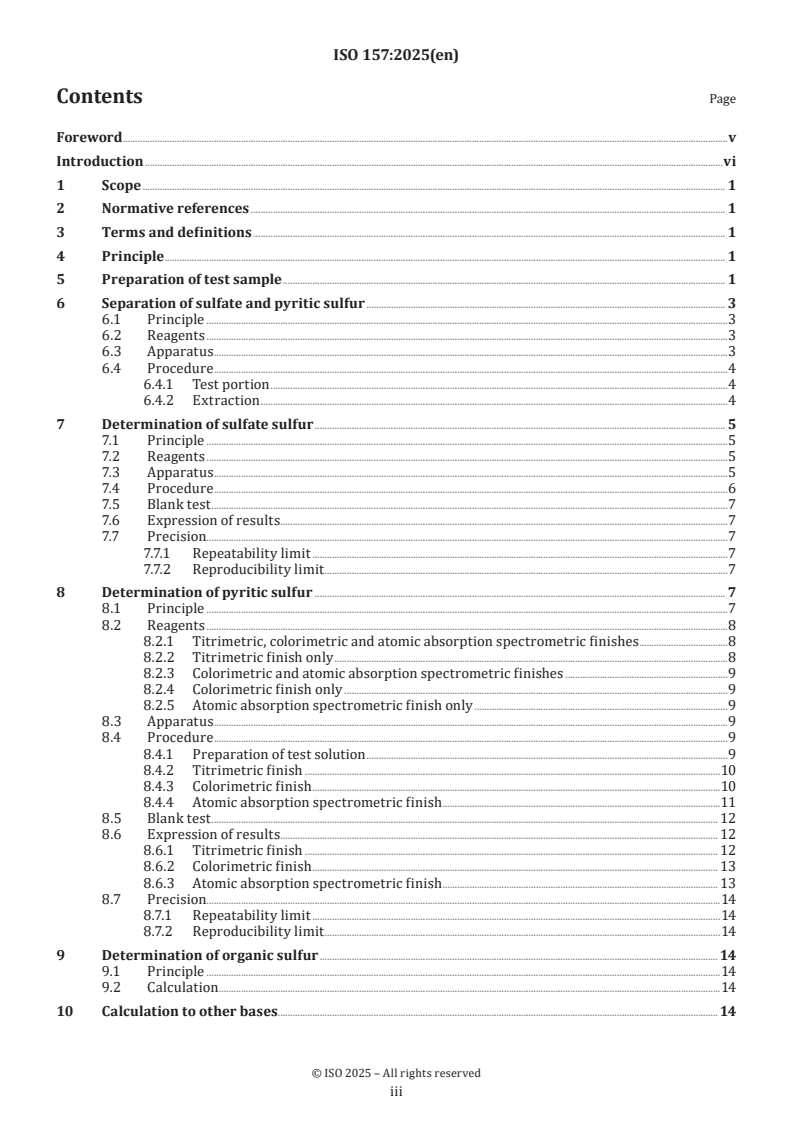
Contents Page
Foreword .v
Introduction .vi
1 Scope . 1
2 Normative references . 1
3 Terms and definitions . 1
4 Principle . 1
5 Preparation of test sample . 1
6 Separation of sulfate and pyritic sulfur . 3
6.1 Principle .3
6.2 Reagents .3
6.3 Apparatus .3
6.4 Procedure .4
6.4.1 Test portion .4
6.4.2 Extraction .4
7 Determination of sulfate sulfur . 5
7.1 Principle .5
7.2 Reagents .5
7.3 Apparatus .5
7.4 Procedure .6
7.5 Blank test .7
7.6 Expression of results .7
7.7 Precision . . .7
7.7.1 Repeatability limit .7
7.7.2 Reproducibility limit .7
8 Determination of pyritic sulfur . 7
8.1 Principle .7
8.2 Reagents .8
8.2.1 Titrimetric, colorimetric and atomic absorption spectrometric finishes .8
8.2.2 Titrimetric finish only .8
8.2.3 Colorimetric and atomic absorption spectrometric finishes .9
8.2.4 Colorimetric finish only .9
8.2.5 Atomic absorption spectrometric finish only .9
8.3 Apparatus .9
8.4 Procedure .9
8.4.1 Preparation of test solution .9
8.4.2 Titrimetric finish .10
8.4.3 Colorimetric finish .10
8.4.4 Atomic absorption spectrometric finish .11
8.5 Blank test . 12
8.6 Expression of results . . 12
8.6.1 Titrimetric finish . 12
8.6.2 Colorimetric finish . 13
8.6.3 Atomic absorption spectrometric finish . 13
8.7 Precision . . .14
8.7.1 Repeatability limit .14
8.7.2 Reproducibility limit .14
9 Determination of organic sulfur . 14
9.1 Principle .14
9.2 Calculation .14
10 Calculation to other bases. 14
iii
11 Test report . 14
Annex A (informative) Derivation of factors used in the calculations .16
iv
Foreword
ISO (the International Organization for Standardization) is a worldwide federation of national standards
bodies (ISO member bodies). The work of preparing International Standards is normally carried out through
ISO technical committees. Each member body interested in a subject for which a technical committee
has been established has the right to be represented on that committee. International organizations,
governmental and non-governmental, in liaison with ISO, also take part in the work. ISO collaborates closely
with the International Electrotechnical Commission (IEC) on all matters of electrotechnical standardization.
The procedures used to develop this document and those intended for its further maintenance are described
in the ISO/IEC Directives, Part 1. In particular, the different approval criteria needed for the different types
of ISO document should be noted. This document was drafted in accordance with the editorial rules of the
ISO/IEC Directives, Part 2 (see www.iso.org/directives).
ISO draws attention to the possibility that the implementation of this document may involve the use of (a)
patent(s). ISO takes no position concerning the evidence, validity or applicability of any claimed patent
rights in respect thereof. As of the date of publication of this document, ISO had not received notice of (a)
patent(s) which may be required to implement this document. However, implementers are cautioned that
this may not represent the latest information, which may be obtained from the patent database available at
www.iso.org/patents. ISO shall not be held responsible for identifying any or all such patent rights.
Any trade name used in this document is information given for the convenience of users and does not
constitute an endorsement.
For an explanation of the voluntary nature of standards, the meaning of ISO specific terms and expressions
related to conformity assessment, as well as information about ISO's adherence to the World Trade
Organization (WTO) principles in the Technical Barriers to Trade (TBT), see www.iso.org/iso/foreword.html.
This document was prepared by Technical Committee ISO/TC 27, Coal and coke, Subcommittee SC 5, Methods
of analysis.
This third edition cancels and replaces the second edition (ISO 157:1996), which has been technically
revised. It also incorporates the Technical Corrigendum ISO 157:1996/Cor. 1:1999.
The main changes are as follows:
— Clause 2 has been updated;
— Clause 3 has been added and subsequent clauses have been renumbered;
— Formula (5), for organic sulfur, has been added;
— the test report has been updated.
Any feedback or questions on this document should be directed to the user’s national standards body. A
complete listing of these bodies can be found at www.iso.org/members.html.
v
Introduction
For many purposes, a knowledge of the total sulfur mass fraction of a coal is sufficient. However, for certain
work it, is also necessary to know how the sulfur is distributed between the coal substance and the mineral
matter. In particular, such information can be required in connection with coal classification and cleaning.
Sulfur is usually present in coal in three forms:
a) sulfate sulfur, i.e. the sulfur present in the form of inorganic sulfates;
b) pyritic sulfur, i.e. the sulfur present in the form of pyrites and marcasite;
c) organic sulfur, i.e. the sulfur present in the form of organic sulfur compounds.
vi
International Standard ISO 157:2025(en)
Coal — Determination of forms of sulfur
1 Scope
This document specifies methods of determining the sulfate and pyritic sulfur mass fraction of coals, and of
calculating the amount of organic sulfur present.
2 Normative references
The following documents are referred to in the text in such a way that some or all of their content constitutes
requirements of this document. For dated references, only the edition cited applies. For undated references,
the latest edition of the referenced document (including any amendments) applies.
ISO 334, Coal and coke — Determination of total sulfur — Eschka method
ISO 1170, Coal and coke — Calculation of analyses to different bases
ISO 5068-2, Brown coals and lignites — Determination of moisture — Part 2: Indirect gravimetric method for
moisture in the analysis sample
ISO 11722, Solid mineral fuels — Hard coal — Determination of moisture in the general analysis test sample by
drying in nitrogen
ISO 13909-4, Coal and coke — Mechanical sampling — Part 4: Preparation of test samples of coal
ISO 18283, Coal and coke — Manual sampling
ISO 19579, Solid mineral fuels — Determination of sulfur by IR spectrometry
ISO 20336, Coal and coke — Determination of total sulfur by Coulomb titration method
3 Terms and definitions
No terms and definitions are listed in this document.
ISO and IEC maintain terminology databases for use in standardization at the following addresses:
— ISO Online browsing platform: available at https:// www .iso .org/ obp
— IEC Electropedia: available at https:// www .electropedia .org/
4 Principle
The procedure described in this document utilizes the differential solubilities of sulfates and pyrites in dilute
hydrochloric and nitric acids under reflux conditions, such that each can be taken in solution successively
and determined directly. A general schematic representation of the procedure is given in Figure 1.
5 Preparation of test sample
The sample shall be the general analysis test sample prepared in accordance with the preparation procedures
specified in ISO 13909-4 or ISO 18283.
Grind about 25 g of the sample to pass a sieve of aperture 75 μm and ensure that its moisture mass fraction
is in equilibrium with the laboratory atmosphere, exposing it if necessary in a thin layer for the minimum
time required to achieve equilibrium.
Before commencing the determination, thoroughly mix the test sample for at least 1 min, preferably by
mechanical means.
If the results are to be calculated other than on an air-dried basis (see Clause 10), then, after determining
the test portion mass (see 6.4), determine the moisture mass fraction using a further portion of the test
sample by the method specified in ISO 5068-2 or ISO 11722.
NOTE Organic sulfur = total sulfur − (sulfate sulfur + pyritic sulfur)
Figure 1 — General schematic representation of the procedure
6 Separation of sulfate and pyritic sulfur
6.1 Principle
The test portion is extracted with dilute hydrochloric acid to bring both the sulfate sulfur and the non-
pyritic iron into solution. The pyritic iron and sulfur remain in the residue which is separated by filtration.
6.2 Reagents
WARNING — Care shall be exercised when handling the reagents, many of which are toxic and
corrosive.
During the analysis, unless otherwise stated, use only reagents of recognized analytical grade and only
distilled water or water of equivalent purity.
6.2.1 Hydrochloric acid, concentrated ρ approximately 1,18 g/ml, mass fraction approximately 36 %.
6.2.2 Hydrochloric acid, dilute, mass fraction approximately 15 %.
Dilute 420 ml of the hydrochloric acid (6.2.1) to 1 l with water.
6.2.3 Nitric acid, concentrated, mass fraction approximately 70 %.
6.2.4 Nitric acid, dilute, mass fraction approximately 9 %.
Dilute 130 ml of concentrated nitric acid (6.2.3) to 1 l with water.
6.3 Apparatus
6.3.1 Analytical balance, capable of determining mass to the nearest 0,1 mg.
6.3.2 Graduated glassware, class A.
6.3.3 Cold-finger condenser, to fit loosely into the neck of a 250 ml conical flask (see Figure 2). Other
condensers can also be used provide that it works as the same effect as cold-finger condenser.
Dimensions in millimetres
Key
1 water inlet
2 water outlet
Figure 2 — Cold-finger condenser for the determination of sulfate and pyritic sulfur
6.4 Procedure
6.4.1 Test portion
Take a test portion of the mass given in Table 1 for the expected total sulfur mass fraction, determining the
mass to the nearest 0,1 mg.
Table 1 — Test portion
Total sulfur Mass of test portion
(%) (g)
<0,7 8
0,7 to 2,0 5
>2,0 2
6.4.2 Extraction
Transfer the test portion to a 250 ml conical flask, add 50 ml of the dilute hydrochloric acid (6.2.2) and fit the
cold-finger condenser (6.3.3) into the neck of the flask. Boil for 30 min, ensuring that a slow stream of water
is passing through the cold finger. Remove the condenser and thoroughly rinse the condensate back into
the flask. Filter the mixture through a medium-textured, doubly acid-washed filter paper into a tall-form
beaker. Wash the residue three times with the dilute hydrochloric acid (6.2.2) and a further three times with
hot distilled water, using a total volume of approximately 30 ml. Retain the filtrate for the determination
of sulfate sulfur (see Clause 7). Immediately transfer the washed, undissolved residue and filter paper to
a 250 ml conical flask, add 50 ml of the dilute nitric acid (6.2.4) and retain for the determination of pyritic
sulfur (see Clause 8).
7 Determination of sulfate sulfur
7.1 Principle
The sulfate sulfur extracted by dilute hydrochloric acid from the test portion is determined gravimetrically
by precipitation with barium chloride.
7.2 Reagents
WARNING — Care shall be exercised when handling the reagents, many of which are toxic and
corrosive.
During the analysis, unless otherwise stated, use only reagents of recognized analytical grade and only
distilled water or water of equivalent purity.
7.2.1 Hydrogen peroxide, solution, mass fraction approximately 30 %.
7.2.2 Methyl red, indicator solution.
Dissolve 1 g of 2-(4-dimethylaminophenylazo) benzoic acid sodium salt (methyl red) in 1 l of water.
7.2.3 Ammonia, concentrated solution, mass fraction not less than 25 %.
7.2.4 Hydrochloric acid, concentrated, mass fraction approximately 36 %.
7.2.5 Potassium sulfate, 2 g/l solution.
The mass of 2 g of potassium sulfate, previously dried at a temperature from 105 °C to 110 °C, is determined
to the nearest 0,1 mg, Dissolve in water and dilute to 1 l.
7.2.6 Barium chloride, 85 g/l solution.
Dissolve 100 g of barium chloride dihydrate in water and dilute to 1 l. Filter before use through a close-
textured, doubly acid-washed filter paper or filter-paper pad.
7.2.7 Silver nitrate, 17 g/l solution.
Dissolve 17 g of silver nitrate in water and dilute to 1 l. Store in a dark glass bottle.
7.3 Apparatus
7.3.1 Analytical balance, capable of determining mass to the nearest 0,1 mg.
7.3.2 Graduated glassware, class A.
7.3.3 Electrically heated muffle furnace, capable of being maintained at a temperature of 800 °C ± 25 °C.
The ventilation through the muffle furnace shall be such as to give about five air changes per minute.
7.3.4 Crucible, of platinum, silica, or glazed porcelain, of capacity approximately 25 ml.
7.3.5 Flat plate, 6 mm thick, of silica (or other suitable refractory material) which fits easily into the
muffle furnace (7.3.3).
7.3.6 Gooch crucible, of glazed porcelain or sintered glass.
7.3.7 Air oven, capable of being maintained at a temperature of 130 °C ± 10 °C.
7.3.8 Filter cone, made of porcelain, of diameter 25 mm.
7.4 Procedure
7.4.1 To the filtrate from the hydrochloric acid extraction (see 6.4.2), add 5 ml of the hydrogen peroxide
solution (7.2.1) and boil for 5 min to convert all the soluble iron to the +3 oxidation state. While still hot, add
2 or 3 drops of the methyl red indicator solution (7.2.2) followed by the ammonia solution (7.2.3), drop by
drop, until the solution is just alkaline (yellow colour) and then add a further 5 drops in excess.
7.4.2 Filter the resultant precipitate on a toughened fast filter paper into a 250 ml beaker. Wash thoroughly
with hot water, discarding the precipitate. Cautiously add the concentrated hydrochloric acid (7.2.4) to the
filtrate, drop by drop, until the colour of the solution changes to pink and then add a further 1 ml in excess.
The volume of the solution shall be between 150 ml and 250 ml.
7.4.3 Add 25,0 ml of the potassium sulfate solution (7.2.5) from a one-mark pipette. Cover the beaker with
a watch glass, heat the covered beaker until the solution boils and then reduce the heating slightly until
ebullition ceases. Add 10 ml of the cold barium chloride solution (7.2.6) from a pipette with a delivery time
of approximately 20 s, held so that the barium chloride solution falls into the centre of the hot solution,
whilst this is being agitated. Keep the solution just below boiling point, without agitation, for 30 min.
7.4.4 Filter the solution using one of the following techniques.
a) By gravity through an ashless, close-textured, doubly acid-washed filter paper of diameter 100 mm to
125 mm. Carefully fold the filter paper and fit it into a fluted, long-stemmed 60° funnel, so that the stem
remains full of liquid during the filtration.
b) By gravity through a filter-paper pad prepared from ashless, doubly acid-washed filter paper. To prepare
the filter-paper pad, shake doubly acid-washed filter-paper clippings, in pieces of area approximately
1 cm , with water in a bottle until the paper is thoroughly disintegrated. Place a filter cone (7.3.8) in a
filter funnel of diameter 75 mm, close the stem of the funnel with
...