

ISO 4443:2022
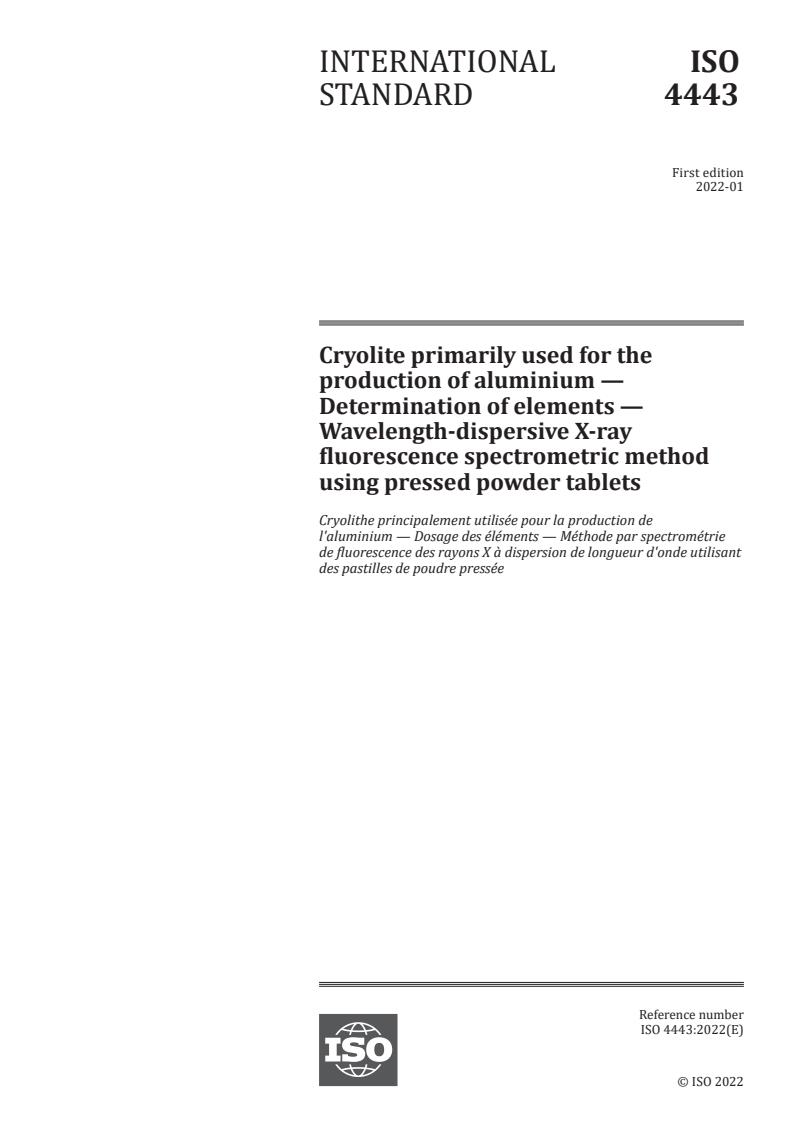
(Main)Cryolite primarily used for the production of aluminium — Determination of elements — Wavelength-dispersive X-ray fluorescence spectrometric method using pressed powder tablets
General Information
- Abstract
This document specifies a wavelength-dispersive X-ray fluorescence spectrometric (XRF) method for the determination of cryolite (Na3AlF6) from the content of fluorine to the content of trace elements. The calibration reference materials are not specified in this method. The method is applicable to cryolite, which is primarily used for the production of aluminium. Annex A provides conversion factors for converting elements to compounds. The validity and precision of test results for concentrations outside these ranges has not been determined. The concentration range of fluorine (given as F) is from 510 g/kg to 560 g/kg. The concentration range of aluminium (given as Al) is from 120 g/kg to 150 g/kg. The concentration range of sodium (given as Na) is from 270 g/kg to 330 g/kg. The concentration range of silicon (given as SiO2) is from the lowest limit of detection (LLD) to 4,0 g/kg. The concentration range of iron (given as Fe2O3) is from LLD to 0,37 g/kg. The concentration range of sulfur (given as SO4) is from LLD to 5,0 g/kg. The concentration range of phosphorus (given as P2O5) is from LLD to 0,40 g/kg. The concentration range of calcium (given as CaO) is from LLD to 0,80 g/kg.
- Status
- Published
- Publication Date
- 16-Jan-2022
- Technical Committee
- ISO/TC 226 - Materials for the production of primary aluminium
- Drafting Committee
- ISO/TC 226/WG 4 - Smelter grade fluorides
- Current Stage
- 6060 - International Standard published
- Start Date
- 17-Jan-2022
- Due Date
- 21-Aug-2021
- Completion Date
- 17-Jan-2022
Overview
ISO 4443:2022 specifies a wavelength-dispersive X‑ray fluorescence (WDXRF/XRF) method for the elemental analysis of cryolite (Na3AlF6) used primarily in aluminium production. The standard covers sample preparation using pressed powder tablets, instrumental conditions, calibration practices, and precision requirements for determining fluorine through selected trace elements. It is intended for laboratories performing cryolite quality control and elemental composition testing.
Key topics and technical requirements
- Scope and target elements: Concentration ranges defined in ISO 4443 include:
- Fluorine (F): 510–560 g/kg
- Aluminium (Al): 120–150 g/kg
- Sodium (Na): 270–330 g/kg
- Silicon (SiO2): LLD to 4.0 g/kg
- Iron (Fe2O3): LLD to 0.37 g/kg
- Sulfur (SO4): LLD to 5.0 g/kg
- Phosphorus (P2O5): LLD to 0.40 g/kg
- Calcium (CaO): LLD to 0.80 g/kg
- Sample preparation:
- Dry to constant mass at (110 ± 2) °C (typical 2 h).
- Mill to <45 µm (10.0 g sample + 10 drops acetone/ethanol; vibrate 60 s).
- Press 2.0 g test portion with boric acid backing into tablets: 340 kN for 20 s; tablet ≥4 mm thick, 40 mm diameter.
- Instrumental conditions:
- Use a WDXRF spectrometer with vacuum path; Kα lines preferred.
- Suggested crystals, angles, collimators, voltages and counting times are provided; correct for background and spectral overlaps.
- Calibration and verification:
- Calibration reference materials are not mandated; users must obtain suitable cryolite reference materials that bracket expected concentrations (six or more standards recommended).
- Daily verification with reference sample tablets and routine drift correction per manufacturer guidance.
- Measurement protocol:
- Run three tablets per test portion; average triplicate results. Repeat if two results differ by more than twice the intralaboratory repeatability.
- Precision:
- Repeatability and reproducibility limits are given (computed using ASTM E691). Laboratories should follow these limits when interpreting results.
Applications and users
- Primary users: QC/analytical laboratories in aluminium producers, suppliers of cryolite, materials testing labs, and instrument manufacturers configuring cryolite application methods.
- Practical uses:
- Incoming raw-material inspection and supplier verification.
- Process control for aluminium electrolysis (flux composition control).
- Regulatory compliance reporting and material certification.
- Method development and inter-laboratory comparisons.
Related standards
- ISO 1619 (sample preparation guidance) is referenced for specimen preparation.
- Precision computation uses ASTM E691 methodology.
- Prepared by ISO/TC 226 (Materials for the production of primary aluminium).
Keywords: ISO 4443, cryolite analysis, XRF, wavelength-dispersive X‑ray fluorescence, pressed powder tablets, aluminium production, elemental analysis, cryolite quality control.
Get Certified
Connect with accredited certification bodies for this standard

ECOCERT
Organic and sustainability certification.

Eurofins Food Testing Global
Global leader in food, environment, and pharmaceutical product testing.

Intertek Bangladesh
Intertek certification and testing services in Bangladesh.
Sponsored listings
Frequently Asked Questions
ISO 4443:2022 is a standard published by the International Organization for Standardization (ISO). Its full title is "Cryolite primarily used for the production of aluminium — Determination of elements — Wavelength-dispersive X-ray fluorescence spectrometric method using pressed powder tablets". This standard covers: This document specifies a wavelength-dispersive X-ray fluorescence spectrometric (XRF) method for the determination of cryolite (Na3AlF6) from the content of fluorine to the content of trace elements. The calibration reference materials are not specified in this method. The method is applicable to cryolite, which is primarily used for the production of aluminium. Annex A provides conversion factors for converting elements to compounds. The validity and precision of test results for concentrations outside these ranges has not been determined. The concentration range of fluorine (given as F) is from 510 g/kg to 560 g/kg. The concentration range of aluminium (given as Al) is from 120 g/kg to 150 g/kg. The concentration range of sodium (given as Na) is from 270 g/kg to 330 g/kg. The concentration range of silicon (given as SiO2) is from the lowest limit of detection (LLD) to 4,0 g/kg. The concentration range of iron (given as Fe2O3) is from LLD to 0,37 g/kg. The concentration range of sulfur (given as SO4) is from LLD to 5,0 g/kg. The concentration range of phosphorus (given as P2O5) is from LLD to 0,40 g/kg. The concentration range of calcium (given as CaO) is from LLD to 0,80 g/kg.
This document specifies a wavelength-dispersive X-ray fluorescence spectrometric (XRF) method for the determination of cryolite (Na3AlF6) from the content of fluorine to the content of trace elements. The calibration reference materials are not specified in this method. The method is applicable to cryolite, which is primarily used for the production of aluminium. Annex A provides conversion factors for converting elements to compounds. The validity and precision of test results for concentrations outside these ranges has not been determined. The concentration range of fluorine (given as F) is from 510 g/kg to 560 g/kg. The concentration range of aluminium (given as Al) is from 120 g/kg to 150 g/kg. The concentration range of sodium (given as Na) is from 270 g/kg to 330 g/kg. The concentration range of silicon (given as SiO2) is from the lowest limit of detection (LLD) to 4,0 g/kg. The concentration range of iron (given as Fe2O3) is from LLD to 0,37 g/kg. The concentration range of sulfur (given as SO4) is from LLD to 5,0 g/kg. The concentration range of phosphorus (given as P2O5) is from LLD to 0,40 g/kg. The concentration range of calcium (given as CaO) is from LLD to 0,80 g/kg.
ISO 4443:2022 is classified under the following ICS (International Classification for Standards) categories: 71.100.10 - Materials for aluminium production. The ICS classification helps identify the subject area and facilitates finding related standards.
ISO 4443:2022 is available in PDF format for immediate download after purchase. The document can be added to your cart and obtained through the secure checkout process. Digital delivery ensures instant access to the complete standard document.
Standards Content (Sample)
INTERNATIONAL ISO
STANDARD 4443
First edition
2022-01
Cryolite primarily used for the
production of aluminium —
Determination of elements —
Wavelength-dispersive X-ray
fluorescence spectrometric method
using pressed powder tablets
Cryolithe principalement utilisée pour la production de
l'aluminium — Dosage des éléments — Méthode par spectrométrie
de fluorescence des rayons X à dispersion de longueur d'onde utilisant
des pastilles de poudre pressée
Reference number
© ISO 2022
All rights reserved. Unless otherwise specified, or required in the context of its implementation, no part of this publication may
be reproduced or utilized otherwise in any form or by any means, electronic or mechanical, including photocopying, or posting on
the internet or an intranet, without prior written permission. Permission can be requested from either ISO at the address below
or ISO’s member body in the country of the requester.
ISO copyright office
CP 401 • Ch. de Blandonnet 8
CH-1214 Vernier, Geneva
Phone: +41 22 749 01 11
Email: copyright@iso.org
Website: www.iso.org
Published in Switzerland
ii
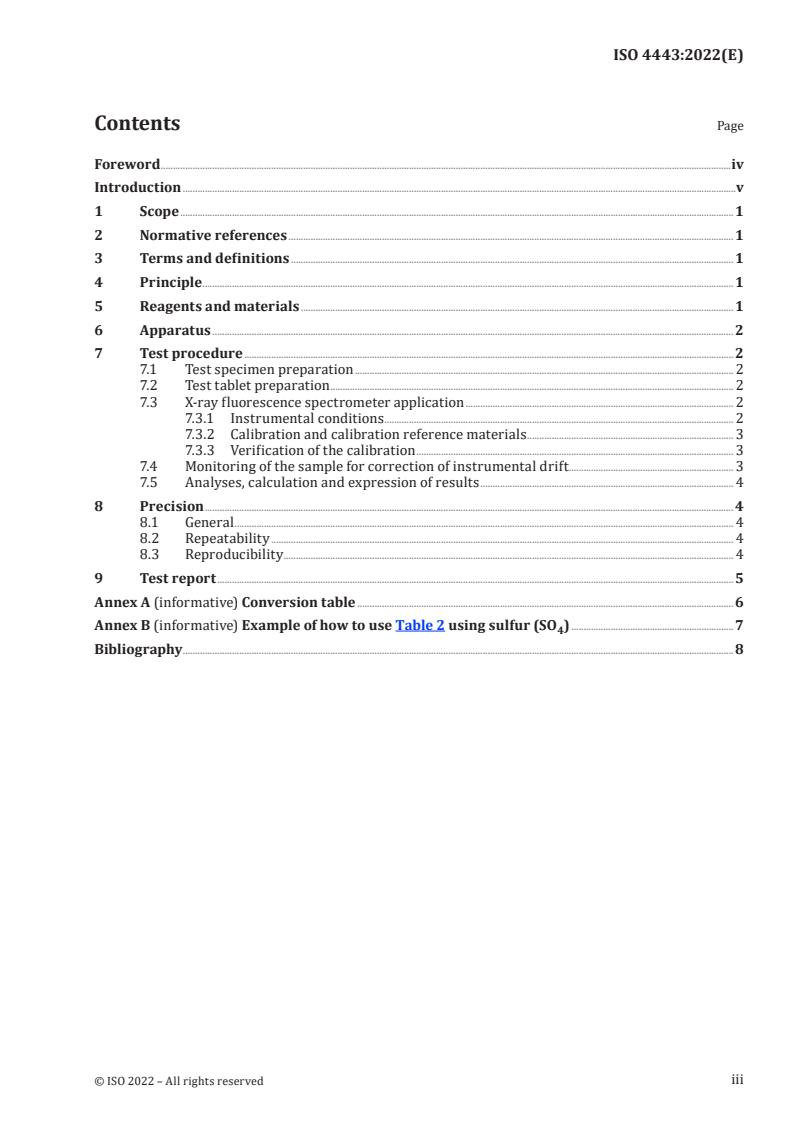
Contents Page
Foreword .iv
Introduction .v
1 Scope . 1
2 Normative references . 1
3 Terms and definitions . 1
4 Principle . 1
5 Reagents and materials . 1
6 Apparatus . 2
7 Test procedure .2
7.1 Test specimen preparation . 2
7.2 Test tablet preparation . 2
7.3 X-ray fluorescence spectrometer application . 2
7.3.1 Instrumental conditions . 2
7.3.2 Calibration and calibration reference materials . 3
7.3.3 Verification of the calibration . 3
7.4 Monitoring of the sample for correction of instrumental drift . 3
7.5 Analyses, calculation and expression of results . 4
8 Precision . 4
8.1 General . 4
8.2 Repeatability . 4
8.3 Reproducibility . 4
9 Test report . 5
Annex A (informative) Conversion table . 6
Annex B (informative) Example of how to use Table 2 using sulfur (SO ) .7
Bibliography . 8
iii
Foreword
ISO (the International Organization for Standardization) is a worldwide federation of national standards
bodies (ISO member bodies). The work of preparing International Standards is normally carried out
through ISO technical committees. Each member body interested in a subject for which a technical
committee has been established has the right to be represented on that committee. International
organizations, governmental and non-governmental, in liaison with ISO, also take part in the work.
ISO collaborates closely with the International Electrotechnical Commission (IEC) on all matters of
electrotechnical standardization.
The procedures used to develop this document and those intended for its further maintenance are
described in the ISO/IEC Directives, Part 1. In particular, the different approval criteria needed for the
different types of ISO documents should be noted. This document was drafted in accordance with the
editorial rules of the ISO/IEC Directives, Part 2 (see www.iso.org/directives).
Attention is drawn to the possibility that some of the elements of this document may be the subject of
patent rights. ISO shall not be held responsible for identifying any or all such patent rights. Details of
any patent rights identified during the development of the document will be in the Introduction and/or
on the ISO list of patent declarations received (see www.iso.org/patents).
Any trade name used in this document is information given for the convenience of users and does not
constitute an endorsement.
For an explanation of the voluntary nature of standards, the meaning of ISO specific terms and
expressions related to conformity assessment, as well as information about ISO's adherence to
the World Trade Organization (WTO) principles in the Technical Barriers to Trade (TBT), see
www.iso.org/iso/foreword.html.
This document was prepared by Technical Committee ISO/TC 226, Materials for the production of
primary aluminium.
Any feedback or questions on this document should be directed to the user’s national standards body. A
complete listing of these bodies can be found at www.iso.org/members.html.
iv
Introduction
In the production of aluminium, cryolite is used as a flux in order to lower the melting points of
aluminium smelting baths and increase the conductivity of the electrolyte. This use is critical during
the start-up and normal operation stages of electrolysis cells.
v
INTERNATIONAL STANDARD ISO 4443:2022(E)
Cryolite primarily used for the production of aluminium —
Determination of elements — Wavelength-dispersive X-ray
fluorescence spectrometric method using pressed powder
tablets
1 Scope
This document specifies a wavelength-dispersive X-ray fluorescence spectrometric (XRF) method for
the determination of cryolite (Na AlF ) from the content of fluorine to the content of trace elements.
3 6
The calibration reference materials are not specified in this method.
The method is applicable to cryolite, which is primarily used for the production of aluminium. Annex A
provides conversion factors for converting elements to compounds. The validity and precision of test
results for concentrations outside these ranges has not been determined.
The concentration range of fluorine (given as F) is from 510 g/kg to 560 g/kg. The concentration range
of aluminium (given as Al) is from 120 g/kg to 150 g/kg. The concentration range of sodium (given as
Na) is from 270 g/kg to 330 g/kg. The concentration range of silicon (given as SiO ) is from the lowest
limit of detection (LLD) to 4,0 g/kg. The concentration range of iron (given as Fe O ) is from LLD to
2 3
0,37 g/kg. The concentration range of sulfur (given as SO ) is from LLD to 5,0 g/kg. The concentration
range of phosphorus (given as P O ) is from LLD to 0,40 g/kg. The concentration range of calcium
2 5
(given as CaO) is from LLD to 0,80 g/kg.
2 Normative references
There are no normative references in this document.
3 Terms and definitions
No terms and definitions are listed in this document.
ISO and IEC maintain terminology databases for use in standardization at the following addresses:
— ISO Online browsing platform: available at https:// www .iso .org/ obp
— IEC Electropedia: available at https:// www .electropedia .org/
4 Principle
A representative sample of cryolite is milled. A test portion is packed and pressed on a powder tablet
press to make the test tablets.
The test tablets are analysed on an X-ray fluorescence spectrometer instrument that has been calibrated
using a series of cryolite reference materials covering the required concentration range of the elements
to be determined.
5 Reagents and materials
5.1 Acetone or ethyl alcohol, analytical pure, used as dispersing agent.
5.2 Boric acid, analytical pure.
6 Apparatus
6.1 Wavelength-dispersive X-ray fluorescence spectrometer (XRF), with vacuum path and
equipped with crystals required as shown in Table 1.
6.2 Vibratory disc mill, with tray, ring and puck made of non-contaminating material. Tungsten-
car
...