

ISO 4992-2:2020
(Main)Steel castings — Ultrasonic testing — Part 2: Steel castings for highly stressed components
General Information
- Abstract
This document specifies the requirements for the ultrasonic testing of steel castings (with ferritic structure) for highly stressed components, and the methods for determining internal discontinuities by the pulse-echo technique. Purchasers determine if components are highly stressed based on the need for performance or safety. This document applies to the ultrasonic testing of steel castings which have usually received a grain-refining heat treatment and which have wall thicknesses up to and including 600 mm. For greater wall thicknesses, special agreements apply with respect to the test procedure and the acceptance levels. This document does not apply to austenitic steels and to joint welds.
- Status
- Published
- Publication Date
- 14-Mar-2020
- Technical Committee
- ISO/TC 17/SC 11 - Steel castings
- Drafting Committee
- ISO/TC 17/SC 11 - Steel castings
- Current Stage
- 9060 - Close of review
- Completion Date
- 02-Sep-2030
Buy Documents


ISO 4992-2:2020 - Steel castings -- Ultrasonic testing
ISO 4992-2:2020 - Steel castings — Ultrasonic testing — Part 2: Steel castings for highly stressed components/15/2020
Overview
ISO 4992-2:2020 - Steel castings - Ultrasonic testing - Part 2: Steel castings for highly stressed components specifies ultrasonic testing (UT) requirements for ferritic steel castings intended for highly stressed components. It covers the pulse‑echo technique for detecting and sizing internal discontinuities, typical pre‑treatments (e.g., grain‑refining heat treatment), test scope up to 600 mm wall thickness (greater thicknesses require special agreement), and explicitly excludes austenitic steels and joint welds. Purchasers determine whether a component is “highly stressed” based on performance or safety needs.
Key technical topics and requirements
- Scope and applicability: Ferritic steel castings for highly stressed applications; wall thicknesses ≤600 mm; special arrangements for >600 mm.
- Testing method: Pulse‑echo ultrasonic testing with specified probe, frequency and instrument considerations.
- Zones and sizing rules: Division into rim zone (one‑third of through‑wall thickness, max 30 mm) and core zone for acceptance evaluation; rules for planar and volumetric discontinuities and distance criteria between indications.
- Acceptance criteria: Purchaser-specified acceptance levels and classes; notable limits include that indications exceeding 3 mm FBH are unacceptable for class 1, and through‑wall dimensions are limited (generally ≤10% of wall thickness, with specific exceptions such as small lengths ≤10 mm).
- Non‑measurable discontinuities: Guidance for when discontinuity dimensions cannot be measured (industry practice: <3 mm taken as non‑measurable) and area calculation conventions (e.g., A = 3 × L when through‑wall width assumed 3 mm).
- Equipment and setup: Requirements for instruments, probes/transducer frequencies, coupling fluids, sensitivity and resolution checks, and calibration (references to calibration blocks).
- Procedure, reporting and personnel: Surface preparation, range/sensitivity setting, recording limits, characterization and sizing procedures, and qualification of NDT personnel.
Practical applications and who uses this standard
ISO 4992-2:2020 is used by:
- NDT engineers and inspectors performing ultrasonic testing on critical cast parts
- Castings manufacturers and quality managers specifying acceptance criteria for highly stressed components (e.g., pressure-containing parts, rotating machinery, safety-critical structures)
- Purchasers and design engineers who define test scope and acceptance levels for safety/performance
- Certification bodies and laboratories establishing UT procedures and training programs
Practical benefits include consistent defect detection and sizing, repeatable acceptance decisions, and improved safety and reliability of highly stressed steel castings.
Related standards (normative references)
Key referenced ISO standards include:
- ISO 2400, ISO 7963 (calibration blocks)
- ISO 5577 (UT vocabulary)
- ISO 9712 (NDT personnel qualification)
- ISO 16810 / ISO 16811 / ISO 16827 (UT principles, sensitivity, characterization)
- ISO 22232 series (equipment verification)
Keywords: ISO 4992-2:2020, ultrasonic testing, steel castings, pulse-echo, ferritic, highly stressed components, NDT, acceptance levels, rim zone, FBH.
Relations
- Effective Date
- 18-Feb-2026
- Effective Date
- 14-Jan-2017
Buy Documents
ISO 4992-2:2020 - Steel castings -- Ultrasonic testing
ISO 4992-2:2020 - Steel castings — Ultrasonic testing — Part 2: Steel castings for highly stressed components/15/2020
Get Certified
Connect with accredited certification bodies for this standard

Element Materials Technology
Materials testing and product certification.

Inštitut za kovinske materiale in tehnologije
Institute of Metals and Technology. Materials testing, metallurgical analysis, NDT.
Sponsored listings
Frequently Asked Questions
ISO 4992-2:2020 is a standard published by the International Organization for Standardization (ISO). Its full title is "Steel castings — Ultrasonic testing — Part 2: Steel castings for highly stressed components". This standard covers: This document specifies the requirements for the ultrasonic testing of steel castings (with ferritic structure) for highly stressed components, and the methods for determining internal discontinuities by the pulse-echo technique. Purchasers determine if components are highly stressed based on the need for performance or safety. This document applies to the ultrasonic testing of steel castings which have usually received a grain-refining heat treatment and which have wall thicknesses up to and including 600 mm. For greater wall thicknesses, special agreements apply with respect to the test procedure and the acceptance levels. This document does not apply to austenitic steels and to joint welds.
This document specifies the requirements for the ultrasonic testing of steel castings (with ferritic structure) for highly stressed components, and the methods for determining internal discontinuities by the pulse-echo technique. Purchasers determine if components are highly stressed based on the need for performance or safety. This document applies to the ultrasonic testing of steel castings which have usually received a grain-refining heat treatment and which have wall thicknesses up to and including 600 mm. For greater wall thicknesses, special agreements apply with respect to the test procedure and the acceptance levels. This document does not apply to austenitic steels and to joint welds.
ISO 4992-2:2020 is classified under the following ICS (International Classification for Standards) categories: 77.040.20 - Non-destructive testing of metals; 77.140.80 - Iron and steel castings. The ICS classification helps identify the subject area and facilitates finding related standards.
ISO 4992-2:2020 has the following relationships with other standards: It is inter standard links to EN ISO 11970:2025, ISO 4992-2:2006. Understanding these relationships helps ensure you are using the most current and applicable version of the standard.
ISO 4992-2:2020 is available in PDF format for immediate download after purchase. The document can be added to your cart and obtained through the secure checkout process. Digital delivery ensures instant access to the complete standard document.
Standards Content (Sample)
INTERNATIONAL ISO
STANDARD 4992-2
Second edition
2020-03
Steel castings — Ultrasonic testing —
Part 2:
Steel castings for highly stressed
components
Pièces moulées en acier - Contrôle par ultrasons —
Partie 2: Pièces moulées en acier pour composants fortement sollicités
Reference number
©
ISO 2020
© ISO 2020
All rights reserved. Unless otherwise specified, or required in the context of its implementation, no part of this publication may
be reproduced or utilized otherwise in any form or by any means, electronic or mechanical, including photocopying, or posting
on the internet or an intranet, without prior written permission. Permission can be requested from either ISO at the address
below or ISO’s member body in the country of the requester.
ISO copyright office
CP 401 • Ch. de Blandonnet 8
CH-1214 Vernier, Geneva
Phone: +41 22 749 01 11
Fax: +41 22 749 09 47
Email: copyright@iso.org
Website: www.iso.org
Published in Switzerland
ii © ISO 2020 – All rights reserved
Contents Page
Foreword .iv
1 Scope . 1
2 Normative references . 1
3 Terms and definitions . 2
4 Requirements . 3
4.1 Order information . 3
4.2 Extent of testing . 3
4.3 Maximum acceptable size of discontinuities . 3
4.3.1 General. 3
4.3.2 Indications without measurable dimensions . 3
4.3.3 Indications with measurable dimensions . 3
4.4 Qualification of personnel . 5
4.5 Wall-section zones . 5
4.6 Classes . 5
5 Testing . 5
5.1 Principles . 5
5.2 Material . 5
5.3 Test equipment, coupling fluid, test sensitivity and resolution of detection . 6
5.3.1 Ultrasonic instrument . 6
5.3.2 Probes and transducer frequencies . 6
5.3.3 Checking of the ultrasonic test equipment . 6
5.3.4 Coupling fluid. 6
5.3.5 Test sensitivity and resolution of detection . 7
5.4 Preparation of casting surfaces for testing . 7
5.5 Test procedure . 7
5.5.1 General. 7
5.5.2 Range setting . 8
5.5.3 Sensitivity setting . 8
5.5.4 Consideration of various types of indications . 9
5.5.5 Recording and recording limits . 9
5.5.6 Assessment of indications to be recorded . 9
5.5.7 Characterization and sizing of discontinuities .10
5.6 Test report .10
Annex A (normative) Resolution of detection of the instrument-probe combination .18
Annex B (informative) Sound-beam diameters .19
Annex C (informative) Types of indications generated by typical discontinuities .21
Bibliography .33
Foreword
ISO (the International Organization for Standardization) is a worldwide federation of national standards
bodies (ISO member bodies). The work of preparing International Standards is normally carried out
through ISO technical committees. Each member body interested in a subject for which a technical
committee has been established has the right to be represented on that committee. International
organizations, governmental and non-governmental, in liaison with ISO, also take part in the work.
ISO collaborates closely with the International Electrotechnical Commission (IEC) on all matters of
electrotechnical standardization.
The procedures used to develop this document and those intended for its further maintenance are
described in the ISO/IEC Directives, Part 1. In particular, the different approval criteria needed for the
different types of ISO documents should be noted. This document was drafted in accordance with the
editorial rules of the ISO/IEC Directives, Part 2 (see www .iso .org/ directives).
Attention is drawn to the possibility that some of the elements of this document may be the subject of
patent rights. ISO shall not be held responsible for identifying any or all such patent rights. Details of
any patent rights identified during the development of the document will be in the Introduction and/or
on the ISO list of patent declarations received (see www .iso .org/ patents).
Any trade name used in this document is information given for the convenience of users and does not
constitute an endorsement.
For an explanation of the voluntary nature of standards, the meaning of ISO specific terms and
expressions related to conformity assessment, as well as information about ISO's adherence to the
World Trade Organization (WTO) principles in the Technical Barriers to Trade (TBT) see www .iso .org/
iso/ foreword .html.
This document was prepared by Technical Committee ISO/TC 17, Steel, Subcommittee SC 11, Steel
castings.
This second edition cancels and replaces the first edition (ISO 4992-2:2006), which has been technically
revised. The main changes compared to the previous edition are as follows:
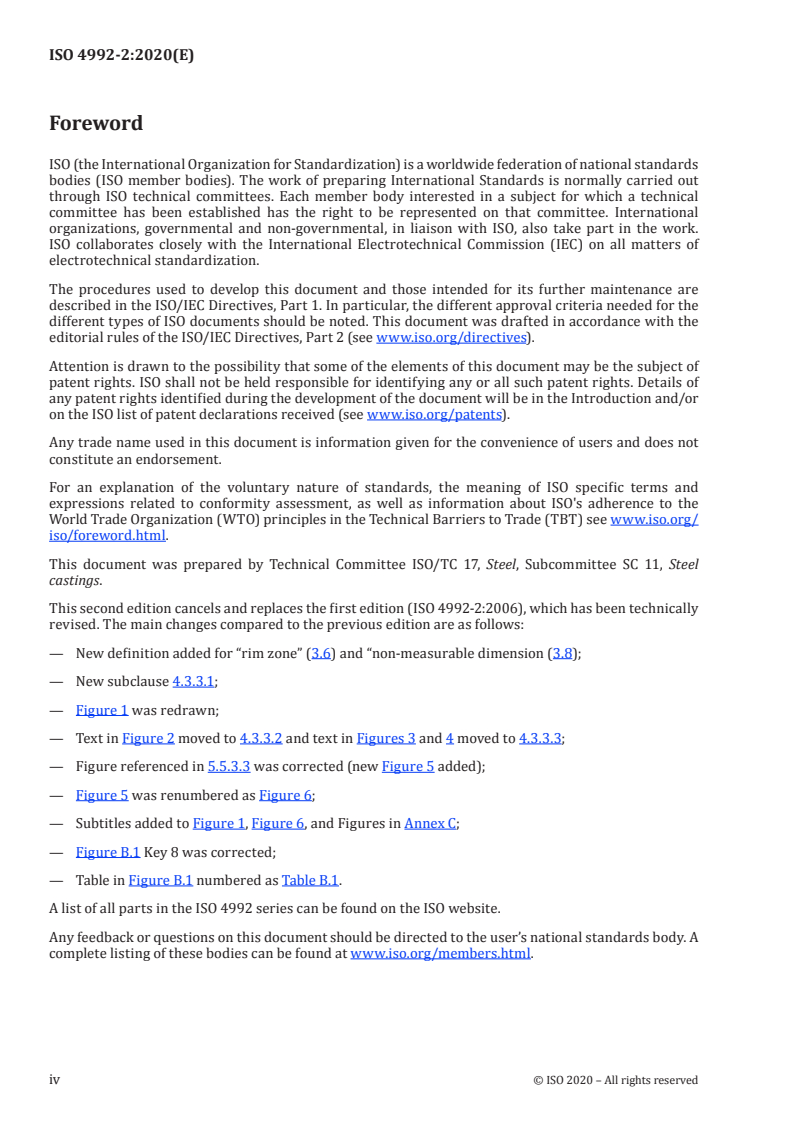
— New definition added for “rim zone” (3.6) and “non-measurable dimension (3.8);
— New subclause 4.3.3.1;
— Figure 1 was redrawn;
— Text in Figure 2 moved to 4.3.3.2 and text in Figures 3 and 4 moved to 4.3.3.3;
— Figure referenced in 5.5.3.3 was corrected (new Figure 5 added);
— Figure 5 was renumbered as Figure 6;
— Subtitles added to Figure 1, Figure 6, and Figures in Annex C;
— Figure B.1 Key 8 was corrected;
— Table in Figure B.1 numbered as Table B.1.
A list of all parts in the ISO 4992 series can be found on the ISO website.
Any feedback or questions on this document should be directed to the user’s national standards body. A
complete listing of these bodies can be found at www .iso .org/ members .html.
iv © ISO 2020 – All rights reserved
INTERNATIONAL STANDARD ISO 4992-2:2020(E)
Steel castings — Ultrasonic testing —
Part 2:
Steel castings for highly stressed components
1 Scope
This document specifies the requirements for the ultrasonic testing of steel castings (with ferritic
structure) for highly stressed components, and the methods for determining internal discontinuities by
the pulse-echo technique. Purchasers determine if components are highly stressed based on the need
for performance or safety.
This document applies to the ultrasonic testing of steel castings which have usually received a grain-
refining heat treatment and which have wall thicknesses up to and including 600 mm. For greater wall
thicknesses, special agreements apply with respect to the test procedure and the acceptance levels.
This document does not apply to austenitic steels and to joint welds.
2 Normative references
The following documents are referred to in the text in such a way that some or all of their content
constitutes requirements of this document. For dated references, only the edition cited applies. For
undated references, the latest edition of the referenced document (including any amendments) applies.
ISO 2400, Non-destructive testing — Ultrasonic testing — Specification for calibration block No. 1
ISO 5577, Non-destructive testing — Ultrasonic testing — Vocabulary
ISO 7963, Non-destructive testing — Ultrasonic testing — Specification for calibration block No. 2
ISO 9712, Non-destructive testing — Qualification and certification of NDT personnel
ISO 11971, Steel and iron castings — Visual testing of surface quality
ISO 16810, Non-destructive testing — Ultrasonic testing — General principles
ISO 16811, Non-destructive testing — Ultrasonic testing — Sensitivity and range setting
ISO 16827:2012, Non-destructive testing — Ultrasonic testing — Characterization and sizing of
discontinuities
1)
ISO 22232-1 , Non-destructive testing — Characterization and verification of ultrasonic test equipment —
Part 1: Instruments
2)
ISO 22232-2 , Non-destructive testing — Characterization and verification of ultrasonic test equipment —
Part 2: Probes
3)
ISO 22232-3 , Non-destructive testing — Characterization and verification of ultrasonic test equipment —
Part 3: Combined equipment
1) Under preparation. Stage at the time of publication: ISO/DIS 22322-1.
2) Under preparation. Stage at the time of publication: ISO/DIS 22322-2.
3) Under preparation. Stage at the time of publication: ISO/DIS 22322-3.
3 Terms and definitions
For the purposes of this document, the terms and definitions given in ISO 5577, ISO 16810, ISO 16811,
ISO 16827 and the following apply.
ISO and IEC maintain terminological databases for use in standardization at the following addresses:
— ISO Online browsing platform: available at https:// www .iso .org/ obp
— IEC Electropedia: available at http:// www .electropedia .org/
3.1
equivalent reference discontinuity echo size
indication to be recorded during the assessment phase of an ultrasonic test, usually expressed as an
equivalent diameter of a flat-bottomed hole (FBH)
3.2
point-like discontinuity
discontinuity, the dimensions of which are smaller than or equal to the sound-beam diameter
Note 1 to entry: Dimensions in this document relate to length, width and/or dimension in the through-wall
direction.
3.3
extended discontinuity
discontinuity, the dimensions of which are larger than the sound-beam diameter
Note 1 to entry: Dimensions in this document relate to length, width and/or dimension in the through-wall
direction.
3.4
planar discontinuity
discontinuity having two measurable dimensions
3.5
volumetric discontinuity
discontinuity having three measurable dimensions
3.6
rim zone
1/3 the through-wall thickness from the surface with a maximum of 30 mm
3.7
special rim zone
outer rim zone (3.6) of the test object with special requirements
Note 1 to entry: Examples of special requirements are machined surfaces, higher stresses and sealing surfaces.
3.8
non-measurable discontinuity
dimension of the discontinuity that cannot be determined, non-measurable, by scanning (dB-drop) when
the dimension is smaller than the beam width, which depends on the probe size and the frequency used
Note 1 to entry: Current state of the industry is <3 mm.
3.9
production welding
any welding on the test object carried out during manufacturing before final delivery to the purchaser
3.10
joint welding
production welding used to assemble components together to obtain an integral unit
2 © ISO 2020 – All rights reserved
3.11
finishing welding
production welding carried out in order to ensure the agreed quality of the casting
4 Requirements
4.1 Order information
The following information shall be available at the time of enquiry and order (see also ISO 16810):
a) the areas of the casting and the number or percentage of castings to which the requirements of
ultrasonic testing apply;
b) the acceptance levels to be applied to the various zones or areas of the casting;
c) requirements for a written test procedure;
d) whether there are any additional requirements for the test procedure, see also 5.5.1.
4.2 Extent of testing
The casting shall be tested so that the agreed areas are covered (insofar as this is possible from the
shape of the casting) by the use of the best applicable test technique.
For wall thicknesses greater than 600 mm, agreement shall be made between the purchaser and
manufacturer on the acceptance levels, test procedure, and the recording of the test results.
4.3 Maximum acceptable size of discontinuities
4.3.1 General
The purchaser shall specify the acceptance level according to the required class for planar and
volumetric discontinuities within each zone and in each specified area of the casting.
The wall section shall be divided into core and rim zones as shown in Figure 1. These sections relate to
the sizes of castings ready for assembly (finish-machined).
4.3.2 Indications without measurable dimensions
In special rim zones and at weld preparation ends, indications without measurable dimensions are
limited to a maximum number of indications.
These indications shall not exceed the limits given in Table 1.
4.3.3 Indications with measurable dimensions
4.3.3.1 General
Single discontinuities extending into the rim zone and core zone shall be evaluated as rim zone.
4.3.3.2 Planar discontinuities
Planar discontinuities shall not exceed the limits given in Figure 2.
Discontinuities exceeding 3 mm FBH shall not be acceptable in class 1.
The largest dimension of a discontinuity in the through-wall direction shall not exceed 10 % of the wall
thickness, except discontinuities with a length ≤10 mm. Discontinuities with a length ≤10 mm shall not
exceed a dimension in the through-wall direction of 25 % of the wall thickness.
The greatest distance between discontinuities, as criterion for evaluation as an individual discontinuity
or a discontinuity area in the through-wall direction or lateral to the surface, shall be 10 mm.
For a discontinuity with more than 3 mm in length and non-measurable dimension in the through-wall
direction, this non-measurable dimension shall be taken as 3 mm and the area shall be calculated as
follows:
A = 3L (1)
where
A is the area of discontinuity, in square millimetres;
3 is the width taken, in millimetres;
L is the length, in millimetres.
The sizing of small planar discontinuities, as given in Figure 2, becomes more difficult with increasing
beam-path length and sound-beam diameter. As a guide, these sizings are normally applied to a rim
zone of 30 mm. This makes the use of probes with focused beams, such as dual-transducer probes,
necessary.
4.3.3.3 Volumetric discontinuities
Volumetric discontinuities shall not exceed the sizes given in Figure 3 for the rim zone and Figure 4 for
the core zone.
Indications exceeding 3 mm FBH shall not be acceptable as class 1.
The maximum acceptable dimensions of discontinuity areas in the through-wall direction in the rim
zone shall be 15 % of the rim zone thickness. The maximum acceptable dimensions of discontinuity
areas in the through-wall direction in the core zone shall be 15 % of the wall thickness.
The maximum distance between discontinuities, as a criterion for evaluation as an individual indication
in the through-wall direction or lateral to the surface, shall be 10 mm in the rim zone and 20 mm in the
core zone.
For a discontinuity with more than 3 mm in length and non-measurable dimension in the through-wall
direction, this non-measurable dimension shall be taken as 3 mm and the area shall be calculated as
follows:
A = 3L (2)
where
A is the area of discontinuity, in square millimetres;
3 is the width taken, in millimetres;
L is the length, in millimetres.
Unless otherwise agreed at the time of enquiry and order, when conducting radiographic and ultrasonic
testing in combination it was proven that if a discontinuity indicated by radiographic testing is situated
in the core zone, the discontinuity is acceptable at one level lower, e.g. in class 3 instead of class 2 for
radiographic testing. For further information, see EN 1559-2.
4 © ISO 2020 – All rights reserved
4.4 Qualification of personnel
Ultrasonic testing shall be performed by qualified personnel. Qualification of personnel may be
according to ISO 9712 or other equivalent recognised standards.
4.5 Wall-section zones
The wall section shall be divided into core and rim zones as shown in Figure 1. These sections relate to
the dimensions of the casting ready for assembly (finish-machined).
4.6 Classes
If the purchaser specifies different classes in different areas of the same casting, all of these areas shall
be clearly identified and shall include:
a) all necessary dimensions for accurate location of zones;
b) the full extent of all weld preparations and the thickness of any special rim zone.
Class 1 is only applied to weld preparations and special rim zones.
Unless other requirements have been agreed at the time of acceptance of the order, for finishing welds,
the requirements for the parent metal shall apply.
5 Testing
5.1 Principles
The principles of ultrasonic testing given in ISO 16810, ISO 16811 and ISO 16827 shall apply.
5.2 Material
The suitability of material for ultrasonic testing is assessed by comparison with the echo height of
a reference reflector (usually the first back-wall echo) and the noise level. This assessment shall be
carried out on selected casting areas which are representative of the surface finish and of the total
thickness range of the objects to be tested. The assessment areas shall have parallel surfaces.
The reference echo height according to Table 2 shall be at least 6 dB above the noise level.
If the echo height of the smallest detectable flat-bottomed or equivalent side-drilled hole diameter at
the far end of the test range to be assessed is less than 6 dB above the noise level, then the ultrasonic
testing has reduced performance. In this case, the diameter of the flat-bottomed or side-drilled hole
which can be detected with a signal-to-noise ratio of at least 6 dB shall be noted in the test report and
the additional procedure shall be agreed between the manufacturer and the purchaser.
NOTE For the definition of an adequate diameter of a flat-bottomed hole, the distance-gain-size system (DGS)
or a test block of identical material, heat treatment condition and section thickness containing flat-bottomed
holes with a diameter according to Table 2 or equivalent side-drilled holes, can be used. The following formula
can be used for converting a flat-bottomed hole diameter into an equivalent side-drilled hole diameter:
4,935D
FBH
D = (3)
SDH
λ s
where
D is the side-drilled hole diameter, in millimetres;
SDH
D is the flat-bottomed hole diameter, in millimetres;
FBH
λ is the wavelength, in millimetres;
s is the path length, in millimetres.
Formula (3) is applicable for D ≥ 2λ and s ≥ 5 times the near-field length and is only defined for
SDH
single-element probes.
5.3 Test equipment, coupling fluid, test sensitivity and resolution of detection
5.3.1 Ultrasonic instrument
The ultrasonic instrument shall meet the requirements given in ISO 22232-1 and shall have the
following characteristics:
a) range setting capability, from at least 10 mm to 2 m continuously selectable, for longitudinal and
transverse waves transmitted in steel;
b) gain span, adjustable in 2 dB maximum steps over a range of at least 80 dB with an accuracy of 1 dB;
c) time-base and vertical linearities less than 5 % of the adjustment range of the screen;
d) suitability, at least for nominal frequencies from 1 MHz up to and including 6 MHz, in the pulse-
echo technique with single-transducer and dual-transducer probes.
5.3.2 Probes and transducer frequencies
The probes and transducer frequencies shall be as given in ISO 22232-2, ISO 22232-2 and ISO 22232-3
with the following exceptions:
a) nominal frequencies shall be in the range 1 MHz to 6 MHz;
b) for oblique incidence, angle-beam probes with angles between 35° and 70° shall be used.
NOTE Normal-beam or angle-beam probes can be used for the testing of steel castings for highly stressed
components. The type of probe used depends on the geometry of the casting and the type of discontinuity to be
detected.
For test zones close to the surface, dual-element probes (normal-beam or angle-beam) should be
preferred.
5.3.3 Checking of the ultrasonic test equipment
The ultrasonic test equipment shall be checked regularly by the operator in accordance with
ISO 22232-3.
5.3.4 Coupling fluid
A coupling fluid in accordance with ISO 16810 shall be used. The coupling fluid shall wet the test surface
to ensure satisfactory sound transmission. The same coupling fluid shall be used for the calibration and
all subsequent test operations.
NOTE The sound transmission can be checked by one or more stable back-wall echoes in areas with parallel
surfaces.
6 © ISO 2020 – All rights reserved
5.3.5 Test sensitivity and resolution of detection
The test sensitivity of the instrument shall allow at least the setting of the sensitivity in accordance
with the requirements of 5.5.2.
The resolution of detection of the instrument-probe combination shall meet the requirements of
Annex A.
5.4 Preparation of casting surfaces for testing
For the preparation of casting surfaces for ultrasonic testing, see ISO 16810.
The casting surfaces to be tested shall be such that satisfactory coupling with the probe can be achieved.
With single-element probes, satisfactory coupling can be achieved if the surfaces correspond at least to
the limit comparator 4 S1 or 4 S2 according to ISO 11971.
The roughness of any machined surface used for testing shall be R ≤ 12,5 μm.
a
For special test techniques, higher surface qualities such as 2 S1 or 2 S2 (see ISO 11971) and R ≤ 6,3 μm
a
may be necessary.
5.5 Test procedure
5.5.1 General
Because the choice of both the direction of incidence and suitable probes largely depends on the shape
of the casting, or on the possible discontinuities in the cast
...
INTERNATIONAL ISO
STANDARD 4992-2
Second edition
2020-03
Steel castings — Ultrasonic testing —
Part 2:
Steel castings for highly stressed
components
Pièces moulées en acier - Contrôle par ultrasons —
Partie 2: Pièces moulées en acier pour composants fortement sollicités
Reference number
©
ISO 2020
© ISO 2020
All rights reserved. Unless otherwise specified, or required in the context of its implementation, no part of this publication may
be reproduced or utilized otherwise in any form or by any means, electronic or mechanical, including photocopying, or posting
on the internet or an intranet, without prior written permission. Permission can be requested from either ISO at the address
below or ISO’s member body in the country of the requester.
ISO copyright office
CP 401 • Ch. de Blandonnet 8
CH-1214 Vernier, Geneva
Phone: +41 22 749 01 11
Fax: +41 22 749 09 47
Email: copyright@iso.org
Website: www.iso.org
Published in Switzerland
ii © ISO 2020 – All rights reserved
Contents Page
Foreword .iv
1 Scope . 1
2 Normative references . 1
3 Terms and definitions . 2
4 Requirements . 3
4.1 Order information . 3
4.2 Extent of testing . 3
4.3 Maximum acceptable size of discontinuities . 3
4.3.1 General. 3
4.3.2 Indications without measurable dimensions . 3
4.3.3 Indications with measurable dimensions . 3
4.4 Qualification of personnel . 5
4.5 Wall-section zones . 5
4.6 Classes . 5
5 Testing . 5
5.1 Principles . 5
5.2 Material . 5
5.3 Test equipment, coupling fluid, test sensitivity and resolution of detection . 6
5.3.1 Ultrasonic instrument . 6
5.3.2 Probes and transducer frequencies . 6
5.3.3 Checking of the ultrasonic test equipment . 6
5.3.4 Coupling fluid. 6
5.3.5 Test sensitivity and resolution of detection . 7
5.4 Preparation of casting surfaces for testing . 7
5.5 Test procedure . 7
5.5.1 General. 7
5.5.2 Range setting . 8
5.5.3 Sensitivity setting . 8
5.5.4 Consideration of various types of indications . 9
5.5.5 Recording and recording limits . 9
5.5.6 Assessment of indications to be recorded . 9
5.5.7 Characterization and sizing of discontinuities .10
5.6 Test report .10
Annex A (normative) Resolution of detection of the instrument-probe combination .18
Annex B (informative) Sound-beam diameters .19
Annex C (informative) Types of indications generated by typical discontinuities .21
Bibliography .33
Foreword
ISO (the International Organization for Standardization) is a worldwide federation of national standards
bodies (ISO member bodies). The work of preparing International Standards is normally carried out
through ISO technical committees. Each member body interested in a subject for which a technical
committee has been established has the right to be represented on that committee. International
organizations, governmental and non-governmental, in liaison with ISO, also take part in the work.
ISO collaborates closely with the International Electrotechnical Commission (IEC) on all matters of
electrotechnical standardization.
The procedures used to develop this document and those intended for its further maintenance are
described in the ISO/IEC Directives, Part 1. In particular, the different approval criteria needed for the
different types of ISO documents should be noted. This document was drafted in accordance with the
editorial rules of the ISO/IEC Directives, Part 2 (see www .iso .org/ directives).
Attention is drawn to the possibility that some of the elements of this document may be the subject of
patent rights. ISO shall not be held responsible for identifying any or all such patent rights. Details of
any patent rights identified during the development of the document will be in the Introduction and/or
on the ISO list of patent declarations received (see www .iso .org/ patents).
Any trade name used in this document is information given for the convenience of users and does not
constitute an endorsement.
For an explanation of the voluntary nature of standards, the meaning of ISO specific terms and
expressions related to conformity assessment, as well as information about ISO's adherence to the
World Trade Organization (WTO) principles in the Technical Barriers to Trade (TBT) see www .iso .org/
iso/ foreword .html.
This document was prepared by Technical Committee ISO/TC 17, Steel, Subcommittee SC 11, Steel
castings.
This second edition cancels and replaces the first edition (ISO 4992-2:2006), which has been technically
revised. The main changes compared to the previous edition are as follows:
— New definition added for “rim zone” (3.6) and “non-measurable dimension (3.8);
— New subclause 4.3.3.1;
— Figure 1 was redrawn;
— Text in Figure 2 moved to 4.3.3.2 and text in Figures 3 and 4 moved to 4.3.3.3;
— Figure referenced in 5.5.3.3 was corrected (new Figure 5 added);
— Figure 5 was renumbered as Figure 6;
— Subtitles added to Figure 1, Figure 6, and Figures in Annex C;
— Figure B.1 Key 8 was corrected;
— Table in Figure B.1 numbered as Table B.1.
A list of all parts in the ISO 4992 series can be found on the ISO website.
Any feedback or questions on this document should be directed to the user’s national standards body. A
complete listing of these bodies can be found at www .iso .org/ members .html.
iv © ISO 2020 – All rights reserved
INTERNATIONAL STANDARD ISO 4992-2:2020(E)
Steel castings — Ultrasonic testing —
Part 2:
Steel castings for highly stressed components
1 Scope
This document specifies the requirements for the ultrasonic testing of steel castings (with ferritic
structure) for highly stressed components, and the methods for determining internal discontinuities by
the pulse-echo technique. Purchasers determine if components are highly stressed based on the need
for performance or safety.
This document applies to the ultrasonic testing of steel castings which have usually received a grain-
refining heat treatment and which have wall thicknesses up to and including 600 mm. For greater wall
thicknesses, special agreements apply with respect to the test procedure and the acceptance levels.
This document does not apply to austenitic steels and to joint welds.
2 Normative references
The following documents are referred to in the text in such a way that some or all of their content
constitutes requirements of this document. For dated references, only the edition cited applies. For
undated references, the latest edition of the referenced document (including any amendments) applies.
ISO 2400, Non-destructive testing — Ultrasonic testing — Specification for calibration block No. 1
ISO 5577, Non-destructive testing — Ultrasonic testing — Vocabulary
ISO 7963, Non-destructive testing — Ultrasonic testing — Specification for calibration block No. 2
ISO 9712, Non-destructive testing — Qualification and certification of NDT personnel
ISO 11971, Steel and iron castings — Visual testing of surface quality
ISO 16810, Non-destructive testing — Ultrasonic testing — General principles
ISO 16811, Non-destructive testing — Ultrasonic testing — Sensitivity and range setting
ISO 16827:2012, Non-destructive testing — Ultrasonic testing — Characterization and sizing of
discontinuities
1)
ISO 22232-1 , Non-destructive testing — Characterization and verification of ultrasonic test equipment —
Part 1: Instruments
2)
ISO 22232-2 , Non-destructive testing — Characterization and verification of ultrasonic test equipment —
Part 2: Probes
3)
ISO 22232-3 , Non-destructive testing — Characterization and verification of ultrasonic test equipment —
Part 3: Combined equipment
1) Under preparation. Stage at the time of publication: ISO/DIS 22322-1.
2) Under preparation. Stage at the time of publication: ISO/DIS 22322-2.
3) Under preparation. Stage at the time of publication: ISO/DIS 22322-3.
3 Terms and definitions
For the purposes of this document, the terms and definitions given in ISO 5577, ISO 16810, ISO 16811,
ISO 16827 and the following apply.
ISO and IEC maintain terminological databases for use in standardization at the following addresses:
— ISO Online browsing platform: available at https:// www .iso .org/ obp
— IEC Electropedia: available at http:// www .electropedia .org/
3.1
equivalent reference discontinuity echo size
indication to be recorded during the assessment phase of an ultrasonic test, usually expressed as an
equivalent diameter of a flat-bottomed hole (FBH)
3.2
point-like discontinuity
discontinuity, the dimensions of which are smaller than or equal to the sound-beam diameter
Note 1 to entry: Dimensions in this document relate to length, width and/or dimension in the through-wall
direction.
3.3
extended discontinuity
discontinuity, the dimensions of which are larger than the sound-beam diameter
Note 1 to entry: Dimensions in this document relate to length, width and/or dimension in the through-wall
direction.
3.4
planar discontinuity
discontinuity having two measurable dimensions
3.5
volumetric discontinuity
discontinuity having three measurable dimensions
3.6
rim zone
1/3 the through-wall thickness from the surface with a maximum of 30 mm
3.7
special rim zone
outer rim zone (3.6) of the test object with special requirements
Note 1 to entry: Examples of special requirements are machined surfaces, higher stresses and sealing surfaces.
3.8
non-measurable discontinuity
dimension of the discontinuity that cannot be determined, non-measurable, by scanning (dB-drop) when
the dimension is smaller than the beam width, which depends on the probe size and the frequency used
Note 1 to entry: Current state of the industry is <3 mm.
3.9
production welding
any welding on the test object carried out during manufacturing before final delivery to the purchaser
3.10
joint welding
production welding used to assemble components together to obtain an integral unit
2 © ISO 2020 – All rights reserved
3.11
finishing welding
production welding carried out in order to ensure the agreed quality of the casting
4 Requirements
4.1 Order information
The following information shall be available at the time of enquiry and order (see also ISO 16810):
a) the areas of the casting and the number or percentage of castings to which the requirements of
ultrasonic testing apply;
b) the acceptance levels to be applied to the various zones or areas of the casting;
c) requirements for a written test procedure;
d) whether there are any additional requirements for the test procedure, see also 5.5.1.
4.2 Extent of testing
The casting shall be tested so that the agreed areas are covered (insofar as this is possible from the
shape of the casting) by the use of the best applicable test technique.
For wall thicknesses greater than 600 mm, agreement shall be made between the purchaser and
manufacturer on the acceptance levels, test procedure, and the recording of the test results.
4.3 Maximum acceptable size of discontinuities
4.3.1 General
The purchaser shall specify the acceptance level according to the required class for planar and
volumetric discontinuities within each zone and in each specified area of the casting.
The wall section shall be divided into core and rim zones as shown in Figure 1. These sections relate to
the sizes of castings ready for assembly (finish-machined).
4.3.2 Indications without measurable dimensions
In special rim zones and at weld preparation ends, indications without measurable dimensions are
limited to a maximum number of indications.
These indications shall not exceed the limits given in Table 1.
4.3.3 Indications with measurable dimensions
4.3.3.1 General
Single discontinuities extending into the rim zone and core zone shall be evaluated as rim zone.
4.3.3.2 Planar discontinuities
Planar discontinuities shall not exceed the limits given in Figure 2.
Discontinuities exceeding 3 mm FBH shall not be acceptable in class 1.
The largest dimension of a discontinuity in the through-wall direction shall not exceed 10 % of the wall
thickness, except discontinuities with a length ≤10 mm. Discontinuities with a length ≤10 mm shall not
exceed a dimension in the through-wall direction of 25 % of the wall thickness.
The greatest distance between discontinuities, as criterion for evaluation as an individual discontinuity
or a discontinuity area in the through-wall direction or lateral to the surface, shall be 10 mm.
For a discontinuity with more than 3 mm in length and non-measurable dimension in the through-wall
direction, this non-measurable dimension shall be taken as 3 mm and the area shall be calculated as
follows:
A = 3L (1)
where
A is the area of discontinuity, in square millimetres;
3 is the width taken, in millimetres;
L is the length, in millimetres.
The sizing of small planar discontinuities, as given in Figure 2, becomes more difficult with increasing
beam-path length and sound-beam diameter. As a guide, these sizings are normally applied to a rim
zone of 30 mm. This makes the use of probes with focused beams, such as dual-transducer probes,
necessary.
4.3.3.3 Volumetric discontinuities
Volumetric discontinuities shall not exceed the sizes given in Figure 3 for the rim zone and Figure 4 for
the core zone.
Indications exceeding 3 mm FBH shall not be acceptable as class 1.
The maximum acceptable dimensions of discontinuity areas in the through-wall direction in the rim
zone shall be 15 % of the rim zone thickness. The maximum acceptable dimensions of discontinuity
areas in the through-wall direction in the core zone shall be 15 % of the wall thickness.
The maximum distance between discontinuities, as a criterion for evaluation as an individual indication
in the through-wall direction or lateral to the surface, shall be 10 mm in the rim zone and 20 mm in the
core zone.
For a discontinuity with more than 3 mm in length and non-measurable dimension in the through-wall
direction, this non-measurable dimension shall be taken as 3 mm and the area shall be calculated as
follows:
A = 3L (2)
where
A is the area of discontinuity, in square millimetres;
3 is the width taken, in millimetres;
L is the length, in millimetres.
Unless otherwise agreed at the time of enquiry and order, when conducting radiographic and ultrasonic
testing in combination it was proven that if a discontinuity indicated by radiographic testing is situated
in the core zone, the discontinuity is acceptable at one level lower, e.g. in class 3 instead of class 2 for
radiographic testing. For further information, see EN 1559-2.
4 © ISO 2020 – All rights reserved
4.4 Qualification of personnel
Ultrasonic testing shall be performed by qualified personnel. Qualification of personnel may be
according to ISO 9712 or other equivalent recognised standards.
4.5 Wall-section zones
The wall section shall be divided into core and rim zones as shown in Figure 1. These sections relate to
the dimensions of the casting ready for assembly (finish-machined).
4.6 Classes
If the purchaser specifies different classes in different areas of the same casting, all of these areas shall
be clearly identified and shall include:
a) all necessary dimensions for accurate location of zones;
b) the full extent of all weld preparations and the thickness of any special rim zone.
Class 1 is only applied to weld preparations and special rim zones.
Unless other requirements have been agreed at the time of acceptance of the order, for finishing welds,
the requirements for the parent metal shall apply.
5 Testing
5.1 Principles
The principles of ultrasonic testing given in ISO 16810, ISO 16811 and ISO 16827 shall apply.
5.2 Material
The suitability of material for ultrasonic testing is assessed by comparison with the echo height of
a reference reflector (usually the first back-wall echo) and the noise level. This assessment shall be
carried out on selected casting areas which are representative of the surface finish and of the total
thickness range of the objects to be tested. The assessment areas shall have parallel surfaces.
The reference echo height according to Table 2 shall be at least 6 dB above the noise level.
If the echo height of the smallest detectable flat-bottomed or equivalent side-drilled hole diameter at
the far end of the test range to be assessed is less than 6 dB above the noise level, then the ultrasonic
testing has reduced performance. In this case, the diameter of the flat-bottomed or side-drilled hole
which can be detected with a signal-to-noise ratio of at least 6 dB shall be noted in the test report and
the additional procedure shall be agreed between the manufacturer and the purchaser.
NOTE For the definition of an adequate diameter of a flat-bottomed hole, the distance-gain-size system (DGS)
or a test block of identical material, heat treatment condition and section thickness containing flat-bottomed
holes with a diameter according to Table 2 or equivalent side-drilled holes, can be used. The following formula
can be used for converting a flat-bottomed hole diameter into an equivalent side-drilled hole diameter:
4,935D
FBH
D = (3)
SDH
λ s
where
D is the side-drilled hole diameter, in millimetres;
SDH
D is the flat-bottomed hole diameter, in millimetres;
FBH
λ is the wavelength, in millimetres;
s is the path length, in millimetres.
Formula (3) is applicable for D ≥ 2λ and s ≥ 5 times the near-field length and is only defined for
SDH
single-element probes.
5.3 Test equipment, coupling fluid, test sensitivity and resolution of detection
5.3.1 Ultrasonic instrument
The ultrasonic instrument shall meet the requirements given in ISO 22232-1 and shall have the
following characteristics:
a) range setting capability, from at least 10 mm to 2 m continuously selectable, for longitudinal and
transverse waves transmitted in steel;
b) gain span, adjustable in 2 dB maximum steps over a range of at least 80 dB with an accuracy of 1 dB;
c) time-base and vertical linearities less than 5 % of the adjustment range of the screen;
d) suitability, at least for nominal frequencies from 1 MHz up to and including 6 MHz, in the pulse-
echo technique with single-transducer and dual-transducer probes.
5.3.2 Probes and transducer frequencies
The probes and transducer frequencies shall be as given in ISO 22232-2, ISO 22232-2 and ISO 22232-3
with the following exceptions:
a) nominal frequencies shall be in the range 1 MHz to 6 MHz;
b) for oblique incidence, angle-beam probes with angles between 35° and 70° shall be used.
NOTE Normal-beam or angle-beam probes can be used for the testing of steel castings for highly stressed
components. The type of probe used depends on the geometry of the casting and the type of discontinuity to be
detected.
For test zones close to the surface, dual-element probes (normal-beam or angle-beam) should be
preferred.
5.3.3 Checking of the ultrasonic test equipment
The ultrasonic test equipment shall be checked regularly by the operator in accordance with
ISO 22232-3.
5.3.4 Coupling fluid
A coupling fluid in accordance with ISO 16810 shall be used. The coupling fluid shall wet the test surface
to ensure satisfactory sound transmission. The same coupling fluid shall be used for the calibration and
all subsequent test operations.
NOTE The sound transmission can be checked by one or more stable back-wall echoes in areas with parallel
surfaces.
6 © ISO 2020 – All rights reserved
5.3.5 Test sensitivity and resolution of detection
The test sensitivity of the instrument shall allow at least the setting of the sensitivity in accordance
with the requirements of 5.5.2.
The resolution of detection of the instrument-probe combination shall meet the requirements of
Annex A.
5.4 Preparation of casting surfaces for testing
For the preparation of casting surfaces for ultrasonic testing, see ISO 16810.
The casting surfaces to be tested shall be such that satisfactory coupling with the probe can be achieved.
With single-element probes, satisfactory coupling can be achieved if the surfaces correspond at least to
the limit comparator 4 S1 or 4 S2 according to ISO 11971.
The roughness of any machined surface used for testing shall be R ≤ 12,5 μm.
a
For special test techniques, higher surface qualities such as 2 S1 or 2 S2 (see ISO 11971) and R ≤ 6,3 μm
a
may be necessary.
5.5 Test procedure
5.5.1 General
Because the choice of both the direction of incidence and suitable probes largely depends on the shape
of the casting, or on the possible discontinuities in the cast
...