

ISO 13536:2024
(Main)Soil quality — Determination of the potential cation exchange capacity and exchangeable cations using barium chloride solution buffered at pH = 8,1
General Information
- Abstract
This document specifies a method for the determination of the potential cation exchange capacity (CEC) of soil buffered at pH = 8,1 and for the determination of the content of exchangeable sodium, potassium, calcium and magnesium in soil. This document is applicable to all types of air-dried soil samples.
- Status
- Published
- Publication Date
- 10-Nov-2024
- Technical Committee
- ISO/TC 190/SC 3 - Chemical and physical characterization
- Drafting Committee
- ISO/TC 190/SC 3 - Chemical and physical characterization
- Current Stage
- 6060 - International Standard published
- Start Date
- 11-Nov-2024
- Due Date
- 24-Oct-2024
- Completion Date
- 11-Nov-2024
Buy Documents
ISO 13536:2024 - Soil quality — Determination of the potential cation exchange capacity and exchangeable cations using barium chloride solution buffered at pH = 8,1
ISO 13536:2024 - Soil quality — Determination of the potential cation exchange capacity and exchangeable cations using barium chloride solution buffered at pH = 8,1 Released:11/11/2024
Overview
ISO 13536:2024 specifies a laboratory method for determining the potential cation exchange capacity (CEC) of soils and the content of exchangeable sodium, potassium, calcium and magnesium. The method uses a barium chloride extraction solution buffered at pH = 8.1 (triethanolamine buffer) to saturate exchange sites with barium, displace barium with magnesium sulfate, and quantify excess magnesium by FAAS or ICP‑AES. The standard is applicable to all types of air‑dried soil samples and is the second edition, revising the CEC calculation and adding guidance for calcareous soils.
Key Topics
- Scope and applicability: CEC and exchangeable Na, K, Ca, Mg for air‑dried soils.
- Principle: Soil saturated with Ba2+ in a buffered BaCl2 solution; Ba2+ precipitated as BaSO4 after addition of excess MgSO4 so exchange sites are occupied by Mg2+; excess Mg2+ measured instrumentally.
- Reagents and solutions: e.g., BaCl2 (1 mol·L−1), triethanolamine solution adjusted to pH 8.1, MgSO4 (0.0200 mol·L−1), acidified lanthanum for FAAS.
- Procedure steps: sample pretreatment (ISO 11464), leaching/extraction (multiple BaCl2 buffer washes), centrifugation, collection of extracts (filtrate A for exchangeable cations, filtrate B for CEC), blank preparation, and calibration series.
- Instrumentation and calculations: magnesium quantified by FAAS (285.2 nm) or ICP‑AES; dilution and blank corrections applied; updated formula for CEC calculation included.
- Quality and limitations: warnings about barium toxicity; organic matter dissolution can underestimate potential CEC; soluble salts can cause sum of exchangeable cations to exceed CEC; special note for calcareous soils (see ISO 23470:2018).
Applications
- Soil testing and fertility assessment for agronomy and crop management
- Environmental monitoring and land‑use planning (soil quality indicators)
- Remediation projects and contaminated site assessment
- Research in soil chemistry, pedology and nutrient cycling
- Routine analytical laboratories and regulatory agencies performing standardized CEC and exchangeable cation determinations
Who uses it: analytical laboratories, agronomists, environmental consultants, soil scientists, regulators and research institutions.
Related Standards
- ISO 11464 - Pretreatment of samples for physico‑chemical analysis
- ISO 11465 - Determination of dry residue / water content
- ISO 23470:2018 - Alternative procedure for soils with low solubility of calcium carbonate minerals
Keywords: ISO 13536:2024, cation exchange capacity, CEC, barium chloride, triethanolamine buffer, exchangeable cations, soil quality, FAAS, ICP‑AES, soil testing.
Relations
- Effective Date
- 29-Oct-2022
Buy Documents
ISO 13536:2024 - Soil quality — Determination of the potential cation exchange capacity and exchangeable cations using barium chloride solution buffered at pH = 8,1
ISO 13536:2024 - Soil quality — Determination of the potential cation exchange capacity and exchangeable cations using barium chloride solution buffered at pH = 8,1 Released:11/11/2024
Get Certified
Connect with accredited certification bodies for this standard

CIS Institut d.o.o.
Personal Protective Equipment (PPE) certification body. Notified Body NB-2890 for EU Regulation 2016/425 PPE.

Kiwa BDA Testing
Building and construction product certification.
Kmetijski inštitut Slovenije
Agricultural Institute of Slovenia. Soil testing, plant health, agricultural product analysis.
Sponsored listings
Frequently Asked Questions
ISO 13536:2024 is a standard published by the International Organization for Standardization (ISO). Its full title is "Soil quality — Determination of the potential cation exchange capacity and exchangeable cations using barium chloride solution buffered at pH = 8,1". This standard covers: This document specifies a method for the determination of the potential cation exchange capacity (CEC) of soil buffered at pH = 8,1 and for the determination of the content of exchangeable sodium, potassium, calcium and magnesium in soil. This document is applicable to all types of air-dried soil samples.
This document specifies a method for the determination of the potential cation exchange capacity (CEC) of soil buffered at pH = 8,1 and for the determination of the content of exchangeable sodium, potassium, calcium and magnesium in soil. This document is applicable to all types of air-dried soil samples.
ISO 13536:2024 is classified under the following ICS (International Classification for Standards) categories: 13.080.10 - Chemical characteristics of soils. The ICS classification helps identify the subject area and facilitates finding related standards.
ISO 13536:2024 has the following relationships with other standards: It is inter standard links to ISO 13536:1995. Understanding these relationships helps ensure you are using the most current and applicable version of the standard.
ISO 13536:2024 is available in PDF format for immediate download after purchase. The document can be added to your cart and obtained through the secure checkout process. Digital delivery ensures instant access to the complete standard document.
Standards Content (Sample)
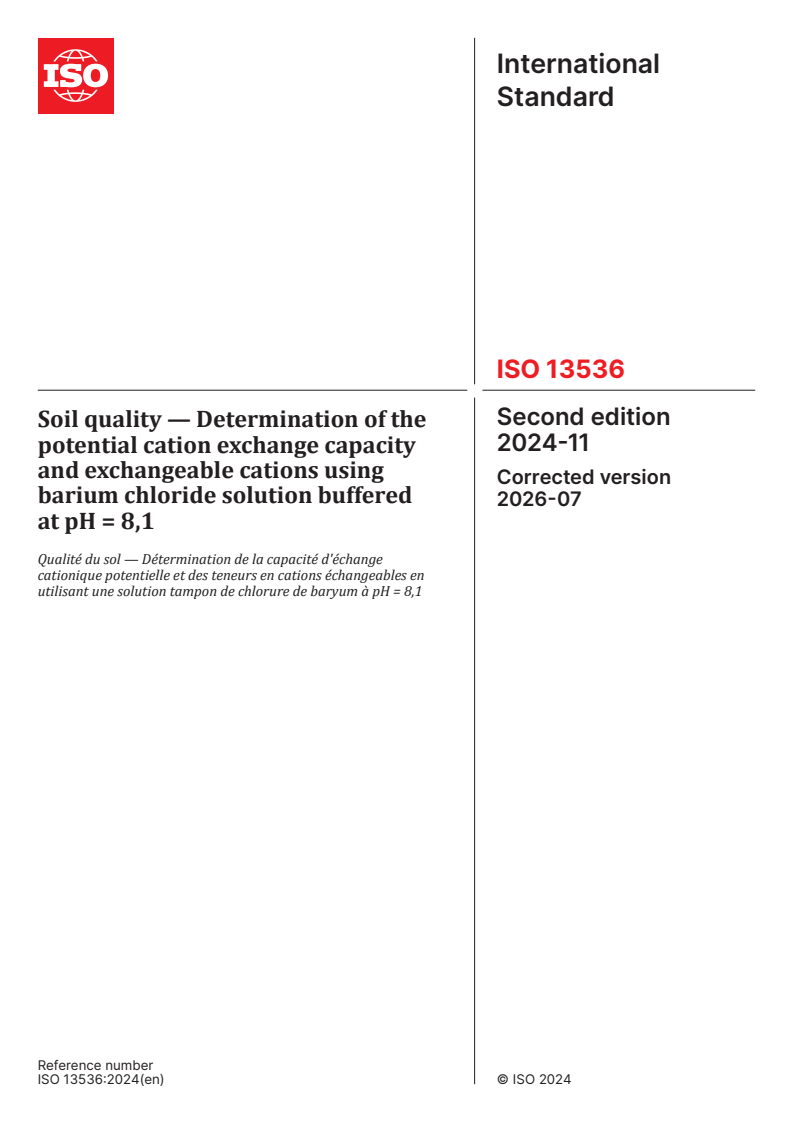
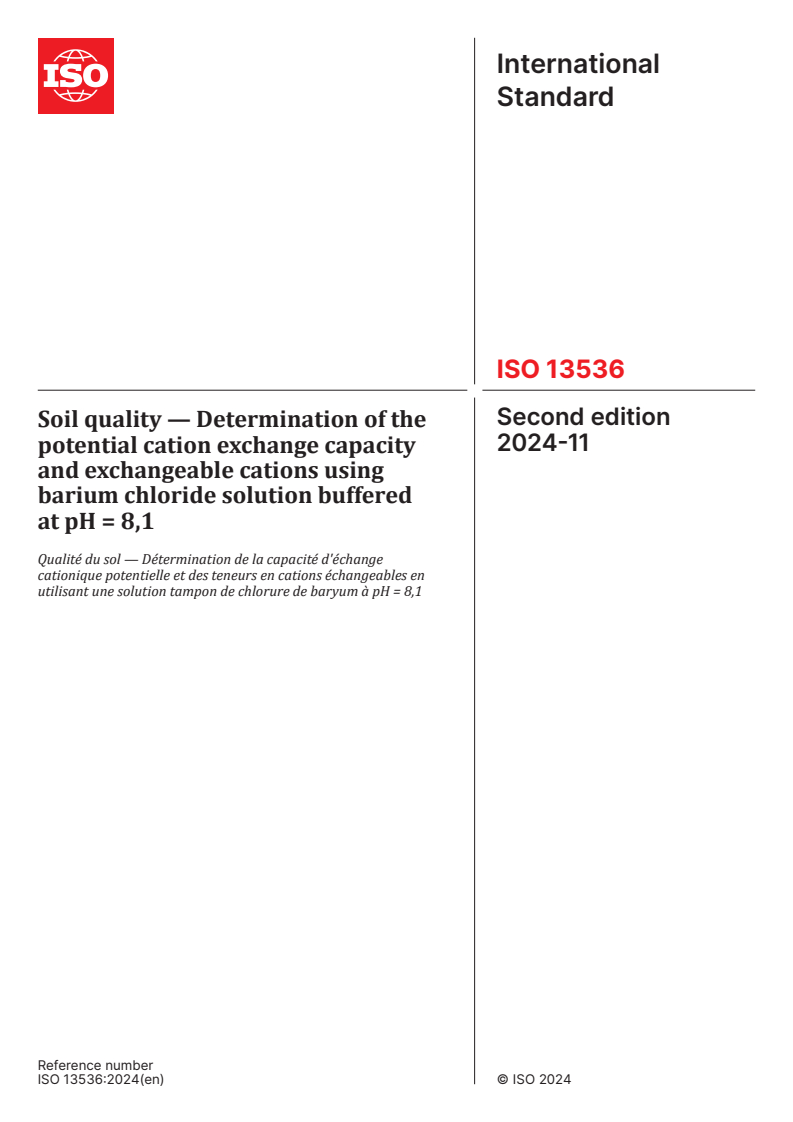
International
Standard
ISO 13536
Second edition
Soil quality — Determination of the
2024-11
potential cation exchange capacity
and exchangeable cations using
Corrected version
barium chloride solution buffered
2026-07
at pH = 8,1
Qualité du sol — Détermination de la capacité d'échange
cationique potentielle et des teneurs en cations échangeables en
utilisant une solution tampon de chlorure de baryum à pH = 8,1
Reference number
© ISO 2024
All rights reserved. Unless otherwise specified, or required in the context of its implementation, no part of this publication may
be reproduced or utilized otherwise in any form or by any means, electronic or mechanical, including photocopying, or posting on
the internet or an intranet, without prior written permission. Permission can be requested from either ISO at the address below
or ISO’s member body in the country of the requester.
ISO copyright office
CP 401 • Ch. de Blandonnet 8
CH-1214 Vernier, Geneva
Phone: +41 22 749 01 11
Email: copyright@iso.org
Website: www.iso.org
Published in Switzerland
ii
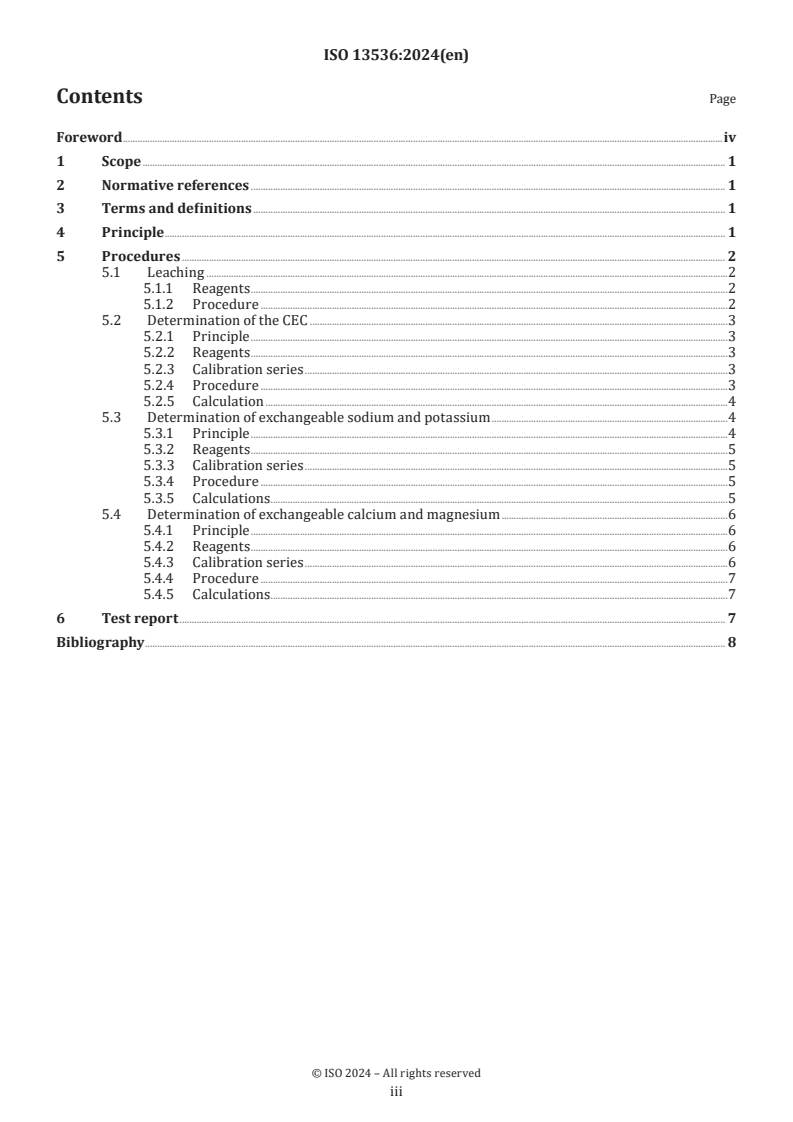
Contents Page
Foreword .iv
1 Scope . 1
2 Normative references . 1
3 Terms and definitions . 1
4 Principle . 1
5 Procedures . 2
5.1 Leaching .2
5.1.1 Reagents .2
5.1.2 Procedure .2
5.2 Determination of the CEC .3
5.2.1 Principle .3
5.2.2 Reagents .3
5.2.3 Calibration series .3
5.2.4 Procedure .4
5.2.5 Calculation .4
5.3 Determination of exchangeable sodium and potassium .5
5.3.1 Principle .5
5.3.2 Reagents .5
5.3.3 Calibration series .5
5.3.4 Procedure .5
5.3.5 Calculations . .5
5.4 Determination of exchangeable calcium and magnesium .6
5.4.1 Principle .6
5.4.2 Reagents .6
5.4.3 Calibration series .7
5.4.4 Procedure .7
5.4.5 Calculations . .7
6 Test report . 7
Bibliography . 9
iii
Foreword
ISO (the International Organization for Standardization) is a worldwide federation of national standards
bodies (ISO member bodies). The work of preparing International Standards is normally carried out through
ISO technical committees. Each member body interested in a subject for which a technical committee
has been established has the right to be represented on that committee. International organizations,
governmental and non-governmental, in liaison with ISO, also take part in the work. ISO collaborates closely
with the International Electrotechnical Commission (IEC) on all matters of electrotechnical standardization.
The procedures used to develop this document and those intended for its further maintenance are described
in the ISO/IEC Directives, Part 1. In particular, the different approval criteria needed for the different types
of ISO documents should be noted. This document was drafted in accordance with the editorial rules of the
ISO/IEC Directives, Part 2 (see www.iso.org/directives).
ISO draws attention to the possibility that the implementation of this document may involve the use of (a)
patent(s). ISO takes no position concerning the evidence, validity or applicability of any claimed patent
rights in respect thereof. As of the date of publication of this document, ISO had not received notice of (a)
patent(s) which may be required to implement this document. However, implementers are cautioned that
this may not represent the latest information, which may be obtained from the patent database available at
www.iso.org/patents. ISO shall not be held responsible for identifying any or all such patent rights.
Any trade name used in this document is information given for the convenience of users and does not
constitute an endorsement.
For an explanation of the voluntary nature of standards, the meaning of ISO specific terms and expressions
related to conformity assessment, as well as information about ISO’s adherence to the World Trade
Organization (WTO) principles in the Technical Barriers to Trade (TBT), see www.iso.org/iso/foreword.html.
This document was prepared by Technical Committee ISO/TC 190, Soil quality, Subcommittee SC 3, Chemical
and physical characterization.
This second edition cancels and replaces the first edition (ISO 13536:1995), which has been technically
revised.
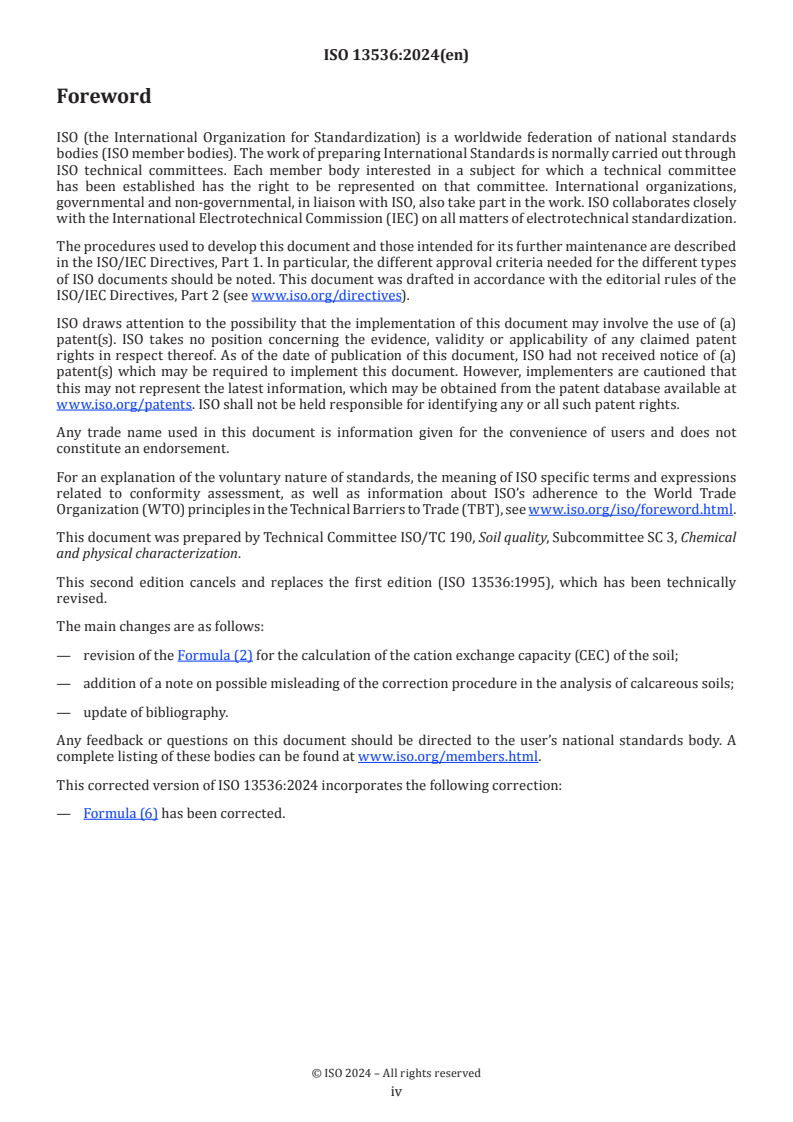
The main changes are as follows:
— revision of the Formula (2) for the calculation of the cation exchange capacity (CEC) of the soil;
— addition of a note on possible misleading of the correction procedure in the analysis of calcareous soils;
— update of bibliography.
Any feedback or questions on this document should be directed to the user’s national standards body. A
complete listing of these bodies can be found at www.iso.org/members.html.
This corrected version of ISO 13536:2024 incorporates the following correction:
— Formula (6) has been corrected.
iv
International Standard ISO 13536:2024(en)
Soil quality — Determination of the potential cation exchange
capacity and exchangeable cations using barium chloride
solution buffered at pH = 8,1
WARNING — Barium is a very toxic element if ingested. The barium ion has health risks for laboratory
personnel working with this chemical; it is also harmful for the environment.
1 Scope
This document specifies a method for the determination of the potential cation exchange capacity (CEC)
of soil buffered at pH = 8,1 and for the determination of the content of exchangeable sodium, potassium,
calcium and magnesium in soil.
This document is applicable to all types of air-dried soil samples.
2 Normative references
The following documents are referred to in the text in such a way that some or all of their content constitutes
requirements of this document. For dated references, only the edition cited applies. For undated references,
the latest edition of the referenced document (including any amendments) applies.
ISO 11464, Soil quality — Pretreatment of samples for physico-chemical analysis
ISO 11465, Sludge, treated biowaste, soil and waste — Determination of dry residue or water content and
calculation of the dry matter fraction on a mass basis
3 Terms and definitions
No terms and definitions are listed in this document.
ISO and IEC maintain terminology databases for use in standardization at the following addresses:
— ISO Online browsing platform: available at https:// www .iso .org/ obp
— IEC Electropedia: available at https:// www .electropedia .org/
4 Principle
The determination of cation exchange capacity (CEC) as specified in this document is a modification of the
[1],[2] [3]
method proposed by Mehlich and modified by Bascomb . The CEC of soil samples is determined in
barium chloride solution buffered at pH = 8,1 using triethanolamine.
The soil is first saturated with respect to barium by treating the soil three times with buffered barium
chloride solution. Subsequently, a known excess of 0,02 mol/l magnesium sulfate solution is added. All the
barium present, in solution as well as adsorbed, is precipitated in the form of highly insoluble barium sulfate
and the sites with exchangeable ions are then readily occupied by magnesium. The excess magnesium is
determined by either flame atomic absorption spectrometry (FAAS) or inductively coupled plasma atomic
emission spectrometry (ICP-AES).
It is also possible to determine sodium, potassium, calcium and magnesium (and other elements) in the
barium chloride extract of the soil.
NOTE 1 Besides sodium, potassium, calcium and magnesium, it is also possible to determine other cations, for
example manganese, in the same extract.
NOTE 2 A yellowish-brown colour of the barium chloride extract indicates that some organic matter has been
dissolved. Since organic matter contributes to the CEC, the measured value will be an underestimate of the potential
CEC.
NOTE 3 The sum of exchangeable cations can give a result that is greater than the CEC due to the dissolution of salts
present in the soil.
Preliminary washing of the soil with water to remove these salts should not be employed because it can
change the relative proportions of cations in the CEC.
NOTE 4 In case the problem described under NOTE 3 is detected, the experiment can be repeated using a method
[4]
which has a much lower solubility for calcium carbonate minerals. This procedure is described in ISO 23470:2018 .
5 Procedures
5.1 Leaching
5.1.1 Reagents
Use only reagents of recognized analytical grade and distilled water or deionized water for all solutions.
5.1.1.1 Water, with a specific conductivity not higher than 0,2 mS/m at 25 °C.
5.1.1.2 Barium chloride solution, c(BaCl ) = 1 mol/l.
Dissolve 244 g of barium chloride dihydrate (BaCl · 2H O) in water and dilute to 1 000 ml with water.
2 2
5.1.1.3 Hydrochloric acid, c(HCI) = 2 mol/l.
Dilute 166 ml of concentrated hydrochloric acid (ρ = 1,19 g/ml) with water to 1 000 ml.
5.1.1.4 Triethanolamine solution, pH = 8,1.
Dilute 90 ml of triethanolamine (HOCH CH ) N with water to approximately 1 litre and adjust the pH to
2 2 3
8,1 ± 0,02 with about 140 ml to 150 ml of hydrochloric acid (5.1.1.3). Dilute with water to 2 litres.
5.1.1.5 Extraction solution.
Mix equal volumes of solutions 5.1.1.2 and 5.1.1.4. Protect this solution from exposure to carbon dioxide
during storage.
5.1.1.6 Magnesium sulfate solution, c(MgSO ) = 0,020 0 mol/l.
Dissolve 4,930 g ± 0,01 g of magnesium sulfate heptahydrate (MgSO ·7H O) in water and dilute to 1 000 ml.
4 2
Magnesium sulfat
...
International
Standard
ISO 13536
Second edition
Soil quality — Determination of the
2024-11
potential cation exchange capacity
and exchangeable cations using
barium chloride solution buffered
at pH = 8,1
Qualité du sol — Détermination de la capacité d'échange
cationique potentielle et des teneurs en cations échangeables en
utilisant une solution tampon de chlorure de baryum à pH = 8,1
Reference number
© ISO 2024
All rights reserved. Unless otherwise specified, or required in the context of its implementation, no part of this publication may
be reproduced or utilized otherwise in any form or by any means, electronic or mechanical, including photocopying, or posting on
the internet or an intranet, without prior written permission. Permission can be requested from either ISO at the address below
or ISO’s member body in the country of the requester.
ISO copyright office
CP 401 • Ch. de Blandonnet 8
CH-1214 Vernier, Geneva
Phone: +41 22 749 01 11
Email: copyright@iso.org
Website: www.iso.org
Published in Switzerland
ii
Contents Page
Foreword .iv
1 Scope . 1
2 Normative references . 1
3 Terms and definitions . 1
4 Principle . 1
5 Procedures . 2
5.1 Leaching .2
5.1.1 Reagents .2
5.1.2 Procedure .2
5.2 Determination of the CEC .3
5.2.1 Principle .3
5.2.2 Reagents .3
5.2.3 Calibration series .3
5.2.4 Procedure .3
5.2.5 Calculation .4
5.3 Determination of exchangeable sodium and potassium .4
5.3.1 Principle .4
5.3.2 Reagents .5
5.3.3 Calibration series .5
5.3.4 Procedure .5
5.3.5 Calculations . .5
5.4 Determination of exchangeable calcium and magnesium .6
5.4.1 Principle .6
5.4.2 Reagents .6
5.4.3 Calibration series .6
5.4.4 Procedure .7
5.4.5 Calculations . .7
6 Test report . 7
Bibliography . 8
iii
Foreword
ISO (the International Organization for Standardization) is a worldwide federation of national standards
bodies (ISO member bodies). The work of preparing International Standards is normally carried out through
ISO technical committees. Each member body interested in a subject for which a technical committee
has been established has the right to be represented on that committee. International organizations,
governmental and non-governmental, in liaison with ISO, also take part in the work. ISO collaborates closely
with the International Electrotechnical Commission (IEC) on all matters of electrotechnical standardization.
The procedures used to develop this document and those intended for its further maintenance are described
in the ISO/IEC Directives, Part 1. In particular, the different approval criteria needed for the different types
of ISO documents should be noted. This document was drafted in accordance with the editorial rules of the
ISO/IEC Directives, Part 2 (see www.iso.org/directives).
ISO draws attention to the possibility that the implementation of this document may involve the use of (a)
patent(s). ISO takes no position concerning the evidence, validity or applicability of any claimed patent
rights in respect thereof. As of the date of publication of this document, ISO [had/had not] received notice of
(a) patent(s) which may be required to implement this document. However, implementers are cautioned that
this may not represent the latest information, which may be obtained from the patent database available at
www.iso.org/patents. ISO shall not be held responsible for identifying any or all such patent rights.
Any trade name used in this document is information given for the convenience of users and does not
constitute an endorsement.
For an explanation of the voluntary nature of standards, the meaning of ISO specific terms and expressions
related to conformity assessment, as well as information about ISO's adherence to the World Trade
Organization (WTO) principles in the Technical Barriers to Trade (TBT), see www.iso.org/iso/foreword.html.
This document was prepared by Technical Committee ISO/TC 190, Soil quality, Subcommittee SC 3, Chemical
and physical characterization.
This second edition cancels and replaces the first edition (ISO 13536:1995), which has been technically
revised.
The main changes are as follows:
— revision of the Formula (2) for the calculation of the cation exchange capacity (CEC) of the soil;
— addition of a note on possible misleading of the correction procedure in the analysis of calcareous soils;
— update of bibliography.
Any feedback or questions on this document should be directed to the user’s national standards body. A
complete listing of these bodies can be found at www.iso.org/members.html.
iv
International Standard ISO 13536:2024(en)
Soil quality — Determination of the potential cation exchange
capacity and exchangeable cations using barium chloride
solution buffered at pH = 8,1
WARNING — Barium is a very toxic element if ingested. The barium ion has health risks for laboratory
personnel working with this chemical; it is also harmful for the environment.
1 Scope
This document specifies a method for the determination of the potential cation exchange capacity (CEC)
of soil buffered at pH = 8,1 and for the determination of the content of exchangeable sodium, potassium,
calcium and magnesium in soil.
This document is applicable to all types of air-dried soil samples.
2 Normative references
The following documents are referred to in the text in such a way that some or all of their content constitutes
requirements of this document. For dated references, only the edition cited applies. For undated references,
the latest edition of the referenced document (including any amendments) applies.
ISO 11464, Soil quality — Pretreatment of samples for physico-chemical analysis
ISO 11465, Sludge, treated biowaste, soil and waste — Determination of dry residue or water content and
calculation of the dry matter fraction on a mass basis
3 Terms and definitions
No terms and definitions are listed in this document.
ISO and IEC maintain terminology databases for use in standardization at the following addresses:
— ISO Online browsing platform: available at https:// www .iso .org/ obp
— IEC Electropedia: available at https:// www .electropedia .org/
4 Principle
The determination of cation exchange capacity (CEC) as specified in this document is a modification of the
[1],[2] [3]
method proposed by Mehlich and modified by Bascomb . The CEC of soil samples is determined in
barium chloride solution buffered at pH = 8,1 using triethanolamine.
The soil is first saturated with respect to barium by treating the soil three times with buffered barium
chloride solution. Subsequently, a known excess of 0,02 mol/l magnesium sulfate solution is added. All the
barium present, in solution as well as adsorbed, is precipitated in the form of highly insoluble barium sulfate
and the sites with exchangeable ions are then readily occupied by magnesium. The excess magnesium is
determined by either flame atomic absorption spectrometry (FAAS) or inductively coupled plasma atomic
emission spectrometry (ICP-AES).
It is also possible to determine sodium, potassium, calcium and magnesium (and other elements) in the
barium chloride extract of the soil.
NOTE 1 Besides sodium, potassium, calcium and magnesium, it is also possible to determine other cations, for
example manganese, in the same extract.
NOTE 2 A yellowish-brown colour of the barium chloride extract indicates that some organic matter has been
dissolved. Since organic matter contributes to the CEC, the measured value will be an underestimate of the potential CEC.
NOTE 3 The sum of exchangeable cations can give a result that is greater than the CEC due to the dissolution of salts
present in the soil.
Preliminary washing of the soil with water to remove these salts should not be employed because it can
change the relative proportions of cations in the CEC.
NOTE 4 In case the problem described under NOTE 3 is detected, the experiment can be repeated using a method
[4]
which has a much lower solubility for calcium carbonate minerals. This procedure is described in ISO 23470:2018 .
5 Procedures
5.1 Leaching
5.1.1 Reagents
Use only reagents of recognized analytical grade and distilled water or deionized water for all solutions.
5.1.1.1 Water, with a specific conductivity not higher than 0,2 mS/m at 25 °C.
5.1.1.2 Barium chloride solution, c(BaCl ) = 1 mol/l.
Dissolve 244 g of barium chloride dihydrate (BaCl · 2H O) in water and dilute to 1 000 ml with water.
2 2
5.1.1.3 Hydrochloric acid, c(HCI) = 2 mol/l.
Dilute 166 ml of concentrated hydrochloric acid (ρ = 1,19 g/ml) with water to 1 000 ml.
5.1.1.4 Triethanolamine solution, pH = 8,1.
Dilute 90 ml of triethanolamine (HOCH CH ) N with water to approximately 1 litre and adjust the pH to
2 2 3
8,1 ± 0,02 with about 140 ml to 150 ml of hydrochloric acid (5.1.1.3). Dilute with water to 2 litres.
5.1.1.5 Extraction solution.
Mix equal volumes of solutions 5.1.1.2 and 5.1.1.4. Protect this solution from exposure to carbon dioxide
during storage.
5.1.1.6 Magnesium sulfate solution, c(MgSO ) = 0,020 0 mol/l.
Dissolve 4,930 g ± 0,01 g of magnesium sulfate heptahydrate (MgSO ·7H O) in water and dilute to 1 000 ml.
4 2
Magnesium sulfate heptahydr
...