


ISO 28037
(Main)Determination and use of straight-line calibration functions
Determination and use of straight-line calibration functions
ISO/TS 28037:2010 is concerned with linear, that is, straight-line, calibration functions that describe the relationship between two variables X and Y, namely, functions of the form Y = A + BX. Although many of the principles apply to more general types of calibration function, the approaches described exploit the simple form of the straight-line calibration function wherever possible. Values of the parameters A and B are determined on the basis of measured data points (xi, yi), i = 1, ... , m. Various cases are considered relating to the nature of the uncertainties associated with these data. No assumption is made that the errors relating to the yi are homoscedastic (having equal variance), and similarly for the xi when the errors are not negligible. Estimates of the parameters A and B are determined using least squares methods. The emphasis is on choosing the least squares method most appropriate for the type of measurement data, in particular methods that reflect the associated uncertainties. The most general type of covariance matrix associated with the measurement data is treated, but important special cases that lead to simpler calculations are described in detail. For all cases considered, methods for validating the use of the straight-line calibration functions and for evaluating the uncertainties and covariance associated with the parameter estimates are given. ISO/TS 28037:2010 also describes the use of the calibration function parameter estimates and their associated uncertainties and covariance to predict a value of X and its associated standard uncertainty given a measured value of Y and its associated standard uncertainty.
Détermination et utilisation des fonctions d'étalonnage linéaire
L'ISO/TS 28037:2010 traite des fonctions d'étalonnage linéaire, c'est-à-dire une droite, qui décrivent la relation entre deux variables X et Y, notamment les fonctions de la forme Y = A + BX. Bien que de nombreux principes s'appliquent à des types de fonction d'étalonnage plus généraux, les approches décrites utilisent dans la mesure du possible cette forme simple de la fonction d'étalonnage linéaire. Les valeurs des paramètres A et B sont déterminées sur la base de paires de données mesurées (xi,yi), i = 1,?, m. Selon la nature des incertitudes associées à ces données, différents cas sont considérés. Aucune hypothèse n'est faite sur les erreurs relatives à yi pour savoir si elles sont homoscédastiques (de variances égales), et de même pour xi lorsque les erreurs ne sont pas négligeables. Les estimations des paramètres A et B sont déterminées par les méthodes des moindres carrés. La présente Spécification Technique met l'accent sur le choix de la méthode des moindres carrés la plus appropriée au type de données de mesure, notamment les méthodes qui reflètent les incertitudes associées. Le cas le plus général de matrice de covariances associée aux données de mesure est traité, mais des cas particuliers importants, donnant lieu à des calculs plus simples, sont décrits en détail. Pour tous les cas considérés, les méthodes de validation du choix de fonctions d'étalonnage linéaire et d'évaluation des incertitudes et de la covariance associées aux estimations des paramètres sont données. L'ISO/TS 28037:2010 décrit aussi l'utilisation des estimations des paramètres de fonction d'étalonnage et de leurs incertitudes et covariance associées dans la prédiction d'une valeur de X et son incertitude-type associée pour une valeur mesurée de Y donnée avec son incertitude-type associée.
General Information
- Status
- Not Published
- Technical Committee
- ISO/TC 69/SC 6 - Measurement methods and results
- Drafting Committee
- ISO/TC 69/SC 6 - Measurement methods and results
- Current Stage
- 6000 - International Standard under publication
- Start Date
- 02-Oct-2025
- Completion Date
- 12-Feb-2026
Relations
- Effective Date
- 06-Jun-2022
Overview
ISO 28037 - Determination and use of straight-line calibration functions - provides a practical, statistically rigorous framework for deriving and using linear (straight-line) calibration functions of the form Y = A + B X. The technical specification explains how to estimate line parameters A and B from measured data (xi, yi), how to account for measurement uncertainty and covariance, and how to validate and apply the calibration function for forward and inverse evaluations.
Key topics and requirements
- Model form: Straight-line calibration functions (Y = A + B X) and their parameterization.
- Data inputs: Measured stimulus (X) and response (Y) values with associated standard uncertainties and covariance information.
- Least-squares methods: Selection and application of ordinary and generalized least-squares techniques that reflect the uncertainty structure of the data.
- Uncertainty propagation: Calculation of standard uncertainties and the covariance matrix associated with estimates of A and B.
- Heteroscedasticity and errors-in-variables: Methods that do not assume equal variance of errors (non-homoscedastic data) and that handle non-negligible errors in X as well as Y.
- Numerical methods: Practical algorithms and matrix techniques (e.g., Cholesky, QR) for stable computation.
- Validation: Procedures for model validation, residual analysis, testing normality assumptions, and assessing the relevance of prior uncertainty information.
- Use cases: Guidance on inverse evaluation (predicting X from a measured Y with uncertainty) and forward evaluation (predicting Y from X).
Practical applications
ISO 28037 is directly applicable in metrology, calibration laboratories, and any industry relying on accurate linear calibration between a known stimulus and measured response. Typical applications include:
- Instrument calibration and characterization (sensors, transducers, analytical instruments).
- Calibration curve development for analytical chemistry and laboratory testing.
- Measurement system validation where uncertainty budgets and covariance matter.
- Quality assurance and traceability activities that require documented uncertainty estimates.
Who should use this standard
- Calibration and test laboratory managers and metrologists
- Instrument manufacturers and product development engineers
- Quality engineers and assurance specialists
- Applied statisticians working on measurement uncertainty and calibration models
Related standards
ISO 28037 is often used alongside other measurement and calibration guidance documents (for example, standards and guides on measurement uncertainty and laboratory competence) to ensure comprehensive calibration practice and traceability.
Keywords: ISO 28037, straight-line calibration, calibration function, least squares, measurement uncertainty, covariance, inverse evaluation, forward evaluation, metrology, calibration labs.

Get Certified
Connect with accredited certification bodies for this standard

BSI Group
BSI (British Standards Institution) is the business standards company that helps organizations make excellence a habit.

Bureau Veritas
Bureau Veritas is a world leader in laboratory testing, inspection and certification services.

DNV
DNV is an independent assurance and risk management provider.
Sponsored listings
Frequently Asked Questions
ISO 28037 is a draft published by the International Organization for Standardization (ISO). Its full title is "Determination and use of straight-line calibration functions". This standard covers: ISO/TS 28037:2010 is concerned with linear, that is, straight-line, calibration functions that describe the relationship between two variables X and Y, namely, functions of the form Y = A + BX. Although many of the principles apply to more general types of calibration function, the approaches described exploit the simple form of the straight-line calibration function wherever possible. Values of the parameters A and B are determined on the basis of measured data points (xi, yi), i = 1, ... , m. Various cases are considered relating to the nature of the uncertainties associated with these data. No assumption is made that the errors relating to the yi are homoscedastic (having equal variance), and similarly for the xi when the errors are not negligible. Estimates of the parameters A and B are determined using least squares methods. The emphasis is on choosing the least squares method most appropriate for the type of measurement data, in particular methods that reflect the associated uncertainties. The most general type of covariance matrix associated with the measurement data is treated, but important special cases that lead to simpler calculations are described in detail. For all cases considered, methods for validating the use of the straight-line calibration functions and for evaluating the uncertainties and covariance associated with the parameter estimates are given. ISO/TS 28037:2010 also describes the use of the calibration function parameter estimates and their associated uncertainties and covariance to predict a value of X and its associated standard uncertainty given a measured value of Y and its associated standard uncertainty.
ISO/TS 28037:2010 is concerned with linear, that is, straight-line, calibration functions that describe the relationship between two variables X and Y, namely, functions of the form Y = A + BX. Although many of the principles apply to more general types of calibration function, the approaches described exploit the simple form of the straight-line calibration function wherever possible. Values of the parameters A and B are determined on the basis of measured data points (xi, yi), i = 1, ... , m. Various cases are considered relating to the nature of the uncertainties associated with these data. No assumption is made that the errors relating to the yi are homoscedastic (having equal variance), and similarly for the xi when the errors are not negligible. Estimates of the parameters A and B are determined using least squares methods. The emphasis is on choosing the least squares method most appropriate for the type of measurement data, in particular methods that reflect the associated uncertainties. The most general type of covariance matrix associated with the measurement data is treated, but important special cases that lead to simpler calculations are described in detail. For all cases considered, methods for validating the use of the straight-line calibration functions and for evaluating the uncertainties and covariance associated with the parameter estimates are given. ISO/TS 28037:2010 also describes the use of the calibration function parameter estimates and their associated uncertainties and covariance to predict a value of X and its associated standard uncertainty given a measured value of Y and its associated standard uncertainty.
ISO 28037 is classified under the following ICS (International Classification for Standards) categories: 03.120.30 - Application of statistical methods. The ICS classification helps identify the subject area and facilitates finding related standards.
ISO 28037 has the following relationships with other standards: It is inter standard links to ISO/TS 28037:2010. Understanding these relationships helps ensure you are using the most current and applicable version of the standard.
ISO 28037 is available in PDF format for immediate download after purchase. The document can be added to your cart and obtained through the secure checkout process. Digital delivery ensures instant access to the complete standard document.
Standards Content (Sample)
International
Standard
First edition
Determination and use of straight-
line calibration functions
Détermination et utilisation des fonctions d'étalonnage linéaire
PROOF/ÉPREUVE
Reference number
© ISO 2025
All rights reserved. Unless otherwise specified, or required in the context of its implementation, no part of this publication may
be reproduced or utilized otherwise in any form or by any means, electronic or mechanical, including photocopying, or posting on
the internet or an intranet, without prior written permission. Permission can be requested from either ISO at the address below
or ISO’s member body in the country of the requester.
ISO copyright office
CP 401 • Ch. de Blandonnet 8
CH-1214 Vernier, Geneva
Phone: +41 22 749 01 11
Email: copyright@iso.org
Website: www.iso.org
Published in Switzerland
PROOF/ÉPREUVE
ii
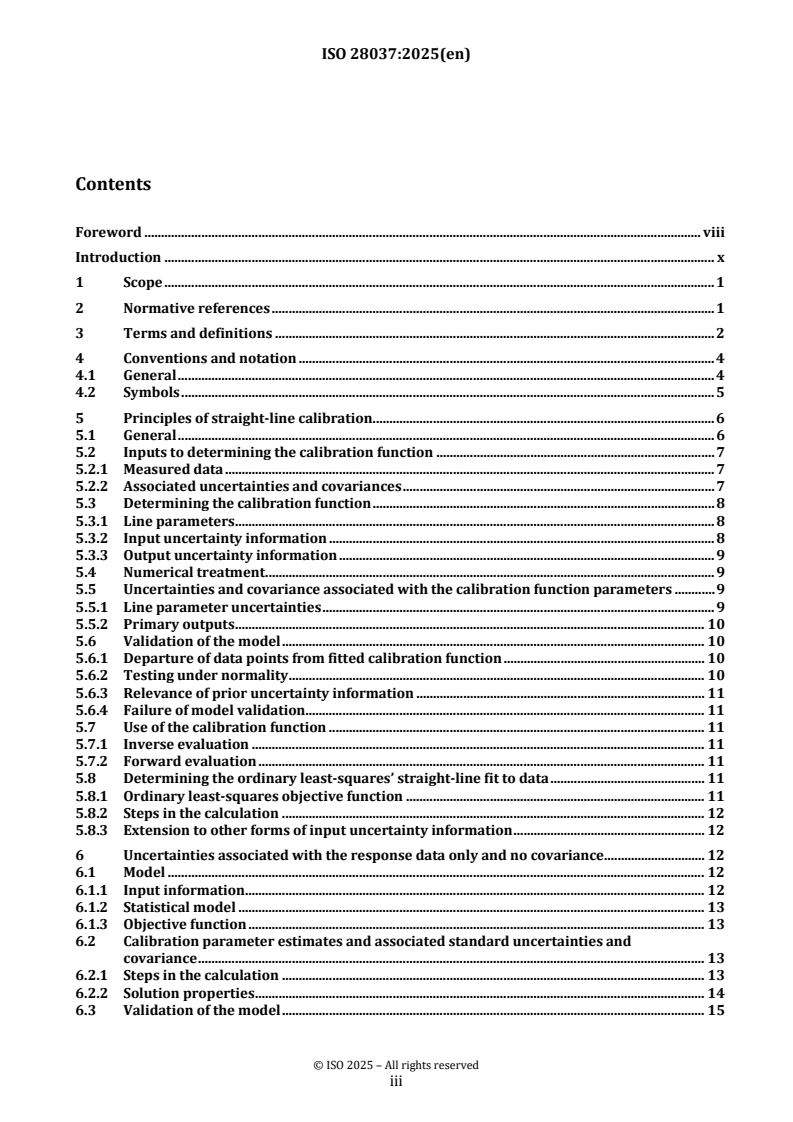
Contents
Foreword . viii
Introduction . x
1 Scope . 1
2 Normative references . 1
3 Terms and definitions . 2
4 Conventions and notation . 4
4.1 General . 4
4.2 Symbols . 5
5 Principles of straight-line calibration. 6
5.1 General . 6
5.2 Inputs to determining the calibration function . 7
5.2.1 Measured data . 7
5.2.2 Associated uncertainties and covariances . 7
5.3 Determining the calibration function . 8
5.3.1 Line parameters . 8
5.3.2 Input uncertainty information . 8
5.3.3 Output uncertainty information . 9
5.4 Numerical treatment . 9
5.5 Uncertainties and covariance associated with the calibration function parameters . 9
5.5.1 Line parameter uncertainties . 9
5.5.2 Primary outputs . 10
5.6 Validation of the model . 10
5.6.1 Departure of data points from fitted calibration function . 10
5.6.2 Testing under normality . 10
5.6.3 Relevance of prior uncertainty information . 11
5.6.4 Failure of model validation. 11
5.7 Use of the calibration function . 11
5.7.1 Inverse evaluation . 11
5.7.2 Forward evaluation . 11
5.8 Determining the ordinary least-squares’ straight-line fit to data . 11
5.8.1 Ordinary least-squares objective function . 11
5.8.2 Steps in the calculation . 12
5.8.3 Extension to other forms of input uncertainty information . 12
6 Uncertainties associated with the response data only and no covariance . 12
6.1 Model . 12
6.1.1 Input information . 12
6.1.2 Statistical model . 13
6.1.3 Objective function . 13
6.2 Calibration parameter estimates and associated standard uncertainties and
covariance . 13
6.2.1 Steps in the calculation . 13
6.2.2 Solution properties . 14
6.3 Validation of the model . 15
iii
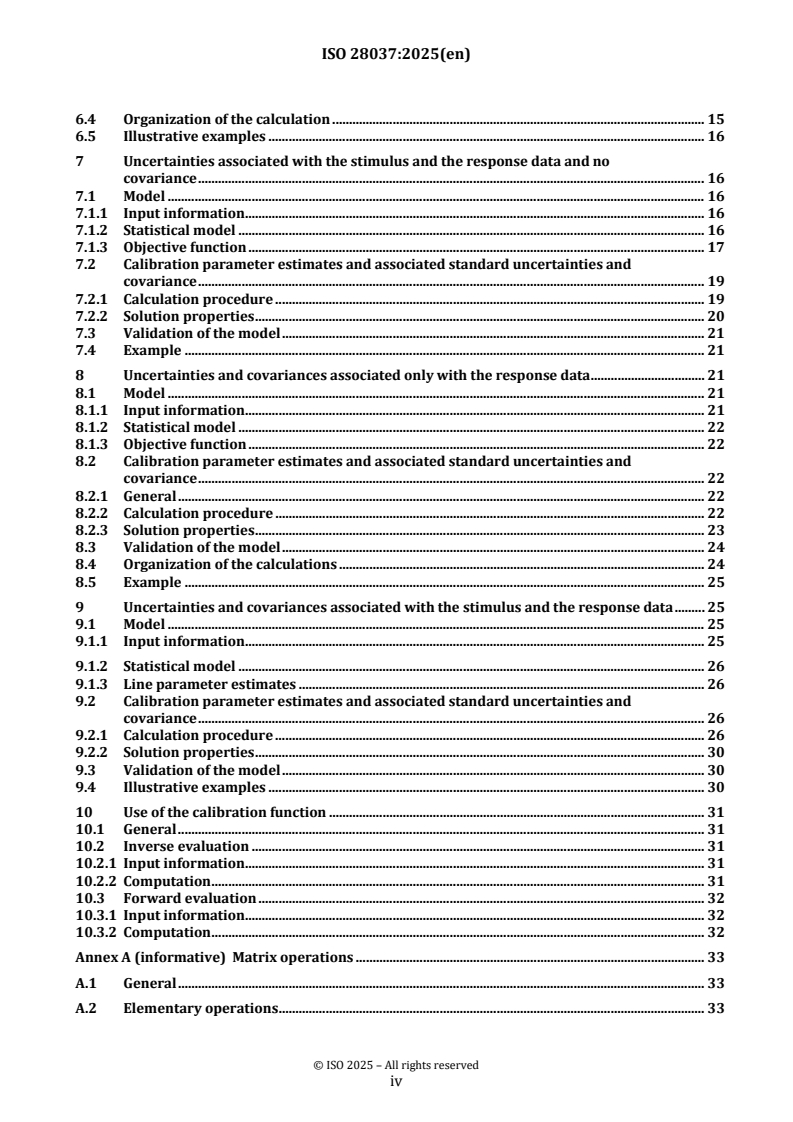
6.4 Organization of the calculation . 15
6.5 Illustrative examples . 16
7 Uncertainties associated with the stimulus and the response data and no
covariance . 16
7.1 Model . 16
7.1.1 Input information . 16
7.1.2 Statistical model . 16
7.1.3 Objective function . 17
7.2 Calibration parameter estimates and associated standard uncertainties and
covariance . 19
7.2.1 Calculation procedure . 19
7.2.2 Solution properties . 20
7.3 Validation of the model . 21
7.4 Example . 21
8 Uncertainties and covariances associated only with the response data . 21
8.1 Model . 21
8.1.1 Input information . 21
8.1.2 Statistical model . 22
8.1.3 Objective function . 22
8.2 Calibration parameter estimates and associated standard uncertainties and
covariance . 22
8.2.1 General . 22
8.2.2 Calculation procedure . 22
8.2.3 Solution properties . 23
8.3 Validation of the model . 24
8.4 Organization of the calculations . 24
8.5 Example . 25
9 Uncertainties and covariances associated with the stimulus and the response data . 25
9.1 Model . 25
9.1.1 Input information . 25
9.1.2 Statistical model . 26
9.1.3 Line parameter estimates . 26
9.2 Calibration parameter estimates and associated standard uncertainties and
covariance . 26
9.2.1 Calculation procedure . 26
9.2.2 Solution properties . 30
9.3 Validation of the model . 30
9.4 Illustrative examples . 30
10 Use of the calibration function . 31
10.1 General . 31
10.2 Inverse evaluation . 31
10.2.1 Input information . 31
10.2.2 Computation . 31
10.3 Forward evaluation . 32
10.3.1 Input information . 32
10.3.2 Computation . 32
Annex A (informative) Matrix operations . 33
A.1 General . 33
A.2 Elementary operations . 33
iv
A.2.1 General . 33
A.2.2 Matrix-vector multiplication . 33
A.2.3 Matrix-matrix multiplication . 33
A.2.4 Matrix transpose . 33
A.2.5 Identity matrix . 33
A.2.6 Inverse of a square matrix . 33
A.3 Elementary definitions . 34
A.3.1 General . 34
A.3.2 Symmetric matrix . 34
A.3.3 Invertible matrix . 34
A.3.4 Lower-triangular and upper-triangular matrix . 34
A.3.5 Orthogonal matrix . 34
A.4 Cholesky factorization . 34
A.4.1 General . 34
A.4.2 Cholesky factorization algorithms . 34
A.4.3 Interpretation of the Cholesky factorization of a covariance matrix . 35
A.4.4 Solution of a lower-triangular system . 36
A.4.5 Solution of an upper-triangular system . 37
A.5 Orthogonal factorization . 37
A.5.1 General . 37
A.5.2 QR factorization . 37
A.5.3 RQ factorization . 38
Annex B (informative) Orthogonal factorization approach to solving the generalized
Gauss-Markov problem . 39
B.1 General . 39
B.2 Calibration parameter estimates and associated standard uncertainties and
covariance . 39
B.3 Validation of the model . 41
Annex C (informative) Provision of uncertainties and covariances associated with the
measured stimulus and response values. 42
C.1 General . 42
C.2 Response data 1 . 42
C.2.1 General . 42
C.2.2 Measurement model for uncertainties and covariances associated with the
measured response values . 43
C.3 Response data 2 . 43
C.4 Stimulus data . 44
C.5 Stimulus and response data . 45
v
Annex D (informative) Uncertainties known up to a scale factor . 46
Annex E (informative) Examples illustrating straight-line regression for all uncertainty
structures . 48
E.1 General . 48
E.2 Uncertainties associated with the measured response values only and no
covariance . 48
E.2.1 General . 48
E.2.2 Calibration of a torque measuring sensor using a reference torque system . 48
E.2.2.1 Outline . 48
E.2.2.2 Data . 49
E.2.2.3 Results . 49
E.2.2.4 Subsequent use . 50
E.2.2.5 Discussion . 50
E.3 Uncertainties associated with the measured response and stimulus values and no
covariance . 50
E.3.1 General . 50
E.3.2 Amount-of-substance fraction of a constituent of a gas mixture . 51
E.3.2.1 Outline . 51
E.3.2.2 Data . 51
E.3.2.3 Results . 51
E.3.2.4 Subsequent use . 52
E.3.2.5 Discussion . 53
E.4 Uncertainties and covariances associated only with the response data . 53
E.4.1 General . 53
E.4.2 Quartz helium reference leaks to calibrate an unknown leak . 53
E.4.2.1 Outline . 53
E.4.2.2 Data . 53
E.4.2.3 Results . 54
E.4.2.4 Subsequent use . 55
E.4.2.5 Discussion . 55
E.5 Uncertainties and covariances associated with the stimulus and response values . 55
E.5.1 General . 55
E.5.2 Calibration of a pressure transducer using a reference device as a pressure
standard . 55
E.5.2.1 Outline . 55
E.5.2.2 Data . 56
E.5.2.3 Results . 56
E.5.2.4 Subsequent use . 58
vi
E.5.2.5 Discussion . 58
E.6 Uncertainties known up to a scale factor . 58
E.6.1 General . 58
E.6.2 Outline . 58
E.6.3 Data . 59
E.6.4 Results . 59
E.7 Inverse and forward evaluation using the straight-line calibration function . 61
E.7.1 General . 61
E.7.2 Inverse evaluation . 61
E.7.3 Forward evaluation . 62
Annex F (informative) GUM-consistent straight-line parameter uncertainties in the
errors-in-variables' case . 63
Annex G (informative) Non-GUM-consistent calculation procedures . 65
G.1 General . 65
G.2 Uncertainties associated with the stimulus and response data and no covariance . 65
G.2.1 General . 65
G.2.2 Organization of the calculations . 65
G.2.3 Example data . 66
G.2.4 Example results . 66
G.3 Uncertainties and covariances associated with the stimulus and response data. 70
G.3.1 General . 70
G.3.2 Organization of the calculations . 71
G.3.3 Example data . 71
Annex H (informative) Software implementations . 76
Bibliography . 77
vii
Foreword
ISO (the International Organization for Standardization) is a worldwide federation of national
standards bodies (ISO member bodies). The work of preparing International Standards is normally
carried out through ISO technical committees. Each member body interested in a subject for which a
technical committee has been established has the right to be represented on that committee.
International organizations, governmental and non-governmental, in liaison with ISO, also take part in
the work. ISO collaborates closely with the International Electrotechnical Commission (IEC) on all
matters of electrotechnical standardization.
The procedures used to develop this document and those intended for its further maintenance are
described in the ISO/IEC Directives, Part 1. In particular, the different approval criteria needed for the
different types of ISO documents should be noted. This document was drafted in accordance with the
editorial rules of the ISO/IEC Directives, Part 2 (see www.iso.org/directives).
ISO draws attention to the possibility that the implementation of this document may involve the use of
(a) patent(s). ISO takes no position concerning the evidence, validity or applicability of any claimed
patent rights in respect thereof. As of the date of publication of this document, ISO had not received
notice of (a) patent(s) which may be required to implement this document. However, implementers
are cautioned that this may not represent the latest information, which may be obtained from the
patent database available at www.iso.org/patents. ISO shall not be held responsible for identifying any
or all such patent rights.
Any trade name used in this document is information given for the convenience of users and does not
constitute an endorsement.
For an explanation of the voluntary nature of standards, the meaning of ISO specific terms and
expressions related to conformity assessment, as well as information about ISO's adherence to the
World Trade Organization (WTO) principles in the Technical Barriers to Trade (TBT), see
www.iso.org/iso/foreword.html.
This document was prepared by Technical Committee ISO/TC 69, Application of statistical methods,
Subcommittee, Subcommittee SC 6, Measurement methods and results.
This first edition of ISO 28037 cancels and replaces the first edition (ISO/TS 28037:2010), which has
been technically revised.
The main changes are as follows:
— improved structuring has been implemented throughout and more user-friendly information
incorporated;
— some definitions have been removed (functional model, structural model, etc.) and others have
been added (correlation matrix, quotient);
— some notation has been improved giving closer alignment with the normative references.
xy,
— the clause concerned with non-zero cross-covariances ( ij≠ ) has been deleted since its
( )
ij
occurrence seems not to arise in calibration problems;
— GUM-consistent solutions are provided in the main text for all uncertainty structures considered,
with a calculation procedure added as an annex;
viii
— solutions in the withdrawn TS, which are strictly inconsistent with the GUM, are valid for
sufficiently small -uncertainties and retained, as annexes, for users who wish to continue to use
x
procedures based on the TS;
— real-life examples from physics and chemistry illustrating GUM-consistent solutions have been
added as an annex. Some existing examples in the TS are retained because of the preceding bullet;
— some references have been added to support the updated material;
— the annex concerned with the Gauss-Newton algorithm has been removed because the
information there can readily be obtained elsewhere (a reference is given).
Any feedback or questions on this document should be directed to the user’s national standards body.
A complete listing of these bodies can be found at www.iso.org/members.html.
ix
Introduction
Calibration is an essential part of many measurement procedures and often involves fitting to
measured data a calibration function that describes the relationship of one variable to another. This
document considers straight-line calibration functions that describe a dependent variable Y as a
function of an independent variable X . The straight-line relationship depends on the intercept A and
the slope of the line referred to as the parameters of the line. A calibration procedure determines
B
estimates a and b of and for a particular measuring system under consideration based on
A B
measured data ( xy, ) , i 1,…,m, provided by that system. The measured data have associated
ii
uncertainty, which means there will be uncertainty associated with a and b and covariance between
them. This document describes how a and b can be estimated given the data and the associated
uncertainty information using least-squares’ regression methods accounting for that information. It
also provides a means for evaluating the uncertainties and covariance associated with these estimates.
The treatment of uncertainty in this document is carried out in a way consistent with
ISO/IEC Guide 98-3 and other guides in the ISO/IEC Guide 98 series. 'GUM-consistency’ in this
document is described as follows. A characterization of the solution is the set of nonlinear equations
given by equating to zero the partial derivatives of the least-squares objective function with respect to
the parameters of the regression model. These equations generally constitute an implicit multivariate
model: see ISO Guide 98-3:2008, Suppl.2., 6.3. Accordingly, estimates of the model parameters are
given by solving those equations and their associated covariance matrix by expression (4) in that
clause (also, see Reference [25]).
Given the uncertainty information associated with the measured data, an appropriate method is used
to estimate the calibration function parameters. This uncertainty information may include quantified
covariance effects, relating to dependencies among some or all the quantities involved.
Once the straight-line model has been fitted to the data, it is necessary to determine whether the
model and data are mutually consistent. In cases of consistency, the model so obtained can validly be
used to predict a value of the variable corresponding to a measured value y of the variable
x X Y
provided by the same measuring system, and to evaluate the uncertainty associated with x .
The determination and use of a straight-line calibration function can be considered to consist of five
steps:
a) Obtaining measured data and associated uncertainty and covariance information.
b) Providing estimates of the straight-line parameters accounting for the information in Step a).
c) Validating the model, both in terms of the functional form (does the data reflect a straight-line
relationship?) and statistically (is the spread of the data consistent with their associated
uncertainties?).
d) Obtaining the standard uncertainties and covariance associated with the estimates of the straight-
line parameters.
e) Using the calibration function for inverse evaluation (also sometimes known as ‘prediction’), that
is, determining an estimate x of the X -variable and its associated uncertainty corresponding to a
measured value y of the Y -variable and its associated uncertainty. An estimate y of the 𝑌𝑌-
variable and its associated uncertainty given a value x of the 𝑋𝑋-variable, a process known as
forward evaluation, and its associated uncertainty can also be determined.
Examples are provided, some from various areas of measurement and some synthetic.
x
=
Figure 1 shows a related dependency chart.
Figure 1 — Dependency chart for determining and using straight-line calibration functions
The main aim of this document is the consideration of Steps 2 to 5. Therefore, as part of Step 1, before
using this document, the user will need to provide standard uncertainties, and covariances if relevant,
associated with the measured Y -values and, as appropriate, those associated with the measured
X -values. Some guidance is given in Annex C. Account is taken of the principles of the GUM in
evaluating these uncertainties based on a measurement model that is specific to the input uncertainty
structure.
[20]
ISO 11095:1996 is concerned with linear calibration using reference materials. It differs from this
document in the ways given in Table 1. For example, the present document addresses data -values
x
that may not be known exactly but their associated uncertainties and, when appropriate, covariances
xi
are provided. Moreover, the systematic errors in the data may be appreciable. Ways to account for
such effects are given.
Table 1 — Differences between ISO 11095:1996 and this document
Feature ISO 11095:1996 This document
Specifically addresses reference materials Yes More general
-values assumed to be known exactly Yes More general uncertainty
x
information
All measured values obtained independently Yes More general uncertainty
information
Terminology aligned with GUM Not totally Yes
Types of uncertainty structure treated Two Four, including the most
general case
Only uncertainty associated with random Yes More general uncertainty
errors information
Consistency test ANOVA Chi-squared
Uncertainty associated with inverse Ad hoc GUM-consistent
evaluation
The provisions of this document are supported by Annexes A to H:
xii
INTERNATIONAL STANDARD ISO 28037:2025(en)
Determination and use of straight-line calibration
functions
1 Scope
This document is concerned with linear, that is, straight-line, calibration functions that describe the
relationship between two variables X and Y, namely, functions of the form Y A+ BX . Although
many of the principles apply to more general types of calibration function, the approaches described
exploit the simple form of the straight-line calibration function wherever possible.
Values of the parameters and are estimated based on measured data points xy, ,
A B ( ) im1, … .
ii
Various cases are considered relating to the nature of the uncertainties associated with these data. No
assumption is made that the errors relating to the y are homoscedastic (having equal variance), and
i
similarly for the x when the errors are not negligible.
i
Estimates of the parameters and are determined using least-squares’ methods. The emphasis of
A B
this document is on using the method most appropriate for the type of measured data, that is,
respecting the associated uncertainties. The most general type of covariance matrix associated with
the measured data is treated, but important special cases that lead to simpler calculations are
described in detail.
For all cases considered, methods for validating the use of the straight-line calibration functions and
for evaluating the uncertainties and covariance associated with the parameter estimates are given.
The document also describes the use of the estimates of the calibration-function parameters and their
associated uncertainties and covariance to predict a value of X and its associated standard
uncertainty given a measured value of and its associated standard uncertainty.
Y
NOTE 1 The document does not give a general treatment of outliers in measured data, although the validation
tests given can be used to indicate discrepant data. ISO 16269-4 can be consulted for guidance.
NOTE 2 The document describes a method to evaluate the uncertainties associated with the measured data
when those uncertainties are known only up to a scale factor (see Annex D).
Software to support this standard is available. See Annex H.
2 Normative references
The following documents are referred to in the text in such a way that some or all their content
constitutes requirements of this document. For dated references, only the edition cited applies. For
undated references, the latest edition of the referenced document (including any amendments)
applies.
ISO 3534-1, Statistics — Vocabulary and symbols — Part 1: Probability and general statistical terms
ISO/IEC Guide 98-3, Uncertainty of measurement — Part 3: Guide to the expression of uncertainty in
measurement (GUM:1995)
ISO/IEC Guide 99, International vocabulary of metrology — Basic and general concepts and associated
terms (VIM)
=
=
3 Terms and definitions
For the purposes of this document, the terms and definitions given in ISO 3534-1, ISO/IEC Guide 98-3
and ISO/IEC Guide 99 and the following apply.
ISO and IEC maintain terminology databases for use in standardization at the following addresses:
— ISO Online browsing platform: available at https://www.iso.org/obp
— IEC Electropedia: available at https://www.electropedia.org/
NOTE ISO/IEC Guide 99 uses the term ‘measured quantity value’. Here, the ter
...
Questions, Comments and Discussion
Ask us and Technical Secretary will try to provide an answer. You can facilitate discussion about the standard in here.
Loading comments...