

ISO 10504:2013
(Main)Starch derivatives — Determination of the composition of glucose syrups, fructose syrups and hydrogenated glucose syrups — Method using high-performance liquid chromatography
General Information
- Abstract
ISO 10504:2013 describes a high-performance liquid chromatographic (HPLC) method for measuring the composition of dextrose solutions, glucose syrups, fructose-containing syrups, hydrogenated glucose syrups, sorbitol, mannitol and maltitol. The constituents are mainly glucose, maltose, maltotriose, fructose, sorbitol, mannitol, maltitol and malto-oligosaccharides. The use of a column packed with cation-exchange resin is essential.
- Status
- Published
- Publication Date
- 18-Aug-2013
- Technical Committee
- ISO/TC 93 - Starch (including derivatives and by-products)
- Drafting Committee
- ISO/TC 93 - Starch (including derivatives and by-products)
- Current Stage
- 9093 - International Standard confirmed
- Start Date
- 11-Sep-2024
- Completion Date
- 29-Aug-2026
Buy Documents
ISO 10504:2013 - Starch derivatives — Determination of the composition of glucose syrups, fructose syrups and hydrogenated glucose syrups — Method using high-performance liquid chromatography Released:8/19/2013
ISO 10504:2013 - Produits dérivés de l'amidon — Détermination de la composition des sirops de glucose, des sirops de fructose et des sirops de glucose hydrogénés — Méthode par chromatographie en phase liquide a haute performance Released:2/10/2015
Overview
ISO 10504:2013 specifies a high-performance liquid chromatography (HPLC) method for determining the composition of starch-derived syrups and related polyols. The standard covers analysis of dextrose solutions, glucose syrups, fructose-containing syrups, hydrogenated glucose syrups (sorbitol, mannitol, maltitol), and malto-oligosaccharides. Separation is achieved on a cation-exchange column with water as eluent and detection by a thermostatted differential refractometer.
Key search terms: ISO 10504:2013, HPLC method, glucose syrups analysis, starch derivatives, cation-exchange column.
Key topics and technical requirements
- Analytical principle: Separation of saccharides on a cation-exchange resin (water eluent); detection by differential refractometry and quantification via electronic integrator.
- Column requirement: Use of a pre-packed cation-exchange column is essential (recommended resin: 6–8% cross-linked sulfonated polystyrene-divinylbenzene; bead size 9–25 µm). Choice of cation form (Ca2+, K+, Na+) can affect resolution (e.g., maltose vs maltotriose).
- Instrumentation: Pulseless pump, thermostatted column oven (up to 95 °C ±0.5 °C), differential refractometer, loop injector (≤20 µL), electronic integrator.
- Sample preparation: Removal of salts by in-line guard cartridges or off-line ion-exchange resins; filtration (0.45 µm or 0.22 µm if necessary); dilution to appropriate concentration and degassed high-purity water (ISO 3696 grade 1).
- Calibration and calculation: Use of primary standard mixtures, determination of response factors (rx = mx/ax), normalized area percentage reporting, rounding to one decimal place. When system response is optimal, a response factor of unity may be applied.
- Quality and performance: The standard provides precision data-repeatability and reproducibility limits-for typical syrup types and analytes (examples: repeatability for Dextrose 95 ≈ 0.90 g/100 g; reproducibility ≈ 1.70 g/100 g).
Applications and practical value
- Routine quality control and specification testing of glucose and fructose syrups.
- Quantification of sugars and hydrogenated products for labelling compliance, process monitoring and R&D.
- Verification of syrup composition in food ingredient supply chains, sweetener manufacturing and analytical contract laboratories.
- Method harmonization across laboratories for comparative testing and regulatory reporting.
Who should use this standard
- Food and beverage analytical laboratories
- Syrup and sweetener manufacturers
- Regulatory and standards bodies
- Research laboratories working on starch hydrolysates and polyols
- Contract testing labs offering HPLC sugar analyses
Related standards
- ISO 3696: Water for analytical laboratory use - Specification and test methods
- ISO 5381: Starch hydrolysis products - Determination of water content - Modified Karl Fischer method
ISO 10504:2013 is a practical, reproducible HPLC protocol for accurate composition analysis of starch-derived syrups and hydrogenated products, emphasizing cation-exchange chromatography, sample demineralization, and validated precision limits.
Relations
- Effective Date
- 28-Feb-2009
Buy Documents
ISO 10504:2013 - Starch derivatives — Determination of the composition of glucose syrups, fructose syrups and hydrogenated glucose syrups — Method using high-performance liquid chromatography Released:8/19/2013
ISO 10504:2013 - Produits dérivés de l'amidon — Détermination de la composition des sirops de glucose, des sirops de fructose et des sirops de glucose hydrogénés — Méthode par chromatographie en phase liquide a haute performance Released:2/10/2015
Get Certified
Connect with accredited certification bodies for this standard

BSI Group
BSI (British Standards Institution) is the business standards company that helps organizations make excellence a habit.

Bureau Veritas
Bureau Veritas is a world leader in laboratory testing, inspection and certification services.

DNV
DNV is an independent assurance and risk management provider.
Sponsored listings
Frequently Asked Questions
ISO 10504:2013 is a standard published by the International Organization for Standardization (ISO). Its full title is "Starch derivatives — Determination of the composition of glucose syrups, fructose syrups and hydrogenated glucose syrups — Method using high-performance liquid chromatography". This standard covers: ISO 10504:2013 describes a high-performance liquid chromatographic (HPLC) method for measuring the composition of dextrose solutions, glucose syrups, fructose-containing syrups, hydrogenated glucose syrups, sorbitol, mannitol and maltitol. The constituents are mainly glucose, maltose, maltotriose, fructose, sorbitol, mannitol, maltitol and malto-oligosaccharides. The use of a column packed with cation-exchange resin is essential.
ISO 10504:2013 describes a high-performance liquid chromatographic (HPLC) method for measuring the composition of dextrose solutions, glucose syrups, fructose-containing syrups, hydrogenated glucose syrups, sorbitol, mannitol and maltitol. The constituents are mainly glucose, maltose, maltotriose, fructose, sorbitol, mannitol, maltitol and malto-oligosaccharides. The use of a column packed with cation-exchange resin is essential.
ISO 10504:2013 is classified under the following ICS (International Classification for Standards) categories: 67.180.20 - Starch and derived products. The ICS classification helps identify the subject area and facilitates finding related standards.
ISO 10504:2013 has the following relationships with other standards: It is inter standard links to ISO 10504:1998. Understanding these relationships helps ensure you are using the most current and applicable version of the standard.
ISO 10504:2013 is available in PDF format for immediate download after purchase. The document can be added to your cart and obtained through the secure checkout process. Digital delivery ensures instant access to the complete standard document.
Standards Content (Sample)
INTERNATIONAL ISO
STANDARD 10504
Second edition
2013-09-01
Starch derivatives — Determination
of the composition of glucose syrups,
fructose syrups and hydrogenated
glucose syrups — Method using high-
performance liquid chromatography
Produits dérivés de l’amidon — Détermination de la composition
des sirops de glucose, des sirops de fructose et des sirops de glucose
hydrogénés — Méthode par chromatographie en phase liquide à
haute performance
Reference number
©
ISO 2013
© ISO 2013
All rights reserved. Unless otherwise specified, no part of this publication may be reproduced or utilized otherwise in any form
or by any means, electronic or mechanical, including photocopying, or posting on the internet or an intranet, without prior
written permission. Permission can be requested from either ISO at the address below or ISO’s member body in the country of
the requester.
ISO copyright office
Case postale 56 • CH-1211 Geneva 20
Tel. + 41 22 749 01 11
Fax + 41 22 749 09 47
E-mail copyright@iso.org
Web www.iso.org
Published in Switzerland
ii © ISO 2013 – All rights reserved
Contents Page
Foreword .iv
1 Scope . 1
2 Normative references . 1
3 Principle . 1
4 Reagents . 1
5 Apparatus . 2
6 Procedure. 3
6.1 Choice of column . 3
6.2 System start-up . 3
6.3 Calibration of column . 3
6.4 Sample preparation . 4
6.5 Sample analysis . 4
7 Calculation . 4
8 Precision . 5
8.1 Repeatability . 5
8.2 Reproducibility . 5
Annex A (informative) Examples of standard solutions . 7
Foreword
ISO (the International Organization for Standardization) is a worldwide federation of national standards
bodies (ISO member bodies). The work of preparing International Standards is normally carried out
through ISO technical committees. Each member body interested in a subject for which a technical
committee has been established has the right to be represented on that committee. International
organizations, governmental and non-governmental, in liaison with ISO, also take part in the work.
ISO collaborates closely with the International Electrotechnical Commission (IEC) on all matters of
electrotechnical standardization.
The procedures used to develop this document and those intended for its further maintenance are
described in the ISO/IEC Directives, Part 1. In particular the different approval criteria needed for the
different types of ISO documents should be noted. This document was drafted in accordance with the
editorial rules of the ISO/IEC Directives, Part 2. www.iso.org/directives
Attention is drawn to the possibility that some of the elements of this document may be the subject of
patent rights. ISO shall not be held responsible for identifying any or all such patent rights. Details of
any patent rights identified during the development of the document will be in the Introduction and/or
on the ISO list of patent declarations received. www.iso.org/patents
Any trade name used in this document is information given for the convenience of users and does not
constitute an endorsement.
The committee responsible for this document is ISO/TC 93, Starch (including derivatives and by-products).
This second edition cancels and replaces ISO 10504:1998, of which it constitutes a minor revision.
iv © ISO 2013 – All rights reserved
INTERNATIONAL STANDARD ISO 10504:2013(E)
Starch derivatives — Determination of the composition
of glucose syrups, fructose syrups and hydrogenated
glucose syrups — Method using high-performance liquid
chromatography
1 Scope
This International Standard describes a high-performance liquid chromatographic (HPLC) method
for measuring the composition of dextrose solutions, glucose syrups, fructose-containing syrups,
hydrogenated glucose syrups, sorbitol, mannitol and maltitol. The constituents are mainly glucose,
maltose, maltotriose, fructose, sorbitol, mannitol, maltitol and malto-oligosaccharides.
The use of a column packed with cation-exchange resin is essential.
2 Normative references
The following documents, in whole or in part, are normatively referenced in this document and are
indispensable for its application. For dated references, only the edition cited applies. For undated
references, the latest edition of the referenced document (including any amendments) applies.
ISO 3696:1987, Water for analytical laboratory use — Specification and test methods
ISO 5381:1983, Starch hydrolysis products — Determination of water content — Modified Karl Fischer method
3 Principle
Saccharide components are separated using high-performance liquid chromatography. Separation is
achieved using a cation-exchange column with water as the eluent. The eluted components are detected
by means of a differential refractometer, and quantified using an electronic integrator.
4 Reagents
All reagents used shall be of recognized analytical reagent grade.
4.1 Special distilled water.
The water used may be double-distilled of quality grade 1 in accordance with ISO 3696. The most
suitable is demineralized water, which prevents contamination of the ion-exchange resin.
The water should be filtered by passage through a 0,22 µm filter. Also, it should be degassed by treatment
under vacuum, or by use of an in-line degassing unit. The water should be maintained under an inert
atmosphere, and preferably at 70 °C to inhibit microbial growth.
NOTE Some commercial water-purification devices produce water which is both filtered and degassed.
4.2 Primary standard solutions.
Prepare solutions (see Annex A) containing 10 % (or less) dry matter, according to the sensitivity of the
refractometer, with compositions as close as possible to that of the samples to be analysed.
NOTE Suitable reference materials for the constituents listed in Clause 1 can be obtained from established
chemical companies.
4.3 Ion-exchange resins, for off-line demineralization of samples.
Salts present in the sample will co-elute from the column, and will be detected by the refractometer,
causing errors in the determination. These salts shall first be removed by ion-exchange resins. The most
convenient way is to have an in-line guard column cartridge system (5.5), but this may also be carried
1)
out off-line using the following resins :
a) Cation type:
+
1) strong cation exchanger, 4 % cross-linked polystyrene divinylbenzene, in the H form;
2) 200 mesh to 400 mesh in the dry form;
b) Anion type:
1) weak anion exchanger, 4 % cross-linked polystyrene divinylbenzene support containing
tertiary amine groups, in the free base form;
2) 200 mesh to 400 mesh in the dry form.
5 Apparatus
5.1 Liquid chromatograph; equipped with the following.
5.1.1 Pump, pulseless, that delivers a constant flow, at the rate required.
5.1.2 Differential refractometer, thermostatically controlled.
5.1.3 Thermostatically controlled column oven, capable of maintaining th
...
NORME ISO
INTERNATIONALE 10504
Deuxième édition
2013-09-01
Produits dérivés de l’amidon —
Détermination de la composition
des sirops de glucose, des sirops de
fructose et des sirops de glucose
hydrogénés — Méthode par
chromatographie en phase liquide à
haute performance
Starch derivatives — Determination of the composition of glucose
syrups, fructose syrups and hydrogenated glucose syrups — Method
using high-performance liquid chromatography
Numéro de référence
©
ISO 2013
DOCUMENT PROTÉGÉ PAR COPYRIGHT
© ISO 2013
Droits de reproduction réservés. Sauf indication contraire, aucune partie de cette publication ne peut être reproduite ni utilisée
sous quelque forme que ce soit et par aucun procédé, électronique ou mécanique, y compris la photocopie, l’affichage sur
l’internet ou sur un Intranet, sans autorisation écrite préalable. Les demandes d’autorisation peuvent être adressées à l’ISO à
l’adresse ci-après ou au comité membre de l’ISO dans le pays du demandeur.
ISO copyright office
Case postale 56 • CH-1211 Geneva 20
Tel. + 41 22 749 01 11
Fax + 41 22 749 09 47
E-mail copyright@iso.org
Web www.iso.org
Publié en Suisse
ii © ISO 2013 – Tous droits réservés
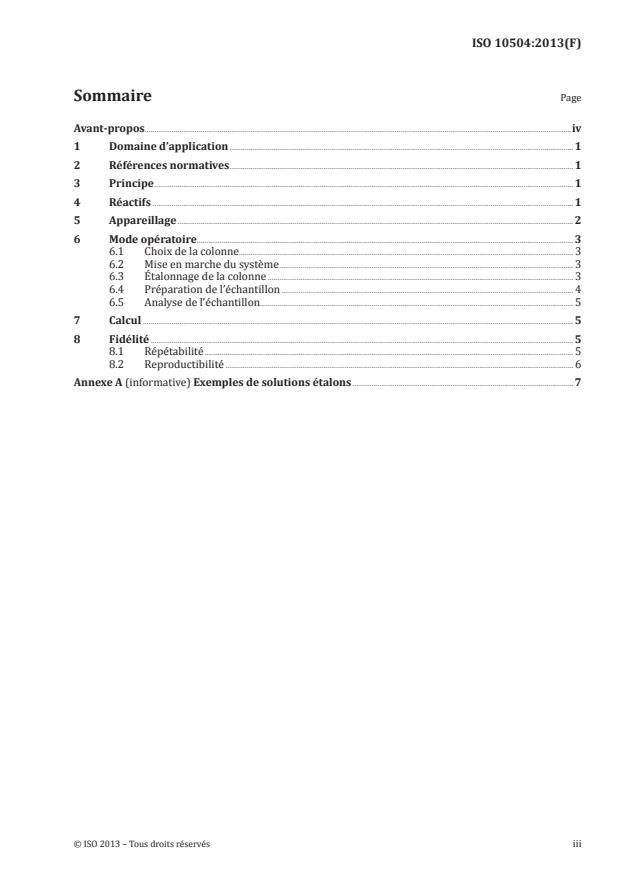
Sommaire Page
Avant-propos .iv
1 Domaine d’application . 1
2 Références normatives . 1
3 Principe . 1
4 Réactifs . 1
5 Appareillage . 2
6 Mode opératoire. 3
6.1 Choix de la colonne. 3
6.2 Mise en marche du système . 3
6.3 Étalonnage de la colonne . 3
6.4 Préparation de l’échantillon . 4
6.5 Analyse de l’échantillon . 5
7 Calcul . 5
8 Fidélité . 5
8.1 Répétabilité . 5
8.2 Reproductibilité . 6
Annexe A (informative) Exemples de solutions étalons . 7
Avant-propos
L’ISO (Organisation internationale de normalisation) est une fédération mondiale d’organismes
nationaux de normalisation (comités membres de l’ISO). L’élaboration des Normes internationales est
en général confiée aux comités techniques de l’ISO. Chaque comité membre intéressé par une étude
a le droit de faire partie du comité technique créé à cet effet. Les organisations internationales,
gouvernementales et non gouvernementales, en liaison avec l’ISO participent également aux travaux.
L’ISO collabore étroitement avec la Commission électrotechnique internationale (IEC) en ce qui concerne
la normalisation électrotechnique.
Les procédures utilisées pour élaborer le présent document et celles destinées à sa mise à jour sont
décrites dans les Directives ISO/IEC, Partie 1. Il convient, en particulier de prendre note des différents
critères d’approbation requis pour les différents types de documents ISO. Le présent document a été
rédigé conformément aux règles de rédaction données dans les Directives ISO/IEC, Partie 2 (voir www.
iso.org/directives).
L’attention est appelée sur le fait que certains des éléments du présent document peuvent faire l’objet de
droits de propriété intellectuelle ou de droits analogues. L’ISO ne saurait être tenue pour responsable
de ne pas avoir identifié de tels droits de propriété et averti de leur existence. Les détails concernant les
références aux droits de propriété intellectuelle ou autres droits analogues identifiés lors de l’élaboration
du document sont indiqués dans l’Introduction et/ou dans la liste des déclarations de brevets reçues par
l’ISO (voir www.iso.org/brevets).
Les appellations commerciales éventuellement mentionnées dans le présent document sont données pour
information, par souci de commodité, à l’intention des utilisateurs et ne sauraient constituer un engagement.
Pour une explication de la signification des termes et expressions spécifiques de l’ISO liés à l’évaluation de
la conformité, ou pour toute information au sujet de l’adhésion de l’ISO aux principes de l’OMC concernant
les obstacles techniques au commerce (OTC), voir le lien suivant: Avant-propos — Informations
supplémentaires.
Le comité chargé de l’élaboration du présent document est le Comité de Projet ISO/PC 271, Systèmes de
management de la conformité.
Cette deuxième édition annule et remplace l’ISO 10504:1998, dont elle constitue une révision mineure.
iv © ISO 2013 – Tous droits réservés
NORME INTERNATIONALE ISO 10504:2013(F)
Produits dérivés de l’amidon — Détermination de la
composition des sirops de glucose, des sirops de fructose
et des sirops de glucose hydrogénés — Méthode par
chromatographie en phase liquide à haute performance
1 Domaine d’application
La présente Norme internationale spécifie une méthode d’analyse par chromatographie en phase liquide
à haute performance (CLHP) pour déterminer la composition de solutions de dextrose, de sirops de
glucose, de sirops contenant du fructose, de sirops de glucose hydrogénés, du sorbitol, du mannitol et
du maltitol. Les constituants sont, principalement, le glucose, le maltose, le maltotriose, le fructose, le
sorbitol, le mannitol, le maltitol et les maltooligosaccharides.
L’utilisation d’une colonne garnie d’une résine échangeuse de cations est indispensable.
2 Références normatives
Les documents ci-après, dans leur intégralité ou non, sont des références normatives indispensables à
l’application du présent document. Pour les références datées, seule l’édition citée s’applique. Pour les
références non datées, la dernière édition du document de référence s’applique (y compris les éventuels
amendements).
ISO 3696:1987, Eau pour laboratoire à usage analytique — Spécification et méthodes d’essai
ISO 5381:1983, Produits d’hydrolyse de l’amidon ou de la fécule. Dosage de l’eau. Méthode Karl Fischer modifiée
3 Principe
Les différents saccharides sont séparés par chromatographie en phase liquide à haute performance. La
séparation est obtenue en utilisant une colonne échangeuse de cations avec de l’eau comme éluant. Les
éluats sont détectés par un réfractomètre différentiel et quantifiés à l’aide d’un intégrateur électronique.
4 Réactifs
Tous les réactifs utilisés doivent être de qualité réactif analytique reconnue.
4.1 Eau distillée spéciale.
L’eau utilisée peut être de l’eau bidistillée de qualité 1 selon ISO 3696. L’eau déminéralisée, qui évite la
contamination de la résine échangeuse d’ions, est celle qui convient le mieux.
Il convient de filtrer l’eau sur un filtre de 0,22 μm. Il est également recommandé de la dégazer par un
traitement sous vide, ou à l’aide d’un appareil de dégazage en ligne. Il convient de conserver l’eau sous
atmosphère inerte et, de préférence, à une température de 70 °C pour inhiber la croissance microbienne.
NOTE Certains dispositifs de purification d’eau disponibles dans le commerce permettent d’obtenir de l’eau
filtrée et dégazée.
4.2 Solutions étalons primaires.
Préparer des solutions (voir Annexe A) dont la teneur en matière sèche est inférieure ou égale à 10 %, en
fonction de la sensibilité du réfractomètre, et ayant une composition aussi proche que possible de celle
des échantillons à analyser.
NOTE Des matériaux de référence appropriés pour les constituants énumérés dans l’Article 1 peuvent être
obtenus auprès d’entreprises reconnues dans le domaine de la chimie.
4.3 Résines échangeuses d’ions, pour la déminéralisation des échantillons à l’extérieur de
l’appareillage de chromatographie.
Les sels présents dans l’échantillon co-éluent dans la colonne et sont détectés par le réfractomètre,
faussant ainsi la détermination. Ces sels doivent donc d’abord être éliminés au moyen de résines
échangeuses d’ions. Pour ce faire, la méthode la plus appropriée consiste à utiliser une pré-colonne
en ligne comprenant un système de cartouches (5.5), mais cela peut aussi être réalisé à l’extérieur de
1)
l’appareillage de chromatographie en utilisant les résines suivantes :
a) type cation:
1) résine de polystyrène divinylbenzène réticulé à 4 %, fortement échangeuse de cations, sous
+
forme H ;
2) sous forme de poudre, granulométrie: 200 mesh à 400 mesh;
b) type anion:
1) résine de polystyrène divinylbenzène réticulé à 4 %, faiblement échangeuse d’anions et
contenant des groupes amines tertiaires, sous forme base libre;
2) sous forme de poudre, granulométrie: 200 mesh à 400 mesh.
5 Appareillage
5.1 Chromatographe en phase liquide, muni des équipements suivants.
5.1.1 Pompe, sans pulsation, permettant de maintenir le débit requis à un niveau constant.
5.1.2 Réfractomètre différentiel, thermostaté
5.1.3 Four pour colonne thermostaté, permettant de maintenir la colonne à des températures allant
jusqu’à 95 °C, précis à ± 0,5 °C près.
5.2 Injecteur d’échantillon, compr
...