

ISO 4898:2025
(Main)Rigid cellular plastics — Thermal insulation products for buildings — Specifications
General Information
- Abstract
This document specifies requirements and methods of testing for three categories of rigid cellular plastics thermal-insulation products for buildings. It covers rigid cellular plastics in the form of flat or profiled boards, with or without natural skins. They can also be faced or laminated with foil, plastic or metal films or sheets, mineral coatings, paper, cardboard, or other materials. This document is not applicable to materials used for the thermal insulation of pipes and vessels, for impact sound absorption or for acoustical insulation. This document covers the following cellular materials used in the thermal insulation of buildings: — PF based on phenolic polymer; — EPS based on expanded polystyrene; — XPS based on extruded polystyrene; — PUR based on polyurethane. The limiting quality values in this document are for use only in the specification of materials between purchaser and supplier.
- Status
- Published
- Publication Date
- 12-Oct-2025
- Technical Committee
- ISO/TC 61/SC 10 - Cellular plastics
- Drafting Committee
- ISO/TC 61/SC 10 - Cellular plastics
- Current Stage
- 6060 - International Standard published
- Start Date
- 13-Oct-2025
- Due Date
- 29-Nov-2025
- Completion Date
- 13-Oct-2025
Overview - ISO 4898:2025 (Rigid cellular plastics - Thermal insulation products for buildings)
ISO 4898:2025 specifies requirements and test methods for rigid cellular plastics used as thermal-insulation products for buildings. It applies to flat or profiled boards (with or without natural skins) that may be faced or laminated with foil, films, metal sheets, mineral coatings, paper or other facings. The standard covers four material families: PF (phenolic foam), EPS (expanded polystyrene), XPS (extruded polystyrene) and PUR (polyurethane). It excludes pipe/vessel insulation and materials intended solely for impact sound absorption or acoustic insulation. Limiting quality values in ISO 4898:2025 are intended for specification between purchaser and supplier (not for structural design).
Key topics and technical requirements
- Product categories and subcategories
- Three usage categories (I, II, III) based on load-bearing and temperature/creep requirements.
- Subcategories A/B/C further differentiate maximum thermal-conductivity values (used as limiting specification values).
- Sizes and dimensional tolerances
- Boards to be supplied in agreed dimensions or per ISO 21723; examples from the standard include length/width tolerances (e.g., <1000 mm ±8 mm; ≥1000 mm ±10 mm) and thickness tolerances (e.g., <50 mm ±2 mm; 50–75 mm ±3 mm; EPS with natural skins ±4 mm).
- Physical-property requirements
- Density, compressive strength, compressive creep (including at elevated temperature), bending load at break, dimensional stability and linear dimensions.
- Thermal performance
- Initial thermal conductivity and long-term thermal resistance requirements (steady-state test methods referenced).
- Safety and emissions
- Burning characteristics, heat release rate and smoke production (cone calorimeter), fire retardancy criteria, and formaldehyde emissions (including ISO 16000-25 micro‑chamber method).
- Durability and moisture
- Water absorption and water vapour permeability testing.
- Quality control and conformity
- Sampling, conditioning, conformity control systems, labelling, and reporting requirements for supplier–purchaser agreements.
Practical applications and who uses ISO 4898:2025
- Manufacturers and suppliers - to define material specification limits, factory production control and product labelling.
- Purchasers, specifiers and procurement teams - to set contractual acceptance criteria for insulation board products.
- Architects and building engineers - to understand material categories, thermal and mechanical properties when selecting insulation (note: thermal-conductivity limits are not design values).
- Testing laboratories and conformity assessors - to perform standardized tests (Clause 8) and report results per the standard’s requirements.
- Regulators and certification bodies - for harmonized assessment of performance, emissions and fire characteristics.
Related standards (normative references)
Key referenced standards include ISO 8301/8302 (thermal resistance), ISO 5660-1 (cone calorimeter), ISO 9772 (horizontal burning), ISO 11561 (long-term thermal resistance), ISO 16000-25 (SVOC emissions), ISO 844/7850/845 (mechanical/density tests), ISO 2896 (water absorption) and ISO 12576-1 (conformity control).
Keywords: ISO 4898:2025, rigid cellular plastics, thermal insulation, EPS, XPS, PUR, PF, thermal conductivity, fire performance, density, building insulation.
Relations
- Revises
ISO 4898:2018 - Rigid cellular plastics — Thermal insulation products for buildings — Specifications - Effective Date
- 03-Dec-2022
Get Certified
Connect with accredited certification bodies for this standard

DIN CERTCO
DIN Group product certification.
DIBt (Deutsches Institut für Bautechnik)
German Institute for Building Technology.

Aboma Certification B.V.
Specialized in construction, metal, and transport sectors.
Sponsored listings
Frequently Asked Questions
ISO 4898:2025 is a standard published by the International Organization for Standardization (ISO). Its full title is "Rigid cellular plastics — Thermal insulation products for buildings — Specifications". This standard covers: This document specifies requirements and methods of testing for three categories of rigid cellular plastics thermal-insulation products for buildings. It covers rigid cellular plastics in the form of flat or profiled boards, with or without natural skins. They can also be faced or laminated with foil, plastic or metal films or sheets, mineral coatings, paper, cardboard, or other materials. This document is not applicable to materials used for the thermal insulation of pipes and vessels, for impact sound absorption or for acoustical insulation. This document covers the following cellular materials used in the thermal insulation of buildings: — PF based on phenolic polymer; — EPS based on expanded polystyrene; — XPS based on extruded polystyrene; — PUR based on polyurethane. The limiting quality values in this document are for use only in the specification of materials between purchaser and supplier.
This document specifies requirements and methods of testing for three categories of rigid cellular plastics thermal-insulation products for buildings. It covers rigid cellular plastics in the form of flat or profiled boards, with or without natural skins. They can also be faced or laminated with foil, plastic or metal films or sheets, mineral coatings, paper, cardboard, or other materials. This document is not applicable to materials used for the thermal insulation of pipes and vessels, for impact sound absorption or for acoustical insulation. This document covers the following cellular materials used in the thermal insulation of buildings: — PF based on phenolic polymer; — EPS based on expanded polystyrene; — XPS based on extruded polystyrene; — PUR based on polyurethane. The limiting quality values in this document are for use only in the specification of materials between purchaser and supplier.
ISO 4898:2025 is classified under the following ICS (International Classification for Standards) categories: 83.100 - Cellular materials; 91.100.60 - Thermal and sound insulating materials. The ICS classification helps identify the subject area and facilitates finding related standards.
ISO 4898:2025 has the following relationships with other standards: It is inter standard links to ISO 4898:2018. Understanding these relationships helps ensure you are using the most current and applicable version of the standard.
ISO 4898:2025 is available in PDF format for immediate download after purchase. The document can be added to your cart and obtained through the secure checkout process. Digital delivery ensures instant access to the complete standard document.
Standards Content (Sample)
International
Standard
ISO 4898
Seventh edition
Rigid cellular plastics — Thermal
2025-10
insulation products for buildings —
Specifications
Plastiques alvéolaires rigides — Produits d'isolation thermique
pour bâtiments — Spécifications
Reference number
© ISO 2025
All rights reserved. Unless otherwise specified, or required in the context of its implementation, no part of this publication may
be reproduced or utilized otherwise in any form or by any means, electronic or mechanical, including photocopying, or posting on
the internet or an intranet, without prior written permission. Permission can be requested from either ISO at the address below
or ISO’s member body in the country of the requester.
ISO copyright office
CP 401 • Ch. de Blandonnet 8
CH-1214 Vernier, Geneva
Phone: +41 22 749 01 11
Email: copyright@iso.org
Website: www.iso.org
Published in Switzerland
ii
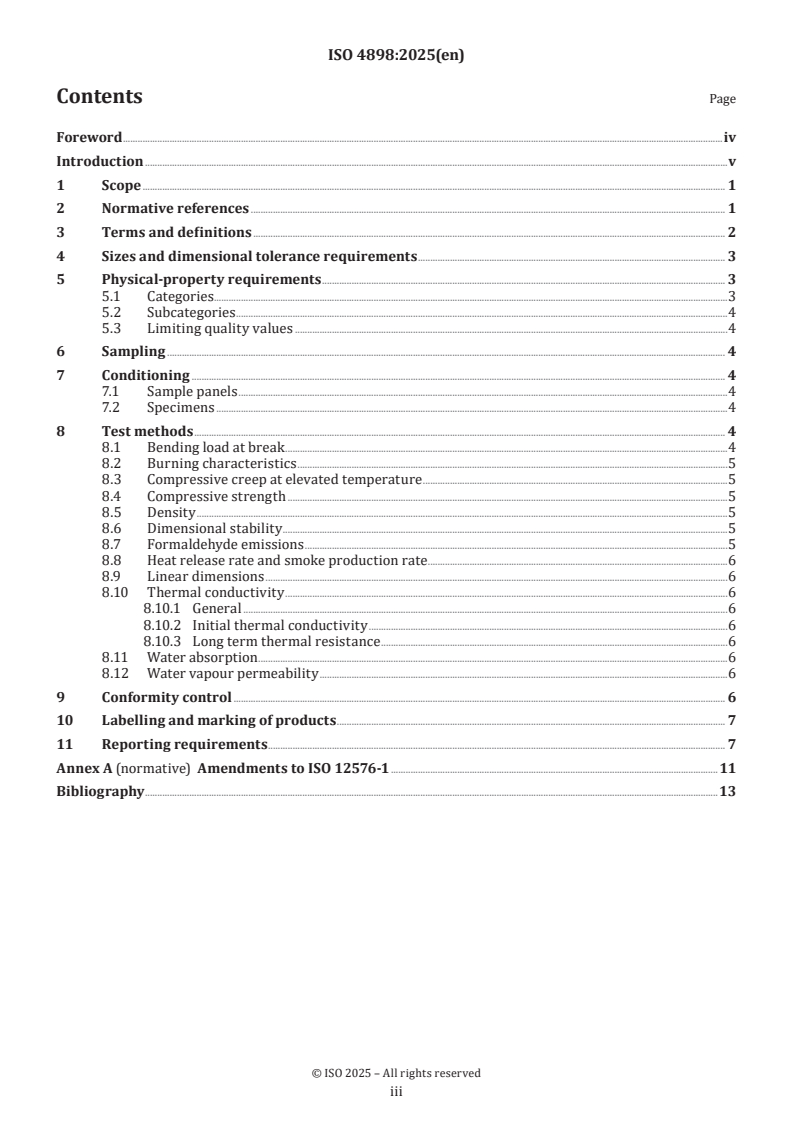
Contents Page
Foreword .iv
Introduction .v
1 Scope . 1
2 Normative references . 1
3 Terms and definitions . 2
4 Sizes and dimensional tolerance requirements . 3
5 Physical-property requirements . 3
5.1 Categories.3
5.2 Subcategories .4
5.3 Limiting quality values .4
6 Sampling . 4
7 Conditioning . 4
7.1 Sample panels .4
7.2 Specimens .4
8 Test methods . 4
8.1 Bending load at break .4
8.2 Burning characteristics .5
8.3 Compressive creep at elevated temperature .5
8.4 Compressive strength .5
8.5 Density .5
8.6 Dimensional stability .5
8.7 Formaldehyde emissions .5
8.8 Heat release rate and smoke production rate .6
8.9 Linear dimensions .6
8.10 Thermal conductivity .6
8.10.1 General .6
8.10.2 Initial thermal conductivity .6
8.10.3 Long term thermal resistance .6
8.11 Water absorption .6
8.12 Water vapour permeability .6
9 Conformity control . 6
10 Labelling and marking of products . 7
11 Reporting requirements . 7
Annex A (normative) Amendments to ISO 12576-1 .11
Bibliography .13
iii
Foreword
ISO (the International Organization for Standardization) is a worldwide federation of national standards
bodies (ISO member bodies). The work of preparing International Standards is normally carried out through
ISO technical committees. Each member body interested in a subject for which a technical committee
has been established has the right to be represented on that committee. International organizations,
governmental and non-governmental, in liaison with ISO, also take part in the work. ISO collaborates closely
with the International Electrotechnical Commission (IEC) on all matters of electrotechnical standardization.
The procedures used to develop this document and those intended for its further maintenance are described
in the ISO/IEC Directives, Part 1. In particular, the different approval criteria needed for the different types
of ISO documents should be noted. This document was drafted in accordance with the editorial rules of the
ISO/IEC Directives, Part 2 (see www.iso.org/directives).
ISO draws attention to the possibility that the implementation of this document may involve the use of (a)
patent(s). ISO takes no position concerning the evidence, validity or applicability of any claimed patent
rights in respect thereof. As of the date of publication of this document, ISO had not received notice of (a)
patent(s) which may be required to implement this document. However, implementers are cautioned that
this may not represent the latest information, which may be obtained from the patent database available at
www.iso.org/patents. ISO shall not be held responsible for identifying any or all such patent rights.
Any trade name used in this document is information given for the convenience of users and does not
constitute an endorsement.
For an explanation of the voluntary nature of standards, the meaning of ISO specific terms and expressions
related to conformity assessment, as well as information about ISO's adherence to the World Trade
Organization (WTO) principles in the Technical Barriers to Trade (TBT), see www.iso.org/iso/foreword.html.
This document was prepared by Technical Committee ISO/TC 61, Plastics, Subcommittee SC 10, Cellular
plastics.
This seventh edition cancels and replaces the sixth edition (ISO 4898:2018), which has been technically
revised.
The main changes are as follows:
— the list of normative references (see Clause 2) has been updated;
— the test methods in Clause 8 have been completely revised;
— requirements for density testing have been added;
— requirements for initial thermal conductivity have been added;
— requirements for burning characteristics have been added;
— requirements for fire retardancy have been added;
— requirements for formaldehyde emissions have been added;
— requirement for testing to ISO 16000-25 has been added.
Any feedback or questions on this document should be directed to the user’s national standards body. A
complete listing of these bodies can be found at www.iso.org/members.html.
iv
Introduction
This document provides a list of material properties for cellular plastic board-stock thermal insulation
materials, along with performance requirements and the test methods to determine the performance
requirements.
v
International Standard ISO 4898:2025(en)
Rigid cellular plastics — Thermal insulation products for
buildings — Specifications
1 Scope
This document specifies requirements and methods of testing for three categories of rigid cellular plastics
thermal-insulation products for buildings. It covers rigid cellular plastics in the form of flat or profiled
boards, with or without natural skins. They can also be faced or laminated with foil, plastic or metal films or
sheets, mineral coatings, paper, cardboard, or other materials.
This document is not applicable to materials used for the thermal insulation of pipes and vessels, for impact
sound absorption or for acoustical insulation.
This document covers the following cellular materials used in the thermal insulation of buildings:
— PF based on phenolic polymer;
— EPS based on expanded polystyrene;
— XPS based on extruded polystyrene;
— PUR based on polyurethane.
The limiting quality values in this document are for use only in the specification of materials between
purchaser and supplier.
2 Normative references
The following documents are referred to in the text in such a way that some or all their content constitutes
requirements of this document. For dated references, only the edition cited applies. For undated references,
the latest edition of the referenced document (including any amendments) applies.
ISO 291, Plastics — Standard atmospheres for conditioning and testing
ISO 844, Rigid cellular plastics — Determination of compression properties
ISO 845, Cellular plastics and rubbers — Determination of apparent density
ISO 21723, Buildings and civil engineering works — Modular coordination — Module
ISO 1209-1, Rigid cellular plastics — Determination of flexural properties — Part 1: Basic bending test
ISO 1663, Rigid cellular plastics — Determination of water vapour transmission properties
ISO 1923, Cellular plastics and rubbers — Determination of linear dimensions
ISO 2796, Cellular plastics, rigid — Test for dimensional stability
ISO 2896, Rigid cellular plastics — Determination of water absorption
ISO 5660-1, Reaction-to-fire tests — Heat release, smoke production and mass loss rate — Part 1: Heat release
rate (cone calorimeter method) and smoke production rate (dynamic measurement)
ISO 7850, Cellular plastics, rigid — Determination of compressive creep
ISO 8301, Thermal insulation — Determination of steady-state thermal resistance and related properties —
Heat flow meter apparatus
ISO 8302, Thermal insulation — Determination of steady-state thermal resistance and related properties —
Guarded hot plate apparatus
ISO 9772, Cellular plastics — Determination of horizontal burning characteristics of small specimens subjected
to a small flame
ISO 11561, Ageing of thermal insulation materials — Determination of the long-term change in thermal
resistance of closed-cell plastics (accelerated laboratory test methods)
ISO 12576-1, Thermal insulation — Insulating materials and products for buildings — Conformity control
systems — Part 1: Factory-made products
ISO 16000-25, Indoor air — Part 25: Determination of the emission of semi-volatile organic compounds by
building products — Micro-chamber method
3 Terms and definitions
For the purposes of this document, the following terms and definitions apply.
ISO and IEC maintain terminology databases for use in standardization at the following addresses:
— ISO Online browsing platform: available at https:// www .iso .org/ obp
— IEC Electropedia: available at https:// www .electropedia .org/
3.1
EPS
expanded polystyrene
rigid cellular plastics insulation material manufactured by moulding beads of expandable polystyrene or
one of its copolymers and that has a substantially closed-cell structure, filled with air
[SOURCE: ISO 9229:2020, 3.1.2.1]
3.2
XPS
extruded polystyrene foam
rigid cellular plastics insulation material expanded and extruded with or without a skin from polystyrene or
one of its copolymers and that has a closed cell structure
[SOURCE: ISO 9229:2020, 3.1.2.2]
3.3
PUR
polyurethane foam
rigid cellular plastics insulation material with a substantially closed-cell structure based on polyurethane
or urethane/isocyanurate polymers
Note 1 to entry: For definitions of polyisocyanurate plastic, polyurethane, and urethane plastic, see ISO 472.
[SOURCE: ISO 9229:2020, 3.1.2.6, modified — Note 1 to entry has been added.]
3.4
PF
phenolic foam
rigid cellular insulation foam, the polymer structure of which is made primarily from the polycondensation
of phenol, its homologues and/or derivatives with aldehydes or ketones
Note 1 to entry: PF used for thermal-insulation purposes has a cellular structure consisting substantially of closed
cells (subcategory A) or with a higher content of open cells (subcategory B) which affects the thermal conductivity.
[SOURCE: ISO 9229:2020, 3.1.2.4, modified — Note 1 to entry has been added.]
4 Sizes and dimensional tolerance requirements
4.1 Board materials shall be supplied in dimensions agreed between purchaser and supplier or in
accordance with ISO 21723. Boards shall be flat.
4.2 Dimensional tolerances for length, width and squareness shall conform to the requirements specified
in Table 1.
Table 1 — Tolerances for dimensions and squareness
Squareness tolerances based
on differences in diagonal
a b
Length or width Tolerance on length or width measurements
mm mm mm
<1 000 ±8 5
≥1 000 ±10 5
a
Tolerance category for diagonal measurements is based on the board length (not width).
b
Squareness may also be determined by equivalent methods such as the use of a rectangular pattern.
4.3 Dimensional tolerances for thickness shall conform to the requirements specified in Table 2.
Table 2 — Tolerances for thickness
Thickness Tolerance
mm mm
<50 ±2
50 to 75 (incl.) ±3
a
>75 to 100 (incl.) ±3
>100 To be agreed between purchaser and supplier
a
For EPS with natural skins, the thickness tolerance for this thickness category shall be ±4 mm.
5 Physical-property requirements
5.1 Categories
Physical property requirements are organized into product categories to meet purchaser and supplier needs
over a range of end-use applications.
Category I — Suitable for non-load bearing applications such as wall and cavity insulation, vented roofs,
cavity wall insulation and similar applications.
Category II — Suitable for limited load-bearing applications such as in built-up roofs, under floors and
comparab
...