

ISO 9453:2020
(Main)Soft solder alloys — Chemical compositions and forms
General Information
- Abstract
This document specifies the requirements for chemical composition for soft solder alloys containing two or more of: tin, lead, antimony, copper, silver, bismuth, zinc, indium and/or cadmium. An indication of the forms generally available is also included.
- Status
- Published
- Publication Date
- 23-Sep-2020
- Technical Committee
- ISO/TC 44/SC 12 - Soldering materials
- Drafting Committee
- ISO/TC 44/SC 12 - Soldering materials
- Current Stage
- 9093 - International Standard confirmed
- Start Date
- 06-Mar-2026
- Completion Date
- 29-Aug-2026
Buy Documents


ISO 9453:2020 - Soft solder alloys -- Chemical compositions and forms
ISO 9453:2020 - Soft solder alloys — Chemical compositions and forms/24/2020


ISO 9453:2020 - Alliages de brasage tendre -- Compositions chimiques et formes
ISO 9453:2020 - Alliages de brasage tendre — Compositions chimiques et formes/24/2020
Overview
ISO 9453:2020 - Soft solder alloys - Chemical compositions and forms - defines chemical composition limits and typical product forms for soft solder alloys used to join metallic parts. The standard covers alloys that contain two or more of tin, lead, antimony, copper, silver, bismuth, zinc, indium and cadmium, and distinguishes between lead-containing and lead‑free alloy groups. It also provides guidance on sampling, analysis, marking, labelling and packaging.
Key topics and technical requirements
- Chemical compositions: Detailed mass‑fraction limits for alloy groups and individual alloys are given in Table 2 (lead‑containing) and Table 3 (lead‑free). Single‑figure impurity limits are maximum values; “Rem” denotes the remainder to 100 %.
- Alloy identification: Numeric alloy designations are listed; Annex A compares these with IEC short names (IEC 61190‑1‑3).
- Melting information: Solidus/liquidus temperatures are shown for information only and are not prescriptive requirements.
- Forms of delivery: Accepted product forms include ingots, slabs, sticks, bars, rods, wire, pellets, preforms, spheres, ribbons, powder, pastes and creams. Not all compositions are available in every form.
- Units of product: Marking and traceability requirements vary by form (e.g., single ingot vs. reel of wire vs. individually packaged paste).
- Sampling and analysis: Inductively coupled plasma (ICP) is the recommended analytical technique; Spark‑OES and AAS are acceptable with agreement between supplier and purchaser.
- Marking and packaging: Each batch must carry specified markings (see Table 4), including health/safety and lead‑free or lead‑containing indicators. Flux inclusion in rods/wire is by supplier–purchaser agreement.
- Regulatory notes: The document acknowledges possible patent assertions and collaboration with IEC/CEN technical committees.
Applications and who uses this standard
- Electronics OEMs and PCBA assemblers selecting solder alloys for wave, reflow or hand soldering.
- Solder manufacturers and formulators specifying product chemistry and product forms.
- Quality, procurement and compliance teams ensuring material traceability, labelling and conformity with chemical specifications.
- Test labs and inspectors using ICP, Spark‑OES or AAS methods for compositional verification.
- Engineers choosing between lead‑free and tin‑lead solders for reliability, process temperature and regulatory needs.
Related standards
- IEC 61190‑1‑3 (short alloy names and compositions) - compared in Annex A of ISO 9453:2020.
- ISO/TC 44 (Welding and allied processes) and CEN collaboration noted in the foreword.
ISO 9453 is a practical reference for anyone involved in specification, production, testing or procurement of soft solder alloys, helping ensure consistent chemistry, correct product forms and proper marking for manufacturing and regulatory compliance.
Relations
- Effective Date
- 25-Aug-2026
- Effective Date
- 25-Aug-2026
- Effective Date
- 12-Feb-2026
- Effective Date
- 23-Apr-2020
Buy Documents
ISO 9453:2020 - Soft solder alloys -- Chemical compositions and forms
ISO 9453:2020 - Soft solder alloys — Chemical compositions and forms/24/2020
ISO 9453:2020 - Alliages de brasage tendre -- Compositions chimiques et formes
ISO 9453:2020 - Alliages de brasage tendre — Compositions chimiques et formes/24/2020
Get Certified
Connect with accredited certification bodies for this standard

DVS-ZERT GmbH
German welding certification society.
CARES (UK Certification Authority for Reinforcing Steels)
UK certification for reinforcing steels and construction.
EWF/IIW (European/International Welding Federation)
International welding personnel certification.
Sponsored listings
Frequently Asked Questions
ISO 9453:2020 is a standard published by the International Organization for Standardization (ISO). Its full title is "Soft solder alloys — Chemical compositions and forms". This standard covers: This document specifies the requirements for chemical composition for soft solder alloys containing two or more of: tin, lead, antimony, copper, silver, bismuth, zinc, indium and/or cadmium. An indication of the forms generally available is also included.
This document specifies the requirements for chemical composition for soft solder alloys containing two or more of: tin, lead, antimony, copper, silver, bismuth, zinc, indium and/or cadmium. An indication of the forms generally available is also included.
ISO 9453:2020 is classified under the following ICS (International Classification for Standards) categories: 25.160.50 - Brazing and soldering. The ICS classification helps identify the subject area and facilitates finding related standards.
ISO 9453:2020 has the following relationships with other standards: It is inter standard links to EN ISO 12224-1:2024, EN ISO 12224-2:2024, EN ISO 9453:2020, ISO 9453:2014. Understanding these relationships helps ensure you are using the most current and applicable version of the standard.
ISO 9453:2020 is available in PDF format for immediate download after purchase. The document can be added to your cart and obtained through the secure checkout process. Digital delivery ensures instant access to the complete standard document.
Standards Content (Sample)
INTERNATIONAL ISO
STANDARD 9453
Fourth edition
2020-09
Soft solder alloys — Chemical
compositions and forms
Alliages de brasage tendre — Compositions chimiques et formes
Reference number
©
ISO 2020
© ISO 2020
All rights reserved. Unless otherwise specified, or required in the context of its implementation, no part of this publication may
be reproduced or utilized otherwise in any form or by any means, electronic or mechanical, including photocopying, or posting
on the internet or an intranet, without prior written permission. Permission can be requested from either ISO at the address
below or ISO’s member body in the country of the requester.
ISO copyright office
CP 401 • Ch. de Blandonnet 8
CH-1214 Vernier, Geneva
Phone: +41 22 749 01 11
Email: copyright@iso.org
Website: www.iso.org
Published in Switzerland
ii © ISO 2020 – All rights reserved
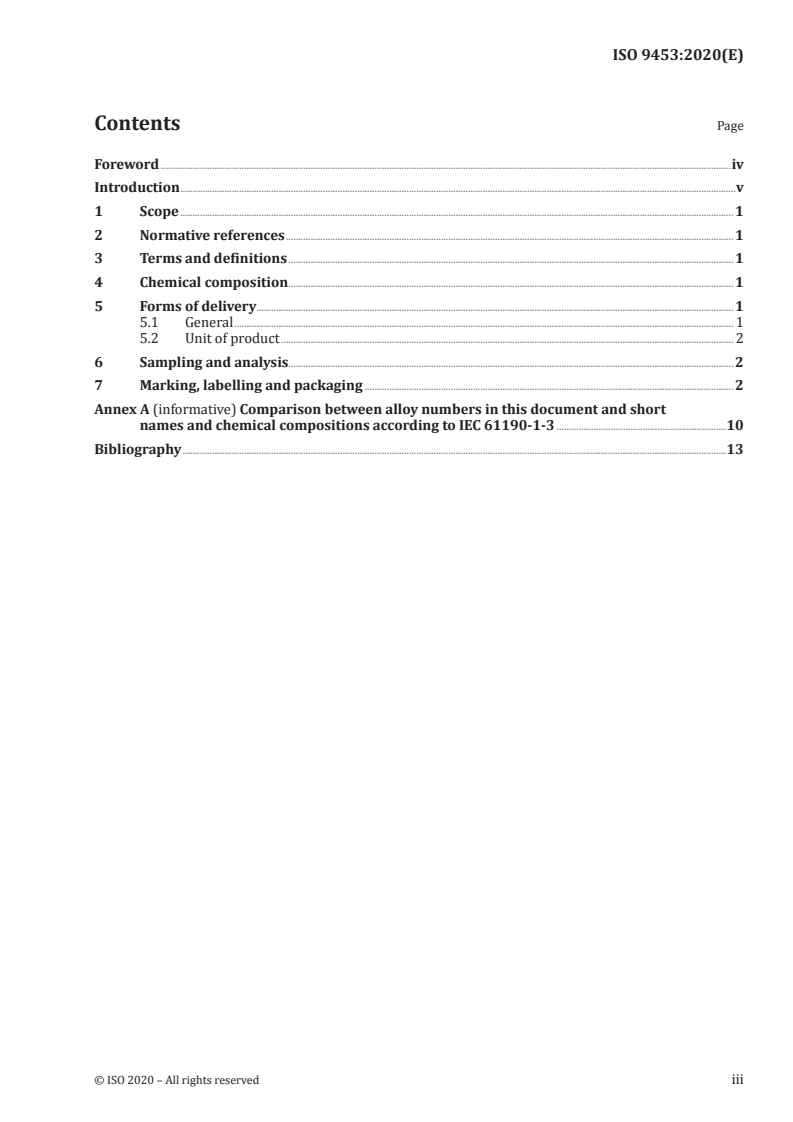
Contents Page
Foreword .iv
Introduction .v
1 Scope . 1
2 Normative references . 1
3 Terms and definitions . 1
4 Chemical composition . 1
5 Forms of delivery . 1
5.1 General . 1
5.2 Unit of product . 2
6 Sampling and analysis. 2
7 Marking, labelling and packaging . 2
Annex A (informative) Comparison between alloy numbers in this document and short
names and chemical compositions according to IEC 61190-1-3 .10
Bibliography .13
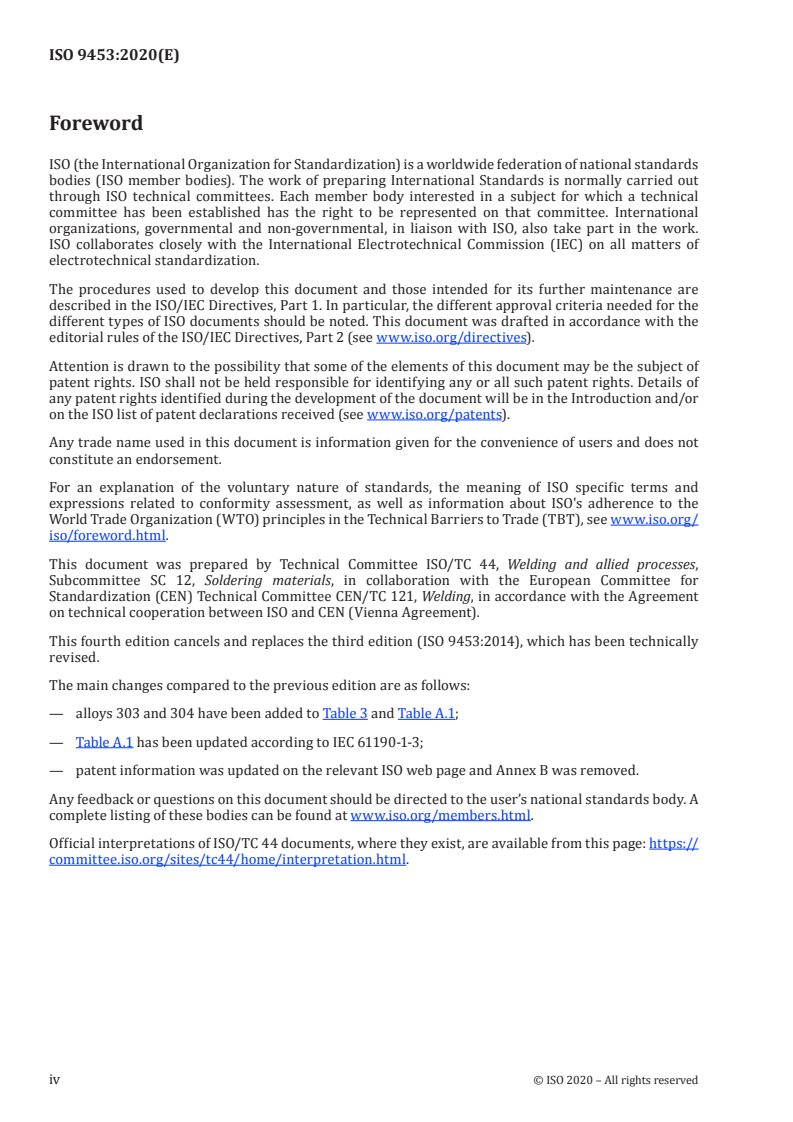
Foreword
ISO (the International Organization for Standardization) is a worldwide federation of national standards
bodies (ISO member bodies). The work of preparing International Standards is normally carried out
through ISO technical committees. Each member body interested in a subject for which a technical
committee has been established has the right to be represented on that committee. International
organizations, governmental and non-governmental, in liaison with ISO, also take part in the work.
ISO collaborates closely with the International Electrotechnical Commission (IEC) on all matters of
electrotechnical standardization.
The procedures used to develop this document and those intended for its further maintenance are
described in the ISO/IEC Directives, Part 1. In particular, the different approval criteria needed for the
different types of ISO documents should be noted. This document was drafted in accordance with the
editorial rules of the ISO/IEC Directives, Part 2 (see www .iso .org/ directives).
Attention is drawn to the possibility that some of the elements of this document may be the subject of
patent rights. ISO shall not be held responsible for identifying any or all such patent rights. Details of
any patent rights identified during the development of the document will be in the Introduction and/or
on the ISO list of patent declarations received (see www .iso .org/ patents).
Any trade name used in this document is information given for the convenience of users and does not
constitute an endorsement.
For an explanation of the voluntary nature of standards, the meaning of ISO specific terms and
expressions related to conformity assessment, as well as information about ISO's adherence to the
World Trade Organization (WTO) principles in the Technical Barriers to Trade (TBT), see www .iso .org/
iso/ foreword .html.
This document was prepared by Technical Committee ISO/TC 44, Welding and allied processes,
Subcommittee SC 12, Soldering materials, in collaboration with the European Committee for
Standardization (CEN) Technical Committee CEN/TC 121, Welding, in accordance with the Agreement
on technical cooperation between ISO and CEN (Vienna Agreement).
This fourth edition cancels and replaces the third edition (ISO 9453:2014), which has been technically
revised.
The main changes compared to the previous edition are as follows:
— alloys 303 and 304 have been added to Table 3 and Table A.1;
— Table A.1 has been updated according to IEC 61190-1-3;
— patent information was updated on the relevant ISO web page and Annex B was removed.
Any feedback or questions on this document should be directed to the user’s national standards body. A
complete listing of these bodies can be found at www .iso .org/ members .html.
Official interpretations of ISO/TC 44 documents, where they exist, are available from this page: https://
committee .iso .org/ sites/ tc44/ home/ interpretation .html.
iv © ISO 2020 – All rights reserved
Introduction
The International Organization for Standardization (ISO) draws attention to the fact that it is claimed
that compliance with this document may involve the use of a patent.
ISO takes no position concerning the evidence, validity and scope of this patent right.
The holder of this patent right has assured ISO that he/she is willing to negotiate licences under
reasonable and non-discriminatory terms and conditions with applicants throughout the world. In
this respect, the statement of the holder of this patent right is registered with ISO. Information may be
obtained from the patent database available at www .iso .org/ patents.
Attention is drawn to the possibility that some of the elements of this document may be the subject of
patent rights other than those in the patent database. ISO shall not be held responsible for identifying
any or all such patent rights.
INTERNATIONAL STANDARD ISO 9453:2020(E)
Soft solder alloys — Chemical compositions and forms
1 Scope
This document specifies the requirements for chemical composition for soft solder alloys containing
two or more of: tin, lead, antimony, copper, silver, bismuth, zinc, indium and/or cadmium.
An indication of the forms generally available is also included.
2 Normative references
There are no normative references in this document.
3 Terms and definitions
For the purposes of this document, the following terms and definitions apply.
ISO and IEC maintain terminological databases for use in standardization at the following addresses:
— ISO Online browsing platform: available at https:// www .iso .org/ obp
— IEC Electropedia: available at http:// www .electropedia .org/
3.1
soft solder
metallic filler material which is used to join metallic parts and which has a melting temperature
(liquidus) lower than that of the parts to be joined and, usually, lower than 450 °C and which wets the
parent metals
3.2
batch
collection of one or more units of product, made in a single production operation
4 Chemical composition
The chemical composition of the soft solder, sampled and analysed in accordance with Clause 6, shall be
as given for the appropriate material in Table 2 or Table 3.
5 Forms of delivery
5.1 General
Soft solders conforming to this document shall be supplied in one of the following forms: ingot, slab,
stick, bar, rod, wire, pellets, preforms, spheres, ribbons, powder or pastes and creams containing
powder. Solder shall be uniform in quality and free from detrimental conditions such as contamination
or surface oxide that prevent melting and flow in a manner suitable for the intended application.
NOTE 1 Solders supplied in the form of rod, wire, or preforms can be supplied with or without an integral flux,
subject to agreement between the supplier and the purchaser.
NOTE 2 Not all the solder compositions given in the tables are necessarily available in all the product
forms listed.
5.2 Unit of product
The unit of product used for defining the requirements for the marking of soft solders varies with the
form of the solder (see Table 1).
Table 1 — Variations of unit of product with form of solder
Form of solder Unit of product
Ingot, bar, slab, stick or rod A single ingot, bar, slab, stick or rod
Wire or ribbon A single coil or reel
Preforms and rings, spheres, pellets or powder The individual packaged quantity
Powder in solder pastes The individual packaged quantity
6 Sampling and analysis
The recommended method of analysis for soft solder alloys is induced coupled plasma (ICP). The
methods used shall be agreed between the supplier and the purchaser.
NOTE Other acceptable analysis methods are Spark optical emission spectrometry (Spark-OES) and atomic
absorption spectroscopy (AAS).
7 Marking, labelling and packaging
Each batch of solder supplied in accordance with this document shall be marked with the information
indicated by a cross in Table 4.
The information in Table 4 shall be applied to the product forms as follows:
a) for ingots and slabs: by stamping, or inkjet marking on the surface of each unit of product;
b) for sticks, bars, rods and wire in coil: either on a label securely attached to each unit of product, or
on a label on the package in which the units of product are contained;
c) for wire or ribbon on reels: on a label on each reel;
d) for pellets, performs, spheres, powder, paste or cream: on a label on each individually packaged
quantity;
e) all applicable health and safety markings including lead free marking or lead containing marking;
f) any other information which may be pertinent to the particular solder form.
2 © ISO 2020 – All rights reserved
Table 2 — Chemical compositions of lead containing solder alloys
(tin-lead, lead-tin, tin-lead-antimony, tin-lead-bismuth, tin-lead-cadmium, tin-lead-copper, tin-lead-silver, and lead-silver)
c,d
Group Alloy Alloy Melting or Chemical composition, mass fraction in %
a
No. designation solidus/
Sn Pb Sb Bi Cd Cu Au In Ag Al As Fe Ni Zn
liquidus
b
temperature
°C
101 Sn63Pb37 183 62,5 to Rem 0,20 0,10 0,002 0,08 0,05 0,10 0,10 0,001 0,03 0,02 0,01 0,001
63,5
Tin-lead
102 Sn63Pb37E 183 62,5 to Rem 0,05 0,05 0,002 0,08 0,05 0,10 0,10 0,001 0,03 0,02 0,01 0,001
binary al-
63,5
loys solidus
103 Sn60Pb40 183/190 59,5 to Rem 0,20 0,10 0,002 0,08 0,05 0,10 0,10 0,001 0,03 0,02 0,01 0,001
tempera-
60,5
ture 183 °C
104 Sn60Pb40E 183/190 59,5 to Rem 0,05 0,05 0,002 0,08 0,05 0,10 0,10 0,001 0,03 0,02 0,01 0,001
60,5
111 Pb50Sn50 183/215 49,5 to Rem 0,20 0,10 0,002 0,08 0,05 0,10 0,10 0,001 0,03 0,02 0,01 0,001
50,5
112 Pb50Sn50E 183/215 49,5 to Rem 0,05 0,05 0,002 0,08 0,05 0,10 0,10 0,001 0,03 0,02 0,01 0,001
50,5
113 Pb55Sn45 183/226 44,5 to Rem 0,50 0,25 0,005 0,08 0,05 0,10 0,10 0,001 0,03 0,02 0,01 0,001
Lead-tin
45,5
binary al-
114 Pb60Sn40 183/238 39,5 to Rem 0,50 0,25 0,005 0,08 0,05 0,10 0,10 0,001 0,03 0,02 0,01 0,001
loys solidus
40,5
tempera-
115 Pb65Sn35 183/245 34,5 to Rem 0,50 0,25 0,005 0,08 0,05 0,10 0,10 0,001 0,03 0,02 0,01 0,001
ture 183 °C
35,5
116 Pb70Sn30 183/255 29,5 to Rem 0,50 0,25 0,005 0,08 0,05 0,10 0,10 0,001 0,03 0,02 0,01 0,001
30,5
117 Pb80Sn20 183/280 19,5 to Rem 0,50 0,25 0,005 0,08 0,05 0,10 0,10 0,001 0,03 0,02 0,01 0,001
20,5
a
For information on IEC short alloy names, see Table A.1.
b
The temperatures are for information purposes and are not specified requirements for the alloy.
c
All single figure limits are maximum values.
d
Elements shown as “Rem” (i.e. Remainder) are calculated as differences from 100 %.
4 © ISO 2020 – All rights reserved
Table 2 (continued)
c,d
Group Alloy Alloy Melting or Chemical composition, mass fraction in %
a
No. designation solidus/
Sn Pb Sb Bi Cd Cu Au In Ag Al As Fe Ni Zn
liquidus
b
temperature
°C
121 Pb85Sn15 226/290 14,5 to Rem 0,50 0,25 0,005 0,08 0,05 0,10 0,10 0,001 0,03 0,02 0,01 0,001
15,5
Lead-tin
122 Pb90Sn10 268/302 9,5 to Rem 0,50 0,25 0,005 0,08 0,05 0,10 0,10 0,001 0,03 0,02 0,01 0,001
binary al-
10,5
loys solidus
...
INTERNATIONAL ISO
STANDARD 9453
Fourth edition
2020-09
Soft solder alloys — Chemical
compositions and forms
Alliages de brasage tendre — Compositions chimiques et formes
Reference number
©
ISO 2020
© ISO 2020
All rights reserved. Unless otherwise specified, or required in the context of its implementation, no part of this publication may
be reproduced or utilized otherwise in any form or by any means, electronic or mechanical, including photocopying, or posting
on the internet or an intranet, without prior written permission. Permission can be requested from either ISO at the address
below or ISO’s member body in the country of the requester.
ISO copyright office
CP 401 • Ch. de Blandonnet 8
CH-1214 Vernier, Geneva
Phone: +41 22 749 01 11
Email: copyright@iso.org
Website: www.iso.org
Published in Switzerland
ii © ISO 2020 – All rights reserved
Contents Page
Foreword .iv
Introduction .v
1 Scope . 1
2 Normative references . 1
3 Terms and definitions . 1
4 Chemical composition . 1
5 Forms of delivery . 1
5.1 General . 1
5.2 Unit of product . 2
6 Sampling and analysis. 2
7 Marking, labelling and packaging . 2
Annex A (informative) Comparison between alloy numbers in this document and short
names and chemical compositions according to IEC 61190-1-3 .10
Bibliography .13
Foreword
ISO (the International Organization for Standardization) is a worldwide federation of national standards
bodies (ISO member bodies). The work of preparing International Standards is normally carried out
through ISO technical committees. Each member body interested in a subject for which a technical
committee has been established has the right to be represented on that committee. International
organizations, governmental and non-governmental, in liaison with ISO, also take part in the work.
ISO collaborates closely with the International Electrotechnical Commission (IEC) on all matters of
electrotechnical standardization.
The procedures used to develop this document and those intended for its further maintenance are
described in the ISO/IEC Directives, Part 1. In particular, the different approval criteria needed for the
different types of ISO documents should be noted. This document was drafted in accordance with the
editorial rules of the ISO/IEC Directives, Part 2 (see www .iso .org/ directives).
Attention is drawn to the possibility that some of the elements of this document may be the subject of
patent rights. ISO shall not be held responsible for identifying any or all such patent rights. Details of
any patent rights identified during the development of the document will be in the Introduction and/or
on the ISO list of patent declarations received (see www .iso .org/ patents).
Any trade name used in this document is information given for the convenience of users and does not
constitute an endorsement.
For an explanation of the voluntary nature of standards, the meaning of ISO specific terms and
expressions related to conformity assessment, as well as information about ISO's adherence to the
World Trade Organization (WTO) principles in the Technical Barriers to Trade (TBT), see www .iso .org/
iso/ foreword .html.
This document was prepared by Technical Committee ISO/TC 44, Welding and allied processes,
Subcommittee SC 12, Soldering materials, in collaboration with the European Committee for
Standardization (CEN) Technical Committee CEN/TC 121, Welding, in accordance with the Agreement
on technical cooperation between ISO and CEN (Vienna Agreement).
This fourth edition cancels and replaces the third edition (ISO 9453:2014), which has been technically
revised.
The main changes compared to the previous edition are as follows:
— alloys 303 and 304 have been added to Table 3 and Table A.1;
— Table A.1 has been updated according to IEC 61190-1-3;
— patent information was updated on the relevant ISO web page and Annex B was removed.
Any feedback or questions on this document should be directed to the user’s national standards body. A
complete listing of these bodies can be found at www .iso .org/ members .html.
Official interpretations of ISO/TC 44 documents, where they exist, are available from this page: https://
committee .iso .org/ sites/ tc44/ home/ interpretation .html.
iv © ISO 2020 – All rights reserved
Introduction
The International Organization for Standardization (ISO) draws attention to the fact that it is claimed
that compliance with this document may involve the use of a patent.
ISO takes no position concerning the evidence, validity and scope of this patent right.
The holder of this patent right has assured ISO that he/she is willing to negotiate licences under
reasonable and non-discriminatory terms and conditions with applicants throughout the world. In
this respect, the statement of the holder of this patent right is registered with ISO. Information may be
obtained from the patent database available at www .iso .org/ patents.
Attention is drawn to the possibility that some of the elements of this document may be the subject of
patent rights other than those in the patent database. ISO shall not be held responsible for identifying
any or all such patent rights.
INTERNATIONAL STANDARD ISO 9453:2020(E)
Soft solder alloys — Chemical compositions and forms
1 Scope
This document specifies the requirements for chemical composition for soft solder alloys containing
two or more of: tin, lead, antimony, copper, silver, bismuth, zinc, indium and/or cadmium.
An indication of the forms generally available is also included.
2 Normative references
There are no normative references in this document.
3 Terms and definitions
For the purposes of this document, the following terms and definitions apply.
ISO and IEC maintain terminological databases for use in standardization at the following addresses:
— ISO Online browsing platform: available at https:// www .iso .org/ obp
— IEC Electropedia: available at http:// www .electropedia .org/
3.1
soft solder
metallic filler material which is used to join metallic parts and which has a melting temperature
(liquidus) lower than that of the parts to be joined and, usually, lower than 450 °C and which wets the
parent metals
3.2
batch
collection of one or more units of product, made in a single production operation
4 Chemical composition
The chemical composition of the soft solder, sampled and analysed in accordance with Clause 6, shall be
as given for the appropriate material in Table 2 or Table 3.
5 Forms of delivery
5.1 General
Soft solders conforming to this document shall be supplied in one of the following forms: ingot, slab,
stick, bar, rod, wire, pellets, preforms, spheres, ribbons, powder or pastes and creams containing
powder. Solder shall be uniform in quality and free from detrimental conditions such as contamination
or surface oxide that prevent melting and flow in a manner suitable for the intended application.
NOTE 1 Solders supplied in the form of rod, wire, or preforms can be supplied with or without an integral flux,
subject to agreement between the supplier and the purchaser.
NOTE 2 Not all the solder compositions given in the tables are necessarily available in all the product
forms listed.
5.2 Unit of product
The unit of product used for defining the requirements for the marking of soft solders varies with the
form of the solder (see Table 1).
Table 1 — Variations of unit of product with form of solder
Form of solder Unit of product
Ingot, bar, slab, stick or rod A single ingot, bar, slab, stick or rod
Wire or ribbon A single coil or reel
Preforms and rings, spheres, pellets or powder The individual packaged quantity
Powder in solder pastes The individual packaged quantity
6 Sampling and analysis
The recommended method of analysis for soft solder alloys is induced coupled plasma (ICP). The
methods used shall be agreed between the supplier and the purchaser.
NOTE Other acceptable analysis methods are Spark optical emission spectrometry (Spark-OES) and atomic
absorption spectroscopy (AAS).
7 Marking, labelling and packaging
Each batch of solder supplied in accordance with this document shall be marked with the information
indicated by a cross in Table 4.
The information in Table 4 shall be applied to the product forms as follows:
a) for ingots and slabs: by stamping, or inkjet marking on the surface of each unit of product;
b) for sticks, bars, rods and wire in coil: either on a label securely attached to each unit of product, or
on a label on the package in which the units of product are contained;
c) for wire or ribbon on reels: on a label on each reel;
d) for pellets, performs, spheres, powder, paste or cream: on a label on each individually packaged
quantity;
e) all applicable health and safety markings including lead free marking or lead containing marking;
f) any other information which may be pertinent to the particular solder form.
2 © ISO 2020 – All rights reserved
Table 2 — Chemical compositions of lead containing solder alloys
(tin-lead, lead-tin, tin-lead-antimony, tin-lead-bismuth, tin-lead-cadmium, tin-lead-copper, tin-lead-silver, and lead-silver)
c,d
Group Alloy Alloy Melting or Chemical composition, mass fraction in %
a
No. designation solidus/
Sn Pb Sb Bi Cd Cu Au In Ag Al As Fe Ni Zn
liquidus
b
temperature
°C
101 Sn63Pb37 183 62,5 to Rem 0,20 0,10 0,002 0,08 0,05 0,10 0,10 0,001 0,03 0,02 0,01 0,001
63,5
Tin-lead
102 Sn63Pb37E 183 62,5 to Rem 0,05 0,05 0,002 0,08 0,05 0,10 0,10 0,001 0,03 0,02 0,01 0,001
binary al-
63,5
loys solidus
103 Sn60Pb40 183/190 59,5 to Rem 0,20 0,10 0,002 0,08 0,05 0,10 0,10 0,001 0,03 0,02 0,01 0,001
tempera-
60,5
ture 183 °C
104 Sn60Pb40E 183/190 59,5 to Rem 0,05 0,05 0,002 0,08 0,05 0,10 0,10 0,001 0,03 0,02 0,01 0,001
60,5
111 Pb50Sn50 183/215 49,5 to Rem 0,20 0,10 0,002 0,08 0,05 0,10 0,10 0,001 0,03 0,02 0,01 0,001
50,5
112 Pb50Sn50E 183/215 49,5 to Rem 0,05 0,05 0,002 0,08 0,05 0,10 0,10 0,001 0,03 0,02 0,01 0,001
50,5
113 Pb55Sn45 183/226 44,5 to Rem 0,50 0,25 0,005 0,08 0,05 0,10 0,10 0,001 0,03 0,02 0,01 0,001
Lead-tin
45,5
binary al-
114 Pb60Sn40 183/238 39,5 to Rem 0,50 0,25 0,005 0,08 0,05 0,10 0,10 0,001 0,03 0,02 0,01 0,001
loys solidus
40,5
tempera-
115 Pb65Sn35 183/245 34,5 to Rem 0,50 0,25 0,005 0,08 0,05 0,10 0,10 0,001 0,03 0,02 0,01 0,001
ture 183 °C
35,5
116 Pb70Sn30 183/255 29,5 to Rem 0,50 0,25 0,005 0,08 0,05 0,10 0,10 0,001 0,03 0,02 0,01 0,001
30,5
117 Pb80Sn20 183/280 19,5 to Rem 0,50 0,25 0,005 0,08 0,05 0,10 0,10 0,001 0,03 0,02 0,01 0,001
20,5
a
For information on IEC short alloy names, see Table A.1.
b
The temperatures are for information purposes and are not specified requirements for the alloy.
c
All single figure limits are maximum values.
d
Elements shown as “Rem” (i.e. Remainder) are calculated as differences from 100 %.
4 © ISO 2020 – All rights reserved
Table 2 (continued)
c,d
Group Alloy Alloy Melting or Chemical composition, mass fraction in %
a
No. designation solidus/
Sn Pb Sb Bi Cd Cu Au In Ag Al As Fe Ni Zn
liquidus
b
temperature
°C
121 Pb85Sn15 226/290 14,5 to Rem 0,50 0,25 0,005 0,08 0,05 0,10 0,10 0,001 0,03 0,02 0,01 0,001
15,5
Lead-tin
122 Pb90Sn10 268/302 9,5 to Rem 0,50 0,25 0,005 0,08 0,05 0,10 0,10 0,001 0,03 0,02 0,01 0,001
binary al-
10,5
loys solidus
...
NORME ISO
INTERNATIONALE 9453
Quatrième édition
2020-09
Alliages de brasage tendre —
Compositions chimiques et formes
Soft solder alloys — Chemical compositions and forms
Numéro de référence
©
ISO 2020
DOCUMENT PROTÉGÉ PAR COPYRIGHT
© ISO 2020
Tous droits réservés. Sauf prescription différente ou nécessité dans le contexte de sa mise en œuvre, aucune partie de cette
publication ne peut être reproduite ni utilisée sous quelque forme que ce soit et par aucun procédé, électronique ou mécanique,
y compris la photocopie, ou la diffusion sur l’internet ou sur un intranet, sans autorisation écrite préalable. Une autorisation peut
être demandée à l’ISO à l’adresse ci-après ou au comité membre de l’ISO dans le pays du demandeur.
ISO copyright office
Case postale 401 • Ch. de Blandonnet 8
CH-1214 Vernier, Genève
Tél.: +41 22 749 01 11
E-mail: copyright@iso.org
Web: www.iso.org
Publié en Suisse
ii © ISO 2020 – Tous droits réservés
Sommaire Page
Avant-propos .iv
Introduction .v
1 Domaine d'application . 1
2 Références normatives . 1
3 Termes and définitions . 1
4 Composition chimique . 1
5 Formes de livraison . 1
5.1 Généralités . 1
5.2 Unité de produit . 2
6 Echantillonnage et analyse . 2
7 Marquage, étiquetage, emballage . 2
Annexe A (informative) Comparaison entre les numéros d'alliages du présent document et
les désignations abrégées et les compositions chimiques selon l'IEC 61190-1-3 .10
Bibliographie .13
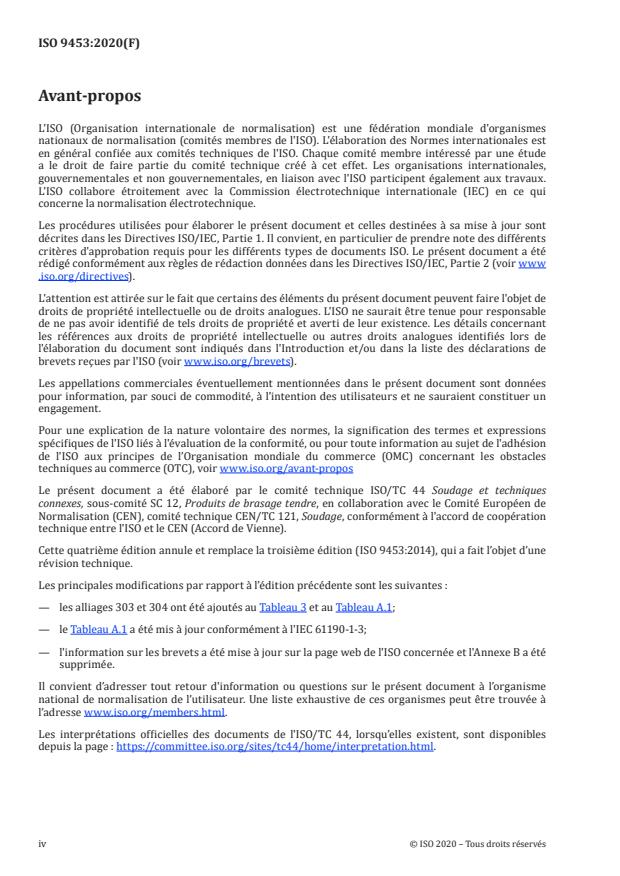
Avant-propos
L'ISO (Organisation internationale de normalisation) est une fédération mondiale d'organismes
nationaux de normalisation (comités membres de l'ISO). L'élaboration des Normes internationales est
en général confiée aux comités techniques de l'ISO. Chaque comité membre intéressé par une étude
a le droit de faire partie du comité technique créé à cet effet. Les organisations internationales,
gouvernementales et non gouvernementales, en liaison avec l'ISO participent également aux travaux.
L'ISO collabore étroitement avec la Commission électrotechnique internationale (IEC) en ce qui
concerne la normalisation électrotechnique.
Les procédures utilisées pour élaborer le présent document et celles destinées à sa mise à jour sont
décrites dans les Directives ISO/IEC, Partie 1. Il convient, en particulier de prendre note des différents
critères d'approbation requis pour les différents types de documents ISO. Le présent document a été
rédigé conformément aux règles de rédaction données dans les Directives ISO/IEC, Partie 2 (voir www
.iso .org/ directives).
L'attention est attirée sur le fait que certains des éléments du présent document peuvent faire l'objet de
droits de propriété intellectuelle ou de droits analogues. L'ISO ne saurait être tenue pour responsable
de ne pas avoir identifié de tels droits de propriété et averti de leur existence. Les détails concernant
les références aux droits de propriété intellectuelle ou autres droits analogues identifiés lors de
l'élaboration du document sont indiqués dans l'Introduction et/ou dans la liste des déclarations de
brevets reçues par l'ISO (voir www .iso .org/ brevets).
Les appellations commerciales éventuellement mentionnées dans le présent document sont données
pour information, par souci de commodité, à l’intention des utilisateurs et ne sauraient constituer un
engagement.
Pour une explication de la nature volontaire des normes, la signification des termes et expressions
spécifiques de l'ISO liés à l'évaluation de la conformité, ou pour toute information au sujet de l'adhésion
de l'ISO aux principes de l’Organisation mondiale du commerce (OMC) concernant les obstacles
techniques au commerce (OTC), voir www .iso .org/ avant -propos
Le présent document a été élaboré par le comité technique ISO/TC 44 Soudage et techniques
connexes, sous-comité SC 12, Produits de brasage tendre, en collaboration avec le Comité Européen de
Normalisation (CEN), comité technique CEN/TC 121, Soudage, conformément à l'accord de coopération
technique entre l'ISO et le CEN (Accord de Vienne).
Cette quatrième édition annule et remplace la troisième édition (ISO 9453:2014), qui a fait l’objet d’une
révision technique.
Les principales modifications par rapport à l’édition précédente sont les suivantes :
— les alliages 303 et 304 ont été ajoutés au Tableau 3 et au Tableau A.1;
— le Tableau A.1 a été mis à jour conformément à l'IEC 61190-1-3;
— l'information sur les brevets a été mise à jour sur la page web de l'ISO concernée et l'Annexe B a été
supprimée.
Il convient d’adresser tout retour d'information ou questions sur le présent document à l’organisme
national de normalisation de l’utilisateur. Une liste exhaustive de ces organismes peut être trouvée à
l’adresse www .iso .org/ members .html.
Les interprétations officielles des documents de l'ISO/TC 44, lorsqu’elles existent, sont disponibles
depuis la page : https:// committee .iso .org/ sites/ tc44/ home/ interpretation .html.
iv © ISO 2020 – Tous droits réservés
Introduction
L’Organisation Internationale de Normalisation (ISO) attire l’attention sur le fait qu’il est déclaré que la
conformité avec les dispositions du présent document peut impliquer l’utilisation d'un Brevet.
L'ISO ne prend pas position quant à la preuve, à la validité et à la portée de ces droits de propriété.
Le détenteur de ces droits de propriété intellectuelle a donné l'assurance à l'ISO qu'il consent à négocier
des licences avec des demandeurs du monde entier, à des termes et conditions raisonnables et non
discriminatoires. À ce propos, la déclaration du Détenteur des droits de propriété est enregistrée à
l'ISO. Des informations sont indiquées dans la base des données des Brevets, disponible sur www .iso
.org/ patents.
L'attention est attirée sur le fait que certains des éléments du présent document peuvent faire l'objet de
droits de propriété autres que ceux figurant dans la base de données des Brevets. L'ISO ne saurait être
tenue pour responsable de l'identification de ces droits de propriété en tout ou partie.
NORME INTERNATIONALE ISO 9453:2020(F)
Alliages de brasage tendre — Compositions chimiques et
formes
1 Domaine d'application
Le présent document spécifie les exigences relatives à la composition chimique d’alliages de brasage
tendre contenant au moins deux éléments: étain, plomb, antimoine, cuivre, argent, bismuth, zinc, indium
et/ou cadmium.
Une indication relative aux formes généralement disponibles est également incluse.
2 Références normatives
Le présent document ne contient aucune référence normative.
3 Termes and définitions
Pour les besoins du présent document, les termes et définitions suivants s’appliquent.
L’ISO et l’IEC tiennent à jour des bases de données terminologiques destinées à être utilisées en
normalisation, consultables aux adresses suivantes:
— ISO Online browsing platform: disponible à l’adresse https:// www .iso .org/ obp
— IEC Electropedia: disponible à l’adresse http:// www .electropedia .org/
3.1
produit de brasage tendre
matériau d’apport métallique qui est utilisé pour l’assemblage de pièces métalliques et qui présente une
température de fusion (liquidus) inférieure à celle des pièces à assembler et, habituellement, inférieur à
450 °C, et qui mouille sur les métaux de base
3.2
lot
ensemble composé d'une ou de plusieurs unités de produit, obtenu en une seule opération de production
4 Composition chimique
La composition chimique du produit d’apport de brasage tendre, échantillonné et analysé conformément
à l’Article 6, doit être telle que donnée pour le matériau approprié dans le Tableau 2 ou Tableau 3.
5 Formes de livraison
5.1 Généralités
Les produits d'apport de brasage tendre conformes au présent document doivent être fournis sous une
des formes suivantes: lingots, brames, jets, barres, baguettes, fils, pastilles, préformes, billes, rubans,
poudre ou pâtes et crèmes contenant de la poudre. Les produits d’apport de brasage tendre doivent
être uniformes en qualité et exempt des conditions néfastes telles que la contamination ou l’oxyde de
surface qui empêche le mélange et le débit de manière appropriée pour l'application prévue.
NOTE 1 Les produits d'apport de brasage tendre fournis sous forme de baguettes, de fils ou de préformes
peuvent être fournis avec ou sans un flux intégré, suivant accord entre le fournisseur et l'acheteur.
NOTE 2 Les compositions chimiques de produits d'apport de brasage tendre indiquées dans les tableaux ne
sont pas toutes nécessairement disponibles dans toutes les formes de produits mentionnées.
5.2 Unité de produit
l'unité de produit utilisée pour définir les exigences relatives au marquage de produits d’apport de
brasage tendre varie avec la forme du brasage (voir Tableau 1).
Tableau 1 — Variations de l'unité de produit avec la forme du brasage
Forme du produit d’apport de brasage tendre Unité de produit
Lingot, barre, brame, jet ou baguette Un(e) seul(e) lingot, barreau, brame, jet ou baguette
Fil ou ruban Un seul rouleau ou une seule bobine
Préformes et anneaux, billes, pastilles ou poudre La quantité unitaire d'un paquet
Poudre sous forme de pâtes de brasage La quantité unitaire d'un paquet
6 Echantillonnage et analyse
La méthode d'analyse recommandée pour les alliages de brasage tendre est le plasma à couplage
inductif (ICP). Les méthodes utilisées doivent être convenues entre le fournisseur et l'acheteur.
NOTE D'autres méthodes d'analyse acceptables sont les méthodes de spectrométrie d'émission optique à
étincelles (SEO) et de spectrométrie d'absorption atomique (SAA).
7 Marquage, étiquetage, emballage
Chaque lot de produit d'apport de brasage tendre livré conformément au présent document doit recevoir
un marquage dans lequel figurent les informations marquées d'une croix dans le Tableau 4.
Les informations données dans le Tableau 4 doivent être appliquées aux formes de produit de la manière
suivante:
a) pour les lingots et les brames: par impression ou par marquage au jet d'encre à la surface de chaque
unité de produit;
b) pour les jets, les barres, les baguettes et le fil en bobine: soit sur une étiquette attachée de manière
sûre à chaque unité de produit, soit sur une étiquette fixée sur l'emballage dans lequel les unités de
produit sont contenues;
c) pour le fil ou le ruban sur bobine, sur une étiquette fixée sur chaque bobine;
d) pour les pastilles, les préformes, les billes, la poudre, la pâte ou la crème : sur une étiquette fixée
sur chaque quantité unitaire emballée;
e) tous les marquages applicables en matière de santé et de sécurité, y compris les marquages sans
plomb ou contenant du plomb;
f) toute autre information qui pourrait être pertinente pour une forme particulière du produit
d’apport de brasage tendre.
2 © ISO 2020 – Tous droits réservés
Tableau 2 — Compositions chimiques de produits d'apport de brasage tendre contenant du plomb
(étain-plomb, plomb-étain, étain-plomb-antimoine, étain-plomb-bismuth, étain-plomb-cadmium, étain-plomb-cuivre, étain-plomb-argent,
et plomb-argent)
c,d
Groupe Alliage Désignation Température Composition chimique, pourcentage massique fraction en %
a
No. de l'alliage de fusion
Sn Pb Sb Bi Cd Cu Au In Ag Al As Fe Ni Zn
ou solidus/
b
liquidus
°C
101 Sn63Pb37 183 62,5 à Reste 0,20 0,10 0,002 0,08 0,05 0,10 0,10 0,001 0,03 0,02 0,01 0,001
63,5
Alliages
102 Sn63Pb37E 183 62,5 à Reste 0,05 0,05 0,002 0,08 0,05 0,10 0,10 0,001 0,03 0,02 0,01 0,001
binaires
63,5
étain-plomb
température
103 Sn60Pb40 183/190 59,5 à Reste 0,20 0,10 0,002 0,08 0,05 0,10 0,10 0,001 0,03 0,02 0,01 0,001
de solidus
60,5
183 °C
104 Sn60Pb40E 183/190 59,5 à Reste 0,05 0,05 0,002 0,08 0,05 0,10 0,10 0,001 0,03 0,02 0,01 0,001
60,5
111 Pb50Sn50 183/215 49,5 à Reste 0,20 0,10 0,002 0,08 0,05 0,10 0,10 0,001 0,03 0,02 0,01 0,001
50,5
112 Pb50Sn50E 183/215 49,5 à Reste 0,05 0,05 0,002 0,08 0,05 0,10 0,10 0,001 0,03 0,02 0,01 0,001
50,5
113 Pb55Sn45 183/226 44,5 à Reste 0,50 0,25 0,005 0,08 0,05 0,10 0,10 0,001 0,03 0,02 0,01 0,001
Alliages
45,5
binaires
plomb-étain 114 Pb60Sn40 183/238 39,5 à Reste 0,50 0,25 0,005 0,08 0,05 0,10 0,10 0,001 0,03 0,02 0,01 0,001
température 40,5
de solidus
115 Pb65Sn35 183/245 34,5 à Reste 0,50 0,25 0,005 0,08 0,05 0,10 0,10 0,001 0,03 0,02 0,01 0,001
183 °C
35,5
116 Pb70Sn30 183/255 29,5 à Reste 0,50 0,25 0,005 0,08 0,05 0,10 0,10 0,001 0,03 0,02 0,01 0,001
30,5
117 Pb80Sn20 183/280 19,5 à Reste 0,50 0,25 0,005 0,08 0,05 0,10 0,10 0,001 0,03 0,02 0,01 0,001
20,5
a
Pour une information relative aux noms abrégés des alliages suivant l'IEC, voir Annexe A, Tableau A.1.
b Les températures sont indiquées à titre données à titre d'information et ne présentent pas des exigences spécifiées pour les alliages.
c
Toutes les limites indiquées en valeurs simples sont des valeurs maximales.
d
Les éléments marqués avec l'indication «Reste» (c'est-à-dire la quantité restante) sont calculés par différence avec 100 %.
4 © ISO 2020 – Tous droits réservés
Tableau 2 (suite)
c,d
Groupe Alliage Désignation Température Composition chimique, pourcentage massique fraction en %
a
No. de l'alliage de fusion
Sn Pb Sb Bi Cd Cu Au In Ag Al As Fe Ni Zn
...
NORME ISO
INTERNATIONALE 9453
Quatrième édition
2020-09
Alliages de brasage tendre —
Compositions chimiques et formes
Soft solder alloys — Chemical compositions and forms
Numéro de référence
©
ISO 2020
DOCUMENT PROTÉGÉ PAR COPYRIGHT
© ISO 2020
Tous droits réservés. Sauf prescription différente ou nécessité dans le contexte de sa mise en œuvre, aucune partie de cette
publication ne peut être reproduite ni utilisée sous quelque forme que ce soit et par aucun procédé, électronique ou mécanique,
y compris la photocopie, ou la diffusion sur l’internet ou sur un intranet, sans autorisation écrite préalable. Une autorisation peut
être demandée à l’ISO à l’adresse ci-après ou au comité membre de l’ISO dans le pays du demandeur.
ISO copyright office
Case postale 401 • Ch. de Blandonnet 8
CH-1214 Vernier, Genève
Tél.: +41 22 749 01 11
E-mail: copyright@iso.org
Web: www.iso.org
Publié en Suisse
ii © ISO 2020 – Tous droits réservés
Sommaire Page
Avant-propos .iv
Introduction .v
1 Domaine d'application . 1
2 Références normatives . 1
3 Termes and définitions . 1
4 Composition chimique . 1
5 Formes de livraison . 1
5.1 Généralités . 1
5.2 Unité de produit . 2
6 Echantillonnage et analyse . 2
7 Marquage, étiquetage, emballage . 2
Annexe A (informative) Comparaison entre les numéros d'alliages du présent document et
les désignations abrégées et les compositions chimiques selon l'IEC 61190-1-3 .10
Bibliographie .13
Avant-propos
L'ISO (Organisation internationale de normalisation) est une fédération mondiale d'organismes
nationaux de normalisation (comités membres de l'ISO). L'élaboration des Normes internationales est
en général confiée aux comités techniques de l'ISO. Chaque comité membre intéressé par une étude
a le droit de faire partie du comité technique créé à cet effet. Les organisations internationales,
gouvernementales et non gouvernementales, en liaison avec l'ISO participent également aux travaux.
L'ISO collabore étroitement avec la Commission électrotechnique internationale (IEC) en ce qui
concerne la normalisation électrotechnique.
Les procédures utilisées pour élaborer le présent document et celles destinées à sa mise à jour sont
décrites dans les Directives ISO/IEC, Partie 1. Il convient, en particulier de prendre note des différents
critères d'approbation requis pour les différents types de documents ISO. Le présent document a été
rédigé conformément aux règles de rédaction données dans les Directives ISO/IEC, Partie 2 (voir www
.iso .org/ directives).
L'attention est attirée sur le fait que certains des éléments du présent document peuvent faire l'objet de
droits de propriété intellectuelle ou de droits analogues. L'ISO ne saurait être tenue pour responsable
de ne pas avoir identifié de tels droits de propriété et averti de leur existence. Les détails concernant
les références aux droits de propriété intellectuelle ou autres droits analogues identifiés lors de
l'élaboration du document sont indiqués dans l'Introduction et/ou dans la liste des déclarations de
brevets reçues par l'ISO (voir www .iso .org/ brevets).
Les appellations commerciales éventuellement mentionnées dans le présent document sont données
pour information, par souci de commodité, à l’intention des utilisateurs et ne sauraient constituer un
engagement.
Pour une explication de la nature volontaire des normes, la signification des termes et expressions
spécifiques de l'ISO liés à l'évaluation de la conformité, ou pour toute information au sujet de l'adhésion
de l'ISO aux principes de l’Organisation mondiale du commerce (OMC) concernant les obstacles
techniques au commerce (OTC), voir www .iso .org/ avant -propos
Le présent document a été élaboré par le comité technique ISO/TC 44 Soudage et techniques
connexes, sous-comité SC 12, Produits de brasage tendre, en collaboration avec le Comité Européen de
Normalisation (CEN), comité technique CEN/TC 121, Soudage, conformément à l'accord de coopération
technique entre l'ISO et le CEN (Accord de Vienne).
Cette quatrième édition annule et remplace la troisième édition (ISO 9453:2014), qui a fait l’objet d’une
révision technique.
Les principales modifications par rapport à l’édition précédente sont les suivantes :
— les alliages 303 et 304 ont été ajoutés au Tableau 3 et au Tableau A.1;
— le Tableau A.1 a été mis à jour conformément à l'IEC 61190-1-3;
— l'information sur les brevets a été mise à jour sur la page web de l'ISO concernée et l'Annexe B a été
supprimée.
Il convient d’adresser tout retour d'information ou questions sur le présent document à l’organisme
national de normalisation de l’utilisateur. Une liste exhaustive de ces organismes peut être trouvée à
l’adresse www .iso .org/ members .html.
Les interprétations officielles des documents de l'ISO/TC 44, lorsqu’elles existent, sont disponibles
depuis la page : https:// committee .iso .org/ sites/ tc44/ home/ interpretation .html.
iv © ISO 2020 – Tous droits réservés
Introduction
L’Organisation Internationale de Normalisation (ISO) attire l’attention sur le fait qu’il est déclaré que la
conformité avec les dispositions du présent document peut impliquer l’utilisation d'un Brevet.
L'ISO ne prend pas position quant à la preuve, à la validité et à la portée de ces droits de propriété.
Le détenteur de ces droits de propriété intellectuelle a donné l'assurance à l'ISO qu'il consent à négocier
des licences avec des demandeurs du monde entier, à des termes et conditions raisonnables et non
discriminatoires. À ce propos, la déclaration du Détenteur des droits de propriété est enregistrée à
l'ISO. Des informations sont indiquées dans la base des données des Brevets, disponible sur www .iso
.org/ patents.
L'attention est attirée sur le fait que certains des éléments du présent document peuvent faire l'objet de
droits de propriété autres que ceux figurant dans la base de données des Brevets. L'ISO ne saurait être
tenue pour responsable de l'identification de ces droits de propriété en tout ou partie.
NORME INTERNATIONALE ISO 9453:2020(F)
Alliages de brasage tendre — Compositions chimiques et
formes
1 Domaine d'application
Le présent document spécifie les exigences relatives à la composition chimique d’alliages de brasage
tendre contenant au moins deux éléments: étain, plomb, antimoine, cuivre, argent, bismuth, zinc, indium
et/ou cadmium.
Une indication relative aux formes généralement disponibles est également incluse.
2 Références normatives
Le présent document ne contient aucune référence normative.
3 Termes and définitions
Pour les besoins du présent document, les termes et définitions suivants s’appliquent.
L’ISO et l’IEC tiennent à jour des bases de données terminologiques destinées à être utilisées en
normalisation, consultables aux adresses suivantes:
— ISO Online browsing platform: disponible à l’adresse https:// www .iso .org/ obp
— IEC Electropedia: disponible à l’adresse http:// www .electropedia .org/
3.1
produit de brasage tendre
matériau d’apport métallique qui est utilisé pour l’assemblage de pièces métalliques et qui présente une
température de fusion (liquidus) inférieure à celle des pièces à assembler et, habituellement, inférieur à
450 °C, et qui mouille sur les métaux de base
3.2
lot
ensemble composé d'une ou de plusieurs unités de produit, obtenu en une seule opération de production
4 Composition chimique
La composition chimique du produit d’apport de brasage tendre, échantillonné et analysé conformément
à l’Article 6, doit être telle que donnée pour le matériau approprié dans le Tableau 2 ou Tableau 3.
5 Formes de livraison
5.1 Généralités
Les produits d'apport de brasage tendre conformes au présent document doivent être fournis sous une
des formes suivantes: lingots, brames, jets, barres, baguettes, fils, pastilles, préformes, billes, rubans,
poudre ou pâtes et crèmes contenant de la poudre. Les produits d’apport de brasage tendre doivent
être uniformes en qualité et exempt des conditions néfastes telles que la contamination ou l’oxyde de
surface qui empêche le mélange et le débit de manière appropriée pour l'application prévue.
NOTE 1 Les produits d'apport de brasage tendre fournis sous forme de baguettes, de fils ou de préformes
peuvent être fournis avec ou sans un flux intégré, suivant accord entre le fournisseur et l'acheteur.
NOTE 2 Les compositions chimiques de produits d'apport de brasage tendre indiquées dans les tableaux ne
sont pas toutes nécessairement disponibles dans toutes les formes de produits mentionnées.
5.2 Unité de produit
l'unité de produit utilisée pour définir les exigences relatives au marquage de produits d’apport de
brasage tendre varie avec la forme du brasage (voir Tableau 1).
Tableau 1 — Variations de l'unité de produit avec la forme du brasage
Forme du produit d’apport de brasage tendre Unité de produit
Lingot, barre, brame, jet ou baguette Un(e) seul(e) lingot, barreau, brame, jet ou baguette
Fil ou ruban Un seul rouleau ou une seule bobine
Préformes et anneaux, billes, pastilles ou poudre La quantité unitaire d'un paquet
Poudre sous forme de pâtes de brasage La quantité unitaire d'un paquet
6 Echantillonnage et analyse
La méthode d'analyse recommandée pour les alliages de brasage tendre est le plasma à couplage
inductif (ICP). Les méthodes utilisées doivent être convenues entre le fournisseur et l'acheteur.
NOTE D'autres méthodes d'analyse acceptables sont les méthodes de spectrométrie d'émission optique à
étincelles (SEO) et de spectrométrie d'absorption atomique (SAA).
7 Marquage, étiquetage, emballage
Chaque lot de produit d'apport de brasage tendre livré conformément au présent document doit recevoir
un marquage dans lequel figurent les informations marquées d'une croix dans le Tableau 4.
Les informations données dans le Tableau 4 doivent être appliquées aux formes de produit de la manière
suivante:
a) pour les lingots et les brames: par impression ou par marquage au jet d'encre à la surface de chaque
unité de produit;
b) pour les jets, les barres, les baguettes et le fil en bobine: soit sur une étiquette attachée de manière
sûre à chaque unité de produit, soit sur une étiquette fixée sur l'emballage dans lequel les unités de
produit sont contenues;
c) pour le fil ou le ruban sur bobine, sur une étiquette fixée sur chaque bobine;
d) pour les pastilles, les préformes, les billes, la poudre, la pâte ou la crème : sur une étiquette fixée
sur chaque quantité unitaire emballée;
e) tous les marquages applicables en matière de santé et de sécurité, y compris les marquages sans
plomb ou contenant du plomb;
f) toute autre information qui pourrait être pertinente pour une forme particulière du produit
d’apport de brasage tendre.
2 © ISO 2020 – Tous droits réservés
Tableau 2 — Compositions chimiques de produits d'apport de brasage tendre contenant du plomb
(étain-plomb, plomb-étain, étain-plomb-antimoine, étain-plomb-bismuth, étain-plomb-cadmium, étain-plomb-cuivre, étain-plomb-argent,
et plomb-argent)
c,d
Groupe Alliage Désignation Température Composition chimique, pourcentage massique fraction en %
a
No. de l'alliage de fusion
Sn Pb Sb Bi Cd Cu Au In Ag Al As Fe Ni Zn
ou solidus/
b
liquidus
°C
101 Sn63Pb37 183 62,5 à Reste 0,20 0,10 0,002 0,08 0,05 0,10 0,10 0,001 0,03 0,02 0,01 0,001
63,5
Alliages
102 Sn63Pb37E 183 62,5 à Reste 0,05 0,05 0,002 0,08 0,05 0,10 0,10 0,001 0,03 0,02 0,01 0,001
binaires
63,5
étain-plomb
température
103 Sn60Pb40 183/190 59,5 à Reste 0,20 0,10 0,002 0,08 0,05 0,10 0,10 0,001 0,03 0,02 0,01 0,001
de solidus
60,5
183 °C
104 Sn60Pb40E 183/190 59,5 à Reste 0,05 0,05 0,002 0,08 0,05 0,10 0,10 0,001 0,03 0,02 0,01 0,001
60,5
111 Pb50Sn50 183/215 49,5 à Reste 0,20 0,10 0,002 0,08 0,05 0,10 0,10 0,001 0,03 0,02 0,01 0,001
50,5
112 Pb50Sn50E 183/215 49,5 à Reste 0,05 0,05 0,002 0,08 0,05 0,10 0,10 0,001 0,03 0,02 0,01 0,001
50,5
113 Pb55Sn45 183/226 44,5 à Reste 0,50 0,25 0,005 0,08 0,05 0,10 0,10 0,001 0,03 0,02 0,01 0,001
Alliages
45,5
binaires
plomb-étain 114 Pb60Sn40 183/238 39,5 à Reste 0,50 0,25 0,005 0,08 0,05 0,10 0,10 0,001 0,03 0,02 0,01 0,001
température 40,5
de solidus
115 Pb65Sn35 183/245 34,5 à Reste 0,50 0,25 0,005 0,08 0,05 0,10 0,10 0,001 0,03 0,02 0,01 0,001
183 °C
35,5
116 Pb70Sn30 183/255 29,5 à Reste 0,50 0,25 0,005 0,08 0,05 0,10 0,10 0,001 0,03 0,02 0,01 0,001
30,5
117 Pb80Sn20 183/280 19,5 à Reste 0,50 0,25 0,005 0,08 0,05 0,10 0,10 0,001 0,03 0,02 0,01 0,001
20,5
a
Pour une information relative aux noms abrégés des alliages suivant l'IEC, voir Annexe A, Tableau A.1.
b Les températures sont indiquées à titre données à titre d'information et ne présentent pas des exigences spécifiées pour les alliages.
c
Toutes les limites indiquées en valeurs simples sont des valeurs maximales.
d
Les éléments marqués avec l'indication «Reste» (c'est-à-dire la quantité restante) sont calculés par différence avec 100 %.
4 © ISO 2020 – Tous droits réservés
Tableau 2 (suite)
c,d
Groupe Alliage Désignation Température Composition chimique, pourcentage massique fraction en %
a
No. de l'alliage de fusion
Sn Pb Sb Bi Cd Cu Au In Ag Al As Fe Ni Zn
...