

ISO 12176-2:2025
(Main)Plastics pipes and fittings — Equipment for fusion jointing polyethylene systems — Part 2: Electrofusion
General Information
- Abstract
This document specifies performance requirements for electrofusion control unit (ECU) for use with polyethylene (PE) electrofusion fittings conforming to ISO 4437-3,[ REF Reference_ref_6 \r \h 1 08D0C9EA79F9BACE118C8200AA004BA90B0200000008000000100000005200650066006500720065006E00630065005F007200650066005F0036000000 ]ISO 4427-3[ REF Reference_ref_7 \r \h 2 08D0C9EA79F9BACE118C8200AA004BA90B0200000008000000100000005200650066006500720065006E00630065005F007200650066005F0037000000 ] and ISO 15494.[ REF Reference_ref_8 \r \h 3 08D0C9EA79F9BACE118C8200AA004BA90B0200000008000000100000005200650066006500720065006E00630065005F007200650066005F0038000000 ] NOTE 1 Electrofusion fittings conforming to other documents, e.g. EN 1555-3[ REF Reference_ref_9 \r \h 4 08D0C9EA79F9BACE118C8200AA004BA90B0200000008000000100000005200650066006500720065006E00630065005F007200650066005F0039000000 ] and EN 12201-3,[ REF Reference_ref_10 \r \h 5 08D0C9EA79F9BACE118C8200AA004BA90B0200000008000000110000005200650066006500720065006E00630065005F007200650066005F00310030000000 ] can also be within the scope of this document. The system designed to manage the transfer of data collected during the fusion process is out of the scope of this document. NOTE 2 Data format and retrieval system are specified in ISO 12176-5. NOTE 3 Parameters for the electrofusion cycle are defined in ISO 13950 and ISO 12176-5. Data for traceability purposes are given in ISO 12176-3, ISO 12176-4 and ISO 12176-5. Electrical safety is out of the scope of this document. NOTE 4 The manufacturer of ECU is informed that different safety regulations are in force in different countries or regional area, e.g.: U.S.A., Europe, etc. ECU designed for only one brand of fittings is out of the scope of this document. Excluding any of the requirements specified in this document is not acceptable when an organization claims conformity to this document.
- Status
- Published
- Publication Date
- 12-Jun-2025
- Current Stage
- 6060 - International Standard published
- Start Date
- 13-Jun-2025
- Due Date
- 27-Oct-2025
- Completion Date
- 13-Jun-2025
Overview
ISO 12176-2:2025 - "Plastics pipes and fittings - Equipment for fusion jointing polyethylene systems - Part 2: Electrofusion" defines performance requirements for electrofusion control units (ECUs) used with polyethylene (PE) electrofusion fittings (e.g., fittings conforming to ISO 4437-3, ISO 4427-3 and ISO 15494). The third edition updates the standard for modern electronic technologies and clarifies scope and test requirements for ECU design, operation and mechanical performance.
Keywords: ISO 12176-2:2025, electrofusion control unit, ECU, polyethylene (PE), fusion jointing, electrofusion, fusion cycle, traceability.
Key technical topics and requirements
ISO 12176-2:2025 covers the full functional and mechanical specification of ECUs without prescribing detailed electrical safety regimes (electrical safety is out of scope; manufacturers must follow applicable regional regulations). Major topic areas included:
- ECU design and components: operator controls, displays, socket contacts, transformers, input/output cables, temperature sensing elements and input data decoder.
- Data handling: on-board data processing, memory, interfaces and data protection during the fusion process (note: system-level data transfer format and retrieval are specified in ISO 12176-5).
- Duty cycle and operating procedures: supply checks, manual and automatic fusion data input, data validation (by ECU and operator), normal fusion cycle behavior and incident handling.
- Operating requirements: power supply, resistance measurement of heating accessories, continuity checks, and energy output control (voltage/current control and fusion cycle timing accuracy).
- Safety & reliability features: obligatory fusion cycle safety functions, endurance, and mandatory conformity to the document’s requirements (no exclusions allowed when claiming conformity).
- Mechanical performance: shock and vibration resistance testing, marking and required ECU-specific information (normative annexes).
Practical applications
ISO 12176-2:2025 is intended for use where reliable electrofusion joining of PE piping is required, supporting quality-controlled, traceable fusion processes in:
- Gas distribution networks
- Water and wastewater PE piping systems
- Industrial PE piping installations
- Field and factory fusion operations
ECUs compliant with this standard help ensure repeatable fusion cycles, accurate energy delivery and documented traceability for joint integrity.
Who should use this standard
- ECU manufacturers designing and certifying electrofusion units
- Pipeline installers and contractors seeking compliant equipment
- Utility owners and operators specifying procurement requirements
- Certification and conformity assessment bodies
- Design engineers and quality managers responsible for PE fusion jointing procedures
Related standards
- ISO 12176 series (Parts 3–5 for operator badge, traceability and data formats)
- ISO 13950 (fusion cycle parameters)
- ISO 4437-3, ISO 4427-3, ISO 15494 (PE electrofusion fittings)
- EN 1555-3, EN 12201-3 (alternative fitting specifications)
Compliance with ISO 12176-2:2025 supports consistent, documented electrofusion joining practices and improves safety, traceability and installation quality for PE piping systems.
Relations
- Effective Date
- 09-Sep-2026
- Effective Date
- 22-Apr-2026
- Effective Date
- 29-Oct-2022
- Effective Date
- 29-Oct-2022
Get Certified
Connect with accredited certification bodies for this standard

DVS-ZERT GmbH
German welding certification society.

Element Materials Technology
Materials testing and product certification.
Institut za varilstvo d.o.o. (Welding Institute)
Slovenia's leading welding institute since 1952. ISO 3834, EN 1090, pressure equipment certification, NDT personnel, welder qualification. Only IIW Au
Sponsored listings
Frequently Asked Questions
ISO 12176-2:2025 is a standard published by the International Organization for Standardization (ISO). Its full title is "Plastics pipes and fittings — Equipment for fusion jointing polyethylene systems — Part 2: Electrofusion". This standard covers: This document specifies performance requirements for electrofusion control unit (ECU) for use with polyethylene (PE) electrofusion fittings conforming to ISO 4437-3,[ REF Reference_ref_6 \r \h 1 08D0C9EA79F9BACE118C8200AA004BA90B0200000008000000100000005200650066006500720065006E00630065005F007200650066005F0036000000 ]ISO 4427-3[ REF Reference_ref_7 \r \h 2 08D0C9EA79F9BACE118C8200AA004BA90B0200000008000000100000005200650066006500720065006E00630065005F007200650066005F0037000000 ] and ISO 15494.[ REF Reference_ref_8 \r \h 3 08D0C9EA79F9BACE118C8200AA004BA90B0200000008000000100000005200650066006500720065006E00630065005F007200650066005F0038000000 ] NOTE 1 Electrofusion fittings conforming to other documents, e.g. EN 1555-3[ REF Reference_ref_9 \r \h 4 08D0C9EA79F9BACE118C8200AA004BA90B0200000008000000100000005200650066006500720065006E00630065005F007200650066005F0039000000 ] and EN 12201-3,[ REF Reference_ref_10 \r \h 5 08D0C9EA79F9BACE118C8200AA004BA90B0200000008000000110000005200650066006500720065006E00630065005F007200650066005F00310030000000 ] can also be within the scope of this document. The system designed to manage the transfer of data collected during the fusion process is out of the scope of this document. NOTE 2 Data format and retrieval system are specified in ISO 12176-5. NOTE 3 Parameters for the electrofusion cycle are defined in ISO 13950 and ISO 12176-5. Data for traceability purposes are given in ISO 12176-3, ISO 12176-4 and ISO 12176-5. Electrical safety is out of the scope of this document. NOTE 4 The manufacturer of ECU is informed that different safety regulations are in force in different countries or regional area, e.g.: U.S.A., Europe, etc. ECU designed for only one brand of fittings is out of the scope of this document. Excluding any of the requirements specified in this document is not acceptable when an organization claims conformity to this document.
This document specifies performance requirements for electrofusion control unit (ECU) for use with polyethylene (PE) electrofusion fittings conforming to ISO 4437-3,[ REF Reference_ref_6 \r \h 1 08D0C9EA79F9BACE118C8200AA004BA90B0200000008000000100000005200650066006500720065006E00630065005F007200650066005F0036000000 ]ISO 4427-3[ REF Reference_ref_7 \r \h 2 08D0C9EA79F9BACE118C8200AA004BA90B0200000008000000100000005200650066006500720065006E00630065005F007200650066005F0037000000 ] and ISO 15494.[ REF Reference_ref_8 \r \h 3 08D0C9EA79F9BACE118C8200AA004BA90B0200000008000000100000005200650066006500720065006E00630065005F007200650066005F0038000000 ] NOTE 1 Electrofusion fittings conforming to other documents, e.g. EN 1555-3[ REF Reference_ref_9 \r \h 4 08D0C9EA79F9BACE118C8200AA004BA90B0200000008000000100000005200650066006500720065006E00630065005F007200650066005F0039000000 ] and EN 12201-3,[ REF Reference_ref_10 \r \h 5 08D0C9EA79F9BACE118C8200AA004BA90B0200000008000000110000005200650066006500720065006E00630065005F007200650066005F00310030000000 ] can also be within the scope of this document. The system designed to manage the transfer of data collected during the fusion process is out of the scope of this document. NOTE 2 Data format and retrieval system are specified in ISO 12176-5. NOTE 3 Parameters for the electrofusion cycle are defined in ISO 13950 and ISO 12176-5. Data for traceability purposes are given in ISO 12176-3, ISO 12176-4 and ISO 12176-5. Electrical safety is out of the scope of this document. NOTE 4 The manufacturer of ECU is informed that different safety regulations are in force in different countries or regional area, e.g.: U.S.A., Europe, etc. ECU designed for only one brand of fittings is out of the scope of this document. Excluding any of the requirements specified in this document is not acceptable when an organization claims conformity to this document.
ISO 12176-2:2025 is classified under the following ICS (International Classification for Standards) categories: 23.040.20 - Plastics pipes; 23.040.45 - Plastics fittings; 25.160.30 - Welding equipment; 75.200 - Petroleum products and natural gas handling equipment. The ICS classification helps identify the subject area and facilitates finding related standards.
ISO 12176-2:2025 has the following relationships with other standards: It is inter standard links to EN ISO 11301-1:2026, EN ISO 11300-1:2026, ISO 12176-2:2008, ISO 12176-2:2008/Amd 1:2021. Understanding these relationships helps ensure you are using the most current and applicable version of the standard.
ISO 12176-2:2025 is available in PDF format for immediate download after purchase. The document can be added to your cart and obtained through the secure checkout process. Digital delivery ensures instant access to the complete standard document.
Standards Content (Sample)
International
Standard
ISO 12176-2
Third edition
Plastics pipes and fittings —
2025-06
Equipment for fusion jointing
polyethylene systems —
Part 2:
Electrofusion
Tubes et raccords en matières plastiques — Appareillage pour
l'assemblage par soudage des systèmes en polyéthylène —
Partie 2: Électrosoudage
Reference number
© ISO 2025
All rights reserved. Unless otherwise specified, or required in the context of its implementation, no part of this publication may
be reproduced or utilized otherwise in any form or by any means, electronic or mechanical, including photocopying, or posting on
the internet or an intranet, without prior written permission. Permission can be requested from either ISO at the address below
or ISO’s member body in the country of the requester.
ISO copyright office
CP 401 • Ch. de Blandonnet 8
CH-1214 Vernier, Geneva
Phone: +41 22 749 01 11
Email: copyright@iso.org
Website: www.iso.org
Published in Switzerland
ii
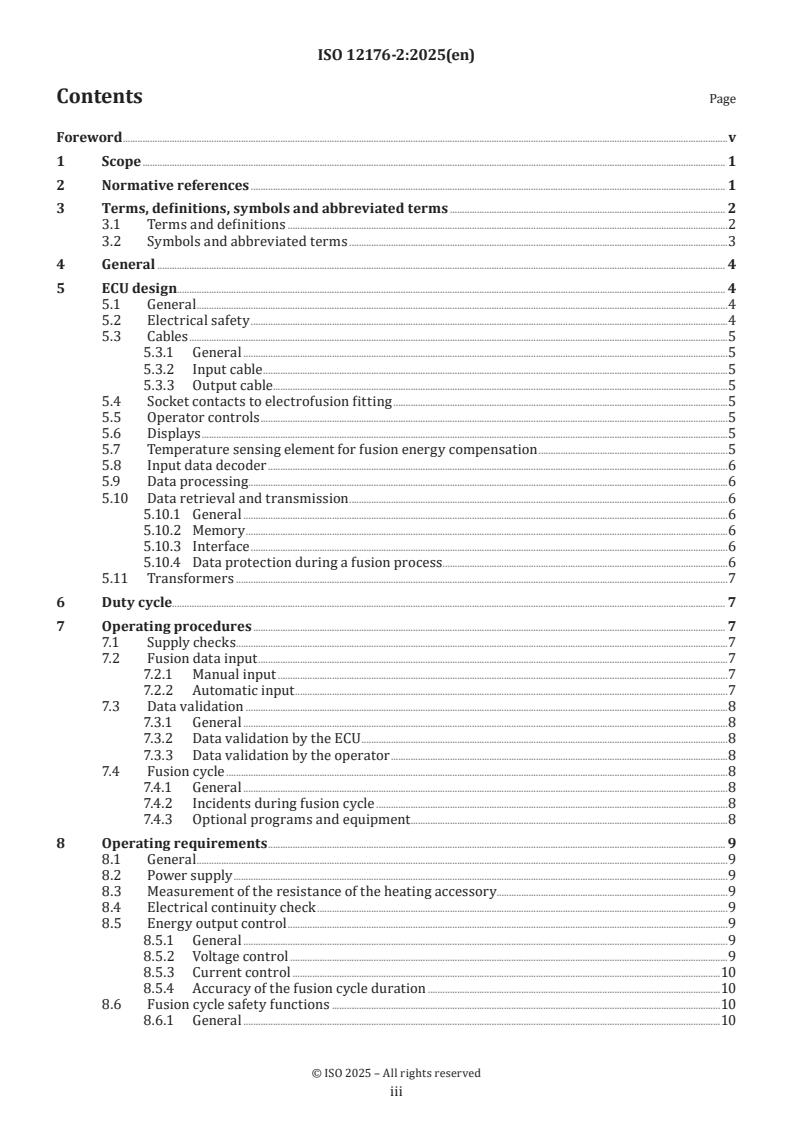
Contents Page
Foreword .v
1 Scope . 1
2 Normative references . 1
3 Terms, definitions, symbols and abbreviated terms . 2
3.1 Terms and definitions .2
3.2 Symbols and abbreviated terms .3
4 General . 4
5 ECU design. 4
5.1 General .4
5.2 Electrical safety .4
5.3 Cables .5
5.3.1 General .5
5.3.2 Input cable .5
5.3.3 Output cable.5
5.4 Socket contacts to electrofusion fitting .5
5.5 Operator controls .5
5.6 Displays .5
5.7 Temperature sensing element for fusion energy compensation .5
5.8 Input data decoder .6
5.9 Data processing.6
5.10 Data retrieval and transmission .6
5.10.1 General .6
5.10.2 Memory .6
5.10.3 Interface .6
5.10.4 Data protection during a fusion process .6
5.11 Transformers .7
6 Duty cycle. 7
7 Operating procedures . 7
7.1 Supply checks .7
7.2 Fusion data input .7
7.2.1 Manual input .7
7.2.2 Automatic input .7
7.3 Data validation .8
7.3.1 General .8
7.3.2 Data validation by the ECU .8
7.3.3 Data validation by the operator .8
7.4 Fusion cycle .8
7.4.1 General .8
7.4.2 Incidents during fusion cycle .8
7.4.3 Optional programs and equipment .8
8 Operating requirements . 9
8.1 General .9
8.2 Power supply .9
8.3 Measurement of the resistance of the heating accessory.9
8.4 Electrical continuity check .9
8.5 Energy output control .9
8.5.1 General .9
8.5.2 Voltage control .9
8.5.3 Current control .10
8.5.4 Accuracy of the fusion cycle duration .10
8.6 Fusion cycle safety functions .10
8.6.1 General .10
iii
8.6.2 Obligatory fusion cycle safety functions.10
8.7 Endurance .11
9 Mechanical performance .11
9.1 Shock test resistance .11
9.2 Vibration test .11
10 Specific information .12
11 Marking . .12
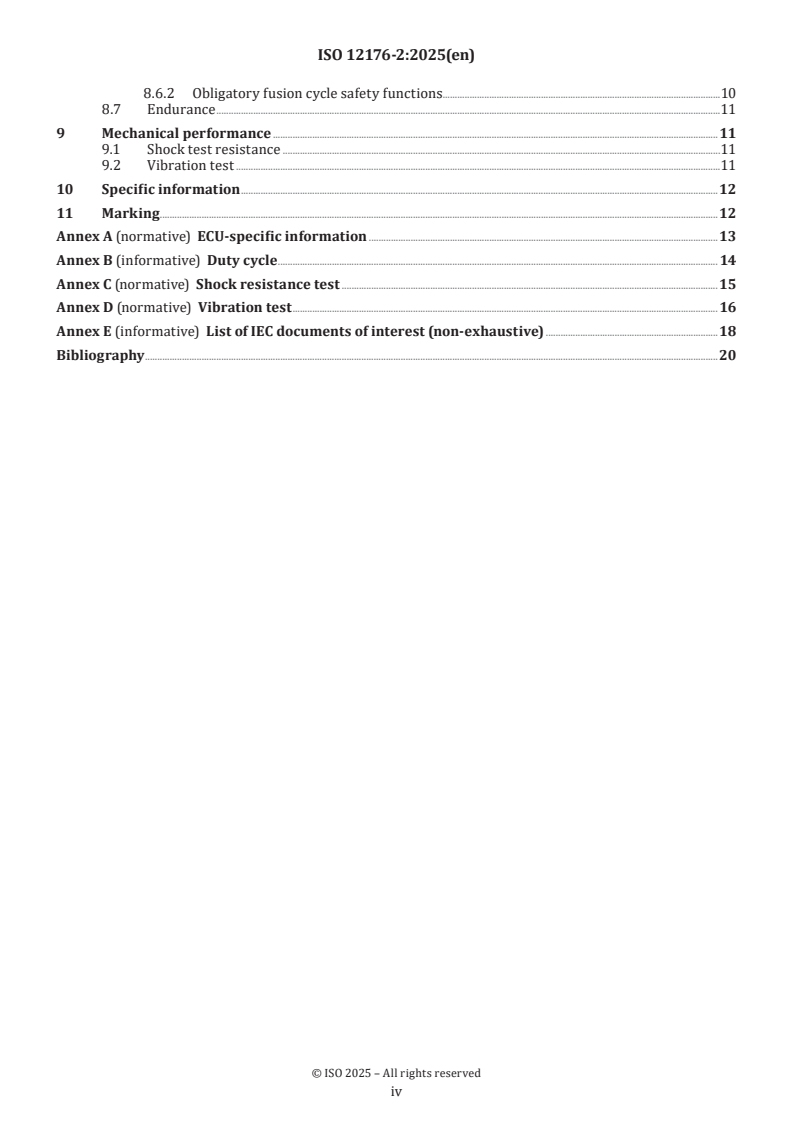
Annex A (normative) ECU-specific information .13
Annex B (informative) Duty cycle . 14
Annex C (normative) Shock resistance test .15
Annex D (normative) Vibration test . 16
Annex E (informative) List of IEC documents of interest (non-exhaustive) .18
Bibliography .20
iv
Foreword
ISO (the International Organization for Standardization) is a worldwide federation of national standards
bodies (ISO member bodies). The work of preparing International Standards is normally carried out through
ISO technical committees. Each member body interested in a subject for which a technical committee
has been established has the right to be represented on that committee. International organizations,
governmental and non-governmental, in liaison with ISO, also take part in the work. ISO collaborates closely
with the International Electrotechnical Commission (IEC) on all matters of electrotechnical standardization.
The procedures used to develop this document and those intended for its further maintenance are described
in the ISO/IEC Directives, Part 1. In particular, the different approval criteria needed for the different types
of ISO document should be noted. This document was drafted in accordance with the editorial rules of the
ISO/IEC Directives, Part 2 (see www.iso.org/directives).
ISO draws attention to the possibility that the implementation of this document may involve the use of (a)
patent(s). ISO takes no position concerning the evidence, validity or applicability of any claimed patent
rights in respect thereof. As of the date of publication of this document, ISO had not received notice of (a)
patent(s) which may be required to implement this document. However, implementers are cautioned that
this may not represent the latest information, which may be obtained from the patent database available at
www.iso.org/patents. ISO shall not be held responsible for identifying any or all such patent rights.
Any trade name used in this document is information given for the convenience of users and does not
constitute an endorsement.
For an explanation of the voluntary nature of standards, the meaning of ISO specific terms and expressions
related to conformity assessment, as well as information about ISO's adherence to the World Trade
Organization (WTO) principles in the Technical Barriers to Trade (TBT), see www.iso.org/iso/foreword.html.
This document was prepared by Technical Committee ISO/TC 138, Plastics pipes, fittings and valves for the
transport of fluids, Subcommittee SC 4, Plastics pipes and fittings for the supply of gaseous fuels.
This third edition cancels and replaces the second edition (ISO 12176-2:2008), which has been technically
revised. It also incorporates the Amendment ISO 12176-2:2008/Amd. 1:2001.
The main changes are as follows:
— the whole document has been redrafted in order to adapt it to current electronic technologies;
— all clauses previously referring to health and safety have been removed, leaving manufacturers free to decide
which level of electrical safety they want to provide to the users, in respect of applicable regional rules;
— a new annex has been added providing information on applicable IEC safety standards.
A list of all parts in the ISO 12176 series can be found on the ISO website.
Any feedback or questions on this document should be directed to the user’s national standards body. A
complete listing of these bodies can be found at www.iso.org/members.html.
v
International Standard ISO 12176-2:2025(en)
Plastics pipes and fittings — Equipment for fusion jointing
polyethylene systems —
Part 2:
Electrofusion
1 Scope
This document specifies performance requirements for electrofusion control unit (ECU) for use with
[1] [2] [3]
polyethylene (PE) electrofusion fittings conforming to ISO 4437-3, ISO 4427-3 and ISO 15494.
[4] [5]
NOTE 1 Electrofusion fittings conforming to other documents, e.g. EN 1555-3 and EN 12201-3, can also be
within the scope of this document.
The system designed to manage the transfer of data collected during the fusion process is out of the scope of
this document.
NOTE 2 Data format and retrieval system are specified in ISO 12176-5.
NOTE 3 Parameters for the electrofusion cycle are defined in ISO 13950 and ISO 12176-5. Data for traceability
purposes are given in ISO 12176-3, ISO 12176-4 and ISO 12176-5.
Electrical safety is out of the scope of this document.
NOTE 4 The manufacturer of ECU is informed that different safety regulations are in force in different countries or
regional area, e.g.: U.S.A., Europe, etc.
ECU designed for only one brand of fittings is out of the scope of this document.
Excluding any of the requirements specified in this document is not acceptable when an organization claims
conformity to this document.
2 Normative references
The following documents are referred to in the text in such a way that some or all of their content constitutes
requirements of this document. For dated references, only the edition cited applies. For undated references,
the latest edition of the referenced document (including any amendments) applies.
ISO 12176-3, Plastics pipes and fittings — Equipment for fusion jointing polyethylene systems — Part 3:
Operator's badge
ISO 12176-4, Plastics pipes and fittings — Equipment for fusion jointing polyethylene systems — Part 4:
Traceability coding
ISO 12176-5:2021, Plastics pipes and fittings — Equipment for fusion jointing polyethylene systems — Part 5:
Two-dimensional data coding of components and data exchange format for PE piping systems
ISO 13950, Plastics pipes and fittings — Automatic recognition systems for electrofusion joints
IEC 60068-2-27, Environmental testing — Part 2-27: Tests — Test Ea and guidance: Shock
3 Terms, definitions, symbols and abbreviated terms
3.1 Terms and definitions
For the purposes of this document, the following terms and definitions apply.
ISO and IEC maintain terminology databases for use in standardization at the following addresses:
— ISO Online browsing platform: available at https:// www .iso .org/ obp
— IEC Electropedia: available at https:// www .electropedia .org/
3.1.1
operator
competent person qualified to assemble polyethylene pipes, fittings, and valves by using electrofusion
fittings
[6]
Note 1 to entry: ISO/TR 19480 provides information on the qualification of fusion operators.
3.1.2
electrofusion control unit
ECU
unit implementing the output fusion parameters of voltage or current and time or energy to execute the
fusion cycle as specified by the electrofusion fitting manufacturer
3.1.3
data retrieval unit
ECU (3.1.2) allowing at least the read-out of the data collected
3.1.4
control cycle time
t
fixed period of time, composed of an on-load period, t , and an off-load period, t
1 2
Note 1 to entry: The control cycle time value is calculated as follows: t = t + t .
1 2
3.1.5
duty cycle
t
d
proportion of the control cycle time, t, for which the output power is on load, t , expressed as a percentage
Note 1 to entry: The duty cycle value is calculated as follows: t = [t /(t + t )] × 100.
d 1 1 2
3.1.6
output voltage
voltage applied to the electrofusion fitting
Note 1 to entry: It is expressed as the root mean square (RMS) value (not the peak value).
3.1.7
reference output voltage
output voltage value at 75 % of the maximum output voltage of the control unit
3.1.8
fusion parameter
one of the following parameters:
— nominal target heating time, or
— level of regulation (voltage, current, power)
3.1.9
fusion cycle
process which includes the fusion time and at least one of the other specified fusion parameters (3.1.8)
3.1.10
connector
means to connect the ECU output cable to the electrofusion fitting electrical terminal
Note 1 to entry: Connectors are generally available in 4,0 mm or 2,0 mm or 4,7 mm diameter.
Note 2 to entry: The dimension of electrofusion terminals is given in the appropriate product standard (e.g. ISO 4437-3).
3.1.11
fusion process
all operations needed to prepare the joint including the fusion cycle (3.1.10) and cooling time
3.1.12
fusion data
values of fusion parameter(s) (3.1.9) plus additional data, e.g: traceability data, fusion operator data,
geographical data, that may be transferred to or gathered by the electrofusion control unit (3.1.1)
3.1.13
real fusion time
fusion time, in s, used in reality, taking account, if necessary, of the ambient temperature and/or the real
electrical parameters
[SOURCE: ISO 13950:2007, 3.15]
3.1.14
professional person
individual professionally trained in the fusion process and in health and safety on the work site
Note 1 to entry: A single professional person can also be defined as operator (3.1.1).
Note 2 to entry: ISO/TR 19480 provides information on the qualification of a fusion operator.
3.1.15
socket-outlet
accessory having socket-contacts designed to engage with the electrofusion fitting terminals
[SOURCE: IEV ref 442-03-02, modified]
3.2 Symbols and abbreviated terms
ECU Electrofusion control unit
RMS Root mean square
GNSS Global navigation satellite system
Ω Ohm
Hz Hertz
g Gravity acceleration (9,81 m/s2)
m Metre
ms Millisecond
°C Degree Celsius
V Volt
s Second
dB Decibel
J Joule
kW Kilo watt
oct Octave
4 General
This document is applicable to ECU designed for use and storage in an environmental temperature in the
range between -10 °C to +40 °C. If temperatures outside this range are expected, suitable operating limits
are subject to agreement between ECU manufacturer and purchaser.
This part of ISO 12176 is applicable to ECU, irrespective to the technology used in the design as long the ECU
fulfil the requirements of this document.
ECU is designed with a control system based on the functional characteristics of standard heating element
technology.
5 ECU design
5.1 General
An ECU can be a single unit or composed of several separate units. Therefore, the control panel and the
regulation system can be, but is not necessarily, integrated in a single unit. If the ECU is designed to be
transported manually by one person, then the weight of each unit shall be in line with the health and safety
aspects. The ECU can be designed with means to allow its transport.
The ECU shall not start the fusion cycle if the fitting fusion parameters transferred to the ECU are out of the
limits provided by the ECU manufacturer and when the output circuit is connected to a resistance above 200 Ω.
The ECU shall be designed for outdoor conditions (e.g. IP 54) and allow ease of readjustment, maintenance,
and repair.
The ECU and its accessories should be designed to minimize the risk of corrosion or mechanical damage due
to transport and handling in the field, which are likely to impair its performance.
Environmental aspects shall be considered, e.g. in the choice of materials, energy consumption and recycling.
[7]
NOTE In some areas (e.g.: RoHS Directive in EU Member States ) restrictions on the use of hazardous substances
in electrical and electronic equipment are in force.
5.2 Electrical safety
The level of safety is under the manufacturers' responsibility. The use of ECU is reserved to professional
people working in an industrial (typical site work conditions) or light industrial and commercial
environment.
NOTE Various bodies are entitled to publish documents on electrical safety, e.g. International Electrotechnical
C
...