

ISO 18113-5:2022
(Main)In vitro diagnostic medical devices — Information supplied by the manufacturer (labelling) — Part 5: In vitro diagnostic instruments for self-testing
General Information
- Abstract
This document specifies requirements for information supplied by the manufacturer of in vitro diagnostic (IVD) instruments intended for self-testing. This document is also applicable to apparatus and equipment intended to be used with IVD instruments for self-testing. This document can also be applicable to accessories. This document does not apply to: a) instructions for instrument servicing or repair; b) IVD reagents, including calibrators and control materials for use in control of the reagent; c) IVD instruments for professional use.
- Status
- Published
- Publication Date
- 05-Oct-2022
- Drafting Committee
- ISO/TC 212/WG 3 - In vitro diagnostic products
- Current Stage
- 6060 - International Standard published
- Start Date
- 06-Oct-2022
- Due Date
- 01-Nov-2022
- Completion Date
- 06-Oct-2022
Buy Documents
ISO 18113-5:2022 - In vitro diagnostic medical devices — Information supplied by the manufacturer (labelling) — Part 5: In vitro diagnostic instruments for self-testing Released:6. 10. 2022
ISO 18113-5:2022 - In vitro diagnostic medical devices — Information supplied by the manufacturer (labelling) — Part 5: In vitro diagnostic instruments for self-testing Released:6. 10. 2022
Overview
ISO 18113-5:2022 - part of the ISO 18113 series - specifies requirements for information supplied by the manufacturer (labelling) for in vitro diagnostic (IVD) instruments intended for self-testing. Published in 2022 (second edition), it covers labels, marking and the content and structure of instructions for use (IFU) for self-test instruments, associated apparatus/equipment and applicable accessories. It does not apply to instrument servicing/repair instructions, IVD reagents (including calibrators/control materials), or IVD instruments intended for professional use.
Key topics and requirements
The standard focuses on clear, risk‑based labelling and user information to ensure safe and effective self-testing. Key technical topics include:
- Identification and traceability
- Instrument name/trade name, additional identifiers (catalogue numbers), unique serial numbers or batch codes, and Unique Device Identifier (UDI) requirements (UDI-DI and UDI-PI including serial/batch).
- Labels and marking
- Compliance with relevant electrical, safety and EMC labelling standards (e.g., IEC 61010‑1, IEC 61010‑2‑101, IEC 61326‑2‑6) and use of standardized symbols per ISO 15223-1.
- Instructions for use (IFU) content elements:
- Manufacturer identification, intended use/purpose, storage/handling, warnings/precautions, installation and commissioning, measurement principles, instrument performance and limitations, preparation and operating procedures, control procedures, reading results, special functions, shut-down, maintenance, troubleshooting, disposal and document control.
- Risk and usability considerations
- Alignment with ISO 14971 (risk management) and IEC/ISO usability guidance (e.g., IEC 62366‑1) to reduce user error in self-testing scenarios.
- Regulatory alignment
- Guidance to harmonize labelling expectations across jurisdictions and support IMDRF convergence.
Applications and who uses it
ISO 18113-5:2022 is practical for:
- IVD manufacturers designing or marketing instruments for self-testing (home use) to prepare compliant labelling and IFUs.
- Regulatory affairs and quality teams ensuring conformity with labelling requirements and UDI obligations.
- Technical writers and usability engineers developing user-friendly IFUs that meet risk-management and accessibility needs.
- Notified bodies, conformity assessors and regulators reviewing documentation for market approval.
- Distributors and healthcare providers verifying product information for safe consumer use.
Using this standard helps manufacturers reduce user errors, meet global labelling expectations, and speed regulatory review for consumer-facing IVD instruments.
Related standards
- ISO 18113-1 (general labelling requirements)
- ISO 15223-1 (symbols for medical device labelling)
- ISO 14971 (risk management)
- IEC 61010 series, IEC 61326-2-6, IEC 62366-1
Keywords: ISO 18113-5:2022, IVD instruments for self-testing, labelling requirements, instructions for use, UDI, in vitro diagnostic, medical device labelling.
Relations
- Effective Date
- 12-Feb-2026
- Effective Date
- 23-Apr-2020
Buy Documents
ISO 18113-5:2022 - In vitro diagnostic medical devices — Information supplied by the manufacturer (labelling) — Part 5: In vitro diagnostic instruments for self-testing Released:6. 10. 2022
ISO 18113-5:2022 - In vitro diagnostic medical devices — Information supplied by the manufacturer (labelling) — Part 5: In vitro diagnostic instruments for self-testing Released:6. 10. 2022
Get Certified
Connect with accredited certification bodies for this standard

BSI Group
BSI (British Standards Institution) is the business standards company that helps organizations make excellence a habit.

TÜV Rheinland
TÜV Rheinland is a leading international provider of technical services.

TÜV SÜD
TÜV SÜD is a trusted partner of choice for safety, security and sustainability solutions.
Sponsored listings
Frequently Asked Questions
ISO 18113-5:2022 is a standard published by the International Organization for Standardization (ISO). Its full title is "In vitro diagnostic medical devices — Information supplied by the manufacturer (labelling) — Part 5: In vitro diagnostic instruments for self-testing". This standard covers: This document specifies requirements for information supplied by the manufacturer of in vitro diagnostic (IVD) instruments intended for self-testing. This document is also applicable to apparatus and equipment intended to be used with IVD instruments for self-testing. This document can also be applicable to accessories. This document does not apply to: a) instructions for instrument servicing or repair; b) IVD reagents, including calibrators and control materials for use in control of the reagent; c) IVD instruments for professional use.
This document specifies requirements for information supplied by the manufacturer of in vitro diagnostic (IVD) instruments intended for self-testing. This document is also applicable to apparatus and equipment intended to be used with IVD instruments for self-testing. This document can also be applicable to accessories. This document does not apply to: a) instructions for instrument servicing or repair; b) IVD reagents, including calibrators and control materials for use in control of the reagent; c) IVD instruments for professional use.
ISO 18113-5:2022 is classified under the following ICS (International Classification for Standards) categories: 11.100.10 - In vitro diagnostic test systems. The ICS classification helps identify the subject area and facilitates finding related standards.
ISO 18113-5:2022 has the following relationships with other standards: It is inter standard links to EN ISO 18113-5:2024, ISO 18113-5:2009. Understanding these relationships helps ensure you are using the most current and applicable version of the standard.
ISO 18113-5:2022 is available in PDF format for immediate download after purchase. The document can be added to your cart and obtained through the secure checkout process. Digital delivery ensures instant access to the complete standard document.
Standards Content (Sample)
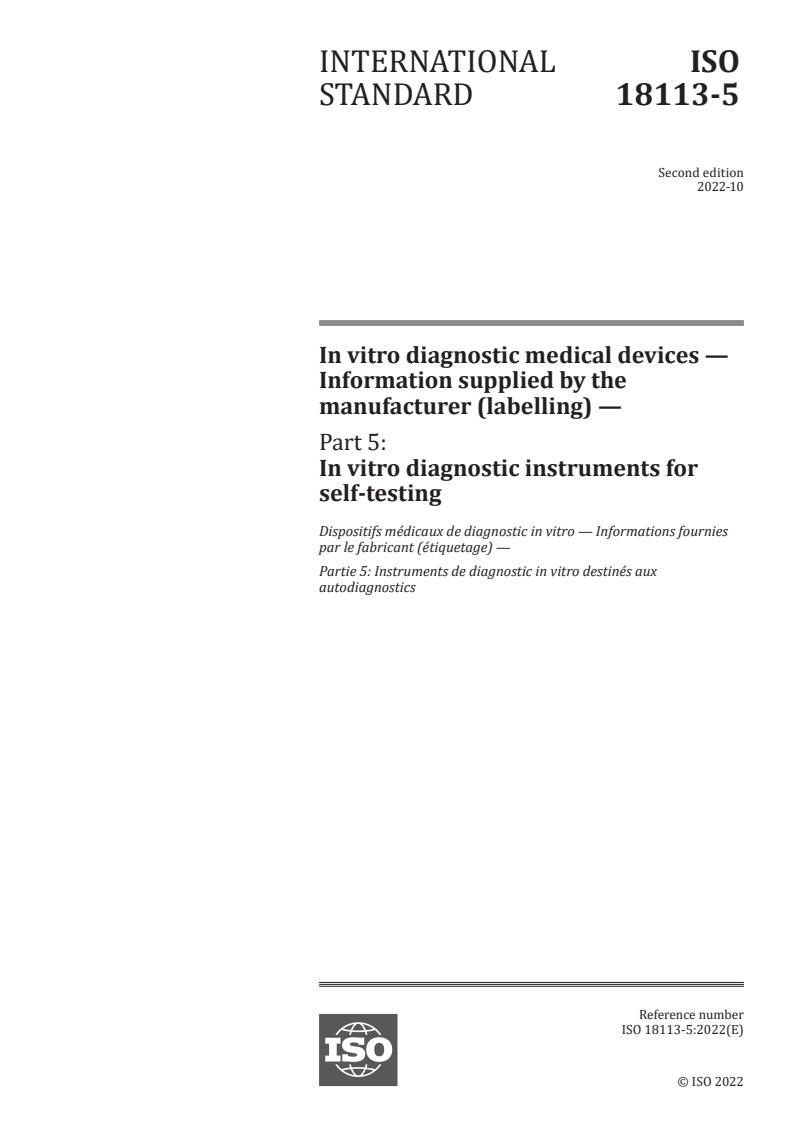
INTERNATIONAL ISO
STANDARD 18113-5
Second edition
2022-10
In vitro diagnostic medical devices —
Information supplied by the
manufacturer (labelling) —
Part 5:
In vitro diagnostic instruments for
self-testing
Dispositifs médicaux de diagnostic in vitro — Informations fournies
par le fabricant (étiquetage) —
Partie 5: Instruments de diagnostic in vitro destinés aux
autodiagnostics
Reference number
© ISO 2022
All rights reserved. Unless otherwise specified, or required in the context of its implementation, no part of this publication may
be reproduced or utilized otherwise in any form or by any means, electronic or mechanical, including photocopying, or posting on
the internet or an intranet, without prior written permission. Permission can be requested from either ISO at the address below
or ISO’s member body in the country of the requester.
ISO copyright office
CP 401 • Ch. de Blandonnet 8
CH-1214 Vernier, Geneva
Phone: +41 22 749 01 11
Email: copyright@iso.org
Website: www.iso.org
Published in Switzerland
ii
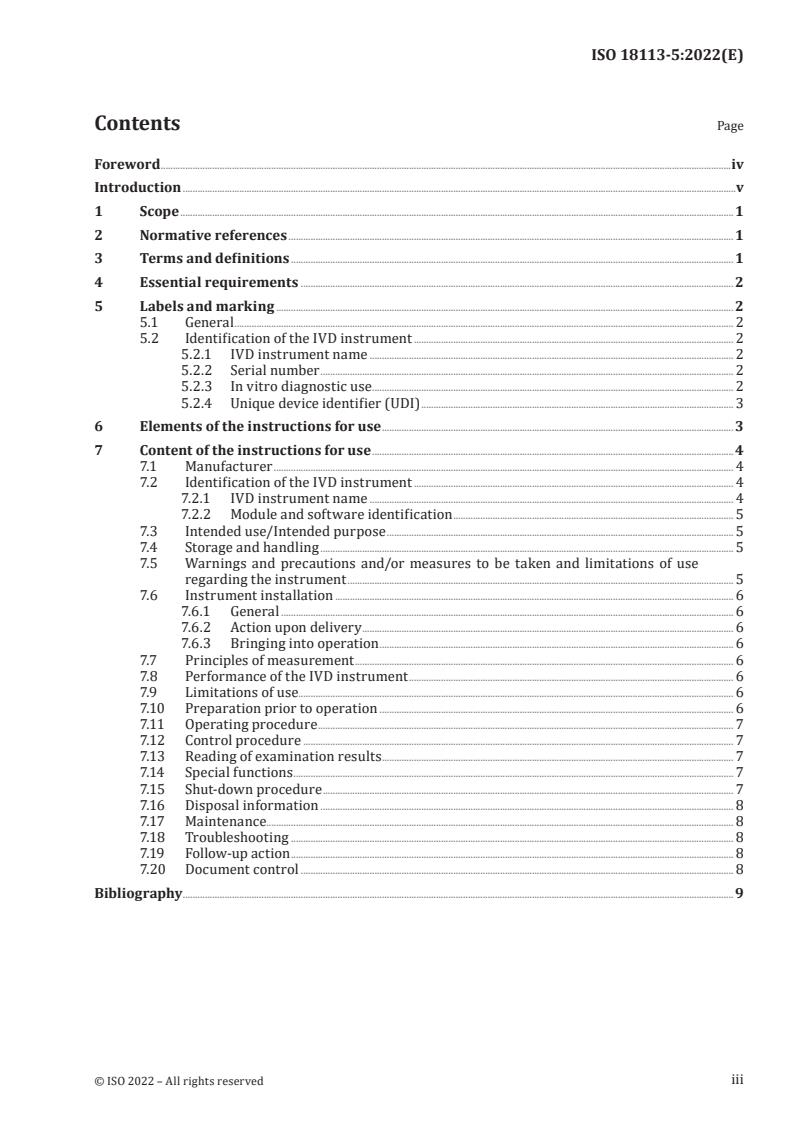
Contents Page
Foreword .iv
Introduction .v
1 Scope . 1
2 Normative references . 1
3 Terms and definitions . 1
4 Essential requirements . 2
5 Labels and marking . 2
5.1 General . 2
5.2 Identification of the IVD instrument . 2
5.2.1 IVD instrument name . 2
5.2.2 Serial number . 2
5.2.3 In vitro diagnostic use . 2
5.2.4 Unique device identifier (UDI) . 3
6 Elements of the instructions for use . 3
7 Content of the instructions for use .4
7.1 Manufacturer . 4
7.2 Identification of the IVD instrument . 4
7.2.1 IVD instrument name . 4
7.2.2 Module and software identification . 5
7.3 Intended use/Intended purpose . 5
7.4 Storage and handling . 5
7.5 Warnings and precautions and/or measures to be taken and limitations of use
regarding the instrument . 5
7.6 Instrument installation . 6
7.6.1 General . 6
7.6.2 Action upon delivery . 6
7.6.3 Bringing into operation . 6
7.7 Principles of measurement . 6
7.8 Performance of the IVD instrument . 6
7.9 Limitations of use. 6
7.10 Preparation prior to operation . 6
7.11 Operating procedure . 7
7.12 Control procedure . 7
7.13 Reading of examination results . 7
7.14 Special functions . 7
7.15 Shut-down procedure . 7
7.16 Disposal information . 8
7.17 Maintenance . 8
7.18 Troubleshooting . 8
7.19 Follow-up action . 8
7.20 Document control . 8
Bibliography . 9
iii
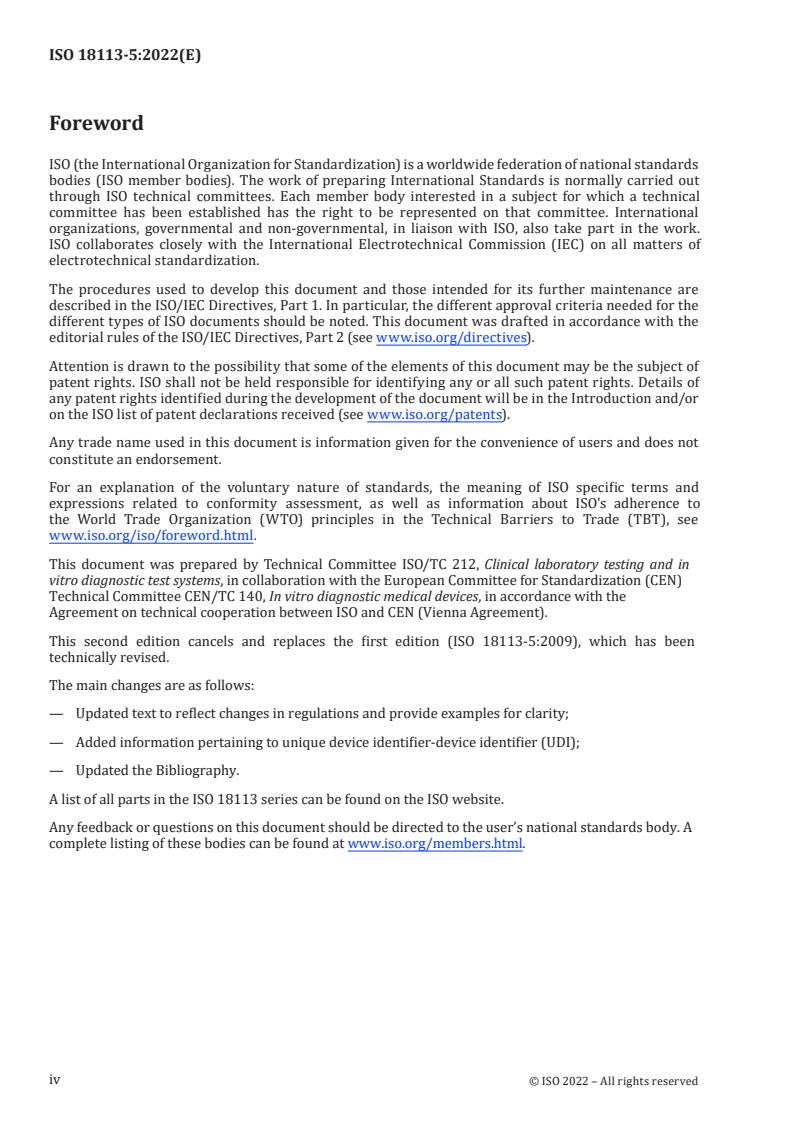
Foreword
ISO (the International Organization for Standardization) is a worldwide federation of national standards
bodies (ISO member bodies). The work of preparing International Standards is normally carried out
through ISO technical committees. Each member body interested in a subject for which a technical
committee has been established has the right to be represented on that committee. International
organizations, governmental and non-governmental, in liaison with ISO, also take part in the work.
ISO collaborates closely with the International Electrotechnical Commission (IEC) on all matters of
electrotechnical standardization.
The procedures used to develop this document and those intended for its further maintenance are
described in the ISO/IEC Directives, Part 1. In particular, the different approval criteria needed for the
different types of ISO documents should be noted. This document was drafted in accordance with the
editorial rules of the ISO/IEC Directives, Part 2 (see www.iso.org/directives).
Attention is drawn to the possibility that some of the elements of this document may be the subject of
patent rights. ISO shall not be held responsible for identifying any or all such patent rights. Details of
any patent rights identified during the development of the document will be in the Introduction and/or
on the ISO list of patent declarations received (see www.iso.org/patents).
Any trade name used in this document is information given for the convenience of users and does not
constitute an endorsement.
For an explanation of the voluntary nature of standards, the meaning of ISO specific terms and
expressions related to conformity assessment, as well as information about ISO's adherence to
the World Trade Organization (WTO) principles in the Technical Barriers to Trade (TBT), see
www.iso.org/iso/foreword.html.
This document was prepared by Technical Committee ISO/TC 212, Clinical laboratory testing and in
vitro diagnostic test systems, in collaboration with the European Committee for Standardization (CEN)
Technical Committee CEN/TC 140, In vitro diagnostic medical devices, in accordance with the
Agreement on technical cooperation between ISO and CEN (Vienna Agreement).
This second edition cancels and replaces the first edition (ISO 18113-5:2009), which has been
technically revised.
The main changes are as follows:
— Updated text to reflect changes in regulations and provide examples for clarity;
— Added information pertaining to unique device identifier-device identifier (UDI);
— Updated the Bibliography.
A list of all parts in the ISO 18113 series can be found on the ISO website.
Any feedback or questions on this document should be directed to the user’s national standards body. A
complete listing of these bodies can be found at www.iso.org/members.html.
iv
Introduction
Manufacturers of in vitro diagnostic (IVD) instruments for self-testing, supply users with information
to enable the safe use and expected performance of their devices. Adequate instructions for use are
essential for the safe and proper operation of IVD instruments. The type and level of detail varies
according to the intended uses and country-specific regulations.
The International Medical Device Regulators Forum (IMDRF) encourages convergence of the evolution
of regulatory systems for medical devices at the global level. Eliminating differences among regulatory
jurisdictions can allow patients earlier access to new technologies and treatments. This document
provides a basis for harmonization of labelling requirements for IVD instruments for self-testing.
This document is concerned solely with information supplied with IVD instruments and equipment
intended for self-testing. It is intended to be used in conjunction with ISO 18113-1, which contains the
general requirements for information supplied by the manufacturer and definitions of general labelling
concepts. This document is intended to support the essential labelling requirements of all the IMDRF
[6]
partners, as well as other countries that have enacted or plan to enact labelling regulations for IVD
medical devices.
For IVD instruments that are intended to be used as a system with reagents provided by the same
manufacturer, this document is also intended to be used together with ISO 18113-1 and ISO 18113-4.
v
INTERNATIONAL STANDARD ISO 18113-5:2022(E)
In vitro diagnostic medical devices — Information supplied
by the manufacturer (labelling) —
Part 5:
In vitro diagnostic instruments for self-testing
1 Scope
This document specifies requirements for information supplied by the manufacturer of in vitro
diagnostic (IVD) instruments intended for self-testing.
This document is also applicable to apparatus and equipment intended to be used with IVD instruments
for self-testing.
This document can also be applicable to accessories.
This document does not apply to:
a) instructions for instrument servicing or repair;
b) IVD reagents, including calibrators and control materials for use in control of the reagent;
c) IVD instruments for professional use.
2 Normative references
The following documents are referred to in the text in such a way that some or all of their content
constitutes requirements of this document. For dated references, only the edition cited applies. For
undated references, the latest edition of the referenced document (including any amendments) applies.
ISO 14971, Medical devices — Application of risk management to medical devices
ISO 15223-1, Medical devices — Symbols to be used with information to be supplied by the manufacturer
— Part 1: General requirements
ISO 18113-1, In vitro diagnostic medical devices — Information supplied by the manufacturer (labelling) —
Part 1: Terms, definitions and general requirements
IEC 61010-1, Safety requirements for electrical equipment for measurement, control and laboratory use —
Part 1: General requirements
IEC 61010-2-101, Safety requirements for electrical equipment for measurement, control and laboratory
use — Part 2-101: Particular requirements for in vitro diagnostic (IVD) medical equipment
IEC 61326-2-6, Electrical equipment for measurement, control and laboratory use — EMC requirements —
Part 2-6: Particular requirements — In vitro diagnostic (IVD) medical equipment
IEC 62366-1, Medical devices — Part 1: Application of usability engineering to medical devices
3 Terms and definitions
For the purposes of this document, the terms and definitions given in ISO 18113-1 apply.
ISO and IEC maintain terminology databases for use in standardization at the following addresses:
— ISO Online browsing platform: available at https:// www .iso .org/ obp
— IEC Electropedia: available at https:// www .electropedia .org/
4 Essential requirements
The requirements of ISO 18113-1 apply.
ISO standards, e.g. ISO 15197 and ISO 17593, for specific IVD medical devices also contain requirements
for information supplied by the manufacturer.
5 Labels and marking
5.1 General
The requirements of IEC 61010-1, IEC 61010-2-101 and IEC 61326-2-6 concerning labels and markings
apply.
For the use of symbols, the requirements of ISO 15223-1 apply.
When including on the labelling any language regarding the manufacturer’s liability in the case of
damage or injury r
...
NORME ISO
INTERNATIONALE 18113-5
Deuxième édition
2022-10
Dispositifs médicaux de diagnostic in
vitro — Informations fournies par le
fabricant (étiquetage) —
Partie 5:
Instruments de diagnostic in vitro
destinés aux autodiagnostics
In vitro diagnostic medical devices — Information supplied by the
manufacturer (labelling) —
Part 5: In vitro diagnostic instruments for self-testing
Numéro de référence
DOCUMENT PROTÉGÉ PAR COPYRIGHT
© ISO 2022
Tous droits réservés. Sauf prescription différente ou nécessité dans le contexte de sa mise en œuvre, aucune partie de cette
publication ne peut être reproduite ni utilisée sous quelque forme que ce soit et par aucun procédé, électronique ou mécanique,
y compris la photocopie, ou la diffusion sur l’internet ou sur un intranet, sans autorisation écrite préalable. Une autorisation peut
être demandée à l’ISO à l’adresse ci-après ou au comité membre de l’ISO dans le pays du demandeur.
ISO copyright office
Case postale 401 • Ch. de Blandonnet 8
CH-1214 Vernier, Genève
Tél.: +41 22 749 01 11
E-mail: copyright@iso.org
Web: www.iso.org
Publié en Suisse
ii
Sommaire Page
Avant-propos .iv
Introduction .v
1 Domaine d’application . 1
2 Références normatives .1
3 Termes et définitions . 2
4 Exigences essentielles . 2
5 Étiquettes et marquage . .2
5.1 Généralités . 2
5.2 Identification de l’instrument de DIV . 2
5.2.1 Nom de l’instrument de DIV . 2
5.2.2 Numéro de série . 2
5.2.3 Utilisation à des fins de diagnostic in vitro . 3
5.2.4 Identifiant unique de dispositif (IUD) . 3
6 Éléments de la notice d’utilisation . 3
7 Contenu de la notice d’utilisation . 4
7.1 Fabricant . 4
7.2 Identification de l’instrument de DIV . 5
7.2.1 Nom de l’instrument de DIV . 5
7.2.2 Identification de module et de logiciel . 5
7.3 Utilisation prévue/Usage prévu . . 5
7.4 Stockage et manipulation . . 5
7.5 Avertissements et précautions et/ou mesures à prendre et limites d’utilisation
associés à l’instrument . 5
7.6 Installation de l’instrument . 6
7.6.1 Généralités . 6
7.6.2 Consignes de livraison . 6
7.6.3 Mise en service . 6
7.7 Principes de mesure . 7
7.8 Performance de l’instrument de DIV . 7
7.9 Limites d’utilisation . 7
7.10 Préparation avant utilisation . 7
7.11 Procédure d’utilisation. 7
7.12 Procédure de contrôle. 7
7.13 Lecture des résultats d’examen . 7
7.14 Fonctions spéciales . 8
7.15 Procédure d’arrêt . 8
7.16 Informations relatives à la mise au rebut . 8
7.17 Maintenance . 8
7.18 Dépannage . 8
7.19 Action de suivi . . 9
7.20 Contrôle des documents . 9
Bibliographie .10
iii
Avant-propos
L’ISO (Organisation internationale de normalisation) est une fédération mondiale d’organismes
nationaux de normalisation (comités membres de l’ISO). L’élaboration des Normes internationales est
en général confiée aux comités techniques de l’ISO. Chaque comité membre intéressé par une étude
a le droit de faire partie du comité technique créé à cet effet. Les organisations internationales,
gouvernementales et non gouvernementales, en liaison avec l’ISO participent également aux travaux.
L’ISO collabore étroitement avec la Commission électrotechnique internationale (IEC) en ce qui
concerne la normalisation électrotechnique.
Les procédures utilisées pour élaborer le présent document et celles destinées à sa mise à jour sont
décrites dans les Directives ISO/IEC, Partie 1. Il convient, en particulier, de prendre note des différents
critères d’approbation requis pour les différents types de documents ISO. Le présent document
a été rédigé conformément aux règles de rédaction données dans les Directives ISO/IEC, Partie 2
(voir www.iso.org/directives).
L’attention est attirée sur le fait que certains des éléments du présent document peuvent faire l’objet de
droits de propriété intellectuelle ou de droits analogues. L’ISO ne saurait être tenue pour responsable
de ne pas avoir identifié de tels droits de brevets. Les détails concernant les références aux droits
de propriété intellectuelle ou autres droits analogues identifiés lors de l’élaboration du document
sont indiqués dans l’Introduction et/ou dans la liste des déclarations de brevets reçues par l’ISO
(voir www.iso.org/brevets).
Les appellations commerciales éventuellement mentionnées dans le présent document sont données
pour information, par souci de commodité, à l’intention des utilisateurs et ne sauraient constituer un
engagement.
Pour une explication de la nature volontaire des normes, la signification des termes et expressions
spécifiques de l’ISO liés à l’évaluation de la conformité, ou pour toute information au sujet de l’adhésion
de l’ISO aux principes de l’Organisation mondiale du commerce (OMC) concernant les obstacles
techniques au commerce (OTC), voir le lien suivant: www.iso.org/iso/fr/avant-propos.
Le présent document a été élaboré par le comité technique ISO/TC 212, Laboratoires de biologie médicale
et systèmes de diagnostic in vitro, en collaboration avec le comité technique CEN/TC 140, Dispositifs
médicaux de diagnostic in vitro, du Comité européen de normalisation (CEN), conformément à l’Accord
de coopération technique entre l’ISO et le CEN (Accord de Vienne).
Cette deuxième édition annule et remplace la première édition (ISO 18113-5:2009), qui a fait l’objet
d’une révision technique.
Les principales modifications apportées sont les suivantes:
— mise à jour du texte pour refléter les modifications apportées à la réglementation et fournir des
exemples à des fins de clarification;
— ajout d’informations relatives à l’identifiant unique de dispositif - identifiant du dispositif (IUD);
— mise à jour de la Bibliographie.
Une liste de toutes les parties de la série ISO 18113 se trouve sur le site web de l’ISO.
Il convient que l’utilisateur adresse tout retour d’information ou toute question concernant le présent
document à l’organisme national de normalisation de son pays. Une liste exhaustive desdits organismes se
trouve à l’adresse www.iso.org/fr/members.html.
iv
Introduction
Les fabricants d’instruments de diagnostic in vitro (DIV) destinés aux autodiagnostics fournissent
aux utilisateurs des informations pour garantir l’utilisation sûre et les performances prévues de leurs
dispositifs. Il est essentiel de proposer des notices d’utilisation appropriées pour une utilisation sûre et
appropriée des instruments de DIV. Le type et le niveau de détails varient en fonction des utilisations
prévues et des réglementations spécifiques à chaque pays.
L’IMDRF (International Medical Device Regulators Forum) encourage la convergence de l’évolution
des systèmes réglementaires pour les dispositifs médicaux au niveau mondial. L’élimination des
différences entre les juridictions de réglementations peut permettre aux patients d’accéder plus
précocement aux nouvelles technologies et aux nouveaux traitements. Le présent document fournit une
base pour l’harmonisation des exigences relatives à l’étiquetage des instruments de DIV destinés aux
autodiagnostics.
Le présent document concerne uniquement les informations accompagnant les instruments de DIV et
l’équipement destinés aux autodiagnostics. Il est destiné à être utilisé conjointement à l’ISO 18113-1, qui
contient les exigences générales relatives aux informations fournies par le fabricant et les définitions
des concepts généraux d’étiquetage. Le présent document a pour vocation de soutenir les exigences
[6]
essentielles relatives à l’étiquetage pour tous les partenaires de l’IMDRF, ainsi que d’autres pays
qui ont édicté, ou envisagent de le faire, des réglementations relatives à l’étiquetage des dispositifs
médicaux de DIV.
Pour les instruments de DIV destinés à être utilisés comme un système avec des réactifs fournis par le
même fabricant, le présent document est aussi destiné à être utilisé avec l’ISO 18113-1 et l’ISO 18113-4.
v
NORME INTERNATIONALE ISO 18113-5:2022(F)
Dispositifs médicaux de diagnostic in vitro — Informations
fournies par le fabricant (étiquetage) —
Partie 5:
Instruments de diagnostic in vitro destinés aux
autodiagnostics
1 Domaine d’application
Le présent document spécifie les exigences relatives aux informations fournies par le fabricant
d’instruments de diagnostic in vitro (DIV) destinés aux autodiagnostics.
Le présent document est également applicable aux appareillages et équipements destinés à être utilisés
avec les instruments de DIV destinés aux autodiagnostics.
Le présent document peut aussi s’appliquer aux accessoires.
Le présent document ne s’applique pas à ce qui suit:
a) instructions d’entretien ou de réparation des instruments;
b) réactifs de DIV, y compris les étalons et les matériaux de contrôle à utiliser dans le contrôle du
réactif;
c) instruments de DIV à usage professionnel.
2 Références normatives
Les documents suivants sont cités dans le texte de sorte qu’ils constituent, pour tout ou partie de leur
contenu, des exigences du présent document. Pour les références datées, seule l’édition citée s’applique.
Pour les références non datées, la dernière édition du document de référence s’applique (y compris les
éventuels amendements).
ISO 14971, Dispositifs médicaux — Application de la gestion des risques aux dispositifs médicaux
ISO 15223-1, Dispositifs médicaux — Symboles à utiliser avec les informations à fournir par le fabricant —
Partie 1: Exigences générales
ISO 18113-1, Dispositifs médicaux de diagnostic in vitro — Informations fournies par le fabricant
(étiquetage) — Partie 1: Termes, définitions et exigences générales
IEC 61010-1, Règles de sécurité pour appareils électriques de mesurage, de régulation et de laboratoire —
Partie 1: Exigences générales
IEC 61010-2-101, Règles de sécurité pour appareils électriques de mesurage, de régulation et de
laboratoire — Partie 2-101: Exigences particulières pour les appareils médicaux de diagnostic in vitro (DIV)
IEC 61326-2-6, Matériel électrique de mesure, de commande et de laboratoire — Exigences relatives à la
CEM — Partie 2-6: Exigences particulières — Matériel médical de diagnostic in vitro (DIV)
IEC 62366-1, Dispositifs médicaux — Partie 1: Application de l'ingénierie de l'aptitude à l'utilisation aux
dispositifs médicaux
3 Termes et définitions
Pour les besoins du présent document, les termes et définitions donnés dans l’ISO 18113-1 s’appliquent.
L’ISO et l’IEC tiennent à jour des bases de données terminologiques destinées à être utilisées en
normalisation, consultables aux adresses suivantes:
— ISO Online browsing platform: disponible à l’adresse https:// www .iso .org/ obp
— IEC Electropedia: disponible à l’adresse https:// www .electropedia .org/
4 Exigences essentielles
Les exigences de l’ISO 18113-1 s’appliquent.
Les normes ISO relatives aux dispositifs médicaux de DIV, telles que l’ISO 15197 et l’ISO 17593,
contiennent également des exigences relatives aux informations fournies par le fabricant.
5 Étiquettes et marquage
5.1 Généralités
Les exigences de l’IEC 61010-1, de l’IEC 61010-2-101 et de l’IEC 61326-2-6 concernant les étiquettes et le
marquage s’appliquent.
Pour l’utilisation des symboles, les exigences de l’ISO 15223-1 s’appliquent.
Lorsque l’étiquetage contient une mention relative à la responsabilité du fabricant en cas de préjudice
ou de blessure résultant de l’utilisation ou du dysfonctionnement du dispositif, il convient de se référer
à la législation ou à la réglementation de la juridiction d’utilisation.
L’étiquetage ne doit pas contenir d’exonération de responsabilité relative à la sécurité et aux
performances du dispositif dans le cadre de son usage prévu qui serait incompatible avec les obligations
du fabricant de concevoir et de fabriquer un produit sûr qui offre le niveau de performance prévu tout
au long de sa durée de vie attendue. Il convient de tenir compte de la législation et de la réglementation
de la juridiction d’utilisation.
5.2 Identification de l’instrument de DIV
5.2.1 Nom de l’
...