


ISO 10109:2015
(Main)Optics and photonics — Guidance for the selection of environmental tests
Optics and photonics — Guidance for the selection of environmental tests
ISO 10109:2015 contains tables for environmental tests and test parameters which can be used as a guideline for the selection of environmental tests. These include the selection of standardized tests according to ISO 9022 as well as additional parameters not described in ISO 9022 and necessary for the optical or photonic instruments. Ultimately, these tables specify the requirements to be met with regard to the reliability of the optical, mechanical, chemical, and electrical properties or performance characteristics of the instruments when exposed to environmental influences.
Optiques et photonique — Directives relatives au choix des essais environnementaux
General Information
- Status
- Withdrawn
- Publication Date
- 03-Jun-2015
- Technical Committee
- ISO/TC 172/SC 1 - Fundamental standards
- Drafting Committee
- ISO/TC 172/SC 1/WG 3 - Environmental test methods
- Current Stage
- 9599 - Withdrawal of International Standard
- Start Date
- 06-Feb-2024
- Completion Date
- 12-Feb-2026
Relations
- Effective Date
- 06-Jun-2022
- Effective Date
- 04-Oct-2014
Frequently Asked Questions
ISO 10109:2015 is a standard published by the International Organization for Standardization (ISO). Its full title is "Optics and photonics — Guidance for the selection of environmental tests". This standard covers: ISO 10109:2015 contains tables for environmental tests and test parameters which can be used as a guideline for the selection of environmental tests. These include the selection of standardized tests according to ISO 9022 as well as additional parameters not described in ISO 9022 and necessary for the optical or photonic instruments. Ultimately, these tables specify the requirements to be met with regard to the reliability of the optical, mechanical, chemical, and electrical properties or performance characteristics of the instruments when exposed to environmental influences.
ISO 10109:2015 contains tables for environmental tests and test parameters which can be used as a guideline for the selection of environmental tests. These include the selection of standardized tests according to ISO 9022 as well as additional parameters not described in ISO 9022 and necessary for the optical or photonic instruments. Ultimately, these tables specify the requirements to be met with regard to the reliability of the optical, mechanical, chemical, and electrical properties or performance characteristics of the instruments when exposed to environmental influences.
ISO 10109:2015 is classified under the following ICS (International Classification for Standards) categories: 37.020 - Optical equipment. The ICS classification helps identify the subject area and facilitates finding related standards.
ISO 10109:2015 has the following relationships with other standards: It is inter standard links to ISO 10109:2024, ISO 10109:2014. Understanding these relationships helps ensure you are using the most current and applicable version of the standard.
ISO 10109:2015 is available in PDF format for immediate download after purchase. The document can be added to your cart and obtained through the secure checkout process. Digital delivery ensures instant access to the complete standard document.
Standards Content (Sample)
INTERNATIONAL ISO
STANDARD 10109
Second edition
2015-06-01
Optics and photonics — Guidance for
the selection of environmental tests
Optiques et photonique — Directives relatives au choix des essais
environnementaux
Reference number
©
ISO 2015
© ISO 2015, Published in Switzerland
All rights reserved. Unless otherwise specified, no part of this publication may be reproduced or utilized otherwise in any form
or by any means, electronic or mechanical, including photocopying, or posting on the internet or an intranet, without prior
written permission. Permission can be requested from either ISO at the address below or ISO’s member body in the country of
the requester.
ISO copyright office
Ch. de Blandonnet 8 • CP 401
CH-1214 Vernier, Geneva, Switzerland
Tel. +41 22 749 01 11
Fax +41 22 749 09 47
copyright@iso.org
www.iso.org
ii © ISO 2015 – All rights reserved
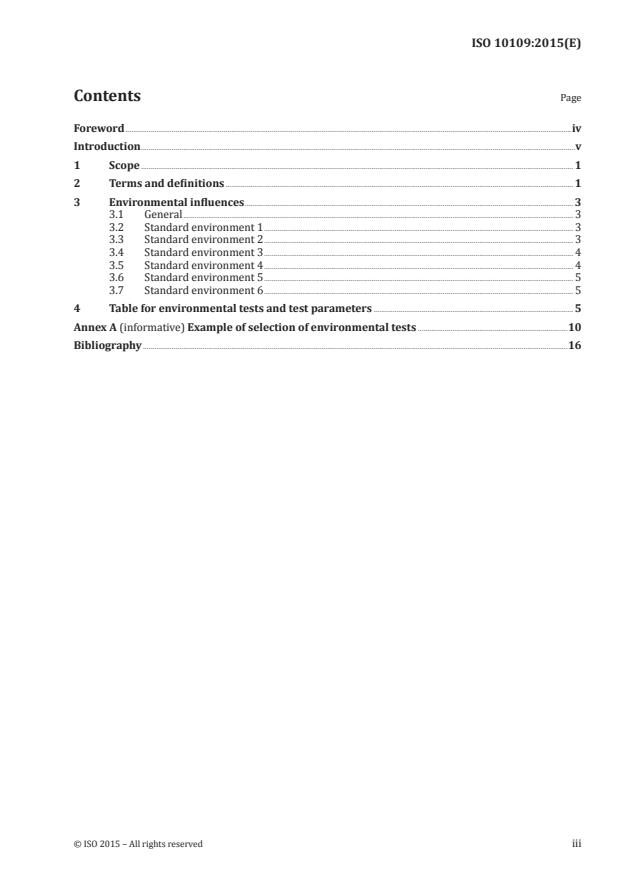
Contents Page
Foreword .iv
Introduction .v
1 Scope . 1
2 Terms and definitions . 1
3 Environmental influences . 3
3.1 General . 3
3.2 Standard environment 1 . 3
3.3 Standard environment 2 . 3
3.4 Standard environment 3 . 4
3.5 Standard environment 4 . 4
3.6 Standard environment 5 . 5
3.7 Standard environment 6 . 5
4 Table for environmental tests and test parameters . 5
Annex A (informative) Example of selection of environmental tests .10
Bibliography .16
Foreword
ISO (the International Organization for Standardization) is a worldwide federation of national standards
bodies (ISO member bodies). The work of preparing International Standards is normally carried out
through ISO technical committees. Each member body interested in a subject for which a technical
committee has been established has the right to be represented on that committee. International
organizations, governmental and non-governmental, in liaison with ISO, also take part in the work.
ISO collaborates closely with the International Electrotechnical Commission (IEC) on all matters of
electrotechnical standardization.
The procedures used to develop this document and those intended for its further maintenance are
described in the ISO/IEC Directives, Part 1. In particular the different approval criteria needed for the
different types of ISO documents should be noted. This document was drafted in accordance with the
editorial rules of the ISO/IEC Directives, Part 2 (see www.iso.org/directives).
Attention is drawn to the possibility that some of the elements of this document may be the subject of
patent rights. ISO shall not be held responsible for identifying any or all such patent rights. Details of any
patent rights identified during the development of the document will be in the Introduction and/or on
the ISO list of patent declarations received (see www.iso.org/patents).
Any trade name used in this document is information given for the convenience of users and does not
constitute an endorsement.
For an explanation on the meaning of ISO specific terms and expressions related to conformity
assessment, as well as information about ISO’s adherence to the WTO principles in the Technical Barriers
to Trade (TBT), see the following URL: Foreword — Supplementary information.
The committee responsible for this document is ISO/TC 172, Optics and photonics, SC 1, Fundamental
standards.
This second edition cancels and replaces the first edition (ISO 10109:2014), of which it constitutes a
minor revision.
iv © ISO 2015 – All rights reserved
Introduction
Optical and photonic instruments including additional assemblies from other fields (e.g. mechanical,
chemical, and electronic devices) are affected during their use by a number of different environmental
and handling parameters, which they are required to resist without significant reduction in performance
and to remain within defined specifications. This is what the manufacturer attempts to ensure and the
user expects to receive.
This expectation can be assessed by exposure of the instrument to a range of simulated environmental
parameters under controlled laboratory conditions. The cumulative combination, degree of severity,
and sequence of these conditions can be selected to obtain meaningful results in a relatively short
period of time.
Technical requirements as given in the tables of this International Standard are abbreviated and the
reader has to consult the referenced standards (i.e. the relevant ISO 9022 part) for the full specification
of the technical requirement.
For the purposes of ISO 10109, nominal values for properties or performance characteristics are
understood to be the manufacturer’s internal technical data and do not directly reflect manufacturer’s
product specifications.
INTERNATIONAL STANDARD ISO 10109:2015(E)
Optics and photonics — Guidance for the selection of
environmental tests
1 Scope
This International Standard contains tables for environmental tests and test parameters which can be
used as a guideline for the selection of environmental tests. These include the selection of standardized
tests according to ISO 9022 as well as additional parameters not described in ISO 9022 and necessary
for the optical or photonic instruments. Ultimately, these tables specify the requirements to be met with
regard to the reliability of the optical, mechanical, chemical, and electrical properties or performance
characteristics of the instruments when exposed to environmental influences.
Environmental test methods, as specified in ISO 9022 (all parts), can be assigned to the various areas
of application for the purpose of ascertaining the suitability of the instruments in the respective area
of application.
2 Terms and definitions
For the purposes of this document, the following terms and definitions apply.
2.1
environmental requirements
specific natural and technical environmental influences between the limiting values of which optical
instruments and instruments with optical, mechanical, chemical, and electrical components are to be
operable
2.2
technical requirement
defined limiting value for the natural and technical environmental influences occurring in the envisaged
area of application
Note 1 to entry: In order to verify whether an instrument fulfils a technical requirement, conditioning methods
can be stipulated with degrees of severity whose limiting values are either higher or lower than those specified.
2.3
extent of testing
sum of all required tests to ascertain operability as well as product performance within the intended
use and time of life
Note 1 to entry: The extent of design verification/testing is subdivided into
— design verification and production process controlling (not addressed by this International Standard), and
— testing of functional models, prototypes, and production series products.
2.4
severity of testing
number of specimens per production batch/series or sample production to be subjected to a specific test
Note 1 to entry: The severity of testing is stipulated in the relevant specification or in the instrument standard.
2.5
area of application
classification of the operability of an instrument within a defined environment and intended application
Note 1 to entry: The manufacturer defines the environment parameters. This can be done, e.g. by using pre-
defined ‘standardized areas of application’ such as in Table 3 to Table 8 in full or in part.
EXAMPLE General application in an office environment with air conditioning; or an outdoor application, non-
weather protected in arctic climate.
2.6
conditioning method
individual or combined environmental influence(s) to which the specimen is submitted during the test,
e.g. shock or damp heat
2.7
degree of severity
parameter containing all the individual quantities required for the test
Note 1 to entry: See also the specific parts of ISO 9022.
EXAMPLE Temperature, humidity, conditioning time, and others have to be defined for the intended area
of application.
2.8
state of operation
code that designates the state of operation of a specimen
Note 1 to entry: Table 1 gives states of operation in accordance with ISO 9022 (all parts).
Table 1 — States of operation
State of operation Comment
0 Specimen in its normal transport and/or storage container as provided by the manufac-
turer (transport container, shipping package).
1 Specimen is unprotected, ready for operation, power supply not connected.
2 Specimen is in operation during conditioning for a period to be specified in the relevant
specification. The mode of the operating status is specified in the relevant specification.
During operation, a check is performed to establish if the specimen is functioning as
required.
2.9
status after test
code that designates the outcome of the test as given in Table 2
Table 2 — Status after test
Status after test Comment
A All performance criteria are satisfied.
B All performance criteria are satisfied. Damage to parts not needed for function or
reduced life are possible.
C Not all performance criteria are satisfied. Damage to parts not needed for func-
tion or reduced life are possible.
D Device may not operate anymore; damage is expected.
2 © ISO 2015 – All rights reserved
3 Environmental influences
3.1 General
Table 3 to Table 8 classify and describe standardized environment areas, which constitute a summary
of the various environmental parameters with major influences to products during shipping, transport,
storage, and operation.
The values for standard environments 1 and 2 have been compiled from excerpts of IEC 60721-2-1 and
IEC 60721-3-4.
Standard environment 5 is defined for use in weather-protected locations.
Standard environment 6 is defined as an open-air climate with restricted limiting values for optical
precision measurements and for the use of optical consumer products in the open air.
3.2 Standard environment 1
Table 3 — Non-weather-protected locations with cold or extremely cold climates
(Arctic or Antarctic climate)
Environmental influence Value Comment
Temperature −65 °C to +35 °C This range applies for commonly experienced conditions. In
extreme geographical conditions, temperatures as low as
−75 °C and as high as 40 °C can occur in the location of use.
With temporary or permanent storage in enclosed vehicles,
sheds, hangars, or attics, temperatures of over 35 °C can be
experienced in strong sunshine, and over 70 °C in extreme
cases. The specification does not address these conditions.
Relative humidity up to 100 %
Air pressure 70 kPa to 106 kPa 50 kPa to 110 kPa in unfavourable conditions.
Total solar irradiance up to 1,1 kW/m Intensity of global radiation on earth’s surface, depending
on the latitude.
Amount of precipitation ≤15 mm/min
(rain, snow, or hail)
Dew or ice build-up yes
3.3 Standard environment 2
Table 4 — Global locations, non-weather-protected,
with the exception of cold and extremely cold climates
Environmental influence Value Comment
Temperature −33 °C to +55 C This range applies for commonly experienced conditions. In
extreme geographical conditions, temperatures as low as
−45 °C and over 60 °C can be experienced in the location of
use. With temporary or permanent storage in enclosed vehi-
cles, sheds, hangars, or attics, temperatures of over 55 °C
can occur in strong sunshine, and over 85 °C in extreme
cases. The specification does not address these conditions.
Relative humidity up to 100 %
Air pressure 70 kPa to 106 kPa 50 kPa to 110 kPa in unfavourable conditions.
Total solar irradiance up to 1,1 kW/m Intensity of global radiation on earth’s surface, depending
on the latitude.
Table 4 (continued)
Environmental influence Value Comment
Amount of precipitation ≤15 mm/min
(rain, snow or hail)
Dew or ice build-up yes
3.4 Standard environment 3
Table 5 — Global locations, non-weather-protected, with maritime and/or coastal climate
Environmental influence Value Comment
Temperature −20 °C to +35 °C This range applies for commonly experienced conditions.
Along coasts with icing, temperatures below −20 °C can be
experienced, and above 35 °C along tropical coasts. With
temporary or permanent storage in enclosed vehicles, sheds,
hangars, or attics, temperatures over 35 °C can be experi-
enced in strong sunshine, and over 85 °C in extreme cases.
The specification does not address these conditions.
Relative humidity up to 100 %
Air pressure 90 kPa to 106 kPa 50 kPa to 110 kPa in unfavourable conditions.
Total solar irradiance up to 1,1 kW/m Intensity of global radiation on earth’s surface, depending on
the latitude.
Amount of precipitation ≤15 mm/min
(rain, snow or hail)
Dew or ice build-up yes
3.5 Standard environment 4
Table 6 — High altitudes of up to 30 000 m
Environmental influence Value Comment
Temperature −65 °C to +55 °C This range applies for commonly experienced conditions.
Above polar zones, temperatures below −65 °C have to be
expected. With temporary or permanent storage in enclosed
vehicles, sheds, hangars, or attics, temperatures over 55 °C
can be experienced in strong sunshine, and over 85 °C in
extreme cases. The specification does not address these con-
ditions.
Relative humidity up to 100 %
Air pressure 1 kPa to 106 kPa
Total solar irradiance up to 1,4kW/m Intensity of radiation at altitude of 30 000 m.
Amount of precipitation ≤15 mm/min
(rain, snow or hail)
Dew or ice build-up yes
4 © ISO 2015 – All rights reserved
3.6 Standard environment 5
Table 7 — Technical climate in weather-protected locations
Environmental influence Value Comment
Temperature +15 °C to +35 °C This range applies for commonly experienced conditions. In
unfavourable conditions, temperatures below 15 °C and over
35 °C may occur. The specification does not address these
conditions.
Relative humidity up to 85 %
Air pressure 70 kPa to 106 kPa 50 kPa to 110 kPa in unfavourable conditions.
Total solar irradiance up to 0,9 kW/m Without protection from sunshine, depending on the latitude.
3.7 Standard environment 6
Table 8 — Non-weather-protected locations with restricted limiting values
Environmental influence Value Comment
Temperature −20 °C to +50 °C The restricted temperature range applies for state of oper-
ation 2. The values of standard environment 2 apply for the
states of operation 0 and 1.
Relative humidity up to 100 %
Air pressure 70 kPa to 106 kPa 50 kPa to 110 kPa in unfavourable conditions.
Total solar irradiance up to 1,1 kW/m The total solar irradiance depends on the latitude. Beware
of critical values in and on the instruments when combining
heat and solar irradiance.
Amount of precipitation ≤6 mm/min
(rain, snow or hail)
Dew or ice build-up yes
4 Table for environmental tests and test parameters
The wide range of technologies applied in complex instruments often requires specific and individually
selected test parameters, test sequences, and combined tests. Table 9 is a collection of mainly climatic
and mechanical tests.
The user of this International Standard, e.g. a manufacturer, selects the tests and adapts the parameters
to his specific equipment. A specific area of application has to be defined for every item of equipment
and both the tests and the degree of severity also have to be adapted to the intended climatic and
operating environment and to the customer expectations. It is up to the manufacturer to carefully select
the appropriate tests, the combination of the tests, the required technical parameters, the degree of
severity, the status of operation and other parameters. An example is given in Annex A.
As a general test result, the status after the test can be shown in the table for each specific test-run.
Note that in Table 9, the combination of the three columns “Conditioning method”, “Degree of severity”,
and “State of operation” provide the full specification using the coded format as defined in ISO 9022-1.
The column labelled “Technical requirement” is only a short description and does not reproduce the full
requirement. For a full description, it is necessary to co
...
Questions, Comments and Discussion
Ask us and Technical Secretary will try to provide an answer. You can facilitate discussion about the standard in here.
Loading comments...