

ISO 10209:2022
(Main)Technical product documentation — Vocabulary — Terms relating to technical drawings, product definition and related documentation
General Information
- Abstract
This document establishes and defines terms used in technical product documentation relating to technical drawings, product definition and related documentation in all fields of application. The terms have been classified into specific fields of application. NOTE New terms required by ISO/TC 10 subcommittees and working groups for new or revised standards will be ratified by the ISO/TC 10 vocabulary maintenance team and included in future amendments of this document.
- Status
- Published
- Publication Date
- 27-Feb-2022
- Technical Committee
- ISO/TC 10 - Technical product documentation
- Drafting Committee
- ISO/TC 10/WG 17 - Vocabulary of terms and definitions
- Current Stage
- 6060 - International Standard published
- Start Date
- 28-Feb-2022
- Due Date
- 18-May-2021
- Completion Date
- 28-Feb-2022
Buy Documents

ISO 10209:2022 - Technical product documentation — Vocabulary — Terms relating to technical drawings, product definition and related documentation Released:2/28/2022

ISO 10209:2022 - Technical product documentation — Vocabulary — Terms relating to technical drawings, product definition and related documentation Released:2/28/2022
Overview
ISO 10209:2022 is the second edition of an ISO vocabulary standard that establishes and defines terms used in technical product documentation relating to technical drawings, product definition and related documentation. The document classifies terms into specific fields of application and replaces the 2012 edition with technical revisions. New or revised terms required by ISO/TC 10 subcommittees are maintained and incorporated through the ISO/TC 10 vocabulary maintenance process.
Key points:
- The standard covers terminology across the full lifecycle of product documentation, from conceptual design to information for use.
- It supports consistent language for engineering, drafting, CAD models, documentation management and digital practices.
- The second edition updates, adds or removes terms and aligns with ISO/IEC editorial rules.
Key Topics
ISO 10209:2022 groups terms into clearly defined topical areas. Major categories include:
- General terms (e.g., activity, component, assembly, CAD model)
- Views and representation conventions
- Dimensions and measurement terminology
- Lines and graphical elements
- Tolerances and related definitions
- Graphics and symbology
- Digital practices and computer-related terms (CAD, data media, layers)
- Documentation and document management
- Writing and marking instruments, design for manufacturing/assembly/disassembly and information for use
Each section provides concise definitions to reduce ambiguity and improve mutual understanding across disciplines and organizations.
Applications
ISO 10209:2022 delivers practical value across multiple activities where precise terminology is critical:
- Engineering and design: harmonizes terms used in drawings, CAD models and product definitions to reduce interpretation errors.
- Manufacturing and procurement: clarifies part references, identifiers and assembly concepts for suppliers and manufacturers.
- Documentation management and quality: provides a foundation for consistent document control, configuration management and lifecycle records.
- Digital interoperability: supports consistent use of CAD, data media and metadata terminology, aiding exchange across systems.
- Training and standards compliance: a reference for onboarding, technical training and cross-border collaboration.
Benefits include improved clarity, fewer disputes over definitions, enhanced interoperability between teams and systems, and a stable basis for developing or revising related standards.
Related Standards
ISO 10209:2022 references and aligns with other international documents and resources, including but not limited to:
- ISO 9000 (quality management - concepts such as process and procedure)
- ISO/IEC Directives, Part 1 and Part 2 (standard development and editorial rules)
- ISO Online Browsing Platform and IEC Electropedia (terminology resources)
- IEC 60050 and IEC 81346-1 (classification and reference designation guidance)
- ISO 6433 (part reference practices)
For implementers, ISO 10209:2022 is a neutral, authoritative vocabulary that complements technical drawing standards and supports precise, consistent technical communication across industries.
Relations
- Effective Date
- 25-Aug-2026
- Effective Date
- 25-Aug-2026
- Effective Date
- 25-Aug-2026
- Effective Date
- 25-Aug-2026
- Effective Date
- 25-Aug-2026
- Effective Date
- 25-Aug-2026
- Effective Date
- 12-Feb-2026
- Effective Date
- 06-Jun-2022
- Effective Date
- 03-Jun-2017
Buy Documents
ISO 10209:2022 - Technical product documentation — Vocabulary — Terms relating to technical drawings, product definition and related documentation Released:2/28/2022
ISO 10209:2022 - Technical product documentation — Vocabulary — Terms relating to technical drawings, product definition and related documentation Released:2/28/2022
Frequently Asked Questions
ISO 10209:2022 is a standard published by the International Organization for Standardization (ISO). Its full title is "Technical product documentation — Vocabulary — Terms relating to technical drawings, product definition and related documentation". This standard covers: This document establishes and defines terms used in technical product documentation relating to technical drawings, product definition and related documentation in all fields of application. The terms have been classified into specific fields of application. NOTE New terms required by ISO/TC 10 subcommittees and working groups for new or revised standards will be ratified by the ISO/TC 10 vocabulary maintenance team and included in future amendments of this document.
This document establishes and defines terms used in technical product documentation relating to technical drawings, product definition and related documentation in all fields of application. The terms have been classified into specific fields of application. NOTE New terms required by ISO/TC 10 subcommittees and working groups for new or revised standards will be ratified by the ISO/TC 10 vocabulary maintenance team and included in future amendments of this document.
ISO 10209:2022 is classified under the following ICS (International Classification for Standards) categories: 01.040.01 - Generalities. Terminology. Standardization. Documentation (Vocabularies); 01.110 - Technical product documentation. The ICS classification helps identify the subject area and facilitates finding related standards.
ISO 10209:2022 has the following relationships with other standards: It is inter standard links to EN ISO 24096-1:2024, EN ISO 128-3:2022, EN ISO 24096-2:2024, EN ISO 4172:2024, EN ISO 7519:2024, EN ISO 7533:2024, EN ISO 10209:2022, ISO 16672:2015, ISO 10209:2012. Understanding these relationships helps ensure you are using the most current and applicable version of the standard.
ISO 10209:2022 is available in PDF format for immediate download after purchase. The document can be added to your cart and obtained through the secure checkout process. Digital delivery ensures instant access to the complete standard document.
Standards Content (Sample)
INTERNATIONAL ISO
STANDARD 10209
Second edition
2022-02
Technical product documentation —
Vocabulary — Terms relating to
technical drawings, product definition
and related documentation
Documentation technique de produits — Vocabulaire — Termes
relatifs aux dessins techniques, à la définition de produits et à la
documentation associée
Reference number
© ISO 2022
All rights reserved. Unless otherwise specified, or required in the context of its implementation, no part of this publication may
be reproduced or utilized otherwise in any form or by any means, electronic or mechanical, including photocopying, or posting on
the internet or an intranet, without prior written permission. Permission can be requested from either ISO at the address below
or ISO’s member body in the country of the requester.
ISO copyright office
CP 401 • Ch. de Blandonnet 8
CH-1214 Vernier, Geneva
Phone: +41 22 749 01 11
Email: copyright@iso.org
Website: www.iso.org
Published in Switzerland
ii
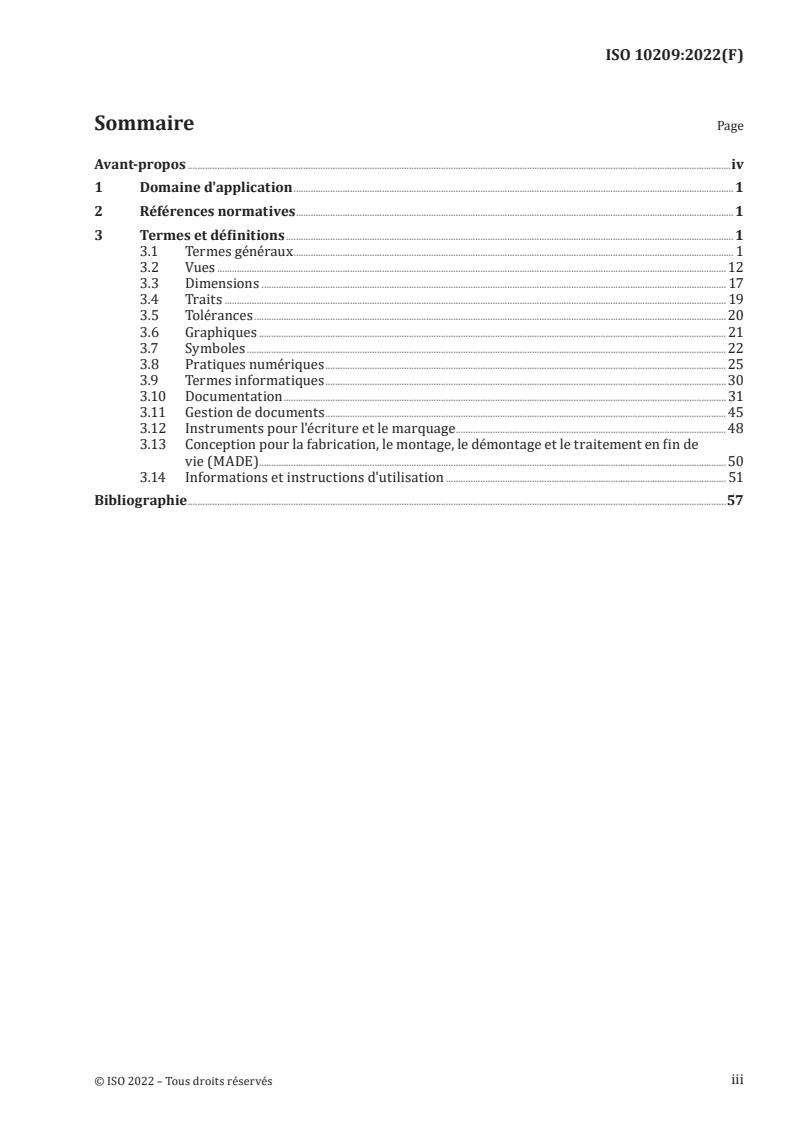
Contents Page
Foreword .iv
1 Scope . 1
2 Normative references . 1
3 Terms and definitions . 1
3.1 General terms . 1
3.2 Views . 11
3.3 Dimensions . 17
3.4 Lines . 18
3.5 Tolerances . 20
3.6 Graphics . 20
3.7 Symbology . 21
3.8 Digital practices. 24
3.9 Computer-related terms . .29
3.10 Documentation .30
3.11 Document management .44
3.12 Writing and marking instruments .46
3.13 Design for manufacturing, assembling, disassembling and end-of-life processing .49
3.14 Information and instructions for use .49
Bibliography .55
iii
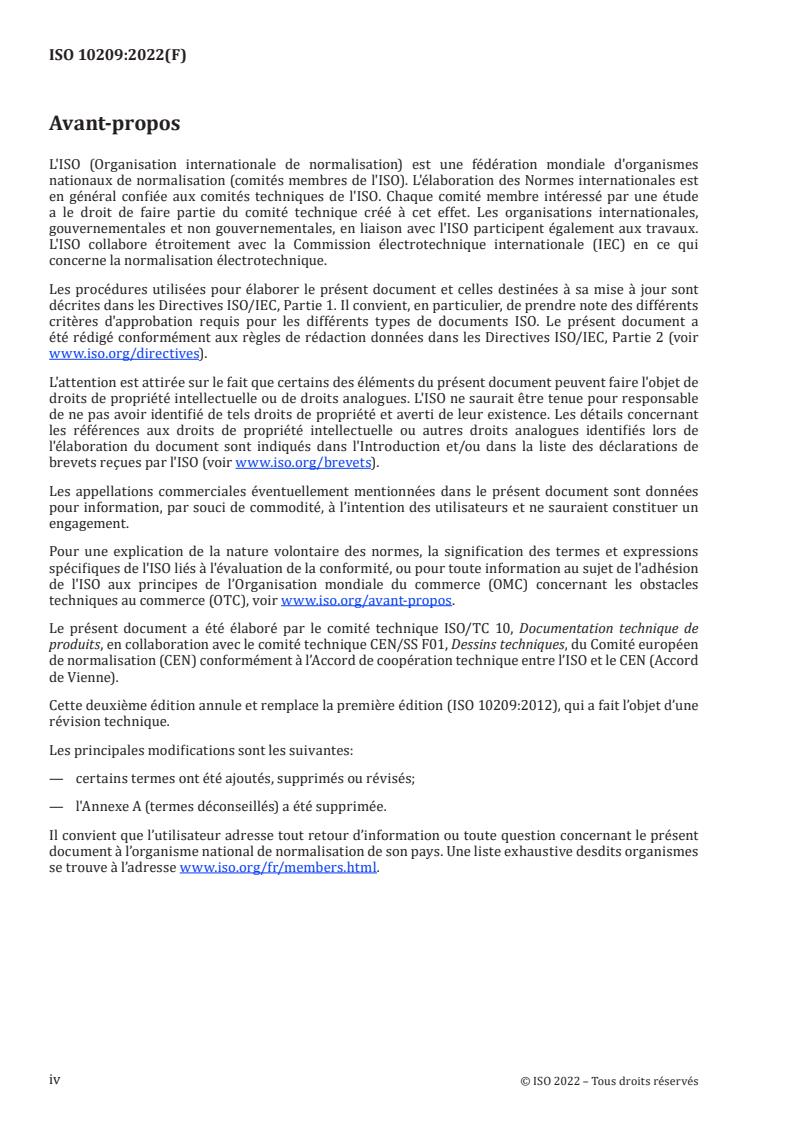
Foreword
ISO (the International Organization for Standardization) is a worldwide federation of national standards
bodies (ISO member bodies). The work of preparing International Standards is normally carried out
through ISO technical committees. Each member body interested in a subject for which a technical
committee has been established has the right to be represented on that committee. International
organizations, governmental and non-governmental, in liaison with ISO, also take part in the work.
ISO collaborates closely with the International Electrotechnical Commission (IEC) on all matters of
electrotechnical standardization.
The procedures used to develop this document and those intended for its further maintenance are
described in the ISO/IEC Directives, Part 1. In particular, the different approval criteria needed for the
different types of ISO documents should be noted. This document was drafted in accordance with the
editorial rules of the ISO/IEC Directives, Part 2 (see www.iso.org/directives).
Attention is drawn to the possibility that some of the elements of this document may be the subject of
patent rights. ISO shall not be held responsible for identifying any or all such patent rights. Details of
any patent rights identified during the development of the document will be in the Introduction and/or
on the ISO list of patent declarations received (see www.iso.org/patents).
Any trade name used in this document is information given for the convenience of users and does not
constitute an endorsement.
For an explanation of the voluntary nature of standards, the meaning of ISO specific terms and
expressions related to conformity assessment, as well as information about ISO's adherence to
the World Trade Organization (WTO) principles in the Technical Barriers to Trade (TBT), see
www.iso.org/iso/foreword.html.
This document was prepared by Technical Committee ISO/TC 10, Technical product documentation, in
collaboration with the European Committee for Standardization (CEN) Technical Committee CEN/SS
F01, Technical drawings, in accordance with the Agreement on technical cooperation between ISO and
CEN (Vienna Agreement).
This second edition cancels and replaces the first edition (ISO 10209:2012), which has been technically
revised.
The main changes are as follows:
— certain terms have been added, deleted or revised;
— Annex A (deprecated terms) has been deleted.
Any feedback or questions on this document should be directed to the user’s national standards body. A
complete listing of these bodies can be found at www.iso.org/members.html.
iv
INTERNATIONAL STANDARD ISO 10209:2022(E)
Technical product documentation — Vocabulary — Terms
relating to technical drawings, product definition and
related documentation
1 Scope
This document establishes and defines terms used in technical product documentation relating to
technical drawings, product definition and related documentation in all fields of application.
The terms have been classified into specific fields of application.
NOTE New terms required by ISO/TC 10 subcommittees and working groups for new or revised standards
will be ratified by the ISO/TC 10 vocabulary maintenance team and included in future amendments of this
document.
2 Normative references
There are no normative references in this document.
3 Terms and definitions
ISO and IEC maintain terminology databases for use in standardization at the following addresses:
— ISO Online browsing platform: available at https:// www .iso .org/ obp
— IEC Electropedia: available at https:// www .electropedia .org/
3.1 General terms
3.1.1
activity
processes, procedures or parts of them, usually related to established organization units
Note 1 to entry: The terms “process” and “procedure” are defined in ISO 9000. A detailed explanation of processes
within companies is also given in ISO 9000.
3.1.2
activity matrix
matrix allocating activities to phases of the product life cycle and to a fixed organization unit
3.1.3
analysis
part of the product development process where a specification of requirements is prepared
3.1.4
ancillary system
system which is not directly required for the power plant process
Note 1 to entry: This includes heating, ventilation, air-conditioning systems, space heating systems, stationary
compressed air supplies, fire protection systems, cranes, elevators, workshops and staff amenities.
3.1.5
application reference model
information model that formally describes the information requirements and constraints for an
application area
3.1.6
aspect
specific way of selecting information on, or describing, a system or an object
of a system
3.1.7
aspect
specific way of viewing an object
Note 1 to entry: Such ways include:
— what the system or object is doing (function viewpoint);
— how the system or object is constructed (product viewpoint);
— where the system or object is located (location viewpoint).
3.1.8
assembly
number of component parts fitted together to perform a specific function
3.1.9
authorization
privileges that give access to designated activities
3.1.10
auxiliary system
system which is required for the support of a power plant process
Note 1 to entry: This includes auxiliary steam system, compressed air, carrier air, control air, central chemicals
supply and sampling systems.
3.1.11
basic design
part of the product development process where one or more design proposals are evaluated and the
basic documentation for design is prepared
3.1.12
burr
rough remainder of material outside the ideal geometrical shape of an external edge, residue of
machining or forming process
3.1.13
CAD model
structured computer-aided design (CAD) data file(s) organized according to the physical parts of the
objects represented, for example a building or a mechanical device
Note 1 to entry: Models can be two-dimensional or three-dimensional and can include graphical as well as non-
graphical data attached to the objects.
3.1.14
complex device
device consisting of several functionally interrelated components or elements, the description of which
needs a diagram
3.1.15
component
constituent part of equipment that cannot be physically divided into smaller parts without losing its
character
3.1.16
conceptual design
part of the product development process which includes the preparation of design specifications and
design proposals for a product
3.1.17
conceptual schema
implementation-independent specification of information structures
3.1.18
concurrent engineering
coordination of parallel activities in the product life cycle, especially in the phases up to market
introduction
3.1.19
configuration control
activities comprising the control of changes to a configuration item after formal establishment of its
configuration documents
3.1.20
conjoint designation
designation of site, factory or plant complex as an optional element of the object identifier
3.1.21
construct
concept or fact that is modelled
3.1.22
coordinate axis
three reference straight lines in space which intersect at the point of origin, thus forming a coordinate
system
3.1.23
coordinate system
basis for establishing a relationship between each point in space and the three corresponding
coordinates and vice versa
3.1.24
coordinates
set of numerical ordered values (and their corresponding units of measure), giving unequivocally the
position of a point in a coordinate system
3.1.25
cylindrical coordinate system
coordinate system based on a reference system given by a reference horizontally oriented straight line
and its origin and units of measure
3.1.26
cylindrical coordinates
three coordinates of a point in space relative to a cylindrical coordinate system
Note 1 to entry: The three coordinates are: 1) the radius (distance of the point from the vertical axis passing
through the origin); 2) the azimuth (angle formed by the vertical plane passing through the point and the origin
and the reference horizontally oriented straight line); and 3) the height (distance of the point from the horizontal
plane passing through the origin).
3.1.27
data medium
material on which data can be recorded and from which they can be retrieved
3.1.28
detailed design
part of the product development process which includes the preparation of the final product definition
3.1.29
device
assembly of components to perform a required function
3.1.30
edge
intersection of two surfaces
3.1.31
element
part of a component
3.1.32
enlargement scale
scale where the ratio is larger than 1:1
3.1.33
equipment
single part of a plant
EXAMPLE Vessel, column, heat exchanger, pump, compressor.
3.1.34
full size
scale with the ratio 1:1
3.1.35
function
activity proper to anything, mode of action by which it fulfils its purpose
3.1.36
function
intended or accomplished purpose or task
3.1.37
functional area
combination of groups and/or elements in a unit that can be used independently
3.1.38
functional group
combination of elements in a unit that can be used independently
3.1.39
functional unit
constructional assembly containing functionally interrelated components or
devices
3.1.40
functional unit
item under consideration defined according to function or effect
3.1.41
identifier
one or more characters used to identify or name a data category
3.1.42
industrial complex
number of discrete or interconnected process plants, together with the associated buildings
3.1.43
information model
conceptual model that describes a specific organization of data to provide communication
for a given application context
3.1.44
information model
implementation-independent specification of information structures
3.1.45
layer
self-contained group of data that can be manipulated or displayed individually
3.1.46
layer
organizational attribute of entities in a computer-aided design (CAD) data
file, used to separate data in order to manage and communicate those data and to control visibility on
the computer screen and on plotted drawings
Note 1 to entry: In CAD systems, synonyms for layer are used, for example “level”.
3.1.47
line distance factor
factor defining the distance between succeeding base lines of a text in relation to the lettering height of
the characters
3.1.48
medium
means of storing, representing and communicating information
3.1.49
multi-level reference designation
reference designation derived from a structure path through an overall system
3.1.50
multi-level reference designation
reference designation consisting of concatenated single-level reference
designations
3.1.51
object
entity treated in the process of design, engineering, realization, operation,
maintenance and demolition
3.1.52
object
entity treated in a process of development, implementation, usage and disposal
Note 1 to entry: The object may refer to a physical or non-physical thing that possibly exists, exists or did exist.
Note 2 to entry: The object has information associated to it.
3.1.53
organization unit
part of an organization, with a fixed function
3.1.54
part number
unique identification of a part for a particular organization
3.1.55
part reference
identification of component parts of assemblies and/or the identification of individual parts on the
same drawing
Note 1 to entry: Part references are document-based, as opposed to reference designations, which are structure-
based. Identical parts on drawings have the same part reference, normally a number (according to ISO 6433),
while each occurrence of an object in a structure has a unique reference designation (according to IEC 81346-1).
3.1.56
physical unit
item under consideration, defined according to construction or configuration
Note 1 to entry: One or several functional units may be implemented in a single physical unit. The corresponding
functional unit(s) is/are in some cases not explicitly designated.
Note 2 to entry: The various parts of a physical unit need not be functionally interrelated. For example, a physical
unit may be in the form of an integrated circuit with four independent AND modules.
Note 3 to entry: If compound terms are used to designate physical units, the following should be used as the last
word (in ascending order of rank):
— component;
— assembly;
— device;
— plant.
Note 4 to entry: See IEC 60050-351:2013, 351-56-03.
3.1.57
plant
complete set of technical equipment and facilities for solving a defined technical task
Note 1 to entry: A plant includes apparatus, machines, instruments, devices, means of transportation, control
equipment and other operating equipment.
3.1.58
plant section
part of a process plant that can, at least occasionally, be operated independently
3.1.59
polar coordinate axis
horizontally oriented straight line and its origin
3.1.60
polar coordinate system
coordinate system based on a reference system given by a polar coordinate axis and its units of measure
3.1.61
polar coordinates
three coordinates of a point in space relative to a polar coordinate system
Note 1 to entry: The three coordinates are: 1) the radius (distance between the point and the origin); 2) the
azimuth (angle formed by the vertical plane passing through the point and the origin, and the polar coordinate
axis); and 3) the angular height (angle formed by the horizontal plane passing through the origin and the straight
line passing through the point and the origin).
3.1.62
process
sequence of chemical, physical or biological operations for the
conversion, transport or storage of material or energy
Note 1 to entry: Different processes or process steps can be carried out in the same process plant or plant section
at different times.
Note 2 to entry: A process can also be regarded as an entirety of interacting events in a system through which
material, energy or information are transformed, transported or stored.
3.1.63
process
set of interacting operations by which material, energy or information is
transformed, transported or stored
3.1.64
process plant
facilities and structures necessary for performing a process
3.1.65
process step
part of a process which is predominantly self-sufficient and consists of one or several unit operations
3.1.66
product
intended or accomplished result of labour or of a natural or artificial process
3.1.67
product
thing or substance produced by a natural or artificial process
3.1.68
product
thing or result produced by a natural process or manufacture
3.1.69
product definition data
data elements required to completely define a product
3.1.70
product definition data set
collection of one or more computer file(s) that discloses (directly or by reference), by means of graphic
or textual presentations, or combinations of both, the physical and functional requirements of a product
3.1.71
rectangular coordinate planes
coordinate planes intersecting at right angles
3.1.72
rectangular coordinate system
coordinate system based on a reference system given by three mutually orthogonal axes (rectangular
coordinate axes), originating from the same point (origin), and their units of measure
3.1.73
rectangular coordinates
x, y and z coordinates of a point in space relative to a rectangular coordinate system
3.1.74
rectangular coordinate axes
coordinate axes intersecting at right angles
3.1.75
reference designation
identifier of a specific object with respect to the system of which the object is a
constituent, based on one or more aspects of that system
3.1.76
reference designation
code for identification of equipment in the functional position of the process
3.1.77
reference designation set
collection of two or more reference designations assigned to an object of which at least one
unambiguously identifies this object
3.1.78
scale
ratio of the linear dimension of an element of an object as represented in the original drawing to the
real linear dimension of the same element of the object itself
Note 1 to entry: The scale of a print may be different from that of the original drawing.
3.1.79
scaling factor
factor by which the coordinates of all defined points of the symbol will be enlarged or reduced in size in
relation to the reference point of the symbol
3.1.80
sharp edge
external or internal edge of part with almost zero deviation from the ideal geometrical shape
3.1.81
single-level reference designation
reference designation assigned with respect to the object of which the specific object is a direct
constituent in one aspect
3.1.82
specification of requirements
compilation of market-, authority- and company-related requirements
Note 1 to entry: 'Authority' relates to, for example, laws, regulations and directives.
3.1.83
state of an edge
geometrical shape and size of an edge
3.1.84
structure
organization of relations among objects of a system describing constituency relations (consist-of/is-a-
part-of)
3.1.85
sub-contract
contract to carry out part of a larger contract
3.1.86
system
set of interrelated objects considered in a defined context as a whole and separated from their
environment
Note 1 to entry: A system is generally defined with the view of achieving a given objective, for example by
performing a definite function.
Note 2 to entry: Elements of a system may be natural or man-made material objects, as well as modes of thinking
and the results thereof (e.g. forms of organization, mathematical methods, programming languages).
Note 3 to entry: The system is considered to be separated from the environment and from the other external
systems by an imaginary surface, which cuts the links between them and the system.
Note 4 to entry: The term system should be qualified when it is not clear from the context to what it refers, e.g.
control system, colorimetric system, system of units, transmission system.
Note 5 to entry: When a system is part of another system, it may be considered as an object as defined in this
document.
3.1.87
tender
written offer to execute at a stated price or rate an order for the supply of goods or services or the
execution of works under given conditions
3.1.88
terminal designation
identifier of a terminal with respect to the object to which it belongs, related to one aspect of the object
3.1.89
unit operation
simplest operation in a process according to the theory of process technology
3.1.90
works
system of industrial complexes and the associated infrastructure in one location
3.1.91
knurling tool
knurl
tool or die used to make a raised surface on a workpiece by a cutting or rolling process
3.1.92
knurling
patterned raised surface on a workpiece produced by a knurl
3.1.93
diametral pitch
P
radial distance between two teeth measured on the outer diameter of the knurling
3.1.94
building
construction work that has the provision of shelter for its occupants or contents as one of its main
purposes, and which is usually partially or totally enclosed and designed to stand permanently in one
place
Note 1 to entry: A building is a type of construction entity.
3.1.95
control
purposeful action on or in a process to meet specified objectives
Note 1 to entry: Actions include measure, count, monitor, indicate, alert, record, log, manipulate, evaluate,
optimize, intervene, manipulate by hand, safeguard, structure, configure, parameter, automate.
3.1.96
designation block
structured compilation of related information units, consisting of a prefix, letters and numbers, and
optionally a breakdown mark
3.1.97
operating equipment
products which serve to implement technical tasks as a whole or in individual parts
3.1.98
power plant process
process for the generation of electrical energy and/or heat energy products, including the conversion,
supply and disposal processes
3.1.99
power plant unit
technical plant including all equipment needed for fulfilment of a power plant process
3.1.100
technical equipment
physical or functional unit used to fulfil a technical task
3.1.101
actuator
functional unit that generates from the controller output variable the manipulated variable to drive the
final controlling element
Note 1 to entry: If the final controlling element is mechanically actuated, it is controlled via an actuated drive.
The actuator drives the actuating drive in this case.
3.1.102
closed-loop control
process whereby one variable (quantity), namely the controlled variable, is continuously measured
compared with another variable (quantity), namely the reference variable, and influenced in such a
manner as to adjust to the reference variable
Note 1 to entry: A characteristic of closed-loop control is the closed action in which the controlled variable
continuously influences itself in the action path of the closed loop.
3.1.103
control function
manipulation via the final controlling element of process media or process objects in order to bring the
media or object into a condition or state defined by the process control system on the basis of measured
process variables and predefined values
3.1.104
control loop
assembly of elements incorporated in the closed action of a closed-loop control
3.1.105
final controlling element
functional unit forming part of the controlled system and arranged at its input, driven by the
manipulated variable and manipulating the mass flow or energy flow
Note 1 to entry: If the final controlling element is mechanically actuated, an additional actuator (positioner) is
used in some cases.
Note 2 to entry: The output variable of the final controlling equipment is usually not free from feedback. The
interface between the actuator and the final controlling element should therefore be selected in such a way that
the manipulated variable is not affected by feedback from the final controlling element.
3.1.106
manipulate
change flows of mass energy or information by means of a final controlling element
Note 1 to entry: Manipulating can be affected continuously or by switching operations.
Note 2 to entry: In control engineering, the final controlling element is regarded as belonging to a process.
3.1.107
open-loop control
process in a system whereby one or more variables (variable quantities) as input variables influence
other variables (variable quantities) as output variables in accordance with the proper laws of the
system
Note 1 to entry: A characteristic of open-loop control is the open action path or, in the case of a closed action
path, the fact that the output variables being influenced by the input variables are not continuously influencing
themselves and not by the same input variables.
3.1.108
process variable
quantity, quality or condition of a process media or process object whose value may be subject to change
and can usually be measured
3.1.109
relief groove
clearance groove of specified form and dimensions created by removing material at an inner corner of a
rotationally symmetric workpiece and which is necessary for subsequent machining and assembly with
mating parts
3.1.110
developed length
initial length of material prior to forming, for example by bending
3.2 Views
3.2.1
alignment line
line parallel to a given line passing through the projection centre
Note 1 to entry: Its intersection with the projection plane gives the vanishing point of all lines parallel to the
given line.
3.2.2
aspect
specified way of viewing an object
3.2.3
axonometric representation
parallel projection of an object on a single projection plane
3.2.4
basic line
intersection between the projection plane and the basic plane
3.2.5
basic plane
horizontal plane parallel to the main projection line on which the viewer stands
Note 1 to entry: The viewer is considered to only use one single viewpoint.
3.2.6
bird's-eye perspective
one-point perspective, seen from above, on a horizontal projection plane
3.2.7
cabinet axonometry
cavalier axonometry
oblique axonometry in which the projection plane is parallel to one of the coordinate planes
3.2.8
central projection
projection method in which the projection centre is placed at a finite distance and all projection lines
are converging
3.2.9
circle of vision
trace of the vision cone on the projection plane
3.2.10
cut
sectional view
section showing, in addition, outlines beyond the cutting plane
3.2.11
cutting line
line indicating the position of a cutting plane, or the sectioning axis in the case of two or more cutting
planes
3.2.12
cutting plane
imaginary plane at which the object represented is cut through
3.2.13
dimetric projection
axonometric representation in which the scales of two coordinate axes are identical, with a different
scale on the third coordinate axis
3.2.14
distance point
each of the two vanishing points of all parallel horizontal lines inclined at 45° to the projection plane
3.2.15
elevation
view on a vertical plane
3.2.16
exploded view
drawing of an assembly in pictorial representation in which all the components are drawn to the same
scale and correctly orientated relative to each other, but are separated from each other in their correct
sequence along common axes
3.2.17
first-angle projection
orthographic representation comprising the arrangement around the principal view of an object of
some or all of the other five views of that object
Note 1 to entry: With reference to the principal view, the other views are arranged as follows:
— the view from above is placed underneath;
— the view from below is placed above;
— the view from the left is placed on the right;
— the view from the right is placed on the left;
— the view from the rear is placed on the left or the right, as convenient.
3.2.18
frog's eye perspective
one-point perspective, seen from beneath, on a horizontal projection plane
3.2.19
half cut
representation of a symmetrical object which, divided by the centre line, is drawn half in view and half
in cut
3.2.20
half section
representation of a symmetrical object which, divided by the centre line, is drawn half in view and half
in section
3.2.21
height of projection
vertical distance of the projection centre from the basic plane
3.2.22
horizon line
intersection between the horizon plane and the vertical projection plane
3.2.23
horizontal distance
distance between the projection centre and the projection plane
3.2.24
horizontal plane
horizontal plane passing through the projection centre
3.2.25
isometric axonometry
orthogonal axonometry in which any projection line forms three equal angles with respect to the
coordinate axes
3.2.26
isometric representation
projection method in which each of the three coordinate axes is inclined at the same angle to the
projection plane
3.2.27
level contour line
intersection of the horizontal plane in a topographical projection at a predetermined level above or
below a reference level with the surface to be represented
3.2.28
local cut
representation in which only a part of an object is drawn in cut
3.2.29
local section
representation in which only a part of an object is drawn in section
3.2.30
main point
intersection between the main projection line and the projection plane
3.2.31
main projection line
horizontal projection line passing through the projection centre and intersecting the vertical projection
plane at right angles to the main point
3.2.32
monometric projection
axonometric representation in which all three scales on all three coordinate axes are identical
3.2.33
oblique axonometry
oblique projection on a single projection plane
3.2.34
oblique projection
parallel projection in which all projection lines intersect the projection plane at the same angle other
than 90°
3.2.35
one-point perspective
perspective representation of an object placed with one of its faces parallel to the projection plane
3.2.36
origin
point of intersection of the coordinate axes
3.2.37
orthogonal axonometry
orthogonal projection on a single plane
3.2.38
orthogonal projection
parallel projection in which all projection lines intersect the projection plane at right angles
3.2.39
orthogonal representation
projection method in which the projectors are at right angles to the projection plane
3.2.40
orthographic representation
orthogonal projections of an object normally positioned with its main faces parallel to the coordinate
planes on one or more projection planes coincident with, or parallel to, the coordinate planes
3.2.41
parallel projection
projection method in which the projection centre is placed at an infinite distance and all projection
lines are parallel
3.2.42
perspective representation
central projection of an object on a projection plane
Note 1 to entry: This is normally vertical.
3.2.43
pictorial representation
parallel or central projection on a single projection plane giving a three-dimensional image of an object
3.2.44
plan
view, section or cut, in a horizontal plane, seen from above
3.2.45
planometric axonometry
oblique axonometry in which the projection plane is parallel to the horizontal coordinate plane
3.2.46
point of view
projection of the projection centre on the basic plane
3.2.47
principal view
view of an object showing the important features, which may be chosen from the point of view of design,
assembly, sales, service or maintenance
3.2.48
projection angle
angle formed by the projection plane and the horizon plane
3.2.49
projection centre
point from which all projection lines originate
3.2.50
projection line
projector
straight line originating from the projection centre and passing through a point on the object to be
represented
3.2.51
projection method
rules used to obtain a two-dimensional image of a three-dimensional object
3.2.52
projection plane
plane on which the object is projected in order to obtain a representation of that object
3.2.53
reduction scale
scale where the ratio is smaller than 1:1
3.2.54
reference arrow layout
representation in which views and sections are freely positioned in the drawing
3.2.55
repeated feature
periodicity of features of the same spacing or angle referred to one or more reference features
3.2.56
representation
presentation of drawn information relating to any type of technical drawing
3.2.57
scale point
vanishing point of the horizontal direction orthogonal to that bisecting the angle formed by the horizon
line and allowing the true length of the projection of the given line to be determined
3.2.58
section
representation showing only the outlines of an object lying in one or more cutting planes
Note 1 to entry: The usage of the terms “cut” and “section” differs between the mechanical engineering and
construction fields. While “cut” is generally used in the construction field, “section” is generally used in the
mechanical engineering field.
3.2.59
station of observation
orthogonal projection of the projection centre onto the basic plane
3.2.60
third-angle projection
orthographic representation comprising the arrangement, around the principal view of an object, of
some or all of the other five views of that object
Note 1 to entry: With reference to the principal view, the other views are arranged as follows:
— the view from above is placed above;
— the view from below is placed underneath;
— the view from the left is placed on the left;
— the view from the right is placed on the right;
— the view from the rear is placed on the left or the right, as convenient.
3.2.61
three-point perspective
perspective representation of an object having all its faces inclined to the projection plane
3.2.62
topographical projection
orthogonal projection on a horizontal projection plane of the intersections of a series of equidistant
horizontal planes with the surface to be represented
3.2.63
trimetric projection
axonometric representation in which the scales are different on all three coordinate axes
3.2.64
true view
view of the features of an object that lie on a plane parallel to the projection plane, geometrically similar
to the corresponding features of the object
3.2.65
two-point perspective
perspective representation of an object placed with its vertical faces inclined to, and its horizontal faces
at right angles to, the projection plane
3.2.66
vanishing point
point at which converging lines meet when representing parallel straight lines in perspective
representation
Note 1 to entry: It is the image of the point at infinite distance of all parallel straight lines.
3.2.67
view
orthogonal projection showing the visible part of an object and also, if necessary, its hidden outlines
3.2.68
vision angle
angle of aperture of the vision cone
3.2.69
vision cone
right circular cone having the main projection line as its axis and the projection centre as vertex
3.2.70
X-ray view
pictorial representation, normally in perspective, showing complex objects as if they were partially
transparent, in order to reveal their main parts
3.3 Dimensions
3.3.1
angular dimension
angle of an angular feature of size or angle between two features
Note 1 to entry: In mechanical engineering drawings, angular dimensions are classified as angular sizes or
angular distances; see ISO 14405-2.
3.3.2
auxiliary dimension
dimensions derived from other dimensions given for information purposes only
3.3.3
dimensional value
nominal numerical value expressed in a specific unit relevant to a linear or angular dimension
Note 1 to entry: The tolerance limits and/or permissible deviations are applied to the dimensional value.
3.3.4
chain dimensioning
method of dimensioning where single dimensions are arranged in a row
3.3.5
coordinate dimensioning
method of dimensioning from a reference feature in a coordinate system
3.3.6
dimension
distance between two features or the size of a feature of size
3.3.7
feature of size
geometrical shape defined by a linear or angular dimension which is a size
3.3.8
linear dimension
linear size of a feature of size or a linear distance between two features
Note 1 to entry: In mechanical engineering drawings, linear dimensions are classified as linear sizes or linear
distances; see ISO 14405-2.
3.3.9
origin circle
starting point of running dimensioning or coordinate dimensioning
3.3.10
parallel dimensioning
method of dimensioning from a reference feature with parallel or concentric dimension lines
3.3.11
reference feature
feature which is used as the origin for the determination of another feature
3.3.12
resolved dimension
model value that is rounded off to the number of decimal places required for the design
3.3.13
running dimensioning
method of dimensioning from a reference feature where each feature is dimensioned
3.3.14
tabular dimensioning
method of dimensioning where features and/or dimensions are indicated by allocated numbers or
letters and recorded in tables
3.3.15
terminator
indication signifying the extremities of a dimension or leader line
3.3.16
edge of undefined shape
transition line, included in an intersection plane, which is not defined on the nominal model and which
exists between two adjacent integral surfaces
3.3.17
undercut
deviation inside the ideal geometrical shape of an edge defined by two tangent outside straight lines to
the adjacent feature of the zone of the undefined edge
3.3.18
passing
deviation outside the ideal geometrical shape of an edge defined by two tangent outside straight lines
to the adjacent feature of the zone of the undefined edge
3.3.19
origin symbol
circle indicating the start of running dimensioning or coordinate dimensioning
3.3.20
property indicator
symbol used to define the shape of a feature or property of an entity composed of several features
3.3.21
centroidal line
line passing through the centre of mass
3.4 Lines
3.4.1
centre line
line or set of two perpendicular lines used to represent a median feature, e.g. an axis or a centre plane
3.4.2
connecting line
graphical symbol representing a functional connection, a mechanical link, a pipeline, a duct or an
electric connection
3.4.3
dimension line
straight or curved line with terminators at each end or origin and terminator at each end, indicating
the size of a feature or the extent of a feature or between two features, or between a feature and an
extension line, or between two extension lines
3.4.4
extension line
line which is an extension of a feature outline or of a centre line
3.4.5
flow line
representation of the flow path of the inlet or outlet streams or of material, energy or energy carriers
3.4.6
leader line
continuous narrow line which establishes the connection between the features of a graphical
representation and additional alphanumeric and/or written instructions in an unambiguous manner
Note 1 to entry: Examples of written instructions include notes, technical requirements and item references.
3.4.7
line
geometrical object, the length of which is more than half of the line width and which connects an origin
with an end in any way
EXAMPLE Straight, curved, with or without interruptions.
Note 1 to entry: The origin and the end may coincide with one another, for example in the case of a line forming a
circle.
Note 2 to entry: A line, the length of which is less than or equal to half of the line width, is called a dot.
Note 3 to entry: A test should be made in order to check the appearance of drawings intended to be microcopied
or transferred by fax.
3.4.8
line element
single part of a non-continuous line
EXAMPLE Dots and dashes, which vary in length, and gaps.
3.4.9
line of symmetry
straight line on a drawing indicating the
...
NORME ISO
INTERNATIONALE 10209
Deuxième édition
2022-02
Documentation technique de
produits — Vocabulaire — Termes
relatifs aux dessins techniques,
à la définition de produits et à la
documentation associée
Technical product documentation — Vocabulary — Terms relating to
technical drawings, product definition and related documentation
Numéro de référence
DOCUMENT PROTÉGÉ PAR COPYRIGHT
© ISO 2022
Tous droits réservés. Sauf prescription différente ou nécessité dans le contexte de sa mise en œuvre, aucune partie de cette
publication ne peut être reproduite ni utilisée sous quelque forme que ce soit et par aucun procédé, électronique ou mécanique,
y compris la photocopie, ou la diffusion sur l’internet ou sur un intranet, sans autorisation écrite préalable. Une autorisation peut
être demandée à l’ISO à l’adresse ci-après ou au comité membre de l’ISO dans le pays du demandeur.
ISO copyright office
Case postale 401 • Ch. de Blandonnet 8
CH-1214 Vernier, Genève
Tél.: +41 22 749 01 11
E-mail: copyright@iso.org
Web: www.iso.org
Publié en Suisse
ii
Sommaire Page
Avant-propos .iv
1 Domaine d'application .1
2 Références normatives .1
3 Termes et définitions . 1
3.1 Termes généraux . 1
3.2 Vues .12
3.3 Dimensions . 17
3.4 Traits . 19
3.5 Tolérances . 20
3.6 Graphiques . 21
3.7 Symboles . 22
3.8 Pratiques numériques . 25
3.9 Termes informatiques .30
3.10 Documentation . 31
3.11 Gestion de documents . 45
3.12 Instruments pour l'écriture et le marquage .48
3.13 Conception pour la fabrication, le montage, le démontage et le traitement en fin de
vie (MADE) .50
3.14 Informations et instructions d'utilisation . 51
Bibliographie .57
iii
Avant-propos
L'ISO (Organisation internationale de normalisation) est une fédération mondiale d'organismes
nationaux de normalisation (comités membres de l'ISO). L'élaboration des Normes internationales est
en général confiée aux comités techniques de l'ISO. Chaque comité membre intéressé par une étude
a le droit de faire partie du comité technique créé à cet effet. Les organisations internationales,
gouvernementales et non gouvernementales, en liaison avec l'ISO participent également aux travaux.
L'ISO collabore étroitement avec la Commission électrotechnique internationale (IEC) en ce qui
concerne la normalisation électrotechnique.
Les procédures utilisées pour élaborer le présent document et celles destinées à sa mise à jour sont
décrites dans les Directives ISO/IEC, Partie 1. Il convient, en particulier, de prendre note des différents
critères d'approbation requis pour les différents types de documents ISO. Le présent document a
été rédigé conformément aux règles de rédaction données dans les Directives ISO/IEC, Partie 2 (voir
www.iso.org/directives).
L'attention est attirée sur le fait que certains des éléments du présent document peuvent faire l'objet de
droits de propriété intellectuelle ou de droits analogues. L'ISO ne saurait être tenue pour responsable
de ne pas avoir identifié de tels droits de propriété et averti de leur existence. Les détails concernant
les références aux droits de propriété intellectuelle ou autres droits analogues identifiés lors de
l'élaboration du document sont indiqués dans l'Introduction et/ou dans la liste des déclarations de
brevets reçues par l'ISO (voir www.iso.org/brevets).
Les appellations commerciales éventuellement mentionnées dans le présent document sont données
pour information, par souci de commodité, à l’intention des utilisateurs et ne sauraient constituer un
engagement.
Pour une explication de la nature volontaire des normes, la signification des termes et expressions
spécifiques de l'ISO liés à l'évaluation de la conformité, ou pour toute information au sujet de l'adhésion
de l'ISO aux principes de l’Organisation mondiale du commerce (OMC) concernant les obstacles
techniques au commerce (OTC), voir www.iso.org/avant-propos.
Le présent document a été élaboré par le comité technique ISO/TC 10, Documentation technique de
produits, en collaboration avec le comité technique CEN/SS F01, Dessins techniques, du Comité européen
de normalisation (CEN) conformément à l’Accord de coopération technique entre l’ISO et le CEN (Accord
de Vienne).
Cette deuxième édition annule et remplace la première édition (ISO 10209:2012), qui a fait l’objet d’une
révision technique.
Les principales modifications sont les suivantes:
— certains termes ont été ajoutés, supprimés ou révisés;
— l'Annexe A (termes déconseillés) a été supprimée.
Il convient que l’utilisateur adresse tout retour d’information ou toute question concernant le présent
document à l’organisme national de normalisation de son pays. Une liste exhaustive desdits organismes
se trouve à l’adresse www.iso.org/fr/members.html.
iv
NORME INTERNATIONALE ISO 10209:2022(F)
Documentation technique de produits — Vocabulaire —
Termes relatifs aux dessins techniques, à la définition de
produits et à la documentation associée
1 Domaine d'application
Le présent document établit et définit les termes utilisés dans la documentation technique de produits
relatifs aux dessins techniques, à la définition de produits et à la documentation associée dans tous les
champs d'application.
Les termes ont été classés en champs d'application spécifiques.
NOTE Les nouveaux termes, exigés par les sous-comités et groupes de travail de l'ISO/TC 10 pour les
nouvelles normes ou les normes révisées, seront ratifiés par l'équipe chargée de la maintenance du vocabulaire
de l'ISO/TC 10 et seront inclus dans les futurs amendements du présent document.
2 Références normatives
Le présent document ne contient aucune référence normative.
3 Termes et définitions
L’ISO et l’IEC tiennent à jour des bases de données terminologiques destinées à être utilisées en
normalisation, consultables aux adresses suivantes:
— ISO Online browsing platform: disponible à l’adresse https:// www .iso .org/ obp
— IEC Electropedia: disponible à l’adresse https:// www .electropedia .org/
3.1 Termes généraux
3.1.1
activité
processus, procédures ou parties de ceux-ci qui sont habituellement reliés à des unités organisationnelles
établies
Note 1 à l'article: Les termes «processus» et «procédure» sont définis dans l'ISO 9000. Une explication détaillée
des processus pouvant être rencontrés dans les entreprises est également donnée dans l'ISO 9000.
3.1.2
matrice d'activité
matrice permettant d'affecter des activités à certaines phases du cycle de vie du produit et à une unité
opérationnelle établie
3.1.3
analyse
partie du processus de développement du produit pendant laquelle une spécification des exigences est
élaborée
3.1.4
système accessoire
système qui n'est pas directement indispensable pour le processus dans la centrale électrique
Note 1 à l'article: Cela inclut les systèmes de chauffage, ventilation et climatisation d'air, les systèmes de chauffage
de locaux, les alimentations fixes en air comprimé, les systèmes de protection contre l'incendie, les grues, les
élévateurs, les ateliers et les commodités pour le personnel.
3.1.5
modèle d'application de référence
modèle d'information qui décrit de manière formelle les exigences et les contraintes d'information pour
un domaine d'application
3.1.6
aspects
procédé spécifique de sélection de l'information ou de description d'un
système ou d'un objet d'un système
3.1.7
aspects
manière spécifique de voir un objet
Note 1 à l'article: Il s'agit notamment de:
— ce que le système ou l'objet est en train de faire (point de vue de la fonction);
— comment le système ou l'objet est constitué (point de vue du produit);
— où le système ou l'objet est situé (point de vue de l'emplacement).
3.1.8
ensemble
regroupement de plusieurs composants installés pour exécuter une fonction spécifique
3.1.9
autorisation
<à un utilisateur> privilège permettant à un utilisateur d'accéder à des activités déterminées
3.1.10
système auxiliaire
système qui est indispensable pour la prise en charge du processus dans l'installation
Note 1 à l'article: Cela inclut le système de vapeur auxiliaire, les systèmes d'air comprimé, d'air vecteur, d'air de
régulation, d'alimentation centralisée en substances chimiques et d'échantillonnage.
3.1.11
étude de base
partie du processus de mise au point d'un produit pendant laquelle une ou plusieurs propositions de
conception sont évaluées et la documentation de base pour la conception est élaborée
3.1.12
bavure
reste rugueux de matière laissée à l'extérieur de la forme géométrique idéale d'une arête extérieure soit
par l'usinage, soit par le procédé de formage
3.1.13
modèle de CAO
fichiers de données CAO (conception assistée par ordinateur), structurés par couche et organisés suivant
les parties physiques des objets représentés (par exemple, un bâtiment ou un dispositif mécanique)
Note 1 à l'article: Les modèles peuvent être bidimensionnels ou tridimensionnels et ils peuvent inclure des
données graphiques et des données non graphiques associées aux objets.
3.1.14
dispositif complexe
dispositif constitué de plusieurs composants ou éléments reliés les uns aux autres, dont la description
nécessite un schéma
3.1.15
composant
partie constitutive d'un équipement qui ne peut être divisée physiquement en parties plus petites sans
perdre son caractère
3.1.16
étude conceptuelle
partie du processus de développement d'un produit qui comprend l'élaboration des spécifications de
conception et les propositions de conception du produit
3.1.17
schéma conceptuel
spécification de structures d'information indépendantes de la réalisation
3.1.18
ingénierie intégrée
coordination d'activités parallèles dans le cycle de vie d'un produit, spécialement dans les phases qui
précèdent la mise sur le marché
3.1.19
maîtrise de la configuration
activités comprenant la maîtrise des évolutions des articles de configuration après établissement
formel de leurs documents de configuration
3.1.20
désignation conjointe
désignation de site, d'usine ou de complexe d'installation comme élément facultatif de l'identificateur
d'un objet
3.1.21
construction
concept ou fait qui est modélisé
3.1.22
axe de coordonnées
ensemble de trois lignes droites de référence dans l'espace se coupant au point d'origine et formant
ainsi un système de coordonnées
3.1.23
système de coordonnées
base permettant d'établir une relation entre chaque point donné dans l'espace et les trois coordonnées
correspondantes et vice versa
3.1.24
coordonnées
ensemble de valeurs numériques disposées d'une certaine façon (avec leurs unités de mesure
correspondantes) donnant sans équivoque la position d'un point dans un système de coordonnées
3.1.25
système de coordonnées cylindriques
système de coordonnées basé sur un système de référence donné par une ligne droite orientée
horizontale de référence, son origine et ses unités de mesure
3.1.26
coordonnées cylindriques
trois coordonnées d'un point dans l'espace relatives à un système de coordonnées cylindriques
Note 1 à l'article: Les trois coordonnées sont: 1) le rayon (distance du point à l'axe vertical passant par l'origine);
2) l'azimut (angle formé par le plan vertical passant par le point et l'origine, et la ligne droite orientée horizontale
de référence); et 3) la hauteur (distance du point au plan horizontal passant par l'origine).
3.1.27
support de données
matériau sur lequel les données peuvent être enregistrées et d'où on peut les extraire
3.1.28
conception détaillée
partie du processus de développement d'un produit qui comprend l'élaboration de la définition finale de
ce produit
3.1.29
dispositif
ensemble de composants pour exécuter une fonction requise
3.1.30
arête
intersection de deux surfaces
3.1.31
élément
partie d'un composant
3.1.32
échelles d'agrandissement
échelles correspondant aux rapports supérieurs à 1:1
3.1.33
équipement
élément individuel d'une usine
EXEMPLE Réservoir, colonne, échangeur de chaleur, pompe, compresseur.
3.1.34
échelle « vraie grandeur »
échelle correspondant au rapport 1:1
3.1.35
fonction
activité propre à n'importe quel objet, mode d'action par lequel il remplit son
but
3.1.36
fonction
usage ou tâche recherché ou réalisé
3.1.37
zone fonctionnelle
combinaison de groupes et/ou d'éléments dans une unité utilisable de manière indépendante
3.1.38
groupe fonctionnel
combinaison d'éléments dans une unité utilisable de manière indépendante
3.1.39
unité fonctionnelle
assemblage construit contenant des composants ou des dispositifs reliés les
uns aux autres
3.1.40
unité fonctionnelle
entité prise en considération, définie selon sa fonction ou son effet
3.1.41
identificateur
un ou plusieurs caractères permettant d'identifier un nom ou une catégorie de données
3.1.42
complexe industriel
nombre d'usines de traitement indépendantes ou interconnectées avec les bâtiments qui leur sont
associés
3.1.43
modèle d'information
modèle conceptuel qui décrit une organisation spécifique de données pour permettre
la communication pour un contexte d'application donné
3.1.44
modèle d'information
spécification de structures d'information indépendantes de la réalisation
3.1.45
couche
groupe de données indépendant qui peut être manipulé ou affiché
individuellement
3.1.46
couche
attribut organisationnel des entités dans un fichier de données
CAO (conception assistée par ordinateur), utilisé pour séparer les données de façon à pouvoir les gérer
et les communiquer, et contrôler leur lisibilité sur l'écran de l'ordinateur et sur les dessins réalisés
Note 1 à l'article: Dans les systèmes de CAO, des synonymes du mot couche sont utilisés, par exemple «niveau».
3.1.47
facteur de distance de ligne
facteur définissant la distance entre des lignes de base successives d'un texte en relation avec la hauteur
d'écriture des caractères
3.1.48
support
moyen pour conserver, présenter et transmettre l'information
3.1.49
référence multi-niveau
référence dérivée d'un chemin de structure par un système global
3.1.50
désignation de référence à plusieurs niveaux
désignation de référence constituée de désignations de référence à niveau
unique concaténées
3.1.51
objet
entité traitée dans le processus de projet, d'ingénierie, de réalisation, de
maintenance et de destruction
3.1.52
objet
entité traitée dans un processus du développement, de la mise en œuvre, de
l'utilisation et de l'élimination
Note 1 à l'article: L'objet peut faire référence à une chose physique ou abstraite qui existe éventuellement, existe
ou a existé.
Note 2 à l'article: Des informations sont associées à l'objet.
3.1.53
unité opérationnelle
partie d'une organisation ayant une fonction donnée
3.1.54
code d'article, numéro d'article
identification unique d'une pièce pour une organisation donnée
3.1.55
référence de pièce
identification de pièces constitutives d'ensembles et/ou identification des pièces d'un même dessin
Note 1 à l'article: Les références de pièce sont basées sur des documents, contrairement aux désignations de
référence qui sont basées sur des structures. Les pièces identiques sur les dessins ont la même référence de
pièce, en général un numéro (conformément à l'ISO 6433), alors que chaque occurrence d'un objet au sein d'une
structure a une désignation de référence unique (conformément à l'IEC 81346-1).
3.1.56
unité physique
entité prise en considération, définie selon sa construction ou sa configuration
Note 1 à l'article: Une ou plusieurs unités fonctionnelles peuvent être mises en œuvre dans une seule unité
physique. Dans certains cas, la ou les unités fonctionnelles correspondantes ne sont pas explicitement désignées.
Note 2 à l'article: Les différentes parties d'une unité physique peuvent ne pas être reliées entre elles sur le plan
fonctionnel. Par exemple, une unité physique peut se présenter sous la forme d'un circuit intégré comportant
quatre modules ET indépendants.
Note 3 à l'article: Si des termes composés sont utilisés pour désigner des unités physiques, il convient d'utiliser
les termes suivants comme premier terme (dans l'ordre d'importance croissant):
— composant;
— ensemble;
— dispositif;
— installation.
Note 4 à l'article: Voir l'IEC 60050-351:2013, 351-56-03.
3.1.57
installation
ensemble complet de matériels et moyens techniques pour accomplir une tâche technique définie
Note 1 à l'article: Une installation comprend les appareils, les machines, les instruments, les dispositifs, les
moyens de transport, les équipements de commande et tout autre matériel opérationnel.
3.1.58
section, unité, partie d'installation/atelier
partie d'une unité de fabrication qui peut, au moins occasionnellement, fonctionner indépendamment
des autres parties
3.1.59
axe de coordonnées polaires
ligne droite horizontale orientée et son origine
3.1.60
système de coordonnées polaires
système de coordonnées basé sur un système de référence donné par un axe de coordonnées polaires et
ses unités de mesure
3.1.61
coordonnées polaires
trois coordonnées d'un point dans l'espace relatives à un système de coordonnées polaires
Note 1 à l'article: Les trois coordonnées sont: 1) le rayon (distance entre le point et l'origine); 2) l'azimut (angle
formé par le plan vertical passant par le point et l'origine, et l'axe de coordonnées polaires); et 3) la hauteur
angulaire (angle formé par le plan horizontal passant par l'origine et la ligne droite passant par le point et
l'origine).
3.1.62
procédé
suite d'opérations chimiques, physiques ou biologiques nécessaires
pour la transformation, le transport et le stockage de matériaux ou d'énergie
Note 1 à l'article: Différents procédés ou étapes de procédé peuvent être effectués dans la même unité de
fabrication/de production ou section d'installation/atelier à différents moments.
Note 2 à l'article: Un procédé peut également être considéré comme un ensemble d'événements interagissant
dans un système où des matériaux, de l'énergie ou des informations sont transformés, transportés ou stockés.
3.1.63
processus
ensemble d'opérations conjuguées par lesquelles de la matière, de l'énergie ou
des informations sont transformées, transportées ou stockées
3.1.64
unité de fabrication/de production
ensemble de moyens et structures nécessaires à la réalisation d'un procédé
3.1.65
étape de procédé
partie de procédé relativement autonome. Elle comprend une ou plusieurs opérations de base
3.1.66
produit
résultat espéré ou obtenu d'un travail ou d'un processus naturel ou artificiel
3.1.67
produit
élément (objet) ou substance issu(e) d'un procédé naturel ou artificiel
3.1.68
produit
chose ou résultat produit par un processus naturel ou artificiel
3.1.69
données de définition de produit
éléments de données indispensables pour définir complètement un produit
3.1.70
jeu de données de définition de produit
ensemble d'un ou de plusieurs fichiers informatiques qui fait état (directement ou par référence), au
moyen de présentations graphiques et/ou textuelles, des exigences physiques et fonctionnelles relatives
au produit
3.1.71
plans de coordonnées orthogonales
plans de coordonnées se coupant à angles droits
3.1.72
système de coordonnées rectangulaires
système de coordonnées basé sur un système de référence défini par trois axes orthogonaux (axes de
coordonnées orthogonales), sécants en un même point (origine), et leurs unités de mesure
3.1.73
coordonnées orthogonales
coordonnées X, Y et Z d'un point dans l'espace relatives à un système de coordonnées rectangulaires
3.1.74
axes de coordonnées orthogonales
axes de coordonnées se coupant à angles droits
3.1.75
désignation de référence
identificateur d'un objet spécifique par rapport au système dont l'objet est un
constituant, basé sur un ou plusieurs aspects de ce système
3.1.76
désignation de référence
code pour l'identification d'un équipement dans sa position fonctionnelle de
traitement
3.1.77
ensemble de désignations de référence
collection de deux ou plusieurs désignations de référence attribuées à un objet, dont au moins une
identifie sans ambiguïté cet objet
3.1.78
échelle
rapport entre la dimension linéaire de la représentation d'un élément d'un objet sur un dessin original
et la dimension linéaire réelle de l'élément correspondant de l'objet lui-même
Note 1 à l'article: L'échelle d'impression peut être différente de celle du dessin original.
3.1.79
facteur d'échelle
facteur par lequel les coordonnées de tous les points définis du symbole seront agrandies ou diminuées
par rapport au point de référence du symbole
3.1.80
arête vive
arête extérieure ou intérieure d'une pièce avec un écart presque nul en comparaison de la forme
géométrique idéale
3.1.81
désignation de référence à niveau unique
désignation de référence assignée en fonction de l'objet dont l'objet spécifique est un constituant direct
dans un aspect
3.1.82
spécification des exigences
compilation des exigences du marché, des autorités et de l'entreprise
Note 1 à l'article: Le terme «autorités» recouvre, par exemple, les lois, les règlementations et les directives.
3.1.83
état d'une arête
forme géométrique et dimension d'une arête
3.1.84
structure
organisation des relations entre objets d'un système décrivant les relations constituantes (est composée
de/fait partie de)
3.1.85
marché de sous-traitance
marché destiné à réaliser une partie d'un marché plus important
3.1.86
système
ensemble d'objets reliés entre eux considéré comme un tout dans un contexte défini et séparé de son
environnement
Note 1 à l'article: Un système est en général défini en vue d'atteindre un objectif déterminé, par exemple en
réalisant une certaine fonction.
Note 2 à l'article: Les éléments d'un système peuvent être aussi bien des objets matériels, naturels ou artificiels,
que des modes de pensée et les résultats de ceux-ci (par exemple, des formes d'organisation, des méthodes
mathématiques, des langages de programmation).
Note 3 à l'article: Le système est considéré comme séparé de l'environnement et des autres systèmes extérieurs
par une surface imaginaire, qui coupe les liaisons entre eux et le système.
Note 4 à l'article: Il convient de qualifier le terme «système» lorsque le concept ne résulte pas clairement
du contexte, par exemple, système de commande, système colorimétrique, système d'unités, système de
transmission.
Note 5 à l'article: Lorsqu'un système fait partie d'un autre système, il peut être considéré comme un objet au sens
du présent document.
3.1.87
offre, soumission
proposition écrite de prix d'une entreprise ou d'un fournisseur pour la réalisation de travaux ou la
fourniture de prestations
3.1.88
désignation de borne
identificateur d'une borne en fonction de l'objet auquel elle appartient, en liaison avec un aspect de
l'objet
3.1.89
opération de base
opération la plus simple d'un procédé suivant la théorie de la technologie des procédés
3.1.90
usine
système de complexes industriels avec l'infrastructure associée dans un lieu donné
3.1.91
outil de moletage
molette
outil ou « emporte-pièce » utilisé pour réaliser une surface «surélevée» sur une pièce selon un procédé
de découpage ou de roulage
3.1.92
moletage
surface « modelée surélevée » sur une pièce produite à l'aide d'une molette
3.1.93
pas diamétral
P
distance radiale séparant deux dents, mesurée sur le diamètre extérieur du moletage
3.1.94
bâtiment
ouvrage de construction dont l'une des principales fonctions est d'abriter ses occupants ou son contenu,
et qui est habituellement, totalement ou partiellement, clos et conçu pour demeurer en place de façon
permanente
Note 1 à l'article: Un bâtiment est un type d'entité de construction.
3.1.95
commande
action délibérée sur ou dans un processus, en vue d'atteindre des objectifs définis
Note 1 à l'article: Mesurer, compter, surveiller, indiquer, alerter, enregistrer, consigner, manipuler, évaluer,
optimiser, intervenir, manipuler à la main, sauvegarder, structurer, configurer, paramétrer, automatiser sont des
exemples d'actions.
3.1.96
bloc de désignation
compilation structurée d'unités d'information associées, composée d'un préfixe, de lettres et de
chiffres, et éventuellement d'un signe de séparation
3.1.97
équipement d'exploitation
produits servant à réaliser des tâches techniques dans leur ensemble ou par séquences individuelles
3.1.98
processus de centrale électrique
processus de production d'énergie électrique et/ou de produits d'énergie thermique, y compris les
processus de conversion, de fourniture et d'élimination
3.1.99
unité de centrale électrique
installation technique, y compris tout équipement nécessaire à l'exécution d'un processus de centrale
électrique
3.1.100
équipement technique
unité physique ou fonctionnelle utilisée pour réaliser une tâche technique
3.1.101
actionneur
unité fonctionnelle qui génère la variable réglante nécessaire pour piloter l'élément de commande final,
à partir de la variable de sortie du régulateur
Note 1 à l'article: Si l'élément de commande final est actionné mécaniquement, il est commandé via une commande
d'actionnement. Dans ce cas, l'actionneur pilote la commande d'actionnement.
3.1.102
commande en boucle fermée
processus par lequel une (grandeur) variable, en l'occurrence la variable commandée, est
continuellement mesurée par rapport à une autre (grandeur) variable, à savoir la variable de référence,
et influencée de telle manière qu'elle soit réglée sur la variable de référence
Note 1 à l'article: Une caractéristique de la commande en boucle fermée est la chaîne d'action fermée par laquelle
la variable commandée influe continuellement sur elle-même dans la chaîne d'action de la boucle fermée.
3.1.103
fonction de commande
manipulation, par l'intermédiaire de l'élément de commande final, de supports ou d'objets de procédé
afin d'amener les supports ou l'objet dans une condition ou un état défini par le système de commande
des procédés, sur la base de variables de procédé mesurées et de valeurs prédéfinies
3.1.104
boucle d'asservissement
ensemble d'éléments incorporés dans l'action fermée d'une commande en boucle fermée
3.1.105
élément de commande final
unité fonctionnelle disposée à l'entrée d'un système commandé et faisant partie de ce dernier, excitée
par la variable réglante et influençant la circulation de masse ou d'énergie
Note 1 à l'article: Si l'élément de commande final est actionné mécaniquement, un actionneur supplémentaire
(positionneur) est utilisé dans certains cas.
Note 2 à l'article: La variable de sortie de l'équipement de commande final n'est habituellement pas exempte de
réaction. Il convient que l'interface entre l'actionneur et l'élément de commande final soit donc choisie de manière
que la variable réglante ne soit pas affectée par la réaction provenant de l'élément de commande final.
3.1.106
manipuler
changer les débits d'énergie de masse ou d'information au moyen d'un élément de commande final
Note 1 à l'article: Les manipulations peuvent être affectées en continu ou déclenchées par des opérations de
commutation.
Note 2 à l'article: Dans le domaine de l'automatique, l'élément de commande final est considéré comme
appartenant à un processus.
3.1.107
commande en boucle ouverte
processus d'un système par lequel une ou plusieurs variables (grandeurs variables), en tant que
variables d'entrée, influent sur d'autres variables (grandeurs variables), comme des variables de sortie,
selon les propres lois du système
Note 1 à l'article: Une caractéristique de la commande en boucle ouverte est la chaîne d'action ouverte ou, en cas
de chaîne d'action fermée, le fait que les variables de sortie, étant influencées par les variables d'entrée, ne soient
pas continuellement influencées par elles-mêmes, et non par les mêmes variables d'entrée.
3.1.108
variable de procédé
quantité, qualité ou état d'un support de procédé ou d'un objet de procédé dont la valeur peut être
modifiée et peut généralement être mesurée
3.1.109
rainure en relief
rainure de dégagement d'une forme et de dimensions spécifiées, créée par enlèvement de matière dans
un coin intérieur d'une pièce à symétrie de révolution et nécessaire pour l'usinage et l'assemblage
ultérieur avec des pièces en contact
3.1.110
longueur développée
longueur initiale du matériau avant formage, par exemple par pliage
3.2 Vues
3.2.1
ligne d'alignement
ligne parallèle à une ligne donnée passant par le centre de projection
Note 1 à l'article: Son intersection avec le plan de projection donne le point de fuite de toutes les lignes parallèles
à la ligne donnée.
3.2.2
aspect
manière spécifique de voir un objet
3.2.3
représentation axonométrique
projection parallèle d'un objet sur un plan de projection unique
3.2.4
ligne de base
intersection entre le plan de projection et le plan de base
3.2.5
plan de base
plan horizontal parallèle à la ligne de projection principale, sur lequel se tient l'observateur
Note 1 à l'article: L'observateur n'est censé utiliser qu'un seul point de vue.
3.2.6
perspective à vol d'oiseau
perspective à un point, vue de dessus sur un plan de projection horizontal
3.2.7
projection axonométrique cavalière
projection axonométrique cavalière spéciale
représentation axonométrique oblique dans laquelle le plan de projection est parallèle à l'un des plans
de coordonnées
3.2.8
projection centrale
méthode de projection dans laquelle le centre de projection est placé à une distance définie et où toutes
les lignes de projection sont convergentes
3.2.9
cercle de vision
intersection entre le cône de vision et le plan de projection
3.2.10
coupe
vue en coupe
section montrant, en plus, les contours situés en arrière du plan de coupe
3.2.11
ligne de coupe
trait indiquant la position d'un plan de coupe, ou l'axe de changement de plan dans le cas où les plans de
coupe sont au moins au nombre de deux
3.2.12
plan de coupe
plan imaginaire suivant lequel l'objet représenté est coupé
3.2.13
projection axonométrique dimétrique
représentation axonométrique dans laquelle les échelles de deux des axes de coordonnées sont
identiques, avec une échelle différente pour le troisième axe
3.2.14
point de distance
chacun des deux points de fuite de toutes les lignes droites horizontales parallèles formant un angle
de 45° avec le plan de projection
3.2.15
élévation
vue dans un plan vertical
3.2.16
vue éclatée
dessin d'un assemblage, en représentation imagée, dans lequel les composants sont dessinés à la même
échelle et correctement disposés les uns par rapport aux autres, mais séparés les uns des autres dans
l'ordre correct de montage, le long d'un axe commun
3.2.17
méthode de projection du premier dièdre
représentation orthographique prévoyant la disposition autour de la vue principale (vue de face) d'un
objet, de certaines ou de toutes les cinq autres vues de cet objet
Note 1 à l'article: Par rapport à la vue principale, les autres vues sont ainsi disposées:
— la vue de dessus, au-dessous;
— la vue de dessous, au-dessus;
— la vue de gauche, à droite;
— la vue de droite, à gauche;
— la vue arrière, à droite ou à gauche, indifféremment.
3.2.18
perspective par en dessous
perspective à un point, vue par en dessous sur un plan de projection horizontal
3.2.19
demi-coupe
représentation d'un objet symétrique qui, divisé suivant son axe, est dessiné à moitié en vue et à moitié
en coupe
3.2.20
demi-section
représentation d'un objet symétrique qui, divisé suivant son axe, est dessiné à moitié en vue et à moitié
en section
3.2.21
hauteur de projection
distance verticale du centre de projection au plan de base
3.2.22
ligne horizontale
intersection entre le plan d'horizon et le plan de projection vertical
3.2.23
distance horizontale
distance entre le centre de projection et le plan de projection
3.2.24
plan horizontal
plan horizontal contenant le centre de projection
3.2.25
projection axonométrique isométrique
représentation axonométrique orthogonale dans laquelle n'importe quelle ligne de projection forme
trois angles égaux par rapport aux axes de coordonnées
3.2.26
représentation isométrique
méthode de projection dans laquelle chacun des trois axes de coordonnées est incliné du même angle
par rapport au plan de projection
3.2.27
courbe de niveau
intersection, dans une projection topographique, entre le plan horizontal situé à un niveau prédéterminé
sur ou sous le niveau de référence et la surface à représenter
3.2.28
coupe locale
représentation dans laquelle seule une partie de l'objet est représentée en coupe
3.2.29
section locale
représentation dans laquelle seule une partie de l'objet est représentée en section
3.2.30
point principal
intersection entre la ligne de projection principale et le plan de projection
3.2.31
ligne de projection principale
ligne de projection horizontale passant par le centre de projection et orthogonale au plan de projection,
au point principal
3.2.32
projection axonométrique monométrique
représentation axonométrique dans laquelle les échelles des trois axes de coordonnées sont identiques
3.2.33
projection axonométrique oblique
projection oblique sur un plan de projection unique
3.2.34
projection oblique
projection parallèle dans laquelle toutes les lignes de projection coupent le plan de projection selon un
angle identique différent de 90°
3.2.35
perspective à un point
représentation en perspective d'un objet dont l'une des faces est disposée parallèlement au plan de
projection
3.2.36
origine
point d'intersection des axes de coordonnées
3.2.37
projection axonométrique orthogonale
projection orthogonale sur un plan unique
3.2.38
projection orthogonale
projection parallèle dans laquelle toutes les lignes de projection coupent le plan de projection à angles
droits
3.2.39
représentation orthogonale
méthode de projection dans laquelle les lignes de projection coupent le plan de projection à angle droit
3.2.40
représentation orthographique
projections orthogonales d'un objet dont les faces principales sont normalement disposées
parallèlement aux plans de coordonnées sur un ou plusieurs plans de projection coïncidant avec les
plans de coordonnées ou parallèles à ceux-ci
3.2.41
projection parallèle
méthode de projection dans laquelle le centre de projection est placé à une distance infinie et où toutes
les lignes de projection sont parallèles
3.2.42
représentation en perspective
projection centrale d'un objet sur un plan de projection
Note 1 à l'article: Ce plan est normalement vertical.
3.2.43
représentation imagée
projection parallèle ou centrale sur un seul plan de projection donnant une image tridimensionnelle
d'un objet
3.2.44
vue en plan
vue, section ou coupe, dans un plan horizontal qui est vue de dessus
3.2.45
projection axonométrique planométrique
représentation axonométrique oblique dans laquelle le plan de projection est parallèle au plan de
coordonnées horizontal
3.2.46
point de vue
projection du centre de projection sur le plan de base
3.2.47
vue principale
vue représentant les caractéristiques importantes d'un objet, qui peuvent être choisies du point de vue
conception, assemblage, vente, service ou maintenance
3.2.48
angle de projection
angle formé par le plan de projection et le plan d'horizon
3.2.49
centre de projection
point d'où partent toutes les lignes de projection
3.2.50
ligne de projection
ligne droite ayant pour origine le centre de projection et passant par un point de l'objet à représenter
3.2.51
méthode de projection
règles permettant d'obtenir une image en deux dimensions d'un objet en trois dimensions
3.2.52
plan de projection
plan sur lequel on projette un objet pour obtenir une représentation de cet objet
3.2.53
échelles de réduction
échelles correspondant aux rapports inférieurs à 1:1
3.2.54
méthode des flèches repérées
représentation dans laquelle les vues et les sections sont librement positionnées sur le dessin
3.2.55
élément répétitif
répétition d'éléments de même intervalle et de même angle se référant à un ou à plusieurs éléments de
référence
3.2.56
représentation
présentation d'information dessinée relative à un dessin technique quel que soit son type
3.2.57
point d'échelle
point de fuite de la direction horizontale orthogonale à celle qui partage l'angle formé par la ligne
d'horizon et permettant de trouver la vraie longueur de la projection de la ligne donnée
3.2.58
section
représentation montrant exclusivement les contours d'un objet se trouvant dans un ou plusieurs plans
de coupe
Note 1 à l'article: L'usage des termes «coupe» et «section» est différent selon les domaines auxquels il est fait
référence. D'une manière générale, le terme «coupe» est utilisé dans le domaine de la construction, alors que le
terme «section» est utilisé en construction mécanique.
3.2.59
station d'observation
projection orthogonale du centre de projection sur le plan de base
3.2.60
méthode de projection du troisième dièdre
représentation orthographique prévoyant la disposition, autour de la vue principale (vue de face) d'un
objet, de certaines ou de toutes les cinq autres vues de cet objet
Note 1 à l'article: Par rapport à la vue principale, les autres vues sont ainsi disposées:
— la vue de dessus, au-dessus;
— la vue de dessous, au-dessous;
— la vue de gauche, à gauche;
— la vue de droite, à droite;
— la vue arrière, à droite ou à gauche, indifféremment.
3.2.61
perspective à trois points
représentation en perspective d'un objet dont toutes les faces sont inclinées par rapport au plan de
projection
3.2.62
projection topographique
projection orthogonale sur un plan de projection horizontal des intersections entre une série de plans
horizontaux et la surface à représenter
3.2.63
projection axonométrique trimétrique
représentation axonométrique dans laquelle les échelles des trois axes de coordonnées sont différentes
3.2.64
vue réelle
vue des caractéristiques d'un objet situé sur un plan parallèle au plan de projection, qui sont
géométriquement similaires aux caractéristiques correspondantes de l'objet
3.2.65
perspective à deux points
représentation en perspective d'un objet dont les faces verticales sont inclinées par rapport au plan de
projection et dont les faces horizontales sont à angles droits par rapport au plan de projection
3.2.66
point de fuite
point vers lequel des lignes convergentes se rencontrent quand elles représentent des lignes droites
parallèles dans une représentation en perspective
Note 1 à l'article: C'est l'image du point à une distance infinie de toutes les lignes droites parallèles.
3.2.67
vue
projection orthogonale montrant la partie visible d'un objet et, si nécessaire, les parties cachées
3.2.68
angle de vision
ouverture de l'angle du cône de vision
3.2.69
cône de vision
cône circulaire droit ayant pour axe la ligne de projection principale et pour sommet le centre de
projection
3.2.70
vue en transparence
représentation picturale, normalement en perspective, montrant des objets complexes comme s'ils
étaient partiellement transparents, dans le but de montrer leurs principaux composants
3.3 Dimensions
3.3.1
dimension
...