

ISO 20898:2008
(Main)Industrial trucks — Electrical requirements
General Information
- Abstract
ISO 20898:2008 specifies the electrical requirements for the design and manufacture of self-propelled industrial trucks including masted and variable reach rough terrain trucks (as defined in ISO 5053:1987), and tow tractors with a rated drawbar pull up to and including 20 000 N. It applies to trucks with battery voltages in accordance with ISO 1044. For additional requirements of trucks with mains power, see IEC 60204‑1. ISO 20898:2008 does not apply to trucks used in potentially explosive atmospheres or issues related to electromagnetic compatibility. It does not repeat all the technical rules which are state of the art and which are applicable to the material used to construct the industrial truck, for which reference can be made to ISO 12100‑2.
- Status
- Published
- Publication Date
- 04-Nov-2008
- Technical Committee
- ISO/TC 110/SC 2 - Safety of powered industrial trucks
- Drafting Committee
- ISO/TC 110/SC 2 - Safety of powered industrial trucks
- Current Stage
- 9093 - International Standard confirmed
- Start Date
- 30-Oct-2023
- Completion Date
- 29-Aug-2026
Buy Documents
ISO 20898:2008 - Industrial trucks — Electrical requirements Released:11/5/2008
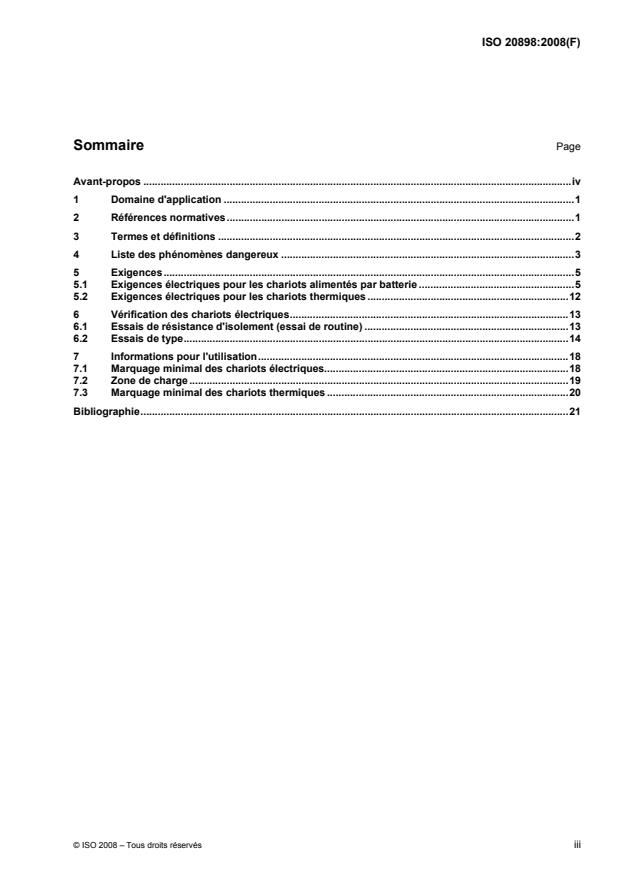
ISO 20898:2008 - Chariots de manutention — Exigences électriques Released:11/5/2008
Overview
ISO 20898:2008 - "Industrial trucks - Electrical requirements" specifies electrical safety, design and verification requirements for self‑propelled industrial trucks (including masted and variable‑reach rough‑terrain trucks) and tow tractors with a rated drawbar pull up to and including 20 000 N. The standard covers trucks with battery voltages defined by ISO 1044 and addresses battery systems, wiring, controls, enclosures and verification tests. It excludes trucks for potentially explosive atmospheres and electromagnetic compatibility (EMC) issues.
Key topics and technical requirements
- Traction batteries and enclosures: requirements for insulated batteries, cell spacing, protection for battery compartments and lockable access where nominal voltages exceed 120 V DC.
- Battery leads and connectors: insulation, temperature and electrolyte resistance; connector design to prevent reverse polarity, recessed live parts and specific IP protection levels (e.g., IP2X for exposed parts, IP23 for coupled connectors).
- Battery charging: prohibition on energizing drive circuits during external charging (except trucks designed for permanent charging); on‑board chargers must meet IEC 60204‑1 provisions.
- Emergency disconnects: ergonomic placement and capacity to interrupt motor starting currents; rules on use of connectors and manual switches for emergency switching off.
- Power and control circuits: separation and protection of power versus auxiliary/control circuits, wiring construction and overcurrent protection.
- Verification and testing: production (routine) tests such as insulation‑resistance checks and type tests including abnormal‑operation, connector and contactor testing, and arc‑rupture verification.
- Hazard listing and risk guidance: identification of mechanical, electrical, thermal and material hazards and related mitigations (referencing ISO 14121‑1 and ISO 12100‑2).
Practical applications - who uses ISO 20898:2008
- OEMs and design engineers developing electric industrial trucks and tow tractors to meet international electrical safety requirements.
- Safety and compliance teams specifying electrical protection, emergency disconnects, battery enclosures and labelling.
- Test laboratories and inspection bodies performing routine and type tests (insulation resistance, connector/contactor tests).
- Fleet managers and service technicians setting maintenance, charging area and marking procedures to reduce fire, shock and functional‑failure risks.
- Purchasing and procurement professionals who specify compliant trucks and chargers for material‑handling operations.
Related standards
- ISO 1044 (battery voltages), ISO 12100‑2 (machine safety principles), ISO 14121‑1 (risk assessment), ISO 13849‑1 (safety‑related control system design), IEC 60204‑1 (electrical equipment of machines – mains powered requirements), EN 50272‑3, IEC 60529 (IP Code), IEC 60947‑5‑1.
ISO 20898:2008 is essential for ensuring electrical safety and reliable operation of battery‑powered industrial trucks, guiding manufacturers and users on battery systems, wiring, controls and verification for safer material‑handling fleets.
Relations
- Effective Date
- 09-Feb-2026
- Effective Date
- 09-Feb-2026
- Effective Date
- 09-Feb-2026
- Effective Date
- 09-Feb-2026
- Effective Date
- 09-Feb-2026
- Effective Date
- 09-Feb-2026
- Effective Date
- 09-Feb-2026
- Effective Date
- 09-Feb-2026
- Effective Date
- 09-Feb-2026
Buy Documents
ISO 20898:2008 - Industrial trucks — Electrical requirements Released:11/5/2008
ISO 20898:2008 - Chariots de manutention — Exigences électriques Released:11/5/2008
Frequently Asked Questions
ISO 20898:2008 is a standard published by the International Organization for Standardization (ISO). Its full title is "Industrial trucks — Electrical requirements". This standard covers: ISO 20898:2008 specifies the electrical requirements for the design and manufacture of self-propelled industrial trucks including masted and variable reach rough terrain trucks (as defined in ISO 5053:1987), and tow tractors with a rated drawbar pull up to and including 20 000 N. It applies to trucks with battery voltages in accordance with ISO 1044. For additional requirements of trucks with mains power, see IEC 60204‑1. ISO 20898:2008 does not apply to trucks used in potentially explosive atmospheres or issues related to electromagnetic compatibility. It does not repeat all the technical rules which are state of the art and which are applicable to the material used to construct the industrial truck, for which reference can be made to ISO 12100‑2.
ISO 20898:2008 specifies the electrical requirements for the design and manufacture of self-propelled industrial trucks including masted and variable reach rough terrain trucks (as defined in ISO 5053:1987), and tow tractors with a rated drawbar pull up to and including 20 000 N. It applies to trucks with battery voltages in accordance with ISO 1044. For additional requirements of trucks with mains power, see IEC 60204‑1. ISO 20898:2008 does not apply to trucks used in potentially explosive atmospheres or issues related to electromagnetic compatibility. It does not repeat all the technical rules which are state of the art and which are applicable to the material used to construct the industrial truck, for which reference can be made to ISO 12100‑2.
ISO 20898:2008 is classified under the following ICS (International Classification for Standards) categories: 53.060 - Industrial trucks. The ICS classification helps identify the subject area and facilitates finding related standards.
ISO 20898:2008 has the following relationships with other standards: It is inter standard links to EN ISO 3691-6:2015, EN ISO 3691-1:2015, EN ISO 3691-5:2015, EN ISO 3691-1:2012, EN ISO 24134:2018, EN ISO 3691-6:2021, EN ISO 3691-5:2009, EN ISO 3691-5:2014/AC:2014, EN ISO 3691-5:2014. Understanding these relationships helps ensure you are using the most current and applicable version of the standard.
ISO 20898:2008 is available in PDF format for immediate download after purchase. The document can be added to your cart and obtained through the secure checkout process. Digital delivery ensures instant access to the complete standard document.
Standards Content (Sample)
INTERNATIONAL ISO
STANDARD 20898
First edition
2008-11-15
Industrial trucks — Electrical
requirements
Chariots de manutention — Exigences électriques
Reference number
©
ISO 2008
PDF disclaimer
This PDF file may contain embedded typefaces. In accordance with Adobe's licensing policy, this file may be printed or viewed but
shall not be edited unless the typefaces which are embedded are licensed to and installed on the computer performing the editing. In
downloading this file, parties accept therein the responsibility of not infringing Adobe's licensing policy. The ISO Central Secretariat
accepts no liability in this area.
Adobe is a trademark of Adobe Systems Incorporated.
Details of the software products used to create this PDF file can be found in the General Info relative to the file; the PDF-creation
parameters were optimized for printing. Every care has been taken to ensure that the file is suitable for use by ISO member bodies. In
the unlikely event that a problem relating to it is found, please inform the Central Secretariat at the address given below.
© ISO 2008
All rights reserved. Unless otherwise specified, no part of this publication may be reproduced or utilized in any form or by any means,
electronic or mechanical, including photocopying and microfilm, without permission in writing from either ISO at the address below or
ISO's member body in the country of the requester.
ISO copyright office
Case postale 56 • CH-1211 Geneva 20
Tel. + 41 22 749 01 11
Fax + 41 22 749 09 47
E-mail copyright@iso.org
Web www.iso.org
Published in Switzerland
ii © ISO 2008 – All rights reserved
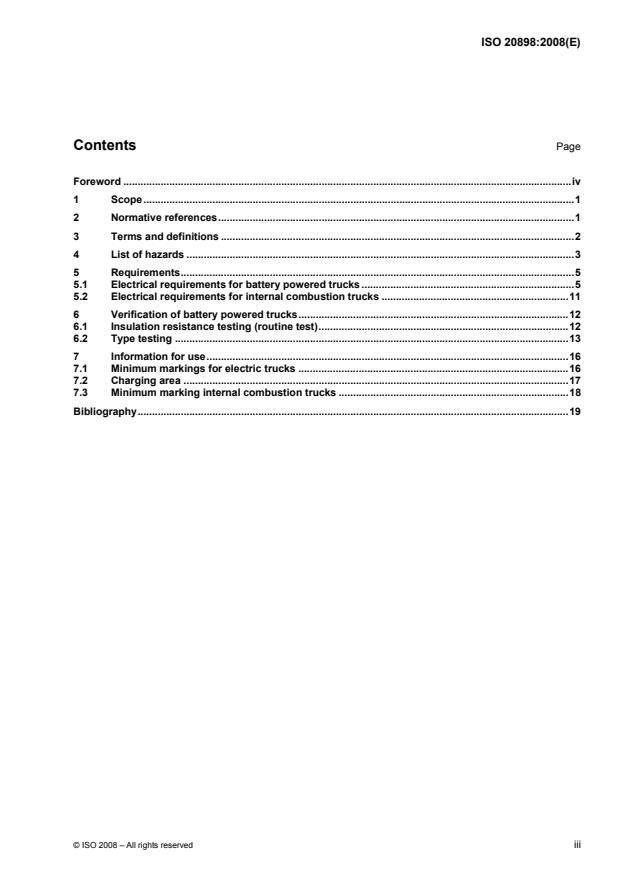
Contents Page
Foreword .iv
1 Scope.1
2 Normative references.1
3 Terms and definitions .2
4 List of hazards .3
5 Requirements.5
5.1 Electrical requirements for battery powered trucks .5
5.2 Electrical requirements for internal combustion trucks .11
6 Verification of battery powered trucks.12
6.1 Insulation resistance testing (routine test).12
6.2 Type testing .13
7 Information for use.16
7.1 Minimum markings for electric trucks .16
7.2 Charging area .17
7.3 Minimum marking internal combustion trucks .18
Bibliography.19
Foreword
ISO (the International Organization for Standardization) is a worldwide federation of national standards bodies
(ISO member bodies). The work of preparing International Standards is normally carried out through ISO
technical committees. Each member body interested in a subject for which a technical committee has been
established has the right to be represented on that committee. International organizations, governmental and
non-governmental, in liaison with ISO, also take part in the work. ISO collaborates closely with the
International Electrotechnical Commission (IEC) on all matters of electrotechnical standardization.
International Standards are drafted in accordance with the rules given in the ISO/IEC Directives, Part 2.
The main task of technical committees is to prepare International Standards. Draft International Standards
adopted by the technical committees are circulated to the member bodies for voting. Publication as an
International Standard requires approval by at least 75 % of the member bodies casting a vote.
Attention is drawn to the possibility that some of the elements of this document may be the subject of patent
rights. ISO shall not be held responsible for identifying any or all such patent rights.
ISO 20898 was prepared by Technical Committee ISO/TC 110, Industrial trucks, Subcommittee SC 2, Safety
of powered industrial trucks.
iv © ISO 2008 – All rights reserved
INTERNATIONAL STANDARD ISO 20898:2008(E)
Industrial trucks — Electrical requirements
1 Scope
This International Standard specifies the electrical requirements for the design and manufacture of self-
propelled industrial trucks including masted and variable reach rough terrain trucks (see ISO 5053:1987,
3.1.3.1.8), and tow tractors with a rated drawbar pull up to and including 20 000 N. This International Standard
applies to trucks with battery voltages in accordance with ISO 1044. For additional requirements of trucks with
mains power, see IEC 60204-1.
This International Standard does not apply to
⎯ trucks used in potentially explosive atmospheres, or
⎯ issues related to electromagnetic compatibility.
This International Standard does not repeat all the technical rules which are state of the art and which are
applicable to the material used to construct the industrial truck, for which reference can be made to
ISO 12100-2.
2 Normative references
The following referenced documents are indispensable for the application of this document. For dated
references, only the edition cited applies. For undated references, the latest edition of the referenced
document (including any amendments) applies.
ISO 1044, Industrial trucks — Lead-acid traction batteries for electric trucks — Preferred voltages
ISO 12100-2, Safety of machinery — Basic concepts, general principles for design — Part 2: Technical
principles
ISO 14121-1, Safety of machinery — Risk assessment — Part 1: Principles
ISO 13849-1, Safety of machinery — Safety-related parts of control systems — Part 1: General principles for
design
EN 50272-3, Safety requirements for secondary batteries and battery installations — Part 3: Traction batteries
IEC 60204-1:2005, Safety of machinery — Electrical equipment of machines — Part 1: General Requirements
IEC 60947-5-1, Low-voltage switchgear and control gear — Part 5-1: Control circuit devices and switching
elements — Electromechanical control circuit devices
IEC 60384-14, Fixed capacitors for use in electronic equipment — Part 14: Sectional specification: Fixed
capacitors for electromagnetic interference suppression and connection to the supply mains
IEC 60529, Degrees of protection provided by enclosures (IP Code)
3 Terms and definitions
For the purposes of this document, the following terms and definitions apply.
3.1
arcing part
mechanical device that interrupts current during operation
3.2
auxiliary circuit
electrical circuit that controls lights, fans and other accessories
3.3
battery compartment
compartment on the truck that houses the battery
3.4
battery enclosure
container or tray that houses the individual cells
3.5
control circuit
electrical circuitry that controls truck movement
3.6
deactivate
make inactive or ineffective.
3.7
direct contact
contact of person with live parts
3.8
electrical enclosure
compartment on a truck that houses uninsulated live electrical components
3.9
electrical or electronic steering
system where input is not mechanically connected to output
3.10
exposed conductive part
conductive part of electrical equipment, which can be touched and which is not normally live, but which may
become live under fault condition
3.11
frame fault
accidental connection of a live part to the truck structure
3.12
indirect contact
contact of persons with exposed conductive parts which have become live under fault conditions
3.13
live part
conductor or conductive part intended to be energized in normal use
2 © ISO 2008 – All rights reserved
3.14
nominal current
current in amperes that the electrical system is able to carry continuously without exceeding the allowable
temperature indicated
3.15
nominal voltage (of the truck system)
total number of battery cells connected in series in the truck’s system multiplied by the nominal cell voltage
3.16
power circuit
electrical circuitry that supplies the motors which cause truck movement, i.e. traction, steering and lifting
3.17
rated operating current
I
e
value of current which is determined by the conditions of use of the contactor
3.18
rated thermal current
I
th
value of current which determines the temperature rise conditions of the main circuit in the absence of any
closing or opening operation of the contacts
3.19
risk of fire
any device that has a surface temperature greater than 175 °C or that emits sparks outside of its enclosure
3.20
routine test
test required for all production trucks
3.21
type test
test to verify compliance with this International Standard for each truck type
4 List of hazards
Table 1 contains all the significant hazards, hazardous situations and events, as far as they are dealt with in
this International Standard, from ISO 14121-1:2007, Annex A and referenced in brackets, and are applicable
in the situations described and could involve risks to persons if not addressed. The corresponding
requirements offer guidance to limit the risk or reduce the hazard in each situation.
Table 1 — List of significant hazards, hazardous situations and hazardous events
Hazard Corresponding requirements
1 Mechanical hazards 5.1.11 Slack chains
Crushing hazard (1.1) 5.1.12 Low voltage
⎯ between truck components 5.1.14 Controls — General
⎯ between truck and obstacles 5.1.15 Controls — Travel
Impact by collision (20) 5.1.16 Controls — Load handling
⎯ when driven by the operator 5.1.17 Controls — Steering
Loss of stability (18) 5.1.18 Contactors
⎯ from excess speed 7.1 Minimum marking electric trucks
⎯ from faulty battery mass 7.3 Minimum marking IC trucks
2 Electrical hazards 5.1.1 Traction batteries
Electric shock (2.1) 5.1.2 Battery leads
Overloading 5.1.3 Battery connectors
⎯ all voltages 5.1.4 Battery charging
5.1.5 Emergency switching off requirements
5.1.6 Design construction
5.1.8 Wiring and wire construction
5.1.9 Electrical shock protection
5.1.13 Overcurrent protective devices
5.2.1 Battery
5.2.2 Circuit protection
5.2.3 Control systems
5.2.4 Wiring and wire construction
5.2.5 Electrical shock protection
6.2.1 Abnormal operation
120 V < voltages u 240 V 5.1.1 Traction batteries
5.1.7 Trucks with nominal voltage exceeding 120 V dc
3 Thermal hazards 6.2.2 Temperature
7 Material/substance hazards 5.1.1 Traction batteries
Battery electrolyte 5.1.2 Battery leads
Fire or explosion hazard (all voltages) 5.1.3 Battery connectors
5.1.4 Battery charging
5.1.5 Emergency switching off requirements
5.1.6 Design construction
6.1 Insulation resistance testing
6.2.1 Abnormal operation
4 © ISO 2008 – All rights reserved
Table 1 (continued)
Hazard Corresponding requirements
6.2.3 Arc rupture
6.2.5 Connector testing
6.2.6 Contactor testing
120 V < voltages u 240 V 5.2.8 Trucks with nominal voltage exceeding 120 V dc
7.1 Minimum marking electric trucks
7.3 Minimum marking IC trucks
4.5 Ergonomic hazards (8) 7.1 Minimum marking electric trucks
4.5.1 Human error (8.6) 7.3 Minimum marking IC trucks
4.6 Hazards due to functional disorders (10) 5.2.13 Low voltage
5.2.15 Controls — General
4.6.1 Failure of energy supply 5.2.16 Controls — Travels
4.6.2 Failure of control system 5.2.17 Controls — Load handling
4.6.3 Loss of machine stability 5.2.18 Control — Steering
5.2.19 Contactors
5.3.2 Circuit protection
5.3.3 Control systems
5 Requirements
5.1 Electrical requirements for battery powered trucks
5.1.1 Traction batteries
5.1.1.1 All trucks shall be equipped with an insulated battery.
5.1.1.2 Cells assembled in metal containers shall be insulated from each other.
5.1.1.3 The cell connections shall be such that the potential between any two adjacent cells cannot be
more than 24 V dc nominal.
5.1.1.4 For battery terminals, measures shall be taken to reduce risk of a connection coming loose
causing arcing or overheating.
5.1.1.5 On trucks equipped with an on-board battery charger, the battery terminals shall be protected by
insulating boots or covers.
Exception No. 1: A terminal that is intentionally connected to ground on the truck frame need not be provided
with a boot or cover.
Exception No. 2: This requirement does not apply to on-board battery chargers complying with 5.1.1.6
equipped with a ground-fault circuit interrupter or an isolated output.
5.1.1.6 When trucks are fitted with on-board chargers the requirements in IEC 60204-1:2005, 6.3 up to
and including 6.3.2, 7.2.1 and 8 up to and including 8.2 shall apply. The enclosure containing equipment
connected to the mains supply shall be IPxxB of IEC 60529. However, for top surfaces the degree of
protection shall be at least IPxxD.
5.1.1.7 For batteries with nominal voltages exceeding 120 V dc, the battery enclosure shall be lockable or
facilities shall be provided so that the battery compartment can be secured to prevent unauthorized access to
the battery if a lockable cover is not present on the battery enclosure.
5.1.1.8 For batteries with nominal voltages exceeding 120 V dc the following protective measures against
indirect contact can be selected:
a) protective electrical insulation or;
b) protection by earth - free equipotential bonding or;
c) protection by automatic disconnection or signalling.
5.1.1.9 A battery enclosure where the battery nominal voltage exceeds 120 V dc shall be:
a) metal and lined with a material bonded to the metal that is impervious to the electrolyte or,
b) constructed of an insulating material.
5.1.2 Battery leads
5.1.2.1 A battery lead for battery nominal voltage up to and including 120 V dc shall be:
a) acceptable for application due to cross section of wires and thickness of insulation (see IEC 60227-1 and
IEC 60245-1);
b) insulated with a suitable material rated for the temperatures and voltages of the truck;
c) resistant to the electrolyte;
d) able to withstand flexing, handling, and impact at temperatures referenced in 5.1.3.2;
e) average insulation thickness shall not be less than 1,5 mm for a wire less than or equal to 35 mm and
shall not be less than 2 mm for a wire greater than 35 mm .
5.1.2.2 A battery lead where the battery nominal voltage exceeds 120 V dc shall meet the requirements
of IEC 60204-1:2005.
5.1.3 Battery connectors
5.1.3.1 If a battery connector is installed, one part of the connector shall be permanently mounted to
either the truck or the battery enclosure. The length of the cable attached to the free part of the connector
shall be as short as practicable, without interfering with the connector mating, operational efficiency or
disconnecting operations and without placing stress on terminals and leads. (See 5.1.2.)
5.1.3.2 The battery connector shall be rated for the voltage of the battery and be designed for use in the
application and shall be resistant to battery electrolyte and battery gases. Connectors shall have a minimum
temperature rating of −20 °C to +90 °C and comply with the tests defined in 6.2.5.
5.1.3.3 The connector shall be designed so that opposite polarities can not be coupled together. Different
operating voltages shall be indicated either by colour or by a coding device to prevent charger/battery/truck
mismatch.
5.1.3.4 The half-connector connected permanently to the battery shall be protected against the accidental
contact of persons with energized parts. Live parts shall be recessed from the face of the connectors. For
battery voltage greater than 60 V dc, protection shall be IP2X or higher, in accordance with IEC 60529.
5.1.3.5 When the two half-connectors are coupled their enclosure shall provide a degree of protection
IP23, in accordance with IEC 60529.
6 © ISO 2008 – All rights reserved
5.1.3.6 Any two half-connectors which may be separated by a force less than 15 N shall be equipped
with a device to ensure the connection remain secure. A handle may be devised to facilitate connection or
disconnection.
5.1.3.7 The connector shall meet the type test described in 6.2.5.
5.1.4 Battery charging
5.1.4.1 When external-charging supply cables are connected to the truck or to the truck battery it shall
not be possible to energize the truck movement circuits. This does not apply to trucks designed for permanent
charging during operation.
5.1.4.2 For nominal battery voltages exceeding 120 V dc, the charger shall be controlled via the
connector auxiliary contacts or other device to prevent arcing at the connector and to ensure the charger is
not energized until it is connected to the battery.
5.1.5 Emergency switching off requirements (disconnection) connections for batteries
5.1.5.1 An emergency switching off control or battery connector when used as an emergency switching
off device shall be accessible to the operator in the normal operating position at all times.
5.1.5.2 The emergency switching off device shall be capable of interrupting without danger the power
supplies to all moving elements. It shall be capable of interrupting the normal maximum current (including
motor starting current) by one of the following methods:
a) battery connector for nominal battery voltage up to and including 120 V dc. Above 120 V dc, provision
shall be made to prevent the use of the battery connector for emergency switching off purposes;
b) manually actuated power switch directly disconnecting one line of power supply;
c) manually actuated control switch disconnecting the power supply to the coil of one contactor in one line of
the power supply. Simultaneously the power controller (e.g. inverter or controller for separate excited
motors) shall be deactivated. In trucks driven by series-wound dc motor(s) with mechanical commutator
without power controller, two independent contactors are necessary to switch off battery supply.
In the case of b) or c) they shall be a positive action type in accordance with IEC 60947-5-1 and the actuator
coloured red. See also IEC 60947-3. A contrasting colour shall be used if the background is red.
It shall be possible to re-establish the power supply to the moving elements only by manual resetting of the
switching off device followed by the normal operation of the controls.
5.1.5.3 If the battery connector is used as an emergency switching off system, the removable part of the
connector shall have a means for disconnecting without damage to the battery connectors or cables.
When the connector is used for emergency switching off, the device shall be capable of being disconnected
quickly in case of emergency and the two half-connectors shall be able to be separated easily. The maximum
force to separate the two half connectors shall not exceed 150 N.
5.1.6 Design construction
5.1.6.1 Any arcing part in a power circuit shall be enclosed or installed so as to avoid the possibility of
flame or molten metal causing a risk of fire.
5.1.6.2 Sparking components or components which can reach a temperature of 300 °C or more shall not
be located where explosive gas/air mixtures may be present, e.g. above or close to a battery where the
hydrogen concentration exceeds 4 % hydrogen by volume [lower explosion limit (LEL)] either during charging
or discharging. Battery connectors shall be accepted as non-sparking components provided they are not used
as an emergency switching-off device.
5.1.6.3 Contactors and fuses shall be located so as to be accessible for servicing, such as complete
replacement or the replacement of contacts and inspection after the removal of a cover or covers. Other
arcing and operating parts shall be accessible for servicing and inspection.
5.1.6.4 There shall be no electrical connection to the truck frame, with the exception of:
a) frame fault detection system;
b) lighting and ancillary equipment, provided that its input voltage does not exceed 60 V dc (nominal) and it
is galvanically separated from the main power source;
c) earthing during charging when using on-board chargers;
d) suppression capacitors, minimum standard Class Y in IEC 60384-14, if input voltage exceeds 60 V dc;
e) the screen of screened (shielded) cables and components. This condition shall meet the requirements of
the insulation resistance testing in 6.1.
5.1.6.5 After switching off the power supply the voltage of charged capacitors with a capacity greater than
60 µF shall be discharged below 60 V within 5 s, see IEC 60204-1:2005, 6.2.4. Alternatively, provide a
warning label instructing to discharge the capacitor.
5.1.7 Trucks with nominal battery voltage exceeding 120 V dc
5.1.7.1 Control and auxiliary circuits shall have a voltage not exceeding 120 V dc and shall be
galvanically separated from the main power source. Circuits for heating purposes and battery state of charge
instrumentation are excepted.
5.1.7.2 Equipotential bonding shall be provided between the frame of the vehicle and metallic electrical
enclosures (e.g. motor frames).
5.1.7.3 An automatic device for frame fault detection for circuits directly connected to the main power
source shall give an audible and/or visual signal, or alternatively bring the truck to a controlled stop and de-
energise the truck in the event of a fault.
5.1.8 Wiring and wire construction
5.1.8.1 Multi-core cables shall have insulation for the circuit of the highest voltage.
5.1.8.2 Cross-sectional area of a conductor shall be sized so conductor temperature does not exceed the
temperature rating of insulation used.
5.1.8.3 Copper conductors external to enclosures (excluding short connections between electric or
electronic components and wires that are an integral part of proprietary components) shall be flexible enough
for application and be of suitable mechanical strength for application.
5.1.8.4 All conductors shall be either effectively insulated and where necessary protected against
mechanical damage or shall be so placed and safeguarded as to avoid damage when the truck is in its normal
operating condition. Wiring that flexes during normal operation of the truck functions shall be relieved of
mechanical strain at their electrical termination. Protection for insulated leads inside the operator’s
compartment is not required if leads are not subject to damage by the operator.
5.1.8.5 Power terminals shall be of such a size and shape as to provide the necessary capacity and
mechanical support for the conductors connected to it. For power terminals, measures shall be taken to
reduce risk of a loose connection causing overheating or arcing.
8 © ISO 2008 – All rights reserved
5.1.8.6 Installation of truck manufacturer’s approved electrical accessories for field installation by
qualified personnel should be capable of installation without major disturbances of factory installed wiring or
require cutting, splicing or soldering of terminals. Electrical accessories shall meet the requirements of this
International Standard.
5.1.8.7 Wiring and cables shall not be exposed to contamination by lubricants and shall not be supported
on surfaces that are unsuitable for their insulation class, or retain lubricants.
5.1.9 Electrical Shock Protection [direct contact and indirect contact (spacing)]
5.1.9.1 Uninsulated live parts of trucks in operating condition shall be protected to a degree of IPxxB
preventing direct contact. For top surfaces, the minimum degree shall be IPxxD in accordance with IEC 60529.
5.1.9.2 Protection against indirect contact shall be achieved by electric separation in accordance with
6.3.2.3 of IEC 60204-1:2005.
5.1.9.3 The cover of an electrical enclosure other than the battery, containing live parts in excess of
battery voltage 60 V dc shall be secured by use of a tool.
5.1.10 Lamps and lampholders
Each lamp and lampholder shall be enclosed by a material rated for the maximum temperature at which it
operates.
5.1.11 Slack/broken chains
Electric or electronic devices, used for detecting slack/broken chains and terminating movement on trucks
designed to travel with an elevated operator position, shall be so designed and fitted that in the event of a
failure, th
...
NORME ISO
INTERNATIONALE 20898
Première édition
2008-11-15
Chariots de manutention — Exigences
électriques
Industrial trucks — Electrical requirements
Numéro de référence
©
ISO 2008
PDF – Exonération de responsabilité
Le présent fichier PDF peut contenir des polices de caractères intégrées. Conformément aux conditions de licence d'Adobe, ce fichier
peut être imprimé ou visualisé, mais ne doit pas être modifié à moins que l'ordinateur employé à cet effet ne bénéficie d'une licence
autorisant l'utilisation de ces polices et que celles-ci y soient installées. Lors du téléchargement de ce fichier, les parties concernées
acceptent de fait la responsabilité de ne pas enfreindre les conditions de licence d'Adobe. Le Secrétariat central de l'ISO décline toute
responsabilité en la matière.
Adobe est une marque déposée d'Adobe Systems Incorporated.
Les détails relatifs aux produits logiciels utilisés pour la création du présent fichier PDF sont disponibles dans la rubrique General Info
du fichier; les paramètres de création PDF ont été optimisés pour l'impression. Toutes les mesures ont été prises pour garantir
l'exploitation de ce fichier par les comités membres de l'ISO. Dans le cas peu probable où surviendrait un problème d'utilisation,
veuillez en informer le Secrétariat central à l'adresse donnée ci-dessous.
DOCUMENT PROTÉGÉ PAR COPYRIGHT
© ISO 2008
Droits de reproduction réservés. Sauf prescription différente, aucune partie de cette publication ne peut être reproduite ni utilisée sous
quelque forme que ce soit et par aucun procédé, électronique ou mécanique, y compris la photocopie et les microfilms, sans l'accord écrit
de l'ISO à l'adresse ci-après ou du comité membre de l'ISO dans le pays du demandeur.
ISO copyright office
Case postale 56 • CH-1211 Geneva 20
Tel. + 41 22 749 01 11
Fax + 41 22 749 09 47
E-mail copyright@iso.org
Web www.iso.org
Publié en Suisse
ii © ISO 2008 – Tous droits réservés
Sommaire Page
Avant-propos .iv
1 Domaine d'application .1
2 Références normatives.1
3 Termes et définitions .2
4 Liste des phénomènes dangereux .3
5 Exigences.5
5.1 Exigences électriques pour les chariots alimentés par batterie .5
5.2 Exigences électriques pour les chariots thermiques .12
6 Vérification des chariots électriques.13
6.1 Essais de résistance d'isolement (essai de routine) .13
6.2 Essais de type.14
7 Informations pour l'utilisation.18
7.1 Marquage minimal des chariots électriques.18
7.2 Zone de charge .19
7.3 Marquage minimal des chariots thermiques .20
Bibliographie.21
Avant-propos
L'ISO (Organisation internationale de normalisation) est une fédération mondiale d'organismes nationaux de
normalisation (comités membres de l'ISO). L'élaboration des Normes internationales est en général confiée
aux comités techniques de l'ISO. Chaque comité membre intéressé par une étude a le droit de faire partie du
comité technique créé à cet effet. Les organisations internationales, gouvernementales et non
gouvernementales, en liaison avec l'ISO participent également aux travaux. L'ISO collabore étroitement avec
la Commission électrotechnique internationale (CEI) en ce qui concerne la normalisation électrotechnique.
Les Normes internationales sont rédigées conformément aux règles données dans les Directives ISO/CEI,
Partie 2.
La tâche principale des comités techniques est d'élaborer les Normes internationales. Les projets de Normes
internationales adoptés par les comités techniques sont soumis aux comités membres pour vote. Leur
publication comme Normes internationales requiert l'approbation de 75 % au moins des comités membres
votants.
L'attention est appelée sur le fait que certains des éléments du présent document peuvent faire l'objet de
droits de propriété intellectuelle ou de droits analogues. L'ISO ne saurait être tenue pour responsable de ne
pas avoir identifié de tels droits de propriété et averti de leur existence.
L'ISO 20898 a été élaborée par le comité technique ISO/TC 110, Chariots de manutention, sous-comité SC 2,
Sécurité des chariots de manutention automoteurs.
iv © ISO 2008 – Tous droits réservés
NORME INTERNATIONALE ISO 20898:2008(F)
Chariots de manutention — Exigences électriques
1 Domaine d'application
La présente Norme internationale spécifie les exigences électriques pour la conception et la fabrication des
chariots de manutention automoteurs, y compris les chariots tout terrain à mât (voir l'ISO 5053:1987,
3.1.3.1.8), et des tracteurs ayant un effort nominal au crochet de 20 000 N au maximum. La présente Norme
internationale s'applique aux chariots alimentés par batteries avec des tensions conformes à l'ISO 1044. Pour
d'autres exigences relatives aux chariots alimentés par le secteur électrique, voir la CEI 60204-1.
La présente Norme internationale ne s'applique pas aux
⎯ chariots utilisés dans des atmosphères potentiellement explosives,
⎯ questions liées à la compatibilité électromagnétique.
La présente Norme internationale ne reprend pas tous les principes techniques qui sont l'état de l'art et qui
s'appliquent au matériau utilisé dans la construction du chariot de manutention. Pour cela, il convient de se
référer à l'ISO 12100-2.
2 Références normatives
Les documents de référence suivants sont indispensables pour l'application du présent document. Pour les
références datées, seule l'édition citée s'applique. Pour les références non datées, la dernière édition du
document de référence s'applique (y compris les éventuels amendements).
ISO 1044, Chariots de manutention — Accumulateurs de traction au plomb pour chariots électriques —
Tensions conseillées
ISO 12100-2, Sécurité des machines — Notions fondamentales, principes généraux de conception —
Partie 2: Principes techniques
ISO 14121-1:2007, Sécurité des machines — Appréciation du risque — Partie 1: Principes
ISO 13849-1, Sécurité des machines — Parties des systèmes de commande relatives à la sécurité —
Partie 1: Principes généraux de conception
EN 50272-3, Règles de sécurité pour les batteries et les installations de batteries — Partie 3: Batteries de
traction
CEI 60204-1:2005, Sécurité des machines — Équipement électrique des machines — Partie 1: Règles
générales
CEI 60947-5-1, Appareillage à basse tension — Partie 5-1: Appareils et éléments de commutation pour
circuits de commande — Appareils électromécaniques pour circuits de commande
CEI 60384-14, Condensateurs fixes utilisés dans les équipements électroniques — Partie 14: Spécification
intermédiaire — Condensateurs fixes d'antiparasitage et raccordement à l'alimentation
CEI 60529, Degrés de protection procurés par les enveloppes (Code IP)
3 Termes et définitions
Pour les besoins du présent document, les termes et définitions suivants s'appliquent.
3.1
pièce susceptible de produire un arc électrique
système mécanique qui coupe le courant pendant le fonctionnement
3.2
circuit auxiliaire
circuit électrique qui commande les éclairages, les ventilateurs et autres accessoires
3.3
coffre de la batterie
compartiment du chariot qui loge la batterie
3.4
enceinte de batterie
conteneur ou bac logeant les différents éléments de batterie
3.5
circuit de commande
circuit électrique qui commande le déplacement du chariot
3.6
désactiver
rendre inactif ou inefficace
3.7
contact direct
contact d'une personne avec des parties sous tension électrique
3.8
enceinte électrique
compartiment d'un chariot qui protège les éléments électriques sous tension qui ne sont pas isolés
3.9
direction électrique ou électronique
système qui n'est pas connecté mécaniquement aux sorties
3.10
élément conducteur exposé
élément conducteur d'un équipement électrique, pouvant être touché et se trouvant hors tension en
fonctionnement normal mais qui, suite à une défaillance, peut se trouver sous tension
3.11
défaut de masse
connexion accidentelle d'une partie alimentée avec la structure des chariots
3.12
contact indirect
contact de personnes avec des éléments conducteurs exposés qui sont sous tension électrique à la suite de
défauts
3.13
partie sous tension
conducteur ou élément conducteur destiné à être alimenté lors d'une utilisation normale
2 © ISO 2008 – Tous droits réservés
3.14
courant nominal
intensité de courant, en ampères, que le système électrique peut fournir continûment sans dépasser la
température admissible indiquée
3.15
tension nominale (du circuit du chariot)
nombre total d'éléments de batterie reliés en série dans le système du chariot, multiplié par la tension
nominale d'un élément
3.16
circuit de puissance
circuit électrique qui alimente les moteurs entraînant le déplacement du chariot, à savoir la traction, la
direction et le levage
3.17
courant nominal de fonctionnement
I
e
valeur de courant qui est déterminée par les conditions d'utilisation du contacteur
3.18
courant thermique nominal
I
th
valeur de courant qui détermine les conditions d'élévation de la température dans un circuit principal, en
l'absence de toute opération d'ouverture ou de fermeture des contacts
3.19
risque d'incendie
tout dispositif qui a une température de surface supérieure à 175 °C ou qui émet des étincelles à l'extérieur de
son enceinte
3.20
essai de routine
essai requis pour tous les chariots de la production
3.21
essai de type
essai effectué pour s'assurer de la conformité à la présente Norme internationale pour chaque type de chariot
4 Liste des phénomènes dangereux
Le Tableau 1 récapitule l'ensemble des phénomènes, des situations et des événements dangereux
significatifs qui, dans la mesure où ils sont traités dans la présente Norme internationale, sont conformes à
l'ISO 14121-1:2007, Annexe A. Ils s'appliquent aux situations décrites et sont susceptibles de constituer un
risque pour les personnes s'ils ne sont pas traités. Les exigences correspondantes présentent des lignes
directrices pour limiter le risque ou réduire le phénomène dangereux propre à chaque situation.
Tableau 1 — Liste de phénomènes, de situations et d'événements dangereux significatifs
Phénomène dangereux Exigences correspondantes
1 Phénomènes dangereux mécaniques 5.1.11 Chaînes détendues
Phénomènes dangereux d'écrasement (1.1) 5.1.12 Basse tension
⎯ entre éléments constitutifs d'un chariot 5.1.14 Systèmes de commande — Généralités
⎯ entre le chariot et des obstacles 5.1.15 Systèmes de commande — Roulage
Choc par collision (20) 5.1.16 Systèmes de commande — Manutention de la
charge
⎯ en cas de conduite par l'opérateur 5.1.17 Systèmes de commande — Direction
Perte de stabilité (18) 5.1.18 Contacteurs
⎯ due à un excès de vitesse 7.1 Marquage minimal des chariots électriques
⎯ due à un défaut de masse de la batterie 7.3 Marquage minimal des chariots thermiques
2 Phénomènes dangereux électriques 5.1.1 Batteries de traction
Choc électrique (2.1) 5.1.2 Câbles de batterie
Surcharge 5.1.3 Connecteurs de batterie
⎯ toutes tensions électriques 5.1.4 Charge de la batterie
5.1.5 Exigences de coupure d'urgence
5.1.6 Éléments de construction au stade de la
conception
5.1.8 Câblage et construction des câbles
5.1.9 Protection contre les chocs électriques
5.1.13 Dispositifs de protection contre les
surintensités
5.2.1 Batterie
5.2.2 Protection du circuit
5.2.3 Systèmes de commande
5.2.4 Câblage et construction des câbles
5.2.5 Protection contre les chocs électriques
6.2.1 Fonctionnement anormal
120 V < tensions u 240 V 5.1.1 Batteries de traction
5.1.7 Chariots avec tension nominale supérieure
à 120 V en courant continu
3 Phénomènes dangereux thermiques 6.2.2 Température
7 Phénomènes dangereux engendrés par les 5.1.1 Batteries de traction
matériaux/produits
Électrolyte de la batterie 5.1.2 Câbles de batterie
Phénomènes dangereux d'incendie ou 5.1.3 Connecteurs de batterie
d'explosion (toutes tensions électriques)
5.1.4 Charge de la batterie
4 © ISO 2008 – Tous droits réservés
Tableau 1 (suite)
Phénomène dangereux Exigences correspondantes
5.1.5 Exigences de coupure d'urgence
5.1.6 Élément de construction au stade
de la conception
6.1 Essais de la résistance d'isolement
6.2.1 Fonctionnement anormal
6.2.3 Rupture d'arc
6.2.5 Essais des connecteurs
6.2.6 Essais des contacteurs
120 V < tensions u 240 V 5.2.8 Chariots avec tension nominale supérieure
à 120 V en courant continu
7.1 Marquage minimal des chariots électriques
7.3 Marquage minimal des chariots thermiques
4.5 Phénomènes dangereux ergonomiques (8) 7.1 Marquage minimal des chariots électriques
4.5.1 Erreur humaine (8.6) 7.3 Marquage minimal des chariots thermiques
4.6 Risques dus à des dysfonctionnements 5.2.13 Tension faible
fonctionnels (10)
5.2.15 Systèmes de commande — Généralités
4.6.1 Défaillance de l'alimentation en énergie 5.2.16 Systèmes de commande — Roulage
4.6.2 Défaillance du système de commande 5.2.17 Systèmes de commande — Manutention
de charges
4.6.3 Perte de stabilité de la machine 5.2.18 Système de commande — Direction
5.2.19 Contacteurs
5.3.2 Protection du circuit
5.3.3 Systèmes de commande
5 Exigences
5.1 Exigences électriques pour les chariots alimentés par batterie
5.1.1 Batteries de traction
5.1.1.1 Tous les chariots doivent être équipés d'une batterie isolée.
5.1.1.2 Les éléments de batterie montés dans des coffres métalliques doivent être isolés les uns des
autres.
5.1.1.3 Les connexions des éléments de batterie doivent être réalisées de telle manière que la différence
de potentiel entre deux éléments contigus quelconque ne puisse pas dépasser 24 V en courant continu
(nominal).
5.1.1.4 Quant aux bornes de batterie, des mesures doivent être prises pour diminuer le risque de
desserrement des connexions susceptible d'être à l'origine d'un arc électrique ou d'une surchauffe.
5.1.1.5 Sur les chariots équipés d'un chargeur de batterie embarqué, les bornes de la batterie doivent
être protégées en isolant les capuchons ou les couvercles.
Exception n°1: il n'est pas nécessaire d'équiper d'un bouchon ou d'un couvercle une borne reliée
intentionnellement à la masse sur le châssis du chariot.
Exception n°2: cette exigence ne s'applique pas aux chargeurs de batterie embarqués conformes à 5.1.1.6,
équipés d'un disjoncteur de fuite à la terre ou d'une sortie isolée.
5.1.1.6 Lorsque des chariots sont équipés de chargeurs embarqués, les exigences de la
CEI 60204-1:2005, 6.3 à 6.3.2 inclus, 7.2.1 et de l'Article 8 à 8.2 inclus, doivent être appliquées. L'enceinte
contenant l'équipement connecté à l'alimentation principale doit être protégée à un degré IPXXB de la
CEI 60529. Cependant, pour les surfaces supérieures, le degré de protection doit être d'au moins IPXXD.
5.1.1.7 Pour les batteries de tensions nominales supérieures à 120 V en courant continu, l'enceinte de la
batterie doit être verrouillable ou bien, si tel n'est pas le cas, elle doit être munie d'un dispositif empêchant
l'ouverture du coffre de la batterie par des personnes non autorisées.
5.1.1.8 Pour les batteries de tensions nominales supérieures à 120 V en courant continu, les mesures de
protection suivantes contre le contact indirect peuvent être choisies:
a) isolation électrique de protection;
b) protection par des liaisons équipotentielles;
c) protection par déconnexion ou signalisation automatique.
5.1.1.9 Une enceinte de batterie dont la tension nominale dépasse 120 V en courant continu doit être
a) métallique avec garniture d'un matériau lié au métal et imperméable à l'électrolyte, ou
b) construite dans un matériau isolant.
5.1.2 Câbles de batterie
5.1.2.1 Un câble de batterie de tension nominale jusqu'à 120 V en courant continu inclus doit
a) être acceptable pour l'application quant à la section des câbles et à l'épaisseur de l'isolation (voir la
CEI 60227-1 et la CEI 60245-1),
b) être isolé au moyen d'un matériau approprié ayant des caractéristiques nominales adaptées aux
températures et tensions du chariot,
c) résister à l'électrolyte,
d) pouvoir supporter la flexion, la manutention et les chocs aux températures mentionnées en 5.1.3.2,
e) l'épaisseur moyenne de l'isolation ne doit être ni inférieure à 1,5 mm pour un câble de section inférieure
2 2
ou égale à 35 mm , ni inférieure à 2,0 mm pour un câble de section supérieure à 35 mm .
5.1.2.2 Un câble de batterie de tension nominale supérieure à 120 V en courant continu doit satisfaire
aux exigences de la CEI 60204-1.
6 © ISO 2008 – Tous droits réservés
5.1.3 Connecteurs de batterie
5.1.3.1 Si un connecteur de batterie est installé, une partie du connecteur doit être raccordée en
permanence au chariot ou bien à l'enceinte de la batterie. Le câble fixé à la partie libre du connecteur doit être
le moins long possible, sans que cela entrave l'accouplement du connecteur ou compromette son efficacité
opérationnelle ou les opérations de déconnexion et sans induire de contrainte sur les bornes et sur les câbles.
(Voir 5.1.2.)
5.1.3.2 Le connecteur de la batterie doit être choisi en fonction de la tension de la batterie et être conçu
pour être utilisé dans l'application. Il doit également résister à l'électrolyte et aux gaz de la batterie. Les
connecteurs doivent avoir des températures nominales minimales comprises entre −20 °C et + 90 °C et être
conformes aux essais définis en 6.2.5.
5.1.3.3 Le connecteur doit être conçu de telle sorte que des polarités opposées ne puissent pas être
couplées ensemble. Les différentes tensions de fonctionnement doivent être indiquées par un code de
couleur ou bien par un dispositif de codage, afin d'éviter toute discordance entre chargeur/batterie/chariot.
5.1.3.4 Le demi-connecteur raccordé en permanence à la batterie doit être protégé afin d'éviter tout
contact accidentel de personnes avec les parties sous tension. Les parties sous tension doivent être en retrait
par rapport à la face des connecteurs. Pour les tensions de batterie supérieures à 60 V en courant continu, le
degré de protection doit être supérieur ou égal à IP2X, selon la CEI 60529.
5.1.3.5 Lorsque les deux demi-connecteurs sont accouplés, leur enceinte doit assurer un degré de
protection IP23, selon la CEI 60529.
5.1.3.6 Toute paire de demi-connecteurs qui peuvent être séparés par une force inférieure à 15 N doit
être équipée d'un dispositif garantissant la sécurité de la connexion. Une manette peut être prévue pour
faciliter la connexion ou la déconnexion.
5.1.3.7 Le connecteur doit satisfaire à l'essai de type décrit en 6.2.5.
5.1.4 Charge de la batterie
5.1.4.1 Lorsque les câbles externes de charge sont connectés au chariot ou à la batterie du chariot, il ne
doit pas être possible d'alimenter les circuits commandant les mouvements du chariot. Cela ne s'applique pas
aux chariots conçus pour une mise en charge permanente en cours de fonctionnement.
5.1.4.2 Pour les tensions nominales de batterie supérieures à 120 V en courant continu, le chargeur doit
être commandé par l'intermédiaire des contacts auxiliaires du connecteur ou d'autres dispositifs pour
empêcher les arcs électriques au niveau du connecteur et pour s'assurer que le chargeur est hors tension tant
qu'il n'est pas connecté à la batterie.
5.1.5 Exigences de coupure d'urgence (déconnexion) des connexions pour les batteries
5.1.5.1 Une commande de coupure d'urgence ou un connecteur de batterie utilisé comme dispositif de
coupure d'urgence doit être accessible à l'opérateur à tout moment dans la position normale de conduite.
5.1.5.2 Le dispositif de coupure d'urgence doit permettre une interruption sans danger de l'alimentation
électrique de tous les éléments mobiles. Il doit permettre de couper le courant maximal normal (y compris le
courant de démarrage du moteur) par l'une des méthodes suivantes:
a) connecteur de batterie pour une tension nominale de batterie jusqu'à 120 V en courant continu inclus.
Au-delà de 120 V en courant continu, des dispositions doivent être prises pour empêcher l'utilisation du
connecteur à des fins de coupure d'urgence;
b) interrupteur de puissance actionné manuellement qui déconnecte directement une ligne d'alimentation
d'énergie;
c) interrupteur de commande actionné manuellement qui déconnecte l'alimentation électrique de la bobine
d'un contacteur dans une ligne d'alimentation d'énergie. Simultanément, le contrôleur de puissance doit
être désactivé (par exemple un convertisseur ou un contrôleur pour des moteurs distincts). Dans les
chariots ayant un ou plusieurs moteurs à courant continu excités en série avec un commutateur
mécanique, et un contrôleur de puissance, deux contacteurs indépendants sont nécessaires pour couper
l'alimentation de la batterie.
Dans les cas b) ou c), les interrupteurs doivent être à action positive, conformément à la CEI 60947-5-1, et
l'actionneur doit être de couleur rouge. Voir également la CEI 60947-3. Si l'arrière-plan est rouge, une couleur
de contraste doit être utilisée.
Seul un réarmement manuel du dispositif de coupure suivi du fonctionnement normal des commandes doit
permettre de réactiver l'alimentation électrique des éléments mobiles.
5.1.5.3 Si le connecteur de batterie est utilisé comme système de coupure d'urgence, la partie amovible
du connecteur doit comporter un dispositif permettant la déconnexion sans endommager les connecteurs ou
les câbles de la batterie.
Lorsque le connecteur est utilisé comme système de coupure d'urgence, le dispositif doit pouvoir être
débranché rapidement en cas d'urgence et les deux demi-conducteurs doivent pouvoir être séparés
facilement. La force maximale nécessaire pour séparer les deux demi-connecteurs ne doit pas dépasser
150 N.
5.1.6 Éléments de construction au stade de la conception
5.1.6.1 Toute pièce susceptible de produire un arc électrique, située dans un circuit de puissance, doit
être enfermée ou bien installée afin d'éliminer tout risque d'incendie dû à une flamme ou à un métal fondu.
5.1.6.2 Les pièces sources d'étincelles ou les pièces qui peuvent atteindre une température de 300 °C ou
plus ne doivent pas être situées aux endroits où peuvent se produire des mélanges explosifs de gaz/air, par
exemple au-dessus ou à proximité d'une batterie, où la concentration d'hydrogène dépasse 4 % d'hydrogène
en volume [limite inférieure d'explosibilité (LEL)], pendant la charge ou la décharge. Les connecteurs de
batterie doivent être considérés comme des pièces qui ne sont pas sources d'étincelles, à condition qu'ils ne
soient pas utilisés comme dispositif de coupure d'urgence.
5.1.6.3 Les contacteurs et les fusibles doivent être placés à des endroits où ils sont accessibles pour les
opérations d'entretien, telles qu'un remplacement complet ou un remplacement des contacts, ainsi que pour
examen après la dépose du ou des couvercles. Les autres pièces de garde d'arc et de fonctionnement
doivent être accessibles pour les opérations d'entretien et d'inspection.
5.1.6.4 Il ne doit pas exister de connexion électrique au châssis du chariot, sauf pour les exceptions
suivantes:
a) système de détection des défauts de masse;
b) éclairage et équipements auxiliaires, à la condition que leur tension de service ne dépasse pas 60 V en
courant continu (nominal) et qu'ils soient séparés de la source d'alimentation principale par une isolation
galvanique;
c) mise à la terre pendant la charge en cas d'utilisation de chargeurs embarqués;
d) condensateurs antiparasites, classe standard minimale Y de la CEI 60384-14, si la tension d'entrée
dépasse 60 V en courant continu;
e) blindage des câbles et composants blindés. Cette condition doit satisfaire aux exigences relatives à
l'essai de résistance d'isolement (voir 6.1).
5.1.6.5 Après coupure de l'alimentation électrique, la tension des condensateurs chargés avec une
capacité supérieure à 60 µF doit être déchargée en dessous de 60 V en 5 s au maximum (voir la
CEI 60204-1:2005, 6.2.4). Une solution de remplacement consiste à fournir une étiquette avertissant qu'il faut
décharger le condensateur.
8 © ISO 2008 – Tous droits réservés
5.1.7 Chariots avec une tension nominale de batterie supérieure à 120 V en courant continu
5.1.7.1 Les circuits de commande et les circuits auxiliaires doivent avoir une tension inférieure ou égale à
120 V en courant continu et ils doivent être séparés de la source d'alimentation principale par une isolation
galvanique. Les circuits destinés au chauffage et les instruments de charge de la batterie font exception.
5.1.7.2 Des liaisons équipotentielles doivent être prévues entre le châssis du véhicule et les enceintes
électriques métalliques (par exemple les bâtis moteurs).
5.1.7.3 Pour les circuits en contact direct avec la source principale d'alimentation, un dispositif
automatique pour la détection des défauts au niveau du châssis doit déclencher un signal audible et/ou visuel,
ou bien doit commander l'arrêt du chariot et provoquer sa mise hors service en cas de défaillance.
5.1.8 Câblage et construction des câbles
5.1.8.1 Les câbles multiconducteurs doivent disposer d'une isolation pour le circuit correspondant à la
tension la plus élevée.
5.1.8.2 La section d'un conducteur doit être dimensionnée de sorte que la température du conducteur ne
dépasse pas la température nominale de l'isolation utilisée.
5.1.8.3 Les conducteurs en cuivre extérieurs aux enceintes (à l'exclusion des connexions courtes entre
composants électriques ou électroniques et fils faisant partie intégrante d'un composant exclusif) doivent être
souples et avoir une résistance mécanique appropriée à l'application considérée.
5.1.8.4 Tous les conducteurs doivent être soit efficacement isolés et le cas échéant protégés contre toute
détérioration mécanique, soit placés et protégés de manière à éviter tout dommage lorsque le chariot se
trouve dans des conditions normales de conduite. Les fils qui bougent pendant l'exécution normale des
fonctions du chariot doivent être préservés de toute contrainte mécanique au niveau de leur connexion
électrique. Si les câbles ne sont pas susceptibles d'être endommagés par l'opérateur, une protection pour les
câbles isolés situés à l'intérieur du compartiment de l'opérateur est inutile.
5.1.8.5 Les bornes de puissance doivent avoir une taille et une forme conçues pour fournir la capacité
nécessaire et le support mécanique indispensable aux conducteurs qui leur sont connectés. Quant aux
bornes de puissance, des mesures doivent être prises pour diminuer le risque de desserrement des
connexions susceptible d'être à l'origine d'une surchauffe ou d'un arc.
5.1.8.6 Il convient que les accessoires électriques approuvés, livrés par le fabricant du chariot et destinés
à être installés in situ par du personnel qualifié, puissent l'être en modifiant le moins possible le câblage mis
en place en usine et sans couper, épisser ou souder les bornes. Les accessoires électriques doivent satisfaire
aux exigences de la présente Norme internationale.
5.1.8.7 Le câblage et les câbles doivent être protégés de toute contamination par des lubrifiants. Seules
des surfaces correspondant à leur classe d'isolation peuvent leur servir de support. Ils ne doivent pas retenir
des lubrifiants.
5.1.9 Protection contre les chocs électriques [contacts directs et contacts indirects (espacement)]
5.1.9.1 Dans les conditions de fonctionnement du chariot, ses parties sous tension non isolées doivent
être protégées à un degré IPXXB empêchant tout contact direct. Pour les surfaces supérieures, le degré
minimal de protection doit être IPXXD, conformément à la CEI 60529.
5.1.9.2 La protection contre les contacts indirects doit être obtenue par séparation électrique,
conformément à la CEI 60204-1:2005, 6.3.2.3.
5.1.9.3 Le couvercle d'une enceinte électrique contenant des parties sous tension de plus de 60 V en
courant continu doit être sécurisé par l'utilisation d'un outil.
5.1.10 Ampoules et douilles
Chaque ensemble ampoule et douille doit être enfermé par un matériau approprié à sa température maximale
de fonctionnement.
5.1.11 Chaînes détendues/cassées
Les dispositifs électriques ou électroniques utilisés pour détecter des chaînes détendues/cassées et pour
arrêter le mouvement de la charge, sur des chariots conçus pour se déplacer avec l'opérateur en position
élevée, doivent être conçus et installés de façon que la fonction d'arrêt du mouvement soit préservée en cas
de défaut.
Si la détection est réalisée par des interrupteurs à commande mécanique qui désactivent directement la
fonction de montée et d'abaissement, ces interrupteurs doivent être à ouverture positive conformément à la
CEI 60947-5-1.
Si la détection est réalisée au moyen d'autres types d'interrupteurs ou de capteurs utilisés avec un ci
...