

ISO/PAS 24969:2025
(Main)Tourism and related services — Guidance on a contingency plan for infection prevention and control (IPC) in the exhibition industry
General Information
- Abstract
This document specifies a contingency plan with a set of actions and protocols, associated with infection prevention and control (IPC), to be implemented in response to any infectious disease outbreak, applicable during the entire cycle of an exhibition, i.e. its planning, operating and evaluating stages. The contingency plan in this document focuses on the following elements: risk assessment, surveillance and early detection, continuity of essential services, capacity building and rapid response mechanism. The contingency plan describes recommendations for organizers, venue operators, service providers, exhibitors and participants in terms of their roles and responsibilities at each stage of the exhibition during an infectious disease outbreak.
- Status
- Published
- Publication Date
- 27-Oct-2025
- Technical Committee
- ISO/TC 228 - Tourism and related services
- Drafting Committee
- TC 354 - ISO/TC 354
- Current Stage
- 6060 - International Standard published
- Start Date
- 28-Oct-2025
- Due Date
- 19-Jun-2025
- Completion Date
- 28-Oct-2025

Overview - ISO/PAS 24969:2025 (IPC contingency plan for exhibitions)
ISO/PAS 24969:2025 provides guidance for developing a contingency plan for infection prevention and control (IPC) specifically tailored to the exhibition industry. Published as a Publicly Available Specification (first edition, 2025), it covers IPC measures to be implemented across the entire exhibition cycle - planning, operating and evaluating - and defines roles and responsibilities for organizers, venue operators, service providers, exhibitors and participants. The document aligns incident management approaches with the ISO 22320 framework for emergency response.
Key topics and technical requirements
The standard focuses on practical IPC elements and structured response mechanisms, including:
- Risk assessment: responsibilities, processes and infection risk measurement to evaluate outbreak likelihood and impact.
- Surveillance and early detection: monitoring and reporting mechanisms to identify cases and signals rapidly.
- Continuity of essential services: plans to maintain critical exhibition operations during an outbreak.
- Capacity building: training, resource allocation and preparedness measures for staff and partners.
- Rapid response mechanism: predefined actions and escalation pathways for outbreak scenarios.
- Infection-related incident management: a management process, structure, roles and resource management for containment and recovery.
- Operational controls such as personal protective equipment (PPE), recommended disinfectants, entrances/exits/signage, queuing and physical distancing measures.
- Communication and education strategies for pre-event, during-event and post-event phases.
- Practical recommendations by stakeholder: organizer, venue operator, service provider and exhibitor (planning, build-up, operation, tear-down).
Practical applications and users
ISO/PAS 24969:2025 is intended for professionals who plan, run or support exhibitions and trade events:
- Exhibition organizers and event planners - to design IPC contingency plans and communications.
- Venue operators and facilities managers - to implement venue-specific hygiene, ventilation and traffic-flow controls.
- Service providers (catering, cleaning, logistics, security) - to integrate IPC into contracts and operations.
- Exhibitors and stand-builders - to apply disinfection and distancing measures during build-up, operation and tear-down.
- Public health advisors, emergency managers and industry associations - to harmonize event-level IPC protocols with local health guidance.
Related standards
- ISO 22320 (incident response framework) - referenced for structure and process of infection-related incident management.
- Other sectoral IPC or public health guidance may be used alongside ISO/PAS 24969:2025 for local regulatory compliance.
Keywords: ISO/PAS 24969:2025, infection prevention and control, IPC contingency plan, exhibition industry, risk assessment, surveillance, rapid response, organizers, venue operators.
Get Certified
Connect with accredited certification bodies for this standard

CIS Institut d.o.o.
Personal Protective Equipment (PPE) certification body. Notified Body NB-2890 for EU Regulation 2016/425 PPE.

Kiwa BDA Testing
Building and construction product certification.
Kmetijski inštitut Slovenije
Agricultural Institute of Slovenia. Soil testing, plant health, agricultural product analysis.
Sponsored listings
Frequently Asked Questions
ISO/PAS 24969:2025 is a technical specification published by the International Organization for Standardization (ISO). Its full title is "Tourism and related services — Guidance on a contingency plan for infection prevention and control (IPC) in the exhibition industry". This standard covers: This document specifies a contingency plan with a set of actions and protocols, associated with infection prevention and control (IPC), to be implemented in response to any infectious disease outbreak, applicable during the entire cycle of an exhibition, i.e. its planning, operating and evaluating stages. The contingency plan in this document focuses on the following elements: risk assessment, surveillance and early detection, continuity of essential services, capacity building and rapid response mechanism. The contingency plan describes recommendations for organizers, venue operators, service providers, exhibitors and participants in terms of their roles and responsibilities at each stage of the exhibition during an infectious disease outbreak.
This document specifies a contingency plan with a set of actions and protocols, associated with infection prevention and control (IPC), to be implemented in response to any infectious disease outbreak, applicable during the entire cycle of an exhibition, i.e. its planning, operating and evaluating stages. The contingency plan in this document focuses on the following elements: risk assessment, surveillance and early detection, continuity of essential services, capacity building and rapid response mechanism. The contingency plan describes recommendations for organizers, venue operators, service providers, exhibitors and participants in terms of their roles and responsibilities at each stage of the exhibition during an infectious disease outbreak.
ISO/PAS 24969:2025 is classified under the following ICS (International Classification for Standards) categories: 13.200 - Accident and disaster control. The ICS classification helps identify the subject area and facilitates finding related standards.
ISO/PAS 24969:2025 is available in PDF format for immediate download after purchase. The document can be added to your cart and obtained through the secure checkout process. Digital delivery ensures instant access to the complete standard document.
Standards Content (Sample)
Publicly
Available
Specification
ISO/PAS 24969
First edition
Tourism and related services —
2025-10
Guidance on a contingency plan for
infection prevention and control
(IPC) in the exhibition industry
Tourisme et services connexes — Recommandations pour un plan
d'urgence de prévention et de contrôle des infections (IPC) dans
l'industrie des foires et expositions
Reference number
© ISO 2025
All rights reserved. Unless otherwise specified, or required in the context of its implementation, no part of this publication may
be reproduced or utilized otherwise in any form or by any means, electronic or mechanical, including photocopying, or posting on
the internet or an intranet, without prior written permission. Permission can be requested from either ISO at the address below
or ISO’s member body in the country of the requester.
ISO copyright office
CP 401 • Ch. de Blandonnet 8
CH-1214 Vernier, Geneva
Phone: +41 22 749 01 11
Email: copyright@iso.org
Website: www.iso.org
Published in Switzerland
ii
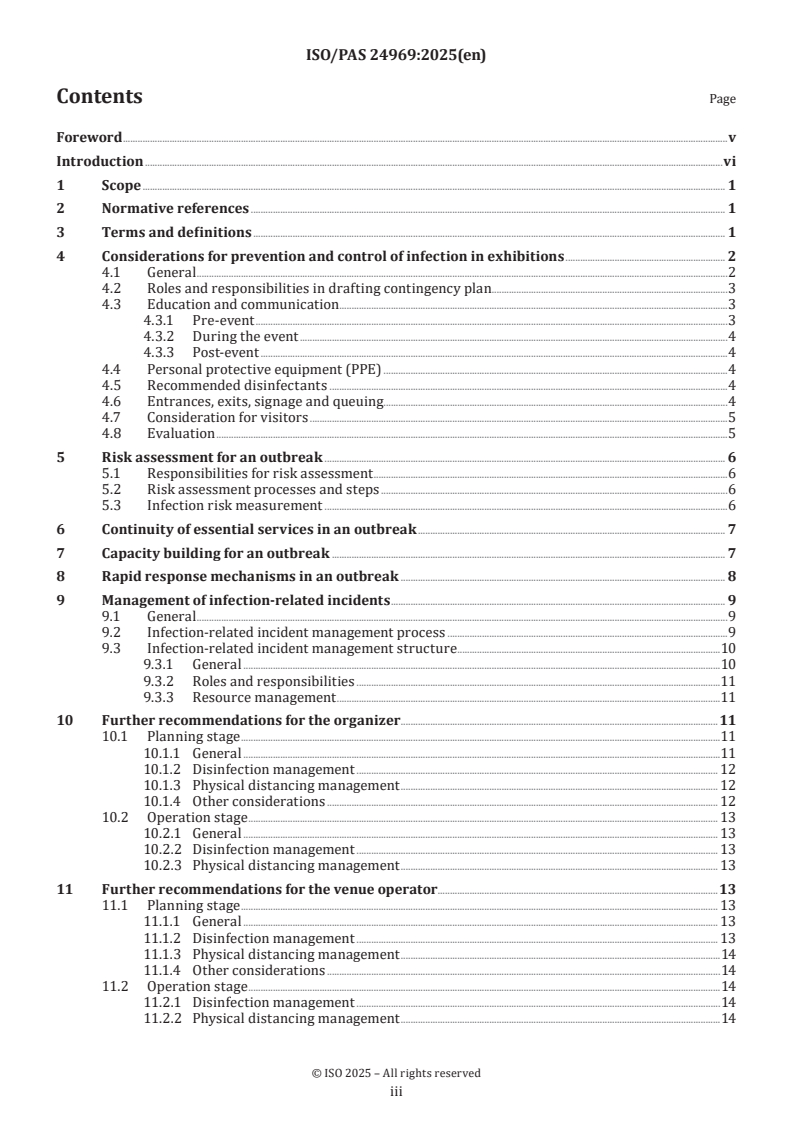
Contents Page
Foreword .v
Introduction .vi
1 Scope . 1
2 Normative references . 1
3 Terms and definitions . 1
4 Considerations for prevention and control of infection in exhibitions . 2
4.1 General .2
4.2 Roles and responsibilities in drafting contingency plan.3
4.3 Education and communication .3
4.3.1 Pre-event .3
4.3.2 During the event .4
4.3.3 Post-event .4
4.4 Personal protective equipment (PPE) .4
4.5 Recommended disinfectants .4
4.6 Entrances, exits, signage and queuing.4
4.7 Consideration for visitors .5
4.8 Evaluation .5
5 Risk assessment for an outbreak . 6
5.1 Responsibilities for risk assessment .6
5.2 Risk assessment processes and steps .6
5.3 Infection risk measurement .6
6 Continuity of essential services in an outbreak . 7
7 Capacity building for an outbreak . 7
8 Rapid response mechanisms in an outbreak . 8
9 Management of infection-related incidents . 9
9.1 General .9
9.2 Infection-related incident management process .9
9.3 Infection-related incident management structure .10
9.3.1 General .10
9.3.2 Roles and responsibilities .11
9.3.3 Resource management .11
10 Further recommendations for the organizer .11
10.1 Planning stage .11
10.1.1 General .11
10.1.2 Disinfection management . 12
10.1.3 Physical distancing management . 12
10.1.4 Other considerations . 12
10.2 Operation stage . 13
10.2.1 General . 13
10.2.2 Disinfection management . 13
10.2.3 Physical distancing management . 13
11 Further recommendations for the venue operator .13
11.1 Planning stage . 13
11.1.1 General . 13
11.1.2 Disinfection management . 13
11.1.3 Physical distancing management .14
11.1.4 Other considerations .14
11.2 Operation stage .14
11.2.1 Disinfection management .14
11.2.2 Physical distancing management .14
iii
11.2.3 Other considerations .14
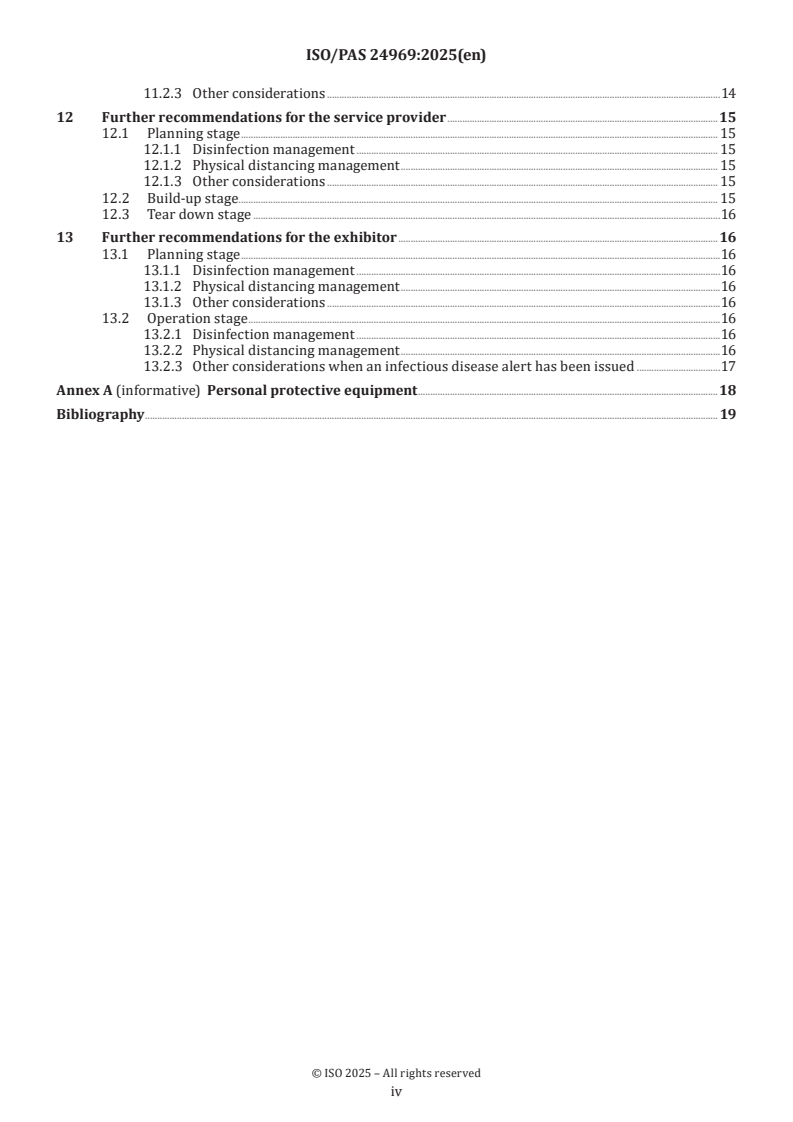
12 Further recommendations for the service provider .15
12.1 Planning stage . 15
12.1.1 Disinfection management . 15
12.1.2 Physical distancing management . 15
12.1.3 Other considerations . 15
12.2 Build-up stage . . 15
12.3 Tear down stage .16
13 Further recommendations for the exhibitor .16
13.1 Planning stage .16
13.1.1 Disinfection management .16
13.1.2 Physical distancing management .16
13.1.3 Other considerations .16
13.2 Operation stage .16
13.2.1 Disinfection management .16
13.2.2 Physical distancing management .16
13.2.3 Other considerations when an infectious disease alert has been issued .17
Annex A (informative) Personal protective equipment .18
Bibliography . 19
iv
Foreword
ISO (the International Organization for Standardization) is a worldwide federation of national standards
bodies (ISO member bodies). The work of preparing International Standards is normally carried out through
ISO technical committees. Each member body interested in a subject for which a technical committee
has been established has the right to be represented on that committee. International organizations,
governmental and non-governmental, in liaison with ISO, also take part in the work. ISO collaborates closely
with the International Electrotechnical Commission (IEC) on all matters of electrotechnical standardization.
The procedures used to develop this document and those intended for its further maintenance are described
in the ISO/IEC Directives, Part 1. In particular, the different approval criteria needed for the different types
of ISO document should be noted. This document was drafted in accordance with the editorial rules of the
ISO/IEC Directives, Part 2 (see www.iso.org/directives).
ISO draws attention to the possibility that the implementation of this document may involve the use of (a)
patent(s). ISO takes no position concerning the evidence, validity or applicability of any claimed patent
rights in respect thereof. As of the date of publication of this document, ISO had not received notice of (a)
patent(s) which may be required to implement this document. However, implementers are cautioned that
this may not represent the latest information, which may be obtained from the patent database available at
www.iso.org/patents. ISO shall not be held responsible for identifying any or all such patent rights.
Any trade name used in this document is information given for the convenience of users and does not
constitute an endorsement.
For an explanation of the voluntary nature of standards, the meaning of ISO specific terms and expressions
related to conformity assessment, as well as information about ISO's adherence to the World Trade
Organization (WTO) principles in the Technical Barriers to Trade (TBT), see www.iso.org/iso/foreword.html.
This document was prepared by Technical Committee ISO/TC 228, Tourism and related services.
Any feedback or questions on this document should be directed to the user’s national standards body. A
complete listing of these bodies can be found at www.iso.org/members.html.
v
Introduction
The exhibition industry has been an indispensable force in building global commercial networks, playing a
central role in the development of domestic and international economies. It is the major power that opens
the door to new markets for trade and for all sectors and sizes of business organizations.
The impact of the last pandemic has been severely felt and reverberated throughout the industry. The lack
of physical gatherings afforded by the industry has in part contributed to laggard recovery of the global
economy. As the industry has started to reopen, it has taken various precautions to protect their employees,
visitors and third-party personnel.
Infectious diseases are a global problem. Changes in demographics, technology and environment, the
ease of international travel and commerce, and infectious agents themselves are contributing factors to
[11]
the emergence of new diseases and re-emergence of diseases once considered under control. And the
[12]
likelihood of another infectious disease outbreak is only growing, which requires the stakeholders in the
exhibition industry to adjust the perceptions of the risks and expectations for preparedness for infectious
disease outbreaks.
This document describes the essential elements of a contingency plan that supports the industry’s
stakeholders to ensure prevention and control of infection during an infectious disease outbreak, before,
during and after the exhibition. A contingency plan in infection prevention and control is a strategy designed
to address potential risks and uncertainties associated with a disease outbreak or epidemic. It outlines a set
of predetermined actions and protocols to be implemented in response to such an outbreak, ensuring an
effective and coordinated response to mitigate the ramifications of the outbreak.
With regard to the process and structure of infection control, this document applies the framework specified
in ISO 22320 for managing infection-related incidents.
vi
Publicly Available Specification ISO/PAS 24969:2025(en)
Tourism and related services — Guidance on a contingency
plan for infection prevention and control (IPC) in the
exhibition industry
1 Scope
This document specifies a contingency plan with a set of actions and protocols, associated with infection
prevention and control (IPC), to be implemented in response to any infectious disease outbreak, applicable
during the entire cycle of an exhibition, i.e. its planning, operating and evaluating stages.
The contingency plan in this document focuses on the following elements: risk assessment, surveillance and
early detection, continuity of essential services, capacity building and rapid response mechanism.
The contingency plan describes recommendations for organizers, venue operators, service providers,
exhibitors and participants in terms of their roles and responsibilities at each stage of the exhibition during
an infectious disease outbreak.
2 Normative references
The following documents are referred to in the text in such a way that some or all of their content constitutes
requirements of this document. For dated references, only the edition cited applies. For undated references,
the latest edition of the referenced document (including any amendments) applies.
ISO 25639-1, Exhibitions and events — Part 1: Vocabulary
3 Terms and definitions
For the purposes of this document, the terms and definitions given in ISO 25639-1 and the following apply.
ISO and IEC maintain terminology databases for use in standardization at the following addresses:
— ISO Online browsing platform: available at https:// www .iso .org/ obp
— IEC Electropedia: available at https:// www .electropedia .org/
3.1
contingency plan
set of actions and protocols for responding to an infectious disease outbreak
3.2
person under investigation
PUI
patient with either clinical or epidemiological risk factors, or both, for an infectious disease, but who has not
yet tested positive for the disease
3.3
personal protective equipment
PPE
device or appliance designed to be worn or held by an individual for protection against one or more health
and safety hazards
[SOURCE: ISO/TS 20141:2022, 3.8]
3.4
risk
potential negative effect of uncertainty on objectives
Note 1 to entry: A negative effect is a deviation from the expected. It addresses, creates or results in opportunities and
threats.
Note 2 to entry: Objectives can have different aspects and categories, and can be applied at different levels.
Note 3 to entry: Risk is usually expressed in terms of risk sources, potential events, their consequences and their
likelihood.
[SOURCE: ISO 31000:2018, 3.1, modified – "potential negative" has been added to the definition; note 1 to
entry has been changed from “positive and/or negative” to “negative”.]
4 Considerations for prevention and control of infection in exhibitions
4.1 General
The recommendations for each stakeholder in the exhibition industry are grouped into three stages:
planning, operation, and evaluation.
The general principles applied to infection prevention and control in exhibitions are as follows.
a) The contingency plan should contain comprehensive recommendations which are suitable for
exhibitions, taking in consideration relevant factors such as venue environment, exhibition types,
expected visitor volumes and changing infection guidelines from local health authorities.
b) All exhibition industry stakeholders should be knowledgeable about the exhibition-related guidelines
from the local authorities.
c) The organizer should ensure their IPC plans are aligned with international health authorities and
national public health guidelines.
d) Updated regulations and guidelines of the WHO (World Health Organization) should be considered and
followed by each outbreak.
Figure 1 shows the key stakeholders in the exhibition industry.
Figure 1 — Key stakeholders of exhibition industry
4.2 Roles and responsibilities in drafting contingency plan
Roles and responsibilities in drafting the contingency plan are:
a) the venue operator, who should:
— take the primary responsibility and lead in drafting the contingency plan for the exhibitions within
the venue.
— coordinate with the organizers to ensure all aspects of exhibitions are covered and aligned with
local health guidelines.
b) the organizer, who should:
— take collaborative roles and provide input and support for exhibition-specific of the contingency plan.
4.3 Education and communication
4.3.1 Pre-event
Effective strategies should be established prior to the event to ensure that all stakeholders are informed of
expectations, available services, and emergency protocols.
a) The organizer should develop communication strategies, which include what is to be expected of the
organizer, and services and contingency plans available in case of an emergency for all stakeholders.
b) The venue operator should make available quarantine guidelines in advance to all stakeholders making
use of available means such as webpage, app, text message, e-mail, and on-site notice.
c) The organizer should employ available means of communication both internally and externally.
d) The organizer should develop multi-communication channels, such as email, exhibition websites, social
networks, infographics, printed materials and mobile, to broadcast real-time information, including
disease news.
e) The dissemination of information should be provided in more than one language, including the local/
regional language, to ensure broader accessibility and understanding for all visitors.
4.3.2 During the event
Real-time and accessible communication should be maintained throughout the event to guide attendees on
health and safety protocols and respond to emerging situations.
a) The organizer and venue operator should make available and instruct the quarantine rules in an easy-
to-understand way.
b) The organizer and the venue operator should display in key areas of the venue quarantine guidelines
and measures to be taken for those exhibiting symptoms.
c) The organizer should communicate regularly to the attendees during the exhibition quarantine
guidelines, such as mask wearing, physical distancing (see ISO 6763) and hand washing.
4.3.3 Post-event
Post-event efforts should focus on gathering feedback and improving future strategies based on lessons
learned.
a) The organizer should collect feedback from attendees, staff and stakeholders about the clarity and
accessibility of safety-related communications during the exhibition.
b) The organizer should update educational resources based on feedback lessons learned during the
exhibition.
4.4 Personal protective equipment (PPE)
The organizer should ensure that:
a) enough PPEs are available during the exhibition;
NOTE Legal requirements can apply.
b) all exhibition attendees, including staff from the organizer and service provider, wear the necessary
protective equipment;
c) attendees are informed about the risk of touching masks or any part of the face;
d) attendees always wear their PPE while staying in the exhibition venue;
e) if a face mask or a PPE is broken, soiled, or difficult to breathe through, it is removed and thrown away
in a designated disposal area.
For further information on PPEs, please see Annex A.
4.5 Recommended disinfectants
For disinfectants for personal use and for environmental and surface disinfections, it is recommended to
use disinfectants approved by local or international authorities, such as WHO.
4.6 Entrances, exits, signage and queuing
Entrance and exit management, signage, and queuing systems should be designed to promote safety,
accessibility, and effective crowd flow while supporting physical distancing.
a) The organizer should manage entrances to and exits from the exhibition venue in such a way that the
attendees entering are separated from those exiting from the venue.
b) The organizer should ensure that all signage includes clear, simple language and universally recognized
symbols for attendees with cognitive disabilities.
c) The organizer should communicate the queuing process to attendees in advance via multiple channels
(e.g. website, email, event app) to ensure they understand physical distancing measure.
d) The organizer should consider integrating digital signage and mobile apps to provide real-time updates
on queue times and locations.
e) The venue operator should consider people with disabilities by minimizing the need to touch or make
contact with surfaces for physical support in entrances to the exhibition area.
f) Staff should be stationed at the exits to prevent visitors from entering through them and guide them to
designated entrances.
g) The organizer should keep the number of entrances and exits to a manageable minimum.
h) The organizer should consider various sizes, types and colour schemes for signage that maximize the
exposure and facilitate a clear understanding of the messages.
i) The organizer should place signage in the most visible areas (e.g. main entrances), employ various sizes
and fonts that accommodate visually challenged people, and use colours that clearly emphasize the
messages to the attendees.
j) Queues for attendees entering the venue should be in place that optimize physical distancing in lines
and ensure fast processing of them to the venue.
4.7 Consideration for visitors
The general considerations for visitors are expected to follow both local guidelines for infection prevention
and control and exhibition-specific guidelines. In general, the organizer, venue operator and exhibitor should
consider means to minimize human-to-human contact by using available technologies. The organizer should
implement measures to control crowd flow, including designated entry and exit points. In particular, the
organizer should:
a) help visitors become familiar with the quarantine guidelines through accessible channels such as the
exhibition website;
b) inform visitors that they should refrain from visiting if they exhibit symptoms of an infectious disease,
or have travelled overseas to areas where an infectious disease has recently spread;
c) recommend visitors to use a face mask as protection from airborne infections;
d) encourage visitors to use hand sanitizer after coming into contact with other people or with any
products or materials in the venue;
e) inform visitors that they can be subject to filling out a health status checklist/questionnaire;
NOTE Local, regional or national guidelines and regulations on personal (health) information can apply.
f) advise visitors to follow the quarantine instructions from the staff members of the exhibition;
g) recommend visitors to keep physical distancing and to avoid physical contact while at the venue;
h) inform visitors that the exhibition can offer staggered visiting times for crowd control.
4.8 Evaluation
The organizer and the venue operator should develop evaluation metrics that capture:
a) effectiveness of the plans observed during operation;
b) improvements that demand immediate or intermediate remedies;
c) compliance with local regulations.
d) any previously unforeseen threat introduced during the exhibition;
e) any potential changes that can mitigate infection risks;
f) feedback from staff members, visitors, exhibitors and venue operators through a survey.
5 Risk assessment for an outbreak
5.1 Responsibilities for risk assessment
The responsibilities for risk assessment are as follows.
a) The organizer should conduct thorough risk assessments to identify potential hazards related to the
spread of the disease and implement measures to mitigate these risks.
b) The venue operator is expected to ensure that the facility complies with local health regulations and
provide sanitation stations, maintain ventilation systems, and implement guidelines provided by health
aut
...