


ISO 10300-2:2023
(Main)Calculation of load capacity of bevel gears — Part 2: Calculation of surface durability (macropitting)
Calculation of load capacity of bevel gears — Part 2: Calculation of surface durability (macropitting)
This document specifies the methods of calculation of the load capacity of bevel gears, the formulae and symbols used for calculation, and the general factors influencing load conditions. The formulae in this document are intended to establish uniformly acceptable methods for calculating the load-carrying capacity of straight, helical (skew), spiral bevel, Zerol and hypoid gears. They are applicable equally to tapered depth and uniform depth teeth. Hereinafter, the term “bevel gear” refers to all of the gear types; if not, the specific forms are identified. The formulae in this document take into account the known major factors influencing load-carrying capacity. The rating formulae are only applicable to types of gear tooth deterioration, that are specifically addressed in the individual parts of the ISO 10300 series. Rating systems for a particular type of bevel gears can be established by selecting proper values for the factors used in the general formulae. NOTE This document is not applicable to bevel gears which have an inadequate contact pattern under load (see Annex D). The rating system of this document is based on virtual cylindrical gears and restricted to bevel gears whose virtual cylindrical gears have transverse contact ratios of εvα The user is cautioned that when the formulae are used for large average mean spiral angles (βm1 + βm2)/2 > 45°, for effective pressure angles αe > 30° and/or for large facewidths b > 13 mmn, the calculated results of this document should be confirmed by experience.
Calcul de la capacité de charge des engrenages coniques — Partie 2: Calcul de la résistance à la pression superficielle (macro-écaillage)
General Information
- Status
- Published
- Publication Date
- 23-Aug-2023
- Technical Committee
- ISO/TC 60/SC 2 - Gear capacity calculation
- Drafting Committee
- ISO/TC 60/SC 2/WG 13 - Bevel gears
- Current Stage
- 6060 - International Standard published
- Start Date
- 24-Aug-2023
- Due Date
- 27-Aug-2023
- Completion Date
- 24-Aug-2023
Relations
- Effective Date
- 23-Apr-2020
Overview - ISO 10300-2:2023 (Bevel gears, macropitting)
ISO 10300-2:2023, "Calculation of load capacity of bevel gears - Part 2: Calculation of surface durability (macropitting)," defines standardized methods to evaluate the surface durability (macropitting) and load-carrying capacity of bevel gears. It covers straight, helical (skew), spiral, Zerol and hypoid bevel gears with tapered or uniform depth teeth. The standard specifies contact stress and permissible stress assessments, rating procedures (Methods B1 and B2), and the main factors that influence macropitting under lubricated conditions.
Key topics and technical requirements
- Macropitting types and assessment: Distinguishes initial versus destructive macropitting and outlines acceptability and assessment requirements for surface fatigue.
- Gear flank rating formulae: Two principal methods are provided:
- Method B1 (original Method B) - uses an inscribed parallelogram approach for load distribution.
- Method B2 - introduces an inscribed ellipse approach, extended for hypoid gears.
- Contact stress evaluation: Hertz-based contact stress fundamentals adapted for bevel gear contact geometry and elliptical pressure zones.
- Permissible contact stress and safety factors: Procedures to compute permissible stresses and safety margins considering life, material and operating conditions.
- Load and geometry influence factors: Includes mid‑zone and load‑sharing factors, facewidth and geometry factors, bevel-gear specific factors, size and hypoid factors.
- Tribology and material factors: Elasticity, lubricant-film influence, roughness, work hardening and life factors are incorporated (Z-factors) to adjust ratings based on lubrication, surface finish and heat treatment.
- Limitations and cautions: Not applicable to gears with inadequate contact patterns; users are cautioned when average spiral angles exceed 45°, effective pressure angles exceed 30°, or facewidths exceed 13 mm - in these cases results should be validated by experience or tests.
Practical applications and users
ISO 10300-2:2023 is intended for:
- Gear designers and gearbox engineers performing load-capacity and surface-durability calculations.
- Manufacturers specifying material, heat treatment and surface finish to avoid destructive macropitting.
- Tribologists and lubrication engineers evaluating lubricant film effects on gear life.
- Test laboratories and quality/standards bodies conducting gear rating, validation and certification. Practical uses include gearbox design, failure-risk assessment, life prediction, specification of inspection criteria and transfer of test data across gear types and sizes.
Related standards
- ISO 10300-1 (general principles for bevel gear rating)
- Other parts of the ISO 10300 series and ISO 6336-5 (cylindrical gear methods)
- ISO/TR 22849 (additional background on macropitting)
Keywords: ISO 10300-2:2023, bevel gears, macropitting, surface durability, load capacity, contact stress, gear design, hypoid gears.


ISO 10300-2:2023 - Calculation of load capacity of bevel gears — Part 2: Calculation of surface durability (macropitting) Released:24. 08. 2023

ISO 10300-2:2023 - Calculation of load capacity of bevel gears — Part 2: Calculation of surface durability (macropitting) Released:4/28/2025
Frequently Asked Questions
ISO 10300-2:2023 is a standard published by the International Organization for Standardization (ISO). Its full title is "Calculation of load capacity of bevel gears — Part 2: Calculation of surface durability (macropitting)". This standard covers: This document specifies the methods of calculation of the load capacity of bevel gears, the formulae and symbols used for calculation, and the general factors influencing load conditions. The formulae in this document are intended to establish uniformly acceptable methods for calculating the load-carrying capacity of straight, helical (skew), spiral bevel, Zerol and hypoid gears. They are applicable equally to tapered depth and uniform depth teeth. Hereinafter, the term “bevel gear” refers to all of the gear types; if not, the specific forms are identified. The formulae in this document take into account the known major factors influencing load-carrying capacity. The rating formulae are only applicable to types of gear tooth deterioration, that are specifically addressed in the individual parts of the ISO 10300 series. Rating systems for a particular type of bevel gears can be established by selecting proper values for the factors used in the general formulae. NOTE This document is not applicable to bevel gears which have an inadequate contact pattern under load (see Annex D). The rating system of this document is based on virtual cylindrical gears and restricted to bevel gears whose virtual cylindrical gears have transverse contact ratios of εvα The user is cautioned that when the formulae are used for large average mean spiral angles (βm1 + βm2)/2 > 45°, for effective pressure angles αe > 30° and/or for large facewidths b > 13 mmn, the calculated results of this document should be confirmed by experience.
This document specifies the methods of calculation of the load capacity of bevel gears, the formulae and symbols used for calculation, and the general factors influencing load conditions. The formulae in this document are intended to establish uniformly acceptable methods for calculating the load-carrying capacity of straight, helical (skew), spiral bevel, Zerol and hypoid gears. They are applicable equally to tapered depth and uniform depth teeth. Hereinafter, the term “bevel gear” refers to all of the gear types; if not, the specific forms are identified. The formulae in this document take into account the known major factors influencing load-carrying capacity. The rating formulae are only applicable to types of gear tooth deterioration, that are specifically addressed in the individual parts of the ISO 10300 series. Rating systems for a particular type of bevel gears can be established by selecting proper values for the factors used in the general formulae. NOTE This document is not applicable to bevel gears which have an inadequate contact pattern under load (see Annex D). The rating system of this document is based on virtual cylindrical gears and restricted to bevel gears whose virtual cylindrical gears have transverse contact ratios of εvα The user is cautioned that when the formulae are used for large average mean spiral angles (βm1 + βm2)/2 > 45°, for effective pressure angles αe > 30° and/or for large facewidths b > 13 mmn, the calculated results of this document should be confirmed by experience.
ISO 10300-2:2023 is classified under the following ICS (International Classification for Standards) categories: 21.200 - Gears. The ICS classification helps identify the subject area and facilitates finding related standards.
ISO 10300-2:2023 has the following relationships with other standards: It is inter standard links to ISO 10300-2:2014. Understanding these relationships helps ensure you are using the most current and applicable version of the standard.
ISO 10300-2:2023 is available in PDF format for immediate download after purchase. The document can be added to your cart and obtained through the secure checkout process. Digital delivery ensures instant access to the complete standard document.
Standards Content (Sample)
INTERNATIONAL ISO
STANDARD 10300-2
Third edition
2023-08
Calculation of load capacity of bevel
gears —
Part 2:
Calculation of surface durability
(macropitting)
Calcul de la capacité de charge des engrenages coniques —
Partie 2: Calcul de la résistance à la pression superficielle (macro-
écaillage)
Reference number
© ISO 2023
All rights reserved. Unless otherwise specified, or required in the context of its implementation, no part of this publication may
be reproduced or utilized otherwise in any form or by any means, electronic or mechanical, including photocopying, or posting on
the internet or an intranet, without prior written permission. Permission can be requested from either ISO at the address below
or ISO’s member body in the country of the requester.
ISO copyright office
CP 401 • Ch. de Blandonnet 8
CH-1214 Vernier, Geneva
Phone: +41 22 749 01 11
Email: copyright@iso.org
Website: www.iso.org
Published in Switzerland
ii
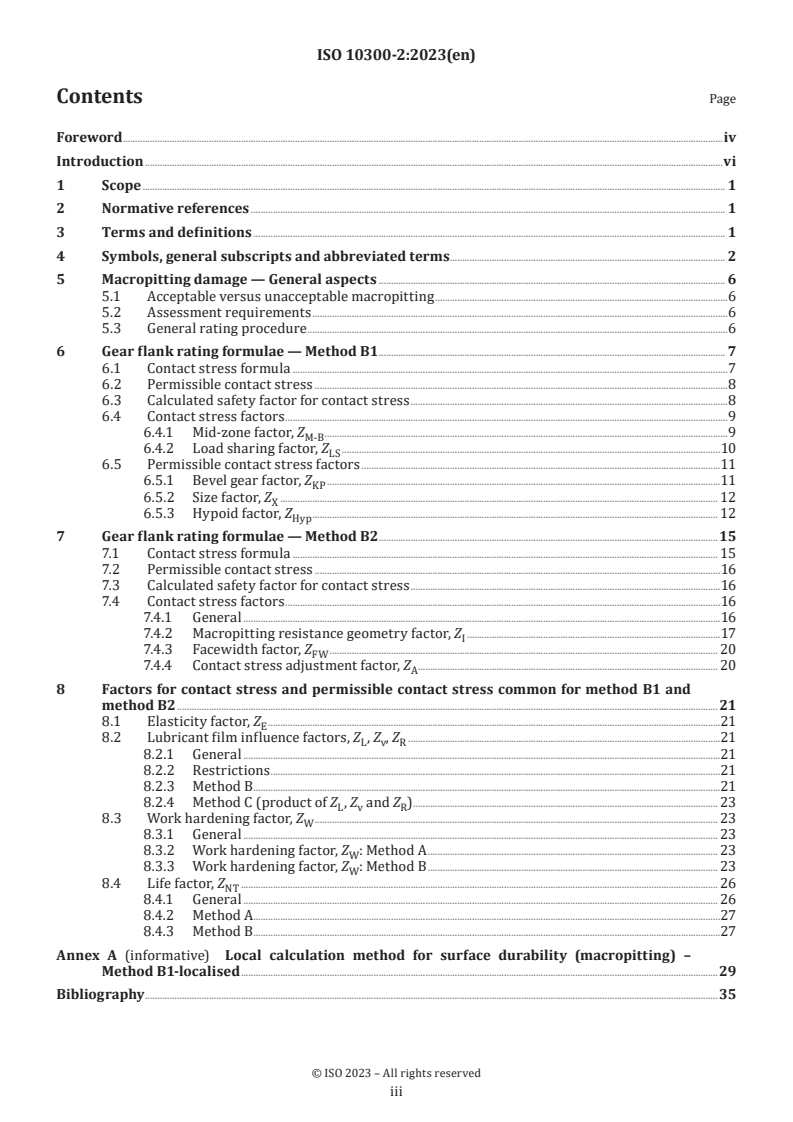
Contents Page
Foreword .iv
Introduction . vi
1 Scope . 1
2 Normative references . 1
3 Terms and definitions . 1
4 Symbols, general subscripts and abbreviated terms . 2
5 Macropitting damage — General aspects . 6
5.1 Acceptable versus unacceptable macropitting . 6
5.2 Assessment requirements . 6
5.3 General rating procedure . 7
6 Gear flank rating formulae — Method B1 . 7
6.1 Contact stress formula . 7
6.2 Permissible contact stress . 8
6.3 Calculated safety factor for contact stress . 8
6.4 Contact stress factors . 9
6.4.1 Mid-zone factor, Z . 9
M-B
6.4.2 Load sharing factor, Z . 10
LS
6.5 Permissible contact stress factors . 11
6.5.1 Bevel gear factor, Z . 11
KP
6.5.2 Size factor, Z .12
X
6.5.3 Hypoid factor, Z .12
Hyp
7 Gear flank rating formulae — Method B2 .15
7.1 Contact stress formula .15
7.2 Permissible contact stress . 16
7.3 Calculated safety factor for contact stress . 16
7.4 Contact stress factors . 16
7.4.1 General . 16
7.4.2 Macropitting resistance geometry factor, Z . 17
I
7.4.3 Facewidth factor, Z .20
FW
7.4.4 Contact stress adjustment factor, Z . 20
A
8 Factors for contact stress and permissible contact stress common for method B1
and method B2 .21
8.1 Elasticity factor, Z . 21
E
8.2 Lubricant film influence factors, Z , Z , Z . 21
L v R
8.2.1 General . 21
8.2.2 Restrictions . 21
8.2.3 Method B . . 21
8.2.4 Method C (product of Z , Z and Z ) . 23
L v R
8.3 Work hardening factor, Z .23
W
8.3.1 General .23
8.3.2 Work hardening factor, Z : Method A . 23
W
8.3.3 Work hardening factor, Z : Method B . 24
W
8.4 Life factor, Z . 26
NT
8.4.1 General . 26
8.4.2 Method A . . . 27
8.4.3 Method B .28
Annex A (informative) Local calculation method for surface durability (macropitting) –
Method B1-localised .29
Bibliography .35
iii
Foreword
ISO (the International Organization for Standardization) is a worldwide federation of national standards
bodies (ISO member bodies). The work of preparing International Standards is normally carried out
through ISO technical committees. Each member body interested in a subject for which a technical
committee has been established has the right to be represented on that committee. International
organizations, governmental and non-governmental, in liaison with ISO, also take part in the work.
ISO collaborates closely with the International Electrotechnical Commission (IEC) on all matters of
electrotechnical standardization.
The procedures used to develop this document and those intended for its further maintenance are
described in the ISO/IEC Directives, Part 1. In particular, the different approval criteria needed for the
different types of ISO document should be noted. This document was drafted in accordance with the
editorial rules of the ISO/IEC Directives, Part 2 (see www.iso.org/directives).
ISO draws attention to the possibility that the implementation of this document may involve the use
of (a) patent(s). ISO takes no position concerning the evidence, validity or applicability of any claimed
patent rights in respect thereof. As of the date of publication of this document, ISO had not received
notice of (a) patent(s) which may be required to implement this document. However, implementers are
cautioned that this may not represent the latest information, which may be obtained from the patent
database available at www.iso.org/patents. ISO shall not be held responsible for identifying any or all
such patent rights.
Any trade name used in this document is information given for the convenience of users and does not
constitute an endorsement.
For an explanation of the voluntary nature of standards, the meaning of ISO specific terms and
expressions related to conformity assessment, as well as information about ISO's adherence to
the World Trade Organization (WTO) principles in the Technical Barriers to Trade (TBT), see
www.iso.org/iso/foreword.html.
This document was prepared by Technical Committee ISO/TC 60, Gears, Subcommittee SC 2, Gear
capacity calculation.
This third edition cancels and replaces the second edition (ISO 10300-2:2014), which has been
technically revised.
The main changes are as follows:
— Table 1 has been inserted;
— Table 2 has been inserted;
— the term “pitting” has been replaced by “macropitting”;
— bevel gear factor, Z , for the calculation of the nominal value of the contact stress has been removed;
K
instead, a new bevel gear factor, Z , has been introduced for the calculation of the permissible
KP
contact stress;
— Formula (37) for the calculation of the length of action considering adjacent teeth has been modified;
— subclause 8.3 — work hardening factor, Z , has been updated and method A added;
W
— Figure 2 — load distribution in the contact area has been updated as the symbol for exponent e has
been changed to e ;
LS
— Figure 6 — facewidth factor, Z has been removed;
FW
— Figure 7 — lubricant factor, Z , for mineral oils has been removed;
L
— Figure 8 — speed factor, Z has been removed;
V
iv
— Figure 9 — roughness factor, Z has been removed;
R
— Figure 10 — work hardening factor, Z has been removed;
W
— former Annex A has been replaced by new Annex A describing a local calculation method for surface
durability (macropitting) – Method B1-localised.
A list of all parts in the ISO 10300 series can be found on the ISO website.
Any feedback or questions on this document should be directed to the user’s national standards body. A
complete listing of these bodies can be found at www.iso.org/members.html.
v
Introduction
When ISO 10300:2001 (all parts) became due for its first revision, the opportunity was taken to include
hypoid gears, since previously the series only allowed for calculating the load capacity of bevel gears
without offset axes. The former structure is retained, i.e. three parts of the ISO 10300 series, together
with ISO 6336-5, and it is intended to establish general principles and procedures for rating of bevel
gears. Moreover, ISO 10300 (all parts) is designed to facilitate the application of future knowledge and
developments, as well as the exchange of information gained from experience.
In view of the decision for ISO 10300 (all parts) to cover hypoid gears also, a separate clause: “Gear
flank rating formulae — Method B2” has been included in this document, while the former method B
was renamed method B1. It became necessary to present a new, clearer structure of the three parts,
which is illustrated in ISO 10300-1:2023, Figure 1.
NOTE ISO 10300 (all parts) gives no preferences in terms of when to use method B1 and when to use
method B2.
This document deals with the failure of gear teeth by macropitting, a fatigue phenomenon. Two varieties
of macropitting are recognized, initial and destructive macropitting.
In applications employing low hardness steel or through hardened steel, initial macropitting
frequently occurs during early use and is not deemed serious. Initial macropitting is characterized by
small pits which do not extend over the entire facewidth or profile depth of the affected tooth. The
degree of acceptability of initial macropitting varies widely, depending on the gear application. Initial
macropitting occurs in localized overstressed areas and tends to redistribute the load by progressively
removing high contact spots. Generally, when the load has been redistributed, the macropitting stops.
In applications employing high hardness steel and case carburized steel, the variety of macropitting
that occurs is usually destructive. The formulae for macropitting resistance given in this document are
intended to assist in the design of bevel gears which stay free from destructive macropitting during
[5]
their design lives (for additional information, see ISO/TR 22849 ).
The basic formulae, first developed by Hertz for the contact pressure between two curved surfaces,
have been modified to consider the following four items: the load sharing between adjacent teeth,
the position of the centre of pressure on the tooth, the shape of the instantaneous area of contact and
the load concentration resulting from manufacturing uncertainties. The Hertzian contact pressure
serves as the theory for the assessment of surface durability with respect to macropitting. Although
all premises for a gear mesh are not satisfied by Hertzian relations, their use can be justified by the
fact that, for a gear material, the limits of the Hertzian pressure are determined on the basis of running
tests with gears, which include the additional influences in the analysis of the limit values. Therefore, if
the reference is within the application range, Hertzian pressure can be used to convert test gear data to
gears of various types and sizes.
NOTE Contrary to cylindrical gears, where the contact is usually linear, bevel gears are generally
manufactured with profile and lengthwise crowning, i.e. the tooth flanks are curved on all sides and the contact
develops an elliptical pressure surface. This is taken into consideration when determining the load factors by
the fact that the rectangular zone of action (in the case of spur and helical gears) is replaced by an inscribed
parallelogram for method B1 and an inscribed ellipse for method B2 (see ISO 10300-1:2023, Annex A for
method B1 and Annex B for method B2). The conditions for bevel gears, different from cylindrical gears in their
contact, are thus taken into consideration by the face and transverse load distribution factors.
vi
INTERNATIONAL STANDARD ISO 10300-2:2023(E)
Calculation of load capacity of bevel gears —
Part 2:
Calculation of surface durability (macropitting)
1 Scope
This document specifies the basic formulae for use in the determination of the surface load capacity
of straight and helical (skew), Zerol and spiral bevel gears including hypoid gears, and comprises all
the influences on surface durability for which quantitative assessments can be made. This document is
applicable to oil lubricated bevel gears, as long as sufficient lubricant is present in the mesh at all times.
The formulae in this document are based on virtual cylindrical gears and restricted to bevel gears
whose virtual cylindrical gears have transverse contact ratios of ε < 2. The results are valid within
vα
the range of the applied factors as specified in ISO 10300-1.
The formulae in this document are not directly applicable to the assessment of other types of gear tooth
surface damage, such as plastic yielding, scratching, scuffing or any other type not specified.
NOTE This document is not applicable to bevel gears which have an inadequate contact pattern under load.
The user is cautioned that when the formulae are used for large average mean spiral angles
(β + β )/2 > 45°, for effective pressure angles α > 30° and/or for large facewidths b > 13 m , the
m1 m2 e mn
calculated results of this document should be confirmed by experience.
2 Normative references
The following documents are referred to in the text in such a way that some or all of their content
constitutes requirements of this document. For dated references, only the edition cited applies. For
undated references, the latest edition of the referenced document (including any amendments) applies.
ISO 701, International gear notation — Symbols for geometrical data
ISO 1122-1, Vocabulary of gear terms — Part 1: Definitions related to geometry
ISO 6336-5, Calculation of load capacity of spur and helical gears — Part 5: Strength and quality of
materials
ISO 10300-1, Calculation of load capacity of bevel gears — Part 1: Introduction and general influence
factors
ISO 17485, Bevel gears — ISO system of accuracy
ISO 23509, Bevel and hypoid gear geometry
3 Terms and definitions
For the purposes of this document, the terms and definitions given in ISO 1122-1 and ISO 23509 and the
following apply.
ISO and IEC maintain terminology databases for use in standardization at the following addresses:
— ISO Online browsing platform: available at https:// www .iso .org/ obp
— IEC Electropedia: available at https:// www .electropedia .org/
3.1
macropitting
material fatigue phenomenon of two meshing surfaces under load
3.2
nominal contact stress
σ
H0
contact stress calculated on the basis of the Hertzian theory at the critical point of load application for
error-free gears loaded by a constant nominal torque
3.3
contact stress
σ
H
determinant contact stress at the critical point of load application including the load factors which
consider static and dynamic loads and load distribution
3.4
allowable stress number (contact)
σ
H,lim
maximum contact stress of standardized test gears and determined at standardized operating
conditions, as specified in ISO 6336-5
3.5
permissible contact stress
σ
HP
maximum contact stress of the evaluated gear set including all influence factors
4 Symbols, general subscripts and abbreviated terms
For the purposes of this document, the symbols given in ISO 701, ISO 17485, ISO 23509 and the following
shall apply.
Table 1 — Symbols
Symbol Description or term Unit
A Auxiliary factor for calculating the dynamic factor K —
v-C
A* Related area for calculating the load sharing factor Z mm
LS
*
Area above the middle contact line mm
A
m
*
Area above the root contact line mm
A
r
*
Area above the tip contact line mm
A
t
b Facewidth mm
b Relative base facewidth —
b
C , C , Constants for determining lubricant film factors —
ZL ZR
C
ZV
d Outer pitch diameter mm
e
d Mean pitch diameter mm
m
d Reference diameter of virtual cylindrical gear mm
v
d Tip diameter of virtual cylindrical gear mm
va
d Base diameter of virtual cylindrical gear mm
vb
E Modulus of elasticity, Young’s modulus N/mm
e Exponent for the load distribution along the lines of contact —
LS
F Auxiliary variable for mid-zone factor —
F Nominal tangential force at mid-facewidth of the reference cone N
mt
TTabablele 1 1 ((ccoonnttiinnueuedd))
Symbol Description or term Unit
F Nominal normal force N
n
f Distance from the centre of the zone of action to a contact line mm
f Maximum distance to middle contact line mm
max
g Length of contact line (method B2) mm
c
g Length of path of contact of virtual cylindrical gear in transverse section mm
va
g Relative length of action in normal section —
van
g Relative length of action within the contact ellipse —
η
g Relative length of action at critical point in contact ellipse —
ηI
g Relative length of action considering adjacent teeth —
ηIΣ
HBW Brinell hardness —
K Dynamic factor —
v
K Application factor —
A
K Transverse load factor for contact stress —
Hα
K Face load factor for contact stress —
Hβ
k Positive integer —
k’ Contact shift factor —
l Length of contact line (method B1) mm
b
l Theoretical length of middle contact line mm
bm
m Outer transverse module mm
et
m Mean normal module mm
mn
N Number of load cycles —
L
p Peak load N/mm
p Maximum peak load N/mm
max
p* Relative peak load for calculating the load sharing factor (method B1) —
p Relative mean normal base pitch —
nb
Ra Centre line average (CLA) = AA arithmetic average roughness μm
R Relative mean back cone distance —
mpt
Rz Mean peak-to-valley roughness μm
Rz Equivalent roughness µm
H
Rz Mean roughness for gear pairs with relative curvature radius ρ = 10 mm μm
10 rel
r Relative mean virtual tip radius —
va
r Relative mean virtual pitch radius —
vn
S Safety factor for contact stress (against macropitting) —
H
S Minimum safety factor for contact stress —
H,min
u Gear ratio of bevel gear —
V Ratio of maximum load over the middle contact line and total load —
v Sliding velocity in the mean point P m/s
g
v Sliding velocity parallel to the contact line m/s
g,par
v Sliding velocity vertical to the contact line m/s
g,vert
v Tangential speed at mid-facewidth of the reference cone m/s
mt
v Circumferential velocity at the pitch line m/s
w
v Sum of velocities in the mean point P m/s
Σ
v Sum of velocities in profile direction m/s
Σh
v Sum of velocities in lengthwise direction m/s
Σl
TTabablele 1 1 ((ccoonnttiinnueuedd))
Symbol Description or term Unit
v Sum of velocities in lengthwise direction m/s
Σs
v Sum of velocities vertical to the contact line m/s
Σ,vert
w Angle of contact line relative to the root cone °
w Surface velocity m/s
t
w Surface velocity in profile direction m/s
t,h
w Surface velocity in lengthwise direction m/s
t,s
w Surface velocity vertical to the contact line m/s
t,vert
X Intermediate value —
Z Inertia factor (macropitting) —
i
Z Speed factor —
v
Z Contact stress adjustment factor (method B2) —
A
2 1/2
Z Elasticity factor (N/mm )
E
Z Facewidth factor —
FW
Z Hypoid factor —
Hyp
Z Macropitting resistance geometry factor (method B2) —
I
Z Bevel gear factor (method B1) —
KP
Z Lubricant factor —
L
Z Load sharing factor (method B1) —
LS
Z Mid-zone factor —
M-B
Z Life factor (macropitting) —
NT
Z Roughness factor for contact stress —
R
Z Bevel slip factor —
S
Z Work hardening factor —
W
Z Size factor —
X
z Number of teeth —
z Number of teeth of virtual cylindrical gear —
v
α Normal pressure angle at point of load application (method B2) °
L
α Adjusted pressure angle (method B2) °
a
α Normal pressure angle at tooth tip °
an
α Effective pressure angle for drive side/coast side °
eD,C
α Limit pressure angle °
lim
α Generated pressure angle for drive side/coast side °
nD,C
α Transverse pressure angle of virtual cylindrical gears °
vet
β Inclination angle of contact line °
B
β Mean base spiral angle °
bm
β Mean spiral angle °
m
ε Load sharing ratio for macropitting (method B2) —
NI
ζ Pinion offset angle in root plane °
R
ζ Slip vertical to the contact line °
vert
λ Adjustment angle for contact angle of hypoid gears (method B2) °
λ Adjustment angle for virtual spiral angle of hypoid gears (method B2) °
r
ρ Density of gear material kg/mm
ρ Local equivalent radius of curvature vertical to contact line mm
rel
ρ Relative radius of profile curvature between pinion and wheel (method B2) —
t
TTabablele 1 1 ((ccoonnttiinnueuedd))
Symbol Description or term Unit
ρ Relative radius of curvature change —
Δred
ρ Relative radius of curvature difference between point of load application and —
Δ1,2
mean point
Σ Shaft angle °
σ Contact stress N/mm
H
σ Allowable stress number for contact stress N/mm
H,lim
σ Permissible contact stress N/mm
HP
v Poisson’s ratio —
v , v Nominal kinematic viscosity of the oil at 40 °C and 50 °C respectively mm /s
40 50
ω Angle between surface velocity in lengthwise and profile direction °
wt
ω Inclination angle of the sum of velocities vector results °
Σ
Table 2 — General subscripts
Subscripts Description
0 Tool
1 Pinion
2 Wheel
A, B, B1, B2, C Value according to method A, B, B1, B2 or C
D Drive flank
C Coast flank
T Relative to standardized test gear dimensions
(1), (2) Trials of interpolation
Table 3 — Abbreviated terms
Abbreviated term Material Type
St Wrought normalized low carbon steels
Normalized low carbon steels/cast steels
St (cast.) Cast steels
Black malleable cast iron
GTS (perl.)
(perlitic structure)
Cast iron materials Nodular cast iron
GGG (perl., bai., ferr.)
(perlitic, bainitic, ferritic structure)
GG Grey cast iron
V Through hardened wrought steels Carbon steels, alloy steels
V (cast) Through hardened cast steels Carbon steels, alloy steels
Eh Case-hardened wrought steels
Flame or induction hardened wrought or
IF
cast steels
NT (nitr.) Nitriding steels
Nitrided wrought steels/nitriding steels/
through hardening steels, nitrided
NV (nitr.) Through hardening steels
NV (nitrocar.) Wrought steels, nitrocarburized Through hardening steels
5 Macropitting damage — General aspects
5.1 Acceptable versus unacceptable macropitting
When limits of the surface durability of the meshing flanks are exceeded, particles break out of the
flank, thus leaving pits. This damage is called pitting, also known as macropitting. The extent, to which
such pits may be tolerated, in terms of their size and number, varies within wide limits which depend
largely on the field of application. In some fields, extensive macropitting is acceptable; in others, no
macropitting is acceptable. The descriptions in 5.2 and 5.3 are relevant to average working conditions
and give guidelines to distinguish between initial and destructive, and acceptable and unacceptable
macropitting varieties.
A linear or progressive increase in the total area of pits (linear or progressive macropitting) is generally
considered to be unacceptable. However, it is possible that the effective tooth bearing area is enlarged
by initial macropitting, and the rate of pit generation subsequently decreases (degressive macropitting),
or even ceases (arrested macropitting), and then may be considered tolerable. Nevertheless, where
there is dispute over the acceptability of macropitting the next subclause shall be determinant.
5.2 Assessment requirements
Macropitting involving the formation of pits which increase linearly or progressively with time under
unchanged service conditions shall be unacceptable. Damage assessment shall include the entire active
area of all the tooth flanks. The number and size of newly developed pits in unhardened tooth flanks
shall be taken into consideration. Pits are frequently formed on just one, or only a few, of the surface
hardened gear tooth flanks. In such circumstances, assessment shall be centred on the flanks actually
pitted.
Teeth suspected of being especially at risk should be marked for critical examination if a quantitative
evaluation is required.
In special cases, it is possible that a first, rough assessment can be based on considerations of the entire
quantity of wear debris. But in critical cases, the condition of the flanks should be examined at least
three times. The first time, however, the examination should take place only after at least 10 cycles
of load. Depending on the results of previous examinations, further ones should be carried out after a
period of service.
When deterioration caused by macropitting is such that it puts human life in danger, or poses a risk of
other grave consequences, the macropitting shall not be tolerated. Due to stress concentration effects,
a pit of 1 mm in diameter near the fillet of a through hardened or case-hardened gear tooth can become
the origin of a crack which can lead to tooth breakage; for this reason, such a pit shall be considered
unacceptable (for example, in aerospace transmissions).
Similar considerations should be taken into account in respect of turbine gears. In general, during the
10 11
long life (10 to 10 cycles) demanded of these gears, neither macropitting nor unduly severe wear
should be considered acceptable as such damage can lead to unacceptable vibrations and excessive
dynamic loads. Appropriately generous safety factors should be included in the calculation: only a low
probability of failure shall be tolerated.
In contrast, macropitting on the operating flanks may be tolerated for some slow speed industrial gears
with large teeth (e.g. module 25) made from low hardness steel, which can safely transmit the rated
power for 10 years to 20 years. Individual pits can be up to 20 mm in diameter and 0,8 mm deep. The
apparently “destructive macropitting”, which occurs during the first two or three years of service,
normally slows down. In such cases, the tooth flanks become smoothed and work hardened to the extent
of increasing the surface Brinell hardness number by 50 % or more. For such conditions, relatively low
safety factors (in some, less than 1) may be chosen, with a correspondingly higher probability of tooth
surface damage. However, a high safety factor against tooth breakage shall be chosen.
5.3 General rating procedure
There are two main methods for rating the surface durability of bevel and hypoid gears: method B1 and
method B2. They are provided in Clause 6 and Clause 7, while Clause 8 contains those influence factors
which are equal for both. Although methods B1 and B2 use the same basis of calculation, the calculation
procedure is unique to each method.
With both methods, the capability of a gear tooth to resist macropitting shall be determined by the
comparison of the following stress values:
— contact stress, σ , based on the geometry of the tooth, the accuracy of its manufacture, the rigidity
H
of the gear blanks, bearings and housing, and the operating torque, expressed by the contact stress
Formulae (1) and (20) (see 6.1 and 7.1);
— permissible contact stress, σ , based on the endurance limit for contact stress, σ , and the effect
HP H,lim
of the operating conditions under which the gears operate, expressed by the permissible contact
stress Formulae (4) and (22) (see 6.2 and 7.2).
The ratio of the permissible contact stress and the calculated contact stress is the safety factor S . The
H
value of the minimum safety factor for contact stress, S , should be 1,0. For further recommendations
H,min
on the choice of this safety factor and other minimum values, see ISO 10300-1.
The gear designer and customer should agree on the value of the minimum safety factor.
Information on a local calculation method based on method B1 can be found in Annex A.
6 Gear flank rating formulae — Method B1
6.1 Contact stress formula
The calculation of macropitting resistance is based on the contact (Hertzian) stress, in which the load
is distributed along the lines of contact (see ISO 10300-1:2023, Annex A). Calculations shall be carried
out for pinion and wheel together; however, in case of different pressure angles of drive and coast side
(hypoid gears, asymmetric bevel gears) separately for drive and coast side flank.
σσ=⋅ KK⋅⋅KK⋅≤σ (1)
HB−−10HB11Av HHβα HP−B
with load factors K , K , K , K as specified in ISO 10300-1.
A v Hβ Hα
The nominal value of the contact stress is given by Formula (2):
F
n
σ = ZZ⋅⋅Z (2)
HB01−−MB LS E
l ⋅ρ
bm rel
where F is the nominal normal force of the virtual cylindrical gear at mean point P according to
n
Formula (3):
F
mt1
F = (3)
n
coscαα⋅ os
nm1
where
α = α is the generated pressure angle for drive side in accordance with ISO 23509;
n nD
α = α is the generated pressure angle for coast side in accordance with ISO 23509;
n nC
l is the length of contact line in the middle of the zone of action as specified in
bm
ISO 10300-1:2023, A.2.7;
ρ is the local equivalent radius of curvature vertical to the contact line as specified in
rel
ISO 10300-1:2023, A.2.8;
Z is the mid-zone factor which accounts for the conversion of the contact stress determined
M-B
at the mean point to the determinant position (see 6.4.1);
Z is the load sharing factor that considers the load sharing between two or more pairs of
LS
teeth (see 6.4.2);
Z is the elasticity factor which accounts for the influence of the material’s E-Module and
E
Poisson’s ratio (see 8.1).
The determinant position of load application is:
a) the inner point of single tooth contact, if ε = 0;
vβ
b) the midpoint of the zone of action, if ε ≥ 1;
vβ
c) interpolation between a) and b), if 0 < ε < 1.
vβ
6.2 Permissible contact stress
The permissible contact stress shall be calculated separately for pinion (suffix 1) and wheel (suffix 2):
σσ=⋅ZZ⋅⋅ZZ⋅⋅ZZ⋅⋅ZZ⋅ (4)
HP−BH1,limNTXLv RW KP Hyp
where
σ is the allowable stress number (contact), which accounts for material, heat treatment and
H,lim
surface influence at test gear dimensions as specified in ISO 6336-5;
Z is the life factor (see 8.4), which accounts for the influence of required numbers of cycles
NT
of operation;
Z is the size factor (see 6.5.2), which accounts for the influence of the tooth size, given by the
X
module, on the permissible contact stress;
Z , Z , Z are the lubricant film factors (see 8.2) for the influence of the lubrication conditions;
L v R
Z is the work hardening factor (see 8.3), which considers the hardening of a softer wheel
W
running with a surface-hardened pinion;
Z is the bevel gear factor which accounts for stress adjustment (see 6.5.1);
KP
Z is the hypoid factor (see 6.5.3), which accounts for the influence of lengthwise sliding onto
Hyp
the surface durability.
6.3 Calculated safety factor for contact stress
The calculated safety factor for contact stress according to Formula (5) shall be checked separately for
pinion and wheel, if the values of permissible contact stress are different:
σ
HP−B1
SS=> (5)
HB− 1 Hm, in
σ
HB− 1
where S is the minimum safety factor; see ISO 10300-1:2023, 5.2 for recommended numerical
H,min
values for the minimum safety factor or the risk of failure (damage probability).
NOTE Formula (5) defines the relationship of the calculated safety factor, S , with respect to contact stress.
H
A safety factor related to the transferable torque is equal to the square of S .
H
6.4 Contact stress factors
6.4.1 Mid-zone factor, Z
M-B
The mid-zone factor, Z , considers the difference between the local equivalent radius of curvature
M-B
ρ at the mean point and at the critical point of load application of the pinion. The radius ρ at the
rel rel
mean point P can directly be calculated from the data of the bevel gears in mesh (see ISO 10300-1:2023,
Annex A). For the conversion to the critical point of mesh, the corresponding virtual cylindrical gears
are used. Depending on the face contact ratio it can be the inner point of single contact B of the pinion
(ε = 0) or point M in the middle of the path of contact (ε ≥ 1) or a point interpolated between B and
vβ vβ
M for 0 < ε < 1 (see Figure 1). The comparison with the results of tooth contact analyses shows a good
vβ
approximation for bevel gear as well as for hypoid gear sets.
For hypoid gears, the mid-zone factor shall be determined for both, drive and coast flank, separately.
NOTE The schematic view of a cylindrical gear set in transverse section shows the line of action being
tangent to both base circles d and d of pinion and wheel. The tip circles d and d intersect the line of
vb1 vb2 va2 va1
action in points A and E, which define the path of contact. In between there are pitch point C, midpoint M and
inner point of single contact B, for which different radii of profile curvature are specified: ρ , ρ , ρ , the
C1,2 M1,2 B1,2
basis for Formula (6).
Figure 1 — Radii of curvature at midpoint M and inner point of single contact B of the pinion for
determination of the mid-zone factor, Z
M-B
The mid-zone factor, Z , is calculated by Formula (6):
M-B
tanα
vet
Z = (6)
MB−
2 2
d π d π
va1 va2
−−1 F ⋅ ⋅ −−1 F ⋅
1 2
d z d z
vb1 v1 vb2 v2
The auxiliary factors F and F for the mid-zone factor are given in Table 4.
1 2
Table 4 — Factors for calculation of mid-zone factor, Z
M-B
Parameters F F
1 2
21⋅−ε
ε = 0 2 ()
vβ vα
22+−()εε⋅ 22·εε−+()2− ⋅ε
0 < ε < 1
vvαβ vvαα vβ
vβ
ε ≥ 1 ε ε
vβ vα vα
6.4.2 Load sharing factor, Z
LS
The load sharing factor, Z , accounts for load sharing between two or more pairs of teeth. That
LS
means this factor determines the maximum portion of the total load which affects one tooth. The load
distribution along each contact line in the zone of action is assumed to be elliptical. The area, A, of
each semi-ellipse (see Figure 2) represents the load on the respective contact line, and the sum of all
areas over all contact lines being simultaneously in mesh, represents the total load on the gear set.
Additionally, the distribution of the peak loads, p, over the line of action is assumed to follow a parabola
(exponent e ). On this basis, the maximum load over the middle contact line divided by the total load is
LS
a measure for load sharing.
NOTE In this context, contact line means the major axis of the Hertzian contact ellipse under load.
a
Parabolic distribution of peak loads.
b
Elliptical load distribution.
c
Contact lines simultaneously in mesh.
Figure 2 — Load distribution in the contact area
For easier calculation, dimensionless parameters related to their maximum values are used (marked
by *) for the peak load, p, and the distance, f, of the relevant contact line from the centre of the zone of
action.
Related peak load p* is given by Formula (7):
e
LS
f e
p
LS
* *
p ==11− =− f (7)
p f
maxmax
with f given in Table A.2 of ISO 10300-1:2023, and exponent, e , given in Table 5.
LS
The related area, A*, is calculated by the formula of an ellipse whose major axis is half the length of the
contact line l and whose minor axis is given by the related peak load p*.
b
For the related area A*, Formula (8) applies:
**
Ap=⋅ ⋅⋅l π (8)
b
with l in accordance with ISO 10300-1:2023, A.2.7.
b
Table 5 — Exponent, e , for calculation of parabolic distribution of peak loads, p*
LS
Profile crowning Exponent e
LS
Low
(e.g. automotive gears)
High
1,5
(e.g. industrial gears)
The ratio, V, of maximum load over the middle contact line and total load can be expressed by
Formula (9):
*
A
m
V = (9)
* * *
AA++A
t m r
As the contact stress is a function of the square root of load, this is necessarily also applied to the ratio
of the maximum load and the total load, when determining the load sharing factor Z according to
LS
Formula (10):
*
A
m
Z = (10)
LS
* * *
AA++A
t m r
where
*
is the area above the tip contact line, where p*, l shall be calculated with f according to
A
b t
t
ISO 10300-1:2023, Table A.2;
*
is the area above the middle contact line where p*, l shall be calculated with f in accordance
A
b m
m
with ISO 10300-1:2023, Table A.2;
*
is the area above the root contact line, where p*, l shall be calculated with f in accordance
A
b r
r
with ISO 10300-1:2023, Table A.2.
6.5 Permissible contact stress factors
6.5.1 Bevel gear factor, Z
KP
The factor Z is an empirical factor which accounts for the differences between cylindrical and bevel
KP
gears in such a way as to agree with practical experience. It is a stress adjustment constant which
permits the rating of bevel gears, using the same allowable contact stress numbers as for cylindrical
gears.
The following value for Z should be used in the absence of more specific knowledge:
KP
Z =12, (11)
KP
6.5.2 Size factor, Z
X
Factor Z accounts for statistical evidence indicating that the stress levels, at which fatigue damage
X
occurs, decreases with an increase in component size. This results from the influence of lower stress
gradients on subsurface defects (theoretical stress analysis) and of gear size on material quality (e.g.
effect on forging process, variations in structure). The main influence parameters related to the size
factor are:
a) material quality (furnace charge, cleanliness, forging);
b) heat treatment, distribution of hardening;
c) module in the case of surface hardening; depth of hardened layer relative to the size of teeth (core-
supporting effect).
The size factor, Z , shall be determined separately for pinion and wheel. Howe
...
International
Standard
ISO 10300-2
Third edition
Calculation of load capacity of
2023-08
bevel gears —
Corrected version
Part 2:
2025-04
Calculation of surface durability
(macropitting)
Calcul de la capacité de charge des engrenages coniques —
Partie 2: Calcul de la résistance à la pression superficielle (macro-
écaillage)
Reference number
© ISO 2023
All rights reserved. Unless otherwise specified, or required in the context of its implementation, no part of this publication may
be reproduced or utilized otherwise in any form or by any means, electronic or mechanical, including photocopying, or posting on
the internet or an intranet, without prior written permission. Permission can be requested from either ISO at the address below
or ISO’s member body in the country of the requester.
ISO copyright office
CP 401 • Ch. de Blandonnet 8
CH-1214 Vernier, Geneva
Phone: +41 22 749 01 11
Email: copyright@iso.org
Website: www.iso.org
Published in Switzerland
ii
Contents Page
Foreword .iv
Introduction .vi
1 Scope . 1
2 Normative references . 1
3 Terms and definitions . 1
4 Symbols, general subscripts and abbreviated terms . 2
5 Macropitting damage — General aspects . 6
5.1 Acceptable versus unacceptable macropitting .6
5.2 Assessment requirements .6
5.3 General rating procedure .6
6 Gear flank rating formulae — Method B1 . 7
6.1 Contact stress formula .7
6.2 Permissible contact stress .8
6.3 Calculated safety factor for contact stress .8
6.4 Contact stress factors .9
6.4.1 Mid-zone factor, Z .9
M-B
6.4.2 Load sharing factor, Z .10
LS
6.5 Permissible contact stress factors .11
6.5.1 Bevel gear factor, Z .11
KP
6.5.2 Size factor, Z . 12
X
6.5.3 Hypoid factor, Z . 12
Hyp
7 Gear flank rating formulae — Method B2 .15
7.1 Contact stress formula . 15
7.2 Permissible contact stress .16
7.3 Calculated safety factor for contact stress .16
7.4 Contact stress factors .16
7.4.1 General .16
7.4.2 Macropitting resistance geometry factor, Z .17
I
7.4.3 Facewidth factor, Z . 20
FW
7.4.4 Contact stress adjustment factor, Z . 20
A
8 Factors for contact stress and permissible contact stress common for method B1 and
method B2 .21
8.1 Elasticity factor, Z .21
E
8.2 Lubricant film influence factors, Z , Z , Z .21
L v R
8.2.1 General .21
8.2.2 Restrictions .21
8.2.3 Method B . .21
8.2.4 Method C (product of Z , Z and Z ) . 23
L v R
8.3 Work hardening factor, Z . 23
W
8.3.1 General . 23
8.3.2 Work hardening factor, Z : Method A . 23
W
8.3.3 Work hardening factor, Z : Method B . 23
W
8.4 Life factor, Z . 26
NT
8.4.1 General . 26
8.4.2 Method A . . .27
8.4.3 Method B .27
Annex A (informative) Local calculation method for surface durability (macropitting) –
Method B1-localised .29
Bibliography .35
iii
Foreword
ISO (the International Organization for Standardization) is a worldwide federation of national standards
bodies (ISO member bodies). The work of preparing International Standards is normally carried out through
ISO technical committees. Each member body interested in a subject for which a technical committee
has been established has the right to be represented on that committee. International organizations,
governmental and non-governmental, in liaison with ISO, also take part in the work. ISO collaborates closely
with the International Electrotechnical Commission (IEC) on all matters of electrotechnical standardization.
The procedures used to develop this document and those intended for its further maintenance are described
in the ISO/IEC Directives, Part 1. In particular, the different approval criteria needed for the different types
of ISO document should be noted. This document was drafted in accordance with the editorial rules of the
ISO/IEC Directives, Part 2 (see www.iso.org/directives).
ISO draws attention to the possibility that the implementation of this document may involve the use of (a)
patent(s). ISO takes no position concerning the evidence, validity or applicability of any claimed patent
rights in respect thereof. As of the date of publication of this document, ISO had not received notice of (a)
patent(s) which may be required to implement this document. However, implementers are cautioned that
this may not represent the latest information, which may be obtained from the patent database available at
www.iso.org/patents. ISO shall not be held responsible for identifying any or all such patent rights.
Any trade name used in this document is information given for the convenience of users and does not
constitute an endorsement.
For an explanation of the voluntary nature of standards, the meaning of ISO specific terms and expressions
related to conformity assessment, as well as information about ISO's adherence to the World Trade
Organization (WTO) principles in the Technical Barriers to Trade (TBT), see www.iso.org/iso/foreword.html.
This document was prepared by Technical Committee ISO/TC 60, Gears, Subcommittee SC 2, Gear capacity
calculation.
This third edition cancels and replaces the second edition (ISO 10300-2:2014), which has been technically
revised.
The main changes are as follows:
— Table 1 has been inserted;
— Table 2 has been inserted;
— the term “pitting” has been replaced by “macropitting”;
— bevel gear factor, Z , for the calculation of the nominal value of the contact stress has been removed; instead,
K
a new bevel gear factor, Z , has been introduced for the calculation of the permissible contact stress;
KP
— Formula (37) for the calculation of the length of action considering adjacent teeth has been modified;
— subclause 8.3 — work hardening factor, Z , has been updated and method A added;
W
— Figure 2 — load distribution in the contact area has been updated as the symbol for exponent e has been
changed to e ;
LS
— Figure 6 — facewidth factor, Z has been removed;
FW
— Figure 7 — lubricant factor, Z , for mineral oils has been removed;
L
— Figure 8 — speed factor, Z has been removed;
V
— Figure 9 — roughness factor, Z has been removed;
R
— Figure 10 — work hardening factor, Z has been removed;
W
iv
— former Annex A has been replaced by new Annex A describing a local calculation method for surface
durability (macropitting) – Method B1-localised.
A list of all parts in the ISO 10300 series can be found on the ISO website.
This corrected version of ISO 10300-2:2023 incorporates the following corrections:
— formula (3) — α is revised to β ;
m1 m1
— A.5 — X is revised to Z ;
LS,Y, LS,Y,
— formula (A.2) — l is revised to l
b,Y bm,Y.
Any feedback or questions on this document should be directed to the user’s national standards body. A
complete listing of these bodies can be found at www.iso.org/members.html.
v
Introduction
When ISO 10300:2001 (all parts) became due for its first revision, the opportunity was taken to include
hypoid gears, since previously the series only allowed for calculating the load capacity of bevel gears
without offset axes. The former structure is retained, i.e. three parts of the ISO 10300 series, together
with ISO 6336-5, and it is intended to establish general principles and procedures for rating of bevel
gears. Moreover, ISO 10300 (all parts) is designed to facilitate the application of future knowledge and
developments, as well as the exchange of information gained from experience.
In view of the decision for ISO 10300 (all parts) to cover hypoid gears also, a separate clause: “Gear flank
rating formulae — Method B2” has been included in this document, while the former method B was renamed
method B1. It became necessary to present a new, clearer structure of the three parts, which is illustrated in
ISO 10300-1:2023, Figure 1.
NOTE ISO 10300 (all parts) gives no preferences in terms of when to use method B1 and when to use method B2.
This document deals with the failure of gear teeth by macropitting, a fatigue phenomenon. Two varieties of
macropitting are recognized, initial and destructive macropitting.
In applications employing low hardness steel or through hardened steel, initial macropitting frequently
occurs during early use and is not deemed serious. Initial macropitting is characterized by small pits which
do not extend over the entire facewidth or profile depth of the affected tooth. The degree of acceptability of
initial macropitting varies widely, depending on the gear application. Initial macropitting occurs in localized
overstressed areas and tends to redistribute the load by progressively removing high contact spots.
Generally, when the load has been redistributed, the macropitting stops.
In applications employing high hardness steel and case carburized steel, the variety of macropitting that
occurs is usually destructive. The formulae for macropitting resistance given in this document are intended
to assist in the design of bevel gears which stay free from destructive macropitting during their design lives
[5]
(for additional information, see ISO/TR 22849 ).
The basic formulae, first developed by Hertz for the contact pressure between two curved surfaces, have
been modified to consider the following four items: the load sharing between adjacent teeth, the position of
the centre of pressure on the tooth, the shape of the instantaneous area of contact and the load concentration
resulting from manufacturing uncertainties. The Hertzian contact pressure serves as the theory for the
assessment of surface durability with respect to macropitting. Although all premises for a gear mesh are
not satisfied by Hertzian relations, their use can be justified by the fact that, for a gear material, the limits of
the Hertzian pressure are determined on the basis of running tests with gears, which include the additional
influences in the analysis of the limit values. Therefore, if the reference is within the application range,
Hertzian pressure can be used to convert test gear data to gears of various types and sizes.
NOTE Contrary to cylindrical gears, where the contact is usually linear, bevel gears are generally manufactured
with profile and lengthwise crowning, i.e. the tooth flanks are curved on all sides and the contact develops an elliptical
pressure surface. This is taken into consideration when determining the load factors by the fact that the rectangular
zone of action (in the case of spur and helical gears) is replaced by an inscribed parallelogram for method B1 and
an inscribed ellipse for method B2 (see ISO 10300-1:2023, Annex A for method B1 and Annex B for method B2). The
conditions for bevel gears, different from cylindrical gears in their contact, are thus taken into consideration by the
face and transverse load distribution factors.
vi
International Standard ISO 10300-2:2023(en)
Calculation of load capacity of bevel gears —
Part 2:
Calculation of surface durability (macropitting)
1 Scope
This document specifies the basic formulae for use in the determination of the surface load capacity
of straight and helical (skew), Zerol and spiral bevel gears including hypoid gears, and comprises all the
influences on surface durability for which quantitative assessments can be made. This document is
applicable to oil lubricated bevel gears, as long as sufficient lubricant is present in the mesh at all times.
The formulae in this document are based on virtual cylindrical gears and restricted to bevel gears whose
virtual cylindrical gears have transverse contact ratios of ε < 2. The results are valid within the range of
vα
the applied factors as specified in ISO 10300-1.
The formulae in this document are not directly applicable to the assessment of other types of gear tooth
surface damage, such as plastic yielding, scratching, scuffing or any other type not specified.
NOTE This document is not applicable to bevel gears which have an inadequate contact pattern under load.
The user is cautioned that when the formulae are used for large average mean spiral angles (β + β )/2 > 45°,
m1 m2
for effective pressure angles α > 30° and/or for large facewidths b > 13 m , the calculated results of this
e mn
document should be confirmed by experience.
2 Normative references
The following documents are referred to in the text in such a way that some or all of their content constitutes
requirements of this document. For dated references, only the edition cited applies. For undated references,
the latest edition of the referenced document (including any amendments) applies.
ISO 701, International gear notation — Symbols for geometrical data
ISO 1122-1, Vocabulary of gear terms — Part 1: Definitions related to geometry
ISO 6336-5, Calculation of load capacity of spur and helical gears — Part 5: Strength and quality of materials
ISO 10300-1, Calculation of load capacity of bevel gears — Part 1: Introduction and general influence factors
ISO 17485, Bevel gears — ISO system of accuracy
ISO 23509, Bevel and hypoid gear geometry
3 Terms and definitions
For the purposes of this document, the terms and definitions given in ISO 1122-1 and ISO 23509 and the
following apply.
ISO and IEC maintain terminology databases for use in standardization at the following addresses:
— ISO Online browsing platform: available at https:// www .iso .org/ obp
— IEC Electropedia: available at https:// www .electropedia .org/
3.1
macropitting
material fatigue phenomenon of two meshing surfaces under load
3.2
nominal contact stress
σ
H0
contact stress calculated on the basis of the Hertzian theory at the critical point of load application for error-
free gears loaded by a constant nominal torque
3.3
contact stress
σ
H
determinant contact stress at the critical point of load application including the load factors which consider
static and dynamic loads and load distribution
3.4
allowable stress number (contact)
σ
H,lim
maximum contact stress of standardized test gears and determined at standardized operating conditions,
as specified in ISO 6336-5
3.5
permissible contact stress
σ
HP
maximum contact stress of the evaluated gear set including all influence factors
4 Symbols, general subscripts and abbreviated terms
For the purposes of this document, the symbols given in ISO 701, ISO 17485, ISO 23509 and the following
shall apply.
Table 1 — Symbols
Symbol Description or term Unit
A Auxiliary factor for calculating the dynamic factor K —
v-C
A* Related area for calculating the load sharing factor Z mm
LS
*
Area above the middle contact line mm
A
m
*
Area above the root contact line mm
A
r
*
Area above the tip contact line mm
A
t
b Facewidth mm
b Relative base facewidth —
b
C , C , C Constants for determining lubricant film factors —
ZL ZR ZV
d Outer pitch diameter mm
e
d Mean pitch diameter mm
m
d Reference diameter of virtual cylindrical gear mm
v
d Tip diameter of virtual cylindrical gear mm
va
d Base diameter of virtual cylindrical gear mm
vb
E Modulus of elasticity, Young’s modulus N/mm
e Exponent for the load distribution along the lines of contact —
LS
F Auxiliary variable for mid-zone factor —
F Nominal tangential force at mid-facewidth of the reference cone N
mt
F Nominal normal force N
n
TTabablele 1 1 ((ccoonnttiinnueuedd))
Symbol Description or term Unit
f Distance from the centre of the zone of action to a contact line mm
f Maximum distance to middle contact line mm
max
g Length of contact line (method B2) mm
c
g Length of path of contact of virtual cylindrical gear in transverse section mm
va
g Relative length of action in normal section —
van
g Relative length of action within the contact ellipse —
η
g Relative length of action at critical point in contact ellipse —
ηI
g Relative length of action considering adjacent teeth —
ηIΣ
HBW Brinell hardness —
K Dynamic factor —
v
K Application factor —
A
K Transverse load factor for contact stress —
Hα
K Face load factor for contact stress —
Hβ
k Positive integer —
k’ Contact shift factor —
l Length of contact line (method B1) mm
b
l Theoretical length of middle contact line mm
bm
m Outer transverse module mm
et
m Mean normal module mm
mn
N Number of load cycles —
L
p Peak load N/mm
p Maximum peak load N/mm
max
p* Relative peak load for calculating the load sharing factor (method B1) —
p Relative mean normal base pitch —
nb
Ra Centre line average (CLA) = AA arithmetic average roughness μm
R Relative mean back cone distance —
mpt
Rz Mean peak-to-valley roughness μm
Rz Equivalent roughness µm
H
Rz Mean roughness for gear pairs with relative curvature radius ρ = 10 mm μm
10 rel
r Relative mean virtual tip radius —
va
r Relative mean virtual pitch radius —
vn
S Safety factor for contact stress (against macropitting) —
H
S Minimum safety factor for contact stress —
H,min
u Gear ratio of bevel gear —
V Ratio of maximum load over the middle contact line and total load —
v Sliding velocity in the mean point P m/s
g
v Sliding velocity parallel to the contact line m/s
g,par
v Sliding velocity vertical to the contact line m/s
g,vert
v Tangential speed at mid-facewidth of the reference cone m/s
mt
v Circumferential velocity at the pitch line m/s
w
v Sum of velocities in the mean point P m/s
Σ
v Sum of velocities in profile direction m/s
Σh
v Sum of velocities in lengthwise direction m/s
Σl
v Sum of velocities in lengthwise direction m/s
Σs
TTabablele 1 1 ((ccoonnttiinnueuedd))
Symbol Description or term Unit
v Sum of velocities vertical to the contact line m/s
Σ,vert
w Angle of contact line relative to the root cone °
w Surface velocity m/s
t
w Surface velocity in profile direction m/s
t,h
w Surface velocity in lengthwise direction m/s
t,s
w Surface velocity vertical to the contact line m/s
t,vert
X Intermediate value —
Z Inertia factor (macropitting) —
i
Z Speed factor —
v
Z Contact stress adjustment factor (method B2) —
A
2 1/2
Z Elasticity factor (N/mm )
E
Z Facewidth factor —
FW
Z Hypoid factor —
Hyp
Z Macropitting resistance geometry factor (method B2) —
I
Z Bevel gear factor (method B1) —
KP
Z Lubricant factor —
L
Z Load sharing factor (method B1) —
LS
Z Mid-zone factor —
M-B
Z Life factor (macropitting) —
NT
Z Roughness factor for contact stress —
R
Z Bevel slip factor —
S
Z Work hardening factor —
W
Z Size factor —
X
z Number of teeth —
z Number of teeth of virtual cylindrical gear —
v
α Normal pressure angle at point of load application (method B2) °
L
α Adjusted pressure angle (method B2) °
a
α Normal pressure angle at tooth tip °
an
α Effective pressure angle for drive side/coast side °
eD,C
α Limit pressure angle °
lim
α Generated pressure angle for drive side/coast side °
nD,C
α Transverse pressure angle of virtual cylindrical gears °
vet
β Inclination angle of contact line °
B
β Mean base spiral angle °
bm
β Mean spiral angle °
m
ε Load sharing ratio for macropitting (method B2) —
NI
ζ Pinion offset angle in root plane °
R
ζ Slip vertical to the contact line °
vert
λ Adjustment angle for contact angle of hypoid gears (method B2) °
λ Adjustment angle for virtual spiral angle of hypoid gears (method B2) °
r
ρ Density of gear material kg/mm
ρ Local equivalent radius of curvature vertical to contact line mm
rel
ρ Relative radius of profile curvature between pinion and wheel (method B2) —
t
ρ Relative radius of curvature change —
Δred
TTabablele 1 1 ((ccoonnttiinnueuedd))
Symbol Description or term Unit
ρ Relative radius of curvature difference between point of load application and mean —
Δ1,2
point
Σ Shaft angle °
σ Contact stress N/mm
H
σ Allowable stress number for contact stress N/mm
H,lim
σ Permissible contact stress N/mm
HP
v Poisson’s ratio —
v , v Nominal kinematic viscosity of the oil at 40 °C and 50 °C respectively mm /s
40 50
ω Angle between surface velocity in lengthwise and profile direction °
wt
ω Inclination angle of the sum of velocities vector results °
Σ
Table 2 — General subscripts
Subscripts Description
0 Tool
1 Pinion
2 Wheel
A, B, B1, B2, C Value according to method A, B, B1, B2 or C
D Drive flank
C Coast flank
T Relative to standardized test gear dimensions
(1), (2) Trials of interpolation
Table 3 — Abbreviated terms
Abbreviated term Material Type
St Wrought normalized low carbon steels
Normalized low carbon steels/cast steels
St (cast.) Cast steels
Black malleable cast iron
GTS (perl.)
(perlitic structure)
Cast iron materials Nodular cast iron
GGG (perl., bai., ferr.)
(perlitic, bainitic, ferritic structure)
GG Grey cast iron
V Through hardened wrought steels Carbon steels, alloy steels
V (cast) Through hardened cast steels Carbon steels, alloy steels
Eh Case-hardened wrought steels
Flame or induction hardened wrought or
IF
cast steels
NT (nitr.) Nitriding steels
Nitrided wrought steels/nitriding steels/
through hardening steels, nitrided
NV (nitr.) Through hardening steels
NV (nitrocar.) Wrought steels, nitrocarburized Through hardening steels
5 Macropitting damage — General aspects
5.1 Acceptable versus unacceptable macropitting
When limits of the surface durability of the meshing flanks are exceeded, particles break out of the flank,
thus leaving pits. This damage is called pitting, also known as macropitting. The extent, to which such pits
may be tolerated, in terms of their size and number, varies within wide limits which depend largely on
the field of application. In some fields, extensive macropitting is acceptable; in others, no macropitting is
acceptable. The descriptions in 5.2 and 5.3 are relevant to average working conditions and give guidelines to
distinguish between initial and destructive, and acceptable and unacceptable macropitting varieties.
A linear or progressive increase in the total area of pits (linear or progressive macropitting) is generally
considered to be unacceptable. However, it is possible that the effective tooth bearing area is enlarged by
initial macropitting, and the rate of pit generation subsequently decreases (degressive macropitting), or
even ceases (arrested macropitting), and then may be considered tolerable. Nevertheless, where there is
dispute over the acceptability of macropitting the next subclause shall be determinant.
5.2 Assessment requirements
Macropitting involving the formation of pits which increase linearly or progressively with time under
unchanged service conditions shall be unacceptable. Damage assessment shall include the entire active area
of all the tooth flanks. The number and size of newly developed pits in unhardened tooth flanks shall be
taken into consideration. Pits are frequently formed on just one, or only a few, of the surface hardened gear
tooth flanks. In such circumstances, assessment shall be centred on the flanks actually pitted.
Teeth suspected of being especially at risk should be marked for critical examination if a quantitative
evaluation is required.
In special cases, it is possible that a first, rough assessment can be based on considerations of the entire
quantity of wear debris. But in critical cases, the condition of the flanks should be examined at least three
times. The first time, however, the examination should take place only after at least 10 cycles of load.
Depending on the results of previous examinations, further ones should be carried out after a period of
service.
When deterioration caused by macropitting is such that it puts human life in danger, or poses a risk of other
grave consequences, the macropitting shall not be tolerated. Due to stress concentration effects, a pit of
1 mm in diameter near the fillet of a through hardened or case-hardened gear tooth can become the origin
of a crack which can lead to tooth breakage; for this reason, such a pit shall be considered unacceptable (for
example, in aerospace transmissions).
Similar considerations should be taken into account in respect of turbine gears. In general, during the long
10 11
life (10 to 10 cycles) demanded of these gears, neither macropitting nor unduly severe wear should be
considered acceptable as such damage can lead to unacceptable vibrations and excessive dynamic loads.
Appropriately generous safety factors should be included in the calculation: only a low probability of failure
shall be tolerated.
In contrast, macropitting on the operating flanks may be tolerated for some slow speed industrial gears
with large teeth (e.g. module 25) made from low hardness steel, which can safely transmit the rated power
for 10 years to 20 years. Individual pits can be up to 20 mm in diameter and 0,8 mm deep. The apparently
“destructive macropitting”, which occurs during the first two or three years of service, normally slows down.
In such cases, the tooth flanks become smoothed and work hardened to the extent of increasing the surface
Brinell hardness number by 50 % or more. For such conditions, relatively low safety factors (in some, less
than 1) may be chosen, with a correspondingly higher probability of tooth surface damage. However, a high
safety factor against tooth breakage shall be chosen.
5.3 General rating procedure
There are two main methods for rating the surface durability of bevel and hypoid gears: method B1 and
method B2. They are provided in Clause 6 and Clause 7, while Clause 8 contains those influence factors
which are equal for both. Although methods B1 and B2 use the same basis of calculation, the calculation
procedure is unique to each method.
With both methods, the capability of a gear tooth to resist macropitting shall be determined by the
comparison of the following stress values:
— contact stress, σ , based on the geometry of the tooth, the accuracy of its manufacture, the rigidity
H
of the gear blanks, bearings and housing, and the operating torque, expressed by the contact stress
Formulae (1) and (20) (see 6.1 and 7.1);
— permissible contact stress, σ , based on the endurance limit for contact stress, σ , and the effect of
HP H,lim
the operating conditions under which the gears operate, expressed by the permissible contact stress
Formulae (4) and (22) (see 6.2 and 7.2).
The ratio of the permissible contact stress and the calculated contact stress is the safety factor S . The value
H
of the minimum safety factor for contact stress, S , should be 1,0. For further recommendations on the
H,min
choice of this safety factor and other minimum values, see ISO 10300-1.
The gear designer and customer should agree on the value of the minimum safety factor.
Information on a local calculation method based on method B1 can be found in Annex A.
6 Gear flank rating formulae — Method B1
6.1 Contact stress formula
The calculation of macropitting resistance is based on the contact (Hertzian) stress, in which the load is
distributed along the lines of contact (see ISO 10300-1:2023, Annex A). Calculations shall be carried out for
pinion and wheel together; however, in case of different pressure angles of drive and coast side (hypoid
gears, asymmetric bevel gears) separately for drive and coast side flank.
σσ=⋅ KK⋅⋅KK⋅≤σ (1)
HB−−10HB11Av HHβα HP−B
with load factors K , K , K , K as specified in ISO 10300-1.
A v Hβ Hα
The nominal value of the contact stress is given by Formula (2):
F
n
σ = ZZ⋅⋅Z (2)
HB01−−MB LS E
l ⋅ρ
bm rel
where F is the nominal normal force of the virtual cylindrical gear at mean point P according to Formula (3):
n
F
mt1
F = (3)
n
coscαβ⋅ os
n m1
where
α = α is the generated pressure angle for drive side in accordance with ISO 23509;
n nD
α = α is the generated pressure angle for coast side in accordance with ISO 23509;
n nC
l is the length of contact line in the middle of the zone of action as specified in
bm
ISO 10300-1:2023, A.2.7;
ρ is the local equivalent radius of curvature vertical to the contact line as specified in
rel
ISO 10300-1:2023, A.2.8;
Z is the mid-zone factor which accounts for the conversion of the contact stress determined at
M-B
the mean point to the determinant position (see 6.4.1);
Z is the load sharing factor that considers the load sharing between two or more pairs of teeth
LS
(see 6.4.2);
Z is the elasticity factor which accounts for the influence of the material’s E-Module and Pois-
E
son’s ratio (see 8.1).
The determinant position of load application is:
a) the inner point of single tooth contact, if ε = 0;
vβ
b) the midpoint of the zone of action, if ε ≥ 1;
vβ
c) interpolation between a) and b), if 0 < ε < 1.
vβ
6.2 Permissible contact stress
The permissible contact stress shall be calculated separately for pinion (suffix 1) and wheel (suffix 2):
σσ=⋅ZZ⋅⋅ZZ⋅⋅ZZ⋅⋅ZZ⋅ (4)
HP−BH1,limNTXLv RW KP Hyp
where
σ is the allowable stress number (contact), which accounts for material, heat treatment and surface
H,lim
influence at test gear dimensions as specified in ISO 6336-5;
Z is the life factor (see 8.4), which accounts for the influence of required numbers of cycles of
NT
operation;
Z is the size factor (see 6.5.2), which accounts for the influence of the tooth size, given by the
X
module, on the permissible contact stress;
Z , Z , Z are the lubricant film factors (see 8.2) for the influence of the lubrication conditions;
L v R
Z is the work hardening factor (see 8.3), which considers the hardening of a softer wheel running
W
with a surface-hardened pinion;
Z is the bevel gear factor which accounts for stress adjustment (see 6.5.1);
KP
Z is the hypoid factor (see 6.5.3), which accounts for the influence of lengthwise sliding onto the
Hyp
surface durability.
6.3 Calculated safety factor for contact stress
The calculated safety factor for contact stress according to Formula (5) shall be checked separately for
pinion and wheel, if the values of permissible contact stress are different:
σ
HP−B1
SS=> (5)
HB− 1 Hm, in
σ
HB− 1
where S is the minimum safety factor; see ISO 10300-1:2023, 5.2 for recommended numerical values for
H,min
the minimum safety factor or the risk of failure (damage probability).
NOTE Formula (5) defines the relationship of the calculated safety factor, S , with respect to contact stress. A
H
safety factor related to the transferable torque is equal to the square of S .
H
6.4 Contact stress factors
6.4.1 Mid-zone factor, Z
M-B
The mid-zone factor, Z , considers the difference between the local equivalent radius of curvature ρ at
M-B rel
the mean point and at the critical point of load application of the pinion. The radius ρ at the mean point P
rel
can directly be calculated from the data of the bevel gears in mesh (see ISO 10300-1:2023, Annex A). For the
conversion to the critical point of mesh, the corresponding virtual cylindrical gears are used. Depending
on the face contact ratio it can be the inner point of single contact B of the pinion (ε = 0) or point M in the
vβ
middle of the path of contact (ε ≥ 1) or a point interpolated between B and M for 0 < ε < 1 (see Figure 1).
vβ vβ
The comparison with the results of tooth contact analyses shows a good approximation for bevel gear as
well as for hypoid gear sets.
For hypoid gears, the mid-zone factor shall be determined for both, drive and coast flank, separately.
NOTE The schematic view of a cylindrical gear set in transverse section shows the line of action being tangent to
both base circles d and d of pinion and wheel. The tip circles d and d intersect the line of action in points
vb1 vb2 va2 va1
A and E, which define the path of contact. In between there are pitch point C, midpoint M and inner point of single
contact B, for which different radii of profile curvature are specified: ρ , ρ , ρ , the basis for Formula (6).
C1,2 M1,2 B1,2
Figure 1 — Radii of curvature at midpoint M and inner point of single contact B of the pinion for
determination of the mid-zone factor, Z
M-B
The mid-zone factor, Z , is calculated by Formula (6):
M-B
tanα
vet
Z = (6)
MB−
2 2
d π d π
va1 va2
−−1 F ⋅ ⋅ −−1 F ⋅
1 2
d z d z
vb1 v1 vb2 v2
The auxiliary factors F and F for the mid-zone factor are given in Table 4.
1 2
Table 4 — Factors for calculation of mid-zone factor, Z
M-B
Parameters F F
1 2
ε = 0 2 21⋅−()ε
vβ vα
22+−εε⋅ 22·εε−+ 2− ⋅ε
0 < ε < 1 () ()
vvαβ vvαα vβ
vβ
ε ≥ 1 ε ε
vβ vα vα
6.4.2 Load sharing factor, Z
LS
The load sharing factor, Z , accounts for load sharing between two or more pairs of teeth. That means this
LS
factor determines the maximum portion of the total load which affects one tooth. The load distribution
along each contact line in the zone of action is assumed to be elliptical. The area, A, of each semi-ellipse
(see Figure 2) represents the load on the respective contact line, and the sum of all areas over all contact
lines being simultaneously in mesh, represents the total load on the gear set. Additionally, the distribution
of the peak loads, p, over the line of action is assumed to follow a parabola (exponent e ). On this basis, the
LS
maximum load over the middle contact line divided by the total load is a measure for load sharing.
NOTE In this context, contact line means the major axis of the Hertzian contact ellipse under load.
a
Parabolic distribution of peak loads.
b
Elliptical load distribution.
c
Contact lines simultaneously in mesh.
Figure 2 — Load distribution in the contact area
For easier calculation, dimensionless parameters related to their maximum values are used (marked by *)
for the peak load, p, and the distance, f, of the relevant contact line from the centre of the zone of action.
Related peak load p* is given by Formula (7):
e
LS
f e
p
LS
* *
p ==11− =− f (7)
p f
maxmax
with f given in Table A.2 of ISO 10300-1:2023, and exponent, e , given in Table 5.
LS
The related area, A*, is calculated by the formula of an ellipse whose major axis is half the length of the
contact line l and whose minor axis is given by the related peak load p*.
b
For the related area A*, Formula (8) applies:
**
Ap=⋅ ⋅⋅l π (8)
b
with l in accordance with ISO 10300-1:2023, A.2.7.
b
Table 5 — Exponent, e , for calculation of parabolic distribution of peak loads, p*
LS
Profile crowning Exponent e
LS
Low
(e.g. automotive gears)
High
1,5
(e.g. industrial gears)
The ratio, V, of maximum load over the middle contact line and total load can be expressed by Formula (9):
*
A
m
V = (9)
* * *
AA++A
t m r
As the contact stress is a function of the square root of load, this is necessarily also applied to the ratio of the
maximum load and the total load, when determining the load sharing factor Z according to Formula (10):
LS
*
A
m
Z = (10)
LS * * *
AA++A
t m r
where
*
is the area above the tip contact line, where p*, l shall be calculated with f according to ISO 10300-
A
b t
t
1:2023, Table A.2;
*
is the area above the middle contact line where p*, l shall be calculated with f in accordance with
A
b m
m
ISO 10300-1:2023, Table A.2;
*
is the area above the root contact line, where p*, l shall be calculated with f in accordance with
A
b r
r
ISO 10300-1:2023, Table A.2.
6.5 Permissible contact stress factors
6.5.1 Bevel gear factor, Z
KP
The factor Z is an empirical factor which accounts for the differences between cylindrical and bevel gears
KP
in such a way as to agree with practical experience. It is a stress adjustment constant which permits the
rating of bevel gears, using the same allowable contact stress numbers as for cylindrical gears.
The following value for Z sh
...
Questions, Comments and Discussion
Ask us and Technical Secretary will try to provide an answer. You can facilitate discussion about the standard in here.
Loading comments...