

ISO 10425:2023
(Main)Steel wire ropes for the petroleum and natural gas industries — Minimum requirements and terms of acceptance
General Information
- Abstract
This document specifies the minimum requirements and terms of acceptance for the manufacture and testing of steel wire ropes not exceeding rope grade 2160 for the petroleum and natural gas industries. Typical applications include tubing lines, rod hanger lines, sand lines, cable-tool drilling and clean out lines, cable tool casing lines, rotary drilling lines, winch lines, horse head pumping unit lines, torpedo lines, mast‑raising lines, guideline tensioner lines, riser tensioner lines, mooring and anchor lines. Wire ropes for lifting slings and cranes, and wire for well-measuring and strand for well-servicing are also included. The minimum breaking forces for the more common sizes, grades and constructions of stranded rope are given in tables. However, this document does not restrict itself to the classes covered by those tables. Other types can also conform with its requirements. The minimum breaking force values for these wire ropes are provided by the manufacturer. For information only, other tables present the minimum breaking forces for large diameter stranded and spiral ropes (i.e. spiral strand and locked coil), while approximate nominal length masses for the more common stranded rope constructions and large diameter stranded and spiral ropes are also given.
- Status
- Published
- Publication Date
- 02-Oct-2023
- Technical Committee
- ISO/TC 105 - Steel wire ropes
- Drafting Committee
- ISO/TC 105 - Steel wire ropes
- Current Stage
- 6060 - International Standard published
- Start Date
- 03-Oct-2023
- Due Date
- 07-Apr-2024
- Completion Date
- 03-Oct-2023
Overview
ISO 10425:2023 - Steel wire ropes for the petroleum and natural gas industries - Minimum requirements and terms of acceptance - defines minimum manufacturing, testing and acceptance requirements for steel wire ropes up to rope grade 2160. The standard covers stranded, spiral and large-diameter ropes used in oil & gas field equipment, and provides tabulated minimum breaking forces for the more common sizes, grades and constructions. It also specifies documentation, sampling, test methods and marking/packaging requirements.
Key topics and technical requirements
- Scope and applicability: ropes for tubing lines, rod hanger lines, sand lines, cable‑tool and rotary drilling, winch lines, pumping units, torpedo lines, riser and guideline tensioners, mooring/anchor lines, lifting slings/cranes, well‑measuring wire and well‑servicing strand.
- Materials: requirements for wire, core types and lubricants (referenced material specifications).
- Wire rope manufacture: rules on wire joints, preformation/postformation, construction, rope grade, wire finish and lay direction/type.
- Dimensions and tolerances: nominal diameters, tolerances, lay length and diameter measurement differences (including compacted/swaged ropes).
- Breaking force: tabulated minimum breaking forces for common stranded constructions; manufacturers provide values for types not listed. Informative tables for large‑diameter stranded and spiral ropes are included.
- Verification & test methods: tests for diameter, breaking force, wires taken from ropes, well‑measuring wire and well‑servicing strand; facilities and witness testing requirements.
- Documentation: certificate contents, required test results, packaging and marking details.
- Annexes: normative and informative annexes covering wire properties, testing methods, breaking force tables, calculation methods, sampling and type‑testing procedures.
Practical applications and users
ISO 10425:2023 is intended for:
- Rope manufacturers ensuring product conformity and declaring minimum breaking forces.
- Petroleum and natural gas operators, rig designers and OEMs selecting ropes for drilling, well servicing, hoisting and mooring applications.
- Procurement, inspection and quality assurance teams who require acceptance criteria, test methods and certification details.
- Testing laboratories and third‑party inspectors conducting mechanical and dimensional tests specified by the standard.
Using ISO 10425 helps maintain consistent safety margins, interoperability with legacy equipment (including converted SI/Imperial sizes) and traceable test documentation for critical oil & gas wire rope applications.
Related standards
Normative references in ISO 10425:2023 include (among others):
- ISO 2232, ISO 4345, ISO 4346, ISO 6892‑1, ISO 7500‑1, ISO 7800, ISO 7989‑2, ISO 17558, ISO 17893.
Keywords: ISO 10425:2023, steel wire ropes, petroleum and natural gas, minimum requirements, breaking force, wire rope testing, rope grade 2160, well‑measuring wire.
Relations
- Effective Date
- 06-Jun-2022
Get Certified
Connect with accredited certification bodies for this standard

Element Materials Technology
Materials testing and product certification.

ABS Group Brazil
ABS Group certification services in Brazil.

ABS Quality Evaluations Inc.
American Bureau of Shipping quality certification.
Sponsored listings
Frequently Asked Questions
ISO 10425:2023 is a standard published by the International Organization for Standardization (ISO). Its full title is "Steel wire ropes for the petroleum and natural gas industries — Minimum requirements and terms of acceptance". This standard covers: This document specifies the minimum requirements and terms of acceptance for the manufacture and testing of steel wire ropes not exceeding rope grade 2160 for the petroleum and natural gas industries. Typical applications include tubing lines, rod hanger lines, sand lines, cable-tool drilling and clean out lines, cable tool casing lines, rotary drilling lines, winch lines, horse head pumping unit lines, torpedo lines, mast‑raising lines, guideline tensioner lines, riser tensioner lines, mooring and anchor lines. Wire ropes for lifting slings and cranes, and wire for well-measuring and strand for well-servicing are also included. The minimum breaking forces for the more common sizes, grades and constructions of stranded rope are given in tables. However, this document does not restrict itself to the classes covered by those tables. Other types can also conform with its requirements. The minimum breaking force values for these wire ropes are provided by the manufacturer. For information only, other tables present the minimum breaking forces for large diameter stranded and spiral ropes (i.e. spiral strand and locked coil), while approximate nominal length masses for the more common stranded rope constructions and large diameter stranded and spiral ropes are also given.
This document specifies the minimum requirements and terms of acceptance for the manufacture and testing of steel wire ropes not exceeding rope grade 2160 for the petroleum and natural gas industries. Typical applications include tubing lines, rod hanger lines, sand lines, cable-tool drilling and clean out lines, cable tool casing lines, rotary drilling lines, winch lines, horse head pumping unit lines, torpedo lines, mast‑raising lines, guideline tensioner lines, riser tensioner lines, mooring and anchor lines. Wire ropes for lifting slings and cranes, and wire for well-measuring and strand for well-servicing are also included. The minimum breaking forces for the more common sizes, grades and constructions of stranded rope are given in tables. However, this document does not restrict itself to the classes covered by those tables. Other types can also conform with its requirements. The minimum breaking force values for these wire ropes are provided by the manufacturer. For information only, other tables present the minimum breaking forces for large diameter stranded and spiral ropes (i.e. spiral strand and locked coil), while approximate nominal length masses for the more common stranded rope constructions and large diameter stranded and spiral ropes are also given.
ISO 10425:2023 is classified under the following ICS (International Classification for Standards) categories: 75.180.10 - Exploratory, drilling and extraction equipment; 77.140.65 - Steel wire, wire ropes and link chains. The ICS classification helps identify the subject area and facilitates finding related standards.
ISO 10425:2023 has the following relationships with other standards: It is inter standard links to ISO 10425:2003. Understanding these relationships helps ensure you are using the most current and applicable version of the standard.
ISO 10425:2023 is available in PDF format for immediate download after purchase. The document can be added to your cart and obtained through the secure checkout process. Digital delivery ensures instant access to the complete standard document.
Standards Content (Sample)
INTERNATIONAL ISO
STANDARD 10425
Second edition
2023-10
Steel wire ropes for the petroleum and
natural gas industries — Minimum
requirements and terms of acceptance
Câbles en acier pour les industries du pétrole et du gaz naturel —
Exigences minimales et conditions de réception
Reference number
© ISO 2023
All rights reserved. Unless otherwise specified, or required in the context of its implementation, no part of this publication may
be reproduced or utilized otherwise in any form or by any means, electronic or mechanical, including photocopying, or posting on
the internet or an intranet, without prior written permission. Permission can be requested from either ISO at the address below
or ISO’s member body in the country of the requester.
ISO copyright office
CP 401 • Ch. de Blandonnet 8
CH-1214 Vernier, Geneva
Phone: +41 22 749 01 11
Email: copyright@iso.org
Website: www.iso.org
Published in Switzerland
ii
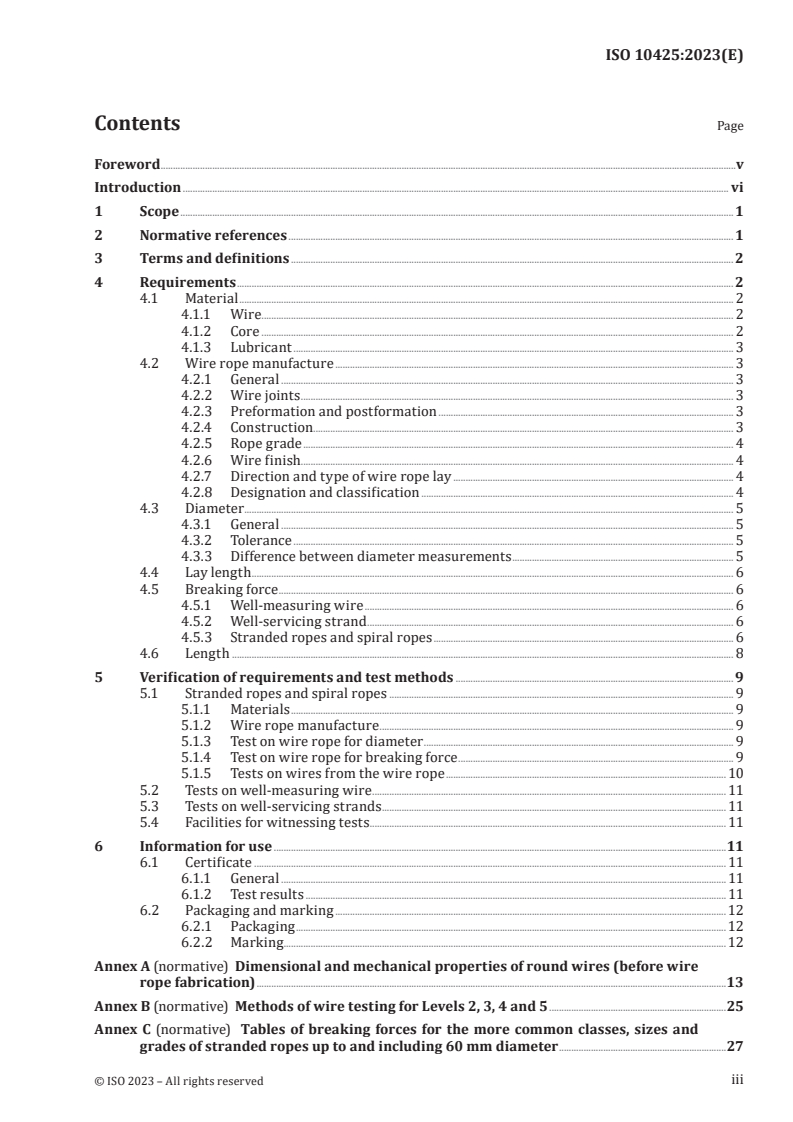
Contents Page
Foreword .v
Introduction . vi
1 Scope . 1
2 Normative references . 1
3 Terms and definitions . 2
4 Requirements . 2
4.1 Material . 2
4.1.1 Wire. 2
4.1.2 Core . 2
4.1.3 Lubricant . 3
4.2 Wire rope manufacture . 3
4.2.1 General . 3
4.2.2 Wire joints . 3
4.2.3 Preformation and postformation . 3
4.2.4 Construction. 3
4.2.5 Rope grade . 4
4.2.6 Wire finish. 4
4.2.7 Direction and type of wire rope lay . 4
4.2.8 Designation and classification . 4
4.3 Diameter . 5
4.3.1 General . 5
4.3.2 Tolerance . 5
4.3.3 Difference between diameter measurements . 5
4.4 Lay length . 6
4.5 Breaking force . 6
4.5.1 Well-measuring wire . 6
4.5.2 Well-servicing strand . 6
4.5.3 Stranded ropes and spiral ropes . 6
4.6 Length . 8
5 Verification of requirements and test methods . 9
5.1 Stranded ropes and spiral ropes . 9
5.1.1 Materials . 9
5.1.2 Wire rope manufacture . 9
5.1.3 Test on wire rope for diameter . 9
5.1.4 Test on wire rope for breaking force . 9
5.1.5 Tests on wires from the wire rope . 10
5.2 Tests on well-measuring wire . 11
5.3 Tests on well-servicing strands . 11
5.4 Facilities for witnessing tests . 11
6 Information for use .11
6.1 Certificate . 11
6.1.1 General . 11
6.1.2 Test results . 11
6.2 Packaging and marking . 12
6.2.1 Packaging . 12
6.2.2 Marking . . 12
Annex A (normative) Dimensional and mechanical properties of round wires (before wire
rope fabrication) .13
Annex B (normative) Methods of wire testing for Levels 2, 3, 4 and 5 .25
Annex C (normative) Tables of breaking forces for the more common classes, sizes and
grades of stranded ropes up to and including 60 mm diameter .27
iii
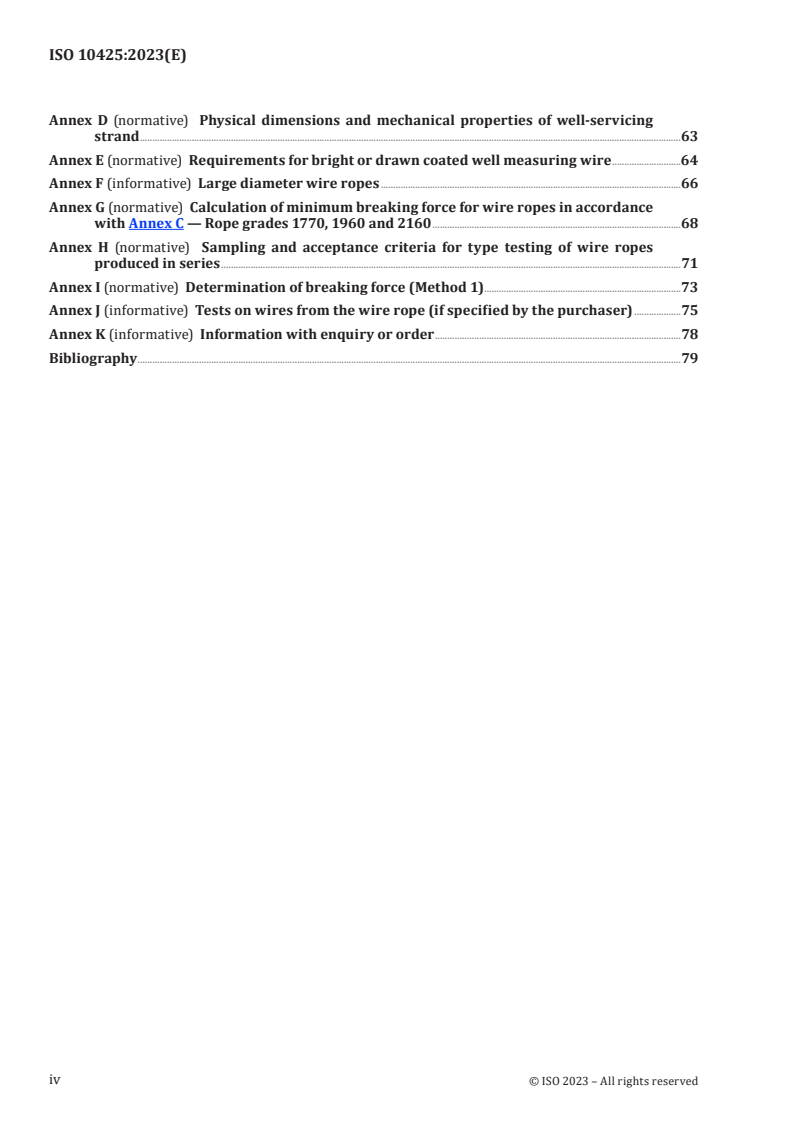
Annex D (normative) Physical dimensions and mechanical properties of well-servicing
strand .63
Annex E (normative) Requirements for bright or drawn coated well measuring wire .64
Annex F (informative) Large diameter wire ropes .66
Annex G (normative) Calculation of minimum breaking force for wire ropes in accordance
with Annex C — Rope grades 1770, 1960 and 2160 .68
Annex H (normative) Sampling and acceptance criteria for type testing of wire ropes
produced in series .71
Annex I (normative) Determination of breaking force (Method 1) .73
Annex J (informative) Tests on wires from the wire rope (if specified by the purchaser) .75
Annex K (informative) Information with enquiry or order .78
Bibliography .79
iv
Foreword
ISO (the International Organization for Standardization) is a worldwide federation of national standards
bodies (ISO member bodies). The work of preparing International Standards is normally carried out
through ISO technical committees. Each member body interested in a subject for which a technical
committee has been established has the right to be represented on that committee. International
organizations, governmental and non-governmental, in liaison with ISO, also take part in the work.
ISO collaborates closely with the International Electrotechnical Commission (IEC) on all matters of
electrotechnical standardization.
The procedures used to develop this document and those intended for its further maintenance are
described in the ISO/IEC Directives, Part 1. In particular, the different approval criteria needed for the
different types of ISO document should be noted. This document was drafted in accordance with the
editorial rules of the ISO/IEC Directives, Part 2 (see www.iso.org/directives).
ISO draws attention to the possibility that the implementation of this document may involve the use
of (a) patent(s). ISO takes no position concerning the evidence, validity or applicability of any claimed
patent rights in respect thereof. As of the date of publication of this document, ISO had not received
notice of (a) patent(s) which may be required to implement this document. However, implementers are
cautioned that this may not represent the latest information, which may be obtained from the patent
database available at www.iso.org/patents. ISO shall not be held responsible for identifying any or all
such patent rights.
Any trade name used in this document is information given for the convenience of users and does not
constitute an endorsement.
For an explanation of the voluntary nature of standards, the meaning of ISO specific terms and
expressions related to conformity assessment, as well as information about ISO's adherence to
the World Trade Organization (WTO) principles in the Technical Barriers to Trade (TBT), see
www.iso.org/iso/foreword.html.
This document was prepared by Technical Committee ISO/TC 105, Steel wire ropes.
This second edition cancels and replaces the first edition (ISO 10425:2003), which has been technically
revised.
The main changes are as follows:
— tolerance, difference of diameter measurements of compacted strands and compacted (swaged)
ropes have been added (see 4.3);
— the breaking forces of the more common classes, sizes and grades of compacted strands and
compacted (swaged) ropes have been added to the breaking force tables (see Annex C);
— some sizes of well-measuring wire have been added to the diameter tables (see Annex E).
Any feedback or questions on this document should be directed to the user’s national standards body. A
complete listing of these bodies can be found at www.iso.org/members.html.
v
Introduction
In recognition of equipment already in use and originally designed to accommodate rope sizes (nominal
rope diameters) based on “Imperial” units, some of the more common “converted SI unit” sizes have
also been included.
In addition, and in recognition of equipment already in use and designed to operate with ropes having
specific rope grades (e.g. IPS), based on “US” wire levels, these grades have also been included in order
to give prominence to the required minimum values of breaking force associated with these grades and
help to ensure that existing design safety levels are maintained.
Having due regard to size and breaking force for a particular rope class or construction, in some cases
it is possible to safely substitute a US customary size and grade with one based solely on SI units and
grade, and vice-versa. To assist in this process, this document gives a size range for each nominal
rope diameter and equivalent minimum breaking forces (converted from US customary units) for
comparison, although it is recommended that the equipment designer or rope manufacturer (or other
competent person) is consulted prior to ordering a substitute rope.
vi
INTERNATIONAL STANDARD ISO 10425:2023(E)
Steel wire ropes for the petroleum and natural gas
industries — Minimum requirements and terms of
acceptance
1 Scope
This document specifies the minimum requirements and terms of acceptance for the manufacture and
testing of steel wire ropes not exceeding rope grade 2160 for the petroleum and natural gas industries.
Typical applications include tubing lines, rod hanger lines, sand lines, cable-tool drilling and clean out
lines, cable tool casing lines, rotary drilling lines, winch lines, horse head pumping unit lines, torpedo
lines, mast-raising lines, guideline tensioner lines, riser tensioner lines, mooring and anchor lines. Wire
ropes for lifting slings and cranes, and wire for well-measuring and strand for well-servicing are also
included.
The minimum breaking forces for the more common sizes, grades and constructions of stranded rope
are given in tables. However, this document does not restrict itself to the classes covered by those
tables. Other types can also conform with its requirements. The minimum breaking force values for
these wire ropes are provided by the manufacturer.
For information only, other tables present the minimum breaking forces for large diameter stranded
and spiral ropes (i.e. spiral strand and locked coil), while approximate nominal length masses for the
more common stranded rope constructions and large diameter stranded and spiral ropes are also
given.
2 Normative references
The following documents are referred to in the text in such a way that some or all of their content
constitutes requirements of this document. For dated references, only the edition cited applies. For
undated references, the latest edition of the referenced document (including any amendments) applies.
ISO 2232, Round non-alloy steel wires for general purpose wire ropes, large diameter wire ropes and mine
hoisting wire ropes —Specifications
ISO 4345, Steel wire ropes — Fibre main cores — Specification
ISO 4346, Steel wire ropes for general purposes — Lubricants — Basic requirements
ISO 6892-1, Metallic materials — Tensile testing — Part 1: Method of test at room temperature
ISO 7500-1, Metallic materials — Calibration and verification of static uniaxial testing machines — Part 1:
Tension/compression testing machines — Calibration and verification of the force-measuring system
ISO 7800, Metallic materials — Wire — Simple torsion test
ISO 7989-2, Steel wire and wire products — Non-ferrous metallic coatings on steel wire — Part 2: Zinc or
zinc-alloy coating
ISO 17558, Steel wire ropes — Socketing procedures — Molten metal and resin socketing
ISO 17893, Steel wire ropes — Vocabulary, designation and classification
3 Terms and definitions
For the purposes of this document, the terms and definitions given in ISO 17893 and ISO 7989-2 apply.
ISO and IEC maintain terminology databases for use in standardization at the following addresses:
— ISO Online browsing platform: available at https:// www .iso .org/ obp
— IEC Electropedia: available at https:// www .electropedia .org/
4 Requirements
4.1 Material
4.1.1 Wire
The wires for stranded ropes and well-servicing strand of carbon steel shall, before fabrication, conform
to the diameter, tensile, torsion, and when applicable, coating requirements specified in Annex A.
2 2 2
The methods of test for wires of tensile strength grades 1 370 N/mm , 1 570 N/mm , 1 770 N/mm ,
2 2
1 960 N/mm and 2 160 N/mm shall be in accordance with those given in ISO 2232.
The methods of test for wires of tensile strength grades Levels 2, 3, 4 and 5 shall be in accordance with
Annex B.
For those wire ropes where a wire rope grade is applicable, the tensile strength grade of the wires shall
be subject to the limits given in Table 1.
NOTE The minimum breaking force values of those wire ropes of grades 1770, 1960 and 2160 as covered by
Tables C.1 through C.24 are calculated on the basis of wire rope grade and not individual wire tensile strength
grades or levels.
Table 1 — Range of wire tensile strength grades
Wire tensile strength grades
Rope grade
N/mm
1770 or IPS 1 570 or Level 2 to 1 960 or Level 4
1960 or EIP 1 770 or Level 3 to 2 160 or Level 5
2160 or EEIP 1 960 or Level 4 to 2 160 or Level 5
For those wire ropes (e.g. larger diameter ropes) where a wire rope grade is not applicable, the tensile
strength grades of the wires shall be one, or a combination, of those given in Annex A.
All wires of the same nominal diameter in the same wire layer shall be of the same tensile strength
grade.
Well-measuring wire and wires used in the manufacture of well-servicing strand shall normally be of
carbon steel but other materials (e.g. stainless steel) may be used.
The purchaser should specify any particular material requirements.
4.1.2 Core
Cores of stranded ropes shall normally be of steel or fibre, although other types, such as composites
(e.g. steel plus fibres or plastics) or cores made of solid polymer, may also be supplied.
The purchaser should specify the type of core.
Fibre cores shall conform to ISO 4345.
The fibre cores for single-layer stranded ropes larger than 8 mm diameter shall be doubly closed
(i.e. from yarn into strand and from strand into rope).
To inhibit rotting and decay, at least one of the following methods shall be adopted for natural fibre
cores:
a) before twisting, the yarn shall be treated with an impregnating compound;
b) after twisting, the fibre cores shall be treated with an impregnating compound.
Steel cores shall be either an independent wire rope (IWRC) or wire strand (WSC).
Steel cores of single-layer stranded ropes larger than 12 mm diameter shall be an independent wire
rope (IWRC), unless specified otherwise.
4.1.3 Lubricant
Lubricants shall conform to ISO 4346.
4.2 Wire rope manufacture
4.2.1 General
In stranded ropes, all the wire layers in a strand shall have the same direction of lay. The lay lengths of
corresponding wire layers in strands of the same size, construction and strand layer shall be uniform.
In compacted strand rope, the strands of the same group and layer shall be manufactured by the same
compaction processing method.
The core of a stranded rope, except for compacted (swaged) ropes, shall be designed (steel) or selected
(fibre) so that in a new wire rope under no load there is clearance between outer strands.
4.2.2 Wire joints
Diameters shall be continuous, but, for wires other than well-measuring wires, if joints are necessary in
wires over 0,4 mm they shall have their ends joined by welding.
For stranded ropes, the minimum distance between joints within one strand shall be 18 × wire rope
diameter (d).
For spiral ropes, the minimum distance between joints in any wire layer shall be 36 × diameter of the
wire layer.
Wires up to and including 0,4 mm may be joined by twisting or by ends being simply inserted into the
strands' formation.
4.2.3 Preformation and postformation
Stranded ropes shall be preformed or postformed, or both, unless specified otherwise by the purchaser.
Some parallel-closed ropes and rotation-resistant ropes may be non-preformed.
4.2.4 Construction
The wire rope construction shall be either one of those listed in Annex C or as stated by the manufacturer.
The constructions of large diameter (i.e. over 60 mm) stranded ropes and spiral ropes (i.e. spiral strand
and full-locked coil) shall be stated by the manufacturer.
Where only the wire rope class is specified by the purchaser, the construction supplied shall be stated
by the manufacturer.
For well-servicing strand, the construction shall be either 1 × 16M or 1 × 19M or as stated by the
manufacturer.
4.2.5 Rope grade
The wire rope grades for the more common classes and sizes of stranded ropes shall be as given in
Annex C.
Intermediate grades may be supplied by agreement between the purchaser and the manufacturer or
supplier.
NOTE Not all wire ropes (e.g. large diameter stranded ropes and spiral ropes) will necessarily have a
nominated rope grade.
4.2.6 Wire finish
The finish of the wires shall be uncoated (bright) and coated.
For wire ropes of bright wire finish, substitution of bright wires by coated wires shall be limited to
inner wires, centre wires, filler wires and core wires.
For wire ropes of coated wire finish, all of the wires shall be coated, including those of any steel core.
Where coating is specified, this may include zinc, zinc alloy and zinc-aluminium alloy.
4.2.7 Direction and type of wire rope lay
The direction and type of wire rope lay for stranded ropes shall be one of the following:
a) right ordinary lay (sZ);
b) left ordinary lay (zS);
c) right lang lay (zZ);
d) left lang lay (sS);
e) right alternate lay (aZ);
f) left alternate lay (aS).
Well-servicing strand shall be left lay (S).
Spiral ropes (i.e. spiral strand and full locked coil) shall be either right (Z) or left lay (S).
NOTE Direction, right(Z) or left(S), is corresponding to the direction of lay of the outer wires in relation to
the longitudinal axis of well-servicing strand or a spiral rope.
The direction and type of wire rope lay should be specified by the purchaser.
4.2.8 Designation and classification
For the purposes of this document, the designation and classification systems according to ISO 17893
shall apply.
4.3 Diameter
4.3.1 General
The nominal diameter shall be that by which the wire, strand or wire rope is designated.
4.3.2 Tolerance
When measured in accordance with 5.1.3, the measured (actual) diameter of stranded ropes shall be
within the tolerances given in Table 2.
Table 2 — Tolerances on rope diameter (stranded rope)
Nominal wire rope Tolerance as percentage of nominal diameter
diameter
d Wire ropes with strands
Type of wire rope
Wire ropes with strands
that are exclusively of wire
mm that incorporate fibre
or incorporate solid poly-
centres
mer centres
+8 +9
2≤ d <4
0 0
+7 +9
4≤ d < 6
0 0
Conventional strand rope
+6 +8
6≤ d <8
0 0
+5 +7
d ≥ 8
0 0
+5 +6
Compacted strand rope d ≥ 8
0 0
+5 +5
Compacted (swaged) rope d ≥ 8
0 0
When measured in accordance with 5.1.3, the measured (actual) diameter of spiral ropes shall be
+5
within % of the nominal diameter.
When measured in accordance with 5.1.3, the measured (actual) diameter of well-servicing strand shall
be within the tolerances given in Annex D.
4.3.3 Difference between diameter measurements
For stranded and spiral ropes, the difference between any two of the four measurements taken in
accordance with 5.1.3 and expressed as a percentage of the nominal diameter shall not exceed the
values given in Table 3.
Table 3 — Permissible differences between any two diameter measurements
Nominal wire rope Wire ropes with strands
diameter that are exclusively of Wire ropes with strands
wire or incorporate solid that incorporate fibre
d
Type of rope
polymer centres and centres
spiral ropes
mm
%
%
2≤ d <4 7 —
4≤ d < 6 6 8
Conventional strand rope
6≤ d <8 5 7
d ≥ 8 4 6
Compacted strand rope d ≥ 8 4 6
Compacted (swaged) rope d ≥ 8 4 6
4.4 Lay length
For single-layer ropes of 6 × 7 class, the length of lay of the finished wire rope shall not exceed 8 × wire
rope diameter (d).
For other single-layer ropes with round strands (except those with three or four strands), parallel-lay
closed ropes and rotation-resistant ropes with round strands or shaped strands, the length of lay of
the finished rope shall not exceed 7,25 × wire rope diameter (d). For single-layer ropes used in static
applications, the length of lay of the finished rope shall not exceed 7,5× wire rope diameter (d).
For single-layer ropes with shaped strands, e.g. triangular strand, the length of lay of the finished rope
shall not exceed 10 × wire rope diameter (d).
For well-servicing strand, the length of lay of the finished strand shall not exceed 10 × strand diameter
(d).
4.5 Breaking force
4.5.1 Well-measuring wire
The minimum breaking force for a given diameter of well-measuring wire shall be as given in Clause E.1.
When tested in accordance with the method specified in Clause E.2, the measured breaking force shall
be greater than or equal to the minimum breaking force.
4.5.2 Well-servicing strand
The minimum breaking force for a given diameter and construction shall be either:
a) as given in Annex D, or
b) as stated by the manufacturer (the value at least in excess of the minimum value given in Annex D).
When tested in accordance with method 1 (see 5.1.4.1), the measured breaking force shall be greater
than or equal to the minimum breaking force.
4.5.3 Stranded ropes and spiral ropes
4.5.3.1 General
The minimum breaking force, F , for a given wire rope diameter and construction shall be either:
min
a) as given in Annex C for stranded ropes, or
b) as stated by the manufacturer (the value at least in excess of the minimum value given in Annex C).
NOTE 1 Values of minimum breaking force for large diameter stranded and spiral ropes are given for
information in Annex F.
For those wire ropes covered in Annex C, the minimum breaking force of intermediate wire rope
diameters shall be calculated with the respective minimum breaking force factors in accordance with
Annex G.
When tested in accordance with method 1 of 5.1.4.1, the measured breaking force, F , shall be greater
m
than or equal to the minimum breaking force, F .
min
Breaking force testing requirements shall be in accordance with Table 4.
NOTE 2 The requirements for breaking force take into account: (i) the wire rope size; (ii) whether or not wire
ropes are produced in series, i.e. repeatedly produced; (iii) whether or not the minimum breaking force factor is
consistent throughout a range of diameters; (iv) whether or not the manufacturer is operating a quality system
in accordance with ISO 9001, certified by an accredited third party certification body.
4.5.3.2 Wire ropes produced in series — Manufacturer operating a quality system in
accordance with ISO 9001, certified by an accredited third party certification body
The manufacturer shall be able to provide the results from type testing in accordance with the sampling
and acceptance criteria given in Annex H.
Type testing shall be repeated on any wire rope that has its design changed in any way which results
in a modified (e.g. increased) breaking force. Apart from wire tensile strength grades, if the same
design is used for wire ropes of a lower grade or lower breaking force, or both, than the one which has
successfully passed the type testing requirements, it shall not be necessary to repeat the tests on those
wire ropes provided the breaking force is calculated with the same spinning loss.
Subsequent production lengths of wire ropes produced in series shall be deemed to conform to the
breaking force requirements when the manufacturer has satisfactorily completed on a sample from
every twentieth production length:
a) the appropriate type tests (see Annex H), and
b) a breaking force test in accordance with method 1 or one of the alternative methods, known as
methods 2 and 3 (see 5.1.4.2 and 5.1.4.3).
Table 4 — Breaking force testing requirements
Manufacturer NOT oper-
Wire rope diameter Manufacturer operating a quali- ating a quality system in
Min. breaking ty system in accordance with ISO accordance with ISO 9001,
d
force factor 9001, certified by an accredited certified by an accredited
mm third party certification body third party certification
body
Same factor Breaking force test in accordance Breaking force test in ac-
throughout a sub- with 5.1.4.1 (method 1) on a sample cordance with 5.1.4.1 (Meth-
group of wire rope from each production length; or, if od 1) on a sample from each
diameters produced in series, type testing in production length.
accordance with H.1.1 plus periodic
test in accordance with 5.1.4.1 (meth-
od 1), 5.1.4.2 (method 2) or 5.1.4.3
(method 3) on a sample from every
twentieth production length relating
to the sub-group of diameters.
d ≤ 60
Different factor Breaking force test in accordance Breaking force test in ac-
throughout a sub- with 5.1.4.1 (Method 1) on a sample cordance with 5.1.4.1 (Meth-
group of wire rope from each production length; or, if od 1) on a sample from each
diameters produced in series, type testing in ac- production length.
cordance with H.1.2 plus periodic test
in accordance with 5.1.4.1 (method 1),
5.1.4.2 (method 2) or 5.1.4.3 (meth-
od 3) on a sample from every twenti-
eth production length of a given wire
rope diameter and construction.
Breaking force test in ac-
Breaking force test in accordance
cordance with 5.1.4.1 (meth-
with 5.1.4.1 (method 1), 5.1.4.2
od 1), 5.1.4.2 (method 2)
d > 60 (method 2) or 5.1.4.3 (method 3) on a
or 5.1.4.3 (method 3) on a
sample from each production length,
sample from each production
or either of the following:
length.
a) if produced in series, type
testing in accordance with H.2
plus periodic test in accordance
with 5.1.4.1 (method 1), 5.1.4.2
(method 2) or 5.1.4.3 (method 3)
on a sample from every twentieth
production length;
or
b) if produced for supply as a set of
wire ropes of the same design
for a specific installation, the
alternative breaking force testing
and sampling as also given in H.2.
NOTE The result from method 1 is known as measured breaking force. The result from method 2 is known as calculated
measured (post-spin) breaking force. The result from method 3 is known as calculated measured (pre-spin) breaking force.
4.6 Length
For those wire ropes not forming part of an assembly, the actual length of wire rope supplied shall be
the specified nominal length subject to the following tolerances:
+5
a) up to and including 400 m: % of the specified length;
+20
b) over 400 m, up to and including 1 000 m: m ;
+2
c) over 1 000 m: % of the specified length.
The wire rope shall be measured under no load.
Wire ropes required with smaller length tolerance should be the subject of agreement between the
purchaser and the manufacturer.
5 Verification of requirements and test methods
5.1 Stranded ropes and spiral ropes
5.1.1 Materials
Compliance with the wire, core, and lubricant requirements shall be through a visual verification of the
inspection documents supplied with the wire, core and lubricant.
5.1.2 Wire rope manufacture
Compliance with the requirements for wire joints and preformation shall be through visual verification.
5.1.3 Test on wire rope for diameter
Diameter measurements shall be taken on a straight portion of wire rope, either under no tension or a
tension not exceeding 5 % of the minimum breaking force, at two positions spaced at least 1 m apart. At
each position, two measurements, at right angles, of the circumscribed circle diameter shall be taken.
The measuring equipment shall extend over at least two adjacent strands (see Figure 1). The average of
these four measurements shall be the measured diameter.
Figure 1 — Method of measuring wire rope diameter
5.1.4 Test on wire rope for breaking force
5.1.4.1 Method 1 — Measured breaking force
The method shall be in accordance with Annex I.
The wire rope shall be deemed to have satisfied the breaking force requirement when the measured
breaking force reaches or exceeds the minimum value.
When the minimum breaking force is not reached, three additional tests may be carried out, one of
which shall achieve or exceed the minimum breaking force value for the manufacture to be accepted.
Otherwise, the whole manufacture shall be rejected.
5.1.4.2 Method 2 —Calculated measured (post-spin) breaking force
Add together the measured breaking forces of all individual wires after they have been removed from
the rope and multiply this value by either:
a) the spinning loss factor derived from Annex G, or
b) the partial spinning loss factor obtained from the results of type testing.
The partial spinning loss factor used in the calculation shall be the lowest of the three values obtained
from type testing.
In the case of triangular strand ropes, the triangular centre of the strand may be considered as an
individual wire.
Test the wires in accordance with the wire tensile test specified in Clause B.2 or in ISO 6892-1.
NOTE The result from this test is known as the “calculated measured (post-spin) breaking force”.
When this method (i.e. method 2) is used for the periodic test (see Table 4) and the calculated measured
(post-spin) breaking force value is less than the intended minimum breaking force value, carry out
another test using method 1.
If the measured (actual) breaking force in this second test fails to meet the intended minimum breaking
force value, de-rate the minimum breaking force to a value not exceeding the measured (actual)
breaking force value and repeat the type testing using method 1.
In such cases, either de-rate the wire rope grade in line with the de-rated minimum breaking force
value or delete it from the wire rope designation.
5.1.4.3 Method 3 —Calculated measured (pre-spin) breaking force
Add together the measured breaking forces of all the individual wires before they are laid into the wire
rope and multiply this value by the total spinning loss factor obtained from the results of type testing.
The total spinning loss factor used in the calculation shall be the lowest of the three values obtained
from type testing.
The wires shall be tested in accordance with the wire tensile test specified in ISO 6892-1.
NOTE The result from this test is known as the “calculated measured (pre-spin) breaking force”.
When this method (i.e. method 3) is used for the periodic test (see Table 4) and the calculated measured
(pre-spin) breaking force value is less than the intended minimum breaking force value, carry out
another test using method 1.
If the measured (actual) breaking force in this second test fails to meet the intended minimum breaking
force value, de-rate the minimum breaking force to a value not exceeding the measured (actual)
breaking force value and repeat the type testing using method 1.
In such cases, either de-rate the wire rope grade in line with the de-rated minimum breaking force
value or delete it from the wire rope designation.
5.1.5 Tests on wires from the wire rope
When tests, if any, are required to be performed on wires taken from the wire rope after fabrication,
and unless specified otherwise by the purchaser, sampling, test methods, and acceptance criteria
should be in accordance with Annex J.
If tests on the wires are required to be carried out, this should be stated in the purchaser’s order.
5.2 Tests on well-measuring wire
The tests shall consist of a simultaneous elongation and tensile test and a separate torsion test. Testing
methods and acceptance criteria shall be in accordance with Annex E.
5.3 Tests on well-servicing strands
The tests shall consist of a measured diameter in accordance with 5.1.3 and a breaking force test in
accordance with 5.1.4.1.
5.4 Facilities for witnessing tests
The manufacturer shall offer the purchaser or purchaser’s representative all necessary facilities for the
witnessing of tests (when these are performed) or for the examination of records of type tests in order
to be assured of compliance with this document, or both.
Test lengths required by the purchaser should be ordered as additional lengths.
6 Information for use
6.1 Certificate
6.1.1 General
A certificate shall confirm conformance with this document and, unless specified otherwise by the
purchaser, shall give at least the following information:
a) certificate number;
b) name and address of the manufacturer;
c) wire rope designation or wire rope description;
d) minimum breaking force;
e) date of issue of the certificate and authentication.
NOTE Refer to the information provided to the purchaser in Annex K.
Quantity and nominal length of wire rope may also be included.
The certificate shall enable traceability of the wire rope.
6.1.2 Test results
When actual test results are required to be certified (see above), the certificate shall additionally give
either a) or b) or both, as follows:
a) breaking force test on wire rope — state which value, i.e.
1) measured breaking force, or
2) calculated measured (post-spin) breaking force, or
3) calculated measured (pre-spin) breaking force;
b) tests on wires —
1) number of wires tested,
2) nominal dimension of wire,
3) measured dimension of wire (diameter or height of profile),
4) breaking force of wire,
5) tensile strength of wire (based on nominal dimension),
6) number of torsions completed (and test length),
7) mass of coating.
6.2 Packaging and marking
6.2.1 Packaging
Wire ropes shall be supplied in coils or on reels at the discretion of the manufacturer.
The wire rope ends shall be secured such that they are prevented from unlaying.
The purchaser should specify any particular packaging requirements.
Rotation-resistant ropes should be supplied on reels.
6.2.2 Marking
The wire rope manufacturer's or supplier's name and address, certificate number if appropriate (see
6.1), length, and wire rope designation shall be legibly and durably marked on a tag attached to each
coil or a plate attached to each reel of wire rope.
Annex A
(normative)
Dimensional and mechanical properties of round wires (before
wire rope fabrication)
2 2 2
A.1 Tensile strength grades 1 370 N/mm , 1 570 N/mm , 1 770 N/mm , 1 960 N/
2 2
mm and 2 160 N/mm
The permitted variations in tensile strengths of non-alloyed steel wires shall not exceed the nominal
values by an amount greater than those given in Table A.1. The values of tensile strength grade are the
lower (minima) limits for each tensile strength grade.
Table A.1 — Permitted variations in tensile strength
Nominal diameter Permitted variation in tensile strength above nominal
mm N/mm
0,2 ≤ δ < 0,5 390
0,5 ≤ δ <1,0 350
1,0 ≤ δ < 1,5 320
1,5 ≤ δ < 2,0 290
2,0 ≤ δ < 3,5 260
3,5 ≤ δ < 7,0 250
In the case of alloy steel wires, the maximum values shall be no greater than the minimum value plus
15 %.
The diameter tolerances, minimum number of torsions, and minimum masses of coating shall be in
accordance with the values given in Table A.2.
Table A.2 — Diameter tolerances, minimum number of torsions, and minimum masses of
2 2 2 2
coating for tensile strength grades 1 370 N/mm , 1 570 N/mm , 1 770 N/mm , 1 960 N/mm and
2 160 N/mm
Nominal Tolerance Min. number of torsions based on 100δ Min. coat-
diameter of ing mass
wire
Bright Coated Bright and coated Coated Coated
and
coated
Quality Quality Quality B Quality A
B A
2 2
mm mm Tensile strength grade (N/mm ) g/m
1 370 1 570 1 7
...