

ISO/TR 230-8:2010
(Main)Test code for machine tools — Part 8: Vibrations
General Information
- Abstract
ISO/TR 230-8:2010 is concerned with the different types of vibration that can occur between the tool-holding part and the workpiece-holding part of a machine tool. (For simplicity, these will generally be referred to as “tool” and “workpiece”, respectively.) These are vibrations that can adversely influence the production of both an acceptable surface finish and an accurate workpiece. It is not aimed primarily at those who have expertise in vibration analysis and who routinely carry out such work in research and development environments. It does not, therefore, replace standard textbooks on the subject.. It is, however, intended for manufacturers and users alike with general engineering knowledge in order to enhance their understanding of the causes of vibration by providing an overview of the relevant background theory. It also provides basic measurement procedures for evaluating certain types of vibration problems that can beset a machine tool: vibrations occurring as a result of mechanical unbalance; vibrations generated by the operation of the machine's linear slides; vibrations transmitted to the machine by external forces; vibrations generated by the cutting process including self-excited vibrations (chatter). Additionally, this report discusses the application of artificial vibration excitation for the purpose of structural analysis.
- Status
- Published
- Publication Date
- 26-May-2010
- Technical Committee
- ISO/TC 39/SC 2 - Test conditions for metal cutting machine tools
- Drafting Committee
- ISO/TC 39/SC 2 - Test conditions for metal cutting machine tools
- Current Stage
- 6060 - International Standard published
- Start Date
- 27-May-2010
- Due Date
- 29-Jan-2012
- Completion Date
- 29-Jan-2012
Buy Documents
ISO/TR 230-8:2010 - Test code for machine tools — Part 8: Vibrations Released:5/27/2010
ISO/TR 230-8:2010 - Code d'essai des machines-outils — Partie 8: Vibrations Released:5/27/2010
Overview
ISO/TR 230-8:2010 - Test code for machine tools - Part 8: Vibrations - is a Technical Report from ISO that explains the types of vibrations that occur between the tool-holding and workpiece-holding parts of a machine tool and how they affect surface finish and dimensional accuracy. Intended for manufacturers, users and engineers with general engineering knowledge (not primarily for specialist vibration researchers), it provides background theory, basic measurement procedures, and guidance on structural analysis using artificial excitation.
Key topics and requirements
- Scope and purpose: Focus on vibrations that degrade machining quality (surface finish, accuracy) rather than operator exposure or noise (those are covered in other standards).
- Theoretical background: Basic vibration concepts, single-degree-of-freedom and multi-degree-of-freedom systems, spectra, bandwidth and graphical representations.
- Types of vibration covered:
- Vibrations from mechanical unbalance
- Vibrations from operation of linear slides (inertial cross-talk)
- External vibration transmission to the machine
- Cutting-process generated vibrations including self‑excited vibrations (chatter)
- Other excitation sources and the use of artificial excitation for structural tests
- Practical testing guidance:
- Measurement parameters, units and uncertainty of measurement
- Instrumentation and mounting of sensors (see Annex F)
- Relative vs absolute measurements and sampling considerations (aliasing)
- Specific tests: unbalance tests, slide acceleration checks, external vibration assessment, cutting vibration evaluation
- Structural analysis methods: Frequency response testing, spectrum analysis, modal analysis, cross-response tests and recommendations for machine setup during tests.
- Supporting annexes: theory summaries, balancing protocol (Annex D), examples of test results (Annex E), instrumentation guidance (Annex F).
Practical applications and users
ISO/TR 230-8 is useful for:
- Machine tool manufacturers validating dynamic behavior during design and production
- Maintenance and reliability engineers diagnosing vibration-related quality or wear problems
- Process engineers and machinists troubleshooting chatter, poor surface finish or dimensional errors
- Test laboratories and quality managers performing acceptance or type tests Practical outcomes include improved surface finish, longer tool life, reduced component scrap and targeted corrective actions (balancing, stiffness changes, damping, process parameter adjustments).
Related standards
Relevant references include other parts of ISO 230 (e.g., ISO 230-1, ISO 230-5), and normative documents such as ISO 2041, ISO 1925, ISO 1940-1, ISO 2954 and ISO 2631-1.
Keywords: ISO/TR 230-8:2010, machine tool vibrations, vibration testing, chatter, modal analysis, vibration measurement, test code for machine tools.
Relations
- Effective Date
- 06-Feb-2010
Buy Documents
ISO/TR 230-8:2010 - Test code for machine tools — Part 8: Vibrations Released:5/27/2010
ISO/TR 230-8:2010 - Code d'essai des machines-outils — Partie 8: Vibrations Released:5/27/2010
Get Certified
Connect with accredited certification bodies for this standard

DVS-ZERT GmbH
German welding certification society.
CARES (UK Certification Authority for Reinforcing Steels)
UK certification for reinforcing steels and construction.
EWF/IIW (European/International Welding Federation)
International welding personnel certification.
Sponsored listings
Frequently Asked Questions
ISO/TR 230-8:2010 is a technical report published by the International Organization for Standardization (ISO). Its full title is "Test code for machine tools — Part 8: Vibrations". This standard covers: ISO/TR 230-8:2010 is concerned with the different types of vibration that can occur between the tool-holding part and the workpiece-holding part of a machine tool. (For simplicity, these will generally be referred to as “tool” and “workpiece”, respectively.) These are vibrations that can adversely influence the production of both an acceptable surface finish and an accurate workpiece. It is not aimed primarily at those who have expertise in vibration analysis and who routinely carry out such work in research and development environments. It does not, therefore, replace standard textbooks on the subject.. It is, however, intended for manufacturers and users alike with general engineering knowledge in order to enhance their understanding of the causes of vibration by providing an overview of the relevant background theory. It also provides basic measurement procedures for evaluating certain types of vibration problems that can beset a machine tool: vibrations occurring as a result of mechanical unbalance; vibrations generated by the operation of the machine's linear slides; vibrations transmitted to the machine by external forces; vibrations generated by the cutting process including self-excited vibrations (chatter). Additionally, this report discusses the application of artificial vibration excitation for the purpose of structural analysis.
ISO/TR 230-8:2010 is concerned with the different types of vibration that can occur between the tool-holding part and the workpiece-holding part of a machine tool. (For simplicity, these will generally be referred to as “tool” and “workpiece”, respectively.) These are vibrations that can adversely influence the production of both an acceptable surface finish and an accurate workpiece. It is not aimed primarily at those who have expertise in vibration analysis and who routinely carry out such work in research and development environments. It does not, therefore, replace standard textbooks on the subject.. It is, however, intended for manufacturers and users alike with general engineering knowledge in order to enhance their understanding of the causes of vibration by providing an overview of the relevant background theory. It also provides basic measurement procedures for evaluating certain types of vibration problems that can beset a machine tool: vibrations occurring as a result of mechanical unbalance; vibrations generated by the operation of the machine's linear slides; vibrations transmitted to the machine by external forces; vibrations generated by the cutting process including self-excited vibrations (chatter). Additionally, this report discusses the application of artificial vibration excitation for the purpose of structural analysis.
ISO/TR 230-8:2010 is classified under the following ICS (International Classification for Standards) categories: 25.080.01 - Machine tools in general. The ICS classification helps identify the subject area and facilitates finding related standards.
ISO/TR 230-8:2010 has the following relationships with other standards: It is inter standard links to ISO/TR 230-8:2009. Understanding these relationships helps ensure you are using the most current and applicable version of the standard.
ISO/TR 230-8:2010 is available in PDF format for immediate download after purchase. The document can be added to your cart and obtained through the secure checkout process. Digital delivery ensures instant access to the complete standard document.
Standards Content (Sample)
TECHNICAL ISO/TR
REPORT 230-8
Second edition
2010-06-01
Test code for machine tools —
Part 8:
Vibrations
Code d'essai des machines-outils —
Partie 8: Vibrations
Reference number
©
ISO 2010
PDF disclaimer
This PDF file may contain embedded typefaces. In accordance with Adobe's licensing policy, this file may be printed or viewed but
shall not be edited unless the typefaces which are embedded are licensed to and installed on the computer performing the editing. In
downloading this file, parties accept therein the responsibility of not infringing Adobe's licensing policy. The ISO Central Secretariat
accepts no liability in this area.
Adobe is a trademark of Adobe Systems Incorporated.
Details of the software products used to create this PDF file can be found in the General Info relative to the file; the PDF-creation
parameters were optimized for printing. Every care has been taken to ensure that the file is suitable for use by ISO member bodies. In
the unlikely event that a problem relating to it is found, please inform the Central Secretariat at the address given below.
© ISO 2010
All rights reserved. Unless otherwise specified, no part of this publication may be reproduced or utilized in any form or by any means,
electronic or mechanical, including photocopying and microfilm, without permission in writing from either ISO at the address below or
ISO's member body in the country of the requester.
ISO copyright office
Case postale 56 • CH-1211 Geneva 20
Tel. + 41 22 749 01 11
Fax + 41 22 749 09 47
E-mail copyright@iso.org
Web www.iso.org
Published in Switzerland
ii © ISO 2010 – All rights reserved
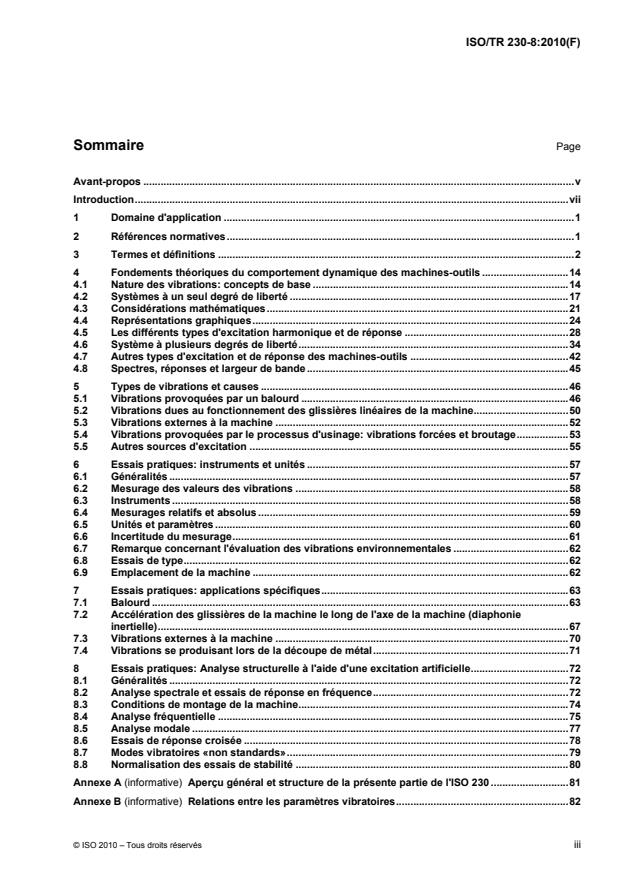
Contents Page
Foreword .v
Introduction.vii
1 Scope.1
2 Normative references.1
3 Terms and definitions .2
4 Theoretical background to the dynamic behaviour of machine tools .13
4.1 Nature of vibration: basic concepts .13
4.2 Single-degree-of-freedom systems .16
4.3 Mathematical considerations .20
4.4 Graphical representations.22
4.5 Different types of harmonic excitation and response .26
4.6 More degrees of freedom.33
4.7 Other miscellaneous types of excitation and response of machine tools .40
4.8 Spectra, responses and bandwidth.43
5 Types of vibration and their causes .44
5.1 Vibrations occurring as a result of unbalance .44
5.2 Vibrations occurring through the operation of linear slides .48
5.3 Vibrations occurring externally to the machine.49
5.4 Vibrations initiated by the machining process: forced vibration and chatter .50
5.5 Other sources of excitation.52
6 Practical testing: general concepts.54
6.1 General .54
6.2 Measurement of vibration values .54
6.3 Instrumentation .55
6.4 Relative and absolute measurements .56
6.5 Units and parameters.56
6.6 Uncertainty of measurement.58
6.7 Note on environmental vibration evaluation .58
6.8 Type testing .59
6.9 Location of machine.59
7 Practical testing: specific applications .60
7.1 Unbalance.60
7.2 Machine slide acceleration along its axis (inertial cross-talk).64
7.3 Vibrations occurring externally to the machine.67
7.4 Vibrations occurring through metal cutting .67
8 Practical testing: structural analysis through artificial excitation .68
8.1 General .68
8.2 Spectrum analysis and frequency response testing .69
8.3 Machine set-up conditions .70
8.4 Frequency analysis .71
8.5 Modal analysis .73
8.6 Cross-response tests.73
8.7 “Non-standard” vibration modes.75
8.8 Providing standard stability tests.76
Annex A (informative) Overview and structure of this part of ISO 230 .77
Annex B (informative) Relationships between vibration parameters.78
Annex C (informative) Summary of basic vibration theory.80
Annex D (informative) Spindle and motor balancing protocol .84
Annex E (informative) Examples of test results and their presentation.85
Annex F (informative) Instrumentation for analysis of machine tool dynamic behaviour .94
Bibliography .107
iv © ISO 2010 – All rights reserved
Foreword
ISO (the International Organization for Standardization) is a worldwide federation of national standards bodies
(ISO member bodies). The work of preparing International Standards is normally carried out through ISO
technical committees. Each member body interested in a subject for which a technical committee has been
established has the right to be represented on that committee. International organizations, governmental and
non-governmental, in liaison with ISO, also take part in the work. ISO collaborates closely with the
International Electrotechnical Commission (IEC) on all matters of electrotechnical standardization.
International Standards are drafted in accordance with the rules given in the ISO/IEC Directives, Part 2.
The main task of technical committees is to prepare International Standards. Draft International Standards
adopted by the technical committees are circulated to the member bodies for voting. Publication as an
International Standard requires approval by at least 75 % of the member bodies casting a vote.
In exceptional circumstances, when a technical committee has collected data of a different kind from that
which is normally published as an International Standard (“state of the art”, for example), it may decide by a
simple majority vote of its participating members to publish a Technical Report. A Technical Report is entirely
informative in nature and does not have to be reviewed until the data it provides are considered to be no
longer valid or useful.
Attention is drawn to the possibility that some of the elements of this document may be the subject of patent
rights. ISO shall not be held responsible for identifying any or all such patent rights.
ISO/TR 230-8 was prepared by Technical Committee ISO/TC 39, Machine tools, Subcommittee SC 2, Test
conditions for metal cutting machine tools.
This second edition cancels and replaces the first edition (ISO/TR 230-8:2009). Annex F has been added and
minor editorial corrections have been made.
ISO 230 consists of the following parts, under the general title Test code for machine tools:
⎯ Part 1: Geometric accuracy of machines operating under no-load or quasi-static conditions
⎯ Part 2: Determination of accuracy and repeatability of positioning numerically controlled axes
⎯ Part 3: Determination of thermal effects
⎯ Part 4: Circular tests for numerically controlled machine tools
⎯ Part 5: Determination of the noise emission
⎯ Part 6: Determination of positioning accuracy on body and face diagonals (Diagonal displacement tests)
⎯ Part 7: Geometric accuracy of axes of rotation
⎯ Part 8: Vibrations [Technical Report]
⎯ Part 9: Estimation of measurement uncertainty for machine tool tests according to series ISO 230, basic
equations [Technical Report]
⎯ Part 10: Determination of measuring performance of probing systems of numerically controlled machine
tools
The following part is under preparation:
⎯ Part 11: Measuring instruments and their application to machine tool geometry tests [Technical Report]
vi © ISO 2010 – All rights reserved
Introduction
The purpose of ISO 230 is to standardize methods of testing the performance of machine tools, generally
1)
without their tooling , and excluding portable power tools. This part of ISO 230 establishes general procedures
for the assessment of machine tool vibration.
The need for vibration control is recognized in order that those types of vibration that produce undesirable
effects can be mitigated. These effects are identified principally as:
⎯ unacceptable cutting performance with regard to surface finish and accuracy;
⎯ premature wear or damage of machine components;
⎯ reduced tool life;
⎯ unacceptable noise level;
⎯ physiological harm to operators.
Of these, only the first is considered to lie within the scope of this part of ISO 230, although the other effects
may well occur incidentally. (Noise is covered by ISO 230-5, and the effect of vibration on operators is
covered by ISO 2631-1.) For the most part, this necessarily limits this part of ISO 230 to the problems of
vibrations that are generated between tool and workpiece.
Although this part of ISO 230 is in the form of a Technical Report, a number of acceptance tests are proposed
within it. These take on the appearance of “standard tests” to be found in other parts of the 230 series. These
tests may be used in this way, but, being less rigorous in their formulation, they do not carry the authority that
a test in accordance with an International Standard would have.
1) In some cases, practical considerations require that real or dummy tooling and workpieces be used (see 7.1.1, 7.2.1,
7.4 and 8.3).
TECHNICAL REPORT ISO/TR 230-8:2010(E)
Test code for machine tools —
Part 8:
Vibrations
1 Scope
This part of ISO 230 is concerned with the different types of vibration that can occur between the tool-holding
part and the workpiece-holding part of a machine tool. (For simplicity, these will generally be referred to as
“tool” and “workpiece”, respectively.) These are vibrations that can adversely influence the production of both
an acceptable surface finish and an accurate workpiece.
This part of ISO 230 is not aimed primarily at those who have expertise in vibration analysis and who routinely
carry out such work in research and development environments. It does not, therefore, replace standard
textbooks on the subject (see the Bibliography). It is, however, intended for manufacturers and users alike
with general engineering knowledge in order to enhance their understanding of the causes of vibration by
providing an overview of the relevant background theory.
It also provides basic measurement procedures for evaluating certain types of vibration problems that can
beset a machine tool:
⎯ vibrations occurring as a result of mechanical unbalance;
⎯ vibrations generated by the operation of the machine's linear slides;
⎯ vibrations transmitted to the machine by external forces;
⎯ vibrations generated by the cutting process including self-excited vibrations (chatter).
Additionally, this report discusses the application of artificial vibration excitation for the purpose of structural
analysis. Instrumentation is described in Annex F. An overview of the structure and content of this part of
ISO 230 is given in Annex A.
NOTE Other sources of vibration (e.g. the instability of drive systems, the use of ancillary equipment or the effects of
worn bearings) are discussed briefly, but a detailed analysis of their vibration-generating mechanisms is not given.
2 Normative references
The following referenced documents are indispensable for the application of this document. For dated
references, only the edition cited applies. For undated references, the latest edition of the referenced
document (including any amendments) applies.
ISO 230-1, Test code for machine tools — Geometric accuracy of machines operating under no-load or
quasi-static conditions
ISO 230-5, Test code for machine tools — Determination of the noise emission
ISO 1925:2001, Mechanical vibration — Balancing — Vocabulary
ISO 1940-1:2003, Mechanical vibration — Balance quality requirements for rotors in a constant (rigid) state —
Part 1: Specification and verification of balance tolerances
ISO 2041:2009, Vibration and shock — Vocabulary
ISO 2631-1, Mechanical vibration and shock — Evaluation of human exposure to whole-body vibration —
Part 1: General requirements
ISO 2954, Mechanical vibration of rotating and reciprocating machinery — Requirements for instruments for
measuring vibration severity
ISO 5348:1998, Mechanical vibration and shock — Mechanical mounting of accelerometers
ISO 6103, Bonded abrasive products — Permissible unbalances of grinding wheels as delivered — Static
testing
ISO 15641, Milling cutters for high speed machining — Safety requirements
3 Terms and definitions
For the purposes of this document, the terms and definitions given in ISO 1925, ISO 2041 and the following
apply.
3.1
absolute vibration
vibration value measured with an inertial transducer at a single point
3.2
absorber
damper
device for reducing the magnitude of a shock or vibration by energy dissipation methods
[ISO 2041:1990, definition 2.114]
3.3
accelerance
vibration quantified by its acceleration per unit excitation force
NOTE See Table 1 in ISO 2041:1990.
3.4
aliasing error
erroneous result in digital analysis of signals caused by having the maximum frequency of the [measured]
signal greater than one-half the value of the sampling frequency
[ISO 2041:1990, definition 5.8]
3.5
amount of unbalance
product of the unbalance mass and the distance of its centre of mass from the shaft axis
[ISO 1925:2001, definition 3.3]
NOTE This is sometimes referred to as the “residual unbalance” (e.g. in ISO 1940-1). It is measured in mass-length
units, e.g. gram millimetres (g·mm).
3.6
amplitude
peak vibration value
maximum value of a sinusoidal vibration
[ISO 2041:1990, definition 2.33]
2 © ISO 2010 – All rights reserved
NOTE This is sometimes called vector amplitude to distinguish it from other senses of the term “amplitude”, and it is
sometimes called single amplitude, or peak amplitude, to distinguish it from double amplitude, which, for a simple harmonic
vibration, is the same as the total excursion or peak-to-peak value. The use of the terms “double amplitude” and “single
amplitude” is deprecated.
3.7
angular frequency
circular frequency
product of the frequency of a sinusoidal quantity and the factor 2π
[ISO 2041:1990, definition 2.30]
NOTE 1 The unit of circular frequency is the radian per unit of time.
NOTE 2 Angular or circular frequency occurs at the rate at which any vibration signal (or part of a vibration signal)
repeats its pattern. It is measured in radians per second and is usually represented by the symbol “ω”.
3.8
antinode
point, line or surface in a standing wave where some characteristic of the wave field has a maximum value
[ISO 2041:1990, definition 2.47]
EXAMPLE A point or line on the surface of a machine tool whose amplitude of vibration (at a particular frequency) is
greater than that at any adjacent points or lines.
3.9
antiresonance
system in forced oscillation in which any change at a given point, however small, in the frequency of excitation
causes an increase in a response at this point
NOTE 1 The above specification defines a response minimum, but not necessarily a response zero.
NOTE 2 Adapted from ISO 2041:1990, definition 2.74.
3.10
averaging
process chosen to determine a single representative value for a set of data
NOTE In connection with sine wave analysis, averaging refers to the arithmetic mean signal level in one half of a sine
wave. In connection with data sampling, various techniques are available. Vector averaging, for example, not only takes
the mean of the signal level but also takes account of its phase relative to some reference frequency (e.g. the excitation
frequency). This technique ensures that any signal content that is unrelated to the frequency of interest, and consequently
of an undetermined phase for each sample, is rapidly diminished through cancelling as the averaging takes place. This
effective enhancer of signal-to-noise ratio also provides a useful diagnostic tool for identifying vibration sources.
3.11
bandwidth
range of frequencies (usually expressed in hertz) where the amplitude exceeds a particular threshold level or
limits within which the power spectrum is considered
NOTE This should not be confused with the same term used in digital communication theory for expressing a data
transmission rate in bits per second.
3.12
beats
periodic variations in the amplitude of an oscillation resulting from the combination of two oscillations of
slightly different frequencies
NOTE 1 The beats occur at the difference frequency.
NOTE 2 Adapted from ISO 2041:1990, definition 2.28.
3.13
broadband measurement
measuring process where the total vibration power is integrated over the frequency range of interest
3.14
centre of mass
that point associated with a body which has the property that an imaginary particle placed at this point with a
mass equal to the mass of a given material system has a first moment with respect to any plane equal to the
corresponding first moment of the system
NOTE This term is sometimes referred to as “centre of inertia” and for most practical situations it is synonymous with
“centre of gravity”.
[ISO 2041:1990, definition 1.31]
3.15
chatter
self-excited regenerative relative vibrations between the tool and workpiece during the cutting process,
precipitating an unstable machining condition
NOTE See also 5.4.
3.16
coherence function
that fraction of the total power in a response signal that is identified with an individual source component
3.17
coupled modes
modes of vibration that are not independent but which influence one another because of energy transfer from
one to another
[ISO 2041:1990, definition 2.53]
3.18
critical damping
〈single-degree-of-freedom system〉 amount of viscous damping that corresponds to the limiting condition
between an oscillatory and a non-oscillatory transient state of free vibration
[ISO 2041:1990, definition 2.85]
3.19
cycle
complete range of states or values through which a periodic phenomenon or function passes before repeating
itself identically
[ISO 2041:1990, definition 2.22]
3.20
damping
dissipation of energy with time
NOTE Adapted from ISO 2041:1990, definition 2.79.
3.21
damping ratio
〈system with linear viscous damping〉 ratio of the actual damping coefficient to the critical damping coefficient
NOTE Adapted from ISO 2041:1990, definition 2.86.
4 © ISO 2010 – All rights reserved
3.22
degrees of freedom
number of degrees of freedom of a mechanical system equal to the minimum number of independent
generalized coordinates required to define completely the configuration of the system at any instant of time
[ISO 2041:1990, definition 1.26]
3.23
distributed system
continuous system
system having an infinite number of possible independent configurations
[ISO 2041:1990, definition 1.29]
NOTE Machine tools generally fall into this category as the mass as well as the stiffness are not located at individual
points but distributed over the whole structure.
3.24
dynamic compliance
reciprocal of dynamic stiffness
NOTE This is quite often referred to as “flexibility”. Typical units are micrometres per newton.
3.25
dynamic stiffness
ratio of change of force to change of displacement under dynamic conditions
NOTE 1 See also ISO 2041:1990, definition 1.54.
NOTE 2 At low frequencies, the dynamic stiffness approximates to the static stiffness. At high frequencies, the response
tends towards zero and the dynamic stiffness tends towards infinity. At intermediate frequencies, where resonances occur,
the dynamic stiffness can drop to a very low value. Units of stiffness are expressed in force per displacement, e.g.
newtons per micrometre.
3.26
dynamic vibration absorber
device for reducing vibrations of a primary system over a desired frequency range by the transfer of energy
to an auxiliary system in resonance so tuned that the force exerted by the auxiliary system is opposite in
phase to the force acting on the primary system
[ISO 2041:1990, definition 2.116]
NOTE Dynamic vibration absorbers may be damped or undamped, but damping is not the primary purpose.
3.27
FFT
fast Fourier transform
process where the computing times of complex multiplications and additions are greatly reduced
[ISO 2041:1990, definition 5.23]
NOTE 1 For more details, see ISO 2041:1990, A.18 to A.22.
NOTE 2 An FFT is a mathematical algorithm enabling vibration-analysis equipment to perform at high speed and thus
appear to function in “real time”.
3.28
forced vibration
steady-state vibration caused by a steady-state excitation
[ISO 2041:1990, definition 2.16]
NOTE 1 Transient vibrations are not considered.
NOTE 2 The vibration (for linear systems) has the same frequencies as the excitation.
3.29
foundation
structure that supports a mechanical system and that may be fixed in a specified frame or it may undergo a
motion that provides excitation for the supported system
[ISO 2041:1990, definition 1.23]
3.30
Fourier analysis
mathematical procedure for determining the coefficients and phase angles of the components of the Fourier
series for a given waveform
3.31
Fourier series
series which expresses the values of a periodic function in terms of discrete frequency components that are
harmonically related to each other
[ISO 2041:1990, definition A.18]
NOTE See the notes to the reference in ISO 2041:1990, A.18, for a mathematical description.
3.32
free vibration
vibration that occurs after the removal of excitation or restraint
[ISO 2041:1990, definition 2.17]
NOTE The system vibrates at natural frequencies of the system.
3.33
frequency
reciprocal of the fundamental period, being the smallest increment of the independent variable of a periodic
quantity [time] for which the function repeats itself
NOTE 1 Adapted from ISO 2041:1990, definitions 2.23 and 2.24.
NOTE 2 The frequency is the rate at which any vibration signal (or part of a vibration signal) repeats its pattern and is
measured in hertz (Hz), which is the number of cycles per second.
3.34
frequency response
output signal expressed as a function of the frequency of the input signal
NOTE 1 On a machine tool, the frequency response is often limited to the expression of the ratio of the relative
displacement between tool and workpiece (output signal) to the excitation force (input signal). See also 4.3 et seq. The
magnitude of the frequency response is equivalent to the dynamic compliance. The frequency response is, however, a
complex quantity and requires two numbers to define it fully: either “magnitude” and “phase”, or “real part” and “imaginary
part”. In some texts, the term “receptance” is used synonymously with “response”.
NOTE 2 The frequency response is usually given graphically by curves showing the relationship of the output signal
and, where applicable, phase shift or phase angle as a function of frequency.
NOTE 3 Adapted from ISO 2041:1990, definition B.13.
3.35
fundamental frequency
〈periodic quantity〉 reciprocal of the fundamental period
[ISO 2041:1990, definition 2.25]
6 © ISO 2010 – All rights reserved
3.36
harmonic
〈periodic quantity〉 sinusoid, the frequency of which is an integral multiple of the fundamental frequency
[ISO 2041:1990, definition 2.26]
th
NOTE 1 The term “overtone” has frequently been used in place of “harmonic”, the n harmonic being called the
th
(n−1) overtone.
NOTE 2 In English, the first overtone and the second harmonic are each twice the frequency of the fundamental. In
French, the distinction between harmonic and overtone does not exist, and the second harmonic is twice the frequency of
the fundamental. The term “overtone” is now deprecated to reduce ambiguity in the numbering of the components of a
periodic quantity.
3.37
harmonic distortion
〈periodic wave〉 amount of vibrational energy existing at second and subsequent harmonic frequencies
compared with the total vibrational energy present
3.38
imaginary part
that part of the displacement frequency response that is in quadrature (90° out of phase) with the excitation
NOTE For a simple vibration system, the imaginary part reaches a maximum at the undamped natural frequency.
3.39
impulse
integral with respect to time of a force taken over the time during which the force is applied, which, for a
constant force, is the product of the force and the time during which the force is applied
[ISO 2041:1990, definition 3.6]
NOTE The “impulsive” force may act over a very short time and change rapidly during the event, often reaching a
very high instantaneous value. Typical examples are a hammer blow or a rapidly accelerating machine slide. Impulses are
measured in units of force multiplied by time, e.g. newton-seconds.
3.40
inertial cross-talk
displacements perpendicular to the intended direction of motion, owing to a lateral offset between the driving
force and the centre of mass, which lead to tilt motions during acceleration and deceleration
3.41
instrumented hammer
hammer incorporating a force transducer that is capable of transmitting a broadband frequency response of
the impact delivered by the hammer when used to strike a structure
3.42
linear system
system in which the response is proportional to the magnitude of the excitation
[ISO 2041:1990, definition 1.21]
3.43
mass eccentricity
distance between the centre of mass of a rigid rotor and the shaft axis
[ISO 1925:2001, definition 2.11]
3.44
mobility
complex ratio of the velocity, taken at a point in a mechanical system, to the force taken at the same or
another point in the system, during simple harmonic motion
[ISO 2041:1990, definition 1.50]
3.45
modal mass
equivalent mass in a single-degree-of-freedom system for a particular mode
3.46
mode of vibration
〈system undergoing vibration〉 mode of vibration designates the characteristic pattern of nodes and antinodes
assumed by the system in which the motion of every particle, for a particular frequency, is simple harmonic
(for linear systems) or has corresponding decay patterns
[ISO 2041:1990, definition 2.48]
NOTE In a machine tool, individual modes of vibration are characterized by the different relative movements of the
basic structural elements. For a particular frequency at any point in time, the instantaneous disposition of these elements
will determine the characteristic modal shape for that frequency.
3.47
modulation, amplitude and frequency
periodic wave whose amplitude and/or frequency is varying as a result of an imposed signal
NOTE Modulated signals are characterized by the presence of side-band frequencies.
3.48
multi-degree-of-freedom system
system for which two or more co-ordinates are required to define completely the configuration of the system at
any instant
[ISO 2041:1990, definition 1.28]
3.49
narrow-band measurement
measuring process where the vibration power over a specified narrow bandwidth of frequencies is measured
3.50
natural frequency
frequency of the free vibration of a damped linear system
[ISO 2041:1990, definition 2.81]
EXAMPLE The frequency at which a structure will vibrate freely when all forced vibration is removed, which in
practice is the damped natural frequency. (The undamped natural frequency occurs when the phase shift is 90°.)
3.51
node
point, line or surface in a standing wave where some characteristic of the wave field has essentially zero
amplitude
EXAMPLE A point or line of little or minimal movement between two parts of the machine, which, at any given
instant, are moving in opposite directions.
[ISO 2041:1990, definition 2.46]
8 © ISO 2010 – All rights reserved
3.52
non-linearity
property of a system in which the response is specifically not proportional to the magnitude of the excitation.
NOTE Systems with non-linear stiffness are usually identified either as “stiffening” or “softening”.
3.53
oscillation
variation, usually with time, of the magnitude of a quantity with respect to a specified reference when the
magnitude is alternately greater and smaller than some mean value
[ISO 2041:1990, definition 1.8]
3.54
peak-to-peak vibration value
algebraic difference between the extreme values of the vibration
[ISO 2041:1990, definition 2.35]
EXAMPLE The total “displacement” movement of the vibration.
NOTE This is twice the amplitude and is sometimes also referred to as “double amplitude”. This term is non-preferred
and loses its relevance for velocity and acceleration vibration signals.
3.55
period
fundamental period
smallest increment of the independent variable of a periodic quantity for which the function repeats itself
[ISO 2041:1990, definition 2.23]
3.56
periodic force
periodic motion
periodic quantity, the values of which recur for certain equal increments of the independent variable (time)
[ISO 2041:1990, definition 2.2]
EXAMPLE Exciting force or motion that repeats its wave pattern at a regular rate.
NOTE The waveform is not necessarily sinusoidal; the force or motion is characterized by its frequency components.
3.57
phase
phase angle
fractional part of a period through which a sinusoidal vibration has advanced as measured from a value of the
independent variable as a reference
[ISO 2041:1990, definition 2.31]
EXAMPLE The angular delay between two otherwise similar vibration signals.
NOTE This delay is either measured in degrees in terms of the vibration period (which is counted as 360°) or in radians.
Thus, two vibrations moving in opposite directions to each other at the same instant are 180° or π radians out of phase.
3.58
power spectrum
spectrum of mean-squared spectral density values
[ISO 2041:1990, definition 5.2]
3.59
Q
Q factor
quantity which is a measure of the sharpness of resonance of a resonant oscillatory system having a single
degree of freedom
NOTE 1 The Q factor is sometimes referred to as the magnification factor. It is equal to one half of the reciprocal of the
damping ratio. See also 4.3.3 and Equation (19).
NOTE 2 Adapted from ISO 2041:1990, definition 2.89.
3.60
real part
that part of the displacement frequency response that is in phase with the excitation
NOTE For a simple vibration system, the real part reaches a maximum positive value just before resonance and a
maximum negative value just after resonance. At the undamped natural frequency, it is zero. For some types of machine,
the size of the maximum negative value provides a measure of the machine's potential instability at that frequency.
3.61
regenerative vibration
vibration that is sustained through resonance and draws its energy through feedback from an ongoing
process
EXAMPLE Machine tool chatter.
3.62
relative vibration
vibration value measured between two locations (e.g. tool and workpiece) using a suitable transducer
attached through a movable member to both locations
3.63
resonance
〈system in forced oscillation〉 any change, however small, in the frequency of excitation causing a decrease in
a response of the system
[ISO 2041:1990, definition 2.72]
NOTE The condition of resonance exists when the frequency of forced vibration is close to the natural frequency
(q.v.) of the structure.
3.64
resonance frequency
frequency at which resonance exists
[ISO 2041:1990, definition 2.73]
NOTE 1 For more information, see 4.3; for extended definitions, see also ISO 2041:1990, 2.73, Notes 2 and 3, and
Table 2.
NOTE 2 The term “resonant frequency” is often used as a popular but syntactically imprecise alternative to “resonance
frequency”.
3.65
rms value
root-mean-square value
〈single-valued function〉 square root of the average of the squared values of the function over a (given) interval
[ISO 2041:1990, definition A.37]
NOTE This is a way of mathematically averaging the power of a vibration signal and is often used when the
waveform of the signal departs from the sinusoidal waveform. See also Annex B.
10 © ISO 2010 – All rights reserved
3.66
sampling
obtaining the values of a function for regularly or irregularly spaced distinct values from its domain
[ISO 2041:1990, definition 5.14]
3.67
sampling frequency
number of samples taken in one second
[ISO 2041:1990, definition 5.15]
3.68
sampling interval
time interval between two samples
[ISO 2041:1990, definition 5.16]
3.69
signal
vibration signal
disturbance variation of a physical quantity used to convey information
[ISO 2041:1990, definition B.1]
EXAMPLE A varying electrical voltage obtained as an analogue of mechanical vibration by means of a transducer.
The voltage can be proportional to the displacement, velocity or acceleration of a mechanical vibration or the
instantaneous force level, according to the type of transducer used and any subsequent processing.
3.70
simple harmonic vibration, sinusoidal vibration
periodic vibration that is a sinusoidal function of the independent variable
[ISO 2041:1990, definition 2.3]
NOTE A periodic vibration consisting of the sum of more than one sinusoid, each having a frequency that is a
multiple of the fundamental frequency, is often referred to as a complex vibration or a multi-sinusoidal vibration.
3.71
single-degree-of-freedom system
system requiring but one co-ordinate to define completely its configuration at any instant
[ISO 2041:1990, definition 1.27]
EXAMPLE An idealized basic vibration system comprising a single mass, spring and damper.
NOTE The representation of such a system is shown in Figure 2 and its response characteristic is shown in Figure 4.
3.72
spectrum
description of a quantity as a function of frequency or wavelength
[ISO 2041:1990, definition 1.56]
3.73
standing wave
periodic wave having a fixed amplitude distribution in space, i.e. the result of interference of progressive
waves of the same frequency and kind
[ISO 2041:1990, definition 2.66]
NOTE 1 A standing wave can be considered to be the result of the superposition of opposing progressive waves of the
same frequency and kind.
NOTE 2 Standing waves are characterized by nodes and antinodes that are fixed in position.
3.74
steady-state vibration
steady-state vibration exists if the vibration is a continuing periodic vibration
[ISO 2041:1990, definition 2.14]
3.75
transducer
device designed to receive energy from one system and supply energy, of either the same or of a different
kind, to another in such a manner that the desired characteristics of the input energy appear at the output
[ISO 2041:1990, definition 4.1]
NOTE A transducer produces an electrical signal analogous to the displacement, velocity or acceleration
characteristic of the vibration to be measured.
3.76
transfer function
mathematical relation between the output (or response) and the input (or excitation) of the system
[ISO 2041:1990, definition 1.37]
NOTE It is usually given as a function of frequency and is usually a complex function.
3.77
transient vibration
vibratory motion of a system other than steady-state or random
[ISO 2041:1990, definition 2.15]
3.78
transmissibility
non-dimensional ratio of the response amplitude of a system in steady-state forced vibration to the excitation
amplitude. The ratio may be one of forces, displacements, velocities or accelerations
[ISO 2041:1990, definition 1.18]
3.79
unbalance
condition that exists in a rotor when vibration force or motion is imparted to its bearings as a result of
centrifugal forces
[ISO 1925:2001, definition 3.1]
NOTE 1 The geometrical condition of a rotating element occurs when the centre of mass is eccentric to the centre of
rotation. This generates a forced vibration proportional to the amount of the unbalance and to the square of the rotational
velocity.
NOTE 2 See also ISO 1940-1.
3.80
unbalance mass
mass whose centre is at distance from the shaft axis
[ISO 1925:2001, definition 3.2]
12 © ISO 2010 – All rights reserved
3.81
vibration
variation with time of the magnitude of a quantity which is descriptive of the motion or position of a mechanical
system, when the magnitude is alternately greater and smaller than some average value or reference
[ISO 2041:1990, definition 2.1]
EXAMPLE The periodic relative motion between tool and workpiece caused by a mechanical disturbance. At any
instant this motion can be quantified by measurements of displacement, velocity or acceleration. The steady-state
magnitude of the vibration can be defined as either the maximum or the rms value of any of these quantities. It can
additionally be characterized by its frequency.
NOTE 1 In vibration terminology, the term “level”, i.e. vibration level, may sometimes be used to denote amplitude,
average value, rms value, or ratios of these values. These uses are deprecated.
NOTE 2 For the precise use of the term “level” in the logarithmic sense, see ISO 2041:1990, 1.57.
NOTE 3 See also Table A.1.
3.82
viscous damping
linear viscous damping
dissipation of energy that occurs when an element or part of a vibration system is resisted by a force the
magnitude of which is proportional to the velocity of the element and the direction of which is opposite to the
direction of the velocity
[ISO 2041:1990, definition 2.82]
3.83
waveform
characteristic shape of one period of the vibration signal
NOTE A sinusoidal vibration (like a sine wave) is characterized by a single frequency. All other repeating wave
patterns contain a mixture of harmonics or integral multiples of the underlying or “fundamental” frequency.
4 Theoretical background to the dynamic behaviour of machine tools
This clause presents the fundamentals of vibration theory relevant to machine tool dynamics. Not intended for
the expert, a simplified account is offered where many concepts are explained with only minimal recourse to
detailed mathematics. The aim is to equip the practical engineer with sufficient information to be able to
understand and evaluate vibration problems, and to carry out the basic tests described in Clauses 7 and 8.
Where it is necessary to explore more technically difficult aspects of this subject, including mathematical
formulae, the relevant material is presented in a series of separate “Technical Boxes”. These may be safely
skipped over by the user requiring simply a general overview. In some cases, it is possible to touch on certain
topics only quite briefly. Interested readers should pursue these topics further through the references in the
Bibliography.
NOTE A brief summary of the essential content of this clause is presented in Annex C.
4.1 Nature of vibration: basic concepts
Vibration is a physical oscillation of a machine structure brought
...
RAPPORT ISO/TR
TECHNIQUE 230-8
Deuxième édition
2010-06-01
Code d'essai des machines-
outils —
Partie 8:
Vibrations
Test code for machine tools —
Part 8: Vibrations
Numéro de référence
©
ISO 2010
PDF – Exonération de responsabilité
Le présent fichier PDF peut contenir des polices de caractères intégrées. Conformément aux conditions de licence d'Adobe, ce fichier
peut être imprimé ou visualisé, mais ne doit pas être modifié à moins que l'ordinateur employé à cet effet ne bénéficie d'une licence
autorisant l'utilisation de ces polices et que celles-ci y soient installées. Lors du téléchargement de ce fichier, les parties concernées
acceptent de fait la responsabilité de ne pas enfreindre les conditions de licence d'Adobe. Le Secrétariat central de l'ISO décline toute
responsabilité en la matière.
Adobe est une marque déposée d'Adobe Systems Incorporated.
Les détails relatifs aux produits logiciels utilisés pour la création du présent fichier PDF sont disponibles dans la rubrique General Info
du fichier; les paramètres de création PDF ont été optimisés pour l'impression. Toutes les mesures ont été prises pour garantir
l'exploitation de ce fichier par les comités membres de l'ISO. Dans le cas peu probable où surviendrait un problème d'utilisation,
veuillez en informer le Secrétariat central à l'adresse donnée ci-dessous.
DOCUMENT PROTÉGÉ PAR COPYRIGHT
© ISO 2010
Droits de reproduction réservés. Sauf prescription différente, aucune partie de cette publication ne peut être reproduite ni utilisée sous
quelque forme que ce soit et par aucun procédé, électronique ou mécanique, y compris la photocopie et les microfilms, sans l'accord écrit
de l'ISO à l'adresse ci-après ou du comité membre de l'ISO dans le pays du demandeur.
ISO copyright office
Case postale 56 • CH-1211 Geneva 20
Tel. + 41 22 749 01 11
Fax + 41 22 749 09 47
E-mail copyright@iso.org
Web www.iso.org
Publié en Suisse
ii © ISO 2010 – Tous droits réservés
Sommaire Page
Avant-propos .v
Introduction.vii
1 Domaine d'application .1
2 Références normatives.1
3 Termes et définitions .2
4 Fondements théoriques du comportement dynamique des machines-outils .14
4.1 Nature des vibrations: concepts de base .14
4.2 Systèmes à un seul degré de liberté .17
4.3 Considérations mathématiques.21
4.4 Représentations graphiques.24
4.5 Les différents types d'excitation harmonique et de réponse .28
4.6 Système à plusieurs degrés de liberté.34
4.7 Autres types d'excitation et de réponse des machines-outils .42
4.8 Spectres, réponses et largeur de bande.45
5 Types de vibrations et causes .46
5.1 Vibrations provoquées par un balourd .46
5.2 Vibrations dues au fonctionnement des glissières linéaires de la machine.50
5.3 Vibrations externes à la machine .52
5.4 Vibrations provoquées par le processus d'usinage: vibrations forcées et broutage.53
5.5 Autres sources d'excitation .55
6 Essais pratiques: instruments et unités .57
6.1 Généralités .57
6.2 Mesurage des valeurs des vibrations .58
6.3 Instruments .58
6.4 Mesurages relatifs et absolus .59
6.5 Unités et paramètres .60
6.6 Incertitude du mesurage.61
6.7 Remarque concernant l'évaluation des vibrations environnementales .62
6.8 Essais de type.62
6.9 Emplacement de la machine .62
7 Essais pratiques: applications spécifiques.63
7.1 Balourd .63
7.2 Accélération des glissières de la machine le long de l'axe de la machine (diaphonie
inertielle).67
7.3 Vibrations externes à la machine .70
7.4 Vibrations se produisant lors de la découpe de métal.71
8 Essais pratiques: Analyse structurelle à l'aide d'une excitation artificielle.72
8.1 Généralités .72
8.2 Analyse spectrale et essais de réponse en fréquence.72
8.3 Conditions de montage de la machine.74
8.4 Analyse fréquentielle .75
8.5 Analyse modale .77
8.6 Essais de réponse croisée .78
8.7 Modes vibratoires «non standards».79
8.8 Normalisation des essais de stabilité .80
Annexe A (informative) Aperçu général et structure de la présente partie de l'ISO 230 .81
Annexe B (informative) Relations entre les paramètres vibratoires.82
Annexe C (informative) Résumé des principes fondamentaux de la théorie des vibrations .85
Annexe D (informative) Protocole d'équilibrage de la broche et du moteur.89
Annexe E (informative) Exemples de résultats d'essai et de leur présentation .90
Annexe F (informative) Instrumentation pour l'analyse du comportement dynamique d'une
machine-outil.99
Bibliographie .112
iv © ISO 2010 – Tous droits réservés
Avant-propos
L'ISO (Organisation internationale de normalisation) est une fédération mondiale d'organismes nationaux de
normalisation (comités membres de l'ISO). L'élaboration des Normes internationales est en général confiée
aux comités techniques de l'ISO. Chaque comité membre intéressé par une étude a le droit de faire partie du
comité technique créé à cet effet. Les organisations internationales, gouvernementales et non
gouvernementales, en liaison avec l'ISO participent également aux travaux. L'ISO collabore étroitement avec
la Commission électrotechnique internationale (CEI) en ce qui concerne la normalisation électrotechnique.
Les Normes internationales sont rédigées conformément aux règles données dans les Directives ISO/CEI,
Partie 2.
La tâche principale des comités techniques est d'élaborer les Normes internationales. Les projets de Normes
internationales adoptés par les comités techniques sont soumis aux comités membres pour vote. Leur
publication comme Normes internationales requiert l'approbation de 75 % au moins des comités membres
votants.
Exceptionnellement, lorsqu'un comité technique a réuni des données de nature différente de celles qui sont
normalement publiées comme Normes internationales (ceci pouvant comprendre des informations sur l'état
de la technique par exemple), il peut décider, à la majorité simple de ses membres, de publier un Rapport
technique. Les Rapports techniques sont de nature purement informative et ne doivent pas nécessairement
être révisés avant que les données fournies ne soient plus jugées valables ou utiles.
L'attention est appelée sur le fait que certains des éléments du présent document peuvent faire l'objet de
droits de propriété intellectuelle ou de droits analogues. L'ISO ne saurait être tenue pour responsable de ne
pas avoir identifié de tels droits de propriété et averti de leur existence.
L'ISO/TR 230-8 a été élaboré par le comité technique ISO/TC 39, Machines-outils, sous-comité SC 2,
Conditions de réception des machines travaillant par enlèvement de métal.
Cette deuxième édition annule et remplace la première édition (ISO/TR 230-8:2009). L'Annexe F a été
ajoutée et des corrections rédactionnelles mineures ont été apportées.
L'ISO 230 comprend les parties suivantes, présentées sous le titre général Code d'essai des machines-outils:
⎯ Partie 1: Précision géométrique des machines fonctionnant à vide ou dans des conditions quasi-statiques
⎯ Partie 2: Détermination de l'exactitude et de la répétabilité de positionnement des axes en commande
numérique
⎯ Partie 3: Évaluation des effets thermiques
⎯ Partie 4: Essais de circularité des machines-outils à commande numérique
⎯ Partie 5: Détermination de l'émission sonore
⎯ Partie 6: Détermination de la précision de positionnement sur les diagonales principales et de face
(Essais de déplacement en diagonale)
⎯ Partie 7: Exactitude géométrique des axes de rotation
⎯ Partie 8: Vibrations [Rapport technique]
⎯ Partie 9: Estimation de l'incertitude de mesure pour les essais des machines-outils selon la série ISO 230,
équations de base [Rapport technique]
⎯ Partie 10: Détermination des performances de mesure des systèmes de palpage d'une machine-outil à
commande numérique
La partie suivante est en cours d'élaboration:
⎯ Partie 11: Instruments de mesure et leurs applications aux essais de géométrie des machines-outils
[Rapport technique]
vi © ISO 2010 – Tous droits réservés
Introduction
L'ISO 230 a pour but de normaliser les méthodes d'essai de performances des machines-outils, généralement
1)
sans leur outillage , en excluant du domaine d'application les machines électroportatives. La présente partie
de l'ISO 230 établit les modes opératoires généraux permettant l'évaluation des vibrations des machines-
outils.
La nécessité de contrôler les vibrations est reconnue; de cette façon, les vibrations qui produisent des effets
indésirables peuvent être diminuées. Ces effets sont essentiellement les suivants:
⎯ performance inacceptable en matière de découpe par rapport à la finition de surface et à l'exactitude;
⎯ usure ou endommagement prématurés des composants de la machine;
⎯ durée de vie réduite de l'outil;
⎯ niveau de bruit inacceptable;
⎯ dommages physiologiques subis par les opérateurs.
Parmi ces effets indésirables, seul le premier est considéré comme relevant du domaine d'application de la
présente partie de l'ISO 230, même si les autres effets peuvent occasionnellement se produire. (La question
du bruit est abordée dans l'ISO 230-5, et l'effet des vibrations sur les opérateurs est abordé dans
l'ISO 2631-1.) Dans sa globalité, la présente partie de l'ISO 230 se limite nécessairement à traiter des
problèmes de vibrations générées principalement entre l'outil et la pièce.
Même si la présente partie de l'ISO 230 est présentée sous la forme d'un Rapport technique, un certain
nombre d'essais de réception y sont proposés. Ils prennent l'aspect d'«essais normalisés» que l'on trouve
dans d'autres parties de la série de l'ISO 230. Ces essais peuvent être utilisés de cette manière mais, étant
formulés de façon moins rigoureuse, ils n'ont pas la même valeur qu'un essai réalisé conformément à une
Norme internationale.
1) Dans certains cas, des considérations pratiques exigent l'utilisation d'un outillage et de pièces réels ou factices. Voir
les références particulières en 7.1.1, 7.2.1, 7.4 et 8.3.
RAPPORT TECHNIQUE ISO/TR 230-8:2010(F)
Code d'essai des machines-outils —
Partie 8:
Vibrations
1 Domaine d'application
La présente partie de l'ISO 230 traite des différents types de vibrations qui peuvent se produire entre la partie
outil et la partie pièce à usiner d'une machine-outil. (Pour plus de simplicité, ces parties seront appelées
respectivement «outil» et «pièce»). Ces vibrations peuvent avoir un effet négatif à la fois sur la production
d'une finition de surface acceptable et sur l'exactitude d'une pièce.
La présente partie de l'ISO 230 n'est pas principalement destinée à ceux qui ont l'expérience de l'analyse des
vibrations et qui effectuent ce type de travail régulièrement dans des milieux de recherche et développement.
Elle ne remplace donc pas les manuels standards sur ce sujet (à ce propos, voir la Bibliographie). Toutefois,
la présente partie de l'ISO 230 s'adresse aussi bien aux fabricants qu'aux utilisateurs qui ont des
connaissances générales en ingénierie, et qui souhaitent mieux comprendre les causes des vibrations grâce
à une vue d'ensemble des théories de base du domaine.
Elle fournit également des modes opératoires de mesure basiques permettant d'évaluer certains types de
vibrations que peut subir une machine-outil:
⎯ vibrations dues à un déséquilibre mécanique;
⎯ vibrations générées par le fonctionnement des glissières de la machine;
⎯ vibrations transmises à la machine par des forces extérieures;
⎯ vibrations générées pendant le processus de coupe, incluant les vibrations auto-excitées (broutage).
De plus, la présente partie de l'ISO 230 traite de l'application de l'excitation de vibration artificielle pour les
besoins de l'analyse structurelle. L'instrumentation est décrite en Annexe F. Un aperçu général de la structure
et du contenu de la présente partie de l'ISO 230 est donné dans l'Annexe A.
NOTE D'autres sources de vibrations (par exemple l'instabilité des systèmes d'entraînement, l'utilisation
d'équipements auxiliaires ou les effets causés par des paliers usés) sont brièvement évoquées, mais l'analyse détaillée
des mécanismes qui en sont à l'origine n'est pas mentionnée.
2 Références normatives
Les documents de référence suivants sont indispensables pour l'application du présent document. Pour les
références datées, seule l'édition citée s'applique. Pour les références non datées, la dernière édition du
document de référence s'applique (y compris les éventuels amendements).
ISO 230-1, Code d'essai des machines-outils ― Partie 1: Précision géométrique des machines fonctionnant à
vide ou dans des conditions quasi-statiques
ISO 230-5, Code d'essai des machines-outils ― Partie 5: Détermination de l'émission sonore
ISO 1925:2001, Vibrations mécaniques ― Équilibrage ― Vocabulaire
ISO 1940-1:2003, Vibrations mécaniques — Exigences en matière de qualité dans l'équilibrage pour les
rotors en état rigide (constant) ― Partie 1: Spécifications et vérification des tolérances d'équilibrage
ISO 2041:2009, Vibrations et chocs ― Vocabulaire
ISO 2631-1, Vibrations et chocs mécaniques ― Évaluation de l'exposition des individus à des vibrations
globales du corps — Partie 1: Spécifications générales
ISO 2954, Vibrations mécaniques des machines tournantes ou alternatives ― Exigences relatives aux
appareils de mesure de l'intensité vibratoire
ISO 5348:1998, Vibrations et chocs mécaniques ― Fixation mécanique des accéléromètres
ISO 6103, Produits abrasifs agglomérés ― Balourds admissibles des meules en état de livraison ― Contrôle
statique
ISO 15641, Fraises pour usinage à grande vitesse ― Prescriptions de sécurité
3 Termes et définitions
Pour les besoins du présent document, les termes et définitions donnés dans l'ISO 1925 et l'ISO 2041, ainsi
que les suivants s'appliquent.
3.1
vibration absolue
valeur d'une vibration (3.81) mesurée en un seul point, à l'aide d'un transducteur inertiel
3.2
absorbeur
amortisseur
dispositif utilisé pour réduire I'ampleur d'un choc ou des vibrations (3.81) par des méthodes de dissipation
d'énergie
[ISO 2041:1990, définition 2.114]
3.3
accélérance
vibration (3.81) quantifiée en unités d'accélération par unité de force d'excitation
NOTE Voir l'ISO 2041:1990, Tableau 1.
3.4
erreur de repliement
résultat erroné dans l'analyse numérique de signaux causé par une fréquence maximale du signal [mesuré]
supérieure à la moitié de la valeur de la fréquence d'échantillonnage
[ISO 2041:1990, définition 5.8]
3.5
module du balourd
produit de la masse du balourd (3.80) par la distance de son centre de masse à l'axe de l'arbre
[ISO 1925:2001, définition 3.3]
NOTE Le module du balourd est parfois appelé «balourd résiduel» (par exemple dans l'ISO 1940-1). Le module du
balourd s'exprime en unités masse-longueur, par exemple en grammes millimètres (g·mm).
2 © ISO 2010 – Tous droits réservés
3.6
amplitude
amplitude maximale de crête
valeur maximale d'une vibration sinusoïdale
[ISO 2041:1990, définition 2.33]
NOTE On l'appelle quelquefois amplitude vectorielle pour la distinguer des autres sens du terme amplitude et on
l'appelle quelquefois amplitude simple ou amplitude crête pour la distinguer de l'amplitude double qui, pour une vibration
harmonique simple, est la même que la courbe totale (idée de déplacement) ou la valeur de crête à crête. L'utilisation des
termes «amplitude double» et «amplitude simple» est déconseillée.
3.7
fréquence angulaire
pulsation
produit de la fréquence d'une grandeur sinusoïdale par le facteur 2π
[ISO 2041:1990, définition 2.30]
NOTE 1 La pulsation s'exprime en radians par unité de temps.
NOTE 2 La fréquence angulaire ou la pulsation survient au régime auquel un signal vibratoire (ou une partie d'un
signal vibratoire) se répète. Elle s'exprime en radian par seconde et est généralement représentée par le symbole «ω».
3.8
ventre
point, ligne ou surface d'un système d'ondes stationnaires où une grandeur caractéristique du champ a une
valeur maximale
[ISO 2041:1990, définition 2.47]
EXEMPLE Point ou ligne de la surface d'une machine-outil dont les vibrations ont une intensité (à une fréquence
donnée) supérieure à celle en un point ou une ligne quelconques.
3.9
antirésonance
système en oscillation forcée lorsque toute variation en un point, aussi petite soit-elle, de la fréquence
d'excitation provoque une augmentation de la réponse en ce point
NOTE 1 La définition ci-dessus définit une réponse minimale, mais la réponse n'est pas nécessairement nulle.
NOTE 2 Adapté de l'ISO 2041:1990, définition 2.74.
3.10
moyennage
processus utilisé pour déterminer une valeur unique représentative d'un ensemble de données
NOTE Dans le contexte de l'analyse des ondes sinusoïdales, le moyennage renvoie à la moyenne arithmétique du
niveau du signal dans une moitié d'une onde sinusoïdale. Dans le contexte de l'échantillonnage des données, différentes
techniques sont possibles. Le moyennage vectoriel, par exemple, prend en compte non seulement la moyenne du niveau
du signal mais aussi sa phase, à une fréquence de référence donnée (par exemple à la fréquence d'excitation). Cette
technique garantit que le contenu d'un signal indépendant de la fréquence considérée et, par conséquent, d'une phase
indéterminée pour chaque échantillon est rapidement diminué par élimination au moment du moyennage. Cet
amplificateur efficace du rapport signal/bruit fournit également un outil de diagnostic utile pour identifier les sources des
vibrations.
3.11
largeur de bande
gamme de fréquences, généralement exprimée en hertz, où l'amplitude dépasse un niveau particulier de seuil
ou bien limites dans lesquelles on considère la puissance du spectre
NOTE À ne pas confondre avec le terme utilisé dans la théorie de communication numérique pour exprimer un taux
de transmission de données en bits par seconde.
3.12
battement
variation périodique de l'amplitude d'une oscillation résultant de la combinaison de deux oscillations de
fréquences légèrement différentes
NOTE 1 Les battements se produisent lors de l'écart de fréquence.
NOTE 2 Adapté de l'ISO 2041:1990, définition 2.28.
3.13
mesurage en bande large
procédé de mesure dans lequel la puissance totale des vibrations (3.81) est intégrée sur la plage de
fréquences considérée
3.14
centre de masse
point d'un système tel que le moment par rapport à un plan quelconque d'une particule imaginaire, située en
ce point, de masse égale à la masse du système, soit égal au moment du premier ordre correspondant du
système
NOTE On utilise quelquefois «centre d'inertie» pour désigner le présent terme et dans la plupart des situations
pratiques, celui-ci est synonyme de «centre de gravité».
[ISO 2041:1990, définition 1.31]
3.15
broutage
vibrations (3.81) relatives auto-excitées et régénératives entre l'outil et la pièce se produisant pendant le
processus de coupe qui engendre des conditions d'usinage instables
NOTE Voir également 5.4.
3.16
fonction de cohérence
fraction de la puissance totale du signal de réponse identifiée à l'aide d'un composant d'une source
individuelle
3.17
modes couplés
modes de vibration (3.81) qui ne sont pas indépendants mais qui se caractérisent par des interactions
produisant des transferts d'énergie d'un mode à l'autre
[ISO 2041:1990, définition 2.53]
3.18
amortissement critique
〈système à un seul degré de liberté〉 valeur de l'amortissement visqueux qui correspond à la condition limite
entre un état oscillant et un état apériodique transitoire d'une vibration (3.81) libre
[ISO 2041:1990, définition 2.85]
3.19
cycle
ensemble des états ou des valeurs par lesquels passe un phénomène ou une fonction périodique, avant de
se reproduire identiquement
[ISO 2041:1990, définition 2.22]
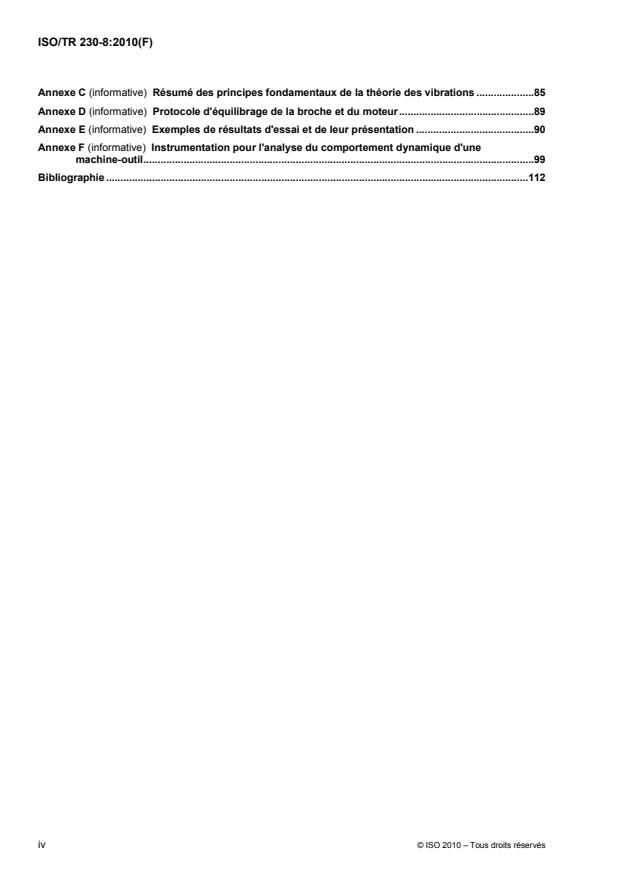
4 © ISO 2010 – Tous droits réservés
3.20
amortissement
dissipation de l'énergie dans le temps
NOTE Adapté de l'ISO 2041:1990, définition 2.79.
3.21
taux d'amortissement
〈système linéaire à amortissement visqueux〉 rapport du coefficient d'amortissement réel au coefficient
d'amortissement critique
NOTE Adapté de l'ISO 2041:1990, définition 2.86.
3.22
degrés de liberté
nombre de degrés de liberté d'un système mécanique égal au nombre minimal de coordonnées généralisées
indépendantes qui sont nécessaires pour définir complètement et à tout instant l'état du système
[ISO 2041:1990, définition 1.26]
3.23
système continu
système à constantes réparties
système ayant un nombre infini de configurations indépendantes possibles
[ISO 2041:1990, définition 1.29]
NOTE Les machines-outils tombent généralement dans cette catégorie, car la masse ainsi que la raideur ne sont pas
situées à des points individuels, mais réparties sur toute la structure.
3.24
souplesse dynamique
inverse de la raideur dynamique (3.25)
NOTE La souplesse dynamique est également appelée «flexibilité». Elle est généralement exprimée en micromètres
par newton.
3.25
raideur dynamique
rapport de la variation de force à la variation de déplacement dans des conditions dynamiques
NOTE 1 Adapté de l'ISO 2041:1990, définition 1.54.
NOTE 2 Aux basses fréquences, la raideur dynamique se rapproche de la raideur statique. Aux hautes fréquences, la
réponse tend vers zéro et la raideur dynamique tend vers l'infini. Aux fréquences intermédiaires, lorsqu'une résonance se
produit, la raideur dynamique peut atteindre une valeur très basse. La raideur dynamique s'exprime en unités de force par
unité de déplacement, par exemple en newtons par micromètre.
3.26
absorbeur dynamique de vibrations
dispositif qui réduit les vibrations (3.81) d'un système primaire dans une gamme de fréquences désirée en
transférant de l'énergie à un système auxiliaire en résonance qui est accordé de façon que la force exercée
par le système auxiliaire soit en opposition de phase avec la force agissant sur le système primaire
[ISO 2041:1990, définition 2.116]
NOTE L'absorbeur dynamique de vibrations peut être amorti ou non amorti, mais l'amortissement n'est pas l'objet
principal.
3.27
FFT
transformation de Fourier rapide
processus dans lequel les durées de calcul de multiplications/d'additions de nombres complexes sont
fortement réduites
[ISO 2041:1990, définition 5.23]
NOTE 1 Pour de plus amples détails, se reporter à l'ISO 2041:1990, A.18 à A.22.
NOTE 2 Une FFT est un algorithme mathématique permettant aux appareils d'analyse des vibrations de fonctionner
très rapidement et donc quasiment en temps réel.
3.28
vibration forcée
vibration (3.81) entretenue causée par une excitation extérieure
[ISO 2041:1990, définition 2.16]
NOTE 1 Les vibrations transitoires ne sont pas prises en considération.
NOTE 2 La vibration (pour un système linéaire) est aux mêmes fréquences que l'excitation.
3.29
fondation
assise
structure qui supporte un système mécanique qui peut être fixe dans un référentiel donné ou qui peut subir un
mouvement provoquant une excitation au système supporté
[ISO 2041:1990, définition 1.23]
3.30
analyse de Fourier
méthode mathématique permettant de déterminer les coefficients et les angles de phase des composantes de
la série de Fourier (3.31), pour une forme d'onde donnée
3.31
série de Fourier
développement en série d'une fonction périodique en fonction de ses harmoniques
[ISO 2041:1990, définition A.18]
NOTE Pour obtenir une description mathématique, voir les notes données dans l'ISO 2041:1990, A.18.
3.32
vibration libre
vibration (3.81) se produisant après arrêt de l'excitation ou de la contrainte
[ISO 2041:1990, définition 2.17]
NOTE Le système vibre sur ses fréquences propres.
3.33
fréquence
inverse de la période fondamentale qui est l'accroissement le plus faible de la variable indépendante d'une
grandeur périodique (temps) pour lequel la fonction reprend les mêmes valeurs
NOTE 1 Adapté de l'ISO 2041:1990, définitions 2.23 et 2.24.
NOTE 2 Régime auquel un signal vibratoire (ou une partie d'un signal vibratoire) se répète. La fréquence s'exprime en
hertz (Hz), cette unité correspondant au nombre de cycles par seconde.
6 © ISO 2010 – Tous droits réservés
3.34
réponse en fréquence
signal de sortie exprimé en fonction de la fréquence (3.33) du signal d'entrée
NOTE 1 Sur une machine-outil, la réponse en fréquence se limite souvent à l'expression de la variation de
déplacement relatif entre l'outil et la pièce (signal de sortie) et la force d'excitation (signal d'entrée). Voir également 4.3 et
les paragraphes suivants. L'intensité de la réponse en fréquence équivaut à la souplesse dynamique. Néanmoins, la
réponse en fréquence est une grandeur complexe qui nécessite deux valeurs pour être complètement définie, soit
l'intensité et la phase, soit la partie réelle et la partie imaginaire. Dans certains textes, le terme «réceptance» est utilisé
comme un synonyme du terme «réponse».
NOTE 2 La réponse en fréquence est généralement donnée graphiquement par des courbes indiquant la variation du
signal de sortie et, s'il y a lieu, du déphasage ou de l'angle de phase en fonction de la fréquence.
NOTE 3 Adapté de l'ISO 2041:1990, définition B.13.
3.35
fréquence fondamentale
〈grandeur périodique〉 inverse de la période fondamentale
[ISO 2041:1990, définition 2.25]
3.36
harmonique
〈phénomène périodique〉 composante sinusoïdale dont la fréquence (3.33) est un multiple entier de la
fréquence fondamentale (3.35)
[ISO 2041:1990, définition 2.26]
ième
NOTE 1 On a fréquemment utilisé en anglais le terme «overtone» à la place du terme «harmonic», le n «harmonic»
ième
étant appelé le (n-1) «overtone».
NOTE 2 En anglais, le premier «overtone» et la seconde harmonique sont chacun égaux au double de la fréquence du
fondamental. En français, la différence entre «harmonic» et «overtone» n'existe pas et la seconde harmonique est deux
fois la fréquence fondamentale. Le terme «overtone» n'est pas approprié afin de pouvoir réduire l'ambiguïté dans la
numérotation des composants d'une quantité de période.
3.37
distorsion harmonique
〈onde périodique〉 quantité d'énergie vibratoire existant à la deuxième fréquence harmonique et aux
fréquences harmoniques suivantes, comparée à l'énergie vibratoire totale présente
3.38
partie imaginaire
partie du déplacement de la réponse en fréquence qui est en quadrature (déphasée de 90°) avec l'excitation
NOTE Dans un système vibratoire simple, la partie imaginaire atteint son maximum à la fréquence propre non
amortie.
3.39
impulsion
intégrale d'une force par rapport au temps pendant la durée d'application, ce qui, pour une force constante,
est le produit de la force par sa durée d'application
[ISO 2041:1990, définition 3.6]
NOTE La force d'impulsion agit généralement sur une très courte période et change rapidement pendant cette durée,
atteignant souvent une valeur instantanée très importante. Les exemples types sont un coup de marteau ou la glissière
d'une machine accélérant rapidement. Les impulsions sont exprimées en unités de force multipliées par le temps, par
exemple en newton seconde.
3.40
diaphonie inertielle
déplacements perpendiculaires à la direction attendue du mouvement du fait d'un décalage latéral entre la
force d'entraînement et le centre de masse qui génèrent des mouvements brusques durant l'accélération et la
décélération
3.41
marteau instrumenté
marteau intégré au sein d'un transducteur de forces capable de transmettre la réponse en fréquence en large
bande d'un choc appliqué par le marteau utilisé pour frapper la structure
3.42
système linéaire
système pour lequel la réponse est proportionnelle à la valeur de l'excitation
[ISO 2041:1990, définition 1.21]
3.43
excentricité de masse
distance entre le centre de masse d'un rotor rigide et l'axe de l'arbre
[ISO 1925:2001, définition 2.11]
3.44
mobilité
rapport complexe de la vitesse mesurée en un point d'un système mécanique à la force mesurée en ce même
point ou en un autre point du système pendant un mouvement harmonique simple
[ISO 2041:1990, définition 1.50]
3.45
masse modale
masse équivalente à un système à un seul degré de liberté pour un mode donné
3.46
mode de vibration
〈système en vibration〉 indique la disposition caractéristique des nœuds et des ventres accusée par le
système lorsque les mouvements de chacune de ses parties élémentaires, pour une fréquence donnée, sont
harmoniques (cas des systèmes linéaires) ou présentent des types de décroissance correspondants
[ISO 2041:1990, définition 2.48]
NOTE Dans une machine-outil, chaque mode de vibration se caractérise par les différents mouvements relatifs des
éléments de base de la structure. À une fréquence donnée, la disposition instantanée de ces éléments détermine, à tout
instant, la forme des modes caractéristiques de cette fréquence donnée.
3.47
modulation, intensité et fréquence
onde périodique dont l'intensité (et/ou la fréquence) varie elle-même du fait d'un signal imposé
NOTE Les signaux modulés se caractérisent par la présence de fréquences latérales.
3.48
système à plusieurs degrés de liberté
système pour lequel deux coordonnées ou plus sont requises pour définir complètement et à tout instant l'état
du système
[ISO 2041:1990, définition 1.28]
8 © ISO 2010 – Tous droits réservés
3.49
mesurage en bande étroite
mesurage dans lequel la puissance des vibrations est mesurée sur une plage de fréquences étroite spécifiée
3.50
fréquence propre
fréquence de vibration libre d'un système linéaire amorti
[ISO 2041:1990, définition 2.81]
EXEMPLE Fréquence à laquelle la structure vibre librement, en l'absence de toute vibration forcée. Il s'agit de la
fréquence propre amortie. (La fréquence propre non amortie apparaît lorsque le déphasage est de 90°.)
3.51
nœud
point, ligne ou surface d'un système d'ondes stationnaires où une grandeur caractéristique du champ a une
amplitude nulle
EXEMPLE Point ou ligne d'un mouvement faible ou minimal entre deux parties de la machine qui, à tout instant,
bougent dans deux directions opposées.
[ISO 2041:1990, définition 2.46]
3.52
non-linéarité
propriété d'un système pour lequel la réponse est non proportionnelle à l'amplitude de l'excitation
NOTE Les systèmes ayant une raideur non linéaire sont généralement définis en termes de «raideur» ou
«souplesse».
3.53
oscillation
variation, habituellement en fonction du temps, de l'amplitude par rapport à une valeur de référence spécifiée,
lorsque l'amplitude varie autour d'une certaine valeur moyenne
[ISO 2041:1990, définition 1.8]
3.54
valeur de crête à crête d'une vibration
différence algébrique entre les valeurs extrêmes de la vibration (3.81)
[ISO 2041:1990, définition 2.35]
EXEMPLE Mouvement total du déplacement d'une vibration.
NOTE La valeur de crête à crête d'une vibration est égale à deux fois son intensité et est parfois appelée «amplitude
double». L'utilisation de ce terme est déconseillée et n'est pas du tout pertinente pour décrire la vitesse et l'accélération
d'un signal vibratoire.
3.55
période
période fondamentale
accroissement le plus faible de la variable indépendante d'une grandeur périodique pour lequel la fonction
reprend les mêmes valeurs
[ISO 2041:1990, définition 2.23]
3.56
force périodique
mouvement périodique
grandeur périodique prenant les mêmes valeurs à intervalles de variation égaux de la variable indépendante
(temps)
[ISO 2041:1990, définition 2.2]
EXEMPLE Force ou mouvement d'excitation dont le schéma d'onde se répète selon un rythme régulier.
NOTE L'onde ne doit pas être nécessairement sinusoïdale; la force ou le mouvement est caractérisé par ses
composantes fréquentielles.
3.57
phase
angle de phase
fraction de période dont une vibration sinusoïdale a avancé, mesurée à partir de la valeur d'origine de la
variable indépendante
[ISO 2041:1990, définition 2.31]
EXEMPLE Retard angulaire entre deux signaux vibratoires sinon identiques.
NOTE Ce retard est mesuré soit en degrés en termes de période des vibrations (sur 360°), soit en radians. Par
conséquent, deux vibrations se déplaçant dans deux directions opposées au même instant sont déphasées de 180° ou
π radians.
3.58
puissance du spectre
spectre des valeurs moyennes quadratique de la densité spectrale
[ISO 2041:1990, définition 5.2]
3.59
Q
facteur d'amplification dynamique
grandeur qui est une mesure de l'acuité d'une résonance d'un système vibratoire résonant à un seul degré de
liberté
NOTE 1 Le facteur d'amplification dynamique est parfois appelé «facteur de résonance». La grandeur Q est égale à la
moitié de l'inverse du facteur d'amortissement. Voir également en 4.3.3 et l'Équation (19).
NOTE 2 Adapté de l'ISO 2041:1990, définition 2.89.
3.60
partie réelle
partie du déplacement de la réponse en fréquence en phase avec l'excitation
NOTE Pour un système vibratoire simple, la partie réelle atteint une valeur positive maximale juste avant la
résonance et une valeur négative maximale juste après la résonance. À la fréquence propre non amortie, la partie réelle
est nulle. Pour certains types de machine, l'ordre de grandeur de la valeur négative maximale fournit une mesure du
potentiel d'instabilité de la machine à cette fréquence.
3.61
vibration régénérative
vibration (3.81) soutenue par résonance et dont l'énergie vient par retour d'un processus en cours
EXEMPLE Broutage des machines-outils.
10 © ISO 2010 – Tous droits réservés
3.62
vibration relative
valeur d'une vibration mesurée entre deux points (par exemple entre l'outil et la pièce) à l'aide d'un
transducteur adapté, attaché au moyen d'un élément mobile en ces deux points
3.63
résonance
〈système en oscillations forcées〉 toute variation, aussi petite soit-elle, de la fréquence d'excitation provoquant
une diminution de la réponse du système
[ISO 2041:1990, définition 2.72]
NOTE Phénomène qui se produit lorsque la fréquence d'une vibration forcée est proche de la fréquence propre de la
structure (q.v.).
3.64
fréquence de résonance
fréquence à laquelle une résonance se produit
[ISO 2041:1990, définition 2.73]
NOTE 1 Pour de plus amples informations, voir 4.3; pour les définitions intégrales voir également l'ISO 2041:1990,
définition 2.73, Notes 2 et 3 ainsi que le Tableau 2.
NOTE 2 Le terme «fréquence résonante» est souvent utilisé dans le langage courant mais n'est pas aussi précis
syntaxiquement que «fréquence de résonance».
3.65
valeur efficace
valeur quadratique moyenne
〈fonction univoque〉 racine carrée de la moyenne des carrés de cette fonction dans un intervalle (donné)
[ISO 2041:1990, définition A.37]
NOTE Elle permet de calculer la moyenne de la puissance d'un signal vibratoire; elle est souvent utilisée lorsque
l'onde du signal s'écarte de l'onde sinusoïdale. Voir aussi l'Annexe B.
3.66
échantillonnage
échantillonner
obtention des valeurs d'une fonction pour des valeurs distinctes espacées régulièrement ou irrégulièrement
du domaine de cette fonction
[ISO 2041:1990, définition 5.14]
3.67
fréquence d'échantillonnage
nombre d'échantillons prélevés en une seconde
[ISO 2041:1990, définition 5.15]
3.68
intervalle d'échantillonnage
intervalle de temps entre deux échantillons
[ISO 2041:1990, définition 5.16]
3.69
signal
signal vibratoire
perturbation d'une grandeur physique utilisée pour transmettre une information
[ISO 2041:1990, définition B.1]
EXEMPLE Tension électrique variable obtenue sous forme d'un équivalent à une vibration mécanique, au moyen
d'un transducteur. La tension est proportionnelle au déplacement, à la vitesse ou à l'accélération d'une vibration
mécanique ou au niveau de force instantané, selon le type de transducteur utilisé et des opérations ultérieures.
3.70
vibration harmonique simple
vibration sinusoïdale
vibration (3.81) périodique qui est une fonction sinusoïdale de la variable indépendante
[ISO 2041:1990, définition 2.3]
NOTE Une vibration périodique constituée de la somme de plusieurs sinusoïdes, dont chacune a une fréquence qui
est un multiple de la fréquence fondamentale, est souvent appelée vibration complexe ou vibration multisinusoïdale.
L'utilisation du terme «vibration complexe» dans ce contexte est à déconseiller.
3.71
système à un seul degré de liberté
système n'exigeant qu'une coordonnée pour définir complètement son état à un instant donné quelconque
[ISO 2041:1990, définition 1.27]
EXEMPLE Un système vibratoire idéal de base comprenant une masse unique, un ressort et un amortisseur.
NOTE La Figure 2 donne une représentation de ce genre de système et la Figure 4 représente sa réponse type.
3.72
spectre
description d'une grandeur en fonction de la fréquence ou de la longueur d'onde
[ISO 2041:1990, définition 1.56]
3.73
onde stationnaire
onde périodique ayant une répartition d'amplitude fixe dans l'espace, c'est-à-dire résultant de l'interférence
d'ondes progressives, de même fréquence et de même nature
[ISO 2041:1990, définition 2.66]
NOTE 1 Une onde stationnaire peut être considérée comme le résultat de la superposition d'ondes progressives
opposées, de même fréquence et de même nature.
NOTE 2 Les ondes stationnaires sont caractérisées par des nœuds et des ventres de position fixe.
3.74
vibration entretenue
vibration entretenue existant si la vibration est une vibration périodique continue
[ISO 2041:1990, définition 2.14]
3.75
transducteur
dispositif conçu pour recevoir de l'énergie de la part d'un système et en fournir, soit sous la même forme, soit
sous une forme différente, à un autre système de telle façon que les caractéristiques recherchées de l'énergie
reçue apparaissent à la sortie
[ISO 2041:1990, définition 4.1]
12 © ISO 2010 – Tous droits réservés
NOTE Un transducteur produit un signal électrique analogue au déplacement, à la vitesse ou à l'accélération propre
à la vibration à mesurer.
3.76
fonction de transfert
relation mathématique entre la grandeur de sortie (ou réponse) et la grandeur d'entrée (ou excitation) du
système
[ISO 2041:1990, définition 1.37]
NOTE Elle est généralement donnée en fonction de la fréquence et c'est habituellement une fonction complexe.
3.77
vibration transitoire
mouvement vibratoire d'un système autre qu'entretenu ou aléatoire
[ISO 2041:1990, définition 2.15]
3.78
...