


ISO 4993:2015
(Main)Steel and iron castings — Radiographic testing
Steel and iron castings — Radiographic testing
ISO 4993:2015 specifies the general requirements for the radiography of steel and iron castings by means of X-rays or gamma-rays, in accordance with procedures given in ISO 5579 and ISO 19232.
Pièces moulées en acier ou en fonte — Contrôle radiographique
General Information
- Status
- Withdrawn
- Publication Date
- 07-Sep-2015
- Technical Committee
- ISO/TC 17/SC 11 - Steel castings
- Drafting Committee
- ISO/TC 17/SC 11 - Steel castings
- Current Stage
- 9599 - Withdrawal of International Standard
- Start Date
- 15-Mar-2024
- Completion Date
- 12-Feb-2026
Relations
- Effective Date
- 06-Jun-2022
- Effective Date
- 12-Feb-2011
Get Certified
Connect with accredited certification bodies for this standard

Element Materials Technology
Materials testing and product certification.

Inštitut za kovinske materiale in tehnologije
Institute of Metals and Technology. Materials testing, metallurgical analysis, NDT.
Sponsored listings
Frequently Asked Questions
ISO 4993:2015 is a standard published by the International Organization for Standardization (ISO). Its full title is "Steel and iron castings — Radiographic testing". This standard covers: ISO 4993:2015 specifies the general requirements for the radiography of steel and iron castings by means of X-rays or gamma-rays, in accordance with procedures given in ISO 5579 and ISO 19232.
ISO 4993:2015 specifies the general requirements for the radiography of steel and iron castings by means of X-rays or gamma-rays, in accordance with procedures given in ISO 5579 and ISO 19232.
ISO 4993:2015 is classified under the following ICS (International Classification for Standards) categories: 77.040.20 - Non-destructive testing of metals; 77.140.80 - Iron and steel castings. The ICS classification helps identify the subject area and facilitates finding related standards.
ISO 4993:2015 has the following relationships with other standards: It is inter standard links to ISO 4993:2024, ISO 4993:2009. Understanding these relationships helps ensure you are using the most current and applicable version of the standard.
ISO 4993:2015 is available in PDF format for immediate download after purchase. The document can be added to your cart and obtained through the secure checkout process. Digital delivery ensures instant access to the complete standard document.
Standards Content (Sample)
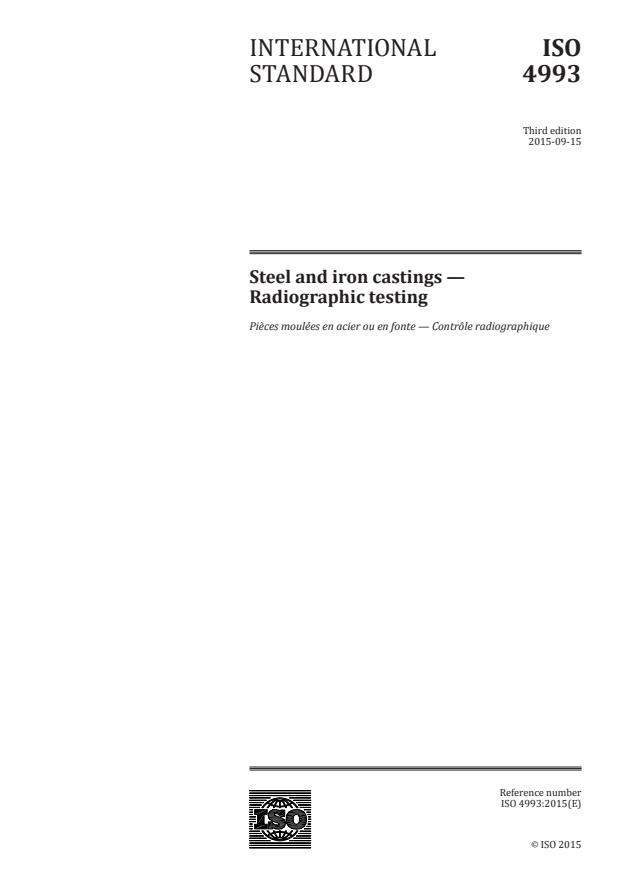
INTERNATIONAL ISO
STANDARD 4993
Third edition
2015-09-15
Steel and iron castings —
Radiographic testing
Pièces moulées en acier ou en fonte — Contrôle radiographique
Reference number
©
ISO 2015
© ISO 2015, Published in Switzerland
All rights reserved. Unless otherwise specified, no part of this publication may be reproduced or utilized otherwise in any form
or by any means, electronic or mechanical, including photocopying, or posting on the internet or an intranet, without prior
written permission. Permission can be requested from either ISO at the address below or ISO’s member body in the country of
the requester.
ISO copyright office
Ch. de Blandonnet 8 • CP 401
CH-1214 Vernier, Geneva, Switzerland
Tel. +41 22 749 01 11
Fax +41 22 749 09 47
copyright@iso.org
www.iso.org
ii © ISO 2015 – All rights reserved
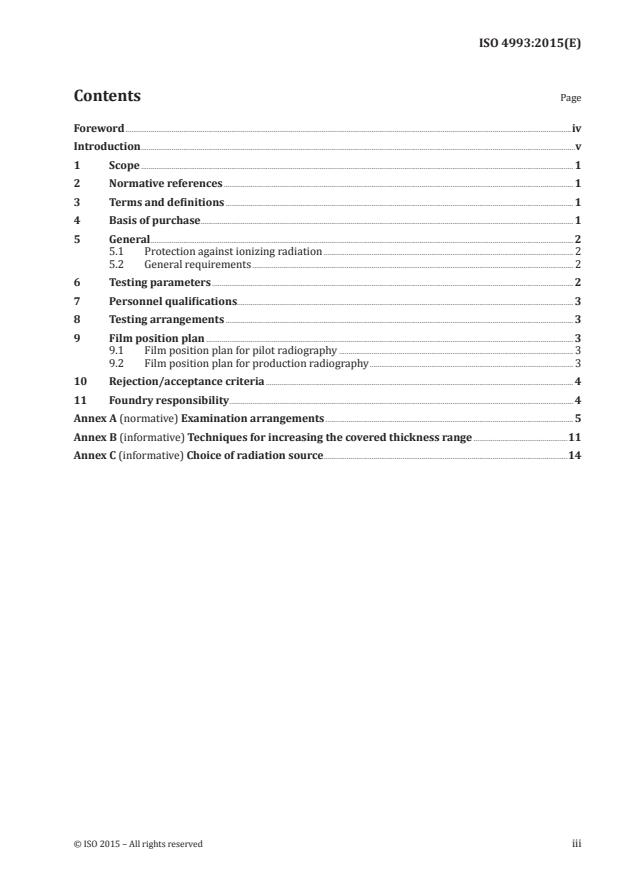
Contents Page
Foreword .iv
Introduction .v
1 Scope . 1
2 Normative references . 1
3 Terms and definitions . 1
4 Basis of purchase. 1
5 General . 2
5.1 Protection against ionizing radiation . 2
5.2 General requirements . 2
6 Testing parameters . 2
7 Personnel qualifications. 3
8 Testing arrangements . 3
9 Film position plan . 3
9.1 Film position plan for pilot radiography . 3
9.2 Film position plan for production radiography . 3
10 Rejection/acceptance criteria . 4
11 Foundry responsibility . 4
Annex A (normative) Examination arrangements . 5
Annex B (informative) Techniques for increasing the covered thickness range .11
Annex C (informative) Choice of radiation source .14
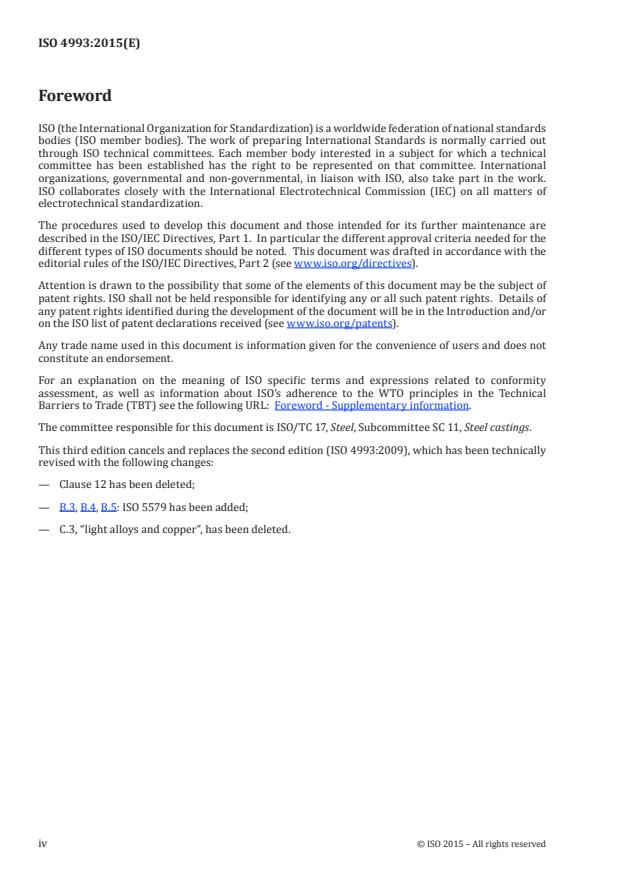
Foreword
ISO (the International Organization for Standardization) is a worldwide federation of national standards
bodies (ISO member bodies). The work of preparing International Standards is normally carried out
through ISO technical committees. Each member body interested in a subject for which a technical
committee has been established has the right to be represented on that committee. International
organizations, governmental and non-governmental, in liaison with ISO, also take part in the work.
ISO collaborates closely with the International Electrotechnical Commission (IEC) on all matters of
electrotechnical standardization.
The procedures used to develop this document and those intended for its further maintenance are
described in the ISO/IEC Directives, Part 1. In particular the different approval criteria needed for the
different types of ISO documents should be noted. This document was drafted in accordance with the
editorial rules of the ISO/IEC Directives, Part 2 (see www.iso.org/directives).
Attention is drawn to the possibility that some of the elements of this document may be the subject of
patent rights. ISO shall not be held responsible for identifying any or all such patent rights. Details of
any patent rights identified during the development of the document will be in the Introduction and/or
on the ISO list of patent declarations received (see www.iso.org/patents).
Any trade name used in this document is information given for the convenience of users and does not
constitute an endorsement.
For an explanation on the meaning of ISO specific terms and expressions related to conformity
assessment, as well as information about ISO’s adherence to the WTO principles in the Technical
Barriers to Trade (TBT) see the following URL: Foreword - Supplementary information.
The committee responsible for this document is ISO/TC 17, Steel, Subcommittee SC 11, Steel castings.
This third edition cancels and replaces the second edition (ISO 4993:2009), which has been technically
revised with the following changes:
— Clause 12 has been deleted;
— B.3, B.4, B.5: ISO 5579 has been added;
— C.3, “light alloys and copper”, has been deleted.
iv © ISO 2015 – All rights reserved
Introduction
Radiography can be used to detect internal discontinuities in castings. The discontinuities can have
higher or lower densities than the parent metal.
INTERNATIONAL STANDARD ISO 4993:2015(E)
Steel and iron castings — Radiographic testing
1 Scope
This International Standard specifies the general requirements for the radiography of steel and
iron castings by means of X-rays or gamma-rays, in accordance with procedures given in ISO 5579
and ISO 19232.
2 Normative references
The following documents, in whole or in part, are normatively referenced in this document and are
indispensable for its application. For dated references, only the edition cited applies. For undated
references, the latest edition of the referenced document (including any amendments) applies.
ISO 5579, Non-destructive testing — Radiographic testing of metallic materials using film and X- or gamma
rays — Basic rules
ISO 19232-1, Non-destructive testing — Image quality of radiographs — Part 1: Determination of the
image quality value using wire-type image quality indicators
ISO 19232-2, Non-destructive testing — Image quality of radiographs — Part 2: Determination of the
image quality value using step/hole-type image quality indicators
ISO 19232-3, Non-destructive testing — Image quality of radiographs — Part 3: Image quality classes
ISO 19232-4, Non-destructive testing — Image quality of radiographs — Part 4: Experimental evaluation
of image quality values and image quality tables
ISO 19232-5, Non-destructive testing — Image quality of radiographs — Part 5: Determination of the
image unsharpness value using duplex wire-type image quality indicators
ASTM E186, Standard Reference Radiographs for Heavy-Walled (2 to 4 1/2 in. [50.8 to 114 mm]) Steel Castings
ASTM E192, Standard Reference Radiographs for Investment Steel Castings for Aerospace Applications
ASTM E280, Standard Reference Radiographs for Heavy-Walled (4 1/2 to 12 in. [114 to 305 mm]) Steel Castings
ASTM E446, Standard Reference Radiographs for Steel Castings up to 2 in. (50.8 mm) in Thickness
ASTM E689, Standard Reference Radiographs for Ductile Iron Castings
ASTM E802, Standard Reference Radiographs for Gray Iron Castings up to 4 1/2 in. (114 mm) in Thickness
ASTM E2660, Standard Digital Reference Images for Investment Steel Castings for Aerospace Applications
3 Terms and definitions
For the purposes of this document, the terms and definitions given in ISO 5579 apply.
4 Basis of purchase
The request for radiographic testing and all pertinent information relating thereto, such as sensitivity,
coverage, and acceptance criteria, shall be indicated in the enquiry and order.
Unless otherwise specified in the enquiry and order, the radiographic coverage may be of two types,
i.e. pilot or regular production inspection. For both types, the manufacturing plan shall show the area
to be examined and the frequency of testing and shall be subject to agreement between the supplier
and purchaser.
If requirements are imposed for which there is not an accepted International Standard or other
standard available, a detailed specification of such requirements shall be provided.
Castings with a complex geometry might include areas which cannot be radiographically inspected
or can only be partly inspected. Such areas shall be identified before starting the radiographic
examination. Areas which cannot be radiographically inspected shall be noted by all contracting
parties and be marked on the film position plan.
5 General
5.1 Protection against ionizing radiation
Local, national, or international safety precautions shall be applied when using ionizing radiation.
WARNING — Exposure of any part of the human body to X-rays or gamma-rays can be highly
harmful to health.
5.2 General requirements
This International Standard shall be used in combination with ISO 5579.
6 Testing parameters
Unless otherwise requested in the enquiry and order, the radiographic testing may be performed at any
point in the manufacturing cycle, before or after the final heat-treatment.
The surface shall be conditioned, if necessary, so that surface irregularities cannot mask or be confused
with discontinuities.
Any type of penetrameter or image quality indicator may be used, provided that the sensitivity level
indicated by the purchaser is achieved.
The following items shall be agreed upon between contracting parties:
a) manufacturing stage;
b) extent of examination;
c) examination areas;
d) surface condition;
e) test class according to ISO 5579 (it is recommended that the examination be performed in
accordance with ISO 5579);
f) information about the film position plan;
g) marking of examination areas on the casting;
h) image quality value, in accordance with ISO 19232;
i) marking of the films;
j) acceptance criteria.
Any additional items shall be agreed upon between the contracting parties.
Radiographs shall be evaluated by comparison to reference radiographs.
2 © ISO 2015 – All rights reserved
7 Personnel qualifications
Operations shall be carried out by qualified personnel. The system of qualification shall be agreed upon
between the purchaser and manufacturer and shall form a part of the technical specification or be
stated in the enquiry.
8 Testing arrangements
The testing arrangements shall be in accordance with Annex A.
9 Film position plan
9.1 Film position plan for pilot radiography
When requested in the order or enquiry, preliminary shooting sketches shall be prepared by the
supplier for submission with the radiographs of the pilot casting for approval by the customer. These
sketches shall show the area of the part to be examined and shall include the following information for
each exposure:
a) gamma source or kilovoltage used;
b) location of radiation source in relation to the area covered and the film;
c) physical size of the source;
d) area covered by the film;
e) placement of the film and location markers;
f) film-to-source distance;
g) placement of the image quality indicators or penetrameters and the image quality value;
h) section thickness;
i) number and types of fil
...
Questions, Comments and Discussion
Ask us and Technical Secretary will try to provide an answer. You can facilitate discussion about the standard in here.
Loading comments...