

ISO 18785-2:2018
(Main)Friction stir spot welding — Aluminium — Part 2: Design of weld joints
General Information
- Abstract
This document specifies the design requirements and provides design guidelines for friction stir spot welding. In this document, the term "aluminium" refers to aluminium and its alloys.
- Status
- Published
- Publication Date
- 26-Nov-2018
- Technical Committee
- IIW - International Institute of Welding
- Drafting Committee
- IIW - International Institute of Welding
- Parallel Committee
- ISO/TC 44/SC 10 - Quality management in the field of welding
- Current Stage
- 9093 - International Standard confirmed
- Start Date
- 23-Jul-2025
- Completion Date
- 29-Aug-2026
Buy Documents
ISO 18785-2:2018 - Friction stir spot welding -- Aluminium
ISO 18785-2:2018 - Friction stir spot welding — Aluminium — Part 2: Design of weld joints/27/2018
ISO 18785-2:2018 - Soudage par friction-malaxage par points -- Aluminium
ISO 18785-2:2018 - Soudage par friction-malaxage par points — Aluminium — Partie 2: Conception des assemblages soudés/27/2018
Overview
ISO 18785-2:2018 specifies design requirements and provides practical design guidelines for friction stir spot welding (FSSW) of aluminium and its alloys. The standard focuses on the information and documentation needed to ensure manufacturable, testable and serviceable spot-welded assemblies. It complements related parts of the ISO 18785 series and aligns weld symbols with ISO 2553.
Friction stir spot welding is a solid-state joining process where a rotating tool produces frictional heat to soften and forge aluminium at discrete spot locations. ISO 18785-2 addresses how joints should be documented and detailed so that production and quality control can demonstrate conformance to the intended design and service requirements.
Key Topics
Documentation and drawings
- Assemblies must be designed and documented according to the intended final use.
- Technical drawings should clearly specify essential information, critical service or safety requirements, and the process control requirements necessary to demonstrate conformance.
- Weld symbols used on drawings should follow ISO 2553.
Design of overlap (lap) assemblies
- The standard provides examples of lap geometries and typical joint configurations (single-layer, multi-layer, stiffened details, edge folds, etc.).
- Designers must consider material properties and assembly geometry when selecting weld locations and patterns.
Essential information to specify
- Base metal specifications, thicknesses and metallurgical condition.
- Assembly geometry and surface condition (including coatings, adhesives or sealants present at interfaces).
- Tool penetration side, distance to edges, orientation of asymmetric spot welds relative to load, required finish and any post-weld heat treatment.
Weld point variables
- Size: round or oblong weld point dimensions (minimum final sizes) must be specified on drawings and verified by surface marks or equivalent measurement methods.
- Location and orientation: precise control of weld placement and, where applicable, oblong orientation must be shown on drawings.
- Strength and quality: when specified, resistance requirements and quality levels must be included in the welding procedure specification (DMOS) and demonstrated via designated test methods.
Control and verification
- The documentation must define control methods, acceptance criteria and inspection requirements; testing and inspection are referenced to ISO 18785-5.
Applications
ISO 18785-2:2018 is applicable where robust, repeatable spot welds in aluminium are required, including:
- Rail and mass transit structures
- Automotive and aerospace components
- Consumer goods and food-processing equipment
- Shipbuilding and marine structures
Specifying clear joint geometry, DMOS parameters and inspection criteria reduces production issues, improves structural reliability and facilitates regulatory or customer acceptance.
Related Standards
- ISO 18785-1 - Vocabulary for friction stir spot welding (aluminium)
- ISO 18785-4 - Qualification of welding procedures (DMOS-P)
- ISO 18785-5 - Quality and control requirements (inspection and test methods)
- ISO 2553 - Welding symbols on drawings
For implementation, refer to the full ISO 18785-2:2018 document and coordinate design details with process qualification and control documentation (DMOS) to ensure compliance and product performance.
Buy Documents
ISO 18785-2:2018 - Friction stir spot welding -- Aluminium
ISO 18785-2:2018 - Friction stir spot welding — Aluminium — Part 2: Design of weld joints/27/2018
ISO 18785-2:2018 - Soudage par friction-malaxage par points -- Aluminium
ISO 18785-2:2018 - Soudage par friction-malaxage par points — Aluminium — Partie 2: Conception des assemblages soudés/27/2018
Get Certified
Connect with accredited certification bodies for this standard

DVS-ZERT GmbH
German welding certification society.
CARES (UK Certification Authority for Reinforcing Steels)
UK certification for reinforcing steels and construction.
EWF/IIW (European/International Welding Federation)
International welding personnel certification.
Sponsored listings
Frequently Asked Questions
ISO 18785-2:2018 is a standard published by the International Organization for Standardization (ISO). Its full title is "Friction stir spot welding — Aluminium — Part 2: Design of weld joints". This standard covers: This document specifies the design requirements and provides design guidelines for friction stir spot welding. In this document, the term "aluminium" refers to aluminium and its alloys.
This document specifies the design requirements and provides design guidelines for friction stir spot welding. In this document, the term "aluminium" refers to aluminium and its alloys.
ISO 18785-2:2018 is classified under the following ICS (International Classification for Standards) categories: 25.160.40 - Welded joints and welds. The ICS classification helps identify the subject area and facilitates finding related standards.
ISO 18785-2:2018 is available in PDF format for immediate download after purchase. The document can be added to your cart and obtained through the secure checkout process. Digital delivery ensures instant access to the complete standard document.
Standards Content (Sample)
INTERNATIONAL ISO
STANDARD 18785-2
First edition
2018-11
Friction stir spot
welding — Aluminium —
Part 2:
Design of weld joints
Soudage par friction-malaxage par points — Aluminium —
Partie 2: Conception des assemblages soudés
Reference number
©
ISO 2018
© ISO 2018
All rights reserved. Unless otherwise specified, or required in the context of its implementation, no part of this publication may
be reproduced or utilized otherwise in any form or by any means, electronic or mechanical, including photocopying, or posting
on the internet or an intranet, without prior written permission. Permission can be requested from either ISO at the address
below or ISO’s member body in the country of the requester.
ISO copyright office
CP 401 • Ch. de Blandonnet 8
CH-1214 Vernier, Geneva
Phone: +41 22 749 01 11
Fax: +41 22 749 09 47
Email: copyright@iso.org
Website: www.iso.org
Published in Switzerland
ii © ISO 2018 – All rights reserved
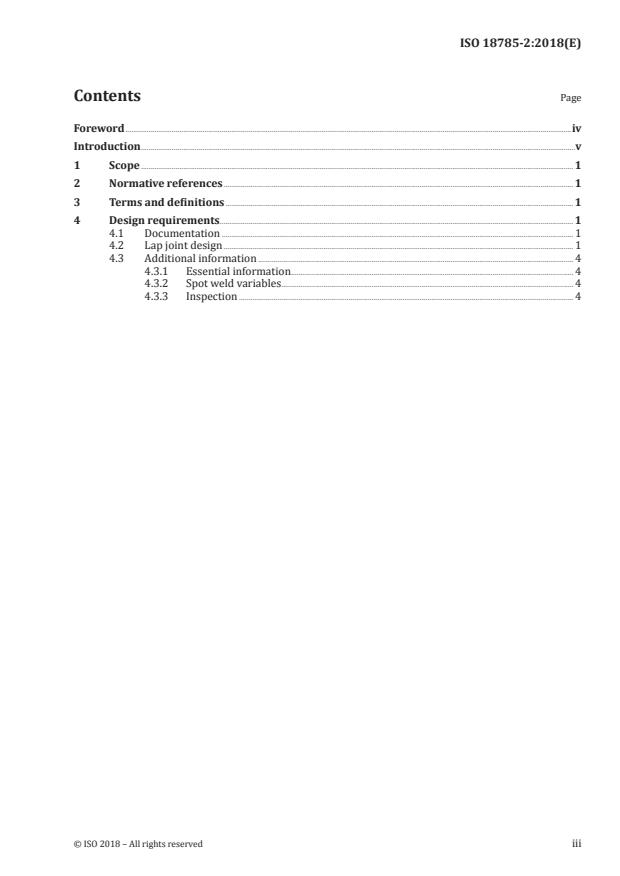
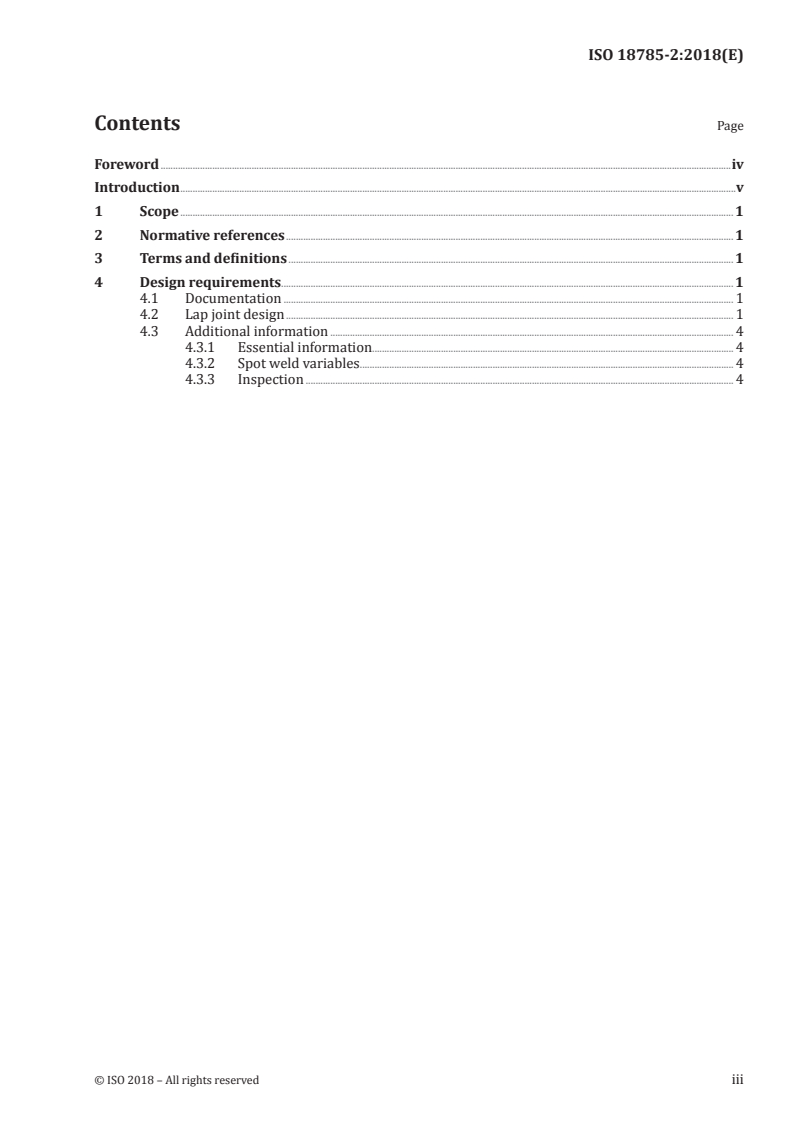
Contents Page
Foreword .iv
Introduction .v
1 Scope . 1
2 Normative references . 1
3 Terms and definitions . 1
4 Design requirements . 1
4.1 Documentation . 1
4.2 Lap joint design . 1
4.3 Additional information . 4
4.3.1 Essential information. 4
4.3.2 Spot weld variables . . 4
4.3.3 Inspection . 4
Foreword
ISO (the International Organization for Standardization) is a worldwide federation of national standards
bodies (ISO member bodies). The work of preparing International Standards is normally carried out
through ISO technical committees. Each member body interested in a subject for which a technical
committee has been established has the right to be represented on that committee. International
organizations, governmental and non-governmental, in liaison with ISO, also take part in the work.
ISO collaborates closely with the International Electrotechnical Commission (IEC) on all matters of
electrotechnical standardization.
The procedures used to develop this document and those intended for its further maintenance are
described in the ISO/IEC Directives, Part 1. In particular, the different approval criteria needed for the
different types of ISO documents should be noted. This document was drafted in accordance with the
editorial rules of the ISO/IEC Directives, Part 2 (see www .iso .org/directives).
Attention is drawn to the possibility that some of the elements of this document may be the subject of
patent rights. ISO shall not be held responsible for identifying any or all such patent rights. Details of
any patent rights identified during the development of the document will be in the Introduction and/or
on the ISO list of patent declarations received (see www .iso .org/patents).
Any trade name used in this document is information given for the convenience of users and does not
constitute an endorsement.
For an explanation of the voluntary nature of standards, the meaning of ISO specific terms and
expressions related to conformity assessment, as well as information about ISO's adherence to the
World Trade Organization (WTO) principles in the Technical Barriers to Trade (TBT) see www .iso
.org/iso/foreword .html.
This document was prepared by the IIW, International Institute of Welding, Commission III, Resistance
welding, solid state welding and allied joining processes.
Any feedback, question or request for official interpretation related to any aspect of this document
should be directed to IIW via your national standards body. A complete listing of these bodies can be
found at www .iso .org/members .html.
A list of all parts in the ISO 18785 series can be found on the ISO website.
iv © ISO 2018 – All rights reserved
Introduction
Welding processes are widely used in the fabrication of engineered structures. During the second half
of the twentieth century, fusion welding processes, wherein fusion is obtained by the melting of parent
material and usually a filler metal, dominated the welding of large structures. In 1991, friction stir
welding (FSW), which is carried out entirely in the solid phase (no melting), was invented.
Friction stir spot welding (FSSW) processes are spot-like variants of the FSW process. Unlike FSW, there
is minimal or no traverse motion of the tool. In basic FSSW, the joint is created by plunging a rotating
tool into the work piece and retracting the tool out of the overlapping sheets. Other FSSW variants
include additional tool movements. Frictional heat is generated from the contact between the tool and
the material to be welded resulting in softening of this material. The softened material
...
INTERNATIONAL ISO
STANDARD 18785-2
First edition
2018-11
Friction stir spot
welding — Aluminium —
Part 2:
Design of weld joints
Soudage par friction-malaxage par points — Aluminium —
Partie 2: Conception des assemblages soudés
Reference number
©
ISO 2018
© ISO 2018
All rights reserved. Unless otherwise specified, or required in the context of its implementation, no part of this publication may
be reproduced or utilized otherwise in any form or by any means, electronic or mechanical, including photocopying, or posting
on the internet or an intranet, without prior written permission. Permission can be requested from either ISO at the address
below or ISO’s member body in the country of the requester.
ISO copyright office
CP 401 • Ch. de Blandonnet 8
CH-1214 Vernier, Geneva
Phone: +41 22 749 01 11
Fax: +41 22 749 09 47
Email: copyright@iso.org
Website: www.iso.org
Published in Switzerland
ii © ISO 2018 – All rights reserved
Contents Page
Foreword .iv
Introduction .v
1 Scope . 1
2 Normative references . 1
3 Terms and definitions . 1
4 Design requirements . 1
4.1 Documentation . 1
4.2 Lap joint design . 1
4.3 Additional information . 4
4.3.1 Essential information. 4
4.3.2 Spot weld variables . . 4
4.3.3 Inspection . 4
Foreword
ISO (the International Organization for Standardization) is a worldwide federation of national standards
bodies (ISO member bodies). The work of preparing International Standards is normally carried out
through ISO technical committees. Each member body interested in a subject for which a technical
committee has been established has the right to be represented on that committee. International
organizations, governmental and non-governmental, in liaison with ISO, also take part in the work.
ISO collaborates closely with the International Electrotechnical Commission (IEC) on all matters of
electrotechnical standardization.
The procedures used to develop this document and those intended for its further maintenance are
described in the ISO/IEC Directives, Part 1. In particular, the different approval criteria needed for the
different types of ISO documents should be noted. This document was drafted in accordance with the
editorial rules of the ISO/IEC Directives, Part 2 (see www .iso .org/directives).
Attention is drawn to the possibility that some of the elements of this document may be the subject of
patent rights. ISO shall not be held responsible for identifying any or all such patent rights. Details of
any patent rights identified during the development of the document will be in the Introduction and/or
on the ISO list of patent declarations received (see www .iso .org/patents).
Any trade name used in this document is information given for the convenience of users and does not
constitute an endorsement.
For an explanation of the voluntary nature of standards, the meaning of ISO specific terms and
expressions related to conformity assessment, as well as information about ISO's adherence to the
World Trade Organization (WTO) principles in the Technical Barriers to Trade (TBT) see www .iso
.org/iso/foreword .html.
This document was prepared by the IIW, International Institute of Welding, Commission III, Resistance
welding, solid state welding and allied joining processes.
Any feedback, question or request for official interpretation related to any aspect of this document
should be directed to IIW via your national standards body. A complete listing of these bodies can be
found at www .iso .org/members .html.
A list of all parts in the ISO 18785 series can be found on the ISO website.
iv © ISO 2018 – All rights reserved
Introduction
Welding processes are widely used in the fabrication of engineered structures. During the second half
of the twentieth century, fusion welding processes, wherein fusion is obtained by the melting of parent
material and usually a filler metal, dominated the welding of large structures. In 1991, friction stir
welding (FSW), which is carried out entirely in the solid phase (no melting), was invented.
Friction stir spot welding (FSSW) processes are spot-like variants of the FSW process. Unlike FSW, there
is minimal or no traverse motion of the tool. In basic FSSW, the joint is created by plunging a rotating
tool into the work piece and retracting the tool out of the overlapping sheets. Other FSSW variants
include additional tool movements. Frictional heat is generated from the contact between the tool and
the material to be welded resulting in softening of this material. The softened material
...
NORME ISO
INTERNATIONALE 18785-2
Première édition
2018-11
Soudage par friction-malaxage par
points — Aluminium —
Partie 2:
Conception des assemblages soudés
Friction stir spot welding — Aluminium —
Part 2: Design of weld joints
Numéro de référence
©
ISO 2018
DOCUMENT PROTÉGÉ PAR COPYRIGHT
© ISO 2018
Tous droits réservés. Sauf prescription différente ou nécessité dans le contexte de sa mise en œuvre, aucune partie de cette
publication ne peut être reproduite ni utilisée sous quelque forme que ce soit et par aucun procédé, électronique ou mécanique,
y compris la photocopie, ou la diffusion sur l’internet ou sur un intranet, sans autorisation écrite préalable. Une autorisation peut
être demandée à l’ISO à l’adresse ci-après ou au comité membre de l’ISO dans le pays du demandeur.
ISO copyright office
Case postale 401 • Ch. de Blandonnet 8
CH-1214 Vernier, Genève
Tél.: +41 22 749 01 11
Fax: +41 22 749 09 47
E-mail: copyright@iso.org
Web: www.iso.org
Publié en Suisse
ii © ISO 2018 – Tous droits réservés
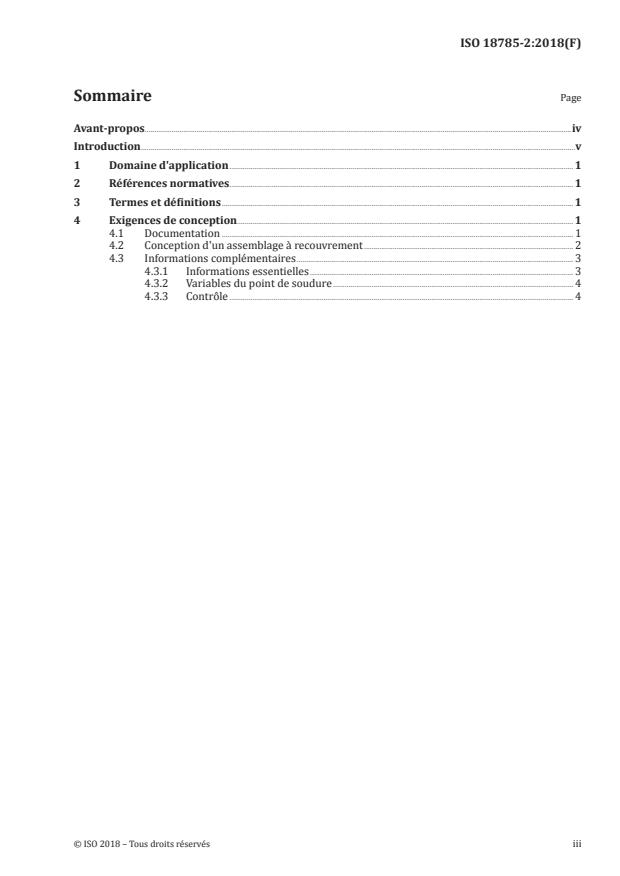
Sommaire Page
Avant-propos .iv
Introduction .v
1 Domaine d'application . 1
2 Références normatives . 1
3 Termes et définitions . 1
4 Exigences de conception. 1
4.1 Documentation . 1
4.2 Conception d'un assemblage à recouvrement . 2
4.3 Informations complémentaires . 3
4.3.1 Informations essentielles . 3
4.3.2 Variables du point de soudure . 4
4.3.3 Contrôle . 4
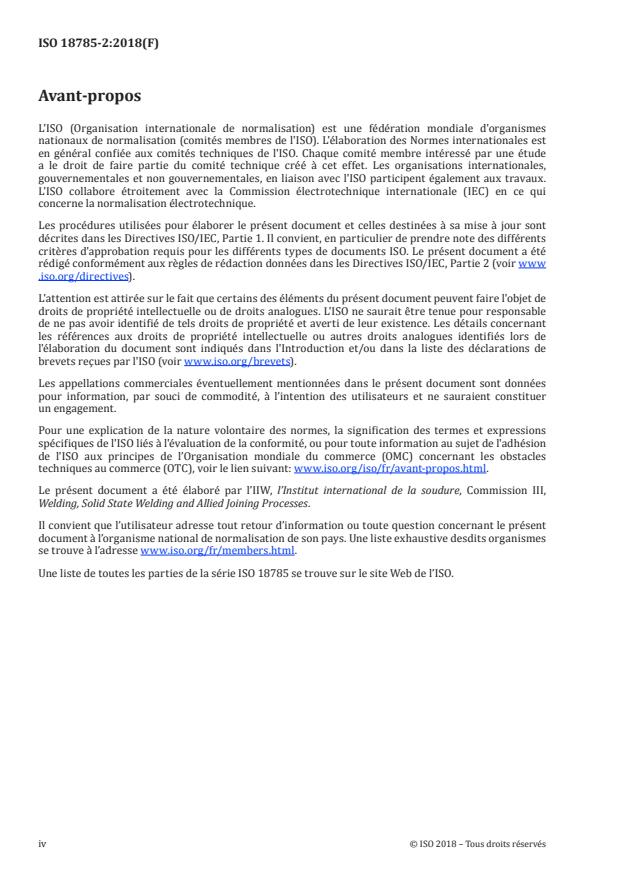
Avant-propos
L'ISO (Organisation internationale de normalisation) est une fédération mondiale d'organismes
nationaux de normalisation (comités membres de l'ISO). L'élaboration des Normes internationales est
en général confiée aux comités techniques de l'ISO. Chaque comité membre intéressé par une étude
a le droit de faire partie du comité technique créé à cet effet. Les organisations internationales,
gouvernementales et non gouvernementales, en liaison avec l'ISO participent également aux travaux.
L'ISO collabore étroitement avec la Commission électrotechnique internationale (IEC) en ce qui
concerne la normalisation électrotechnique.
Les procédures utilisées pour élaborer le présent document et celles destinées à sa mise à jour sont
décrites dans les Directives ISO/IEC, Partie 1. Il convient, en particulier de prendre note des différents
critères d'approbation requis pour les différents types de documents ISO. Le présent document a été
rédigé conformément aux règles de rédaction données dans les Directives ISO/IEC, Partie 2 (voir www
.iso .org/directives).
L'attention est attirée sur le fait que certains des éléments du présent document peuvent faire l'objet de
droits de propriété intellectuelle ou de droits analogues. L'ISO ne saurait être tenue pour responsable
de ne pas avoir identifié de tels droits de propriété et averti de leur existence. Les détails concernant
les références aux droits de propriété intellectuelle ou autres droits analogues identifiés lors de
l'élaboration du document sont indiqués dans l'Introduction et/ou dans la liste des déclarations de
brevets reçues par l'ISO (voir www .iso .org/brevets).
Les appellations commerciales éventuellement mentionnées dans le présent document sont données
pour information, par souci de commodité, à l’intention des utilisateurs et ne sauraient constituer
un engagement.
Pour une explication de la nature volontaire des normes, la signification des termes et expressions
spécifiques de l'ISO liés à l'évaluation de la conformité, ou pour toute information au sujet de l'adhésion
de l'ISO aux principes de l’Organisation mondiale du commerce (OMC) concernant les obstacles
techniques au commerce (OTC), voir le lien suivant: www .iso .org/iso/fr/avant -propos .html.
Le présent document a été élaboré par l’IIW, l’Institut international de la soudure, Commission III,
Welding, Solid State Welding and Allied Joining Processes.
Il convient que l’utilisateur adresse tout retour d’information ou toute question concernant le présent
document à l’organisme national de normalisation de son pays. Une liste exhaustive desdits organismes
se trouve à l’adresse www .iso .org/fr/members .html.
Une liste de toutes les parties de la série ISO 18785 se trouve sur le site Web de l’ISO.
iv © ISO 2018 – Tous droits réservés
Introduction
Les procédés de soudage sont largement utilisés dans la fabrication de structures. Au cours de la
ème
deuxième moitié du XX siècle, les procédés de soudage par fusion faisant intervenir la fusion du
métal de base et, généralement, d'un métal d'apport de soudage ont dominé le soudage des structures
de grandes dimensions. En 1991, le soudage par friction-malaxage, qui est entièrement réalisé en phase
solide (sans fusion), a été inventé.
Les procédés de soudage par friction-malaxage par points sont des variantes par points du procédé de
soudage par friction-malaxage. Contrairement au soudage par friction-malaxage, ils ne font intervenir
que peu ou pas de mouvement transversal de l'outil. Dans la variante conventionnelle du procédé de
soudage par friction-malaxage par points, l'assemblage est créé par la pénétration d'un outil rotatif dans
la pièce, suivie du retrait de l’outil des tôles se recouvrant. Les autres variantes du soudage par friction-
malaxage par points comprennent d'autres mouvements de l'outil. La chaleur de friction est produite
par le contact entre l'outil et le métal à souder, qui se ramollit sous l'effet de cette chaleur. Le métal ainsi
ramolli est malaxé de manière à former un assemblage métallurgique, processus qui est facilité par
l'action de forgeage exercée par l'épaulement de l'outil en contact avec la surface supérieure de la tôle.
L'utilisation croissante du soudage par friction-malaxage par points a rendu nécessaire l'élaboration
d'une norme relative à ce procédé de soudage afin de garantir que le soudage est réalisé de la manière
la plus efficace et que tous les aspects de l'opération font l'objet d'un contrôle approprié. La série
ISO 18785 se focalise sur le soudage par frict
...
NORME ISO
INTERNATIONALE 18785-2
Première édition
2018-11
Soudage par friction-malaxage par
points — Aluminium —
Partie 2:
Conception des assemblages soudés
Friction stir spot welding — Aluminium —
Part 2: Design of weld joints
Numéro de référence
©
ISO 2018
DOCUMENT PROTÉGÉ PAR COPYRIGHT
© ISO 2018
Tous droits réservés. Sauf prescription différente ou nécessité dans le contexte de sa mise en œuvre, aucune partie de cette
publication ne peut être reproduite ni utilisée sous quelque forme que ce soit et par aucun procédé, électronique ou mécanique,
y compris la photocopie, ou la diffusion sur l’internet ou sur un intranet, sans autorisation écrite préalable. Une autorisation peut
être demandée à l’ISO à l’adresse ci-après ou au comité membre de l’ISO dans le pays du demandeur.
ISO copyright office
Case postale 401 • Ch. de Blandonnet 8
CH-1214 Vernier, Genève
Tél.: +41 22 749 01 11
Fax: +41 22 749 09 47
E-mail: copyright@iso.org
Web: www.iso.org
Publié en Suisse
ii © ISO 2018 – Tous droits réservés
Sommaire Page
Avant-propos .iv
Introduction .v
1 Domaine d'application . 1
2 Références normatives . 1
3 Termes et définitions . 1
4 Exigences de conception. 1
4.1 Documentation . 1
4.2 Conception d'un assemblage à recouvrement . 2
4.3 Informations complémentaires . 3
4.3.1 Informations essentielles . 3
4.3.2 Variables du point de soudure . 4
4.3.3 Contrôle . 4
Avant-propos
L'ISO (Organisation internationale de normalisation) est une fédération mondiale d'organismes
nationaux de normalisation (comités membres de l'ISO). L'élaboration des Normes internationales est
en général confiée aux comités techniques de l'ISO. Chaque comité membre intéressé par une étude
a le droit de faire partie du comité technique créé à cet effet. Les organisations internationales,
gouvernementales et non gouvernementales, en liaison avec l'ISO participent également aux travaux.
L'ISO collabore étroitement avec la Commission électrotechnique internationale (IEC) en ce qui
concerne la normalisation électrotechnique.
Les procédures utilisées pour élaborer le présent document et celles destinées à sa mise à jour sont
décrites dans les Directives ISO/IEC, Partie 1. Il convient, en particulier de prendre note des différents
critères d'approbation requis pour les différents types de documents ISO. Le présent document a été
rédigé conformément aux règles de rédaction données dans les Directives ISO/IEC, Partie 2 (voir www
.iso .org/directives).
L'attention est attirée sur le fait que certains des éléments du présent document peuvent faire l'objet de
droits de propriété intellectuelle ou de droits analogues. L'ISO ne saurait être tenue pour responsable
de ne pas avoir identifié de tels droits de propriété et averti de leur existence. Les détails concernant
les références aux droits de propriété intellectuelle ou autres droits analogues identifiés lors de
l'élaboration du document sont indiqués dans l'Introduction et/ou dans la liste des déclarations de
brevets reçues par l'ISO (voir www .iso .org/brevets).
Les appellations commerciales éventuellement mentionnées dans le présent document sont données
pour information, par souci de commodité, à l’intention des utilisateurs et ne sauraient constituer
un engagement.
Pour une explication de la nature volontaire des normes, la signification des termes et expressions
spécifiques de l'ISO liés à l'évaluation de la conformité, ou pour toute information au sujet de l'adhésion
de l'ISO aux principes de l’Organisation mondiale du commerce (OMC) concernant les obstacles
techniques au commerce (OTC), voir le lien suivant: www .iso .org/iso/fr/avant -propos .html.
Le présent document a été élaboré par l’IIW, l’Institut international de la soudure, Commission III,
Welding, Solid State Welding and Allied Joining Processes.
Il convient que l’utilisateur adresse tout retour d’information ou toute question concernant le présent
document à l’organisme national de normalisation de son pays. Une liste exhaustive desdits organismes
se trouve à l’adresse www .iso .org/fr/members .html.
Une liste de toutes les parties de la série ISO 18785 se trouve sur le site Web de l’ISO.
iv © ISO 2018 – Tous droits réservés
Introduction
Les procédés de soudage sont largement utilisés dans la fabrication de structures. Au cours de la
ème
deuxième moitié du XX siècle, les procédés de soudage par fusion faisant intervenir la fusion du
métal de base et, généralement, d'un métal d'apport de soudage ont dominé le soudage des structures
de grandes dimensions. En 1991, le soudage par friction-malaxage, qui est entièrement réalisé en phase
solide (sans fusion), a été inventé.
Les procédés de soudage par friction-malaxage par points sont des variantes par points du procédé de
soudage par friction-malaxage. Contrairement au soudage par friction-malaxage, ils ne font intervenir
que peu ou pas de mouvement transversal de l'outil. Dans la variante conventionnelle du procédé de
soudage par friction-malaxage par points, l'assemblage est créé par la pénétration d'un outil rotatif dans
la pièce, suivie du retrait de l’outil des tôles se recouvrant. Les autres variantes du soudage par friction-
malaxage par points comprennent d'autres mouvements de l'outil. La chaleur de friction est produite
par le contact entre l'outil et le métal à souder, qui se ramollit sous l'effet de cette chaleur. Le métal ainsi
ramolli est malaxé de manière à former un assemblage métallurgique, processus qui est facilité par
l'action de forgeage exercée par l'épaulement de l'outil en contact avec la surface supérieure de la tôle.
L'utilisation croissante du soudage par friction-malaxage par points a rendu nécessaire l'élaboration
d'une norme relative à ce procédé de soudage afin de garantir que le soudage est réalisé de la manière
la plus efficace et que tous les aspects de l'opération font l'objet d'un contrôle approprié. La série
ISO 18785 se focalise sur le soudage par frict
...