

ISO 13348:2025
(Main)Fans — Tolerances, methods of conversion and technical data presentation
General Information
- Abstract
This document specifies performance tolerances and the technical data presentation for fans of all types. It does not apply for fans designed solely for low-volume air circulation, such as those used for household or similar purposes (ceiling and table fans, extractor fans, etc.). For jet fans, refer to ISO 13350. The upper limit of fan work per unit mass is normally 25 kJ/kg, corresponding to an increase of fan pressure of approximately 30 kPa for a mean density in the fan of 1,2 kg/m3. For higher values, agreement is to be reached between the supplier and the user. This document applies the five installation categories defined in ISO 5801: A free inlet, free outlet; B free inlet, ducted outlet; C ducted inlet, free outlet; D ducted inlet, ducted outlet; E free inlet and free outlet without a partition. The performance of a fan can vary considerably with the installation category it is operating within. Therefore, these categories form an important part of the definition of the fan’s technical data presentation. NOTE International acceptance of the five installation categories provides the opportunity to base a contract on the most appropriate fan category for the end user and the system designer. Correspondingly, the likelihood of the fan providing the agreed performance, without compromise or concession, is enhanced. The efficiency scaling procedures described in 8.1.5 apply to centrifugal fans and axial fans within the specific speed ranges shown in Table 4. To date, there is no experimental data to confirm how they apply to mixed flow fans, having specific speeds in between. Category E fans are treated in Clause 7.
- Status
- Published
- Publication Date
- 05-Jun-2025
- Technical Committee
- ISO/TC 117 - Fans
- Drafting Committee
- ISO/TC 117 - Fans
- Current Stage
- 6060 - International Standard published
- Start Date
- 06-Jun-2025
- Due Date
- 15-Aug-2026
- Completion Date
- 06-Jun-2025
Buy Documents
ISO 13348:2025 - Fans — Tolerances, methods of conversion and technical data presentation Released:6. 06. 2025

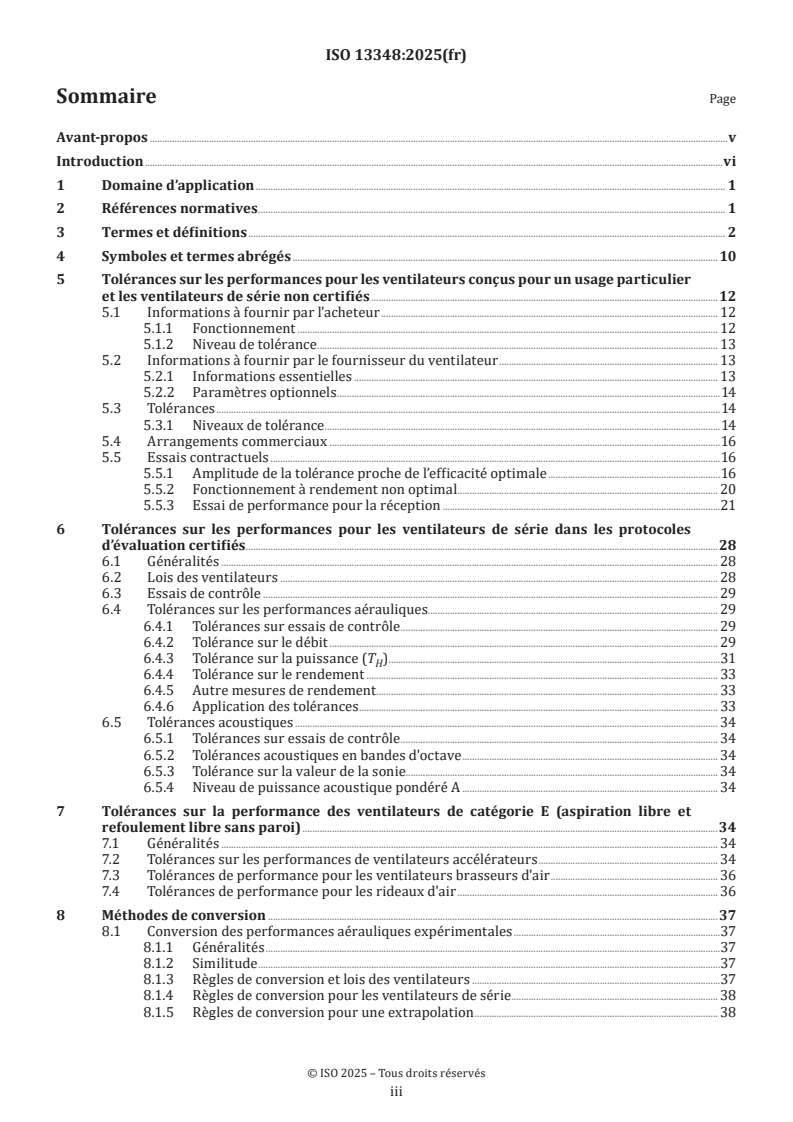
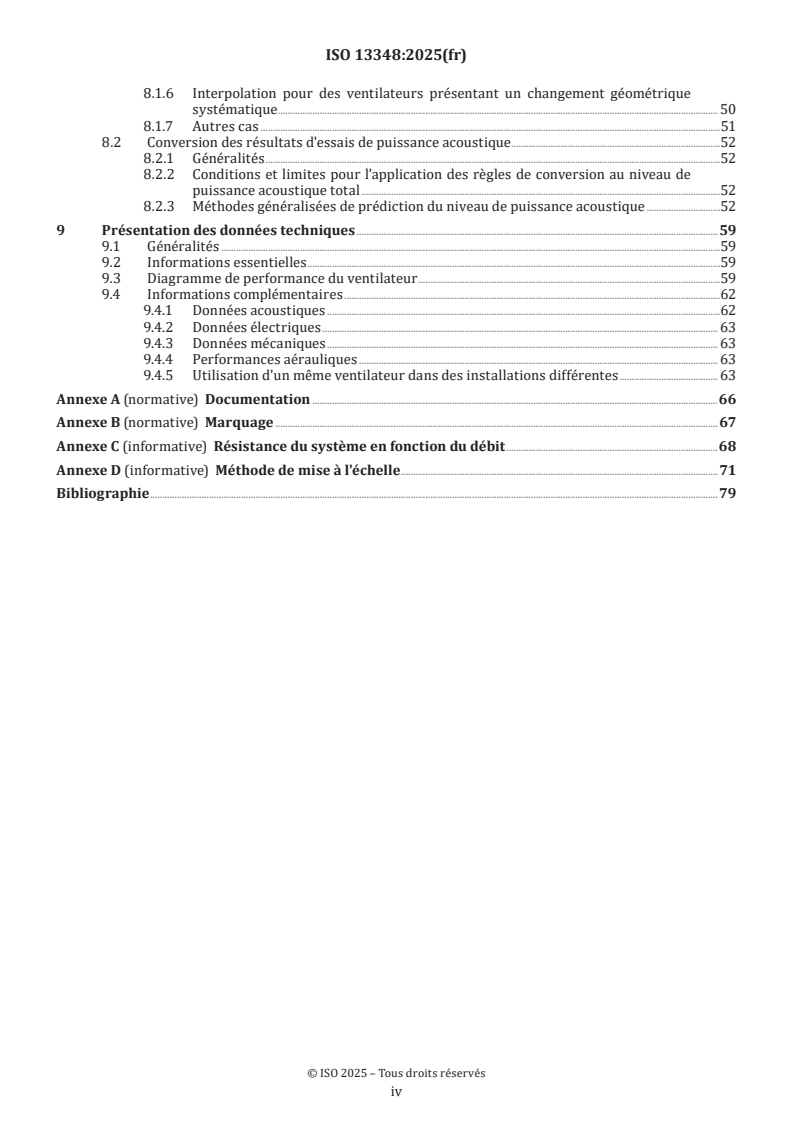
ISO 13348:2025 - Ventilateurs — Tolérances, méthodes de conversion et présentation des données techniques Released:6. 06. 2025
Overview
ISO 13348:2025 - "Fans - Tolerances, methods of conversion and technical data presentation" specifies how fan performance is to be reported, converted and tolerated. It applies to fans of all types except low‑volume household fans (ceiling, table, extractor fans) and excludes jet fans (refer to ISO 13350). The standard establishes performance tolerances, conversion rules (air and sound), and a consistent technical data presentation to improve contract clarity and catalogue consistency for manufacturers, purchasers and designers.
Key phrases: ISO 13348:2025, fans tolerances, technical data presentation, performance tolerances, fan testing, conversion methods, efficiency scaling.
Key topics and requirements
Scope and limits
- Applies to fans up to a typical upper limit of fan work per unit mass (normally 25 kJ/kg, ~30 kPa at mean density 1.2 kg/m3); higher values require supplier–user agreement.
- Excludes household low‑volume fans and jet fans (ISO 13350).
Installation categories
- Uses the five installation categories from ISO 5801: A, B, C, D and E (A = free inlet/outlet; B = free inlet/ducted outlet; C = ducted inlet/free outlet; D = ducted inlet/ducted outlet; E = free inlet and outlet without a partition). Performance reporting must state the installation category because it strongly affects fan behavior.
Performance tolerances
- Defines tolerance regimes for purpose‑designed fans and for series‑produced fans (including certified ratings programmes).
- Provides guidance on purchaser and supplier information requirements, tolerance grades and contractual testing procedures (air performance, power, efficiency and sound).
Methods of conversion
- Rules for converting test data using similarity and fan laws, including interpolation, extrapolation and scaling procedures.
- Efficiency scaling procedures applicable to centrifugal and axial fans within specified specific speed ranges (see Table 4); mixed‑flow fan behavior currently lacks experimental confirmation.
- Sound power conversion and prediction methods with stated conditions and limits.
Technical data presentation
- Standardized requirements for fan performance charts, essential and optional data (air, sound, electrical, mechanical), marking and documentation.
- Annexes include documentation, marking and a scaling method (Annex D).
Practical applications and users
ISO 13348:2025 is essential for:
- Fan manufacturers preparing catalogue data or contractual performance guarantees
- Specifiers, system designers and HVAC engineers ensuring agreed performance in different installations
- Test laboratories and certification bodies applying standardized tolerances and conversion methods
- Procurement teams and end users drafting performance clauses to reduce disputes
Using ISO 13348:2025 improves accuracy in fan selection, reduces warranty disputes, and enables reliable performance comparisons across suppliers.
Related standards
- ISO 5801 - Installation categories and test methods reference
- ISO 13350 - Jet fans (where applicable)
- AMCA certified ratings programme rules (referenced for certified series‑produced fans)
Relations
- Revises
ISO 13348:2007 - Industrial fans — Tolerances, methods of conversion and technical data presentation - Effective Date
- 19-Aug-2023
Buy Documents
ISO 13348:2025 - Fans — Tolerances, methods of conversion and technical data presentation Released:6. 06. 2025
ISO 13348:2025 - Ventilateurs — Tolérances, méthodes de conversion et présentation des données techniques Released:6. 06. 2025
Get Certified
Connect with accredited certification bodies for this standard

Institut za varilstvo d.o.o. (Welding Institute)
Slovenia's leading welding institute since 1952. ISO 3834, EN 1090, pressure equipment certification, NDT personnel, welder qualification. Only IIW Au
Sponsored listings
Frequently Asked Questions
ISO 13348:2025 is a standard published by the International Organization for Standardization (ISO). Its full title is "Fans — Tolerances, methods of conversion and technical data presentation". This standard covers: This document specifies performance tolerances and the technical data presentation for fans of all types. It does not apply for fans designed solely for low-volume air circulation, such as those used for household or similar purposes (ceiling and table fans, extractor fans, etc.). For jet fans, refer to ISO 13350. The upper limit of fan work per unit mass is normally 25 kJ/kg, corresponding to an increase of fan pressure of approximately 30 kPa for a mean density in the fan of 1,2 kg/m3. For higher values, agreement is to be reached between the supplier and the user. This document applies the five installation categories defined in ISO 5801: A free inlet, free outlet; B free inlet, ducted outlet; C ducted inlet, free outlet; D ducted inlet, ducted outlet; E free inlet and free outlet without a partition. The performance of a fan can vary considerably with the installation category it is operating within. Therefore, these categories form an important part of the definition of the fan’s technical data presentation. NOTE International acceptance of the five installation categories provides the opportunity to base a contract on the most appropriate fan category for the end user and the system designer. Correspondingly, the likelihood of the fan providing the agreed performance, without compromise or concession, is enhanced. The efficiency scaling procedures described in 8.1.5 apply to centrifugal fans and axial fans within the specific speed ranges shown in Table 4. To date, there is no experimental data to confirm how they apply to mixed flow fans, having specific speeds in between. Category E fans are treated in Clause 7.
This document specifies performance tolerances and the technical data presentation for fans of all types. It does not apply for fans designed solely for low-volume air circulation, such as those used for household or similar purposes (ceiling and table fans, extractor fans, etc.). For jet fans, refer to ISO 13350. The upper limit of fan work per unit mass is normally 25 kJ/kg, corresponding to an increase of fan pressure of approximately 30 kPa for a mean density in the fan of 1,2 kg/m3. For higher values, agreement is to be reached between the supplier and the user. This document applies the five installation categories defined in ISO 5801: A free inlet, free outlet; B free inlet, ducted outlet; C ducted inlet, free outlet; D ducted inlet, ducted outlet; E free inlet and free outlet without a partition. The performance of a fan can vary considerably with the installation category it is operating within. Therefore, these categories form an important part of the definition of the fan’s technical data presentation. NOTE International acceptance of the five installation categories provides the opportunity to base a contract on the most appropriate fan category for the end user and the system designer. Correspondingly, the likelihood of the fan providing the agreed performance, without compromise or concession, is enhanced. The efficiency scaling procedures described in 8.1.5 apply to centrifugal fans and axial fans within the specific speed ranges shown in Table 4. To date, there is no experimental data to confirm how they apply to mixed flow fans, having specific speeds in between. Category E fans are treated in Clause 7.
ISO 13348:2025 is classified under the following ICS (International Classification for Standards) categories: 23.120 - Ventilators. Fans. Air-conditioners. The ICS classification helps identify the subject area and facilitates finding related standards.
ISO 13348:2025 has the following relationships with other standards: It is inter standard links to ISO 13348:2007. Understanding these relationships helps ensure you are using the most current and applicable version of the standard.
ISO 13348:2025 is available in PDF format for immediate download after purchase. The document can be added to your cart and obtained through the secure checkout process. Digital delivery ensures instant access to the complete standard document.
Standards Content (Sample)
International
Standard
ISO 13348
Third edition
Fans — Tolerances, methods of
2025-06
conversion and technical data
presentation
Ventilateurs — Tolérances, méthodes de conversion et
présentation des données techniques
Reference number
© ISO 2025
All rights reserved. Unless otherwise specified, or required in the context of its implementation, no part of this publication may
be reproduced or utilized otherwise in any form or by any means, electronic or mechanical, including photocopying, or posting on
the internet or an intranet, without prior written permission. Permission can be requested from either ISO at the address below
or ISO’s member body in the country of the requester.
ISO copyright office
CP 401 • Ch. de Blandonnet 8
CH-1214 Vernier, Geneva
Phone: +41 22 749 01 11
Email: copyright@iso.org
Website: www.iso.org
Published in Switzerland
ii
Contents Page
Foreword .v
Introduction .vi
1 Scope . 1
2 Normative references . 1
3 Terms and definitions . 2
4 Symbols and abbreviated terms.10
5 Performance tolerances for purpose-designed fans and series-produced non-certified
fans .13
5.1 Information to be provided by the purchaser . 13
5.1.1 Operational . 13
5.1.2 Tolerance grade . 13
5.2 Information to be provided by the fan supplier . 13
5.2.1 Essential information . 13
5.2.2 Optional parameters .14
5.3 Tolerances .14
5.3.1 Tolerance grades . . .14
5.4 Purchasing arrangements .16
5.5 Contractual testing .16
5.5.1 Tolerance magnitude near optimum efficiency .16
5.5.2 Operation at other than optimum efficiency . . 20
5.5.3 Performance acceptance testing .21
6 Performance tolerances for series-produced fans in certified ratings programmes .28
6.1 General . 28
6.2 Fan laws . 28
6.3 Check-tests . 28
6.4 Air performance tolerances . 29
6.4.1 Check-test tolerances . 29
6.4.2 Airflow Tolerance . 29
6.4.3 Power tolerance (T ) .
H
6.4.4 Efficiency tolerance . 33
6.4.5 Other efficiency metrics . 33
6.4.6 Application of tolerances. 33
6.5 Sound Tolerances . 33
6.5.1 Check-Test tolerances . 33
6.5.2 Sound tolerances in octave bands . 33
6.5.3 Sone value tolerance . 33
6.5.4 A-weighted sound power level . 33
7 Performance tolerances for Category E fans (free inlet and free outlet without a
partition) .34
7.1 General . 34
7.2 Performance tolerances for Jet fans . 34
7.3 Performance tolerances for circulating fans . 35
7.4 Performance tolerances for air curtains . 35
8 Methods of conversion .36
8.1 Conversion of air performance test data . 36
8.1.1 General . 36
8.1.2 Similarity . . 36
8.1.3 Conversion rules and the fan laws . 36
8.1.4 Conversion rules for series-produced fans .37
8.1.5 Conversion rules for extrapolation .37
iii
8.1.6 Interpolation for fans incorporating one systematic geometrical change . 49
8.1.7 Other identities . 50
8.2 Conversion of sound power test data .51
8.2.1 General .51
8.2.2 Conditions and limits for application of conversion rules to total sound power
level .51
8.2.3 Generalized methods for sound power level prediction .51
9 Technical data presentation .58
9.1 General . 58
9.2 Essential information . 58
9.3 Fan performance chart . 58
9.4 Additional information. 60
9.4.1 Sound data . 60
9.4.2 Electrical data .61
9.4.3 Mechanical data .61
9.4.4 Air performance . .61
9.4.5 Same fan used for different installations .61
Annex A (normative) Documentation .64
Annex B (normative) Marking .65
Annex C (informative) System resistance as a function of flowrate .66
Annex D (informative) Scaling method .69
Bibliography . 76
iv
Foreword
ISO (the International Organization for Standardization) is a worldwide federation of national standards
bodies (ISO member bodies). The work of preparing International Standards is normally carried out through
ISO technical committees. Each member body interested in a subject for which a technical committee
has been established has the right to be represented on that committee. International organizations,
governmental and non-governmental, in liaison with ISO, also take part in the work. ISO collaborates closely
with the International Electrotechnical Commission (IEC) on all matters of electrotechnical standardization.
The procedures used to develop this document and those intended for its further maintenance are described
in the ISO/IEC Directives, Part 1. In particular, the different approval criteria needed for the different types
of ISO document should be noted. This document was drafted in accordance with the editorial rules of the
ISO/IEC Directives, Part 2 (see www.iso.org/directives).
ISO draws attention to the possibility that the implementation of this document may involve the use of (a)
patent(s). ISO takes no position concerning the evidence, validity or applicability of any claimed patent
rights in respect thereof. As of the date of publication of this document, ISO had not received notice of (a)
patent(s) which may be required to implement this document. However, implementers are cautioned that
this may not represent the latest information, which may be obtained from the patent database available at
www.iso.org/patents. ISO shall not be held responsible for identifying any or all such patent rights.
Any trade name used in this document is information given for the convenience of users and does not
constitute an endorsement.
For an explanation of the voluntary nature of standards, the meaning of ISO specific terms and expressions
related to conformity assessment, as well as information about ISO's adherence to the World Trade
Organization (WTO) principles in the Technical Barriers to Trade (TBT), see www.iso.org/iso/foreword.html.
This document was prepared by Technical Committee ISO/TC 117, Fans.
This third edition cancels and replaces the second edition (ISO 13348:2007), which has been technically
revised.
The main changes are as follows:
— terms have been revised;
— symbols and units in Clause 4 have been updated;
— Clauses 6 and 7 have been revised;
— additional information provided in Annex D.
Any feedback or questions on this document should be directed to the user’s national standards body. A
complete listing of these bodies can be found at www.iso.org/members.html.
v
Introduction
This document aims to clarify technical aspects of contracts where fan performance is concerned, and the
accuracy and consistency of performance details published in technical catalogues.
In this document, a distinction is drawn between specially designed fans to suit a specific purpose, to meet
a contract specification, and series-produced fans where the performance data is contained in a catalogue.
For purpose-designed fans, the methods of calculating performance data under contract conditions, from
performance data obtained under test conditions, are described in Clause 5 for both air and sound data.
Four tolerance grades are given, each appropriate to a particular type of fan and/or its application. These
procedures have been found satisfactory; however, the supplier and user can agree to adopt alternative
methods.
For series-produced non-certified fans, the associated technical data will be contained in a catalogue
(electronic and/or printed form). In this case, the recommended method of applying tolerances is as
described in Clause 5.
For series-produced fans in certified ratings programmes, the associated technical data will be contained in
a catalogue (electronic and/or printed form). In this case, the recommended method of applying tolerances
is as described in Clause 6 (based on AMCA (Air Movement and Control Association) International, Inc.
[16],[17],[18]
certified reference program rules ).
vi
International Standard ISO 13348:2025(en)
Fans — Tolerances, methods of conversion and technical data
presentation
1 Scope
This document specifies performance tolerances and the technical data presentation for fans of all types. It
does not apply for fans designed solely for low-volume air circulation, such as those used for household or
similar purposes (ceiling and table fans, extractor fans, etc.). For jet fans, refer to ISO 13350.
The upper limit of fan work per unit mass is normally 25 kJ/kg, corresponding to an increase of fan pressure
of approximately 30 kPa for a mean density in the fan of 1,2 kg/m . For higher values, agreement is to be
reached between the supplier and the user.
This document applies the five installation categories defined in ISO 5801:
A free inlet, free outlet;
B free inlet, ducted outlet;
C ducted inlet, free outlet;
D ducted inlet, ducted outlet;
E free inlet and free outlet without a partition.
The performance of a fan can vary considerably with the installation category it is operating within.
Therefore, these categories form an important part of the definition of the fan’s technical data presentation.
NOTE International acceptance of the five installation categories provides the opportunity to base a contract on
the most appropriate fan category for the end user and the system designer. Correspondingly, the likelihood of the fan
providing the agreed performance, without compromise or concession, is enhanced.
The efficiency scaling procedures described in 8.1.5 apply to centrifugal fans and axial fans within the
specific speed ranges shown in Table 4. To date, there is no experimental data to confirm how they apply to
mixed flow fans, having specific speeds in between.
Category E fans are treated in Clause 7.
2 Normative references
The following documents are referred to in the text in such a way that some or all of their content constitutes
requirements of this document. For dated references, only the edition cited applies. For undated references,
the latest edition of the referenced document (including any amendments) applies.
ISO 5801:2017, Fans — Performance testing using standardized airways
ISO 5802, Industrial fans — Performance testing in situ
ISO 13347-1, Industrial fans — Determination of fan sound power levels under standardized laboratory
conditions — Part 1: General overview
ISO 13349-1, Fans — Vocabulary and definitions of categories — Part 1: Vocabulary
ISO 13349-2, Fans — Vocabulary and definitions of categories — Part 2: Categories
ISO 13350, Fans — Performance testing of jet fans
ISO 14694, Industrial fans — Specifications for balance quality and vibration levels
ISO 14695, Industrial fans — Method of measurement of fan vibration
3 Terms and definitions
For the purposes of this document, the terms and definitions given in ISO 5801, ISO 5802, ISO 13349-1,
ISO 13349-2 and ISO 13350 and the following apply.
ISO and IEC maintain terminology databases for use in standardization at the following addresses:
— ISO Online browsing platform: available at https:// www .iso .org/ obp
— IEC Electropedia: available at https:// www .electropedia .org/
3.1
fan
fan other than that used for household or similar purposes such as air circulation, climatization
Note 1 to entry: For the purpose of this document and other industrial fan standards, a household fan is defined as
having a single-phase motor operating at a maximum of 250 V and 16 A. With a sufficiently soft start, this equates to
an input power of not more than 3 kW.
3.2
series-produced fan
fan whose detailed performances is widely available in a catalogue (electronic and or printed), and which is
frequently manufactured in significant quantities and available on short delivery
3.3
average stagnation pressure at a section x
p
sgx
sum of the conventional dynamic pressure, p , corrected by the Mach factor coefficient, f , at the section,
dx Mx
and the average absolute pressure, p
x
pp=+pf (1)
sgx xdxMx
Note 1 to entry: The average stagnation pressure can be calculated by Formula (2):
κ
κ −1
2κ−1
pp=+1 Ma . (2)
sgx xx
where
κ
is the isentropic exponent;
p
is the static pressure at the section x;
x
p
is the dynamic pressure at the section x;
dx
f
is the Mach factor coefficient at the section x;
Mx
Ma
is the Mach number at the section x.
x
Note 2 to entry: It is expressed in pascals (Pa).
3.4
average total pressure at a section x
p
tx
sum of the conventional dynamic pressure, p , corrected by the Mach factor coefficient, F , at the cross-
dx Mx
section, and the average gauge pressure, p
ex
pp=+pf =−pp (3)
tx ex dx Mx sgx a
where
p
is the mean gauge pressure at the cross-section x;
ex
p
is the dynamic pressure at the cross-section x;
dx
f
is the Mach factor coefficient at the cross-section x;
Mx
p
is the stagnation pressure at the cross-section x;
sgx
p
is the atmospheric pressure.
a
Note 1 to entry: When the Mach number, Ma, is less than 0,122, the Mach factor, F , can be neglected
Mx
Note 2 to entry: See ISO 5801
3.5
characteristic error
flow rate change produced along the actual system characteristic by the maximum fan performance
deviation allowed by the tolerance grade selected
Note 1 to entry: Characteristic error is a function of the tolerance grade, the measurement uncertainty allowed, and
the shape (local slope) of the fan and actual system characteristics
Note 2 to entry: For the actual system characteristics, see ISO 5801.
3.6
fan aerodynamic characteristic curves
fan pressure, power, efficiency, etc., against flow rate under specified ambient conditions and at a constant
speed, or when fitted with a specified motor
3.7
fan dynamic pressure at outlet
p
d2
conventional dynamic pressure at the fan outlet calculated from the mass flow rate, the average gas density
at the outlet and the fan outlet area
vq
1
mm2
p ==ρ (4)
d22
2 2ρ A
where
ρ
is the fluid density at the fan outlet;
v
is the fluid velocity at the fan outlet;
m2
q
is the mass flow rate;
m
A
is the fan outlet area.
Note 1 to entry: It is expressed in pascals (Pa).
3.8
fan flow coefficient
φ
non-dimensional quantity equal to the mass flow rate divided by the product of the mean density, the
peripheral speed of the impeller and the square of the diameter of the impeller
4q
V1
ϕ= (5)
πDu
r
where
q
is the volume flow rate at the fan inlet;
V1
D
is the diameter of the impeller;
r
u
is the tip speed of the impeller.
3.9
fan outlet area
A
area inside the fan outlet casing flange
Note 1 to entry: It is expressed in square metres (m ).
3.10
fan pressure
p
F
difference between the stagnation pressure at the fan outlet and the stagnation pressure at the fan inlet
pp=− p (6)
Fsgs21g
pp== pp− if Ma < 0,122 (7)
FtFt21t
where
p
is the stagnation pressure at the fan outlet;
sg2
p
is the stagnation pressure at the fan inlet;
sg1
p
is the total pressure at the fan outlet;
t2
p
is the total pressure at the fan inlet.
t1
Note 1 to entry: When expressing fan pressure, reference should be made to the installation category A, B, C or D.
Note 2 to entry: It is expressed in pascals (Pa).
3.11
fan static pressure
p
sF
conventional quantity defined as the difference between the fan pressure and the fan dynamic pressure
corrected by Mach factor f
M2
pp=−pf −=pp −p (8)
sF sg22dM21sg 21sg
pp=− pp− if Ma < 0,122 at the fan outlet area (9)
sF tt21 d2
where
p
is the stagnation pressure at the fan outlet;
sg2
p
is the dynamic pressure at the fan outlet;
d2
f
is the Mach factor coefficient at the fan outlet;
M2
p
is the stagnation pressure at the fan inlet;
sg1
p
is the total pressure at the fan outlet;
t2
p
is the total pressure at the fan inlet.
t1
Note 1 to entry: It is expressed in pascals (Pa).
3.12
Mach factor
f
M
correction factor applied to the dynamic pressure at a point
pp−
sg
f = (10)
M
p
d
where
p
is the stagnation pressure;
sg
p
is the absolute pressure;
p
is the dynamic pressure.
d
Note 1 to entry: The Mach factor can be calculated by Formula (11):
2−κκMa 22− −2κ Ma
Ma () ()()
f =+1 + + +…validforκ =14, (11)
M
4 24 192
where
κ
is the isentropic exponent;
Ma
is the Mach number.
Note 2 to entry: It is dimensionless.
3.13
Mach number at a point
Ma
ratio of the air velocity to the velocity of sound at the fan inlet stagnation conditions
v v
Ma== (12)
c
κθR
wsg
where
c
is the velocity of sound, cR= κθ ;
wsg
v
is the fluid velocity;
κ
is the isentropic exponent;
R is the gas constant of humid gas;
w
θ
is the stagnation temperature.
sg
Note 1 to entry: It is dimensionless.
3.14
Mach number at a section x
Ma
x
average gas velocity divided by the velocity of sound at the specified airway cross-section
v
x
Ma = (13)
x
κθR
x sgx
where
v
is the fluid velocity at the cross-section x;
x
κ
is the isentropic exponent;
R
is the gas constant of humid gas;
w
θ
is the stagnation temperature at the cross-section x.
sgx
Note 1 to entry: It is dimensionless.
3.15
efficiency
η
ratio of fan air power to the fan impeller power
P qp ψ
u mF
η== = (14)
P ρ P λ
r mr
where
P
is the fan air power;
u
P
is the fan impeller power;
r
q
is the mass flow rate;
m
p
is the fan pressure;
F
ρ
is the mean fluid density;
m
ϕ
is the fan flow coefficient;
ψ
is the fan pressure coefficient;
λ
is the fan power coefficient.
Note 1 to entry: It is expressed as a percentage.
3.16
optimum efficiency
η
opt
maximum efficiency achieved on the fan air characteristic with all operational parameters, except the air
system resistance, being fixed
Note 1 to entry: The operating point where optimum efficiency is achieved is called the best efficiency point (BEP).
3.17
peripheral Reynolds number
Re
u
Reynolds number based on the tip speed, u
uD ρ
r 1
Re = (15)
u
μ
where
u
is the tip speed;
D
is the impeller diameter;
r
ρ
is the fluid density at the fan inlet;
μ
is the fluid dynamic viscosity.
Note 1 to entry: It is dimensionless.
3.18
peripheral Mach number
Ma
u
Mach number based on the tip speed, u
u u
Ma == (16)
u
c
κR Θ
wsg1
where
u is the tip speed;
κ
is the isentropic exponent;
R is the gas constant of humid gas;
w
θ
is the stagnation temperature at the fan inlet;
sg1
c
is the velocity of sound.
Note 1 to entry: It is dimensionless.
3.19
power coefficient
λ
non-dimensional quantity related to the impeller power using the mean fluid density and the tip speed
2P
r
λ= (17)
qu
m
where
P
is the fan impeller power;
r
q
is the mass flow rate;
m
u
is the tip speed.
3.20
pressure coefficient
ψ
non-dimensional number related to the fan pressure using the mean density of the gas and the tip speed of
the impeller
2p
F
ψ = (18)
ρ u
m
where
p
is the fan pressure;
F
ρ
is the mean fluid density;
m
u
is the tip speed.
3.21
tip speed
u
peripheral speed of the impeller blades at their maximum diameter
un=π D (19)
where
n
is the rotational speed/rotational frequency;
D
is the impeller diameter.
−1
Note 1 to entry: It is expressed in metres per second (m ⋅ s ).
3.22
hub-to-tip ratio
ξξ
ratio of the hub-diameter to the tip-diameter of an axial fan
D
i
ξ = (20)
D
r
where
D
is the hub-diameter;
i
D
is the impeller diameter.
r
3.23
relative roughness
R
r
non-dimensional quantity equal to the maximum height per section roughness divided by 1,5 times a
characteristic length
R
z
R = (21)
r
15, ⋅l
char
where
R
is the maximum height per section roughness;
z
l
is a characteristic length.
char
Note 1 to entry: Here, the maximum height per section divided by factor 1,5 depicts the equivalent sand roughness.
3.24
relative gap
S
r
non-dimensional quantity equal to the absolute gap width divided by the outer diameter or the tip-diameter
of the fan.
S
a
S = (22)
r
D
r
where
S
is the absolute gap width;
a
D
is the impeller diameter.
r
3.25
specific speed
σ
non-dimensional quantity that characterizes the shape and operating range of a fan
n
σ = (23)
−−12/
−14/
pq
4
2 F m
2π ⋅ ⋅
()
ρρ
m m
where
n
is the rotational speed/rotational frequency;
p
is the fan pressure;
F
ρ
is the mean fluid density;
m
q
is the mass flow rate.
m
Note 1 to entry: It is used to compare different fan designs and select the most appropriate fan for a given application.
3.26
total sound power level
L
W
unweighted sound power level defined as 10 times the logarithm to the base 10 of the ratio of the sound
−12
power in watts to a reference value of 10 W (1 picowatt [pW])
Note 1 to entry: It is expressed in decibels (dB).
3.27
octave band sound power level
L
Wfc
sound power level in an octave band with a defined centre frequency, defined as 10 times the logarithm to
−12
the base 10 of the ratio of the sound power in watts to a reference value of 10 W (1 picowatt [pW])
Note 1 to entry: It is expressed in decibels (dB).
3.28
A-weighted sound power level
L
WA
total sound power level using A-weighting
Note 1 to entry: See IEC 61672-1 for a definition of A-weighting.
Note 2 to entry: It is expressed in decibels (dB).
3.29
total sound pressure level
L
p
unweighted total sound pressure level at a specified point and under specified conditions, normally in the
octave bands with centre frequencies from 63 Hz to 8 kHz, defined as 10 times the logarithm to the base 10
of the ratio of the square of the sound pressure to the reference value of 20 µPa
Note 1 to entry: It is expressed in decibels (dB).
3.30
A-weighted sound pressure level
L
pA
total sound pressure level using A-weighting
Note 1 to entry: For a definition of A-weighting, see IEC 61672-1.
Note 2 to entry: It is expressed in decibels (dB).
3.31
tolerance zone
range of values of the specified parameters allowed, according to the applicable tolerance grade
3.32
tolerance grade
designation defining the limit deviations from the agreed or published technical performance parameters
3.33
dimensionless frequency
non-dimensional logarithmic function of the ratio between the centre frequency of an octave or third-octave
band, and the rotational speed of the fan
f
centre
χ =10lg (24)
n
where
f
is the octave centre frequency;
centre
n
is the rotational speed/rotational frequency.
4 Symbols and abbreviated terms
For the purposes of this document, the following symbols and abbreviations apply.
Symbol Term Unit
A Fan outlet area m
A Wetted surface of the section x m
x
B Depth of the casing m
b Inner depth of the impeller m
i
b Outer depth of the impeller m
r
−1
c Velocity of sound m·s
C(Ma) Correction factor for Carnot losses ---
D Inner diameter of the impeller m
i
D Diameter of impeller m
r
e Uncertainty of measurement —
F Mach factor for correction of dynamic pressure at section x —
Mx
F Shape factor of the Carnot loss coefficient ---
c
F Shape factor of the impeller or rotor ---
r
F Shape factor of the casing or stator ---
s
f Carnot coefficient ---
c
f Octave centre frequency Hz
centre
f Friction coefficient of the impeller or rotor ---
r
f Friction coefficient of the casing or stator ---
s
G Index of agreed value —
k —
Parabolic constant k = ψ /φ
p
L Sound pressure level dB
p
L A-weighted sound pressure level dB (A)
pA
L Sound power level dB
W
L A-weighted sound power level dB (A)
WA
L Octave band sound power level dB
Wfc
l Length of the blade m
r
M Index of measured value —
Ma Mach number at a point —
Ma Mach number at section x —
x
−1
n Rotational speed/rotational frequency r · s
P Mechanical power supplied to the fan shaft W
a
P Shaft power of electric motor W
m
P Mechanical power required by the fan impeller W
r
p Atmospheric pressure Pa
a
p Mean gauge pressure in space and time at section x Pa
ex
p Fan pressure Pa
F
p Fan dynamic pressure Pa
dF
p Fan dynamic pressure at outlet Pa
d2
p Fan static pressure Pa
sF
p Absolute stagnation pressure Pa
sg
p Average total pressure Pa
t
p Mean absolute pressure in space and time at a point Pa
x
fraction of free delivery fan airflow rate at the catalogued duty point —
q
F
−1
q Inlet mass flow rate kg⋅s
m
3 −1
q Inlet volume flow rate m s
V
Symbol Term Unit
q gap volume flow
Vg
Re Peripheral Reynolds number —
u
*
Re Local Reynolds number at the position x ---
x
−1 −1
R Gas constant of fluid handled J⋅kg ⋅K
w
R Absolute roughness at the position x m
z,x
R Relative roughness at the position x ---
r,x
S Absolute gap at the position x m
a,x
S Relative gap at the position x m
r,x
T airflow tolerance %
t Limit deviation specified —
−1
u Tip speed m⋅s
-1
v Fluid velocity m⋅s
z Number of blades ---
c
p
Ratio of specific heats of air, κ = , where c is the massic heat
p
c
κ v
—
capacity at constant pressure, and c is the massic heat capacity at
v
constant volume
ζ Carnot loss coefficient ---
C
ζ Friction loss coefficient ---
f
ζ
Gap loss coefficient —
g
η Fan efficiency —
η Fan optimum efficiency —
opt
θ Fluid absolute temperature K
λ Power coefficient —
μ Dynamic viscosity Pa⋅s
μ Flow coefficient through the gap ---
g
ξ hub-tip ratio ---
−3
ρ Density kg⋅m
−3
ρ Mean density of gas in fan kg⋅m
m
−3
ρ Density at fan inlet kg⋅m
−3
ρ Density at fan outlet kg⋅m
σ
specific speed —
τ Air flow test tolerance %
φ Fan flow coefficient —
χ Dimensionless frequency —
ψ
Pressure coefficient —
5 Performance tolerances for purpose-designed fans and series-produced non-
certified fans
5.1 Information to be provided by the purchaser
5.1.1 Operational
The following information shall be provided.
a) Volume flow rate, q , rate at the fan inlet or mass flow rate q .
V m
b) Total pressure increase, p , between fan inlet and outlet, or static pressure increase, p , at a specified
t s
discharge area.
c) Distribution of total pressure losses in the system between inlet and outlet side of fan.
d) Absolute pressure at fan inlet.
e) Density, ρ , of handled fluid at fan inlet.
f) Temperature of the gas handled at the fan inlet for normal operation relevant for the fan performance,
and the maximum and minimum temperatures for which the fan is to be designed.
g) Dust, mist or vapour content of gas at fan inlet for normal operation, the properties of these, and
their maximum content. Information as to whether the dust, mist or vapour is combustible, noxious,
aggressive or sticky.
h) Maximum permissible A-weighted sound power level, in A-weighted decibels, as specified in ISO 13347-1.
i) Maximum permissible levels of mechanical vibration in service, as specified in ISO 14694.
j) System characteristic, if necessary.
k) Design speed cycles: i.e. the number of speed cycles per 24 h, the range of speed, if variable speed, plus
the total number of start-stops the fan is to be designed for.
l) Other specifications (e.g. preferred rotational speed, type and range of control, orientation of the inlet
and discharge, impeller rotation, as viewed from the driver). See ISO 13349-1 and ISO 13349-2.
5.1.2 Tolerance grade
The tolerance grade shall be stated in accordance with the requirements specified in 5.3.1.
A supplier can only provide a fan once the customer has provided all the information necessary to complete
the order. This should take place before the tender is prepared or, at the latest, before a sales agreement has
been reached. Such information is to include details on fan design, arrangement, construction, materials and
scope of supply, and should be based on the customer’s own calculations, measurements and experience in
this field.
5.2 Information to be provided by the fan supplier
5.2.1 Essential information
If the fan supplier cannot refer to catalogue information, installation, maintenance or operation instructions,
they shall generally provide the following information.
a) Operational parameters at design conditions, especially volume or mass flow rate, fan pressure,
absorbed power and fan speed. The exact scope of supply, as well as any other accessories that the
supplier considers necessary for installation and connection (e.g. motors, devices to prevent accidental
contact, flexible connectors, control and shut-off devices, inlet boxes).
b) The major dimensions for connection, installation and transport.
c) The total mass of the assembly and the mass of the essential components supplied.
d) Important design features where essential for assembly, e.g. materials of construction. Other information
should be supplied on request, or if necessary.
e) Motor output power.
f) Other information, e.g. the electric or pneumatic connected load, provision of sealing gas, cooling air
and water.
g) Installation, operation, and maintenance instructions.
NOTE For many installations, the fan supplier does not provide the motor. As such, it might not be possible to
state the type of drive, its speed, and other associated ratings.
The information shall be provided in Documentation (in accordance with Annex A). In addition, the fan shall
wear a marking that displays essential information (in accordance with Annex B).
5.2.2 Optional parameters
The following information may also be provided.
a) Fan power (see ISO 5801) as a function of the parameters listed in 5.1.
b) Rotational speed of the impeller as a function of the parameters listed in 5.1, and maximum permissible
rotational speed.
c) A-weighted sound power level as specified in ISO 13347-1. Sound pressure levels are not recommended
as they can be heavily influenced by the room acoustics and sound propagation from connecting ducts.
In addition, they can be significantly influenced by directional characteristics, especially if the fan is of
the open-inlet or outlet type. Sound pressure levels can only be stated under free-field conditions and
may not be representative of actual room conditions.
d) Fan performance characteristic, if specifically requested by the purchaser. The following additional
parameters may be supplied if specifically requested:
1) fan efficiency (see ISO 5801) as a function of the parameters listed in 5.1;
2) vibration values (see ISO 14695);
3) balance quality (see ISO 14694).
e) The mass moment of inertia of the rotating parts, or if applicable, the starting torque curve.
5.3 Tolerances
5.3.1 Tolerance grades
Measuring uncertainties include systematic deviation of a measured value from the true value of the
property, deviations if the same product is measured with the same instrumentation, method, and laboratory
numerous times, and deviations if the same product is measured by different laboratories. Measuring
uncertainties shall be considered differently from manufacturing tolerances.
At each stage of the fan design and manufacturing cycle, including conversion from prototype performance
data or calculation, fabrication and testing of a purpose-designed fan, finite uncertainties will prevail and
acceptance tolerances shall be applied.
Zero or exclusively positive tolerances cannot be supported and are not recommended.
Uncertainties are spurious, random, or systematic which affect design, fabrication and therefore fan
performance. Uncertainties are not absolute and because of this are handled statistically, i.e. a level of
confidence is attributed to the measured quantity lying within the uncertainty boundary of the true value.
Tolerances are the definition of acceptability for uncertainties. They are absolute and can vary according
to the application. They effectively define an absolute limit for uncertainties which would otherwise have
to be expressed statistically. The user is therefore provided with absolute criteria for fan selection and
acceptance.
This document acknowledges that there are two different sources of uncertainty influencing performance tests.
Design and manufacturing processes have inherent dimensional uncertainties leading to deviations of
important mechanical dimensions from the target value. This, again, will lead to inevitable deviations in
performance data:
±t
limit deviation of volume flow;
q
V
±t
limit deviation of fan pressure;
p
F
±t
limit deviation of fan shaft power;
P
a
− t
limit deviation of fan efficiency;
η
+t
limit deviation of A-weighted fan sound power
...
Norme
internationale
ISO 13348
Troisième édition
Ventilateurs — Tolérances,
2025-06
méthodes de conversion et
présentation des données
techniques
Fans — Tolerances, methods of conversion and technical data
presentation
Numéro de référence
DOCUMENT PROTÉGÉ PAR COPYRIGHT
© ISO 2025
Tous droits réservés. Sauf prescription différente ou nécessité dans le contexte de sa mise en œuvre, aucune partie de cette
publication ne peut être reproduite ni utilisée sous quelque forme que ce soit et par aucun procédé, électronique ou mécanique,
y compris la photocopie, ou la diffusion sur l’internet ou sur un intranet, sans autorisation écrite préalable. Une autorisation peut
être demandée à l’ISO à l’adresse ci-après ou au comité membre de l’ISO dans le pays du demandeur.
ISO copyright office
Case postale 401 • Ch. de Blandonnet 8
CH-1214 Vernier, Genève
Tél.: +41 22 749 01 11
E-mail: copyright@iso.org
Web: www.iso.org
Publié en Suisse
ii
Sommaire Page
Avant-propos .v
Introduction .vi
1 Domaine d’application . 1
2 Références normatives . 1
3 Termes et définitions . 2
4 Symboles et termes abrégés .10
5 Tolérances sur les performances pour les ventilateurs conçus pour un usage particulier
et les ventilateurs de série non certifiés .12
5.1 Informations à fournir par l'acheteur . 12
5.1.1 Fonctionnement . 12
5.1.2 Niveau de tolérance . 13
5.2 Informations à fournir par le fournisseur du ventilateur . 13
5.2.1 Informations essentielles . 13
5.2.2 Paramètres optionnels .14
5.3 Tolérances .14
5.3.1 Niveaux de tolérance .14
5.4 Arrangements commerciaux .16
5.5 Essais contractuels .16
5.5.1 Amplitude de la tolérance proche de l’efficacité optimale .16
5.5.2 Fonctionnement à rendement non optimal. 20
5.5.3 Essai de performance pour la réception .21
6 Tolérances sur les performances pour les ventilateurs de série dans les protocoles
d’évaluation certifiés .28
6.1 Généralités . 28
6.2 Lois des ventilateurs . 28
6.3 Essais de contrôle . 29
6.4 Tolérances sur les performances aérauliques. 29
6.4.1 Tolérances sur essais de contrôle . 29
6.4.2 Tolérance sur le débit . 29
6.4.3 Tolérance sur la puissance (T ) .31
H
6.4.4 Tolérance sur le rendement . 33
6.4.5 Autre mesures de rendement . 33
6.4.6 Application des tolérances . 33
6.5 Tolérances acoustiques . 34
6.5.1 Tolérances sur essais de contrôle . 34
6.5.2 Tolérances acoustiques en bandes d'octave . 34
6.5.3 Tolérance sur la valeur de la sonie. 34
6.5.4 Niveau de puissance acoustique pondéré A . 34
7 Tolérances sur la performance des ventilateurs de catégorie E (aspiration libre et
refoulement libre sans paroi) .34
7.1 Généralités . 34
7.2 Tolérances sur les performances de ventilateurs accélérateurs . 34
7.3 Tolérances de performance pour les ventilateurs brasseurs d'air . 36
7.4 Tolérances de performance pour les rideaux d'air . 36
8 Méthodes de conversion .37
8.1 Conversion des performances aérauliques expérimentales .37
8.1.1 Généralités .37
8.1.2 Similitude .37
8.1.3 Règles de conversion et lois des ventilateurs .37
8.1.4 Règles de conversion pour les ventilateurs de série . 38
8.1.5 Règles de conversion pour une extrapolation . 38
iii
8.1.6 Interpolation pour des ventilateurs présentant un changement géométrique
systématique . 50
8.1.7 Autres cas .51
8.2 Conversion des résultats d'essais de puissance acoustique .52
8.2.1 Généralités .52
8.2.2 Conditions et limites pour l'application des règles de conversion au niveau de
puissance acoustique total .52
8.2.3 Méthodes généralisées de prédiction du niveau de puissance acoustique .52
9 Présentation des données techniques .59
9.1 Généralités .59
9.2 Informations essentielles .59
9.3 Diagramme de performance du ventilateur .59
9.4 Informations complémentaires .62
9.4.1 Données acoustiques .62
9.4.2 Données électriques . 63
9.4.3 Données mécaniques . 63
9.4.4 Performances aérauliques . 63
9.4.5 Utilisation d'un même ventilateur dans des installations différentes . 63
Annexe A (normative) Documentation .66
Annexe B (normative) Marquage . 67
Annexe C (informative) Résistance du système en fonction du débit .68
Annexe D (informative) Méthode de mise à l'échelle .71
Bibliographie .79
iv
Avant-propos
L'ISO (Organisation internationale de normalisation) est une fédération mondiale d'organismes nationaux
de normalisation (comités membres de l'ISO). L'élaboration des Normes internationales est en général
confiée aux comités techniques de l'ISO. Chaque comité membre intéressé par une étude a le droit de faire
partie du comité technique créé à cet effet. Les organisations internationales, gouvernementales et non
gouvernementales, en liaison avec l'ISO participent également aux travaux. L'ISO collabore étroitement avec
la Commission électrotechnique internationale (IEC) en ce qui concerne la normalisation électrotechnique.
Les procédures utilisées pour élaborer le présent document et celles destinées à sa mise à jour sont
décrites dans les Directives ISO/IEC, Partie 1. Il convient, en particulier, de prendre note des différents
critères d'approbation requis pour les différents types de documents ISO. Le présent document a
été rédigé conformément aux règles de rédaction données dans les Directives ISO/IEC, Partie 2 (voir
www.iso.org/directives).
L’ISO attire l’attention sur le fait que la mise en application du présent document peut entraîner l’utilisation
d’un ou de plusieurs brevets. L’ISO ne prend pas position quant à la preuve, à la validité et à l’applicabilité de
tout droit de propriété revendiqué à cet égard. À la date de publication du présent document, l’ISO n'avait pas
reçu notification qu’un ou plusieurs brevets pouvaient être nécessaires à sa mise en application. Toutefois,
il y a lieu d’avertir les responsables de la mise en application du présent document que des informations
plus récentes sont susceptibles de figurer dans la base de données de brevets, disponible à l'adresse
www.iso.org/brevets. L’ISO ne saurait être tenue pour responsable de ne pas avoir identifié tout ou partie de
tels droits de propriété.
Les appellations commerciales éventuellement mentionnées dans le présent document sont données pour
information, par souci de commodité, à l’intention des utilisateurs et ne sauraient constituer un engagement.
Pour une explication de la nature volontaire des normes, la signification des termes et expressions
spécifiques de l'ISO liés à l'évaluation de la conformité, ou pour toute information au sujet de l'adhésion de
l'ISO aux principes de l’Organisation mondiale du commerce (OMC) concernant les obstacles techniques au
commerce (OTC), voir www.iso.org/avant-propos.
Le présent document a été élaboré par le comité technique ISO/TC 117, Ventilateurs.
Cette troisième édition annule et remplace la deuxième édition (ISO 13348:2007), qui a fait l’objet d’une
révision technique.
Les principales modifications sont les suivantes:
— les termes ont été révisés;
— les symboles et unités à l'Article 4 ont été mis à jour;
— les Articles 6 et 7 ont été mis à jour;
— informations supplémentaires fournies à l'Annexe D.
Il convient que l’utilisateur adresse tout retour d’information ou toute question concernant le présent
document à l’organisme national de normalisation de son pays. Une liste exhaustive desdits organismes se
trouve à l’adresse www.iso.org/fr/members.html.
v
Introduction
Le présent document vise à clarifier les éléments techniques des contrats, pour ce qui concerne la
performance des ventilateurs, ainsi que l'exactitude et la cohérence des performances publiées dans les
catalogues techniques.
Dans le présent document, une distinction est faite entre les ventilateurs spéciaux, conçus pour un
but particulier ou pour satisfaire une spécification contractuelle, et les ventilateurs de série, dont les
performances figurent dans un catalogue.
Pour les ventilateurs spéciaux, les méthodes de calcul des performances dans des conditions contractuelles,
à partir de performances obtenues dans des conditions d’essai, sont décrites à l’Article 5, pour les
caractéristiques aérauliques et acoustiques. Quatre niveaux de tolérance sont donnés, applicables à un type
particulier de ventilateur et/ou d’application. Ces procédures se sont révélées satisfaisantes, toutefois le
fournisseur et l’utilisateur peuvent convenir d’adopter d’autres méthodes.
Pour les ventilateurs de série non certifiés, les données techniques associées sont normalement présentes
dans un catalogue (sous forme électronique et/ou imprimée). Dans ce cas, la méthode d’application des
tolérances est telle que décrite à l’Article 5.
Pour les ventilateurs de série dans les protocoles d’évaluation certifiés, les données techniques associées
sont normalement présentes dans un catalogue (sous forme électronique et/ou imprimée). Dans ce cas, la
méthode d’application des tolérances est telle que décrite à l’Article 6 (basée sur les règles du protocole de
[16], [17], [18]
référence certifié de l’AMCA (Air Movement and Control Association) International, Inc.).
vi
Norme internationale ISO 13348:2025(fr)
Ventilateurs — Tolérances, méthodes de conversion et
présentation des données techniques
1 Domaine d’application
Le présent document spécifie les tolérances sur les performances et la présentation des données techniques
des ventilateurs de tous types. Elle ne s’applique pas aux ventilateurs conçus uniquement pour le brassage de
l’air, tels que ceux utilisés pour les besoins domestiques et analogues (par exemple, ventilateurs plafonniers
ou de table, ventilateurs d’extraction, etc.). Pour les ventilateurs accélérateurs, voir l’ISO 13350.
La limite supérieure du travail massique fourni par un ventilateur est normalement 25 kJ/kg, ce qui
correspond à une élévation de pression au ventilateur d’environ 30 kPa pour une masse volumique moyenne
de 1,2 kg/m dans le ventilateur. Pour des valeurs supérieures, un accord doit être conclu entre le fournisseur
et l’utilisateur.
Le présent document couvre les cinq catégories d’installation définies dans l’ISO 5801:
A aspiration libre, refoulement libre;
B aspiration libre, refoulement en conduit;
C aspiration en conduit, refoulement libre;
D aspiration en conduit, refoulement en conduit;
E aspiration libre et refoulement libre sans paroi.
La performance d’un ventilateur peut considérablement varier suivant la catégorie d’installation dans
laquelle il fonctionne. Ces catégories constituent donc une part importante de la définition de la description
technique des ventilateurs.
NOTE La reconnaissance internationale des cinq catégories d’installation fournit l’opportunité de baser un
contrat sur la catégorie de ventilateur la plus appropriée pour l’utilisateur final et pour le concepteur du système.
Corrélativement, la probabilité d’obtention d’un ventilateur apportant la performance convenue, sans compromis ni
concession, s’en trouve renforcée.
Les procédures de mise à l'échelle du rendement décrites au 8.1.5 s'appliquent aux ventilateurs centrifuges
et aux ventilateurs axiaux dans les plages de vitesses spécifiques indiquées dans le Tableau 4. A ce jour, il
n'existe pas de données expérimentales permettant de confirmer leur application aux ventilateurs hélico-
centrifuges, dont les vitesses spécifiques se situent entre les deux.
Les ventilateurs de catégorie E sont traités à l'Article 7.
2 Références normatives
Les documents suivants sont cités dans le texte de sorte qu’ils constituent, pour tout ou partie de leur
contenu, des exigences du présent document. Pour les références datées, seule l’édition citée s’applique. Pour
les références non datées, la dernière édition du document de référence s'applique (y compris les éventuels
amendements).
ISO 5801:2017, Ventilateurs — Essais aérauliques sur circuits normalisés
ISO 5802, Ventilateurs industriels — Essai de performance in situ
ISO 13347-1, Ventilateurs industriels — Détermination des niveaux de puissance acoustique des ventilateurs
dans des conditions de laboratoire normalisées — Partie 1: Présentation générale
ISO 13349-1, Ventilateurs — Vocabulaire et définitions des catégories — Partie 1: Vocabulaire
ISO 13349-2, Ventilateurs — Vocabulaire et définitions des catégories — Partie 2: Catégories
ISO 13350, Ventilateurs — Essai de performance des ventilateurs accélérateurs
ISO 14694, Ventilateurs industriels — Spécifications pour l'équilibrage et les niveaux de vibration
ISO 14695, Ventilateurs industriels — Méthode de mesure des vibrations des ventilateurs
3 Termes et définitions
Pour les besoins du présent document, les termes et les définitions donnés dans les ISO 5801, ISO 5802,
ISO 13349-1, ISO 13349-2 et ISO 13350, ainsi que les suivants s'appliquent.
L'ISO et l'IEC tiennent à jour des bases de données terminologiques destinées à être utilisées en normalisation,
consultables aux adresses suivantes:
— ISO Online browsing platform: disponible à l'adresse https:// www .iso .org/ obp
— IEC Electropedia: disponible à l'adresse https:// www .electropedia .org/
3.1
ventilateur
ventilateur autre que ceux utilisés pour des applications domestiques ou similaires, telles que brassage d’air,
climatisation
Note 1 à l'article: Pour les besoins du présent document et d’autres normes concernant les ventilateurs industriels, un
ventilateur à usage domestique est défini comme ayant un moteur monophasé fonctionnant à 250 V et 16 A au maximum.
Avec un démarrage suffisamment progressif, cela correspond à une puissance absorbée ne dépassant pas 3 kW.
3.2
ventilateur de série
ventilateur dont les performances détaillées sont largement disponibles dans un catalogue (électronique et/
ou imprimé), et qui est fabriqué fréquemment en quantités significatives et disponible à court délai
3.3
pression moyenne de stagnation dans une section x
p
sgx
somme de la pression dynamique conventionnelle, p , corrigée par le coefficient du facteur de Mach, f ,
dx Mx
dans la section considérée, et de la pression absolue moyenne, p
x
pp=+pf (1)
sgx xdxMx
Note 1 à l'article: La pression moyenne de stagnation peut être calculée à partir de la Formule (2):
κ
κ −1
κ−1
pp=+1 Ma . (2)
sgx xx
où
κ est l'exposant isentropique;
p est la pression statique à la section x;
x
p est la pression dynamique à la section x;
dx
f est le coefficient de Mach à la section x;
Mx
Ma est le nombre de Mach à la section x.
x
Note 2 à l'article: Est exprimée en pascals (Pa).
3.4
pression totale dans une section x
p
tx
somme de la pression dynamique conventionnelle, p , corrigée par le coefficient du facteur de Mach, F ,
dx Mx
dans la section transversale, et de la pression relative moyenne, p
ex
pp=+pf =−pp (3)
tx ex dx Mx sgx a
où
p est la pression relative moyenne à la section transversale x;
ex
p est la pression dynamique à la section transversale x;
dx
f est le coefficient de Mach à la section transversale x;
Mx
p est la pression de stagnation à la section transversale x;
sgx
p est la pression atmosphérique.
a
Note 1 à l'article: Lorsque le nombre de Mach, Ma, est inférieur à 0,122, le facteur de Mach, F , peut être négligé.
Mx
Note 2 à l'article: Voir l'ISO 5801.
3.5
erreur caractéristique
variation de débit résultant, selon la caractéristique effective du système, de l’écart maximal de performance
du ventilateur permis par le niveau de tolérance choisi
Note 1 à l'article: L’erreur caractéristique dépend du niveau de tolérance, de l’incertitude de mesure permise et de la
forme (pente locale) des caractéristiques du ventilateur et du système.
Note 2 à l'article: Pour les caractéristiques effectives des systèmes, voir l’ISO 5801.
3.6
courbes des caractéristiques aérodynamiques d’un ventilateur
pression, puissance, rendement, etc. du ventilateur en fonction du débit, dans des conditions ambiantes
spécifiées et à vitesse constante, ou avec un moteur spécifié
3.7
pression dynamique au refoulement du ventilateur
p
d2
pression dynamique conventionnelle au refoulement, calculée à partir du débit-masse, de la masse volumique
moyenne au refoulement et de l’aire de l’ouïe de refoulement
vq
1
mm2
p ==ρ (4)
d22
2 2ρ A
où
ρ est la densité du fluide au refoulement du ventilateur;
v est la vitesse du fluide au refoulement du ventilateur;
m2
q est le débit massique;
m
A est l'aire de refoulement du ventilateur.
Note 1 à l'article: Sont exprimés en pascals (Pa).
3.8
coefficient de débit du ventilateur
φ
coefficient sans dimension égal au débit-masse divisé par le produit de la masse volumique moyenne par la
vitesse périphérique de la roue et par le carré du diamètre de la roue
4q
V1
ϕ= (5)
πDu
r
où
q est le débit-volume au refoulement du ventilateur;
V1
D est le diamètre de la roue;
r
u est la vitesse périphérique de la roue.
3.9
aire de l’ouïe de refoulement
A
aire intérieure de la bride de l’enveloppe du ventilateur au refoulement
Note 1 à l'article: L'aire de l’ouïe de refoulement est exprimée en mètres carrés (m ).
3.10
pression du ventilateur
p
F
différence entre les pressions de stagnation au refoulement et à l’aspiration du ventilateur
pp=− p (6)
Fsgs21g
pp== pp− si Ma < 0,122 (7)
FtFt21t
où
p est la pression de stagnation au refoulement du ventilateur;
sg2
p est la pression de stagnation au refoulement du ventilateur;
sg1
p est la pression totale au refoulement du ventilateur;
t2
p est la pression totale à l'aspiration du ventilateur.
t1
Note 1 à l'article: Il convient que la pression du ventilateur se réfère aux catégories d’installation, A, B, C ou D.
Note 2 à l'article: Sont exprimés en pascals (Pa).
3.11
pression statique du ventilateur
p
sF
grandeur conventionnelle définie comme la différence entre la pression du ventilateur et la pression
dynamique corrigée par le facteur de Mach, f
M2
pp=−pf −=pp −p (8)
sF sg22dM21sg 21sg
pp=− pp− si Ma < 0,122 au refoulement du ventilateur (9)
sF tt21 d2
où
p est la pression de stagnation au refoulement du ventilateur;
sg2
p est la pression dynamique au refoulement du ventilateur;
d2
f est le coefficient de Mach au refoulement du ventilateur;
M2
p est la pression de stagnation au refoulement du ventilateur;
sg1
p est la pression totale au refoulement du ventilateur;
t2
p est la pression totale à l'aspiration du ventilateur.
t1
Note 1 à l'article: Est exprimée en pascals (Pa).
3.12
facteur de Mach
f
M
facteur de correction appliqué à la pression dynamique en un point
pp−
sg
f = (10)
M
p
d
où
p est la pression de stagnation;
sg
p est la pression absolue;
p est la pression dynamique.
d
Note 1 à l'article: Le facteur de Mach peut être calculé par la Formule (11):
()2−κκMa ()22− ()−2κ Ma
Ma
f =+1 + + +…validepourκ =14, (11)
M
4 24 192
où
κ est l'exposant isentropique;
Ma est le nombre de Mach.
Note 2 à l'article: Le facteur de Mach est sans dimension.
3.13
nombre de Mach en un point
Ma
rapport de la vitesse du gaz en un point et de la vitesse du son
v v
Ma== (12)
c
κθR
wsg
où
c est la vitesse du son: cR= κθ ;
wsg
v est la vitesse du fluide;
κ est l'exposant isentropique;
R est la constante massique du gaz humide;
w
θ est la température de stagnation.
sg
Note 1 à l'article: Le nombre de Mach est sans dimension.
3.14
nombre de Mach dans une section x
Ma
x
vitesse moyenne du gaz divisée par la vitesse du son dans la section transversale spécifiée du circuit d’air
v
x
Ma = (13)
x
κθR
x sgx
où
v est la vitesse du fluide à la section transversale x;
x
κ est l'exposant isentropique;
R est la constante massique du gaz humide;
w
θ est la température de stagnation à la section transversale x.
sgx
Note 1 à l'article: Le nombre de Mach est sans dimension.
3.15
rendement
η
rapport entre la puissance de l'air du ventilateur et la puissance de la roue du ventilateur
P qp
ψ
u mF
η== = (14)
P ρ P λ
r mr
où
P est la puissance aéraulique du ventilateur;
u
P est la puissance à la roue du ventilateur;
r
q est le débit massique;
m
p est la pression du ventilateur;
F
ρ est la densité moyenne du fluide;
m
ϕ est le coefficient du débit du ventilateur;
ψ est le coefficient de la pression du ventilateur;
λ est le coefficient de la puissance du ventilateur.
Note 1 à l'article: Le rendement est exprimé en pourcentage
3.16
rendement optimal
η
opt
rendement maximal obtenu d’après la caractéristique aéraulique du ventilateur, tous les paramètres de
fonctionnement étant fixés à l’exception de la résistance aéraulique du système
Note 1 à l'article: Le point de fonctionnement où le rendement optimal est atteint est appelé point de rendement
optimal (BEP).
3.17
nombre de Reynolds périphérique
Re
u
nombre de Reynolds basé sur la vitesse périphérique des pales de la roue, u
uD ρ
r 1
Re = (15)
u
μ
où
u est la vitesse périphérique;
D est le diamètre de la roue;
r
ρ est la vitesse du fluide à l'aspiration du ventilateur;
μ est la viscosité dynamique du fluide.
Note 1 à l'article: Le nombre de Reynolds périphérique est sans dimension.
3.18
nombre de Mach périphérique
Ma
u
nombre de Mach basé sur la vitesse périphérique, u
u u
Ma == (16)
u
c
κR Θ
wsg1
où
u est la vitesse périphérique;
κ est l'exposant isentropique;
R est la constante massique du gaz humide;
w
θ est la température de stagnation à l'aspiration du ventilateur;
sg1
c est la vitesse du bruit.
Note 1 à l'article: Le nombre de Mach périphérique est sans dimension.
3.19
coefficient de puissance
λ
grandeur sans dimension relative à la puissance à la roue et basée sur la densité moyenne du fluide et la
vitesse périphérique
2P
r
λ= (17)
qu
m
où
P est la puissance à la roue du ventilateur;
r
q est le débit massique;
m
u est la vitesse périphérique.
3.20
coefficient de pression
ψ
grandeur sans dimension relative à la pression du ventilateur et basée sur la masse volumique moyenne et la
vitesse périphérique de la roue
2p
F
ψ = (18)
ρ u
m
où
p est la pression du ventilateur;
F
ρ est la densité moyenne du fluide;
m
u est la vitesse périphérique.
3.21
vitesse périphérique
u
vitesse périphérique des pales de la roue au niveau de leur diamètre maximal
un=π D (19)
où
n est la vitesse de rotation/fréquence de rotation;
D est le diamètre de la roue.
−1
Note 1 à l'article: La vitesse périphérique est exprimée en mètres par seconde (m⋅s ).
3.22
rapport entre le moyeu et l'extrémité
ξξ
rapport entre le diamètre du moyeu et le diamètre de l'extrémité d'un ventilateur hélicoïde
D
i
ξ = (20)
D
r
où
D est le diamètre du moyeu;
i
D est le diamètre de la roue.
r
3.23
rugosité relative
R
r
quantité non dimensionnelle égale à la hauteur maximale par section rugueuse divisée par 1,5 fois une
longueur caractéristique
R
z
R = (21)
r
15, ⋅l
char
où
R est la hauteur maximale par section rugueuse;
z
l est la longueur caractéristique.
char
Note 1 à l'article: Ici, la hauteur maximale par section divisée par le facteur 1,5 représente la rugosité équivalente du sable.
3.24
écart relatif
S
r
quantité non dimensionnelle égale à la largeur absolue de l'écart divisée par le diamètre extérieur ou le
diamètre de l'extrémité du ventilateur
S
a
S = (22)
r
D
r
où
S largeur absolue de l'écart;
a
D est le diamètre de la roue.
r
3.25
vitesse spécifique
σσ
quantité non dimensionnelle qui caractérise la forme et la plage de fonctionnement d'un ventilateur
n
σ = (23)
−−12/
−14/
pq 4
F m
2π ⋅ ⋅
()
ρρ
m m
où
n est la vitesse de rotation/fréquence de rotation;
p est la pression du ventilateur;
F
ρ est la densité moyenne du fluide;
m
q est le débit massique.
m
Note 1 à l'article: Elle est utilisée pour comparer différentes conceptions de ventilateurs et sélectionner le ventilateur
le plus approprié pour une application donnée.
3.26
niveau de puissance acoustique total
L
W
niveau total de puissance acoustique, non pondéré, défini comme 10 fois le logarithme décimal du quotient
−12
de la puissance acoustique en watts sur une valeur de référence de 10 watts (1 picowatt [pW])
Note 1 à l'article: Le niveau de puissance acoustique total est exprimé en décibels (dB).
3.27
niveau de puissance acoustique dans une bande d’octave
L
Wfc
niveau de puissance acoustique dans une bande d’octave centrée sur une fréquence définie, défini comme
10 fois le logarithme décimal du quotient de la puissance acoustique en watts sur une valeur de référence de
−12
10 watts (1 picowatt [pW])
Note 1 à l'article: Le niveau de puissance acoustique dans une bande d’octave est exprimé en décibels (dB).
3.28
niveau de puissance acoustique pondéré A
L
WA
niveau de puissance acoustique total utilisant une pondération A
Note 1 à l'article: Voir la norme IEC 61672-1 pour une définition de la pondération A.
Note 2 à l'article: Le niveau de puissance acoustique pondéré A est exprimé en décibels (dB).
3.29
niveau de pression acoustique total
L
p
en un point spécifié, et dans les conditions spécifiées, niveau total de pression acoustique, non pondéré,
normalement dans les bandes d'octave centrées sur les fréquences allant de 63 Hz à 8 kHz, défini comme
10 fois le logarithme décimal du quotient du carré de la pression acoustique sur le carré d’une valeur de
référence de 20 micropascals (20 µPa)
Note 1 à l'article: Le niveau de puissance acoustique total est exprimé en décibels (dB).
3.30
niveau de pression acoustique pondéré A
L
pA
niveau de pression acoustique utilisant une pondération A
Note 1 à l'article: Voir la norme IEC 61672-1 pour une définition de la pondération A.
Note 2 à l'article: Le niveau de puissance acoustique pondéré A est exprimé en décibels (dB).
3.31
zone de tolérance
plage des valeurs des paramètres spécifiés permises, conformément au niveau de tolérance applicable
3.32
niveau de tolérance
désignation définissant les écarts limites par rapport aux performances techniques convenues ou publiées
3.33
fréquence sans dimension
χ
fonction logarithmique sans dimension du rapport entre la fréquence centrale d’une bande d'octave ou de
tiers d’octave et la vitesse de rotation du ventilateur
f
centre
χ =10lg (24)
n
où
f est la fréquence centrale d'une octave;
centre
n est la vitesse de rotation/fréquence de rotation.
4 Symboles et termes abrégés
Pour les besoins du présent document, les symboles suivants s’appliquent:
Symbole Terme Unité
A Aire de l'ouïe de refoulement du ventilateur m
A Surface humide de la section x m
x
B Profondeur de l'enveloppe m
b Profondeur intérieure de la roue m
i
b Profondeur extérieure de la roue m
r
−1
c Vitesse du son m·s
C(Ma) Facteur de correction pour les pertes de Carnot ---
D Diamètre intérieur de la roue m
i
D Diamètre de la roue à pales m
r
e Incertitude de mesure —
F Facteur de Mach pour la correction de la pression dynamique dans une section x
Mx
Symbole Terme Unité
F Facteur de forme du coefficient de perte de Carnot ---
c
F Facteur de forme de la roue ou du rotor ---
r
F Facteur de forme de l'enveloppe ou du stator ---
s
f Coefficient de Carnot ---
c
f Fréquence centrale d'une octave Hz
centre
f Coefficient de frottement de la roue ou du rotor —
r
G Indice d'une valeur convenue —
k —
Constante parabolique k = ψ /φ
p
L Niveau de pression acoustique total, non pondéré dB
p
L Niveau de pression acoustique pondéré A dB (A)
pA
L Niveau de puissance acoustique total, non pondéré dB
W
L Niveau de puissance acoustique pondéré A dB (A)
WA
Niveau de puissance acoustique d'une bande d'octave dB
L
Wf
c
l Longueur de la pale m
r
M Indice d'une valeur mesurée —
Ma Nombre de Mach en un point —
Ma Nombre de Mach dans une section x —
x
−1
n Vitesse de rotation r·s
P Puissance mécanique fournie à l’arbre du ventilateur W
a
P Puissance mécanique requise par la roue du ventilateur W
r
P Puissance à l'arbre du moteur électrique W
m
p Pression atmosphérique Pa
a
p Pression effective moyenne dans le temps et l’espace, dans une section x Pa
ex
p Pression du ventilateur Pa
F
p Pression dynamique du ventilateur Pa
dF
p Pression dynamique du ventilateur au refoulement Pa
d2
p Pression statique du ventilateur Pa
sF
p Pression de stagnation absolue Pa
sg
p Pression totale moyenne Pa
t
p Pression absolue moyenne spatio-temporelle en un point Pa
x
q Fraction du débit d'air libre du ventilateur au point de fonctionnement catalogué —
F
−1
q Débit-masse à l'aspiration kg·s
m
3 −1
q Débit-volume à l'aspiration m s
V
q débit-volume de l'écart
Vg
Re Nombre de Reynolds périphérique —
u
Re * Nombre de Reynolds local à la position x ---
x
−1 −1
R Constante des gaz du fluide véhiculé J·kg ·K
w
R Rugosité absolue à la position x m
z,x
R Rugosité relative à la position x ---
r,x
S Ecart absolu à la position x m
a,x
S Ecart relatif à la position x m
r,x
T tolérance du débit d'air %
t Écart limite spécifié —
−1
u Vitesse à l'extrémité de la roue m·s
−1
v Vitesse du fluide m·s
Symbole Terme Unité
z Nombre de pales ---
c
p
Exposant isentropique de l'air, κ = , où c est la capacité thermique massique à pression
p
κ
—
c
v
constante et c est la capacité thermique massique à volume constant
v
ζ Coefficient de perte de Carnot ---
C
---
ζ Coefficient de perte par frottement
f
ζ
Coefficient de perte de l'écart —
g
η Rendement du ventilateur —
η Rendement optimal du ventilateur —
opt
θ
Température absolue du fluide K
λ Coefficient de puissance —
μ Viscosité dynamique Pa⋅s
Coefficient de débit à travers l'écart ---
μ
g
ξ rapport Hub-tête ---
−3
ρ Masse volumique kg·m
−3
ρ Masse volumique moyenne du gaz dans le ventilateur kg·m
m
−3
ρ Masse volumique à l’aspiration kg·m
−3
ρ Masse volumique au refoulement kg·m
σ
Vitesse spécifique —
τ Tolérance sur le débit d'essai de contrôle %
φ Coefficient de débit du ventilateur —
χ Fréquence sans dimension —
ψ Coefficient de pression —
5 Tolérances sur les performances pour les ventilateurs conçus pour un usage
particulier et les ventilateurs de série non certifiés
5.1 Informations à fournir par l'acheteur
5.1.1 Fonctionnement
Les informations suivantes doivent être fournies.
a) Le débit-volume à l'aspiration, q , ou le débit-masse, q .
V m
b) L'élévation de pression totale, p , entre l'aspiration et le refoulement du ventilateur, ou l'élévation de
t
pression statique, p , sur une surface de décharge spécifiée.
s
c) La répartition des pertes de pression totales dans le système entre les côtés aspiration et refoulement
du ventilateur.
d) La pression absolue à l'aspiration du ventilateur.
e) La masse volumique, ρ , du fluide véhiculé à l'aspiration du ventilateur.
f) La température du gaz véhiculé à l'aspiration du ventilateur en fonctionnement normal, à prendre en
compte pour la performance du ventilateur, et les températures minimale et maximale pour lesquelles
le ventilateur doit être conçu.
g) La teneur en poussières, gouttelettes ou vapeur du gaz à l'aspiration du ventilateur en fonctionnement
normal, leurs propriétés et leurs teneurs maximales. Informations sur le caractère combustible, nocif,
agressif ou collant de ces poussières, gouttelettes ou vapeurs.
h) Le niveau maximal admissible de niveau de puissance acoustique pondéré A, en dB (A), comme spécifié
dans l'ISO 13347-1.
i) Les niveaux maximaux admissibles des vibrations mécaniques en service, comme spécifié dans
l'ISO 14694.
j) La caractéristique du système, si nécessaire.
k) Les cycles de vitesse de conception. C'est-à-dire, le nombre de cycles de vitesse sur 24 heures, la plage
des vitesses, si vitesse variable, ainsi que le nombre de séquences marche-arrêt pour lequel le ventilateur
est conçu.
l) Toute autre spécification (par exemple: la vitesse de rotation préférée, le type et la plage de régulation,
l'orientation de l'aspiration et du refoulement, sens de rotation de la roue vue depuis l'entraînement).
Voir l'ISO 13349-1 et ISO 13349-2.
5.1.2 Niveau de tolérance
Le niveau de tolérance doit être formulé conformément aux exigences spécifiées en 5.3.1.
Il est à noter qu’un fournisseur ne peut fournir un ventilateur que lorsque le client lui a fourni tous les
renseignements nécessaires à la mise au point de la commande. Il est recommandé que cela intervienne
avant l'élaboration de l'offre ou, au plus tard, avant la conclusion d'un accord commercial. Cette information
doit comprendre des éléments sur la conception, la disposition, la construction, les matériaux constitutifs
et le domaine d'utilisation du ventilateur, et il convient qu'elle soit basée sur les propres calculs, mesures et
expérience du client dans ce domaine.
5.2 Informations à fournir par le fournisseur du ventilateur
5.2.1 Informations essentielles
Si le fournisseur du ventilateur ne peut se référer aux informations d'un catalogue ou à des instructions
d'installation, de maintenance ou de fonctionnement, il doit en règle générale fournir les informations
suivantes.
a) Les paramètres de fonctionnement aux conditions de conception, notamment le débit-masse ou le
débit-volume, la pression du ventilateur, la puissance absorbée et la vitesse du ventilateur. Le domaine
précis d’utilisation, ainsi que tout autre accessoire considéré par le fournisseur comme né
...