

ISO/IEC 8859-13:1998
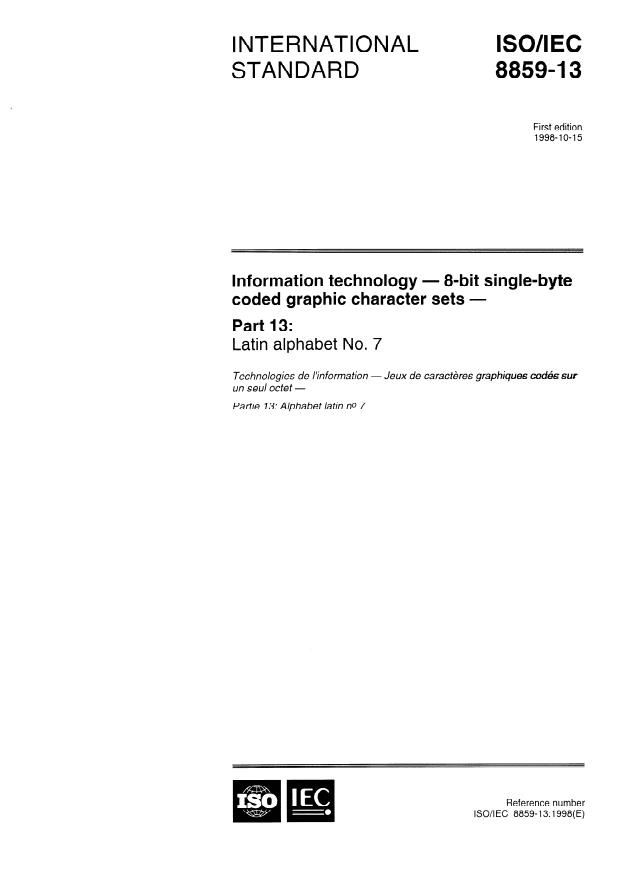
(Main)Information technology — 8-bit single-byte coded graphic character sets — Part 13: Latin alphabet No. 7
General Information
- Abstract
- Status
- Published
- Publication Date
- 21-Oct-1998
- Technical Committee
- ISO/IEC JTC 1/SC 2 - Coded character sets
- Drafting Committee
- ISO/IEC JTC 1/SC 2 - Coded character sets
- Current Stage
- 9093 - International Standard confirmed
- Start Date
- 27-Aug-2020
- Completion Date
- 29-Aug-2026
Buy Documents
ISO/IEC 8859-13:1998 - Information technology — 8-bit single-byte coded graphic character sets — Part 13: Latin alphabet No. 7 Released:10/22/1998
ISO/IEC 8859-13:1998 - Information technology — 8-bit single-byte coded graphic character sets — Part 13: Latin alphabet No. 7 Released:10/22/1998
Overview
ISO/IEC 8859-13:1998 - Information technology - 8‑bit single‑byte coded graphic character sets - Part 13: Latin alphabet No. 7 - specifies an 8‑bit single‑byte coded character set of 191 graphic characters intended for data and text processing and interchange. The standard assigns unique names and identifiers (taken from ISO/IEC 10646/Unicode) and maps characters to specific 8‑bit code table positions. It targets languages used in northern and Baltic Europe, and defines conformance rules for devices and information interchange.
Key topics and technical requirements
- 8‑bit single‑byte code table: characters are allocated to a 16×16 table (256 positions) with positions identified by xx/yy or hexadecimal hk notation.
- Bit notation and weights: bits b8…b1 have weights 128…1 for binary interpretation of byte values.
- 191 graphic characters: includes basic Latin letters, accented characters needed for Danish, Estonian, Finnish, German, Latvian, Lithuanian, Norwegian, Polish, Slovene, Swedish, English and Latin, plus punctuation, digits, NO‑BREAK SPACE and SOFT HYPHEN.
- Names & identifiers: character names and unique identifiers are sourced from ISO/IEC 10646‑1 to support unambiguous mapping to Unicode code points.
- No combining characters: the part contains only non‑combining graphic characters; composite symbols must not be created using control functions.
- Conformance and device behavior: rules for CC‑data‑elements and device conformance are specified - devices must document how users supply and recognize characters; originating and receiving device requirements are defined.
- Usage constraints: this part is not intended to be used in conjunction with other ISO/IEC 8859 parts via simple mixing; ISO/IEC 2022 or ISO/IEC 4873 related mechanisms are referenced for code extension scenarios.
Applications and who uses it
- Legacy systems and data interchange: suitable for legacy file encodings, protocol implementations, and archival data where 8‑bit single‑byte encodings are required.
- Localization and software internationalization: useful for applications, printers, terminals, and embedded devices targeting Baltic and Nordic languages that require the specified accented characters.
- Font and renderer development: font vendors and renderer implementers use the code table and character identifiers to ensure correct glyph mapping.
- Migration planning: developers mapping legacy encodings to Unicode will use the standard’s character names and identifiers to create accurate mapping tables.
Related standards
- ISO/IEC 10646‑1 (Unicode mapping)
- ISO/IEC 2022 and ISO/IEC 4873 (code extension and structure)
- ISO/IEC 6429 (control functions)
- ISO/IEC 10367 (equivalent coded character sets)
ISO/IEC 8859‑13 is essential reference material when implementing or converting 8‑bit character encodings for Baltic and Nordic language environments.
Relations
- Effective Date
- 25-Aug-2026
- Effective Date
- 25-Aug-2026
- Effective Date
- 25-Aug-2026
- Effective Date
- 25-Aug-2026
- Effective Date
- 25-Aug-2026
- Referred By
CR 13928:2000 - Information Technology - Guide to the use of character set standards in Europe - Effective Date
- 25-Aug-2026
- Effective Date
- 25-Aug-2026
- Effective Date
- 25-Aug-2026
- Effective Date
- 03-Jun-2026
- Effective Date
- 03-Jun-2026
Buy Documents
ISO/IEC 8859-13:1998 - Information technology — 8-bit single-byte coded graphic character sets — Part 13: Latin alphabet No. 7 Released:10/22/1998
ISO/IEC 8859-13:1998 - Information technology — 8-bit single-byte coded graphic character sets — Part 13: Latin alphabet No. 7 Released:10/22/1998
Get Certified
Connect with accredited certification bodies for this standard

BSI Group
BSI (British Standards Institution) is the business standards company that helps organizations make excellence a habit.

NYCE
Mexican standards and certification body.
Sponsored listings
Frequently Asked Questions
ISO/IEC 8859-13:1998 is a standard published by the International Organization for Standardization (ISO). Its full title is "Information technology — 8-bit single-byte coded graphic character sets — Part 13: Latin alphabet No. 7". This standard covers: Information technology — 8-bit single-byte coded graphic character sets — Part 13: Latin alphabet No. 7
Information technology — 8-bit single-byte coded graphic character sets — Part 13: Latin alphabet No. 7
ISO/IEC 8859-13:1998 is classified under the following ICS (International Classification for Standards) categories: 35.040 - Information coding; 35.040.10 - Coding of character sets. The ICS classification helps identify the subject area and facilitates finding related standards.
ISO/IEC 8859-13:1998 has the following relationships with other standards: It is inter standard links to CEN ISO/TS 18234-2:2013, EN 1064:2005+A1:2007, EN ISO 81714-1:2010, EN ISO 11073-10201:2005, EN ISO 17573-3:2024, CR 13928:2000, EN 419212-1:2014, EN ISO 9241-304:2008, EN ISO 19115:2005, CEN ISO/TS 18234-2:2006. Understanding these relationships helps ensure you are using the most current and applicable version of the standard.
ISO/IEC 8859-13:1998 is available in PDF format for immediate download after purchase. The document can be added to your cart and obtained through the secure checkout process. Digital delivery ensures instant access to the complete standard document.
Standards Content (Sample)
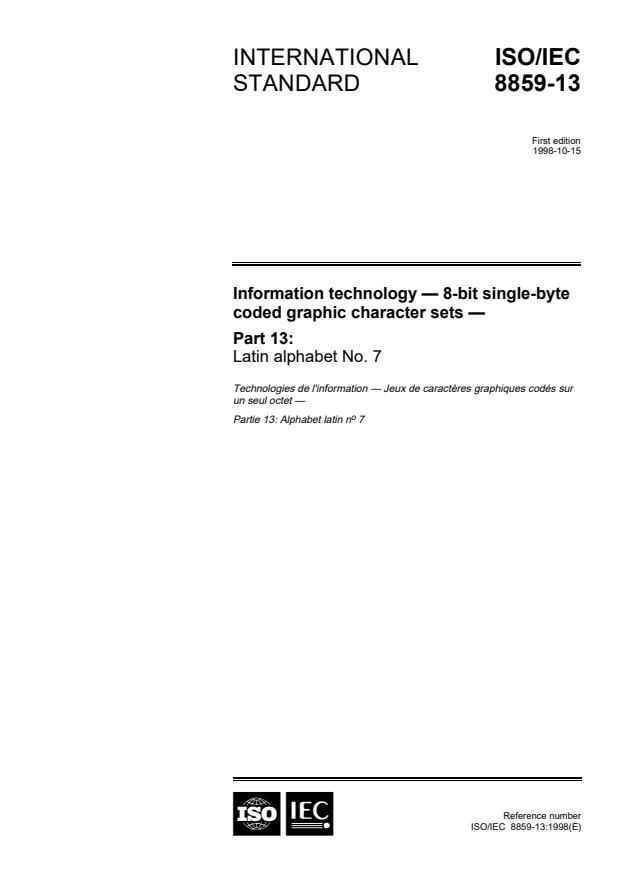
lso/lEx
INTERNATIONAL
8859-l 3
STANDARD
First edition
1998-10-E
Information technology - 8-bit single-byte
coded graphic character sets -
Part 13:
Latin alphabet No. 7
Technologies de I’informa tion - Jeux de caractkres graphiques m~&sw
un seul octet -
Par-tie 13: Alphabet latin n* 7
ISOAEC 8859-l 3:1998 (E)
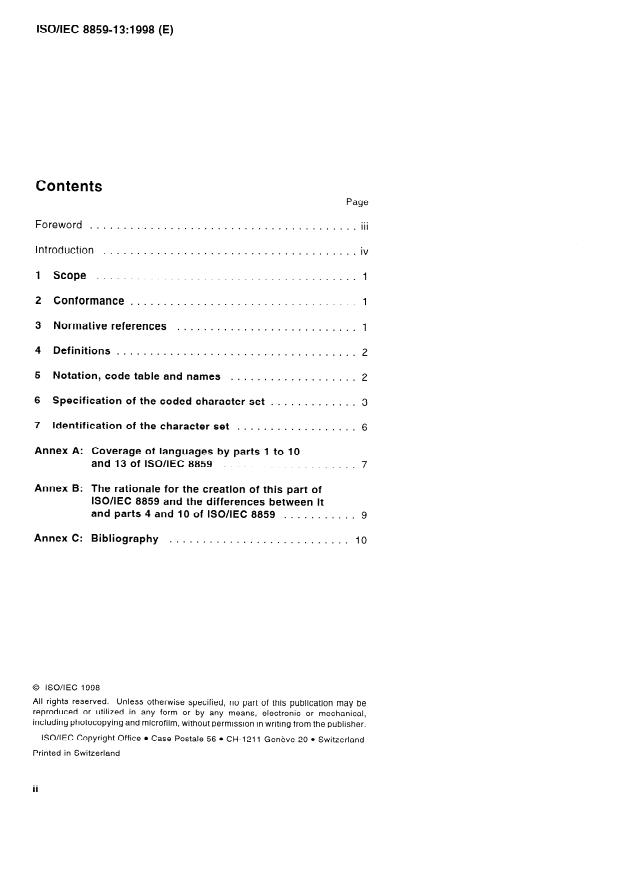
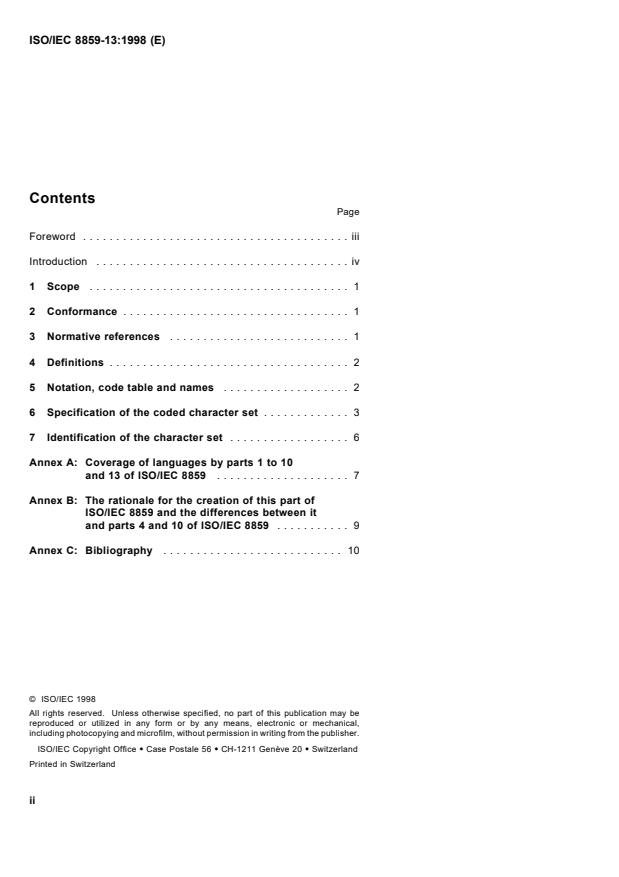
Contents
Page
Foreword . . . . . . . . . . . . . . . . . . . . . . . . . . . . . . . . . . . . . . . . iii
Introduction . . . . . . . . . . . . . . . . . . . . . . . . . . . . . . . . . . . . . . iv
Scope . . . . . . . . . . . . . . . . . . . . . . . . . . . . . . . . . . . . . . . 1
2 Conformance . . . . . . . . . . . . . . . . . . . . . . . . . . . . . . . . . . 1
3 Normative references . . . . . . . . . . . . . . . . . . . . . . . . . . . 1
4 Definitions . . . . . . . . . . . . . . . . . . . . . . . . . . . . . . . . . . . . 2
5 Notation, code table and names . . . . . . . . . . . . . . . . . . . 2
6 Specification of the coded character set . . . . . . . . . . . . . 3
7 Identification of the character set . . . V . . . . . . . . . . . . . . 6
Annex A: Coverage of languages by parts 1 to 10
. . . . . . . . . . . . . . . . . . . . 7
and13ofISOIIEC8859
Annex B: The rationale for the creation of this part of
lSO/IEC 8859 and the differences between it
andparts4andlOofISO/IEC8859 . . . . . . . . . . . 9
Annex C: Bibliography . . . . . . . . . . . . . . . . . . . . . . . . . . . 10
0 lSO/lEC 1998
All rights reserved. Unless otherwise specified, no part of this publication may be
reproduced or utilized in any form or by any means, electronic or mechanical,
including photocopying and microfilm, without permission in writing from the publisher.
ISO/IEC Copyright Office l Case Postale 56 l CH-1211 Geneve 20 l Switzerland
Printed in Switzerland
ii
ISO/IEC 8859-l 3: 1998 (E)
0 ISO/IEC
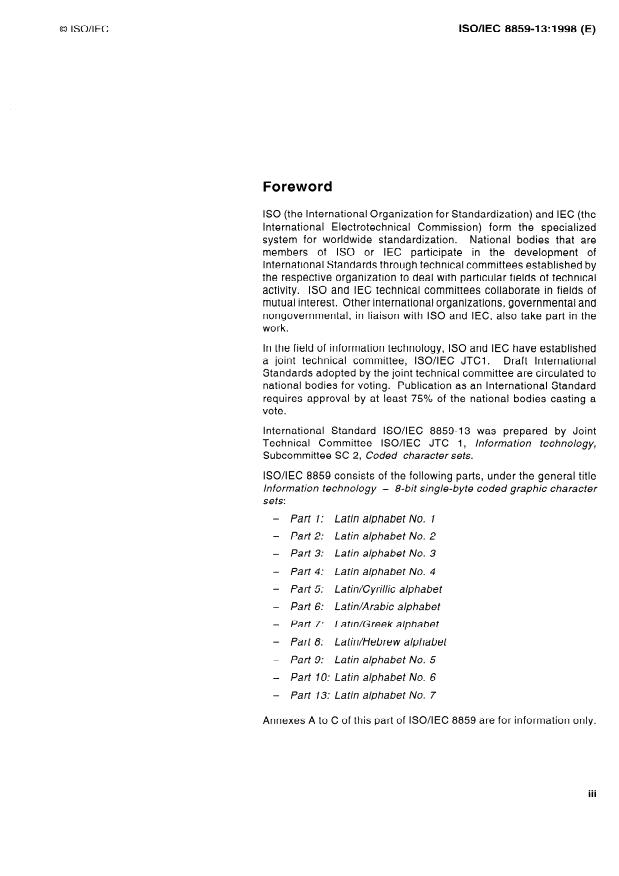
Foreword
IS0 (the International Organization for Standardization) and IEC (the
International Electrotechnical Commission) form the specialized
system for worldwide standardization. National bodies that are
members of IS0 or IEC participate in the development of
International Standards through technical committees established by
the respective organization to deal with particular fields of technical
activity. IS0 and IEC technical committees collaborate in fields of
mutual interest. Other international organizations, governmental and
nongovernmental, in liaison with IS0 and IEC, also take part in the
work.
In the field of information technology, IS0 and IEC have established
a joint technical committee, ISO/IEC JTCI. Draft International
Standards adopted by the joint technical committee are circulated to
national bodies for voting. Publication as an International Standard
requires approval by at least 75% of the national bodies casting a
vote.
International Standard lSO/IEC 8859-13 was prepared by Joint
Technical Committee ISO/IEC JTC 1, information technology,
Subcommittee SC 2, Coded character sets.
ISO/IEC 8859 consists of the following parts, under the general title
lnforma tion technology - 8-bit single-byte coded graphic character
sets:
- Part I: Latin alphabet No. I
- Part 2: Latin alphabet No. 2
- Part 3: Latin alphabet No. 3
- Part 4: Latin alphabet No. 4
- Part 5: LatinKyrillic alphabet
- Part 6: Latin/Arabic alphabet
- Part 7: Latin/Greek alphabet
- Part 8: Latin/Hebrew alphabet
- Part 9: Latin alphabet No. 5
- Part 10: Latin alphabet No. 6
- Part 13: Latin alphabet No. 7
Annexes A to C of this part of ISO/IEC 8859 are for information only.
..I
III
ISOAEC 8859-l 3:1998 (E)
a ISOAEC
Introduction
ISOAEC 8859 consists of several parts. Each part specifies a set of
up to 191 graphic characters and the coded representation of these
characters by means of a single 8-bit byte. Each set is intended for
use for a particular group of languages.
iv
INTERNATIONAL STANDARD o ISO/IEC ISO/IEC 8859~13:1998 (E)
Information technology -
8-bit single-byte coded graphic character sets -
Part 13: Latin alphabet No. 7
2.2 Conformance of devices
1 Scope
A device is in conformance with this part of
This part of ISO/IEC 8859 specifies a set of 191
ISO/IEC 8859 if it conforms to the requirements of
coded graphic characters identified as Latin
2.2.1, and either or both of 2.2.2 and 2.2.3. A claim
alphabet No. 7.
of conformance shall identify the document which
This set of coded graphic characters is intended for
contains the description specified in 2.2.1.
use in data and text processing applications and
also for information interchange.
2.2.1 Device description
A device that conforms to this part of ISO/IEC 8859
The set contains graphic characters used for
shall be the subject of a description that identifies
general purpose applications in typical office
the means by which the user may supply characters
environments in at least the following languages:
to the device, or may recognize them when they are
Danish, English, Estonian, Finnish, German, Latin,
made available to him, as specified respectively in
Latvian, Lithuanian, Norwegian, Polish, Slovene and
2.2.2 and 2.2.3.
Swedish.
2.2.2 Originating devices
This set of coded graphic characters may be
An originating device shall allow its user to supply
regarded as a version of an 8-bit code according to
any sequence of characters from those specified in
ISO/IEC 2022 or ISO/IEC 4873 at level I.
clause 6, and shall be capable of transmitting their
This part of lSO/IEC 8859 may not be used in
coded representations within a CC-data-element.
conjunction with any other parts of ISO/IEC 8859.
If coded characters from more than one part are to
2.2.3 Receiving devices
be used together, by means of code extension
A receiving device shall be capable of receiving and
techniques, the equivalent coded character sets
interpreting any coded representations of characters
from ISO/IEC 10367 should be used instead within
that are within a CC-data-element, and that conform
a version of ISO/IEC 4873 at level 2 or level 3.
to clause 6, and shall make the corresponding
characters available to its user in such a way that
The coded characters in this set may be used in
the user can identify them from among those
conjunction with coded control functions selected
specified there, and can distinguish them from each
from ISO/IEC 6429. However, control functions are
other.
not used to create composite graphic symbols from
two or more graphic characters (see clause 6).
3 Normative references
NOTE - ISO/IEC 8859 is not intended for use with
Telematic services defined by ITU-T. If information coded
The following standards contain provisions which,
according to ISO/IEC 8859 is to be transferred to such
through reference in this text, constitute provisions
services, it will have to conform to the requirements of
of this part of ISO/IEC 8859. At the time of publica-
those services at the access-point.
tion, the editions indicated were valid. All standards
are subject to revision, and parties to agreements
2 Conformance
based on this part of ISO/IEC 8859 are encouraged
2.1 Conformance of information interchange
to investigate the possibility of applying the most
recent editions of the standards indicated below.
A coded-character-data-element (CC-data-element)
Members of IEC and IS0 maintain registers of
within coded information for interchange is in
currently valid International Standards.
conformance with this part of ISO/IEC 8859 if all the
coded representations of graphic characters within
that CC-data-element conform to the requirements
of clause 6.
0 lSO/IEC
ISO/IEC 8859913:1998 (E)
Information technology - The bit combinations may be interpreted to
ISO/IEC 2022:1994,
represent numbers in binary notation by attributing
Character code structure and extension techniques.
the following weights to the individual bits:
ISO/I EC 4873: 1991, lnforma tion technology -
Bit
IS0 8-bit code for information interchange -
b8 b7 b6 b5 b4 b3 b2 b,
Structure and rules for implementation.
Weight 128 64 32 16 8 4 2 1
ISO/IEC 8824-l :1995, lnforma tion technology -
Using these weights,
the bit combinations are
Abstract Syntax Notation One (ASN. I): Specifica-
identified by notations of the form xx/yy, where xx
tion of basic notation.
and yy are numbers in the range 00 to 15. The
correspondence between the notations of the form
4 Definitions
xx/yy and the bit combinations consisting of the bits
For the purposes of this part of ISO/IEC 8859 the
b, t0 b, iS aS fOllOWS:
following definitions apply:
- xx is the number represented by b8, b,, b6 and
4.1 bit combination: An ordered set of bits used
b, where these bits are given the weights 8, 4, 2,
for the representation of characters.
and 1 respectively.
4.2 byte: A bit string that is operated upon as a unit.
-
yy is the number represented by b,, b,, b, and
4.3 character: A member of a set of elements b, where these bits are given the weights 8, 4, 2,
and 1 respectively.
used for the organization, control, or representation
of data.
The bit combinations are also identified bv notations
4.4 code table: A table showing the characters
of the form hk, where h and k are numbers in the
allocated to each bit combination in a code.
range 0 to F in hexadecimal notation. The number
h is the same as the number xx described above,
4.5 coded character set; code: A set of
and the number k the same as the number yy
unambiguous rules that establishes a character set
described above.
and the one-to-one relationship between the
characters of the set and their bit combinations.
5.2 Layout of the code table
4.6 coded-character-data-element (CC-data-
An 8-bit code table consists of 256 positions
element): An element of interchanged information
arranged in 16 columns and 16 rows. The columns
that is specified to consist of a sequence of coded
and the rows are numbered 00 to 15. In hexa-
representations of characters, in accordance with
decimal notation the columns and the rows are
one or more identified standards for coded
numbered 0 to F.
character sets.
The code table positions are identified by notations
4.7 graphic character: A character, other than a
of the form xx/yy, where xx is the column number
control function, that has a visual representation
and yy is the row number. The column and row
normally handwritten, printed or displayed, and that
numbers are shown at the top and left edges of the
has a coded representation consisting of one or
table respectively. The code table positions are
more bit combinations.
also identified by notations of the form hk, where h
NOTE - In ISO/IEC 8859 a single bit combination is used
is the column number and k is the row number in
to represent each character.
hexadecimal notation. The column and row
4.8 graphic symbol: A visual representation of a
numbers are shown at the bottom and right edges of
graphic character or of a control function.
the table respectively.
4.9 position: That part of a code table identified
The positions of the code table are in one-to-one
by its column and row coordinates.
correspondence with the bit combinations of the
code. The notation of a code table position, of the
5 Notation, code table and names
form xx/yy, or of the form hk, is the same as that of
5.1 Notation the corresponding bit combination.
The bits of the bit combinations of the 8-bit code are
5.3 Names and meanings
identified by b,, b,, b,, b,, b,, b,, b,, and b,, where
bs is the highest-order, or most-significant bit and b,
This part of ISO/IEC 8859 assigns a unique name
is the lowest-order, or least-significant bit.
and a unique identifier to each graphic character.
These names and identifiers have been taken from
0 ISO/IEC ISOAEC 8859-l 3:1998 (E)
ISO/IEC 10646-I (E). This part of ISO/IEC 8859 Table 1 - Character set, coded representation
also specifies an acronym for each of the characters
Bit
SPACE, NO-BREAK SPACE and SOFT HYPHEN.
combi- Hex Identifier Name
nation
For acronyms only Latin capital letters A to Z are
used. It is intended that the acronyms be retained in
02/00 20 u+oo20 SPACE
02/01 21 utoo21 EXCLAMATION MARK
all translations of the text.
02/02 22 utoo22 QUOTATION MARK
02lo3 23 utoo23 NUMBER SIGN
Except for SPACE (SP), NO-BREAK SPACE
02/04 24 utoo24 DOLLAR SIGN
(NBSP) and SOFT HYPHEN (SHY), this part of
02/05 25
utoo25 PERCENT SIGN
ISO/IEC 8859 does not define and does not restrict
02/06 26 UtO026 AMPERSAND
the meanings of graphic characters.
02/07 27 utoo27 APOSTROPHE
02/08 28 UtO028 LEFT PARENTHESIS
This part of ISO/IEC 8859 specifies a graphic
02/09 29 utoo29 RIGHT PARENTHESIS
02llO 2A Ut002A ASTERISK
symbol for each graphic character. This symbol is
02/l 1 2B Ut002B PLUS SIGN
shown in the corresponding position of the code
02/12 2c utoo2c COMMA
table. However, this part, or any other part, of
02/13 20 Ut002D HYPHEN-MINUS
ISO/IEC 8859 does not specify a particular style or
02/14 2E Ut002E FULL STOP
02/15 2F
font design for imaging graphic characters. Annex UtOO2F SOLIDUS
03100 30 utoo30 DIGIT ZERO
B of ISO/IEC 10367 gives further information on this
03101 31 utoo31 DIGIT ONE
subject.
03102 utoo32 DIGIT TWO
03103 33 utoo33 DIGIT THREE
5.3.1 SPACE (SP)
03/04 34 utoo34 DIGIT FOUR
35 utoo35
03105 DIGIT FIVE
A graphic character the visual representation of
03106 36 UtO036 DIGIT SIX
which consists of the absence of a graphic symbol.
03/07 37 utoo37 DIGIT SEVEN
03/08 UtO038 DIGIT EIGHT
5.3.2 NO-BREAK SPACE (NBSP) 03/09 39 utoo39 DIGIT NINE
03/l 0 3A Ut003A COLON
A graphic character the visual representation of
3B Ut003B
03/l 1 SEMICOLON
which consists of the absence of a graphic symbol, 03/l 2 3C utoo3c LESS-THAN SIGN
03/l 3 3D Ut003D EQUALS SIGN
for use when a line break is to be prevented in the
03/l 4 3E Ut003E GREATER-THAN SIGN
text as presented.
03/l 5 3F UtOO3F QUESTION MARK
04100 40 utoo40 COMMERCIAL AT
5.3.3 SOFT HYPHEN (SHY)
04/o 1 41 utoo41 LATIN CAPITAL LETTER A
04102 42 utoo42 LATIN CAPITAL LETTER B
A graphic character that is imaged by a graphic
04103 43 utoo43 LATIN CAPITAL LETTER C
symbol identical with, or similar to, that representing
04104 44 utoo44 LATIN CAPITAL LETTER D
HYPHEN, for use when a line break has been
04/05 45 utoo45 LATIN CAPITAL LETTER E
04106 46 UtO046 LATIN CAPITAL LETTER F
established within a word.
04107 47 utoo47 LATIN CAPITAL LETTER G
04108 48 UtO048 LATIN CAPITAL LETTER H
6 Specification of the coded character set 04/09 49 utoo49 LATIN CAPITAL LETTER I
04/l 0 4A Ut004A LATIN CAPITAL LETTER J
This part of ISO/IEC 8859 specifies 191 characters
4B Ut004B
04/l 1 LATIN CAPITAL LETTER K
04/l 2 4c utoo4c LATIN CAPITAL LETTER L
allocated to the bit combinations of the code table
04/l 3 40 Ut004D LATIN CAPITAL LETTER M
(table 2). None of these characters are combining
4E
04/l 4 Ut004E LATIN CAPITAL LETTER N
characters.
04/l 5 4F UtOO4F LATIN CAPITAL LETTER 0
05100 50 utoo50 LATIN CAPITAL LETTER P
NOTE
- Combining characters are described in ISOAEC
05/o 1 51 utoo51
...
INTERNATIONAL ISO/IEC
STANDARD 8859-13
First edition
1998-10-15
Information technology — 8-bit single-byte
coded graphic character sets —
Part 13:
Latin alphabet No. 7
Technologies de l'information — Jeux de caractères graphiques codés sur
un seul octet —
o
Partie 13: Alphabet latin n 7
Reference number
B C
ISO/IEC 8859-13:1998(E)
Contents
Page
Foreword . . iii
Introduction . . iv
1 Scope . 1
2 Conformance . 1
3 Normative references . 1
4 Definitions . 2
5 Notation, code table and names . 2
6 Specification of the coded character set . 3
7 Identification of the character set . 6
Annex A: Coverage of languages by parts 1 to 10
and 13 of ISO/IEC 8859 . 7
Annex B: The rationale for the creation of this part of
ISO/IEC 8859 and the differences between it
and parts 4 and 10 of ISO/IEC 8859 . 9
Annex C: Bibliography . 10
© ISO/IEC 1998
All rights reserved. Unless otherwise specified, no part of this publication may be
reproduced or utilized in any form or by any means, electronic or mechanical,
including photocopying and microfilm, without permission in writing from the publisher.
ISO/IEC Copyright Office Case Postale 56 CH-1211 Genève 20 Switzerland
• • •
Printed in Switzerland
ii
© ISO/IEC ISO/IEC 8859-13:1998 (E)
Foreword
ISO (the International Organization for Standardization) and IEC (the
International Electrotechnical Commission) form the specialized
system for worldwide standardization. National bodies that are
members of ISO or IEC participate in the development of
International Standards through technical committees established by
the respective organization to deal with particular fields of technical
activity. ISO and IEC technical committees collaborate in fields of
mutual interest. Other international organizations, governmental and
nongovernmental, in liaison with ISO and IEC, also take part in the
work.
In the field of information technology, ISO and IEC have established
a joint technical committee, ISO/IEC JTC1. Draft International
Standards adopted by the joint technical committee are circulated to
national bodies for voting. Publication as an International Standard
requires approval by at least 75% of the national bodies casting a
vote.
International Standard ISO/IEC 8859-13 was prepared by Joint
Technical Committee ISO/IEC JTC 1, Information technology,
Subcommittee SC 2, Coded character sets.
ISO/IEC 8859 consists of the following parts, under the general title
Information technology – 8-bit single-byte coded graphic character
sets:
– Part 1: Latin alphabet No. 1
– Part 2: Latin alphabet No. 2
– Part 3: Latin alphabet No. 3
– Part 4: Latin alphabet No. 4
– Part 5: Latin/Cyrillic alphabet
– Part 6: Latin/Arabic alphabet
– Part 7: Latin/Greek alphabet
– Part 8: Latin/Hebrew alphabet
– Part 9: Latin alphabet No. 5
– Part 10: Latin alphabet No. 6
– Part 13: Latin alphabet No. 7
Annexes A to C of this part of ISO/IEC 8859 are for information only.
iii
Introduction
ISO/IEC 8859 consists of several parts. Each part specifies a set of
up to 191 graphic characters and the coded representation of these
characters by means of a single 8-bit byte. Each set is intended for
use for a particular group of languages.
iv
INTERNATIONAL STANDARD © ISO/IEC ISO/IEC 8859-13:1998 (E)
Information technology –
8-bit single-byte coded graphic character sets –
Part 13: Latin alphabet No. 7
2.2 Conformance of devices
1 Scope
A device is in conformance with this part of
This part of ISO/IEC 8859 specifies a set of 191
ISO/IEC 8859 if it conforms to the requirements of
coded graphic characters identified as Latin
2.2.1, and either or both of 2.2.2 and 2.2.3. A claim
alphabet No. 7.
of conformance shall identify the document which
This set of coded graphic characters is intended for
contains the description specified in 2.2.1.
use in data and text processing applications and
also for information interchange.
2.2.1 Device description
A device that conforms to this part of ISO/IEC 8859
The set contains graphic characters used for
shall be the subject of a description that identifies
general purpose applications in typical office
the means by which the user may supply characters
environments in at least the following languages:
to the device, or may recognize them when they are
Danish, English, Estonian, Finnish, German, Latin,
made available to him, as specified respectively in
Latvian, Lithuanian, Norwegian, Polish, Slovene and
2.2.2 and 2.2.3.
Swedish.
2.2.2 Originating devices
This set of coded graphic characters may be
regarded as a version of an 8-bit code according to An originating device shall allow its user to supply
ISO/IEC 2022 or ISO/IEC 4873 at level 1. any sequence of characters from those specified in
clause 6, and shall be capable of transmitting their
This part of ISO/IEC 8859 may not be used in
coded representations within a CC-data-element.
conjunction with any other parts of ISO/IEC 8859.
If coded characters from more than one part are to
2.2.3 Receiving devices
be used together, by means of code extension
A receiving device shall be capable of receiving and
techniques, the equivalent coded character sets
interpreting any coded representations of characters
from ISO/IEC 10367 should be used instead within
that are within a CC-data-element, and that conform
a version of ISO/IEC 4873 at level 2 or level 3.
to clause 6, and shall make the corresponding
characters available to its user in such a way that
The coded characters in this set may be used in
the user can identify them from among those
conjunction with coded control functions selected
specified there, and can distinguish them from each
from ISO/IEC 6429. However, control functions are
other.
not used to create composite graphic symbols from
two or more graphic characters (see clause 6).
3 Normative references
NOTE – ISO/IEC 8859 is not intended for use with
Telematic services defined by ITU-T. If information coded
The following standards contain provisions which,
according to ISO/IEC 8859 is to be transferred to such
through reference in this text, constitute provisions
services, it will have to conform to the requirements of
of this part of ISO/IEC 8859. At the time of publica-
those services at the access-point.
tion, the editions indicated were valid. All standards
are subject to revision, and parties to agreements
2 Conformance
based on this part of ISO/IEC 8859 are encouraged
2.1 Conformance of information interchange
to investigate the possibility of applying the most
recent editions of the standards indicated below.
A coded-character-data-element (CC-data-element)
Members of IEC and ISO maintain registers of
within coded information for interchange is in
currently valid International Standards.
conformance with this part of ISO/IEC 8859 if all the
coded representations of graphic characters within
that CC-data-element conform to the requirements
of clause 6.
ISO/IEC 2022:1994, Information technology – The bit combinations may be interpreted to
Character code structure and extension techniques. represent numbers in binary notation by attributing
the following weights to the individual bits:
ISO/IEC 4873:1991, Information technology –
Bit b b b b b b b b
ISO 8-bit code for information interchange –
8 7 6 5 4 3 2 1
Structure and rules for implementation.
Weight 128 64 32 16 8 4 2 1
ISO/IEC 8824-1:1995, Information technology –
Using these weights, the bit combinations are
Abstract Syntax Notation One (ASN.1): Specifica-
identified by notations of the form xx/yy, where xx
tion of basic notation.
and yy are numbers in the range 00 to 15. The
correspondence between the notations of the form
4 Definitions
xx/yy and the bit combinations consisting of the bits
For the purposes of this part of ISO/IEC 8859 the
b to b is as follows:
8 1
following definitions apply:
– xx is the number represented by b ,b ,b and
8 7 6
4.1 bit combination: An ordered set of bits used
b where these bits are given the weights 8, 4, 2,
for the representation of characters.
and 1 respectively.
4.2 byte: A bit string that is operated upon as a unit.
– yy is the number represented by b ,b ,b and
4 3 2
4.3 character: A member of a set of elements b where these bits are given the weights 8, 4, 2,
used for the organization, control, or representation and 1 respectively.
of data.
The bit combinations are also identified by notations
4.4 code table: A table showing the characters
of the form hk, where h and k are numbers in the
allocated to each bit combination in a code.
range 0 to F in hexadecimal notation. The number
h is the same as the number xx described above,
4.5 coded character set; code: A set of
and the number k the same as the number yy
unambiguous rules that establishes a character set
described above.
and the one-to-one relationship between the
characters of the set and their bit combinations.
5.2 Layout of the code table
4.6 coded-character-data-element (CC-data-
An 8-bit code table consists of 256 positions
element): An element of interchanged information
arranged in 16 columns and 16 rows. The columns
that is specified to consist of a sequence of coded
and the rows are numbered 00 to 15. In hexa-
representations of characters, in accordance with
decimal notation the columns and the rows are
one or more identified standards for coded
numbered 0 to F.
character sets.
The code table positions are identified by notations
4.7 graphic character: A character, other than a
of the form xx/yy, where xx is the column number
control function, that has a visual representation
and yy is the row number. The column and row
normally handwritten, printed or displayed, and that
numbers are shown at the top and left edges of the
has a coded representation consisting of one or
table respectively. The code table positions are
more bit combinations.
also identified by notations of the form hk, where h
NOTE – In ISO/IEC 8859 a single bit combination is used
is the column number and k is the row number in
to represent each character.
hexadecimal notation. The column and row
4.8 graphic symbol: A visual representation of a
numbers are shown at the bottom and right edges of
graphic character or of a control function.
the table respectively.
4.9 position: That part of a code table identified
The positions of the code table are in one-to-one
by its column and row coordinates.
correspondence with the bit combinations of the
code. The notation of a code table position, of the
5 Notation, code table and names
form xx/yy, or of the form hk, is the same as that of
5.1 Notation
the corresponding bit combination.
The bits of the bit combinations of the 8-bit code are
5.3 Names and meanings
identified by b ,b ,b ,b ,b ,b ,b , and b , where
8 7 6 5 4 3 2 1
b is the highest-order, or most-significant bit and b
This part of ISO/IEC 8859 assigns a unique name
8 1
is the lowest-order, or least-significant bit.
and a unique identifier to each graphic character.
These names and identifiers have been taken from
© ISO/IEC ISO/IEC 8859-13:1998 (E)
ISO/IEC 10646-1 (E). This part of ISO/IEC 8859 Table 1 – Character set, coded representation
also specifies an acronym for each of the characters
Bit
SPACE, NO-BREAK SPACE and SOFT HYPHEN.
combi- Hex Identifier Name
nation
For acronyms only Latin capital letters A to Z are
used. It is intended that the acronyms be retained in
02/00 20 U+0020 SPACE
02/01 21 U+0021 EXCLAMATION MARK
all translations of the text.
02/02 22 U+0022 QUOTATION MARK
02/03 23 U+0023 NUMBER SIGN
Except for SPACE (SP), NO-BREAK SPACE
02/04 24 U+0024 DOLLAR SIGN
(NBSP) and SOFT HYPHEN (SHY), this part of
02/05 25 U+0025 PERCENT SIGN
ISO/IEC 8859 does not define and does not restrict
02/06 26 U+0026 AMPERSAND
the meanings of graphic characters.
02/07 27 U+0027 APOSTROPHE
02/08 28 U+0028 LEFT PARENTHESIS
This part of ISO/IEC 8859 specifies a graphic
02/09 29 U+0029 RIGHT PARENTHESIS
symbol for each graphic character. This symbol is 02/10 2A U+002A ASTERISK
02/11 2B U+002B PLUS SIGN
shown in the corresponding position of the code
02/12 2C U+002C COMMA
table. However, this part, or any other part, of
02/13 2D U+002D HYPHEN-MINUS
ISO/IEC 8859 does not specify a particular style or
02/14 2E U+002E FULL STOP
font design for imaging graphic characters. Annex 02/15 2F U+002F SOLIDUS
03/00 30 U+0030 DIGIT ZERO
B of ISO/IEC 10367 gives further information on this
03/01 31 U+0031 DIGIT ONE
subject.
03/02 32 U+0032 DIGIT TWO
03/03 33 U+0033 DIGIT THREE
5.3.1 SPACE (SP)
03/04 34 U+0034 DIGIT FOUR
03/05 35 U+0035 DIGIT FIVE
A graphic character the visual representation of
03/06 36 U+0036 DIGIT SIX
which consists of the absence of a graphic symbol.
03/07 37 U+0037 DIGIT SEVEN
03/08 38 U+0038 DIGIT EIGHT
5.3.2 NO-BREAK SPACE (NBSP)
03/09 39 U+0039 DIGIT NINE
03/10 3A U+003A COLON
A graphic character the visual representation of
03/11 3B U+003B SEMICOLON
which consists of the absence of a graphic symbol,
03/12 3C U+003C LESS-THAN SIGN
03/13 3D U+003D EQUALS SIGN
for use when a line break is to be prevented in the
03/14 3E U+003E GREATER-THAN SIGN
text as presented.
03/15 3F U+003F QUESTION MARK
04/00 40 U+0040 COMMERCIAL AT
5.3.3 SOFT HYPHEN (SHY)
04/01 41 U+0041 LATIN CAPITAL LETTER A
04/02 42 U+0042 LATIN CAPITAL LETTER B
A graphic character that is imaged by a graphic
04/03 43 U+0043 LATIN CAPITAL LETTER C
symbol identical with, or similar to, that representing
04/04 44 U+0044 LATIN CAPITAL LETTER D
HYPHEN, for use when a line break has been
04/05 45 U+0045 LATIN CAPITAL LETTER E
04/06 46 U+0046 LATIN CAPITAL LETTER F
established within a word.
04/07 47 U+0047 LATIN CAPITAL LETTER G
04/08 48 U+0048 LATIN CAPITAL LETTER H
6 Specification of the coded character set
04/09 49 U+0049 LATIN CAPITAL LETTER I
04/10 4A U+004A LATIN CAPITAL LETTER J
This part of ISO/IEC 8859 specifies 191 characters
4B U+004B
04/11 LATIN CAPITAL LETTER K
allocated to the bit combinations of the code table 04/12 4C U+004C LATIN CAPITAL LETTER L
04/13 4D U+004D LATIN CAPITAL LETTER M
(table 2). None of these characters are
...