

ISO 5507:2002
(Main)Oilseeds, vegetable oils and fats — Nomenclature
General Information
- Abstract
ISO 5507:2002 gives the botanical names of the main species of oleaginous plants, together with the names of the corresponding raw materials and oils (fats). An alphabetical index of the raw materials is also given.
- Status
- Withdrawn
- Publication Date
- 18-Nov-2002
- Technical Committee
- ISO/TC 34/SC 2 - Oleaginous seeds and fruits and oilseed meals
- Drafting Committee
- ISO/TC 34/SC 2 - Oleaginous seeds and fruits and oilseed meals
- Current Stage
- 9599 - Withdrawal of International Standard
- Start Date
- 02-Sep-2026
- Completion Date
- 05-Sep-2026
Overview
ISO 5507:2002 - "Oilseeds, vegetable oils and fats - Nomenclature" is an ISO international standard that establishes a consistent nomenclature for oleaginous (oil-bearing) plants and their products. The standard provides botanical names for the main species of oilseeds and gives the corresponding names of raw materials and names of oils/fats. An alphabetical index of raw materials is included to assist users. This third edition (2002) updates and replaces the 1992 edition and was prepared by ISO/TC 34 (Food products), Subcommittee SC 2 (Oleaginous seeds and fruits). The publication is bilingual (English/French) and permits limited reproduction of its terms and definitions for educational or implementation purposes.
Key Topics
- Standardized botanical names of the main oleaginous plant species (genus and species).
- Names of raw materials (e.g., seeds, kernels, pericarp) associated with each botanical entry.
- Names of corresponding oils and fats, including common trade names (e.g., palm oil, sunflowerseed oil).
- Alphabetical index of raw materials for quick lookup and cross-reference.
- Bilingual presentation (English and French) to support international use.
- Published and maintained by ISO/TC 34/SC 2 for the food and oilseed sector.
Applications
ISO 5507:2002 is a practical reference for anyone who needs accurate, internationally recognized nomenclature for oilseeds and vegetable oils:
- Food manufacturers and processors - labeling, ingredient listings, product specifications.
- Trade and procurement teams - clear contract terms and commodity descriptions for oilseed and vegetable oil transactions.
- Regulators and inspection bodies - regulatory definitions, import/export classification, and enforcement.
- Laboratories and quality-control teams - unambiguous sample identification and reporting.
- Researchers, agronomists and botanists - consistent botanical references across studies and publications.
- Standards writers and technical committees - harmonizing terminology in new standards, specifications, and guidance documents.
Benefits
- Ensures consistent terminology across international trade, regulatory documents and technical literature.
- Reduces ambiguity between botanical, raw material and commercial oil names (important for labeling, safety data sheets and product claims).
- Facilitates cross-border communication with an authoritative, bilingual reference.
Related standards
ISO 5507:2002 is part of ISO’s body of standards for food products and oleaginous seeds/fruits (developed by ISO/TC 34). Users implementing ISO 5507 often consult other ISO food and labelling standards or national regulations to align nomenclature with legal and commercial requirements.
Keywords: ISO 5507:2002, oilseeds nomenclature, vegetable oils, fats, botanical names, raw materials, oil names, ISO standard.
Relations
- Effective Date
- 06-Jun-2022
- Effective Date
- 15-Apr-2008
Get Certified
Connect with accredited certification bodies for this standard

BSI Group
BSI (British Standards Institution) is the business standards company that helps organizations make excellence a habit.

Bureau Veritas
Bureau Veritas is a world leader in laboratory testing, inspection and certification services.

DNV
DNV is an independent assurance and risk management provider.
Sponsored listings
Frequently Asked Questions
ISO 5507:2002 is a standard published by the International Organization for Standardization (ISO). Its full title is "Oilseeds, vegetable oils and fats — Nomenclature". This standard covers: ISO 5507:2002 gives the botanical names of the main species of oleaginous plants, together with the names of the corresponding raw materials and oils (fats). An alphabetical index of the raw materials is also given.
ISO 5507:2002 gives the botanical names of the main species of oleaginous plants, together with the names of the corresponding raw materials and oils (fats). An alphabetical index of the raw materials is also given.
ISO 5507:2002 is classified under the following ICS (International Classification for Standards) categories: 01.040.67 - Food technology (Vocabularies); 67.200.20 - Oilseeds. The ICS classification helps identify the subject area and facilitates finding related standards.
ISO 5507:2002 has the following relationships with other standards: It is inter standard links to ISO 5507:2026, ISO 5507:1992. Understanding these relationships helps ensure you are using the most current and applicable version of the standard.
ISO 5507:2002 is available in PDF format for immediate download after purchase. The document can be added to your cart and obtained through the secure checkout process. Digital delivery ensures instant access to the complete standard document.
Standards Content (Sample)
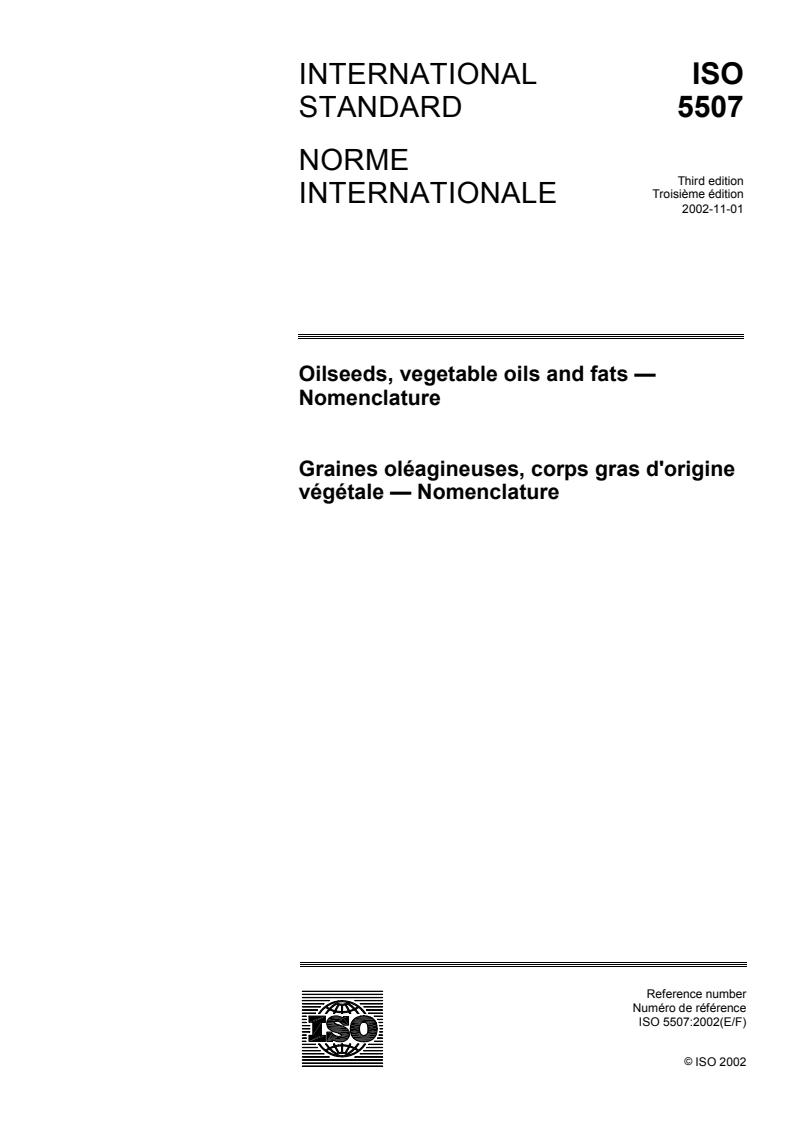
INTERNATIONAL ISO
STANDARD 5507
NORME
Third edition
Troisième édition
INTERNATIONALE
2002-11-01
Oilseeds, vegetable oils and fats —
Nomenclature
Graines oléagineuses, corps gras d'origine
végétale — Nomenclature
Reference number
Numéro de référence
©
ISO 2002
PDF disclaimer
This PDF file may contain embedded typefaces. In accordance with Adobe's licensing policy, this file may be printed or viewed but shall not
be edited unless the typefaces which are embedded are licensed to and installed on the computer performing the editing. In downloading this
file, parties accept therein the responsibility of not infringing Adobe's licensing policy. The ISO Central Secretariat accepts no liability in this
area.
Adobe is a trademark of Adobe Systems Incorporated.
Details of the software products used to create this PDF file can be found in the General Info relative to the file; the PDF-creation parameters
were optimized for printing. Every care has been taken to ensure that the file is suitable for use by ISO member bodies. In the unlikely event
that a problem relating to it is found, please inform the Central Secretariat at the address given below.
PDF – Exonération de responsabilité
Le présent fichier PDF peut contenir des polices de caractères intégrées. Conformément aux conditions de licence d'Adobe, ce fichier peut
être imprimé ou visualisé, mais ne doit pas être modifié à moins que l'ordinateur employé à cet effet ne bénéficie d'une licence autorisant
l'utilisation de ces polices et que celles-ci y soient installées. Lors du téléchargement de ce fichier, les parties concernées acceptent de fait la
responsabilité de ne pas enfreindre les conditions de licence d'Adobe. Le Secrétariat central de l'ISO décline toute responsabilité en la
matière.
Adobe est une marque déposée d'Adobe Systems Incorporated.
Les détails relatifs aux produits logiciels utilisés pour la création du présent fichier PDF sont disponibles dans la rubrique General Info du
fichier; les paramètres de création PDF ont été optimisés pour l'impression. Toutes les mesures ont été prises pour garantir l'exploitation de
ce fichier par les comités membres de l'ISO. Dans le cas peu probable où surviendrait un problème d'utilisation, veuillez en informer le
Secrétariat central à l'adresse donnée ci-dessous.
© ISO 2002
The reproduction of the terms and definitions contained in this International Standard is permitted in teaching manuals, instruction booklets,
technical publications and journals for strictly educational or implementation purposes. The conditions for such reproduction are: that no
modifications are made to the terms and definitions; that such reproduction is not permitted for dictionaries or similar publications offered for
sale; and that this International Standard is referenced as the source document.
With the sole exceptions noted above, no other part of this publication may be reproduced or utilized in any form or by any means, electronic or
mechanical, including photocopying and microfilm, without permission in writing from either ISO at the address below or ISO's member body in
the country of the requester.
La reproduction des termes et des définitions contenus dans la présente Norme internationale est autorisée dans les manuels d'enseignement,
les modes d'emploi, les publications et revues techniques destinés exclusivement à l'enseignement ou à la mise en application. Les conditions
d'une telle reproduction sont les suivantes: aucune modification n'est apportée aux termes et définitions; la reproduction n'est pas autorisée
dans des dictionnaires ou publications similaires destinés à la vente; la présente Norme internationale est citée comme document source.
À la seule exception mentionnée ci-dessus, aucune partie de cette publication ne peut être reproduite ni utilisée sous quelque forme que ce soit
et par aucun procédé, électronique ou mécanique, y compris la photocopie et les microfilms, sans l'accord écrit de l'ISO à l'adresse ci-après ou
du comité membre de l'ISO dans le pays du demandeur.
ISO copyright office
Case postale 56 • CH-1211 Geneva 20
Tel. + 41 22 749 01 11
Fax + 41 22 749 09 47
E-mail copyright@iso.org
Web www.iso.org
Published in Switzerland/Publié en Suisse
ii © ISO 2002 – All rights reserved/Tous droits réservés
Foreword
ISO (the International Organization for Standardization) is a worldwide federation of national standards bodies (ISO
member bodies). The work of preparing International Standards is normally carried out through ISO technical
committees. Each member body interested in a subject for which a technical committee has been established has
the right to be represented on that committee. International organizations, governmental and non-governmental, in
liaison with ISO, also take part in the work. ISO collaborates closely with the International Electrotechnical
Commission (IEC) on all matters of electrotechnical standardization.
International Standards are drafted in accordance with the rules given in the ISO/IEC Directives, Part 3.
The main task of technical committees is to prepare International Standards. Draft International Standards adopted
by the technical committees are circulated to the member bodies for voting. Publication as an International
Standard requires approval by at least 75 % of the member bodies casting a vote.
Attention is drawn to the possibility that some of the elements of this International Standard may be the subject of
patent rights. ISO shall not be held responsible for identifying any or all such patent rights.
ISO 5507 was prepared by Technical Committee ISO/TC 34, Food products, Subcommittee SC 2, Oleaginous
seeds and fruits.
This third edition cancels and replaces the second edition (ISO 5507:1992), which has been technically revised.
The Russian version has also been deleted.
Avant-propos
L'ISO (Organisation internationale de normalisation) est une fédération mondiale d'organismes nationaux de
normalisation (comités membres de l'ISO). L'élaboration des Normes internationales est en général confiée aux
comités techniques de l'ISO. Chaque comité membre intéressé par une étude a le droit de faire partie du comité
technique créé à cet effet. Les organisations internationales, gouvernementales et non gouvernementales, en
liaison avec l'ISO participent également aux travaux. L'ISO collabore étroitement avec la Commission
électrotechnique internationale (CEI) en ce qui concerne la normalisation électrotechnique.
Les Normes internationales sont rédigées conformément aux règles données dans les Directives ISO/CEI,
Partie 3.
La tâche principale des comités techniques est d'élaborer les Normes internationales. Les projets de Normes
internationales adoptés par les comités techniques sont soumis aux comités membres pour vote. Leur publication
comme Normes internationales requiert l'approbation de 75 % au moins des comités membres votants.
L'attention est appelée sur le fait que certains des éléments de la présente Norme internationale peuvent faire
l'objet de droits de propriété intellectuelle ou de droits analogues. L'ISO ne saurait être tenue pour responsable de
ne pas avoir identifié de tels droits de propriété et averti de leur existence.
L'ISO 5507 a été élaborée par le comité technique ISO/TC 34, Produits alimentaires, sous-comité SC 2, Graines et
fruits oléagineux.
Cette troisième édition annule et remplace la deuxième édition (ISO 5507:1992), qui a fait l'objet d'une révision
technique.
La version russe a également été retirée.
iv © ISO 2002 – All rights reserved/Tous droits réservés
INTERNATIONAL STANDARD
NORME INTERNATIONALE
Oilseeds, vegetable oils and Graines oléagineuses, corps
fats — Nomenclature gras d'origine végétale —
Nomenclature
1 Scope 1 Domaine d’application
This International Standard gives the botanical La présente Norme internationale donne les noms
names of the main species of oleaginous plants, botaniques des principales espèces de plantes
together with the names of the corresponding raw oléagineuses, ainsi que les noms des matières
materials and oils (fats). premières et des corps gras correspondants.
An alphabetical index of the raw materials is also Un index alphabétique des matières premières est
given to assist in the use of this International également donné pour faciliter l'emploi de la
Standard. présente Norme internationale.
No. Botanical name Name of the raw material Name of the oil (fat)
o
Nom botanique Nom de la matière première Nom du corps gras
N
A1 Abelmoschus esculentus (L.) Moench E) See H4 E) See H4
cf. Hibiscus esculentus F) Voir H4 F) Voir H4
A2 Aleurites cordata (Thunb.) R. Br. ex Steud. E) See V1 E) See V1
cf. Vernicia cordata
F) Voir V1 F) Voir V1
A3* Aleurites fordii Hemsl.
E) Tung nut E) Tung nut oil
F) Tung (graines de) F) Huile de tung
Huile de bois de Chine
A4* Aleurites moluccana (L.) Willd. E) Candle nut E) Candle nut oil
Indian walnut Artist's oil
Lumbang oil
F) Bancoul (noix de)
Kukui oil
F) Huile de bancoul
A5 Aleurites montana (Lour.) Wils.
E) See V3 E) See V3
cf. Vernicia montana
F) Voir V3 F) Voir V3
A6* Anarcadium occidentale L.
E) Cashew nut E) Cashew nut oil
F) Cajou (noix de) F) Beurre d'anacarde
A7* Arachis hypogaea L. E) Arachis (seeds) E) Arachis seed oil
Earthnut Groundnut oil
Groundnut kernel Peanut oil
Peanut Nut oil
F) Arachide (graines d') F) Huile d'arachide
Cacahouète
A8* Argania spinosa (L.) Skeels
E) Argan nut E) Argan oil
F) Argan (amandes de noyaux F) Huile d'argan
d')
A9 Armeniaca vulgaris Lam. E) See P6 E) See P6
cf. Prunus armeniaca F) Voir P6 F) Voir P6
Attalea cohune (Mart.)
A10 E) See O4 E) See O4
cf. Orbignya cohune F) Voir O4 F) Voir O4
A11* Attalea speciosa Mart. ex Spreng.; E) Babassu kernel
E) Babassu oil
syn. Orbignya speciosa (Mart.) Barb. Rodr. F) Babassu (noix de)
F) Huile de babassu
A12 Azadirachta indica A. Juss.; E) Neem (seeds)
E) Neem oil
syn. Antelaea azadirachta (L.) Adelbert
F) Neem (graines de)
F) Huile de neem
B1 Bassia longifolia L. E) See M2
E) See M2
cf. Madhuca longifolia F) Voir M2
F) Voir M2
Borago officinalis L.
B2* E) Borage (seeds)
E) Borage (seed) oil
F) Bourrache (graines de)
F) Huile de bourrache
B3 Brassica juncea (L.) Czern. et Coss. E) Brown mustard (seeds) E) Brown mustard seed oil
Indian mustard (seeds) Indian mustard seed oil
Canola Rapeseed oil
Rape (seeds)
F) Huile de moutarde brune
Huile de moutarde d'Inde
F) Moutarde brune (graines de)
Moutarde d'Inde (graines de)
B4* Brassica napus L. var. oleifera E) Rape (seeds)
E) Rapeseed oil
Canola
F) Colza (graines de)
F) Huile de colza
2 © ISO 2002 – All rights reserved/Tous droits réservés
No. Botanical name Name of the raw material Name of the oil (fat)
o
Nom botanique Nom de la matière première Nom du corps gras
N
Brassica nigra (L.) W.D.J. Koch
B5* E) Black mustard (seeds) E) Black mustard seed oil
F) Moutarde noire (graines de) F) Huile de moutarde noire
B6* Brassica rapa L.; E) Turnip rape (seeds) E) Rapeseed oil
Rape (seeds) Canola oil
syn. Brassica campestris L.
Canola
F) Huile de colza
F) Navette (graines de)
Colza (graines de)
B7 Butyrospermum paradoxum (Gaertn. f.) E) See V5
E) See V5
Hepper;
F) Voir V5
F) Voir V5
syn. Butyrospermum parkii (G. Don)
Kotschy
cf. Vitellaria paradoxa
C1* Camelina sativa (L.) Crantz E) Cameline (seeds) E) Cameline seed oil
F) Cameline (graines de) F) Huile de cameline
C2* Camellia sinensis (L.) Kuntze E) Tea (seeds) E) Teaseed oil
F) Thé (graines de) F) Huile de thé
C3* Cannabis sativa L. E) Cannabis (seeds) E) Cannabis oil
Hemp (seeds) Hempseed oil
F) Chènevis (graines de) F) Huile de chènevis
Chanvre (graines de)
C4* Carica papaya L. E) Papaya (seeds) E) Papaya seed oil
F) Papaye (graines de) F) Huile de papaye
C5* Carthamus tinctorius L. E) Safflower (seeds) E) Safflower oil
Safflowerseed oil
F) Carthame (graines de) F) Huile de carthame
C6* Ceiba pentandra (L.) Gaertn. E) Kapokseed oil
E) Kapok (seeds)
F) Huile de kapok
F) Kapok (graines de)
C7* Citrus aurantiifolia (Christm.) Swingle E) Lime (seeds) E) Lime seed oil
F) Citron vert (pépins de) F) Huile de pépins de citron
vert
C8* Citrus limon L. Burm. f. E) Lemon (seeds) E) Lemon seed oil
F) Citron (pépins de) F) Huile de pépins de citron
C9* Citrus paradisi Macfad. E) Grapefruit (seeds) E) Grapefruit seed oil
F) Pamplemousse (pépins de) F) Huile des pépins de
pamplemousse
C10* Citrus sinensis (L.) Osbeck E) Sweet orange (seeds) E) Sweet orange seed oil
F) Orange (pépins d') F) Huile des pépins d'orange
C11 E) Watermelon (seeds) E) Watermelon seed oil
Citrullus lanatus (Thunb.) Matsum. et
Oontanga oil
Nakai
F) Melon d'eau (graines de) F) Huile de graines de
Citrullus spp.
Pastèque (graines de) pastèque
C12* Cocos nucifera L. E) Coconut E) Coconut oil
Copra (kernels) Copra oil
F) Coco (noix de) F) Huile de coco
Coprah (amandes de) Huile de coprah
No. Botanical name Name of the raw material Name of the oil (fat)
o
Nom botanique Nom de la matière première Nom du corps gras
N
C13* Coffea arabica L. E) Coffee bean E) Coffee seed oil
Arabica or Robusta
coffee oil
F) Café (grains de) F) Huile de café
C14 Corozo oleifera (H. B. K.) L. H. Bailey E) See E2 E) See E2
cf. Elaeis oleifera F) Voir E2 F) Voir E2
C15* Corylus avellana L. E) Hazelnut E) Hazelnut oil
F) Noisette F) Huile de noisette
C16* Crambe abyssinica Hochst. ex R.E. Fr. E) Abyssinian kale (seeds) E) Sea kale oil
Abyssinian cabbage (seeds) Crambe oil
Crambe seeds
Sea kale seeds
F) Crambe (graines de)
F) Huile de crambe
Chou abyssin (graines de)
C17* Croton tiglium L. E) Croton (seeds) E) Croton seed oil
F) Croton (graines de) F) Huile de croton
C18* Cucumis melo L. E) Musk melon (seeds) E) Musk melon seed oil
Cantaloupe (seeds)
F) Melon (pépins de) F) Huile de pépins de melon
C19* Cucurbita maxima Duchesne E) Pumpkin (seeds) E) Pumpkinseed oil
Squash (seeds) Squash seed oil
Vegetable marrow (seeds) Vegetable marrow seed
oil
Cucurbita pepo L.
F) Citrouille (pépins de) F) Huile de pépins de
Courge (pépins de) cucurbitacées (citrouille
Potiron (pépins de) courge, potiron)
C20 Cuphea spp. E) Cuphea (seeds) E) Cuphea seed oil
F) Cuphéa F) Huile de cuphéa
C21* Cynara cardunculus L. E) Artichoke E) Artichoke seed oil
F) Cynara (graines de) F) Huile de cynara
Cardon (graines de) Huile de cardon
E1* Elaeis guineensis Jacq. E) Oil palm fruit (pericarp) E) Palm oil
Palm kernel Palm kernel oil
F) Palme (péricarpe) F) Huile de palme
Palmiste (noix de) Huile de palmiste
E2* Elaeis oleifera (Kunth) Cortés; E) South American oil palm E) South American palm
kernel kernel oil
syn. Elaeis melanococca auctores non
South American oil palm fruit South American palm oil
Gaertn.;
(pericarp)
syn. Alfonsia oleifera Kunth;
F) Palmiste d'Amérique du Sud F) Huile de palmiste
syn. Corozo oleifera (H. B. K.) L. H. Bailey
(noix de) d'Amérique du Sud
Palme d'Amérique du Sud Huile de palme
(péricarpe) d'Amérique du Sud
Euphorbia lathyris L.
E3* E) Spurge (seeds) E) Spurge seed oil
F) Épurge (graines d') F) Huile d'épurge
F1* Fagus sylvatica L. E) Beech nut E) Beechnut oil
F) Faine F) Huile de faine
G1* Glycine max (L.) Merr. E) Soya bean E) Soyabean oil
Soybean Soybean oil
F) Soja (graines de) F) Huile de soja
4 © ISO 2002 – All rights reserved/Tous droits réservés
No. Botanical name Name of the raw material Name of the oil (fat)
o
Nom botanique Nom de la matière première Nom du corps gras
N
Gossypium spp.
G2 E) Cotton (seeds) E) Cottonseed oil
F) Coton (graines de) F) Huile de coton
G3* Guizotia abyssinica (L. f.) Cass. E) Niger seeds E) Nigerseed oil
F) Niger (graines de) F) Huile de niger
H1* Helianthus annuus L. E) Sunflower (seeds) E) Sunflowerseed oil
Sunflower oil
F) Tournesol (graines de) F) Huile de tournesol
H2* Hevea brasiliensis (Wild. ex A. Juss) Muell. E) Rubber (seeds) E) Rubber seed oil
Arg.
F) Hévéa (graines d') F) Huile d'hévéa
Caoutc
...