

ISO/TR 14872:2019
(Main)Health informatics — Identification of medicinal products — Core principles for maintenance of identifiers and terms
General Information
- Abstract
The purpose of this document is to describe the core principles and proposed service delivery model for supporting implementation and ongoing maintenance of IDMP terminologies. The information provided in this document can be used as evaluation and/or design criteria when considering current or future operations and service level agreements for systems and terminology support services in conformity with IDMP.
- Status
- Withdrawn
- Publication Date
- 11-Jul-2019
- Technical Committee
- ISO/TC 215 - Health informatics
- Drafting Committee
- ISO/TC 215/WG 6 - Pharmacy and medicines business
- Current Stage
- 9599 - Withdrawal of International Standard
- Start Date
- 10-Dec-2025
- Completion Date
- 29-Aug-2026
Buy Documents
ISO/TR 14872:2019 - Health informatics -- Identification of medicinal products -- Core principles for maintenance of identifiers and terms
ISO/TR 14872:2019 - Health informatics — Identification of medicinal products — Core principles for maintenance of identifiers and terms/12/2019
Overview
ISO/TR 14872:2019 - "Health informatics - Identification of medicinal products - Core principles for maintenance of identifiers and terms" provides high-level guidance for the ongoing maintenance, governance and service delivery of terminologies that support the IDMP (Identification of Medicinal Products) family of standards. It describes core principles and a proposed federated service delivery model to help organizations evaluate or design operations and service level agreements (SLAs) for systems that create, maintain and distribute IDMP identifiers and controlled vocabularies.
Key topics and technical requirements
- Scope and purpose: Guidance for supporting the five IDMP standards (ISO 11615, ISO 11616, ISO 11238, ISO 11239, ISO 11240) and their terminologies.
- Federated service delivery model: Hybrid approach where some maintenance services are centralized (global authorities) and others decentralized (regional or national providers).
- Data governance: Roles and processes for data owners, data stewards and governance groups to ensure quality, consistency, usability and access control.
- Terminology maintenance services: Procedures for creation of value sets, identifiers, change management, mapping and translations.
- Change management: Principles for consistent update cycles, reconciliation of regional variations and enforcement of SLAs between providers and stakeholders.
- Mapping and translations: Recommendations for mapping regional terminologies to IDMP-compliant value sets when a single global terminology is not feasible.
- Relationships with stakeholders: Coordination between regulators, standards development organizations (SDOs) and maintenance organizations; emphasis on vendor neutrality and interoperability.
- Interoperability considerations: Alignment with HL7 messaging and emerging specifications such as FHIR, and references to terminology authorities like SNOMED CT, LOINC, and EDQM.
Applications and who uses it
ISO/TR 14872:2019 is practical for organizations that create, manage or consume medicinal product data, including:
- National and regional regulators (e.g., EMA, FDA)
- Pharmaceutical and biopharmaceutical companies
- Clinical research organizations (CROs)
- Health IT vendors, dictionary and terminology service providers
- Standards bodies and implementers working on IDMP, pharmacovigilance, regulatory submissions, drug dictionaries and interoperability projects
Use cases include designing SLA-backed terminology services, evaluating maintenance workflows, establishing data governance, and planning mappings between local drug dictionaries and IDMP-compliant value sets.
Related standards
- IDMP family: ISO 11615, ISO 11616, ISO 11238, ISO 11239, ISO 11240
- Supporting technical specifications: ISO/TS 20440, ISO/TS 20443, ISO/TS 20451, ISO/TS 19844
- IT and process frameworks: ISO/IEC 20000-1, ISO/IEC 20000-2, ISO/IEC 33002
- Interoperability: HL7 FHIR, SNOMED CT, LOINC, EDQM
Keywords: ISO TR 14872:2019, IDMP, terminology maintenance, federated service delivery model, data governance, value set management, medicinal product identifiers, change management, HL7 FHIR.
Relations
- Effective Date
- 28-Jan-2023
Buy Documents
ISO/TR 14872:2019 - Health informatics -- Identification of medicinal products -- Core principles for maintenance of identifiers and terms
ISO/TR 14872:2019 - Health informatics — Identification of medicinal products — Core principles for maintenance of identifiers and terms/12/2019
Get Certified
Connect with accredited certification bodies for this standard

BSI Group
BSI (British Standards Institution) is the business standards company that helps organizations make excellence a habit.

NYCE
Mexican standards and certification body.
Sponsored listings
Frequently Asked Questions
ISO/TR 14872:2019 is a technical report published by the International Organization for Standardization (ISO). Its full title is "Health informatics — Identification of medicinal products — Core principles for maintenance of identifiers and terms". This standard covers: The purpose of this document is to describe the core principles and proposed service delivery model for supporting implementation and ongoing maintenance of IDMP terminologies. The information provided in this document can be used as evaluation and/or design criteria when considering current or future operations and service level agreements for systems and terminology support services in conformity with IDMP.
The purpose of this document is to describe the core principles and proposed service delivery model for supporting implementation and ongoing maintenance of IDMP terminologies. The information provided in this document can be used as evaluation and/or design criteria when considering current or future operations and service level agreements for systems and terminology support services in conformity with IDMP.
ISO/TR 14872:2019 is classified under the following ICS (International Classification for Standards) categories: 35.240.80 - IT applications in health care technology. The ICS classification helps identify the subject area and facilitates finding related standards.
ISO/TR 14872:2019 has the following relationships with other standards: It is inter standard links to ISO/TR 14872:2025. Understanding these relationships helps ensure you are using the most current and applicable version of the standard.
ISO/TR 14872:2019 is available in PDF format for immediate download after purchase. The document can be added to your cart and obtained through the secure checkout process. Digital delivery ensures instant access to the complete standard document.
Standards Content (Sample)
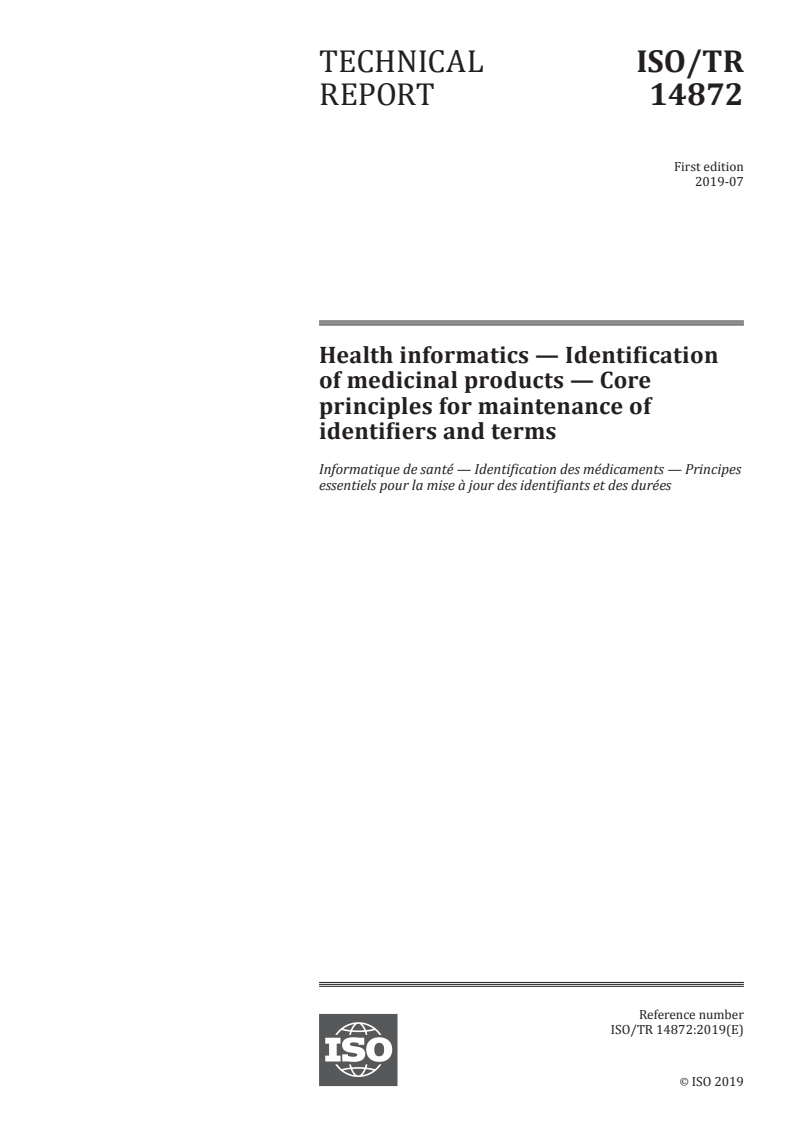
TECHNICAL ISO/TR
REPORT 14872
First edition
2019-07
Health informatics — Identification
of medicinal products — Core
principles for maintenance of
identifiers and terms
Informatique de santé — Identification des médicaments — Principes
essentiels pour la mise à jour des identifiants et des durées
Reference number
©
ISO 2019
© ISO 2019
All rights reserved. Unless otherwise specified, or required in the context of its implementation, no part of this publication may
be reproduced or utilized otherwise in any form or by any means, electronic or mechanical, including photocopying, or posting
on the internet or an intranet, without prior written permission. Permission can be requested from either ISO at the address
below or ISO’s member body in the country of the requester.
ISO copyright office
CP 401 • Ch. de Blandonnet 8
CH-1214 Vernier, Geneva
Phone: +41 22 749 01 11
Fax: +41 22 749 09 47
Email: copyright@iso.org
Website: www.iso.org
Published in Switzerland
ii © ISO 2019 – All rights reserved
Contents Page
Foreword .iv
Introduction .v
1 Scope . 1
2 Normative references . 1
3 Terms and definitions . 1
4 Symbols and abbreviated terms . 2
5 Maintenance of International Standards on IDMP — Leveraging existing
relationships between global regulators and other standards development organizations 3
6 IDMP terminology maintenance . 3
6.1 Federated service delivery model. 3
6.2 Future IDMP data governance . 5
6.3 Change management . 5
6.4 Relationships with data owners . 5
7 IDMP terminology maintenance core principles . 6
8 International mapping and language translations . 7
9 Maintenance process considerations. 7
Bibliography . 8
Foreword
ISO (the International Organization for Standardization) is a worldwide federation of national standards
bodies (ISO member bodies). The work of preparing International Standards is normally carried out
through ISO technical committees. Each member body interested in a subject for which a technical
committee has been established has the right to be represented on that committee. International
organizations, governmental and non-governmental, in liaison with ISO, also take part in the work.
ISO collaborates closely with the International Electrotechnical Commission (IEC) on all matters of
electrotechnical standardization.
The procedures used to develop this document and those intended for its further maintenance are
described in the ISO/IEC Directives, Part 1. In particular, the different approval criteria needed for the
different types of ISO documents should be noted. This document was drafted in accordance with the
editorial rules of the ISO/IEC Directives, Part 2 (see www .iso .org/directives).
Attention is drawn to the possibility that some of the elements of this document may be the subject of
patent rights. ISO shall not be held responsible for identifying any or all such patent rights. Details of
any patent rights identified during the development of the document will be in the Introduction and/or
on the ISO list of patent declarations received (see www .iso .org/patents).
Any trade name used in this document is information given for the convenience of users and does not
constitute an endorsement.
For an explanation of the voluntary nature of standards, the meaning of ISO specific terms and
expressions related to conformity assessment, as well as information about ISO's adherence to the
World Trade Organization (WTO) principles in the Technical Barriers to Trade (TBT) see www .iso
.org/iso/foreword .html.
This document was prepared by Technical Committee ISO/TC 215, Health informatics.
Any feedback or questions on this document should be directed to the user’s national standards body. A
complete listing of these bodies can be found at www .iso .org/members .html.
iv © ISO 2019 – All rights reserved
Introduction
This document describes the core operating principles and a proposed service delivery model for
terminology maintenance services in support of five International Standards on the Identification of
Medicinal Products (IDMP), i.e. ISO 11615, ISO 11616, ISO 11238, ISO 11239, ISO 11240. Collectively,
the International Standards on IDMP provide the basis for data collection and information exchange
about key medicinal product characteristics that support the unique and unambiguous identification of
medicinal products for a variety of regulatory and commercial business objectives and use cases.
Since the International Standards on IDMP can be applied to a broad range of use cases, (e.g., regulatory
product applications, product registration, creation of drug dictionaries, etc.), adherence to common
coordination and maintenance principles is critical to help ensure consistent adoption, use and
maintenance of the International Standards on IDMP.
Currently, many organizations serve as data owners or terminology service providers in several
jurisdictions. These organizations maintain and distribute their own medicinal product terminology
which does not fully correspond to terminology mapping and format criteria described in Technical
Specifications on IDMP (i.e., ISO/TS 20443, ISO/TS 20451, ISO/TS 19844, ISO/TS 20440). The
terminology maintenance service delivery model proposed in this document is adapted for IDMP based
upon well-established IT service models which use a hybrid support approach comprised of centralized
and decentralized services (also referred to as service components) for a comprehensive set of IT
support services. These IT support models are often referred to as “federated enterprise architecture”
[20]
models . The success of the IDMP federated service delivery model proposed in this document will
help provide a framework to support more collaboration and shared data governance among key IDMP
stakeholders and is dependent upon several factors, including the following:
— Adherence to a set of core principles for each of the International Standards on IDMP;
— Adherence to the core principles described in this document;
— Strict enforcement of service level agreements between IDMP terminology service providers and
their stakeholders to help address jurisdictional differences.
Since IDMP standards are in the process of adoption internationally, it is anticipated that this document
will be revised to reflect real-world experience in how the information models, data elements and
their associated terminologies are used, as well as to accommodate any potential gaps in mapping and
governance for specific IDMP terminology domains (e.g., substance/specified substance, dosage form,
route of administration).
This document leverages and complements several ISO and joint ISO/IEC specifications pertaining to
support principles and processes that should be exhibited by developers of healthcare terminologies
in support of international healthcare terminology standardization, information technology service
management and the design and maintenance of quality systems. The applicable International
Standards are ISO/IEC 20000-1:2018, ISO/IEC 20000-2:2012 and ISO/IEC 33002:2015.
The intended audience for this document includes the following:
— Organizations seeking an opportunity to support creation and/or dissemination of IDMP
terminologies;
— Organizations interested in implementing or applying the International Standards on IDMP (e.g.,
technical format and/or scientific content) to their internal processes and systems in support of
regulatory or healthcare-related business; and
— Global regulators, pharmaceutical/biopharmaceutical companies, Clinical Research Organizations
(CROs) and universities/scientific institutes involved in the development, authorization and
marketing of medicinal products.
TECHNICAL REPORT ISO/TR 14872:2019(E)
Health informatics — Identification of medicinal products
— Core principles for maintenance of identifiers and terms
1 Scope
The purpose of this document is to describe the core principles and proposed service delivery model for
supporting implementation and ongoing maintenance of IDMP terminologies.
The information provided in this document can be used as evaluation and/or design criteria when
considering current or future operations and service level agreements for systems and terminology
support services in conformity with IDMP.
2 Normative references
There are no normative references in this document.
3 Terms and definitions
For the purposes of this document, the following terms and definitions apply.
ISO and IEC maintain terminological databases for use in standardization at the following addresses:
— ISO Online browsing platform: available at https: //www .iso .org/obp
— IEC Electropedia: available at http: //www .electropedia .org/
3.1
controlled vocabulary
finite list of values that represent the only allowed values for a data item
Note 1 to entry: These values can be codes, text, or numeric.
Note 2 to entry: It includes the use of a taxonomy to classify terms into parent/child or broad-to-narrow
relationships. The terms within a taxonomy can be referred to as a sub-vocabulary.
Note 3 to entry: This definition is taken from Reference [21].
3.2
data governance
process focused on managing the quality, consistency, usability, security, and availability of information
Note 1 to entry: This process is closely linked to the notions of data ownership and stewardship.
Note 2 to entry: This definition is adapted from Reference [22].
3.3
data governance group
group of individuals (or a hierarchy of groups) typically representing a cross-section of stakeholder
groups.
Note 1 to entry: Together, they define a set of rules for data governance in the form of policies, standards,
requirements, guidelines, or data definitions.
Note 2 to entry: This definition is adapted from Reference [18].
3.4
data owner
organization that is in the position to obtain, create, and have significant control over the content,
access and distribution of data
Note 1 to entry: This definition is adapted from Reference [18].
3.5
data steward
role within an organization responsible for ensuring that data-related work is performed according to
policies and practices as established through data governance (3.2)
Note 1 to entry: This definition is adapted from Reference [18].
3.6
federated service delivery model
terminology maintenance support model whereby some services can be provided by a centralized
regional authority and other services can be provided by public or private (decentralized) service
providers.
3.7
maintenance organization
formal and recognized group or legal business entity involved in the direct or indirect provision
of terminology services such as the creation, reconciliation, maintenance and distribution of IDMP
controlled vocabularies
3.8
non-preferred term
term that has the equivalent meaning to the preferred term but its use is limited or it is not used
3.9
use case
description of a sequence of interactions between a user and a system (e.g., IT or business process
component) used to help identify, clarify, and organize requirements to support a specific business goal
3.10
terminology maintenance services
standard operating procedures and processes related to the creation of new IDMP value sets (terms
and identifiers), change management (maintenance) of value sets (3.11), and mapping and translations
between value sets
3.11
value set
uniquely identifiable set of values consisting of concept representations drawn from one or more code
systems, which can be resolved at a given point in time to an exact set of codes
4 Symbols and abbreviated terms
The following abbreviations are used in this document.
CDISC Clinical Data Interchange Standards Consortium
CEN European Committee for Standardization
FHIR Fast Healthcare Interoperability Resources
HL7 Health Level Seven
IDMP Identification of Medicinal Products
2 © ISO 2019 – All rights reserved
IT Information Technology
SDO Standards Development Organization
SMS Service Management System
SNOMED CT SNOMED Clinical Terminology
TC Technical Committee
5 Maintenance of International Standards on IDMP — Leveraging existing
relationships between global regulators and other standards development
organizations
The proposed IDMP terminology maintenance model is adapted from several existing sources such as
cooperative agreements between global regulators, e.g., bi-lateral agreements, International Council
[26]
for Harmonisation of Technical Requirements for Pharmaceuticals for Human Use (ICH) and SDOs,
such as the ISO/CEN Vienna Agreement, or the Joint Initiative on SDO Global Health Informatics
[27]
Standardization . Key aspects of these agreements and collaborations include the following:
— Mutual agreement on goals, objectives, work plans and decision-making processes;
— Mutual agreement to harmonize standards to eliminate redundancy and duplication of effort; and
— Mutual agreement on all deliverables to meet broader aims to protect and promote public health
globally.
It is recommended that organizations serving as data owners or service providers have well
established processes in place and adopt the international IDMP terms and/or identifiers once they
become available. In accordance with ISO/TS 20440:2016, Clause 4, a terminology mapping approach is
recommended to address mapping challenges when a common or global terminology cannot be agreed
upon, is precluded by regional requirements or when there are differences in granularity between high-
and low-level terms. Refer to ISO/TS 20440 for more information about the mapping and reconciliation
of regional terms.
6 IDMP terminology maintenance
6.1 Federated service delivery model
The proposed model for IDMP terminology maintenance is adapted using derived concepts from
[28]
federated IT service delivery and change management process models . In a federated service delivery
model, some IT and terminology support services are provided by a central authority and others
[23]
might be provided locally. Examples of central authorities include Regenstrief Institute , [Logical
[24]
Observation Identifiers Names and Codes (LOINC)], SNOMED International , [SNOMED Clinical
[25]
Terminology (SNOMED CT)] and the European Directorate for the Quality of Medicines & HealthCare ,
[EDQM (Standard Terms)]. Examples of local authorities include the US Food and Drug Administration
(FDA), European Medicines Agency (EMA), Deutsches Arzneibuch (DAB) (German Pharmacopoeia)
and the Korean Ministry of Food and Drug Safety. Consideration of this proposed maintenance model
is based upon the intended purpose of the International Standards on IDMP, which is the consistent
definition, representation and data exchange of medicinal product information internationally.
Federated service delivery models leverage disparate, seemingly different operational support groups
that agree to a common set of operating principles in support of business drivers. Core operating
principles are dependent upon continued progression and adoption of International Standards on IDMP,
taking into account several key themes that IDMP maintenance organizations should adhere to, such as:
— All participants will work towards achieving the goal and purpose of the International Standards
on IDMP;
— All stakeholders are key to the success of International Standards on IDMP; no single organization
nor any individual segment of the industry can do it alone;
— Promote interoperability of IDMP information exchange based upon the existing Health Level Seven
Version 3 messaging standards and other emerging technologies such as HL7’s Fast Healthcare
Interoperability Resources (FHIR) Specification;
— Coordination with other key stakeholders, such as ISO/TC 215 and HL7, to address identified issues
with the underlying domain information models and standards for the purpose of creating and
maintaining controlled terminologies for International Standards on IDMP;
— Provide guidance to stakeholders regarding ac
...
TECHNICAL ISO/TR
REPORT 14872
First edition
2019-07
Health informatics — Identification
of medicinal products — Core
principles for maintenance of
identifiers and terms
Informatique de santé — Identification des médicaments — Principes
essentiels pour la mise à jour des identifiants et des durées
Reference number
©
ISO 2019
© ISO 2019
All rights reserved. Unless otherwise specified, or required in the context of its implementation, no part of this publication may
be reproduced or utilized otherwise in any form or by any means, electronic or mechanical, including photocopying, or posting
on the internet or an intranet, without prior written permission. Permission can be requested from either ISO at the address
below or ISO’s member body in the country of the requester.
ISO copyright office
CP 401 • Ch. de Blandonnet 8
CH-1214 Vernier, Geneva
Phone: +41 22 749 01 11
Fax: +41 22 749 09 47
Email: copyright@iso.org
Website: www.iso.org
Published in Switzerland
ii © ISO 2019 – All rights reserved
Contents Page
Foreword .iv
Introduction .v
1 Scope . 1
2 Normative references . 1
3 Terms and definitions . 1
4 Symbols and abbreviated terms . 2
5 Maintenance of International Standards on IDMP — Leveraging existing
relationships between global regulators and other standards development organizations 3
6 IDMP terminology maintenance . 3
6.1 Federated service delivery model. 3
6.2 Future IDMP data governance . 5
6.3 Change management . 5
6.4 Relationships with data owners . 5
7 IDMP terminology maintenance core principles . 6
8 International mapping and language translations . 7
9 Maintenance process considerations. 7
Bibliography . 8
Foreword
ISO (the International Organization for Standardization) is a worldwide federation of national standards
bodies (ISO member bodies). The work of preparing International Standards is normally carried out
through ISO technical committees. Each member body interested in a subject for which a technical
committee has been established has the right to be represented on that committee. International
organizations, governmental and non-governmental, in liaison with ISO, also take part in the work.
ISO collaborates closely with the International Electrotechnical Commission (IEC) on all matters of
electrotechnical standardization.
The procedures used to develop this document and those intended for its further maintenance are
described in the ISO/IEC Directives, Part 1. In particular, the different approval criteria needed for the
different types of ISO documents should be noted. This document was drafted in accordance with the
editorial rules of the ISO/IEC Directives, Part 2 (see www .iso .org/directives).
Attention is drawn to the possibility that some of the elements of this document may be the subject of
patent rights. ISO shall not be held responsible for identifying any or all such patent rights. Details of
any patent rights identified during the development of the document will be in the Introduction and/or
on the ISO list of patent declarations received (see www .iso .org/patents).
Any trade name used in this document is information given for the convenience of users and does not
constitute an endorsement.
For an explanation of the voluntary nature of standards, the meaning of ISO specific terms and
expressions related to conformity assessment, as well as information about ISO's adherence to the
World Trade Organization (WTO) principles in the Technical Barriers to Trade (TBT) see www .iso
.org/iso/foreword .html.
This document was prepared by Technical Committee ISO/TC 215, Health informatics.
Any feedback or questions on this document should be directed to the user’s national standards body. A
complete listing of these bodies can be found at www .iso .org/members .html.
iv © ISO 2019 – All rights reserved
Introduction
This document describes the core operating principles and a proposed service delivery model for
terminology maintenance services in support of five International Standards on the Identification of
Medicinal Products (IDMP), i.e. ISO 11615, ISO 11616, ISO 11238, ISO 11239, ISO 11240. Collectively,
the International Standards on IDMP provide the basis for data collection and information exchange
about key medicinal product characteristics that support the unique and unambiguous identification of
medicinal products for a variety of regulatory and commercial business objectives and use cases.
Since the International Standards on IDMP can be applied to a broad range of use cases, (e.g., regulatory
product applications, product registration, creation of drug dictionaries, etc.), adherence to common
coordination and maintenance principles is critical to help ensure consistent adoption, use and
maintenance of the International Standards on IDMP.
Currently, many organizations serve as data owners or terminology service providers in several
jurisdictions. These organizations maintain and distribute their own medicinal product terminology
which does not fully correspond to terminology mapping and format criteria described in Technical
Specifications on IDMP (i.e., ISO/TS 20443, ISO/TS 20451, ISO/TS 19844, ISO/TS 20440). The
terminology maintenance service delivery model proposed in this document is adapted for IDMP based
upon well-established IT service models which use a hybrid support approach comprised of centralized
and decentralized services (also referred to as service components) for a comprehensive set of IT
support services. These IT support models are often referred to as “federated enterprise architecture”
[20]
models . The success of the IDMP federated service delivery model proposed in this document will
help provide a framework to support more collaboration and shared data governance among key IDMP
stakeholders and is dependent upon several factors, including the following:
— Adherence to a set of core principles for each of the International Standards on IDMP;
— Adherence to the core principles described in this document;
— Strict enforcement of service level agreements between IDMP terminology service providers and
their stakeholders to help address jurisdictional differences.
Since IDMP standards are in the process of adoption internationally, it is anticipated that this document
will be revised to reflect real-world experience in how the information models, data elements and
their associated terminologies are used, as well as to accommodate any potential gaps in mapping and
governance for specific IDMP terminology domains (e.g., substance/specified substance, dosage form,
route of administration).
This document leverages and complements several ISO and joint ISO/IEC specifications pertaining to
support principles and processes that should be exhibited by developers of healthcare terminologies
in support of international healthcare terminology standardization, information technology service
management and the design and maintenance of quality systems. The applicable International
Standards are ISO/IEC 20000-1:2018, ISO/IEC 20000-2:2012 and ISO/IEC 33002:2015.
The intended audience for this document includes the following:
— Organizations seeking an opportunity to support creation and/or dissemination of IDMP
terminologies;
— Organizations interested in implementing or applying the International Standards on IDMP (e.g.,
technical format and/or scientific content) to their internal processes and systems in support of
regulatory or healthcare-related business; and
— Global regulators, pharmaceutical/biopharmaceutical companies, Clinical Research Organizations
(CROs) and universities/scientific institutes involved in the development, authorization and
marketing of medicinal products.
TECHNICAL REPORT ISO/TR 14872:2019(E)
Health informatics — Identification of medicinal products
— Core principles for maintenance of identifiers and terms
1 Scope
The purpose of this document is to describe the core principles and proposed service delivery model for
supporting implementation and ongoing maintenance of IDMP terminologies.
The information provided in this document can be used as evaluation and/or design criteria when
considering current or future operations and service level agreements for systems and terminology
support services in conformity with IDMP.
2 Normative references
There are no normative references in this document.
3 Terms and definitions
For the purposes of this document, the following terms and definitions apply.
ISO and IEC maintain terminological databases for use in standardization at the following addresses:
— ISO Online browsing platform: available at https: //www .iso .org/obp
— IEC Electropedia: available at http: //www .electropedia .org/
3.1
controlled vocabulary
finite list of values that represent the only allowed values for a data item
Note 1 to entry: These values can be codes, text, or numeric.
Note 2 to entry: It includes the use of a taxonomy to classify terms into parent/child or broad-to-narrow
relationships. The terms within a taxonomy can be referred to as a sub-vocabulary.
Note 3 to entry: This definition is taken from Reference [21].
3.2
data governance
process focused on managing the quality, consistency, usability, security, and availability of information
Note 1 to entry: This process is closely linked to the notions of data ownership and stewardship.
Note 2 to entry: This definition is adapted from Reference [22].
3.3
data governance group
group of individuals (or a hierarchy of groups) typically representing a cross-section of stakeholder
groups.
Note 1 to entry: Together, they define a set of rules for data governance in the form of policies, standards,
requirements, guidelines, or data definitions.
Note 2 to entry: This definition is adapted from Reference [18].
3.4
data owner
organization that is in the position to obtain, create, and have significant control over the content,
access and distribution of data
Note 1 to entry: This definition is adapted from Reference [18].
3.5
data steward
role within an organization responsible for ensuring that data-related work is performed according to
policies and practices as established through data governance (3.2)
Note 1 to entry: This definition is adapted from Reference [18].
3.6
federated service delivery model
terminology maintenance support model whereby some services can be provided by a centralized
regional authority and other services can be provided by public or private (decentralized) service
providers.
3.7
maintenance organization
formal and recognized group or legal business entity involved in the direct or indirect provision
of terminology services such as the creation, reconciliation, maintenance and distribution of IDMP
controlled vocabularies
3.8
non-preferred term
term that has the equivalent meaning to the preferred term but its use is limited or it is not used
3.9
use case
description of a sequence of interactions between a user and a system (e.g., IT or business process
component) used to help identify, clarify, and organize requirements to support a specific business goal
3.10
terminology maintenance services
standard operating procedures and processes related to the creation of new IDMP value sets (terms
and identifiers), change management (maintenance) of value sets (3.11), and mapping and translations
between value sets
3.11
value set
uniquely identifiable set of values consisting of concept representations drawn from one or more code
systems, which can be resolved at a given point in time to an exact set of codes
4 Symbols and abbreviated terms
The following abbreviations are used in this document.
CDISC Clinical Data Interchange Standards Consortium
CEN European Committee for Standardization
FHIR Fast Healthcare Interoperability Resources
HL7 Health Level Seven
IDMP Identification of Medicinal Products
2 © ISO 2019 – All rights reserved
IT Information Technology
SDO Standards Development Organization
SMS Service Management System
SNOMED CT SNOMED Clinical Terminology
TC Technical Committee
5 Maintenance of International Standards on IDMP — Leveraging existing
relationships between global regulators and other standards development
organizations
The proposed IDMP terminology maintenance model is adapted from several existing sources such as
cooperative agreements between global regulators, e.g., bi-lateral agreements, International Council
[26]
for Harmonisation of Technical Requirements for Pharmaceuticals for Human Use (ICH) and SDOs,
such as the ISO/CEN Vienna Agreement, or the Joint Initiative on SDO Global Health Informatics
[27]
Standardization . Key aspects of these agreements and collaborations include the following:
— Mutual agreement on goals, objectives, work plans and decision-making processes;
— Mutual agreement to harmonize standards to eliminate redundancy and duplication of effort; and
— Mutual agreement on all deliverables to meet broader aims to protect and promote public health
globally.
It is recommended that organizations serving as data owners or service providers have well
established processes in place and adopt the international IDMP terms and/or identifiers once they
become available. In accordance with ISO/TS 20440:2016, Clause 4, a terminology mapping approach is
recommended to address mapping challenges when a common or global terminology cannot be agreed
upon, is precluded by regional requirements or when there are differences in granularity between high-
and low-level terms. Refer to ISO/TS 20440 for more information about the mapping and reconciliation
of regional terms.
6 IDMP terminology maintenance
6.1 Federated service delivery model
The proposed model for IDMP terminology maintenance is adapted using derived concepts from
[28]
federated IT service delivery and change management process models . In a federated service delivery
model, some IT and terminology support services are provided by a central authority and others
[23]
might be provided locally. Examples of central authorities include Regenstrief Institute , [Logical
[24]
Observation Identifiers Names and Codes (LOINC)], SNOMED International , [SNOMED Clinical
[25]
Terminology (SNOMED CT)] and the European Directorate for the Quality of Medicines & HealthCare ,
[EDQM (Standard Terms)]. Examples of local authorities include the US Food and Drug Administration
(FDA), European Medicines Agency (EMA), Deutsches Arzneibuch (DAB) (German Pharmacopoeia)
and the Korean Ministry of Food and Drug Safety. Consideration of this proposed maintenance model
is based upon the intended purpose of the International Standards on IDMP, which is the consistent
definition, representation and data exchange of medicinal product information internationally.
Federated service delivery models leverage disparate, seemingly different operational support groups
that agree to a common set of operating principles in support of business drivers. Core operating
principles are dependent upon continued progression and adoption of International Standards on IDMP,
taking into account several key themes that IDMP maintenance organizations should adhere to, such as:
— All participants will work towards achieving the goal and purpose of the International Standards
on IDMP;
— All stakeholders are key to the success of International Standards on IDMP; no single organization
nor any individual segment of the industry can do it alone;
— Promote interoperability of IDMP information exchange based upon the existing Health Level Seven
Version 3 messaging standards and other emerging technologies such as HL7’s Fast Healthcare
Interoperability Resources (FHIR) Specification;
— Coordination with other key stakeholders, such as ISO/TC 215 and HL7, to address identified issues
with the underlying domain information models and standards for the purpose of creating and
maintaining controlled terminologies for International Standards on IDMP;
— Provide guidance to stakeholders regarding ac
...