

ISO 23316-2:2023
(Main)Tractors and machinery for agriculture and forestry — Electrical high-power interface 700 V DC / 480 V AC — Part 2: Physical interface
General Information
- Abstract
This document specifies direction for the design of the physical interface between a supply system and a consumer system. Electrical, geometrical and test requirements are defined within this document.
- Status
- Published
- Publication Date
- 28-Sep-2023
- Technical Committee
- ISO/TC 23/SC 19 - Agricultural electronics
- Drafting Committee
- ISO/TC 23/SC 19/WG 9 - Components and electrical systems
- Current Stage
- 6060 - International Standard published
- Start Date
- 29-Sep-2023
- Due Date
- 08-Mar-2024
- Completion Date
- 29-Sep-2023
Overview
ISO 23316-2:2023 specifies the physical interface for high-power electrical connections between a supply system and a consumer system on tractors and machinery for agriculture and forestry. Covering interfaces rated at 700 V DC / 480 V AC, this Part 2 document defines the electrical, geometrical and test requirements for connectors, contacts and associated mechanical and environmental performance. It complements system-level guidance by ensuring safe, interoperable high-power connections for electrified implements and traction systems.
Key topics and technical requirements
The standard addresses practical, design-oriented aspects of the physical interface, including:
- Connector requirements: general and detailed functional descriptions, geometric interface definitions and external requirements (see Clause 4).
- Phase and protective contacts: AC/DC current and voltage ratings, rated continuous current, contact resistance, clearance and creepage distances, and protective bonding conductor (PBC) contact specifics.
- Safety features: DC interlock, protection against access, insulation resistance and withstand voltage requirements.
- Communication and EMC: communication contact/link segment requirements, cross-talk mitigation, connector shielding and shield performance.
- Mechanical and environmental requirements: connecting and disconnecting sequences, pinning, mechanical load capacity, ingress protection, marking and durability (mechanical, thermal, vibration, shock).
- Environmental qualification tests: a comprehensive battery of tests (insulation, connection resistance, pressure washing, UV, salt, thermal shock, vibration, drop, corrosion, dust, etc.) and recommended test sequences (see Clause 5 and informative Annex A).
- Installation and servicing: connecting procedure recommendations, implement connector park housing and covers, and marking requirements for traceability.
Applications and practical value
ISO 23316-2:2023 is intended for:
- OEMs designing tractors, electric drive vehicles and powered implements that require a robust high-power interface.
- Implement manufacturers creating electrified attachments (e.g., pumps, motors, harvesters) that must interoperate with tractor supply systems.
- Connector and harness designers specifying geometry, pinning and EMC shielding for 700 V DC / 480 V AC applications.
- Test laboratories and conformity assessors executing environmental qualification and durability tests.
- Maintenance and service engineers implementing safe connecting/disconnecting procedures and replacement parts.
Adopting this standard improves safety, interoperability, and reliability of high-power tractor-implement interfaces and supports the wider electrification of agricultural and forestry machinery.
Related standards
- ISO 23316 series (other parts addressing system-level requirements and interfaces)
- Relevant ISO/IEC standards on electrical connectors, EMC and safety (for system integration and testing).
Get Certified
Connect with accredited certification bodies for this standard

Control Union Certifications
Global certification for agriculture and sustainability.

ECOCERT
Organic and sustainability certification.

FSC International
Forest Stewardship Council certification.
Sponsored listings
Frequently Asked Questions
ISO 23316-2:2023 is a standard published by the International Organization for Standardization (ISO). Its full title is "Tractors and machinery for agriculture and forestry — Electrical high-power interface 700 V DC / 480 V AC — Part 2: Physical interface". This standard covers: This document specifies direction for the design of the physical interface between a supply system and a consumer system. Electrical, geometrical and test requirements are defined within this document.
This document specifies direction for the design of the physical interface between a supply system and a consumer system. Electrical, geometrical and test requirements are defined within this document.
ISO 23316-2:2023 is classified under the following ICS (International Classification for Standards) categories: 65.060.10 - Agricultural tractors and trailed vehicles. The ICS classification helps identify the subject area and facilitates finding related standards.
ISO 23316-2:2023 is available in PDF format for immediate download after purchase. The document can be added to your cart and obtained through the secure checkout process. Digital delivery ensures instant access to the complete standard document.
Standards Content (Sample)
INTERNATIONAL ISO
STANDARD 23316-2
First edition
2023-09
Tractors and machinery for
agriculture and forestry — Electrical
high-power interface 700 V DC / 480 V
AC —
Part 2:
Physical interface
Reference number
© ISO 2023
All rights reserved. Unless otherwise specified, or required in the context of its implementation, no part of this publication may
be reproduced or utilized otherwise in any form or by any means, electronic or mechanical, including photocopying, or posting on
the internet or an intranet, without prior written permission. Permission can be requested from either ISO at the address below
or ISO’s member body in the country of the requester.
ISO copyright office
CP 401 • Ch. de Blandonnet 8
CH-1214 Vernier, Geneva
Phone: +41 22 749 01 11
Email: copyright@iso.org
Website: www.iso.org
Published in Switzerland
ii
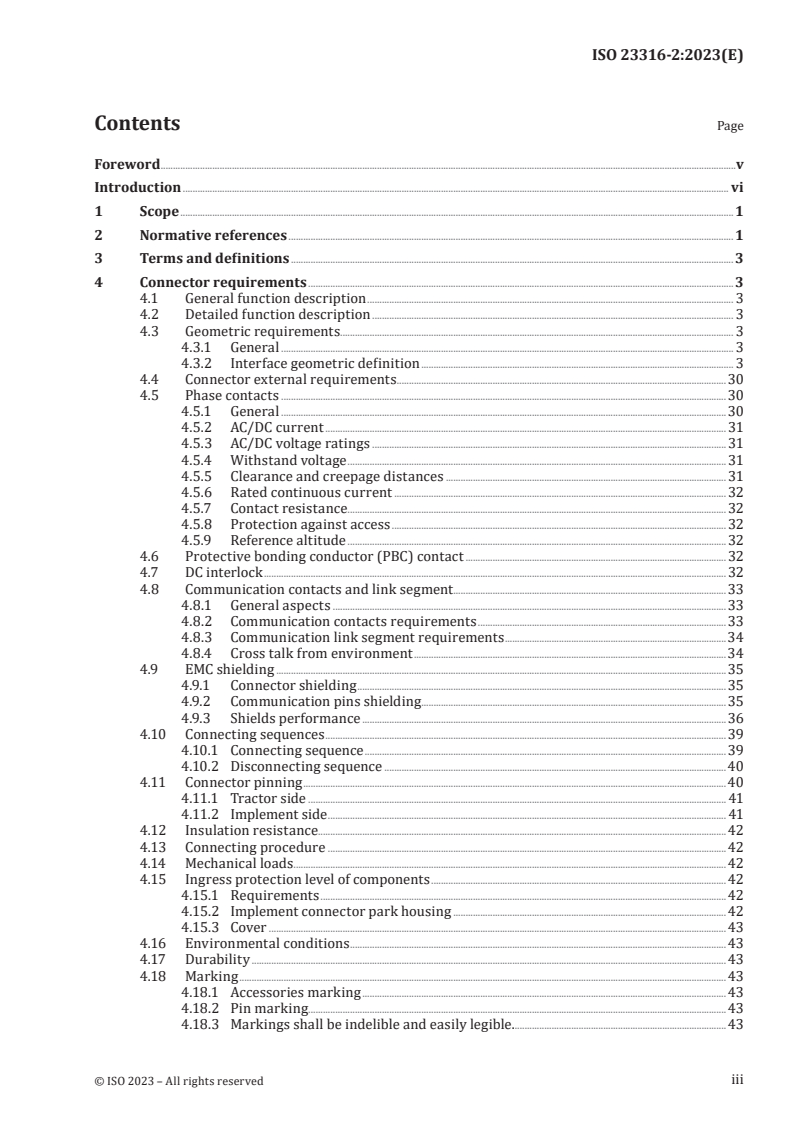
Contents Page
Foreword .v
Introduction . vi
1 Scope . 1
2 Normative references . 1
3 Terms and definitions . 3
4 Connector requirements .3
4.1 General function description . 3
4.2 Detailed function description . 3
4.3 Geometric requirements. 3
4.3.1 General . 3
4.3.2 Interface geometric definition . 3
4.4 Connector external requirements . 30
4.5 Phase contacts .30
4.5.1 General .30
4.5.2 AC/DC current . 31
4.5.3 AC/DC voltage ratings . 31
4.5.4 Withstand voltage . 31
4.5.5 Clearance and creepage distances . 31
4.5.6 Rated continuous current . 32
4.5.7 Contact resistance . 32
4.5.8 Protection against access . 32
4.5.9 Reference altitude . 32
4.6 Protective bonding conductor (PBC) contact . 32
4.7 DC interlock . 32
4.8 Communication contacts and link segment . 33
4.8.1 General aspects . 33
4.8.2 Communication contacts requirements . 33
4.8.3 Communication link segment requirements .34
4.8.4 Cross talk from environment .34
4.9 EMC shielding . 35
4.9.1 Connector shielding . 35
4.9.2 Communication pins shielding . . 35
4.9.3 Shields performance .36
4.10 Connecting sequences . 39
4.10.1 Connecting sequence . 39
4.10.2 Disconnecting sequence .40
4.11 Connector pinning .40
4.11.1 Tractor side . 41
4.11.2 Implement side . 41
4.12 Insulation resistance. 42
4.13 Connecting procedure . 42
4.14 Mechanical loads. 42
4.15 Ingress protection level of components . 42
4.15.1 Requirements . 42
4.15.2 Implement connector park housing . 42
4.15.3 Cover . 43
4.16 Environmental conditions . 43
4.17 Durability . 43
4.18 Marking . 43
4.18.1 Accessories marking . 43
4.18.2 Pin marking . . . 43
4.18.3 Markings shall be indelible and easily legible. 43
iii
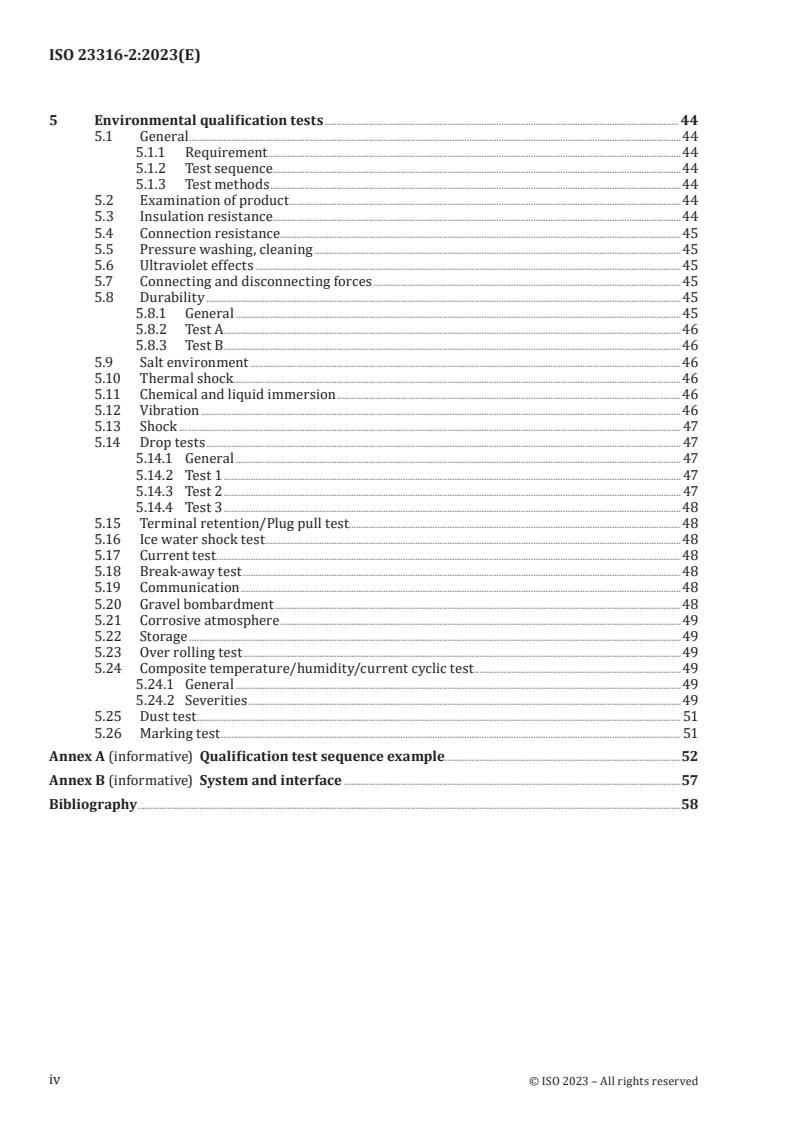
5 Environmental qualification tests . 44
5.1 General .44
5.1.1 Requirement .44
5.1.2 Test sequence.44
5.1.3 Test methods .44
5.2 Examination of product .44
5.3 Insulation resistance.44
5.4 Connection resistance . 45
5.5 Pressure washing, cleaning . 45
5.6 Ultraviolet effects . 45
5.7 Connecting and disconnecting forces . 45
5.8 Durability . 45
5.8.1 General . 45
5.8.2 Test A.46
5.8.3 Test B . .46
5.9 Salt environment .46
5.10 Thermal shock.46
5.11 Chemical and liquid immersion .46
5.12 Vibration .46
5.13 Shock . 47
5.14 Drop tests . 47
5.14.1 General . 47
5.14.2 Test 1 . 47
5.14.3 Test 2 . 47
5.14.4 Test 3 .48
5.15 Terminal retention/Plug pull test.48
5.16 Ice water shock test .48
5.17 Current test .48
5.18 Break-away test .48
5.19 Communication .48
5.20 Gravel bombardment .48
5.21 Corrosive atmosphere .49
5.22 Storage .49
5.23 Over rolling test .49
5.24 Composite temperature/humidity/current cyclic test .49
5.24.1 General .49
5.24.2 Severities .49
5.25 Dust test . . . 51
5.26 Marking test . 51
Annex A (informative) Qualification test sequence example .52
Annex B (informative) System and interface .57
Bibliography .58
iv
Foreword
ISO (the International Organization for Standardization) is a worldwide federation of national standards
bodies (ISO member bodies). The work of preparing International Standards is normally carried out
through ISO technical committees. Each member body interested in a subject for which a technical
committee has been established has the right to be represented on that committee. International
organizations, governmental and non-governmental, in liaison with ISO, also take part in the work.
ISO collaborates closely with the International Electrotechnical Commission (IEC) on all matters of
electrotechnical standardization.
The procedures used to develop this document and those intended for its further maintenance are
described in the ISO/IEC Directives, Part 1. In particular, the different approval criteria needed for the
different types of ISO document should be noted. This document was drafted in accordance with the
editorial rules of the ISO/IEC Directives, Part 2 (see www.iso.org/directives).
ISO draws attention to the possibility that the implementation of this document may involve the use
of (a) patent(s). ISO takes no position concerning the evidence, validity or applicability of any claimed
patent rights in respect thereof. As of the date of publication of this document, ISO had received notice of
(a) patent(s) which may be required to implement this document. However, implementers are cautioned
that this may not represent the latest information, which may be obtained from the patent database
available at www.iso.org/patents. ISO shall not be held responsible for identifying any or all such patent
rights.
Any trade name used in this document is information given for the convenience of users and does not
constitute an endorsement.
For an explanation of the voluntary nature of standards, the meaning of ISO specific terms and
expressions related to conformity assessment, as well as information about ISO's adherence to
the World Trade Organization (WTO) principles in the Technical Barriers to Trade (TBT), see
www.iso.org/iso/foreword.html.
This document was prepared by Technical Committee ISO/TC 23, Tractors and machinery for agriculture
and forestry, Subcommittee SC 19, Agricultural electronics.
This document is intended to be used in conjunction with ISO 23316-1, ISO 23316-3, ISO 23316-4,
ISO 23316-5 and ISO/FDIS 23316-6:—.
A list of all parts in the ISO 23316 series can be found on the ISO website.
Any feedback or questions on this document should be directed to the user’s national standards body. A
complete listing of these bodies can be found at www.iso.org/members.html.
v
Introduction
The purpose ISO 23316 series is to provide design and application standards covering implementation
of an electrical high-power interface with a nominal voltage of 700 V DC/480 V AC for agricultural and
forestry machinery.
The ISO 23316 series specifies physical and logical interface requirements that provide interoperability
and cross compatibility for systems and equipment operating at nominal voltages of 700 V DC/480 V AC.
The following are not within the scope of ISO 23316:
— service, maintenance, and related diagnostics;
— functional safety;
— control strategies for high-power supplies and loads;
— application-specific strategies and operational modes;
— component design;
— energy storage systems, e.g. supercapacitors or batteries;
— multiple electrical power supplies to a common DC-link.
vi
INTERNATIONAL STANDARD ISO 23316-2:2023(E)
Tractors and machinery for agriculture and forestry —
Electrical high-power interface 700 V DC / 480 V AC —
Part 2:
Physical interface
1 Scope
This document specifies direction for the design of the physical interface between a supply system and
a consumer system. Electrical, geometrical and test requirements are defined within this document.
2 Normative references
The following documents are referred to in the text in such a way that some or all of their content
constitutes requirements of this document. For dated references, only the edition cited applies. For
undated references, the latest edition of the referenced document (including any amendments) applies.
ISO/IEC/IEEE 8802-3:2021, Telecommunications and exchange between information technology systems
— Requirements for local and metropolitan area networks — Part 3: Standard for Ethernet
ISO 4892-3, Plastics — Methods of exposure to laboratory light sources — Part 3: Fluorescent UV lamps
ISO 6270-2, Paints and varnishes — Determination of resistance to humidity — Part 2: Condensation (in-
cabinet exposure with heated water reservoir)
ISO 8092-2:2005, Road vehicles — Connections for on-board electrical wiring harnesses — Part 2:
Definitions, test methods and general performance requirements
ISO 9227, Corrosion tests in artificial atmospheres — Salt spray tests
ISO 16230-1, Agricultural machinery and tractors — Safety of higher voltage electrical and electronic
components and systems — Part 1: General requirements
ISO 16750-3:2012, Road vehicles — Environmental conditions and testing for electrical and electronic
equipment — Part 3: Mechanical loads
ISO 16750-4, Road vehicles — Environmental conditions and testing for electrical and electronic equipment
– Part 4: Climatic loads
ISO 16750-5:2010, Road vehicles — Environmental conditions and testing for electrical and electronic
equipment — Part 5: Chemical loads
ISO 20567-1, Paints and varnishes — Determination of stone-chip resistance of coatings — Part 1: Multi-
impact testing
ISO 20653, Road vehicles — Degrees of protection (IP code) — Protection of electrical equipment against
foreign objects, water and access
ISO 23316-1:2022, Tractors and machinery for agriculture and forestry — Electrical high-power interface
700 V DC / 480 V AC — Part 1: General
ISO 23316-4, Tractors and machinery for agriculture and forestry — Electrical high-power interface
700 V DC / 480 V AC — Part 4: AC operation mode
1)
ISO/FDIS 23316-6:— , Tractors and machinery for agriculture and forestry — Electrical high-power
interface 700 V DC / 480 V AC — Part 6: Communication signals
IEC 60068-2-6, Environmental testing — Part 2-6: Tests — Test Fc: Vibration (sinusoidal)
IEC 60068-2-14, Environmental testing — Part 2-14: Tests — Test N: Change of temperature
IEC 60068-2-27, Environmental testing — Part 2-27: Tests — Test Ea and guidance: Shock
IEC 60068-2-31, Environmental testing — Part 2-31: Tests — Test Ec: Rough handling shocks, primarily for
equipment-type specimens
IEC 60068-2-60:2015, Environmental testing — Part 2-60: Tests — Test Ke: Flowing mixed gas corrosion
test
IEC 60068-2-78, Environmental testing — Part 2-78: Tests — Test Cab: Damp heat, steady state
IEC 60309-1, Plugs, socket-outlets and couplers for industrial purposes — Part 1: General requirements
IEC 60512-2-1, Connector for electronic equipment — Tests and measurements — Parts 2-1: Electrical
continuity and contact resistance — Test 2a: Contact resistance – Millivolt level method
IEC 60512-5-1, Connectors for electronic equipment — Tests and measurements — Part 5-1: Current –
carrying capacity tests — Test 5a: Temperature rise
IEC 60512-5-2, Connectors for electronic equipment — Tests and measurements — Part 5-2: Current –
carrying capacity tests — Test 5b: Current - temperature derating
IEC 60512-23-7, Connectors for electronic equipment — Tests and measurements — Part 23-7: Screening
and filtering tests — Test 23g: Effective transfer impedance of connectors
IEC 60512-25-2, Connectors for electronic equipment — Tests and measurements — Part 25-2: Test 25g —
Attenuation (insertion loss)
IEC 60512-25-5, Connectors for electronic equipment — Tests and measurements — Part 25-5: Test 25e —
Return loss
IEC 60512-25-7, Connectors for electronic equipment — Tests and measurements — Part 25-7: Test 25g —
Impedance, reflection coefficient, and voltage standing wave ratio (VSWR)
IEC 60603-7-7:2010, Connectors for electronic equipment — Part 7-7: Detail specification for 8-way,
shielded, free and fixed connectors for data transmission with frequencies up to 600 MHz
IEC 60664-1:2007, Insulation coordination for equipment within low voltage systems
IEC 61984, Connectors — Safety requirements and tests
IEC 62153-4-6, Metallic cables and other passive components test methods — Part 4-6: Electromagnetic
compatibility (EMC) — Surface transfer impedance — Line injection method
IEC 62153-4-7, Electromagnetic compatibility (EMC) — Test method for measuring of transfer impedance
ZT and screening attenuation ac or coupling attenuation ac of connectors and assemblies up to and above
3 GHz – Triaxle tube in tube method
IEC 62196-1:2014, Plugs, socket outlets, vehicle connectors and vehicle inlets — Conductive charging of
electric vehicles — Part 1: General requirements
1) Under development. Stage at the date of publication: ISO/FDIS 23316-6:2023.
3 Terms and definitions
For the purposes of this document, the terms and definitions given in ISO 23316-1, ISO/FDIS 23316-6:—
and the following apply.
ISO and IEC maintain terminological databases for use in standardization at the following addresses:
— ISO Online browsing platform: available at https:// www .iso .org/ obp
— IEC Electropedia: available at https:// www .electropedia .org/
3.1
space inside the connector
area inside of the connector which is permanently closed and cannot be reached without tools
3.2
exposed connector parts and surfaces
all connector parts and space inside connector face which are accessible without using tools
3.3
comparative tracking index
CTI
numerical value of the maximum voltage at which five test specimens withstand the test period for 50
drops without tracking failure and without a persistent flame occurring and including also a statement
relating to the behaviour of the material when tested using 100 drops
[SOURCE: IEC 60112:2009, 3.5]
4 Connector requirements
4.1 General function description
a) The connector is part of the electric drive system of agricultural vehicles and implements.
b) Its function is to provide external consumers with electric power.
c) The connector is intended to be a part mounted to the vehicle chassis exterior.
4.2 Detailed function description
a) The connector shall be designed such that more than one connector can be installed on vehicle.
b) The connector shall incorporate a housing providing environmental protection, including EMC
shielding.
4.3 Geometric requirements
4.3.1 General
The connector shall provide a cable strain relief.
4.3.2 Interface geometric definition
4.3.2.1 General tolerances
General tolerance applies to all unspecified dimensions on the partial drawings within this subclause.
See Table 1.
Table 1 — Tolerances
Range 1 Range 2 Range 3 Angles
Length of
dimension 0 – 50 50 – 100 100 > n/a
[mm]
Tolerance
±0,15 ±0,2 ±0,3 ±0,5°
[mm]
4.3.2.2 Maximum material model for the tractor side
Figure 1 — Main front view of the tractor side in maximum material model
Figure 2 — Main front view, section A-A
Figure 3 — Main front view, section D-D
Key
CZ contact zone
Figure 4 — Main front view, section D-D and detail X
Figure 5 — Main front view, section C-C
Figure 6 — Main front view, section C-C and detail Y
Figure 7 — Main front view, section B-B
Key
CZ contact zone
T1 area for axial tolerance compensation
T2 area for sealing
T3 area for shield transfer
T4 finger protection cap
Figure 8 — Main front view, section B-B, detail Z
4.3.2.3 Minimum material model for the tractor side
Figure 9 — Main front view of the tractor side in minimum material model
Figure 10 — Main front view, section A-A
Figure 11 — Main front view, section D-D
Key
CZ contact zone
Figure 12 — Main front view, section D-D, detail Y
Figure 13 — Main front view, section B-B
Key
CZ contact zone
T1 area for axial tolerance compensation
T2 area for sealing
T3 area for shield transfer
T4 finger protection cap
Figure 14 — Main front view, section B-B, detail Z
Figure 15 — Main front view, section C-C
Key
CZ contact zone
Figure 16 — Main front view, section C-C, detail X
4.3.2.4 Maximum material model for the implement side
Figure 17 — Main front view of the implement side in maximum material model
Figure 18 — Main front view, section A-A
Key
CZ contact zone
Figure 19 — Main front view, section A-A, detail Z
NOTE Pins dimensions are valid for minimum and maximum models of implement connector
Figure 20 — Main front view, section A-A, pin dimensions
Figure 21 — Main front view, section B-B
Figure 22 — Main front view, section B-B, detail Y
NOTE Pins dimensions are valid for minimum and maximum models of implement connector.
Figure 23 — Main front view, section B-B, pin dimensions
Key
CZ contact zone
Figure 24 — Main front view, section C-C
NOTE Pins dimensions are valid for minimum and maximum models of implement connector.
Figure 25 — Main front view, section C-C, pin dimensions
Figure 26 — Top view
4.3.2.5 Minimum material model for the implement side
Figure 27 — Main front view of the implement side in minimum material model
Figure 28 — Main front view, section C-C
Key
CZ contact zone
Figure 29 — Main front view, section C-C, detail X
Figure 30 — Main front view, section B-B
Figure 31 — Main front view, section B-B, detail Y
Figure 32 — Main front view, section A-A
Figure 33 — Main front view, section A-A, detail Z
4.3.2.6 Connecting pins sequences
Figure 34 — Interlock pins connecting sequence
Figure 35 — PBC pins connecting sequence
Figure 36 — Power pins connecting sequence
4.4 Connector external requirements
The following basic external requirements shall apply to the connector.
a) All edges shall be free of burs.
b) Any edges that the operator can touch shall be chamfered or rounded to prevent injury.
c) External parts shall provide space to attach type and information decals.
d) The design envelope shall be as small as practically possible.
e) The colour of the connector and the colour of connector parts may be customer specific.
Receptacle and a plug connector, which are intended to be used together as a part of electrical high-
power interface 700 V DC/480 V AC system, shall comply with the requirements of the relevant part of
ISO 23316, if applicable.
In general, compliance is checked by carrying out all the tests specified.
Deviations from the dimensions that are specified in this document may be made, but only if they
provide a technical advantage and do not adversely affect the purpose and safety of the connectors
complying with the relevant ISO 23316 parts, especially regarding compatibility.
4.5 Phase contacts
4.5.1 General
The design of the connector is intended to accommodate different power ratings. However, amongst the
various ratings, their geometric properties, particularly the contact diameters, shall remain the same.
The connector shall incorporate three phase contacts for electrical power transmission.
Phase contacts shall have mechanical strength, electrical conductivity, and resistance to corrosion
adequate to intended agriculture and forestry use.
Suitable base metals for current carrying parts, used within a permissible temperature range and
under conditions of chemical pollution specified in this document, are:
— for base material:
— copper;
— an alloy containing at least 58 % copper for parts that are worked cold or at least 50 % copper
for other parts;
— for electroplating material:
— silver for phase contacts, PBC contact and DC interlock contacts;
— gold for communication contacts;
— nickel as underplating barrier directly on base material, if required to protect the plating layer
from diffusion into the base material.
Plating for base material is required to protect it against corrosion.
Phase contact with multiple contacting areas are allowed only in tractor-side receptacle connector.
Compliance shall be verified by visual inspection and by chemical analysis.
4.5.2 AC/DC current
The connector’s phase contacts shall be capable of carrying either AC and DC electric current.
4.5.3 AC/DC voltage ratings
The nominal and maximum AC and DC voltage ratings shall be in accordance with the definitions in
ISO 23316-1:2022, Table 1 and Table 2.
4.5.4 Withstand voltage
Withstand test voltage for test location at 2 000 m above sea level shall be 5,3 kV according to
IEC 60664-1:2007, 5.1.
For equipment test locations at altitude other than 2 000 m, local impulse test voltages shall be
determined in accordance with IEC 60664-1:2007, 6.1.2.2.1.
4.5.5 Clearance and creepage distances
Pollution degree 2 in accordance with IEC 60664-1 applies to space inside the connector.
Pollution degree 3 in accordance with IEC 60664-1 applies to exposed connector parts and surfaces.
The shortest clearance distance in tractor-side connector face is 12,1 mm.
The shortest clearance distance in implement-side connector face is 8,9 mm.
The shortest creepage distance in tractor-side connector face is 38,1 mm.
The shortest creepage distance in implement-side connector face is 36,2 mm.
According to ISO 16230-1, clearance and creepage distances shall meet the requirements for double or
reinforced insulation as defined in IEC 60664-1:2007, 5.1 and 5.2.
NOTE The comparative tracking index (CTI) value for distances calculation is evaluated in IEC 60112:2009,
Clause 11.
4.5.6 Rated continuous current
The rated continuous AC RMS or DC current shall be a minimum of 200 A. Peak current depends on
system application and shall be reviewed in detail by the connector manufacturers.
Connector suppliers shall provide derating curves and typical duty cycles for their design.
Contacts shall be able to accept a conductor cross section of up to 70 mm .
4.5.7 Contact resistance
Contact resistance shall be lower than 150 µΩ. The value may increase to 3x contact resistance after
performing the proposed test sequence defined in Annex A.
4.5.8 Protection against access
The phase contacts shall be finger proof to IPXXB / IP2X according to ISO 20653.
4.5.9 Reference altitude
For connector system dimensioning, the reference altitude above sea level is 4 000 m.
4.6 Protective bonding conductor (PBC) contact
The following requirements shall apply to PBC contact.
a) The contact shall be able to accept a protective bonding conductor (PBC) cross section of at least
10 mm .
b) The contact resistance shall be lower than 200 µΩ. The value may increase to 3x contact resistance
after performing the test sequence defined in Annex A.
c) The PBC shall be bonded to the connector housing with a cross section of minimum 2 mm and a
connection resistance shall not exceed 2 mΩ. The value of the resistance may increase by 3 times
after performing proposed test sequence defined in Annex A.
d) The PBC contact shall connect first and disconnect last (see Figure 39 and Figure 40).
4.7 DC interlock
The connector shall incorporate two contacts to detect the status of the connector as being properly
connected and also "no connector is present".
a) Maximum voltage shall be 60 V DC.
b) Maximum current shall be 20 mA.
c) Contact resistance shall be lower than 5 mΩ. The value may increase to 3x contact resistance after
tests according the test sequence defined in Annex A.
d) Conductor cross section shall be max 2,5 mm .
e) During the connecting process the interlock shall connect as last contact. During the disconnecting
process the interlock contacts shall disconnect as first contacts (see Figure 39 and Figure 40).
4.8 Communication contacts and link segment
4.8.1 General aspects
Communication contacts are optional.
When communication contacts are implemented, the connector shall incorporate two data contacts for
transmitting control data between vehicle and implement.
These data contacts shall have the identifier C1 and C2 and shall have a 360° EMC shield.
Contacts C1 and C2 shall be arranged inside the connector as illustrated in Figure 40 and Figure 41.
Electrical transmission parameters for communication contacts shall be verified by test for standalone
communication pins with a shielded housing.
The basic requirements for the communication systems are:
a) The contacts and the connector link segment shall fulfil requirements in accordance with
ISO/IEC/IEEE 8802-3:2021, 96.7 (100BASE-T1).
b) The cabling system shall be one twisted pair, balanced, shielded cabling with impedance of 100 Ω
(nominal ±10 %) in accordance with IEC 60512-25-7 and ISO/IEC/IEEE 8802-3:2021, 96.7.1.
c) The differential characteristic impedance shall be 100 Ω measured with time-domain reflectometer
and rise time set not lower than 700 ps as defined in ISO/IEC/IEEE 8802-3:2021, 96.7.1.1 d),
Communication contacts shall be part of AC mode data interlock system (see Figure 41).
e) Contact resistance shall be lower than 5 mΩ. The value may increase to 3x after test sequence
defined in Annex A.
f) During the insertion process, the communication contacts shall connect as last contacts.
g) During the extraction process it shall disconnect as first contact (see Figure 40).
For future potential use of power over the communication channel according to
ISO/IEC/IEEE 8802-3:2021, Clause 104 (48 V regulated PSE):
— the maximum voltage shall be 60 V DC,
— the maximum current shall be 1 360 mA.
The cabling model of ISO/IEC/IEEE 8802-3:2021, 96.7.1 only considers cable sections that all have the
same impedance. Impedance changes within the cabling system cause reflections and thus deteriorate
the signal quality. Therefore, for heterogeneous systems, a usage of an extended calculation model is
recommended. Due to package constraints, care shall be taken on the cable junction length inside the
connector to reduce any impact on measured values.
4.8.2 Communication contacts requirements
The resulting requirement
...