

ISO 10668:2010
(Main)Brand valuation — Requirements for monetary brand valuation
General Information
- Abstract
ISO 10668:2010 specifies requirements for procedures and methods of monetary brand value measurement. ISO 10668:2010 specifies a framework for brand valuation, including objectives, bases of valuation, approaches to valuation, methods of valuation and sourcing of quality data and assumptions. It also specifies methods for reporting the results of such valuation.
- Status
- Published
- Publication Date
- 12-Aug-2010
- Technical Committee
- ISO/TC 289 - Brand evaluation
- Drafting Committee
- ISO/TC 289 - Brand evaluation
- Current Stage
- 9092 - International Standard to be revised
- Start Date
- 13-Feb-2026
- Completion Date
- 29-Aug-2026
Buy Documents

ISO 10668:2010 - Brand valuation — Requirements for monetary brand valuation Released:8/13/2010
ISO 10668:2010 - Évaluation d'une marque — Exigences pour l'évaluation monétaire d'une marque Released:8/13/2010
ISO 10668:2010 - Brand valuation — Requirements for monetary brand valuation Released:12/11/2012
Overview
ISO 10668:2010 - "Brand valuation - Requirements for monetary brand valuation" defines a consistent framework for measuring the monetary value of brands. It establishes principles and mandatory requirements for transparent, valid, reliable and objective brand appraisals that integrate financial, behavioural and legal parameters. The standard covers valuation objectives, value concepts, valuation dates, data sourcing and the required reporting of results (single value or range).
Key Topics and Technical Requirements
- General principles: Transparency, validity, reliability, sufficiency and objectivity of the valuation process.
- Declaration of purpose: Specify intended use, audience, identified asset, premise of value, appraiser position, valuation date and value date.
- Value concept: Brand value represents the economic benefit conferred by a brand over its expected useful life, generally calculated by reference to cash flows (earnings, economic profits or cost savings).
- Identification: Clear definition and description of the brand subject to valuation.
- Valuation approaches: Use one or more of the three accepted approaches - income, market or cost - chosen according to the purpose and brand characteristics.
- Income-approach methods: Includes detailed accepted methods such as price premium, volume premium, income-split, multi-period excess earnings, incremental cash flow and royalty relief.
- Financial variables: Discount rates should be derived from the business-level discount rate (e.g., WACC) and adjusted to reflect brand-specific risks. Non-reflected risks belong in the discount rate.
- Inputs: Requires market and financial data, behavioural research (brand strength, stakeholder perceptions), and legal analysis (trademark protection, exclusivity).
- Reporting and independence: Specifies how results must be reported, disclosed and the requirement for appraiser independence.
Applications and Who Uses It
ISO 10668 is practical for:
- Brand valuation professionals and appraisers conducting monetary valuations
- Corporate finance teams (M&A, divestitures, licensing negotiations)
- Accountants and auditors for intangible asset reporting and valuation support
- Tax authorities and legal professionals for litigation, dispute resolution and transfer pricing
- Investors, bankers and management for strategic planning and financing
Common uses include valuation for license negotiations, financial reporting, tax planning, litigation support, strategic decision-making, and investment analysis.
Related Standards (if applicable)
ISO 10668 complements other frameworks for intangible asset accounting, intellectual property law and valuation best practices. It is typically used alongside applicable financial reporting standards and legal guidance on trademarks and licensing to ensure consistent, defensible monetary brand valuations.
Keywords: ISO 10668, brand valuation, monetary brand valuation, brand value, valuation methods, income approach, royalty relief, price premium, intangible assets.
Buy Documents
ISO 10668:2010 - Brand valuation — Requirements for monetary brand valuation Released:8/13/2010
ISO 10668:2010 - Évaluation d'une marque — Exigences pour l'évaluation monétaire d'une marque Released:8/13/2010
ISO 10668:2010 - Brand valuation — Requirements for monetary brand valuation Released:12/11/2012
Get Certified
Connect with accredited certification bodies for this standard

Great Wall Tianjin Quality Assurance Center
Established 1993, first batch to receive national accreditation with IAF recognition.
Hong Kong Quality Assurance Agency (HKQAA)
Hong Kong's leading certification body.

Innovative Quality Certifications Pvt. Ltd. (IQCPL)
Known for integrity, providing ethical & impartial Assessment & Certification. CMMI Institute Partner.
Sponsored listings
Frequently Asked Questions
ISO 10668:2010 is a standard published by the International Organization for Standardization (ISO). Its full title is "Brand valuation — Requirements for monetary brand valuation". This standard covers: ISO 10668:2010 specifies requirements for procedures and methods of monetary brand value measurement. ISO 10668:2010 specifies a framework for brand valuation, including objectives, bases of valuation, approaches to valuation, methods of valuation and sourcing of quality data and assumptions. It also specifies methods for reporting the results of such valuation.
ISO 10668:2010 specifies requirements for procedures and methods of monetary brand value measurement. ISO 10668:2010 specifies a framework for brand valuation, including objectives, bases of valuation, approaches to valuation, methods of valuation and sourcing of quality data and assumptions. It also specifies methods for reporting the results of such valuation.
ISO 10668:2010 is classified under the following ICS (International Classification for Standards) categories: 03.140 - Patents. Intellectual property. The ICS classification helps identify the subject area and facilitates finding related standards.
ISO 10668:2010 is available in PDF format for immediate download after purchase. The document can be added to your cart and obtained through the secure checkout process. Digital delivery ensures instant access to the complete standard document.
Standards Content (Sample)
INTERNATIONAL ISO
STANDARD 10668
First edition
2010-09-01
Brand valuation — Requirements
for monetary brand valuation
Evaluation d'une marque — Exigences pour l'évaluation monétaire
d'une marque
Reference number
©
ISO 2010
PDF disclaimer
This PDF file may contain embedded typefaces. In accordance with Adobe's licensing policy, this file may be printed or viewed but
shall not be edited unless the typefaces which are embedded are licensed to and installed on the computer performing the editing. In
downloading this file, parties accept therein the responsibility of not infringing Adobe's licensing policy. The ISO Central Secretariat
accepts no liability in this area.
Adobe is a trademark of Adobe Systems Incorporated.
Details of the software products used to create this PDF file can be found in the General Info relative to the file; the PDF-creation
parameters were optimized for printing. Every care has been taken to ensure that the file is suitable for use by ISO member bodies. In
the unlikely event that a problem relating to it is found, please inform the Central Secretariat at the address given below.
© ISO 2010
All rights reserved. Unless otherwise specified, no part of this publication may be reproduced or utilized in any form or by any means,
electronic or mechanical, including photocopying and microfilm, without permission in writing from either ISO at the address below or
ISO's member body in the country of the requester.
ISO copyright office
Case postale 56 • CH-1211 Geneva 20
Tel. + 41 22 749 01 11
Fax + 41 22 749 09 47
E-mail copyright@iso.org
Web www.iso.org
Published in Switzerland
ii © ISO 2010 – All rights reserved
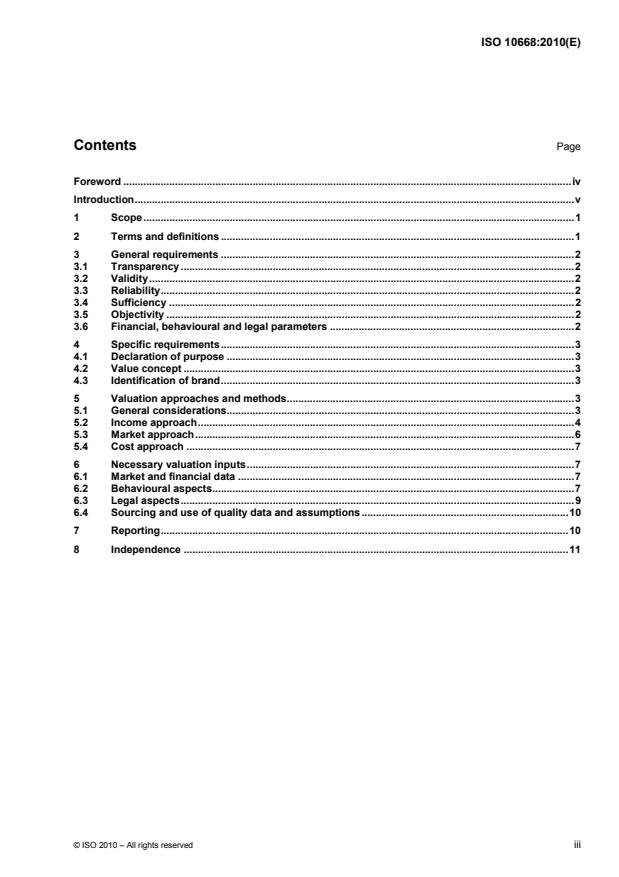
Contents Page
Foreword .iv
Introduction.v
1 Scope.1
2 Terms and definitions .1
3 General requirements .2
3.1 Transparency .2
3.2 Validity.2
3.3 Reliability.2
3.4 Sufficiency .2
3.5 Objectivity .2
3.6 Financial, behavioural and legal parameters .2
4 Specific requirements.3
4.1 Declaration of purpose .3
4.2 Value concept .3
4.3 Identification of brand.3
5 Valuation approaches and methods.3
5.1 General considerations.3
5.2 Income approach.4
5.3 Market approach.6
5.4 Cost approach .7
6 Necessary valuation inputs.7
6.1 Market and financial data .7
6.2 Behavioural aspects.7
6.3 Legal aspects.9
6.4 Sourcing and use of quality data and assumptions .10
7 Reporting.10
8 Independence .11
Foreword
ISO (the International Organization for Standardization) is a worldwide federation of national standards bodies
(ISO member bodies). The work of preparing International Standards is normally carried out through ISO
technical committees. Each member body interested in a subject for which a technical committee has been
established has the right to be represented on that committee. International organizations, governmental and
non-governmental, in liaison with ISO, also take part in the work. ISO collaborates closely with the
International Electrotechnical Commission (IEC) on all matters of electrotechnical standardization.
International Standards are drafted in accordance with the rules given in the ISO/IEC Directives, Part 2.
The main task of technical committees is to prepare International Standards. Draft International Standards
adopted by the technical committees are circulated to the member bodies for voting. Publication as an
International Standard requires approval by at least 75 % of the member bodies casting a vote.
Attention is drawn to the possibility that some of the elements of this document may be the subject of patent
rights. ISO shall not be held responsible for identifying any or all such patent rights.
ISO 10668 was prepared by Project Committee ISO/PC 231, Brand valuation.
iv © ISO 2010 – All rights reserved
Introduction
Intangible assets are recognized as highly valued properties. Arguably the most valuable but least understood
intangible assets are brands. However, reliable values need to be placed on brands. This International
Standard provides a consistent, reliable approach to brand valuation, including financial, behavioural and legal
aspects.
INTERNATIONAL STANDARD ISO 10668:2010(E)
Brand valuation — Requirements for monetary brand valuation
1 Scope
This International Standard specifies requirements for procedures and methods of monetary brand value
measurement.
This International Standard specifies a framework for brand valuation, including objectives, bases of valuation,
approaches to valuation, methods of valuation and sourcing of quality data and assumptions. It also specifies
methods for reporting the results of such valuation.
2 Terms and definitions
For the purposes of this document, the following terms and definitions apply.
2.1
asset
legal right or organizational resource which is controllable by an entity and has the capacity to generate
economic benefits
2.2
brand
marketing-related intangible asset including, but not limited to, names, terms, signs, symbols, logos and
designs, or a combination of these, intended to identify goods, services or entities, or a combination of these,
creating distinctive images and associations in the minds of stakeholders, thereby generating economic
benefits/values
2.3
intangible asset
identifiable non-financial asset with no physical substance
2.4
monetary brand value
brand value
economic value of the brand in transferable monetary units
NOTE The result obtained can be either a single economic value or a range of values.
2.5
premise of value
assumption regarding the most likely set of circumstances that can be applicable to the subject valuation
2.6
present value
current discounted worth of a future monetary amount
2.7
stakeholder
person whose decision making is, or might be, affected by a brand
NOTE Common stakeholders are customers, consumers, suppliers, employees, potential employees, opinion leaders,
shareholders, investors, governmental authorities and non-governmental organizations.
2.8
trade mark
legally protectable sign, or any combination of signs, capable of distinguishing the goods or services of one
undertaking from those of other undertakings
EXAMPLE Words (including personal names), letters, numerals, figurative elements and combinations of colours.
NOTE 1 This definition is in accordance with the trade mark definition of the WTO Agreement on Trade-Related
Aspects of Intellectual Property Rights (TRIPS).
NOTE 2 A trade name is the name of a business, association or other organization used to identify it. It might or might
not be the same as the trade mark used to identify the company's goods and/or services.
2.9
valuation date
date on which the valuation is concluded
2.10
value date
date on which the valuation inputs, assumptions and valuation result are valid
3 General requirements
3.1 Transparency
Monetary brand valuation processes shall be transparent. This requirement includes disclosure and
quantification of valuation inputs, assumptions and risks as well as, when appropriate, sensitivity analyses of
the brand value to the main parameters used in the valuation models.
3.2 Validity
A valuation shall be based on valid and relevant inputs and assumptions as of the value date.
3.3 Reliability
If a valuation is repeated, it shall reliably give a comparable and reconcilable result.
3.4 Sufficiency
Brand valuations shall be based on sufficient data and analysis to form a reliable conclusion.
3.5 Objectivity
The appraiser shall conduct the valuation free from any form of biased judgement.
3.6 Financial, behavioural and legal parameters
When performing a monetary brand valuation, financial, behavioural and legal parameters shall be taken into
account, the aforementioned parameters forming part of the overall assessment. The monetary brand
valuation shall be conducted on the basis of the findings from the financial, behavioural and legal modules.
2 © ISO 2010 – All rights reserved
4 Specific requirements
4.1 Declaration of purpose
The declaration of purpose shall specify the intended use, the addressed audiences, the identified asset, the
premise of value, the position of the appraiser (valuator), the valuation date and the value date.
The value concept shall be specified in accordance with the purpose of valuation.
NOTE The purposes of valuation are diverse. Common purposes are:
a) management information;
b) strategic planning;
c) value reporting;
d) accounting;
e) liquidation;
f) legal transaction;
g) licensing;
h) litigation support;
i) dispute resolution;
j) taxation planning and compliance;
k) loan and equity financing.
4.2 Value concept
The monetary value of a brand shall represent the economic benefit conferred by a brand over its expected
useful economic life. Generally, the monetary value shall be calculated by reference to cash flows, determined
by reference to earnings, economic profits or cost savings.
4.3 Identification of brand
The appraisal shall identify, define and describe the brand subject to valuation.
5 Valuation approaches and methods
5.1 General considerations
Brands shall be valued by applying the income, market or cost approach. The purpose of the valuation, the
value concept and the characteristics of the brand being valued shall dictate which approach (or approaches)
is (are) utilized to calculate the value of a brand.
5.2 Income approach
5.2.1 Description of the income approach
The income approach measures the value of the brand by reference to the present value of the economic
benefits expected to be received over the remaining useful economic life of the brand.
The steps followed in applying the income approach shall include estimating the expected after-tax cash flow
streams attributable to the asset over its remaining useful economic life, and converting these after-tax cash
flow streams to present value through discounting with an appropriate discount rate.
5.2.2 Determination of cash flows
5.2.2.1 General
The cash flows (or an alternative measure of brand earnings) used in a brand valuation shall be those cash
flows reasonably attributable to the brand. Various methods are available to determine the cash flows, as
outlined in 5.2.2.2 to 5.2.2.7.
5.2.2.2 Price premium method
The price premium method shall estimate the value of a brand by reference to the price premium that it
generates.
The price charged for goods or services marketed with a certain brand shall preferably be compared with the
price charged for a generic product, i.e. an unbranded product.
In order to arrive at the additional cash flow attributable to a brand, the appraisal shall identify and eliminate
non-brand factors that make it possible for the owner of the brand to charge a higher price for the goods or
services in question.
Additional and extra costs incurred in order to be able to charge a premium price shall be deducted from any
price premium charged.
In many industries, identifying an unbranded or generic product for comparison with a branded product can be
difficult, and price premium shall then be assessed through reference to the brand with the lowest brand
strength (see 6.2.4) in the market.
The price premium method shall be used taking into account the volume premium method. In addition, it shall
take into account cost-saving benefits.
5.2.2.3 Volume premium method
The volume premium method shall estimate the value of a brand by reference to the volume premium that it
generates.
In order to determine the cash flow generated by the brand, the volume premium method can be applied. In
this method, additional cash flows generated through a volume premium shall be determined based on an
analysis of market shares.
The additional cash flow generated by the brand is the operating cash profit related to the excess market
share.
The appraisal shall pay attention to the fact that there may be other factors explaining a specific market share.
Market imperfection is one such very important factor. When valuing a brand with a significant market position,
the appraisal shall identify the effect of any market imperfection on the generated cash flow and exclude this
from the cash flow attributed to the brand.
4 © ISO 2010 – All rights reserved
As with the premium price, consideration shall be given to additional costs incurred in order to hold a larger
market share or faster growth in market share.
The volume premium method shall be used taking into account the price premium method. In addition, it shall
take into account cost-saving benefits.
5.2.2.4 Income-split method
The income-split method shall value the brand as the present value of the portion of the economic profit
attributable to the brand. The economic profit corresponds to the net operating profit after a charge for capital
employed in the business, expressed at market value. The results of behavioural research shall then be used
to identify the contribution of
...
NORME ISO
INTERNATIONALE 10668
Première édition
2010-09-01
Évaluation d'une marque — Exigences
pour l'évaluation monétaire d'une marque
Brand valuation — Requirements for monetary brand valuation
Numéro de référence
©
ISO 2010
PDF – Exonération de responsabilité
Le présent fichier PDF peut contenir des polices de caractères intégrées. Conformément aux conditions de licence d'Adobe, ce fichier
peut être imprimé ou visualisé, mais ne doit pas être modifié à moins que l'ordinateur employé à cet effet ne bénéficie d'une licence
autorisant l'utilisation de ces polices et que celles-ci y soient installées. Lors du téléchargement de ce fichier, les parties concernées
acceptent de fait la responsabilité de ne pas enfreindre les conditions de licence d'Adobe. Le Secrétariat central de l'ISO décline toute
responsabilité en la matière.
Adobe est une marque déposée d'Adobe Systems Incorporated.
Les détails relatifs aux produits logiciels utilisés pour la création du présent fichier PDF sont disponibles dans la rubrique General Info
du fichier; les paramètres de création PDF ont été optimisés pour l'impression. Toutes les mesures ont été prises pour garantir
l'exploitation de ce fichier par les comités membres de l'ISO. Dans le cas peu probable où surviendrait un problème d'utilisation,
veuillez en informer le Secrétariat central à l'adresse donnée ci-dessous.
DOCUMENT PROTÉGÉ PAR COPYRIGHT
© ISO 2010
Droits de reproduction réservés. Sauf prescription différente, aucune partie de cette publication ne peut être reproduite ni utilisée sous
quelque forme que ce soit et par aucun procédé, électronique ou mécanique, y compris la photocopie et les microfilms, sans l'accord écrit
de l'ISO à l'adresse ci-après ou du comité membre de l'ISO dans le pays du demandeur.
ISO copyright office
Case postale 56 • CH-1211 Geneva 20
Tel. + 41 22 749 01 11
Fax + 41 22 749 09 47
E-mail copyright@iso.org
Web www.iso.org
Publié en Suisse
ii © ISO 2010 – Tous droits réservés
Sommaire Page
Avant-propos .iv
Introduction.v
1 Domaine d'application .1
2 Termes et définitions .1
3 Exigences générales.2
3.1 Transparence .2
3.2 Validité.2
3.3 Fiabilité .2
3.4 Exhaustivité .2
3.5 Objectivité .2
3.6 Paramètres financiers, mercatiques (marketing) et juridiques .3
4 Exigences spécifiques.3
4.1 Présentation de l'objectif.3
4.2 Concept de valeur .3
4.3 Identification des actifs en rapport avec la marque .3
5 Approches et méthodes d'évaluation.4
5.1 Remarques générales .4
5.2 Approche par les revenus .4
5.3 Approche par le marché .6
5.4 Approche par les coûts.7
6 Données requises pour l'évaluation.8
6.1 Données de marché et données financières .8
6.2 Aspects mercatiques (marketing).8
6.3 Aspects juridiques .9
6.4 Collecte et utilisation de données et d'hypothèses pertinentes .11
7 Élaboration de rapports.11
8 Indépendance .11
Avant-propos
L'ISO (Organisation internationale de normalisation) est une fédération mondiale d'organismes nationaux de
normalisation (comités membres de l'ISO). L'élaboration des Normes internationales est en général confiée
aux comités techniques de l'ISO. Chaque comité membre intéressé par une étude a le droit de faire partie du
comité technique créé à cet effet. Les organisations internationales, gouvernementales et non
gouvernementales, en liaison avec l'ISO participent également aux travaux. L'ISO collabore étroitement avec
la Commission électrotechnique internationale (CEI) en ce qui concerne la normalisation électrotechnique.
Les Normes internationales sont rédigées conformément aux règles données dans les Directives ISO/CEI,
Partie 2.
La tâche principale des comités techniques est d'élaborer les Normes internationales. Les projets de Normes
internationales adoptés par les comités techniques sont soumis aux comités membres pour vote. Leur
publication comme Normes internationales requiert l'approbation de 75 % au moins des comités membres
votants.
L'attention est appelée sur le fait que certains des éléments du présent document peuvent faire l'objet de
droits de propriété intellectuelle ou de droits analogues. L'ISO ne saurait être tenue pour responsable de ne
pas avoir identifié de tels droits de propriété et averti de leur existence.
L'ISO 10668 a été élaborée par le comité de projet ISO/PC 231, Évaluation des marques.
iv © ISO 2010 – Tous droits réservés
Introduction
Les actifs incorporels sont reconnus comme étant des actifs dont la valeur est très importante. Les marques
sont souvent les actifs incorporels qui ont le plus de valeur, mais qui sont les moins bien appréhendés. Il est
toutefois nécessaire d'évaluer les marques de façon fiable. La présente Norme internationale s'attache donc à
proposer une approche cohérente et fiable pour déterminer la valeur des marques en s'appuyant sur leurs
aspects financiers, mercatiques (marketing) et juridiques.
NORME INTERNATIONALE ISO 10668:2010(F)
Évaluation d'une marque — Exigences pour l'évaluation
monétaire d'une marque
1 Domaine d'application
La présente Norme internationale spécifie les exigences relatives aux modes opératoires et aux méthodes de
mesure de la valeur monétaire des marques.
La présente Norme internationale spécifie un cadre pour l'évaluation des marques, comprenant la définition
des objectifs, les concepts d'évaluation, les approches et les méthodes d'évaluation, ainsi que l'origine des
données et des hypothèses utilisées. Elle décrit également les éléments de présentation des résultats de
l'évaluation.
2 Termes et définitions
Pour les besoins du présent document, les termes et définitions suivants s'appliquent.
2.1
actif
droit juridique ou ressource organisationnelle, contrôlé(e) par une entité et qui a la capacité de générer des
avantages économiques futurs
2.2
marque
actif incorporel de nature mercatique (marketing) qui regroupe notamment les noms, les termes, les signes,
les symboles, les logos, le design, ou une combinaison de ces éléments, dans le but d'identifier des biens,
des services ou des entités, ou une combinaison de ceux-ci, en créant des images et associations qui les
distinguent de façon qu'ils soient ancrés dans l'esprit des parties prenantes, générant ainsi des avantages
économiques/de la valeur
2.3
actif incorporel
actif identifiable, non financier, sans substance physique
2.4
valeur monétaire d'une marque
valeur économique d'une marque exprimée en unité monétaire
NOTE Le résultat obtenu peut être soit une valeur unique, soit une fourchette de valeurs.
2.5
hypothèse contextuelle de l'évaluation
ensemble des éléments de contexte pouvant être applicables à l'évaluation
2.6
valeur actuelle
valeur actualisée d'une somme monétaire future
2.7
partie prenante
toute personne (physique ou morale) dont le processus de décision est ou peut être influencé par la marque
NOTE Les clients, les consommateurs, les fournisseurs, les employés, les employés potentiels, les leaders d'opinion,
les actionnaires, les investisseurs, les autorités gouvernementales et les organisations non gouvernementales sont
généralement considérés comme des parties prenantes.
2.8
marque commerciale
tout signe susceptible d'être protégé juridiquement ou toute combinaison de signes, propre à distinguer des
biens ou des services de ceux d'autres entreprises
EXEMPLE Les mots, y compris les noms de personne, les lettres, les chiffres, les éléments figuratifs et les
combinaisons de couleurs.
NOTE 1 Cette définition est conforme à la définition de marque commerciale figurant dans l'Accord sur les aspects des
droits de propriété intellectuelle qui touchent au commerce (ADPIC) de l'OMC.
NOTE 2 Un nom commercial est le nom d'une activité, d'une entreprise, d'une association ou de tout type
d'organisation utilisé pour l'identifier. Il peut être ou ne pas être identique à la marque commerciale utilisée pour identifier
les biens et/ou services d'une entreprise.
2.9
date de l'évaluation
date à laquelle les travaux d'évaluation sont réalisés
2.10
date d'évaluation
date à laquelle les paramètres d'évaluation, les hypothèses et les résultats de l'évaluation sont valides
3 Exigences générales
3.1 Transparence
Les processus d'évaluation monétaire des marques doivent être transparents. Cette exigence inclut la
présentation et la quantification des données d'évaluation, des hypothèses et des risques qui y sont associés,
ainsi que, suivant le cas, des analyses de sensibilité de la valeur de la marque en relation avec les principaux
paramètres utilisés dans les modèles d'évaluation.
3.2 Validité
Une évaluation doit reposer sur des informations et des hypothèses valides et pertinentes à la date
d'évaluation.
3.3 Fiabilité
Si une évaluation est réitérée, elle doit conduire à des résultats pouvant être comparés et recoupés entre eux.
3.4 Exhaustivité
Les évaluations de marques doivent reposer sur des données et une analyse les plus complètes possibles
afin d'en tirer des conclusions fiables.
3.5 Objectivité
L'évaluateur doit réaliser son évaluation en toute objectivité.
2 © ISO 2010 – Tous droits réservés
3.6 Paramètres financiers, mercatiques (marketing) et juridiques
Pour la réalisation de l'évaluation monétaire d'une marque, les paramètres financiers, mercatiques
(marketing) et juridiques doivent être pris en compte simultanément, lesdits paramètres faisant partie
intégrante de l'évaluation globale. L'évaluation monétaire d'une marque doit être réalisée sur la base des
résultats obtenus à partir de l'analyse des aspects financiers, mercatiques (marketing) et juridiques.
4 Exigences spécifiques
4.1 Présentation de l'objectif
La présentation de l'objectif doit préciser l'utilisation prévue de l'évaluation, les destinataires, l'actif identifié,
les hypothèses contextuelles de l'évaluation, le statut de l'évaluateur (expert), la date d'évaluation et la date
de l'évaluation.
Le concept de valeur doit être précisé conformément à l'objectif de l'évaluation.
NOTE Les objectifs de l'évaluation peuvent être divers, par exemple:
a) informations pour la gestion;
b) planification stratégique;
c) rapport financier;
d) comptabilité;
e) liquidation;
f) transaction légale;
g) concession de licences;
h) assistance en matière de litiges financiers;
i) règlement de contentieux;
j) fiscalité;
k) financement par dette et par opération en capital.
4.2 Concept de valeur
La valeur monétaire d'une marque doit représenter l'avantage économique généré par la marque au cours de
sa durée de vie économique prévue. En général, la valeur monétaire doit être calculée par référence aux flux
de trésorerie déterminés à partir des revenus, des avantages économiques ou des économies de coûts
générés par l'actif.
4.3 Identification des actifs en rapport avec la marque
L'exercice d'évaluation doit identifier, définir et décrire la marque évaluée.
5 Approches et méthodes d'évaluation
5.1 Remarques générales
Les marques doivent être évaluées en appliquant une approche par les revenus, une approche par le marché
ou une approche par les coûts. L'objectif de l'évaluation, le concept de valeur retenu et les caractéristiques de
la marque évaluée doivent permettre de définir l'approche (ou les approches) à utiliser pour estimer la valeur
d'une marque.
5.2 Approche par les revenus
5.2.1 Description de l'approche par les revenus
L'approche par les revenus mesure la valeur de la marque par référence à la valeur actuelle nette des
avantages économiques attendus au cours de sa durée de vie économique résiduelle.
Les étapes à suivre pour mettre en œuvre l'approche par les revenus doivent inclure l'estimation des flux de
trésorerie prévisionnels après impôts attribuables à la marque au cours de sa durée de vie économique
résiduelle et l'actualisation desdits flux de trésorerie à l'aide d'un taux d'actualisation approprié.
5.2.2 Détermination des flux de trésorerie
5.2.2.1 Généralités
Les flux de trésorerie (ou toute autre mesure des revenus générés par la marque) utilisés pour l'évaluation de
la marque doivent correspondre aux flux de trésorerie raisonnablement attribuables à la marque. Il existe
plusieurs méthodes pour déterminer les flux de trésorerie, comme indiqué de 5.2.2.2 à 5.2.2.7.
5.2.2.2 Méthode de la prime des prix (ou Price Premium)
La méthode de la prime des prix doit estimer la valeur d'une marque par référence à la prime de prix
attribuable à la marque.
Le prix des biens ou des services commercialisés sous une marque donnée doit de préférence être comparé
au prix d'un produit générique, c'est-à-dire un produit sans marque.
Pour obtenir le flux de trésorerie spécifiquement attribuable à la marque, l'exercice d'évaluation doit identifier
et éliminer les facteurs non liés à la marque qui ont permis à son propriétaire de vendre les biens ou les
services considérés à un prix supérieur.
Les coûts ou les frais supplémentaires engagés pour pouvoir justifier la prime de prix doivent être déduits du
flux de trésorerie.
Dans de nombreux secteurs, il peut être difficile d'identifier un produit sans marque ou générique pour le
comparer avec le produit de marque. Dans ce cas, la prime de prix doit être appréciée par référence à la
marque la plus faible (voir 6.2.4) sur le marché.
La méthode de la prime des prix doit être utilisée conjointement à la méthode de la prime des volumes. Elle
doit en outre intégrer les bénéfices attribuables aux économies d'échelle.
5.2.2.3 Méthode de la prime des volumes (ou Volume Premium)
La méthode de la prime des volumes doit conduire à une estimation de la valeur d'une marque par référence
au supplément de volume de ventes qu'elle génère.
Afin de déterminer le flux de trésorerie généré par la marque, la méthode de la prime des volumes peut être
appliquée. Dans cette méthode, les flux de trésorerie supplémentaires générés par la prime de volume
doivent être déterminés sur la base d'une analyse des parts de marché.
4 © ISO 2010 – Tous droits réservés
Le flux de trésorerie supplémentaire généré par la marque correspond à la marge d'exploitation liée à
l'augmentation de la part de marché.
L'exercice d'évaluation doit prendre en compte d'autres facteurs qui peuvent expliquer un différentiel de part
de marché. L'imperfection du marché est un facteur très important. Lorsqu'une marque a une position
dominante sur le marché, l'exercice d'évaluation doit identifier l'effet de toute imperfection du marché sur le
flux de trésorerie généré et l'exclure du flux de trésorerie attribué à la marque.
À l'instar de la méthode de la prime des prix, il convient de tenir compte des coûts engagés pour obtenir une
part de marché supplémentaire ou pour en accélérer sa croissance.
La méthode de la prime des volumes doit être utilisée conjointement à la méthode de la prime des prix. Elle
doit en outre intégrer les bénéfices attribuables aux économies d'échelle.
5.2.2.4 Méthode de répartition du revenu
La méthode de répartition du revenu doit évaluer la marque à partir de la valeur actuelle de la quote-part de
bénéfice économique qui lui est attribuable. Le bénéfice économique correspond à la différence entre le
résultat opérationnel et la rémunération des actifs hors incorporels nécessaires à l'exploitation, exprimée en
valeur du marché. Les résultats des diligences liées aux aspects mercatiques (marketing) doivent ensuite être
utilisés pour mesurer la capacité de la marque à accroître les bénéfices ou réduire les coûts. La valeur de la
marque doit alors correspondre à la valeur actuelle de la quote-part de bénéfice économique qui lui est
attribuable pendant toute sa durée de vie économique résiduelle.
5.2.2.5 Méthode des surprofits économiques
La méthode des surprofits économiques doit conduire à évaluer la marque à partir de la valeur actuelle des
flux de trésorerie résiduels futurs obtenus après rémunération de tous les autres actifs nécessaires à
l'exploitation de l'entreprise ou de l'activité.
Lorsqu'il y a plusieurs actifs incorporels générant un flux de trésorerie dans l'ent
...
МЕЖДУНАРОДНЫЙ ISO
СТАНДАРТ 10668
Первое издание
2010-09-01
Оценка бренда. Требования к
денежной оценке бренда
Brand valuation — Requirements for monetary brand valuation
Ответственность за подготовку русской версии несёт GOST R
(Российская Федерация) в соответствии со статьёй 18.1 Устава ISO
Ссылочный номер
©
ISO 2010
Отказ от ответственности при работе в PDF
Настоящий файл PDF может содержать интегрированные шрифты. В соответствии с условиями лицензирования, принятыми
фирмой Adobe, этот файл можно распечатать или смотреть на экране, но его нельзя изменить, пока не будет получена
лицензия на установку интегрированных шрифтов в компьютере, на котором ведется редактирование. В случае загрузки
настоящего файла заинтересованные стороны принимают на себя ответственность за соблюдение лицензионных условий
фирмы Adobe. Центральный секретариат ISO не несет никакой ответственности в этом отношении.
Adobe - торговый знак Adobe Systems Incorporated.
Подробности, относящиеся к программным продуктам, использованным для создания настоящего файла PDF, можно найти в
рубрике General Info файла; параметры создания PDF оптимизированы для печати. Были приняты во внимание все меры
предосторожности с тем, чтобы обеспечить пригодность настоящего файла для использования комитетами – членами ISO. В
редких случаях возникновения проблемы, связанной со сказанным выше, просим информировать Центральный секретариат
по адресу, приведенному ниже.
ДОКУМЕНТ ЗАЩИЩЕН АВТОРСКИМ ПРАВОМ
© ISO 2010
Все права сохраняются. Если не задано иначе, никакую часть настоящей публикации нельзя копировать или использовать в
какой-либо форме или каким-либо электронным или механическим способом, включая фотокопии и микрофильмы, без
предварительного письменного согласия офиса ISO по адресу, указанному ниже, или членов ISO в стране регистрации
пребывания.
ISO copyright office
Case postale 56 • CH-1211 Geneva 20
Tel. + 41 22 749 01 11
Fax + 41 22 749 09 47
E-mail copyright@iso.org
Web www.iso.org
Опубликовано в Швейцарии
ii © ISO 2010 – Все права сохраняются
Содержание Страница
Предисловие .iv
Введение .v
1 Область применения .1
2 Термины и определения .1
3 Общие требования .2
3.1 Прозрачность .2
3.2 Действительность .2
3.3 Надежность.2
3.4 Достаточность.3
3.5 Объективность.3
3.6 Финансовые, поведенческие и юридические параметры .3
4 Особые требования .3
4.1 Заявление цели.3
4.2 Понятие ценности.3
4.3 Идентификация бренда.4
5 Подходы и методы оценки .4
5.1 Общие рассуждения.4
5.2 Доходный подход.4
5.3 Рыночный подход.7
5.4 Стоимостный подход.7
6 Необходимые вводимые факторы оценки .8
6.1 Рыночные и финансовые данные .8
6.2 Поведенческие аспекты .8
6.3 Юридические аспекты.9
6.4 Поиск источников и использование данных качества и предположений.11
7 Отчетность.11
8 Независимость.11
ISO 10688:2010(R)
Предисловие
Международная организация по стандартизации (ISO) является всемирной федерацией национальных
организаций по стандартизации (комитетов-членов ISO). Разработка международных стандартов
обычно осуществляется техническими комитетами ISO. Каждый комитет-член, заинтересованный в
деятельности, для которой был создан технический комитет, имеет право быть представленным в
этом комитете. Международные правительственные и неправительственные организации, имеющие
связи с ISO, также принимают участие в работах. Что касается стандартизации в области
электротехники, то ISO работает в тесном сотрудничестве с Международной электротехнической
комиссией (IEC).
Проекты международных стандартов разрабатываются в соответствии с правилами Директив ISO/IEC,
Часть 2.
Основной задачей технических комитетов является подготовка международных стандартов. Проекты
международных стандартов, принятые техническими комитетами, рассылаются комитетам-членам на
голосование. Их опубликование в качестве международных стандартов требует одобрения не менее
75 % комитетов-членов, принимающих участие в голосовании.
Следует иметь в виду, что некоторые элементы настоящего международного стандарта могут быть
объектом патентных прав. Международная организация по стандартизации не может нести
ответственность за идентификацию какого-либо одного или всех патентных прав.
ISO 10668 подготовил проектный комитет ISO/PC 231, Оценка брендов.
iv © ISO 2010 – Все права сохраняются
Введение
Нематериальные активы считаются очень ценной неосязаемой собственностью. Можно утверждать,
что наиболее ценными, но и наименее понятными нематериальными активами являются бренды.
Однако брендам необходимо назначать достоверную цену. Настоящий международный стандарт
предоставляет непротиворечивый, надежный подход к оценке брендов, включая финансовые,
поведенческие и юридические аспекты.
МЕЖДУНАРОДНЫЙ СТАНДАРТ ISO 10668:2010(R)
Оценка бренда. Требования к денежной оценке бренда
1 Область применения
Настоящий международный стандарт задает требования для процедур и методов измерения денежной
ценности бренда.
Настоящий международный стандарт задает структуру для оценки брендов, включая цели, базис,
подходы, методы оценки и поиск источников данных и предположений о качестве. Он также задает
методы сообщения результатов такой оценки.
2 Термины и определения
В настоящем документе применяются следующие термины и определения.
2.1
активы
asset
законное право или организационное средство, контролируемое экономическим объектом и способное
приносить экономические выгоды
2.2
бренд
brand
связанный с маркетингом нематериальный актив, включающий без ограничения названия, термины,
знаки, символы, логотипы и дизайны или комбинацию всего этого, предназначенные для
идентификации товаров, услуг или фирм или их комбинацию, а также для создания отличий и
ассоциаций, которые возникают как набор восприятий в сознании потребителей, способствуя тем
самым экономическим выгодам/ценностям
2.3
нематериальный актив
intangible asset
опознаваемый нефинансовый актив без какой-либо физической сущности
2.4
денежная ценность бренда
ценность бренда
monetary brand value
brand value
экономическая ценность бренда в переводных денежных единицах
ПРИМЕЧАНИЕ Полученный результат может быть либо единичным экономически выгодным значением или
областью значений.
2.5
предпосылка ценности
premise of value
предположение, касающееся наиболее вероятного набора обстоятельств, которые могут быть
приемлемыми для оценки предмета
ISO 10688:2010(R)
2.6
приведенная стоимость
present value
текущая дисконтированная стоимость ожидаемой в будущем денежной суммы
2.7
участник общего дела
stakeholder
человек, которые принимает или может принимать решение под влиянием бренда
ПРИМЕЧАНИЕ Распространенными участниками общего дела являются заказчики, потребители, поставщики,
потенциальные работники по найму, лица, формирующие мнение о товарах, акционеры, инвесторы,
правительственные органы и неправительственные организации.
2.8
торговая марка
trade mark
зарегистрированный и юридически защищенный знак или любая комбинация знаков, способных
отличать товары или услуги одних предприятий от однородных товаров и услуг других предприятий
ПРИМЕР Слова (включая имена собственные), буквы, цифры, графические элементы и комбинации
раскрасок.
ПРИМЕЧАНИЕ 1 Это определение соответствует определению торговой марки в Соглашении ВТО по торговым
аспектам прав интеллектуальной собственности (WTO Agreement on Trade-Related Aspects of Intellectual Property
Rights – TRIPS).
ПРИМЕЧАНИЕ 2 Коммерческое наименование есть название, используемое для идентификации бизнеса,
ассоциации или другой организации. Оно может быть одинаковым с торговой маркой, которая используется для
идентификации товаров и/или услуг компании, или отличаться от нее.
2.9
дата оценки
valuation date
дата, на которую завершается оценка
2.10
дата ценности
value date
дата, на которую вводимые факторы, предположения и результат оценки являются действительными
3 Общие требования
3.1 Прозрачность
Процесс финансовой оценки бренда должен быть прозрачным. Это требование включает
раскрывающие и количественные факторы оценки, допущения и риски, а также в подходящем случае
анализ чувствительности ценности бренда к основным параметрам, используемым в моделях оценки.
3.2 Действительность
Оценка должна базироваться на действительных и уместных вводимых факторах и предположениях
на дату ценности.
3.3 Надежность
В случае повторения оценки она должна надежно выдавать сравнимый и совместимый результат.
2 © ISO 2010 – Все права сохраняются
3.4 Достаточность
Оценки брендов должны базироваться на достаточных данных и анализе, чтобы сформировать
надежное заключение.
3.5 Объективность
Оценщик должен давать оценку без какой-либо формы предвзятого суждения.
3.6 Финансовые, поведенческие и юридические параметры
При выполнении денежной оценки бренда необходимо учитывать финансовые, поведенческие и
юридические параметры, которые формируют часть всесторонней оценки. Денежная оценка бренда
должна осуществляться на основе данных, полученных от финансовых, поведенческих и юридических
модулей.
4 Особые требования
4.1 Заявление цели
Заявление цели должно точно определять планируемое использование, адресуемую публику,
выявленные активы, предпосылку ценности, позицию оценщика, дату оценки и дату ценности.
Понятие ценности должно быть задано в соответствии с целью оценки.
ПИМЕЧАНИЕ Цели оценки являются разными. Общими целями является следующее:
a) управленческая информация;
b) стратегическое планирование;
c) отчетность по ценности;
d) бухгалтерское дело;
e) перевод в наличные;
f) законная сделка;
g) лицензирование;
h) поддержка судебного процесса;
i) разрешение споров;
j) планирование и соответствие налогообложения;
k) заем и финансирование путем выпуска новых акций.
4.2 Понятие ценности
Денежная ценность бренда должна представлять экономическую выгоду, дарованную брендом на
протяжении его ожидаемого полезного экономического существования. Как правило, денежная
ценность должна быть рассчитана путем обращения к движению денежной наличности, установлена
на основе доходов, экономических выгод или снижения издержек.
ISO 10688:2010(R)
4.3 Идентификация бренда
Оценочный документ должен выявить, определить и дать описание бренда, подлежащего оценке.
5 Подходы и методы оценки
5.1 Общие рассуждения
Бренды должны быть оценены путем применения доходного, рыночного или стоимостного подхода.
Цель оценки, концепция оценки и характеристики оцениваемого бренда должны предписывать
используемый подход (или подходы), чтобы вычислять ценность бренда.
5.2 Доходный подход
5.2.1 Описание доходного подхода
Подход на основе периодического дохода измеряет ценность бренда путем обращения к текущей
стоимости экономических выгод, получение которых ожидается на протяжении оставшегося полезного
экономического существования определенного бренда.
Шаги доходного подхода должны включать количественную оценку ожидаемых, после выплаты
налогов, потоков денежной наличности, которые можно отнести к активу за его оставшийся полезный
экономический срок, и конвертирование упомянутых выше потоков в текущую стоимость через
дисконтирование с подходящей учетной ставкой.
5.2.2 Определение движений денежной наличности
5.2.2.1 Общие положения
Движения денежной наличности (или альтернативная мера прибыли от бренда), используемые в
оценке бренда, должны быть теми потоками денег, которые в разумной степени можно отнести к
бренду. Существуют разные методы, чтобы устанавливать движения денежной наличности, как
намечено в общих чертах в 5.2.2.2 – 5.2.2.7.
5.2.2.2 Метод надбавки цены
Метод надбавки цены должен приблизительно подсчитывать ценность бренда путем обращения к
ценовой надбавке, которую он дает.
Цена, назначенная за товары или услуги, отмеченные на рынке определенным брендом, должна быть
предпочтительно сравнимой с ценой, которая назначается за обычный продукт, т.е. не отмеченный
брендом.
Чтобы прийти к дополнительному движению наличных денег, отнесенной к бренду, оценка должна
идентифицировать и исключить факторы, не имеющие отношения к бренду, что должно позволить
собственнику бренда назначать более высокую цену за рассматриваемые товары или услуги.
Дополнительные и внерыночные расходы, понесенные для назначения цены с надбавкой, необходимо
вычитать из любой назначенной надбавки цены.
Во многих отраслях промышленности выявление продукта без бренда или общего назначения, чтобы
сравнивать с продуктом, отмеченным брендом, может быть трудной задачей. Тогда надбавка цены
должна быть рассчитана через обращение к бренду наименьшей силы (см. 6.2.4), т.е. с наименьшей
степенью привязанности к нему потребителей и устойчивостью бренда на рынке.
4 © ISO 2010 – Все права сохраняются
Метод надбавки цены должен быть использован с учетом метода увеличения объема продаж за счет
использования бренда. Кроме того, он должен принимать во внимание выгоды от снижения расходов.
5.2.2.3 Метод дополнительного объема продаж
Метод дополнительного объема продаж дает возможность приблизительно подсчитывать ценность
бренда на основе обращения к увеличению объема товаров, продаваемых под определенным
брендом.
Этот метод может быть применен, чтобы установить движение денежной наличности, полученной за
счет использования бренда, Дополнительное наличные деньги, полученные через увеличение объема
продаж, должны быть определены на основе анализа долей участия в рынке.
Дополнительное движение денежных средств от использования бренда есть условно чистая прибыль
наличными, связанная с превышением доли продаж на рынке.
При оценке необходимо обращать внимание на тот факт, что могут быть другие факторы,
объясняющие удельную долю рынка. Несовершенство рынка является одним таким очень важным
фактором. При оценке бренда, занимающего значимое положение на рынке, необходимо
идентифицировать влияние любого несовершенства рынка на получаемое движение денежной
наличности и исключить эти деньги его из движения ликвидности, приписываемой бренду.
Как и в случае цены с надбавкой, внимание следует уделить дополнительным издержкам, понесенным
для того, чтобы удерживать больший объем продаж на рынке или ускоренный рост доли рынка.
Метод дополнительного объема продаж должен быть использован с учетом метода надбавки цены.
Кроме того, необходимо принимать во внимание выгоды от снижения расходов.
5.2.2.4 Метод дробления дохода
Метод дробления дохода должен оценивать бренд как приведенную стоимость доли экономической
прибыли, отнесенной к бренду. Экономическая прибыль соответствует условно чистой прибыли после
вычета капитала, использованного в бизнесе. Она выражается по рыночной стоимости. Тогда
результаты поведенческого научного исследования должны быть использованы для выявления вклада
бренда в увеличение выручки или снижение расходов. Ценность бренда должна затем
соответствовать приведенной стоимости доли экономической прибыли за оставшийся полезный срок
экономического существован
...