


ISO/FDIS 80601-2-61
(Main)Medical electrical equipment — Part 2-61: Particular requirements for basic safety and essential performance of pulse oximeter equipment
Medical electrical equipment — Part 2-61: Particular requirements for basic safety and essential performance of pulse oximeter equipment
ISO 80601-2-61:2017 applies to the basic safety and essential performance of pulse oximeter equipment intended for use on humans, hereafter referred to as me equipment. This includes any part necessary for normal use, including the pulse oximeter monitor, pulse oximeter probe, and probe cable extender. These requirements also apply to pulse oximeter equipment, including pulse oximeter monitors, pulse oximeter probes and probe cable extenders, which have been reprocessed. The intended use of pulse oximeter equipment includes, but is not limited to, the estimation of arterial oxygen haemoglobin saturation and pulse rate of patients in professional healthcare institutions as well as patients in the home healthcare environment and the emergency medical services environment. ISO 80601-2-61:2017 is not applicable to pulse oximeter equipment intended for use in laboratory research applications nor to oximeters that require a blood sample from the patient. If a clause or subclause is specifically intended to be applicable to me equipment only, or to me systems only, the title and content of that clause or subclause will say so. If that is not the case, the clause or subclause applies both to me equipment and to me systems, as relevant. Hazards inherent in the intended physiological function of me equipment or me systems within the scope of this document are not covered by specific requirements in this document except in 201.11 and in 7.2.13 and 8.4.1 of the general standard. NOTE 1 See also 4.2 of the general standard. "The general standard" is IEC 60601-1:2005+AMD1:2012, Medical electrical equipment ? Part 1: General requirements for basic safety and essential performance. ISO 80601-2-61:2017 can also be applied to me equipment and their accessories used for compensation or alleviation of disease, injury or disability. ISO 80601-2-61:2017 is not applicable to pulse oximeter equipment intended solely for foetal use. ISO 80601-2-61:2017 is not applicable to remote or slave (secondary) equipment that displays SpO2 values that are located outside of the patient environment. NOTE 2 Me equipment that provides selection between diagnostic and monitoring functions is expected to meet the requirements of the appropriate document when configured for that function. ISO 80601-2-61:2017 is applicable to pulse oximeter equipment intended for use under extreme or uncontrolled environmental conditions outside the hospital environment or physician's office, such as in ambulances and air transport. Additional standards can apply pulse oximeter equipment for those environments of use. ISO 80601-2-61:2017 is a particular standard in the IEC 60601-1 and ISO/IEC 80601 series of standards.
Appareils électromédicaux — Partie 2-61: Exigences particulières pour la sécurité de base et les performances essentielles pour les oxymètres de pouls
ISO 80601-2-61:2017 s'applique à la sécurité de base et aux performances essentielles des oxymètres de pouls conçus pour une utilisation chez les êtres humains, ci-après dénommés appareils em. Sont inclus tous les éléments de l'appareil nécessaires pour une utilisation normale, y compris le moniteur de l'oxymètre de pouls, le capteur de l'oxymètre de pouls et le câble de raccordement du capteur. Ces exigences s'appliquent de la même manière aux oxymètres de pouls, y compris aux moniteurs d'oxymètre de pouls, aux capteurs d'oxymètre de pouls et aux câbles de raccordement du capteur, qui ont été remis en état. L'utilisation prévue des oxymètres de pouls inclut notamment, sans toutefois s'y limiter, l'estimation de la saturation en oxygène de l'hémoglobine artérielle et de la fréquence du pouls chez des patients en établissement de soins professionnel ainsi que chez les patients dans l'environnement des soins à domicile et dans l'environnement des services médicaux d'urgence. ISO 80601-2-61:2017 ne s'applique pas aux oxymètres de pouls destinés à être utilisés dans le cadre de recherches en laboratoire, de même qu'aux oxymètres nécessitant un échantillon de sang du patient. Si un article ou un paragraphe est spécifiquement destiné à être applicable uniquement aux appareils em ou uniquement aux systèmes em, le titre et le contenu de cet article ou de ce paragraphe l'indiquent. Si cela n'est pas le cas, l'article ou le paragraphe s'applique à la fois aux appareils em et aux systèmes em, selon le cas. Les dangers inhérents à la fonction physiologique prévue de l'appareil em ou des systèmes em dans le cadre du domaine d'application du présent document ne sont pas couverts par des exigences spécifiques contenues dans le présent document, à l'exception de 201.11 et de 7.2.13 et 8.4.1 de la norme générale. NOTE 1 Voir également 4.2 de la norme générale. La norme générale est l'IEC 60601-1:2005+AMD1:2012, Appareils électromédicaux ? Partie 1: Exigences générales pour la sécurité de base et les performances essentielles. ISO 80601-2-61:2017 peut également être appliqué aux appareils em et à leurs accessoires utilisés pour l'atténuation d'une maladie, la compensation ou l'atténuation d'une blessure ou d'une incapacité. ISO 80601-2-61:2017 ne s'applique pas aux oxymètres de pouls destinés uniquement à la surveillance de f?tus. ISO 80601-2-61:2017 ne s'applique pas aux appareils distants ou esclaves (secondaires) qui affichent les valeurs de la SpO2 et qui sont situés à l'extérieur de l'environnement du patient. NOTE 2 Il est attendu que les appareils em qui permettent une sélection entre des fonctions de diagnostic et de surveillance satisfassent aux exigences du document approprié lorsqu'ils sont configurés pour ladite fonction. ISO 80601-2-61:2017 est applicable aux oxymètres de pouls destinés à être utilisés dans des conditions environnementales extrêmes ou non maîtrisées à l'extérieur de l'environnement hospitalier ou d'un cabinet de médecin, telles que dans des ambulances ou dans les transports aériens. Des normes supplémentaires peuvent s'appliquer aux oxymètres de pouls pour ces environnements d'utilisation. ISO 80601-2-61:2017 est une norme particulière des séries de normes de l'IEC 60601-1 et de l'ISO/IEC 80601.
General Information
- Status
- Not Published
- Current Stage
- 5020 - FDIS ballot initiated: 2 months. Proof sent to secretariat
- Start Date
- 22-Dec-2025
- Completion Date
- 22-Dec-2025
Relations
- Effective Date
- 12-Feb-2026
- Effective Date
- 06-Jun-2022
Overview
ISO/FDIS 80601-2-61 specifies particular requirements for the basic safety and essential performance of pulse oximeter equipment intended for use on humans. The scope covers pulse oximeter monitors, pulse oximeter probes and probe cable extenders, including devices that have been reprocessed. The standard focuses on the estimation of arterial oxygen haemoglobin saturation (SpO2) and pulse rate in clinical, home healthcare and emergency medical services (EMS) environments. It excludes devices intended solely for foetal use, laboratory research applications, or devices that require a blood sample.
Key Topics
- Scope and applicability: Requirements apply to both ME equipment and ME systems unless a clause states otherwise. The standard also addresses equipment used under extreme or uncontrolled environmental conditions (ambulances, air transport).
- Safety and essential performance: Framework for design, construction, testing, documentation, and marking to ensure accurate and safe SpO2 and pulse monitoring.
- Components covered: Pulse oximeter monitors, probes, probe cable extenders, and reprocessed parts necessary for normal use.
- Excluded items: Foetal-only oximeters, laboratory-only devices, blood-sample oximeters and remote/slave displays outside the patient environment.
- Testing and annexes: Includes normative and informative annexes covering clinical studies, accuracy assessment, pigmentation differential bias, simulators/calibrators, data interfaces, alarm systems, usability and temperature/skin considerations.
Applications
This standard is essential for:
- Manufacturers designing pulse oximeters and associated probes to meet recognized safety and performance requirements for market access.
- Regulatory and quality teams preparing technical files, conformity assessment documentation, and clinical performance evidence.
- Procurement and clinical engineering evaluating device suitability for hospitals, home healthcare programs and EMS fleets.
- Test laboratories and compliance engineers performing performance verification, electromagnetic compatibility and usability testing aligned with the general IEC 60601-1 requirements.
Practical benefits include improved device reliability, clearer labelling and instructions for use, guidance for reprocessing of probes, and harmonized criteria for accuracy and alarm behavior in real-world environments.
Related Standards
- IEC 60601-1 (Medical electrical equipment - Part 1: General requirements for basic safety and essential performance) - referenced as the general standard for foundational safety requirements.
- ISO/IEC 80601 series - the family of particular standards for medical electrical equipment; ISO/FDIS 80601-2-61 is a particular standard within this series.
Keywords: pulse oximeter, SpO2, pulse rate, probe, monitor, safety, essential performance, IEC 60601-1, EMS, home healthcare, usability, accuracy

ISO/FDIS 80601-2-61 - Medical electrical equipment — Part 2-61: Particular requirements for basic safety and essential performance of pulse oximeter equipment Released:8. 12. 2025


REDLINE ISO/FDIS 80601-2-61 - Medical electrical equipment — Part 2-61: Particular requirements for basic safety and essential performance of pulse oximeter equipment Released:8. 12. 2025

ISO/FDIS 80601-2-61 - Appareils électromédicaux — Partie 2-61: Exigences particulières pour la sécurité de base et les performances essentielles pour les oxymètres de pouls Released:17. 01. 2026
Get Certified
Connect with accredited certification bodies for this standard

BSI Group
BSI (British Standards Institution) is the business standards company that helps organizations make excellence a habit.

TÜV Rheinland
TÜV Rheinland is a leading international provider of technical services.

TÜV SÜD
TÜV SÜD is a trusted partner of choice for safety, security and sustainability solutions.
Sponsored listings
Frequently Asked Questions
ISO/FDIS 80601-2-61 is a draft published by the International Organization for Standardization (ISO). Its full title is "Medical electrical equipment — Part 2-61: Particular requirements for basic safety and essential performance of pulse oximeter equipment". This standard covers: ISO 80601-2-61:2017 applies to the basic safety and essential performance of pulse oximeter equipment intended for use on humans, hereafter referred to as me equipment. This includes any part necessary for normal use, including the pulse oximeter monitor, pulse oximeter probe, and probe cable extender. These requirements also apply to pulse oximeter equipment, including pulse oximeter monitors, pulse oximeter probes and probe cable extenders, which have been reprocessed. The intended use of pulse oximeter equipment includes, but is not limited to, the estimation of arterial oxygen haemoglobin saturation and pulse rate of patients in professional healthcare institutions as well as patients in the home healthcare environment and the emergency medical services environment. ISO 80601-2-61:2017 is not applicable to pulse oximeter equipment intended for use in laboratory research applications nor to oximeters that require a blood sample from the patient. If a clause or subclause is specifically intended to be applicable to me equipment only, or to me systems only, the title and content of that clause or subclause will say so. If that is not the case, the clause or subclause applies both to me equipment and to me systems, as relevant. Hazards inherent in the intended physiological function of me equipment or me systems within the scope of this document are not covered by specific requirements in this document except in 201.11 and in 7.2.13 and 8.4.1 of the general standard. NOTE 1 See also 4.2 of the general standard. "The general standard" is IEC 60601-1:2005+AMD1:2012, Medical electrical equipment ? Part 1: General requirements for basic safety and essential performance. ISO 80601-2-61:2017 can also be applied to me equipment and their accessories used for compensation or alleviation of disease, injury or disability. ISO 80601-2-61:2017 is not applicable to pulse oximeter equipment intended solely for foetal use. ISO 80601-2-61:2017 is not applicable to remote or slave (secondary) equipment that displays SpO2 values that are located outside of the patient environment. NOTE 2 Me equipment that provides selection between diagnostic and monitoring functions is expected to meet the requirements of the appropriate document when configured for that function. ISO 80601-2-61:2017 is applicable to pulse oximeter equipment intended for use under extreme or uncontrolled environmental conditions outside the hospital environment or physician's office, such as in ambulances and air transport. Additional standards can apply pulse oximeter equipment for those environments of use. ISO 80601-2-61:2017 is a particular standard in the IEC 60601-1 and ISO/IEC 80601 series of standards.
ISO 80601-2-61:2017 applies to the basic safety and essential performance of pulse oximeter equipment intended for use on humans, hereafter referred to as me equipment. This includes any part necessary for normal use, including the pulse oximeter monitor, pulse oximeter probe, and probe cable extender. These requirements also apply to pulse oximeter equipment, including pulse oximeter monitors, pulse oximeter probes and probe cable extenders, which have been reprocessed. The intended use of pulse oximeter equipment includes, but is not limited to, the estimation of arterial oxygen haemoglobin saturation and pulse rate of patients in professional healthcare institutions as well as patients in the home healthcare environment and the emergency medical services environment. ISO 80601-2-61:2017 is not applicable to pulse oximeter equipment intended for use in laboratory research applications nor to oximeters that require a blood sample from the patient. If a clause or subclause is specifically intended to be applicable to me equipment only, or to me systems only, the title and content of that clause or subclause will say so. If that is not the case, the clause or subclause applies both to me equipment and to me systems, as relevant. Hazards inherent in the intended physiological function of me equipment or me systems within the scope of this document are not covered by specific requirements in this document except in 201.11 and in 7.2.13 and 8.4.1 of the general standard. NOTE 1 See also 4.2 of the general standard. "The general standard" is IEC 60601-1:2005+AMD1:2012, Medical electrical equipment ? Part 1: General requirements for basic safety and essential performance. ISO 80601-2-61:2017 can also be applied to me equipment and their accessories used for compensation or alleviation of disease, injury or disability. ISO 80601-2-61:2017 is not applicable to pulse oximeter equipment intended solely for foetal use. ISO 80601-2-61:2017 is not applicable to remote or slave (secondary) equipment that displays SpO2 values that are located outside of the patient environment. NOTE 2 Me equipment that provides selection between diagnostic and monitoring functions is expected to meet the requirements of the appropriate document when configured for that function. ISO 80601-2-61:2017 is applicable to pulse oximeter equipment intended for use under extreme or uncontrolled environmental conditions outside the hospital environment or physician's office, such as in ambulances and air transport. Additional standards can apply pulse oximeter equipment for those environments of use. ISO 80601-2-61:2017 is a particular standard in the IEC 60601-1 and ISO/IEC 80601 series of standards.
ISO/FDIS 80601-2-61 is classified under the following ICS (International Classification for Standards) categories: 11.040.10 - Anaesthetic, respiratory and reanimation equipment; 11.040.55 - Diagnostic equipment. The ICS classification helps identify the subject area and facilitates finding related standards.
ISO/FDIS 80601-2-61 has the following relationships with other standards: It is inter standard links to FprEN ISO 80601-2-61, ISO 80601-2-61:2017. Understanding these relationships helps ensure you are using the most current and applicable version of the standard.
ISO/FDIS 80601-2-61 is available in PDF format for immediate download after purchase. The document can be added to your cart and obtained through the secure checkout process. Digital delivery ensures instant access to the complete standard document.
Standards Content (Sample)
FINAL DRAFT
International
Standard
ISO/FDIS
80601-2-61
ISO/TC 121/SC 3
Medical electrical equipment —
Secretariat: ANSI
Part 2-61:
Voting begins on:
2025-12-22
Particular requirements for basic
safety and essential performance of
Voting terminates on:
2026-02-16
pulse oximeter equipment
Appareils électromédicaux —
Partie 2-61: Exigences particulières pour la sécurité de base et les
performances essentielles pour les oxymètres de pouls
RECIPIENTS OF THIS DRAFT ARE INVITED TO SUBMIT,
This draft is submitted to a parallel vote in ISO and in IEC.
WITH THEIR COMMENTS, NOTIFICATION OF ANY
RELEVANT PATENT RIGHTS OF WHICH THEY ARE AWARE
AND TO PROVIDE SUPPOR TING DOCUMENTATION.
IN ADDITION TO THEIR EVALUATION AS
BEING ACCEPTABLE FOR INDUSTRIAL, TECHNO-
ISO/CEN PARALLEL PROCESSING LOGICAL, COMMERCIAL AND USER PURPOSES, DRAFT
INTERNATIONAL STANDARDS MAY ON OCCASION HAVE
TO BE CONSIDERED IN THE LIGHT OF THEIR POTENTIAL
TO BECOME STAN DARDS TO WHICH REFERENCE MAY BE
MADE IN NATIONAL REGULATIONS.
Reference number
FINAL DRAFT
International
Standard
ISO/FDIS
80601-2-61
ISO/TC 121/SC 3
Medical electrical equipment —
Secretariat: ANSI
Part 2-61:
Voting begins on:
Particular requirements for basic
safety and essential performance of
Voting terminates on:
pulse oximeter equipment
Appareils électromédicaux —
Partie 2-61: Exigences particulières pour la sécurité de base et les
performances essentielles pour les oxymètres de pouls
RECIPIENTS OF THIS DRAFT ARE INVITED TO SUBMIT,
This draft is submitted to a parallel vote in ISO and in IEC.
WITH THEIR COMMENTS, NOTIFICATION OF ANY
RELEVANT PATENT RIGHTS OF WHICH THEY ARE AWARE
AND TO PROVIDE SUPPOR TING DOCUMENTATION.
© ISO 2025
IN ADDITION TO THEIR EVALUATION AS
All rights reserved. Unless otherwise specified, or required in the context of its implementation, no part of this publication may
BEING ACCEPTABLE FOR INDUSTRIAL, TECHNO-
ISO/CEN PARALLEL PROCESSING
LOGICAL, COMMERCIAL AND USER PURPOSES, DRAFT
be reproduced or utilized otherwise in any form or by any means, electronic or mechanical, including photocopying, or posting on
INTERNATIONAL STANDARDS MAY ON OCCASION HAVE
the internet or an intranet, without prior written permission. Permission can be requested from either ISO at the address below
TO BE CONSIDERED IN THE LIGHT OF THEIR POTENTIAL
or ISO’s member body in the country of the requester.
TO BECOME STAN DARDS TO WHICH REFERENCE MAY BE
MADE IN NATIONAL REGULATIONS.
ISO copyright office
CP 401 • Ch. de Blandonnet 8
CH-1214 Vernier, Geneva
Phone: +41 22 749 01 11
Email: copyright@iso.org
Website: www.iso.org
Published in Switzerland Reference number
ii
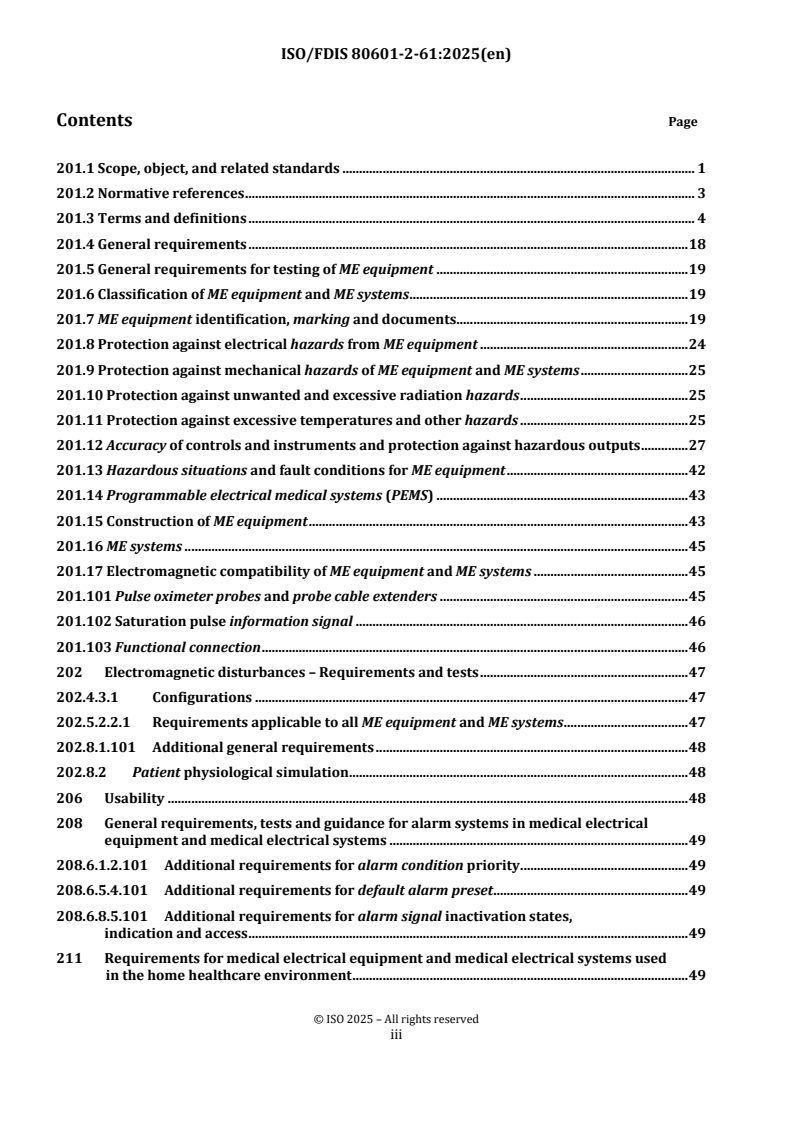
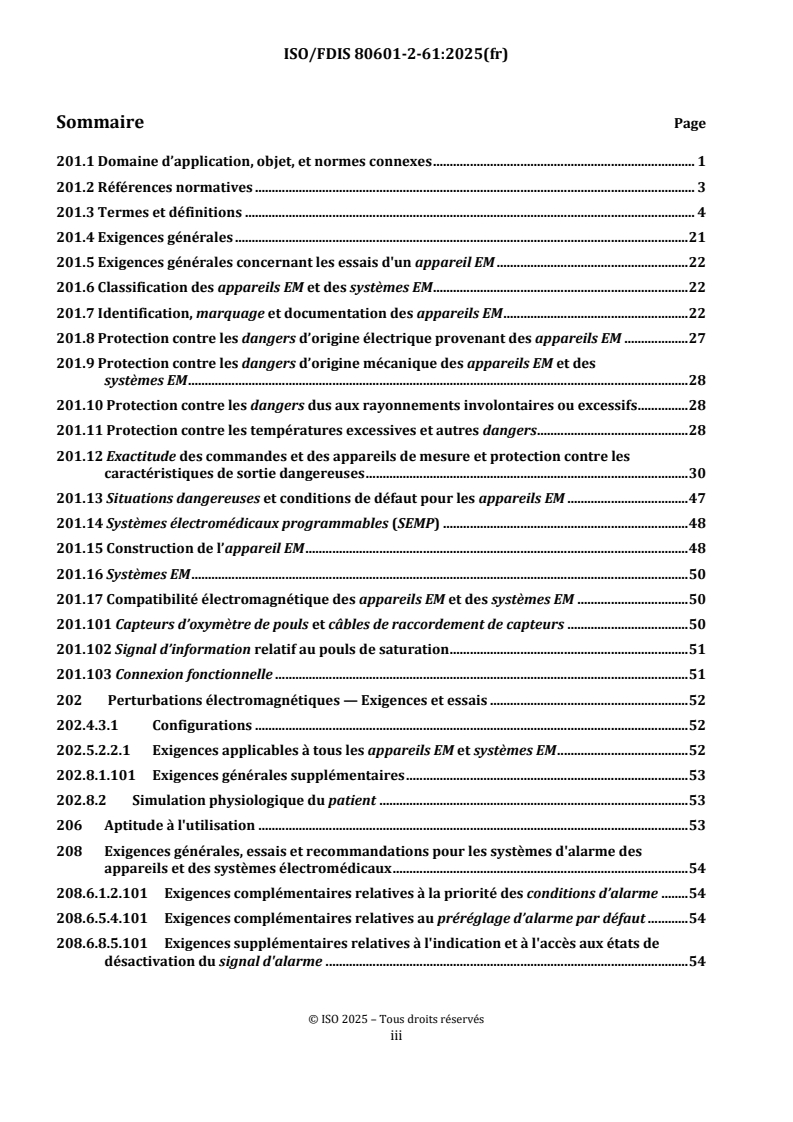
Contents Page
201.1 Scope, object, and related standards . 1
201.2 Normative references . 3
201.3 Terms and definitions . 4
201.4 General requirements . 18
201.5 General requirements for testing of ME equipment . 19
201.6 Classification of ME equipment and ME systems . 19
201.7 ME equipment identification, marking and documents . 19
201.8 Protection against electrical hazards from ME equipment . 24
201.9 Protection against mechanical hazards of ME equipment and ME systems . 25
201.10 Protection against unwanted and excessive radiation hazards . 25
201.11 Protection against excessive temperatures and other hazards . 25
201.12 Accuracy of controls and instruments and protection against hazardous outputs . 27
201.13 Hazardous situations and fault conditions for ME equipment . 42
201.14 Programmable electrical medical systems (PEMS) . 43
201.15 Construction of ME equipment . 43
201.16 ME systems . 45
201.17 Electromagnetic compatibility of ME equipment and ME systems . 45
201.101 Pulse oximeter probes and probe cable extenders . 45
201.102 Saturation pulse information signal . 46
201.103 Functional connection . 46
202 Electromagnetic disturbances – Requirements and tests . 47
202.4.3.1 Configurations . 47
202.5.2.2.1 Requirements applicable to all ME equipment and ME systems . 47
202.8.1.101 Additional general requirements . 48
202.8.2 Patient physiological simulation . 48
206 Usability . 48
208 General requirements, tests and guidance for alarm systems in medical electrical
equipment and medical electrical systems . 49
208.6.1.2.101 Additional requirements for alarm condition priority . 49
208.6.5.4.101 Additional requirements for default alarm preset . 49
208.6.8.5.101 Additional requirements for alarm signal inactivation states,
indication and access . 49
211 Requirements for medical electrical equipment and medical electrical systems used
in the home healthcare environment . 49
iii
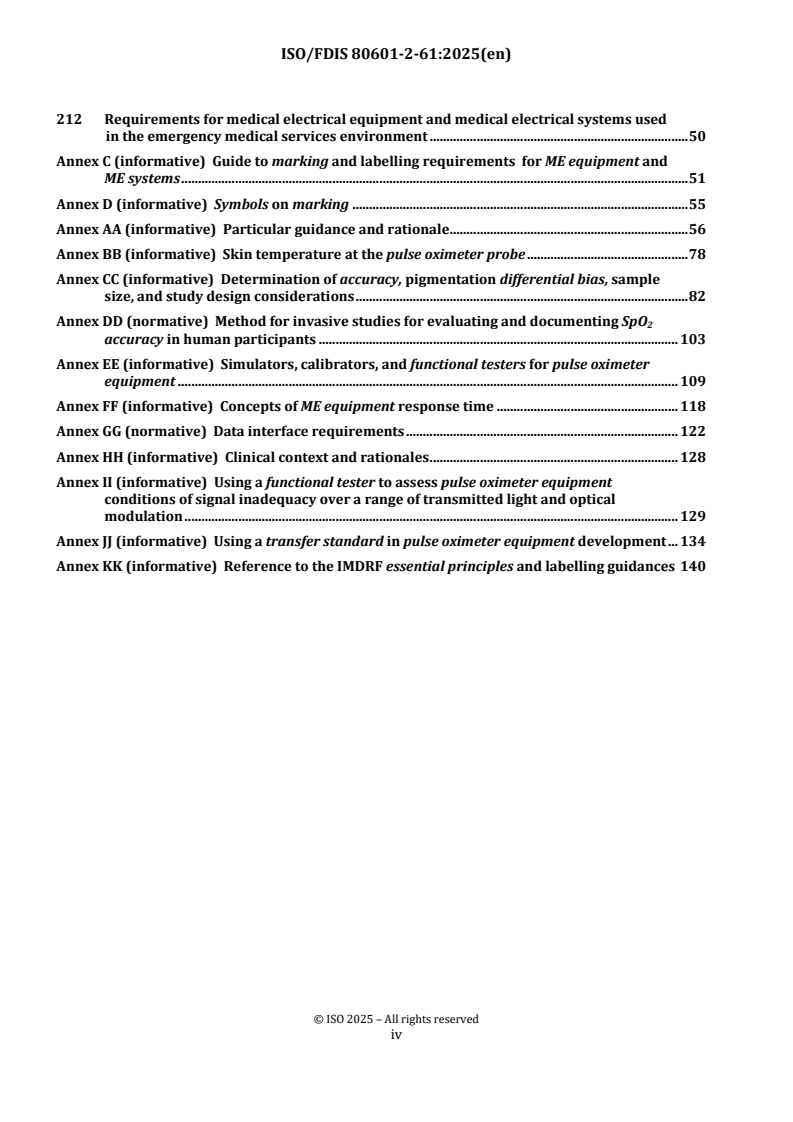
212 Requirements for medical electrical equipment and medical electrical systems used
in the emergency medical services environment . 50
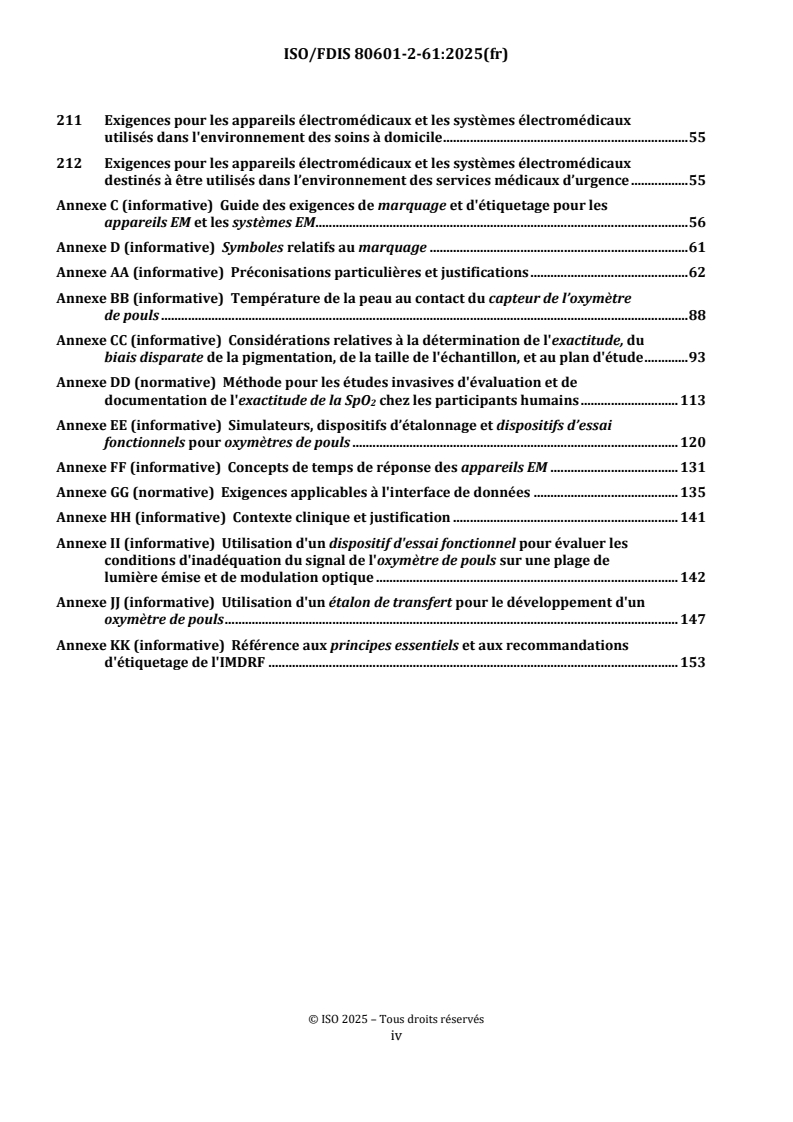
Annex C (informative) Guide to marking and labelling requirements for ME equipment and
ME systems . 51
Annex D (informative) Symbols on marking . 55
Annex AA (informative) Particular guidance and rationale . 56
Annex BB (informative) Skin temperature at the pulse oximeter probe . 78
Annex CC (informative) Determination of accuracy, pigmentation differential bias, sample
size, and study design considerations . 82
Annex DD (normative) Method for invasive studies for evaluating and documenting SpO
accuracy in human participants . 103
Annex EE (informative) Simulators, calibrators, and functional testers for pulse oximeter
equipment . 109
Annex FF (informative) Concepts of ME equipment response time . 118
Annex GG (normative) Data interface requirements . 122
Annex HH (informative) Clinical context and rationales . 128
Annex II (informative) Using a functional tester to assess pulse oximeter equipment
conditions of signal inadequacy over a range of transmitted light and optical
modulation . 129
Annex JJ (informative) Using a transfer standard in pulse oximeter equipment development . 134
Annex KK (informative) Reference to the IMDRF essential principles and labelling guidances 140
iv
Foreword
ISO (the International Organization for Standardization) is a worldwide federation of national standards
bodies (ISO member bodies). The work of preparing International Standards is normally carried out through
ISO technical committees. Each member body interested in a subject for which a technical committee has been
established has the right to be represented on that committee. International organizations, governmental and
non-governmental, in liaison with ISO, also take part in the work. ISO collaborates closely with the
International Electrotechnical Commission (IEC) on all matters of electrotechnical standardization.
The procedures used to develop this document and those intended for its further maintenance are described
in the ISO/IEC Directives, Part 1. In particular, the different approval criteria needed for the different types of
ISO document should be noted. This document was drafted in accordance with the editorial rules of the
ISO/IEC Directives, Part 2 (see www.iso.org/directives).
ISO draws attention to the possibility that the implementation of this document may involve the use of (a)
patent(s). ISO takes no position concerning the evidence, validity or applicability of any claimed patent rights
in respect thereof. As of the date of publication of this document, ISO had not received notice of (a) patent(s)
which may be required to implement this document. However, implementers are cautioned that this may not
represent the latest information, which may be obtained from the patent database available at
www.iso.org/patents. ISO shall not be held responsible for identifying any or all such patent rights.
Any trade name used in this document is information given for the convenience of users and does not
constitute an endorsement.
For an explanation of the voluntary nature of standards, the meaning of ISO specific terms and expressions
related to conformity assessment, as well as information about ISO's adherence to the World Trade
Organization (WTO) principles in the Technical Barriers to Trade (TBT), see www.iso.org/iso/foreword.html.
This document was prepared by Technical Committee ISO/TC 121, Anaesthetic and respiratory equipment,
Subcommittee SC 3, Respiratory devices and related equipment used for patient care and Technical Committee
IEC/TC 62, Electrical equipment in medical practice, Subcommittee SC 62D, Electric equipment, in collaboration
with the European Committee for Standardization (CEN) Technical Committee CEN/TC 215, Respiratory and
anaesthetic equipment, in accordance with the Agreement on technical cooperation between ISO and CEN
(Vienna Agreement).
This third edition cancels and replaces the second edition (ISO 80601-2-61:2018), which has been technically
revised.
The main changes are as follows:
alignment with IEC 60601-1:2005+AMD1:2012+AMD2:2020, IEC 60601-1-8:2006+AMD1:2012
+AMD2:2020, IEC 60601-1-2:2014+AMD1:2020 and IEC 60601-1-6:2010+AMD1:2013 +AMD2:2020.
increased disclosure requirements;
increased the required number of participants in the clinical study and their diversity (a means to assure
equal contributions across the range of skin pigmentation);
reduced the maximum permissible A ;
rms
required differential bias determination;
v
clarified that accessories need to be included in the clinical performance verification and conformity to the
requirements of the document
updated the reporting requirements for the clinical performance verification;
added an Annex describing the use of transfer standard for product development purposes;
[25]
added an Annex mapping the requirements of this document to the IMDRF essential principles and
[26]
labelling guidances; and
harmonization with ISO 20417, where appropriate.
A list of all parts in the ISO 80601 series and the IEC 80601 series can be found on the ISO website.
Any feedback or questions on this document should be directed to the user’s national standards body. A
complete listing of these bodies can be found at www.iso.org/members.html.
vi
Introduction
The approximation of arterial haemoglobin saturation and pulse rate using pulse oximetry is common practice
in many areas of medicine. This document covers basic safety and essential performance requirements
achievable within the limits of existing technology.
The committees recognized the need to revise the first edition of this document because of the publication of
IEC 60601-1-12:2014+AMD1:2020, as well as IEC 60601-1-2:2014+AMD1:2020,
IEC 60601-1-11:2015+AMD1:2020, IEC 60601-1:2005+AMD1:2012+AMD2:2020,
IEC 60601-1-6:2010+AMD1:2013+AMD2:2020 and IEC 60601-1-8:2006+AMD1:2012+AMD2:2020.
Annex C contains a guide to the marking and labelling requirements in this document.
Annex D contains a summary of the symbols referenced in this document.
Annex AA contains a rationale for some of the requirements. It is included to provide additional insight into
the reasoning of the committees that led to a requirement and identifying the hazards that the requirement
addresses.
Annex BB is a literature survey relevant to the determination of the maximum safe temperature of the
interface between a pulse oximeter probe and a patient’s tissue.
Annex CC discusses the formulae used to evaluate the SpO accuracy of pulse oximeter equipment
measurements, differential bias and the names that are assigned to those formulae.
Annex DD presents a guideline for a controlled desaturation study for the calibration of pulse oximeter
equipment.
Annex EE is a tutorial introduction to several kinds of testers used in pulse oximetry.
Annex FF describes concepts of pulse oximeter equipment response time.
Annex GG describes data interface requirements.
Annex HH describing the clinical context of this document and its rationale;
Annex II describing the use of a functional tester;
Annex JJ describing the use of transfer standard;
[25] [26]
Annex KK maps the requirements of this document to the IMDRF essential principles and labelling
guidances
In referring to the structure of this document, the term
– “clause” means one of the six numbered divisions within the table of contents, inclusive of all subdivisions
(e.g. Clause 201 includes subclauses 201.7.1, 201.7.2) and
– “subclause” means a numbered subdivision of a clause (e.g. 201.7.1, 7.2 and 201.7.2.1 are all subclauses of
Clause 201.7).
References to clauses within this document are preceded by the term “Clause” followed by the clause number.
References to subclauses within this document are by number only.
In this document, the conjunctive “or” is used as an “inclusive or” so a statement is true if any combination of
the conditions is true.
The verbal forms used in this document conform to usage described in Annex H of the ISO/IEC Directives, Part
2. For the purposes of this document, the auxiliary verb:
vii
– “shall” indicates a requirement;
– “should” indicates a recommendation;
– “may” indicates a permission;
– “can” indicates a possibility or capability; and
– “must” is used express an external constraint.
viii
FINAL DRAFT International Standard ISO/FDIS 80601-2-61:2025(en)
Medical electrical equipment —
Part 2-61:
Particular requirements for basic safety and essential
performance of pulse oximeter equipment
201.1 Scope, object, and related standards
IEC 60601-1:2005+AMD1:2012+AMD2:2020, Clause 1 applies, except as follows:
201.1.1 Scope
Replacement:
NOTE 1 There is guidance or rationale for this subclause contained in AA.2.1.
This document applies to the basic safety and essential performance of pulse oximeter equipment intended for
use on humans, hereafter referred to as ME equipment. This includes any part necessary for normal use,
including the pulse oximeter monitor, pulse oximeter probe, and probe cable extender.
These requirements apply to pulse oximeter equipment, including pulse oximeter monitors, pulse oximeter
probes and probe cable extenders regardless of their origin (i.e. including remanufactured products).
The intended use of pulse oximeter equipment includes, but is not limited to, the estimation of arterial oxygen
haemoglobin saturation and pulse rate of patients in professional healthcare institutions as well as patients in
the home healthcare environment and the emergency medical services environment.
If a clause or subclause is specifically intended to be applicable to ME equipment only, or to ME systems only,
the title and content of that clause or subclause will say so. If that is not the case, the clause or subclause applies
both to ME equipment and to ME systems, as relevant.
Hazards inherent in the intended physiological function of ME equipment or ME systems within the scope of
this document are not covered by specific requirements in this document except in 201.11.1.2.2, IEC 60601-
1:2005+AMD1:2012+AMD2:2020, 7.2.13 and 8.4.1.
NOTE 2 See also IEC 60601-1:2005+AMD1:2012+AMD2:2020, 4.2.
This document can also be applied to ME equipment and their accessories used for compensation or alleviation
of disease, injury, or disability.
This document is not applicable to pulse oximeter equipment intended for use in laboratory research
applications nor to oximeters that require a blood sample from the patient.
This document is not applicable to pulse oximeter equipment intended solely for foetal use.
This document is not applicable to remote or slave (secondary) equipment that displays SpO values that are
located outside of the patient environment.
NOTE 3 ME equipment that provides selection between diagnostic and monitoring functions is expected to meet the
appropriate requirements of this document when configured for that function.
This document is applicable to pulse oximeter equipment intended for use under extreme or uncontrolled
environmental conditions outside the hospital environment or physician’s office, such as in ambulances and
air transport. Additional standards can apply pulse oximeter equipment for those environments of use.
This document is a particular standard in the IEC 60601-1 and ISO and IEC 80601 series of standards.
201.1.2 Object
Replacement:
The object of this document is to establish particular basic safety and essential performance requirements for
pulse oximeter equipment [as defined in 201.3.253] and its accessories.
NOTE 1 Accessories are included because the combination of the pulse oximeter monitor and the accessories needs to
be adequately safe. Accessories can have a significant impact on the basic safety or essential performance of pulse oximeter
equipment.
[25] [26]
NOTE 2 This document has been prepared to address the relevant essential principles and labelling guidances of
the International Medical Devices Regulators Forum (IMDRF) as indicated in Annex KK.
NOTE 3 This document has been prepared to address the relevant general safety and performance requirements of
[27]
European regulation (EU) 2017/745 .
201.1.3 Collateral standards
Amendment (add after existing text):
This document refers to those applicable collateral standards that are listed in
IEC 60601-1:2005+AMD1:2012+AMD2:2020, Clause 2 and Clause 201.2 of this document.
IEC 60601-1-2:2014+AMD1:2020, IEC 60601-1-6:2010+AMD1:2013+AMD2:2020,
IEC 60601-1-8:2006+AMD1:2012+AMD2:2020, IEC 60601-1-11+AMD1:2020 and
IEC 60601-1-12+AMD1:2020 apply as modified in Clauses 202, 206, 208, 211 and 212, respectively.
IEC 60601-1-3 and IEC 60601-1-9 do not apply. All other published collateral standards in the IEC 60601-1
series apply as published.
201.1.4 Particular standards
Replacement:
In the IEC 60601 series, particular standards may modify, replace, or delete requirements contained in the
general standard, including the collateral standards, as appropriate for the particular ME equipment under
consideration, and may add other basic safety or essential performance requirements.
NOTE The general standard is IEC 60601-1:2005+AMD1:2012+AMD2:2020.
A requirement of a particular standard takes priority over the general standard or the collateral standards.
For brevity, IEC 60601-1:2005+AMD1:2012+AMD2:2020 is referred to in this document as the general
standard. Collateral standards are referred to by their document number.
The numbering of clauses and subclauses of this document corresponds to those of the general standard with
the prefix “201” (e.g. 201.1 in this document addresses the content of Clause 1 of the general standard) or
applicable collateral standard with the prefix “2xx” where xx is the final digits of the collateral standard
document number (e.g. 202.4 in this document addresses the content of Clause 4 of the IEC 60601-1-2
collateral standard, 208.4 in this document addresses the content of Clause 4 of the IEC 60601-1-8 collateral
standard, etc.). The changes to the text of the general standard are specified by the use of the following
abbreviated words:
"Replacement" means that the clause or subclause of the general standard or applicable collateral standard is
replaced completely by the text of this document.
"Addition" means that the text of this document is additional to the requirements of the general standard or
applicable collateral standard.
"Amendment" means that the clause or subclause of the general standard or applicable collateral standard is
amended as indicated by the text of this document.
Subclauses or figures that are additional to those of the general standard are numbered starting from 201.101,
additional annexes are lettered AA, BB, etc., and additional items aa), bb), etc.
Subclauses or figures that are additional to those of a collateral standard are numbered starting from 2xx,
where “x” is the number of the collateral standard (e.g. 202 for IEC 60601-1-2, 203 for IEC 60601-1-3, etc).
The term "this document" is used to make reference to the general standard, any applicable collateral
standards and this particular document taken together.
Where there is no corresponding clause or subclause in this document, the section, clause or subclause of the
general standard or applicable collateral standard, although possibly not relevant, applies without
modification; where it is intended that any part of the general standard or applicable collateral standard,
although possibly relevant, is not to be applied, a statement to that effect is given in this particular document.
201.2 Normative references
The following documents are referred to in the text in such a way that some or all of their content constitutes
requirements of this document. For dated references, only the edition cited applies. For undated references,
the latest edition of the referenced document (including any amendments) applies.
NOTE 1 The way in which these referenced documents are cited in normative requirements determines the extent (in
whole or in part) to which they apply.
NOTE 2 Informative references are listed in the Bibliography.
IEC 60601-1:2005+AMD1:2012+AMD2:2020, Clause 2 applies, except as follows:
Addition:
ISO 14155:2020, Clinical investigation of medical devices for human subjects — Good clinical practice
ISO 15223-1:2021+AMD1:2025, Medical devices — Symbols to be used with medical device labels, labelling and
information to be supplied — Part 1: General requirements
ISO 20417:— , Medical devices — Information to be supplied by the manufacturer
IEC 60068-2-27:2008, Environmental testing — Part 2-27: Tests — Test Ea and guidance: Shock
IEC 60068-2-31:2008, Environmental testing — Part 2-31: Tests — Test Ec: Rough handling shocks, primarily
for equipment-type specimens
IEC 60068-2-64:2008+AMD1:2019, Environmental testing — Part 2-64: Tests — Test Fh: Vibration, broadband
random and guidance
IEC 60601-1-11:2015+AMD1:2020, Medical electrical equipment — Part 1-11: General requirements for basic
safety and essential performance — Collateral Standard: Requirements for medical electrical equipment and
medical electrical systems used in the home healthcare environment
Under preparation. Stage at the time of publication: ISO/FDIS 20417:2025.
IEC 60601-1-12:2014+AMD1:2020, Medical electrical equipment — Part 1-12: General requirements for basic
safety and essential performance — Collateral Standard: Requirements for medical electrical equipment and
medical electrical systems used in the emergency medical services environment
IEC 60825-1:2014, Safety of laser products - Part 1: Equipment classification and requirements
IEC 60825-2:2021, Safety of laser products — Part 2: Safety of optical fibre communication systems (OFCS)
201.3 Terms and definitions
For the purposes of this document, the terms and definitions given in
IEC 60601-1:2005+AMD 1:2012+AMD1:2020, and the following apply.
ISO and IEC maintain terminology databases for use in standardization at the following addresses:
— ISO Online browsing platform: available at https://www.iso.org/obp
— IEC Electropedia: available at https://www.electropedia.org/
NOTE An alphabetized index of defined terms is found following the Bibliography.
201.3.201
accompanying information
information supplied by the manufacturer with or marked on a medical device or accessory for the user or
responsible organization, particularly regarding safe use
Note 1 to entry: The accompanying information is be regarded as part of the medical device or accessory.
Note 2 to entry: The accompanying information can consist of the label, marking, instructions for use, technical description,
information shown on the packaging or graphical user interface (GUI), installation manual, quick reference guide, etc.
and can address the installation, use, processing, maintenance and disposal of the medical device or accessory.
Note 3 to entry: Accompanying information is not necessarily a written or printed document but can involve auditory,
visual, or tactile materials and multiple media types (e.g. CD-ROM, DVD-ROM, USB drive, website).
Note 4 to entry: Medical devices and accessories that can be used safely without accompanying information are exempted
from having accompanying information by some authorities having jurisdiction.
[SOURCE: ISO 20417:—, 3.2]
201.3.202
accuracy
closeness of agreement between a test result and an accepted reference value
Note 1 to entry: Subclause 201.12.1.101.4 provides the method of calculating the SpO accuracy of pulse oximeter
equipment.
Note 2 to entry: Additional information is found in Annex CC.
[SOURCE: ISO 3534-2:2006, 3.3.1, modified — Replaced note 1 to note 3 with new notes and ‘or measurement
result and the true’ with ‘and an accepted reference ’.]
201.3.203
alarm condition delay
time from the occurrence of a triggering event either in the patient, for physiological alarm conditions, or in
the equipment, for technical alarm conditions, to when the alarm system determines that an alarm condition
exists
[SOURCE: IEC 60601-1-8:2006, 3.2]
201.3.204
alarm limit
threshold used by an alarm system to determine an alarm condition
[SOURCE: IEC 60601-1-8:2006+AMD1:2012+AMD2:2020, 3.3]
201.3.205
alarm paused
state of limited duration in which the alarm system or part of the alarm system does not generate alarm signals
[SOURCE: IEC 60601-1-8:2006+AMD1:2012+AMD2:2020, 3.5]
201.3.206
alarm preset
set of stored configuration parameters, including selection of algorithms and initial values for use by
algorithms, which affect or modify the performance of the alarm system
[SOURCE: IEC 60601-1-8:2006+AMD1:2012+AMD2:2020, 3.6]
201.3.207
alarm signal generation delay
time from the onset of an alarm condition to the generation of its alarm signal(s)
[SOURCE: IEC 60601-1-8:2006+AMD1:2012+AMD2:2020, 3.10
201.3.208
audio paused
state of limited duration in which the alarm system or part of the alarm system does not generate an auditory
alarm signal
[SOURCE: IEC 60601-1-8:2006+AMD1:2012+AMD2:2020, 3.13]
201.3.209
colour measurement site
location on the body at which the skin pigmentation is assessed by pigmentation measurement methods (PMMs)
201.3.210
controlled desaturation study
hypoxaemia induced in a cohort of healthy adult human participants performed under well controlled, optimal
or non-optimal laboratory conditions.
201.3.211
CO-oximeter
multiwavelength optical blood analyser that measures total haemoglobin concentration and the
concentrations of various haemoglobin derivatives
Note 1 to entry: The relevant CO-oximetry value is functional saturation of arterial blood, SaO2, which pulse oximeter
equipment estimates and reports as SpO2.
201.3.212
data update period
interval in which the pulse oximeter equipment algorithm provides new valid data to the display or the
functional connection
Note 1 to entry: The data update period does not refer to the regular refresh period of the display, which is typically on
the order of 1 s, but rather to the (typically longer) interval defined above.
201.3.213
declared range
portion of the displayed range of SpO and pulse rate values over which there is specified accuracy
201.3.214
default alarm preset
alarm preset that can be activated by the alarm system without operator action
Note 1 to entry: Manufacturer- or responsible organization-configured alarm presets are possible types of default alarm
presets.
[SOURCE: IEC 60601-1-8:2006+AMD1:2012+AMD2:2020, 3.16]
201.3.215
differential bias
measure of the overall dependence of participant-specific mean bias to a factor
201.3.216
displayed range
range of SpO or pulse rate values that can be displayed by the pulse oximeter equipment
Note 1 to entry: The displayed range can extend beyond the declared range.
201.3.217
distributed alarm system
DAS
alarm system that involves more than one item of equipment of a ME system intended for delivery of alarm
conditions with technical confirmation
Note 1 to entry: The parts of a distributed alarm system can be widely separated in distance.
Note 2 to entry: A distributed alarm system is intended to notify operators of the existence of an alarm condition.
Note 3 to entry: For the purposes of this document, technical confirmation means that each element of a distributed
alarm system confirms or guarantees the successful delivery of the alarm condition to the next element or appropriate
technical alarm conditions are created as described in IEC 60601-1-8:2006+AMD1:2012+AMD2:2020, 6.11.2.2.1.
[SOURCE: IEC 60601-1-8:2006+AMD1:2012+AMD2:2020, 3.17]
201.3.218
EMS environment
emergency medical services environment
actual conditions and settings, in which operators interact with the ME equipment or ME system, in and around
the scene of an emergency outside of a professional healthcare facility where a patient can be given medical
care, basic or advanced life support as well as during professional transport to a professional healthcare
facility or between professional healthcare facilities
EXAMPLE 1 Responding to and providing life support at the scene of an emergency to a patient reported as
experiencing injury or illness in a pre-hospital setting, and transporting the patient, while continuing such life support
care, to an appropriate professional healthcare facility for further care.
EXAMPLE 2 Providing monitoring, treatment or diagnosis during transport between professional healthcare
facilities.
Note 1 to entry: For the purposes of this document, use of equipment intended for the EMS environment and temporarily
used in the home healthcare environment by emergency medical personnel is considered use in the EMS environment.
Note 2 to entry: For the purposes of this document, the operators of equipment intended for the EMS environment are
presumed to be professional medical personnel or personnel with relevant specialized training.
Note 3 to entry: Professional healthcare facilities include hospitals, physician offices, freestanding surgical centres,
dental offices, freestanding birthing centres, limited care facilities, first aid rooms or rescue rooms and multiple treatment
facilities.
Note 4 to entry: Emergency medical services are known by various names in different countries and regions.
Note 5 to entry: For the purposes of this document, transport includes road, rotary and fixed-wing ambulances.
[SOURCE: IEC 60601-1-12:2014+AMD1:2020, 3.1]
201.3.219
essential function
function or capability that is required to maintain basic safety, essential performance, a minimum of clinical
functionality as specified by the manufacturer, and operational availability for the medical device
Note 1 to entry: Essential functions include, but are not limited to, the safety instrumented function (basic safety and
essential performance), the control function and the availability of urgently needed functions and such allowing the
operator to view and manipulate the medical device safely with the most urgently needed performance (operational
availability). The loss of essential function is commonly termed loss of protection, loss of control and loss of view
respectively.
Note 2 to entry: The term is derived from IEC 62443-4-2:2019, 3.1.20, and has been refined for the purpose and scope
of this document.
[SOURCE: IEC/TR 60601-4-5:2021, 3.10]
201.3.220
essential principles
essential principles of safety and performance
fundamental high-level requirements that when complied with ensure a medical device or accessory is safe
and performs as intended
[SOURCE: ISO 20417:—, 3.10]
201.3.221
false positive alarm condition
presence of an alarm condition when no valid triggering event has occurred in the patient, the equipment or
the alarm system
Note 1 to entry: A false positive alarm condition can be caused by spurious information produced by the patient, the
patient-equipment interface, other equipment or the alarm system itself.
[SOURCE: IEC 60601-1-8:2006+AMD1:2012+AMD2:2020, 3.21]
201.3.222
firecall
method established to provide emergency access to a secure medical device
Note 1 to entry: In an emergency situation, unprivileged users can gain access to key systems to correct the problem.
When a firecall is used, there is usually a review process to ensure that the access was used properly to correct a problem.
These methods generally either provide a one-time use user identifier (ID) or one-time password or other suitable
measures.
Note 2 to entry: Also referred to as "break glass" feature.
[SOURCE: IEC/TR 60601-4-5:2021, 3.11]
201.3.223
fractional oxyhaemoglobin
DEPRECATED :FO Hb fractional saturation
oxyhaemoglobin concentration cO Hb divided by the total haemoglobin concentration, ctHb, in the blood
cO Hb
FO Hb=
ctHb
Note 1 to entry: cO Hb is the concentration of oxyhaemoglobin; ctHb is the total haemoglobin concentration.
Note 2 to entry: This is sometimes reported as a percentage (multiplying the fraction by 100).
Note 3 to entry: Fractional oxyhaemoglobin is the term used by the Clinical and Laboratory Standards Institute (CLSI),
(formerly NCCLS or National Committee for Clinical Laboratory Sciences) for this ratio.
Note 4 to entry: CLSI denotes “concentration” by a prefixed letter c, while in the past the convention of square brackets
(e.g. [O Hb] ) was used.
[3]
Note 5 to entry: CLSI uses the following notations:
− oxyhaemoglobin (O Hb);
− deoxyhaemoglobin (HHb);
− carboxyhaemoglobin (COHb);
− methaemoglobin (MetHb);
− sulfhaemoglobin (SulfHb); and
− total haemoglobin concentration (ctHb), which is derived by the cyanmethaemoglobin method of
[23]
CLSI H15 .
201.3.224
functional oxygen saturation
percentage saturation given by the oxyhaemoglobin concentration (cO Hb) divided by the sum of the
oxyhaemoglobin concentration and the deoxyhaemoglobin concentration (cHHb)
100× cO Hb
ccO Hb+ HHb
[3]
Note 1 to entry: The CLSI term for this ratio is haemoglobin oxygen saturation, and its notation is SO .
Note 2 to entry: As related to SpO2, this percent saturation is for arterial blood.
201.3.225
functional tester
test equipment which presents pulse oximeter equipment with a signal having a predictable value of
modulation ratio so that the operator can observe the resulting displayed value of SpO , and compare it to the
expected value derived from the calibration curve for that particular pulse oximeter equipment
Note 1 to entry: The accuracy of the SpO value given by the pulse oximeter equipment depends in part on whether the
calibration curve of the pulse oximeter monitor properly reflects the optical characteristics of the pulse oximeter probe
and pulse oximeter probe-tissue interaction. Functional testers are not able to confirm the SpO2 accuracy of the calibration
curve or sufficiently assess the optical characteristics of pulse oximeter probes to determine their proper calibration.
Additional information is found in EE.4.
Note 2 to entry: Not all functional testers and pulse oximeter equipment are compatible. Functional testers can vary in pulse
simulation methods, pulse contours, and amplitude. It is possible that a functional tester cannot accurately reproduce the
calibration of the pulse oximeter equipment and can yield different results between pulse oximeter equipment.
201.3.226
healthcare professional, adj
appropriately trained, knowledgeable, and skilled, providing systematic preventive, curative, promotional or
rehabilitative healthcare services
[SOURCE: ISO 80601-2-12:2023, 201.3.247]
201.3.227
HF surgical equipment
medical electrical equipment which generates high frequency currents intended for the performance of
surgical tasks, such as the cutting or coagulation of biological tissue by means of these high frequency currents
Note 1 to entry: HF surgical equipment is also variously known as surgical diathermy, electrosurgical equipment,
electrosurgical generator, RF generator or HF generator.
Note 2 to entry: A footswitch is an example of an associated accessory that is part of HF surgical equipment.
[SOURCE: IEC 60601-2-2:2017, 3.224]
201.3.228
home healthcare environment
dwelling place in which a patient lives or other places where patients are present, excluding professional
healthcare facility environments where operators with medical training are continually available when
patients are present
EXAMPLE In a car, bus, train, boat or plane, in a wheelchair or walking outdoors.
Note 1 to entry: Professional healthcare facilities include hospitals, physician offices, freestanding surgical centres,
dental offices, freestanding birthing centres, limited care facilities, first aid rooms or rescue rooms, multiple treatment
facilities and emergency medical services.
Note 2 to entry: For the purpose of this document, nursing homes are considered home healthcare environments.
Note 3 to entry: Other places where a patient is present include the outdoor environment, while working and in vehicles.
[SOURCE: IEC 60601-1-11:2015+AMD1:2020, 3.1, modified — replaced ' collateral standard' with 'document'.]
201.3.229
immunity
ability of ME equipment or a ME system to perform without degradation in the presence of an electromagnetic
disturbance
[SOURCE: IEC 60601-1-2:2014+AMD1:2020, 3.8, modified — deleted 'the'.]
201.3.230
immunity test level
level of a test signal used to simulate an electromagnetic disturbance when performing an immunity test
[SOURCE: IEC 60601-1-2:2014+AMD1:2020, 3.9, modified — deleted 'the'.]
201.3.231
individual typology angle
ITA
objective colourimetry measure of skin pigmentation that is inversely related to the amount of pigmentation
*
180 L − 50
[8][52]
ITA= • arctan
*
π
b
where
L* is the luminance ranging from black (0) to white (100); and
b* is the yellow/blue component.
Note 1 to entry: ITA is the vector direction on the L*-b* plane where ITA is given in degrees.
Note 2 to entry: ITA is collected with the use of equipment that provides the measure directly or derived from the
parameters L* and b* according to Reference [52].
Note 3 to entry: For the purposes of this document, skin pigmentation and the quantification thereof by ITA only refers
to melanin.
201.3.232
information supplied by the manufacturer
information related to the identification and use of a medical device or accessory, in whatever form provided,
intended to ensure the safe and effective use of the medical device or accessory
Note 1 to entry: e-documentation is included in the information supplied by the manufacturer.
Note 2 to entry: Shipping documents (e.g. packing list and customs documents) and promotional material are excluded
from information supplied by the manufacturer. However, some authorities having jurisdiction can consider such
supplemental information as information supplied by the manufacturer.
Note 3 to entry: The primary purpose of information supplied by the manufacturer is to identify the medical device or
acc
...
ISO /FDIS 80601-2-61:2025(Ed 3en)
ISO/TC 121/SC 3/JWG 10
IEC 62D/JWG 5
Date: 2025-10-1023
Secretariat: ANSI
Medical Electrical Equipment — Part 2-61: Particular requirements for basic safety and
essential performance of pulse oximeter equipment
Appareils électromédicaux — Partie 2-61: Exigences particulières pour la sécurité de base et les performances
essentiellesxessentielles pour les oximètres de pouls
FDIS stage
Warning for WDs and CDs
This document is not an ISO International Standard. It is distributed for review and comment. It is subject to
change without notice and may not be referred to as an International Standard.
Recipients of this draft are invited to submit, with their comments, notification of any relevant patent rights
of which they are aware and to provide supporting documentation.
ii © ISO 2010 – All rights reserved
ISO 80601-2-61:2025(E) ISO/TC 121/SC 3/ N3248
All rights reserved. Unless otherwise specified, no part of this publication may be reproduced or
utilized otherwise in any form or by any means, electronic or mechanical, including photocopying,
or posting on the internet or an intranet, without prior written permission. Permission can be
requested from either ISO at the address below or ISO's member body in the country of the
requester.
ISO copyright office
Case postale 56 • CH-1211 Geneva 20
Tel. + 41 22 749 01 11
Fax + 41 22 749 09 47
E-mail copyright@iso.org
Web www.iso.org
Published in Switzerland.
ii © ISO 2025 – All rights reserved
ISO 80601-2-61:2025(E)
Contents Page
201.1 Scope, object, and related standards . 1
201.2 Normative references . 3
201.3 Terms and definitions . 4
201.4 General requirements . 17
201.5 General requirements for testing of ME equipment . 19
201.6 Classification of ME equipment and ME systems . 19
201.7 ME equipment identification, marking and documents . 19
201.8 Protection against electrical hazards from ME equipment . 24
201.9 Protection against mechanical hazards of ME equipment and ME systems . 24
201.10 Protection against unwanted and excessive radiation hazards . 24
201.11 Protection against excessive temperatures and other hazards . 24
201.12 Accuracy of controls and instruments and protection against hazardous outputs . 26
201.13 Hazardous situations and fault conditions for ME equipment . 41
201.14 Programmable electrical medical systems (PEMS) . 41
201.15 Construction of ME equipment . 42
201.16 ME systems . 43
201.17 Electromagnetic compatibility of ME equipment and ME systems . 43
201.101 Pulse oximeter probes and probe cable extenders . 44
201.102 Saturation pulse information signal . 45
201.103 Functional connection . 45
202 Electromagnetic disturbances – Requirements and tests . 45
202.4.3.1 Configurations . 45
202.5.2.2.1 Requirements applicable to all ME equipment and ME systems . 46
202.8.1.101 Additional general requirements . 46
202.8.2 Patient physiological simulation . 46
206 Usability . 47
208 General requirements, tests and guidance for alarm systems in medical electrical
equipment and medical electrical systems . 47
208.6.1.2.101 Additional requirements for alarm condition priority . 47
208.6.5.4.101 Additional requirements for default alarm preset . 47
208.6.8.5.101 Additional requirements for alarm signal inactivation states,
indication and access . 48
211 Requirements for medical electrical equipment and medical electrical systems used
in the home healthcare environment . 48
ii © ISO 2025 – All rights reserved
ISO /FDIS 80601-2-61:2025(Een)
212 Requirements for medical electrical equipment and medical electrical systems used
in the emergency medical services environment . 48
Annex C (informative) Guide to marking and labelling requirements for ME equipment and
ME systems . 49
Annex D (informative) Symbols on marking . 53
Annex AA (informative) Particular guidance and rationale . 54
Annex BB (informative) Skin temperature at the pulse oximeter probe . 76
Annex CC (informative) Determination of accuracy, pigmentation differential bias, sample
size, and study design considerations . 80
Annex DD (normative) Method for invasive studies for evaluating and documenting SpO
accuracy in human participants . 100
Annex EE (informative) Simulators, calibrators, and functional testers for pulse oximeter
equipment . 106
Annex FF (informative) Concepts of ME equipment response time . 115
Annex GG (normative) Data interface requirements . 119
Annex HH (informative) Clinical context and rationales . 125
Annex II (informative) Using a functional tester to assess pulse oximeter equipment
conditions of signal inadequacy over a range of transmitted light and optical
modulation . 126
Annex JJ (informative) Using a transfer standard in pulse oximeter equipment development . 131
Annex KK (informative) Reference to the IMDRF essential principles and labelling guidances 136
Figure 201.101 — Example finger pulse oximeter probe locations and orientation .22
Figure 201.102 — Dorsal distal phalanx location .34
Figure AA.1 — Probability of obtaining an observed A for fingerclip vs reference CO-oximeter
rms
less than or equal to 3,0, as a function of the true A , by sample size .64
rms
Figure CC.1 — Synthesized calibration data (base case) .82
Figure CC.2 — Constant offset has been added to base case .83
Figure CC.3 — Tilt has been added to base case .84
Figure CC.4 — Graphical representation for the definition of local bias (Test pulse oximeter probe
SpO as a function of reference S ) .85
R
Figure CC.5 — Graphical representation for the definition of local bias and mean bias (Test probe
SpO as a function of reference S ) .86
R
Figure CC.6 Two examples of modified Bland-Altman graphs of the controlled desaturation study
data, delineating participants, and bias by skin tone .92
iii
ISO 80601-2-61:2025(E)
Figure CC.7 — Point estimates and 90 % confidence intervals of differential bias from LME, LR,
and MLR analysis of 34 unlabelled pulse oximeter equipment at 85 % SaO .94
Figure CC.8 Example graph of simulated per-participant bias versus per-participant ITA within a
particular SaO span .95
Figure CC.9 — Example graph of the observed pigmentation differential bias versus SaO .96
Figure CC.10 Power curves for the participant-level ITA vs participant-level bias regression
analysis method (MLR). .98
Figure DD.1 — Example of desaturation-time profile . 103
Figure EE.1 — Sample calibration curve for pulse oximeter equipment . 108
Figure EE.2 — Interface of a functional tester that uses a photodiode and LED to interact with a
pulse oximeter probe . 110
Figure EE.3 — Interface of a functional tester that uses a dye mixture . 111
Figure EE.4 — Interface of a functional tester that uses a liquid crystal modulator . 111
Figure EE.5 — Absorbency of blue bandage material (measured in reflection) used in a special
test pulse oximeter probe with great patient-to-patient variability . 113
Figure EE.6 —High-variability production pulse oximeter probe in a controlled desaturation study
on five test participants . 114
Figure FF.1 — Illustration of fidelity of pulse oximeter equipment performance in tracking
saturation changes . 116
Figure FF.2 — Illustration of effect of different averaging times on fidelity . 116
Figure FF.3 — Graphic representation of components of alarm system delay . 117
Figure FF.4 — Illustration of the effects of different averaging times on a more rapid and noisier
desaturation signal . 118
Figure JJ.1 — Distribution of root mean square error of SpO . 134
Table 201.101 — Distributed essential performance requirements .18
Table 201.C.101 — Marking on the outside of pulse oximeter equipment or its parts or accessories
...........................................................................................................................................................................49
Table 201.C.102 — Accompanying documents, general .49
Table 201.C.103 — Accompanying documents, instructions for use .50
Table 201.C.104 — Accompanying documents, technical description .52
Table 201.D.1.101 — Additional symbols on marking .53
iv © ISO 2025 – All rights reserved
ISO /FDIS 80601-2-61:2025(Een)
Table AA.1 — Probability of detection per sample size .63
Table AA.2 — Qualitative assessment of pulse oximeter equipment shock and vibration
environment .71
Table BB.1 — Pulse oximeter probe safe application time and source .78
Table DD.1 — Example of target plateaus and ranges . 103
Table GG.1 — Parameters and units of measurement . 120
Table GG.2 — Equipment identification . 121
Table GG.3 — Operator-adjustable equipment settings . 121
Table GG.4 — Equipment configuration . 122
Table GG.5 — Equipment specifications . 123
Table GG.6 — Service monitoring indicators . 123
Table GG.7 — External device information . 124
Table II.1 — Results following the outlined testing procedure. 128
Table II.2 — Categorization of the observations shown in Table II.1 . 128
Table II.3 — Categorization of the observations shown in Table II.2 using a deviation threshold of
±4 digits . 129
Table JJ.1 — Quantiles of RMS values from bootstrap samples of size 30 (10 dark / 20 light
skinned) . 134
Table KK.1 — Correspondence between this document and the essential principles . 135
Table KK.2 — Correspondence between this document and the labelling principles . 137
v
ISO 80601-2-61:2025(E)
Foreword
ISO (the International Organization for Standardization) is a worldwide federation of national standards
bodies (ISO member bodies). The work of preparing International Standards is normally carried out through
ISO technical committees. Each member body interested in a subject for which a technical committee has been
established has the right to be represented on that committee. International organizations, governmental and
non-governmental, in liaison with ISO, also take part in the work. ISO collaborates closely with the
International Electrotechnical Commission (IEC) on all matters of electrotechnical standardization.
The procedures used to develop this document and those intended for its further maintenance are described
in the ISO/IEC Directives, Part 1. In particular, the different approval criteria needed for the different types of
ISO document should be noted. This document was drafted in accordance with the editorial rules of the
ISO/IEC Directives, Part 2 (see www.iso.org/directives).
ISO draws attention to the possibility that the implementation of this document may involve the use of (a)
patent(s). ISO takes no position concerning the evidence, validity or applicability of any claimed patent rights
in respect thereof. As of the date of publication of this document, ISO had not received notice of (a) patent(s)
which may be required to implement this document. However, implementers are cautioned that this may not
represent the latest information, which may be obtained from the patent database available at
www.iso.org/patents. ISO shall not be held responsible for identifying any or all such patent rights.
Any trade name used in this document is information given for the convenience of users and does not
constitute an endorsement.
For an explanation of the voluntary nature of A standards, the meaning of ISO specific terms and expressions
rms
related to conformity assessment, as well as information about ISO's adherence to the World Trade
Organization (WTO) principles in the Technical Barriers to Trade (TBT), see www.iso.org/iso/foreword.html.
This document was prepared by Technical Committee ISO/TC 121, Anaesthetic and respiratory equipment,
Subcommittee SC 3, Respiratory devices and related equipment used for patient care and Technical Committee
IEC/TC 62, Electrical equipment in medical practice, Subcommittee SC 62D, Electric equipment, in collaboration
with the European Committee for Standardization (CEN) Technical Committee CEN/TC 215, Respiratory and
anaesthetic equipment, in accordance with the Agreement on technical cooperation between ISO and CEN
(Vienna Agreement).
This third edition cancels and replaces the second edition (ISO 80601-2-61:2018), which has been technically
revised.
The main changes compared to the previous edition are as follows:
alignment with IEC 60601-1:2005+AMD1:2012+AMD2:2020, IEC 60601-1-8:2006+AMD1:2012
+AMD2:2020, IEC 60601-1-2:2014+AMD1:2020 and IEC 60601-1-6:2010+AMD1:2013 +AMD2:2020.
increased disclosure requirements;
increased the required number of participants in the clinical study and their diversity (a means to assure
equal contributions across the range of skin pigmentation);
reduced the maximum permissible A ;
rms
required differential bias determination;
clarified that accessories need to be included in the clinical performance verification and conformity to the
requirements of the document
vi © ISO 2025 – All rights reserved
ISO /FDIS 80601-2-61:2025(Een)
updated the reporting requirements for the clinical performance verification;
added an Annex describing the use of transfer standard for product development purposes;
[[25]
added an Annex mapping the requirements of this document to the IMDRF essential principles and
[26][26]
labelling guidances; and
harmonization with ISO 20417, where appropriate.
A list of all parts in the ISO 80601 series and the IEC 80601 series can be found on the ISO website.
Any feedback or questions on this document should be directed to the user’s national standards body. A
complete listing of these bodies can be found at www.iso.org/members.html.
vii
ISO 80601-2-61:2025(E)
Introduction
The approximation of arterial haemoglobin saturation and pulse rate using pulse oximetry is common practice
in many areas of medicine. This document covers basic safety and essential performance requirements
achievable within the limits of existing technology.
The committees recognized the need to revise the first edition of this document because of the publication of
IEC 60601-1-12:2014+AMD1:2020, as well as IEC 60601-1-2:2014+AMD1:2020,
IEC 60601-1-11:2015+AMD1:2020, IEC 60601-1:2005+AMD1:2012+AMD2:2020,
IEC 60601-1-6:2010+AMD1:2013+AMD2:2020 and IEC 60601-1-8:2006+AMD1:2012+AMD2:2020.
Annex C contains a guide to the marking and labelling requirements in this document.
Annex D contains a summary of the symbols referenced in this document.
Annex AA contains a rationale for some of the requirements. It is included to provide additional insight into
the reasoning of the committees that led to a requirement and identifying the hazards that the requirement
addresses.
Annex BB is a literature survey relevant to the determination of the maximum safe temperature of the
interface between a pulse oximeter probe and a patient’s tissue.
Annex CC discusses the formulae used to evaluate the SpO accuracy of pulse oximeter equipment
measurements, differential bias and the names that are assigned to those formulae.
Annex DD presents a guideline for a controlled desaturation study for the calibration of pulse oximeter
equipment.
Annex EE is a tutorial introduction to several kinds of testers used in pulse oximetry.
Annex FF describes concepts of pulse oximeter equipment response time.
Annex GG describes data interface requirements.
Annex HH describing the clinical context of this document and its rationale;
Annex II describing the use of a functional tester;
Annex JJ describing the use of transfer standard;
[[25] [26][26]
Annex KK maps the requirements of this document to the IMDRF essential principles and labelling
guidances
In this document, the following print types are used:
– requirements and definitions: roman type;
– terms defined in Clause 3 of the IEC 60601-1:2005+AMD1:2012+AMD2:2020 in this document or as noted:
italic type; and
– informative material appearing outside of tables, such as notes, examples and references: in smaller type; normative
text of tables is also in a smaller type.
In referring to the structure of this document, the term
– “clause” means one of the six numbered divisions within the table of contents, inclusive of all subdivisions
(e.g. Clause 201 includes subclauses 201.7.1, 201.7.2) and
– “subclause” means a numbered subdivision of a clause (e.g. 201.7.1, 7.2 and 201.7.2.1 are all subclauses of
Clause 201.7).
viii © ISO 2025 – All rights reserved
ISO /FDIS 80601-2-61:2025(Een)
References to clauses within this document are preceded by the term “Clause” followed by the clause number.
References to subclauses within this document are by number only.
In this document, the conjunctive “or” is used as an “inclusive or” so a statement is true if any combination of
the conditions is true.
The verbal forms used in this document conform to usage described in Annex H of the ISO/IEC Directives, Part
2. For the purposes of this document, the auxiliary verb:
– “shall” indicates a requirement;
– “should” indicates a recommendation;
– “may” indicates a permission;
– “can” indicates a possibility or capability; and
– “must” is used express an external constraint.
A list of all parts in the ISO 80601 series and the IEC 80601 series can be found on the ISO website.
Any feedback or questions on this document should be directed to the user’s national standards body. A
complete listing of these bodies can be found at www.iso.org/members.html.
ix
Medical electrical equipment —
Part 2-61:
Particular requirements for basic safety and essential
performance of pulse oximeter equipment
201.1 Scope, object, and related standards
IEC 60601-1:2005+AMD1:2012+AMD2:2020, Clause 1 applies, except as follows:
201.1.1 Scope
Replacement:
NOTE 1 There is guidance or rationale for this subclause contained in AA.2.1.
This document applies to the basic safety and essential performance of pulse oximeter equipment
intended for use on humans, hereafter referred to as ME equipment. This includes any part necessary
for normal use, including the pulse oximeter monitor, pulse oximeter probe, and probe cable extender.
These requirements apply to pulse oximeter equipment, including pulse oximeter monitors, pulse
oximeter probes and probe cable extenders regardless of their origin (i.e. including remanufactured
products).
The intended use of pulse oximeter equipment includes, but is not limited to, the estimation of arterial
oxygen haemoglobin saturation and pulse rate of patients in professional healthcare institutions as
well as patients in the home healthcare environment and the emergency medical services environment.
If a clause or subclause is specifically intended to be applicable to ME equipment only, or to ME
systems only, the title and content of that clause or subclause will say so. If that is not the case, the
clause or subclause applies both to ME equipment and to ME systems, as relevant.
Hazards inherent in the intended physiological function of ME equipment or ME systems within the
scope of this document are not covered by specific requirements in this document except in
201.11.1.2.2, IEC 60601-1:2005+AMD1:2012+AMD2:2020, 7.2.13 and 8.4.1.
NOTE 2 See also IEC 60601-1:2005+AMD1:2012+AMD2:2020, 4.2.
This document can also be applied to ME equipment and their accessories used for compensation or
alleviation of disease, injury, or disability.
This document is not applicable to pulse oximeter equipment intended for use in laboratory research
applications nor to oximeters that require a blood sample from the patient.
This document is not applicable to pulse oximeter equipment intended solely for foetal use.
This document is not applicable to remote or slave (secondary) equipment that displays SpO values
that are located outside of the patient environment.
NOTE 3 ME equipment that provides selection between diagnostic and monitoring functions is expected to
meet the appropriate requirements of this document when configured for that function.
This document is applicable to pulse oximeter equipment intended for use under extreme or
uncontrolled environmental conditions outside the hospital environment or physician’s office, such
as in ambulances and air transport. Additional standards can apply pulse oximeter equipment for
those environments of use.
This document is a particular standard in the IEC 60601-1 and ISO and IEC 80601 series of standards.
201.1.2 Object
Replacement:
The object of this document is to establish particular basic safety and essential performance
requirements for pulse oximeter equipment [as defined in 201.3.253] and its accessories.
NOTE 1 Accessories are included because the combination of the pulse oximeter monitor and the accessories
needs to be adequately safe. Accessories can have a significant impact on the basic safety or essential
performance of pulse oximeter equipment.
[[25] [[26]
NOTE 2 This document has been prepared to address the relevant essential principles and labelling
guidances of the International Medical Devices Regulators Forum (IMDRF) as indicated in Annex KK.
NOTE 3 This document has been prepared to address the relevant general safety and performance
[27][27]
requirements of European regulation (EU) 2017/745 .
201.1.3 Collateral standards
Amendment (add after existing text):
This document refers to those applicable collateral standards that are listed in
IEC 60601-1:2005+AMD1:2012+AMD2:2020, Clause 2 and Clause 201.2 of this document.
IEC 60601-1-2:2014+AMD1:2020, IEC 60601-1-6:2010+AMD1:2013+AMD2:2020,
IEC 60601-1-8:2006+AMD1:2012+AMD2:2020, IEC 60601-1-11+AMD1:2020 and
IEC 60601-1-12+AMD1:2020 apply as modified in Clauses 202, 206, 208, 211 and 212, respectively.
IEC 60601-1-3 and IEC 60601-1-9 do not apply. All other published collateral standards in the
IEC 60601-1 series apply as published.
201.1.4 Particular standards
Replacement:
In the IEC 60601 series, particular standards may modify, replace, or delete requirements contained
in the general standard, including the collateral standards, as appropriate for the particular
ME equipment under consideration, and may add other basic safety or essential performance
requirements.
NOTE The general standard is IEC 60601-1:2005+AMD1:2012+AMD2:2020.
A requirement of a particular standard takes priority over the general standard or the collateral
standards.
For brevity, IEC 60601-1:2005+AMD1:2012+AMD2:2020 is referred to in this document as the
general standard. Collateral standards are referred to by their document number.
The numbering of clauses and subclauses of this document corresponds to those of the general
standard with the prefix “201” (e.g. 201.1 in this document addresses the content of Clause 1 of the
general standard) or applicable collateral standard with the prefix “2xx” where xx is the final digits
of the collateral standard document number (e.g. 202.4 in this document addresses the content of
Clause 4 of the IEC 60601-1-2 collateral standard, 208.4 in this document addresses the content of
Clause 4 of the IEC 60601-1-8 collateral standard, etc.). The changes to the text of the general
standard are specified by the use of the following abbreviated words:
"Replacement" means that the clause or subclause of the general standard or applicable collateral
standard is replaced completely by the text of this document.
"Addition" means that the text of this document is additional to the requirements of the general
standard or applicable collateral standard.
2 © ISO 2025 – All rights reserved
"Amendment" means that the clause or subclause of the general standard or applicable collateral
standard is amended as indicated by the text of this document.
Subclauses or figures that are additional to those of the general standard are numbered starting from
201.101, additional annexes are lettered AA, BB, etc., and additional items aa), bb), etc.
Subclauses or figures that are additional to those of a collateral standard are numbered starting from
2xx, where “x” is the number of the collateral standard (e.g. 202 for IEC 60601-1-2, 203 for
IEC 60601-1-3, etc).
The term "this document" is used to make reference to the general standard, any applicable collateral
standards and this particular document taken together.
Where there is no corresponding clause or subclause in this document, the section, clause or
subclause of the general standard or applicable collateral standard, although possibly not relevant,
applies without modification; where it is intended that any part of the general standard or applicable
collateral standard, although possibly relevant, is not to be applied, a statement to that effect is given
in this particular document.
201.2 Normative references
The following documents are referred to in the text in such a way that some or all of their content
constitutes requirements of this document. For dated references, only the edition cited applies. For
undated references, the latest edition of the referenced document (including any amendments)
applies.
NOTE 1 The way in which these referenced documents are cited in normative requirements determines the
extent (in whole or in part) to which they apply.
NOTE 2 Informative references are listed in the Bibliography.
IEC 60601-1:2005+AMD1:2012+AMD2:2020, Clause 2 applies, except as follows:
Addition:
ISO 14155:2020, Clinical investigation of medical devices for human subjects — Good clinical practice
ISO 15223-1:2021+AMD1:2025, Medical devices — Symbols to be used with medical device labels,
labelling and information to be supplied — Part 1: General requirements
ISO 20417:— , Medical devices — Information to be supplied by the manufacturer
IEC 60068-2-27:2008, Environmental testing — Part 2-27: Tests — Test Ea and guidance: Shock
IEC 60068-2-31:2008, Environmental testing — Part 2-31: Tests — Test Ec: Rough handling shocks,
primarily for equipment-type specimens
IEC 60068-2-64:2008+AMD1:2019, Environmental testing — Part 2-64: Tests — Test Fh: Vibration,
broadband random and guidance
IEC 60601-1-11:2015+AMD1:2020, Medical electrical equipment — Part 1-11: General requirements
for basic safety and essential performance — Collateral Standard: Requirements for medical electrical
equipment and medical electrical systems used in the home healthcare environment
IEC 60601-1-12:2014+AMD1:2020, Medical electrical equipment — Part 1-12: General requirements
for basic safety and essential performance — Collateral Standard: Requirements for medical electrical
equipment and medical electrical systems used in the emergency medical services environment
Under preparation. Stage at the time of publication: ISO/FDIS 20417:2025.
IEC 60825-1:2014, Safety of laser products - Part 1: Equipment classification and requirements
IEC 60825-2:2021, Safety of laser products — Part 2: Safety of optical fibre communication systems
(OFCS)
201.3 Terms and definitions
For the purposes of this document, the terms and definitions given in
IEC 60601-1:2005+AMD 1:2012+AMD1:2020, and the following apply.
ISO and IEC maintain terminology databases for use in standardization at the following addresses:
— ISO Online browsing platform: available at https://www.iso.org/obp
— IEC Electropedia: available at https://www.electropedia.org/
NOTE An alphabetized index of defined terms is found following the Bibliography.
201.3.201
accompanying information
information supplied by the manufacturer with or marked on a medical device or accessory for the
user or responsible organization, particularly regarding safe use
Note 1 to entry: The accompanying information is be regarded as part of the medical device or accessory.
Note 2 to entry: The accompanying information can consist of the label, marking, instructions for use, technical
description, information shown on the packaging or graphical user interface (GUI), installation manual, quick
reference guide, etc. and can address the installation, use, processing, maintenance and disposal of the medical
device or accessory.
Note 3 to entry: Accompanying information is not necessarily a written or printed document but can involve
auditory, visual, or tactile materials and multiple media types (e.g. CD-ROM, DVD-ROM, USB drive, website).
Note 4 to entry: Medical devices and accessories that can be used safely without accompanying information are
exempted from having accompanying information by some authorities having jurisdiction.
[SOURCE: ISO 20417:—, 3.2]
201.3.202
accuracy
closeness of agreement between a test result and an accepted reference value
Note 1 to entry: Subclause 201.12.1.101.4 provides the method of calculating the SpO accuracy of pulse
oximeter equipment.
Note 2 to entry: Additional information is found in Annex CC.
[SOURCE: ISO 3534-2:2006, 3.3.1, modified — Replaced note 1 to note 3 with new notes and ‘or
measurement result and the true’ with ‘and an accepted reference ’.]
201.3.203
alarm condition delay
time from the occurrence of a triggering event either in the patient, for physiological alarm conditions,
or in the equipment, for technical alarm conditions, to when the alarm system determines that an
alarm condition exists
[SOURCE: IEC 60601-1-8:2006, 3.2]
201.3.204
alarm limit
threshold used by an alarm system to determine an alarm condition
[SOURCE: IEC 60601-1-8:2006+AMD1:2012+AMD2:2020, 3.3]
4 © ISO 2025 – All rights reserved
201.3.205
alarm paused
state of limited duration in which the alarm system or part of the alarm system does not generate
alarm signals
[SOURCE: IEC 60601-1-8:2006+AMD1:2012+AMD2:2020, 3.5]
201.3.206
alarm preset
set of stored configuration parameters, including selection of algorithms and initial values for use by
algorithms, which affect or modify the performance of the alarm system
[SOURCE: IEC 60601-1-8:2006+AMD1:2012+AMD2:2020, 3.6]
201.3.207
alarm signal generation delay
time from the onset of an alarm condition to the generation of its alarm signal(s)
[SOURCE: IEC 60601-1-8:2006+AMD1:2012+AMD2:2020, 3.10
201.3.208
audio paused
state of limited duration in which the alarm system or part of the alarm system does not generate an
auditory alarm signal
[SOURCE: IEC 60601-1-8:2006+AMD1:2012+AMD2:2020, 3.13]
201.3.209
colour measurement site
location on the body at which the skin pigmentation is assessed by pigmentation measurement
methods (PMMs)
201.3.210
controlled desaturation study
hypoxaemia induced in a cohort of healthy adult human participants performed under well
controlled, optimal or non-optimal laboratory conditions.
201.3.211
CO-oximeter
multiwavelength optical blood analyser that measures total haemoglobin concentration and the
concentrations of various haemoglobin derivatives
Note 1 to entry: The relevant CO-oximetry value is functional saturation of arterial blood, SaO2, which pulse
oximeter equipment estimates and reports as SpO .
201.3.212
data update period
interval in which the pulse oximeter equipment algorithm provides new valid data to the display or
the functional connection
Note 1 to entry: The data update period does not refer to the regular refresh period of the display, which is
typically on the order of 1 s, but rather to the (typically longer) interval defined above.
201.3.213
declared range
portion of the displayed range of SpO and pulse rate values over which there is specified accuracy
201.3.214
default alarm preset
alarm preset that can be activated by the alarm system without operator action
Note 1 to entry: Manufacturer- or responsible organization-configured alarm presets are possible types of
default alarm presets.
[SOURCE: IEC 60601-1-8:2006+AMD1:2012+AMD2:2020, 3.16]
201.3.215
differential bias
measure of the overall dependence of participant-specific mean bias to a factor
201.3.216
displayed range
range of SpO or pulse rate values that can be displayed by the pulse oximeter equipment
Note 1 to entry: The displayed range can extend beyond the declared range.
201.3.217
distributed alarm system
DAS
alarm system that involves more than one item of equipment of a ME system intended for delivery of
alarm conditions with technical confirmation
Note 1 to entry: The parts of a distributed alarm system can be widely separated in distance.
Note 2 to entry: A distributed alarm system is intended to notify operators of the existence of an alarm
condition.
Note 3 to entry: For the purposes of this document, technical confirmation means that each element of a
distributed alarm system confirms or guarantees the successful delivery of the alarm condition to the next
element or appropriate technical alarm conditions are created as described in
IEC 60601-1-8:2006+AMD1:2012+AMD2:2020, 6.11.2.2.1.
[SOURCE: IEC 60601-1-8:2006+AMD1:2012+AMD2:2020, 3.17]
201.3.218
EMS environment
emergency medical services environment
actual conditions and settings, in which operators interact with the ME equipment or ME system, in
and around the scene of an emergency outside of a professional healthcare facility where a patient
can be given medical care, basic or advanced life support as well as during professional transport to
a professional healthcare facility or between professional healthcare facilities
EXAMPLE 1 Responding to and providing life support at the scene of an emergency to a patient reported as
experiencing injury or illness in a pre-hospital setting, and transporting the patient, while continuing such life
support care, to an appropriate professional healthcare facility for further care.
EXAMPLE 2 Providing monitoring, treatment or diagnosis during transport between professional
healthcare facilities.
Note 1 to entry: For the purposes of this document, use of equipment intended for the EMS environment and
temporarily used in the home healthcare environment by emergency medical personnel is considered use in the
EMS environment.
Note 2 to entry: For the purposes of this document, the operators of equipment intended for the EMS
environment are presumed to be professional medical personnel or personnel with relevant specialized
training.
6 © ISO 2025 – All rights reserved
Note 3 to entry: Professional healthcare facilities include hospitals, physician offices, freestanding surgical
centres, dental offices, freestanding birthing centres, limited care facilities, first aid rooms or rescue rooms and
multiple treatment facilities.
Note 4 to entry: Emergency medical services are known by various names in different countries and regions.
Note 5 to entry: For the purposes of this document, transport includes road, rotary and fixed-wing
ambulances.
[SOURCE: IEC 60601-1-12:2014+AMD1:2020, 3.1]
201.3.219
essential function
function or capability that is required to maintain basic safety, essential performance, a minimum of
clinical functionality as specified by the manufacturer, and operational availability for the medical
device
Note 1 to entry: Essential functions include, but are not limited to, the safety instrumented function (basic
safety and essential performance), the control function and the availability of urgently needed functions and
such allowing the operator to view and manipulate the medical device safely with the most urgently needed
performance (operational availability). The loss of essential function is commonly termed loss of protection,
loss of control and loss of view respectively.
Note 2 to entry: The term is derived from IEC 62443-4-2:2019, 3.1.20, and has been refined for the purpose
and scope of this document.
[SOURCE: IEC/TR 60601-4-5:2021, 3.10]
201.3.220
essential principles
essential principles of safety and performance
fundamental high-level requirements that when complied with ensure a medical device or accessory
is safe and performs as intended
[SOURCE: ISO 20417:—, 3.10]
201.3.221
false positive alarm condition
presence of an alarm condition when no valid triggering event has occurred in the patient, the
equipment or the alarm system
Note 1 to entry: A false positive alarm condition can be caused by spuriou
...
PROJET FINAL
Norme
internationale
ISO/FDIS
80601-2-61
ISO/TC 121/SC 3
Appareils électromédicaux —
Secrétariat: ANSI
Partie 2-61:
Début de vote:
2025-12-22
Exigences particulières pour la
sécurité de base et les performances
Vote clos le:
2026-02-16
essentielles pour les oxymètres de
pouls
Medical electrical equipment —
Part 2-61: Particular requirements for basic safety and essential
performance of pulse oximeter equipment
LES DESTINATAIRES DU PRÉSENT PROJET SONT
INVITÉS À PRÉSENTER, AVEC LEURS OBSERVATIONS,
NOTIFICATION DES DROITS DE PROPRIÉTÉ DONT ILS
AURAIENT ÉVENTUELLEMENT CONNAISSANCE ET À
FOURNIR UNE DOCUMENTATION EXPLICATIVE.
Ce projet est soumis à un vote parallèle à ISO et à IEC.
OUTRE LE FAIT D’ÊTRE EXAMINÉS POUR
ÉTABLIR S’ILS SONT ACCEPTABLES À DES FINS
INDUSTRIELLES, TECHNOLOGIQUES ET COM-MERCIALES,
AINSI QUE DU POINT DE VUE DES UTILISATEURS, LES
PROJETS DE NORMES
TRAITEMENT PARALLÈLE ISO/CEN
INTERNATIONALES DOIVENT PARFOIS ÊTRE CONSIDÉRÉS
DU POINT DE VUE DE LEUR POSSI BILITÉ DE DEVENIR DES
NORMES POUVANT
SERVIR DE RÉFÉRENCE DANS LA RÉGLEMENTATION
NATIONALE.
Numéro de référence
PROJET FINAL
Norme
internationale
ISO/FDIS
80601-2-61
ISO/TC 121/SC 3
Appareils électromédicaux —
Secrétariat: ANSI
Partie 2-61:
Début de vote:
Exigences particulières pour la 2025-12-22
sécurité de base et les performances
Vote clos le:
2026-02-16
essentielles pour les oxymètres de
pouls
Medical electrical equipment —
Part 2-61: Particular requirements for basic safety and essential
performance of pulse oximeter equipment
LES DESTINATAIRES DU PRÉSENT PROJET SONT
INVITÉS À PRÉSENTER, AVEC LEURS OBSERVATIONS,
NOTIFICATION DES DROITS DE PROPRIÉTÉ DONT ILS
AURAIENT ÉVENTUELLEMENT CONNAISSANCE ET À
FOURNIR UNE DOCUMENTATION EXPLICATIVE.
Ce projet est soumis à un vote parallèle à ISO et à IEC.
DOCUMENT PROTÉGÉ PAR COPYRIGHT
OUTRE LE FAIT D’ÊTRE EXAMINÉS POUR
ÉTABLIR S’ILS SONT ACCEPTABLES À DES FINS
© ISO 2025 INDUSTRIELLES, TECHNOLOGIQUES ET COM-MERCIALES,
AINSI QUE DU POINT DE VUE DES UTILISATEURS, LES
Tous droits réservés. Sauf prescription différente ou nécessité dans le contexte de sa mise en œuvre, aucune partie de cette
PROJETS DE NORMES
TRAITEMENT PARALLÈLE ISO/CEN
INTERNATIONALES DOIVENT PARFOIS ÊTRE CONSIDÉRÉS
publication ne peut être reproduite ni utilisée sous quelque forme que ce soit et par aucun procédé, électronique ou mécanique,
DU POINT DE VUE DE LEUR POSSI BILITÉ DE DEVENIR DES
y compris la photocopie, ou la diffusion sur l’internet ou sur un intranet, sans autorisation écrite préalable. Une autorisation peut
NORMES POUVANT
être demandée à l’ISO à l’adresse ci-après ou au comité membre de l’ISO dans le pays du demandeur.
SERVIR DE RÉFÉRENCE DANS LA RÉGLEMENTATION
NATIONALE.
ISO copyright office
Case postale 401 • Ch. de Blandonnet 8
CH-1214 Vernier, Genève
Tél.: +41 22 749 01 11
E-mail: copyright@iso.org
Web: www.iso.org
Publié en Suisse Numéro de référence
ii
Sommaire Page
201.1 Domaine d’application, objet, et normes connexes . 1
201.2 Références normatives . 3
201.3 Termes et définitions . 4
201.4 Exigences générales . 21
201.5 Exigences générales concernant les essais d'un appareil EM . 22
201.6 Classification des appareils EM et des systèmes EM . 22
201.7 Identification, marquage et documentation des appareils EM . 22
201.8 Protection contre les dangers d’origine électrique provenant des appareils EM . 27
201.9 Protection contre les dangers d’origine mécanique des appareils EM et des
systèmes EM . 28
201.10 Protection contre les dangers dus aux rayonnements involontaires ou excessifs . 28
201.11 Protection contre les températures excessives et autres dangers . 28
201.12 Exactitude des commandes et des appareils de mesure et protection contre les
caractéristiques de sortie dangereuses . 30
201.13 Situations dangereuses et conditions de défaut pour les appareils EM . 47
201.14 Systèmes électromédicaux programmables (SEMP) . 48
201.15 Construction de l’appareil EM . 48
201.16 Systèmes EM . 50
201.17 Compatibilité électromagnétique des appareils EM et des systèmes EM . 50
201.101 Capteurs d’oxymètre de pouls et câbles de raccordement de capteurs . 50
201.102 Signal d’information relatif au pouls de saturation . 51
201.103 Connexion fonctionnelle . 51
202 Perturbations électromagnétiques — Exigences et essais . 52
202.4.3.1 Configurations . 52
202.5.2.2.1 Exigences applicables à tous les appareils EM et systèmes EM . 52
202.8.1.101 Exigences générales supplémentaires . 53
202.8.2 Simulation physiologique du patient . 53
206 Aptitude à l'utilisation . 53
208 Exigences générales, essais et recommandations pour les systèmes d'alarme des
appareils et des systèmes électromédicaux . 54
208.6.1.2.101 Exigences complémentaires relatives à la priorité des conditions d’alarme . 54
208.6.5.4.101 Exigences complémentaires relatives au préréglage d’alarme par défaut . 54
208.6.8.5.101 Exigences supplémentaires relatives à l'indication et à l'accès aux états de
désactivation du signal d'alarme . 54
iii
211 Exigences pour les appareils électromédicaux et les systèmes électromédicaux
utilisés dans l'environnement des soins à domicile . 55
212 Exigences pour les appareils électromédicaux et les systèmes électromédicaux
destinés à être utilisés dans l’environnement des services médicaux d’urgence . 55
Annexe C (informative) Guide des exigences de marquage et d'étiquetage pour les
appareils EM et les systèmes EM . 56
Annexe D (informative) Symboles relatifs au marquage . 61
Annexe AA (informative) Préconisations particulières et justifications . 62
Annexe BB (informative) Température de la peau au contact du capteur de l’oxymètre
de pouls . 88
Annexe CC (informative) Considérations relatives à la détermination de l'exactitude, du
biais disparate de la pigmentation, de la taille de l'échantillon, et au plan d'étude . 93
Annexe DD (normative) Méthode pour les études invasives d'évaluation et de
documentation de l'exactitude de la SpO chez les participants humains . 113
Annexe EE (informative) Simulateurs, dispositifs d’étalonnage et dispositifs d’essai
fonctionnels pour oxymètres de pouls . 120
Annexe FF (informative) Concepts de temps de réponse des appareils EM . 131
Annexe GG (normative) Exigences applicables à l'interface de données . 135
Annexe HH (informative) Contexte clinique et justification . 141
Annexe II (informative) Utilisation d'un dispositif d'essai fonctionnel pour évaluer les
conditions d'inadéquation du signal de l'oxymètre de pouls sur une plage de
lumière émise et de modulation optique . 142
Annexe JJ (informative) Utilisation d'un étalon de transfert pour le développement d'un
oxymètre de pouls . 147
Annexe KK (informative) Référence aux principes essentiels et aux recommandations
d'étiquetage de l'IMDRF . 153
iv
Avant-propos
L'ISO (Organisation internationale de normalisation) est une fédération mondiale d'organismes nationaux de
normalisation (comités membres de l'ISO). L'élaboration des Normes internationales est en général confiée
aux comités techniques de l'ISO. Chaque comité membre intéressé par une étude a le droit de faire partie du
comité technique créé à cet effet. Les organisations internationales, gouvernementales et non
gouvernementales, en liaison avec l'ISO participent également aux travaux. L'ISO collabore étroitement avec
la Commission électrotechnique internationale (IEC) en ce qui concerne la normalisation électrotechnique.
Les procédures utilisées pour élaborer le présent document et celles destinées à sa mise à jour sont décrites
dans les Directives ISO/IEC, Partie 1. Il convient, en particulier de prendre note des différents critères
d'approbation requis pour les différents types de documents ISO. Le présent document a été rédigé
conformément aux règles de rédaction données dans les Directives ISO/IEC, Partie 2
(voir www.iso.org/directives).
L'attention est appelée sur le fait que certains des éléments du présent document peuvent faire l'objet de
droits de propriété intellectuelle ou de droits analogues. L'ISO ne saurait être tenue pour responsable de ne
pas avoir identifié de tels droits de propriété et averti de leur existence. Les détails concernant les références
aux droits de propriété intellectuelle ou autres droits analogues identifiés lors de l'élaboration du document
sont indiqués dans l'Introduction et/ou dans la liste des déclarations de brevets reçues par l’ISO
(voir www.iso.org/brevets).
Les appellations commerciales éventuellement mentionnées dans le présent document sont données pour
information, par souci de commodité à l'intention des utilisateurs et ne sauraient constituer un engagement.
Pour une explication de la signification des termes et expressions spécifiques de l'ISO liés à l'évaluation de la
conformité, ou pour toute information au sujet de l'adhésion de l'ISO aux principes de l'Organisation mondiale
du commerce (OMC) concernant les obstacles techniques au commerce (OTC) voir le lien suivant:
www.iso.org/iso/fr/foreword.html.
Le présent document a été élaboré par le comité technique ISO/TC 121, Matériel d'anesthésie et de réanimation
respiratoire, sous-comité SC 3, Appareils respiratoires et équipements connexes utilisés pour les soins aux
patients, et le comité d'études IEC/TC 62, Équipements électriques dans la pratique médicale, sous-comité
SC 62D, Appareils électromédicaux, en collaboration avec le comité technique CEN/TC 215 du Comité européen
de normalisation (CEN), Équipement respiratoire et anesthésique, conformément à l'Accord de coopération
technique entre l'ISO et le CEN (Accord de Vienne).
Cette troisième édition annule et remplace la deuxième édition (ISO 80601-2-61:2018), qui a fait l’objet d’une
révision technique.
Les principales modifications sont les suivantes :
⎯ alignement avec l’IEC 60601-1:2005+AMD1:2012+AMD2:2020,
l’IEC 60601-1-8:2006+AMD1:2012+AMD2:2020, l’IEC 60601-1-2:2014+AMD1:2020 et
l’IEC 60601-1-6:2010+AMD1:2013+AMD2:2020 ;
⎯ augmentation des exigences en matière de divulgation ;
⎯ augmentation du nombre requis de participants à l'étude clinique et de leur diversité (un moyen d'assurer
des contributions égales dans toute la plage de pigmentation de la peau) ;
v
⎯ réduction de la valeur A maximale admissible ;
rms
⎯ obligation de détermination du biais disparate ;
⎯ clarification du fait que les accessoires sont à inclure dans la vérification de la performance clinique et de
la conformité aux exigences du document ;
⎯ mise à jour des exigences en matière de rapports pour la vérification de la performance clinique ;
⎯ ajout d'une Annexe décrivant l'utilisation de l'étalon de transfert à des fins de développement de produits ;
⎯ ajout d'une Annexe mettant en correspondance les exigences du présent document avec les principes
[25] [26]
essentiels et recommandations d'étiquetage de l'IMDRF ; et
⎯ harmonisation avec l'ISO 20417, le cas échéant.
Une liste de toutes les parties de la série ISO 80601 et de la série IEC 80601 se trouve sur le site web de l'ISO.
Il convient que l'utilisateur adresse tout retour d'information ou toute question concernant le présent
document à l'organisme national de normalisation de son pays. Une liste exhaustive desdits organismes se
trouve à l'adresse www.iso.org/fr/members.html.
vi
Introduction
Lae mesure approchée de la saturation de l’hémoglobine artérielle et de la fréquence du pouls par le biais de
l’oxymétrie de pouls est une pratique courante dans de nombreuses spécialités de la médecine. Le présent
document couvre les exigences de sécurité de base et de performances essentielles réalisables dans les limites
de la technologie existante.
Les comités ont reconnu la nécessité de réviser la première édition du présent document en raison de la
publication de l'IEC 60601-1-12:2014+AMD1:2020, ainsi que de l'IEC 60601-1-2:2014+AMD1:2020,
l'IEC 60601-1-11:2015+AMD1:2020, l'IEC 60601-1:2005+AMD1:2012+AMD2:2020,
l'IEC 60601-1-6:2010+AMD1:2013+AMD2:2020 et l'IEC 60601-1-8:2006+AMD1:2012+AMD2:2020.
L'Annexe C contient un guide pour le marquage et les exigences d'étiquetage dans le présent document.
L'Annexe D contient un résumé des symboles référencés dans le présent document.
L’Annexe AA contient une justification de certaines exigences. Elle est incluse afin de fournir des indications
supplémentaires du raisonnement des comités qui ont conduit à une exigence et afin d'identifier les dangers
abordés par l'exigence.
L'Annexe BB est une enquête documentaire pertinente pour la détermination de la température maximale de
sécurité de l'interface entre un capteur d’oxymètre de pouls et le tissu d'un patient.
L'Annexe CC traite des formules utilisées pour évaluer l'exactitude des mesures de la SpO des oxymètres de
pouls, du biais disparate et des noms attribués à ces formules.
L’Annexe DD propose des lignes directrices pour l’étude de désaturation contrôlée permettant l’étalonnage de
l’oxymètre de pouls.
L’Annexe EE est une introduction didactique à différents types de dispositifs d’essai utilisés dans l’oxymétrie
de pouls.
L’Annexe FF définit les concepts relatifs au temps de réponse de l’oxymètre de pouls.
L'Annexe GG décrit les exigences applicables à l'interface de données.
L'Annexe HH décrit le contexte clinique du présent document et sa justification ;
L'Annexe II décrit l'utilisation d'un dispositif d'essai fonctionnel ;
L'Annexe JJ décrit l'utilisation de l'étalon de transfert ;
[25]
L'Annexe KK met en correspondance les exigences du présent document avec les principes essentiels et
[26]
recommandations d'étiquetage de l'IMDRF.
Concernant la structure du présent document, le terme :
⎯ « article » désigne l'une des sections numérotées dans le sommaire, avec toutes ses subdivisions (par
exemple, l'Article 201 inclut les paragraphes 201.7.1, 201.7.2, etc.) ; et
vii
⎯ « paragraphe » désigne une subdivision numérotée d'un article (par exemple, 201.7.1, 7.2 et 201.7.2.1
sont des paragraphes appartenant à l'Article 201.7).
Dans le présent document, les références aux articles sont précédées par le terme « Article » suivi du numéro
de l’article. Dans le présent document, les références aux paragraphes utilisent uniquement le numéro du
paragraphe concerné.
Dans le présent document, la conjonction « ou » est utilisée comme un « ou inclusif » ; une affirmation est donc
vraie si une combinaison quelconque des conditions est vraie.
Les formes verbales utilisées dans le présent document sont conformes à l'usage décrit dans l'Annexe H des
Directives ISO/IEC, Partie 2. Pour les besoins du présent document :
⎯ « doit » exprime une exigence ;
⎯ « il convient de » exprime une recommandation ;
⎯ « peut » (« may ») exprime une permission ;
⎯ « peut » indique une possibilité ou une capacité (« can » en anglais) ; et
⎯ « il faut » est utilisée pour exprimer une contrainte externe.
viii
PROJET FINAL Norme internationale ISO/FDIS 80601-2-61:2025(fr)
Appareils électromédicaux —
Partie 2-61 :
Exigences particulières pour la sécurité de base et les
performances essentielles pour les oxymètres de pouls
1 Domaine d'application
201.1 Domaine d’application, objet, et normes connexes
L'IEC 60601-1:2005+AMD1:2012+AMD2:2020, Article 1, s'applique, avec les exceptions suivantes :
201.1.1 Domaine d'application
Remplacement :
NOTE 1 Le paragraphe AA.2.1 contient des recommandations ou justifications concernant le présent paragraphe.
Le présent document s’applique à la sécurité de base et aux performances essentielles des oxymètres de pouls
conçus pour une utilisation chez les êtres humains, ci-après dénommés appareils EM. Sont inclus tous les
éléments de l’appareil nécessaires pour une utilisation normale, y compris le moniteur de l’oxymètre de pouls,
le capteur de l’oxymètre de pouls et le câble de raccordement du capteur.
Ces exigences s’appliquent aux oxymètres de pouls, y compris aux moniteurs de l'oxymètre de pouls, aux
capteurs de l'oxymètre de pouls et aux câbles de raccordement du capteur, quelle que soit leur origine (c'est-à-
dire y compris les produits remis à neuf).
L’utilisation prévue des oxymètres de pouls inclut notamment, sans toutefois s’y limiter, l’estimation de la
saturation en oxygène de l’hémoglobine artérielle et de la fréquence du pouls chez des patients en
établissement de soins professionnel ainsi que chez les patients dans l’environnement des soins à domicile et
dans l’environnement des services médicaux d’urgence.
Si un article ou un paragraphe est spécifiquement destiné à être appliqué uniquement aux appareils EM ou
uniquement aux systèmes EM, le titre et le contenu dudit article ou paragraphe l'indiqueront. Si cela n'est pas
le cas, l'article ou le paragraphe s'applique à la fois aux appareils EM et aux systèmes EM, selon le cas.
Les dangers inhérents à la fonction physiologique prévue des appareils EM ou des systèmes EM dans le cadre
du domaine d'application du présent document ne sont pas couverts par des exigences spécifiques contenues
dans le présent document, à l'exception de 201.11.1.2.2, L'IEC 60601-1:2005+AMD1:2012+AMD2:2020, 7.2.13 et
8.4.1.
NOTE 2 Voir également l'IEC 60601‑1:2005+AMD1:2012+AMD2:2020, 4.2.
Le présent document peut également être appliqué aux appareils EM et à leurs accessoires utilisés pour
l'atténuation d'une maladie, la compensation ou l'atténuation d'une blessure ou d'une incapacité.
Le présent document ne s’applique pas aux oxymètres de pouls destinés à être utilisés dans le cadre de
recherches en laboratoire, de même qu’aux oxymètres nécessitant un échantillon de sang du patient.
Le présent document ne s’applique pas aux oxymètres de pouls destinés uniquement à la surveillance de fœtus.
Le présent document ne s'applique pas aux appareils à distance ou asservis (secondaires) qui affichent les
valeurs de SpO et qui sont situés en dehors de l'environnement du patient.
NOTE 3 Il est attendu que les appareils EM qui offrent le choix entre des fonctions de diagnostic et de surveillance
respectent les exigences appropriées du présent document lorsqu'ils sont configurés pour cette fonction.
Le présent document est applicable aux oxymètres de pouls destinés à être utilisés dans des conditions
environnementales extrêmes ou non maîtrisées à l’extérieur de l’environnement hospitalier ou d’un cabinet
de médecin, telles que dans des ambulances ou dans les transports aériens. Des normes supplémentaires
peuvent s’appliquer aux oxymètres de pouls pour ces environnements d’utilisation.
Le présent document est une norme particulière de la série de normes IEC 60601-1 et ISO et IEC 80601.
201.1.2 Objet
Remplacement :
L’objet du présent document est d’établir des exigences particulières relatives à la sécurité de base et aux
performances essentielles applicables aux oxymètres de pouls [tels que définis en 201.3.253] et à leurs
accessoires.
NOTE 1 Les accessoires sont inclus, car il est nécessaire que la combinaison du moniteur de l'oxymètre de pouls et des
accessoires présente un niveau de sécurité adéquat. Les accessoires peuvent avoir une incidence significative sur la
sécurité de base ou les performances essentielles d’un oxymètre de pouls.
[25]
NOTE 2 Le présent document a été élaboré pour satisfaire aux principes essentiels pertinents et aux
[26]
recommandations d'étiquetage de l'International Medical Devices Regulators Forum (IMDRF), comme indiqué à
l'Annexe KK.
NOTE 3 Le présent document a été élaboré pour satisfaire aux exigences générales en matière de sécurité et de
[27]
performances pertinentes du Règlement de l'Union européenne (UE) 2017/745 .
201.1.3 Normes collatérales
Modification (ajout après le texte existant) :
Le présent document fait référence aux normes collatérales applicables figurant dans l'Article 2 de
l'IEC 60601-1:2005+AMD1:2012+AMD2:2020, et l'Article 201.2 du présent document.
L'IEC 60601-1-2:2014+AMD1:2020, l'IEC 60601-1-6:2010+AMD1:2013+AMD2:2020,
l'IEC 60601-1-8:2006+AMD1:2012+AMD2:2020, l'IEC 60601-1-11+AMD1:2020 et
l'IEC 60601-1-12+AMD1:2020 s’appliquent telles que modifiées dans les Articles 202, 206, 208, 211 et 212,
respectivement. L'IEC 60601-1-3 et l'IEC 60601‑1‑9 ne s'appliquent pas. Toutes les autres normes collatérales
publiées dans la série IEC 60601-1 s'appliquent telles que publiées.
201.1.4 Normes particulières
Remplacement :
Dans la série IEC 60601, des normes particulières peuvent modifier, remplacer ou supprimer des exigences
contenues dans la norme générale, y compris les normes collatérales, selon ce qui convient pour l'appareil EM
considéré, et peuvent ajouter d'autres exigences concernant la sécurité de base ou les performances essentielles.
NOTE La norme générale est l'IEC 60601-1:2005+AMD1:2012+AMD2:2020.
Une exigence d'une norme particulière prévaut sur l'exigence correspondante de la norme générale ou des
normes collatérales.
Par souci de concision, le présent document fait référence à l'IEC 60601-1:2005+AMD1:2012+AMD2:2020
comme norme générale. Il est fait référence aux normes collatérales par leur numéro de document.
La numérotation des articles et des paragraphes du présent document correspond à celle de la norme générale
avec le préfixe « 201 » (par exemple dans le présent document, 201.1 reprend le contenu de l'Article 1 de la
norme générale) ou de la norme collatérale applicable avec le préfixe « 2xx », où xx sont les derniers chiffres
du numéro de document de la norme collatérale (par exemple dans le présent document, 202.4 reprend le
contenu de l'Article 4 de la norme collatérale IEC 60601-1-2, 208.4 reprend le contenu de l'Article 4 de la
norme collatérale IEC 60601-1-8, etc.). Les modifications apportées au texte de la norme générale sont
spécifiées à l'aide des termes abrégés suivants :
« Remplacement » signifie que l'article ou le paragraphe de la norme générale ou de la norme collatérale
applicable est remplacé totalement par le texte du présent document.
« Ajout » signifie que le texte du présent document s'ajoute aux exigences de la norme générale ou de la norme
collatérale applicable.
« Modification » signifie que l'article ou le paragraphe de la norme générale ou de la norme collatérale
applicable est modifié comme cela est indiqué par le texte du présent document.
Les paragraphes ou les figures ajoutés à ceux de la norme générale sont numérotés à partir de 201.101. Les
annexes supplémentaires sont désignées par les lettres AA, BB, etc. et les éléments supplémentaires par aa),
bb), etc.
Les paragraphes ou figures qui s'ajoutent à ceux de la norme collatérale sont numérotés à partir de 2xx, où
« x » est le numéro de la norme collatérale (par exemple, 202 pour l'IEC 60601-1-2, 203 pour
l'IEC 60601-1-3, etc.).
Le terme « le présent document » permet de faire référence en même temps à la norme générale, aux normes
collatérales applicables et au présent document particulier.
Lorsqu'il n'existe aucun article ni aucun paragraphe correspondant dans le présent document, la section,
l'article ou le paragraphe de la norme générale ou de la norme collatérale applicable, même éventuellement
sans intérêt, s'applique sans modification. Lorsqu'il est envisagé que toute partie de la norme générale ou de
la norme collatérale applicable, bien qu'éventuellement intéressante, ne doit pas être appliquée, une
indication est donnée à cet effet dans le présent document.
201.2 Références normatives
Les documents suivants sont cités dans le texte de sorte qu’ils constituent, pour tout ou partie de leur contenu,
des exigences du présent document. Pour les références datées, seule l'édition citée s'applique. Pour les
références non datées, la dernière édition du document de référence s'applique (y compris les éventuels
amendements).
NOTE 1 La façon dont ces documents de référence sont cités dans les exigences normatives détermine la mesure dans
laquelle ils s'appliquent (dans leur intégralité ou non).
NOTE 2 La Bibliographie fournit une liste de références informatives.
L'IEC 60601-1:2005+AMD1:2012+AMD2:2020, Article 2, s'applique, avec les exceptions suivantes :
Ajout :
ISO 14155:2020, Investigation clinique des dispositifs médicaux pour sujets humains — Bonnes pratiques
cliniques
ISO 15223-1:2021+AMD1:2025, Dispositifs médicaux — Symboles à utiliser avec les informations à fournir par
le fabricant — Partie 1 : Exigences générales
ISO 20417:— , Dispositifs médicaux — Informations à fournir par le fabricant
IEC 60068-2-27:2008, Essais d'environnement — Partie 2-27 : Essais — Essai Ea et guide : Chocs
IEC 60068-2-31:2008, Essais d'environnement — Partie 2-31 : Essais — Essai Ec : choc lié à des manutentions
brutales, essai destiné en premier lieu aux matériels
IEC 60068-2-64:2008+AMD1:2019, Essais d'environnement — Partie 2-64 : Essais — Essai Fh : Vibrations
aléatoires à large bande et guide
IEC 60601-1-11:2015+AMD1:2020, Appareils électromédicaux — Partie 1-11 : Exigences générales pour la
sécurité de base et les performances essentielles — Norme collatérale : Exigences pour les appareils
électromédicaux et les systèmes électromédicaux utilisés dans l'environnement des soins à domicile
IEC 60601-1-12:2014+AMD1:2020, Appareils électromédicaux — Partie 1-12 : Exigences générales pour la
sécurité de base et les performances essentielles — Norme collatérale : Exigences pour les appareils
électromédicaux et les systèmes électromédicaux destinés à être utilisés dans l'environnement des services
médicaux d'urgence
IEC 60825-1:2014, Sécurité des appareils à laser — Partie 1 : Classification des matériels et exigences
IEC 60825-2:2021, Sécurité des appareils à laser — Partie 2: Sécurité des systèmes de télécommunications par
fibres optiques (STFO)
201.3 Termes et définitions
Pour les besoins du présent document, les termes et les définitions de
l'IEC 60601-1:2005+AMD 1:2012+AMD1:2020 ainsi que les suivants s'appliquent.
En cours d'élaboration. Stade à la date de publication : ISO/FDIS 20417:2025.
L'ISO et l'IEC tiennent à jour des bases de données terminologiques destinées à être utilisées en normalisation,
consultables aux adresses suivantes :
⎯ ISO Online browsing platform : disponible à l’adresse https://www.iso.org/obp
⎯ IEC Electropedia : disponible à l'adresse https://www.electropedia.org/
NOTE Un index alphabétique des termes définis est disponible à la suite de la bibliographie.
201.3.201
informations d'accompagnement
informations fournies par le fabricant accompagnant ou marquées sur un dispositif médical ou un accessoire à
destination de l'utilisateur ou de l'organisme responsable, en particulier concernant une utilisation sûre
Note 1 à l'article : Les informations d'accompagnement sont à considérer comme faisant partie intégrante du dispositif
médical ou de l'accessoire.
Note 2 à l'article : Les informations d'accompagnement peuvent consister en une étiquette, un marquage, des instructions
d'utilisation, une description technique, des informations indiquées sur l'emballage ou l'interface utilisateur graphique
(GUI), un manuel d'installation, un guide de référence rapide, etc., et peuvent traiter de l'installation, de l'utilisation, du
traitement, de la maintenance et de la mise au rebut du dispositif médical ou de l'accessoire.
Note 3 à l'article : Les informations d'accompagnement ne sont pas nécessairement écrites ou imprimées, mais peuvent
comprendre des supports sonores, visuels ou tactiles et des médias multiples (par exemple : CD-ROM, DVD-ROM, clé USB,
site Internet).
Note 4 à l'article : Les dispositifs médicaux et les accessoires qui peuvent être utilisés en toute sécurité sans informations
d'accompagnement sont exemptés de l'exigence d'être accompagnés d'informations d'accompagnement par certaines
autorités compétentes.
[SOURCE : ISO 20417:—, 3.2]
201.3.202
exactitude
proximité de l’accord entre un résultat d’essai et une valeur de référence acceptée
Note 1 à l'article : Le paragraphe 201.12.1.101.4 fournit la méthode de calcul de l’exactitude de la SpO des oxymètres de
pouls.
Note 2 à l'article : Pour plus d’information, se reporter à l’Annexe CC.
[SOURCE : ISO 3534-2:2006, 3.3.1, modifié — Remplacement de la note 1 à la note 3 par de nouvelles notes et
remplacement de « le résultat d’essai ou résultat de mesure et la valeur vraie » par « un résultat d’essai et une
valeur de référence acceptée ».]
201.3.203
délai de condition d'alarme
temps qui s'écoule entre l'apparition d'un événement déclenchant, soit sur le patient pour les conditions
d'alarmes physiologiques, soit dans l'appareil pour les conditions d'alarmes techniques, et le moment où le
système d'alarme détermine qu'une condition d'alarme existe
[SOURCE : IEC 60601-1-8:2006, 3.2]
201.3.204
limite d'alarme
seuil utilisé par un système d'alarme pour déterminer une condition d'alarme
[SOURCE : IEC 60601-1-8:2006+AMD1:2012+AMD2:2020, 3.3]
201.3.205
pause de l'alarme
état de durée limitée dans lequel un système d'alarme ou une partie d'un système d'alarme ne génère pas de
signaux d'alarme
[SOURCE : IEC 60601-1-8:2006+AMD1:2012+AMD2:2020, 3.5]
201.3.206
préréglage d’alarme
ensemble de paramètres de configuration stockés, comprenant la sélection des algorithmes et des valeurs
initiales devant être utilisées par les algorithmes, qui affectent ou modifient les performances du système
d'alarme
[SOURCE : IEC 60601-1-8:2006+AMD1:2012+AMD2:2020, 3.6]
201.3.207
délai de génération d'un signal d'alarme
temps qui s'écoule entre le début d'une condition d'alarme et la génération du ou des signaux d'alarme
correspondants
[SOURCE : IEC 60601-1-8:2006+AMD1:2012+AMD2:2020, 3.10]
201.3.208
pause de l'alarme sonore
état de durée limitée dans lequel un système d'alarme ou une partie d'un système d'alarme ne génère pas de
signaux d'alarme sonores
[SOURCE : IEC 60601-1-8:2006+AMD1:2012+AMD2:2020, 3.13]
201.3.209
sites de mesure de la couleur
endroit du corps où la pigmentation de la peau est évaluée par méthodes de mesure de la pigmentation cutanée
(PMM)
201.3.210
étude de désaturation contrôlée
l'hypoxémie induite dans une cohorte de participants humains adultes sains, réalisée dans des conditions de
laboratoire convenablement contrôlées, optimales ou non optimales
201.3.211
CO-oxymètre
appareil d’analyse optique du sang, à multilongueur d’onde, qui mesure la concentration d'hémoglobine totale
et des différents dérivés de l’hémoglobine
Note 1 à l'article : La valeur pertinente en CO-oxymétrie est la saturation fonctionnelle du sang artériel ou SaO , estimée
par les oxymètres de pouls et reportée comme SpO .
201.3.212
période de mise à jour des données
intervalle de temps après lequel l’algorithme de l’oxymètre de pouls fournit de nouvelles données valides à
l’affichage ou à la connexion fonctionnelle
Note 1 à l'article : La période de mise à jour des données ne désigne pas le rafraîchissement régulier de l'affichage, qui est
généralement de l'ordre de 1 s, mais plutôt l'intervalle (généralement plus long) défini ci-dessus.
201.3.213
plage déclarée
portion de la plage d'affichage des valeurs de SpO et de fréquence de pouls sur laquelle l'exactitude est
spécifiée
201.3.214
préréglage d’alarme par défaut
préréglage d'alarme qui peut être activé par le système d'alarme sans action de l'opérateur
Note 1 à l'article : Les préréglages d'alarme définis par le fabricant ou l'organisme responsable sont des types possibles
de préréglages d'alarme par défaut.
[SOURCE : IEC 60601-1-8:2006+AMD1:2012+AMD2:2020, 3.16]
201.3.215
biais disparate
mesure de la dépendance globale à un facteur du biais moyen spécifique au participant
201.3.216
plage d’affichage
plage de la valeur de la SpO ou de la fréquence de pouls pouvant être affichée par l’oxymètre de pouls
Note 1 à l'article : La plage d’affichage peut être étendue au-delà de la plage déclarée.
201.3.217
système d’alarme réparti
DAS
système d'alarme qui implique plus d'un élément d'équipement d'un système EM destiné à fournir des
conditions d'alarme accompagnées d'une confirmation technique
Note 1 à l'article : Les parties d'un système d'alarme réparti peuvent être situées à très grande distance les unes des
autres.
Note 2 à l'article : Un système d'alarme réparti est destiné à informer les opérateurs de l'existence d'une condition
d'alarme.
Note 3 à l'article : Pour les besoins du présent document, la confirmation technique signifie que chaque élément d'un
système d'alarme réparti confirme ou garantit la transmission réussie de la condition d'alarme au prochain élément ou
que des conditions d'alarmes techniques appropriées sont créées, comme cela est décrit dans
l'IEC 60601-1-8:2006+AMD1:2012+AMD2:2020, 6.11.2.2.1.
[SOURCE : IEC 60601-1-8:2006+AMD1:2012+AMD2:2020, 3.17]
201.3.218
environnement SMU
environnement des services médicaux d'urgence
conditions et contextes réels dans lesquels des opérateurs interagissent avec les appareils EM ou les
systèmes EM dans et à proximité des lieux d'une intervention d'urgence hors d'un établissement de soins
professionnel où un patient peut recevoir des soins médicaux, une réanimation de base ou avancée, ainsi que
pendant le transport professionnel vers un établissement de soins professionnel ou entre des établissements
de soins professionnels
EXEMPLE 1 Réaction à une situation d'urgence et prestation d'un maintien de la vie sur les lieux d'une intervention
d'urgence à un patient réputé blessé ou malade dans un contexte préhospitalier, transport du patient vers un
établissement de soins professionnel approprié en vue d'un soin supplémentaire, et ce, tout en poursuivant les soins de
maintien de la vie.
EXEMPLE 2 Prestation de services de surveillance, de traitement ou de diagnostic pendant le transport entre des
établissements de soins professionnels.
Note 1 à l'article : Pour les besoins du présent document, l'utilisation d'appareils destinés à l'environnement SMU et
utilisés provisoirement dans l'environnement des soins à domicile par le personnel médical d'urgence est considérée
comme une utilisation dans l'environnement SMU.
Note 2 à l'article : Pour les besoins du présent document, les opérateurs d'appareils destinés à l'environnement SMU sont
supposés constituer le personnel médical professionnel ou le personnel disposant d'une formation spécialisée
appropriée.
Note 3 à l'article : Les établissements de soins professionnels comprennent les hôpitaux, les cabinets médicaux, les
centres chirurgicaux indépendants, les cabinets dentaires, les centres d'accouchement indépendants, les établissements
de soins en résidence, les salles de premiers soins ou les salles d'intervention de secours et les établissements
multitraitements.
Note 4 à l'article : Les services médicaux d'urgence sont connus sous diverses appellations dans différents pays et
régions.
Note 5 à l'article : Pour les besoins du présent document, le transport inclut les ambulances routières et les ambulances
aériennes (hélicoptères, avions).
[SOURCE : IEC 60601-1-12:2014+AMD1:2020, 3.1]
201.3.219
fonction essentielle
fonction ou capacité nécessaire au maintien de la sécurité de base, des performances essentielles, du minimum
de fonctionnalité clinique tel que spécifié par le fabricant, et de la disponibilité opérationnelle du dispositif
médical
Note 1 à l'article : Les fonctions essentielles comprennent, sans toutefois s'y limiter, la fonction équipée pour la sécurité
(sécurité de base et performances essentielles), la fonction de commande et la disponibilité immédiate de fonctions
indispensables qui permettent à l'opérateur de voir et de manipuler le dispositif médical en toute sécurité, tout en
assurant le maintien des performances minimales (disponibilité opérationnelle). La perte d'une fonction essentielle est
communément appelée « perte de protection », « perte de contrôle » ou « perte de visibilité », selon le cas.
Note 2 à l'article : Le terme est issu de l'IEC 62443-4-2:2019, 3.1.20, et sa définition a été adaptée pour les besoins et le
domaine d'application du présent document.
[SOURCE : IEC/TR 60601-4-5:2021, 3.10]
201.3.220
principes essentiels
principes essentiels de sécurité et de performance
exigences fondamentales de haut niveau qui, lorsqu'elles sont respectées, assurent qu'un dispositif médical
ou un accessoire est sûr et fonctionne comme prévu
[SOURCE : ISO 20417:—, 3.10]
201.3.221
fausse condition d'alarme positive
présence d'une condition d'alarme alors qu'aucun événement déclenchant valable n'est apparu concernant le
patient, l'appareil ou le système d'alarme
Note 1 à l'article : Une fausse condition d'alarme positive peut être causée par des informations parasites produites par le
patient, l'interface appareil-patient, d'autres appareils ou le système d'alarme lui-même.
[SOURCE : IEC 60601-1-8:2006+AMD1:2012+AMD2:2020, 3.21]
201.3.222
appel d'urgence
méthode établie permettant de fournir un accès d'urgence à un dispositif médical sécurisé
Note 1 à l'article : Dans une situation d'urgence, des utilisateurs non privilégiés peuvent avoir accès aux systèmes clés
pour corriger le problème. Lorsqu'un appel d'urgence est utilisé, un processus de révision est généralement prévu afin de
s'assurer que l'accès a été utilisé correctement pour corriger un problème. Ces méthodes prévoient généralement un
identifiant (ID) d'utilisateur à usage unique ou un mot de passe à usage unique ou d'autres mesures appropriées.
Note 2 à l'article : Également appelé fonction « bris de glace ».
[SOURCE : IEC/TR 60601-4-5:2021, 3.11]
201.3.223
oxyhémoglobine fractionnaire
DÉCONSEILLÉ : FO Hb saturation fractionnaire
concentration d'oxyhémoglobine cO Hb divisée par la concentration d'hémoglobine totale, ctHb, dans le sang
cO Hb
FO Hb=
ctHb
Note 1 à l’article : cO Hb est la concentration en oxyhémoglobine ; ctHb est la concentration en hémoglobine totale.
Note 2 à l'article : Cette valeur est parfois rapportée sous forme de pourcentage (en multipliant la fraction par 100).
Note 3 à l'article : Oxyhémoglobine fractionnaire est le terme utilisé par le CLSI (Clinical and Laboratory Standards
Institute) (anciennement NCCLS pour National Committee for Clinical Laboratory Sciences) pour désigner ce rapport.
Note 4 à l'article : Le CLSI marque la « concentration » par un préfixe c, alors que, dans le passé, la convention voulait que
des crochets soient employés (par exemple [O Hb]).
[3]
Note 5 à l'article : Le CLSI utilise les notations suivantes :
⎯ oxyhémoglobine (O Hb) ;
⎯ désoxyhémoglobine (HHb) ;
⎯ carboxyhémoglobine (COHb) ;
⎯ méthémoglobine (MetHb) ;
⎯ sulfhémoglobine (SulfHb) ; et
⎯ concentration en hémoglobine totale (ctHb), qui est obtenue par la méthode à la cyanméthémoglobine
[23]
du CLSI H15 .
201.3.224
saturation fonctionnelle en oxygène
saturation en pourcentage donnée par la concentration d'oxyhémoglobine (cO Hb) divisée par la somme des
concentrations d'oxyhémoglobine et de désoxyhémoglobine (cHHb)
100 cO Hb
ccO Hb+ HHb
[3]
Note 1 à l'article : Le terme employé par le CLSI pour ce rapport est la saturation en oxygène de l'hémoglobine, et sa
notation est SO .
Note 2 à l'arti
...
Questions, Comments and Discussion
Ask us and Technical Secretary will try to provide an answer. You can facilitate discussion about the standard in here.
Loading comments...