


ISO/FDIS 17934
(Main)Condition monitoring and diagnostics of machines — Reciprocating compressors
Condition monitoring and diagnostics of machines — Reciprocating compressors
Scope of the proposed deliverable This document focuses on recommended condition monitoring techniques for detecting and diagnosing developing machine faults associated with the most common potential failure modes for reciprocating compressors. It is intended to improve the reliability of implementing an effective condition monitoring approach for the compressors. It is also intended to help create a mutual understanding of the criteria for successful reciprocating compressor condition monitoring and to foster cooperation between the various application stakeholders. This document is intended for end-users, contractors, consultants, service providers, machine and parts manufacturers and instrument suppliers. The condition monitoring and diagnostics strategy and techniques described in this standard technically apply to reciprocating compressors with many different machine configurations (e.g. vertical/horizontal/L-type/V-type/W-type cylinder orientation, number of stages, speed range, lubrication, capacity control, cylinder cooling, etc.) and used in many different industrial applications. From a cost benefits perspective, however, this standard is most relevant for critical, possibly un-spared units and/or medium to large sized units that are over 1000 kW. As the vast majority of these types of reciprocating compressors are used primarily in the hydrocarbon processing and natural gas industry, the focus will be on these applications but this by no means excludes critical applications in other industries. This standard focuses on the compressor itself (cylinders, distance pieces, frame and all internal parts) and not on the driver or the external systems such as foundation/skid/pedestal, piping, scrubbers, pulsation vessels, and pulsation control devices. The scope does not include monitoring the auxiliary systems such as for lubrication, cylinder cooling, intercoolers and gas purging, but process parameters from these systems are often monitored. The scope doesn’t cover installation analyses of systems either, such as pulsation and mechanical response analysis of the piping, thermal analysis of piping, etc. This document covers online (permanently installed) and portable instrument condition monitoring and diagnostic techniques for operational reciprocating compressors during steady-state and transient conditions. Machine testing, i.e. that which is only done during shutdown, although very important, is not part of the scope of this document. Nor is one-time acceptance and performance testing within the scope. The condition monitoring techniques presented in this document cover a wide range of continuous and interval-based monitoring techniques under generalized conditions for a wide range of applications. The actual monitoring approach required, however, can be different from one application to another.
Surveillance et diagnostic d'état des machines — Compresseurs alternatifs
General Information
- Status
- Not Published
- Technical Committee
- ISO/TC 108/SC 5 - Condition monitoring and diagnostics of machine systems
- Current Stage
- 5020 - FDIS ballot initiated: 2 months. Proof sent to secretariat
- Start Date
- 19-Dec-2025
- Completion Date
- 19-Dec-2025
Overview
ISO/FDIS 17934 provides recommended condition monitoring (CM) and diagnostic approaches for reciprocating compressors. The document targets the most common developing failure modes and aims to improve reliability, reduce unplanned downtime and foster a common understanding among end-users, contractors, service providers, manufacturers and instrument suppliers. The guidance applies to a wide range of compressor configurations and industrial applications, with particular relevance to critical or large units (typically > 1 000 kW) in the hydrocarbon processing and natural gas sectors.
Scope highlights:
- Focus on the compressor assembly (cylinders, distance pieces, crosshead, frame and internal parts).
- Covers online (permanently installed) and portable instrument techniques during steady-state and transient operation.
- Excludes prime mover, external piping/pulsation devices, auxiliary system monitoring and shutdown machine testing.
Key Topics
The standard organizes practical CM guidance to help implement and evaluate monitoring programs. Key topics include:
- Initial preparations for CM: establishing objectives, failure mode prioritization and data sharing between stakeholders.
- Failure mode identification: typical reciprocating compressor component faults, symptom descriptors and severity considerations.
- Monitoring and diagnostic techniques: overview of primary descriptors and plots, correlation measurements and adaptive monitoring strategies.
- Technique selection and evaluation: matching monitoring approaches to fault modes, criticality and operating conditions.
- Automatic decision support and AI: considerations for diagnostic automation and data-driven analytics.
- Implementation and maintenance: sensor selection, installation practices, CMS selection and daily operation guidance.
The standard also includes informative annexes that map machine components to failure modes, list sensors and monitoring techniques relevant to those faults, describe primary monitoring descriptors and provide methods to evaluate monitoring effectiveness.
Applications
ISO/FDIS 17934 is intended for organizations responsible for compressor reliability and asset integrity, including:
- Plant operators and maintenance teams in oil & gas, petrochemical and chemical processing.
- Contractors, consultants and third-party service providers delivering CM solutions.
- Compressor and parts manufacturers and instrument suppliers designing CM-capable equipment.
Practical benefits include improved fault detection and diagnosis, optimized maintenance planning, reduced lifecycle costs for critical compressors and enhanced cooperation among stakeholders through shared data and standardized descriptors.
Related Standards
ISO/FDIS 17934 references and complements existing standards (for example API STD 618 and ISO 13631) that address design, procurement and protection of reciprocating compressors. Use ISO/FDIS 17934 alongside mechanical, vibration and AMS/CMS standards to form a comprehensive condition monitoring strategy.
Keywords: reciprocating compressors, condition monitoring, diagnostics, CM techniques, failure modes, online monitoring, reliability, hydrocarbon industry.



ISO/FDIS 17934 - Condition monitoring and diagnostics of machines — Reciprocating compressors Released:12/5/2025


REDLINE ISO/FDIS 17934 - Condition monitoring and diagnostics of machines — Reciprocating compressors Released:12/5/2025
Get Certified
Connect with accredited certification bodies for this standard

Institut za varilstvo d.o.o. (Welding Institute)
Slovenia's leading welding institute since 1952. ISO 3834, EN 1090, pressure equipment certification, NDT personnel, welder qualification. Only IIW Au
Sponsored listings
Frequently Asked Questions
ISO/FDIS 17934 is a draft published by the International Organization for Standardization (ISO). Its full title is "Condition monitoring and diagnostics of machines — Reciprocating compressors". This standard covers: Scope of the proposed deliverable This document focuses on recommended condition monitoring techniques for detecting and diagnosing developing machine faults associated with the most common potential failure modes for reciprocating compressors. It is intended to improve the reliability of implementing an effective condition monitoring approach for the compressors. It is also intended to help create a mutual understanding of the criteria for successful reciprocating compressor condition monitoring and to foster cooperation between the various application stakeholders. This document is intended for end-users, contractors, consultants, service providers, machine and parts manufacturers and instrument suppliers. The condition monitoring and diagnostics strategy and techniques described in this standard technically apply to reciprocating compressors with many different machine configurations (e.g. vertical/horizontal/L-type/V-type/W-type cylinder orientation, number of stages, speed range, lubrication, capacity control, cylinder cooling, etc.) and used in many different industrial applications. From a cost benefits perspective, however, this standard is most relevant for critical, possibly un-spared units and/or medium to large sized units that are over 1000 kW. As the vast majority of these types of reciprocating compressors are used primarily in the hydrocarbon processing and natural gas industry, the focus will be on these applications but this by no means excludes critical applications in other industries. This standard focuses on the compressor itself (cylinders, distance pieces, frame and all internal parts) and not on the driver or the external systems such as foundation/skid/pedestal, piping, scrubbers, pulsation vessels, and pulsation control devices. The scope does not include monitoring the auxiliary systems such as for lubrication, cylinder cooling, intercoolers and gas purging, but process parameters from these systems are often monitored. The scope doesn’t cover installation analyses of systems either, such as pulsation and mechanical response analysis of the piping, thermal analysis of piping, etc. This document covers online (permanently installed) and portable instrument condition monitoring and diagnostic techniques for operational reciprocating compressors during steady-state and transient conditions. Machine testing, i.e. that which is only done during shutdown, although very important, is not part of the scope of this document. Nor is one-time acceptance and performance testing within the scope. The condition monitoring techniques presented in this document cover a wide range of continuous and interval-based monitoring techniques under generalized conditions for a wide range of applications. The actual monitoring approach required, however, can be different from one application to another.
Scope of the proposed deliverable This document focuses on recommended condition monitoring techniques for detecting and diagnosing developing machine faults associated with the most common potential failure modes for reciprocating compressors. It is intended to improve the reliability of implementing an effective condition monitoring approach for the compressors. It is also intended to help create a mutual understanding of the criteria for successful reciprocating compressor condition monitoring and to foster cooperation between the various application stakeholders. This document is intended for end-users, contractors, consultants, service providers, machine and parts manufacturers and instrument suppliers. The condition monitoring and diagnostics strategy and techniques described in this standard technically apply to reciprocating compressors with many different machine configurations (e.g. vertical/horizontal/L-type/V-type/W-type cylinder orientation, number of stages, speed range, lubrication, capacity control, cylinder cooling, etc.) and used in many different industrial applications. From a cost benefits perspective, however, this standard is most relevant for critical, possibly un-spared units and/or medium to large sized units that are over 1000 kW. As the vast majority of these types of reciprocating compressors are used primarily in the hydrocarbon processing and natural gas industry, the focus will be on these applications but this by no means excludes critical applications in other industries. This standard focuses on the compressor itself (cylinders, distance pieces, frame and all internal parts) and not on the driver or the external systems such as foundation/skid/pedestal, piping, scrubbers, pulsation vessels, and pulsation control devices. The scope does not include monitoring the auxiliary systems such as for lubrication, cylinder cooling, intercoolers and gas purging, but process parameters from these systems are often monitored. The scope doesn’t cover installation analyses of systems either, such as pulsation and mechanical response analysis of the piping, thermal analysis of piping, etc. This document covers online (permanently installed) and portable instrument condition monitoring and diagnostic techniques for operational reciprocating compressors during steady-state and transient conditions. Machine testing, i.e. that which is only done during shutdown, although very important, is not part of the scope of this document. Nor is one-time acceptance and performance testing within the scope. The condition monitoring techniques presented in this document cover a wide range of continuous and interval-based monitoring techniques under generalized conditions for a wide range of applications. The actual monitoring approach required, however, can be different from one application to another.
ISO/FDIS 17934 is classified under the following ICS (International Classification for Standards) categories: 23.140 - Compressors and pneumatic machines. The ICS classification helps identify the subject area and facilitates finding related standards.
ISO/FDIS 17934 is available in PDF format for immediate download after purchase. The document can be added to your cart and obtained through the secure checkout process. Digital delivery ensures instant access to the complete standard document.
Standards Content (Sample)
FINAL DRAFT
International
Standard
ISO/TC 108/SC 5
Condition monitoring and
Secretariat: SA
diagnostics of machines —
Voting begins on:
Reciprocating compressors
2025-12-19
Surveillance et diagnostic d'état des machines — Compresseurs
Voting terminates on:
alternatifs
2026-02-13
RECIPIENTS OF THIS DRAFT ARE INVITED TO SUBMIT,
WITH THEIR COMMENTS, NOTIFICATION OF ANY
RELEVANT PATENT RIGHTS OF WHICH THEY ARE AWARE
AND TO PROVIDE SUPPOR TING DOCUMENTATION.
IN ADDITION TO THEIR EVALUATION AS
BEING ACCEPTABLE FOR INDUSTRIAL, TECHNO
LOGICAL, COMMERCIAL AND USER PURPOSES, DRAFT
INTERNATIONAL STANDARDS MAY ON OCCASION HAVE
TO BE CONSIDERED IN THE LIGHT OF THEIR POTENTIAL
TO BECOME STAN DARDS TO WHICH REFERENCE MAY BE
MADE IN NATIONAL REGULATIONS.
Reference number
FINAL DRAFT
International
Standard
ISO/TC 108/SC 5
Condition monitoring and
Secretariat: SA
diagnostics of machines —
Voting begins on:
Reciprocating compressors
Surveillance et diagnostic d'état des machines — Compresseurs
Voting terminates on:
alternatifs
RECIPIENTS OF THIS DRAFT ARE INVITED TO SUBMIT,
WITH THEIR COMMENTS, NOTIFICATION OF ANY
RELEVANT PATENT RIGHTS OF WHICH THEY ARE AWARE
AND TO PROVIDE SUPPOR TING DOCUMENTATION.
© ISO 2025
IN ADDITION TO THEIR EVALUATION AS
All rights reserved. Unless otherwise specified, or required in the context of its implementation, no part of this publication may
BEING ACCEPTABLE FOR INDUSTRIAL, TECHNO
LOGICAL, COMMERCIAL AND USER PURPOSES, DRAFT
be reproduced or utilized otherwise in any form or by any means, electronic or mechanical, including photocopying, or posting on
INTERNATIONAL STANDARDS MAY ON OCCASION HAVE
the internet or an intranet, without prior written permission. Permission can be requested from either ISO at the address below
TO BE CONSIDERED IN THE LIGHT OF THEIR POTENTIAL
or ISO’s member body in the country of the requester.
TO BECOME STAN DARDS TO WHICH REFERENCE MAY BE
MADE IN NATIONAL REGULATIONS.
ISO copyright office
CP 401 • Ch. de Blandonnet 8
CH-1214 Vernier, Geneva
Phone: +41 22 749 01 11
Email: copyright@iso.org
Website: www.iso.org
Published in Switzerland Reference number
ii
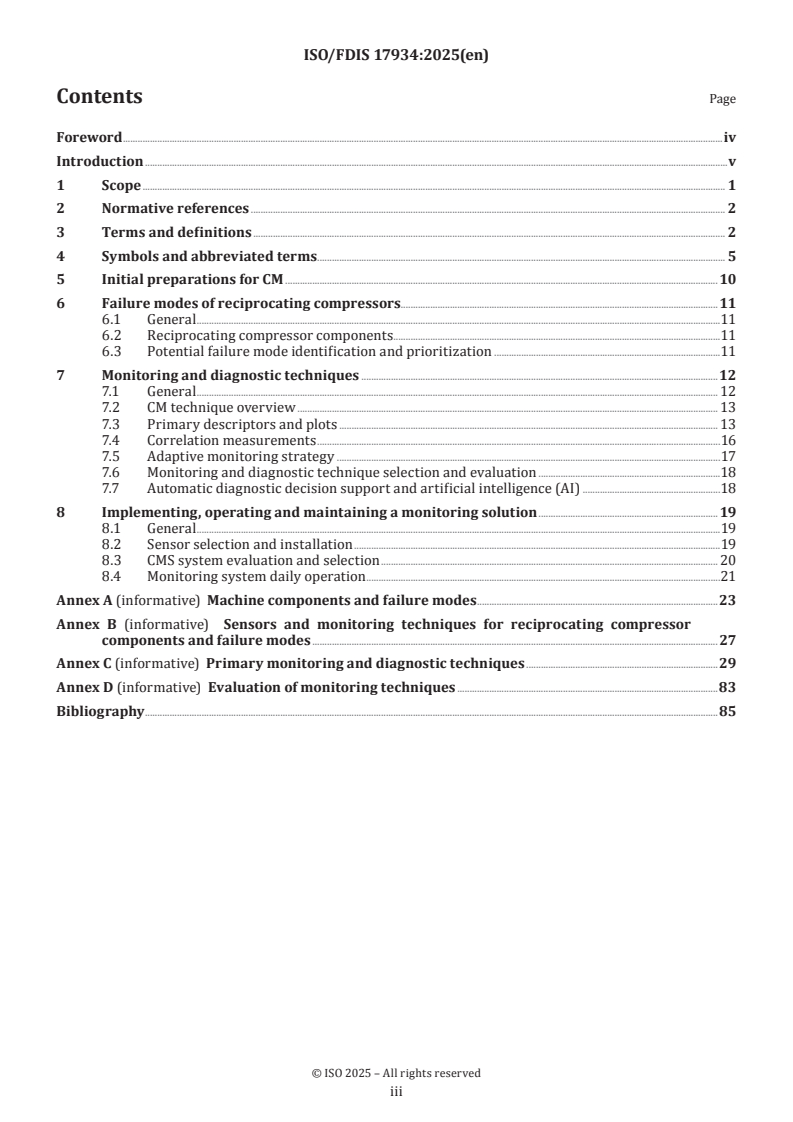
Contents Page
Foreword .iv
Introduction .v
1 Scope . 1
2 Normative references . 2
3 Terms and definitions . 2
4 Symbols and abbreviated terms. 5
5 Initial preparations for CM . 10
6 Failure modes of reciprocating compressors.11
6.1 General .11
6.2 Reciprocating compressor components . .11
6.3 Potential failure mode identification and prioritization .11
7 Monitoring and diagnostic techniques .12
7.1 General . 12
7.2 CM technique overview . 13
7.3 Primary descriptors and plots . 13
7.4 Correlation measurements .16
7.5 Adaptive monitoring strategy .17
7.6 Monitoring and diagnostic technique selection and evaluation .18
7.7 Automatic diagnostic decision support and artificial intelligence (AI) .18
8 Implementing, operating and maintaining a monitoring solution . 19
8.1 General .19
8.2 Sensor selection and installation .19
8.3 CMS system evaluation and selection . 20
8.4 Monitoring system daily operation .21
Annex A (informative) Machine components and failure modes .23
Annex B (informative) Sensors and monitoring techniques for reciprocating compressor
components and failure modes .27
Annex C (informative) Primary monitoring and diagnostic techniques .29
Annex D (informative) Evaluation of monitoring techniques .83
Bibliography .85
iii
Foreword
ISO (the International Organization for Standardization) is a worldwide federation of national standards
bodies (ISO member bodies). The work of preparing International Standards is normally carried out through
ISO technical committees. Each member body interested in a subject for which a technical committee
has been established has the right to be represented on that committee. International organizations,
governmental and non-governmental, in liaison with ISO, also take part in the work. ISO collaborates closely
with the International Electrotechnical Commission (IEC) on all matters of electrotechnical standardization.
The procedures used to develop this document and those intended for its further maintenance are described
in the ISO/IEC Directives, Part 1. In particular, the different approval criteria needed for the different types
of ISO documents should be noted. This document was drafted in accordance with the editorial rules of the
ISO/IEC Directives, Part 2 (see www.iso.org/directives).
ISO draws attention to the possibility that the implementation of this document may involve the use of (a)
patent(s). ISO takes no position concerning the evidence, validity or applicability of any claimed patent
rights in respect thereof. As of the date of publication of this document, ISO had not received notice of (a)
patent(s) which may be required to implement this document. However, implementers are cautioned that
this may not represent the latest information, which may be obtained from the patent database available at
www.iso.org/patents. ISO shall not be held responsible for identifying any or all such patent rights.
Any trade name used in this document is information given for the convenience of users and does not
constitute an endorsement.
For an explanation of the voluntary nature of standards, the meaning of ISO specific terms and expressions
related to conformity assessment, as well as information about ISO's adherence to the World Trade
Organization (WTO) principles in the Technical Barriers to Trade (TBT), see www.iso.org/iso/foreword.html.
This document was prepared by Technical Committee ISO/TC 108, Mechanical vibration, shock and condition
monitoring, Subcommittee SC 5, Condition monitoring and diagnostics of machine systems.
Any feedback or questions on this document should be directed to the user’s national standards body. A
complete listing of these bodies can be found at www.iso.org/members.html.
iv
Introduction
Reciprocating compressors have been used in industry long before centrifugal, axial and other types of
compressors were invented, and they are still being used today. In fact, reciprocating compressors have a
special niche in the industry that cannot be matched by other types. These are applications where precise,
efficient high-pressure gas delivery is needed with low flow rates in comparison with turbo-compressors.
This is made possible by the positive displacement compression action of reciprocating compressors. The
compressor’s efficient flexibility is essential for variable process conditions such as for multiple-stream
compression and for gases that vary in molecular weight. They are able to generate high pressure ratios
independent of the density of the gas and are very flexible to control the flow capacity. In the hydrocarbon
processing industry, the reciprocating compressor is ideal for low molecular weight gases such as hydrogen
(H ).
Reciprocating compressors are increasingly important in refinery processes (e.g. hydrotreating,
hydrocracking, isomerisation and catalytic reforming), many of which are intended for producing
cleaner fuels. There are many industrial applications today that require this type of compression and this
requirement will continue to be important well into the future. This is especially true in future energy
transition processes such as midstream transport and storage, where pure hydrogen or a blend of hydrogen
with natural gas will become an important energy carrier.
The reciprocating compressor successfully fulfils those process requirements for which it is intended, but
there is a challenge from the maintenance side for these machines. As a result of the many moving parts
(rotation and translation) and the high-dynamic forces and moments caused by the reciprocating movement
of them (including pulsation-induced forces and cylinder gas forces, also called cylinder stretch forces),
there is a higher incidence of wear, leakage and breakage, compared to the centrifugal compressor. The
extra maintenance and downtime incurred by reciprocating compressors, both planned and unplanned, can
represent a critical bottleneck to process production, if not properly managed.
Because of the design of the reciprocating compressor, it will always require more maintenance (e.g. replacing
compressor valves, piston rings and rider bands, and packing) than a comparable turbo-compressor.
Therefore, an effective condition monitoring and diagnostic strategy plays an extremely important role for
reducing downtime and life cycle costs of these machines while increasing reliability, safety, integrity and
efficiency.
Traditionally, however, the reciprocating compressor is often less monitored or incorrectly monitored
compared to other critical plant machinery. This is partly due to the difficulty of detecting and diagnosing
the unique potential failure modes associated with the compressor’s reciprocating action, caused by the
dynamic loads already described. From a vibration perspective, many machine faults manifest themselves
as impacts (i.e. short duration non-stationary peaks or peaks that occur only at approximate specific
crank angles). Consumable component wear is difficult to monitor directly and therefore requires the use
of specialized measurement techniques as does cylinder trim leak detection and diagnosis. Pressure and
flow-induced pulsations due to the reciprocating action can distort the raw signals, therefore not only are
specialized measurement techniques required, but also expertise in interpreting the results.
In general, there is less understanding of the condition monitoring and diagnostics requirements of
reciprocating compressors compared to other machines and there has been a lack of standards to fulfil this
void. Existing standards such as ISO 13631, ISO 20816-8, API STD 618 and API STD 670 deal with design,
procurement, installation and protection of the reciprocating compressors but very few of them address
condition monitoring and diagnostics.
Emission regulations have recently become more stringent, therefore monitoring gas leakage to the
atmosphere is briefly mentioned in this document.
The CM and diagnostic strategy and techniques described in this document apply to reciprocating
compressors with many different machine configurations (e.g. number of stages, speed range, cylinder
lubrication, capacity control, cylinder cooling) and is used in many different industrial applications.
However, from a cost benefits perspective, this document is most relevant for critical, possibly single-line
machines instead of standby machines and/or units that have an output over 1 000 kW.
v
The vast majority of these types of reciprocating compressors are used in the hydrocarbon and chemical
processing industries and natural gas transport and storage facilities. As these machines are used
extensively in the upstream, midstream and downstream oil and gas industries, the focus will be on these
applications but this by no means excludes critical applications in other industries.
vi
FINAL DRAFT International Standard ISO/FDIS 17934:2025(en)
Condition monitoring and diagnostics of machines —
Reciprocating compressors
1 Scope
This document focuses on recommending condition monitoring (CM) techniques for detecting and diagnosing
developing machine faults associated with the most common potential failure modes in reciprocating
compressors.
This document is intended
a) to set out a reliable and effective CM approach for reciprocating compressors,
b) to create a mutual understanding of the criteria for successful reciprocating compressor CM and to
foster cooperation between the various application stakeholders,
c) for use by end-users, contractors, consultants, service providers, machine and part manufacturers and
instrument suppliers,
d) as the reciprocating compressor design, its operation and maintenance regime can be very different
from one application to the next, it is important to highlight that condition monitoring and diagnostics
method described in this document is reference guidelines and non-mandatory information, and
e) To make this standard more effective, it is required to actively share the operation and condition data of
the reciprocating compressor among the relevant parties.
Some of the reciprocating compressor types covered by the requirements of this document include:
f) slow (under 600 r/min) and moderate speed (600 r/min to 1 000 r/min) machines manufactured and
procured in accordance with the requirements of API STD 618;
g) high-speed and pre-packaged machines (over 1 000 r/min) on a skid that are manufactured and
procured in accordance with the requirements of ISO 13631 or API SPEC 11P;
h) hyper compressors used for secondary ethylene compression in low density polyethylene (LDPE)
production;
i) lubricated and non-lubricated machines;
j) water-cooled and gas-cooled machines;
k) horizontal, vertical V-type, L-type and W-type machines;
l) horizontal, vertical machines with piston rings and those with labyrinth seal pistons (vertical machines
only);
m) single-acting and double acting machines;
n) machines with a tandem cylinder configuration;
o) single and multi-stage compression machines;
p) machines with and without capacity control;
q) ring, poppet, reed and plate valve type machines;
r) machines mounted on flexible and rigid structures;
s) machines driven by electric motors, gas and diesel engines, turbines (with or without a gearbox) all
with a flexible or rigid coupling;
t) integral gas-engine-driven machines (engine portion out of scope);
u) offshore applications (e.g. platforms, FPSOs (floating production storage and offloading), FLNGs
(floating liquified natural gas), FPU (offshore foating production unit) and fixed installations).
This document focuses on the compressor itself (cylinders, distance pieces, crosshead, frame and all internal
parts) and not on the prime mover or the external systems (e.g. piping, scrubbers, pulsation vessels, and
pulsation control devices). Only brief mention is made of monitoring the foundation, skid and pedestal.
The scope does not include requirements for monitoring the auxiliary systems (e.g. for lubrication, cylinder
cooling, intercoolers and gas purging), but process parameters from these systems are often monitored.
The scope does not cover installation analyses of systems either, (e.g. pulsation and mechanical response
and thermal analysis of the piping).
This document covers online (permanently installed) and portable instrument CM and diagnostic techniques
for operating reciprocating compressors.
Machine testing, which is only done during shutdown, although very important, is not part of the scope of
this document, nor is the one-time acceptance and performance testing.
2 Normative references
The following documents are referred to in the text in such a way that some or all of their content constitutes
requirements of this document. For dated references, only the edition cited applies. For undated references,
the latest edition of the referenced document (including any amendments) applies.
API STD 618, Reciprocating Compressors for Petroleum, Chemical, and Gas Industry Services
3 Terms and definitions
For the purposes of this document, the following terms and definitions apply.
ISO and IEC maintain terminology databases for use in standardization at the following addresses:
— ISO Online browsing platform: available at https://www.iso.org/obp
— IEC Electropedia: available at https://www.electropedia.org/
3.1
machine state
operational process or duty cycle of the reciprocating compressor
EXAMPLE Stopped, unloaded, loaded, capacity control (variable frequency drive, valve unloading, clearance
pockets, recycling), change of speed, change of suction and/or discharge conditions and change of gas properties.
3.2
descriptor
data item derived from raw or processed parameters or external observation
[SOURCE: ISO 16079-1:—, 3.4]
Note 1 to entry: Descriptors are used to express symptoms and anomalies. The descriptors used for monitoring and
diagnostics are generally those obtained from condition monitoring systems. However, operational parameters, like
any other measurement, can be considered as descriptors.
Note 2 to entry: Descriptors are also referred to as "condition monitoring descriptors".
3.3
prime mover
engine, motor or turbine that drives the reciprocating compressor
3.4
monitoring technique
measurement or set of descriptors (3.2) used to detect a potential failure mode (3.12) or provide diagnostic
information on the type of fault that has occurred, its location and severity
3.5
crank throw
portion of crankshaft that connects to a single or tandem cylinder
Note 1 to entry: Also refers to the entire cylinder and distance piece assembly connected to the crankshaft.
3.6
stroke
distance travelled by the piston from TDC to BDC, or vice versa
Note 1 to entry: In quantitative terms, it is the crank rotation diameter or crank radius × 2.
3.7
rod reversal
change in direction of force in the piston rod/crosshead pin loading (tension to compression or vice-versa),
which results in a load reversal at the crosshead pin during each revolution
[SOURCE: ISO 13631:2002, 3.14, modified — "/crosshead" has been added.]
3.8
tail rod
rod extension from piston on HE to ensure equal volume displacement on both sides of piston for more equal
loading as well as provide optimal piston alignment
3.9
tandem cylinder
arrangement of at least two pistons on the same rod moving in separate chambers in the same cylinder
[SOURCE: ISO 5598:2020, 3.2.753]
Note 1 to entry: The order of the large and small pistons on the rod depends on the application.
3.10
combined rod load
algebraic sum of gas load and inertia force on the crosshead pin
[SOURCE: API STD 618:2024, 3.7]
Note 1 to entry: Gas load is the force resulting from differential gas pressure acting on the piston differential area.
Inertia force is the force resulting from the acceleration of reciprocating mass. The inertia force with respect to the
crosshead pin is the summation of the products of all reciprocating masses (piston and rod assembly, and crosshead
assembly including pin) and their respective acceleration.
3.11
crosshead
mechanical joint that converts rotary motion of the crankshaft into a reciprocating motion of the piston and
piston rod with minimal friction
3.12
potential failure mode
change in condition of a reciprocating compressor component that can be detected by measurements that
indicate an incipient fault is developing, which will eventually lead to failure
3.13
crank angle reference sensor
reference speed and phase sensor or a crankshaft position sensor, that generates at least one pulse per crank
revolution, which is used for determining machine speed and for synchronizing one or more descriptors
(3.2) to crank angles
Note 1 to entry: Different types of sensors (displacement sensors, inductive sensors and optical sensors) with different
types of outputs are used for this purpose.
Note 2 to entry: API STD 670 specifies displacement sensors for protection systems.
3.14
indicated power
brake power multiplied by the η
mech
Note 1 to entry: It also represents the total area enclosed in a pV diagram times the speed.
3.15
brake power
power delivered by the prime mover (3.3) to supply the indicated power for the cylinder and compensate for
frictional losses
Note 1 to entry: to entry; It is also the ratio of the indicated power to η .
mech
Note 2 to entry: Frictional losses are the sum of indicated power and friction power.
Note 3 to entry: Brake horsepower of a reciprocating compressor is the power measured using a brake type (load)
dynamometer at the crankshaft.
3.16
adiabatic power
power required for isentropic compression and expansion within the cylinder chamber
3.17
friction power
power lost due to rider band and piston ring friction on the liner, packing friction, crosshead pin friction and
the connecting rod bearing and the main bearing friction
3.18
prognostics
analysis of the symptoms of faults to predict a future condition and remaining useful life
[SOURCE: ISO 6781-1:2023, 3.1.20]
Note 1 to entry: This can be a data-driven or model-based prediction model where loading conditions are continuously
monitored.
3.19.1
volumetric efficiency
ratio of the actual volume of gas displaced by the piston during discharge and
suction and discharge to the swept volume
Note 1 to entry: There are two values for this, for discharge and suction.
3.19.2
volumetric efficiency
ratio of the stroke distance the valves are open to the total piston displacement-
stroke
Note 1 to entry: There are two values for this, for discharge and suction.
3.20
compressor efficiency
ratio of the compressed gas energy delivered to the consumed power to compress the gas
Note 1 to entry: It gives an indication of the combined thermodynamic losses due to all the valves during the gas
compression and expansion work. It also includes losses due to gas friction and mechanical losses.
4 Symbols and abbreviated terms
For the purposes of this document, symbols and abbreviated terms that apply are listed in Table 1:
Table 1 — Symbols and abbreviated terms
Symbol/abbreviation Description Unit Reference
AI Artificial intelligence — 7.7
Bottom dead center, most retracted position of the ° Figure C.3
BDC
piston in the cylinder on the CE side
Specific heat capacity at constant volume and con- J/kg·K, J/ See k
C , C stant pressure, respectively. The ratio of these two kg·°C
p v
coefficients is the isentropic exponent k
CE Crank end side of cylinder — Figure A.1, C.2, C.4
— 6.3, 7.2, 8.2, 8.4
CM Condition monitoring
Table 2
— 8.1, 8.2, 8.3, 8.4
CMS Condition monitoring system
Table 2
— 7.2, 8.3
DCS Distributed control system
Table C.2, C.11, C.15
mm Figure C.4, C.10
d Cylinder diameter
cyl
Formulae (C.1), (C.27)
mm Figure C.4, C.10
d Piston rod or tail rod diameter
rod
Formulae (C.1), (C.27)
f Geometric factor for calculating rider band wear — C.17.2.3
g
Formulae (C.33), (C.34)
F Gas forces on piston N Figure C.9, C.10
gas
Formulae (C.23),
(C.27), (C.28)
F Peak gas load (tension and compression) N Formula (C.28)
gas,peak
F Inertia forces of running gear components N Figure C.9, C.10
inertia
Formulae (C.23), (C.29)
F Peak load during compression N Figure C.9
peak,compr
Formulae (C.25), (C.26)
F Peak load during tension N Figure C.9
peak,tens
Formulae (C.24), (C.26)
F Peak load difference (tension and compression) — Formula (C.26)
peak,%diff
F Piston rod load N Figure C.9
rod
Formula (C.23)
— Table C.4
Flow balance between compressor suction and
B
f
discharge capacities
Formula (C.11)
HE Head end side of cylinder — Figure A.1, C.2, C.4
TTabablele 1 1 ((ccoonnttiinnueuedd))
Symbol/abbreviation Description Unit Reference
— C.7, C.8, C.5.2
Isentropic exponent (also known as the ratio of spe-
cific heats, C /C ). Used in performance calculations Table 7, C.3, C.4, C.6
p v
k
but in many cases more accuracy can be achieved
Formulae (C.3), (C.4),
using the polytropic exponent n instead.
(C.15), (C.17)
mm Figure C.4, C.10
l Connecting rod length
Formulae (C.1), (C.2),
(C.29)
L Distance from crosshead wrist pin to point on the mm C.17.2.3
piston rod directly under the displacement sensor
Figure C.21
(for calculating rider band wear)
Formula (C.34)
L Fixed length between the crosshead wrist pin to a mm C.17.2.3, C.13.2.4
point between the rider bands (for calculating rider
Figure C.21
band wear)
Formula (C.34)
L Lower range limit for determining outlying data in °K, °C C.13.2.4
RL
a data set. Used for T gas discharge tempera-
Table C.12
D,act
ture spread monitoring
Formula (C.31)
kg Figure C.10
Mass of running components (e.g. piston, piston
m
rod
rod, crosshead)
Formula (C.29)
MACCPL Maximum allowable continuous combined pin load N C.10.2.2
MACCRL Maximum allowable continuous combined rod load N C.10.2.2
MACCGL Maximum allowable continuous combined gas load N C.10.2.2
ML Machine learning — 7.7
— C.11
Figure C.11
n Polytropic exponent that depends on gas properties
Table 7, C.9
Formula (C.30)
— 8.4, C.2.3.3, C.5.2.2,
OEM Original equipment manufacturer C.7.3, C.12.1C.12.1,
Table D.2
Successively measured CE or HE cylinder pressures Pa C.3, C.11
that correspond to expected cylinder volumes
Formulae (C.3), (C.30)
p , p
A B
V , and V , for an adiabatic pV or polytropic
theo A theo B
exponent n plot, or with V(ϴ) for an actual pV plot
Pa C.3, C.9
Figure C.3, C.5, C.6, C.7
p Discharge pressure (absolute)
D
Formulae (C.4), (C.15),
(C.17), (C.22)
Pressure in CE and HE compression chambers, Pa Figure C.10, C.17
p , p
CE HE
respectively
µm, mm/s, C.17.2.2
Peak to peak. Difference between the maximum
Pk-Pk
m/s
and minimum peak value within a time interval
Table C.19
Pa C.3, C.9
Figure C.3, C.5, C.6, C.7
p Suction pressure (absolute)
S
Formulae (C.4), (C.8),
(C.15), (C.17), (C.22)
Pa C.6.2.3
p Pressure at standard conditions
std
Formula (C.8)
— C.3
pV Pressure-volume
Figure C.3, C.5, C.6, C.7,
C.8, C.11, C.12
TTabablele 1 1 ((ccoonnttiinnueuedd))
Symbol/abbreviation Description Unit Reference
W C.8.2.3
Figure C.8
P Adiabatic power
adia
Table C.6
Formula (C.18),
W C.8.2.8
P Brake power Table C.6
brake
Formula (C.21)
W C.8.2.5
Figure C.8
Table C.6
P Indicated power
ind
Formulae (C.12), (C.14),
(C.18), (C.19), (C.20),
(C.21)
W/(m /s) C.6.2.8, C.6.2.9
P is the ratio of P to Q for a specific cylinder
ind/cap ind
P , P pressure chamber (e.g. P , etc.) and P Table C.4, C.6
ind/cap ind/cap,sum cyl,I,CE ind/cap,sum
is the sum of P for all cylinders or all stages
Formulae (C.12), (C.14)
ind/cap
W C.8.2.2
P Isentropic power Table C.6
isen
Formulae (C.17), (C.18)
W C.8.2.4
Figure C.8
P Suction valve power loss
Sv
Table C.6
Formula (C.19)
— C.8.2.7
P Ratio of P to P Table C.6
Sv/ind Sv ind
Formula (C.19)
W C.8.2.4
Figure C.8
P Discharge valve power loss
Dv
Table C.6
Formula (C.20)
— C.8.2.7
P Ratio of P to P Table C.6
Dv/ind Dv ind
Formula (C.20)
°K, °C C.13.2.4
Median of data set quartiles. Used for T gas
D,act
q , q , q Table C.12
1 2 3
discharge temperature spread monitoring
Formulae (C.31), (C.32)
m /s C.6.2.2, C.6.2.9
Average capacity (volumetric flow) for a specific
Table C.4
Q, Q cylinder pressure chamber (e.g. Q , etc.) and
sum cyl,i,CE
Formulae (C.10), (C.12),
Q is the sum of Q for all cylinders or all stages
sum
(C.13)
m /s C.6.2.5
Table C.4
Q Capacity at discharge conditions)
D
Formulae (C.7), (C.8),
(C.9), (C.10), (C.11)
Q Capacity, mass flow kg/s C.6.2.1
m
m /s C.6.2.2
Table C.4
Q Capacity at inlet conditions
S
Formulae (C.7), (C.8),
(C.9), (C.10), (C.11)
TTabablele 1 1 ((ccoonnttiinnueuedd))
Symbol/abbreviation Description Unit Reference
m /s C.6.2.4
Q and Q can be calculated to be more accurate
S D
Q , Q
S,real D,real
using real gas compressibility factors Z , Z and Z
Formula (C.9)
S D std
Q and Q can be calculated to standard conditions m /s C.6.2.3
S D
Q , Q for easier comparison, using standard condition
S,std D,std Formula (C.8)
factors T and p
std std
mm Figure C.4, C.9
r Crank radius (stroke/2)
Formulae (C.1), (C.2),
(C.29)
— C.9
R Compression ratio Table C.7
compr
Formula (C.22)
mm/s, m/ C.16.2.3, C.17.2.2. a)
Root mean squared. Total vibration energy of the
RMS
s
amplitude over a time interval
Table C.19
µm C.17.2.2
Maximum orbital displacement of a shaft in a jour-
s
max
nal bearing
Table C.19
°K, °C C.7, C.13
Table C.5, C.11
T Discharge temperature
D
Formulae (C.8), (C.15),
(C.16)
°C C.7.2.3, C.13
T Measured gas discharge temperature Table C.5, C.11
D, act
Formula (C.16)
Top dead center, furthest extension of the piston in ° Figure C.3, C.23
TDC
the cylinder on the HE side
°K, °C C.17.2.2, C.13
T Theoretical gas discharge temperature Table C.5
D, theo
Formulae (C.15), (C.16)
°C C.14
T Temperature of pressure packing
pp
Table C.13
°K, °C C.6.2.3
T Actual suction temperature Table C.5
S
Formulae (C.8), (C.15)
°K, °C C.6.2.3
T Temperature at standard conditions
std
Formulae (C.8)
— C.16.2.4. C.17.2.4
Time waveform signal (e.g. raw vibration or dy-
TWF Table C.16, C.17, C.19
namic pressure)
Figure C.17, C.22
U Upper range limit for determining outlying data in a °K, °C C.13.2.4
RL
data set. Used for T gas discharge temperature
Table C.12
D,act
spread monitoring
Formula (C.32)
Expected adiabatic cylinder displaced volume m C.3, C.11
V calculated for the respective compression
Formulae (C.3), (C.30)
theo
V , V
theo,A theo,B
chambers CE and HE at the corresponding cylinder
pressures p and p
A B
— C.5
Figure C.7
V Volumetric efficiency at discharge valves
ED
Table C.3
Formula (C.6)
TTabablele 1 1 ((ccoonnttiinnueuedd))
Symbol/abbreviation Description Unit Reference
— C.5
Volumetric efficiency at suction valves (theoretical
Figure C.7
volumetric efficiency at valves is written simply as
V , V
Table C.3
E ES
V , while volumetric efficiency based on measured
E
Formulae (C.4), (C.5),
dynamic pressure is V
ES
(C.7)
m Figure C.3, C.7
CE or HE swept volume displacement in the cylin-
V
Swept
der (V − V )
Formulae (C.7), (C.17)
1 3
m Figure C.3, C.7
V CE or HE discharge volume (V − V )
D 2 3
Formula (C.6)
m Figure C.3, C.7
V CE or HE suction volume (V − V )
S 1 4
Formula (C.5)
m C.3.3.4, C.5.2.3
Figure C.3, C.4, C.5, C.6,
Various cylinder chamber volume values corre-
V (V V ) C.7
i 1, …, 4
sponding to different crank angles
Formulae (C.1), (C.4),
(C.5), (C.6)
m C.5.2.3
Total CE or HE cylinder chamber volume
V Figure C.3, C.7
(V + V )
3 Swept
Formula (C.5), (C.6)
m C.3.3.4, C.5.2.3
V Volume at start of discharge (CE or HE) Figure C.3, C.5, C.6, C.7
Formula (C.6)
m C.5.2.3
CE or HE clearance volume in the cylinder (fixed or Figure C.3, C.4, C.7
V , V , V , V , V
3 CL CL 3.CE 3.HE
variable)
Formulae (C.1), (C.4),
(C.5), (C.6)
m C.3.3.4, C.5.2.3
V Volume at start of suction (CE or HE) Figure C.3, C.5, C.6, C.7
Formula (C.5)
m C.3.2.2
Instantaneous actual displaced cylinder volume
V (ϴ), V (ϴ) calculated as a function of crank angle ϴ for the Figure C.4
CE HE
respective compression chambers CE and HE
Formula (C.1)
X(ϴ) Piston linear displacement as a function of crank mm C.3.2.2
angle ϴ
Figure C.4
Formulae (C.1), (C.2)
x , y Maximum orbital displacement in the X-axis or µm C.17.2.2
max max
Y-axis of a shaft in a journal bearing
Table C.19
Y Calculated rider band wear of the piston to the mm C.17.2.3
L2
cylinder liner between rider bands
Table C.21
Formula (C.33)
Y Measured displacement of piston rod (rider band mm C.17.2.3
L1
wear) at point L1 from the crosshead wrist pin
Figure C.21
Formula (C.33)
— C.6.2.4, C.17.2.2
Compressibility factor for gas at suction, discharge
Z , Z , Z
S D std
and standard conditions, respectively
Formula (C.9)
Vibration amplitude difference between the max- µm, mm/s, C.17.2.2
ΔPk-Pk imum and minimum peak value inside a vibration m/s
Table C.19
segment
TTabablele 1 1 ((ccoonnttiinnueuedd))
Symbol/abbreviation Description Unit Reference
°K, °C C.7.2.3, C.13.2.3
Difference between actual (T ) and theoretical
D,act
ΔT Table C.5
D
(T ) gas discharge temperature
D,theo
Formula (C.16)
η Compressor efficiency — Formula (C.18)
compr
η Mechanical efficiency — Formula (C.21)
mech
ϴ Crank angle , radians Figure C.4, C.9
Formula (C.1)
ν Crank rotational speed r/min Formulae (C.7), (C.17)
ω Crank angular velocity ϴ/s, radi- Figure C.10
ans/s
Formula (C.29)
5 Initial preparations for CM
Implementing an optimal reciprocating compressor condition-based monitoring strategy involves several
steps, all of which should be considered in order to maximize machine reliability, safety, integrity and
efficiency and minimize its lifecycle costs.
a) These initial steps, which are beyond the scope of this document, are generalized in ISO 17359 and
include evaluating:
1) cost benefit analysis of the machine for monitoring;
2) machine maintenance history and potential failure modes;
3) reliability requirements and criticality audit;
4) lead-time-to-maintenance requirements.
b) After the CM strategy has been implemented, it should be periodically reviewed and refined as
experience is gained and monitoring technology improves.
c) If a CMS is already in use, the monitoring and diagnostic functionality of that system should be re-
evaluated from time to time in order to fulfil current CM strategy requirements, as described in a).
d) The entire process of implementing a condition-based monitoring strategy is summarized in Table 2,
which is partly based on ISO 13379-1:2012, Figure 1.
Table 2 — Implementation of a condition-based monitoring solution for reciprocating compressors
CM implementation Activity Remarks
a
CM implementation overview Described in ISO 17359
a
CM strategy
Partly described in IEC 60300-3-3,
a
Cost benefits and risk analysis
IEC 60812, ISO 13379 series
See Tables 3 to 7 for a list of standards for
Failure modes, monitoring techniques, descrip-
CM application specific reciprocating compressor moni-
tors
toring techniques
Data processing, measurement systems, data Partly described in ISO 13374-1,
a
management ISO 13374-2, ISO 13374-3
CMS
a
Data security, cyber security ISO/IEC 27032
Sensors Common types described in this document
General diagnostics described in this
Detection, diagnostics
document
CM operations
a
Root cause analysis, prognostics Standards currently under development
TTabablele 2 2 ((ccoonnttiinnueuedd))
CM implementation Activity Remarks
a
CM implementation activities not covered in this document.
6 Failure modes of reciprocating compressors
6.1 General
The implementation of an effective CM and diagnostic approach for reciprocating compressors is directly
related to the relevant potential failure modes that can occur in specific machine components.
Failure means the component is no longer able to serve its intended function.
A CM solution shall offer enough functionality to detect the prioritized potential failure modes, while
conversely, unneeded functionality that is not planned for the future, should be avoided since this would
only add to cost in terms of investment, training, operation and upkeep.
Failure modes for the components of the reciprocating compressor are described in more detail for
a) cylinders – Table A.1, and
b) distance piece and frame – Table A.2.
Failure modes that are detected by specific monitoring techniques are summarized in Table B.1.
6.2 Reciprocating compressor components
The potential failure modes considered are grouped in these primary component categories (see Figures A.1
and A.2):
a) cylinders – compressor valves, valve unloading mechanism, piston, cylinder liner, variable clearance
volume mechanism, tail rod, piston rings, cylinder liner, piston nut and rider bands;
1)
b) distance pieces (single and double) – primary and low-pressure piston rod pressure packing , piston
rod, oil wipers, packing vent piping, crosshead (guide, shoe, pin and pin bushing);
c) frame and foundation – main bearings, big-end bearings, small-end crankshaft, connecting rod, small-
end bearings, foundation/skid, anchor bolts;
2)
d) gas properties ;
3)
e) auxiliary and other external systems – cooling system, main lubrication system, cylinder and packing
lubrication system, nitrogen buffer gas purge/vent system, knock-out drums.
6.3 Potential failure mode identification and prioritization
The CM solution implemented for a specific application depends on identifying the relevant potential failure
modes that are expected to occur on the machine and then prioritizing them. Although not covered by this
document, this is done by using reliability and risk analysis methods (e.g. failure mode effects analysis
(FMEA), failure modes effects and criticality analysis (FMECA), fault tree analysis (FTA) and other methods,
which are partly covered by the standards summarized under CM Strategy in Table 2).
1) For some reciprocating compressors, the packing can also be part of the cylinder.
2) Gas properties are not strictly a component of the reciprocating compressor, but they play an important role when
calculating performance parameters when monitoring the compressor.
3) The failure modes for these components are often monitored by manufacturer installed sensors and instrumentation,
but this data is important for correlating with reciprocating compressor CM data for more reliable and accurate diagnostics,
as described in 7.4.
The actual method that is most suitable for identifying and prioritizing potential failure modes depends on
the application and requirements.
Regardless of the method employed, there are a number of factors that should be considered for identifying
potential failure modes:
a) OEM machine design and construction;
b) machine refurbishment and modifications;
c) compressor mounting type and design (e.g. foundation, skid, pedestal);
d) compressor piping and vessel restraints;
e) pulsation control systems;
f) maintenance, monitoring and operational history (including off-design operation);
g) ambient conditions;
h) single-line machines instead of standby machines;
i) operating parameters (e.g. type of gas, pressure, temperature, flow and capacity control).
Prioritization of the potential failure modes depends on their criticality in the cost benefits analysis, which
is influenced by:
j) cost of production downtime;
k) current and operation maintenance strategy;
l) machine life cycle costs;
m) availability of spare production capacity;
n) whether the process uses only a single-line machine or there are standby machines;
o) availability of maintenance expertise;
p) availability of CM and diagnostic expertise;
q) availability and procurement times for spare parts.
There are many potential failure modes in reciprocating compressors, some of which can be detected and
diagnosed relatively easily, and some with more difficulty.
This document focuses on the potential failure modes listed in A.3, which are generalized for a wide range
of applications and machine types, which can be monitored and diagnosed using the techniques described
in Annex C. The potential failure modes presented in this document are not prioritized for any specific
application.
As the reciprocating compressor design and its operation and maintenance regime can be very different from
one application to the next, it is important to
...
ISO/TC 108/SC 5
Secretariat: SA
Date: 2025-12-13xx
Condition monitoring and diagnostics of machines — Reciprocating
compressors
Surveillance et diagnostic d'état des machines — Compresseurs alternatifs
FDIS stage
All rights reserved. Unless otherwise specified, or required in the context of its implementation, no part of this publication
may be reproduced or utilized otherwise in any form or by any means, electronic or mechanical, including photocopying,
or posting on the internet or an intranet, without prior written permission. Permission can be requested from either ISO
at the address below or ISO’s member body in the country of the requester.
ISO copyright office
CP 401 • Ch. de Blandonnet 8
CH-1214 Vernier, Geneva
Phone: + 41 22 749 01 11
EmailE-mail: copyright@iso.org
Website: www.iso.org
Published in Switzerland
ii
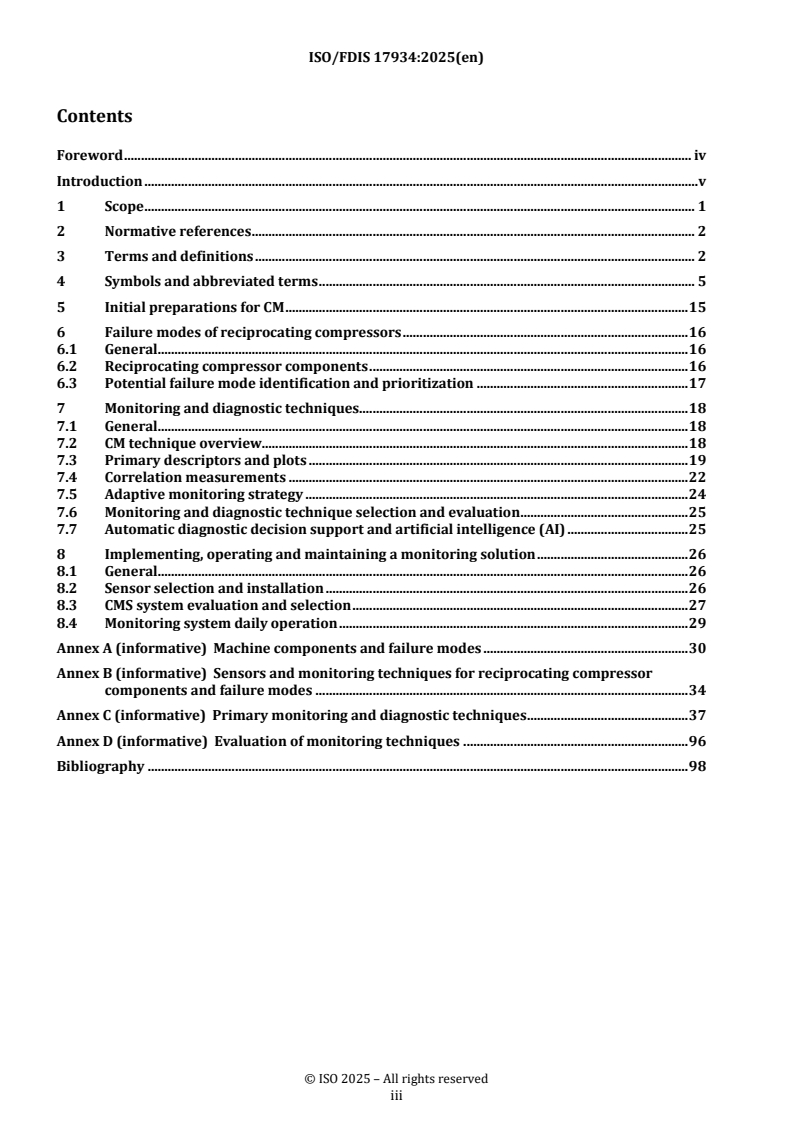
Contents
Foreword . iv
Introduction . v
1 Scope . 1
2 Normative references . 2
3 Terms and definitions . 2
4 Symbols and abbreviated terms . 5
5 Initial preparations for CM . 15
6 Failure modes of reciprocating compressors . 16
6.1 General. 16
6.2 Reciprocating compressor components . 16
6.3 Potential failure mode identification and prioritization . 17
7 Monitoring and diagnostic techniques. 18
7.1 General. 18
7.2 CM technique overview. 18
7.3 Primary descriptors and plots . 19
7.4 Correlation measurements . 22
7.5 Adaptive monitoring strategy . 24
7.6 Monitoring and diagnostic technique selection and evaluation . 25
7.7 Automatic diagnostic decision support and artificial intelligence (AI) . 25
8 Implementing, operating and maintaining a monitoring solution . 26
8.1 General. 26
8.2 Sensor selection and installation . 26
8.3 CMS system evaluation and selection . 27
8.4 Monitoring system daily operation . 29
Annex A (informative) Machine components and failure modes . 30
Annex B (informative) Sensors and monitoring techniques for reciprocating compressor
components and failure modes . 34
Annex C (informative) Primary monitoring and diagnostic techniques . 37
Annex D (informative) Evaluation of monitoring techniques . 96
Bibliography . 98
iii
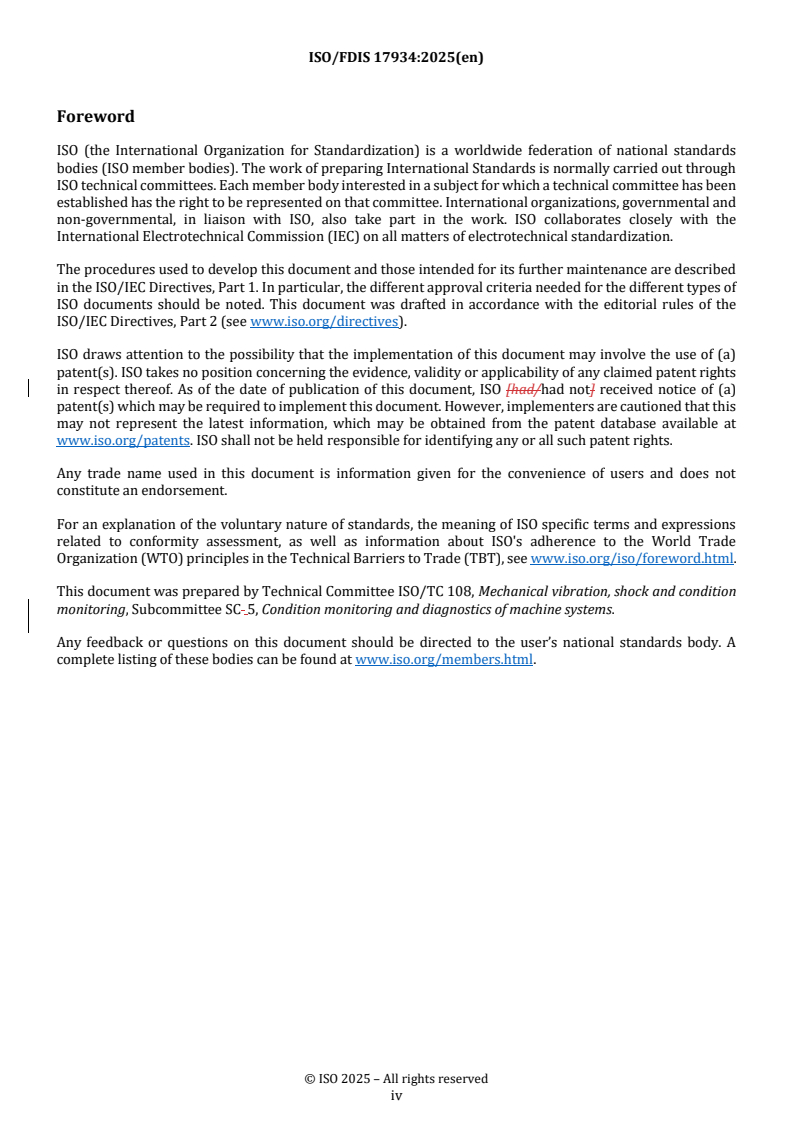
Foreword
ISO (the International Organization for Standardization) is a worldwide federation of national standards
bodies (ISO member bodies). The work of preparing International Standards is normally carried out through
ISO technical committees. Each member body interested in a subject for which a technical committee has been
established has the right to be represented on that committee. International organizations, governmental and
non-governmental, in liaison with ISO, also take part in the work. ISO collaborates closely with the
International Electrotechnical Commission (IEC) on all matters of electrotechnical standardization.
The procedures used to develop this document and those intended for its further maintenance are described
in the ISO/IEC Directives, Part 1. In particular, the different approval criteria needed for the different types of
ISO documents should be noted. This document was drafted in accordance with the editorial rules of the
ISO/IEC Directives, Part 2 (see www.iso.org/directives).
ISO draws attention to the possibility that the implementation of this document may involve the use of (a)
patent(s). ISO takes no position concerning the evidence, validity or applicability of any claimed patent rights
in respect thereof. As of the date of publication of this document, ISO [had/had not] received notice of (a)
patent(s) which may be required to implement this document. However, implementers are cautioned that this
may not represent the latest information, which may be obtained from the patent database available at
www.iso.org/patents. ISO shall not be held responsible for identifying any or all such patent rights.
Any trade name used in this document is information given for the convenience of users and does not
constitute an endorsement.
For an explanation of the voluntary nature of standards, the meaning of ISO specific terms and expressions
related to conformity assessment, as well as information about ISO's adherence to the World Trade
Organization (WTO) principles in the Technical Barriers to Trade (TBT), see www.iso.org/iso/foreword.html.
This document was prepared by Technical Committee ISO/TC 108, Mechanical vibration, shock and condition
monitoring, Subcommittee SC 5, Condition monitoring and diagnostics of machine systems.
Any feedback or questions on this document should be directed to the user’s national standards body. A
complete listing of these bodies can be found at www.iso.org/members.html.
iv
Introduction
Reciprocating compressors have been used in industry long before centrifugal, axial and other types of
compressors were invented, and they are still being used today. In fact, reciprocating compressors have a
special niche in the industry that cannot be matched by other types. These are applications where precise,
efficient high-pressure gas delivery is needed with low flow rates in comparison with turbo-compressors. This
is made possible by the positive displacement compression action of reciprocating compressors. The
compressor’s efficient flexibility is essential for variable process conditions such as for multiple-stream
compression and for gases that vary in molecular weight. They are able to generate high pressure ratios
independent of the density of the gas and are very flexible to control the flow capacity. In the hydrocarbon
processing industry, the reciprocating compressor is ideal for low molecular weight gases such as hydrogen
(H ).
Reciprocating compressors are increasingly important in refinery processes (e.g.,. hydrotreating,
hydrocracking, isomerisation and catalytic reforming), muchmany of which isare intended for producing
cleaner fuels. There are many industrial applications today that require this type of compression and this
requirement will continue to be important well into the future. This is especially true in future energy
transition processes such as midstream transport and storage, where pure hydrogen or a blend of hydrogen
with natural gas will become an important energy carrier.
The reciprocating compressor successfully fulfils those process requirements for which it is intended, but
there is a challenge from the maintenance side for these machines. As a result of the many moving parts
(rotation and translation) and the high-dynamic forces and moments caused by the reciprocating movement
of them (including pulsation-induced forces and cylinder gas forces, also called cylinder stretch forces), there
is a higher incidence of wear, leakage and breakage, compared to the centrifugal compressor. The extra
maintenance and downtime incurred by reciprocating compressors, both planned and unplanned, can
represent a critical bottleneck to process production, if not properly managed.
Because of the design of the reciprocating compressor, it will always require more maintenance (e.g.,.
replacing compressor valves, piston rings and rider bands, and packing) than a comparable turbo-compressor.
Therefore, an effective condition monitoring and diagnostic strategy plays an extremely important role for
reducing downtime and life cycle costs of these machines while increasing reliability, safety, integrity and
efficiency.
Traditionally, however, the reciprocating compressor is often less monitored or incorrectly monitored
compared to other critical plant machinery. This is partly due to the difficulty of detecting and diagnosing the
unique potential failure modes associated with the compressor’s reciprocating action, caused by the dynamic
loads already described. From a vibration perspective, many machine faults manifest themselves as impacts
(i.e.,. short duration non-stationary peaks or peaks that occur only at approximate specific crank angles).
Consumable component wear is difficult to monitor directly and therefore requires the use of specialized
measurement techniques as does cylinder trim leak detection and diagnosis. Pressure and flow-induced
pulsations due to the reciprocating action can distort the raw signals, therefore not only are specialized
measurement techniques required, but also expertise in interpreting the results.
In general, there is less understanding of the condition monitoring and diagnostics requirements of
reciprocating compressors compared to other machines and there has been a lack of standards to fulfil this
void. Existing standards such as ISO 13631, ISO 20816-8, API STD 618 and API STD 670 deal with design,
procurement, installation and protection of the reciprocating compressors but very few of them address
condition monitoring and diagnostics.
Emission regulations have recently become more stringent, therefore monitoring gas leakage to the
atmosphere is briefly mentioned in this document.
v
The CM and diagnostic strategy and techniques described in this document apply to reciprocating
compressors with many different machine configurations (e.g.,. number of stages, speed range, cylinder
lubrication, capacity control, cylinder cooling) and is used in many different industrial applications.
However, from a cost benefits perspective, this document is most relevant for critical, possibly single-line
machines instead of standby machines and/or units that have an output over 1 000 kW.
The vast majority of these types of reciprocating compressors are used in the hydrocarbon and chemical
processing industries and natural gas transport and storage facilities. As these machines are used extensively
in the upstream, midstream and downstream oil and gas industries, the focus will be on these applications but
this by no means excludes critical applications in other industries.
vi
Condition monitoring and diagnostics of machines — Reciprocating
compressors
1 Scope
This document focuses on recommending condition monitoring (CM) techniques for detecting and diagnosing
developing machine faults associated with the most common potential failure modes in reciprocating
compressors.
This document is intended:
a) a) to set out a reliable and effective CM approach for reciprocating compressors;,
b) b) to create a mutual understanding of the criteria for successful reciprocating compressor CM
and to foster cooperation between the various application stakeholders;,
c) c) for use by end-users, contractors, consultants, service providers, machine and part
manufacturers and instrument suppliers;,
d) d) as the reciprocating compressor design, its operation and maintenance regime can be very
different from one application to the next, it is important to highlight that condition monitoring and
diagnostics method described in this document is reference guidelines and non-mandatory information;,
and
e) e) To make this standard more effective, it is required to actively share the operation and
condition data of the reciprocating compressor among the relevant parties.
Some of the reciprocating compressor types covered by the requirements of this document include:
f) d) slow (under 600 r/min) and moderate speed (600 r/min -to 1 000 r/min) machines
manufactured and procured in accordance with the requirements of API STD 618;
g) e) high-speed and pre-packaged machines (over 1 000 r/min) on a skid that are manufactured
and procured in accordance with the requirements of ISO 13631 or API SPEC 11P;
h) f) hyper compressors used for secondary ethylene compression in low density polyethylene
(LDPE) production;
i) g) lubricated and non-lubricated machines;
j) h) water-cooled and gas-cooled machines;
k) i) horizontal, vertical V-type, L-type and W-type machines;
l) j) horizontal, vertical machines with piston rings and those with labyrinth seal pistons (vertical
machines only);
m) k) single-acting and double acting machines;
n) l) machines with a tandem cylinder configuration;
o) m) single and multi-stage compression machines;
p) n) machines with and without capacity control;
q) o) ring, poppet, reed and plate valve type machines;
r) p) machines mounted on flexible and rigid structures;
s) q) machines driven by electric motors, gas and diesel engines, turbines (with or without a
gearbox) all with a flexible or rigid coupling;
t) r) integral gas-engine-driven machines (engine portion out of scope); and
u) s) offshore applications (e.g.,. platforms, FPSOs (floating production storage and offloading),
FLNGs (floating liquified natural gas), FPU (offshore Floatingfoating production unit) and fixed
installations).
This document focuses on the compressor itself (cylinders, distance pieces, crosshead, frame and all internal
parts) and not on the prime mover or the external systems (e.g.,. piping, scrubbers, pulsation vessels, and
pulsation control devices). Only brief mention is made of monitoring the foundation, skid and pedestal.
The scope does not include requirements for monitoring the auxiliary systems (e.g.,. for lubrication, cylinder
cooling, intercoolers and gas purging), but process parameters from these systems are often monitored.
The scope does not cover installation analyses of systems either, (e.g.,. pulsation and mechanical response and
thermal analysis of the piping).
This document covers online (permanently installed) and portable instrument CM and diagnostic techniques
for operating reciprocating compressors.
Machine testing, which is only done during shutdown, although very important, is not part of the scope of this
document, nor is the one-time acceptance and performance testing.
2 Normative references
API STD 618:2024.
The following documents are referred to in the text in such a way that some or all of their content constitutes
requirements of this document. For dated references, only the edition cited applies. For undated references,
the latest edition of the referenced document (including any amendments) applies.
API STD 618, Reciprocating Compressors for Petroleum, Chemical, and Gas Industry Services
3 Terms and definitions
For the purposes of this document, the following terms and definitions apply.
ISO and IEC maintain terminology databases for use in standardization at the following addresses:
— — ISO Online browsing platform: available at https://www.iso.org/obp
— — IEC Electropedia: available at https://www.electropedia.org/
3.1 3.1
machine state
operational process or duty cycle of the reciprocating compressor
EXAMPLESEXAMPLE Stopped, unloaded, loaded, capacity control (variable frequency drive, valve unloading,
clearance pockets, recycling), change of speed, change of suction and/or discharge conditions and change of gas
properties.
3.2 3.2
descriptor
data item derived from raw or processed parameters or external observation
[SOURCE: ISO 16079-1,:—, 3.4]
Note 1 to entry: Descriptors are used to express symptoms and anomalies. The descriptors used for monitoring and
diagnostics are generally those obtained from condition monitoring systems. However, operational parameters, like any
other measurement, can be considered as descriptors.
Note 2 to entry: Descriptors are also referred to as "condition monitoring descriptors".
3.3 3.3
prime mover
engine, motor or turbine that drives the reciprocating compressor
3.4 3.5
monitoring technique
measurement or set of descriptors (Error! Reference source not found.(3.2)) used to detect a potential
failure mode (Error! Reference source not found.(3.13)) or provide diagnostic information on the type of
fault that has occurred, its location and severity
3.5 3.6
crank throw
portion of crankshaft that connects to a single or tandem cylinder
Note 1 to entry: Also refers to the entire cylinder and distance piece assembly connected to the crankshaft.
3.6 3.7
stroke
distance travelled by the piston from TDC to BDC, or vice versa
Note 1 to entry: In quantitative terms, it is the crank rotation diameter or crank radius × 2.
3.7 3.8
rod reversal
change in direction of force in the piston rod/crosshead pin loading (tension to compression or vice-versa),
which results in a load reversal at the crosshead pin during each revolution
[SOURCE: ISO 13631:2002, 3.14, modified — "/crosshead" has been added.]
3.8 3.9
tail rod
rod extension from piston on HE to ensure equal volume displacement on both sides of piston for more equal
loading as well as provide optimal piston alignment
3.9 3.10
tandem cylinder
arrangement of at least two pistons on the same rod moving in separate chambers in the same cylinder
[SOURCE: ISO 5598:2020, 3.2.753]
Note 1 to entry: The order of the large and small pistons on the rod depends on the application.
3.10 3.11
combined rod load
algebraic sum of gas load and inertia force on the crosshead pin
[SOURCE: API STD 618:2024, 3.7]
Note 1 to entry: Gas load is the force resulting from differential gas pressure acting on the piston differential area.
Inertia force is the force resulting from the acceleration of reciprocating mass. The inertia force with respect to the
crosshead pin is the summation of the products of all reciprocating masses (piston and rod assembly, and crosshead
assembly including pin) and their respective acceleration.
3.11 3.12
crosshead
mechanical joint that converts rotary motion of the crankshaft into a reciprocating motion of the piston and
piston rod with minimal friction
3.12 3.13
potential failure mode
change in condition of a reciprocating compressor component that can be detected by measurements that
indicate an incipient fault is developing, which will eventually lead to failure
3.13 3.14
crank angle reference sensor
reference speed and phase sensor or a crankshaft position sensor, that generates at least one pulse per crank
revolution, which is used for determining machine speed and for synchronizing one or more descriptors
(Error! Reference source not found.(3.2)) to crank angles
Note 1 to entry: Different types of sensors (displacement sensors, inductive sensors and optical sensors) with different
types of outputs are used for this purpose.
Note 2 to entry: API STD 670 specifies displacement sensors for protection systems.
3.14 3.15
indicated power
brake power multiplied by the η
mech
Note 1 to entry: It also represents the total area enclosed in a pV diagram times the speed.
3.15 3.16
brake power
power delivered by the prime mover (Error! Reference source not found.(3.3)) to supply the indicated
power for the cylinder and compensate for frictional losses
Note 1 to entry: to entry; It is also the ratio of the indicated power to ηmech.
Note 2 to entry: Frictional losses are the sum of indicated power and friction power.
Note 3 to entry: Brake horsepower of a reciprocating compressor is the power measured using a brake type (load)
dynamometer at the crankshaft.
3.16 3.17
adiabatic power
power required for isentropic compression and expansion within the cylinder chamber
3.17 3.18
friction power
power lost due to rider band and piston ring friction on the liner, packing friction, crosshead pin friction and
the connecting rod bearing and the main bearing friction
3.18 3.19
prognostics
analysis of the symptoms of faults to predict a future condition and remaining useful life
[SOURCE: ISO 6781-1:2023, 3.1.20]
Note 1 to entry: This can be a data-driven or model-based prediction model where loading conditions are continuously
monitored.
3.18.1 3.20.1
volumetric efficiency
ratio of the actual volume of gas displaced by the piston during discharge and suction
and discharge to the swept volume
Note 1 to entry: There are two values for this, for discharge and suction.
3.18.2 3.20.2
volumetric efficiency
ratio of the stroke distance the valves are open to the total piston displacement-
stroke
Note 1 to entry: There are two values for this, for discharge and suction.
3.19 3.21
compressor efficiency
ratio of the compressed gas energy delivered to the consumed power to compress the gas
Note 1 to entry: It gives an indication of the combined thermodynamic losses due to all the valves during the gas
compression and expansion work. It also includes losses due to gas friction and mechanical losses.
4 Symbols and abbreviated terms
For the purposes of this document, symbols and abbreviated terms that apply are listed in 0Table 1::
C.1, C.2, C.3, C.4, C.5, C.6, C.7, , C.8, C.9, C.10, C.11, C.12, C.13, C.14, C.15, C.16, C.17, C.18, C.19, C.20, C.21, C.22,
C.23, C.24, C.25, C.26, C.27, C.28, C.29, C.30, C.31, C.32, C.33, C.34
Table 1 — Symbols and abbreviated terms
Symbol/abbreviation Description Unit Reference
AI Artificial intelligence -— 7.77.7
Bottom dead center, most retracted position of the
° 0Figure C.3
BDC
piston in the cylinder on the CE side
Specific heat capacity at constant volume and J/kg·K, See k
C , C constant pressure, respectively. The ratio of these J/kg·°C
p v
two coefficients is the isentropic exponent k
-— 0, 0Figure A.1, C.2,
CE Crank end side of cylinder
C.4, 0
Symbol/abbreviation Description Unit Reference
-— 6.3, 7.2, 8.2, 8.46.3,
7.2, 8.2, 8.4
CM Condition monitoring
Table 2
-— 8.1, 8.2, 8.3, 8.48.1,
8.2, 8.3, 8.4
CMS Condition monitoring system
Table 2
-— 7.2, 8.3
0, 07.2, 8.3
DCS Distributed control system
Table C.2, C.11, C.15,
mm 0, 0
d Cylinder diameter 0Figure C.4, C.10
cyl
Equation C.1, C.27, 0
mm 0, 0
d Piston rod or tail rod diameter 0Figure C.4, C.10
rod
Equation C.1, C.27, 0
fg Geometric factor for calculating rider band wear -— C.17.2.3
0C.17.2.3
Equation C.33, C.34, 0
Fgas Gas forces on piston N 0, 0
0, 0Figure C.9, C.10
Equation C.23, C.27,
C.28, 0
F Peak gas load (tension and compression) N 0Equation C.28
gas,peak
F Inertia forces of running gear components N 0, 0
inertia
0Figure C.9, C.10
Equation C.23, C.29, 0
Fpeak,compr Peak load during compression N 0
0Figure C.9
Equation C.25, C.26, 0
Fpeak,tens Peak load during tension N 0
0Figure C.9
Equation C.24, C.26, 0
F Peak load difference (tension and compression) -— 0Equation C.26
peak,%diff
Frod Piston rod load N 0Figure C.9
Equation C.23
-— 0Table C.4
Flow balance between compressor suction and
Bf Equation C.11
discharge capacities
-— 0, 0Figure A.1, C.2,
HE Head end side of cylinder
C.4, 0
Symbol/abbreviation Description Unit Reference
-— C.7, C.8, C.5.2
Isentropic exponent (also known as the ratio of
0, 0, 0, 0
specific heats, Cp/Cv). Used in performance
0, 0, 0C.7, C.8, C.5.2
k calculations but in many cases more accuracy can
Table 7, C.3, C.4, C.6
be achieved using the polytropic exponent n
instead. Equation C.3, C.4,
C.15, C.17, 0
mm 0, 0
0, 0Figure C.4, C.10
l Connecting rod length
Equation C.1, C.2,
C.29, 0
L1 Distance from crosshead wrist pin to point on the mm C.17.2.3
piston rod directly under the displacement sensor
0C.17.2.3
(for calculating rider band wear)
Figure C.21
Equation C.34
L2 Fixed length between the crosshead wrist pin to a mm C.17.2.3, C.13.2.4
point between the rider bands (for calculating
0C.17.2.3, C.13.2.4
rider band wear)
Figure C.21
Equation C.34
LRL Lower range limit for determining outlying data in °K, °C C.13.2.4
a data set. Used for TD,act gas discharge
0C.13.2.4
temperature spread monitoring
Table C.12
Equation C.31
kg 0Figure C.10
Mass of running components (e.g.,. piston, piston
mrod Equation C.29
rod, crosshead)
MACCPL Maximum allowable continuous combined pin load N C.10.2.2C.10.2.2
Maximum allowable continuous combined rod N C.10.2.2C.10.2.2
MACCRL
load
MACCGL Maximum allowable continuous combined gas load N C.10.2.2C.10.2.2
ML Machine learning -— 7.77.7
-— C.11
0, 0C.11
Polytropic exponent that depends on gas
n Figure C.11
properties
Table 7, C.9
Equation C.30
-— 8.4, C.2.3.3, C.5.2.2,
C.7.3, C.12.1C.12.18.4,
OEM Original equipment manufacturer C.2.3.3, C.5.2.2, C.7.3,
C.12.1 C.12.1,
Table D.2, 0
Symbol/abbreviation Description Unit Reference
Successively measured CE or HE cylinder Pa C.3, C.11
pressures that correspond to expected cylinder
0C.3, C.11
pA, pB volumes Vtheo,A and Vtheo,B for an adiabatic pV or
Equation C.3, C.30, 0
polytropic exponent n plot, or with V(ϴ) for an
actual pV plot
Pa C.3, C.9
0, 0, 0, 0
0, 0, 0C.3, C.9
pD Discharge pressure (absolute)
Figure C.3, C.5, C.6,
C.7
Equation C.4, C.15,
C.17, C.22, 0
Pressure in CE and HE compression chambers, Pa 0Figure C.10, C.17, 0
pCE, pHE
respectively
µm, C.17.2.2C.17.2.2
Peak to peak. Difference between the maximum
mm/s,
Pk-Pk Table C.19
and minimum peak value within a time interval 2
m/s
Pa C.3, C.9
0, 0, 0, 0
0, 0, 0, 0C.3, C.9
pS Suction pressure (absolute)
Figure C.3, C.5, C.6,
C.7
Equation C.4, C.8,
C.15, C.17, C.22, 0
Pa C.6.2.3C.6.2.3
p Pressure at standard conditions Equation C.8
std
-— C.3
0, 0, 0, 0, 0, 0C.3
pV Pressure-volume
Figure C.3, C.5, C.6,
C.7, C.8, C.11, C.12, 0
W C.8.2.3
Padia Adiabatic power 0C.8.2.3
Figure C.8
Table C.6
Equation C.18,,
W C.8.2.8
0C.8.2.8
P Brake power Table C.6
brake
Equation C.21
W C.8.2.5
Pind Indicated power 0
Symbol/abbreviation Description Unit Reference
0, 0, 0, 0, 0C.8.2.5
Figure C.8
Table C.6
Equation C.12, C.14,
C.18, C.19, C.20, C.21,
W/(m /s C.6.2.8, C.6.2.9
)
0, 0
Pind/cap is the ratio of Pind to Q for a specific cylinder
pressure chamber (e.g.,. P , etc.) and P
Pind/cap, Pind/cap,sum cyl,I,CE ind/cap,sum 0C.6.2.8, C.6.2.9
is the sum of P for all cylinders or all stages
ind/cap
Table C.4, C.6
Equation C.12, C.14, 0
W C.8.2.2
Pisen Isentropic power 0C.8.2.2
Table C.6
Equation C.17, C.18, 0
W C.8.2.4
0C.8.2.4
PSv Suction valve power loss Figure C.8
Table C.6
Equation C.19
-— C.8.2.7
0C.8.2.7
P Ratio of P to P Table C.6
Sv/ind Sv ind
Equation C.19
W C.8.2.4
0C.8.2.4
P Discharge valve power loss Figure C.8
Dv
Table C.6
Equation C.20
-— C.8.2.7
0C.8.2.7
P Ratio of P to P Table C.6
Dv/ind Dv ind
Equation C.20
°K, °C C.13.2.4
Median of data set quartiles. Used for T gas
D,act
q , q , q 0C.13.2.4
1 2 3
discharge temperature spread monitoring
Table C.12
Equation C.31, C.32, 0
Symbol/abbreviation Description Unit Reference
m /s C.6.2.2, C.6.2.9
Average capacity (volumetric flow) for a specific
0, 0C.6.2.2, C.6.2.9
Q, Qsum cylinder pressure chamber (e.g.,. Qcyl,i,CE, etc.) and
Table C.4
Qsum is the sum of Q for all cylinders or all stages
Equation C.10, C.12,
C.13, 0
m /s C.6.2.5
0, 0, 0, 0C.6.2.5
QD Capacity at discharge conditions)
Table C.4
Equation C.7, C.8, C.9,
C.10, C.11, 0
Q Capacity, mass flow kg/s C.6.2.1C.6.2.1
m
m /s C.6.2.2
0, 0, 0, 0C.6.2.2
QS Capacity at inlet conditions
Table C.4
Equation C.7, C.8, C.9,
C.10, C.11, 0
m /s C.6.2.4C.6.2.4
Q and Q can be calculated to be more accurate
S D
QS,real, QD,real Equation C.9
using real gas compressibility factors ZS, ZD and Zstd
m /s C.6.2.3C.6.2.3
QS and QD can be calculated to standard conditions
QS,std, QD,std for easier comparison, using standard condition Equation C.8
factors T and p
std std
mm 0, 0
0, 0Figure C.4, C.9
r Crank radius (stroke/2)
Equation C.1, C.2,
C.29, 0
-— C.9
0C.9
R Compression ratio Table C.7
compr
Equation C.22
mm/s, C.16.2.3,
m/s C.17.2.2C.16.2.3,
Root mean squared. Total vibration energy of the
RMS
C.17.2.2. a)
amplitude over a time interval
0Table C.19
µm C.17.2.2C.17.2.2
Maximum orbital displacement of a shaft in a
s Table C.19
max
journal bearing
°K, °C C.7, C.13
0, 0
T Discharge temperature
D
0, 0C.7, C.13
Table C.5, C.11
Symbol/abbreviation Description Unit Reference
Equation C.8, C.15,
C.16, 0
°C C.7.2.3, C.13
0, 0C.7.2.3, C.13
TD, act Measured gas discharge temperature Table C.5, C.11
Equation C.16
° 0Figure C.3, C.23
Top dead center, furthest extension of the piston in
TDC
the cylinder on the HE side
, 0
°K, °C C.17.2.2, C.13
TD, theo Theoretical gas discharge temperature 0C.17.2.2, C.13
Table C.5
Equation C.15, C.16, 0
°C C.14C.14
T Temperature of pressure packing Table C.13
pp
°K, °C C.6.2.3
T Actual suction temperature 0C.6.2.3
S
Table C.5
Equation C.8, C, 0
°K, °C C.6.2.3C.6.2.3
Tstd Temperature at standard conditions Equation C.8
-— C.16.2.4. C.17.2.4
0, 0, 0
Time waveform signal (e.g.,. raw vibration or
TWF 0C.16.2.4. C.17.2.4
dynamic pressure)
Table C.16, C.17, C.19
Figure C.17, C.22, 0
URL Upper range limit for determining outlying data in °K, °C C.13.2.4
a data set. Used for TD,act gas discharge
0C.13.2.4
temperature spread monitoring
Table C.12
Equation C.32
Expected adiabatic cylinder displaced volume V m C.3, C.11
theo
calculated for the respective compression
0C.3, C.11
Vtheo,A, Vtheo,B
chambers CE and HE at the corresponding cylinder
Equation C.3, C.30, 0
pressures p and p
A B
-— C.5
VED Volumetric efficiency at discharge valves 0C.5
Figure C.7
Table C.3
Symbol/abbreviation Description Unit Reference
Equation C.6
-— C.5
Volumetric efficiency at suction valves (theoretical
volumetric efficiency at valves is written simply as 0, 0C.5
V , V
E ES
VE, while volumetric efficiency based on measured
Figure C.7
dynamic pressure is VES
Table C.3
Equation C.4, C.5, C.7,
m 0, 0
CE or HE swept volume displacement in the
V 0Figure C.3, C.7
Swept
cylinder (V - − V )
1 3
Equation C.7, C.17, 0
m 0, 0Figure C.3, C.7
VD CE or HE discharge volume (V2- − V3) Equation C.6
m 0, 0Figure C.3, C.7
VS CE or HE suction volume (V1- − V4) Equation C.5
m C.3.2.4, C.5.2.3
0, 0, 0, 0, 0
0, 0, 0C.3.3.4, C.5.2.3
Various cylinder chamber volume values
Vi (V1, …, V4)
Figure C.3, C.4, C.5,
corresponding to different crank angles
C.6, C.7
Equation C.1, C.4, C.5,
C.6, 0
m C.5.2.3
0, 0
Total CE or HE cylinder chamber volume
V1 0C.5.2.3
(V + + V )
3 Swept
Figure C.3, C.7
Equation C.5, C.6, 0
m C.3.2.4, C.5.2.3
0, 0, 0, 0C.3.3.4,
C.5.2.3
V Volume at start of discharge (CE or HE) Figure C.3, C.5, C.6,
C.7
Equation C.6
m C.5.2.3
0, 0, 0
CE or HE clearance volume in the cylinder (fixed or 0, 0, 0C.5.2.3
V , V , V , V , V
3 CL CL 3.CE 3.HE
variable)
Figure C.3, C.4, C.7
Equation C.1, C.4, C.5,
C.6, 0
V4 Volume at start of suction (CE or HE) m C.3.2.4, C.5.2.3
Symbol/abbreviation Description Unit Reference
0, 0, 0, 0C.3.3.4,
C.5.2.3
Figure C.3, C.5, C.6,
C.7
Equation C.5
m C.3.1.2
0C.3.2.2
Instantaneous actual displaced cylinder volume
calculated as a function of crank angle ϴ for the
VCE(ϴ), VHE(ϴ) Figure C.4
respective compression chambers CE and HE
Equation C.1
X(ϴ) Piston linear displacement as a function of crank mm C.3.1.2
angle ϴ
0C.3.2.2
Figure C.4
Equation C.1, C.2, 0
x , y Maximum orbital displacement in the X-axis or Y- µm C.17.2.2C.17.2.2
max max
axis of a shaft in a journal bearing
Table C.19
YL2 Calculated rider band wear of the piston to the mm C.17.2.3
cylinder liner between rider bands
0C.17.2.3
Table C.21
Equation C.33
Y Measured displacement of piston rod (rider band mm C.17.2.3
L1
wear) at point L1 from the crosshead wrist pin
0C.17.2.3
Figure C.21
Equation C.33
-— C.6.2.4,
C.17.2.2C.6.2.4,
Compressibility factor for gas at suction, discharge
C.17.2.2
ZS, ZD, Zstd
and standard conditions, respectively
Equation C.9
µm, C.17.2.2C.17.2.2
Vibration amplitude difference between the
mm/s,
ΔPk-Pk maximum and minimum peak value inside a Table C.19
m/s
vibration segment
°K, °C C.7.2.3, C.13.2.3
0C.7.2.3, C.13.2.3
Difference between actual (TD,act) and theoretical
ΔTD Table C.5
(T ) gas discharge temperature
D,theo
Equation C.16
η Compressor efficiency -— 0Equation C.18
compr
η Mechanical efficiency -— 0Equation C.21
mech
Symbol/abbreviation Description Unit Reference
ϴ Crank angle , radians 0, 0Figure C.4, C.9
Equation C.1
ν Crank rotational speed r/min 0Equation C.7, C.17, 0
ω Crank angular velocity ϴ/s, 0Figure C.10
radians/s
Equation C.29
5 Initial preparations for CM
Implementing an optimal reciprocating compressor condition-based monitoring strategy involves several
steps, all of which should be considered in order to maximize machine reliability, safety, integrity and
efficiency and minimize its lifecycle costs .
a) a) These initial steps, which are beyond the scope of this document, are generalized in ISO 17359
and include evaluating:
1) 1) cost benefit analysis of the machine for monitoring;
2) 2) machine maintenance history and potential failure modes;
3) 3) reliability requirements and criticality audit; and
4) 4) lead-time-to-maintenance requirements.
b) b) After the CM strategy has been implemented, it should be periodically reviewed and refined as
experience is gained and monitoring technology improves.
c) c) If a CMS is already in use, the monitoring and diagnostic functionality of that system should be
re-evaluated from time to time in order to fulfil current CM strategy requirements, as described in a).
d) d) The entire process of implementing a condition-based monitoring strategy is summarized in
0Table 2,, which is partly based on ISO 13379-1:2012, Figure 1.
Table 2 — Implementation of a condition-based monitoring solution for reciprocating compressors
CM
Activity Remarks
implementation
a
CM implementation overview Described in ISO 17359
a
CM strategy
Partly described in IEC 60300-3-3,
a
Cost benefits and risk analysis
IEC 60812, ISO 13379 series
See 0Tables 3 to 07 for a list of standards
Failure modes, monitoring techniques,
CM application for specific reciprocating compressor
descriptors
monitoring techniques
Data processing, measurement systems, data Partly described in ISO 13374-1,
a
management ISO 13374-2, ISO 13374-3
a
CMS Data security, cyber security ISO/IEC 27032
Common types described in this
Sensors
document
CM
Activity Remarks
implementation
General diagnostics described in this
Detection, diagnostics
document
CM operations
a
Root cause analysis, prognostics Standards currently under development
a
CM implementation activities not covered in this document are shaded in grey.
6 Failure modes of reciprocating compressors
6.1 General
The implementation of an effective CM and diagnostic approach for reciprocating compressors is directly
related to the relevant potential failure modes that can occur in specific machine components.
Failure means the component is no longer able to serve its intended function.
A CM solution shall offer enough functionality to detect the prioritized potential failure modes, while
conversely, unneeded functionality that is not planned for the future, should be avoided since this would only
add to cost in terms of investment, training, operation and upkeep.
Failure modes for the these components of the reciprocating compressor are described in more detail for:
a) a) cylinders – 0Table A.1;, and
b) b) distance piece and frame – 0Table A.2.
Failure modes that are detected by specific monitoring techniques are summarized in 0Table B.1.
6.2 Reciprocating compressor components
The potential failure modes considered are grouped in these primary component categories (see 0Figures A.1
and 0A.2):):
a) a) cylinders – compressor valves, valve unloading mechanism, piston, cylinder liner, variable
clearance volume mechanism, tail rod, piston rings, cylinder liner, piston nut and rider bands;
1)
b) b) distance pieces (single and double) – primary and low-pressure piston rod pressure packing, ,
piston rod, oil wipers, packing vent piping, crosshead (guide, shoe, pin and pin bushing);
c) c) frame and foundation – main bearings, big-end bearings, small-end crankshaft, connecting rod,
small-end bearings, foundation/skid, anchor bolts;
2)
d) d) gas properties; and ;
3)
e) e) auxiliary and other external systems – cooling system, main lubrication system, cylinder and
packing lubrication system, nitrogen buffer gas purge/vent system, knock-out drums.
1)
For some reciprocating compressors, the packing can also be part of the cylinder.
2)
Gas properties are not strictly a component of the reciprocating compressor, but they play an important role when
calculating performance parameters when monitoring the compressor.
3)
The failure modes for these components are often monitored by manufacturer installed sensors and instrumentation,
but this data is important for correlating with reciprocating compressor CM data for more reliable and accurate
diagnostics, as described in 7.4. The failure modes for these components are often monitored by manufacturer installed
6.3 Potential failure mode identification and prioritization
The CM solution implemented for a specific application depends on identifying the relevant potential failure
modes that are expected to occur on the machine and then prioritizing them. Although not covered by this
document, this is done by using reliability and risk analysis methods (e.g.,. failure mode effects analysis
(FMEA), failure modes effects and criticality analysis (FMECA), fault tree analysis (FTA) and other methods,
which are partly covered by the standards summarized under CM Strategy in 0Table 2).).
The actual method that is most suitable for identifying and prioritizing potential failure modes depends on the
application and requirements.
Regardless of the method employed, there are a number of factors that should be considered for identifying
potential failure modes:
a) a) OEM machine design and construction;
b) b) machine refurbishment and modifications;
c) c) compressor mounting type and design (e.g.,. foundation, skid, pedestal);
d) d) compressor piping and vessel restraints;
e) e) pulsation control systems;
f) f) maintenance, monitoring and operational history (including off-design operation);
g) g) ambient conditions;
h) h) single-line machines instead of standby machines; and
i) i) operating parameters (e.g.,. type of gas, pressure, temperature, flow and capacity control).
Prioritization of the potential failure modes depends on their criticality in the cost benefits analysis, which is
influenced by:
j) j) cost of production downtime;
k) k) current and operation maintenance strategy;
l) l) machine life cycle costs;
m) m) availability of spare production capacity;
n) n) whether the process uses only a single-line machine or there are standby machines;
o) o) availability of maintenance expertise;
p) p) availability of CM and diagnostic expertise; and
q) q) availability and procurement times for spare parts.
sensors and instrumentation, but this data is important for correlating with reciprocating compressor CM data for more
reliable and accurate diagnostics, as described in 7.4.
There are many potential failure modes in reciprocating compressors, some of which can be detected and
diagnosed relatively easily, and some with more difficulty.
This document focuses on the p
...
Questions, Comments and Discussion
Ask us and Technical Secretary will try to provide an answer. You can facilitate discussion about the standard in here.
Loading comments...