


ISO 17874-2:2004
(Main)Remote-handling devices for radioactive materials — Part 2: Mechanical master-slave manipulators
Remote-handling devices for radioactive materials — Part 2: Mechanical master-slave manipulators
ISO 17874-2:2004 specifies the criteria for the selection, installation and use of a mechanical master-slave manipulator, for remote handling of radiaoactive materials in a nuclear facility. ISO 17874-2:2004 deals only with the technical aspects related to the manipulator and its interface with the nuclear facility in which it is intended to be installed. In particular, the process apparatus and the manipulator features need to be studied in parallel in order to optimize all the functionalities of the manipulator. However, ISO 17874-2:2004 does not cover the fundamental design criteria of the nuclear facility (e.g. the process involved, maintenance of the process equipment, intervention for other purposes).
Dispositifs de manipulation à distance pour matériaux radioactifs — Partie 2: Télémanipulateurs maître-esclave mécaniques
L'ISO 17874-2:2004 spécifie les critères de sélection, de montage et d'utilisation d'un télémanipulateur maître-esclave mécanique, pour la manipulation à distance de matériaux radioactifs dans une installation nucléaire. L'ISO 17874-2:2004 ne traite que des aspects techniques relatifs au télémanipulateur et à ses interfaces avec l'installation nucléaire dans laquelle son montage est prévu. En particulier, les appareils du procédé et les caractéristiques du télémanipulateur doivent être étudiés en parallèle dans l'intention d'optimiser toutes les fonctionnalités du télémanipulateur. Cependant, l'ISO 17874-2:2004 ne couvre pas les critères fondamentaux de conception de l'installation nucléaire (par exemple le procédé mis en oeuvre, la maintenance du procédé, les moyens d'intervention destinés à d'autres applications).
General Information
- Status
- Published
- Publication Date
- 05-Dec-2004
- Technical Committee
- ISO/TC 85/SC 2 - Radiological protection
- Drafting Committee
- ISO/TC 85/SC 2 - Radiological protection
- Current Stage
- 9093 - International Standard confirmed
- Start Date
- 09-Sep-2024
- Completion Date
- 12-Feb-2026
Overview
ISO 17874-2:2004 specifies technical criteria for the selection, installation and use of mechanical master‑slave manipulators used for remote handling of radioactive materials in nuclear facilities. It focuses on the manipulator and its interface with the facility (through-wall tubes, connection tubes, gaiters and mounting) and does not cover the fundamental design of the nuclear process or facility maintenance. The standard supports safe, repeatable remote‑handling operations in hot cells, reprocessing, fuel‑fabrication, waste‑treatment and decommissioning applications.
Key topics and technical requirements
The document addresses practical, technical aspects of mechanical master‑slave manipulators, including:
General architecture and classification
- Three main components: master arm, slave arm and connection tube
- Classification into telescopic and articulated manipulators with matched kinematics
Kinematics and force transmission
- Reversible mechanical transmission that provides force reflection from slave to master
- Matching master and slave motions for accurate positioning and orientation
Selection and installation criteria
- Criteria for choosing manipulator type, reach (X/Y/Z), load capacity and balancing
- Integration with through‑wall tubes and shielding windows
Mounting and leak‑tightness
- Mounting methods: sealed and unsealed connection tubes, gaiter (flexible sleeve) designs
- Protection against contamination, gaiter replacement and attachment methods
Operational features and accessories
- Indexing motions, extended reach (double telescope), tongs/jaws interchangeability
- Accessories: shielding connection tubes, balancing systems, power/electric supply considerations
Testing and measurement (Annexes)
- Annex A: measurement methods for no‑load forces, torques, flexures and backlashes
- Annex B: examples of disconnection stations
Applications and users
ISO 17874-2 is intended for practical deployment and regulatory oversight of remote‑handling systems in nuclear environments. Typical users include:
- Nuclear facility designers and hot‑cell engineers specifying remote‑handling capabilities
- Manufacturers of mechanical master‑slave manipulators and remote‑handling equipment
- Operations and maintenance teams using manipulators for handling radioactive materials
- Regulatory and licensing authorities assessing remote‑handling interfaces and safety
Practical applications: hot cells for fuel R&D, fuel fabrication and reprocessing plants, waste treatment, decommissioning tasks and any shielded containment requiring dexterous remote manipulation.
Related standards
Key related documents to consult:
- ISO 17874-1:2004 - Remote‑handling devices for radioactive materials - Part 1: General requirements
- ISO 17874-3/4/5 - Other parts addressing electrical manipulators, power manipulators and tongs
- ISO 11933-1/2 and ISO 10648-2 - Components for containment enclosures, gloves/gaiters and leak‑tightness classification
Keywords: ISO 17874-2, mechanical master‑slave manipulators, remote‑handling devices, hot cells, radioactive materials, connection tube, gaiter, through‑wall tube.
Get Certified
Connect with accredited certification bodies for this standard

NSF International
Global independent organization facilitating standards development and certification.

CIS Institut d.o.o.
Personal Protective Equipment (PPE) certification body. Notified Body NB-2890 for EU Regulation 2016/425 PPE.

Kiwa BDA Testing
Building and construction product certification.
Sponsored listings
Frequently Asked Questions
ISO 17874-2:2004 is a standard published by the International Organization for Standardization (ISO). Its full title is "Remote-handling devices for radioactive materials — Part 2: Mechanical master-slave manipulators". This standard covers: ISO 17874-2:2004 specifies the criteria for the selection, installation and use of a mechanical master-slave manipulator, for remote handling of radiaoactive materials in a nuclear facility. ISO 17874-2:2004 deals only with the technical aspects related to the manipulator and its interface with the nuclear facility in which it is intended to be installed. In particular, the process apparatus and the manipulator features need to be studied in parallel in order to optimize all the functionalities of the manipulator. However, ISO 17874-2:2004 does not cover the fundamental design criteria of the nuclear facility (e.g. the process involved, maintenance of the process equipment, intervention for other purposes).
ISO 17874-2:2004 specifies the criteria for the selection, installation and use of a mechanical master-slave manipulator, for remote handling of radiaoactive materials in a nuclear facility. ISO 17874-2:2004 deals only with the technical aspects related to the manipulator and its interface with the nuclear facility in which it is intended to be installed. In particular, the process apparatus and the manipulator features need to be studied in parallel in order to optimize all the functionalities of the manipulator. However, ISO 17874-2:2004 does not cover the fundamental design criteria of the nuclear facility (e.g. the process involved, maintenance of the process equipment, intervention for other purposes).
ISO 17874-2:2004 is classified under the following ICS (International Classification for Standards) categories: 13.280 - Radiation protection. The ICS classification helps identify the subject area and facilitates finding related standards.
ISO 17874-2:2004 is available in PDF format for immediate download after purchase. The document can be added to your cart and obtained through the secure checkout process. Digital delivery ensures instant access to the complete standard document.
Standards Content (Sample)
INTERNATIONAL ISO
STANDARD 17874-2
First edition
2004-12-01
Remote-handling devices for radioactive
materials —
Part 2:
Mechanical master-slave manipulators
Dispositifs de manipulation à distance pour matériaux radioactifs —
Partie 2: Télémanipulateurs maître-esclave mécaniques
Reference number
©
ISO 2004
PDF disclaimer
This PDF file may contain embedded typefaces. In accordance with Adobe's licensing policy, this file may be printed or viewed but
shall not be edited unless the typefaces which are embedded are licensed to and installed on the computer performing the editing. In
downloading this file, parties accept therein the responsibility of not infringing Adobe's licensing policy. The ISO Central Secretariat
accepts no liability in this area.
Adobe is a trademark of Adobe Systems Incorporated.
Details of the software products used to create this PDF file can be found in the General Info relative to the file; the PDF-creation
parameters were optimized for printing. Every care has been taken to ensure that the file is suitable for use by ISO member bodies. In
the unlikely event that a problem relating to it is found, please inform the Central Secretariat at the address given below.
© ISO 2004
All rights reserved. Unless otherwise specified, no part of this publication may be reproduced or utilized in any form or by any means,
electronic or mechanical, including photocopying and microfilm, without permission in writing from either ISO at the address below or
ISO's member body in the country of the requester.
ISO copyright office
Case postale 56 • CH-1211 Geneva 20
Tel. + 41 22 749 01 11
Fax + 41 22 749 09 47
E-mail copyright@iso.org
Web www.iso.org
Published in Switzerland
ii © ISO 2004 – All rights reserved
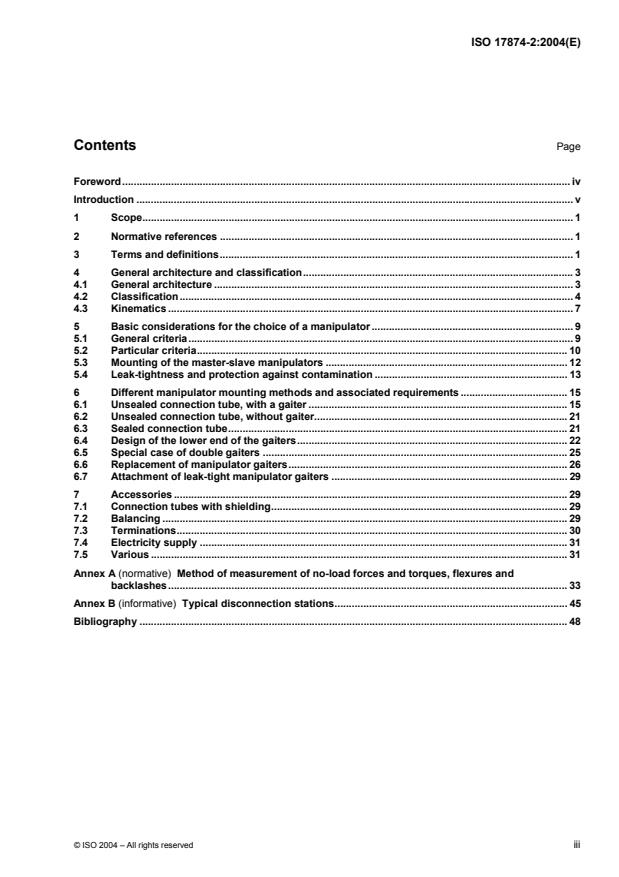
Contents Page
Foreword. iv
Introduction . v
1 Scope. 1
2 Normative references . 1
3 Terms and definitions. 1
4 General architecture and classification. 3
4.1 General architecture . 3
4.2 Classification. 4
4.3 Kinematics . 7
5 Basic considerations for the choice of a manipulator . 9
5.1 General criteria. 9
5.2 Particular criteria. 10
5.3 Mounting of the master-slave manipulators . 12
5.4 Leak-tightness and protection against contamination . 13
6 Different manipulator mounting methods and associated requirements . 15
6.1 Unsealed connection tube, with a gaiter . 15
6.2 Unsealed connection tube, without gaiter.21
6.3 Sealed connection tube. 21
6.4 Design of the lower end of the gaiters. 22
6.5 Special case of double gaiters . 25
6.6 Replacement of manipulator gaiters. 26
6.7 Attachment of leak-tight manipulator gaiters . 29
7 Accessories . 29
7.1 Connection tubes with shielding. 29
7.2 Balancing . 29
7.3 Terminations. 30
7.4 Electricity supply . 31
7.5 Various . 31
Annex A (normative) Method of measurement of no-load forces and torques, flexures and
backlashes. 33
Annex B (informative) Typical disconnection stations. 45
Bibliography . 48
Foreword
ISO (the International Organization for Standardization) is a worldwide federation of national standards bodies
(ISO member bodies). The work of preparing International Standards is normally carried out through ISO
technical committees. Each member body interested in a subject for which a technical committee has been
established has the right to be represented on that committee. International organizations, governmental and
non-governmental, in liaison with ISO, also take part in the work. ISO collaborates closely with the
International Electrotechnical Commission (IEC) on all matters of electrotechnical standardization.
International Standards are drafted in accordance with the rules given in the ISO/IEC Directives, Part 2.
The main task of technical committees is to prepare International Standards. Draft International Standards
adopted by the technical committees are circulated to the member bodies for voting. Publication as an
International Standard requires approval by at least 75 % of the member bodies casting a vote.
Attention is drawn to the possibility that some of the elements of this document may be the subject of patent
rights. ISO shall not be held responsible for identifying any or all such patent rights.
ISO 17874-2 was prepared by Technical Committee ISO/TC 85, Nuclear energy, Subcommittee SC 2,
Radiation protection.
ISO 17874 consists of the following parts, under the general title Remote-handling devices for radioactive
materials:
— Part 1: General requirements
— Part 2: Mechanical master-slave manipulators
— Part 3: Electrical master-slave manipulators
— Part 4: Power manipulators
— Part 5: Remote-handling tongs
iv © ISO 2004 – All rights reserved
Introduction
This part of ISO 17874 deals with mechanical master-slave manipulators used for nuclear applications.
These devices replace the hands and arms of the operators in areas inaccessible to personnel (mostly behind
shielding walls).
Mechanical master-slave manipulators were originally developed for hot cells, which were designed for
research and development for nuclear power reactor-fuel elements. They are now also in use in other nuclear
installations, such as fabrication or reprocessing plants for fuel elements, waste-treatment stations and
decommissioning of nuclear facilities.
This part of ISO 17874 should be of assistance to designers of nuclear plants, as well as to manufacturers,
users and license authorities.
INTERNATIONAL STANDARD ISO 17874-2:2004(E)
Remote-handling devices for radioactive materials —
Part 2:
Mechanical master-slave manipulators
1 Scope
This part of ISO 17874 specifies the criteria for the selection, installation and use of a mechanical
master-slave manipulator, for remote handling of radiaoactive materials in a nuclear facility.
This part of ISO 17874 deals only with the technical aspects related to the manipulator and its interface with
the nuclear facility in which it is intended to be installed.
In particular, the process apparatus and the manipulator features need to be studied in parallel in order to
optimize all the functionalities of the manipulator.
However, this part of ISO 17874 does not cover the fundamental design criteria of the nuclear facility (e.g. the
process involved, maintenance of the process equipment, intervention for other purposes).
2 Normative references
The following referenced documents are indispensable for the application of this document. For dated
references, only the edition cited applies. For undated references, the latest edition of the referenced
document (including any amendments) applies.
ISO 11933-1:1997, Components for containment enclosures — Part 1: Glove/bag ports, bungs for glove/bag
ports, enclosure rings and interchangeable units
ISO 11933-2:1997, Components for containment enclosures — Part 2: Gloves, welded bags, gaiters for
remote-handling tongs and for manipulators
ISO 10648-2:1994, Containment enclosures — Part 2: Classification according to leak tightness and
associated checking methods
ISO 17874-1:2004, Remote-handling devices for radioactive materials — Part 1: General requirements
3 Terms and definitions
For the purposes of this document, the following terms and definitions apply.
3.1
mechanical master-slave manipulator
manipulator reproducing the effects of the hand and arm movements of the operator by means of mechanical
transmission elements, installed in a shielding or a containment wall
3.2
arm
effectively reproduces the functions of a human arm, respecting in most cases the same distribution and
corresponding articulations
NOTE 1 The corresponding articulations are shoulder, upper arm, elbow, forearm, wrist joint, etc.
NOTE 2 The motions of a manipulator master arm and its associated slave arm are generally parallel.
3.3
master arm
arm located outside a hot cell and equipped with a handle on which the operator acts
3.4
slave arm
arm located inside a hot cell and equipped with tongs to grip the work-piece
3.5
axis
directions of a Cartesian coordinate system defined from the operator's standing point, considered as the
origin of this system
NOTE The following axes are considered: Axis X: from right to left along the shielding wall; Axis Y: forward into the
shielded cell; Axis Z: up towards the ceiling of the shielded cell.
3.6
balancing
characteristic allowing the manipulator to be maintained with negligible forces applied by the operator in stable
positions throughout the whole operating volume by mechanical means (e.g. counterweights)
3.7
connection tube
component mounted inside the through-wall tube, which transmits the motions of the master arm to the slave
arm by rotation and by internal mechanical elements
NOTE The connection tube can be withdrawn into the operating room.
3.8
disconnection
mechanical operation allowing the separation of two assembled elements, such as the disconnection of a
slave arm or a master arm from the connection tube
3.9
extended reach (Z-motion)
a motorized mechanical extension of the slave arm, by a double telescope, serving to adjust the working
length and hence to extend the reach across the working volume
3.10
gaiter of a manipulator
booting US
specially profiled flexible sleeve designed to protect the mechanical parts of the slave arms of a manipulator
from contamination or to provide continuity of the leak-tightness of a hot cell
3.11
handle
component fixed at the end of the master arm and gripped by the operator, facilitating the control of the
movement of the manipulator
2 © ISO 2004 – All rights reserved
3.12
indexing motions (X- and Y-motion)
an adjustable mechanical or electrical displacement between the slave arm position and the corresponding
master-arm position, to enlarge the working volume and minimize operator strain
3.13
jaws
components fixed on the end of the tongs which facilitate the handling of an object
NOTE The jaws can be disconnectable.
3.14
joint
articulation
assembly of several pieces allowing one or more rotational motions
3.15
operating volume
space in which the operation of a tong is possible, considering all the positions in which the different
components of the slave arm of a manipulator can be moved
3.16
operator side removal
operation consisting of extracting a part or the whole of a manipulator from the operator side of the hot cell
3.17
orientation motion
rotation motions around certain axes of the manipulator
NOTE 1 According to the axis considered, the three following motions are distinguished: tilt (α), twist (β) and swivel or
azimuth motion (γ).
NOTE 2 In articulated manipulators, the orientation motion can be accomplished around the forearm axis or around the
arm axis.
3.18
tong
gripping device fixed at the slave-arm end of the manipulator and consisting of an actuator assembly and jaws
3.19
through-wall tube
cylindrical piece mounted in the wall of a hot cell and allowing the passage of the mechanical linking elements
between the different parts of a manipulator from the outside to the inside of the hot cell
NOTE The through-wall tube contains the connection tube.
3.20
positioning motion
motion effecting a displacement of the tongs (or end-effector)
NOTE According to the axis considered, three different motions are distinguished: X, Y and Z.
4 General architecture and classification
4.1 General architecture
A mechanical master-slave manipulator is a fixed assembly mounted on a shielded enclosure wall. It
comprises three main components, a master arm, a slave arm and a connection tube equipped with
mechanical elements ensuring the connection between the master arm and the slave arm.
The connection tube is generally installed horizontally through the enclosure wall. It shall be constructed in
such a manner that the motions, forces, and torques, executed by the hand of the operator on the handle of
the master arm, are transmitted respectively to the slave arm and the tongs.
The manipulator shall ensure force reflection from the slave arm to the master arm. The transmission
elements shall be reversible in motion and communicate forces and torques reversibly, in all positions.
Depending on the final use (mounting on βγ hot cells or α-βγ hot cells), the connection tube can be unsealed
or sealed. In addition, the slave arm can be equipped with a gaiter, the aim of which is to realize the protection
or the leak-tightness of the manipulator slave arm. The jaws of the tongs or the complete tongs assembly can
be exchanged by remote control.
The master arm and slave arm are arranged to have identical kinematics. Additional components are provided
on the master arm, in particular, counter-weights balancing the arms of the master-slave manipulators and,
where necessary, lockable brakes and/or the control elements for motorized relative motions or off-sets
between the slave arm and the master arm (i.e. indexing).
4.2 Classification
4.2.1 Introduction
As defined in ISO 17874-1, mechanical master-slave manipulators are classified into two categories
(see Figure 1):
mechanical master-slave manipulator with telescopic arms;
mechanical master-slave manipulator with articulated arms.
Figure 1 — Classification of mechanical master-slave manipulators
4 © ISO 2004 – All rights reserved
4.2.2 Mechanical master-slave manipulators with telescopic arms
Depending on the type, this kind of mechanical master-slave manipulator (see Figure 2) permits the
transmission of forces up to the maximum magnitude that an operator would employ in unaided manual
activity. They are suitable for complicated tasks, and are usually installed in pairs on a working station.
Manipulators with telescopic arms are designed for hot cells of all sizes with shielding walls made mainly of
concrete or even of lead. They constitute the main working devices in such types of cells, which are generally
of large dimensions.
A version with short arms is available, if higher forces must be executed than are possible with mechanical
master-slave manipulators with articulated arms.
There are also compact manipulators with a double telescope in the slave arm, available for hot cells with a
restricted height.
Key
1 tong with parallel jaws 8 through-wall tube
2 slave arm 9 shielding window
3 connection tube 10 microphone
4 counter-weights 11 sound-transmission cable
5 master arm 12 loudspeaker
6 handle 13 hot cell
7 shielding wall 14 operating room
Figure 2 — Mechanical master-slave manipulator with telescopic arms
4.2.3 Mechanical master-slave manipulators with articulated arms
This kind of mechanical master-slave manipulator (see Figure 3) permits the transmission of forces up to a
medium level such as an operator could easily employ repeatedly in unaided manual activity. They are
suitable for complicated tasks, and are usually installed in pairs on a working station. They are designed for
hot cells of all sizes, with shielding walls typically of lead, or even steel.
They are also often used in containment enclosures with thick concrete shielding walls. They have
small dimensions and therefore provide a relatively small working volume. They are used instead of
remote-handling tongs, if a larger working volume is available or/and more dexterity is needed.
Key
1 tong with parallel jaws 8 through-wall tube
2 slave arm 9 shielding window
3 connection tube 10 upper arm
4 counter-weights 11 forearm
5 master arm 12 overhang
6 handle 13 hot cell
7 shielding wall 14 operating room
Figure 3 — Mechanical master-slave manipulator with articulated arms
6 © ISO 2004 – All rights reserved
4.3 Kinematics
4.3.1 General
The manipulator shall have seven motions, three positioning motions (see Figure 4), three orientation motions
(see Figure 5) and one gripping motion, according to the definitions given in ISO 17874-1.
Figure 4 — Positioning motions Figure 5 — Orientation and gripping
4.3.2 Manipulators with telescopic arms
For manipulators with telescopic arms, for which the motion along the Z axis is performed by translation of the
tubes (see Figure 6).
Key
1 right-left motion (around the Y axis) 7 tongs rotation (around the Y axis) (twist motion)
2 forward-backward motion (around the X axis) 8 shoulder
3 arm rotation (around the Z axis) (swivel or azimuth motion) 9 telescopic arm
4 up-down motion (along the Z axis) 10 wrist joint
5 gripping motion 11 handle (master side)/tongs (slave side)
6 wrist rotation (around the X axis) (tilt motion)
Figure 6 — Mechanical master-slave manipulator with telescopic arms
This kind of manipulator shall be equipped with an electrical indexing of the Y-motion (forward-backward) and
X-motion (right-left). It may also include an electrical extension of the Z-motion (up and down), consisting of a
double telescopic arm. The latter is called extended reach.
The indexing allows the range of action of the slave arm to be increased, while keeping the master arm in a
good ergonomic position.
Mechanical master-slave manipulators with telescopic arms are differentiated in the following way.
Manipulators without disconnectable arms. In this case, the functional links between the master arm and
the slave arm are directly realized by cables or tapes.
Manipulators with disconnectable arms. In this case, the links by cables or tapes are interrupted at the
level of the connection tube, where the motion transmissions are performed by rotating shafts and gears.
This solution consequently allows the disconnection of the slave arm. In many cases, the disconnection of the
master arm is also possible.
8 © ISO 2004 – All rights reserved
4.3.3 Manipulators with articulated arms
For manipulators with articulated arms, the motion along the Z axis is performed by a combination of two
rotations around the shoulder axis and the elbow axis (see Figure 7).
This kind of manipulator can be equipped with electrical or mechanical indexing of the upper arm.
Key
1 right-left motion (around the Y axis) 8 shoulder
2 forward-backward motion (around the X axis) 9 upper arm
3 arm rotation (around the Z axis) (swivel or azimuth motion) 10 elbow
4 up-down motion (along the Z axis) 11 forearm
5 gripping motion 12 wrist joint
6 wrist rotation (around the X axis) (tilt motion) 13 handle (master side)/tongs (slave side)
7 tongs rotation (around the Y axis) (twist motion)
Figure 7 — Mechanical master-slave manipulator with articulated arms
5 Basic considerations for the choice of a manipulator
5.1 General criteria
The design constraints of the manipulator determine the field of use offered by the two categories of
manipulators.
Mechanical master-slave manipulators with telescopic arms
are designed to be installed in walls of large thickness (generally about 1 000 mm),
provide operation in relatively large volumes,
offer generally a reduced dexterity compared to those equipped with articulated arms,
provide a large range of load capacities (up to 45 kg),
allow two possibilities of maintenance (operator side removal or disconnection of the slave arm inside the
hot cell),
provide a large variety of features compared to mechanical master-slave manipulators with articulated
arms.
Mechanical master-slave manipulators with articulated arms
are designed for operation in a limited working volume, generally between 100 mm and 500 mm),
provide a restricted range of load capacities (up to 12 kg),
provide a better dexterity than those with telescopic arms,
impose maintenance-access constraints (operator side removal), affecting the general design of the
installation.
5.2 Particular criteria
5.2.1 Introduction
This clause lists the technical characteristics which have to be specified to enable the choice of the type of
manipulator.
5.2.2 Main characteristics of the manipulators
5.2.2.1 General
The characteristics of the equipment shall be chosen in accordance with Clause 7 of ISO 17874-1:2004.
5.2.2.2 Load capacity
It is necessary to define the task to be performed as precisely as possible. For this purpose, the following
parameters shall be specified:
1)
the maximum as well as the likely weight of the loads to be handled (objects, tools) ;
forces (static and dynamic) to be exerted on objects;
torques (static and dynamic) to be applied by the rotation of the operator's hand or arm;
the reaction provided by tools (e.g. hydraulic shear, impact wrench, vibration sources, high-pressure jets
for decontamination, compressed air chisel);
2)
weight of the objects to be lifted . The lifting capacity may be significantly higher than the handling
capacity.
1) Handling means moving a piece in the whole space using the tongs.
2) Lifting means moving a piece in the vertical direction using a hook.
10 © ISO 2004 – All rights reserved
To increase the lifetime of the mechanical master-slave manipulator, its use near the limit of its maximum load
capacity has to be avoided.
The key parameter dictating the choice of manipulator type is generally the maximum weight to be handled.
Table 1 gives the required maximal load capacities, according to the class of the manipulators.
NOTE Because of the resultant significant decrease of dexterity, care should be taken when working in extreme
positions.
Table 1 — Classification of mechanical master-slave manipulators according
to their maximal load capacity (handling capacity)
Manipulator class Light (L) Medium (M) Heavy (H)
Maximum load capacity < 10 10 - 20 > 20
(handling capacity)
(kg)
5.2.2.3 Geometric characteristics
For this purpose, the following aspects shall be considered:
the operating volume of the master arm; this parameter shall be taken into account especially regarding
the layout of the front face of the shielded enclosure and any adjacent equipment or structures;
the operating volume of the slave arm; this parameter shall be taken into account especially to guarantee
the required accessibility to the process equipment; the adequacy of the operating volume in combination
with the foreseen load capacity shall also be checked;
the spaces required for the operation and the maintenance of the manipulator, as recommended by the
manufacture, have also to be respected.
5.2.2.4 Dexterity
The dexterity of a manipulator characterizes the ease with which it can perform complex tasks.
The dexterity cannot readily be quantified, but is adversely affected by the no-load forces (friction, dynamic
mass, etc., see 5.2.3) or excessive flexure and is improved by the provision of a smooth action, minimal
backlash (or play), and good operator ergonomics (see 5.2.4).
Accordingly, it can be said that the dexterity can be increased by reducing the values of the friction to be
overcome by the operator in the no-load condition. For a given manipulator, dexterity varies inversely with the
load applied.
It should also be noted that, in extreme positions, the dexterity is reduced (and some complicated tasks
cannot be performed) owing to loss of effective motions in one or more axes.
5.2.2.5 Reliability
For a given manipulator, the reliability depends critically on the working conditions, which in general can be
foreseen. To achieve a good reliability, it is therefore necessary to avoid the use of the manipulator in extreme
working conditions (e.g. frequent use at maximum load capacity, or with exposure to degradation due to a
chemical atmosphere, or with inadequately trained operators, etc.).
In addition, to maximize the reliability, the maintenance intervals and procedural instructions of the
manufacture have to be respected.
5.2.3 No-load forces and torques
A significant contribution to the total force to be overcome by the operator comes from the no-load forces and
torques, including residual balancing errors and the spring tension of the tong (which has to open
automatically when relieved of the force of the operator's hand).
Generally, the no-load forces and torques shall be as low as possible. The no-load forces and torques are
influenced by the load capacities (manipulator classes), the general design of the manipulator, the tension in
any cables or tapes, the presence of gaiters, seals and a number of other variables.
These no-load forces and torques shall be provided by the manufacturers upon request, using the
standardized measurement methods described in Annex A.
5.2.4 Flexures and backlashes
Although flexures and backlashes do not contribute additional forces for the operator to overcome, they
adversely affect the dexterity of the manipulator by introducing a requirement for nugatory movements of the
master arm and any indexing system. In addition, the flexure (that is, elastic distortion of the components
of the manipulator) represents stored energy in the affected motions that may cause problems, such as
spring-back if rapidly released.
Accordingly, flexures and backlashes shall be minimized while recognizing the inevitable design compromises
of the increased cost and/or weight of more rigid components and the friction that can be associated with anti-
backlash mechanisms. The reduction of flexures and backlashes is therefore also a compromise with respect
to the increase of the no-load forces and torques described above.
The flexure and backlash behaviour of the manipulator shall be provided by the manufacturers upon request,
using the standardized measurement methods described in Annex A.
5.2.5 Other criteria
Other parameters, such as those listed in ISO 17874-1, have to be considered if relevant (e.g. ease of
decontamination, maintainability, resistance to radiation).
5.3 Mounting of the master-slave manipulators
5.3.1 General
The positioning of the manipulator in the enclosure wall shall take into account the following aspects.
5.3.2 Height of the connection tube axis with regard to the level where the operator stands
Concerning this variable, the following considerations apply.
Manipulators with articulated arms and manipulators with telescopic arms, of small dimensions: the height
depends on the dimensions of the type of master-slave manipulator. It shall lie between 1 850 mm and
2 500 mm.
Manipulators with telescopic arms for shielded enclosures of large dimensions: for usual manipulators,
the standard height is 3 050 mm.
The connection tube is specific to the type of manipulator. It is installed in a through-wall tube embedded in
the enclosure wall. Since the established products of different manufacturers differ in the required diameter of
the through-wall tube, care has to be exercised in the choice of diameter for any particular installation.
12 © ISO 2004 – All rights reserved
It is possible to fit size-reduction rings to accommodate smaller connection tubes in larger through-wall tubes,
but not vice versa. The recommended range or standard dimensions of internal diameters of through-wall
tubes is shown below for each type of manipulator:
for master-slave manipulators with articulated arms: 160 mm to 170 mm;
for master-slave manipulators with telescopic arms of small dimensions: 190 mm;
for master-slave manipulators with telescopic arms of large dimensions: 254 mm.
5.3.3 Interaxis
A working station is generally equipped with two similar master-slave manipulators. The interaxis distance
between the through-wall tubes varies from 700 mm (master-slave manipulators with small operating volume)
to 900 mm (master-slave manipulators with large operating volume).
The actual value recommended by manufacturers depends on the design of the manipulator and must not be
reduced when the overall hot-cell design is implemented, in order to avoid collisions during motion. Moreover,
the optimal ergonomic conditions for the operator(s) are achieved with the two master-slave manipulators so
installed on the working station.
5.3.4 Operating volume of the master arm
The operating volume of the master arm shall be free of obstacles. It shall be checked that items of auxiliary
equipment are not installed in the front face, near the manipulator working station (e.g. ventilation ducts,
service penetrations, electric cables, walk-ways, control consoles), because they would interfere with the
range of action of the master-slave manipulator.
5.4 Leak-tightness and protection against contamination
5.4.1 General
In order to avoid the spread of radioactive contamination into the operator areas, a containment enclosure,
shielded or unshielded, is generally provided and characterized by a total permissible leakage rate (see
ISO 10648-2). This total permissible leakage rate results from the contribution of all of the local leaks due to
the penetrations through the enclosure walls (doors, windows, ventilation ducts, service penetrations, etc.) as
well as the contribution of all the manipulator penetrations.
It is commonly accepted that the local leakage rate due to the manipulator penetrations through the enclosure
wall should be maintained at a level not higher than the leakage rate of the rest of the enclosure. In cases
where a specific leak-tightness is specified by the end-user, the manufacturer has to comply with the required
specification and to demonstrate the compliance with the specifications.
This leak-tightness can be obtained in two different ways, according to the chosen manipulator maintenance
mode:
unsealed connection tube, with or without a gaiter;
sealed connection tube, typically with a gaiter.
NOTE A variation of this configuration is also available without a gaiter, in which case leak-tightness is not ensured.
The specified leakage rate of the manipulator during standard maintenance procedures shall be maintained as
far as possible at a level no greater than that of normal operation.
5.4.2 Gaiters for manipulators
Gaiters for mechanical master-slave manipulators are flexible sleeves covering the slave arm. There are two
categories of gaiters, according to the function intended:
protection gaiters;
leak-tight gaiters.
These two categories of gaiters shall be used in order to comply with the following objectives:
a) A protection gaiter is designed to provide some protection of the manipulator slave arm against the
radioactive contamination and any physical or chemical pollutants present inside the hot cell. It does not
contribute to the leak-tightness of the hot cell or of the containment enclosure, which is ensured by the
sealed connection tube.
b) A leak-tight gaiter is designed to ensure the leak-tightness of the hot cell or the containment enclosure
in the case of an unsealed connection tube. This type of gaiter also ensures a high standard of protection
of the manipulator slave arm against the radioactive contamination and any physical or chemical
pollutants present inside the hot cell.
A manipulator has to be equipped with only one category of gaiter, which depends upon the intended
operating conditions. Gaiters shall be designed to suit the manipulator category, the gaiter interchangeability
technique for maintenance, the environmental conditions (radiation exposure, mechanical damage, etc.) and
the leak-tightness requirements. The leak-tightness of the hot cell or the containment enclosure shall be
achieved by seals placed between the through-wall tube and the connection tube.
The choice of a manipulator equipped with a sealed or unsealed connection tube and the use of an additional
gaiter depends on several operational parameters which have to be taken into account. Some of these could
be contradictory, so that a compromise has to be made. These parameters are as follows:
high leak-tightness;
special internal atmosphere;
presence of high temperature or aggressive atmosphere;
necessity of maintenance of the manipulator (from inside or outside the hot cell);
frequent use of the manipulator;
allowed periods of disuse;
necessity of replacement of the gaiter;
procedure of removal of the manipulator from of the shielded cell;
high level of radiation inside the cell;
good dexterity (e.g. reduced no-load forces and backlashes) and maximum operating volume;
need for a large viewing angle;
mechanical impact by objects during work;
need for transportation equipment for the manipulators inside or outside the hot cell;
removal concept for damaged manipulators and likely frequency of such damage;
acceptable decontamination efforts before any repair;
contamination risk in the operating room.
14 © ISO 2004 – All rights reserved
5.4.3 Installation and replacement of gaiters
Installation and replacement of the gaiter are accomplished as follows:
a) for leak-tight gaiters, from the outside of the enclosure and after removal of the manipulator;
b) for protection gaiters, at the same time as the whole slave arm, using an auxiliary lifting device inside
the hot cell.
6 Different manipulator mounting methods and associated requirements
6.1 Unsealed connection tube, with a gaiter
6.1.1 General
This solution applies to all types of mechanical master-slave manipulators. Depending on the type of gaiter
used (leak-tight gaiter or protection gaiter), the slave arm is totally or partly protected.
6.1.2 Use of a protection gaiter
When a protection gaiter is used (see Figure 8), the containment of the hot cell shall be performed in a
dynamic way. Accordingly, this technique is not recommended for nuclear applications where a risk of spread
of radioactive contamination exists.
In this configuration, the protection gaiter is mounted on a ring which has to be fastened to the slave arm
behind the shoulder pivot (see Figure 9). The slave arm is exchangeable by remote control, using a lifting
device which is kept inside the hot cell.
Figure 8 — Use of a protection gaiter Figure 9 — Fastening of a protection gaiter
6.1.3 Use of a leak-tight gaiter
6.1.3.1 General
When a leak-tight gaiter is used, the continuity of the static containment of the hot cell is ensured. This
technique is therefore especially recommended for highly contaminated hot cells (α-βγ or neutron hot cells).
6.1.3.2 Method 1
In this configuration [see Figure 10 a)], the gaiters are mounted on an ejectable support ring fastened to the
containment enclosure wall located behind the βγ shielding wall.
a) General view
16 © ISO 2004 – All rights reserved
b) Gaiter mounted on a type 1 support ring, c) Gaiter mounted on a type 3 support ring,
fixed on a type 1 enclosure ring fixed on a glove port used as a type 3 enclosure ring
Key
1 gaiter 6 gaiter
2 enclosure ring 7 glove port
3 shielding wall 8 support ring
4 support ring 9 shielding wall
5 enclosure wall 10 enclosure wall
Figure 10 — Gaiter fastened on a support ring, fixed on the containment enclosure wall
The mounting is to be accomplished by one of the following options:
a) gaiter fixed on a type 1 support ring, mounted on a type 1 enclosure ring [see Figure 10 b)];
b) gaiter fixed on a type 3 support ring, mounted on a glove port used as a type 3 enclosure ring [see
Figure 10 c)].
The only permissible variation of this system is described in the following configuration, where the gaiter is
mounted on the inner liner of a highly contaminated hot cell (see Figure 11).
a) General view
b) Gaiter mounted on a type 1 support ring, c) Gaiter mounted on a type 3 support ring,
fixed on a type 1 enclosure ring fixed on a type 3 enclosure ring
Key
1 gaiter 5 glove port
2 support ring 6 enclosure ring
3 enclosure ring 7 shielded wall
4 gaiter 8 inner liner
Figure 11 — Gaiter fixed onto the inner liner of a leak-tight concrete hot cell
18 © ISO 2004 – All rights reserved
Depending on the type of support ring, the gaiter is either:
fixed directly on a type 3 support ring, which is attached to a glove port used as a type 3 enclosure ring
thus terminating the inner liner, or
mounted on a type 1 support ring, fixed on a type 1 enclosure ring, which is screwed onto a flange
located at the termination of the inner liner.
NOTE References to type 1, type 2 and type 3 support rings and enclosure rings are derived from ISO 11933-2.
6.1.3.3 Method 2
In this configuration, the gaiters shall be mounted on a support ring fixed at the inner end of the through-wall
tube (on the side opposite to the operator).
The support ring is to be mounted either directly on the through-wall tube [when a type 3 support ring is used,
[see Figure 12 a)], or indirectly through a containment enclosure ring [when a type 1 support ring is used, see
Figure 12 b)].
a) Gaiter mounted on a type 3 support ring, b) Gaiter mounted on a type 1 support ring,
fixed on a trough-wall tube fixed on a type 1 enclosure ring
Key
1 inside enclosure
2 gaiter
3 support ring
4 enclosure ring
5 through-wall tube
Figure 12 — Gaiter fixed to a through-wall tube
6.1.3.4 Method 3
In this relatively primitive configuration, the gaiters were mounted directly on the flange of a glove or bag port
fixed on the shielding wall at the operator side (see Figure 13).
WARNING — This solution is no longer recommended, because it entails a breach of containment
during mounting and removal of the manipulator for maintenance, etc.
Key
1 gaiter terminated in a bead and sealed at the wall flange using a clamping system
2 slave arm
3 master arm
NOTE No longer recommended.
Figure 13 — Mounting of a gaiter fixed on a glove/bag port on shielding wall at the operator side
20 © ISO 2004 – All rights reserved
6.1.3.5 Additional requirements
In the two recommended configurations, the gaiters maintain the leak-tightness of the containment enclosure,
when the manipulator is removed from the wall from the operator side (see Figure 14).
Exchanges of leak-tight gaiters are generally made by remote control, using an ejecting device. The different
techniques for exchanging such gaiters are described in ISO 11933-2.
Profiles, designs, material of construction and additional recommendations concerning gaiters for
manipulators are also described in ISO 11933-2.
Figure 14 — Example of exchange of a manipulator, removal from the operator side
6.2 Unsealed connection tube, without gaiter
This technique is only applicable for βγ hot cells, with no contamination. This solution applies to all categories
of mechanical master-slave manipulator with disconnectable arms. The three components of the manipulator
(the master arm, the slave arm and the connection tube) are exchangeable by remote control.
The containment of the hot cell can only be realized dynamically.
NOTE This technique has frequently been used in the past for some nuclear applications, but because it does not
offer a continuity of the static leak-tightness of the hot-cell wall, it is no longer recommended fo
...
NORME ISO
INTERNATIONALE 17874-2
Première édition
2004-12-01
Dispositifs de manipulation à distance
pour matériaux radioactifs —
Partie 2:
Télémanipulateurs maître-esclave
mécaniques
Remote-handling devices for radioactive materials —
Part 2: Mechanical master-slave manipulators
Numéro de référence
©
ISO 2004
PDF – Exonération de responsabilité
Le présent fichier PDF peut contenir des polices de caractères intégrées. Conformément aux conditions de licence d'Adobe, ce fichier
peut être imprimé ou visualisé, mais ne doit pas être modifié à moins que l'ordinateur employé à cet effet ne bénéficie d'une licence
autorisant l'utilisation de ces polices et que celles-ci y soient installées. Lors du téléchargement de ce fichier, les parties concernées
acceptent de fait la responsabilité de ne pas enfreindre les conditions de licence d'Adobe. Le Secrétariat central de l'ISO décline toute
responsabilité en la matière.
Adobe est une marque déposée d'Adobe Systems Incorporated.
Les détails relatifs aux produits logiciels utilisés pour la création du présent fichier PDF sont disponibles dans la rubrique General Info
du fichier; les paramètres de création PDF ont été optimisés pour l'impression. Toutes les mesures ont été prises pour garantir
l'exploitation de ce fichier par les comités membres de l'ISO. Dans le cas peu probable où surviendrait un problème d'utilisation,
veuillez en informer le Secrétariat central à l'adresse donnée ci-dessous.
© ISO 2004
Droits de reproduction réservés. Sauf prescription différente, aucune partie de cette publication ne peut être reproduite ni utilisée sous
quelque forme que ce soit et par aucun procédé, électronique ou mécanique, y compris la photocopie et les microfilms, sans l'accord écrit
de l'ISO à l'adresse ci-après ou du comité membre de l'ISO dans le pays du demandeur.
ISO copyright office
Case postale 56 • CH-1211 Geneva 20
Tel. + 41 22 749 01 11
Fax. + 41 22 749 09 47
E-mail copyright@iso.org
Web www.iso.org
Publié en Suisse
ii © ISO 2004 – Tous droits réservés
Sommaire Page
Avant-propos. iv
Introduction . v
1 Domaine d'application. 1
2 Références normatives. 1
3 Termes et définitions . 1
4 Architecture générale et classification . 4
4.1 Architecture générale . 4
4.2 Classification. 4
4.3 Cinématique. 7
5 Considérations générales pour le choix d'un télémanipulateur . 9
5.1 Critères généraux. 9
5.2 Critères particuliers . 10
5.3 Montage des télémanipulateurs maître-esclave . 12
5.4 Étanchéité et protection contre la contamination . 13
6 Différentes méthodes de montage du télémanipulateur et exigences associées . 15
6.1 Tube de connexion non étanche, avec une manche. 15
6.2 Tube de connexion non étanche, sans manche . 22
6.3 Tube de connexion étanche. 22
6.4 Conception de l'extrémité inférieure des manches. 24
6.5 Cas particulier de la double manche . 25
6.6 Remplacement des manches de télémanipulateur . 27
6.7 Fixation des manches d'étanchéité de télémanipulateurs . 30
7 Accessoires . 30
7.1 Tubes de connexion blindés. 30
7.2 Équilibrage. 30
7.3 Terminaux . 31
7.4 Alimentation électrique . 32
7.5 Divers . 32
Annexe A (normative) Méthodes de mesurage des forces et couples à vide, des flexions et des
jeux . 34
Annexe B (informative) Stations de déconnexion usuelles . 46
Bibliographie . 49
Avant-propos
L'ISO (Organisation internationale de normalisation) est une fédération mondiale d'organismes nationaux de
normalisation (comités membres de l'ISO). L'élaboration des Normes internationales est en général confiée
aux comités techniques de l'ISO. Chaque comité membre intéressé par une étude a le droit de faire partie du
comité technique créé à cet effet. Les organisations internationales, gouvernementales et non
gouvernementales, en liaison avec l'ISO participent également aux travaux. L'ISO collabore étroitement avec
la Commission électrotechnique internationale (CEI) en ce qui concerne la normalisation électrotechnique.
Les Normes internationales sont rédigées conformément aux règles données dans les Directives ISO/CEI,
Partie 2.
La tâche principale des comités techniques est d'élaborer les Normes internationales. Les projets de Normes
internationales adoptés par les comités techniques sont soumis aux comités membres pour vote. Leur
publication comme Normes internationales requiert l'approbation de 75 % au moins des comités membres
votants.
L'attention est appelée sur le fait que certains des éléments du présent document peuvent faire l'objet de
droits de propriété intellectuelle ou de droits analogues. L'ISO ne saurait être tenue pour responsable de ne
pas avoir identifié de tels droits de propriété et averti de leur existence.
L'ISO 17874-2 a été élaborée par le comité technique ISO/TC 85, Énergie nucléaire, sous-comité SC 2,
Radioprotection.
L'ISO 17874 comprend les parties suivantes, présentées sous le titre général Dispositifs de manipulation à
distance pour matériaux radioactifs:
— Partie 1: Exigences générales
— Partie 2: Télémanipulateurs maître-esclave mécaniques
— Partie 3: Télémanipulateurs maître-esclave électriques
— Partie 4: Télémanipulateurs télécommandés
— Partie 5: Pinces pour manipulation à distance
iv © ISO 2004 – Tous droits réservés
Introduction
La présente partie de l'ISO 17874 concerne les télémanipulateurs maître-esclave mécaniques utilisés pour
des applications nucléaires.
Ces dispositifs remplacent les mains et les bras des opérateurs dans des zones inaccessibles au personnel
(en grande partie derrière des parois blindées).
Les télémanipulateurs maître-esclave mécaniques furent développés à l'origine pour les cellules chaudes, qui
furent conçues dans un but de recherche et de développement pour les éléments combustibles des réacteurs
nucléaires de puissance. Ils sont maintenant aussi utilisés en d'autres installations nucléaires, telles que des
usines de fabrication ou de retraitement d'éléments combustibles, des stations de traitement des déchets et
de déclassement d'installations nucléaires.
La présente partie de l'ISO 17874 a vocation d'aide aux concepteurs d'installations nucléaires ainsi qu'aux
fabricants, utilisateurs et organismes habilités à délivrer des licences.
NORME INTERNATIONALE ISO 17874-2:2004(F)
Dispositifs de manipulation à distance pour matériaux
radioactifs —
Partie 2:
Télémanipulateurs maître-esclave mécaniques
1 Domaine d'application
La présente partie de l'ISO 17874 spécifie les critères de sélection, de montage et d'utilisation d'un
télémanipulateur maître-esclave mécanique, pour la manipulation à distance de matériaux radioactifs dans
une installation nucléaire.
La présente partie de l'ISO 17874 ne traite que des aspects techniques relatifs au télémanipulateur et à ses
interfaces avec l'installation nucléaire dans laquelle son montage est prévu.
En particulier, les appareils du procédé et les caractéristiques du télémanipulateur doivent être étudiés en
parallèle dans l'intention d'optimiser toutes les fonctionnalités du télémanipulateur.
Cependant, la présente partie de l'ISO 17874 ne couvre pas les critères fondamentaux de conception de
l'installation nucléaire (par exemple le procédé mis en œuvre, la maintenance du procédé, les moyens
d'intervention destinés à d'autres applications).
2 Références normatives
Les documents de référence suivants sont indispensables pour l'application du présent document. Pour les
références datées, seule l'édition citée s'applique. Pour les références non datées, la dernière édition du
document de référence s'applique (y compris les éventuels amendements).
ISO 11933-1:1997, Composants pour enceintes de confinement — Partie 1: Ronds de gant et de sac,
obturateurs de ronds de gant et de sac, bagues d'enceintes et éléments interchangeables à distance
ISO 11933-2:1997, Composants pour enceintes de confinement — Partie 2: Gants, sacs à souder, manches
de protection pour pinces à distance et télémanipulateurs
ISO 10648-2:1994, Enceintes de confinement — Partie 2: Classification selon leur étanchéité et méthodes de
contrôle associées
ISO 17874-1:2004, Dispositifs de manipulation à distance pour matériaux radioactifs — Partie 1: Exigences
générales
3 Termes et définitions
Pour les besoins du présent document, les termes et définitions suivants s'appliquent.
3.1
télémanipulateur maître-esclave mécanique
manipulateur installé dans un mur blindé ou de confinement et reproduisant les effets des mouvements de la
main et du bras de l'opérateur au moyen d'éléments de transmission mécaniques
3.2
bras
définit un système reproduisant les fonctions d'un bras humain, respectant la plupart du temps la même
répartition et les articulations correspondantes
NOTE 1 Les articulations correspondantes sont l'épaule, le bras, le coude, l'avant-bras, le poignet (aussi appelé
genouillère), etc.
NOTE 2 Les mouvements assurés par un bras maître d'un télémanipulateur et son bras esclave associé sont
généralement parallèles.
3.3
bras maître
bras situé à l'extérieur d'une cellule chaude et équipé d'une poignée sur laquelle agit l'opérateur
3.4
bras esclave
bras situé à l'intérieur d'une cellule chaude et équipé d'une pince pour saisir la pièce à manipuler
3.5
axe
directions d'un système de coordonnées cartésiennes définies depuis la position de l'opérateur, considéré
comme l'origine du système
NOTE Les axes suivants sont pris en compte: axe X, de la droite vers la gauche le long de la paroi blindée; axe Y, en
avant vers la cellule blindée; axe Z, montée vers le plafond de la cellule blindée.
3.6
équilibrage
caractéristique permettant au télémanipulateur, soumis à des efforts négligeables par l'opérateur, de rester en
position stable dans tout l'espace de travail grâce à des moyens mécaniques (par exemple contrepoids)
3.7
tube de connexion
composant monté à l'intérieur du fourreau et permettant la transmission des mouvements du bras maître au
bras esclave par rotation et par des éléments mécaniques internes
NOTE Le tube de connexion est extractible depuis la face avant des cellules blindées.
3.8
déconnexion
opération mécanique permettant la séparation de deux éléments assemblés, tels que la déconnexion d'un
bras esclave ou d'un bras maître du tube de connexion
3.9
extension (mouvement Z)
extension mécanique, motorisée, du bras esclave par l'intermédiaire d'un double télescope, servant à ajuster
la longueur du bras donc à augmenter la portée à travers l'espace de travail
3.10
manche d'un télémanipulateur
manchette flexible, spécialement conçue pour assurer la protection contre la contamination des parties
mécaniques des bras esclave, d'un télémanipulateur ou pour assurer la continuité de l'étanchéité d'une cellule
chaude
NOTE Ce composant est aussi appelé «booting» (USA).
2 © ISO 2004 – Tous droits réservés
3.11
poignée
composant fixé à l'extrémité du bras maître et saisi par l'opérateur pour permettre la réalisation des
mouvements du télémanipulateur
3.12
indexage (mouvement X et Y)
décalage mécanique ou électrique, réglable, entre la position du bras esclave et la position correspondante du
bras maître, permettant d'augmenter l'espace de travail et de minimiser la fatigue de l'opérateur
3.13
doigts (de pinces)
éléments fixés à l'extrémité des pinces pour faciliter la préhension d'un objet
NOTE Les doigts peuvent être déconnectables.
3.14
articulation
assemblage de plusieurs pièces autorisant un ou plusieurs mouvements de rotation
3.15
espace de travail
espace dans lequel le fonctionnement d'une pince est possible, compte tenu de toutes les positions dans
lesquelles les différents éléments constitutifs du bras esclave peuvent se déplacer
3.16
retrait frontal
opération consistant à extraire une partie ou la totalité d'un télémanipulateur depuis la zone avant d‘une
cellule chaude
3.17
mouvement d'orientation
rotation autour de certains axes du télémanipulateur
NOTE 1 Conformément aux axes considérés, on distingue les trois mouvements suivants: élévation de pince (α),
rotation de pince (β) et pivotement ou mouvement azimut de pince (γ).
NOTE 2 Pour les télémanipulateurs articulés, les mouvements d'orientation peuvent être réalisés autour des axes de
l'avant-bras ou du bras.
3.18
pince
dispositif de préhension fixé sur le bras esclave d'un télémanipulateur et comprenant un élément actuateur et
des doigts
3.19
fourreau
élément cylindrique monté dans la paroi d'une cellule chaude et permettant le passage des liaisons
mécaniques entre les différentes parties du télémanipulateur depuis l'extérieur vers l'intérieur de la cellule
chaude
NOTE Le fourreau reçoit le tube de connexion.
3.20
mouvement de positionnement
mouvement effectuant un déplacement de la pince (ou du système de préhension terminal)
NOTE Conformément aux axes considérés, on distingue trois mouvements différents: X, Y et Z.
4 Architecture générale et classification
4.1 Architecture générale
Un télémanipulateur maître-esclave mécanique est un équipement fixe monté sur une paroi blindée. Il
comprend trois principaux ensembles, un bras maître, un bras esclave et un tube de connexion équipé des
éléments mécaniques assurant la liaison entre le bras maître et le bras esclave.
En général la traversée est placée horizontalement à travers la paroi blindée. Elle doit être construite de telle
manière que les mouvements, les forces et couples exercés par la main de l'opérateur sur la poignée du bras
maître soient transmis au bras esclave et à la pince.
Le télémanipulateur doit assurer le retour d'effort du bras esclave vers le bras maître. Les éléments de
transmission doivent être réversibles en mouvement et en force et couples, dans toutes les positions.
Suivant la destination finale (montage sur des cellules chaudes βγ ou α-βγ), le tube de connexion peut être
non étanche ou étanche. De plus, le bras esclave peut être équipé d'une manche, le but étant de réaliser la
protection ou l'étanchéité du bras esclave du télémanipulateur. Les doigts des pinces ou les pinces complètes
peuvent être remplacés à distance.
Le bras maître et le bras esclave sont agencés de manière à avoir des cinématiques identiques. Des
composants supplémentaires sont prévus sur le bras maître, en particulier des contrepoids d'équilibrage des
bras du télémanipulateur maître-esclave et, lorsque nécessaire, des dispositifs de contrôle pour les
mouvements électriques ou pour les décalages entre le bras esclave et le bras maître (exemple: indexage).
4.2 Classification
4.2.1 Introduction
Tels que définis dans l'ISO 17874-1 les télémanipulateurs maître-esclave mécaniques sont classés en deux
catégories (voir Figure 1):
télémanipulateurs maître-esclave mécaniques à bras télescopiques;
télémanipulateurs maître-esclave mécaniques à bras articulés.
Figure 1 — Classification des télémanipulateurs maître-esclave mécaniques
4 © ISO 2004 – Tous droits réservés
4.2.2 Télémanipulateurs maître-esclave mécaniques à bras télescopiques
Selon le modèle, ces types de télémanipulateurs maître-esclave (voir Figure 2) permettent la transmission
d'efforts de l'ordre des efforts maximaux pouvant être réalisés par un opérateur qui effectuerait une activité
manuelle sans assistance. Ils conviennent pour des tâches complexes et sont habituellement installés par
paires au poste de travail.
Les télémanipulateurs à bras télescopiques sont conçus pour des cellules chaudes de toutes les tailles avec
des parois blindées construites principalement en béton, voire en plomb. Ils constituent le principal appareil de
travail dans de telles cellules qui sont généralement de grandes dimensions.
Une version est disponible avec des bras courts, si des efforts plus importants que ceux possibles avec des
télémanipulateurs maître-esclave mécaniques avec bras articulés doivent être exécutés.
Il existe aussi des télémanipulateurs compacts avec un double télescope dans le bras esclave, disponible
pour les cellules chaudes de hauteur limitée.
Légende
1 pince avec doigts parallèles 8 fourreau
2 bras esclave 9 fenêtre blindée
3 tube de connexion 10 microphone
4 contre-poids 11 câble de transmission audio
5 bras maître 12 haut-parleur
6 poignée 13 cellule chaude
7 paroi blindée 14 zone avant
Figure 2 — Télémanipulateur maître-esclave mécanique à bras télescopiques
4.2.3 Télémanipulateurs maître-esclave mécaniques à bras articulés
Ce type de télémanipulateurs maître-esclave mécaniques (voir Figure 3) autorise la transmission des forces
jusqu'à un niveau intermédiaire, telles que celles qu'un opérateur pourrait facilement répéter au cours d'une
activité manuelle non assistée. Ils conviennent pour des tâches complexes et sont habituellement installés par
paires au poste de travail. Ils sont conçus pour des cellules chaudes de toutes les tailles avec des parois
blindées construites principalement en plomb, voire en acier.
Ils sont souvent aussi utilisés en enceinte confinée avec des parois blindées épaisses en béton. Ils sont de
petites dimensions et en conséquence permettent l'accès à un espace de travail relativement réduit. Ils
remplacent les pinces à distance si un plus grand espace de travail est disponible ou/et une meilleure
dextérité est nécessaire.
Légende
1 pince avec doigts parallèles 8 fourreau
2 bras esclave 9 fenêtre blindée
3 tube de connexion 10 bras supérieur
4 contre-poids 11 avant-bras
5 bras maître 12 porte-à-faux
6 poignée 13 cellule chaude
7 paroi blindée 14 zone avant
Figure 3 — Télémanipulateur maître-esclave mécanique à bras articulés
6 © ISO 2004 – Tous droits réservés
4.3 Cinématique
4.3.1 Généralités
Le télémanipulateur doit avoir sept mouvements, trois de positionnement (voir Figure 4), trois d'orientation
(voir Figure 5) et un de serrage par pince, conformément aux définitions données dans l'ISO 17874-1.
Figure 4 — Mouvements de positionnement Figure 5 — Mouvements d'orientation
et de serrage
4.3.2 Télémanipulateurs à bras télescopiques
Pour les télémanipulateurs à bras télescopiques, pour lesquels le mouvement suivant l'axe Z est obtenu par
translation des tubes (voir la Figure 6).
Légende
1 mouvement droite-gauche (autour de l'axe Y) 7 rotation pince (autour de l'axe Y)
(mouvement de rotation)
2 mouvement avant-arrière (autour de l'axe X)
8 épaule
3 rotation du bras (autour de l'axe Z) (pivotement ou mouvement
azimut) 9 bras télescopique
4 mouvement haut-bas (le long de l'axe Z) 10 genouillère
5 serrage pince 11 poignée (côté maître)/pince (côté esclave)
6 rotation genouillère (autour de l'axe Y) (mouvement d'élévation)
Figure 6 — Télémanipulateur maître-esclave mécanique à bras télescopiques
Ce type de télémanipulateur doit être équipé d'un indexage électrique sur les mouvements Y (avant-arrière) et
X (droite-gauche). Il peut aussi posséder une extension électrique du mouvement Z (haut-bas) en adoptant un
bras à double télescope. Ce dernier est appelé extensible.
Le positionnement électrique permet d'étendre l'espace de travail du bras esclave, alors que le bras maître
reste dans une bonne position ergonomique.
Les télémanipulateurs maître-esclave mécaniques à bras télescopiques se différencient de la façon suivante.
Télémanipulateurs sans bras déconnectables. Dans ce cas, les liaisons fonctionnelles entre le bras
maître et le bras esclave sont directement réalisées par des câbles ou des rubans.
Télémanipulateurs avec bras déconnectables. Dans ce cas, les liaisons par câbles ou rubans sont
interrompues au niveau de la traversée, où la transmission des mouvements est assurée par des barres
tournantes et des engrenages.
En conséquence, cette solution permet la déconnexion du bras esclave. Souvent, la déconnexion du bras
maître est aussi possible.
8 © ISO 2004 – Tous droits réservés
4.3.3 Télémanipulateurs à bras articulés
Pour les télémanipulateurs à bras articulés, le mouvement suivant l'axe Z est obtenu par une combinaison de
deux rotations autour des axes de l'épaule et du coude (voir Figure 7).
Ce type de télémanipulateur peut être équipé avec un indexage électrique ou mécanique du bras.
Légende
1 mouvement droite-gauche (autour de l'axe Y) 8 épaule
2 mouvement avant-arrière (autour de l'axe X) 9 bras
3 rotation du bras (autour de l'axe Z) (pivotement ou mouvement azimut) 10 coude
4 mouvement haut-bas (le long de l'axe Z) 11 avant-bras
5 serrage pince 12 genouillère
6 rotation genouillère (autour de l'axe X) (mouvement d'élévation) 13 poignée (côté maître)/pince (côté
esclave)
7 rotation pince (autour de l'axe Y) (mouvement de rotation)
Figure 7 — Télémanipulateur maître esclave mécanique à bras articulés
5 Considérations générales pour le choix d'un télémanipulateur
5.1 Critères généraux
Les contraintes de conception d'un télémanipulateur limitent le domaine d'application offert par les deux
catégories de télémanipulateurs.
Les télémanipulateurs maître-esclave mécaniques à bras télescopiques
sont conçus pour être installés dans des parois de grande épaisseur (généralement environ 1 000 mm),
autorisent le travail dans un espace relativement important,
offrent généralement une moindre dextérité en comparaison avec ceux équipés de bras articulés,
procurent une large gamme de capacités en charge (jusqu'à 45 kg),
autorisent deux possibilités de maintenance (extraction côté opérateur ou déconnexion du bras esclave à
l'intérieur de la cellule chaude), et
sont disponibles avec une grande variété de caractéristiques en comparaison des télémanipulateurs
maître-esclave mécaniques à bras articulés.
Les télémanipulateurs maître-esclave mécaniques à bras articulés
sont conçus pour intervenir dans un espace de travail limité,
sont conçus pour être installés dans des parois de faible à moyenne épaisseur (généralement entre 100
et 500 mm),
procurent une gamme restreinte de capacités en charge (jusqu'à 12 kg),
offrent une meilleure dextérité en comparaison avec celle des télémanipulateurs à bras télescopiques, et
entraînent des contraintes d'accès pour leur maintenance (extraction côté opérateur), interférant avec la
conception générale de l'installation.
5.2 Critères particuliers
5.2.1 Introduction
Le présent paragraphe établit la liste des caractéristiques techniques qui doivent être spécifiées pour
permettre le choix du type de télémanipulateur.
5.2.2 Principales caractéristiques du télémanipulateur
5.2.2.1 Généralités
Les caractéristiques de l'équipement doivent être choisies conformément à l'Article 7 de l'ISO 17874-1:2004.
5.2.2.2 Capacité en charge
Il est nécessaire de définir aussi précisément que possible les tâches devant être réalisées. À cet effet, les
paramètres suivants doivent être spécifiés:
les poids maximaux ainsi que les charges les plus représentatives devant être manipulées (objets,
1)
outils) ;
les forces (statiques et dynamiques) à exercer sur les objets;
1) Manipuler signifie déplacer un objet dans tout l'espace de travail au moyen des pinces.
10 © ISO 2004 – Tous droits réservés
les couples (statiques et dynamiques) à appliquer par rotation du bras ou de la main de l'opérateur;
la réaction provoquée par les outils (par exemple cisaille hydraulique, clé à choc, sources de vibration,
jets haute pression de décontamination, burin à air comprimé);
2)
les masses des objets à soulever . La capacité de levage peut être significativement supérieure à la
capacité de manipulation.
Pour augmenter la durée de vie du télémanipulateur maître-esclave mécanique, son utilisation avec des
charges proches de sa capacité maximale devrait être évitée.
Le paramètre clé dictant le choix du type de télémanipulateur est généralement la charge maximale à
manipuler. Le Tableau 1 indique les capacités en charge maximales requises en fonction de la classe du
télémanipulateur.
NOTE En raison de la diminution significative de dextérité, il convient de prendre des précautions pour travailler dans
des positions extrêmes.
Tableau 1 — Classification des télémanipulateurs maître-esclave mécaniques
en fonction de leur capacité en charge maximale
Classe du télémanipulateur Léger (L) Moyen (M) Lourd (H)
Capacité en charge maximale
< 10 10 à 20 > 20
(kg)
5.2.2.3 Caractéristiques géométriques
Pour ce critère, les aspects suivants doivent être considérés:
l'espace de travail du bras maître; ce paramètre doit être surtout pris en compte pour ce qui concerne
l'organisation de la face avant de l'enceinte blindée et tout équipement ou structure adjacents;
l'espace de travail du bras esclave; ce paramètre doit être surtout pris en compte pour garantir
l'accessibilité nécessaire aux équipements procédé; l'adéquation entre l'espace de travail et la capacité
en charge considérée précédemment doit également être vérifiée;
l'espace requis pour le fonctionnement et la maintenance du télémanipulateur, tel que recommandé par
le constructeur, doit être respecté.
5.2.2.4 Dextérité
La dextérité d'un télémanipulateur caractérise la facilité avec laquelle il peut accomplir des tâches complexes.
La dextérité ne peut être facilement quantifiée, mais elle varie inversement avec les efforts à vide (friction,
masses en mouvement, etc., voir 5.2.3) ou par une flexion excessive. Elle peut être améliorée par une
manipulation en souplesse, par un jeu de fonctionnement minimal et par une bonne ergonomie pour les
opérateurs (voir 5.2.4).
En conséquence, on peut dire que la dextérité peut être augmentée par la réduction des valeurs de friction à
vide à surmonter par les opérateurs. Pour un télémanipulateur donné, elle est inversement proportionnelle à
la charge appliquée.
Il convient également de noter qu'en positions extrêmes, la dextérité est réduite (et des tâches complexes ne
peuvent pas être réalisées) en raison de la perte de mouvements suivant un ou plusieurs axes.
2) On entend par levage, déplacer un objet verticalement en utilisant un crochet.
5.2.2.5 Fiabilité
Pour un télémanipulateur donné, la fiabilité dépend essentiellement des conditions de travail, qui en général
peuvent être prévues. Pour obtenir une bonne fiabilité, il est cependant nécessaire d'éviter l'utilisation du
télémanipulateur en conditions extrêmes (par exemple utilisation fréquente avec la charge maximale ou
exposition à l'agression chimique de l'atmosphère ou par des opérateurs insuffisamment formés, etc.).
De plus, pour optimiser la fiabilité, la fréquence de la maintenance et les procédures du constructeur doivent
être respectées.
5.2.3 Forces et couples à vide
Une part non négligeable de l'effort total à vaincre par l'opérateur est constituée des forces et couples à vide,
comprenant les défauts résiduels d'équilibrage et la tension du ressort de serrage pince (qui doit s'ouvrir
automatiquement quand la main de l'opérateur relâche l'effort).
En conséquence les forces et couples à vides doivent être aussi faibles que possible. Les forces et couples à
vide dépendent des capacités en charge (classes de télémanipulateur), de la conception générale du
télémanipulateur, de la tension des câbles ou des rubans de transmission, de la présence de manches de
protection, de joints et de quantité d'autres éléments.
Ces valeurs de forces et couples à vide doivent être fournies par le fabricant sur demande, en utilisant les
méthodes de mesurages normalisées décrites à l'Annexe A.
5.2.4 Flexions et jeux
Bien que les flexions et les jeux n'induisent pas d'efforts supplémentaires pour l'opérateur, ils affectent la
dextérité du télémanipulateur en générant des contraintes lors de la réalisation de petits mouvements du bras
maître et de tout système d'indexage. De plus, la flexion (qui est une déformation élastique des composants
du télémanipulateur) constitue une réserve d'énergie dans les mouvements concernés qui peut causer des
problèmes, par exemple l'effet de détente de ressort s'il est rapidement libéré.
En conséquence, la flexion et les jeux doivent être minimisés, bien que le compromis de conception soit
inévitable du fait de l'accroissement du coût et/ou du poids des composants plus rigides et de la friction qui
peut être associée aux mécanismes de rattrapage des jeux. La réduction de la flexion et des jeux est par
conséquent aussi un compromis avec l'accroissement des forces et couples à vide décrits ci-dessus.
Le comportement de la flexion et des jeux du télémanipulateur doit être précisé par le constructeur sur
demande, en utilisant les méthodes de mesurages normalisées décrites à l'Annexe A.
5.2.5 Autres critères
D'autres paramètres, tels ceux listés dans l'ISO 17874-1 doivent être pris en compte si nécessaire (par
exemple l'aptitude à la décontamination, la maintenance, la résistance aux rayonnements).
5.3 Montage des télémanipulateurs maître-esclave
5.3.1 Généralités
L'implantation du télémanipulateur dans la paroi de l'enceinte doit prendre en compte les aspects suivants.
5.3.2 Hauteur de l'axe de traversée par rapport au niveau du sol où se tient l'opérateur
En ce qui concerne ce paramètre, les dispositions suivantes s'appliquent.
Télémanipulateurs à bras articulés et télémanipulateurs à bras télescopiques, de petites dimensions: la
hauteur dépend de la dimension et du type du télémanipulateur maître-esclave. Elle doit se situer entre
1 850 et 2 500 mm.
12 © ISO 2004 – Tous droits réservés
Télémanipulateurs à bras télescopiques pour enceintes blindées de grandes dimensions: pour les
télémanipulateurs usuels, la hauteur normalisée est de 3 050 mm.
Le tube de connexion est spécifique au type de télémanipulateur. Il est monté dans un fourreau intégré dans
la paroi de l'enceinte. Compte tenu que les modèles fournis par les différents fabricants diffèrent dans le
diamètre requis pour le tube de connexion, un soin particulier doit être pris dans le choix du diamètre pour
toute installation.
Il est possible d'insérer un chemisage constitué d'un anneau de réduction de diamètre approprié pour adopter
un tube de connexion plus petit, mais pas inversement. La gamme recommandée ou les dimensions
normalisées des diamètres internes de fourreau est indiquée ci-après pour chaque type de télémanipulateur:
pour les télémanipulateurs maître-esclave à bras articulés: de 160 à 170 mm;
pour les télémanipulateurs maître-esclave à bras télescopiques de petites dimensions: 190 mm;
pour les télémanipulateurs maître-esclave à bras télescopiques de grandes dimensions: 254 mm.
5.3.3 Entraxes
Un poste de travail est généralement équipé de deux télémanipulateurs maître-esclave identiques. La
distance entre les axes des fourreaux varie de 700 mm (télémanipulateurs maître-esclave pour de petits
espaces de travail) à 900 mm (télémanipulateurs maître-esclave pour de grands espaces de travail).
La valeur concrète recommandée par les fabricants dépend du modèle du télémanipulateur et ne doit pas être
réduite quand la conception générale de la cellule chaude est validée, dans le but d'éviter les collisions
pendant le mouvement. De plus, les conditions ergonomiques optimales pour l'(les) opérateur(s) sont
atteintes lorsque les deux télémanipulateurs sont montés au poste de travail, conformément aux instructions
du fabricant.
5.3.4 Espace de travail du bras maître
L'espace de travail du bras maître doit être libre de tout obstacle. Il doit être vérifié que des équipements
auxiliaires ne sont pas installés en façade, près du poste de travail de l'opérateur (par exemple conduits de
ventilation, pénétrations d'utilités, câbles électriques, passages, consoles de commandes), parce qu'ils
pourraient interférer avec les axes de débattement du télémanipulateur maître-esclave.
5.4 Étanchéité et protection contre la contamination
5.4.1 Généralités
Dans le but d'éviter la dispersion de la contamination radioactive dans les zones où les opérateurs évoluent,
une enceinte de confinement, blindée ou non blindée, est généralement installée et caractérisée par un taux
de fuite total admissible (voir l'ISO 10648-2). Ce taux de fuite total admissible est le résultat de toutes les
fuites localisées dues aux ouvertures réalisées à travers les murs de l'enceinte (portes, fenêtres, conduits de
ventilation, pénétrations d'utilités, etc.) ainsi qu'aux passages des télémanipulateurs.
Il est communément admis que le taux de fuite dus aux passages des télémanipulateurs à travers la paroi de
l'enceinte devrait être au plus équivalent au taux de fuite du reste de l'enceinte. Au cas où une étanchéité
spécifique serait spécifiée par l'utilisateur, le constructeur doit respecter les exigences requises et démontrer
la conformité à ces exigences.
Cette étanchéité peut être obtenue de deux manières différentes, suivant le mode choisi de maintenance du
télémanipulateur:
tube de connexion non étanche, avec ou sans manche;
tube de connexion étanche, généralement avec une manche.
NOTE Une variante de cette configuration, sans manche de protection, est également disponible; dans ce cas,
l'étanchéité n'est pas assurée.
Le taux de fuite spécifié du télémanipulateur pendant une procédure de maintenance standard doit être
maintenu autant que possible à un niveau qui n'est pas supérieur à celui requis en utilisation normale.
5.4.2 Manches de protection pour télémanipulateurs
Les manches pour télémanipulateur maître-esclave mécanique sont des enveloppes flexibles couvrant le bras
esclave. Il y a deux catégories de manches, suivant la fonction attendue:
manches de protection;
manches d'étanchéité.
Ces deux catégories de manches doivent être utilisées dans le dessin de satisfaire les objectifs suivants:
a) une manche de protection est conçue pour fournir une protection au bras esclave du télémanipulateur
contre la contamination radioactive et tout polluant physique ou chimique présent à l'intérieur de la cellule
chaude; elle ne participe pas à l'étanchéité de la cellule chaude ou de l'enceinte de confinement, qui est
assurée par le tube de connexion étanche;
b) une manche d'étanchéité est conçue pour assurer l'étanchéité de la cellule chaude ou de l'enceinte de
confinement dans le cas d'un tube de connexion non étanche; ce type de manche assure aussi un haut
niveau de protection du bras esclave du télémanipulateur contre la contamination radioactive et tout
polluant physique ou chimique présent à l'intérieur de la cellule chaude.
Un télémanipulateur ne doit être équipé que d'un seul type de manche, lequel dépend des conditions de
travail attendues. Les manches seront conçues pour s'adapter à la catégorie du télémanipulateur, la
technique de la manche interchangeable pour la maintenance, les conditions d'environnement (exposition aux
rayonnements, détériorations mécaniques, etc.) et les exigences d'étanchéité. L'étanchéité de la cellule
chaude ou de l'enceinte de confinement doit être réalisée par des joints placés entre le fourreau et le tube de
connexion.
Le choix d'un télémanipulateur équipé avec un tube de connexion non étanche ou étanche et l'utilisation d'une
manche additionnelle dépendent de plusieurs paramètres qui doivent être pris en compte. Certains d'entre
eux peuvent être contradictoires, aussi un compromis doit être recherché. Ces paramètres sont:
haut niveau d'étanchéité;
atmosphère interne particulière;
présence de haute température ou d'atmosphère agressive;
obligation de maintenance du télémanipulateur (depuis l'intérieur ou l'extérieur de la cellule chaude);
fréquence d'utilisation du télémanipulateur;
périodes autorisées de non-utilisation;
obligation de remplacement de la manche;
procédure de dépose du télémanipulateur en dehors de la cellule blindée;
haut niveau d'irradiation à l'intérieur de la cellule chaude;
bonne dextérité (par exemple de faibles forces à vide et des jeux réduits) et espace de travail maximal;
14 © ISO 2004 – Tous droits réservés
nécessité d'un angle de vue maximal;
agression mécanique par des objets pendant le travail;
besoin en moyen de transport des télémanipulateurs à l'intérieur ou à l'extérieur des cellules;
procédures de dépose des télémanipulateurs endommagés et fréquence de ces dommages;
possibilités de décontamination avant réparation;
risque de contamination dans la zone de présence des opérateurs.
5.4.3 Montage et remplacement des manches
Le montage et le remplacement des manches sont réalisés comme suit:
a) pour les manches d'étanchéité, depuis l'extérieur de l'enceinte et après dépose du télémanipulateur;
b) pour les manches de protection, en même temps que l'ensemble du bras esclave, en utilisant un
appareil de levage auxiliaire à l'intérieur de la cellule chaude.
6 Différentes méthodes de montage du télémanipulateur et exigences associées
6.1 Tube de connexion non étanche, avec une manche
6.1.1 Généralités
Cette solution convient à tous les types de télémanipulateurs maître-esclave mécaniques. En fonction du type
de manche utilisée (manche d'étanchéité ou manche de protection), le bras esclave est totalement ou
partiellement protégé.
6.1.2 Utilisation d'une manche de protection
Lorsqu'une manche de protection est utilisée (voir Figure 8), le confinement de la cellule chaude doit être
réalisé de façon dynamique. En conséquence, cette technique n'est pas recommandée dans les applications
nucléaires où un risque de dissémination de la contamination existe.
Dans cette configuration, la manche de protection est montée sur un anneau qui doit être fixé sur le bras
esclave derrière l'axe de l'épaule (voir Figure 9). Le bras esclave est interchangeable à distance, en utilisant
un appareil de levage qui est conservé à l'intérieur de la cellule chaude.
Figure 8 — Utilisation d'une manche de protection Figure 9 — Montage d'une manche de protection
6.1.3 Utilisation d'une manche d'étanchéité
6.1.3.1 Généralités
Lorsqu'une manche d'étanchéité est utilisée, la continuité du confinement statique de la cellule chaude est
assurée. C'est pourquoi cette technique est spécialement recommandée pour les cellules chaudes très
contaminées (cellules chaudes de type α-βγ ou neutrons).
Il existe deux méthodes recommandées pour le montage de la manche d'étanchéité sur la paroi de l'enceinte
de confinement.
6.1.3.2 Méthode 1
Dans cette configuration [voir Figure 10 a)], les manches sont montées sur une bague support éjectable, fixée
sur la paroi de l'enceinte de confinement se trouvant derrière le mur de protection βγ.
16 © ISO 2004 – Tous droits réservés
a) Vue générale
b) Manche fixée sur une bague support de type 1, c) Manche fixée sur une bague support de type 3,
montée sur une bague d'enceinte de type 1 montée sur une bague d'enceinte de type 3
Légende
1 manche 6 manche
2 bague d'enceinte 7 rond de gant
3 paroi blindée 8 bague support
4 bague support 9 paroi blindée
5 mur d'enceinte 10 mur d'enceinte
Figure 10 — Manche montée sur une bague support, fixée sur la paroi de l'enceinte étanche
Le montage doit être réalisé selon l'une des options suivantes:
a) manche fixée sur une bague support de type 1, montée sur une bague d'enceinte de type 1 [voir
Figure 10 b);
b) manche fixée sur une bague support de type 3, montée sur un rond de gant utilisé
...
Questions, Comments and Discussion
Ask us and Technical Secretary will try to provide an answer. You can facilitate discussion about the standard in here.
Loading comments...